
A trust may be in place, yet an asset still appears in someone’s individual name because the paperwork wasn’t completed as intended. If that’s happened in your family, a court order to confirm trust assets may offer a way to ask the court to recognize the asset as trust property. The outcome depends on the available evidence and the procedure that applies.
An asset left outside a trust doesn’t automatically mean full probate administration is the only path to explore. This guide explains what a court order may accomplish, which records can help show the owner’s intent, and when an uncontested Heggstad petition may be appropriate.
HEGGSTAD HELP assists families, attorneys, title companies, and their clients throughout California with qualifying, uncontested ex parte Heggstad petitions. These petitions are filed in the Santa Clara County Probate Court, regardless of the trust’s county, and are typically granted in 7 to 10 days. In other counties, a petition may require a noticed hearing and take many months. Knowing the available options can help you discuss a practical next step with counsel.
Key Takeaways
- A court order to confirm trust assets is a court determination, not an automatic transfer. Start by comparing the trust documents with the asset’s title or ownership records.
- A Heggstad petition may ask the Court to confirm an asset belongs to a trust. Gather records that connect the asset to the trust and show the decedent’s or settlor’s intent.
- “Ex parte” means the request is handled without a formal hearing. Uncontested petitions filed in Santa Clara County are typically granted in 7 to 10 days, including petitions involving trusts located elsewhere in California.
- Before considering next steps, identify the asset, collect the trust and title records, and describe the ownership issue clearly. Whether the matter is uncontested can help determine which California court path may apply.
How California Trust Asset Confirmation Orders Work
An asset may be connected to a trust in some records, while its deed, account, or other ownership record still names the person who created the trust. That mismatch can leave a successor trustee unsure whether the asset can be handled as trust property or whether another court process may be needed.
A court order to confirm trust assets is a ruling the petitioner asks the Court to make about ownership. It isn’t an automatic transfer. The Court reviews the request and supporting facts, then decides whether to issue an order. A Heggstad petition is one possible way to seek that determination under Probate Code Section 850. For more on the statutory context involving real property, see California Probate Code Section 850: A Guide to Real Property Petitions.
How a petition differs from the court order
A petition is the filing that asks the Court to act. An order is the Court’s decision on that request. Filing a petition doesn’t guarantee approval. The result depends on the facts, the evidence, and the procedure that applies. If no one disputes the request, it may be handled as uncontested. If someone objects, resolving the disagreement may require a contested process.
When a trust may need asset confirmation
For example, trust-related records may refer to a home, while the recorded deed still lists the decedent individually. The successor trustee may need clarity before treating the home as a trust asset. Records that connect the property, the trust, and the owner’s intent can help explain the request. The Estate of Heggstad is the California case associated with this type of petition.
Families, attorneys, title companies, and their clients throughout California can seek help with qualifying, uncontested ex parte Heggstad petitions filed in Santa Clara County, regardless of where the trust is located. HEGGSTAD HELP handles uncontested petitions, not contested petitions.
How Evidence and a Heggstad Petition Support a Trust-Asset Request
A Heggstad petition may give an interested person a way to ask the Court to confirm that an asset belongs to a trust when ownership records are incomplete or don’t clearly reflect the intended transfer. The petition is a request, not a guarantee of a particular ruling. Under California Probate Code Section 850, the Court considers the facts and applicable law before deciding whether to issue an order.
The evidence should tell a coherent story connecting three things: the asset, the trust, and the decedent’s or settlor’s intent to include that asset in the trust. No single document automatically establishes that connection in every case.
What documents may help explain the ownership history?
Depending on the circumstances, counsel may review the trust and any amendments, deeds, and records related to the asset. Compare dates and signatures on a deed with the trust’s terms and timing to help clarify what happened and when. Gather the records you have, note gaps or inconsistencies, and avoid treating the list as a universal checklist. Which materials matter depends on the specific request.
Why uncontested status matters
An uncontested petition is one without an objection or active dispute over the request. If someone challenges ownership or the evidence, the matter may require a different process to resolve the dispute. HEGGSTAD HELP handles uncontested Heggstad petitions, not contested petitions. For a broader overview, see the Heggstad petition filing guide.
Before considering next steps, organize the relevant records and identify any dispute. HEGGSTAD HELP assists clients throughout California with qualifying, uncontested ex parte petitions filed in the Santa Clara County Probate Court, regardless of where the trust is located. Learn more about uncontested Heggstad petition assistance.
California Ex Parte and Noticed-Hearing Paths: What Timing Depends On
The route and timing for seeking a court order to confirm trust assets can depend on whether the request is uncontested and which court handles it. An “ex parte” request is handled without a formal hearing. A noticed hearing involves setting a hearing date and giving notice to interested parties. The petition is made under California Probate Code Section 850, but local filing procedures and the Court’s decision still matter.
How the filing county can affect the path
Uncontested ex parte Heggstad petitions filed in the Santa Clara County Probate Court are typically granted in 7 to 10 days from filing. In San Mateo County, petitions can be filed, heard, and granted the same day. Contra Costa County petitions can often be filed and granted the same day if the Court is satisfied that urgency has been shown.
In counties other than Santa Clara, San Mateo, and Contra Costa, Heggstad petitions often require noticed hearings and may take many months to be heard. A noticed hearing may be set 30 to 60 days after filing, or several months later in some counties, with additional time needed to give notice. Qualifying uncontested petitions involving trusts elsewhere in California can often instead be filed ex parte in the Santa Clara County Probate Court and decided in 7 to 10 days from filing.
Statewide assistance through California court procedures
This option may be relevant to families, attorneys, title companies, and their clients in Los Angeles, Orange, San Diego, Alameda, San Francisco, and Sacramento Counties, among others. HEGGSTAD HELP assists clients throughout California by filing qualifying, uncontested ex parte petitions in the Santa Clara County Probate Court, regardless of where the trust is located. The office does not handle contested petitions. Court procedures can vary and may change, so confirm the applicable filing requirements for the intended filing date.
For information about this option, review uncontested Heggstad petition assistance.
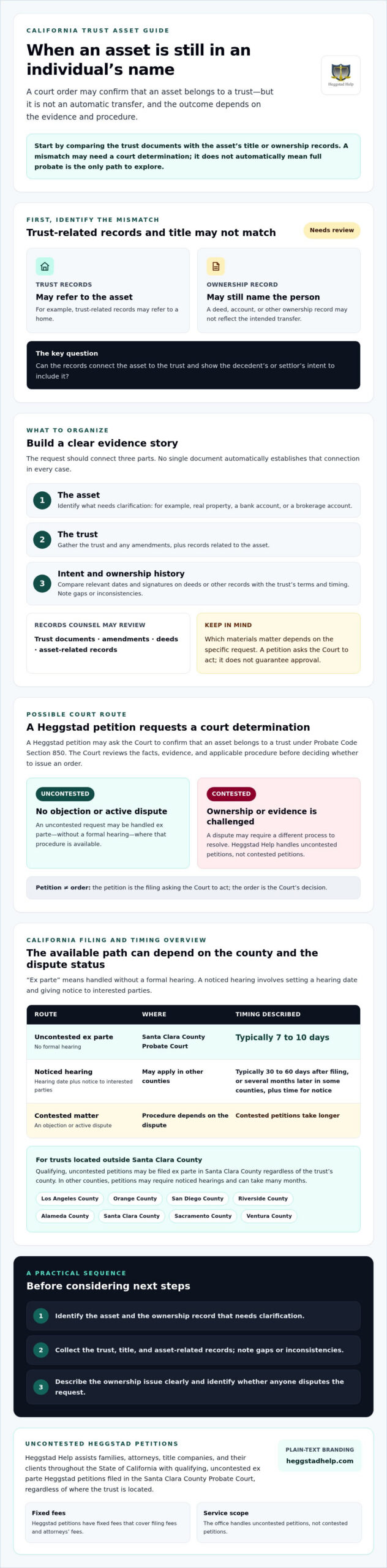
Next Steps for Confirming Trust Assets via Court Order
Before pursuing a court order to confirm trust assets, organize the basic facts so the ownership question is clear. Identify the asset, then gather the trust and any amendments, current title or account records, and documents that may show the intended ownership. Write a short timeline of events and note where the records appear incomplete or inconsistent. This preparation can make a focused review more productive, but it doesn’t determine whether the Court will grant a request.
Questions to clarify before moving forward
Use these questions to frame the issue and identify what still needs review:
- What asset needs confirmation, where is it located, and whose name appears on its current title or ownership records?
- Does anyone dispute the trust’s claim to the asset, or is the request uncontested?
- What trust, title, and asset records are available, and what additional documents may counsel need to assess the facts and possible filing path?
Whether the matter is uncontested and which California court path may apply are important procedural questions. If someone objects, the matter may require a different process. HEGGSTAD HELP handles uncontested petitions and doesn’t handle contested petitions.
How specialized petition support may help
Robert P. Bergman is a California-licensed attorney and Board-Certified Specialist in Estate Planning, Trust and Probate Law. The practice focuses on Heggstad petition filing, ex parte court orders, and trust-asset title correction. It assists families, attorneys, title companies, and their clients throughout California with qualifying, uncontested ex parte Heggstad petitions filed in Santa Clara County, regardless of where the trust is located. Fixed fees cover filing fees and attorneys’ fees; a court outcome isn’t guaranteed.
After gathering the records and clarifying whether anyone disputes the request, learn about California Heggstad petition assistance.
Prepare a Clear Path to Get a Court Order to Confirm Trust Assets
A title or ownership record that doesn’t match the trust can raise difficult questions, but the next step is to clarify the facts. A court order to confirm trust assets is a Court decision, not an automatic transfer. The request depends on the evidence, applicable procedure, and whether anyone disputes the trust’s claim.
Gather the trust documents, amendments, and current asset records, then outline what they show and where the ownership gap remains. For a qualifying uncontested Heggstad petition, the filing county may affect timing. Santa Clara County petitions are typically granted in 7 to 10 days, though no outcome is guaranteed.
Robert P. Bergman is a California-licensed attorney and Board-Certified Specialist in Estate Planning, Trust and Probate Law. HEGGSTAD HELP assists families, attorneys, title companies, and their clients throughout California with uncontested ex parte Heggstad petitions filed in Santa Clara County, regardless of the trust’s county. Fixed fees cover filing fees and attorneys’ fees.
To discuss your records and whether an uncontested petition may fit, request help with a Heggstad petition.
Frequently Asked Questions
What is a court order to confirm trust assets in California?
It’s a Court ruling that determines whether an asset belongs to a trust. A petition is the request asking the Court to make that decision; approval isn’t automatic. For example, a Heggstad petition may ask the Court to confirm an asset as trust property when title records don’t clearly show a transfer. The Court considers the evidence, facts, and applicable procedure.
Can a Heggstad petition confirm property located outside Santa Clara County?
Yes, qualifying uncontested petitions involving property or other assets located elsewhere in California can often be filed ex parte in Santa Clara County, regardless of the trust’s location. HEGGSTAD HELP assists families, attorneys, title companies, and their clients statewide. This may help people in the San Francisco Bay Area, Northern California, Southern California, the Central Valley, San Diego, Sacramento, Fresno, Bakersfield, Greater Los Angeles, Orange County, Riverside County, and San Bernardino County.
How long does it take to get a Heggstad court order in California?
Timing depends on the county and procedure. Uncontested ex parte petitions in Santa Clara County are typically granted in 7 to 10 days. In San Mateo County, petitions can be filed, heard, and granted the same day. Contra Costa County petitions can often be filed and granted the same day if the Court is satisfied that urgency has been shown. Other counties may require noticed hearings and take many months.
Does a court order to confirm trust assets avoid probate?
It may help avoid full probate for an asset if the Court confirms that the asset belongs to the trust, but it doesn’t guarantee that probate will be unnecessary for every asset or issue. A Heggstad petition seeks a court decision about specific trust ownership. To assess whether this path may fit, identify the asset, gather trust and title records, and clarify whether anyone disputes the trust’s claim.

Article by
Robert P. Bergman, Attorney at Law
Attorney Robert P. Bergman ("Bob Bergman") has been a Board-Certified Specialist in Estate Planning, Trust and Probate Law since 2011, as certified by the California State Bar Board of Legal Specialization. For several years, Bob has assisted families and the clients of other attorneys with obtaining court orders through Heggstad petitions to avoid the time and expense of Probate administration. Bob is friendly, very approachable, and believes in explaining complex legal topics in clear ordinary language so that his clients understand exactly what they're doing and why they're doing it.
Bob is often able to assist clients who are in other counties than his home county of Santa Clara through his approach to Heggstad petitions.
Disclaimer
This article is for informational purposes only. Nothing in this article is intended to replace legal advice from a competent attorney or be considered legal guidance for anybody's specific legal situation. Nobody should rely on information in this article in making legal decisions without such consultation.


