Petition to Confirm CA Trust Assets: 2026 Heggstad Guide

Imagine the relief of finding a trust, only to realize the family home was never legally transferred into it. It’s a common discovery that often…

Imagine the relief of finding a trust, only to realize the family home was never legally transferred into it. It’s a common discovery that often leads to the fear of a long probate delay. You likely feel overwhelmed by the prospect of court hearings and mounting legal fees. Filing a petition to confirm trust assets California is often the most effective way to fix this unfunded trust issue without the burden of a full probate administration.

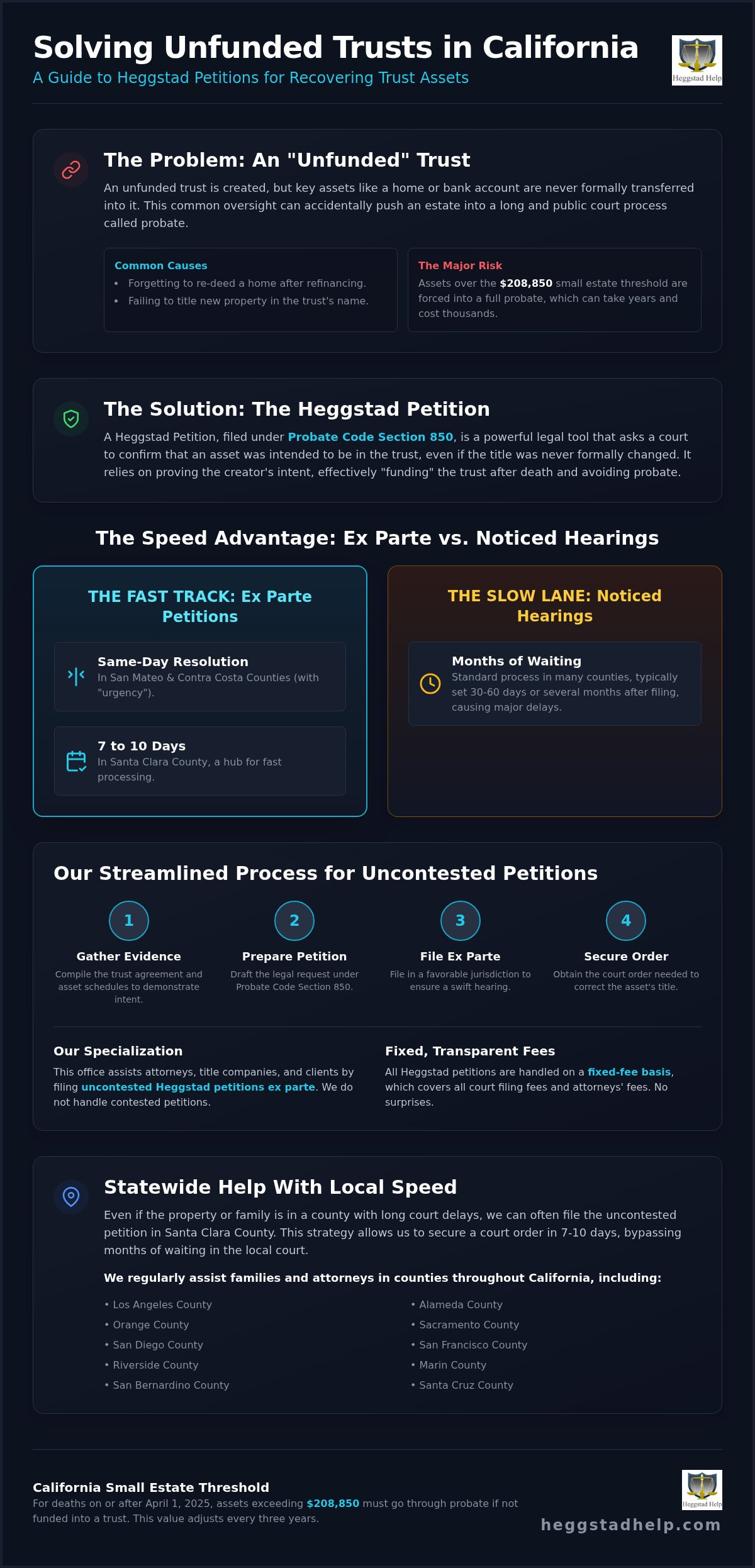
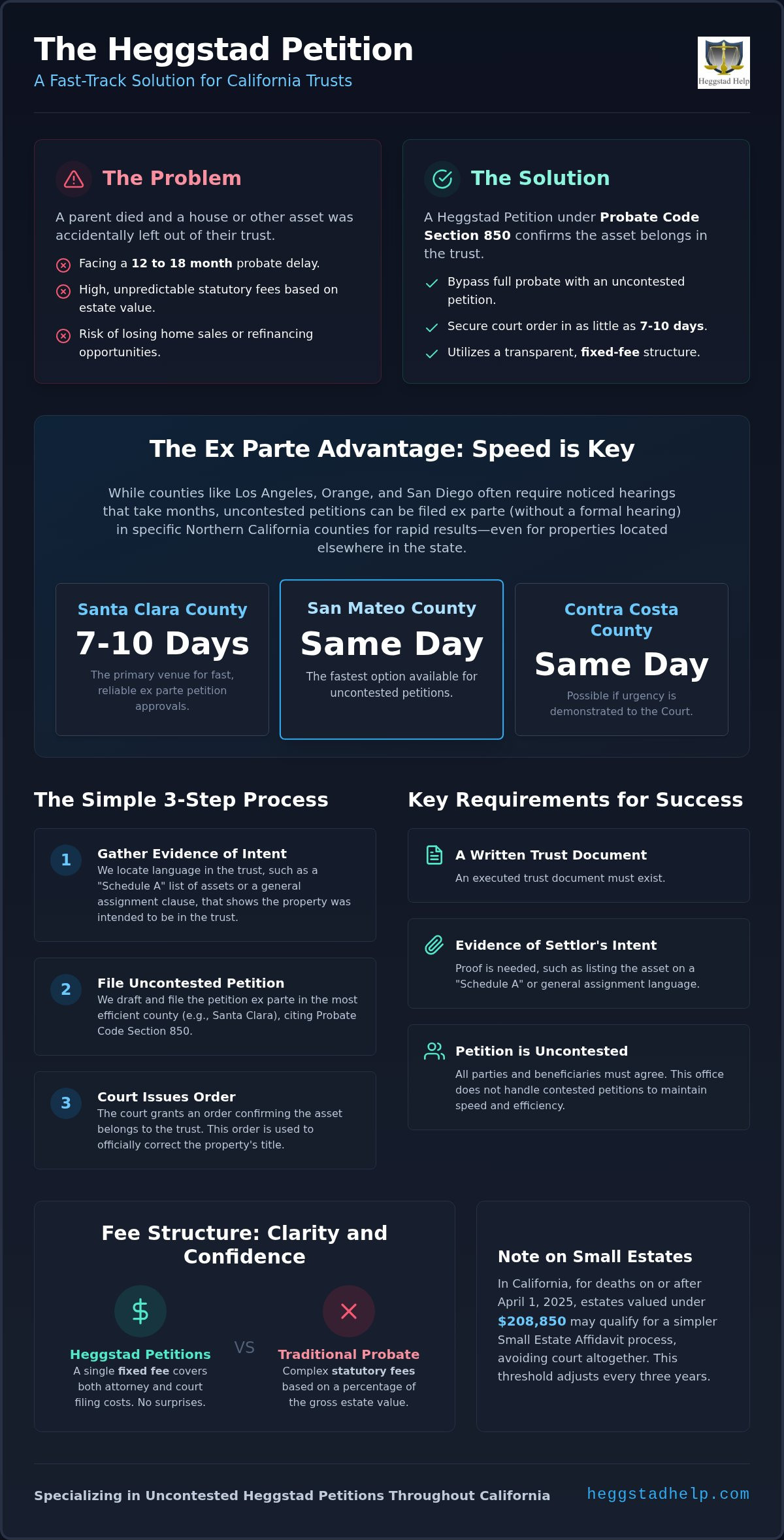
This guide explains how a Heggstad petition, which is a legal request under Probate Code Section 850, can quickly transfer missing assets. We’ll outline the fixed fees that cover both filing and attorney fees and small estate thresholds of $208,850 for deaths on or after April 1, 2025, and $239,700 for those after April 1, 2026. You will also learn why certain counties like Santa Clara can resolve cases in as little as 7 to 10 days while we assist families from Los Angeles County to Sacramento County.

Key Takeaways

  • Learn how a petition to confirm trust assets California families rely on under Probate Code Section 850 can transfer missing property into a trust without the delays of a full probate.
  • Discover how to secure court orders in just 7 to 10 days in Santa Clara County, which can also hear uncontested petitions for properties located in any other California county.
  • Understand the updated small estate thresholds of $208,850 for those dying on or after April 1, 2025, and $239,700 for those dying on or after April 1, 2026.
  • Benefit from fixed fees that cover both filing fees and attorney fees for uncontested Heggstad petitions, providing a predictable path for asset distribution throughout California.

What is a Petition to Confirm Trust Assets in California?

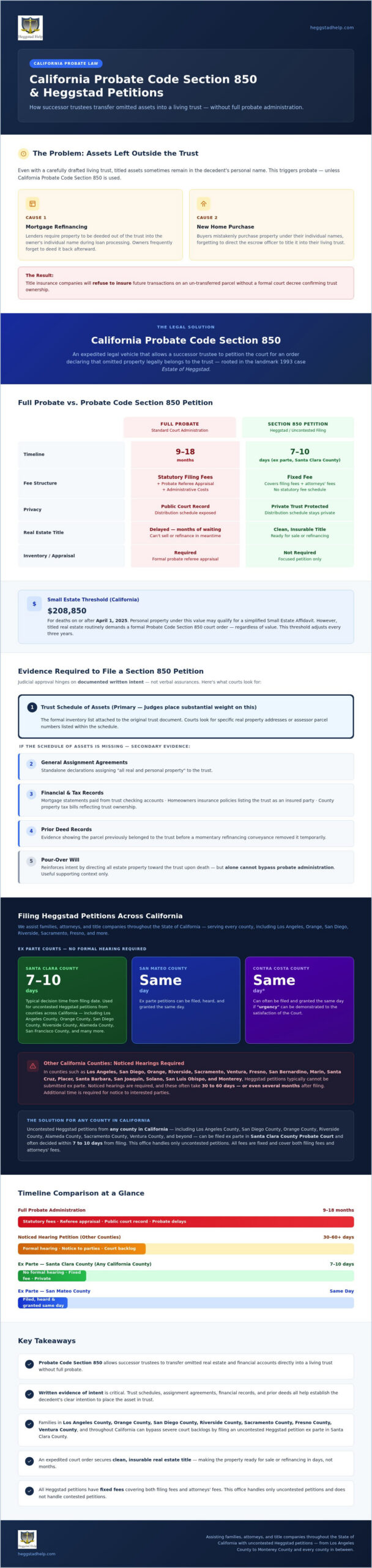
A Heggstad petition is a specialized legal request filed under Probate Code Section 850 to confirm that a specific asset belongs to a trust. This procedure is essential when a person creates a trust but forgets to officially transfer a property title or financial account into it. The landmark case Estate of Heggstad established that clear written intent can sometimes be enough for a judge to rule that an asset is trust property. A Heggstad petition is the primary remedy for unfunded trusts in California.

By using this petition to confirm trust assets California families can avoid the heavy burden of full probate. Traditional probate cases in Alameda County or San Francisco County often take over a year to resolve. In contrast, this petition allows successor trustees to correct title errors efficiently. We provide these services to families, attorneys, and title companies throughout California with fixed fees that cover both filing fees and attorney fees for uncontested matters. Please note that we don’t handle contested petitions.

The Legal Basis: Probate Code Section 850

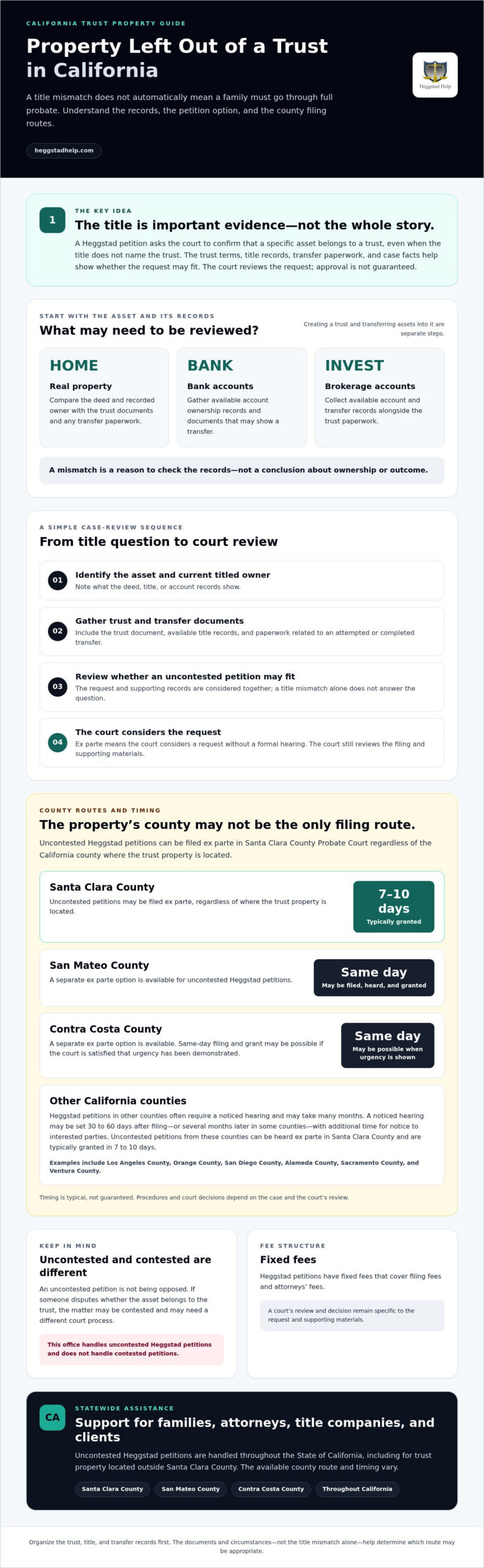
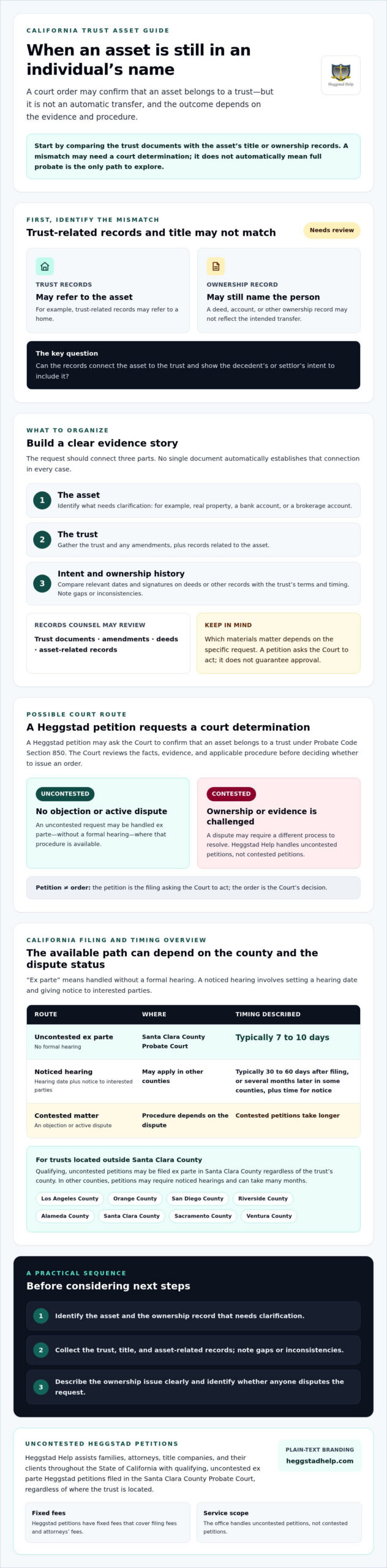
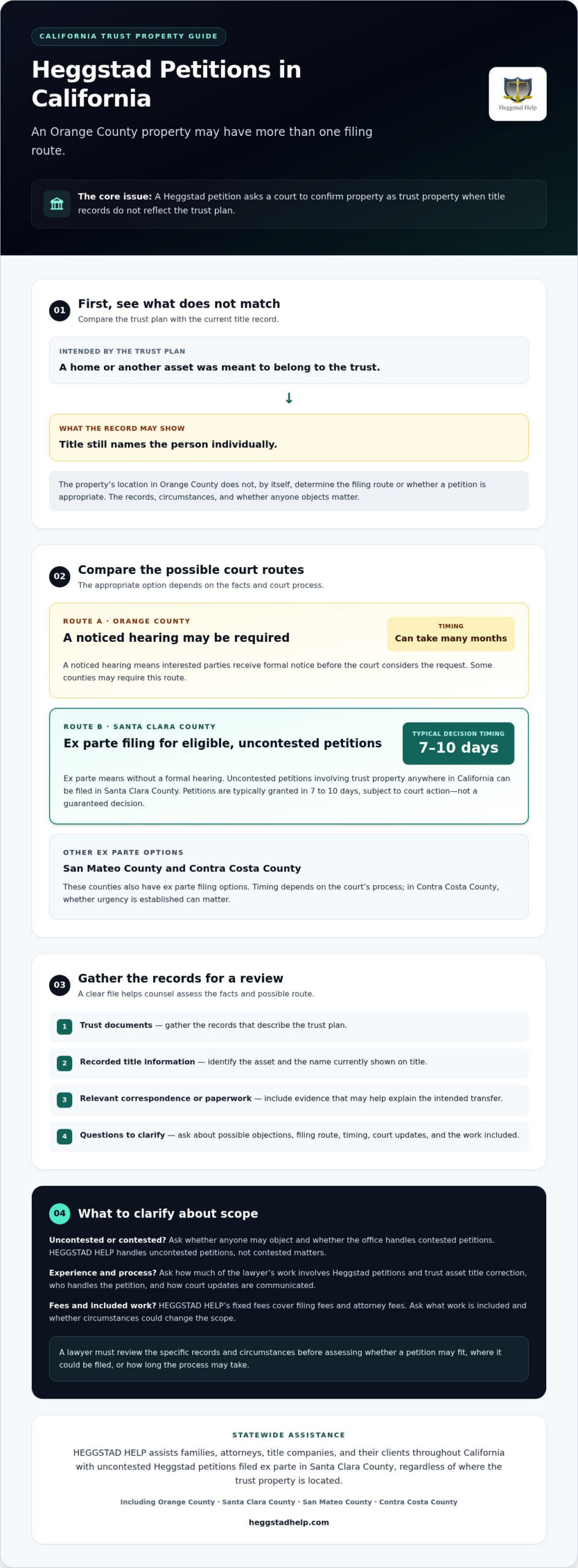
Under Probate Code Section 850(a)(3), the court has the authority to issue an order confirming title to property even if the deed was never recorded in the name of the trust. This is a vital alternative to full probate administration in Los Angeles County, Orange County, or San Bernardino County. Petitions in those counties often require noticed hearings (formal court dates set by the judge) and can take many months to be heard. However, uncontested Heggstad petitions from those counties can be heard ex parte (without a formal hearing) in Santa Clara County and are often decided within 7 to 10 days of filing. This process is a significant advantage for clients in San Diego County, Riverside County, or Sacramento County who need to resolve title issues quickly.

Requirements for a Successful Heggstad Petition in California

To succeed with a petition to confirm trust assets California courts require specific documentation and clear evidence. First, you must identify the asset with absolute precision. For real property in San Diego County or Riverside County, this involves providing the full legal description rather than just a street address. Second, you should verify if the asset value warrants a petition. For individuals dying on or after April 1, 2025, the small estate threshold is $208,850, and for those dying on or after April 1, 2026, it increases to $239,700. If the asset falls below these amounts, a Small Estate Affidavit might be a simpler alternative. Finally, remember that specialized firms like ours focus on efficiency; we don’t handle contested or litigated trust matters.

Proving the Trust Maker’s Intent

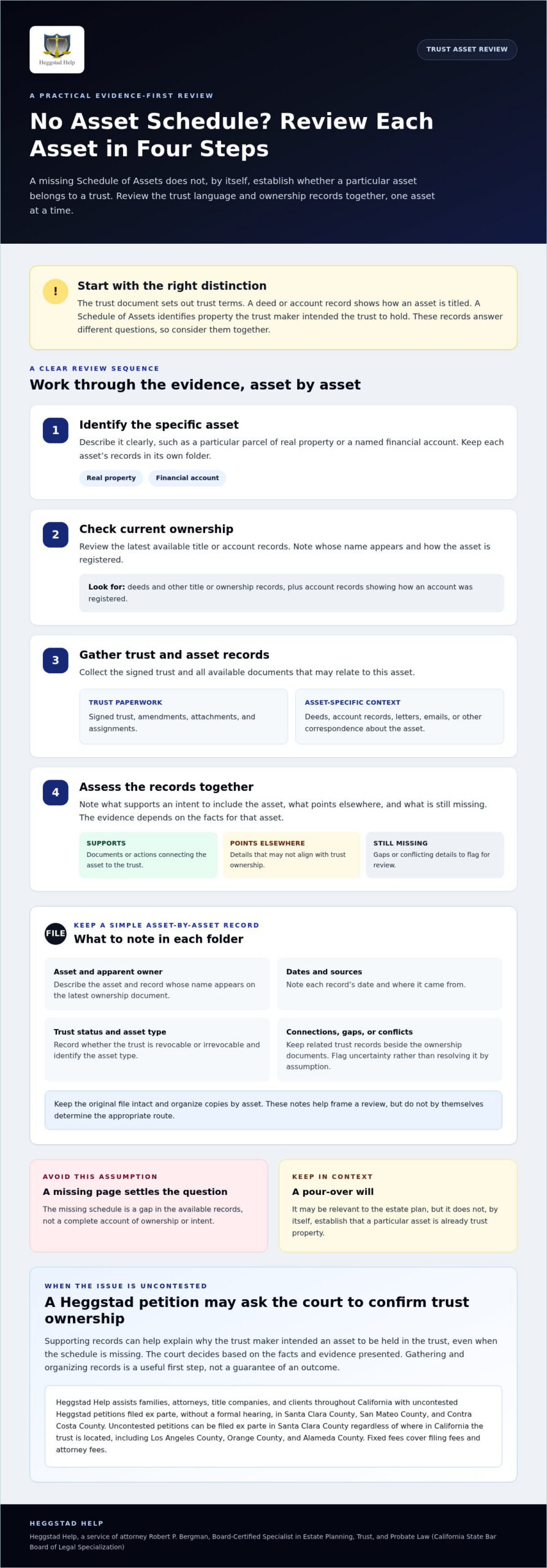
Proving intent is the core of any filing under California Probate Code § 850. A general statement of intent in the trust document is often sufficient to show that the creator wanted their property held in trust. You can find more details in this guide to recovering missing trust assets in California. Common evidence used to support these claims includes:

  • A comprehensive "Schedule of Assets" listing the specific property.
  • Unsigned deeds or recent brokerage statements showing the owner’s name.
  • A "pour-over" will that directs all assets into the trust upon death.

We help families and attorneys in Alameda County and Santa Cruz County gather this evidence to secure an order quickly. Our fixed fees cover both filing fees and attorney fees, ensuring you have a clear path to resolution. If your case is uncontested, our specialist team can help you navigate the process with calm competence.

Petition to Confirm CA Trust Assets: 2026 Heggstad Guide

Filing Timelines and Strategy in California Counties

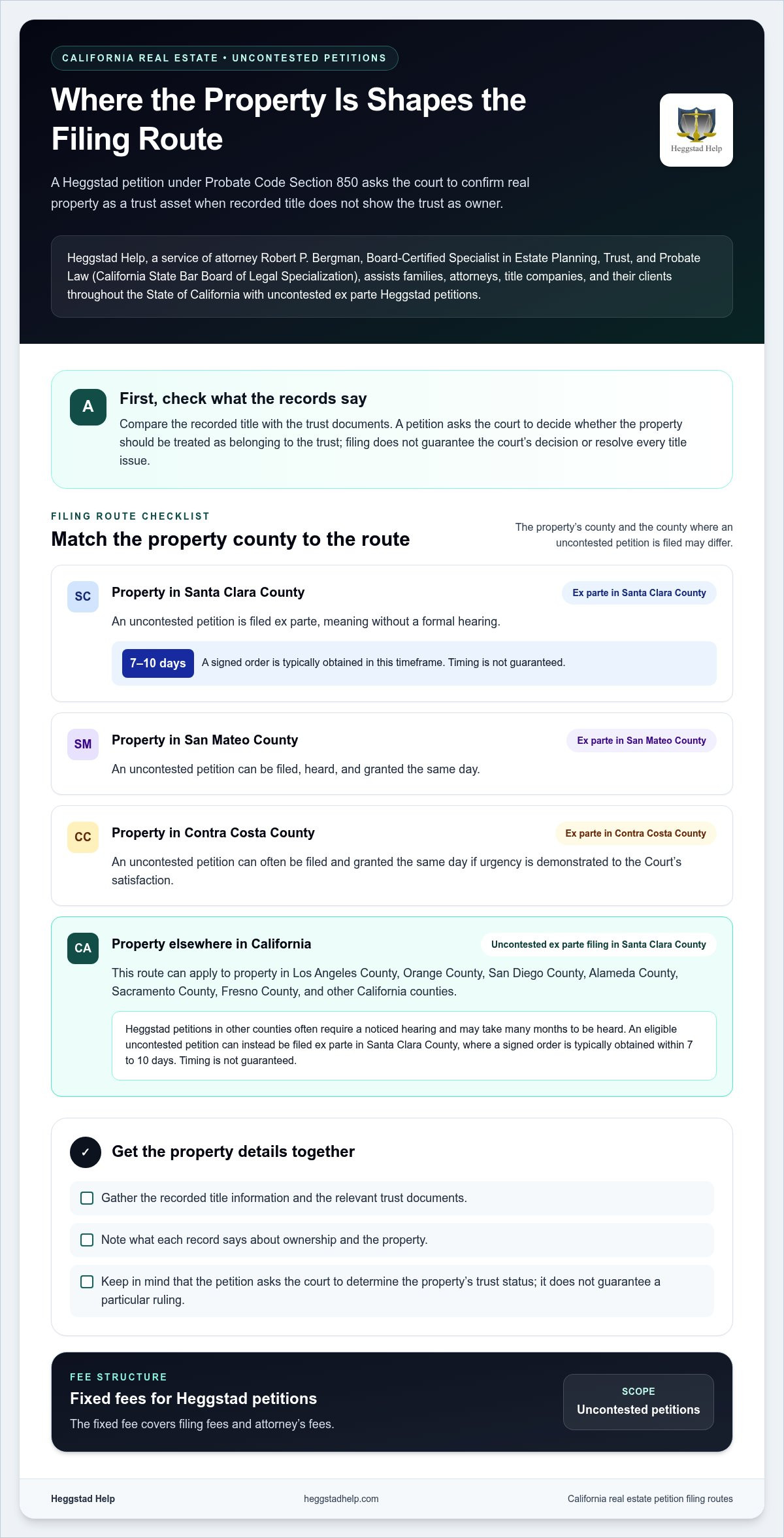
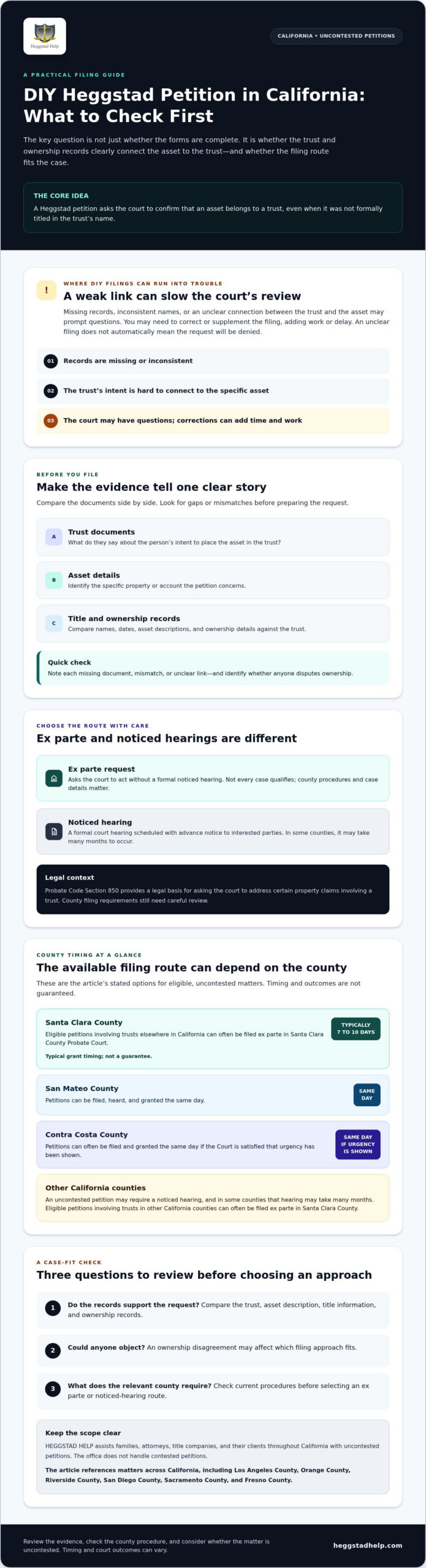
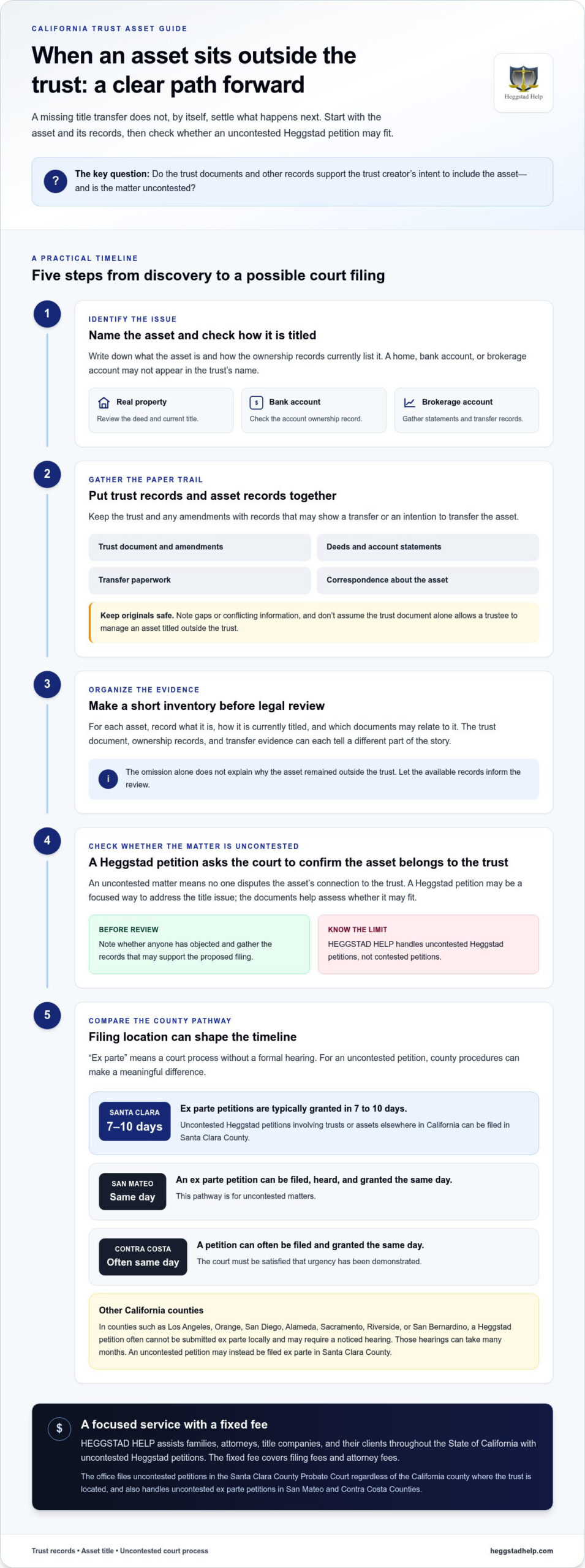
Speed varies significantly depending on the venue where you file. In Santa Clara County, uncontested petitions are typically granted ex parte (without a formal hearing) in 7 to 10 days. San Mateo County offers even faster results; petitions can often be filed, heard, and granted on the same day. For properties in Contra Costa County, same-day grants are possible if you demonstrate "urgency" to the Court’s satisfaction. This efficiency makes these Northern California courts a strategic choice for resolving title issues.

A strategic petition to confirm trust assets California families rely on often involves choosing the most efficient court. Even if the asset is located in Sacramento County or San Francisco County, an uncontested Heggstad petition can be heard ex parte in Santa Clara County. This approach typically results in a decision within 7 to 10 days of filing, bypassing the local backlogs that frequently plague other jurisdictions. We assist attorneys, title companies, and clients throughout California with these specialized filings.

Navigating Delays in Southern California and the Central Valley

In Los Angeles County or San Bernardino County, the court system is often heavily burdened. A noticed Heggstad petition hearing in these areas can take many months to be heard. By working with a specialist who understands how to utilize ex parte filings in Northern California, you can avoid these exhausting delays. We provide this specialized assistance to families in Orange County, Riverside County, and San Diego County to ensure assets are transferred without unnecessary waiting periods.

Our office offers cost certainty through fixed fees that cover both filing fees and attorney fees. While we don’t handle contested cases, we ensure a smooth path for uncontested matters in Marin County, Alameda County, and Santa Cruz County. If a noticed hearing is required, it’s typically set 30 to 60 days after filing, plus time for notice, though some counties take several months longer. This methodical approach helps you move from broad legal complications to a specific, timely resolution.

Take Control of Your Trust Distribution Today

Securing a petition to confirm trust assets California doesn’t have to be a stressful or lengthy ordeal. By utilizing Probate Code Section 850, you can bypass the complexities of a full probate and move forward with confidence. Whether your property is in Los Angeles County or San Diego County, you can benefit from the efficient ex parte procedures available in Northern California. Our Board-Certified Specialist provides fixed fees that cover all filing and attorney costs, ensuring you have total price certainty. We assist families and attorneys throughout the state to resolve these title issues quickly and effectively. If you’re ready to clear the path for your beneficiaries, we’re here to guide you through every step. Get fixed-fee help for your Heggstad petition in California today and rest easy knowing your family’s legacy is secure.

Frequently Asked Questions

How long does a Heggstad petition take in California?

The timeline for a Heggstad petition depends on the county and the specific hearing type required. In Santa Clara County, uncontested petitions are typically granted in 7 to 10 days, while San Mateo County often grants them the same day. While a noticed hearing in many counties can take several months, uncontested petitions from any California county can be heard ex parte (without a formal hearing) in Santa Clara County for a faster resolution.

What are the costs for a petition to confirm trust assets in California?

We provide Heggstad petition services throughout California using a fixed-fee model that ensures predictable costs. These fixed fees cover both the court filing fees and the attorney fees from the start. This approach helps families in San Bernardino County and Riverside County avoid the financial uncertainty of traditional hourly billing. It’s important to remember that our office specializes in uncontested matters and doesn’t handle litigated trust cases.

Can I file a Heggstad petition if the asset is a house in Los Angeles County?

Yes, you can use a petition to confirm trust assets California courts authorize to transfer real property located in Los Angeles County. While a noticed hearing in Los Angeles can take many months to be heard, we can often file uncontested petitions ex parte in Santa Clara County to secure an order in 7 to 10 days. We assist attorneys, title companies, and families throughout Southern California with these specialized filings.

What is the small estate threshold for a Small Estate Affidavit in California for 2026?

The small estate threshold for a Small Estate Affidavit is $208,850 for those dying on or after April 1, 2025, and $239,700 for those dying on or after April 1, 2026. If the value of the missing trust assets exceeds these specific limits, a Heggstad petition is often the most efficient way to avoid a full probate. This process allows successor trustees to distribute assets according to the trust maker’s original intent.

Robert P. Bergman, Attorney at Law

Article by

Robert P. Bergman, Attorney at Law

Attorney Robert P. Bergman ("Bob Bergman") has been a Board-Certified Specialist in Estate Planning, Trust and Probate Law since 2011, as certified by the California State Bar Board of Legal Specialization. For several years, Bob has assisted families and the clients of other attorneys with obtaining court orders through Heggstad petitions to avoid the time and expense of Probate administration. Bob is friendly, very approachable, and believes in explaining complex legal topics in clear ordinary language so that his clients understand exactly what they're doing and why they're doing it.
Bob is often able to assist clients who are in other counties than his home county of Santa Clara through his approach to Heggstad petitions.

Disclaimer

This article is for informational purposes only. Nothing in this article is intended to replace legal advice from a competent attorney or be considered legal guidance for anybody's specific legal situation. Nobody should rely on information in this article in making legal decisions without such consultation.

2026 California Heggstad Petition: Fees and Expenses

You shouldn’t have to forfeit a massive portion of your inheritance to statutory fees just because an asset was left out of a trust. It’s stressful…

You shouldn’t have to forfeit a massive portion of your inheritance to statutory fees just because an asset was left out of a trust. It’s stressful to realize a property title is incorrect while facing the long delays of a standard probate. You’ll discover how the cost of heggstad petition California compares to proceedings under the Probate Code and why it’s the most efficient way to transfer assets. We provide a clear, fixed-fee quote for uncontested petitions in Los Angeles County, Orange County, and San Diego County that covers both filing and attorney fees. We’ll explain why a Heggstad Petition in California is faster than a Small Estate Affidavit (limited to $208,850 for deaths on or after April 1, 2025, or $239,700 for deaths on or after April 1, 2026). Whether you’re in Riverside, San Bernardino, or Sacramento County, we’ll show how filing in Santa Clara County bypasses the months of waiting seen in Alameda, San Francisco, Marin, or Santa Cruz County.

Key Takeaways

  • Learn how to bypass the high statutory fees required by Probate Code Section 10810, which often cost families in Los Angeles County, Orange County, Riverside County, or San Diego County significantly more than a petition.
  • Gain total pricing transparency regarding the cost of heggstad petition California with a fixed-fee model for uncontested matters that covers both your attorney fees and court filing fees.
  • Determine if your assets exceed the Small Estate Affidavit in California thresholds of $208,850 for deaths on or after April 1, 2025, or $239,700 for deaths on or after April 1, 2026.
  • Discover how filing in Santa Clara County can secure an order in 7 to 10 days for properties located in San Bernardino County, Alameda County, Sacramento County, San Francisco County, Marin County, or Santa Cruz County.

Comparing the Cost of a Heggstad Petition in California to Full Probate

When you discover an asset was left out of a trust, the financial impact of your next step is significant. In California, traditional probate fees are strictly dictated by Probate Code Section 10810. These statutory fees are calculated based on the gross value of the estate, which means the court doesn’t care if there’s a large mortgage on the property. For example, a $1 million home in Los Angeles County or Orange County could trigger mandatory fees exceeding $23,000 for the attorney and another $23,000 for the executor. The cost of heggstad petition California is substantially lower because it operates as a title correction rather than a full estate administration.

A Heggstad petition is almost always the superior choice for real property. However, if the total estate value is below specific limits, you might consider a Small Estate Affidavit. The threshold is $208,850 for those dying on or after April 1, 2025, and it rises to $239,700 for those dying on or after April 1, 2026. If the asset exceeds these amounts, a Heggstad petition provides a fixed-fee solution for families in San Bernardino County, Riverside County, and San Diego County. Our fixed fees cover both the filing fees and attorney fees, ensuring you won’t face billable hour surprises.

Why Avoiding Probate Saves Families Thousands

Probate involves several “hidden” expenses that a Heggstad petition avoids. These include bond premiums (insurance for the executor), probate referee appraisal fees, and mandatory newspaper publication costs. By choosing a petition, the successor trustee duties for an unfunded trust become much simpler. We assist families and attorneys in Alameda County, Sacramento County, San Francisco County, Marin County, and Santa Cruz County with these filings. We don’t handle contested petitions, which allows us to keep our process streamlined and our fees predictable for every client.

Understanding Fixed Fees and Court Costs for Heggstad Petitions in California

HEGGSTAD HELP prioritizes transparency to eliminate the financial anxiety often associated with legal proceedings. We provide fixed fees that encompass both the professional attorney fees and the required court filing fees. This approach ensures that families in Los Angeles County, Orange County, and San Bernardino County are protected from the “billable hour” surprises that often occur in traditional law firms. When evaluating the total cost of heggstad petition California, it’s helpful to know exactly what you’re paying for upfront. Our fixed-fee structure covers the essential procedural steps: drafting the petition under Probate Code Section 850 (the legal mechanism used to confirm trust ownership), filing the documents with the court, and obtaining the signed court order.

It’s vital to understand that these fixed-fee arrangements apply specifically to uncontested petitions, which are cases where no parties are legally challenging the transfer. Since our office doesn’t handle contested litigation, we can maintain a highly efficient, streamlined process for families who simply need to fix a title error. If you’re a successor trustee in San Diego County or Riverside County, this predictability allows you to manage estate expenses without fear of depleting the trust’s assets through unexpected legal bills.

The Financial Advantage of Fixed-Fee Legal Services

Title companies and attorneys throughout California frequently rely on our services because they value predictable pricing. Unlike standard probate, where fees are a percentage of the estate’s gross value, our model is based on the service provided. Securing a Heggstad petition in Los Angeles or Sacramento County shouldn’t be a financial guessing game. By removing the percentage calculation, the cost of heggstad petition California remains stable regardless of the property’s market value. This ensures more of the inheritance stays with the beneficiaries. If you’re managing property in Alameda County, San Francisco County, Marin County, or Santa Cruz County, we can help you resolve title issues with a clear, upfront quote.

2026 California Heggstad Petition: Fees and Expenses

Speed vs. Cost: Ex Parte Services and County Specifics

Speed is often overlooked when calculating the total cost of heggstad petition California. In counties such as Sacramento County, San Francisco County, or San Diego County, a noticed hearing typically takes three to six months to be heard. During this period, the estate continues to accumulate holding costs, including property taxes, insurance, and utilities. Conversely, Santa Clara County petitions are typically granted in 7 to 10 days. San Mateo County can often grant orders the same day they are filed, and Contra Costa County offers similar same-day results if “urgency” is demonstrated to the Court’s satisfaction. Choosing the right venue is a strategic decision that saves both time and money.

How Filing in Santa Clara County Accelerates Your Results

We assist families, attorneys, and title companies throughout California by leveraging what we call the “Santa Clara Advantage.” Even if the decedent lived in Los Angeles County, Orange County, San Bernardino County, or Riverside County, an uncontested Heggstad petition filing in California can often be heard ex parte (without a formal hearing) in Santa Clara County. This specialized process allows for a decision within 7 to 10 days of the filing date. This is a stark contrast to noticed hearings in Alameda County, Marin County, or Santa Cruz County, which may take many months to be heard. Our fixed fees cover all filing and attorney fees, providing a fast resolution for estates that exceed the small estate threshold ($208,850 for deaths on or after April 1, 2025; $239,700 for deaths on or after April 1, 2026).

For successor trustees managing a pending home sale, prioritizing ex parte services is essential to clear title quickly and avoid losing a buyer. Because we do not handle contested petitions, our focus remains on these high-speed, title-correction orders that move assets into the trust in weeks instead of years.

Secure Your Trust Assets Without the Probate Price Tag

Navigating the cost of heggstad petition California doesn’t have to be a source of anxiety for successor trustees. By choosing an uncontested petition over full probate, you avoid the high statutory fees that often drain estates in Los Angeles County, Orange County, and San Francisco County. Our fixed-fee model ensures you know exactly what you’ll pay for both filing and attorney fees from the start. Whether your asset exceeds the small estate threshold of $208,850 (for deaths on or after April 1, 2025) or $239,700 (for deaths on or after April 1, 2026), we provide a streamlined path to recovery. As a Board-Certified Specialist in Estate Planning, Trust and Probate Law, Robert P. Bergman helps families across San Diego County and Riverside County secure orders in as little as 7 to 10 days through Santa Clara County. Get a Fixed-Fee Quote for Your Heggstad Petition and protect your inheritance today. You’re just weeks away from a total resolution.

Frequently Asked Questions

What is the small estate threshold in California for 2026?

The small estate threshold is $239,700 for those dying on or after April 1, 2026, and $208,850 for those dying on or after April 1, 2025. If the asset exceeds these limits, a Heggstad petition in Sacramento County or San Francisco County often provides a much faster and more affordable solution than a traditional probate proceeding.

Does the Heggstad petition fee include the court filing costs?

Yes, our fixed-fee quote for an uncontested Heggstad petition includes both the attorney fees and the required court filing fees. This model protects families in Los Angeles County, Orange County, and San Bernardino County from unexpected costs. We handle the entire filing process to ensure the asset is moved into the trust without billable hour surprises.

How much cheaper is a Heggstad petition than a full probate?

A Heggstad petition is nearly always cheaper because it bypasses the statutory fees required by Probate Code Section 10810. While probate fees are calculated as a percentage of the gross estate value, the cost of heggstad petition California is a predictable fixed fee. This saves families in San Diego County and Riverside County thousands in administrative expenses.

What happens if someone contests my Heggstad petition?

We exclusively handle uncontested matters to maintain efficiency and low costs. If a petition is contested, it requires trust litigation, which our office does not provide. For uncontested petitions in Alameda County, Marin County, or Santa Cruz County, a noticed hearing can take many months; however, we can often file these ex parte in Santa Clara County for a decision within 7 to 10 days.

Robert P. Bergman, Attorney at Law

Article by

Robert P. Bergman, Attorney at Law

Attorney Robert P. Bergman ("Bob Bergman") has been a Board-Certified Specialist in Estate Planning, Trust and Probate Law since 2011, as certified by the California State Bar Board of Legal Specialization. For several years, Bob has assisted families and the clients of other attorneys with obtaining court orders through Heggstad petitions to avoid the time and expense of Probate administration. Bob is friendly, very approachable, and believes in explaining complex legal topics in clear ordinary language so that his clients understand exactly what they're doing and why they're doing it.
Bob is often able to assist clients who are in other counties than his home county of Santa Clara through his approach to Heggstad petitions.

Disclaimer

This article is for informational purposes only. Nothing in this article is intended to replace legal advice from a competent attorney or be considered legal guidance for anybody's specific legal situation. Nobody should rely on information in this article in making legal decisions without such consultation.

Ex Parte Heggstad Petition: California Trust Funding 2026

Imagine you’re days from closing a sale in Los Angeles, only to discover the deed was never transferred into the living trust. You’re likely facing…

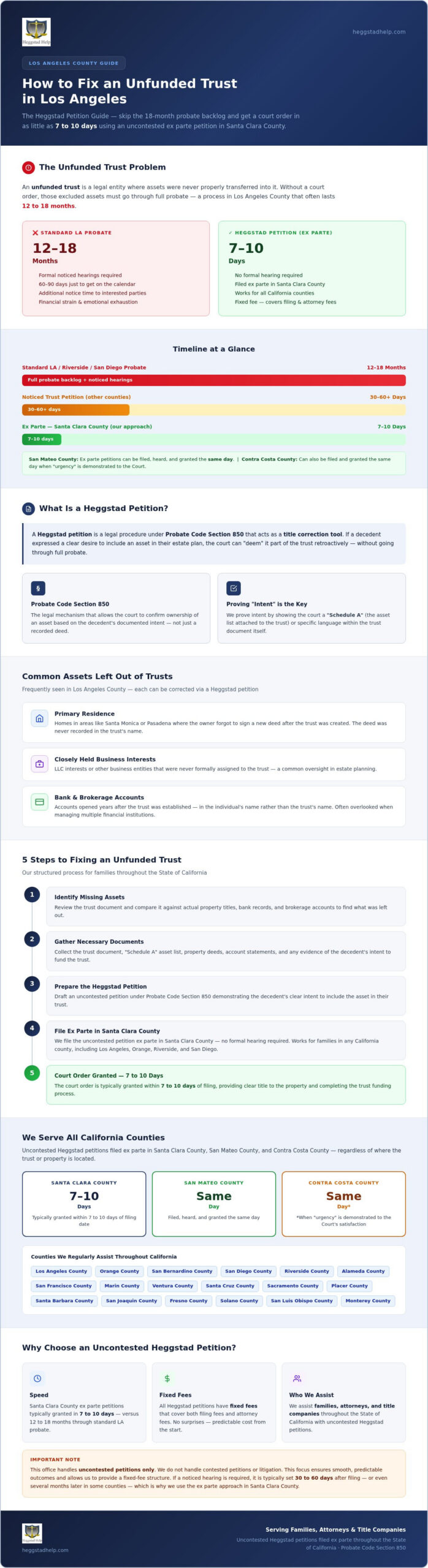
Imagine you’re days from closing a sale in Los Angeles, only to discover the deed was never transferred into the living trust. You’re likely facing the stress of a 12-to-18-month probate delay while your buyer walks away. It’s a common complication, but you don’t have to lose the deal. By filing an ex parte Heggstad petition in California, you can bypass the standard Probate Code timeline and secure a court order (a formal judicial decree confirming the asset belongs to the trust) in as little as 72 hours.

This article explains how we help families statewide secure these orders with fixed fees covering both filing and attorney fees. We’ll preview the rapid 7-to-10-day process in Santa Clara County, same-day options in San Mateo and Contra Costa, and explain the Small Estate Affidavit thresholds of $208,850 for deaths on or after April 1, 2025, and $239,700 for deaths on or after April 1, 2026. We’ll also show how petitions from other counties can be heard in Santa Clara for faster results.

Key Takeaways

  • Learn how an ex parte Heggstad petition in California can transfer assets into a trust in as little as 72 hours, allowing you to bypass the standard 12-to-18-month probate delay.
  • Discover strategic filing techniques in Santa Clara County to secure court orders in 7 to 10 days, even for properties located in Los Angeles, Orange, or San Diego.
  • Understand the specific Small Estate Affidavit thresholds of $208,850 for deaths on or after April 1, 2025, and $239,700 for deaths on or after April 1, 2026, to determine the most efficient path forward.
  • Benefit from fixed-fee legal services that cover both filing and attorney fees, providing cost certainty for successor trustees and attorneys throughout the entire state of California.

Understanding the Ex Parte Heggstad Petition in California

A Heggstad petition is a specialized legal request under Probate Code Section 850. Our team at HEGGSTAD HELP uses this to ask the court to confirm trust ownership of assets that were never formally retitled. This remedy stems from the landmark case Estate of Heggstad, which proved that a written declaration of trust is often sufficient to show intent. This process is vital when a "forgotten house" deed remains in the decedent’s name rather than the trust’s name.

The standard process requires a noticed hearing that can take several months. However, an ex parte Heggstad petition in California acts as a fast-track mechanism. It allows for an emergency hearing that bypasses the standard 30-to-60-day notice period. Success requires clear evidence of the decedent’s intent, such as a "Schedule A" document listing the property as a trust asset.

When Urgency Justifies an Ex Parte Filing

Courts require a valid reason to expedite a hearing. If you’re facing a pending real estate sale in Los Angeles or an imminent foreclosure in Riverside, these emergencies often justify ex parte relief. Obtaining written consent from all heirs is the fastest way to secure a court decision. In jurisdictions like Santa Clara, courts may even allow ex parte filings for uncontested matters simply to clear backlogs.

If an estate is small, you might consider a Small Estate Affidavit. This applies if the total value is under $208,850 for deaths on or after April 1, 2025, or under $239,700 for deaths on or after April 1, 2026. For larger real property, an ex parte Heggstad petition in California remains the most efficient path to avoid the 12-to-18-month probate delay.

County-Specific Timelines for a Heggstad Petition in California

While California law is uniform, local court procedures vary significantly. In Los Angeles, Orange, or San Diego, a noticed hearing can take several months including notice time. If a petition is contested, the timeline extends much further. Conversely, Santa Clara, San Mateo, and Contra Costa Counties offer a fast-track through an ex parte Heggstad petition in California. In Santa Clara, uncontested petitions are regularly granted in 7 to 10 days without a formal hearing. San Mateo and Contra Costa can often grant these the same day, provided you demonstrate sufficient urgency in Contra Costa.

Many people assume they must file in the county where the property is located. However, a strategic advantage exists: uncontested petitions from any county, including Alameda, Sacramento, San Francisco, or Santa Cruz, can often be heard ex parte in Santa Clara County. This allows you to secure an order in days rather than waiting months for a noticed hearing in a backlogged jurisdiction. Using a Heggstad Petition to Avoid Probate in this manner is a powerful tool for successor trustees. Our office assists clients throughout the entire state of California with fixed fees covering both filing and attorney fees. If you’re managing an estate in San Bernardino or Riverside, reaching out to a specialist can clarify if this expedited path fits your needs.

The Process for Successor Trustees and Attorneys

To navigate this effectively, follow these three steps:

  • Step 1: Gather the trust document, the "Schedule of Assets," other written evidence of intention concerning the assets and the current deed or account statement.
  • Step 2: Draft the petition referencing Probate Code Section 850 and the specific facts showing the decedent’s intent.
  • Step 3: File ex parte in a favorable jurisdiction like Santa Clara to secure an order in 7 to 10 days.

If the estate value is below the Small Estate Affidavit threshold, which is $208,850 for deaths on or after April 1, 2025, and $239,700 for deaths on or after April 1, 2026, different simplified procedures might apply. For most real estate, however, the ex parte route remains the most reliable way to maintain a closing schedule.

Ex Parte Heggstad Petition: California Trust Funding 2026

Robert P. Bergman is a Board-Certified Specialist in Estate Planning, Trust and Probate Law who has practiced since 1980. His team at HEGGSTAD HELP serves as a specialized partner for families, title companies, and probate attorneys across the state. We specialize in correcting title errors for complex holdings, including LLC interests or brokerage accounts that were inadvertently left out of a trust. By filing an ex parte Heggstad petition in California, we provide a structured, logical path to resolution that avoids the stress of traditional litigation. We regularly assist professionals in counties like Alameda, San Francisco, and Riverside to ensure that sudden title hurdles don’t derail an entire administration.

Successor trustees often appreciate the clarity provided by our fixed-fee model. This approach ensures total cost certainty because the fee covers both the court filing costs and all attorney fees. You won’t have to worry about the unpredictable nature of hourly billing while trying to resolve a "forgotten" asset. We act as a friendly, reliable guide, providing the specialized knowledge required to navigate the Probate Code with confidence.

Navigating the Small Estate Thresholds in 2026

A petition is typically necessary when the value of the unfunded assets exceeds the California Small Estate Affidavit limits. It’s critical to use the threshold matching the date of death. For deaths occurring on or after April 1, 2025, the limit is $208,850. For deaths occurring on or after April 1, 2026, the limit increases to $239,700. If your assets exceed these specific values, an ex parte Heggstad petition in California is the most efficient way to maintain your timeline and avoid a 12-to-18-month probate delay.

Securing Your Trust Assets Without Delay

Navigating the aftermath of a loved one’s death is difficult, but correcting a title error doesn’t have to add months of stress. By filing an ex parte Heggstad petition in California, you can often secure trust assets in as little as 72 hours and bypass the 12-to-18-month probate delay. Whether the property is in Orange, San Bernardino, or Marin, our strategic filing in Santa Clara County provides a 7-to-10-day turnaround for uncontested matters. We offer cost certainty with fixed fees that cover both filing and attorney costs, ensuring your family’s inheritance remains protected. If the estate exceeds the Small Estate Affidavit thresholds of $208,850 for deaths on or after April 1, 2025, and $239,700 for deaths on or after April 1, 2026, this is your most efficient path forward. Contact Robert P. Bergman, a Board-Certified Specialist, for a Fixed-Fee Heggstad Petition Consultation and move forward with confidence.

Frequently Asked Questions

How long does a Heggstad petition in California take to complete?

The timeline depends on the county and whether you’re using a noticed hearing or an ex parte process. Noticed hearings in counties like Los Angeles or Orange typically take several months. However, an ex parte Heggstad petition in California filed in Santa Clara County is usually granted in 7 to 10 days.

Can I file an ex parte Heggstad petition if there is no pending sale?

Yes, you can file ex parte in certain jurisdictions even without an immediate real estate closing. While Contra Costa County requires demonstrated urgency, such as a pending sale or foreclosure, Santa Clara County regularly allows ex parte filings for uncontested matters to clear court backlogs. This helps successor trustees secure trust assets without waiting for a standard hearing date.

What evidence is needed to win a Probate Code Section 850 petition?

You must provide clear evidence that the decedent intended the asset to be part of the trust. This typically includes a "Schedule of Assets" (a list of property attached to the trust document) or a specific declaration within the trust itself. Under Probate Code Section 850, the court requires this proof of intent to confirm the trust’s ownership.

Is a Heggstad petition cheaper than a full probate in California?

Yes, it’s significantly more cost-effective because it avoids statutory probate fees based on the estate’s gross value. A petition is necessary when assets exceed the Small Estate Affidavit threshold of $208,850 for deaths on or after April 1, 2025, and $239,700 for deaths on or after April 1, 2026. Our office uses fixed fees for an ex parte Heggstad petition in California.

Can an attorney from Santa Clara handle a Heggstad petition in Los Angeles?

Yes, and there is often a strategic advantage to doing so. We assist families and attorneys throughout the entire state of California, including San Diego, Riverside, and San Francisco. Uncontested petitions for property located in Los Angeles or Orange County can often be heard ex parte in Santa Clara County and decided within 7 to 10 days.

What happens if a Heggstad petition is contested by a beneficiary?

The court will move the matter to a noticed hearing if a beneficiary or heir objects to the petition. Contested petitions take much longer to resolve than uncontested ones and may require formal litigation. Most Heggstad matters remain uncontested because they simply fulfill the decedent’s documented intent to keep assets in the trust and avoid the probate process.

Robert P. Bergman, Attorney at Law

Article by

Robert P. Bergman, Attorney at Law

Attorney Robert P. Bergman ("Bob Bergman") has been a Board-Certified Specialist in Estate Planning, Trust and Probate Law since 2011, as certified by the California State Bar Board of Legal Specialization. For several years, Bob has assisted families and the clients of other attorneys with obtaining court orders through Heggstad petitions to avoid the time and expense of Probate administration. Bob is friendly, very approachable, and believes in explaining complex legal topics in clear ordinary language so that his clients understand exactly what they're doing and why they're doing it.
Bob is often able to assist clients who are in other counties than his home county of Santa Clara through his approach to Heggstad petitions.

Disclaimer

This article is for informational purposes only. Nothing in this article is intended to replace legal advice from a competent attorney or be considered legal guidance for anybody's specific legal situation. Nobody should rely on information in this article in making legal decisions without such consultation.
Transferring Assets to a Trust After Death in California: The 2026 Heggstad Guide

You just discovered that your loved one’s home in Los Angeles or Orange County was never formally deeded into their trust. It’s a heavy realization…

You just discovered that your loved one’s home in Los Angeles or Orange County was never formally deeded into their trust. It’s a heavy realization that brings the fear of a year-long probate. We understand the stress of managing an estate while facing title errors, but transferring assets to a trust after death shouldn’t feel like an impossible hurdle. Using Probate Code Section 850 (the statute allowing for Heggstad petitions), we can often fix these errors without a full probate administration. This guide outlines how families from San Diego to Alameda use this procedure to secure assets. You’ll learn how uncontested petitions from any county can be heard ex parte in Santa Clara County and granted in 7 to 10 days. Whether you face the $208,850 limit for deaths occurring on or after April 1, 2025, or the $239,700 limit for deaths occurring on or after April 1, 2026, this fixed-fee path provides a clear resolution.

Key Takeaways

  • Learn how a Heggstad petition, governed by Probate Code Section 850, can legally move real estate and accounts into a trust after a loved one passes, bypassing the standard year-long probate process.
  • Discover how to avoid long court delays in counties like Los Angeles, Orange, San Diego or Riverside by filing uncontested petitions in Santa Clara County, where court orders are typically granted in just 7 to 10 days.
  • Identify if you can use a simplified affidavit or require a court order by checking the small estate thresholds of $208,850 for deaths on or after April 1, 2025, and $239,700 for deaths on or after April 1, 2026.
  • Gain peace of mind regarding transferring assets to a trust after death with fixed-fee legal services that cover both filing and attorney fees for families and title companies throughout California.

Understanding the Process of Transferring Assets to a Trust After Death

When a loved one passes away, the successor trustee typically steps in to manage assets already held in the trust. This process, often referred to as trust administration, involves following the specific instructions left by the decedent. However, complications arise when a home or bank account was never formally deeded or retitled. These "forgotten" assets are common funding mistakes, often caused by simple oversight or technical errors during the initial setup. Understanding Trusts and how they function is the first step in realizing that a trust doesn’t necessarily fail just because a deed is missing.

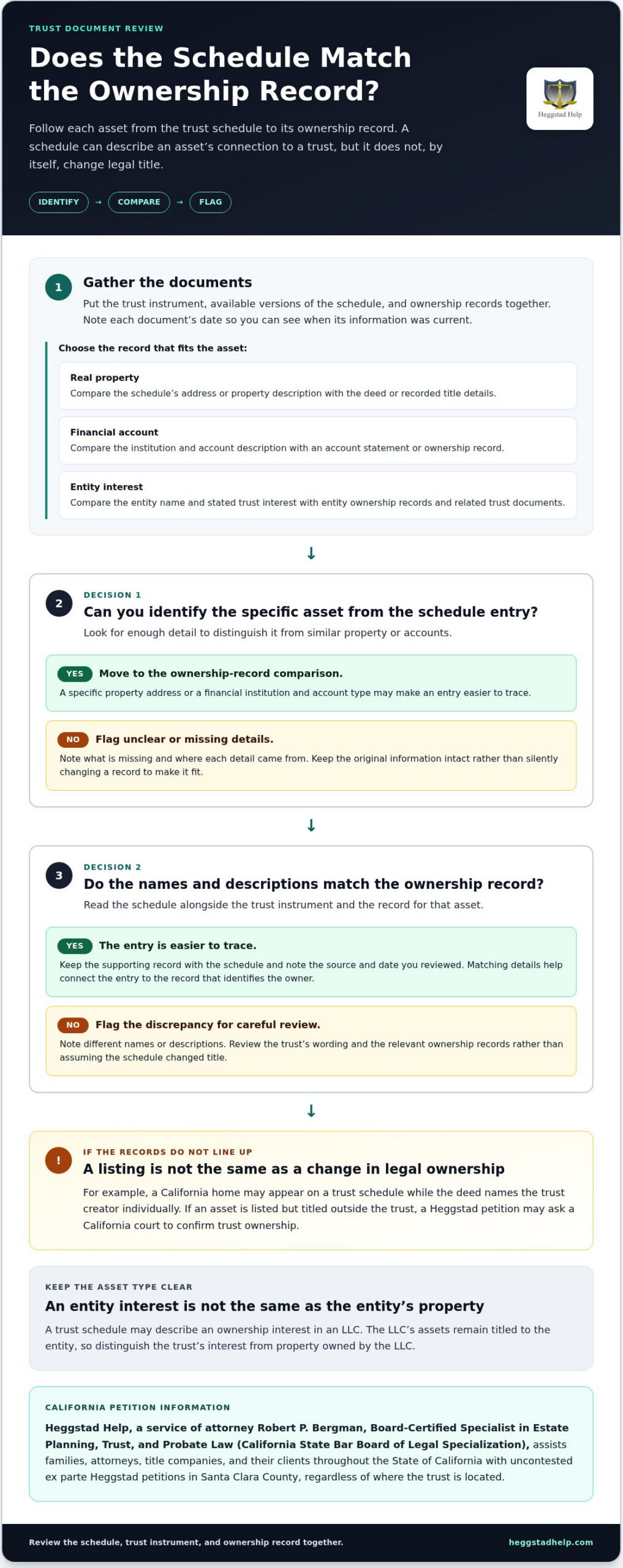
In legal terms, transferring assets to a trust after death when title correction is required means proving to the court that the creator intended for the property to be included. We look for written evidence of this intent, such as a "Schedule A" (the list of assets usually attached to the back of a trust) or a "General Assignment" document. If these documents exist, we can often avoid a full probate. Our office helps families in Los Angeles, Orange, and San Bernardino Counties navigate these Heggstad petitions to ensure the estate is settled efficiently and correctly.

The Small Estate Threshold in California for 2026

If the "left out" assets are below a certain value, you might avoid court entirely using procedures outlined in the Probate Code. For deaths occurring on or after April 1, 2025, the Small Estate Affidavit threshold is $208,850. This limit increases to $239,700 for deaths occurring on or after April 1, 2026. If the total value of assets outside the trust exceeds these specific limits, a formal court petition becomes necessary. Without a Heggstad petition, these larger assets would be forced into a standard probate process that can often last 12 to 18 months.

Recovering ‘Forgotten’ Assets Using Probate Code Section 850 in California

The Heggstad Petition, named after the landmark case Estate of Heggstad, provides a specialized path for transferring assets to a trust after death without the burden of a full probate. Under Probate Code Section 850, the court has the authority to confirm that a property belongs to a trust even if the title was never formally updated. This procedure simplifies transferring assets to a trust after death by focusing on the decedent’s intent rather than technical deed errors. While a full probate often lasts 12 to 18 months and involves public filings, a Heggstad petition is faster, more private, and considerably more cost-effective. If you’re managing a trust where assets were left out, reading about Successor Trustee Duties for an Unfunded Trust in California can help you understand your legal obligations during this time.

Eligibility Requirements for a Heggstad Petition

To succeed, you must provide written evidence showing the decedent intended to include the asset in their trust. This evidence often includes a "Schedule A" (the list of assets attached to the trust) or a general assignment of assets. This process works for various holdings, including real property (houses), brokerage accounts, and business interests. Since every trust is unique, you should consult a specialist to review your specific trust language before filing. Our office assists families, attorneys, and title companies throughout the entire state of California, including those in Riverside and San Bernardino. All Heggstad petitions are handled with fixed fees covering both filing and attorney fees. This is especially helpful when assets exceed the small estate thresholds of $208,850 for deaths on or after April 1, 2025, and $239,700 for deaths on or after April 1, 2026. If you’re struggling with an incomplete estate, you can contact us to review your trust documents to see if you qualify.

Transferring Assets to a Trust After Death in California: The 2026 Heggstad Guide

Strategic Filing: How to Accelerate Asset Transfers Throughout California

Navigating the court system for transferring assets to a trust after death requires understanding local procedural nuances. Most counties, such as Los Angeles, Orange, or San Diego, typically require noticed hearings. These hearings usually take 30 to 60 days plus the time needed for legal notice; contested petitions take even longer. However, we utilize ex parte orders (legal requests decided without a formal hearing) to expedite the process. To provide financial clarity, we handle these petitions with a fixed fee that covers both court filing and attorney fees for clients and title companies statewide. For a deeper look at the paperwork involved, see our guide on Heggstad Petition Filing in California.

The Santa Clara County Advantage for Successor Trustees

While some counties take months, Santa Clara County typically grants uncontested ex parte petitions in just 7 to 10 days. This is a vital strategy for families in Riverside or Sacramento because uncontested petitions from any California county can often be heard ex parte in Santa Clara. This approach bypasses the lengthy timelines often described in the California Courts probate guide. If you can demonstrate "urgency" in Contra Costa County or file in San Mateo County, petitions are often granted the same day. This speed is essential when real estate sales are pending or when assets exceed the small estate limits of $208,850 for deaths occurring on or after April 1, 2025, and $239,700 for deaths occurring on or after April 1, 2026. You don’t have to wait for a distant hearing date when a faster path exists.

Secure Your Family’s Legacy Without the Probate Delay

Discovering that a home or account was left out of a trust doesn’t have to lead to a 12 month probate process. By utilizing Probate Code Section 850, we provide a streamlined path for transferring assets to a trust after death. This is vital if the estate exceeds the Small Estate Affidavit thresholds of $208,850 for deaths occurring on or after April 1, 2025, or $239,700 for deaths occurring on or after April 1, 2026. Whether you’re in Los Angeles, Riverside, or Sacramento, you can avoid long court delays by leveraging our specialized filing strategies.

Robert P. Bergman is a California-Licensed Attorney and Board-Certified Specialist who knows how to navigate these technical hurdles. We offer fixed-fee pricing and a proven 7 to 10 day turnaround in Santa Clara County for uncontested petitions. Get a Fixed-Fee Heggstad Petition Consultation Today and move forward with confidence. Let us help you finish this process with calm competence and efficiency.

Frequently Asked Questions

Can I move a house into a trust after the owner has died?

Yes, you can legally move a house into a trust after the owner passes away by filing a Heggstad petition. This procedure, authorized by Probate Code Section 850, allows a judge to confirm the property belongs in the trust based on the decedent’s written intent. It effectively corrects the title without requiring a full probate administration, even if the deed was never formally recorded in the trust’s name.

How long does a Heggstad Petition take in California?

The timeline varies significantly by county. In Santa Clara County, uncontested ex parte petitions are typically granted in 7 to 10 days. San Mateo and Contra Costa Counties can often grant these orders the same day if urgency is shown. In other counties like Los Angeles or San Diego, a noticed hearing usually takes 30 to 60 days; however, we often file in Santa Clara to accelerate the process.

What is the cost of filing a Heggstad Petition in 2026?

We handle Heggstad petitions using a fixed-fee model that includes both attorney fees and court filing costs. This approach provides financial certainty and eliminates the hidden expenses often found in traditional hourly billing.  Our comprehensive service covers all procedural requirements to ensure the final court order is obtained without unexpected financial surprises or hourly billing anxiety.

Does a Heggstad Petition avoid the need for a full probate?

Yes, a successful Heggstad petition completely bypasses the formal probate court system. Instead of enduring a 12 to 18 month process with multiple hearings and statutory fees, this petition targets specific "left out" assets. It’s a highly efficient tool for transferring assets to a trust after death, provided there is clear written evidence that the creator intended for those assets to be trust property.

What happens if a property was left out of a trust in Los Angeles County?

If a property was left out in Los Angeles County, the local court typically requires a noticed hearing that can take several months. However, we strategically file uncontested petitions from Los Angeles in Santa Clara County, where they can be decided within 7 to 10 days. This allows families to resolve title issues quickly regardless of where the real estate is located within the state of California.

Is an attorney required for transferring assets to a trust after death?

While you aren’t legally required to hire an attorney, the technical requirements of the Probate Code make professional guidance essential. This is critical if the estate exceeds the Small Estate Affidavit threshold of $208,850 for deaths on or after April 1, 2025, or the $239,700 limit for deaths on or after April 1, 2026. A specialist ensures your petition for transferring assets to a trust after death is granted.

Robert P. Bergman, Attorney at Law

Article by

Robert P. Bergman, Attorney at Law

Attorney Robert P. Bergman ("Bob Bergman") has been a Board-Certified Specialist in Estate Planning, Trust and Probate Law since 2011, as certified by the California State Bar Board of Legal Specialization. For several years, Bob has assisted families and the clients of other attorneys with obtaining court orders through Heggstad petitions to avoid the time and expense of Probate administration. Bob is friendly, very approachable, and believes in explaining complex legal topics in clear ordinary language so that his clients understand exactly what they're doing and why they're doing it.
Bob is often able to assist clients who are in other counties than his home county of Santa Clara through his approach to Heggstad petitions.

Disclaimer

This article is for informational purposes only. Nothing in this article is intended to replace legal advice from a competent attorney or be considered legal guidance for anybody's specific legal situation. Nobody should rely on information in this article in making legal decisions without such consultation.

Heggstad Petition Timeline in California: How Long Does the Process Take?

What if you could bypass a year-long probate delay and secure an inheritance in just a few days? Families often assume that an unfunded trust, where…

What if you could bypass a year-long probate delay and secure an inheritance in just a few days? Families often assume that an unfunded trust, where a home was never formally transferred, leads to 18 months of delays. It’s stressful to discover property was left out of a trust, but the Heggstad petition timeline California offers a faster path. A Heggstad petition (a petition under Probate Code Section 850) allows a judge to transfer assets into a trust without a full probate.

This guide to the Heggstad Petition Timeline in California explains how to find a resolution in 30 to 60 days. You’ll learn why counties like Santa Clara offer ex parte orders (rulings without a formal hearing) in 7 to 10 days. We cover small estate thresholds, including the $208,850 limit for deaths on or after April 1, 2025, and the $239,700 limit for deaths on or after April 1, 2026. Whether you’re in Los Angeles, Orange, or San Diego, we provide fixed-fee services to find the fastest filing venue.

Key Takeaways

  • Learn how a Heggstad petition in California, filed under Probate Code Section 850, typically resolves in 30 to 60 days compared to 18 months for a full probate.
  • Discover how the Heggstad petition timeline California can be reduced to 7 to 10 days through ex parte filings in Santa Clara, San Mateo, or Contra Costa Counties.
  • Understand why uncontested petitions from counties like Orange or San Diego are often filed in Santa Clara to avoid long court backlogs.
  • See how fixed-fee filing services provide a predictable path for title correction while serving clients and attorneys throughout the entire state.

How Long Does a Heggstad Petition Take in California?

A Heggstad petition (a request under Probate Code Section 850) generally takes between 30 and 60 days for a noticed hearing. This timeline is significantly shorter than full probate administration, which typically lasts 12 to 18 months in California. The Heggstad petition timeline California is heavily influenced by court-specific rules regarding notice requirements. If a court requires a formal noticed hearing, you must provide a minimum of 30 days’ notice to all interested parties. In busy jurisdictions like Los Angeles, Riverside, or San Francisco, court calendars often push these hearing dates out even further.

Strategic filing changes the pace. In Santa Clara County, uncontested petitions are typically granted in 7 to 10 days. San Mateo and Contra Costa Counties can often grant these orders the same day, provided urgency is demonstrated in Contra Costa. While other counties like San Diego, Alameda, or Sacramento often require noticed hearings that take many months, uncontested petitions from those areas can instead be heard ex parte (without a formal hearing) in Santa Clara County and decided within 7 to 10 days. We provide these services for attorneys and families statewide with fixed fees covering both filing and attorney fees.

Heggstad vs. Small Estate Affidavit Thresholds

It’s vital to verify if your assets exceed the California small estate limits before proceeding. For deaths occurring on or after April 1, 2025, the threshold is $208,850. For deaths occurring on or after April 1, 2026, the limit increases to $239,700. If the asset value exceeds these specific figures, a petition is the most efficient way to bypass probate with a Heggstad petition. This is especially helpful for families in Marin, Santa Cruz, or San Bernardino dealing with real estate that was never deeded into a trust.

Factors That Influence the California Heggstad Petition Timeline

The specific California county where you file is the primary factor in determining your wait time. Noticed hearings (proceedings where legal notice is sent to all heirs and creditors) require a minimum of 30 days notice to all interested parties. This procedural requirement often pushes court dates out 60 days or more in busy counties like Los Angeles, Orange, or San Francisco. If a petition is contested, meaning an heir or creditor objects to the transfer, it will move the case into litigation. This shift can add months or years to the Heggstad petition timeline California. Understanding the mechanics of California Probate Code Section 850 in California is essential for managing these expectations.

The Santa Clara Advantage for Faster Results

Speed often depends on whether a court allows an ex parte order (an expedited ruling issued without a formal hearing). In Santa Clara, San Mateo, and Contra Costa Counties, uncontested petitions are regularly handled this way. Petitions in Santa Clara County are typically granted in just 7 to 10 days, while San Mateo can often be granted the same day. Families in Alameda, Sacramento, or Riverside don’t have to wait for their local court’s multi-month backlog. Instead, uncontested petitions from those counties can be heard ex parte in Santa Clara County and decided within 7 to 10 days. We provide these services to attorneys, title companies, and clients throughout the entire state of California. All petitions are handled with fixed fees covering both filing and attorney fees to help you resolve title issues quickly through these expedited venues.

Heggstad Petition Timeline in California: How Long Does the Process Take?

Accelerating Your Asset Transfer with Expert Filing

HEGGSTAD HELP provides specialized services to ensure your Heggstad petition filing is completed accurately to avoid unnecessary procedural delays. Our office assists families, attorneys, and title companies in Orange, San Bernardino, Marin, and Santa Cruz Counties by leveraging the most efficient filing venues available. We operate on a fixed-fee basis that covers both the court filing fees and attorney fees, ensuring you face no surprise costs during the legal process. Working with a Board-Certified Specialist ensures every Probate Code Section requirement is met, which prevents the common court rejections that can reset the Heggstad petition timeline California.

Step-by-Step Timeline from Filing to Final Order

A structured approach is the best way to ensure a fast resolution. While a standard probate can drag on for 18 months, our streamlined process aims for a 30-day window. When you prioritize speed, the Heggstad petition timeline California follows a clear, methodical progression:

  • Day 1-5: We focus on the preparation of the petition. This involves gathering necessary trust documents and property deeds to build a strong legal case.
  • Day 6-15: We file the petition ex parte (an expedited request) in Santa Clara or San Mateo. This strategic move allows for rapid approval without the multi-month wait times found in other counties.
  • Day 16-30: Once the judge signs the court order, we record the new deed. This final step completes the trust asset title correction in California, moving the property into the trust where it belongs.

This efficiency is available throughout the entire state. Even if the property is located in San Diego, Riverside, or Los Angeles, we can often utilize the faster processing times in Santa Clara to secure your inheritance quickly. This focused expertise turns a potentially overwhelming legal hurdle into a manageable, 30-day task.

Securing Your Trust Assets Without the Probate Delay

The Heggstad petition timeline California doesn’t have to be a source of stress. By choosing the right filing venue, you can bypass the standard 18-month probate process and fix title issues in as little as 7 to 10 days. Whether you are dealing with a property in San Bernardino or an unfunded trust in San Francisco, strategic filing in Santa Clara County offers a significant speed advantage. Our office brings over 40 years of experience and the expertise of a Board-Certified Specialist in Estate Planning, Trust and Probate Law to every case. We provide fixed-fee services for all 58 California counties, covering both filing and attorney fees to ensure total cost transparency. You don’t have to navigate these complex procedural hurdles alone. Get a Fixed-Fee Quote for Your Heggstad Petition today and take the first step toward a calm, efficient resolution for your family.

Frequently Asked Questions

How long does a Heggstad petition take in Santa Clara County?

Santa Clara County petitions are typically granted in 7 to 10 days. This rapid turnaround is possible because the court regularly handles uncontested petitions ex parte (without a formal hearing). This efficiency is a cornerstone of the Heggstad petition timeline California, allowing families to avoid the multi-month backlogs common in other counties. We frequently assist clients statewide by utilizing this expedited filing venue.

Can I file a Heggstad petition if the decedent died more than a year ago?

Yes, you can file a petition under Probate Code Section 850 regardless of how much time has passed since the death. There is no strict deadline for correcting trust titles. You should first confirm the asset value exceeds the Small Estate Affidavit limits of $208,850 for deaths starting April 1, 2025, and $239,700 for deaths starting April 1, 2026. If it does, a petition is necessary.

What happens if someone objects to the Heggstad petition timeline?

If an heir or creditor objects, the petition moves into a contested phase, which replaces the expedited timeline with formal litigation. This transition can add months or years to the process as the court requires evidence and testimony. Most cases we handle are uncontested, allowing us to maintain a predictable Heggstad petition timeline California by ensuring all legal requirements are satisfied before filing.

Is a Heggstad petition faster than a regular probate in Los Angeles?

A Heggstad petition is significantly faster than a traditional probate in Los Angeles, which often takes 12 to 18 months. While a noticed hearing in Los Angeles might take 60 days or more, it remains a more efficient choice. For the fastest resolution, we often file uncontested Los Angeles petitions in Santa Clara County to secure an order in just 7 to 10 days.

Robert P. Bergman, Attorney at Law

Article by

Robert P. Bergman, Attorney at Law

Attorney Robert P. Bergman ("Bob Bergman") has been a Board-Certified Specialist in Estate Planning, Trust and Probate Law since 2011, as certified by the California State Bar Board of Legal Specialization. For several years, Bob has assisted families and the clients of other attorneys with obtaining court orders through Heggstad petitions to avoid the time and expense of Probate administration. Bob is friendly, very approachable, and believes in explaining complex legal topics in clear ordinary language so that his clients understand exactly what they're doing and why they're doing it.
Bob is often able to assist clients who are in other counties than his home county of Santa Clara through his approach to Heggstad petitions.

Disclaimer

This article is for informational purposes only. Nothing in this article is intended to replace legal advice from a competent attorney or be considered legal guidance for anybody's specific legal situation. Nobody should rely on information in this article in making legal decisions without such consultation.
What Happens if a House is Not in a Trust When Someone Dies in California?

A missing deed doesn’t have to mean your family is trapped in probate court for the next year. You might feel overwhelmed discovering that a home was…

A missing deed doesn’t have to mean your family is trapped in probate court for the next year. You might feel overwhelmed discovering that a home was left out of a living trust, especially when facing the prospect of a 12 to 18 month delay. It’s a common frustration to see a trust exist but realize the deed remains in the individual’s name. Understanding what happens if a house is not in a trust when someone dies California is critical to protecting the estate from high statutory fees. This guide reveals how you can bypass a full probate through a Heggstad petition (a legal procedure under Probate Code Section 850 that asks a judge to recognize the asset as part of the trust). We’ll explain how to secure a fast court order to confirm trust ownership and why fixed-fee legal help is the most efficient path forward.

Key Takeaways

  • Understand that an “unfunded” house (an asset not properly deeded to the trust) remains part of the probate estate and cannot be transferred to beneficiaries until the title is legally corrected.
  • Learn how a Heggstad petition, filed under Probate Code Section 850, bypasses the 12 to 18 month probate process by asking a judge to confirm the home as trust property based on the decedent’s intent.
  • Discover how to secure a court order in as little as 7 to 10 days by filing ex parte (without a formal hearing) in Santa Clara County, a strategy available for properties located throughout the state.
  • Identify the specific legal steps to resolve what happens if a house is not in a trust when someone dies California, including how to use a “Schedule of Assets” to avoid high statutory probate fees.

When someone passes away, families often assume that having a trust document is enough to manage the estate. However, the legal reality changes significantly when the deed to a home was never transferred into the trust’s name. An unfunded trust is a trust that exists on paper but does not legally own the assets intended for it. In this scenario, the property is technically an "unfunded" asset that remains part of the decedent’s probate estate.

Understanding what happens if a house is not in a trust when someone dies California is vital because, without court intervention, the title cannot be transferred to beneficiaries by the successor trustee alone. The county recorder’s office still sees the individual as the owner, which usually triggers a mandatory full probate in California. We support families and attorneys across the state, including those in Los Angeles, Orange, and Riverside, who need to file Heggstad petitions to correct these title errors. The Probate process is the standard court procedure used to settle a person’s debts and distribute their remaining assets as governed by the California Probate Code.

The California Small Estate Threshold in 2026

While some smaller assets can be transferred using simplified procedures, real estate rarely qualifies. For deaths occurring on or after April 1, 2025, the Small Estate Affidavit threshold is $208,850, and for deaths occurring on or after April 1, 2026, the threshold increases to $239,700. Since most homes in California exceed these limits, a house usually requires more than a simple affidavit to transfer. Consider these points:

  • The house value is calculated at gross market value, not equity.
  • Successor trustees lack authority to sign deeds for property not officially owned by the trust.
  • Title companies won’t issue insurance without a court order or probate.

Avoiding Full Probate with a Heggstad Petition in California

A Heggstad petition, filed under Probate Code Section 850, is a specialized legal request that asks the court to confirm a house belongs in a trust based on the decedent’s clear intent. This is the primary solution for what happens if a house is not in a trust when someone dies California. Rather than suffering through a year of California probate, this procedure allows a judge to "transfer" the title retroactively. We regularly assist families in Los Angeles, Orange, and San Diego by securing these court orders. This process typically costs a fraction of statutory probate fees and concludes significantly faster than a full probate administration in California.

Strategic Filing: The Santa Clara County Advantage

Timing is everything when managing an estate. In Santa Clara County, uncontested Heggstad petitions are often granted ex parte (without a formal hearing) in just 7 to 10 days. Similarly, San Mateo and Contra Costa Counties can often grant these orders the same day, provided urgency is demonstrated in Contra Costa. While other counties like Riverside, San Francisco, or San Bernardino often require noticed hearings that take many months, we can often have those uncontested petitions heard ex parte in Santa Clara County and decided within 7 to 10 days. Knowing what happens if a house is not in a trust when someone dies California helps you choose the fastest path. Our firm provides ex parte court order services throughout the entire state of California using fixed fees that cover both filing and attorney fees.

What Happens if a House is Not in a Trust When Someone Dies in California?

How to Transfer Your House to the Trust After Death

Recovering a home for a trust requires a methodical approach. First, you must gather the original trust documents and any "Schedule A" (a list of assets intended to be held by the trust) that specifically names the house. While the California Courts Self-Help Guide to Probate outlines the standard path for estates, a Heggstad petition offers a specialized shortcut. You’ll need to engage a specialized Heggstad petition attorney in California to draft the legal petition and supporting declarations. This documentation proves to the court that the decedent intended the home to be trust property despite the title error.

Once the court reviews the evidence, it issues a signed order confirming the house is trust property. You then record this order with the County Recorder to update the title. Our firm handles these filings state-wide, assisting clients in Alameda, Sacramento, and Santa Cruz with fixed fees that cover both attorney time and court filing costs. This transparency is vital for understanding what happens if a house is not in a trust when someone dies California, as it provides a predictable path to resolution without the variable costs of a full probate.

Why Work with a California Board-Certified Specialist?

Robert P. Bergman is a Board-Certified Specialist in Estate Planning, Trust and Probate Law with decades of specialized experience. Choosing a specialist ensures your 850 petition in California is drafted to meet the specific requirements of local courts, whether you’re in San Francisco or Marin. We provide a steady, knowledgeable hand to reduce the stress of navigating the California Probate Code. Our expertise ensures your petition is accurate, increasing the likelihood of a swift, favorable outcome.

Take Control of Your Family’s Estate Recovery

Discovering that a deed was never recorded into a trust can feel like a legal roadblock, but it doesn’t have to lead to a year of court delays. By understanding what happens if a house is not in a trust when someone dies California, you can choose a faster path through a Heggstad petition. This process confirms the decedent’s intent and updates the title without the high costs of full probate. Robert P. Bergman, a Board-Certified Specialist in Estate Planning, Trust and Probate Law, helps families in Los Angeles, Orange, and San Diego secure ex parte orders in as little as 7 to 10 days through strategic filings in Santa Clara County. Ready to bypass the probate process? Get a Fixed-Fee Quote for Your Heggstad Petition today. You have the tools to protect your inheritance and we’re here to guide you every step of the way.

Frequently Asked Questions

Can I sell a house that was left out of a trust in California?

You cannot sell a house left out of a trust until the title is legally corrected. Most California homes exceed the Small Estate Affidavit threshold of $208,850 for deaths on or after April 1, 2025, and $239,700 for deaths on or after April 1, 2026. To address what happens if a house is not in a trust when someone dies California, you must file a Heggstad petition under Probate Code Section 850.

How much does a Heggstad Petition cost compared to full probate?

A Heggstad petition is significantly more cost-effective because it bypasses statutory probate fees. In a full probate, fees are calculated as a percentage of the gross estate value. For instance, a $1 million estate triggers roughly $46,000 in combined statutory fees for the attorney and executor. Our firm offers fixed fees for Heggstad petitions state-wide, providing a predictable and lower-cost alternative to the expensive probate process.

What happens if the house is not listed on a Schedule A?

You can still succeed even if the house isn’t on a Schedule A, provided other evidence of intent exists. A general assignment of all assets or specific trust language often suffices to prove the decedent’s wishes. Courts in counties like San Bernardino or Alameda look for clear and convincing evidence that the decedent meant for the property to be trust-owned, even if the deed was never recorded.

Is a Heggstad Petition possible if there is no written evidence of intent?

A Heggstad petition usually requires some form of written evidence to prove intent. While a Schedule A is standard, a signed "General Assignment" is often accepted. While counties like Riverside or San Diego often require noticed hearings taking many months, we can instead have uncontested petitions from those counties heard ex parte in Santa Clara County and decided within 7 to 10 days.

Robert P. Bergman, Attorney at Law

Article by

Robert P. Bergman, Attorney at Law

Attorney Robert P. Bergman ("Bob Bergman") has been a Board-Certified Specialist in Estate Planning, Trust and Probate Law since 2011, as certified by the California State Bar Board of Legal Specialization. For several years, Bob has assisted families and the clients of other attorneys with obtaining court orders through Heggstad petitions to avoid the time and expense of Probate administration. Bob is friendly, very approachable, and believes in explaining complex legal topics in clear ordinary language so that his clients understand exactly what they're doing and why they're doing it.
Bob is often able to assist clients who are in other counties than his home county of Santa Clara through his approach to Heggstad petitions.

Disclaimer

This article is for informational purposes only. Nothing in this article is intended to replace legal advice from a competent attorney or be considered legal guidance for anybody's specific legal situation. Nobody should rely on information in this article in making legal decisions without such consultation.

Specialized Heggstad Petition Lawyer: Why Expertise Trumps General Probate Help in 2026

What if you could bypass a twelve-month probate delay and secure a family home in as little as seven to ten days? It’s frustrating to discover a…

What if you could bypass a twelve-month probate delay and secure a family home in as little as seven to ten days? It’s frustrating to discover a property was never titled in a trust, but a specialized Heggstad petition lawyer can prevent this from turning into a year-long legal nightmare. You likely feel overwhelmed by the complex requirements of the Probate Code (the laws governing estate transfers) and the fear that statutory fees will eat into the inheritance.

We understand that you want a fast, predictable resolution. This article explains how specialized expertise allows for ex parte filings (expedited requests made without a standard noticed hearing) in Santa Clara County to resolve cases in days, even for properties in San Diego or Orange. You’ll learn how these strategies help estates over the Small Estate Affidavit threshold, $208,850 for deaths on or after April 1, 2025, and $239,700 for deaths on or after April 1, 2026, to avoid full probate in California.

Key Takeaways

  • Understand how a specialized Heggstad petition lawyer uses Probate Code Section 850 and ex parte filings (expedited requests) in Santa Clara County to secure a court order in just 7 to 10 days.
  • Learn why filing in Santa Clara, San Mateo, or Contra Costa is a faster alternative to the standard noticed hearings that often take months in counties like San Diego, Los Angeles, Orange, Riverside, or other counties throughout California.
  • Discover the financial predictability of a fixed-fee model that covers both filing and attorney fees for families in Los Angeles, Orange, San Francisco, or elsewhere throughout California.
  • Confirm if you can bypass formal probate by reviewing the Small Estate Affidavit limits of $208,850 for deaths on or after April 1, 2025, and $239,700 for deaths on or after April 1, 2026.

Choosing a Specialized Heggstad Petition Lawyer vs. a General Probate Attorney

Many families start by calling a general probate attorney, but there’s a significant difference in how these professionals handle your case. A generalist often treats a Heggstad petition as a secondary task within a broad practice that includes divorces or civil litigation. In contrast, a specialized Heggstad petition lawyer focuses entirely on the mechanics of transferring assets into a trust after death. This specialization is vital because the legal precedent set by the Estate of Heggstad requires clear evidence of the decedent’s intent to avoid a full probate.

Efficiency is the primary benefit of specialization. A generalist might miss a specific requirement of Probate Code Section 850, leading to a "re-filing trap" where the court rejects the initial petition. This error can delay your inheritance by several months. A specialist ensures the petition is granted on the first attempt by providing the exact documentation the court expects. This is especially helpful in counties like Los Angeles, San Bernardino, or Riverside, where court backlogs are already long.

The Value of a Board-Certified Specialist

Choosing a Board Certified Specialist in California provides an extra layer of security for your family’s assets. This certification requires rigorous testing and peer review specifically in Probate Code matters to prove a high level of expertise. While a general lawyer might handle a few petitions a year, a specialized Heggstad petition lawyer manages these complex title issues, often several times a month. This deep experience is why we can offer fixed fees that cover both filing and attorney fees to families, attorneys, and title companies throughout the entire state of California.

The Strategic Advantage of Ex Parte Filings in California

In many California counties, like Los Angeles, Orange, or San Diego, getting a court date for a Heggstad petition involves a noticed hearing. This process usually requires waiting 30 to 60 days or much more just for a hearing date, plus additional time for notice. However, a specialized Heggstad petition lawyer knows how to bypass these lengthy queues by utilizing ex parte procedures. An ex parte application is an expedited request (a motion made to the court without the standard notice period) that allows for much faster resolution. Under California Probate Code 850, these filings are the most efficient way to correct title issues when a property was left out of a trust.

One of the most powerful tools for efficiency is the "Santa Clara Strategy." While courts in Orange or Riverside might be backed up for months, uncontested petitions from those counties can often be heard in Santa Clara County instead. This strategic move allows us to resolve cases in a fraction of the time it takes for a full probate. If you’re dealing with an unfunded trust, you can consult with a specialist to see if your case qualifies for this fast-track approach.

County-Specific Timelines for Heggstad Petitions

Timelines vary drastically depending on the local court rules. In Santa Clara County, uncontested petitions are typically granted in just 7 to 10 days without any formal hearing required. For families in San Mateo and Contra Costa, we can often file and receive a granted order the same day, provided we demonstrate "urgency" to the court in Contra Costa. This speed is a massive advantage over the multi-month wait times found in San Francisco or Marin. We handle these petitions with fixed fees for clients throughout California, ensuring that geography doesn’t limit your access to efficient legal relief.

Specialized Heggstad Petition Lawyer: Why Expertise Trumps General Probate Help in 2026

How to Evaluate Your Heggstad Attorney: Fees, Success, and Small Estate Limits

When you evaluate a specialized Heggstad petition lawyer, transparency regarding fees is a critical starting point. Many generalists charge by the hour or use the statutory fee schedule found in the Probate Code, which can become quite expensive. Instead, look for a fixed-fee model that covers both court filing fees and attorney fees in one clear price. This approach removes the anxiety of hidden costs while you’re managing the complex process of correcting trust asset titles.

During your initial meeting, there are specific questions to ask a Heggstad petition lawyer to gauge their experience. You should ask about their success rate with Probate Code Section 850 and how they navigate the specific requirements of title companies after the court order is granted. A specialist doesn’t just obtain the order; they act as a bridge to ensure the title is actually corrected so the property can be sold or transferred. This expertise is essential for families in Alameda, Sacramento, or Santa Cruz who need to move quickly.

Small Estate Thresholds in 2026

Before filing a petition, it’s vital to determine if a simpler Small Estate Affidavit might work. For deaths occurring on or after April 1, 2025, the threshold for these affidavits is $208,850. However, for deaths occurring on or after April 1, 2026, the limit increases to $239,700. If the value of the omitted asset exceeds these specific values, a Heggstad petition is legally required to avoid full probate administration. Specialists understand these shifting limits and can quickly advise if your case qualifies for a faster track or requires a formal petition to the court.

Finally, consider the lawyer’s role in dealing with title companies post-order. Once the judge signs the order, title companies often have rigorous internal requirements before they’ll recognize the trust as the legal owner. A specialist understands these policies and provides the exact documentation needed to finalize the transfer without further delays, ensuring the inheritance is secured for the beneficiaries.

Secure Your Inheritance with Specialized Expertise

You don’t have to endure a year-long probate delay just because an asset was left out of a trust. By partnering with a specialized Heggstad petition lawyer, you leverage proven strategies like ex parte filings (expedited requests) in Santa Clara County to achieve results in seven to ten days. This efficiency is available to families throughout California, including those in San Francisco, Riverside, and San Diego, providing a clear path to correcting title issues without hidden costs. Whether you are navigating the $208,850 threshold for deaths on or after April 1, 2025, or the $239,700 limit for deaths on or after April 1, 2026, our fixed-fee model ensures financial predictability. Board-Certified Specialist Robert P. Bergman provides the calm competence needed to navigate the Probate Code successfully. Get a Fixed-Fee Heggstad Petition Evaluation from HEGGSTAD HELP and protect your family’s legacy today.

Frequently Asked Questions

How much does a specialized Heggstad petition lawyer cost in California?

Most specialists offer a fixed-fee model that covers both the court filing fees and the attorney fees in one transparent price. This approach is much more predictable than the statutory fees used in full probate, which are based on a percentage of the estate value. Choosing a specialized Heggstad petition lawyer allows families in Los Angeles or Orange to avoid the uncertainty of hourly billing.

Can I file a Heggstad petition myself without a lawyer?

You can legally file on your own, but the technical requirements of the Probate Code make success difficult for non-specialists. If the asset value exceeds the Small Estate Affidavit limits of $208,850 for deaths on or after April 1, 2025, or $239,700 for deaths on or after April 1, 2026, a mistake could force you into a twelve-month probate. Professional help ensures the petition is granted the first time.

How long does the Heggstad petition process take in Santa Clara County?

The process in Santa Clara County typically takes just 7 to 10 days for uncontested petitions. This is because the court allows for ex parte filings (expedited requests without a formal hearing). While a noticed hearing in San Diego or Riverside might take months, we can often use the Santa Clara court to resolve title issues for property located anywhere in California much faster.

What happens if my Heggstad petition is contested by a family member?

If a petition is contested, the court will move the case from the expedited ex parte track to a noticed hearing. A specialized Heggstad petition lawyer focuses on presenting clear evidence of the decedent’s intent to minimize the chance of a dispute. Contested matters take significantly longer than the standard 30 to 60 days required for noticed hearings and may require additional litigation.

Do I need to go to court for a Heggstad petition in California?

You generally do not need to appear in court for an uncontested Heggstad petition. In counties like Santa Clara, San Mateo, and Contra Costa, the judge typically signs the order based on the written evidence provided in the filing. This allows us to assist clients in Sacramento, San Francisco, and Marin remotely, providing a convenient resolution without the need for travel or public testimony.

Robert P. Bergman, Attorney at Law

Article by

Robert P. Bergman, Attorney at Law

Attorney Robert P. Bergman ("Bob Bergman") has been a Board-Certified Specialist in Estate Planning, Trust and Probate Law since 2011, as certified by the California State Bar Board of Legal Specialization. For several years, Bob has assisted families and the clients of other attorneys with obtaining court orders through Heggstad petitions to avoid the time and expense of Probate administration. Bob is friendly, very approachable, and believes in explaining complex legal topics in clear ordinary language so that his clients understand exactly what they're doing and why they're doing it.
Bob is often able to assist clients who are in other counties than his home county of Santa Clara through his approach to Heggstad petitions.

Disclaimer

This article is for informational purposes only. Nothing in this article is intended to replace legal advice from a competent attorney or be considered legal guidance for anybody's specific legal situation. Nobody should rely on information in this article in making legal decisions without such consultation.
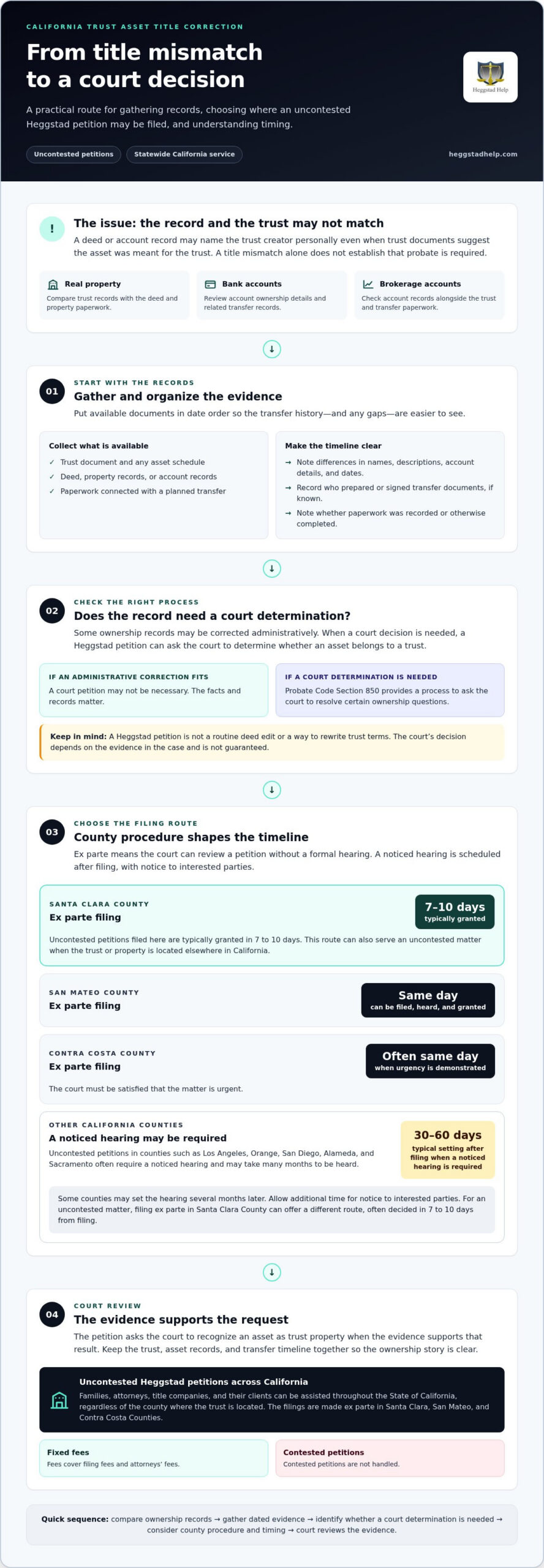
California Ex Parte Court Order: Fast-Track Heggstad Petitions in 2026

What if you could bypass a twelve-month probate delay and fix a missing trust asset in less than two weeks? It’s incredibly frustrating when a title…

What if you could bypass a twelve-month probate delay and fix a missing trust asset in less than two weeks? It’s incredibly frustrating when a title company refuses to close a sale in Los Angeles or San Diego because a property was never deeded into the trust. You likely feel the weight of this procedural hurdle, especially when navigating the complexities of Probate Code Section 850. We understand that you need a resolution measured in weeks, not years. This is why we help families and attorneys secure a **California ex parte Heggstad court order **(a fast-track legal request handled without a formal, lengthy hearing) to move assets into a trust immediately.

We’ll explain how Heggstad petitions in California can be fast-tracked using fixed-fee legal services. While courts in Orange, Riverside, or San Bernardino may take months, we leverage streamlined procedures in Santa Clara County to get orders granted in 7 to 10 days. In San Mateo and Contra Costa Counties, we can often secure orders the same day. We’ll also clarify the 2026 small estate thresholds, specifically the $208,850 limit for deaths on or after April 1, 2025, and the $239,700 limit for deaths on or after April 1, 2026, so you can determine the most efficient path forward for your estate.

Key Takeaways

  • Learn how to bypass the standard 12-month probate process by using a Heggstad petition to secure a California ex parte court order for missing assets.
  • Discover why choosing the right venue, such as Santa Clara or San Mateo Counties, can reduce your wait time for a court order from several months to as little as 7 to 10 days.
  • Find out how families and attorneys in Los Angeles, Orange, and San Diego can access statewide fixed-fee services that cover both filing and attorney fees.
  • Master the requirements of Probate Code Section 850 to satisfy title company demands and successfully close property sales that are currently stalled.
  • Understand the 2026 small estate thresholds, including the $208,850 limit for deaths on or after April 1, 2025, and the $239,700 limit for deaths on or after April 1, 2026.

Understanding Ex Parte Court Orders for Trust Assets in California

An ex parte court order (an expedited order issued by a judge without a lengthy waiting period) provides the fastest path to confirming that an asset belongs in a trust. While many people associate "ex parte" with high-conflict litigation, it’s actually a vital tool for correcting title errors. By securing a California ex parte court order, you can avoid the 12-month probate process that often stalls property sales in Los Angeles or Orange County. In 2026, an ex parte order is superior to a noticed hearing because it resolves uncontested title issues in days rather than months, provided the court has clear evidence of the grantor’s intent.

When is a Heggstad Petition Necessary?

If a loved one intended to place a home in a trust but died before signing the deed, a petition under Probate Code Section 850 is usually required. This process is essential when the estate value exceeds the Small Estate Affidavit thresholds. Specifically, for deaths occurring on or after April 1, 2025, the limit is $208,850, and for deaths on or after April 1, 2026, the limit increases to $239,700. You can determine if your situation fits these criteria by reviewing our California Probate Code Section 850 guide. We assist families throughout the state, from San Diego to Sacramento, with fixed fees that cover both filing and attorney fees.

The Role of Probate Code Section 850

This section of the Probate Code allows a judge to "confirm" trust ownership based on the grantor’s written intent. It effectively "funds" the trust after the creator has passed away. Once the order is signed, the successor trustee can immediately sell or distribute the property. This legal precedent, established by the Estate of Heggstad, ensures that a simple clerical error doesn’t force a family into a full probate administration. Whether the asset is a primary residence or a brokerage account, the court uses this section to align the legal title with the owner’s true wishes.

The Strategic Advantage: Santa Clara, San Mateo, and Contra Costa Procedures

While the asset you need to transfer might be located in Los Angeles or Riverside, the court where you file your petition can drastically change your experience. Choosing the right venue is a critical strategic decision. Many successor trustees assume they must file in the county where the decedent lived or where the real property sits. However, if you’re seeking a California ex parte court order to fix a title error, moving the matter to a faster jurisdiction can save you months of frustration.

In Santa Clara County, uncontested Heggstad petitions are regularly filed ex parte and are typically granted within 7 to 10 days. San Mateo and Contra Costa Counties offer even faster turnarounds, often granting orders the same day if you can demonstrate "urgency," such as a pending home sale that’s about to fall through. Compare this to a noticed hearing in San Diego or Orange County, where you might wait 60 days just for a court date, followed by additional time for notice requirements.

The ‘Santa Clara Hack’ for Statewide Assets

You don’t have to live in Northern California to benefit from these faster timelines. Uncontested petitions for property located anywhere in the state, from Sacramento to San Bernardino, can be heard ex parte in Santa Clara County. This strategy is a game changer for families who need to resolve title issues quickly to satisfy a title company. Our office assists attorneys, title companies, and clients throughout the entire state via Heggstad Help, utilizing fixed fees that cover both filing and attorney fees.

Timelines: Ex Parte vs. Noticed Hearings

The difference in speed is stark. Under California Probate Code 850, the standard noticed hearing process in most counties takes 30 to 60 days plus notice time, often totaling four to five months. If you’re dealing with an estate that exceeds the Small Estate Affidavit thresholds ($208,850 for deaths on or after April 1, 2025, and $239,700 for deaths on or after April 1, 2026), you can’t afford to wait. An ex parte filing in Santa Clara provides a resolution in about a week. It’s important to remember that contested petitions, where a beneficiary objects, aren’t eligible for this fast track and will always take longer.

California Ex Parte Court Order: Fast-Track Heggstad Petitions in 2026

Securing Your Order with Expert Heggstad Petition Filing

Navigating the complex nuances of the Probate Code requires a specialist who understands the specific local rules of both Northern and Southern California courts. Robert P. Bergman, a Board-Certified Specialist in Estate Planning, Trust and Probate Law, provides a streamlined process aimed at reducing the stress often felt by successor trustees. Whether the property you’re managing is located in San Francisco, Marin, or Santa Cruz, our primary goal is to secure a clean title and facilitate a quick distribution to beneficiaries. We handle the entire California ex parte court order process with a sense of calm competence, ensuring that procedural hurdles don’t stand in the way of your family’s inheritance.

One of the most significant advantages of working with our office is our transparent pricing. Heggstad Help operates on a fixed-fee basis, which includes both the court filing fees and all attorney fees. This approach ensures you won’t face surprise costs or hidden expenses as we move through the legal system. We believe in providing a steady, knowledgeable hand to guide you through these specialized requirements, treating your case with the individual attention it deserves.

How Heggstad Help Simplifies the Process

We manage every aspect of the Heggstad petition filing in California, from the initial drafting of documents to the final court order. Our team frequently coordinates with title companies to ensure the court order is formatted correctly for immediate recording. This level of detail is crucial for resolving title issues without the need for a full probate. We provide dedicated support for families and attorneys in Alameda, Riverside, and throughout the Central Valley, ensuring that every petition meets the strict standards of the Probate Code Section governing these transfers.

Next Steps for Successor Trustees

If you’ve discovered that an asset was left out of a trust, your first step is to gather the existing trust document and the deed to the unrecorded property. You’ll also want to verify if the estate value falls below the Small Estate Affidavit thresholds. These limits are $208,850 for deaths occurring on or after April 1, 2025, and $239,700 for deaths occurring on or after April 1, 2026. If the asset exceeds these limits, a Heggstad petition is usually your best option. You can consult with a specialist to determine if an ex parte filing in Santa Clara is the right move for your specific case. Contact Robert P. Bergman at the Law Offices of Robert P. Bergman for a fixed-fee quote and a clear path toward resolution.

Take Control of Your Trust Distribution Today

Securing a California ex parte court order trust doesn’t have to be a stressful or drawn-out experience. By leveraging the strategic procedural advantages in Santa Clara County, you can resolve title errors in as little as 7 to 10 days rather than waiting many months in other jurisdictions. This fast-track approach is particularly vital if your estate exceeds the Small Estate Affidavit thresholds of $208,850 for deaths on or after April 1, 2025, and $239,700 for deaths on or after April 1, 2026. Whether you’re managing property in San Diego, San Francisco, or Alameda, our statewide fixed-fee service ensures you have total cost certainty from start to finish.

Robert P. Bergman, a Board-Certified Specialist in Estate Planning, Trust and Probate Law, is ready to help you navigate the complexities of the Probate Code with confidence. We provide a steady hand to ensure your trust assets are correctly titled and ready for immediate distribution or sale. Don’t let a missing deed stall your progress for another year. Reach out to our team to Get a Fixed-Fee Quote for Your Heggstad Petition and move forward with the peace of mind you deserve. You’re just a few weeks away from a resolution that protects your family’s legacy.

Frequently Asked Questions

What is an ex parte court order in a California trust case?

An ex parte court order is an expedited legal directive issued by a judge with shortened notice to other parties, or sometimes without any formal hearing at all. In the context of a California ex parte court order, it serves as a fast-track mechanism to confirm that an asset belongs in a trust despite a title error. This process allows a successor trustee to bypass the standard, months-long probate queue and receive a signed order in a matter of days.

Can I file a Heggstad petition ex parte if the property is in Los Angeles?

Yes, you can strategically file your petition in Santa Clara County to secure a faster result, even if the real property is located in Los Angeles, Orange, or San Diego. While Southern California courts often require noticed hearings that take many months, we utilize the streamlined procedures in Santa Clara to obtain orders in 7 to 10 days. This "Santa Clara strategy" is available for uncontested petitions involving assets located anywhere in the state.

How much does a Heggstad petition cost in California in 2026?

Our office handles Heggstad petitions on a fixed-fee basis, which provides total cost certainty by covering both the court filing fees and all attorney fees. While the statewide initial filing fee for probate matters is set by the state (currently $435 under the Government Code), our fixed-fee model ensures you don’t face unpredictable hourly billing. This approach is designed to reduce the financial stress for families in San Bernardino, Riverside, and Sacramento who are already managing complex estate affairs.

What happens if a Heggstad petition is contested?

If a beneficiary or interested party objects to the petition, the matter can no longer be handled through the expedited ex parte process. Contested petitions are moved to a standard litigation calendar, which typically takes 30 to 60 days for an initial hearing plus additional time for notice and discovery. It’s important to note that the 7-day fast track in Santa Clara or the same-day service in San Mateo only applies to uncontested matters where everyone is in agreement.

Do I need to go to court for an ex parte trust hearing?

In many instances, you won’t need to step foot in a courtroom for an uncontested petition. In Santa Clara, San Mateo, and Contra Costa Counties, these matters are frequently handled "in chambers" (meaning the judge reviews the paperwork and signs the order without a public hearing). This is particularly helpful for clients in Marin, Santa Cruz, or Alameda who want to resolve title issues efficiently without the time and expense of a formal court appearance.

Is there a deadline to file an ex parte petition after someone dies?

There is no specific statutory deadline to file, but delaying the process can lead to complications with title companies or pending property sales. If the estate value is below the Small Estate Affidavit thresholds ($208,850 for deaths on or after April 1, 2025, and $239,700 for deaths on or after April 1, 2026), you might have other options. However, for real property or larger accounts, filing as soon as possible ensures the successor trustee has the legal authority to manage the assets without a 12-month probate delay.

Robert P. Bergman, Attorney at Law

Article by

Robert P. Bergman, Attorney at Law

Attorney Robert P. Bergman ("Bob Bergman") has been a Board-Certified Specialist in Estate Planning, Trust and Probate Law since 2011, as certified by the California State Bar Board of Legal Specialization. For several years, Bob has assisted families and the clients of other attorneys with obtaining court orders through Heggstad petitions to avoid the time and expense of Probate administration. Bob is friendly, very approachable, and believes in explaining complex legal topics in clear ordinary language so that his clients understand exactly what they're doing and why they're doing it.
Bob is often able to assist clients who are in other counties than his home county of Santa Clara through his approach to Heggstad petitions.

Disclaimer

This article is for informational purposes only. Nothing in this article is intended to replace legal advice from a competent attorney or be considered legal guidance for anybody's specific legal situation. Nobody should rely on information in this article in making legal decisions without such consultation.

California Heggstad Petition: 2026 Step-by-Step Guide

You’ve just discovered that your family’s most valuable asset, the family home, was accidentally left out of the trust, and now a title company is…

You’ve just discovered that your family’s most valuable asset, the family home, was accidentally left out of the trust, and now a title company is rejecting your authority to sell it. It’s a frustrating complication that often surfaces during a refinance or after a sudden passing, leaving families feeling overwhelmed by the prospect of a year-long court battle. If the estate exceeds the small estate threshold, which is $208,850 for deaths on or after April 1, 2025, and $239,700 for deaths on or after April 1, 2026, you might worry that the Heggstad petition process California provides is your only remaining hope to avoid a full probate.

We understand how stressful this uncertainty feels, but mastering these legal steps allows you to transfer forgotten assets into your trust and secure a valid court order (a legal document from a judge confirming ownership) without the crushing weight of statutory fees. This guide for a Heggstad Petition in California will show you how to navigate Probate Code Section 850 and leverage strategic filing locations to obtain clear title to real property. You’ll learn how to bypass the typical 12 month probate delay and potentially resolve your case in as little as seven to 10 days.

Key Takeaways

  • Discover how the Heggstad petition process California provides can reduce a 12-month probate wait to just 7 to 10 days by utilizing strategic filing venues like Santa Clara County.
  • Identify if your assets qualify for simpler transfers by referencing the small estate thresholds of $208,850 (for deaths on or after April 1, 2025) and $239,700 (for deaths on or after April 1, 2026).
  • Learn how to secure an ex parte order (a court ruling granted without a formal hearing) to achieve same-day results for urgent title corrections in San Mateo and Contra Costa Counties.
  • Master the specific requirements of Probate Code Section 850 to prove the decedent’s intent and successfully transfer real property into a trust after a death.
  • Understand the benefits of a fixed-fee service model that provides cost certainty by covering both filing and attorney fees while bypassing high statutory probate costs.

Understanding the Heggstad Petition in California

A Heggstad petition is a specialized legal tool used to confirm that an asset belongs in a trust, even if the formal title transfer was never completed. This complication frequently arises when a homeowner creates a trust but neglects to record a new deed with the county recorder’s office. When the settlor (the person who created the trust) passes away, the Successor Trustee is responsible for initiating the Heggstad petition process California provides to correct this oversight. Without this legal intervention, the asset remains stuck in the decedent’s individual name, which often triggers the very probate process the trust was originally designed to avoid.

Before moving forward, it’s vital to determine if a simpler Small Estate Affidavit might apply. However, these simplified procedures are only available for estates falling below specific financial limits. In 2026, you must consider two distinct figures: the $208,850 threshold (for deaths on or after April 1, 2025) and the $239,700 threshold (for deaths on or after April 1, 2026). If the real property or the combined value of the estate exceeds these amounts, a petition under Probate Code Section 850 becomes the most effective path to secure the asset.

The Legal Basis: Probate Code Section 850

The modern petition is rooted in the landmark 1993 appellate case, Estate of Heggstad. This ruling established that a written declaration of trust is sufficient to transfer property, even if a formal deed was never recorded. This principle is now codified under Probate Code Section 850, which allows the court to "perfect" the title. The cornerstone of any successful filing is "settlor intent," which requires proving the creator of the trust clearly intended for the asset to be included in the trust estate.

We look for specific evidence to satisfy the court’s requirements. A "Schedule A" (the list of assets typically attached to the back of a trust) or a specific mention of the property address within the trust document itself serves as vital proof. When we present this evidence through the Heggstad petition process California courts require, the judge can issue an order confirming trust ownership, effectively funding the trust after the settlor has passed away.

Heggstad Petition vs. Probate in California

Choosing a petition over a full probate administration offers significant advantages in both speed and cost. A traditional probate often drags on for 12 to 18 months, whereas a Heggstad petition is typically resolved in 30 to 60 days. In certain "fast-track" counties, the timeline is even more compressed. We regularly secure orders in seven to 10 days in Santa Clara County. In San Mateo and Contra Costa Counties, we can often obtain same-day grants if we can demonstrate urgency to the court. For a detailed breakdown of these differences, see our Heggstad Petition vs. Probate in California: 2026 Comparison Guide.

The financial difference is equally stark. Probate fees are statutory, meaning they are calculated as a percentage of the estate’s gross value, which can be incredibly expensive. Our firm assists attorneys, title companies, and families throughout the state using a fixed-fee structure that covers both filing and attorney fees. If you’re dealing with a county where noticed hearings take many months, remember that uncontested petitions from those other counties can often be heard ex parte (without a formal hearing) in Santa Clara County, where they are typically decided within 7 to 10 days of filing.

Requirements for a Successful Heggstad Petition in California

Success in the Heggstad petition process California provides depends on your ability to present a clear, documented connection between the asset and the trust. Courts aren’t looking for a perfect track record of paperwork; they are looking for evidence that the decedent intended for the property to be managed by the Successor Trustee. You’ll need a validly executed California Living Trust or Irrevocable Trust document as your foundation. Additionally, you must provide the exact legal description of the real property, which is usually found on the last recorded deed. It’s equally important to verify that the asset wasn’t intentionally excluded or transferred out of the trust for a specific reason, such as a sale that never closed.

Proving Settlor Intent to the Court

Proving intent is the most critical hurdle in this procedure. Settlor intent is the documented desire of the trust creator to hold an asset within their estate plan. The most powerful piece of evidence is the "Schedule of Assets" or "Schedule A" typically attached to the back of the trust document. If the property address or legal description appears there, your case is significantly stronger. However, judges also consider secondary evidence. This might include bank statements showing trust funds were used for property taxes, letters of instruction to an attorney, or even draft deeds that were never signed. This guide to the Heggstad petition process explains how courts weigh these different types of evidence to reach a decision.

Document Checklist for Filing

To initiate the filing, you must prepare a specific set of documents for the court. This includes the Petition itself, the Notice of Hearing, and a Proposed Order that the judge will sign if the petition is granted. Accuracy is paramount here. A minor typo in the legal description can lead to title company rejections later, even if the judge signs your order. You can find a complete list of what you’ll need in our Documents Needed for Heggstad Petition in California: A Complete Filing Checklist.

We assist attorneys, title companies, and families across the state using a fixed-fee structure that covers both filing and attorney fees. This approach eliminates the stress of unpredictable hourly billing while ensuring your paperwork meets the strict standards of the Probate Code. In counties like Santa Clara, San Mateo, and Contra Costa, we can often file these petitions ex parte, which means we skip the long wait for a formal hearing. This can reduce the timeline to just 7 to 10 days in Santa Clara County, or even same-day in San Mateo and Contra Costa if there is demonstrated urgency. If you’re managing an estate that exceeds the small estate thresholds of $208,850 (for deaths on or after April 1, 2025) and $239,700 (for deaths on or after April 1, 2026), taking these steps now prevents a much longer probate. For those looking for a streamlined resolution, you might consider professional help with your Heggstad petition to ensure every requirement is met from day one.

Strategic Venue Selection: Fast-Track Counties in California

Many families assume they must file a petition in the county where the real property is located. However, the Heggstad petition process California courts follow is actually more flexible. The choice of venue, which is the specific court where your case is heard, is perhaps the most significant factor in how quickly you can clear title. While some probate courts are backed up for months, others have established procedures that allow for a resolution in days rather than weeks. This strategic choice is especially important if the estate value is above the small estate thresholds of $208,850 (for deaths on or after April 1, 2025) and $239,700 (for deaths on or after April 1, 2026).

Ex Parte Advantages in the Bay Area

The primary speed advantage comes from filing "ex parte," which is a legal term for obtaining a court ruling without a formal noticed hearing. In Santa Clara County, uncontested petitions are typically granted within seven to 10 days of filing. San Mateo and Contra Costa Counties offer even more rapid results, with the potential for same-day grants. It is important to note that Contra Costa County usually requires a demonstration of "urgency" to skip the standard court calendar. By comparison, other California counties often require noticed hearings that can take 30 to 60 days just to get on the calendar, plus additional time for legal notice. Contested petitions, where someone objects to the transfer, will naturally take longer regardless of the location.

Statewide Filing Strategy

You aren’t necessarily restricted to the county where the house sits. A Heggstad petition can often be filed in the county where the trustee resides. This means if a trustee lives in Northern California but the forgotten property is in Los Angeles or San Diego, we can often use the Santa Clara jurisdiction to secure an order in about a week. This strategy bypasses the months of waiting common in larger Southern California probate departments. Even if a noticed hearing is eventually required, the timeline is usually 30 to 60 days, which is far better than the 12 to 18 months required for a full probate.

Our firm assists attorneys, title companies, and families throughout California using a fixed-fee structure that covers both filing and attorney fees. We understand the specific requirements for a successful Heggstad petition and how to leverage local court rules to your advantage. Whether you are a professional fiduciary or a family member trying to settle an estate, choosing the right venue can mean the difference between a quick title correction and a long, expensive court process. If you need to move quickly, we can help you determine the best filing strategy for your specific situation across any California county.

California Heggstad Petition: 2026 Step-by-Step Guide

Step-by-Step: The Heggstad Petition Process in California

The Heggstad petition process California requires begins with a methodical evaluation of your existing trust documents and property records. We first determine if the asset and your trust meet the specific criteria established in Probate Code Section 850. This initial review is vital because if the estate value falls below certain limits, you might qualify for a Small Estate Affidavit instead. Specifically, these thresholds are $208,850 for deaths on or after April 1, 2025, and $239,700 for deaths on or after April 1, 2026. If the real property value exceeds these amounts, a formal petition is the most reliable way to transfer the asset without a full probate.

Once we confirm the petition is the correct path, we move into the drafting phase. This involves creating a legal document that incorporates the exact legal description of the property and clear evidence of the settlor’s intent. After drafting, the petition is filed with the Superior Court. Depending on the county, we then provide notice to all interested parties and heirs as mandated by the Probate Code. This ensures everyone with a legal interest in the estate is informed of the request to transfer the asset into the trust.

Phase 1: Drafting and Filing

Precision during the drafting phase prevents future headaches. One of the most common errors we see is an inaccurate legal description of real property. If the description on the petition doesn’t perfectly match the last recorded deed, a title company may reject the eventual court order. We mitigate this risk by performing a thorough title search before filing. Our fixed-fee structure simplifies this stage by covering both the court filing fees and all attorney fees. For a detailed breakdown of these expenses, you can review our guide on California Heggstad Petition Cost: Fees, Legal Expenses, and Savings in 2026.

Phase 2: The Hearing and Final Decree

The path to a final decree depends on whether the court requires a noticed hearing or allows an ex parte application. In a noticed hearing, which is standard in many California counties, the timeline is typically 30 to 60 days plus the time required to serve notice. During the hearing, the judge reviews the evidence of intent to ensure the transfer follows the decedent’s wishes. If the judge is satisfied, they issue a "Heggstad Order," which is a valid court order confirming trust ownership. In fast-track counties like Santa Clara, we often secure these orders in as little as seven to 10 days. The final, essential step is recording a certified copy of this order with the County Recorder to officially update the deed and clear the title.

Navigating these procedural requirements demands attention to detail and an understanding of local court preferences. If you want to ensure your filing is handled with professional precision, you can secure professional help with your Heggstad petition to move your case forward without unnecessary delays.

Finding Expert Help for Your Heggstad Petition in California

Facing a title rejection or a stalled real estate closing is an incredibly stressful experience for any Successor Trustee. While many probate lawyers handle general estate administration, few specialize in the rapid ex parte (without a formal hearing) procedures that characterize the Heggstad petition process California allows. Robert P. Bergman has been a Board-Certified Specialist in Estate Planning, Trust and Probate Law since 1980. This certification means he has met rigorous standards of experience and peer review that generalist attorneys often haven’t achieved, particularly regarding the nuances of Probate Code Section 850.

Specialized experts know that while many counties require a noticed hearing taking 30 to 60 days plus notice time, specific venues like Santa Clara County offer a significantly faster route. We regularly file uncontested petitions ex parte in Santa Clara, obtaining orders in just seven to 10 days. We also leverage same-day grant opportunities in San Mateo and Contra Costa Counties when urgency is demonstrated. Even if your property is located in a county where hearings take many months, we can often file in Santa Clara if the trustee resides there, securing a faster resolution for your family and avoiding the 12 to 18 month probate wait.

Fixed-Fee Transparency

Most legal fees in probate matters are either statutory (set by law as a percentage of the estate’s gross value) or billed by the hour, which can lead to unpredictable costs. We believe Successor Trustees and beneficiaries deserve more predictability. Our fixed-fee structure covers both the attorney fees and the court filing fees, ensuring you know exactly what the estate will pay from the very beginning. This transparency is especially helpful when managing expenses for estates that exceed the small estate thresholds of $208,850 (for deaths on or after April 1, 2025) and $239,700 (for deaths on or after April 1, 2026). By choosing a fixed-fee model, you protect the estate’s assets from the high costs typically associated with traditional probate administration.

Next Steps for Successor Trustees

If you’ve discovered an asset that was never properly titled in the trust, you don’t have to accept a lengthy court delay. You can start the resolution process by gathering your trust documents and the most recent deed for a free initial evaluation. We assist attorneys, title companies, and clients throughout California to correct title issues and secure clear ownership. To get started, schedule your consultation for a Heggstad Petition in California with Robert P. Bergman today and see if your case qualifies for our fast-track ex parte services.

Secure Your Family’s Legacy Without the Probate Wait

Correcting a title error doesn’t have to mean entering a year-long legal maze. By understanding the Heggstad petition process California offers, you can move assets into a trust efficiently and affordably. This is particularly vital if the estate value is above the small estate thresholds of $208,850 (for deaths on or after April 1, 2025) and $239,700 (for deaths on or after April 1, 2026). In these cases, a petition under the Probate Code is often your most effective path to avoiding a full probate and ensuring the decedent’s wishes are honored.

Strategic filing remains your greatest advantage. While some counties face significant backlogs, utilizing the ex parte procedures in Santa Clara County can result in a turnaround of just seven to 10 days. Robert P. Bergman, a Board-Certified Specialist since 1980, provides the calm competence needed to navigate these complex court requirements. With a fixed-fee structure that covers all filing and attorney costs, you can resolve title issues with complete financial certainty and peace of mind.

Take the first step toward clearing your property title and fulfilling your role as a Successor Trustee today. You can bypass the traditional probate system and secure a court order that protects the estate’s value. Get a Fixed-Fee Quote for Your Heggstad Petition in California

Frequently Asked Questions

How long does the Heggstad petition process take in California?

The timeline depends largely on the county where you file your petition. In Santa Clara County, uncontested petitions are typically granted within seven to 10 days, while San Mateo and Contra Costa Counties can offer same-day grants if you can demonstrate a specific urgency. In most other counties, the court requires a noticed hearing that can take 30 to 60 days plus additional time for notice, though we can often bypass these months of waiting by filing in Santa Clara County if the trustee resides there.

Can I file a Heggstad petition if there is no Schedule A in the trust?

Yes, you can still file a Heggstad Petition in California even if a formal Schedule A (the list of assets intended for the trust) is missing. While a schedule is excellent evidence, the court will consider other proof of settlor intent, such as bank statements, letters of instruction, or specific property addresses mentioned within the trust document itself. The key is providing enough documentation to convince a judge that the trust creator truly intended for the asset to be part of the trust estate.

What is the cost of a Heggstad petition in California compared to probate?

A petition is significantly more affordable than a full probate, which typically costs between 4% and 7% of the estate’s gross value in statutory fees. For the Heggstad petition process California families use to avoid these costs, we provide a fixed-fee structure that covers both the court filing fees and all attorney fees. This model provides cost certainty and prevents the estate from being depleted by the high statutory percentages required in traditional probate administrations.

Do I need to go to court for a Heggstad petition in Santa Clara County?

For uncontested cases in Santa Clara County, a formal court appearance is usually not required. These petitions are regularly filed ex parte (a legal term for a ruling granted without a formal hearing), meaning the judge reviews the written evidence and signs the order in chambers. This streamlined approach is one of the primary reasons we can secure a valid court order in as little as seven to 10 days for our clients and the title companies we assist.

Does a Heggstad petition work for bank accounts and brokerage accounts?

Yes, this procedure is effective for a wide variety of assets, including bank accounts, brokerage accounts, and partnership interests. While many people associate a Heggstad Petition in California with real estate, it can be used for any asset that was intended to be in the trust but remained in the decedent’s individual name. If you can show clear intent through trust language or account records, the court can order the financial institution to transfer the account into the trust’s name.

What happens if a Heggstad petition is contested by an heir?

If an heir or interested party files a formal objection, the case loses its uncontested status and cannot be handled through the rapid ex parte process. The matter will be moved to the regular probate calendar for a noticed hearing, which significantly lengthens the timeline. Contested petitions require a more complex legal strategy and will take longer than the standard 30 to 60 days required for a typical noticed hearing, as the court must weigh the conflicting evidence presented by both sides.

Is a Heggstad petition available for properties located outside of California?

No, the Heggstad petition is a specific procedure based on the California Probate Code and only applies to assets that would otherwise be subject to the California probate system. If the decedent owned real property in another state that was left out of the trust, you’ll likely need to follow that state’s specific "ancillary probate" or equivalent procedures. We recommend consulting with an attorney in the state where the property is located to determine their specific requirements for trust asset transfers.

What is the small estate limit for a Heggstad petition in 2026?

A petition is usually only necessary if the estate value exceeds the small estate threshold, which allows for a simpler transfer process without a court order. In 2026, you must be aware of two specific limits: the $208,850 threshold (for deaths on or after April 1, 2025) and the $239,700 threshold (for deaths on or after April 1, 2026). If the assets are valued below these amounts, you can likely use a Small Estate Affidavit; if they are above these figures, the Heggstad petition process California provides becomes your primary tool to avoid full probate.

Robert P. Bergman, Attorney at Law

Article by

Robert P. Bergman, Attorney at Law

Attorney Robert P. Bergman ("Bob Bergman") has been a Board-Certified Specialist in Estate Planning, Trust and Probate Law since 2011, as certified by the California State Bar Board of Legal Specialization. For several years, Bob has assisted families and the clients of other attorneys with obtaining court orders through Heggstad petitions to avoid the time and expense of Probate administration. Bob is friendly, very approachable, and believes in explaining complex legal topics in clear ordinary language so that his clients understand exactly what they're doing and why they're doing it.
Bob is often able to assist clients who are in other counties than his home county of Santa Clara through his approach to Heggstad petitions.

Disclaimer

This article is for informational purposes only. Nothing in this article is intended to replace legal advice from a competent attorney or be considered legal guidance for anybody's specific legal situation. Nobody should rely on information in this article in making legal decisions without such consultation.
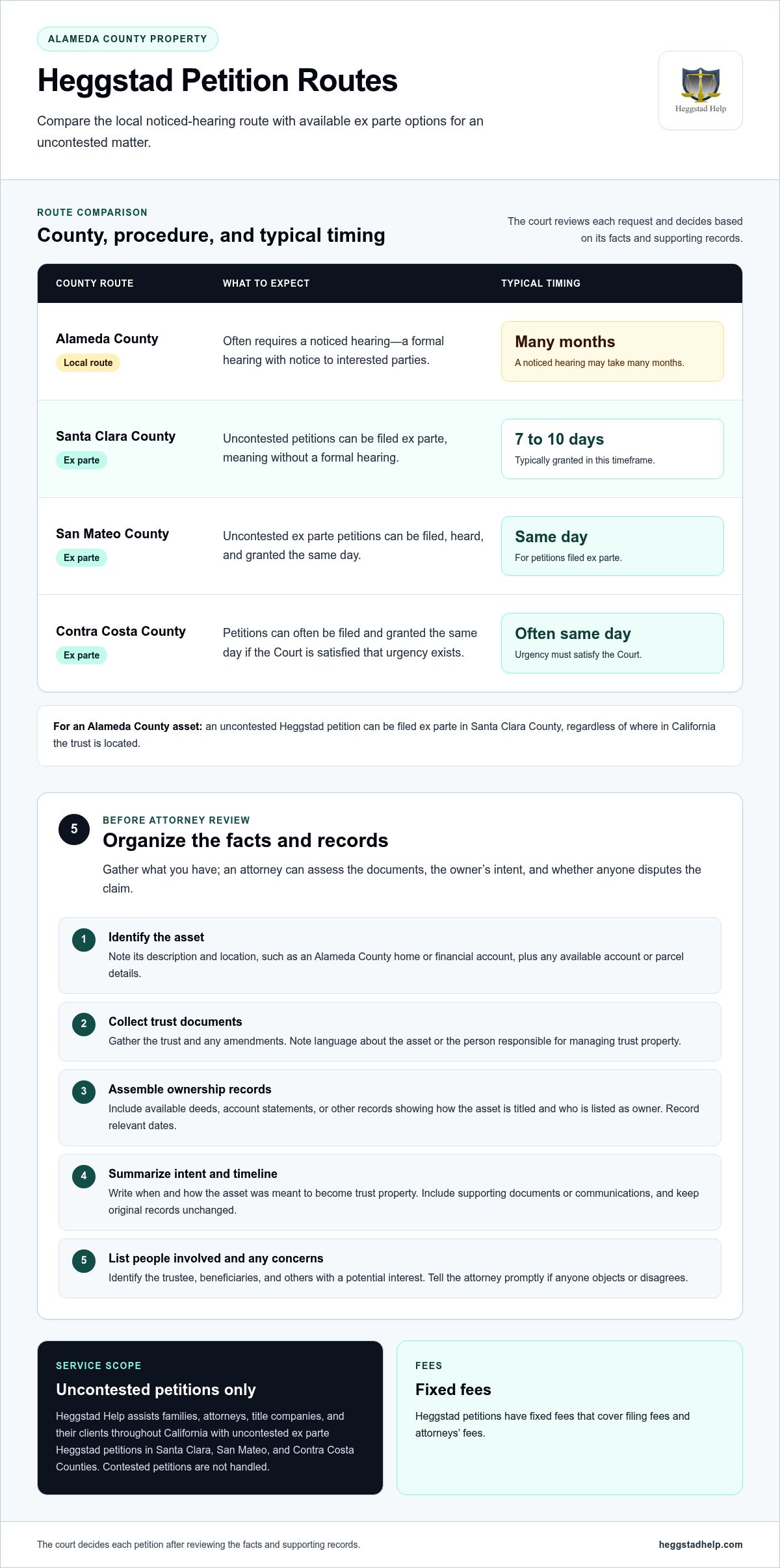
California Heggstad Petition Cost: Fees, Legal Expenses, and Savings in 2026

What if you could bypass a year of court delays and thousands in statutory probate fees just by filing a single document? Many families realize too…

What if you could bypass a year of court delays and thousands in statutory probate fees just by filing a single document? Many families realize too late that a home or account was never deeded into a trust, triggering anxiety about the Heggstad petition cost California families face when trying to correct a title. It’s understandable to feel overwhelmed by the prospect of high hourly rates and confusing court filing fees, especially when you’re already managing the emotional weight of a loved one’s passing.

This guide provides a clear breakdown of the expenses you’ll encounter, from court fees to the benefits of a fixed-fee model that covers both filing and attorney fees for clients, title companies, and fellow attorneys. You’ll learn how a Heggstad Petition in California (a specialized legal request to include "forgotten" assets in a trust) can be resolved in as little as 7 to 10 days in Santa Clara County, or even same-day in San Mateo and Contra Costa Counties. We’ll also cover the Probate Code thresholds, which are $208,850 for deaths on or after April 1, 2025, and $239,700 for deaths on or after April 1, 2026, to help you choose the most efficient path forward.

Key Takeaways

  • Learn how a fixed-fee structure provides cost certainty by covering both filing and attorney fees for your trust asset transfer.
  • Discover how to bypass months of delays by filing ex parte in Santa Clara, San Mateo, or Contra Costa Counties, where orders can be granted in as little as 7 to 10 days.
  • Compare the total Heggstad petition cost California families encounter against the significantly higher statutory fees required for a full probate under the Probate Code.
  • Understand the strategic benefit of filing statewide cases in Santa Clara County to avoid the lengthy noticed hearings required in other jurisdictions.
  • Identify the correct path forward by comparing your asset value to the Small Estate Affidavit thresholds of $208,850 (for deaths on or after April 1, 2025) and $239,700 (for deaths on or after April 1, 2026).

The Financial Impact of an Unfunded Trust in California

Creating a living trust is a vital step in protecting your family’s future, but the document itself is only half of the equation. For a trust to function as intended, it must be "funded," which means legal title to your assets must be transferred into the trust’s name. When a house or financial account is left out of a trust, it creates an "unfunded trust" problem. This oversight often forces families into the very probate process they tried to avoid, leading to concerns about the total Heggstad petition cost California residents will face to fix the error.

Inaction can be expensive. While a home sits in legal limbo, you might face lost property value, mounting maintenance costs, and complex tax complications. Successor trustees, beneficiaries, and even title companies often find themselves stuck when they realize the deceased person’s intent to include an asset in their trust wasn’t matched by a recorded deed. Fortunately, California law provides a specialized remedy to correct these title errors without a year-long probate stay. By taking proactive steps, you can secure the asset and move forward with the administration of the estate.

Why Assets Are Frequently Left Out of Trusts

Title errors happen more often than you might think. A common scenario involves refinancing a home in California; lenders frequently require the property to be moved out of the trust and back into the individual’s name to process the loan. If the owner forgets to record a new deed putting the house back into the trust afterward, the asset remains "unfunded." Other times, a person might create a trust but simply fail to follow through with the deed recording for a new purchase. A Heggstad petition in California serves as a corrective tool, allowing the court to confirm that the asset belongs to the trust based on the creator’s clear written intent.

The Role of Probate Code Section 850

The legal foundation for this procedure is found in Probate Code Section 850. This section allows the court to transfer property to its rightful owner when there is evidence of a contract or intent to convey that property. This approach became the "gold standard" for title recovery following the landmark case of the Estate of Heggstad. By using this specific Probate Code Section, Robert P. Bergman assists families and professionals with a fixed-fee resolution that provides cost certainty. This is especially helpful if the estate exceeds the small estate thresholds of $208,850 (for deaths on or after April 1, 2025) or $239,700 (for deaths on or after April 1, 2026), making a full probate the only other alternative.

Breaking Down the Heggstad Petition Cost in California

Understanding the Heggstad petition cost California families can expect involves looking at both the check you write to the court clerk and the invoice from your legal representative. While the total expense is significantly lower than a full probate, the costs are split into two primary categories: mandatory administrative fees and professional legal fees. For those managing an estate, having a clear picture of these numbers is the first step toward reducing the stress of a title correction.

Standard filing fees for a petition under California Probate Code 850 typically range between $435 and $500 as of 2026. These fees are set by the state and vary slightly depending on county surcharges. If the asset value is below the Small Estate Affidavit limits ($208,850 for deaths on or after April 1, 2025, and $239,700 for deaths on or after April 1, 2026), you might have other options. However, for real property exceeding these amounts, the petition remains the most economical path forward.

Court Filing Fees and Administrative Costs

Beyond the initial filing fee at the clerk’s window, you’ll encounter a few smaller administrative expenses. Recording the final court order with the County Recorder ( the process of updating public records to show the trust owns the property) usually costs less than $100. You’ll also want to budget for certified copies of the order to provide to title companies or financial institutions. When compared to the thousands of dollars required for a full probate administration, these administrative costs are remarkably low. In counties like Santa Clara, San Mateo, and Contra Costa, where we can often resolve cases ex parte (without a formal hearing), you also save on the costs associated with multiple court appearances.

Legal Fees: Hourly vs. Fixed-Fee Models

The most variable part of the Heggstad petition cost California residents face is the attorney’s fee. Many firms bill hourly, with rates for experienced specialists ranging from $450 to over $800 per hour. This can lead to "fee creep," where a seemingly simple matter becomes expensive due to administrative back-and-forth. To solve this, the Heggstad Help fixed-fee structure provides a single, transparent price that covers both the filing fees and the legal work. This model is particularly beneficial for title companies and other attorneys who need a predictable cost for their clients. If you’re looking for a way to secure a fixed-price solution for title correction, this approach eliminates the uncertainty of hourly billing. By streamlining the process, we help you avoid the high statutory fees that would otherwise be calculated based on the property’s gross value.

Cost Comparison: Heggstad Petition vs. Full Probate Fees

When you’re dealing with an unfunded trust, the financial stakes are high. In California, traditional probate is often viewed as a "probate tax" because the costs are determined by the gross value of the estate rather than the amount of work performed. Under Probate Code Section 10800 and Probate Code Section 10810, the law sets mandatory statutory fees for both the attorney and the executor. These fees are non-negotiable and apply to the total value of the property, regardless of how much debt or mortgage is owed on it. This is why the Heggstad petition cost California families typically pay is a fraction of the price of a full probate administration.

Beyond the immediate financial expense, you must also consider the cost of time. A standard probate in California rarely takes less than 12 months, and in many counties, the timeline can stretch toward 18 months or longer. During this period, assets are often locked, preventing beneficiaries from selling property or accessing funds. In contrast, an uncontested Heggstad petition can be resolved in as little as 7 to 10 days in Santa Clara County when filed ex parte (a request for a court order without a formal, scheduled hearing). Even in San Mateo and Contra Costa Counties, these orders can potentially be granted the same day they are filed, provided you can demonstrate the necessary urgency. To understand exactly how this Heggstad petition process California courts follow works from start to finish, reviewing a detailed step-by-step breakdown can help you prepare for each stage.

Statutory Fee Math: A Real-World Example

To see the savings, let’s look at the math for a $1,000,000 California home. In a full probate, the statutory fees would be approximately $23,000 for the attorney and another $23,000 for the executor, totaling $46,000. For a $500,000 asset, the combined fees would still reach $26,000. Because a Heggstad petition bypasses the traditional probate process, it often saves families 70% to 90% in total costs. Legal professionals frequently discuss these efficiencies, as seen in resources from the Placer County Bar Association on Probate §850 Petitions. For a deeper dive into these numbers, you can review our Heggstad Petition vs. Probate in California: 2026 Comparison Guide.

The 2026 Small Estate Threshold Limits

Before proceeding with a petition, it’s essential to check if the estate qualifies for a Small Estate Affidavit. This is a simplified process, but it only applies if the total value of the estate is below specific legal limits. For deaths occurring on or after April 1, 2025, the threshold is $208,850. For deaths occurring on or after April 1, 2026, the threshold increases to $239,700. If the value of the "forgotten" asset exceeds these figures, a Small Estate Affidavit is not an option. In these cases, a Heggstad petition remains the most financially superior and time-efficient alternative to a full, year-long probate process.

California Heggstad Petition Cost: Fees, Legal Expenses, and Savings in 2026

Geographic Factors Affecting Your Heggstad Petition Timeline and Expense

Where you file your petition in California matters as much as the legal arguments within the document. Each county’s probate court operates under its own set of local rules and scheduling backlogs. These geographic variations directly influence the Heggstad petition cost California residents encounter, mainly because a long wait for a hearing date can lead to increased property holding costs, such as taxes, utilities, and insurance. If you’re managing a home that needs to be sold quickly, a six-month delay in a busy court like Los Angeles or San Diego isn’t just frustrating; it’s expensive.

Fortunately, certain counties offer a distinct "Ex Parte Advantage." This procedural shortcut allows a judge to sign an order without requiring a formal, noticed hearing on the court’s regular calendar. By bypassing the standard wait times, we can resolve title issues in a fraction of the time required for a full probate. This efficiency is a cornerstone of how we help attorneys and title companies maintain momentum during trust administrations. It’s a strategic move that keeps the process moving while minimizing the stress of legal uncertainty.

Fast-Track Counties: Santa Clara, San Mateo, and Contra Costa

The probate courts in Santa Clara, San Mateo, and Contra Costa Counties are among the most efficient for these types of filings. In Santa Clara County, we regularly see uncontested petitions granted within 7 to 10 days of filing. San Mateo and Contra Costa Counties offer even more rapid results, with the potential for same-day grants. It’s worth noting that Contra Costa County requires a demonstrated "urgency" to qualify for this expedited treatment. Because these counties allow ex parte filings, the amount of legal labor is reduced, which helps us keep our services affordable and predictable through a fixed-fee model that covers both filing and attorney fees.

Handling Petitions in Other California Counties

In most other California counties, the court will require a noticed hearing. This usually adds 30 to 60 days to the timeline, plus the time needed to serve notice to all interested parties. If the petition is contested, the process can take much longer. However, there is a strategic solution for petitions originating in these slower jurisdictions. Uncontested Heggstad petitions from other counties can often be heard ex parte in Santa Clara County. This allows us to secure a court order within 7 to 10 days, avoiding the months of waiting typical in other courts. This venue selection is a vital tool for estates that exceed the small estate thresholds of $208,850 (for deaths on or after April 1, 2025) and $239,700 (for deaths on or after April 1, 2026). If you need to move quickly, utilizing our Ex Parte Court Order Services can save your family significant time and money.

When you are faced with the realization that a significant asset was left out of a trust, the path forward should be defined by clarity rather than financial guesswork. Many law firms operate on an hourly basis, which can make the total Heggstad petition cost California families pay unpredictable and stressful. Heggstad Help was founded on the principle of transparent, fixed-fee legal assistance. By offering a single price that covers both attorney fees and court filing fees, we provide a reliable solution for successor trustees, beneficiaries, and the professional partners who support them.

Our service extends beyond individual clients to assist attorneys and title companies throughout California who need a specialized hand to correct title errors efficiently. Whether the property is a family home or a commercial building, our goal is to resolve the "unfunded trust" problem without the complexity of a full probate. Because we handle these petitions daily, we have streamlined the process to ensure that every filing meets the strict requirements of the court, reducing the risk of costly delays or rejections.

Specialized Expertise vs. General Practice

Choosing a legal representative for a Probate Code Section 850 petition involves more than just finding a lawyer. Robert P. Bergman is a Board-Certified Specialist in Estate Planning, Trust and Probate Law. This certification means he has met rigorous standards of experience and passed a second bar exam specifically in this field. This level of expertise allows us to avoid the "learning curve" costs often associated with generalist probate lawyers who may only handle a few Heggstad matters a year. For a deeper look at the procedural requirements, you can check out our Heggstad Petition Filing Guide, which outlines how we navigate the system to recover missing assets.

Getting Started with Heggstad Help

The first step in our process is a thorough review of your trust documents and the current title of the asset in question. We help you determine if a petition is the correct tool by comparing your asset value to the California small estate thresholds. These limits are currently $208,850 for deaths on or after April 1, 2025, and $239,700 for deaths on or after April 1, 2026. If the asset exceeds these amounts, we move forward with the intake for Heggstad Petitions in California. To begin, you’ll simply need to provide the trust document, any amendments, and the most recent deed or account statement. From there, we provide a fixed-fee quote and a clear timeline for your specific county, ensuring you can recover your missing trust assets with confidence and financial certainty.

Securing Your Family’s Trust Assets

Navigating the Heggstad petition cost California families face doesn’t have to be a source of financial anxiety. By choosing a fixed-fee approach, you eliminate the threat of high statutory probate fees and the uncertainty of hourly billing. Whether your estate assets fall above the small estate limits of $208,850 (for deaths on or after April 1, 2025) and $239,700 (for deaths on or after April 1, 2026), or you simply need to move property into a trust quickly, there’s a clear path forward.

With over 40 years of California legal experience, Robert P. Bergman, a Board-Certified Specialist in Estate Planning, Trust and Probate Law, provides the steady hand you need. Our fixed-fee structure covers all filing and attorney fees; this ensures there are no surprises as we work to secure your family’s legacy. If you’re ready to bypass the 12-month probate delay and correct your title in as little as 7 to 10 days in Santa Clara County, we’re ready to assist you.

Get a Fixed-Fee Quote for Your California Heggstad Petition and take the first step toward resolving your trust asset issues today. You’ve worked hard for your home and investments, and we’re dedicated to making sure they stay exactly where they belong.

Frequently Asked Questions

How much does a Heggstad petition cost in California in 2026?

The total Heggstad petition cost California residents encounter includes the court filing fee, which typically ranges from $435 to $500 in 2026, and professional legal fees. While many firms bill hourly at rates between $450 and $800, we utilize a fixed-fee structure that covers both the filing fees and the attorney fees. This approach provides cost certainty and prevents the "fee creep" often associated with traditional probate matters.

Is a Heggstad petition cheaper than probate?

Yes, a Heggstad petition is significantly more affordable than a full probate administration. Probate fees are statutory (meaning they are set by law) under Probate Code Section 10800 and are based on the gross value of the estate. For example, a $1 million home could trigger $46,000 in statutory fees. A Heggstad petition bypasses these costs by using a single court order to confirm trust ownership.

How long does the Heggstad petition process take?

The timeline varies by county and the type of hearing required. In Santa Clara County, uncontested petitions are typically decided in 7 to 10 days. San Mateo and Contra Costa Counties can offer same-day grants, though Contra Costa requires demonstrated "urgency." In other counties, a noticed hearing (a formal court date where all parties are notified) usually takes 30 to 60 days plus additional time for notice. For a complete walkthrough of each stage, our California Heggstad petition step-by-step guide for 2026 covers the full process from document gathering to receiving your court order.

Can I file a Heggstad petition without an attorney?

While self-filing is technically possible, it’s rarely advisable because title companies and the court require very specific legal language to transfer property ownership. Errors in the petition can lead to rejected orders or a title that remains "unmarketable," meaning you can’t sell or refinance the home. A Board-Certified Specialist ensures the petition is drafted correctly the first time, avoiding the high cost of corrective legal work later.

What is the small estate limit in California for 2026?

California has two specific thresholds you must know. For deaths occurring on or after April 1, 2025, the small estate threshold is $208,850. For deaths occurring on or after April 1, 2026, the threshold increases to $239,700. If the asset you’re trying to recover exceeds these amounts, a Heggstad Petition in California is usually the most efficient legal tool to avoid a full, year-long probate process.

Do all California counties allow ex parte Heggstad petitions?

No, most California counties require a formal noticed hearing, which can take several months to be heard. However, uncontested petitions from any county can be heard ex parte (without a formal hearing) in Santa Clara County. This strategic move allows us to secure a court order in 7 to 10 days, providing a much faster resolution for clients regardless of where the property is located.

What happens if a Heggstad petition is contested?

If a beneficiary or another interested party objects to the petition, the court will require a noticed hearing regardless of the county. This moves the case onto the regular probate calendar, and the timeline will typically extend beyond 60 days. Contested matters are more complex and generally fall outside of a standard fixed-fee structure because they require traditional litigation services and additional court appearances.

Can a Heggstad petition be used for out-of-state property?

A California court only has the authority to correct title for real property located within California. If a deceased person left a house or land in another state out of their trust, you’ll likely need to file for ancillary probate (a secondary probate process) in that specific state. The Heggstad petition is a unique tool created under the Probate Code specifically for California trust asset title correction.

Robert P. Bergman, Attorney at Law

Article by

Robert P. Bergman, Attorney at Law

Attorney Robert P. Bergman ("Bob Bergman") has been a Board-Certified Specialist in Estate Planning, Trust and Probate Law since 2011, as certified by the California State Bar Board of Legal Specialization. For several years, Bob has assisted families and the clients of other attorneys with obtaining court orders through Heggstad petitions to avoid the time and expense of Probate administration. Bob is friendly, very approachable, and believes in explaining complex legal topics in clear ordinary language so that his clients understand exactly what they're doing and why they're doing it.
Bob is often able to assist clients who are in other counties than his home county of Santa Clara through his approach to Heggstad petitions.

Disclaimer

This article is for informational purposes only. Nothing in this article is intended to replace legal advice from a competent attorney or be considered legal guidance for anybody's specific legal situation. Nobody should rely on information in this article in making legal decisions without such consultation.
Lawyer to Transfer Property Into Trust After Death in California: The Heggstad Solution

Imagine the frustration of settling a loved one’s estate only to discover their home was never deeded into their living trust. This "unfunded…

Imagine the frustration of settling a loved one’s estate only to discover their home was never deeded into their living trust. This "unfunded trust," where the trust document exists but doesn’t legally own the property, usually forces families into a full probate process that can drag on for over a year. If you’re looking for a lawyer to transfer property into trust after death California, you’re likely facing high statutory fees and long court delays just to clear title for a sale. It’s an exhausting position to be in, especially when you’re already managing the stress of a loss.

Fortunately, a Heggstad Petition in California offers a faster alternative. By filing a petition under Probate Code Section 850, we can often transfer real estate into a trust without full probate. For smaller assets, you might use an affidavit if the value is below $208,850 for deaths on or after April 1, 2025, or $239,700 for deaths on or after April 1, 2026. We provide fixed-fee services covering both filing and attorney fees throughout the state. In Santa Clara County, we typically see results in 7 to 10 days, while San Mateo and Contra Costa Counties can even grant same-day orders. We can even file out-of-county cases in Santa Clara County to bypass months of waiting for a noticed hearing.

Key Takeaways

  • Understand how a Heggstad Petition, filed under Probate Code Section 850, can legally move assets into an unfunded trust and bypass the standard probate process.
  • Find out how working with a lawyer to transfer property into trust after death California can secure a court order to clear title for a home sale in weeks rather than years.
  • Compare the high statutory fees of full probate against a fixed-fee model that covers both court filing and attorney fees for more predictable estate administration.
  • Learn how to use specialized filing strategies in Santa Clara, San Mateo, and Contra Costa Counties to secure ex parte (without a hearing) orders that avoid lengthy delays.
  • Check if your estate meets the small estate thresholds of $208,850 for deaths on or after April 1, 2025, and $239,700 for deaths on or after April 1, 2026, to use simpler transfer methods.

The Problem of the Unfunded Trust: Why Property is Left Out After Death

When a person creates a living trust, the goal is usually to ensure their assets pass to heirs without the burden of a court-supervised probate. However, a trust is merely a legal entity; it only protects the assets it actually owns. An "unfunded trust" occurs when a legal document exists, but the person failed to transfer the legal title of their property into that trust. If you are searching for a lawyer to transfer property into trust after death California, you’ve likely discovered that the decedent’s home is still in their individual name. This oversight often leads to an emotional and financial crisis for families, as it technically triggers a full probate administration that can take a year or longer to resolve.

Funding failures happen for several common reasons. Sometimes, a homeowner creates a trust but simply forgets to sign and record the grant deed. In other cases, they might purchase a new home or refinance an existing mortgage and neglect to move the title back into the trust after the bank’s requirements are met. The "smoking gun" for resolving these issues is often a document called a General Assignment of Assets. This document expresses the decedent’s clear intent that all their property belongs to the trust. This procedural path is based on the landmark case Estate of Heggstad, which established the precedent that a court can "confirm" assets as trust property if the owner’s intent is well-documented.

Identifying Trust Funding Mistakes in California

To determine if you need a lawyer to transfer property into trust after death California, start by checking the last recorded deed at the County Recorder’s office. If the deed lists the individual’s name rather than the name of the trust, the property is unfunded. You should also examine the trust’s "Schedule A," which is the list of assets intended for the trust. If the property is listed there but the deed is incorrect, you have strong evidence of intent. For more details, see our guide on California Trust Funding Mistakes: How to Identify Them.

When a Small Estate Affidavit Isn’t Enough

California provides simplified procedures for small estates, but real estate rarely qualifies. For deaths on or after April 1, 2025, the small estate threshold is $208,850. For deaths on or after April 1, 2026, that limit increases to $239,700. Because most California homes exceed these values, a simple Small Estate Affidavit cannot be used to transfer the title. Changing the title on real property requires a formal deed or a court order. When an affidavit is unavailable due to these mandatory thresholds, a Heggstad Petition under Probate Code Section 850 becomes the most efficient tool to avoid a full, costly probate.

The Heggstad Petition: Using Probate Code Section 850 to Recover Assets

When a property owner dies without properly deeding their home into their trust, many families assume a year-long probate is the only path forward. However, a California Probate Code Section 850 petition, commonly referred to as a Heggstad Petition, provides a surgical legal solution. If you’re working with a lawyer to transfer property into trust after death California, this specific petition asks the court to "confirm" the asset as trust property. The legal theory is that if the decedent clearly intended for the property to be in the trust, the court has the authority to declare it so, even without a recorded deed. This process allows families to skip the standard 12-month probate timeline entirely, often resolving title issues in just a few weeks.

To succeed, the petitioner must present "clear and convincing evidence" of the decedent’s intent. This is a higher legal standard than a simple "preponderance of evidence," meaning the documentation must be highly persuasive to the judge. When this evidence is presented correctly, the court issues a formal order that functions as a deed. This order is then recorded with the County Recorder, effectively moving the property into the trust as if the deed had been signed before death. It’s an efficient way to clear title, especially if there’s a pending home sale that can’t wait for a traditional probate to conclude.

Legal Grounds for a Probate Code Section 850 Petition

The foundation of this procedure rests on the landmark 1993 Estate of Heggstad ruling. In that case, the court decided that a written declaration of trust was sufficient to transfer real property, even if a separate grant deed wasn’t recorded. Today, we often use a "Comprehensive Transfer Document" or a "General Assignment" as the primary evidence to prove this intent. These documents serve as a clear statement that the owner intended all their assets to be governed by the trust’s terms. For a deeper look at the mechanics, you can read our California Probate Code Section 850: A Guide to Real Property Petitions.

The Role of a Board-Certified Specialist

While any probate attorney can technically file a petition, working with a Board-Certified Specialist ensures the petition is drafted to satisfy both the judge and the title company. Every county has its own Local Rules of Court, which are the specific procedural requirements for that jurisdiction. Missing a single local requirement can lead to months of delays. A specialist understands how to navigate these nuances, especially when seeking an ex parte (without a formal hearing) order. At our firm, we specialize in these filings and offer a fixed-fee structure for Heggstad petitions that covers everything from filing fees to attorney time, providing a predictable path toward resolution.

The timeline for recovery varies significantly by jurisdiction. In Santa Clara County, uncontested petitions are typically granted within 7 to 10 days of filing. In San Mateo and Contra Costa Counties, grants can often be obtained on the same day if we can demonstrate urgency. For clients with property in other parts of California where hearings take many months, we often file in Santa Clara County to take advantage of their efficiency, securing an order in about a week rather than waiting for a distant court’s calendar.

Comparing the Costs: Heggstad Petition vs. Full Probate in California

The financial impact of a funding mistake can be shocking for families. In California, the cost of a formal probate is not based on the complexity of the work, but on the gross value of the assets. Under Probate Code Section 10810, statutory fees are set as a percentage of the estate’s total value, without any deduction for mortgages or debts. If you’re looking for a lawyer to transfer property into trust after death California, understanding this math is vital. For example, a home appraised at $1,000,000 carries approximately $46,000 in combined statutory fees for the attorney and the executor. Even if that home has a $700,000 mortgage, the fees are still calculated on the full million dollars.

In contrast, our firm utilizes a fixed-fee structure for Heggstad Petitions that covers both the court filing fees and attorney fees. This approach typically costs only a small fraction of what a formal probate would require. Beyond the attorney fees, probate also involves several "hidden" costs that a Heggstad Petition avoids. These include bond premiums to insure the executor, publication fees to notify creditors in a local newspaper, and probate referee fees (which are 0.1% of the appraised value of non-cash assets). By using a Heggstad Petition to "confirm" the property as a trust asset, you bypass these mandatory expenses entirely.

Time is Money: The Hidden Cost of Delay

A standard probate in California usually takes between 12 and 18 months, during which time the property is effectively frozen. You cannot easily sell or refinance the home while the court process drags on. A Heggstad Petition moves much faster, often resolving in just a few weeks. In Santa Clara County, we frequently see grants within 7 to 10 days, while San Mateo and Contra Costa Counties can sometimes grant orders on the same day if urgency is shown. This speed is critical for families who need to clear title for a pending sale. You can learn more about this in our guide on Selling a House Left Out of a California Trust.

Fixed-Fee Transparency in Trust Litigation

Successor trustees often feel overwhelmed by the prospect of open-ended legal bills. We address this stress by offering fixed-fee transparency, which includes everything from the initial drafting to the service of notice on heirs. This allows trustees to fulfill their duties without the fear of the "billable hour" trap that often accompanies general probate matters. It’s important to remember that while Small Estate Affidavits are cheaper, they are limited to estates valued below $208,850 (for deaths on or after April 1, 2025) or $239,700 (for deaths on or after April 1, 2026). Since most California real estate exceeds these figures, a fixed-fee Heggstad filing is usually the most cost-effective path forward.

Lawyer to Transfer Property Into Trust After Death in California: The Heggstad Solution

Strategic Filing: Timelines and County-Specific Advantages

While Heggstad Petitions are available statewide, the speed of your case often depends on which court has jurisdiction. We assist clients, title companies, and fellow attorneys throughout the state, but we frequently leverage what we call the "Bay Area Advantage" to bypass long court backlogs. If you’re working with a lawyer to transfer property into trust after death California, it’s vital to know that Santa Clara, San Mateo, and Contra Costa Counties allow uncontested petitions to be filed ex parte (without a formal hearing). This procedural shortcut can save you months of waiting for a standard court date.

The timelines in these specific counties are remarkably efficient. In Santa Clara County, we typically see grants within 7 to 10 days of filing. San Mateo and Contra Costa offer even faster results, with the potential for same-day grants. It’s important to remember that Contra Costa requires us to demonstrate a specific "urgency," such as a looming escrow deadline, to qualify for this speed. A major strategic advantage we offer is that uncontested Heggstad Petitions for properties located in other California counties can often be heard ex parte in Santa Clara County. Instead of waiting for a calendar date in a crowded court elsewhere, we can often secure your order in about a week.

Filing in Other California Counties

When filing in Los Angeles, San Diego, or the Central Valley, the process is usually more methodical and time-consuming. These courts often require a "noticed hearing," which typically takes 30 to 60 days to be scheduled, plus additional time to provide legal notice to all heirs and beneficiaries as required by the Probate Code. In some larger counties, backlogs can stretch this timeline to several months. While we handle these cases statewide using our fixed-fee structure that covers both filing and attorney fees, we always look for the most efficient venue to clear your title quickly.

The Ex Parte Process Explained

An ex parte application is a request for a court order that happens outside the normal, lengthy hearing schedule. It’s designed for situations where a standard noticed hearing would cause unnecessary delay, such as a pending home sale that might fall through if title isn’t cleared immediately. While many counties treat Heggstad matters as standard probate items, the Bay Area courts recognize the efficiency of confirming trust assets quickly. If your estate value is below the small estate thresholds, specifically $208,850 for deaths on or after April 1, 2025, and $239,700 for deaths on or after April 1, 2026, you might use a Small Estate Affidavit for personal property. However, for real property exceeding these limits, this strategic filing is often the only way to avoid the year-long probate "sledgehammer." You can explore more about regional nuances in our guide to the Heggstad Petition in Los Angeles.

If you need to fix a title error quickly and avoid the stress of a long court process, our fixed-fee Heggstad filing services provide a clear, predictable path to resolution.

How to Get Started with a California Trust Lawyer

Starting the process of correcting a title error requires more than just a signed trust document. When you engage a lawyer to transfer property into trust after death California, the first task is to assemble a robust evidentiary file. This file serves as the foundation for your Probate Code Section 850 petition. Beyond the trust itself, we look for "intent" documents that bridge the gap between the decedent’s individual name and the trust entity. Without these documents, the court may lack the "clear and convincing" evidence needed to grant the petition.

Identifying all legal heirs and beneficiaries is a critical procedural step that cannot be overlooked. Even in cases where everyone agrees on the outcome, the Probate Code requires that specific parties receive formal notice of the proceedings. Failing to provide proper notice can lead to the court denying the petition or, even worse, a title company refusing to insure the property later. We coordinate directly with title companies throughout this process to ensure the final court order contains the specific legal descriptions and language required for recording. Once the judge signs the order, it is recorded with the County Recorder; this officially updates the chain of title and allows the successor trustee to sell or distribute the property.

Your Consultation Checklist

Before your initial evaluation, gather as much documentation as possible to streamline the process. A complete package typically includes the original Trust Agreement and all subsequent amendments. You should also locate the most recent grant deed for the property in question and any "Schedule A" or list of assets that was attached to the trust. If the decedent signed a General Assignment or Comprehensive Transfer Document, these are often the most valuable pieces of evidence we can present to the court.

Identifying potential objectors early is also vital for setting realistic expectations. If a family member is likely to contest the transfer, the case may move from a fast ex parte track to a noticed hearing timeline of 30 to 60 days plus notice time. For a deeper dive into these requirements, see our Evidence Required for Heggstad Petition in California: A 2026 Guide. This preparation ensures that your petition is handled with the precision necessary to satisfy the court.

Why Choose Robert P. Bergman and Heggstad Help

Robert P. Bergman is a Board-Certified Specialist with over 40 years of experience who focuses exclusively on title correction and Heggstad Petitions. We don’t just help families; we act as a strategic partner for other attorneys and title companies who need specialized speed. Our fixed-fee structure covers both filing and attorney fees, providing total cost transparency from the start. Whether you are dealing with a small estate near the thresholds of $208,850 (for deaths on or after April 1, 2025) and $239,700 (for deaths on or after April 1, 2026) or a multi-million dollar residence, we provide a clear path forward. Contact Heggstad Help for a Free Evaluation of Your Trust Assets and let us help you avoid the delays of a full probate.

Secure Your Loved One’s Legacy Without the Probate Delay

Discovering that a home was left out of a trust doesn’t have to result in a year of court-supervised probate. By utilizing a Heggstad Petition under Probate Code Section 850, you can bypass the high statutory fees and long delays that typically exhaust an estate’s value. Whether you’re navigating the specific ex parte advantages in Santa Clara County or managing a filing in another part of the state, working with an experienced lawyer to transfer property into trust after death California is the most efficient path to clearing title. This surgical legal approach ensures that the decedent’s intent is honored while protecting the equity for the beneficiaries.

Robert P. Bergman is a Board-Certified Specialist in Estate Planning, Trust and Probate Law who has been practicing in California since 1980. Our firm provides fixed-fee transparency for all filings, helping you avoid the unpredictable costs of traditional litigation. We manage the complex procedural details so you can focus on moving forward with confidence. If you’re ready to resolve these title issues quickly, you can Get a Fixed-Fee Quote for Your Heggstad Petition today. We’re here to provide the steady, knowledgeable hand you need to reach a resolution.

Frequently Asked Questions

What is a Heggstad Petition in California?

A Heggstad Petition is a specialized legal request filed under Probate Code Section 850 that asks a judge to confirm an asset as trust property even if the deed was never recorded. It relies on evidence of the decedent’s intent, such as a written declaration or a General Assignment. This procedure allows a successor trustee to "capture" assets into the trust after death, effectively avoiding the year-long probate process.

How much does a lawyer charge to transfer property into a trust after death?

While many firms charge hourly, we use a fixed-fee structure that covers both the court filing fees and the attorney fees for uncontested matters. This provides successor trustees with predictable costs and avoids the expensive statutory fees required by a full probate. Because probate fees are calculated as a percentage of the gross estate value under the Probate Code, a Heggstad filing is almost always the more cost-effective choice.

Can I sell a house while a Heggstad Petition is pending?

You can list the property and enter into a purchase agreement, but you cannot legally transfer the title to a buyer until the court order is signed and recorded. A lawyer to transfer property into trust after death California can help you navigate this by seeking an expedited order in counties like Santa Clara or San Mateo. Once the order is recorded, it clears the chain of title, allowing escrow to close and the sale to finalize.

What is the small estate limit in California for 2026?

The limit for using simplified small estate procedures depends on the specific date of the decedent’s death. For deaths occurring on or after April 1, 2025, the threshold is $208,850. For deaths occurring on or after April 1, 2026, the threshold increases to $239,700. If the value of the property left out of the trust exceeds these mandatory figures, you must typically use a Heggstad Petition or full probate to transfer the assets.

Do I need to go to court for a Heggstad Petition?

In most uncontested cases, you won’t need to step foot in a courtroom. In Santa Clara, San Mateo, and Contra Costa Counties, we regularly file these petitions ex parte (without a formal hearing). The judge reviews our written evidence and signs the order in chambers. Even in counties that require a noticed hearing, your attorney can usually appear on your behalf, saving you the stress of a personal court appearance.

What happens if a Heggstad Petition is contested by an heir?

If an heir or beneficiary objects to the transfer, the court will schedule a formal hearing to evaluate the evidence of the decedent’s intent. Contested matters move away from the expedited ex parte track and follow a more traditional litigation timeline. While most petitions are successful due to clear written evidence, a contest may require a noticed hearing that takes 30 to 60 days plus additional time for legal notice.

Can a Heggstad Petition fix a brokerage account missing from a trust?

Yes, a petition under Probate Code Section 850 applies to personal property like brokerage accounts and stocks just as it does to real estate. If the decedent listed the account on their trust’s Schedule A but failed to update the beneficiary forms, the court can confirm the account as a trust asset. This allows the trustee to collect the funds directly from the financial institution without a full probate administration.

How long does it take to get a court order to confirm trust assets?

The timeline depends heavily on the county of filing, but it’s significantly faster than the 12 to 18 months seen in probate. In Santa Clara County, we typically see grants within 7 to 10 days of filing. San Mateo and Contra Costa Counties can even provide same-day grants if we demonstrate urgency. In other California counties, a noticed hearing might be required, which generally takes between 30 and 60 days plus notice time.

Robert P. Bergman, Attorney at Law

Article by

Robert P. Bergman, Attorney at Law

Attorney Robert P. Bergman ("Bob Bergman") has been a Board-Certified Specialist in Estate Planning, Trust and Probate Law since 2011, as certified by the California State Bar Board of Legal Specialization. For several years, Bob has assisted families and the clients of other attorneys with obtaining court orders through Heggstad petitions to avoid the time and expense of Probate administration. Bob is friendly, very approachable, and believes in explaining complex legal topics in clear ordinary language so that his clients understand exactly what they're doing and why they're doing it.
Bob is often able to assist clients who are in other counties than his home county of Santa Clara through his approach to Heggstad petitions.

Disclaimer

This article is for informational purposes only. Nothing in this article is intended to replace legal advice from a competent attorney or be considered legal guidance for anybody's specific legal situation. Nobody should rely on information in this article in making legal decisions without such consultation.
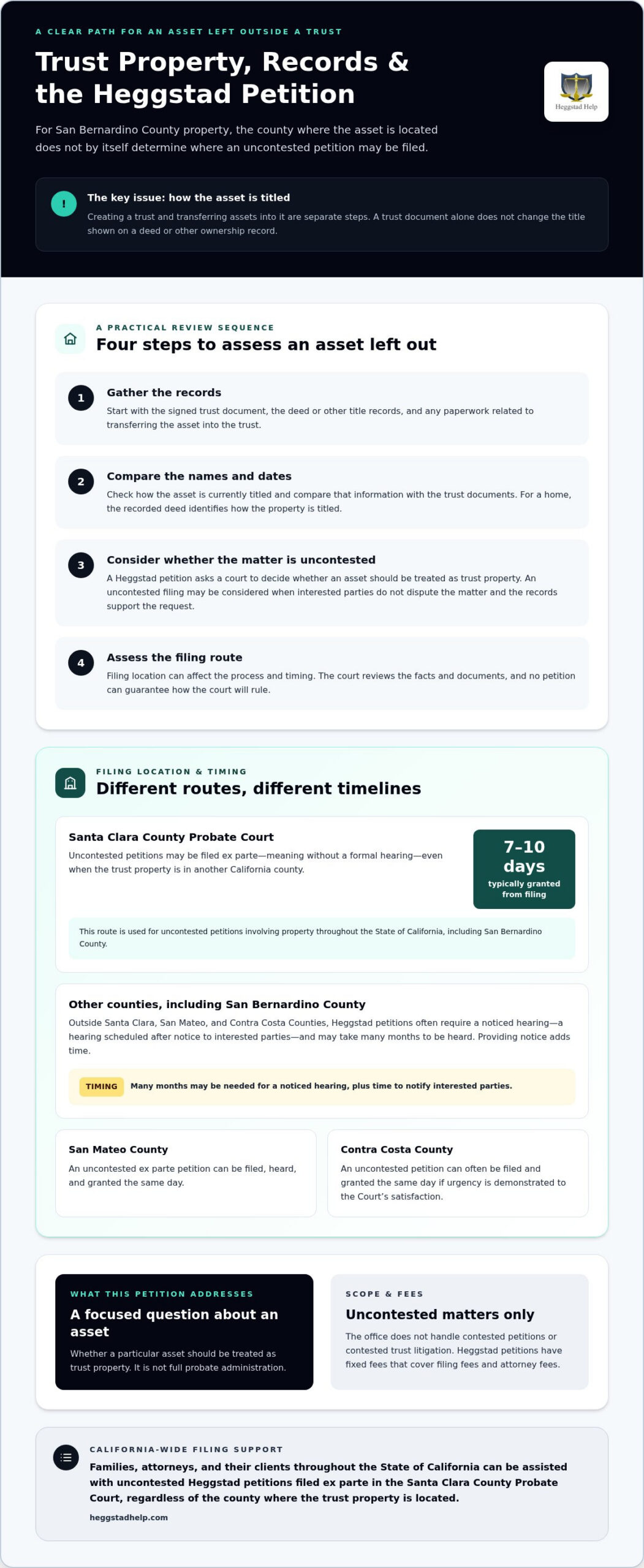
Transferring Business Interests to a Trust After Death in California: The Heggstad Solution

Imagine the sudden frustration of discovering that your late family member’s LLC or primary brokerage account wasn’t actually titled in their trust,…

Imagine the sudden frustration of discovering that your late family member’s LLC or primary brokerage account wasn’t actually titled in their trust, leaving essential business operations frozen and accounts locked. It’s a common oversight that often leads families to believe they’re trapped in a year-long probate process. You may be wondering if it’s even possible to transfer business interest to trust after death California without a full court proceeding. It’s stressful to watch a legacy stall because of a simple paperwork error, but you’re not alone in facing this hurdle.

The good news is that you don’t have to endure the 12 to 18 months of a full probate administration just to fix a title mistake. This article explains how a Heggstad petition, which is a specialized court filing under Probate Code § 850, allows you to move forgotten assets into a trust in a fraction of the time. We’ll explore how this strategic legal tool can fund a trust post-death, sometimes in as little as 7 to 10 days through an ex parte (without a formal hearing) court order, by proving the decedent’s clear intent to include the asset in their estate plan.

Key Takeaways

  • Learn why business interests often become “stuck” outside of a trust and how to recognize an unfunded (not properly titled) asset before it causes long-term operational delays.
  • Understand how to transfer business interest to trust after death California using Probate Code Section 850, a specialized legal remedy that avoids the 12 to 18-month timeline of a full probate.
  • Discover the critical role of written evidence, such as a Schedule of Assets or a general assignment, in proving the decedent’s intent to a California judge.
  • Differentiate between the Small Estate Affidavit for low-value personal property and the more robust Heggstad petition used for high-value business or brokerage accounts.
  • Find out how ex parte (expedited) court orders can resolve title issues in as little as 7 to 10 days in specific jurisdictions like Santa Clara County.

Why Business Interests and Brokerage Accounts Get ‘Stuck’ Outside of Trusts in California

When a business owner or investor creates a living trust, the primary goal is usually to ensure a seamless transition for their heirs. However, a trust only governs assets that it legally owns. An unfunded business interest occurs when an LLC membership or brokerage account remains in a decedent’s individual name at the time of their passing. This creates a significant legal disconnect. While the trust document may clearly state that the owner intended to leave everything to their beneficiaries, the official title on the account statement or operating agreement still reflects the individual’s name. This oversight often forces families to seek a way to transfer business interest to trust after death California to avoid a lengthy court ordeal.

The immediate consequence of this disconnect is the “frozen asset” trap. Financial institutions and LLC managers typically stop all operations immediately upon receiving a death notice. Banks won’t allow withdrawals, and brokerage firms will not execute trades because they no longer have a living person to take directions from. Many families are surprised to learn that a standard Power of Attorney (a legal document granting someone the authority to act on another’s behalf) loses all its authority the moment the principal passes away. Without a living owner or a trust as the titled owner, the asset sits in a legal vacuum. This same challenge arises when families need a lawyer to transfer property into trust after death California, as real estate left outside a trust faces identical title complications.

A gap exists between intent and title. A judge requires a specific legal mechanism to bridge this divide. This is why the landmark case of the Estate of Heggstad is so vital to California law. It established the precedent that if a decedent’s intent to include an asset in their trust is documented in writing, the court can “confirm” that asset as a trust asset without a full probate. Without this remedy, an unfunded interest might be stuck in probate for over a year.

Common Business Assets Left Out of Trusts

  • LLC Membership Interests: Owners often forget to execute a formal “Assignment of Interest” to their trust, leaving the membership in their personal name despite what the trust says.
  • Brokerage Accounts: Accounts at major firms like Schwab, Fidelity, or Vanguard are frequently left in individual names because the paperwork to retitle them seemed too complex during the owner’s life.
  • Closely Held Stock: Physical stock certificates for small corporations or partnership interests are often stashed in files without being updated to reflect trust ownership.

The Crisis for the Successor Trustee

The successor trustee (the person appointed to manage the trust after the original owner dies) often steps into a chaotic situation. They may need to manage payroll or pay business debts, yet they cannot access the necessary funds because the accounts are frozen. This creates immense pressure, especially when beneficiaries are anxious for their distributions. To understand the full scope of these responsibilities, you can review our detailed guide on Successor Trustee Duties for an Unfunded Trust: The California Guide. Resolving these title issues quickly is the only way to restore operational stability to the business.

Using California Probate Code Section 850 to Transfer Business Interests

The Heggstad petition serves as the primary procedural vehicle for correcting title errors after a trust settlor (the person who created the trust) has passed away. When a successor trustee discovers an unfunded asset, they don’t necessarily have to resign themselves to the lengthy probate process. Instead, they can file a petition under California Probate Code Section 850. This specific statute grants the probate court the authority to “confirm” that a particular asset, such as an LLC interest or a brokerage account, actually belongs to the trust. By focusing on the decedent’s written intent rather than the name on the account statement, the court can bridge the gap between individual ownership and trust ownership.

One of the most compelling reasons to use this petition is the significant time savings it offers. While a standard probate administration in California often consumes 12 to 18 months, a Heggstad petition typically resolves in just two to six months. In some specific jurisdictions, such as Santa Clara County, an experienced attorney can even secure an order in as little as 7 to 10 days through an ex parte (an expedited request without a formal hearing) process. This efficiency is vital when trying to transfer business interest to trust after death California, as it allows the business to regain operational control and access frozen funds before the delay causes permanent financial damage.

The Legal Theory Behind Heggstad

The legal foundation for this process stems from the 1993 Estate of Heggstad case. The California Court of Appeal ruled that a written declaration of trust, which lists an asset on an attached schedule, is sufficient to create a trust in that asset. This remains true even if the formal title was never changed. Effectively, the court “reaches back” to the date of the decedent’s death to confirm that the asset was always intended to be part of the trust estate. Successor trustees should note the difference between a standard noticed hearing, which requires 30 days of notice to all interested parties, and an ex parte order, which can bypass the traditional court calendar in urgent situations.

Evidence Needed for Business Interests

Success is entirely dependent on the quality of the evidence presented to the judge. The court looks for “clear and convincing” proof of the decedent’s intent. This evidence usually includes the trust’s “Schedule A” (the list of assets intended for the trust) or a “General Assignment of Assets” that specifically mentions business interests. For LLCs, we also examine the operating agreement; many modern agreements include provisions expressing a desire for the membership interest to be held in trust. For a more detailed look at the documentation required, you can consult our Evidence Required for Heggstad Petition in California: A 2026 Guide. For those managing complex estates, choosing an expert in Heggstad petitions ensures the process remains on track and avoids common procedural pitfalls.

Small Estate Affidavits vs. Heggstad Petitions for Business Assets in California

When you’re determining how to transfer business interest to trust after death California, you’ll likely encounter two primary simplified procedures: the Small Estate Affidavit and the Heggstad petition. While both aim to avoid the 12 to 18-month delay of a full probate administration, they serve very different purposes. A Small Estate Affidavit (a non-court procedure used to collect personal property) is only available when the total value of the decedent’s property falls below a specific statutory threshold. In contrast, a petition filed under California Probate Code Section 850 has no value limit. It’s the standard tool for moving high-value LLC interests or brokerage accounts into a trust when clear evidence of the owner’s intent exists.

The challenge with Small Estate Affidavits is that many business interests and brokerage accounts quickly exceed the legal limits. Even if an asset is technically under the limit, financial institutions often present a “refusal to transfer.” Banks and LLC managers are cautious. They often fear liability if they release assets based on a simple signed statement from an heir. A Heggstad petition resolves this by providing a formal court order that “confirms” the trust’s ownership, which institutions are legally required to honor.

California Small Estate Thresholds (2025 and 2026)

California law adjusts the maximum value for “small estates” every three years to account for inflation. It’s vital to use the correct figure based on the date of death to avoid a rejected filing. The current thresholds for personal property are:

  • Deaths on or after April 1, 2025: The threshold is $208,850.
  • Deaths on or after April 1, 2026: The threshold increases to $239,700.

If the total value of the assets left outside the trust (including the business interest) exceeds these amounts, the Small Estate Affidavit is no longer an option. You must then look toward a Heggstad petition to avoid a full probate. The same threshold rules apply when working with a lawyer to transfer property into trust after death California, as real property values almost always exceed these limits and require a formal court order rather than a simple affidavit.

Why a Court Order is Often Safer

A Heggstad order provides a level of absolute legal protection that an affidavit cannot match. Major brokerage firms, such as Schwab, Fidelity, or Vanguard, have strict internal compliance rules. They’re far more likely to process a transfer quickly when presented with a certified court order signed by a judge. This is especially true when the total estate value far exceeds the small estate limits, as the court order provides the successor trustee with the definitive authority needed to manage and distribute the business assets as the decedent intended.

Transferring Business Interests to a Trust After Death in California: The Heggstad Solution

Filing a Heggstad Petition for CA Business Interests

The path to successfully completing a transfer business interest to trust after death California involves more than just filling out forms; it requires a strategic understanding of court procedures. The process moves from document collection to judicial confirmation through several critical stages. Successor trustees must follow a methodical sequence to ensure the court has sufficient evidence to grant the order without unnecessary delays. The goal is to move the asset from the decedent’s individual name into the trust’s name as efficiently as the law allows.

The standard procedure for a Heggstad petition generally follows these five steps:

  • Step 1: Gather Documentation. You’ll need the original trust document, any general assignment of assets, and the most recent statement for the brokerage account or LLC membership.
  • Step 2: Draft the Petition. A formal legal petition is prepared under California Probate Code Section 850, detailing the facts of the case and the evidence of the decedent’s intent.
  • Step 3: Strategic Filing. The petition is filed in the appropriate Superior Court. Choosing the right county can significantly impact your timeline.
  • Step 4: Obtain the Court Order. If the petition is uncontested, you may seek an ex parte (expedited) order. Otherwise, you’ll attend a noticed hearing where a judge reviews the evidence.
  • Step 5: Finalize the Transfer. Once the judge signs the order, you present a certified copy to the LLC manager or brokerage firm to update the title on the account.

Strategic Filing in Santa Clara, San Mateo, and Contra Costa Counties

Where you file often dictates how quickly you can unlock frozen accounts. In Santa Clara County, uncontested petitions are typically granted ex parte in just 7 to 10 days, making it one of the most efficient jurisdictions for trust asset title correction. San Mateo and Contra Costa counties also offer streamlined processes where orders can sometimes be granted the same day they’re filed. However, it’s vital to recognize that Contra Costa requirements for same-day grants usually require a specific showing of “urgency,” such as an impending business sale or a critical payroll deadline that cannot be met without account access.

Handling Out-of-County Filings

Successor trustees aren’t always restricted to the county where the decedent lived if the business interest or brokerage firm has a sufficient connection to another jurisdiction. Filing in Santa Clara County is often a strategic alternative for business interests located in other California counties because of the court’s familiarity with these petitions. In many other counties, you might be forced into a noticed hearing schedule that takes 30 to 60 days, or even longer if the court calendar is backed up. A specialist can use ex parte procedures in favorable counties to save months of waiting, ensuring a faster transfer business interest to trust after death California. If you’re facing a frozen business account and need a rapid resolution, you can learn more about our specialized Heggstad petition filing services to see which filing strategy fits your situation.

The process to transfer business interest to trust after death California requires a high level of procedural precision that many generalist probate attorneys simply don’t possess. While a standard probate lawyer may understand the broad strokes of trust law, they often lack the deep experience needed to navigate the ex parte (expedited) nuances of a Heggstad petition. These specialized filings depend on a specific understanding of local court rules and the unique evidentiary requirements that judges look for when confirming business title. Missteps in the initial filing can lead to delays that keep assets frozen for months longer than necessary.

At our firm, we provide a sense of calm competence rooted in over 40 years of experience. Robert P. Bergman is a Board-Certified Specialist in Estate Planning, Trust and Probate Law. This certification signifies a level of expertise that goes beyond basic legal practice, as it requires rigorous testing and a demonstrated track record in this specific field. We don’t just handle these cases for individual trustees; we also frequently assist other attorneys and title companies throughout California who encounter complex title recovery hurdles they cannot resolve on their own. This collaborative approach has made us a trusted resource for professional peers across the state.

Predictable Costs and Timelines

One of the biggest anxieties for successor trustees is the “billable hour” trap, where legal costs can spiral out of control during a long court process. We address this by offering fixed fees for Heggstad petitions, which cover both the filing and attorney fees. This approach ensures predictability and allows you to focus on business continuity rather than mounting legal bills. During your initial consultation for a business interest transfer, we will review your documents and provide a clear roadmap of the expected timeline. For a deeper look at the process, you can read our comprehensive resource: Heggstad Petition Filing: The California Guide to Recovering Missing Trust Assets in 2026.

Next Steps for Successor Trustees

If you’ve discovered an unfunded business asset, the most important step is to act quickly. Frozen accounts and stalled operations can lead to lost revenue and legal liability for the estate. To initiate a review of your situation, you should gather your trust documents and the most recent statements for the assets in question. We can then determine if a Heggstad petition is the right path to transfer business interest to trust after death California. Contacting Robert P. Bergman provides you with the expert guidance of a dedicated problem-solver who knows exactly how to unlock your business assets and restore the momentum of the estate as the decedent intended.

Restoring Business Continuity and Securing the Trust Estate

Discovering that a significant asset was left outside of a trust is a stressful experience for any successor trustee. California law provides a structured path to correct these title errors without the burden of a full probate administration. By utilizing a Heggstad petition, you can honor the decedent’s clear intent and move assets like LLC interests or brokerage accounts into the trust’s name. This process doesn’t just save time; it protects the financial health of the business and ensures beneficiaries receive their intended distributions.

By utilizing this specialized legal remedy, you can effectively transfer business interest to trust after death California while avoiding the 12 to 18-month probate delay. We invite you to Get a Fixed-Fee Quote for Your Heggstad Petition in California. Our services are led by a Board-Certified Specialist in Estate Planning, Trust and Probate Law, offering fixed fees that cover all filing and legal costs for complete predictability. For those filing in Santa Clara County, we can often secure an order in as little as 7 to 10 days. You don’t have to navigate these procedural hurdles alone; specialized help is available to resolve these complications quickly and professionally.

Frequently Asked Questions

Can I transfer a business interest to a trust after the owner has died in California?

Yes, you can transfer business interest to trust after death California by filing a Heggstad petition under Probate Code Section 850. This legal procedure allows a judge to confirm that an asset belongs to a trust if there’s written evidence of the decedent’s intent, such as a schedule of assets or a general assignment. It effectively bypasses the need for a full probate administration and restores control to the successor trustee.

How long does a Heggstad petition take for an LLC in Santa Clara County?

In Santa Clara County, an uncontested Heggstad petition for an LLC interest can often be resolved in as little as 7 to 10 days. This rapid turnaround is possible through an ex parte (expedited) court order process. This is significantly faster than the standard noticed hearing route, which can take several months in many other California jurisdictions.

What are the small estate limits for business assets in California for 2026?

For deaths occurring on or after April 1, 2026, the small estate threshold for personal property, which includes LLC interests and brokerage accounts, is $239,700. If the total value of assets left outside the trust exceeds this amount, you cannot use a simple Small Estate Affidavit. Instead, a Heggstad petition becomes the necessary legal tool to move those assets into the trust’s name.

Do I need a formal court hearing for a Heggstad petition in San Mateo County?

San Mateo County often allows for ex parte orders that can be granted the same day they’re filed, potentially avoiding a formal noticed hearing altogether. While some counties require a 30 day notice period to all beneficiaries, the specific procedural rules in San Mateo permit a more rapid resolution for uncontested matters. This efficiency helps successor trustees restore business operations without months of waiting.

What happens if a brokerage firm refuses to transfer an account to a trust?

If a brokerage firm like Schwab or Fidelity refuses to transfer an account based on a Small Estate Affidavit, you should obtain a Heggstad court order. Financial institutions are legally required to honor a certified court order confirming trust ownership. This provides the firm with the liability protection they need to release the frozen funds to the successor trustee immediately.

Is a Heggstad petition faster than probate for a California business?

A Heggstad petition is substantially faster than formal probate. While a full probate in California typically lasts 12 to 18 months, a Heggstad petition usually concludes within 2 to 6 months. In expedited cases, it can be finished in a matter of days. This speed is vital when you need to transfer business interest to trust after death California to maintain business continuity and pay employees.

Can I file a Heggstad petition in Santa Clara if the decedent lived in another county?

You may be able to file in Santa Clara County even if the decedent resided elsewhere, provided the business entity or brokerage account has a legal connection to that jurisdiction. This is often a strategic choice because of the court’s efficient handling of ex parte petitions. A specialist can evaluate the venue rules to see if this fast track is available for your specific case.

What is the cost of a Heggstad petition for a brokerage account in California?

The cost includes a standard court filing fee of $435 in most California counties, plus potential appraisal fees if a probate referee is required. While attorney fees vary across the industry, our firm uses a fixed fee model to provide predictability for successor trustees. This covers both the filing and legal representation, helping you avoid the uncertainty of the billable hour during a difficult transition.

Robert P. Bergman, Attorney at Law

Article by

Robert P. Bergman, Attorney at Law

Attorney Robert P. Bergman ("Bob Bergman") has been a Board-Certified Specialist in Estate Planning, Trust and Probate Law since 2011, as certified by the California State Bar Board of Legal Specialization. For several years, Bob has assisted families and the clients of other attorneys with obtaining court orders through Heggstad petitions to avoid the time and expense of Probate administration. Bob is friendly, very approachable, and believes in explaining complex legal topics in clear ordinary language so that his clients understand exactly what they're doing and why they're doing it.
Bob is often able to assist clients who are in other counties than his home county of Santa Clara through his approach to Heggstad petitions.

Disclaimer

This article is for informational purposes only. Nothing in this article is intended to replace legal advice from a competent attorney or be considered legal guidance for anybody's specific legal situation. Nobody should rely on information in this article in making legal decisions without such consultation.

Transfer Real Estate to a Living Trust After Death in California: The Heggstad Solution

Imagine the frustration of discovering, weeks after a loved one has passed, that their family home was never formally deeded into their trust. You…

Imagine the frustration of discovering, weeks after a loved one has passed, that their family home was never formally deeded into their trust. You might feel trapped by the prospect of a 12 to 18 month probate process, but a missing deed is a fixable error rather than an automatic sentence to court delays. It’s entirely possible to transfer real estate to a living trust after death in California by using a strategic legal tool known as a Heggstad petition (a request for a court order declaring that a property is a trust asset despite a title error). This approach bypasses full probate administration, saving your family from high statutory fees (legal costs set by state law) and clearing the title for an immediate sale or distribution.

We act as a steady guide for families, title companies, and attorneys, providing a logical path through these procedural hurdles. While many counties require noticed hearings that take many months, we often utilize ex parte (expedited) filings in Santa Clara County to get petitions granted in just 7 to 10 days. In San Mateo and Contra Costa Counties, we can often secure orders the same day. If a noticed hearing is required, the timeline is typically 30 to 60 days plus notice time. For smaller assets, remember that California Small Estate Affidavit thresholds are $208,850 for deaths on or after April 1, 2025, and $239,700 for deaths on or after April 1, 2026. Our fixed-fee Heggstad solutions provide a clear, efficient path to resolving trust funding errors without the stress of a year-long probate.

Key Takeaways

  • Learn how to transfer real estate to a living trust after death in California using a Heggstad petition (a court order confirming trust ownership) to bypass the lengthy probate process.
  • Discover why filing in Santa Clara County is a strategic choice, providing results in 7 to 10 days for uncontested petitions compared to the many months required in other counties.
  • Compare the Heggstad solution to Small Estate Affidavits, which are limited to estates under $208,850 for deaths on or after April 1, 2025, and $239,700 for deaths on or after April 1, 2026.
  • Understand how fixed-fee arrangements and ex parte (expedited) filings can resolve title errors as quickly as the same day in San Mateo and Contra Costa Counties.

The Challenge of an Unfunded Trust in California

Creating a living trust is a significant step toward protecting your family’s future, but the document itself is only half of the equation. For a trust to function as intended, it must be “funded,” which is the formal process of transferring ownership of your assets from your individual name into the name of the trust. When it comes to your home, this requires signing and recording a new deed with the county recorder. If a parent or loved one passes away and you discover the deed is still in their personal name, the trust is considered “unfunded” regarding that specific property. Even if the trust document explicitly states that the house belongs to the trust, the transfer of title is not automatic under California law.

This oversight creates a legal gap that often prevents successor trustees (the people appointed to manage the trust) from selling the home or distributing it to beneficiaries. Without a recorded deed, title companies generally won’t issue the insurance necessary to close a sale. Fortunately, you can still transfer real estate to living trust after death by utilizing a specific legal remedy known as a Heggstad petition. Named after the landmark case Estate of Heggstad, this procedure allows a court to declare that the property is a trust asset based on the deceased person’s clear written intent, even if the formal deed was never recorded.

Why Real Estate Title Errors Occur

Title errors are surprisingly common, even for those who worked with experienced estate planners. One of the most frequent culprits is a residential refinance. Lenders often require borrowers to move a property out of a trust and back into their individual names to process a new loan; unfortunately, the final step of moving the property back into the trust is frequently forgotten once the paperwork is signed. In other cases, a “Schedule A” (the list of assets attached to the trust) might be too vague, failing to include a specific legal description or the assessor’s parcel number. Procrastination also plays a role, as many people intend to record a deed but simply never get around to the notary or the recorder’s office before they pass away.

The Consequences of Doing Nothing

Ignoring a title error usually results in the property being forced into a full probate administration, a process that typically lasts 12 to 18 months in California. During this time, the asset is effectively frozen, and the estate must pay high statutory fees (legal costs set by the state based on the gross value of the property). If the property value is relatively low, you might consider a Small Estate Affidavit, but these are subject to strict limits. For deaths occurring on or after April 1, 2025, the threshold is $208,850, and for those on or after April 1, 2026, it is $239,700. Because most California real estate exceeds these values, a Heggstad petition is usually the only way to avoid a year-long court battle. The same Heggstad solution that rescues real estate from probate can also be used to transfer business interest to trust after death in California, making it a versatile remedy for many types of forgotten assets. You can read more about the specific hurdles of Selling a House Left Out of a California Trust to understand why acting quickly is essential for clearing the title.

Using Probate Code 850 to Transfer Property in California

The primary legal mechanism for resolving a title error after a loved one passes away is California Probate Code Section 850. This specific statute allows the court to determine the ownership of property and, when appropriate, order its transfer to the rightful party. The foundation for this approach is the 1993 case of Estate of Heggstad, which established that a formal deed isn’t always strictly necessary if the deceased person’s intent to include the property in their trust is clearly documented. This precedent is a powerful tool for successor trustees (the individuals responsible for managing trust assets) who need to transfer real estate to living trust after death without the burden of a full probate administration.

By filing what’s commonly known as a Heggstad petition, you’re asking a judge to confirm that the home is a trust asset despite the missing deed. This process is significantly faster and less expensive than a traditional probate, which often consumes 12 to 18 months of time and thousands of dollars in statutory fees. Our approach focuses on speed and precision, acting as a steady hand for families and title companies across California. If you’re ready to resolve a title issue, you can learn more about our specialized petition services to see how we can help.

Proving Intent to the Court

To succeed with a petition under Section 850, you must provide clear evidence of the settlor’s (the person who created the trust) written intent. Judges typically look first at the trust’s “Schedule of Assets,” often labeled as Schedule A, which lists the properties intended for the trust. If the schedule includes the property’s address or a general description like “my primary residence,” it often serves as sufficient proof. Additionally, many trusts include a “General Assignment” document, which acts as a catch-all statement transferring all of the owner’s property into the trust. Gathering the correct Evidence Required for Heggstad Petition in California is the most critical step in ensuring the court grants your request without unnecessary delays.

Fixed Fees vs. Statutory Probate Commissions

One of the most significant advantages of a Heggstad petition is the cost structure. In a full probate, both the attorney and the executor are entitled to statutory commissions (legal fees set by the state as a percentage of the estate’s gross value). For a million-dollar home, these fees can be tens of thousands of dollars. In contrast, we handle Heggstad petitions using fixed fees that cover both the filing and attorney fees, providing families with financial predictability. Because title companies require a court order before they’ll issue title insurance for a sale, having a Board-Certified Specialist like Robert P. Bergman manage the filing ensures the order is drafted correctly the first time. Our expertise allows us to file uncontested petitions ex parte (without a formal hearing) in Santa Clara County, often securing results in just 7 to 10 days, or even the same day in San Mateo and Contra Costa Counties.

Procedural Timelines: Choosing the Right County in California

The timeline to transfer real estate to living trust after death in California isn’t uniform across the state. In many jurisdictions, a petition requires a “noticed hearing,” which is a formal court appearance scheduled 4 to 6 months after the initial filing. This delay can be catastrophic if you have a pending home sale or are facing financial pressure from a lender. However, our specialized approach leverages the procedural efficiencies of specific Northern California courts to bypass these lengthy queues. By selecting the right venue, we can often turn a half-year ordeal into a matter of days.

In Santa Clara County, we’ve refined a process where uncontested petitions are granted in just 7 to 10 days. For those dealing with property in San Mateo or Contra Costa Counties, we can often secure a signed order the very same day the petition is filed. Understanding that these courts are physically located in the Bay Area is key, as we can often utilize the Santa Clara court to hear uncontested petitions for assets located anywhere in the state. This strategic filing allows us to resolve title errors in a fraction of the time it would take in Southern California or the Central Valley.

Ex Parte vs. Noticed Hearings

The term “ex parte” refers to a legal proceeding where a court order is obtained without a formal, scheduled hearing date that requires months of waiting. While a noticed hearing requires 30 to 60 days of notice time plus the court’s availability, an ex parte filing moves to the front of the line. In Contra Costa County, achieving a same-day order typically requires demonstrating “urgency,” such as an open escrow that is at risk of falling through. If a noticed hearing is required regardless of location, the timeline typically stretches to 30 to 60 days plus notice time, with contested petitions taking much longer. By presenting the case correctly from the start, we help successor trustees avoid the 4 to 6 month wait common in other regions.

Avoiding the “Probate Trap” in High-Volume Counties

High-volume jurisdictions like Los Angeles, Riverside, or San Diego are often backlogged, meaning even a simple petition can sit for many months before a judge reviews it. This “probate trap” can derail estate distributions and cause significant stress for grieving families who just want to move forward. HEGGSTAD HELP acts as a dedicated resource for attorneys and title companies throughout California, helping them navigate these hurdles with expedited filings. If you’re struggling with a missing deed, our Heggstad Petition Filing Guide in California provides more detail on how to recover missing trust assets efficiently. Choosing the right venue for your petition ensures that the title correction process remains a quick resolution rather than a long-term burden.

Transfer Real Estate to a Living Trust After Death in California: The Heggstad Solution

Small Estate Affidavits vs. Heggstad Petitions for Real Estate

When a loved one passes away, families naturally search for the most efficient way to handle the estate. You might have heard of a California Small Estate Affidavit, which is a document used to collect assets without a formal court proceeding. However, this tool is primarily designed for personal property like bank accounts or vehicles. If you need to transfer real estate to living trust after death, an affidavit is rarely the right solution because California law imposes very low financial ceilings on its use. Most real property in our state quickly exceeds these limits, making a Heggstad petition the more appropriate and powerful tool for title correction. Families who find themselves in this situation often benefit most from working with a lawyer to transfer property into trust after death in California who specializes in these expedited petition procedures.

Combining the 2025 and 2026 Thresholds

To determine if an estate qualifies for simplified procedures, you must first identify the date of death. For deaths occurring on or after April 1, 2025, the threshold for a small estate is $208,850. For those occurring on or after April 1, 2026, the threshold increases to $239,700. It’s vital to remember that these figures represent the gross value (the total fair market value) of the assets, not the net value after subtracting mortgages or debts. Because the 2026 figure of $239,700 is tied to inflation adjustments, it must always be viewed alongside the 2025 figure of $208,850 to ensure you’re applying the correct law for the specific year of passing. If the house is worth more than these amounts, the affidavit cannot be used to transfer the title.

Why Real Property Usually Exceeds These Limits

In the California real estate market, it’s rare to find a home valued below the small estate limits. Even a modest condominium or a small plot of land usually exceeds the $208,850 or $239,700 thresholds. When the property value surpasses these limits, the Small Estate Affidavit is no longer an option. This leaves you with two choices: a full probate administration or a Heggstad petition. A Heggstad petition acts as the logical middle ground, allowing you to move high-value real estate into a trust without the 12 to 18 month wait associated with probate.

One actionable tip is to always check the date of death before choosing a filing threshold, as using the wrong year’s limit can lead to court rejections. If the property was intended for the trust but the deed was never recorded, a Heggstad petition is the most efficient way to bypass the “small estate” hurdles. If you aren’t sure which path fits your situation, you can consult with a specialist on Heggstad petitions to verify your eligibility and avoid the costs of a full probate.

Securing Your Court Order and Correcting the Title

The journey to transfer real estate to living trust after death concludes with a signed court order, but the procedural path requires precision to ensure the title is truly cleared. Once we file the petition, the court reviews the evidence of intent we’ve gathered. In Santa Clara County, our ex parte (expedited) process typically results in a granted petition within 7 to 10 days. For those in San Mateo or Contra Costa Counties, we can often secure these orders the same day. After the judge signs the order, it must be recorded with the County Recorder in the county where the property is located. This recorded order serves as the legal bridge, officially moving the property from the deceased individual’s name into the trust.

Working with title companies is a critical part of this final stage. A court order is only useful if a title officer accepts it to issue title insurance for a future sale or refinance. Generalist probate lawyers might provide a standard order, but title companies often require specific language to confirm the court’s jurisdiction and the finality of the decision. We act as the “expert for the experts,” assisting other attorneys and title companies to ensure the court order is bulletproof. This specialized focus prevents title errors from blocking a home sale at the last minute. Families dealing with more complex estates should also be aware that the same Probate Code § 850 framework used for real estate can help transfer business interests to a trust after death in California when an LLC or brokerage account was similarly left out of the trust.

The Role of a Specialized Heggstad Attorney

Generalist probate lawyers often default to the standard 12 to 18 month probate process because they aren’t familiar with the ex parte shortcuts available for Heggstad petitions. Robert P. Bergman, a Board-Certified Specialist in Estate Planning, Trust and Probate Law, brings a sense of calm competence to these high-stress situations. We use fixed fees that cover both the attorney’s time and the court filing costs, so you don’t have to worry about the rising costs of traditional probate commissions. This transparency allows successor trustees to manage the estate’s finances with confidence while resolving complex title hurdles.

Next Steps for Successor Trustees

If you’re ready to move forward, your first step is to gather the original trust document and the most recent deed (the document currently showing the “wrong” title). Even if the estate value is below the thresholds of $208,850 for deaths on or after April 1, 2025, or $239,700 for deaths on or after April 1, 2026, real estate title issues usually require this court-supervised path. You should consult with a specialist to evaluate your trust’s specific language and “Schedule A” to confirm eligibility. You can get expert help with your Heggstad Petition in California to ensure your family’s home is protected and ready for sale or distribution.

Resolve Your Trust Funding Errors with Confidence

Finding a missing deed doesn’t have to mean entering a year-long probate. By using a Heggstad petition, which is a court order that confirms a property belongs in a trust, you can quickly transfer real estate to living trust after death and move forward with your loved one’s wishes. While standard probate procedures in many counties take months, our strategic ex parte (expedited) filings in Santa Clara County regularly secure results in just 7 to 10 days. In San Mateo and Contra Costa Counties, we can often obtain orders the same day. Even if an estate is below the thresholds of $208,850 for deaths on or after April 1, 2025, and $239,700 for deaths on or after April 1, 2026, real estate title issues usually require this specialized path.

Robert P. Bergman is a Board-Certified Specialist in Estate Planning, Trust and Probate Law who provides a steady hand for families and attorneys throughout California. We offer fixed-fee Heggstad filings that provide a clear, predictable path to resolution without the stress of traditional probate commissions. Request a Consultation for Heggstad Petitions in California to confirm your property as a trust asset and clear the title for distribution. We’re here to help you resolve these complications with speed and professional precision.

Frequently Asked Questions

Can I transfer real estate to a living trust after the death of the grantor in California?

Yes, you can transfer real estate to living trust after death by filing a Heggstad petition (a legal request for a court order confirming trust ownership). This procedure is used when a property was intended for the trust but the formal deed was never recorded. It relies on providing written evidence of the deceased person’s intent to include the asset in their trust estate.

How long does a Heggstad petition take to process in Santa Clara County?

In Santa Clara County, uncontested Heggstad petitions are typically granted in just 7 to 10 days. We achieve this speed by filing ex parte (without a formal, scheduled hearing), which bypasses the standard court backlog. This is significantly faster than the 4 to 6 months required for noticed hearings in many other California counties.

What is the California Small Estate threshold for 2025 and 2026?

For deaths occurring on or after April 1, 2025, the small estate threshold is $208,850. For deaths on or after April 1, 2026, the threshold increases to $239,700. Both figures represent the gross fair market value of the estate and must be referenced together to ensure you are using the correct limit based on the date of death.

Do I need to go through full probate if a house was left out of the trust?

No, you can often avoid the 12 to 18 month full probate process by filing a petition under Probate Code Section 850. This “Heggstad” solution is designed specifically to correct title errors for assets that were left out of a trust. It allows you to move the property into the trust quickly and at a much lower cost than traditional probate administration.

What evidence is needed for a Heggstad petition in California?

The court primarily requires written evidence of intent, such as a “Schedule of Assets” (Schedule A) listing the property or a “General Assignment” document. You will also need to provide the trust document itself and the current deed that shows the property in the deceased person’s individual name. These documents help the judge confirm that the omission was a clerical error.

Are Heggstad petition legal fees fixed or hourly in California?

We provide fixed fees for Heggstad petitions in California, which cover both the attorney fees and the court filing costs. This fixed-fee structure offers families financial predictability and avoids the expensive, percentage-based statutory fees found in full probate cases. It’s a transparent way to resolve title issues without worrying about mounting hourly bills.

Can I file a Heggstad petition ex parte in San Mateo or Contra Costa Counties?

Yes, uncontested petitions in San Mateo and Contra Costa Counties are regularly filed ex parte and can often be granted the same day. While Contra Costa County requires a showing of “urgency” for same-day results, both counties provide an expedited path compared to the many months required for noticed hearings in larger California jurisdictions.

What happens if a property was never deeded to the trust before death?

If a property was never deeded, the title remains in the deceased person’s individual name, which prevents the successor trustee from selling or distributing it. To transfer real estate to living trust after death in this situation, you must obtain a court order declaring the home as a trust asset. Without this court intervention, the property remains frozen and cannot be insured by title companies for a sale.

Robert P. Bergman, Attorney at Law

Article by

Robert P. Bergman, Attorney at Law

Attorney Robert P. Bergman ("Bob Bergman") has been a Board-Certified Specialist in Estate Planning, Trust and Probate Law since 2011, as certified by the California State Bar Board of Legal Specialization. For several years, Bob has assisted families and the clients of other attorneys with obtaining court orders through Heggstad petitions to avoid the time and expense of Probate administration. Bob is friendly, very approachable, and believes in explaining complex legal topics in clear ordinary language so that his clients understand exactly what they're doing and why they're doing it.
Bob is often able to assist clients who are in other counties than his home county of Santa Clara through his approach to Heggstad petitions.

Disclaimer

This article is for informational purposes only. Nothing in this article is intended to replace legal advice from a competent attorney or be considered legal guidance for anybody's specific legal situation. Nobody should rely on information in this article in making legal decisions without such consultation.
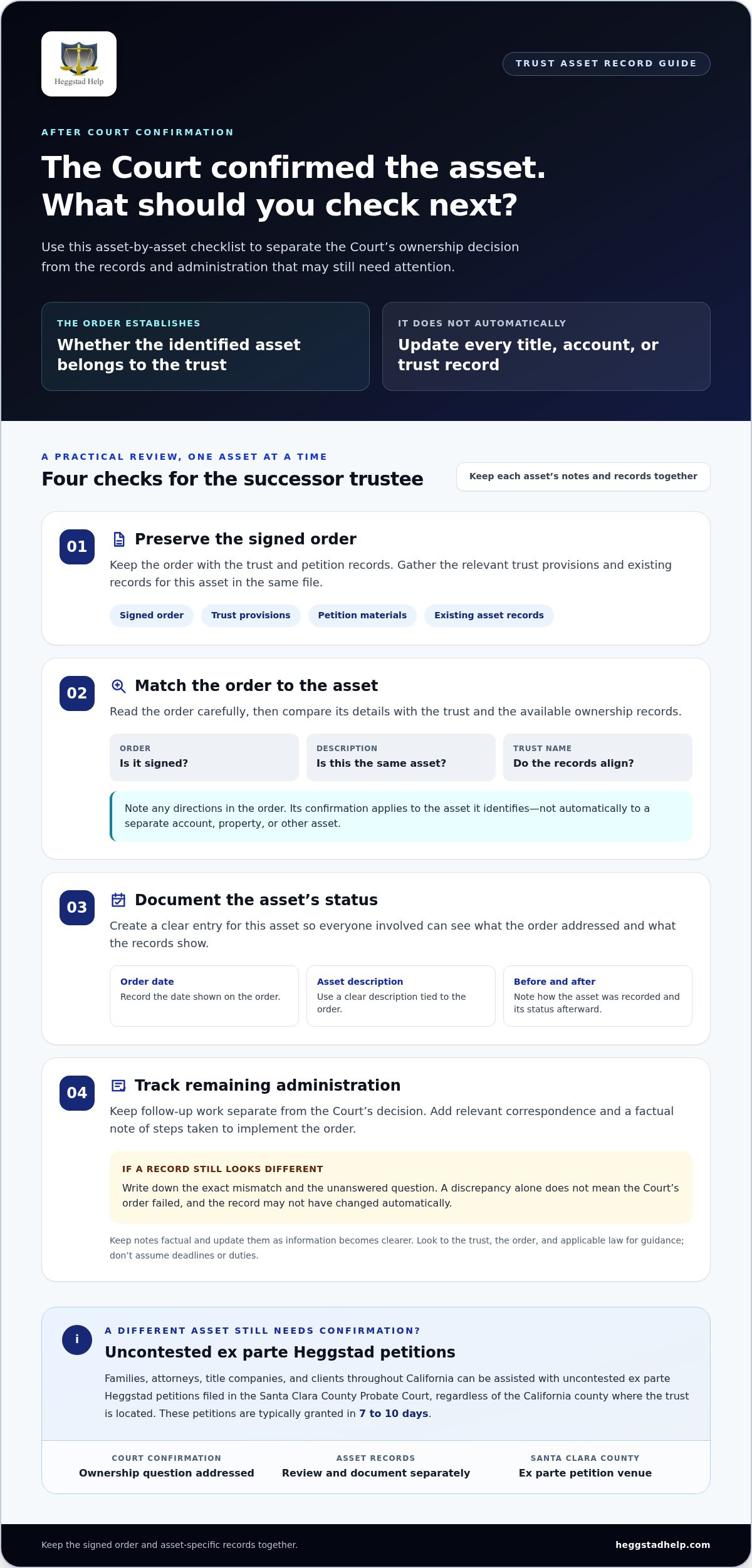
Transferring an LLC to Trust After Death: The Heggstad Solution

Imagine the frustration of realizing a late loved one’s business is effectively frozen because their membership interest (the legal right to own and…

Imagine the frustration of realizing a late loved one’s business is effectively frozen because their membership interest (the legal right to own and manage the company) was never formally moved into their living trust. You’re likely worried that transferring an LLC to trust after death in California will mean a grueling twelve to eighteen month wait in probate court while operations stall and expenses mount. It’s a stressful situation, and it’s perfectly normal to feel overwhelmed by the technical distinction between a physical asset and a membership interest.

There’s a faster way to restore order. You can utilize a Heggstad Petition, which is a specialized court filing under Probate Code Section 850 that asks a judge to recognize the trust’s ownership of an asset that was left out. This article explains how you can bypass full probate and correct the title through a streamlined process. You’ll discover how certain counties like Santa Clara can grant these petitions in seven to ten days, and why a fixed-fee legal service can provide the calm competence you need to resolve this hurdle quickly. Whether you’re dealing with a small estate under the $208,850 threshold for 2025 or a larger business interest, we’ll show you how to regain control without the delays of traditional court supervision.

Key Takeaways

  • Learn how a Heggstad Petition (Probate Code 850) serves as a streamlined “title correction” to move business assets into a trust without the typical 12 to 18-month delay of full probate.
  • Discover how evidence of intent, such as a trust’s Schedule A or a general assignment document, can successfully facilitate transferring an LLC to trust after death in California.
  • Compare the financial benefits of a fixed-fee legal model against the expensive, percentage-based statutory fees required in traditional California probate cases.
  • Identify specific Bay Area counties where ex parte filings (petitions heard without a formal hearing) can grant your request in as little as one to ten days.
  • Understand how to bypass long wait times in other counties by filing uncontested Heggstad petitions in Santa Clara County for a decision typically within 7 to 10 days.

The Crisis of the ‘Forgotten’ LLC: Why Business Assets Face California Probate

A "forgotten" LLC occurs when a business owner intends for their company to be part of their trust but passes away before formally recording the transfer of interest. In California, this oversight creates a significant legal hurdle because the law treats un-transferred LLC interests as personal property. Unless the title is corrected, these interests are subject to formal probate. This means that transferring an LLC to trust after death in California often feels like an impossible task for grieving families who find themselves locked out of the company’s daily operations.

The consequences of this title error are immediate and often severe. Banks typically freeze business accounts upon learning of a member’s death, and vendors may stop fulfilling orders without a clear, authorized successor. Beyond the operational paralysis, the financial burden is heavy. California probate fees are statutory (set by law) and based on the gross value of the asset. For instance, a business valued at $1,000,000 could trigger over $23,000 in attorney fees and an equal amount in executor fees. This is why many families look toward the precedent set in the Estate of Heggstad to find a more efficient path forward.

Membership Interests vs. Physical Assets

It’s vital to understand that a trust must own the actual membership interest (the intangible right to profits and control) rather than just the physical tools or bank accounts used by the business. Title errors are common in California business succession planning, often because owners assume that mentioning the business in their will is sufficient. However, the LLC Operating Agreement (the contract governing the company’s internal affairs) must allow for trust ownership. If the paperwork doesn’t match the owner’s intent, the business remains in legal limbo. Even if the estate is relatively small, business interests often exceed the simplified probate thresholds, which sit at $208,850 for individuals dying on or after April 1, 2025, and increased to $239,700 on or after April 1, 2026. These situations are among the most common California trust funding mistakes that families encounter when a loved one passes away without completing the transfer of business interests.

The Role of the Successor Trustee

The successor trustee has a fiduciary duty (a high legal obligation to act in the beneficiaries’ best interests) to recover any assets that were intended for the trust. This includes tracking down "missing" LLC interests to ensure the business doesn’t face involuntary dissolution by the state. For those overwhelmed by this responsibility, finding Successor Trustee Help for Missing Assets is a critical first step. Waiting too long to fix a title error only increases the risk of permanent business failure. When transferring an LLC to trust after death in California, the trustee must act decisively to secure the business’s future and protect its value for the beneficiaries.

California Probate Code 850: How a Heggstad Petition Corrects LLC Title Errors

While the frozen business operations described earlier are daunting, California law provides a specific remedy known as a Heggstad Petition. This legal mechanism, formally brought under Probate Code Section 850, allows a judge to confirm that a trust owns an asset even if the formal title was never updated. It effectively bypasses the lengthy probate process by "correcting" the title to reflect the deceased owner’s clear intentions. While commonly used for real estate, a Heggstad petition for an LLC is often the most efficient way to resolve membership interest disputes. This process is versatile; it applies to business interests, brokerage accounts, and various other assets that were meant to be held within the trust’s protection. Utilizing a fixed-fee model that covers both filing and attorney fees can help successor trustees manage these costs predictably while transferring LLC to trust after death California.

The success of this petition relies heavily on the "Intent Rule." California courts look for written evidence that the grantor (the person who created the trust) meant for the LLC to be a trust asset. If you can provide this proof, the court can issue an order declaring the trust as the rightful owner. This avoids the need for a court-supervised executor to manage the business for a year or more, allowing the successor trustee to step into their role with full legal authority.

Evidence of Intent for LLC Transfers

To prove intent, we typically look for a "Schedule of Assets" (a list often found at the back of a trust document) or a "General Assignment of Assets" (a broad statement transferring all of a person’s property into their trust). These documents serve as a clear paper trail for the court. Written declarations within the trust document itself, such as a statement that "I hereby transfer all my business interests to this trust," can also satisfy the legal requirements. Probate Code 850 is the specific statutory authority that grants California courts the power to confirm trust assets and correct title errors after a grantor has passed away. This is a vital tool when business interests exceed the California small estate threshold of $208,850 for deaths occurring on or after April 1, 2025.

Correcting the Title at the Secretary of State

Once the court grants the petition, the work isn’t quite finished. The successor trustee must use the certified court order to update the LLC’s records with the California Secretary of State. This usually involves filing a new Statement of Information (the public document listing the LLC’s managers or members) to reflect that the trust is now the member. It’s critical to ensure the LLC remains in "Good Standing" (a status showing the business has paid its taxes and filed its required reports) during this time. If the business is suspended, the court may delay the petition until the entity is revived. For a deeper look at how these rules apply to different types of property, you can review this California Probate Code Section 850: A Guide.

If you’re unsure if your documentation is sufficient, consulting with a specialist can clarify your path forward through professional Heggstad petition services.

Comparing Your Options: Heggstad Petition vs. Full Probate for LLC Interests

When faced with a "frozen" business, the choice between a full probate and a Heggstad petition is often a matter of months versus years. Transferring an LLC interest to trust after death California through the full probate system is a slow, public, and expensive journey. A typical California probate case takes 12 to 18 months, requiring multiple court hearings and formal appraisals by a probate referee (a court-appointed official who values assets). In contrast, an uncontested Heggstad petition is a targeted filing that can often be resolved in 7 to 60 days, depending on the county.

The financial difference is equally stark. Probate fees are statutory, meaning they are a fixed percentage of the gross value of the estate. If an LLC owns a property worth $1,000,000, the statutory fees for the attorney and executor could exceed $46,000 combined. By choosing a Heggstad petition, you can utilize a fixed-fee legal service that covers both filing and attorney fees, providing a predictable and often significantly lower cost. Beyond the money, there is the matter of privacy. Probate is a wide-open public record where every asset and beneficiary is listed for the world to see, while a Heggstad petition is a focused procedure designed to correct a specific title error.

The speed of this process varies significantly across California. In Santa Clara County, uncontested petitions are typically granted in 7 to 10 days. In San Mateo County, they can be filed, heard, and granted the same day. Contra Costa County also offers same-day grants if "urgency" is demonstrated to the Court’s satisfaction. Petitions in other counties often require noticed hearings that can take many months. However, uncontested Heggstad petitions from those other counties can often be heard ex parte (without a formal hearing) in Santa Clara County instead, where they are typically decided within 7 to 10 days of filing.

The 2026 Small Estate Affidavit Thresholds

Some families wonder if they can avoid court entirely using a Small Estate Affidavit. This is only possible if the total value of the deceased’s assets falls below specific thresholds. For individuals dying on or after April 1, 2025, the small estate threshold is $208,850. For those dying on or after April 1, 2026, this threshold increases to $239,700. While this might cover a very small business, most California LLCs, particularly those holding real estate or significant equipment, will quickly exceed these limits. When an LLC is valued above these figures, a court order is required to transfer ownership. Understanding these thresholds is essential to avoiding the most costly California trust funding mistakes that can force a family into full probate when a simpler remedy may be available.

When is a Heggstad Petition Not Enough?

A Heggstad petition is a powerful tool, but it is not a universal solution. It works best when there is clear, written evidence of the owner’s intent, such as a mention of the business in the trust’s Schedule A. If there is zero written evidence of intent, the court may deny the petition. Additionally, if beneficiaries disagree on the transfer and the petition becomes contested (meaning someone formally objects), the process will take much longer and may require a full trial. In these complex scenarios, or when dealing with intricate multi-member business structures, the guidance of an expert Heggstad petition lawyer is essential to navigate the procedural hurdles.

Transferring an LLC to Trust After Death: The Heggstad Solution

Timelines and Procedures: Navigating California Courts for LLC Transfers

The speed of your recovery process depends largely on the county where the petition is filed and the specific procedural path chosen. While a full probate takes over a year, a Heggstad petition can utilize ex parte filings (legal requests heard by a judge without a formal noticed hearing). This streamlined approach is the most effective way of transferring an LLC to trust after death California when time is of the essence. Our firm assists attorneys, title companies, and individual clients throughout the state by leveraging these expedited procedures through a fixed-fee structure that covers all filing and attorney costs.

In the Bay Area, certain courts are particularly efficient with uncontested petitions. Santa Clara County typically grants these orders within seven to ten days of filing. In San Mateo County, it’s often possible to have a petition filed, heard, and granted on the very same day. Contra Costa County also allows for same-day grants, provided the court is satisfied that "urgency" exists. For clients dealing with properties or business interests in other California counties, we often employ the "Santa Clara Strategy." Because uncontested Heggstad petitions from other counties can frequently be heard ex parte in Santa Clara County instead, we can bypass the months of delays common in other jurisdictions and secure a decision in that same seven to ten-day window.

The Noticed Hearing Timeline

If a county does not allow for ex parte petitions or if the court determines a formal hearing is necessary, the timeline shifts to a noticed hearing schedule. This typically involves a thirty to sixty-day wait period plus the time required to serve legal notice to all interested parties. In counties outside of our primary Bay Area focus, these noticed hearings can sometimes take many months to resolve. If a petition becomes contested (meaning a beneficiary or creditor formally objects), the process can drag on significantly longer, potentially moving into the realm of traditional litigation.

Demonstrating Urgency to the Court

To secure a same-day grant in counties like Contra Costa, a lawyer must craft a detailed ex parte declaration that clearly outlines the necessity for immediate action. Common examples of LLC urgency include an impending sale of business real estate, the need to meet payroll for employees, or preventing a default on a business loan that requires a member’s signature. Proving these facts requires specialized knowledge of how judges evaluate business risks. For a broader look at how these rules apply to various assets, you can read our guide on how to fix trust title errors on California real property. Regardless of the complexity, we provide the steady hand needed to navigate these court requirements.

If your business operations are currently frozen, you can start the process of regaining control today by contacting our team for expert Heggstad petition assistance.

Expert Assistance with Trust Asset Title Correction and Heggstad Filings

When you are tasked with transferring an LLC to trust after death, the technical requirements can feel like a moving target. You need a partner who understands the nuance of Probate Code 850 and how it interacts with business law. We provide a steady, knowledgeable hand through our Heggstad Help services, utilizing a fixed-fee structure that covers both filing and attorney fees. This model ensures that successor trustees, title companies, and other attorneys across the state have a predictable path forward without the uncertainty of hourly billing or the high cost of statutory probate fees.

Our firm is uniquely positioned to assist with uncontested petitions throughout California. We leverage the "Santa Clara Strategy" to help clients in counties where the court system is backlogged. While a noticed hearing in many jurisdictions can take months, we can often file uncontested petitions ex parte (without a formal hearing) in Santa Clara County, where they are typically decided within seven to ten days. We also facilitate same-day grants in San Mateo and Contra Costa counties when urgency is demonstrated. This level of specialized knowledge is essential for business assets that cannot afford to remain in legal limbo while the probate threshold for small estates continues to rise, reaching $208,850 on or after April 1, 2025, and $239,700 on or after April 1, 2026

A Specialized Approach to Business Assets

Robert P. Bergman is a Board-Certified Specialist in Estate Planning, Trust, and Probate Law with over 40 years of experience navigating the California court system. Working with a firm that exclusively handles Heggstad filings provides a distinct advantage when dealing with complex business structures. We focus on ensuring that the transfer of membership interests is handled with precision to keep the LLC’s liability shield (the legal barrier that protects your personal assets from business debts) fully intact. By gathering your LLC Operating Agreement and the original Trust documents, including any Schedule A or general assignment language, we can build a compelling case for the court that honors the grantor’s original intent.

Get Started with a Case Evaluation

Determining if your LLC interest qualifies for a Heggstad filing is the first step toward regaining control of the business. You should act quickly to prevent frozen assets from impacting payroll, vendor relationships, or property sales. We recommend gathering all relevant documents to verify that the owner intended the business to be held in trust. Once we review these materials, we can determine the most efficient county for filing and provide a clear timeline for resolution. If you are ready to move past the delays of probate and secure the business’s future, you can Request a Heggstad Petition Consultation to discuss your specific case.

Restore Business Continuity with a Heggstad Petition

Dealing with a "forgotten" business interest doesn’t have to mean enduring the long, public, and expensive California probate process. By choosing a Heggstad Petition, you can utilize a streamlined title correction to move membership interests into a trust in a fraction of the time. Whether you’re a successor trustee or a professional partner, the path to transferring an LLC to trust after death in California is much clearer when you bypass traditional court delays. You’ve learned that while some counties take months, our specialized "Santa Clara Strategy" can often secure a court order in just seven to ten days for uncontested filings throughout the state.

Our firm, led by a Board-Certified Specialist in Estate Planning, Trust and Probate Law, is here to provide the calm competence you need during a complex time. We offer a fixed-fee structure that covers all filing and attorney fees, giving you total cost predictability from the start. Don’t let frozen assets stall your loved one’s legacy or disrupt company operations any longer. You have the tools to correct this error and regain control of the business today. Secure Your Business Legacy with a Fixed-Fee Heggstad Petition. We are ready to help you navigate this process with specialized expertise and a focus on your success.

Frequently Asked Questions

Can an LLC be transferred to a trust after the owner has already died?

Yes, you can transfer an LLC interest to a trust after death by filing a Heggstad Petition under Probate Code Section 850. This legal procedure allows a judge to confirm that the business interest belongs in the trust based on evidence of the deceased owner’s intent. It’s a specialized solution for families who discover that a membership interest (the legal right to own and manage the company) was never formally re-titled before the grantor passed away.

What is the small estate threshold for California in 2026?

For individuals dying on or after April 1, 2026, the California small estate threshold is $239,700. If the total value of the estate falls below this figure, beneficiaries might use a simplified affidavit process instead of court. For those who pass away on or after April 1, 2025, the threshold is $208,850. Most business interests exceed these amounts, meaning a Heggstad Petition is often required to move the asset without a full probate.

How long does a Heggstad Petition take in Santa Clara County?

In Santa Clara County, uncontested Heggstad petitions are typically granted within seven to ten days of filing. This rapid turnaround is possible because the court allows these petitions to be heard ex parte (without a formal, noticed hearing). This is significantly faster than the traditional probate process, which usually lasts twelve to eighteen months, providing a quick resolution for business owners and their families.

Do I need a full probate if the LLC deed was never recorded?

You generally don’t need a full probate if you can provide the court with written evidence of the owner’s intent to include the LLC in their trust. A Heggstad Petition serves as a title correction mechanism that bypasses the need for formal probate administration. By obtaining a court order, the successor trustee gains the legal authority to manage the business without the high statutory fees and long delays of the probate court.

Can I file a Heggstad Petition for an LLC in Los Angeles or other counties through the Santa Clara court?

Yes, uncontested Heggstad petitions for assets located in other counties, such as Los Angeles, can often be heard ex parte in Santa Clara County. This "Santa Clara Strategy" allows you to secure a court order in seven to ten days rather than waiting many months for a noticed hearing in a backlogged local court. It’s an efficient way to resolve title issues for business interests located anywhere in California.

What evidence is needed to prove an LLC belongs in a trust?

The court typically looks for a "Schedule A" (a list of assets attached to the trust) or a "General Assignment of Assets" that mentions business interests. Written declarations within the trust document itself can also serve as clear and convincing evidence of the owner’s intent. These documents prove to the judge that the owner meant for the trust to hold the membership interest, even if the formal paperwork was never completed.

Is there a fixed fee for filing a Heggstad Petition in California?

Our firm uses a fixed-fee structure that covers both the required court filing fees and all attorney fees for the petition process. This model offers total cost predictability for successor trustees and is almost always more affordable than the percentage-based fees required in a full probate. We specialize in transferring LLC to trust after death California using this transparent pricing model to help families regain control of business assets quickly.

What happens to an LLC’s bank account if it wasn’t in the trust?

Banks will usually freeze an LLC’s accounts once they are notified of the member’s death if a successor hasn’t been legally established. This can paralyze business operations, making it impossible to pay employees or vendors. A successful Heggstad Petition results in a court order that the bank must recognize, allowing the successor trustee to access the funds and keep the business running without further interruption.

Robert P. Bergman, Attorney at Law

Article by

Robert P. Bergman, Attorney at Law

Attorney Robert P. Bergman ("Bob Bergman") has been a Board-Certified Specialist in Estate Planning, Trust and Probate Law since 2011, as certified by the California State Bar Board of Legal Specialization. For several years, Bob has assisted families and the clients of other attorneys with obtaining court orders through Heggstad petitions to avoid the time and expense of Probate administration. Bob is friendly, very approachable, and believes in explaining complex legal topics in clear ordinary language so that his clients understand exactly what they're doing and why they're doing it.
Bob is often able to assist clients who are in other counties than his home county of Santa Clara through his approach to Heggstad petitions.

Disclaimer

This article is for informational purposes only. Nothing in this article is intended to replace legal advice from a competent attorney or be considered legal guidance for anybody's specific legal situation. Nobody should rely on information in this article in making legal decisions without such consultation.

Heggstad Petition Los Angeles: Expert Legal Help for Unfunded Trusts (2026)

Did you know that Los Angeles County handles nearly 30% of all probate filings in California? This massive volume often results in a 12 to 18-month…

Did you know that Los Angeles County handles nearly 30% of all probate filings in California? This massive volume often results in a 12 to 18-month wait at the Stanley Mosk Courthouse. It’s incredibly stressful to discover that a family home was never formally deeded into a trust, especially when you’re facing high statutory fees and complex court procedures. You want a resolution that doesn’t involve years of litigation. By filing a Heggstad petition Los Angeles, you can often transfer an "unfunded" asset into the trust without a full probate.

This article explains how to secure a clear title and fast-track asset distribution using a fixed-fee legal model. We’ll show you how to bypass the typical delays found in Southern California; for instance, while local noticed hearings can take months, we can often file in Santa Clara County to get a decision in just 7 to 10 days. We also cover essential updates for 2026, such as the new small estate affidavit threshold of $239,700 for deaths occurring on or after April 1. Whether you’re a trustee, an attorney, or a title company, you’ll find a clear, logical path to resolving these title complications.

Key Takeaways

  • Learn how a Heggstad petition Los Angeles can transfer a house or asset into a trust without the 12 to 18 month delay of a full probate.
  • Discover how to bypass months of waiting by filing uncontested petitions ex parte, which can lead to court orders in as little as 7 to 10 days in specific counties.
  • Understand the specific evidence needed, such as a Schedule A or written declaration, to prove the decedent’s intent to include an asset in their trust.
  • Access specialized assistance for attorneys, title companies, and clients throughout California using a fixed-fee model for all filing and attorney costs.
  • Determine if you qualify for simplified procedures based on the 2026 small estate threshold of $239,700 for deaths occurring on or after April 1.

What is a Heggstad Petition in Los Angeles?

If you’ve discovered that a family home or a significant investment account was left out of a trust after a loved one passed away, you’re likely facing the prospect of a lengthy probate. A Heggstad petition Los Angeles is a specific legal request filed under California Probate Code Section 850. It asks the court to "confirm" that an asset belongs to a trust, even though the formal title transfer (the process of re-titling the asset in the name of the trust) was never completed during the owner’s lifetime. When successful, the court issues an order that functions just like a deed, allowing the trustee to manage or sell the property without going through the full, 12 to 18-month probate process.

The Legal Basis: Probate Code Section 850

The foundation of this procedure is the landmark 1993 case, Estate of Heggstad. This case established that a "written declaration of trust" (a document stating that certain assets are held in trust) is sufficient evidence of an owner’s intent to include those assets. California courts generally prioritize the decedent’s (the deceased person’s) documented intent over a missing signature on a deed or a clerical oversight. Under Section 850, a judge has the authority to rectify title errors if you can provide clear and convincing evidence that the creator of the trust intended for the asset to be part of their estate plan. This is a vital remedy because it honors the spirit of the trust while avoiding the high statutory fees associated with traditional probate.

Common Scenarios for LA Successor Trustees

Most title complications we see in Los Angeles arise from simple human error or the complexities of modern financing. Common situations include:

  • The "Forgotten House": A property purchased years after the original trust was established, where the owner simply forgot to title the new deed in the name of the trust.
  • Refinancing Errors: Lenders often require owners to take a home out of a trust to process a new loan. Frequently, the property is never deeded back into the trust after the refinance is finalized.
  • Missing Trust Designations: Brokerage accounts, business interests, or LLC memberships that were listed on a "Schedule A" (the list of assets typically attached to a trust) but never formally assigned to the trust entity. If you are dealing specifically with a business interest that was never moved into the trust, our guide on transferring an LLC to trust after death in California explains how the Heggstad petition can restore order without a full probate.

It’s important to note that if the total value of assets left outside the trust is relatively small, you might use a Small Estate Affidavit instead. For individuals dying on or after April 1, 2026, this threshold is $239,700. However, for real estate in Los Angeles, a Heggstad petition Los Angeles is almost always the necessary path. At HEGGSTAD HELP, we assist trustees and attorneys throughout California with a fixed-fee model that covers all filing and attorney costs. While local courts are often backlogged, we can frequently file uncontested petitions ex parte (without a formal hearing) in Santa Clara County to secure a much faster resolution for your family.

Heggstad Petition vs. Full Probate in Los Angeles

Choosing between a full probate administration and a Heggstad petition Los Angeles is often the difference between a year of stress and a few weeks of focused legal work. In Los Angeles County, which handles nearly 30% of all California probate filings, a standard probate case at the Stanley Mosk Courthouse typically drags on for 12 to 18 months. This delay occurs because full probate is a public, multi-step process requiring court-supervised appraisals, bond requirements, and multiple hearings. By contrast, a Heggstad petition is a targeted legal action designed to fix a specific title error, allowing you to bypass the broader probate system entirely.

Cost Savings and Fee Structures

The financial impact of choosing the right path is significant. California law sets statutory fees for full probate based on the gross value of the estate’s assets, regardless of how much debt or mortgage remains. For a $1 million Los Angeles home, the attorney fee is $23,000 and the executor fee is another $23,000, totaling $46,000 in mandatory costs. Utilizing HEGGSTAD HELP’s fixed-fee structure provides predictable budgeting by covering both filing and attorney fees for a fraction of those statutory costs. You’ll also save the estate thousands by avoiding probate referee appraisals and the cost of a fiduciary bond.

Timeline and Efficiency

Efficiency is where the Heggstad process truly shines. While Los Angeles courts are often backed up for months, we can frequently utilize ex parte filings, which are requests made without a formal, noticed hearing, to speed up the results. If you file in Los Angeles, you may still face a 30 to 60 day notice period plus notice time. However, we often assist clients by filing uncontested petitions in other counties to secure faster outcomes. For example:

  • Santa Clara County: Petitions are typically granted in 7 to 10 days.
  • San Mateo County: Petitions can often be filed, heard, and granted on the same day.
  • Contra Costa County: Same-day grants are possible if we demonstrate urgency to the court’s satisfaction.

If your case involves an LA property but the petition is uncontested, we can often move the matter to Santa Clara County to take advantage of that 7 to 10 day window. This is much faster than waiting months for a noticed hearing in Southern California. If you are unsure which path is right for your specific situation, you can review our Heggstad petition services to see how we simplify the process. For smaller estates, remember that the threshold for a Small Estate Affidavit is $208,850 for deaths on or after April 1, 2025, and increases to $239,700 for deaths on or after April 1, 2026. If a home is involved, a Heggstad petition Los Angeles remains your best "fast track" option.

Eligibility: Can You Use a Heggstad Petition?

Determining whether you qualify for a Heggstad petition Los Angeles is the first step toward avoiding a full probate administration. While the process is powerful, it isn’t a universal fix for every missing asset. To succeed, you must first have a valid, written California Living Trust or Irrevocable Trust already in existence. The court doesn’t have the authority to create a trust where none exists; instead, it uses California Probate Code § 850 to confirm that a specific asset should be recognized as part of that existing trust. This remedy is most effective when the transfer is uncontested by other heirs or beneficiaries. Before you begin the filing process, it’s wise to review the Heggstad petition requirements in California to ensure your documentation is in order.

Required Evidence and Documentation

The court requires "clear and convincing evidence" that the person who created the trust intended for the asset to be included. The most common piece of evidence is a "Schedule A" (the list of assets typically found at the back of a trust document) or an "Attachment 1" that specifically names the property. However, even if a property isn’t listed on a schedule, you can often succeed by pointing to general assignment language within the trust. This language often states that the settlor (the person who created the trust) transfers all their current and future property to the trust. Other supporting documents can include prior deeds where the owner attempted to title the property correctly, or mortgage documents where they checked a box identifying themselves as a "Trustee." A well-prepared Heggstad petition Los Angeles will weave these facts together to present a logical, undeniable case of intent to the judge.

Small Estate Alternatives for 2026

If the total value of the assets left outside the trust is relatively low, you might not need a court order at all. California allows for a simplified Small Estate Affidavit process, but the eligibility thresholds are strictly tied to the date of death. These figures are adjusted periodically for inflation. For individuals dying on or after April 1, 2025, the small estate threshold is $208,850. For those dying on or after April 1, 2026, the limit increases to $239,700. If the asset in question is a bank account or a vehicle that falls under these amounts, the affidavit is a faster, cheaper path. However, because real estate values in Los Angeles almost always exceed these limits, a Heggstad petition remains the primary tool for correcting title to a family home or commercial building. We assist clients in evaluating these thresholds to ensure you choose the most efficient path forward.

Heggstad Petition Los Angeles: Expert Legal Help for Unfunded Trusts (2026)

The Heggstad Process and Los Angeles Court Timelines

The timeline for a Heggstad petition Los Angeles depends heavily on whether the matter is contested and which court hears the case. In a standard noticed hearing at the Stanley Mosk Courthouse, you can expect a wait of 30 to 60 days just to get on the calendar. This doesn’t include the time required to serve notice to all heirs and interested parties, which typically adds another 30 days to the process. If a petition is contested by a disgruntled family member, the timeline can stretch into many months or even years. However, most title correction cases are uncontested, allowing for much faster "ex parte" (without a formal hearing) options. You can read a detailed breakdown of the Heggstad petition process in Los Angeles to understand these procedural steps more clearly.

The Santa Clara County Advantage

One of the most effective strategies we use to bypass the Southern California backlog is filing in Northern California. Uncontested petitions for assets located anywhere in the state, including Los Angeles, can often be heard ex parte in Santa Clara County. While a Los Angeles judge might require a full noticed hearing, the Santa Clara court typically reviews and grants these orders within 7 to 10 days of filing. This "legal shortcut" is a game-changer for trustees who need to sell a property or distribute assets quickly. In other counties like San Mateo, orders can sometimes be granted the same day they’re filed. In Contra Costa County, we can often secure a same-day grant if we can demonstrate a specific "urgency," such as a pending real estate sale, to the court’s satisfaction.

Why Choose a Board-Certified Heggstad Petition Expert?

Robert P. Bergman is a Board-Certified Specialist in Estate Planning, Trust, and Probate Law. This distinction is held by only a small fraction of California attorneys and represents a commitment to a high level of expertise in this specific field. When you are dealing with a **Heggstad petition **for property in Los Angeles, choosing a specialist means you aren’t paying for a generalist’s learning curve. We focus exclusively on Heggstad petitions and trust title correction, which allows us to identify procedural "fast tracks" that others might overlook. We don’t just work with families; we also act as a resource for title companies and fellow attorneys who need a precise, efficient resolution to a title complication.

The Value of Specialization

A generalist probate lawyer might default to a standard noticed hearing at the Stanley Mosk Courthouse, potentially subjecting you to a months-long wait. A specialized Heggstad petition lawyer knows that if the petition is uncontested, we can often file ex parte (without a formal hearing) in Santa Clara County instead. This strategy can result in a granted order in as little as 7 to 10 days, even for a property located in Southern California. Correcting these title errors quickly is essential if you’re in the middle of a home sale or a refinance that’s been stalled by a missing deed. If you’re currently vetting legal help, we recommend reviewing our guide on questions to ask a Heggstad petition lawyer to ensure your counsel understands these specific venue advantages.

A Streamlined, Stress-Free Experience

We aim to provide a sense of calm competence to reduce the stress that often accompanies the death of a loved one. Our fixed-fee structure is a key part of this reassurance; it covers both the court filing fees and the attorney fees, eliminating the anxiety of unpredictable billable hours. This transparency allows trustees to budget accurately for the estate’s expenses without fear of "scope creep" or hidden costs. We believe in providing a service-oriented posture that treats your case with the specialized attention it deserves.

For successor trustees living outside of California, we handle the entire process remotely. You won’t need to travel to Northern California to resolve these issues. You’ll have direct access to Robert P. Bergman throughout the petition process, ensuring that you receive authoritative guidance from a seasoned expert. Whether your case involves a complex commercial property or ensuring you meet the 2026 small estate threshold of $239,700 for deaths occurring on or after April 1, our goal is to provide a logical, organized path toward a successful resolution. A Heggstad petition Los Angeles doesn’t have to be a burden when you have a dedicated problem-solver leading the way.

Secure a Faster Path to Trust Distribution

Dealing with an unfunded trust doesn’t have to mean entering a multi-year legal battle at the Stanley Mosk Courthouse. By utilizing a **Heggstad petition, **you can correct title errors and secure a court order that functions as a deed, saving the estate thousands in statutory probate fees. Whether you’re dealing with a property that was never transferred or a refinance error, the law provides a clear path to honor the decedent’s intent without the stress of a full probate administration. It’s a logical, organized way to move forward when the paperwork hasn’t kept pace with your family’s estate planning goals.

Robert P. Bergman, a Board-Certified Specialist in Estate Planning, Trust and Probate Law with over 40 years of experience, offers a fixed-fee structure that covers both filing and attorney costs. We specialize in finding procedural advantages, such as filing uncontested petitions ex parte in Santa Clara County to achieve results in as little as 7 to 10 days. Even as the small estate threshold increases to $239,700 for deaths on or after April 1, 2026, a Heggstad filing remains the gold standard for real estate title correction. Get a Fixed-Fee Quote for Your Los Angeles Heggstad Petition today and take the first step toward a stress-free resolution for your family.

Frequently Asked Questions

How long does a Heggstad petition take in Los Angeles?

A standard Heggstad petition Los Angeles typically takes 30 to 60 days plus notice time if a hearing is required at the Stanley Mosk Courthouse. However, we can often bypass this long wait by filing uncontested petitions on an ex parte basis (without a formal hearing) in Santa Clara County, where orders are usually granted within 7 to 10 days.

What is the cost of a Heggstad petition vs. full probate?

A Heggstad petition is much more cost-effective than full probate because it avoids statutory fees that are based on the estate’s gross asset value. For example, a $1 million home in a full probate would trigger $46,000 in mandatory fees for the attorney and executor. We utilize a fixed-fee structure that covers both filing and attorney fees, providing you with predictable costs and peace of mind without hidden billable hour surprises.

Can I file a Heggstad petition if there is no Schedule A?

You can still file even if the trust lacks a Schedule A (the list of assets typically attached to the back of the document). We look for "general assignment" language within the trust or other evidence like prior deeds and mortgage applications that show the owner’s intent. If we can demonstrate clear intent to include the asset in the trust, the court has the authority to grant the petition under Probate Code Section 850.

Is a Heggstad petition public record?

Like most court filings, a **Heggstad petition **is a matter of public record, but it is far less intrusive than a full probate administration. Probate involves a public accounting of all debts and assets over 12 to 18 months. A Heggstad petition is a targeted legal action that focuses only on specific title errors, making the process much more discrete and significantly faster for the beneficiaries involved.

Do I need to go to court for a Heggstad petition hearing?

In most cases, you won’t need to step foot in a courtroom. If the petition is uncontested and we file it ex parte, the judge reviews the evidence in their chambers without a formal hearing. We handle the entire filing process on your behalf, which is especially helpful for out-of-state successor trustees who cannot easily travel to a California probate court to resolve title issues.

Can a Heggstad petition be used for bank accounts or stocks?

Yes, this procedure is frequently used for brokerage accounts, stocks, and bank accounts that were never properly assigned to the trust entity. If these financial assets were intended to be part of the estate plan, a Heggstad petition can correct the title error. This allows the trustee to manage the accounts and distribute funds to beneficiaries without the delays and costs associated with a full probate proceeding.

What is the small estate threshold in California for 2026?

The threshold for using a Small Estate Affidavit depends strictly on the date of death. For individuals dying on or after April 1, 2026, the threshold increases to $239,700. For those who passed away on or after April 1, 2025, the limit is $208,850. If the assets left outside the trust fall below these specific amounts, you might avoid a court petition entirely by using the affidavit process instead.

What happens if someone objects to the Heggstad petition?

This office only handles uncontested Heggstad petitions. In noticed hearings for Heggatgad, If an heir or interested party objects, the petition becomes a contested matter and will more hearings and expense. The court will then set a calendar date for both sides to present their evidence and arguments.

Robert P. Bergman, Attorney at Law

Article by

Robert P. Bergman, Attorney at Law

Attorney Robert P. Bergman ("Bob Bergman") has been a Board-Certified Specialist in Estate Planning, Trust and Probate Law since 2011, as certified by the California State Bar Board of Legal Specialization. For several years, Bob has assisted families and the clients of other attorneys with obtaining court orders through Heggstad petitions to avoid the time and expense of Probate administration. Bob is friendly, very approachable, and believes in explaining complex legal topics in clear ordinary language so that his clients understand exactly what they're doing and why they're doing it.
Bob is often able to assist clients who are in other counties than his home county of Santa Clara through his approach to Heggstad petitions.

Disclaimer

This article is for informational purposes only. Nothing in this article is intended to replace legal advice from a competent attorney or be considered legal guidance for anybody's specific legal situation. Nobody should rely on information in this article in making legal decisions without such consultation.
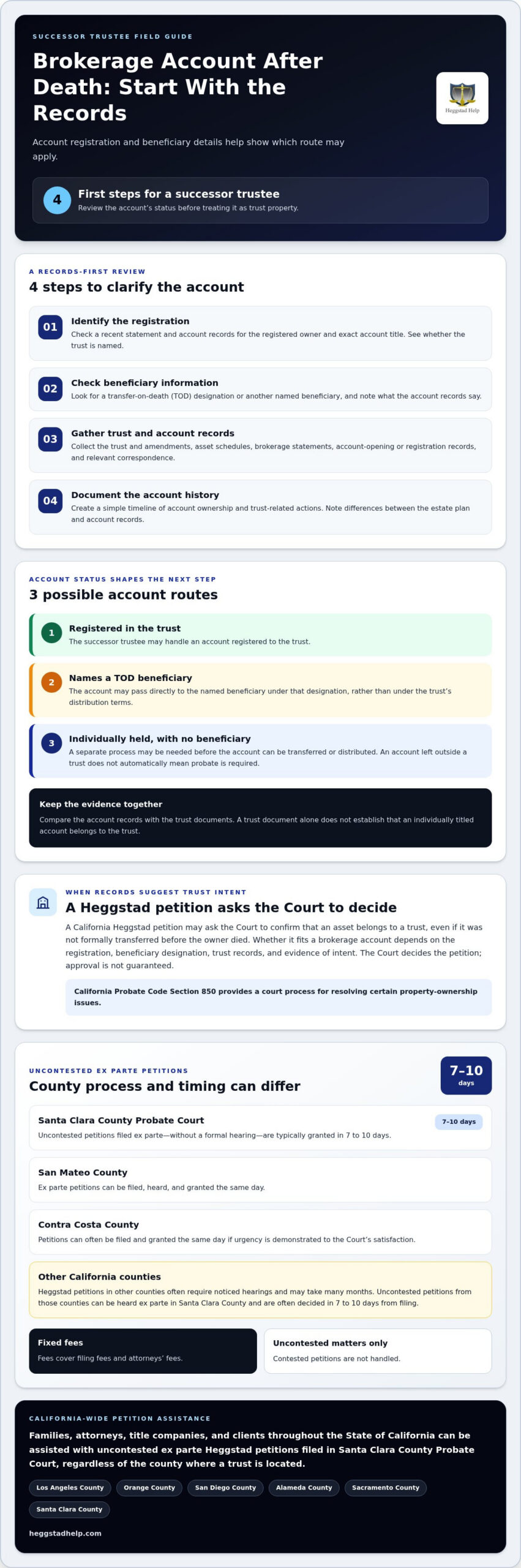
Selling a House Left Out of a California Trust

You finally have a buyer for your loved one’s home, but then the title company delivers the crushing news: the house was never deeded to the trust,…

You finally have a buyer for your loved one’s home, but then the title company delivers the crushing news: the house was never deeded to the trust, and escrow is frozen. It’s a common nightmare where you’re told a house not in trust can’t sell California real estate without a full probate process lasting over a year. You’re likely feeling the weight of managing an empty property while facing a daunting legal hurdle that seems to have no end in sight.

We understand this frustration, but a title error doesn’t have to mean a 12-to-18 month delay. You can often legally fix this using a Heggstad petition (a court order that confirms an asset belongs in a trust even if the deed was never updated). As a Board-Certified Specialist, Robert P. Bergman helps families across California navigate this process with a transparent, fixed-fee structure that covers both filing and attorney fees.

In this guide, you’ll learn how to bypass full probate and secure a court order to finalize your sale. We’ll explain how we achieve same-day results in San Mateo County or 7 to 10 day turnarounds in Santa Clara County. We’ll even show how cases from other counties can often be heard quickly in Santa Clara to avoid the months of waiting typical in other jurisdictions.

Key Takeaways

  • Discover why a house not in trust can’t sell California property and how an “unfunded trust” creates a roadblock for title companies during escrow.
  • Learn how a Heggstad Petition under Probate Code Section 850 can legally transfer a home into a trust after death by proving the owner’s original intent.
  • Find out how specific counties like San Mateo and Santa Clara allow for accelerated “ex parte” orders that can fix title issues in as little as one to ten days.
  • Identify the essential evidence required to win your case, including the “Schedule of Assets” and broad “General Assignment” language found in many trust documents.
  • Understand the advantages of working with a Board-Certified Specialist who offers a fixed-fee structure covering both attorney fees and court filing costs.

The Unfunded Trust Crisis: Why You Can’t Sell the House

Imagine you’ve signed a listing agreement and found a motivated buyer; then the title company calls with bad news. They’ve discovered that while your parents had a trust, they never actually deeded the family home into it. This situation creates what we call an "unfunded trust." In simple terms, an unfunded trust occurs when someone creates the legal document but fails to complete the funding (the formal process of transferring legal title from an individual name to the trust’s name). It’s a common mistake that brings real estate transactions to a grinding halt.

This oversight is the primary reason why a house not in trust can’t sell California real estate without court intervention. Even if the trust document explicitly names you as the Successor Trustee and grants you the "power to sell" all assets, that power only applies to assets the trust actually owns. Because the deed still lists the deceased individual as the owner, the title company cannot legally recognize your authority to sign closing documents. This roadblock often stems from a simple oversight; perhaps a bank required the house be moved out of the trust during a refinance and it was never moved back, or a DIY trust kit was completed without recording the necessary deeds at the County Recorder’s office. The same funding problem that affects real estate can also impact other estate assets, and families dealing with forgotten LLCs or business accounts may need to transfer business interest to trust after death in California using the same Heggstad petition process.

How to Check the Current Title Status

If you’re unsure about the status of a property, your first step should be to obtain a Preliminary Title Report (a document prepared by an escrow or title company that shows the current owner and any liens on the property). Look specifically for the "Grantee" section. If the Grantee is listed as an individual name rather than "The [Name] Family Trust," the property is unfunded. Many people assume that listing the house on a "Schedule of Assets" (a list of items intended to be in the trust) is enough to transfer ownership. Unfortunately, for California real property, a written list does not replace the requirement for a recorded deed.

The Legal Consequences of an Unfunded Home

When a house not in trust can’t sell California law typically points toward a default path: full probate administration. This is a court-supervised process that can easily take 12 to 18 months to complete. Until the title is corrected, the property is essentially frozen. You cannot legally finalize a sale, and the expenses of maintaining an empty home continue to mount while legal issues linger. You don’t have to accept this "probate nightmare" as your only option. At Heggstad Help, we specialize in assisting attorneys, title companies, and families with a faster alternative that corrects these title errors through a fixed-fee structure that covers both filing and attorney fees, ensuring transparency and peace of mind.

Heggstad Petitions: The California Solution for Missing Assets

When a title company informs you that a house not in trust can’t sell California real estate, the most efficient path forward is often a Heggstad Petition. This legal request, filed under California Probate Code Section 850, asks the court to confirm that a property belongs in a trust even if the deed was never formally updated. It’s a powerful tool because it focuses on the decedent’s intent rather than just the paperwork. If you can show the court that the owner meant for the house to be trust property, the judge can issue an order that functions just like a recorded deed. This process acts as a vital shortcut, allowing you to bypass the multi-step probate process and move straight to a court order that satisfies title insurance requirements. Learn how a Heggstad Petition saves time compared to probate and keeps your real estate transaction on track.

Eligibility Requirements for a Heggstad Petition

To successfully file this petition, certain criteria must be met. First, a written trust document must exist; you cannot use this process for a purely oral agreement. Second, you must provide evidence of intent. This is typically found in a "Schedule of Assets" (a list attached to the trust) or specific language within the trust document itself that mentions the property. Finally, the petition must be filed in the proper venue, which is usually the county where the property is located or where the trust is currently being administered. If you’re dealing with a stalled sale, you may want to consult a specialist to review your trust documents for these specific requirements.

Small Estate Alternatives in 2026

Some families wonder if they can use a simpler Small Estate Affidavit instead of a Heggstad Petition. However, California sets strict financial thresholds for these affidavits based on the date of death. For individuals dying on or after April 1, 2025, the small estate threshold is $208,850. For those dying on or after April 1, 2026, the threshold increases to $239,700. Since most California real estate values far exceed these amounts, a Heggstad Petition is usually the only viable alternative to full probate. Consider the financial impact: a standard probate for a $1 million home can result in a 4% statutory fee (the fee set by law) totaling $40,000 or more in combined costs. In contrast, our fixed-fee Heggstad services provide a much more cost-effective way to correct the title and finalize your home sale.

Timelines: How Quickly Can You Fix the Title and Sell?

Speed is the primary concern when a house not in trust can’t sell California real estate. While standard probate administration often drags on for 12 to 18 months, a Heggstad Petition offers a significantly faster route. The actual duration of your case depends largely on whether the petition is uncontested and which county court handles the filing. Our goal is always to secure a "Confirmation of Trust Assets" court order, which provides the legal certainty title companies require to close escrow and finalize the sale.

In most California counties, a "noticed hearing" (a scheduled court appearance where all interested parties are formally notified of the legal action) is the standard requirement. This process typically takes 30 to 60 days, plus the additional time required for legal notice. If heirs or beneficiaries disagree on the property’s status, the case becomes contested, which can lead to significant delays. However, for most families dealing with a simple paperwork error, we can often utilize "ex parte" procedures (legal actions taken without a formal, long-lead hearing) to move much faster.

County-Specific Speed Lanes in Northern California

We leverage specific court procedures in the Bay Area to move much faster than the standard timeline. In San Mateo County, we can often file, hear, and have an ex parte petition granted on the same day. In Contra Costa County, same-day grants are also possible if we demonstrate "urgency" to the court’s satisfaction, such as a pending escrow with a buyer who is ready to walk away. Santa Clara County is also remarkably efficient; uncontested petitions there are typically decided and granted within 7 to 10 days of filing.

The ‘Santa Clara Advantage’ for Other Counties

This is where our specialized knowledge provides a distinct benefit for clients outside of Northern California. If you’re dealing with a property in Los Angeles, San Diego, or other counties with significant court backlogs, a noticed hearing might take many months. This delay is often unacceptable when a house not in trust can’t sell California property because the buyer might lose their mortgage rate lock or find another home.

There’s a strategic solution to this problem. Uncontested Heggstad petitions for properties located in those other counties can often be heard ex parte in Santa Clara County instead. This allows us to secure a court order in just 7 to 10 days rather than waiting half a year or more in a backlogged Southern California court. By utilizing this "Santa Clara Advantage," we help successor trustees resolve title issues quickly and keep their home sales on track.

Selling a House Left Out of a California Trust

Evidence Required to Win Your Heggstad Petition

Securing a court order depends entirely on your ability to demonstrate "decedent intent" (the clear desire of the person who passed away to have their home owned by the trust). When a house not in trust can’t sell California real estate, the judge needs to see more than just a signature on a trust document. We must present specific evidence that bridges the gap between the trust’s creation and the missing deed. The most powerful piece of evidence is the "Schedule of Assets" (a list typically found at the back of a trust document that identifies which properties are included in the trust estate). If the home’s address or legal description appears on this list, your case for a Heggstad order is very strong.

If a specific list doesn’t exist, we look for "General Assignment" language. This is a broad clause within the trust or a separate document where the creator states they are transferring "all real and personal property" to the trust. While less specific than an address, it serves as a legal catch-all that often satisfies the court’s requirements. This same General Assignment language is equally important when families need to transfer business interest to trust after death in California, covering forgotten LLCs or brokerage accounts alongside real property. To strengthen the case, we frequently include supporting declarations (written statements signed under penalty of perjury) from the attorney who drafted the trust or from witnesses who can testify to the decedent’s wishes. Read our full guide on required evidence for Heggstad Petitions to see how these documents work together.

Document Checklist for Successor Trustees

Gathering the right paperwork early prevents delays in the filing process. You’ll need to provide the following items to your legal specialist:

  • The original Trust Agreement along with any signed amendments.
  • The most recently recorded deed (even if it still shows the individual name of the deceased).
  • The pending Purchase Agreement if the property is currently in escrow and needs a quick resolution.

Common Pitfalls in Evidence

One common hurdle is a missing "Schedule A" or list of assets. Don’t panic if you can’t find this specific page. Even without a perfect "Schedule A," a skilled specialist can often find alternative proof of intent through other trust provisions or external documents. Another potential issue involves conflicting documents, such as a Will written after the trust that seems to give the house to someone else. These complications require careful handling to ensure the Heggstad petition isn’t contested by other heirs. If you’re unsure if your documents are sufficient, you can get expert help with your Heggstad petition to review your evidence before filing.

Next Steps: Fixing the Title with Heggstad Help

When you’re stuck because a house not in trust can’t sell California real estate, the path toward a resolution starts with expert intervention. You don’t need a general practitioner who handles everything from traffic tickets to divorces; you need a specialist who understands the specific "speed lanes" within the California probate court system. Robert P. Bergman is a Board-Certified Specialist in Estate Planning, Trust and Probate Law with over 40 years of experience. Our office assists successor trustees, attorneys, and title companies throughout the state to clear stalled titles and keep escrows moving forward.

We believe in total transparency, which is why we utilize a fixed-fee structure. This single fee covers both the court’s filing fees and all attorney fees required to secure your order. You won’t have to worry about unpredictable hourly billing or surprise costs while you’re already managing the stress of a loved one’s estate. To initiate the process, we offer a simple consultation to review your trust documents and determine the most efficient county for your filing. If you’re ready to move past the legal roadblocks, we’re here to provide a steady, knowledgeable hand.

Why Choose a Specialist Over a Generalist?

Choosing a specialist gives you access to deep knowledge of local court procedures that generalists often overlook. For instance, we know exactly how to navigate the ex parte (emergency) rules in Santa Clara County to secure orders in just 7 to 10 days. We also understand how to help clients with properties in backlogged areas like Los Angeles or San Diego by utilizing the "Santa Clara Advantage," where we file uncontested petitions in Santa Clara to avoid months of waiting. Our goal is always efficiency; we file specifically to avoid the standard, months-long noticed hearing process whenever possible. Learn more about our Heggstad Petition services and how we can accelerate your timeline.

Getting the House Back on the Market

Once the judge signs the Heggstad order, the legal "fix" is nearly complete. We take that signed court order and ensure it is recorded with the County Recorder in the county where the property is located. This recorded order acts as the formal bridge in the chain of title, effectively moving the home into the trust as of the date of the decedent’s death. Many families are surprised to learn that it is possible to transfer real estate to a living trust after death through this court-ordered process, bypassing the need for full probate administration entirely.

At this point, the title is officially "cleared." The title company will recognize the Successor Trustee’s authority to sign the grant deed for the buyer, allowing escrow to close without further delay. You can finally finalize the sale, pay off any remaining property expenses, and distribute the proceeds to the beneficiaries according to the instructions in the trust. It’s the resolution you’ve been waiting for, achieved in weeks rather than years.

Secure Your Property Sale and Protect the Estate

Facing the reality that a house not in trust can’t sell California real estate is stressful, but it’s a solvable problem. By utilizing a Heggstad petition, you can bypass the lengthy probate process and secure the court order needed to clear the title. Your loved one’s original intent, documented in the trust or a schedule of assets, is the key to unlocking this legal shortcut. Whether you’re dealing with a property in San Mateo, Santa Clara, or anywhere else in the state, there’s a path to finalize your home sale in weeks rather than years.

Robert P. Bergman is a Board-Certified Specialist who has spent over 40 years helping families navigate these specific hurdles. We offer a transparent, fixed-fee structure that covers both filing and attorney fees, so you don’t have to worry about hidden costs. With our ability to file ex parte petitions, we can often achieve results in as little as 7 to 10 days. Don’t let a missing deed derail your progress any longer.

Fix Your Trust Title Error Today – Contact Heggstad Help

You’ve already done the hard work of managing the estate; let us handle the technical legal fix to get your property back on the market and your escrow closed.

Frequently Asked Questions

Can I sell a house if the deed is not in the trust’s name?

No, you generally cannot finalize the sale because the title company will refuse to close escrow. Since a house not in trust can’t sell California real estate without a clear chain of title, the Successor Trustee lacks the legal authority to sign the grant deed. You must first correct the title error through a court order, such as a Heggstad Petition, before the sale can proceed.

How long does a Heggstad Petition take in California?

The timeline depends on the county and whether the petition is uncontested. In San Mateo County, we can often have a petition heard and granted the same day. In Santa Clara County, it typically takes 7 to 10 days. Other counties often require a noticed hearing, which usually takes 30 to 60 days plus notice time, though court backlogs can extend this significantly.

What is the cost of a Heggstad Petition versus full probate?

A Heggstad Petition is significantly more affordable than full probate, which involves statutory fees based on the gross value of the estate. For example, a $1 million home in probate could trigger over $40,000 in fees. We provide a fixed-fee structure that covers both filing and attorney fees, offering a transparent and predictable cost compared to the percentage-based fees of probate.

Do I need a noticed hearing to fix a trust title error?

Not always. While many counties default to a noticed hearing (a formal court date scheduled weeks in advance), we can often file uncontested petitions ex parte. This "ex parte" process allows us to seek a court order without a long-lead hearing in specific counties like Santa Clara or San Mateo, drastically shortening the time it takes to clear title.

What is the small estate threshold for California in 2026?

For individuals dying on or after April 1, 2026, the small estate threshold is $239,700. If the individual died on or after April 1, 2025, the threshold is $208,850. Because most California homes are worth more than these amounts, a house not in trust can’t sell California property using a simple Small Estate Affidavit and will require a Heggstad Petition instead.

Can a Heggstad Petition be filed if there is no ‘Schedule A’?

Yes, you can still file even if the "Schedule A" or list of assets is missing. We can often prove the owner’s intent by using "General Assignment" language found within the trust document or by providing supporting declarations from the drafting attorney. A missing list is a common hurdle, but it’s rarely a dead end for a skilled specialist.

Do all beneficiaries have to agree to a Heggstad Petition?

While the law doesn’t strictly require every beneficiary to sign off, the process is much faster if the petition is uncontested. If all beneficiaries agree, we can often use the expedited ex parte procedures mentioned earlier. If someone objects, the case becomes contested, requiring a noticed hearing and a longer legal process to resolve the dispute.

Can I file a Heggstad Petition in Santa Clara for a property in Los Angeles?

Yes, if the petition is uncontested, we can often have it heard in Santa Clara County regardless of where the property is located. This is a major advantage because backlogged courts in Southern California can take many months to hear a case. Filing in Santa Clara allows us to secure a court order in just 7 to 10 days, saving you months of waiting.

Robert P. Bergman, Attorney at Law

Article by

Robert P. Bergman, Attorney at Law

Attorney Robert P. Bergman ("Bob Bergman") has been a Board-Certified Specialist in Estate Planning, Trust and Probate Law since 2011, as certified by the California State Bar Board of Legal Specialization. For several years, Bob has assisted families and the clients of other attorneys with obtaining court orders through Heggstad petitions to avoid the time and expense of Probate administration. Bob is friendly, very approachable, and believes in explaining complex legal topics in clear ordinary language so that his clients understand exactly what they're doing and why they're doing it.
Bob is often able to assist clients who are in other counties than his home county of Santa Clara through his approach to Heggstad petitions.

Disclaimer

This article is for informational purposes only. Nothing in this article is intended to replace legal advice from a competent attorney or be considered legal guidance for anybody's specific legal situation. Nobody should rely on information in this article in making legal decisions without such consultation.

Heggstad Petition Cost vs. Probate Cost California: 2026 Financial Guide

Why would you pay a lawyer $25,000 for an eighteen-month probate process when a single court petition could solve your problem in as little as one…

Why would you pay a lawyer $25,000 for an eighteen-month probate process when a single court petition could solve your problem in as little as one week for a fraction of the price? If you’ve discovered that a family home or property was left out of a trust, you’re likely feeling the stress of looming statutory fees that can swallow 4% to 8% of the estate’s gross value. It’s an overwhelming situation, but you don’t have to accept the standard 12 to 18 month court delay as your only option. This guide explores the Heggstad petition cost vs probate cost California to show you how a surgical legal strike can protect your inheritance.

We’ll explain how our fixed-fee structure, which covers both filing and attorney fees, offers a predictable and budget-friendly alternative to the traditional probate system. You’ll learn how we assist attorneys, title companies, and families by securing orders in as little as 7 to 10 days in Santa Clara County, or even same-day grants in San Mateo and Contra Costa. Whether you’re navigating the 2026 small estate threshold of $239,700 or a multi-million dollar residence, we’ll outline the exact steps to transfer your assets quickly and privately without the public burden of a full probate administration.

Key Takeaways

  • Learn how to evaluate the Heggstad petition cost vs probate cost California to avoid statutory fees that often consume 4% to 8% of an estate’s gross value.
  • Discover how ex parte filings, which are petitions decided without a formal hearing, can reduce court wait times from eighteen months to just a few business days.
  • Explore why uncontested petitions in Santa Clara County are typically granted in 7 to 10 days, offering a faster resolution than the months-long wait in other jurisdictions.
  • Identify the correct legal path by checking the updated small estate thresholds, which increase to $239,700 for deaths occurring on or after April 1, 2026.
  • See how our fixed-fee structure provides financial transparency by covering all filing and attorney fees for your trust asset title correction.

Understanding the High Cost of California Probate Administration

California probate is the court-supervised process of identifying, managing, and distributing a deceased person’s assets to their rightful heirs. While a well-structured trust is designed to avoid this system entirely, probate is often triggered when a significant asset, such as a family home, is left out of the trust (a situation frequently referred to as an unfunded trust). When this happens, the law requires a formal court proceeding to transfer the title, which quickly becomes an expensive and public burden for the family.

The primary driver of these expenses is the statutory fee (a mandatory payment set by state law) outlined in California Probate Code Section 10810. Unlike many other legal services where you might negotiate an hourly rate, probate fees are calculated as a fixed percentage of the estate’s value. A critical and often frustrating detail for families is that these fees are based on the gross estate value (the total market value of the property) rather than the net value. This means if a house is worth $800,000, the court calculates fees on that full amount, even if there is a $700,000 mortgage still owed on the property. When evaluating a Heggstad petition cost vs probate cost California, this distinction alone can save a family tens of thousands of dollars.

The 2026 Statutory Fee Schedule

The state uses a tiered system to determine these costs: 4% of the first $100,000; 3% of the next $100,000; and 2% of the next $800,000. Both the attorney and the executor (the person appointed to manage the estate) are each entitled to these full fees. For a standard $1,000,000 California home, the attorney receives $23,000 and the executor receives $23,000. This results in a combined $46,000 in statutory fees before a single other bill is paid.

Hidden Probate Expenses Beyond Statutory Fees

Beyond the mandatory percentages, several administrative costs inflate the final bill. You’ll face court filing fees (typically $435 or more), mandatory publication costs to notify potential creditors, and fees for a probate referee (a court-appointed official who appraises the property). Families also frequently overlook bond premiums and specialized appraisal costs that can add several thousand dollars to the total. Perhaps the most significant hidden cost is the time delay. A typical probate takes 12 to 18 months, during which the family must continue paying property taxes, insurance, and maintenance on a home they cannot yet sell or transfer.

A Heggstad petition, formally known as a petition under California Probate Code Section 850, serves as a specialized legal tool to “re-fund” a trust after the creator has passed away. It addresses a common but stressful problem: an asset that should have been in the trust was left in the deceased person’s individual name. Instead of forcing the entire estate into a year-long probate, this petition asks the court to recognize that the asset already belongs to the trust based on the creator’s clear written intent. When you evaluate the Heggstad petition cost vs probate cost California, the petition stands out as a surgical solution that targets only the missing asset, avoiding the sweeping statutory fees associated with full probate administration.

One of the most frequent reasons families need this service is the “Refinance Trap.” During the mortgage refinancing process, lenders often require homeowners to move their property out of the trust and back into their individual names to finalize the loan. Unfortunately, many homeowners forget to deed the property back into the trust once the paperwork is signed. A Heggstad petition allows a judge to correct this oversight retroactively. By presenting evidence of the owner’s original intent, such as a “Schedule of Assets” attached to the trust or specific language within the trust document itself, we can secure a court order that transfers the title without the need for a full probate proceeding.

Successor Trustee Duties and Asset Recovery

When a trust creator passes away, the successor trustee has a fiduciary duty to identify and secure all trust assets. If a house or bank account was left out of the trust, the trustee’s first priority is title correction. Understanding successor trustee duties for an unfunded trust is essential because failing to act quickly can lead to property tax hikes or complications with title insurance. A Heggstad petition is often the primary mechanism a trustee uses to fulfill these obligations and protect the beneficiaries’ inheritance.

Ex Parte vs. Noticed Hearings

The speed of a Heggstad petition often depends on whether it is filed “ex parte” or as a noticed hearing. An ex parte request is a specialized application for a court order that doesn’t require a formal, scheduled hearing months in advance. In counties like Santa Clara, uncontested ex parte petitions are typically granted in just 7 to 10 days. In San Mateo and Contra Costa, these orders can sometimes be obtained the same day if urgency is shown. In contrast, a standard noticed hearing involves serving notice to all interested parties and waiting for a court date, which usually takes 30 to 60 days plus additional time for notice requirements. For many families, choosing the right procedural path is the key to resolving title issues before a pending home sale falls through. If you aren’t sure if your situation qualifies, you can review the requirements for a Heggstad petition to see if this shortcut is available to you.

Financial Comparison: Heggstad Petition Fees vs. Statutory Probate Costs

While the time saved by a petition is invaluable, the financial contrast is often the deciding factor for families. When analyzing the Heggstad petition cost vs probate cost California, you’re comparing a fixed, predictable expense against a mandatory percentage of the property’s gross value. In a traditional probate, the law dictates exactly how much the attorney and executor receive, leaving no room for negotiation based on the actual work performed. This statutory mandate often results in fees that feel disconnected from the complexity of the estate.

Consider a California home with a fair market value of $750,000. In a standard probate proceeding, the combined statutory fees for the attorney and the executor would total $36,000. Once you add court filing fees, publication costs, and the probate referee’s appraisal fee, the total bill easily reaches $38,000. By contrast, a Heggstad petition is a surgical legal action that bypasses these percentage-based mandates. Instead of losing a massive chunk of your inheritance to the court system, you pay for a specific procedural outcome that restores the house to the trust.

It’s vital to recognize that these savings apply primarily to uncontested petitions where all parties agree the asset belongs in the trust. If a beneficiary objects or a third party claims ownership of the asset, the matter becomes contested litigation. In those specific scenarios, the cost structure changes because the scope of work expands significantly beyond a standard title correction. However, for the vast majority of families dealing with a simple oversight, the petition remains the most cost-effective path forward.

Fixed Fee Predictability

Attorneys, title companies, and private clients frequently prefer our specialized services because of the transparency a fixed-fee model provides. Our approach covers the entire process from start to finish, including the drafting of the petition, the court filing fees, and professional representation. This predictability eliminates the anxiety of hourly billing or surprise administrative costs during a difficult time. For a family already navigating the emotional weight of a loss, knowing the total financial commitment upfront provides a sense of control and psychological relief that the open-ended probate process simply cannot offer.

Why ‘Cheap’ Probate Alternatives Often Fail

It’s tempting to look for “do-it-yourself” legal forms to save money, but real estate title correction is rarely a simple paperwork exercise. Errors in the petition’s language or a failure to meet specific evidentiary requirements can lead to procedural resets or outright denials. A Board-Certified Specialist in Estate Planning understands the nuances of California Probate Code Section 850: A Guide to Real Property Petitions, ensuring the filing is correct the first time. Avoiding a single refiling or a rejected petition often saves more in the long run than any DIY approach could promise.

Heggstad Petition Cost vs. Probate Cost California: 2026 Financial Guide

Timeline Advantages: Ex Parte Filings and County-Specific Speed

Time is often the most expensive factor in estate administration. While the Heggstad petition cost vs probate cost California comparison clearly favors the petition financially, the speed difference is even more dramatic. A standard probate takes at least a year. In contrast, a Heggstad petition can be resolved in days through an ex parte filing for a California ex parte court order on trust assets (a request for a court order without a formal, scheduled hearing). This is a vital tool for families who need to move quickly, especially when a property sale is on the line.

Most people don’t realize they aren’t always stuck with their local court’s slow schedule. In many California counties, a standard noticed hearing takes 30 to 60 days just to get a court date, plus additional time for notice requirements. Some jurisdictions take many months to even look at a file. However, uncontested Heggstad petitions from those slower counties can often be heard ex parte in Santa Clara County instead. This strategy allows a decision to be made within 7 to 10 days of filing, bypassing months of unnecessary waiting and legal friction.

The 7-Day Window in Santa Clara County

Santa Clara County has developed a specialized review process for ex parte petitions. This speed is critical for families trying to sell a house that is currently in escrow. If a title issue isn’t resolved quickly, the buyer might walk away, causing the entire deal to collapse. To qualify for this expedited 7 to 10 day timeline, the petition must remain uncontested. This means all beneficiaries and interested parties agree that the property belongs in the trust, removing the need for a long, public trial.

Demonstrating Urgency in San Mateo and Contra Costa

San Mateo and Contra Costa counties offer even faster results for those in a crisis. In San Mateo County, we can often file, hear, and secure a grant for a petition on the same day. Contra Costa County also permits same-day grants if you can demonstrate urgency to the Court’s satisfaction. Usually, this involves proving a pending real estate sale or a financial hardship that requires immediate access to the property’s value. Generalist lawyers often miss these local rules, but we specialize in navigating these specific court procedures to protect your inheritance. If you’re facing a court delay that threatens your family’s property, you can start your Heggstad petition today to secure a faster resolution.

Choosing the Right Path: When to Use Heggstad Help for Your Estate

Deciding between a full probate, a small estate affidavit, or a Heggstad petition depends entirely on the value of the asset and the evidence of the trust creator’s intent. When you weigh the Heggstad petition cost vs probate cost California, the petition is almost always the superior choice for real estate because it targets the specific title error without exposing the entire estate to statutory fees. However, for smaller bank accounts or personal property, a simpler tool might be available depending on the date of death and the total value of assets held outside the trust.

We assist clients, attorneys, and title companies throughout California by providing a structured, fixed-fee path to title correction. Our role is to act as a steady hand, ensuring that the legal paperwork meets the strict standards required for an ex parte grant. If you’re a successor trustee facing a “refinance trap” property or an attorney looking for a specialized partner to handle a trust funding oversight, choosing the right procedural path is the first step toward a resolution.

The 2026 Small Estate Thresholds

California law allows for a simplified transfer process called a Small Estate Affidavit, but only if the total value of assets outside the trust falls below a specific dollar amount. These figures are adjusted periodically to keep pace with inflation. For individuals who pass away on or after April 1, 2025, the small estate threshold is $208,850. For those dying on or after April 1, 2026, the threshold increases to $239,700.

It’s important to recognize that these thresholds apply to the aggregate value of all non-trust assets. Since the vast majority of California homes are valued well above $239,700, the Small Estate Affidavit is rarely a viable option for real property. If the house was intended for the trust but the title remained in the decedent’s name, the Heggstad petition remains the primary legal mechanism to avoid the high Heggstad petition cost vs probate cost California and the year-long delays of a full probate administration.

Getting Started with a Fixed-Fee Specialist

Before you commit to a legal strategy, it’s helpful to review your documents against a basic eligibility checklist. First, look for written intent, such as a Schedule of Assets or a general assignment of property to the trust. Second, check the trust language for “pour-over” provisions that indicate a desire for all assets to be managed under the trust’s terms. Finally, confirm the asset’s value exceeds the current small estate threshold.

Working with a Board-Certified Specialist in Estate Planning, Trust and Probate Law ensures your petition is drafted with the precision necessary to satisfy a judge’s requirements on the first attempt. Our fixed-fee model covers both filing and attorney fees, providing the financial transparency you need during a difficult transition. By focusing specifically on trust asset title correction, we help you secure the court order you need without the stress of hourly billing or procedural resets. Bypass the probate backlog with a Heggstad Petition today and restore your family’s peace of mind.

Secure Your Inheritance with a Strategic Title Correction

Managing the aftermath of a loss is difficult enough without the added burden of a year-long court battle. By choosing a targeted petition over a full probate, you can bypass the rigid statutory fee system that penalizes families based on the gross value of their property. When you evaluate the Heggstad petition cost vs probate cost California, the path toward a fixed-fee resolution offers both financial clarity and significant time savings. Whether you’re facing a pending home sale or simply want to fulfill your duties as a successor trustee, our specialized approach ensures your trust assets are protected.

Robert P. Bergman, a Board-Certified Specialist with over 40 years of experience, provides the calm competence needed to handle even the most complex title issues. Our fixed-fee structure covers both filing and attorney fees, while our ex parte services offer the possibility of results in as little as 7 to 10 days. You don’t have to wait for the probate backlog to clear before moving forward. You can Schedule a Consultation for a Fixed-Fee Heggstad Petition to begin the process of restoring your trust’s title today. We’re here to act as your steady, knowledgeable guide through every step of this procedural journey.

Frequently Asked Questions

Is a Heggstad petition cheaper than probate in California?

Yes, a Heggstad petition is almost always the more affordable option because it avoids statutory probate fees. While probate costs are calculated as a percentage of the property’s gross value, often totaling 4% to 8% of the estate, our services utilize a fixed-fee structure that covers both filing and attorney fees. This provides predictable budgeting and prevents tens of thousands of dollars from being deducted from the beneficiaries’ inheritance.

How long does a Heggstad petition take compared to probate?

A Heggstad petition is substantially faster, often resolving in days rather than the 12 to 18 months required for a full California probate. In Santa Clara County, uncontested petitions are typically granted in 7 to 10 days. San Mateo and Contra Costa counties can even grant orders on the same day if urgency is shown, whereas standard noticed hearings in other counties can take 30 to 60 days plus notice time.

Can I file a Heggstad petition if I live outside of Santa Clara County?

Yes, you can file a Heggstad petition regardless of where you or the property are located in California. We assist clients statewide by utilizing specific court procedures that allow uncontested petitions from other counties to be heard ex parte (without a formal hearing) in Santa Clara County. This strategy allows you to bypass the months-long delays in your local court and secure a court order in about 7 to 10 days.

What documents do I need to prove a house belongs in a trust?

To prove a house belongs in a trust, you generally need the trust instrument and evidence of the creator’s intent to fund the asset into the trust. This evidence often includes a “Schedule of Assets” (an itemized list attached to the trust document) or a general assignment of property. These documents allow the court to confirm trust ownership and correct the title without requiring a full probate administration.

What is the small estate threshold in California for 2026?

For individuals dying on or after April 1, 2026, the small estate threshold is $239,700. If the person passed away between April 1, 2025, and March 31, 2026, the threshold is $208,850. When analyzing the Heggstad petition cost vs probate cost California, these figures help determine if you can use a simple affidavit or if a petition is required for higher-value assets like real estate.

Can a Heggstad petition be filed if there is no written ‘Schedule A’?

Yes, a petition can often be successful even without a formal “Schedule A” list. The court looks for any clear written intent, such as a general assignment of all assets to the trust or specific language within the trust document itself. If the paperwork demonstrates that the owner intended for the trust to hold the property, a judge can grant the petition to correct the title retroactively.

Does a Heggstad petition work for brokerage accounts and bank accounts?

Yes, Heggstad petitions are effective for brokerage accounts, bank accounts, and other financial assets that were mistakenly left in an individual’s name. While real estate is the most common use, any asset that should have been titled in the name of the trust can be captured by the trust through this court order. This avoids the need for a separate probate process for those specific accounts.

What happens if a family member objects to the Heggstad petition?

If a family member objects, the petition becomes a contested matter and moves from an expedited ex parte process to a formal trial track. Contested petitions take much longer than the typical 30 to 60 day noticed hearing timeline and involve higher legal costs due to the increased complexity of litigation. Most petitions we handle remain uncontested, allowing for the rapid results and fixed fees that benefit the entire family.

Robert P. Bergman, Attorney at Law

Article by

Robert P. Bergman, Attorney at Law

Attorney Robert P. Bergman ("Bob Bergman") has been a Board-Certified Specialist in Estate Planning, Trust and Probate Law since 2011, as certified by the California State Bar Board of Legal Specialization. For several years, Bob has assisted families and the clients of other attorneys with obtaining court orders through Heggstad petitions to avoid the time and expense of Probate administration. Bob is friendly, very approachable, and believes in explaining complex legal topics in clear ordinary language so that his clients understand exactly what they're doing and why they're doing it.
Bob is often able to assist clients who are in other counties than his home county of Santa Clara through his approach to Heggstad petitions.

Disclaimer

This article is for informational purposes only. Nothing in this article is intended to replace legal advice from a competent attorney or be considered legal guidance for anybody's specific legal situation. Nobody should rely on information in this article in making legal decisions without such consultation.
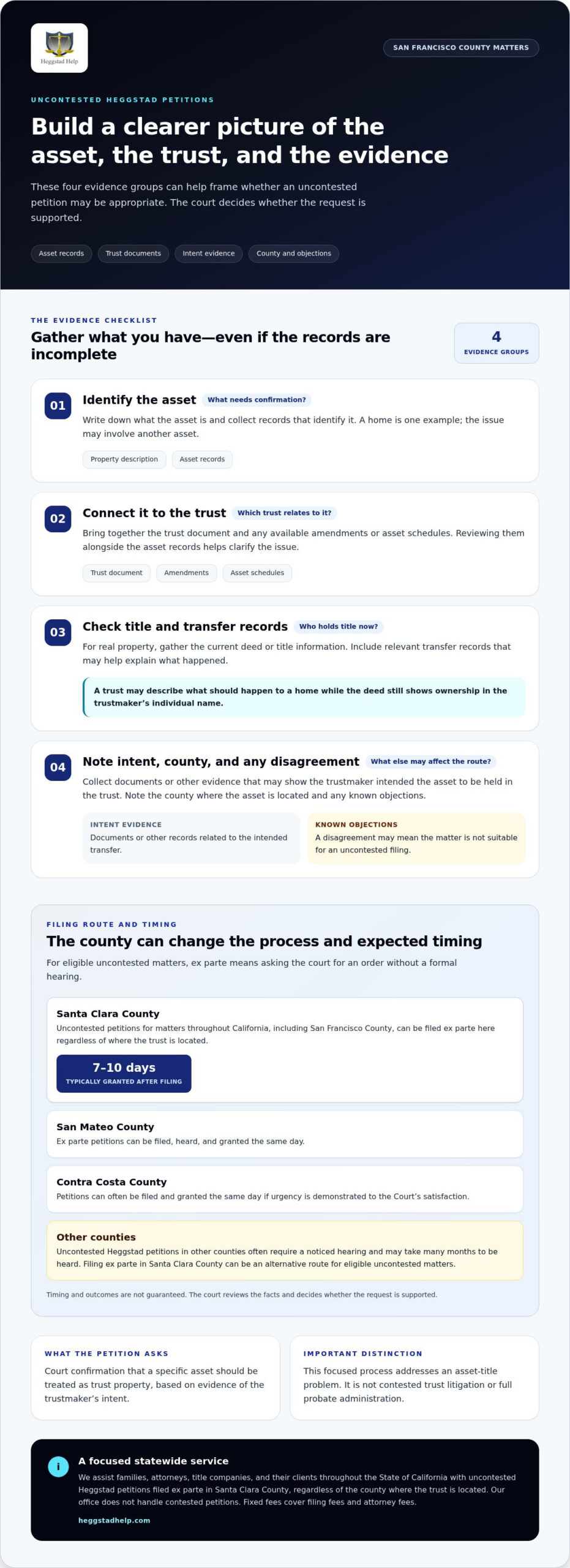
Heggstad Petition Los Angeles County: How to Fix a Missing Trust Asset Without Probate (2026 Guide)

A single missing signature on a deed doesn’t have to mean two years of probate court delays and thousands of dollars in lost fees. If you’ve…

A single missing signature on a deed doesn’t have to mean two years of probate court delays and thousands of dollars in lost fees. If you’ve discovered an asset was left out of a trust in Los Angeles County, the prospect of facing the 18-month backlog at the Stanley Mosk Courthouse is understandably daunting. Most families worry about the high statutory costs and the complex paperwork required to fix title issues. However, filing a **Heggstad petition **offers a streamlined path to confirm the asset belongs to the trust, effectively bypassing the traditional probate marathon.

We believe that legal solutions should be accessible and reassuring rather than cold or detached. In this 2026 guide, you’ll learn exactly how to recover property and correct real estate titles using this specialized court order. We’ll also cover critical updates, such as the California small estate thresholds of $208,850 for deaths on or after April 1, 2025, and $239,700 for those occurring on or after April 1, 2026. This overview provides a clear, logical progression from procedural confusion to a successful resolution for your trust assets.

Key Takeaways

  • Bypass the 18-month probate backlog at Stanley Mosk by using a Heggstad petition to confirm trust ownership of missing assets.
  • Gather written evidence like an asset list (Schedule A) or a General Assignment to prove the decedent’s intent to include the property in their trust.
  • Benefit from transparent, fixed-fee pricing that covers both filing and attorney fees for your ex parte (expedited) court order.
  • Identify if you meet the 2026 small estate threshold of $239,700 (or $208,850 for 2025) to determine the most efficient path for asset recovery.

Understanding the Heggstad Petition in Los Angeles County

Discovering that a family home or a significant bank account was never officially transferred into a trust is a common hurdle for many Los Angeles County families. If you find yourself in this position, you don’t necessarily have to resign yourself to the two-year probate process at the Stanley Mosk Courthouse. A **Heggstad petition **is a specific legal request that asks the court to declare that an asset belongs to a trust, even if the formal title transfer was never completed. This process relies on proving that the person who created the trust intended for that specific asset to be included, despite the clerical error on the deed or account title.

The court prioritizes "intent" over technicalities. If your loved one listed their home on a "Schedule A" (a list of assets attached to the trust) or signed a "General Assignment" stating all their property belongs to the trust, the law often views these documents as sufficient proof. You might encounter this need in several typical scenarios. Perhaps a house was refinanced and the bank required it to be taken out of the trust but it was never put back. Maybe a brokerage account was opened years after the trust was formed and the owner simply forgot to link it. In these cases, a petition can correct the title without the need for a full probate administration.

The Legal Basis: California Probate Code Section 850

The authority for this procedure comes from California Probate Code Section 850. This statute allows the court to "transfer" property to a trustee if there is clear evidence of the decedent’s wishes. The entire concept grew from the landmark Estate of Heggstad case in 1993. That ruling established that a written declaration of trust by the owner of the property is enough to create a trust in that property, even if they don’t sign a separate deed. Our team at Heggstad Help assists attorneys and clients throughout California to use this precedent to fix title errors efficiently.

Why LA Families Choose Heggstad Over Probate

Choosing this path is primarily about saving time and protecting the estate’s value. While a full probate in Los Angeles can drag on for 12 to 18 months, an ex parte (i.e., no format hearing) expedited Heggstad petition can be resolved in as little as 7 to 10 days, if filed in a county like Santa Clara County through our office at Heggstad Help. If the estate is small, you might consider a Small Estate Affidavit instead. However, the thresholds are strict: $208,850 for those dying on or after April 1, 2025, and $239,700 for those dying on or after April 1, 2026. For real estate, which usually exceeds these amounts, a petition is the standard solution.

Cost transparency is another major factor. Traditional probate fees are "statutory," meaning they are calculated as a percentage of the gross value of the estate. This can lead to massive bills for a single house. We provide Heggstad petition filing with fixed fees that cover both the filing and attorney fees, ensuring you know exactly what the process costs from the start. While Los Angeles County has its own pace, our expertise in other counties allows for even faster results. For example, we often see petitions granted in 7 to 10 days in Santa Clara County, or even the same day in San Mateo and Contra Costa Counties when we can demonstrate urgency to the court.

Filing legal documents in a county with over 10 million residents requires an exacting focus on local procedure. When you submit a **Heggstad petition **in Los Angeles County, you aren’t just navigating state law; you’re entering a system that handled 12,051 estate and trust filings in the 2024-2025 fiscal year alone. This volume is larger than the probate caseloads of Orange, Riverside, San Bernardino, and San Diego counties combined. Because of this massive scale, the court system is divided into districts, but almost all trust-related petitions are funneled into the Central District.

Determining the correct venue is your first hurdle. Generally, you must file in the county where the successor trustee of the decedent’s trust is located, even if that is not Los Angeles County. If a successor trustee is from outside of California, in any county where the decedent owned real property is a proper county for venue for a Heggstad petition for. Getting this right is vital because an incorrectly filed petition will be transferred or dismissed, costing you months of time and unnecessary filing fees.

The Role of the Stanley Mosk Courthouse

The Stanley Mosk Courthouse, located at 111 N. Hill St., Los Angeles, CA 90012, serves as the hub for probate matters in the county. Its probate departments are some of the busiest in the world. Judges here manage hundreds of cases simultaneously, which means they have very little patience for incomplete filings. Precision isn’t just a preference; it’s a requirement for a successful outcome in this high-volume environment.

One specific requirement often overlooked by those filing without specialized help is the mandatory local form PRO-010. This is the Probate Case Cover Sheet and Certificate of Grounds for Assignment. It functions as a roadmap for the court clerk, confirming exactly why the case belongs in the Central District rather than a regional branch. If you’re managing this process, remember that all filings in 2026 must be submitted electronically through an approved e-filing service provider. Mistakes on these digital forms can lead to immediate rejections by the clerk’s office.

Avoiding Procedural Delays in LA County

In the Los Angeles system, the "probate note" is either your best friend or your worst enemy. These are notes written by court staff who review your petition several days before your hearing. They highlight missing information or legal flaws that the judge will want you to address. If you don’t check these notes and fix the issues before you appear, the judge will likely "continue" (postpone) your hearing by another 60 to 90 days.

You can view these notes online through the court’s portal, and you should also check for tentative rulings. For those who can’t make it to downtown LA, the court allows remote appearances via LACourtConnect, which doesn’t require a reservation. While the process is rigorous, our team specializes in managing these ex parte court order services to ensure your paperwork is perfect the first time, helping you bypass the common delays that plague unrepresented filers.

Heggstad Petition Los Angeles County: How to Fix a Missing Trust Asset Without Probate (2026 Guide)

Eligibility and Evidence: Does Your LA Property Qualify?

Determining whether your missing asset qualifies for a simplified transfer depends almost entirely on the "paper trail" left behind by the decedent. To succeed with a Heggstad petition Los Angeles filing, you must provide the court with clear, written evidence that the property was intended to be part of the trust. The most common piece of evidence is the "Schedule A," which is the list of assets typically attached to the back of a trust document. If the property address or account number is clearly written on this list, your chances of a successful petition are high. You can review the full Heggstad petition requirements California to see how these evidence standards apply across the state.

Beyond the asset list, judges also look for a "General Assignment" (a legal document stating that all of the person’s assets are transferred to their trust). Even if a specific house isn’t named, a well-drafted General Assignment can act as a safety net. Another helpful tool is a "Pour-Over Will" (a specific type of will that directs any assets left outside of a trust to be "poured" into it upon death). While a Pour-Over Will usually triggers a full probate, it serves as powerful secondary evidence of intent when used in a Heggstad filing.

Real estate presents unique challenges, particularly when a deed was signed but never recorded with the Los Angeles County Registrar-Recorder. If you find an unrecorded deed in a file cabinet or safe deposit box, it serves as nearly indisputable evidence of intent. The court can use your petition to "validate" that deed, effectively backdating the transfer to the trust. This is a common fix for families who realized too late that a title company or attorney missed a filing step years ago.

Common Evidence Used in LA Probate Courts

Success at the Stanley Mosk Courthouse often comes down to the details. Judges look for specific trust language, such as a clause where the creator says, "I hereby transfer my residence at 123 LA Street to my trust." They may also look for estate planning notes, letters to financial advisors, or even emails that discuss moving an account into the trust.

When a Heggstad Petition Might Not Work

This process isn’t a "cure-all" for every missing asset. If there’s absolutely no written mention of the asset in the trust documents or supporting papers, the court cannot guess at the decedent’s intent. Additionally, if other heirs or beneficiaries contest the petition, the case moves from an uncontested matter to trust litigation. At Heggstad Help, we specialize in uncontested ex parte filings, we always provide transparent, fixed fees that cover both filing and attorney fees so you know the cost upfront. If your case is straightforward, we can often secure orders in 7 to 10 days in Santa Clara County, or even the same day in San Mateo and Contra Costa Counties, depending on the court’s schedule.

If you’re unsure if your evidence is strong enough, we can review your documents to see if you qualify for our specialized petition services.

Why a Specialist Matters for Your Heggstad Petition Filing

When filing a **Heggstad petition, **working with a Board-Certified Specialist in Estate Planning, Trust and Probate Law provides a distinct advantage. Judges and court staff recognize this certification as a mark of high expertise, which can lead to a smoother review process. Attorney Robert P. Bergman has specialized in estate planning, including asset recovery and title correction since 1980, bringing over 40 years of specialized experience to every case. This deep familiarity with the system helps prevent the "probate notes" (court corrections) that often sideline unrepresented families for months. Working with a specialized Heggstad petition lawyer rather than a general probate attorney can make the critical difference between a swift resolution and months of unnecessary delays.

The "Ex Parte" Advantage

One of the primary ways we help families avoid the 12 to 18 month probate wait is through ex parte (expedited court hearing) services. An ex parte filing allows us to bypass the standard 60 to 90 day notice period in specific circumstances. For instance, we typically see petitions granted in 7 to 10 days in Santa Clara County. In San Mateo and Contra Costa Counties, we can often have a petition filed and granted on the same day if we can prove the necessary urgency to the court.

Correcting the Title After the Order

The process doesn’t end when the judge signs the order. To truly fix the problem, the court order must be recorded with the County Recorder in the county where the property is located. This title correction ensures that the property is legally held in the name of the trust, allowing the trustee to sell or distribute it as intended.

We believe in complete transparency regarding costs. All of our Heggstad petitions are handled with fixed fees that cover both the filing fees and the attorney fees. This approach eliminates the stress of unpredictable billing and ensures you know the total investment required to recover your family’s assets. Whether the estate is just above the 2026 small estate threshold of $239,700 (or $208,850 for deaths after April 1, 2025) or involves high-value real estate, our goal is a logical, efficient resolution. For Southern California families dealing with unfunded trusts in Los Angeles, understanding your options early can make a significant difference in both time and cost.

Contact Robert P. Bergman for a consultation on your Heggstad petition

Take the First Step Toward Asset Recovery

Recovering a home or account left out of a trust doesn’t have to be an endless battle with the legal system. By choosing a **Heggstad petition, **you can often avoid the high statutory fees and the 18-month wait time often found at the Stanley Mosk Courthouse. Whether you’re dealing with an unrecorded deed or a missing brokerage account, the right evidence can secure a court order that corrects the title and honors your loved one’s true intent.

Robert P. Bergman is a California Board-Certified Specialist with over 40 years of probate experience and an exclusive focus on asset recovery. This specialized knowledge allows for a logical path through complex procedural hurdles, often utilizing ex parte filings to expedite your resolution. We provide complete transparency with fixed fees that cover everything from filing to attorney costs, ensuring you can move forward with confidence. Get Expert Help with Your Heggstad Petition today. You have the tools to protect your family’s legacy, and we’re here to guide you every step of the way.

Frequently Asked Questions

How long does a Heggstad petition take in Los Angeles County?

An uncontested petition in Los Angeles usually takes 2 to 4 months from the initial filing to the final court order. This is significantly faster than the 12 to 24 months required for a full probate administration at the Stanley Mosk Courthouse. Regardless, we can avoid even the 2-to-4 month delay by filing in Santa Clara County, with results in as little as 7 to 10 days.

Where is the Los Angeles probate court located?

All probate matters are filed at the Stanley Mosk Courthouse. The address is 111 N. Hill Street, Los Angeles, CA 90012. Most trust-related petitions are heard within the Central District’s specialized probate departments. Because this is one of the busiest courts in the world, ensure your paperwork is submitted electronically through an approved e-filing service provider to avoid immediate rejection by the clerk’s office.

Can I file a Heggstad petition without a lawyer in LA?

While you can legally file on your own, the high volume of cases in Los Angeles means the court has very little tolerance for procedural errors. Small mistakes on local forms like the PRO-010 can trigger probate notes (written corrections from court staff) that delay your hearing by several months.

What happens if the house was never deeded to the trust?

If a house was never deeded to the trust, the court can issue an order transferring the title if you can prove the decedent intended for the property to be a trust asset. The court looks for written evidence, such as the property being listed on a Schedule A (the list of assets attached to the trust). If the total value of assets outside the trust is below the small estate threshold, which is $239,700 for deaths on or after April 1, 2026, or $208,850 for deaths after April 1, 2025, you might have other options, but real estate almost always requires a court order.

Robert P. Bergman, Attorney at Law

Article by

Robert P. Bergman, Attorney at Law

Attorney Robert P. Bergman ("Bob Bergman") has been a Board-Certified Specialist in Estate Planning, Trust and Probate Law since 2011, as certified by the California State Bar Board of Legal Specialization. For several years, Bob has assisted families and the clients of other attorneys with obtaining court orders through Heggstad petitions to avoid the time and expense of Probate administration. Bob is friendly, very approachable, and believes in explaining complex legal topics in clear ordinary language so that his clients understand exactly what they're doing and why they're doing it.
Bob is often able to assist clients who are in other counties than his home county of Santa Clara through his approach to Heggstad petitions.

Disclaimer

This article is for informational purposes only. Nothing in this article is intended to replace legal advice from a competent attorney or be considered legal guidance for anybody's specific legal situation. Nobody should rely on information in this article in making legal decisions without such consultation.

How to Fix Trust Title Errors on California Real Property: A 2026 Legal Guide

Imagine you have finally found a buyer for your late parent’s home, only to have the title company halt the sale because the deed was never formally…

Imagine you have finally found a buyer for your late parent’s home, only to have the title company halt the sale because the deed was never formally moved into the trust. This discovery often brings the severe consequences of incorrect trust property title California families face into sharp focus, potentially triggering a probate process that can last 12 to 18 months. It’s a stressful situation, especially when you are already dealing with the loss of a loved one and the weight of technical terms like vesting (the legal way a property’s ownership is officially recorded on a deed).

You likely want a solution that avoids the high costs of a traditional court case. This guide will teach you how to identify title mistakes and correct them using a Heggstad petition, which is a specialized court order used to confirm assets as trust property. We’ll explain how to bypass full probate, whether your situation qualifies for an ex parte (a request for a court order without a formal hearing) filing, and how counties like San Mateo can often grant these the same day. You’ll also learn about the 2026 small estate threshold of $239,700 and how fixed fees help attorneys and clients move forward with confidence.

Key Takeaways

  • Discover why a California trust cannot technically hold title and how incorrect vesting (the legal way ownership is listed) often leads to rejected deeds at the title company.
  • Understand the severe consequences of incorrect trust property title California families face, including a frozen chain of title that prevents you from selling or refinancing the home.
  • Learn how to use a Heggstad petition to fix an “unfunded” trust without a 12-month probate, specifically through fast-tracked ex parte filings (court orders granted without a formal hearing).
  • Identify if your estate qualifies for simplified procedures based on the 2026 threshold of $239,700 for those dying on or after April 1, 2026.
  • Get clarity on costs with fixed-fee arrangements that cover both filing and attorney fees, ensuring there are no hidden financial surprises during the legal process.

Understanding Trust Title Errors: Why Your Deed Might Be Invalid

When you examine a property deed, you are looking at the “vesting” (the formal legal method through which ownership is officially recorded). A common misconception is that a trust is a distinct legal entity, similar to a corporation, that can own property in its own name. In reality, a trust is a fiduciary relationship. One of the most significant consequences of incorrect trust property title California homeowners encounter is a “clouded” title that prevents a house from being sold or refinanced. This occurs because California law dictates that a trust cannot hold title; only the trustee (the person or entity managing the trust assets) can hold the legal title to the property.

To understand why this matters, it helps to look at What is a Trust in Property Law to see the distinction between legal and equitable title. The trustee holds the legal title, which provides the authority to sign deeds and manage the asset. The beneficiaries hold the equitable title, which gives them the right to benefit from the property. If a deed is made out to “The Miller Family Trust” instead of “John Miller, as Trustee of the Miller Family Trust,” the chain of title is technically broken. The “vesting deed” must clearly show that the trustee has the legal power to act, or title insurance companies will likely refuse to clear the transaction.

The Trust vs. Trustee Distinction

Naming the trust itself as the owner is a frequent error that can lead to a rejected sale. While the 2023 case Boshernitsan v. Bach provided some relief by suggesting that courts can look at the intent of the parties, title companies remain extremely risk-averse. They often require a court order to prove the property is actually a trust asset. If you find yourself in this position, Heggstad Help can assist in securing an ex parte (a request for a court order without a formal hearing) order to resolve the discrepancy quickly.

Common Scenarios for Title Mistakes

Errors often stem from simple human oversight or technical lapses. You might find typographical errors in the trust’s name or the date the trust was created, which creates a mismatch with the trust documents. In other cases, a deed was simply never recorded after the trust was signed, leaving the trust “unfunded.” This is particularly problematic if the estate’s value exceeds the California small estate thresholds ($208,850 for deaths on or after April 1, 2025, and $239,700 for those on or after April 1, 2026). Additionally, deeds that still name a predecessor trustee who has since passed away can halt a sale until a successor trustee’s authority is legally confirmed. The same Heggstad petition process that resolves real estate title errors also applies to business interests, such as when transferring an LLC to trust after death in California becomes necessary because a membership interest was never formally moved into the living trust.

Fixing these errors doesn’t have to take years. While a noticed hearing can take 30 to 60 days, we specialize in fast-tracking uncontested petitions. In Santa Clara County, these are typically granted in 7 to 10 days. In San Mateo and Contra Costa Counties, we can often have them filed and granted the same day, provided we can demonstrate urgency to the court. Our services use fixed fees that cover both the filing fees and attorney fees, so you don’t have to worry about escalating legal costs while trying to secure your property’s title.

Consequences of Incorrect Trust Property Title in California

Discovering an error on a property deed usually happens at the worst possible moment, such as during the final days of an escrow period. The consequences of incorrect trust property title California residents face are not merely clerical; they can halt a multi-million dollar sale or prevent a family from accessing their inheritance for years. When the “chain of title” (the historical record of property ownership) is broken by an incorrect vesting, the property is effectively frozen. Title insurance companies will refuse to issue a policy on what they call a “dirty” title, meaning the buyer cannot secure a loan and the seller cannot transfer the home.

Lenders are equally strict. If you’re trying to refinance a home held in a trust, the bank’s underwriters will scrutinize the deed to ensure the trustee has the legal authority to pledge the property as collateral. If the vesting is technically incorrect under the California Probate Code on Trust Law, the lender will likely deny the application until a court order corrects the record. This creates a significant roadblock for families who need to access home equity for medical expenses or other urgent needs.

The most expensive consequence is the “probate trap.” If a property owner dies with a title error that leaves the home outside the trust, the property may be forced into full probate administration. In California, a standard probate for a $1 million home can take 9 to 18 months and cost upwards of $46,000 in statutory fees (fees set by law that both the attorney and executor are entitled to receive). This is a stark contrast to the fixed-fee Heggstad petition process, which resolves the issue in a fraction of the time. Additionally, improper title transfers can trigger a loss of Proposition 19 protections. For 2026, the exclusion for an inherited primary residence is capped at the parent’s assessed value plus $1,044,586; a title error that results in a “change in ownership” could lead to a massive property tax reassessment.

Why Title Companies Reject Incorrect Vesting

Title officers flag errors when the deed names an entity that cannot legally hold title, such as the trust itself rather than the trustee. This places the property “outside the chain of title,” making it impossible for the officer to verify who actually has the power to sign the closing documents. While a “Correction Deed” (a document used to fix minor typos) might work for a misspelled name, it cannot fix a situation where the property was never transferred to the trust in the first place, especially if the original grantor is deceased and cannot sign a new deed. Understanding common California trust funding mistakes before they occur is the most effective way to prevent your family from facing this exact scenario.

The Financial and Time Costs of Inaction

Ignoring a title error only makes the eventual fix more expensive and time-consuming. A full probate process in Los Angeles or the Bay Area can stretch toward two years, while an uncontested Heggstad petition can often be resolved in 60 to 90 days. If you’re managing an estate with missing assets, you can find more details in our guide on Successor Trustee Help for Missing Assets. If you’re unsure if your deed is valid, reviewing our specialized Heggstad petition services can provide clarity. Remember that in counties like Santa Clara, we can often secure these orders in 7 to 10 days, and in San Mateo or Contra Costa, we can occasionally achieve same-day results for urgent cases.

Identifying the Right Fix: Simple Deed Corrections vs. Heggstad Petitions

Fixing a title error requires a clear understanding of whether you are dealing with a minor clerical slip or a fundamental failure to “fund” (transfer ownership into) the trust. If you choose the wrong remedy, you could waste months in administrative loops while the consequences of incorrect trust property title California laws impose continue to stall your home sale. Generally, the path you take depends on whether the error is a “scrivener’s error” (a simple typo made by the person drafting the document) or a complete omission of the property from the trust’s legal chain of ownership.

For major errors where a property was left out of the trust entirely, the legal engine for a fix is Probate Code Section 850. This section allows a judge to declare that a property belongs in a trust even if the deed was never recorded. This is commonly known as a Heggstad petition. Because we specialize in this niche, we often utilize ex parte (a request for a court order without a formal hearing) filings to bypass the standard court calendar. While a noticed hearing might take 60 days, our ex parte expertise allows us to secure orders in Santa Clara County within 7 to 10 days. In San Mateo and Contra Costa Counties, we can often have petitions filed and granted the same day, provided we can show the court a sense of urgency, such as a pending home sale.

When a Correction Deed Works

A Correction Deed is a simple document used to fix minor mistakes like a misspelled name or an incorrect trust date on an existing deed. This is a cost-effective solution, but it has one strict limitation: all parties, including the grantor (the person giving the property) and the grantee (the person receiving it), must be alive to sign the new document. If the original owner has passed away, you cannot simply “correct” the deed because the person with the legal authority to grant the property is no longer here. In these cases, a simple affidavit won’t satisfy a title company, and a court order becomes necessary.

When You Need a Heggstad Petition

If the property was never deeded to the trust at all, you must prove the owner’s intent to include it. This often involves using a “General Assignment” (a document stating all assets are moved to the trust) or a “Schedule A” (the list of assets typically found at the back of a trust document). As noted in this Heggstad petition guide, this process is the primary way to avoid a 12-month probate for an unfunded California home. The same petition process applies equally when transferring an LLC to trust after death in California, where a deceased owner’s membership interest was never formally assigned to the trust.

Using this petition is vital if the property value exceeds the small estate threshold, which is $208,850 for deaths on or after April 1, 2025, and increases to $239,700 for those on or after April 1, 2026. At Heggstad Help, we provide these services with fixed fees that cover both the attorney fees and court filing fees. This transparency ensures you know the total cost upfront while we work to secure your property’s chain of title through the most efficient legal channels available.

How to Fix Trust Title Errors on California Real Property: A 2026 Legal Guide

Step-by-Step Guide to Correcting California Trust Title Issues

Correcting a title error requires a methodical approach to satisfy both the court and the title insurance company. When you’re managing the consequences of incorrect trust property title California law creates, you need a clear path to move from a rejected deed to a clean title. Following a structured sequence helps you avoid the “probate trap” and ensures your property is legally secured within the trust’s protection. Here’s how to navigate the process effectively.

The first step is gathering the “smoking gun” evidence that proves the property was intended to be part of the trust. You’ll need the original trust document and any specific evidence of intent, such as a “Schedule A” (the list of assets intended for the trust) or an “Omnibus Assignment” (a document that assigns all current and future property to the trust). If you’re looking for specific evidence tips, our guide on Deed Not Recorded to Trust in California: Legal Remedies provides a deep dive into what courts look for. Once the evidence is in hand, you must determine the best legal vehicle for the fix.

Evaluating the Estate Value

Before filing a court petition, it’s essential to check if the estate qualifies for simplified procedures. For deaths occurring on or after April 1, 2025, the Small Estate Affidavit threshold is $208,850. This limit increases to $239,700 for deaths occurring on or after April 1, 2026. While these thresholds are helpful for bank accounts or vehicles, California real estate almost always exceeds these limits. Because the home’s value usually pushes the estate over the threshold, a Heggstad petition under Probate Code Section 850 is typically the only way to avoid a full, 12-month probate administration. Reviewing a comprehensive checklist of California trust funding mistakes to avoid in 2026 can help successor trustees identify gaps before they become costly legal problems.

Gathering Evidence of Intent

Successor trustees should search the decedent’s estate planning binder for an “Assignment of Assets” or a “Purpose” clause within the trust itself. These clauses often state that the person intended to include all their real property in the trust. This documentation is vital because it allows us to prepare a petition that clearly demonstrates the owner’s intent to the judge. By presenting a strong case, we can often file these petitions ex parte (a request for a court order without a formal hearing), which significantly speeds up the timeline.

Efficiency is our priority. In Santa Clara County, we typically see petitions granted in 7 to 10 days. In San Mateo and Contra Costa Counties, we can often have a petition filed and granted on the same day, provided we can show the court a clear sense of urgency. Once the judge signs the order, the final step is recording a certified copy of that order with the County Recorder to officially “clean” the title. We handle this entire process through our Heggstad petition services, using a fixed-fee model that covers all filing and attorney costs so you have total price transparency from day one.

Fast-Tracking Your Title Correction with Heggstad Help

One of the most daunting consequences of incorrect trust property title California families deal with is the prospect of a long, drawn-out probate. While a general probate lawyer might guide you through a process that lasts 12 to 18 months, a specialist focusing on Heggstad petitions operates on a completely different timeline. By narrowing our focus to trust title corrections, we’ve developed a methodical approach that prioritizes speed and precision. We assist attorneys, title companies, and private clients throughout the state to resolve these issues before they cause a real estate transaction to collapse.

Our service model is built on transparency, which is why we utilize a fixed-fee structure. This single fee covers both the court’s filing fees and all attorney fees, ensuring you won’t face unexpected bills as your case progresses. This clarity is especially important when you’re managing an estate that exceeds the California small estate thresholds ($208,850 for deaths on or after April 1, 2025, and $239,700 for those on or after April 1, 2026). When real estate values push an estate over these limits, our specialized knowledge becomes the most efficient tool for securing the property’s chain of title.

The Ex Parte Advantage

The secret to our speed lies in our expertise with ex parte (a request for a court order without a formal hearing) filings. By presenting an uncontested petition directly to a judge, we can often bypass the standard 30 to 60 day notice period required for formal hearings. This regional efficiency is a hallmark of our practice. In Santa Clara County, we typically see petitions granted in just 7 to 10 days. In San Mateo and Contra Costa Counties, we can often file and receive a granted order on the same day, provided we can demonstrate a clear sense of urgency to the court. This rapid resolution is essential for successor trustees who are in the middle of a 30-day escrow.

Ready to Secure Your Trust Property?

Waiting to fix a title error is a risky strategy. As time passes, evidence of intent can be lost, and the legal hurdles only become more complex. Robert P. Bergman uses over 40 years of specialized experience to navigate the intricacies of the California court system, ensuring that your property is legally confirmed as a trust asset without the need for full probate administration. If you’re facing a rejected deed or a clouded title, taking action now can save your family tens of thousands of dollars in statutory probate fees. You can take the first step toward a resolution today and Get a Fixed-Fee Quote for Your Heggstad Petition.

Securing Your Real Estate Legacy Without the Probate Delay

Vesting errors on a deed don’t have to result in a multi-year legal nightmare for your family. By understanding the severe consequences of incorrect trust property title California law imposes, you can take the necessary steps to restore your property’s chain of title. The Heggstad petition remains the most powerful tool for successor trustees to fix “unfunded” trusts and avoid the high costs of full probate administration. Whether you’re navigating the 2026 small estate thresholds or racing against a 30-day escrow, a specialized court order provides the finality you need.

We assist families, title companies, and attorneys statewide by leveraging regional court efficiencies. Our team provides ex parte expertise that can secure orders in 7 to 10 days in Santa Clara County, with same-day filing available in San Mateo and Contra Costa Counties when urgency is demonstrated. Led by a California Board-Certified Specialist since 1980, our service uses fixed fees that include all court costs to ensure you have complete financial certainty. You can resolve these title complications quickly and move forward with confidence.

Start Your Heggstad Petition with a Fixed-Fee Specialist

Protecting your property and your beneficiaries’ inheritance is just one step away with the help of a dedicated guide.

Frequently Asked Questions

What is a Heggstad Petition and how does it fix title errors?

A Heggstad Petition is a specific legal request made under Probate Code Section 850 that asks a judge to declare that a property is part of a trust. It fixes title errors by providing a court order that serves as a legal bridge for a broken chain of title (the official record of ownership). This process is essential when the consequences of incorrect trust property title California families face include a rejected home sale due to a deed that was never properly recorded.

How much does it cost to file a Heggstad Petition in California in 2026?

We provide Heggstad Petition services using a transparent, fixed-fee model that covers both the attorney fees and the required court filing fees. This approach eliminates the stress of hourly billing and ensures you know the total cost before the process begins. By choosing a fixed fee, you avoid the unpredictable expenses often associated with traditional probate litigation while working to secure your property’s legal standing.

Can I sell my house while the Heggstad Petition is pending in court?

You can open escrow and find a buyer, but you cannot officially close the sale until the petition is granted and the certified court order is recorded. Title insurance companies require this order to “clean” the title before they’ll issue a policy to the new owner. If you’re in a hurry, we use ex parte (a request for an order without a formal hearing) filings to speed up the court’s decision.

What happens if a deed was never recorded to the trust before the owner died?

If a deed wasn’t recorded, the property is technically “unfunded” and remains in the decedent’s individual name. This often triggers a full probate process unless you file a Heggstad Petition to prove the owner’s intent to include the house in their trust. We look for “evidence of intent” in the trust’s Schedule A (the list of assets) or a general assignment document to convince the judge to move the property into the trust posthumously (after death).

How long does the Heggstad Petition process take in Santa Clara County?

In Santa Clara County, uncontested Heggstad Petitions are typically granted in just 7 to 10 days. This rapid timeline is possible because we specialize in ex parte applications that bypass the standard court calendar. In neighboring counties like San Mateo and Contra Costa, we can often see petitions filed and granted the same day, though Contra Costa requires demonstrating “urgency” to the court to achieve that speed.

Is a Heggstad Petition the same as a full California probate?

No, a Heggstad Petition is a streamlined alternative that is much faster and less expensive than a full probate. While a standard probate can take 12 to 18 months and involves high statutory fees (fees set by law based on the estate’s value), a Heggstad Petition focuses only on the specific title error. It’s a targeted solution designed to resolve the consequences of incorrect trust property title California residents encounter without the burden of a year-long court case.

Can I fix a trust title error if the original grantor is still alive?

If the grantor (the person who created the trust) is still alive and has the mental capacity to sign documents, you don’t need a court petition. You can simply prepare and record a new deed with the correct vesting (the legal way ownership is held) at the County Recorder’s office. A Heggstad Petition is only necessary if the grantor has passed away or is no longer legally able to sign a new deed to correct the mistake.

What is the small estate threshold for California in 2026?

For individuals who pass away on or after April 1, 2026, the California small estate threshold is $239,700. This is an increase from the $208,850 limit set for those dying on or after April 1, 2025. While these thresholds allow for simplified transfers of bank accounts or vehicles, real estate in California almost always exceeds these values, which is why a Heggstad Petition is usually required to move a home into a trust.

Robert P. Bergman, Attorney at Law

Article by

Robert P. Bergman, Attorney at Law

Attorney Robert P. Bergman ("Bob Bergman") has been a Board-Certified Specialist in Estate Planning, Trust and Probate Law since 2011, as certified by the California State Bar Board of Legal Specialization. For several years, Bob has assisted families and the clients of other attorneys with obtaining court orders through Heggstad petitions to avoid the time and expense of Probate administration. Bob is friendly, very approachable, and believes in explaining complex legal topics in clear ordinary language so that his clients understand exactly what they're doing and why they're doing it.
Bob is often able to assist clients who are in other counties than his home county of Santa Clara through his approach to Heggstad petitions.

Disclaimer

This article is for informational purposes only. Nothing in this article is intended to replace legal advice from a competent attorney or be considered legal guidance for anybody's specific legal situation. Nobody should rely on information in this article in making legal decisions without such consultation.
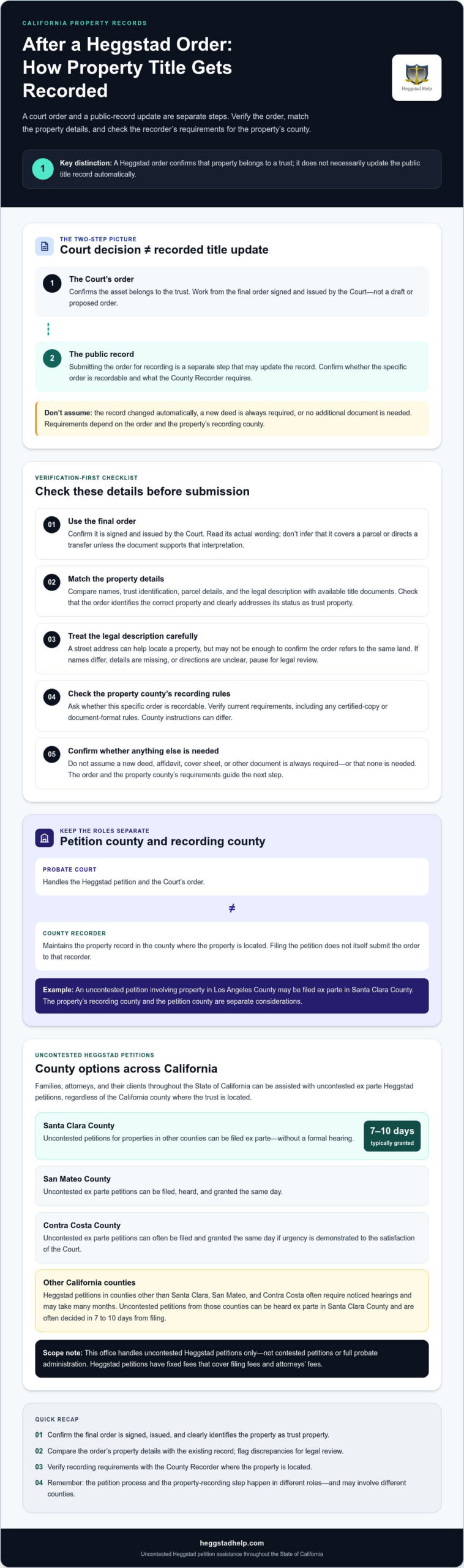
Heggstad Petition vs. Probate in California: 2026 Comparison Guide

What if a single missing signature on a property deed didn’t have to trigger a grueling eighteen-month court battle? You might have recently…

What if a single missing signature on a property deed didn’t have to trigger a grueling eighteen-month court battle? You might have recently discovered that a family home or significant account was never formally titled in the name of a living trust (a legal arrangement where a trustee holds assets for beneficiaries), leaving you facing the daunting prospect of a full court-supervised administration. When weighing the benefits of a Heggstad petition vs probate California, it’s important to realize that a simple administrative oversight doesn’t always require the traditional, expensive, and lengthy probate path.

We understand the anxiety that comes with navigating complex California probate codes while you’re still grieving a loved one. It’s frustrating to realize that a clerical error might subject your family to high statutory fees (set legal costs calculated as a percentage of the estate’s gross value) and public court records. This guide will show you how to bypass those hurdles and transfer assets to the trust in a fraction of the time. We’ll compare the two processes across 2026 court standards, explaining how you can clear title and prepare for a home sale without the typical year-long delay.

Key Takeaways

  • Discover why choosing a Heggstad petition vs probate California can reduce a typical 18-month court process to just a few weeks or even days.
  • Learn how to protect the estate’s value by avoiding statutory probate fees, which are mandatory legal costs calculated as a percentage of the gross value of the property.
  • Identify the Apirl 1, 2026 small estate threshold of $239,700 to determine if you can use a simple affidavit or if a formal court order is necessary for your specific assets.
  • Explore how filing in specific counties like Santa Clara or San Mateo allows for ex parte orders (expedited court rulings) that can clear title in as little as 7 to 10 days.
  • Understand the importance of using specialized legal services to avoid the common procedural errors that lead to court rejections and clouded titles for trust properties.

The ‘Forgotten House’ Dilemma: Heggstad Petition vs. Full Probate Basics

Successor trustees often encounter a frustrating discovery while settling an estate. They find that a primary residence or investment property is still titled in the decedent’s (the person who passed away) individual name rather than the name of their living trust. This discrepancy creates a significant legal hurdle because, without a clear title, the property cannot be sold or distributed to beneficiaries. When you’re faced with this scenario, you generally have two paths: a full probate administration or a Heggstad petition. Understanding the choice between a Heggstad petition vs probate California is the first step toward a more efficient resolution for your family.

Full probate is a comprehensive, court-supervised process used to distribute a deceased person’s estate when no trust exists or when assets are left outside of one. It’s a public and often slow journey through the California court system. Conversely, a Heggstad petition is a specialized legal request filed under California Probate Code Section 850. It asks the court to "transfer" the asset into the trust retroactively by proving it was always intended to be there. In 2026, the concept of "intent" remains the cornerstone of California trust law. If we can demonstrate the grantor (the person who created the trust) intended for the asset to be part of the trust estate, the court has the authority to correct the title without a full probate.

When Assets Are Left Out of a Trust

Funding errors occur more frequently than most families realize. A homeowner might refinance their mortgage and the lender requires the property be moved out of the trust for the transaction, but the deed is never moved back. In other cases, a person might purchase a new property and simply forget to title it correctly at the closing. Often, the trust document includes a "Schedule A" (a list of assets intended for the trust) or a general assignment of assets that clearly mentions real property. If you find yourself in a forgot to put house in trust California situation, don’t assume a year of court delays is inevitable. These documents often provide the necessary evidence to avoid the traditional probate process entirely.

The Legal Basis: California Probate Code Section 850

The modern solution to these errors stems from the landmark 1993 case, Estate of Heggstad. The California Court of Appeal ruled that a written declaration of trust is sufficient to create a trust in real property, even if a formal deed was never recorded. This ruling was eventually codified in Probate Code Section 850, giving the court the power to "perfect" title when evidence of written intent exists. In many instances, we can utilize an ex parte application (a request for a court order made with short notice and without a standard 30-day waiting period) to secure results much faster than traditional litigation. This specialized approach allows us to resolve a Heggstad petition vs probate California dispute with surgical precision, saving both time and estate resources. For a complete walkthrough of each stage, the Heggstad petition process California families must follow is outlined in a detailed 2026 step-by-step guide that covers every filing requirement.

Direct Comparison: Time, Costs, and Privacy in 2026

When evaluating a Heggstad petition vs probate California, the differences are not merely procedural; they represent a fundamental shift in how your family’s resources are preserved. Traditional probate is often described as a ‘sledgehammer’ approach to asset distribution, whereas a Heggstad petition filing acts as a surgical strike, targeting only the specific assets left out of the trust. This precision allows successor trustees to resolve title issues without opening a massive, multi-step court case that could last for years.

Feature Full Probate Administration Heggstad Petition (PC 850)
Typical Timeline 12 to 18 Months 30 to 60 Days (often less)
Legal Fees Statutory (Percentage of gross value) Fixed Fee transparency
Court Appearances Multiple formal hearings Often zero to one hearing
Public Privacy Fully public court record Limited public disclosure

The Cost Difference: Fixed Fees vs. Statutory Percentages

California law dictates statutory fees (mandatory legal costs set by the state) for full probate based on the gross value of the estate. For example, a property valued at $1,000,000 could result in over $46,000 in combined attorney and executor fees, regardless of the mortgage balance. In contrast, specialized firms offer fixed fee transparency, covering both filing and attorney fees in a single, predictable price. To better understand the full breakdown of what families pay, reviewing a detailed guide on Heggstad petition cost California families face can help you plan ahead and avoid unexpected expenses. This avoids the hidden costs of probate, such as appraisal fees, bond premiums (insurance for the executor), and expensive publication costs in local newspapers.

Timeline Realities: 30 Days vs. 12 Months

Standard California probate requires a minimum of one year to complete, largely due to the mandatory ‘Notice to Creditors’ period. This four-month window freezes progress while potential lenders or claimants come forward. A Heggstad petition bypasses this window entirely because the trust is already established and responsible for debts. If you’re working with a specialized firm, you may find that securing an ex parte order can resolve the issue in a a single day in San Mateo County and Contra Costa County, and typically 7-10 days working through Santa Clara County, allowing you to move forward with a home sale or distribution.

Probate is a matter of public record, meaning anyone can view the decedent’s assets, debts, and beneficiary list at the courthouse. Heggstad petitions are significantly more private, focusing only on the specific asset transfer. For a successor trustee, this speed and privacy are invaluable tools for managing the expectations of beneficiaries who may be anxious for their inheritance. It’s much easier to provide a calm, steady hand when the timeline is measured in weeks rather than years.

The 2026 Small Estate Threshold: Is a Heggstad Petition Mandatory?

Determining the most efficient path between a Heggstad petition vs probate California often hinges on the total market value of the assets left outside the trust. Not every funding error requires a formal court petition, but the rules for simpler alternatives are strict and dependent on the date of death. If the total value of the excluded assets falls below a specific dollar amount, you might qualify for a non-court alternative known as a Small Estate Affidavit (a document used to collect property under Probate Code Section 13100).

For decedents dying on or after April 1, 2026, the small estate threshold is $239,700. This figure is adjusted for inflation every three years. If the loved one passed away during the "gap year" between April 1, 2025, and March 31, 2026, the applicable threshold is $208,850. When the combined value of all assets staying outside the trust exceeds these limits, a Heggstad petition vs probate California becomes the primary comparison for a successor trustee. Because California real estate values are historically high, even a modest condominium or a small parcel of land typically pushes an estate well beyond these thresholds, making a court order necessary.

When You Can Use a Small Estate Affidavit

A Small Estate Affidavit is primarily designed for personal property, such as bank accounts, vehicles, or final paychecks. To use this process, you must wait at least 40 days after the date of death before presenting the signed affidavit to the financial institution holding the asset. While this is an excellent tool for liquidating a small savings account, it’s rarely a solution for real estate. Most California title companies refuse to recognize these affidavits for the transfer of land or homes. They require the legal finality and protection of a court decree to ensure the chain of title is clear and unassailable for future buyers.

When the Heggstad Petition is the Only Solution

If the "forgotten" asset is a house or commercial building valued above the small estate limit, a Heggstad petition is often the only way to avoid a full, year-long probate. This remains true even if the decedent left a Pour-Over Will (a backup will that "pours" any remaining assets into the trust). While the will proves the person wanted their assets in the trust, it doesn’t transfer the title by itself. Instead, we use the Pour-Over Will as powerful evidence of intent during the petition process. For a detailed look at the evidentiary requirements for these cases, you can review our guide on unfunded trust probate California. By presenting this evidence through a Heggstad filing, we can secure a court order that instructs the county recorder to update the deed, effectively bypassing the need for a full probate administration.

Heggstad Petition vs. Probate in California: 2026 Comparison Guide

Regional Efficiency: Filing in Santa Clara, San Mateo, and Contra Costa

The physical location of the court often dictates the speed of your asset recovery just as much as the legal merits of your case. While the California Probate Code applies uniformly across the state, local court rules and judicial staffing levels create significant variations in processing times. When evaluating the efficiency of a Heggstad petition vs probate California, understanding these regional nuances allows a successor trustee to set realistic expectations for beneficiaries and potential home buyers. A filing that takes months in one county might be resolved in days in another if handled by a specialist familiar with local judicial rhythms.

In Santa Clara County, the court system is particularly adept at handling uncontested petitions. For well-prepared filings that meet all evidentiary standards, we typically see results in as little as 7 to 10 days. This is a staggering contrast to the standard probate track, which can languish for months before a single hearing is even scheduled. Moving slightly north, San Mateo and Contra Costa counties offer even more streamlined opportunities. In these jurisdictions, it’s often possible to secure same-day petition grants if the paperwork is filed with absolute precision. However, the Contra Costa Court frequently requires a clear demonstration of an ‘Urgency’ factor, such as a pending home sale or an immediate financial need, to move a case to the front of the line.

The Power of Ex Parte Filings

An ex parte filing is a specialized legal request made for the benefit of one party without the requirement of a standard 30-day notice to all other potential interests. By utilizing this method, we can often eliminate the typical 60-day wait for a noticed hearing (a formal court date set on the public calendar). Many generalist probate lawyers are uncomfortable with the ex parte process because it requires a higher level of procedural rigor and an intimate knowledge of local judicial preferences. If the petition isn’t perfect, the court will summarily deny the request, forcing the family back into the slow-moving standard probate queue. Our specialization in ex parte court order services ensures that these requests are positioned for immediate approval.

Successor Trustee Responsibilities in Fast-Track Filings

To achieve these expedited results, the successor trustee must be diligent in the initial discovery phase. This involves gathering a specific set of documents needed for Heggstad petition California, including the original signed trust and any subsequent amendments. It’s vital to verify that you have the most current version of the trust, as any discrepancy can cloud the title correction process and lead to a court rejection.

Actionable Tip: Before assuming a full probate is required, thoroughly search the decedent’s trust binder for a ‘General Transfer’ or ‘Assignment of Assets’ document. This single page often serves as the foundational evidence for proving intent, even if the specific property deed was never updated at the county recorder’s office. Finding this document can be the difference between a same-day order and a year of litigation.

While the data clearly shows the advantages of a Heggstad petition vs probate California in terms of speed and cost, the success of this strategy relies entirely on procedural precision. Attempting a "do-it-yourself" filing or hiring a generalist attorney often results in court rejections that waste valuable months. More dangerously, an improperly drafted petition can lead to clouded titles (unresolved legal questions regarding property ownership), which can halt a home sale at the eleventh hour. Because title companies are risk-averse, they require a court order that is legally unassailable before they will issue title insurance for a future buyer.

Specialized firms often act as a resource for other attorneys and title companies across the state because they understand the specific evidentiary standards required by different judicial officers. By focusing exclusively on these petitions, a specialist can provide a fixed-fee guarantee, which eliminates the stress of "billable hour traps" common in traditional probate litigation. This transparency allows successor trustees to fulfill their fiduciary duties (the legal obligation to act in the best interest of beneficiaries) without depleting the estate’s resources on open-ended legal fees. Families who want a complete picture of what to budget for should consult a thorough resource on Heggstad petition cost California attorneys and courts typically charge, so there are no surprises once the process begins.

Uncontested vs. Contested Petitions

The exceptional speed of a Heggstad filing is most effective when the petition is uncontested, meaning all beneficiaries and heirs are in agreement with the transfer. If a beneficiary objects to the petition, the court cannot grant an ex parte order. Instead, a noticed hearing (a formal court session where all parties have the right to argue their position) becomes mandatory. This shift typically adds at least 60 days to the timeline as the court follows standard litigation protocols. Ensuring all parties are informed and in agreement before filing is a critical step that a seasoned specialist will manage to maintain the fast-track schedule.

Next Steps for Successor Trustees

If you’ve discovered a property left out of a trust, taking organized action is the best way to reduce your personal liability and stress. We recommend following these three steps to secure the estate’s assets:

  • Step 1: Locate the original trust document, all amendments, and the most recent deed for the "forgotten" property.
  • Step 2: Consult with a Board-Certified Estate Planning Specialist who has a documented history of successful Heggstad filings in your specific county.
  • Step 3: Secure a fixed-fee quote to ensure you have a clear understanding of the total cost before the process begins.

Choosing the right path today can save your family from the public, costly, and exhausting experience of a full California probate. If you’re ready to clear title and move forward, get specialized help with your California Heggstad Petition today.

Taking the Next Step Toward Estate Resolution

Navigating the aftermath of a loved one’s passing is difficult enough without the added burden of a "forgotten" asset. Choosing a Heggstad petition vs probate California allows you to bypass the public, year-long court process and secure a clear title in a fraction of the time. By leveraging the 2026 small estate thresholds and regional court efficiencies, you can ensure that the estate’s value remains with the beneficiaries rather than being consumed by statutory probate fees.

As a Board-Certified Specialist in Estate Planning, Trust and Probate Law, Robert P. Bergman provides the seasoned expertise needed to handle these filings with surgical precision. We offer transparent fixed fees that include all court costs, giving you complete financial predictability. In select counties, we even utilize same-day filing options to resolve title issues immediately. You don’t have to face the complexities of the California probate code alone.

Secure a Fixed-Fee Heggstad Petition Consultation today to protect your family’s inheritance and move forward with confidence.

Frequently Asked Questions

Is a Heggstad petition faster than probate in California?

Yes, a Heggstad petition is significantly faster than traditional probate. While a standard California probate typically requires 12 to 18 months to complete, a Heggstad petition can often be resolved in 30 to 60 days. In certain counties where ex parte filings are common, the process can be even shorter, sometimes concluding in just a few weeks. This speed allows successor trustees to distribute assets or close home sales without the year-long wait required by the formal court calendar.

What is the cost of a Heggstad petition vs. full probate?

A Heggstad petition is generally much more cost-effective because it avoids the statutory fees associated with full probate. In California, probate fees are set by law as a percentage of the estate’s gross value, which often totals tens of thousands of dollars for real property. Heggstad filings typically operate on a fixed-fee basis. This transparency helps families avoid the expense of court-appointed appraisals, bond premiums, and lengthy publication requirements that drive up the cost of a standard administration.

Can I file a Heggstad petition myself without a lawyer?

While you can technically file a petition without legal counsel, the risk of court rejection is extremely high for self-represented individuals. California courts require strict adherence to procedural rules and evidentiary standards to prove the decedent’s intent. Any error in the paperwork can lead to a clouded title, which prevents the property from being sold or transferred. Most successor trustees find that hiring a specialist ensures the order is granted correctly the first time, protecting the chain of title. Reviewing the Heggstad petition process California courts require can help you understand the full scope of what a proper filing entails before deciding whether to proceed with professional assistance.

What is the small estate threshold in California for 2026?

The small estate threshold for decedents dying on or after April 1, 2026, is $239,700. This figure represents the total market value of all assets left outside of a trust or named beneficiary designations. If the assets exceed this amount, you cannot use a simple affidavit and must instead compare the merits of a Heggstad petition vs probate California. For deaths occurring between April 2025 and March 2026, the applicable threshold remains $208,850.

How long does it take to get a Heggstad order in Santa Clara County?

In Santa Clara County, well-prepared uncontested petitions typically receive a court order within 7 to 10 days. The local court is efficient at processing these requests when they are filed correctly with all supporting documentation. This timeline assumes that no beneficiaries object to the transfer and that the evidence of the grantor’s intent is clear. Working with a firm familiar with Santa Clara’s specific local rules is the best way to ensure this expedited turnaround.

What happens if I forgot to put my house in my trust?

If a house was left out of a trust, the property’s title remains in the decedent’s individual name, which prevents the trustee from selling or distributing it. You’ll need to obtain a court order to transfer the house into the trust retroactively. By filing a Heggstad petition, you can present evidence to the court showing that the owner intended for the home to be trust property. Once the judge signs the order, you can record it to update the deed.

Do title companies accept Heggstad orders for selling a home?

Yes, California title companies routinely accept valid Heggstad orders to clear title for a home sale. These court orders provide the legal certainty that title insurers require to issue a policy to a new buyer. It’s essential that the petition is drafted with professional precision to ensure the final order contains the specific legal language title companies expect. A properly executed order serves as a definitive link in the chain of ownership, allowing the sale to proceed.

Can a Heggstad petition be used for bank accounts and stocks?

Yes, a Heggstad petition can be used for various types of assets, including bank accounts, brokerage accounts, and stock certificates. While these petitions are most commonly used for real estate, they are equally effective for any significant asset that was intended for the trust but never formally retitled. If the value of these accounts exceeds the 2026 small estate limits, a Heggstad petition vs probate California is the most efficient way to recover those missing trust assets.

Robert P. Bergman, Attorney at Law

Article by

Robert P. Bergman, Attorney at Law

Attorney Robert P. Bergman ("Bob Bergman") has been a Board-Certified Specialist in Estate Planning, Trust and Probate Law since 2011, as certified by the California State Bar Board of Legal Specialization. For several years, Bob has assisted families and the clients of other attorneys with obtaining court orders through Heggstad petitions to avoid the time and expense of Probate administration. Bob is friendly, very approachable, and believes in explaining complex legal topics in clear ordinary language so that his clients understand exactly what they're doing and why they're doing it.
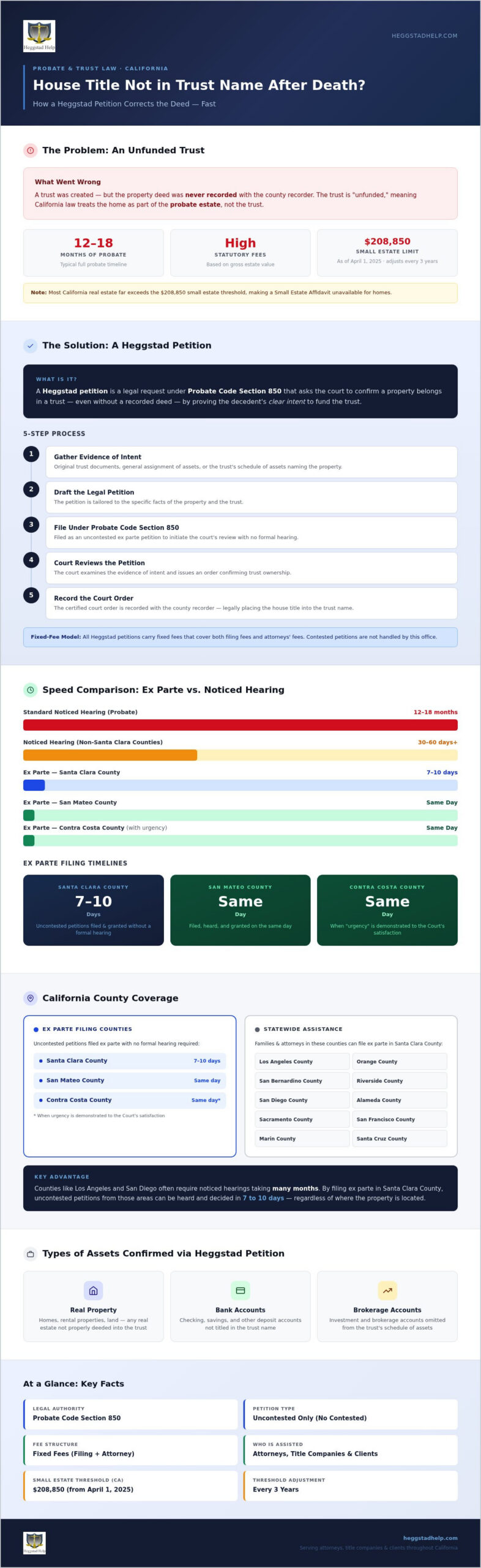

Bob is often able to assist clients who are in other counties than his home county of Santa Clara through his approach to Heggstad petitions.

Disclaimer

This article is for informational purposes only. Nothing in this article is intended to replace legal advice from a competent attorney or be considered legal guidance for anybody's specific legal situation. Nobody should rely on information in this article in making legal decisions without such consultation.