
Why would you pay a lawyer $25,000 for an eighteen-month probate process when a single court petition could solve your problem in as little as one week for a fraction of the price? If you’ve discovered that a family home or property was left out of a trust, you’re likely feeling the stress of looming statutory fees that can swallow 4% to 8% of the estate’s gross value. It’s an overwhelming situation, but you don’t have to accept the standard 12 to 18 month court delay as your only option. This guide explores the Heggstad petition cost vs probate cost California to show you how a surgical legal strike can protect your inheritance.
We’ll explain how our fixed-fee structure, which covers both filing and attorney fees, offers a predictable and budget-friendly alternative to the traditional probate system. You’ll learn how we assist attorneys, title companies, and families by securing orders in as little as 7 to 10 days in Santa Clara County, or even same-day grants in San Mateo and Contra Costa. Whether you’re navigating the 2026 small estate threshold of $239,700 or a multi-million dollar residence, we’ll outline the exact steps to transfer your assets quickly and privately without the public burden of a full probate administration.
Key Takeaways
- Learn how to evaluate the Heggstad petition cost vs probate cost California to avoid statutory fees that often consume 4% to 8% of an estate’s gross value.
- Discover how ex parte filings, which are petitions decided without a formal hearing, can reduce court wait times from eighteen months to just a few business days.
- Explore why uncontested petitions in Santa Clara County are typically granted in 7 to 10 days, offering a faster resolution than the months-long wait in other jurisdictions.
- Identify the correct legal path by checking the updated small estate thresholds, which increase to $239,700 for deaths occurring on or after April 1, 2026.
- See how our fixed-fee structure provides financial transparency by covering all filing and attorney fees for your trust asset title correction.
Understanding the High Cost of California Probate Administration
California probate is the court-supervised process of identifying, managing, and distributing a deceased person’s assets to their rightful heirs. While a well-structured trust is designed to avoid this system entirely, probate is often triggered when a significant asset, such as a family home, is left out of the trust (a situation frequently referred to as an unfunded trust). When this happens, the law requires a formal court proceeding to transfer the title, which quickly becomes an expensive and public burden for the family.
The primary driver of these expenses is the statutory fee (a mandatory payment set by state law) outlined in California Probate Code Section 10810. Unlike many other legal services where you might negotiate an hourly rate, probate fees are calculated as a fixed percentage of the estate’s value. A critical and often frustrating detail for families is that these fees are based on the gross estate value (the total market value of the property) rather than the net value. This means if a house is worth $800,000, the court calculates fees on that full amount, even if there is a $700,000 mortgage still owed on the property. When evaluating a Heggstad petition cost vs probate cost California, this distinction alone can save a family tens of thousands of dollars.
The 2026 Statutory Fee Schedule
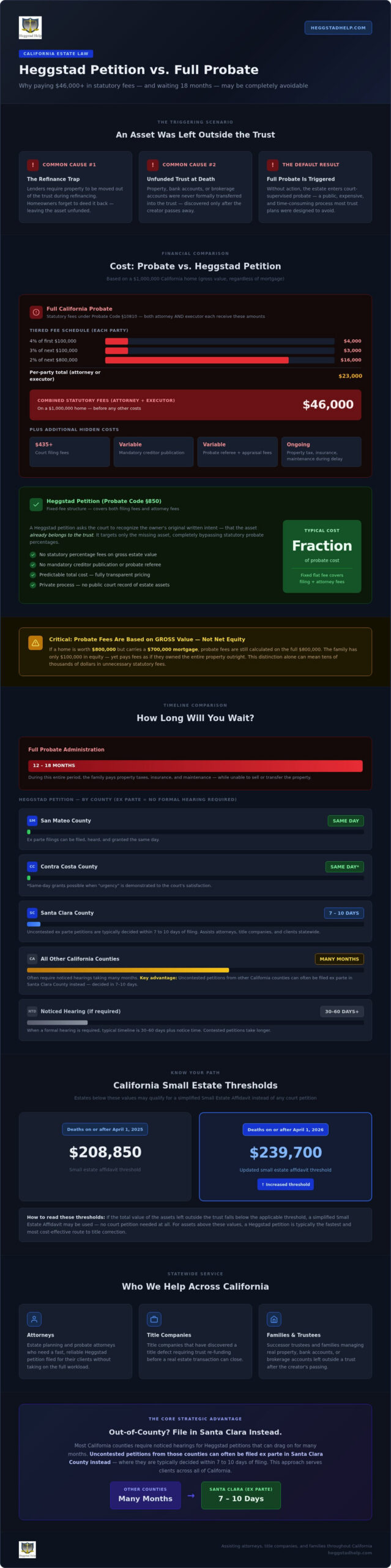
The state uses a tiered system to determine these costs: 4% of the first $100,000; 3% of the next $100,000; and 2% of the next $800,000. Both the attorney and the executor (the person appointed to manage the estate) are each entitled to these full fees. For a standard $1,000,000 California home, the attorney receives $23,000 and the executor receives $23,000. This results in a combined $46,000 in statutory fees before a single other bill is paid.
Hidden Probate Expenses Beyond Statutory Fees
Beyond the mandatory percentages, several administrative costs inflate the final bill. You’ll face court filing fees (typically $435 or more), mandatory publication costs to notify potential creditors, and fees for a probate referee (a court-appointed official who appraises the property). Families also frequently overlook bond premiums and specialized appraisal costs that can add several thousand dollars to the total. Perhaps the most significant hidden cost is the time delay. A typical probate takes 12 to 18 months, during which the family must continue paying property taxes, insurance, and maintenance on a home they cannot yet sell or transfer.
The Heggstad Petition: A Legal Shortcut for Unfunded Trusts
A Heggstad petition, formally known as a petition under California Probate Code Section 850, serves as a specialized legal tool to "re-fund" a trust after the creator has passed away. It addresses a common but stressful problem: an asset that should have been in the trust was left in the deceased person’s individual name. Instead of forcing the entire estate into a year-long probate, this petition asks the court to recognize that the asset already belongs to the trust based on the creator’s clear written intent. When you evaluate the Heggstad petition cost vs probate cost California, the petition stands out as a surgical solution that targets only the missing asset, avoiding the sweeping statutory fees associated with full probate administration.
One of the most frequent reasons families need this service is the "Refinance Trap." During the mortgage refinancing process, lenders often require homeowners to move their property out of the trust and back into their individual names to finalize the loan. Unfortunately, many homeowners forget to deed the property back into the trust once the paperwork is signed. A Heggstad petition allows a judge to correct this oversight retroactively. By presenting evidence of the owner’s original intent, such as a "Schedule of Assets" attached to the trust or specific language within the trust document itself, we can secure a court order that transfers the title without the need for a full probate proceeding.
Successor Trustee Duties and Asset Recovery
When a trust creator passes away, the successor trustee has a fiduciary duty to identify and secure all trust assets. If a house or bank account was left out of the trust, the trustee’s first priority is title correction. Understanding successor trustee duties for an unfunded trust is essential because failing to act quickly can lead to property tax hikes or complications with title insurance. A Heggstad petition is often the primary mechanism a trustee uses to fulfill these obligations and protect the beneficiaries’ inheritance.
Ex Parte vs. Noticed Hearings
The speed of a Heggstad petition often depends on whether it is filed "ex parte" or as a noticed hearing. An ex parte request is a specialized application for a court order that doesn’t require a formal, scheduled hearing months in advance. In counties like Santa Clara, uncontested ex parte petitions are typically granted in just 7 to 10 days. In San Mateo and Contra Costa, these orders can sometimes be obtained the same day if urgency is shown. In contrast, a standard noticed hearing involves serving notice to all interested parties and waiting for a court date, which usually takes 30 to 60 days plus additional time for notice requirements. For many families, choosing the right procedural path is the key to resolving title issues before a pending home sale falls through. If you aren’t sure if your situation qualifies, you can review the requirements for a Heggstad petition to see if this shortcut is available to you.
Financial Comparison: Heggstad Petition Fees vs. Statutory Probate Costs
While the time saved by a petition is invaluable, the financial contrast is often the deciding factor for families. When analyzing the Heggstad petition cost vs probate cost California, you’re comparing a fixed, predictable expense against a mandatory percentage of the property’s gross value. In a traditional probate, the law dictates exactly how much the attorney and executor receive, leaving no room for negotiation based on the actual work performed. This statutory mandate often results in fees that feel disconnected from the complexity of the estate.
Consider a California home with a fair market value of $750,000. In a standard probate proceeding, the combined statutory fees for the attorney and the executor would total $36,000. Once you add court filing fees, publication costs, and the probate referee’s appraisal fee, the total bill easily reaches $38,000. By contrast, a Heggstad petition is a surgical legal action that bypasses these percentage-based mandates. Instead of losing a massive chunk of your inheritance to the court system, you pay for a specific procedural outcome that restores the house to the trust.
It’s vital to recognize that these savings apply primarily to uncontested petitions where all parties agree the asset belongs in the trust. If a beneficiary objects or a third party claims ownership of the asset, the matter becomes contested litigation. In those specific scenarios, the cost structure changes because the scope of work expands significantly beyond a standard title correction. However, for the vast majority of families dealing with a simple oversight, the petition remains the most cost-effective path forward.
Fixed Fee Predictability
Attorneys, title companies, and private clients frequently prefer our specialized services because of the transparency a fixed-fee model provides. Our approach covers the entire process from start to finish, including the drafting of the petition, the court filing fees, and professional representation. This predictability eliminates the anxiety of hourly billing or surprise administrative costs during a difficult time. For a family already navigating the emotional weight of a loss, knowing the total financial commitment upfront provides a sense of control and psychological relief that the open-ended probate process simply cannot offer.
Why ‘Cheap’ Probate Alternatives Often Fail
It’s tempting to look for "do-it-yourself" legal forms to save money, but real estate title correction is rarely a simple paperwork exercise. Errors in the petition’s language or a failure to meet specific evidentiary requirements can lead to procedural resets or outright denials. A Board-Certified Specialist in Estate Planning understands the nuances of California Probate Code Section 850: A Guide to Real Property Petitions, ensuring the filing is correct the first time. Avoiding a single refiling or a rejected petition often saves more in the long run than any DIY approach could promise.
Timeline Advantages: Ex Parte Filings and County-Specific Speed
Time is often the most expensive factor in estate administration. While the Heggstad petition cost vs probate cost California comparison clearly favors the petition financially, the speed difference is even more dramatic. A standard probate takes at least a year. In contrast, a Heggstad petition can be resolved in days through an ex parte filing for a California ex parte court order on trust assets (a request for a court order without a formal, scheduled hearing). This is a vital tool for families who need to move quickly, especially when a property sale is on the line.
Most people don’t realize they aren’t always stuck with their local court’s slow schedule. In many California counties, a standard noticed hearing takes 30 to 60 days just to get a court date, plus additional time for notice requirements. Some jurisdictions take many months to even look at a file. However, uncontested Heggstad petitions from those slower counties can often be heard ex parte in Santa Clara County instead. This strategy allows a decision to be made within 7 to 10 days of filing, bypassing months of unnecessary waiting and legal friction.
The 7-Day Window in Santa Clara County
Santa Clara County has developed a specialized review process for ex parte petitions. This speed is critical for families trying to sell a house that is currently in escrow. If a title issue isn’t resolved quickly, the buyer might walk away, causing the entire deal to collapse. To qualify for this expedited 7 to 10 day timeline, the petition must remain uncontested. This means all beneficiaries and interested parties agree that the property belongs in the trust, removing the need for a long, public trial.
Demonstrating Urgency in San Mateo and Contra Costa
San Mateo and Contra Costa counties offer even faster results for those in a crisis. In San Mateo County, we can often file, hear, and secure a grant for a petition on the same day. Contra Costa County also permits same-day grants if you can demonstrate urgency to the Court’s satisfaction. Usually, this involves proving a pending real estate sale or a financial hardship that requires immediate access to the property’s value. Generalist lawyers often miss these local rules, but we specialize in navigating these specific court procedures to protect your inheritance. If you’re facing a court delay that threatens your family’s property, you can start your Heggstad petition today to secure a faster resolution.
Choosing the Right Path: When to Use Heggstad Help for Your Estate
Deciding between a full probate, a small estate affidavit, or a Heggstad petition depends entirely on the value of the asset and the evidence of the trust creator’s intent. When you weigh the Heggstad petition cost vs probate cost California, the petition is almost always the superior choice for real estate because it targets the specific title error without exposing the entire estate to statutory fees. However, for smaller bank accounts or personal property, a simpler tool might be available depending on the date of death and the total value of assets held outside the trust.
We assist clients, attorneys, and title companies throughout California by providing a structured, fixed-fee path to title correction. Our role is to act as a steady hand, ensuring that the legal paperwork meets the strict standards required for an ex parte grant. If you’re a successor trustee facing a "refinance trap" property or an attorney looking for a specialized partner to handle a trust funding oversight, choosing the right procedural path is the first step toward a resolution.
The 2026 Small Estate Thresholds
California law allows for a simplified transfer process called a Small Estate Affidavit, but only if the total value of assets outside the trust falls below a specific dollar amount. These figures are adjusted periodically to keep pace with inflation. For individuals who pass away on or after April 1, 2025, the small estate threshold is $208,850.
It’s important to recognize that these thresholds apply to the aggregate value of all non-trust assets. Since the vast majority of California homes are valued well above $208,850, the Small Estate Affidavit is rarely a viable option for real property. If the house was intended for the trust but the title remained in the decedent’s name, the Heggstad petition remains the primary legal mechanism to avoid the high Heggstad petition cost vs probate cost California and the year-long delays of a full probate administration.
Getting Started with a Fixed-Fee Specialist
Before you commit to a legal strategy, it’s helpful to review your documents against a basic eligibility checklist. First, look for written intent, such as a Schedule of Assets or a general assignment of property to the trust. Second, check the trust language for "pour-over" provisions that indicate a desire for all assets to be managed under the trust’s terms. Finally, confirm the asset’s value exceeds the current small estate threshold.
Working with a Board-Certified Specialist in Estate Planning, Trust and Probate Law ensures your petition is drafted with the precision necessary to satisfy a judge’s requirements on the first attempt. Our fixed-fee model covers both filing and attorney fees, providing the financial transparency you need during a difficult transition. By focusing specifically on trust asset title correction, we help you secure the court order you need without the stress of hourly billing or procedural resets. Bypass the probate backlog with a Heggstad Petition today and restore your family’s peace of mind.
Secure Your Inheritance with a Strategic Title Correction
Managing the aftermath of a loss is difficult enough without the added burden of a year-long court battle. By choosing a targeted petition over a full probate, you can bypass the rigid statutory fee system that penalizes families based on the gross value of their property. When you evaluate the Heggstad petition cost vs probate cost California, the path toward a fixed-fee resolution offers both financial clarity and significant time savings. Whether you’re facing a pending home sale or simply want to fulfill your duties as a successor trustee, our specialized approach ensures your trust assets are protected.
Robert P. Bergman, a Board-Certified Specialist with over 40 years of experience, provides the calm competence needed to handle even the most complex title issues. Our fixed-fee structure covers both filing and attorney fees, while our ex parte services offer the possibility of results in as little as 7 to 10 days. You don’t have to wait for the probate backlog to clear before moving forward. You can Schedule a Consultation for a Fixed-Fee Heggstad Petition to begin the process of restoring your trust’s title today. We’re here to act as your steady, knowledgeable guide through every step of this procedural journey.
Frequently Asked Questions
Is a Heggstad petition cheaper than probate in California?
Yes, a Heggstad petition is almost always the more affordable option because it avoids statutory probate fees. While probate costs are calculated as a percentage of the property’s gross value, often totaling 4% to 8% of the estate, our services utilize a fixed-fee structure that covers both filing and attorney fees. This provides predictable budgeting and prevents tens of thousands of dollars from being deducted from the beneficiaries’ inheritance.
How long does a Heggstad petition take compared to probate?
A Heggstad petition is substantially faster, often resolving in days rather than the 12 to 18 months required for a full California probate. In Santa Clara County, uncontested petitions are typically granted in 7 to 10 days. San Mateo and Contra Costa counties can even grant orders on the same day if urgency is shown, whereas standard noticed hearings in other counties can take 30 to 60 days plus notice time.
Can I file a Heggstad petition if I live outside of Santa Clara County?
Yes, you can file a Heggstad petition regardless of where you or the property are located in California. We assist clients statewide by utilizing specific court procedures that allow uncontested petitions from other counties to be heard ex parte (without a formal hearing) in Santa Clara County. This strategy allows you to bypass the months-long delays in your local court and secure a court order in about 7 to 10 days.
What documents do I need to prove a house belongs in a trust?
To prove a house belongs in a trust, you generally need the trust instrument and evidence of the creator’s intent to fund the asset into the trust. This evidence often includes a "Schedule of Assets" (an itemized list attached to the trust document) or a general assignment of property. These documents allow the court to confirm trust ownership and correct the title without requiring a full probate administration.
What is the small estate threshold in California for 2026?
For individuals dying on or after April 1, 2026, the small estate threshold is $239,700. If the person passed away between April 1, 2025, and March 31, 2026, the threshold is $208,850. When analyzing the Heggstad petition cost vs probate cost California, these figures help determine if you can use a simple affidavit or if a petition is required for higher-value assets like real estate.
Can a Heggstad petition be filed if there is no written ‘Schedule A’?
Yes, a petition can often be successful even without a formal "Schedule A" list. The court looks for any clear written intent, such as a general assignment of all assets to the trust or specific language within the trust document itself. If the paperwork demonstrates that the owner intended for the trust to hold the property, a judge can grant the petition to correct the title retroactively.
Does a Heggstad petition work for brokerage accounts and bank accounts?
Yes, Heggstad petitions are effective for brokerage accounts, bank accounts, and other financial assets that were mistakenly left in an individual’s name. While real estate is the most common use, any asset that should have been titled in the name of the trust can be captured by the trust through this court order. This avoids the need for a separate probate process for those specific accounts.
What happens if a family member objects to the Heggstad petition?
If a family member objects, the petition becomes a contested matter and moves from an expedited ex parte process to a formal trial track. Contested petitions take much longer than the typical 30 to 60 day noticed hearing timeline and involve higher legal costs due to the increased complexity of litigation. Most petitions we handle remain uncontested, allowing for the rapid results and fixed fees that benefit the entire family.

Article by
Robert P. Bergman, Attorney at Law
Attorney Robert P. Bergman ("Bob Bergman") has been a Board-Certified Specialist in Estate Planning, Trust and Probate Law since 2011, as certified by the California State Bar Board of Legal Specialization. For several years, Bob has assisted families and the clients of other attorneys with obtaining court orders through Heggstad petitions to avoid the time and expense of Probate administration. Bob is friendly, very approachable, and believes in explaining complex legal topics in clear ordinary language so that his clients understand exactly what they're doing and why they're doing it.
Bob is often able to assist clients who are in other counties than his home county of Santa Clara through his approach to Heggstad petitions.
Disclaimer
This article is for informational purposes only. Nothing in this article is intended to replace legal advice from a competent attorney or be considered legal guidance for anybody's specific legal situation. Nobody should rely on information in this article in making legal decisions without such consultation.


