Discovering that real estate or bank accounts were omitted from a living trust doesn’t mean your family is trapped in an expensive 12 to 18-month probate process. For an acting successor trustee unfunded trust California complications can feel instantly overwhelming, particularly when anxious beneficiaries demand immediate distributions while legal title remains completely frozen. It’s entirely normal to feel frustrated by conflicting title documents and unfamiliar court terminology during an already difficult transition.
Fortunately, you don’t have to endure full probate administration to resolve legal ownership. Under California Probate Code Section 850, an expedited court petition (commonly called a Heggstad petition) enables you to legally transfer omitted real property and bank accounts into the trust based on documented written intent. This complete action checklist provides a concrete procedural roadmap to confirm which assets qualify, protect your fiduciary standing, and secure an efficient title correction without draining estate funds.
Key Takeaways
- Understand your statutory thresholds, because for an acting successor trustee unfunded trust California rules allow personal property valued under $208,850 (for deaths on or after April 1, 2025) to transfer via a Small Estate Affidavit without court intervention.
- Discover the specific paper trail, including general assignments and declaration pages, required to prove the creator’s written intent under Probate Code Section 850.
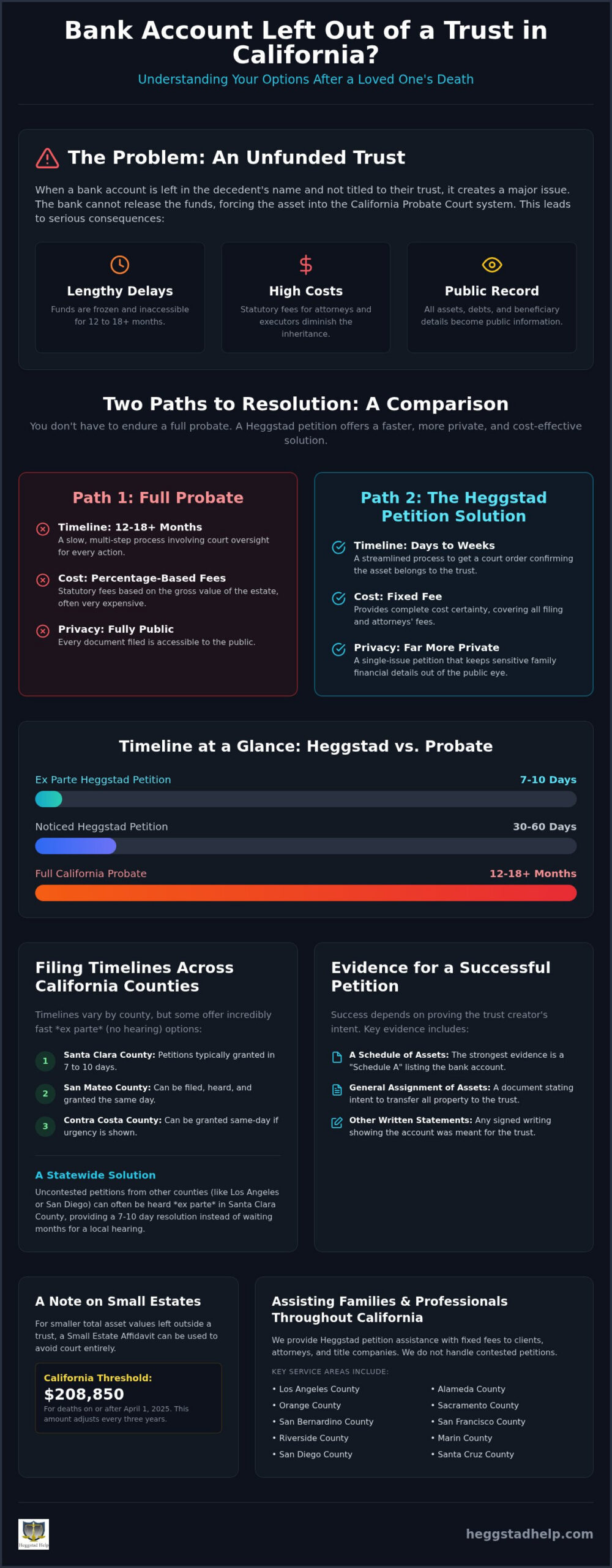
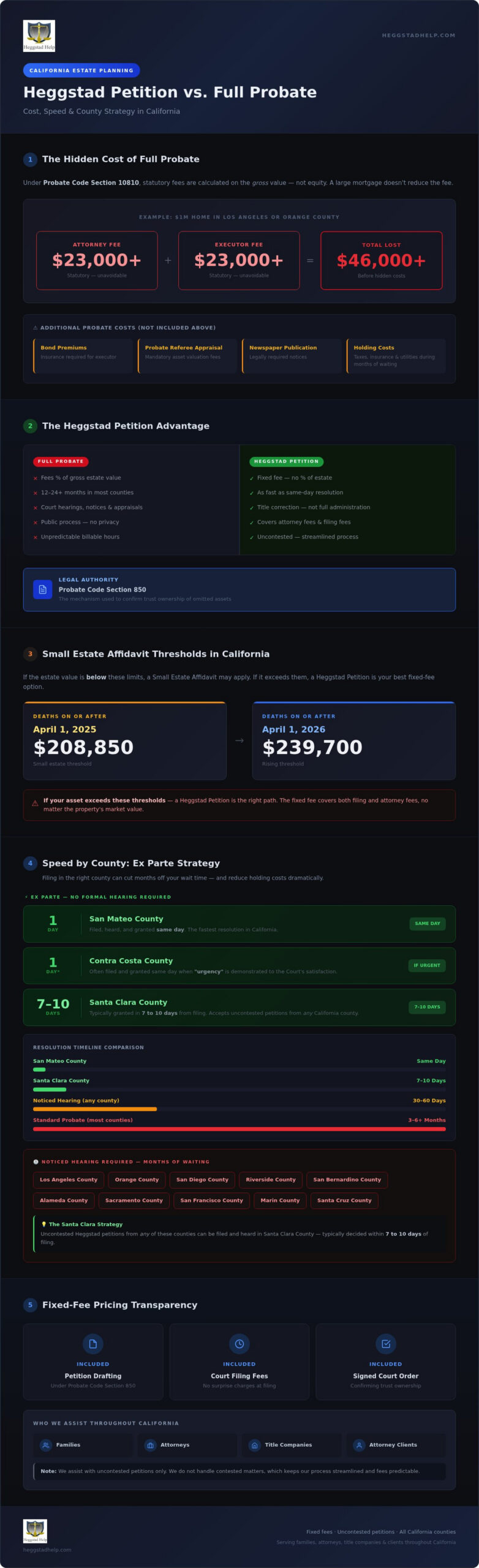
- Find out how filing an uncontested ex parte Heggstad petition in Santa Clara County can resolve legal title in 7 to 10 days, bypassing multi-month hearing backlogs in jurisdictions like Los Angeles County and Orange County.
The Successor Trustee Unfunded Trust Checklist in California: Assessing Missing Assets
When stepping into the fiduciary responsibilities of a trustee, your immediate priority is verifying that intended assets actually belong to the trust. For an acting successor trustee unfunded trust California complications usually surface when recorded ownership doesn’t match the decedent’s stated estate plan. You must quickly determine whether you are dealing with a completely empty trust or specific omitted parcels of real estate through an initial diagnostic review:
- Inspect Schedule A: Examine the initial asset inventory list attached to the trust agreement to establish what the creator intended to transfer.
- Audit County Records: Compare recorded grant deeds on file with the local county recorder against the formal trust declaration.
- Verify Accounts: Review bank, brokerage, and corporate entity records to catch accounts still held in individual names.
Locating Written Evidence of Settlor Intent
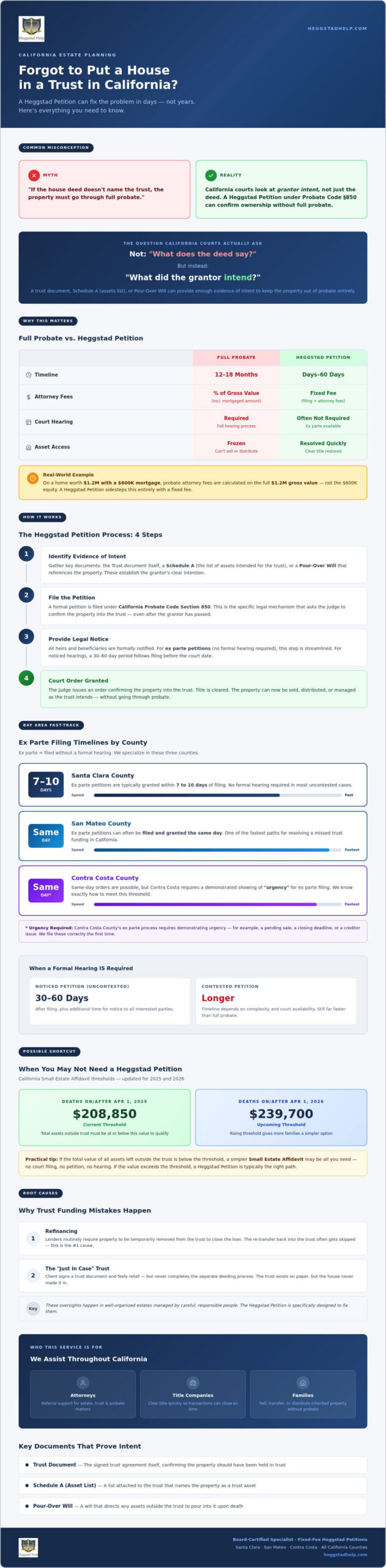
California courts require clear proof of the creator’s written intent before confirming trust ownership. Search the decedent’s files for a general assignment declaration transferring all personal property to the trust. Inspect trust schedules explicitly referencing real estate parcels, even if recorded deeds lack trust vesting. In counties like Los Angeles County or Orange County, lenders routinely require borrowers to deed homes out of trusts during refinancing, and settlors frequently forget to record a return deed.
Identifying Titled Assets Versus Non-Titled Personal Property
Review financial statements closely to identify forgotten personal accounts, partnership interests, or corporate shares that lack formal transfer documentation. Finding successor trustee help for missing assets provides a structured method to catalog these holdings before pursuing court action. Organizing this evidence early protects your fiduciary standing and confirms whether omitted assets require court intervention or qualify for simplified statutory transfer.
Evaluating Legal Options: Small Estate Affidavits Versus Probate Code Section 850
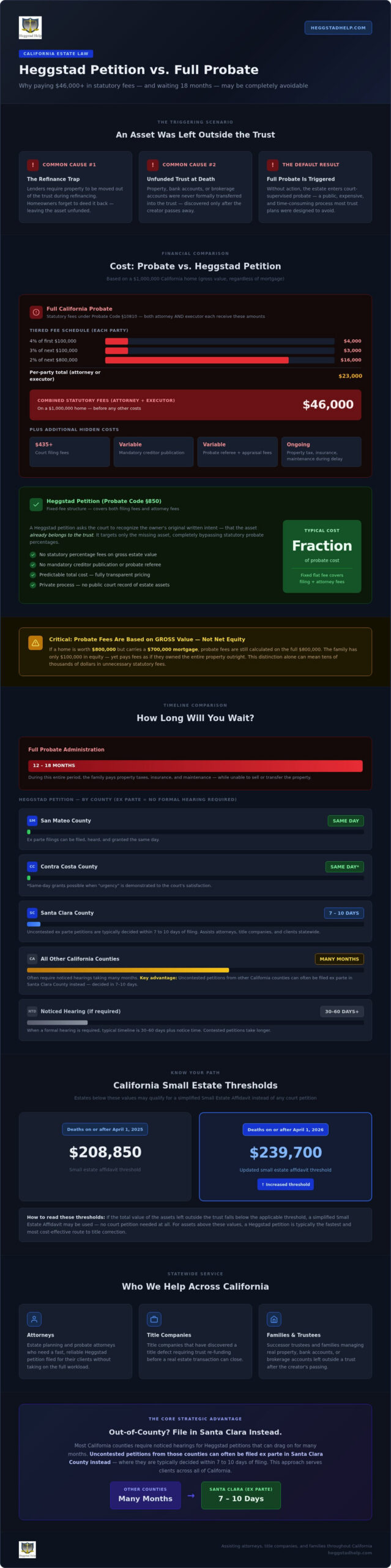
When you discover assets outside the trust, you aren’t automatically forced into court-supervised administration. Formal California probate consumes 12 to 18 months, generating statutory attorney and executor fees under Probate Code Section 10810 that quickly reach tens of thousands of dollars. As outlined in the official California Courts probate guide, state law offers streamlined paths to transfer ownership. Choosing the proper legal mechanism depends directly on asset value and property character.
When a Small Estate Affidavit Applies
For an acting successor trustee unfunded trust California statutes offer an out-of-court remedy if the omitted personal property remains under statutory thresholds. In California, the small estate threshold is $208,850 for deaths on or after April 1, 2025, adjusting every three years. You can collect personal property, such as standalone bank balances, using an affidavit under Probate Code Section 13100 without opening probate. However, you can’t use simple personal property affidavits to transfer valuable residential real estate, which almost always exceeds statutory limits.
Understanding California Probate Code Section 850 Relief
When omitted assets include residential real estate or accounts exceeding the affidavit ceiling, a petition under Probate Code Section 850 provides the primary legal alternative. Often termed a Heggstad petition, this filing asks the court to confirm that property belongs to the trust based on the creator’s documented written intent. Reviewing a helpful summary of California Probate Code Section 850 petitions will show you whether your documentation qualifies. By securing an expedited court order, you preserve estate liquidity, satisfy demanding beneficiaries, and complete legal title transfers without initiating formal probate proceedings.
The California Heggstad Petition Process: Step-by-Step for Successor Trustees
Transferring an omitted asset back into trust ownership requires a methodical approach under California Probate Code Section 850. When an acting successor trustee unfunded trust California situation arises, filing this petition asks the probate court to issue an order confirming title. For uncontested cases where family members agree, the process bypasses trial calendars entirely, provided your documentary proof meets strict judicial standards.
Gathering Necessary Documentary Evidence
Judges evaluate written intent above all else. You must collect the fully executed trust agreement, signed amendments, and any initial property schedules explicitly listing the disputed asset. Retrieve certified copies of prior grant deeds from the county recorder to illustrate chain of title, especially if a mortgage lender required deeding the home out during a prior financing transaction. Reviewing our comprehensive guide to Heggstad petition filing in California will help you organize these exhibits before drafting your verified petition.
Filing and Perfecting the Court Order
Once you assemble your exhibits, you must draft the petition, serve formal statutory notice on all heirs and beneficiaries, and submit the package according to local court rules. After the court reviews the pleadings and signs the proposed decree, follow these steps to finalize title:
- Obtain certified copies of the signed court order directly from the probate clerk.
- Submit the certified order alongside a Preliminary Change of Ownership Report (PCOR) to the county recorder’s office where the real estate sits.
- Present the recorded order to financial institutions to retitle frozen brokerage or banking accounts.
If you need prompt assistance navigating court requirements and correcting title, file your Heggstad petition to protect estate assets and complete distribution.

Bypassing County Probate Hearing Delays With Santa Clara County Ex Parte Filings
When you attempt to correct title in local probate courts, you often run headfirst into severe calendar congestion. For an acting successor trustee unfunded trust California court bottlenecks can stall property sales and freeze liquid distributions for months. While attorneys and title companies often assume you must file where the decedent lived or where the real estate sits, strategic venue options exist under California law to bypass these multi-month calendar delays entirely.
Understanding Notice Delays in Local California Courts
In high-volume jurisdictions like Los Angeles County, Orange County, San Diego County, Riverside County, and Alameda County, probate dockets are severely backlogged. Petitions under Probate Code Section 850 in those jurisdictions often cannot be submitted ex parte (meaning without a formal hearing). Instead, they require formal noticed hearings set 30 to 60 days out, or even several months later. Learning the steps for resolving an unfunded trust probate in California helps you evaluate alternative venues rather than accepting prolonged court gridlock.
The Santa Clara County Ex Parte Solution
Our office assists families, attorneys, and title companies throughout the State of California by filing uncontested ex parte Heggstad petitions in the Santa Clara County Probate Court, regardless of which county the trust is located in. While our office also files ex parte petitions in San Mateo County (often heard and granted the same day) and Contra Costa County (granted the same day if court-approved urgency is shown), Santa Clara County provides the primary expedited venue for all other California counties.
Consider the practical timing advantages of this procedural approach:
- Accelerated Timelines: Petitions filed ex parte in Santa Clara County are typically reviewed and granted in 7 to 10 days, avoiding months of waiting for a noticed hearing date in local courts.
- Statewide Reach: We regularly resolve unfunded trust issues for properties located in San Francisco County, Marin County, Sacramento County, Placer County, Fresno County, and San Joaquin County.
- Predictable Costs: We handle exclusively uncontested matters using transparent fixed fees covering filing fees and legal fees. Our office does not handle contested petitions.
Connecting with HEGGSTAD HELP allows you to secure clean court orders quickly, protecting fiduciary standing and eliminating holding costs.
Resolve Omitted Trust Assets and Secure Clean Legal Title
Stepping into trust administration is challenging when valuable property was left outside the trust, but you hold clear statutory remedies. Auditing Schedule A inventories, verifying personal property limits, and documenting written intent allow you to resolve title defects efficiently. For an acting successor trustee unfunded trust California complications don’t require enduring an exhausting 12 to 18-month probate proceeding.
You can safeguard estate assets and satisfy waiting beneficiaries with prompt judicial relief. Led by Robert P. Bergman, a Board-Certified Specialist in Estate Planning, Trust and Probate Law practicing since 1980, our practice files uncontested ex parte Heggstad petitions in Santa Clara County, where orders are typically granted in just 7 to 10 days. We operate on transparent fixed fees covering all court filing costs and attorney fees with no hidden surprises. Connect with HEGGSTAD HELP to transfer omitted real estate into trust and complete your administrative duties with confidence.
Frequently Asked Questions
Can a successor trustee manage real estate that was never deeded into the trust in California?
No, a successor trustee cannot sell, encumber, or distribute real estate titled outside the trust until legal title is formally corrected. For an acting successor trustee unfunded trust California title defects completely freeze management authority because title companies require a clear chain of ownership. You can’t simply record an affidavit of successor trustee for non-trust real estate; you must first obtain a court order under Probate Code Section 850.
How does a Heggstad petition solve the problem of an unfunded trust in California?
A Heggstad petition asks the probate court to issue an order confirming that omitted property legally belongs to the trust based on written intent. Filed under Probate Code Section 850, this procedure transfers legal title directly into the trust without opening formal probate administration. The court relies on documentary evidence like Schedule A or general assignments, allowing trustees to bypass statutory probate fees and proceed directly with lawful trust distributions.
What is the small estate limit for an unfunded trust in California?
In California, the small estate threshold is $208,850 for decedents dying on or after April 1, 2025, adjusting automatically every three years. If personal property omitted from the trust falls below this statutory ceiling, you can transfer accounts using a Small Estate Affidavit under Probate Code Section 13100 without court petitions. However, real property exceeding this value cannot transfer via simple affidavit, requiring an expedited Heggstad petition instead.
How long does it take for a California court to grant a Heggstad petition?
Timing depends directly on the filing county and whether the petition proceeds ex parte or on a noticed calendar. Uncontested ex parte petitions filed in Santa Clara County are typically reviewed and granted in 7 to 10 days. In San Mateo County, ex parte petitions can often be granted the same day. Conversely, standard noticed petitions in counties like Los Angeles County or Orange County take 30 to 60 days, or several months.
Can an ex parte Heggstad petition be filed in Santa Clara County for property located elsewhere?
Yes, uncontested ex parte Heggstad petitions can be filed in the Santa Clara County Probate Court regardless of which California county the property or trust is in. When resolving an acting successor trustee unfunded trust California dilemma, utilizing Santa Clara County allows you to bypass multi-month hearing delays in counties like San Diego County, Alameda County, or Riverside County. You secure clean court orders in 7 to 10 days under transparent fixed fees.

Article by
Robert P. Bergman, Attorney at Law
Attorney Robert P. Bergman ("Bob Bergman") has been a Board-Certified Specialist in Estate Planning, Trust and Probate Law since 2011, as certified by the California State Bar Board of Legal Specialization. For several years, Bob has assisted families and the clients of other attorneys with obtaining court orders through Heggstad petitions to avoid the time and expense of Probate administration. Bob is friendly, very approachable, and believes in explaining complex legal topics in clear ordinary language so that his clients understand exactly what they're doing and why they're doing it.
Bob is often able to assist clients who are in other counties than his home county of Santa Clara through his approach to Heggstad petitions.
Disclaimer
This article is for informational purposes only. Nothing in this article is intended to replace legal advice from a competent attorney or be considered legal guidance for anybody's specific legal situation. Nobody should rely on information in this article in making legal decisions without such consultation.