A forgotten deed doesn’t have to derail everything your loved one worked so hard to protect. If you’re dealing with a situation where someone forgot to put a house in a trust in California, you’re probably staring down the prospect of a 12 to 18 month probate process, thousands of dollars in statutory fees, and a stack of court forms that seem designed to confuse. That fear is completely understandable, and it’s one of the most common complications families face after losing someone.
Here’s the reassuring truth: California law provides a powerful remedy called a Heggstad Petition, and in many cases it can transfer real estate into a trust in a matter of days, not years. No full probate hearing required. No drawn-out court calendar. Just a targeted legal filing that confirms the property always belonged in the trust.
In this article, you’ll learn exactly how a Heggstad Petition works, who qualifies, and how the process unfolds in California courts, including specific timelines for counties where petitions can move especially fast. Whether you’re an attorney, a title company, or a family trying to clear title so you can sell or distribute a property, this guide will walk you through every step.
Key Takeaways
- If you forgot to put a house in a trust in California, a Heggstad Petition can often resolve the problem in days rather than months — no full probate required.
- California courts look at the grantor’s intent, not just the deed, which means a trust document, Schedule A, or Pour-Over Will can be enough to confirm ownership and keep the property out of probate.
- In Santa Clara, San Mateo, and Contra Costa Counties, petitions can be filed ex parte (without a formal hearing), with Santa Clara typically resolving cases in 7 to 10 days and same-day orders possible in the other two counties under the right circumstances.
- If the total value of assets left outside the trust is below $208,850 (for deaths on or after April 1, 2025, rising to $239,700 on or after April 1, 2026), a simpler Small Estate Affidavit may be all you need.
- Attorneys, title companies, and families across California can work with a Board-Certified Specialist on a fixed-fee basis — meaning no billing surprises for filing fees or attorney fees.
Myth vs. Reality: Does a Forgotten Deed Always Mean Probate?
Let’s clear up the most persistent misconception families run into after a loved one passes: if the house deed doesn’t name the trust, the property must go through full probate. That’s simply not true in California, and believing it can cost a family an enormous amount of time and money.
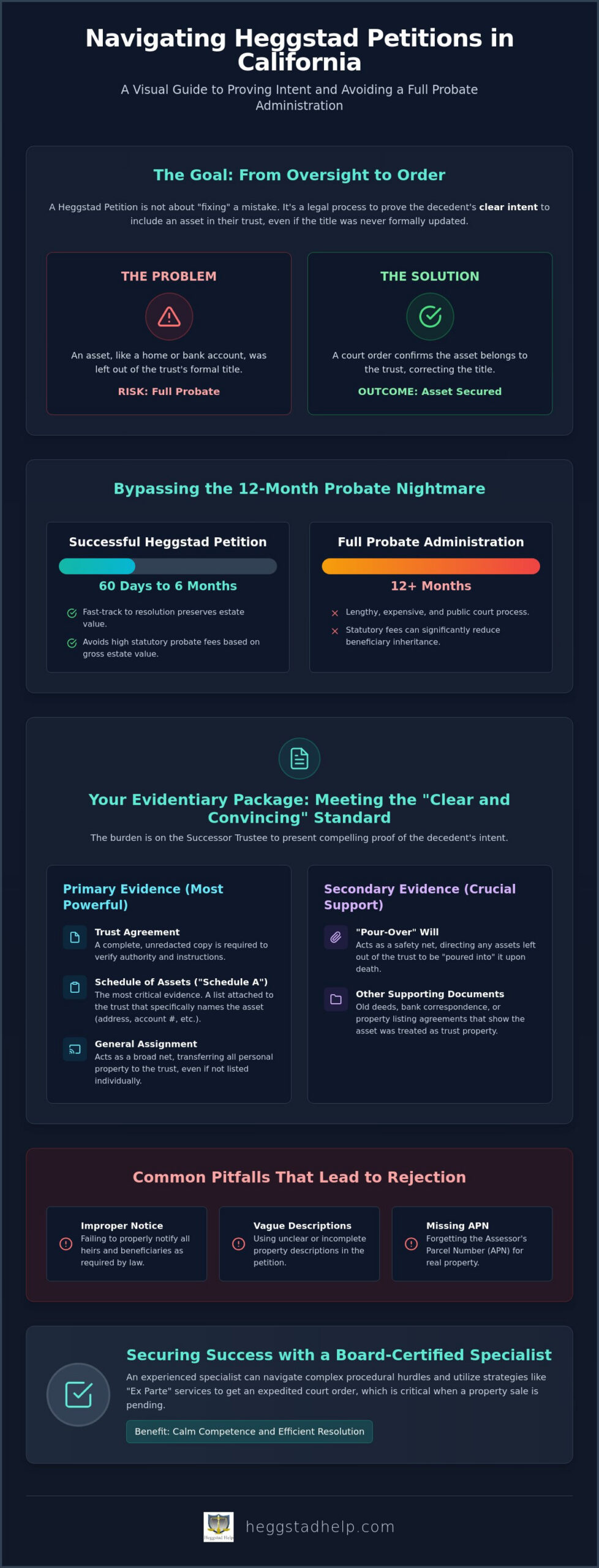
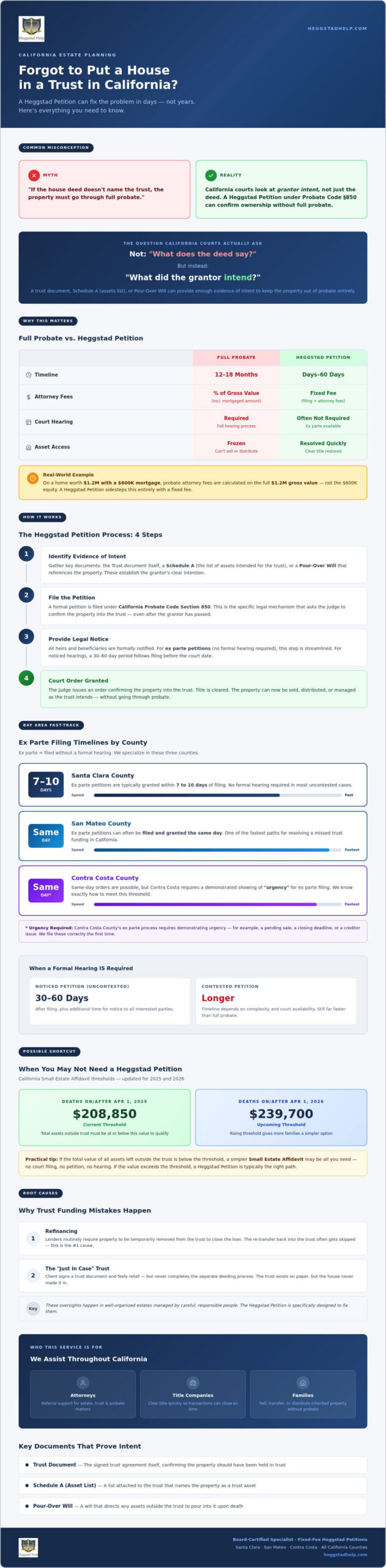
The reality is that California Probate Code Section 850 gives courts the authority to confirm that an asset belongs to a trust even when the deed was never formally transferred. This is the legal foundation of a Heggstad Petition. Instead of asking "what does the deed say?", a California court applying Section 850 asks a more important question: what did the grantor intend? If the trust document, a Schedule of Assets (a list attached to the trust identifying property meant to be held in it), or a Pour-Over Will clearly identifies the property as a trust asset, that evidence of intent can be enough to confirm ownership without triggering a full probate process.
This is a critical distinction that many general-practice attorneys and even some online resources miss entirely. Intent, documented in the right places, carries real legal weight in California courts.
Why Trust Funding Mistakes Happen
Most people don’t forget to fund their trust out of carelessness. The most common culprit is refinancing. When a homeowner refinances their mortgage, lenders routinely require the property to be temporarily transferred out of the trust and back into the borrower’s personal name to close the loan. After funding, the property is supposed to be deeded back into the trust. That step gets skipped far more often than it should.
Another common scenario involves what estate planning attorneys sometimes call the "just in case" trust: the client signs a beautifully drafted trust document, feels a sense of relief, and never follows through on the separate deeding process. The trust exists on paper, but the house never officially made it inside. For a deeper look at how this plays out procedurally, the Heggstad Petition Filing: The California Guide walks through the mechanics in detail.
If you forgot to put a house in a trust in California, you’re not alone. These oversights happen in well-organized estates managed by careful, responsible people.
The Cost of Doing Nothing
Choosing to ignore the problem isn’t a neutral decision. A full probate administration in California typically runs 12 to 18 months from start to finish, and the statutory attorney fees alone are calculated as a percentage of the property’s gross value, not its equity. On a home worth $1.2 million with a $600,000 mortgage, the fee calculation still starts from $1.2 million. That means thousands of dollars in unavoidable fees, a frozen asset your family can’t sell or distribute, and a court calendar that moves on its own schedule, not yours.
A Heggstad Petition, by contrast, can resolve the same problem in a fraction of the time. Understanding the full Heggstad petition vs probate California cost and timeline differences can help families make a more informed decision before committing to either path. In counties like Santa Clara, San Mateo, and Contra Costa, petitions filed ex parte (without a formal hearing) can be resolved in as little as 7 to 10 days, or even the same day in urgent circumstances. For cases that require a noticed hearing, the timeline is typically 30 to 60 days after filing. Either path is dramatically faster and less expensive than full probate.
How the Heggstad Petition Process Works in California
The Heggstad Petition process is a methodical legal path that moves much faster than traditional probate. If you’ve realized someone forgot to put a house in a trust in California, the procedure focuses on gathering specific documentation that demonstrates the deceased person’s clear desire for the property to be trust-held. The process typically follows these four steps:
- Step 1: Identify Evidence of Intent. We look for documents like the Trust document itself, a "Schedule A" (the list of assets intended for the trust), or a Pour-Over Will that references the property.
- Step 2: File the Petition. A formal petition is filed under California Probate Code Section 850. This is the specific legal mechanism that asks the judge to "transfer" the property into the trust posthumously.
- Step 3: Provide Legal Notice. All heirs and beneficiaries must be notified. For standard noticed hearings, this usually results in a court date set 30 to 60 days after filing. However, in certain counties, we can bypass this wait through an ex parte filing, getting a signed order in as little as the date of filing the petition in San Mateo and Contra Costa Counties, and 7 to 10 days through Santa Clara County.
- Step 4: Obtain the Court Order. Once the judge signs the order, it is recorded with the county. This officially clears the title, allowing the successor trustee to sell or distribute the home.
Evidence Needed for a Successful Filing
The court requires "clear and convincing" evidence of the grantor’s intent. The most common proof is a Schedule of Assets or an "Exhibit A" that specifically lists the real estate by its address or legal description. If these aren’t available, a Pour-Over Will acts as a vital safety net because it explicitly states that any property left outside the trust should be moved into it upon death. You can find a full list of required items in our guide to Documents Needed for Heggstad Petition filings. Understanding these requirements is especially important when the property value exceeds the California small estate threshold, making a Heggstad Petition the most efficient way to avoid a full probate.
Fixed Fees vs. Hourly Legal Billing
Managing an estate is stressful enough without worrying about unpredictable legal bills. That’s why we handle these petitions with fixed fees that cover both the court filing fees and attorney fees. This approach provides successor trustees with total financial predictability, ensuring that estate funds are preserved for the beneficiaries rather than being consumed by hourly billing. For a detailed breakdown of what those fees typically look like and how they compare to statutory probate costs, the Heggstad petition cost California families face in 2026 is covered comprehensively in our dedicated cost guide. If you need help determining if your documents qualify, our Heggstad petition services can provide the clarity you need to move forward confidently.
Local Speed: Filing in Santa Clara, San Mateo, and Contra Costa
Not every California county handles Heggstad petitions the same way. If you forgot to put a house in a trust in California and the property happens to be located in Santa Clara, San Mateo, or Contra Costa County, you’re in a genuinely advantageous position. These three counties allow what’s called an ex parte filing, which simply means you’re asking the court for a ruling without scheduling a formal, noticed hearing. The practical effect is dramatic: instead of waiting months for a court date, the petition can be resolved in days.
Here’s how the timelines break down by county:
- Santa Clara County: Ex parte Heggstad petitions are typically granted within 7 to 10 days of filing. No hearing required, no crowded court calendar to navigate.
- San Mateo County: Under the right circumstances, petitions can be filed and granted the same day.
- Contra Costa County: Same-day filing and granting is also possible, but the court requires a demonstrated showing of urgency. A pending real estate sale with an imminent closing date is a classic example of circumstances that satisfy this requirement.
That urgency requirement in Contra Costa isn’t a barrier; it’s simply a threshold to meet. A well-prepared filing that documents the time-sensitive nature of the situation will typically satisfy the court’s standard.
Why Local Expertise Matters for Successor Trustees
Each county maintains its own local rules governing how Probate Code Section 850 petitions must be formatted, submitted, and supported. A filing that works cleanly in Santa Clara may need to be structured differently for Contra Costa. This is where working with a specialist who files regularly in these specific courts makes a real difference. Attorneys and title companies across California rely on this kind of local knowledge precisely because a misstep in procedure can delay a pending sale or cause a title company to hold up a transaction. Fixed fees cover both filing fees and attorney fees, so there are no billing surprises regardless of which county the property sits in.
Noticed Hearings for Other Counties
If the property is in a county that doesn’t permit ex parte Heggstad filings, the process follows a noticed hearing path. That means all interested parties must receive formal legal notice, and the court sets a hearing date. Realistically, expect the hearing to be scheduled 30 to 60 days after the petition is filed, with additional time built in for the notice period itself. Contested petitions will take longer. It’s still dramatically faster than full probate, but if you’re working against a sale deadline, county location matters more than most families initially realize.
If you’re facing a time-sensitive title issue, explore how our Heggstad petition services can move your case forward efficiently based on the specific county and circumstances involved.
When a Heggstad Petition Isn’t Needed: 2026 Thresholds
A Heggstad Petition is a powerful tool, but it’s not always the right one. If the total value of assets left outside the trust is relatively modest, California law offers a simpler path: the Small Estate Affidavit. This is a straightforward legal declaration that allows successor trustees or heirs to collect and transfer assets without any court involvement at all.
The thresholds are specific and recently updated:
- Deaths on or after April 1, 2025: The small estate limit is $208,850.
- Deaths on or after April 1, 2026: That limit rises to $239,700.
Here’s the practical reality: if someone forgot to put a house in a trust in California, the property almost certainly exceeds these thresholds. California real estate values being what they are, even a modest home will push the total well past $239,700. That’s why the Heggstad Petition remains the primary tool for real property, while the Small Estate Affidavit handles the smaller assets sitting alongside it. For a detailed side-by-side breakdown of costs, timelines, and procedural requirements, the Heggstad petition vs probate California 2026 comparison guide offers a comprehensive look at when each path makes the most sense.
Combining Tools for a Clean Estate Transfer
These two approaches aren’t mutually exclusive. A well-organized estate transfer often uses both: a Heggstad Petition to clear title on the home, and a Small Estate Affidavit to collect a forgotten bank account or transfer a small brokerage balance. For brokerage accounts and other titled assets, a separate title correction process may be required, depending on how the account was held. The goal is matching the right legal tool to each specific asset rather than forcing everything through the same procedure.
Next Steps for Successor Trustees
The single most important thing a successor trustee can do right now is consult with a Board-Certified Specialist to evaluate which assets qualify for which approach. Don’t guess, and don’t improvise.
One critical warning: do not attempt to record a "correction deed" after the grantor’s death. It seems like a logical shortcut, but title companies will almost certainly reject it, and it can create additional complications that slow the process down rather than speeding it up. The correct path runs through the court, not around it.
Whether you’re an attorney, a title company holding a transaction open, or a family trying to figure out what comes next after someone forgot to put a house in a trust in California, the right evaluation starts with understanding exactly what’s in the estate and what tools apply. Contact Heggstad Help for a fixed-fee evaluation of your California trust assets and get a clear answer on the fastest, most cost-effective path forward.
Your Next Step Toward Clearing Title and Moving Forward
If someone forgot to put a house in a trust in California, the situation feels overwhelming at first, but the path forward is clearer than most families expect. California law gives courts the authority to confirm a property belongs in a trust based on intent, not just paperwork. The right petition, filed in the right county, can resolve the problem in days rather than months.
The key points to carry forward are straightforward: a Heggstad Petition is almost always faster and less expensive than full probate, county location directly affects your timeline, and working with a specialist matters more than most people realize until a filing goes sideways.
Robert P. Bergman is a Board-Certified Specialist in Estate Planning, Trust and Probate Law with over 40 years of California legal experience. Every petition is handled on a fixed-fee basis, so attorneys, title companies, and families know exactly what to expect from day one.
Get a fixed-fee evaluation for your Heggstad Petition today and find out how quickly your specific situation can be resolved. The process is more manageable than it looks right now.
Frequently Asked Questions
Can I file a Heggstad petition if there is no Schedule of Assets?
Yes, a missing Schedule of Assets doesn’t automatically disqualify a petition. California courts look at the totality of evidence showing the grantor’s intent, so a Pour-Over Will that directs assets into the trust, language within the trust document itself referencing the property, or other written communications from the grantor can all serve as supporting evidence. The stronger and more specific your documentation, the better positioned your petition will be.
That said, cases without a Schedule of Assets do require more careful preparation. Working with a Board-Certified Specialist who files these petitions regularly helps ensure that the available evidence is presented in the way California courts find most persuasive, rather than leaving gaps that could slow the process down or invite objections from interested parties.
How long does a Heggstad petition take in California?
Timeline depends heavily on the county where the property is located. In Santa Clara County, ex parte petitions (those filed without a formal hearing) are typically granted within 7 to 10 days of filing. In San Mateo and Contra Costa Counties, same-day resolution is possible under the right circumstances, though Contra Costa requires a demonstrated showing of urgency, such as a pending sale with an imminent closing date.
For counties that don’t permit ex parte filings, the process follows a noticed hearing path. All interested parties receive formal legal notice, and the court sets a hearing date that’s typically 30 to 60 days after the petition is filed. Contested petitions take longer. Either way, it’s a fraction of the 12 to 18 months a full probate administration would require.
What is the cost of a Heggstad petition compared to probate?
The cost difference between a Heggstad petition and full probate is substantial. California’s statutory probate fees are calculated as a percentage of the property’s gross value, not its equity, so a $1.2 million home with a $600,000 mortgage still generates fees based on $1.2 million. Those fees accumulate quickly and are unavoidable. A Heggstad petition, by contrast, is handled on a fixed-fee basis covering both filing fees and attorney fees, giving successor trustees complete financial predictability from day one. For a full breakdown of what to expect, our guide to Heggstad petition cost California families encounter in 2026 covers every line item in detail.
Beyond the direct cost savings, avoiding probate also means avoiding 12 to 18 months of a frozen asset your family can’t sell or distribute. The combination of lower fees and dramatically faster resolution makes a Heggstad petition the more cost-effective path in virtually every situation involving California real estate that was forgotten to be put in a trust.
Can I sell the house while the Heggstad petition is pending?
In most cases, no. Title companies won’t insure a sale until the court order is recorded, because the title can’t be confirmed as belonging to the trust until a judge signs off. Trying to close escrow before the order is in place will typically result in the title company holding the transaction open, which is exactly the kind of delay that frustrates buyers and can put a sale at risk.
The good news is that a pending sale with a closing deadline is precisely the kind of urgency that supports an expedited filing in counties like Contra Costa, and it’s consistent with the circumstances that make ex parte petitions appropriate in Santa Clara and San Mateo. If you’re working against a sale deadline, that timing pressure isn’t a problem; it’s actually a reason to move quickly and file as soon as possible.
Do I need a lawyer to file a Heggstad petition in California?
Technically, California law doesn’t prohibit a self-represented successor trustee from filing a Heggstad petition. Practically speaking, though, the procedural requirements are specific enough that errors in formatting, notice, or supporting documentation can delay the case or cause the court to deny the petition entirely. Each county has its own local rules, and what works in Santa Clara may need to be structured differently for another court.
For attorneys and title companies handling estates across California, working with a specialist who focuses exclusively on Heggstad petitions provides both efficiency and predictability. If you forgot to put a house in a trust in California and you’re now managing a time-sensitive title issue, the fixed-fee structure means you know the full cost upfront, and the specialized experience means the filing is done right the first time.

Article by
Robert P. Bergman, Attorney at Law
Attorney Robert P. Bergman ("Bob Bergman") has been a Board-Certified Specialist in Estate Planning, Trust and Probate Law since 2011, as certified by the California State Bar Board of Legal Specialization. For several years, Bob has assisted families and the clients of other attorneys with obtaining court orders through Heggstad petitions to avoid the time and expense of Probate administration. Bob is friendly, very approachable, and believes in explaining complex legal topics in clear ordinary language so that his clients understand exactly what they're doing and why they're doing it.
Bob is often able to assist clients who are in other counties than his home county of Santa Clara through his approach to Heggstad petitions.
Disclaimer
This article is for informational purposes only. Nothing in this article is intended to replace legal advice from a competent attorney or be considered legal guidance for anybody's specific legal situation. Nobody should rely on information in this article in making legal decisions without such consultation.