
What if a single missing signature on a property deed didn’t have to trigger a grueling eighteen-month court battle? You might have recently discovered that a family home or significant account was never formally titled in the name of a living trust (a legal arrangement where a trustee holds assets for beneficiaries), leaving you facing the daunting prospect of a full court-supervised administration. When weighing the benefits of a Heggstad petition vs probate California, it’s important to realize that a simple administrative oversight doesn’t always require the traditional, expensive, and lengthy probate path.
We understand the anxiety that comes with navigating complex California probate codes while you’re still grieving a loved one. It’s frustrating to realize that a clerical error might subject your family to high statutory fees (set legal costs calculated as a percentage of the estate’s gross value) and public court records. This guide will show you how to bypass those hurdles and transfer assets to the trust in a fraction of the time. We’ll compare the two processes across 2026 court standards, explaining how you can clear title and prepare for a home sale without the typical year-long delay.
Key Takeaways
- Discover why choosing a Heggstad petition vs probate California can reduce a typical 18-month court process to just a few weeks or even days.
- Learn how to protect the estate’s value by avoiding statutory probate fees, which are mandatory legal costs calculated as a percentage of the gross value of the property.
- Identify the Apirl 1, 2026 small estate threshold of $239,700 to determine if you can use a simple affidavit or if a formal court order is necessary for your specific assets.
- Explore how filing in specific counties like Santa Clara or San Mateo allows for ex parte orders (expedited court rulings) that can clear title in as little as 7 to 10 days.
- Understand the importance of using specialized legal services to avoid the common procedural errors that lead to court rejections and clouded titles for trust properties.
The ‘Forgotten House’ Dilemma: Heggstad Petition vs. Full Probate Basics
Successor trustees often encounter a frustrating discovery while settling an estate. They find that a primary residence or investment property is still titled in the decedent’s (the person who passed away) individual name rather than the name of their living trust. This discrepancy creates a significant legal hurdle because, without a clear title, the property cannot be sold or distributed to beneficiaries. When you’re faced with this scenario, you generally have two paths: a full probate administration or a Heggstad petition. Understanding the choice between a Heggstad petition vs probate California is the first step toward a more efficient resolution for your family.
Full probate is a comprehensive, court-supervised process used to distribute a deceased person’s estate when no trust exists or when assets are left outside of one. It’s a public and often slow journey through the California court system. Conversely, a Heggstad petition is a specialized legal request filed under California Probate Code Section 850. It asks the court to "transfer" the asset into the trust retroactively by proving it was always intended to be there. In 2026, the concept of "intent" remains the cornerstone of California trust law. If we can demonstrate the grantor (the person who created the trust) intended for the asset to be part of the trust estate, the court has the authority to correct the title without a full probate.
When Assets Are Left Out of a Trust
Funding errors occur more frequently than most families realize. A homeowner might refinance their mortgage and the lender requires the property be moved out of the trust for the transaction, but the deed is never moved back. In other cases, a person might purchase a new property and simply forget to title it correctly at the closing. Often, the trust document includes a "Schedule A" (a list of assets intended for the trust) or a general assignment of assets that clearly mentions real property. If you find yourself in a forgot to put house in trust California situation, don’t assume a year of court delays is inevitable. These documents often provide the necessary evidence to avoid the traditional probate process entirely.
The Legal Basis: California Probate Code Section 850
The modern solution to these errors stems from the landmark 1993 case, Estate of Heggstad. The California Court of Appeal ruled that a written declaration of trust is sufficient to create a trust in real property, even if a formal deed was never recorded. This ruling was eventually codified in Probate Code Section 850, giving the court the power to "perfect" title when evidence of written intent exists. In many instances, we can utilize an ex parte application (a request for a court order made with short notice and without a standard 30-day waiting period) to secure results much faster than traditional litigation. This specialized approach allows us to resolve a Heggstad petition vs probate California dispute with surgical precision, saving both time and estate resources. For a complete walkthrough of each stage, the Heggstad petition process California families must follow is outlined in a detailed 2026 step-by-step guide that covers every filing requirement.
Direct Comparison: Time, Costs, and Privacy in 2026
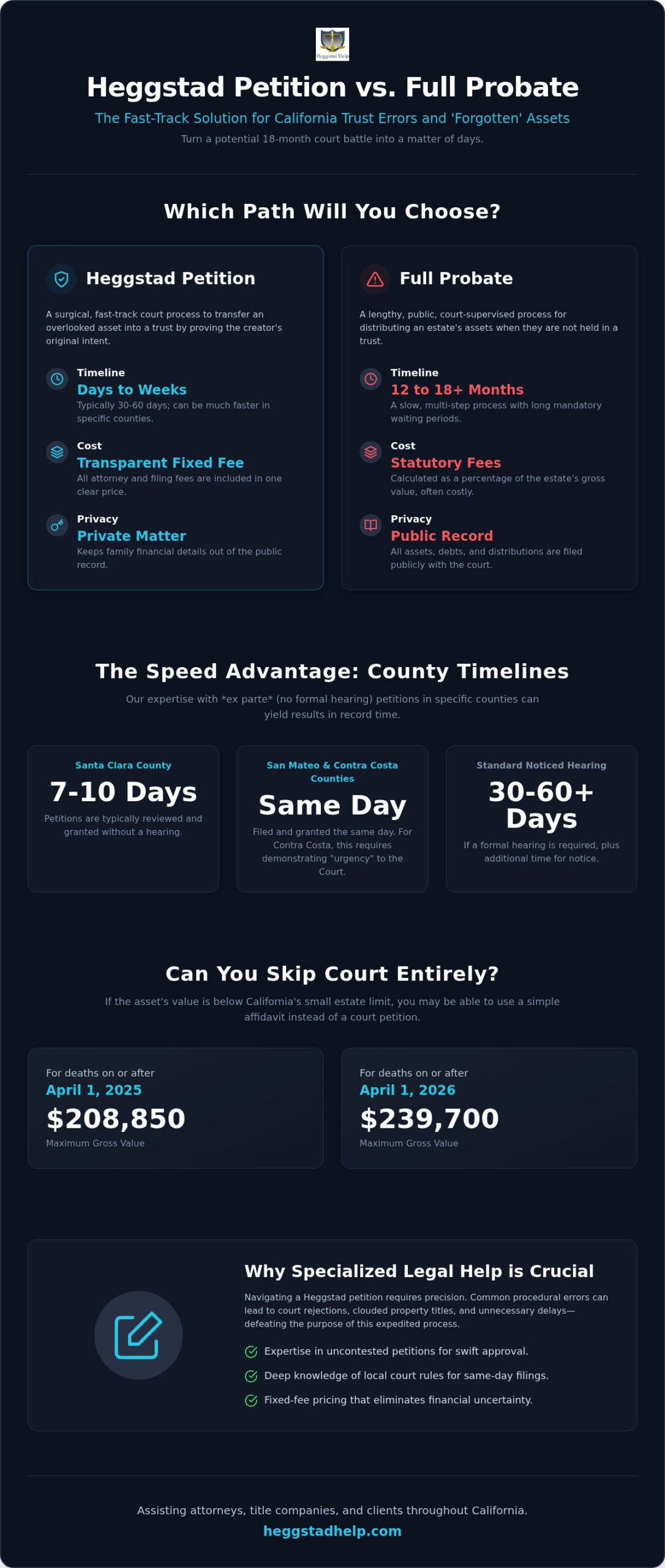
When evaluating a Heggstad petition vs probate California, the differences are not merely procedural; they represent a fundamental shift in how your family’s resources are preserved. Traditional probate is often described as a ‘sledgehammer’ approach to asset distribution, whereas a Heggstad petition filing acts as a surgical strike, targeting only the specific assets left out of the trust. This precision allows successor trustees to resolve title issues without opening a massive, multi-step court case that could last for years.
| Feature | Full Probate Administration | Heggstad Petition (PC 850) |
|---|---|---|
| Typical Timeline | 12 to 18 Months | 30 to 60 Days (often less) |
| Legal Fees | Statutory (Percentage of gross value) | Fixed Fee transparency |
| Court Appearances | Multiple formal hearings | Often zero to one hearing |
| Public Privacy | Fully public court record | Limited public disclosure |
The Cost Difference: Fixed Fees vs. Statutory Percentages
California law dictates statutory fees (mandatory legal costs set by the state) for full probate based on the gross value of the estate. For example, a property valued at $1,000,000 could result in over $46,000 in combined attorney and executor fees, regardless of the mortgage balance. In contrast, specialized firms offer fixed fee transparency, covering both filing and attorney fees in a single, predictable price. To better understand the full breakdown of what families pay, reviewing a detailed guide on Heggstad petition cost California families face can help you plan ahead and avoid unexpected expenses. This avoids the hidden costs of probate, such as appraisal fees, bond premiums (insurance for the executor), and expensive publication costs in local newspapers.
Timeline Realities: 30 Days vs. 12 Months
Standard California probate requires a minimum of one year to complete, largely due to the mandatory ‘Notice to Creditors’ period. This four-month window freezes progress while potential lenders or claimants come forward. A Heggstad petition bypasses this window entirely because the trust is already established and responsible for debts. If you’re working with a specialized firm, you may find that securing an ex parte order can resolve the issue in a a single day in San Mateo County and Contra Costa County, and typically 7-10 days working through Santa Clara County, allowing you to move forward with a home sale or distribution.
Probate is a matter of public record, meaning anyone can view the decedent’s assets, debts, and beneficiary list at the courthouse. Heggstad petitions are significantly more private, focusing only on the specific asset transfer. For a successor trustee, this speed and privacy are invaluable tools for managing the expectations of beneficiaries who may be anxious for their inheritance. It’s much easier to provide a calm, steady hand when the timeline is measured in weeks rather than years.
The 2026 Small Estate Threshold: Is a Heggstad Petition Mandatory?
Determining the most efficient path between a Heggstad petition vs probate California often hinges on the total market value of the assets left outside the trust. Not every funding error requires a formal court petition, but the rules for simpler alternatives are strict and dependent on the date of death. If the total value of the excluded assets falls below a specific dollar amount, you might qualify for a non-court alternative known as a Small Estate Affidavit (a document used to collect property under Probate Code Section 13100).
For decedents dying on or after April 1, 2026, the small estate threshold is $239,700. This figure is adjusted for inflation every three years. If the loved one passed away during the "gap year" between April 1, 2025, and March 31, 2026, the applicable threshold is $208,850. When the combined value of all assets staying outside the trust exceeds these limits, a Heggstad petition vs probate California becomes the primary comparison for a successor trustee. Because California real estate values are historically high, even a modest condominium or a small parcel of land typically pushes an estate well beyond these thresholds, making a court order necessary.
When You Can Use a Small Estate Affidavit
A Small Estate Affidavit is primarily designed for personal property, such as bank accounts, vehicles, or final paychecks. To use this process, you must wait at least 40 days after the date of death before presenting the signed affidavit to the financial institution holding the asset. While this is an excellent tool for liquidating a small savings account, it’s rarely a solution for real estate. Most California title companies refuse to recognize these affidavits for the transfer of land or homes. They require the legal finality and protection of a court decree to ensure the chain of title is clear and unassailable for future buyers.
When the Heggstad Petition is the Only Solution
If the "forgotten" asset is a house or commercial building valued above the small estate limit, a Heggstad petition is often the only way to avoid a full, year-long probate. This remains true even if the decedent left a Pour-Over Will (a backup will that "pours" any remaining assets into the trust). While the will proves the person wanted their assets in the trust, it doesn’t transfer the title by itself. Instead, we use the Pour-Over Will as powerful evidence of intent during the petition process. For a detailed look at the evidentiary requirements for these cases, you can review our guide on unfunded trust probate California. By presenting this evidence through a Heggstad filing, we can secure a court order that instructs the county recorder to update the deed, effectively bypassing the need for a full probate administration.
Regional Efficiency: Filing in Santa Clara, San Mateo, and Contra Costa
The physical location of the court often dictates the speed of your asset recovery just as much as the legal merits of your case. While the California Probate Code applies uniformly across the state, local court rules and judicial staffing levels create significant variations in processing times. When evaluating the efficiency of a Heggstad petition vs probate California, understanding these regional nuances allows a successor trustee to set realistic expectations for beneficiaries and potential home buyers. A filing that takes months in one county might be resolved in days in another if handled by a specialist familiar with local judicial rhythms.
In Santa Clara County, the court system is particularly adept at handling uncontested petitions. For well-prepared filings that meet all evidentiary standards, we typically see results in as little as 7 to 10 days. This is a staggering contrast to the standard probate track, which can languish for months before a single hearing is even scheduled. Moving slightly north, San Mateo and Contra Costa counties offer even more streamlined opportunities. In these jurisdictions, it’s often possible to secure same-day petition grants if the paperwork is filed with absolute precision. However, the Contra Costa Court frequently requires a clear demonstration of an ‘Urgency’ factor, such as a pending home sale or an immediate financial need, to move a case to the front of the line.
The Power of Ex Parte Filings
An ex parte filing is a specialized legal request made for the benefit of one party without the requirement of a standard 30-day notice to all other potential interests. By utilizing this method, we can often eliminate the typical 60-day wait for a noticed hearing (a formal court date set on the public calendar). Many generalist probate lawyers are uncomfortable with the ex parte process because it requires a higher level of procedural rigor and an intimate knowledge of local judicial preferences. If the petition isn’t perfect, the court will summarily deny the request, forcing the family back into the slow-moving standard probate queue. Our specialization in ex parte court order services ensures that these requests are positioned for immediate approval.
Successor Trustee Responsibilities in Fast-Track Filings
To achieve these expedited results, the successor trustee must be diligent in the initial discovery phase. This involves gathering a specific set of documents needed for Heggstad petition California, including the original signed trust and any subsequent amendments. It’s vital to verify that you have the most current version of the trust, as any discrepancy can cloud the title correction process and lead to a court rejection.
Actionable Tip: Before assuming a full probate is required, thoroughly search the decedent’s trust binder for a ‘General Transfer’ or ‘Assignment of Assets’ document. This single page often serves as the foundational evidence for proving intent, even if the specific property deed was never updated at the county recorder’s office. Finding this document can be the difference between a same-day order and a year of litigation.
Choosing Your Path: Why Specialized Legal Help Matters
While the data clearly shows the advantages of a Heggstad petition vs probate California in terms of speed and cost, the success of this strategy relies entirely on procedural precision. Attempting a "do-it-yourself" filing or hiring a generalist attorney often results in court rejections that waste valuable months. More dangerously, an improperly drafted petition can lead to clouded titles (unresolved legal questions regarding property ownership), which can halt a home sale at the eleventh hour. Because title companies are risk-averse, they require a court order that is legally unassailable before they will issue title insurance for a future buyer.
Specialized firms often act as a resource for other attorneys and title companies across the state because they understand the specific evidentiary standards required by different judicial officers. By focusing exclusively on these petitions, a specialist can provide a fixed-fee guarantee, which eliminates the stress of "billable hour traps" common in traditional probate litigation. This transparency allows successor trustees to fulfill their fiduciary duties (the legal obligation to act in the best interest of beneficiaries) without depleting the estate’s resources on open-ended legal fees. Families who want a complete picture of what to budget for should consult a thorough resource on Heggstad petition cost California attorneys and courts typically charge, so there are no surprises once the process begins.
Uncontested vs. Contested Petitions
The exceptional speed of a Heggstad filing is most effective when the petition is uncontested, meaning all beneficiaries and heirs are in agreement with the transfer. If a beneficiary objects to the petition, the court cannot grant an ex parte order. Instead, a noticed hearing (a formal court session where all parties have the right to argue their position) becomes mandatory. This shift typically adds at least 60 days to the timeline as the court follows standard litigation protocols. Ensuring all parties are informed and in agreement before filing is a critical step that a seasoned specialist will manage to maintain the fast-track schedule.
Next Steps for Successor Trustees
If you’ve discovered a property left out of a trust, taking organized action is the best way to reduce your personal liability and stress. We recommend following these three steps to secure the estate’s assets:
- Step 1: Locate the original trust document, all amendments, and the most recent deed for the "forgotten" property.
- Step 2: Consult with a Board-Certified Estate Planning Specialist who has a documented history of successful Heggstad filings in your specific county.
- Step 3: Secure a fixed-fee quote to ensure you have a clear understanding of the total cost before the process begins.
Choosing the right path today can save your family from the public, costly, and exhausting experience of a full California probate. If you’re ready to clear title and move forward, get specialized help with your California Heggstad Petition today.
Taking the Next Step Toward Estate Resolution
Navigating the aftermath of a loved one’s passing is difficult enough without the added burden of a "forgotten" asset. Choosing a Heggstad petition vs probate California allows you to bypass the public, year-long court process and secure a clear title in a fraction of the time. By leveraging the 2026 small estate thresholds and regional court efficiencies, you can ensure that the estate’s value remains with the beneficiaries rather than being consumed by statutory probate fees.
As a Board-Certified Specialist in Estate Planning, Trust and Probate Law, Robert P. Bergman provides the seasoned expertise needed to handle these filings with surgical precision. We offer transparent fixed fees that include all court costs, giving you complete financial predictability. In select counties, we even utilize same-day filing options to resolve title issues immediately. You don’t have to face the complexities of the California probate code alone.
Secure a Fixed-Fee Heggstad Petition Consultation today to protect your family’s inheritance and move forward with confidence.
Frequently Asked Questions
Is a Heggstad petition faster than probate in California?
Yes, a Heggstad petition is significantly faster than traditional probate. While a standard California probate typically requires 12 to 18 months to complete, a Heggstad petition can often be resolved in 30 to 60 days. In certain counties where ex parte filings are common, the process can be even shorter, sometimes concluding in just a few weeks. This speed allows successor trustees to distribute assets or close home sales without the year-long wait required by the formal court calendar.
What is the cost of a Heggstad petition vs. full probate?
A Heggstad petition is generally much more cost-effective because it avoids the statutory fees associated with full probate. In California, probate fees are set by law as a percentage of the estate’s gross value, which often totals tens of thousands of dollars for real property. Heggstad filings typically operate on a fixed-fee basis. This transparency helps families avoid the expense of court-appointed appraisals, bond premiums, and lengthy publication requirements that drive up the cost of a standard administration.
Can I file a Heggstad petition myself without a lawyer?
While you can technically file a petition without legal counsel, the risk of court rejection is extremely high for self-represented individuals. California courts require strict adherence to procedural rules and evidentiary standards to prove the decedent’s intent. Any error in the paperwork can lead to a clouded title, which prevents the property from being sold or transferred. Most successor trustees find that hiring a specialist ensures the order is granted correctly the first time, protecting the chain of title. Reviewing the Heggstad petition process California courts require can help you understand the full scope of what a proper filing entails before deciding whether to proceed with professional assistance.
What is the small estate threshold in California for 2026?
The small estate threshold for decedents dying on or after April 1, 2026, is $239,700. This figure represents the total market value of all assets left outside of a trust or named beneficiary designations. If the assets exceed this amount, you cannot use a simple affidavit and must instead compare the merits of a Heggstad petition vs probate California. For deaths occurring between April 2025 and March 2026, the applicable threshold remains $208,850.
How long does it take to get a Heggstad order in Santa Clara County?
In Santa Clara County, well-prepared uncontested petitions typically receive a court order within 7 to 10 days. The local court is efficient at processing these requests when they are filed correctly with all supporting documentation. This timeline assumes that no beneficiaries object to the transfer and that the evidence of the grantor’s intent is clear. Working with a firm familiar with Santa Clara’s specific local rules is the best way to ensure this expedited turnaround.
What happens if I forgot to put my house in my trust?
If a house was left out of a trust, the property’s title remains in the decedent’s individual name, which prevents the trustee from selling or distributing it. You’ll need to obtain a court order to transfer the house into the trust retroactively. By filing a Heggstad petition, you can present evidence to the court showing that the owner intended for the home to be trust property. Once the judge signs the order, you can record it to update the deed.
Do title companies accept Heggstad orders for selling a home?
Yes, California title companies routinely accept valid Heggstad orders to clear title for a home sale. These court orders provide the legal certainty that title insurers require to issue a policy to a new buyer. It’s essential that the petition is drafted with professional precision to ensure the final order contains the specific legal language title companies expect. A properly executed order serves as a definitive link in the chain of ownership, allowing the sale to proceed.
Can a Heggstad petition be used for bank accounts and stocks?
Yes, a Heggstad petition can be used for various types of assets, including bank accounts, brokerage accounts, and stock certificates. While these petitions are most commonly used for real estate, they are equally effective for any significant asset that was intended for the trust but never formally retitled. If the value of these accounts exceeds the 2026 small estate limits, a Heggstad petition vs probate California is the most efficient way to recover those missing trust assets.

Article by
Robert P. Bergman, Attorney at Law
Attorney Robert P. Bergman ("Bob Bergman") has been a Board-Certified Specialist in Estate Planning, Trust and Probate Law since 2011, as certified by the California State Bar Board of Legal Specialization. For several years, Bob has assisted families and the clients of other attorneys with obtaining court orders through Heggstad petitions to avoid the time and expense of Probate administration. Bob is friendly, very approachable, and believes in explaining complex legal topics in clear ordinary language so that his clients understand exactly what they're doing and why they're doing it.
Bob is often able to assist clients who are in other counties than his home county of Santa Clara through his approach to Heggstad petitions.
Disclaimer
This article is for informational purposes only. Nothing in this article is intended to replace legal advice from a competent attorney or be considered legal guidance for anybody's specific legal situation. Nobody should rely on information in this article in making legal decisions without such consultation.


