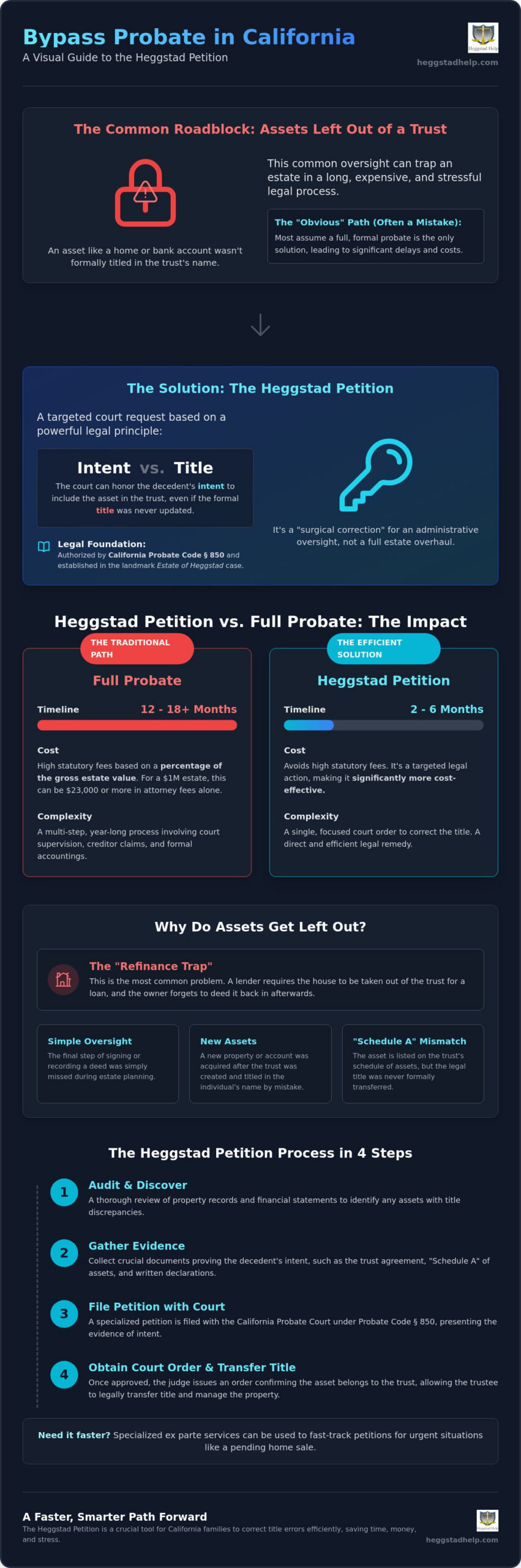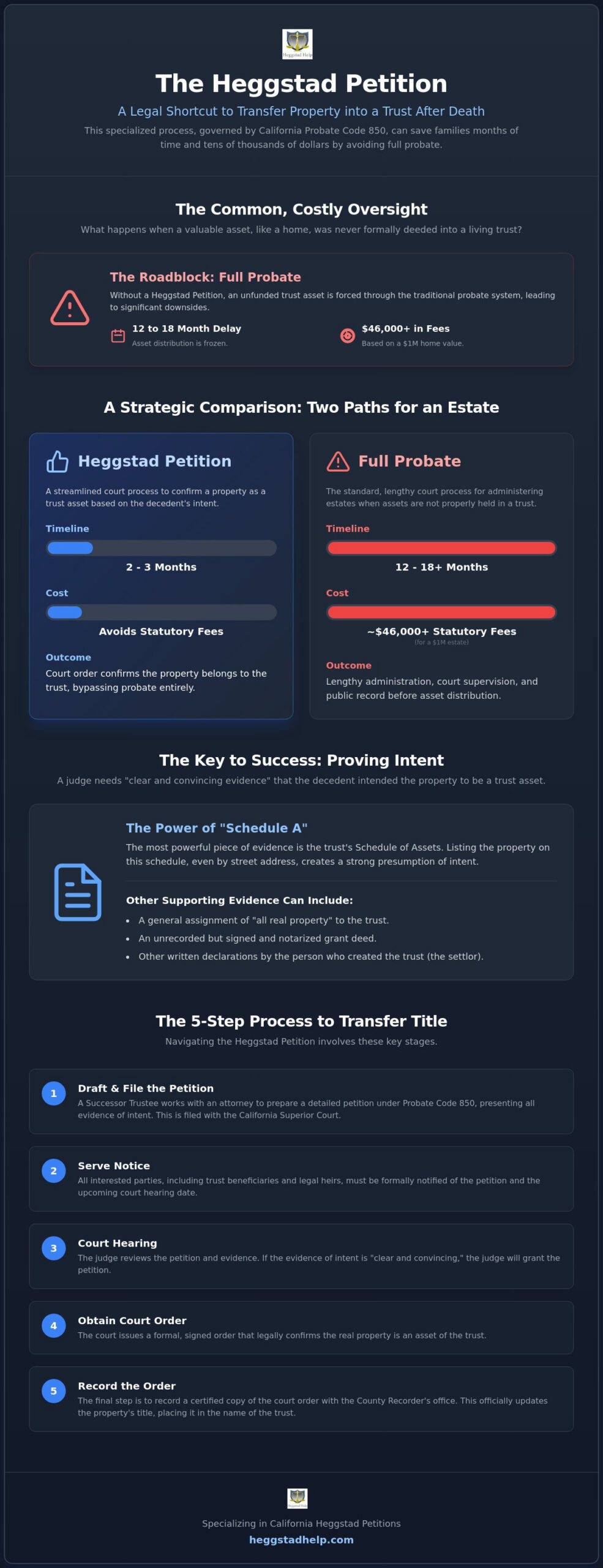
Heggstad Petition: Avoid Probate for CA Bank Accounts 2026

Imagine discovering a forgotten brokerage account left out of a trust, only to have the bank insist on a full probate administration (a…

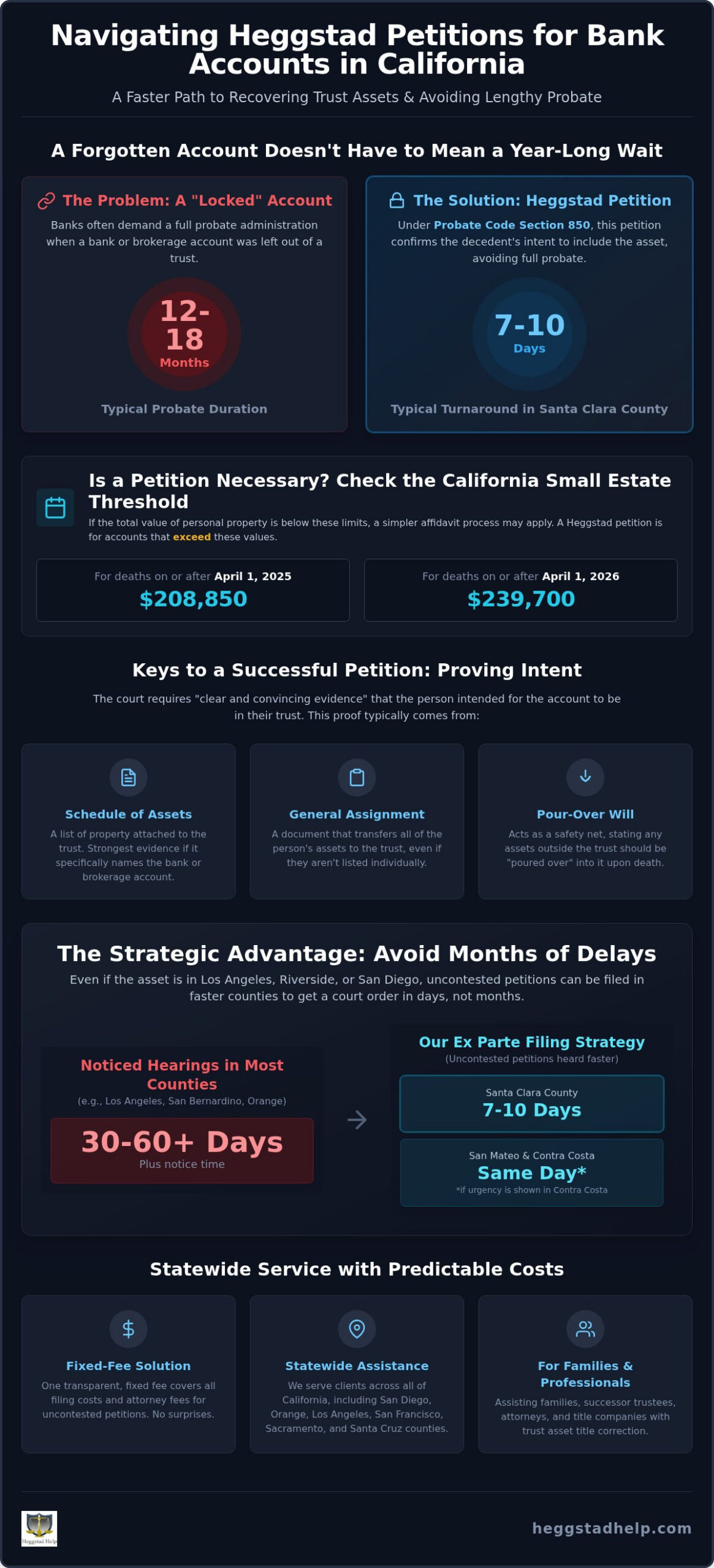
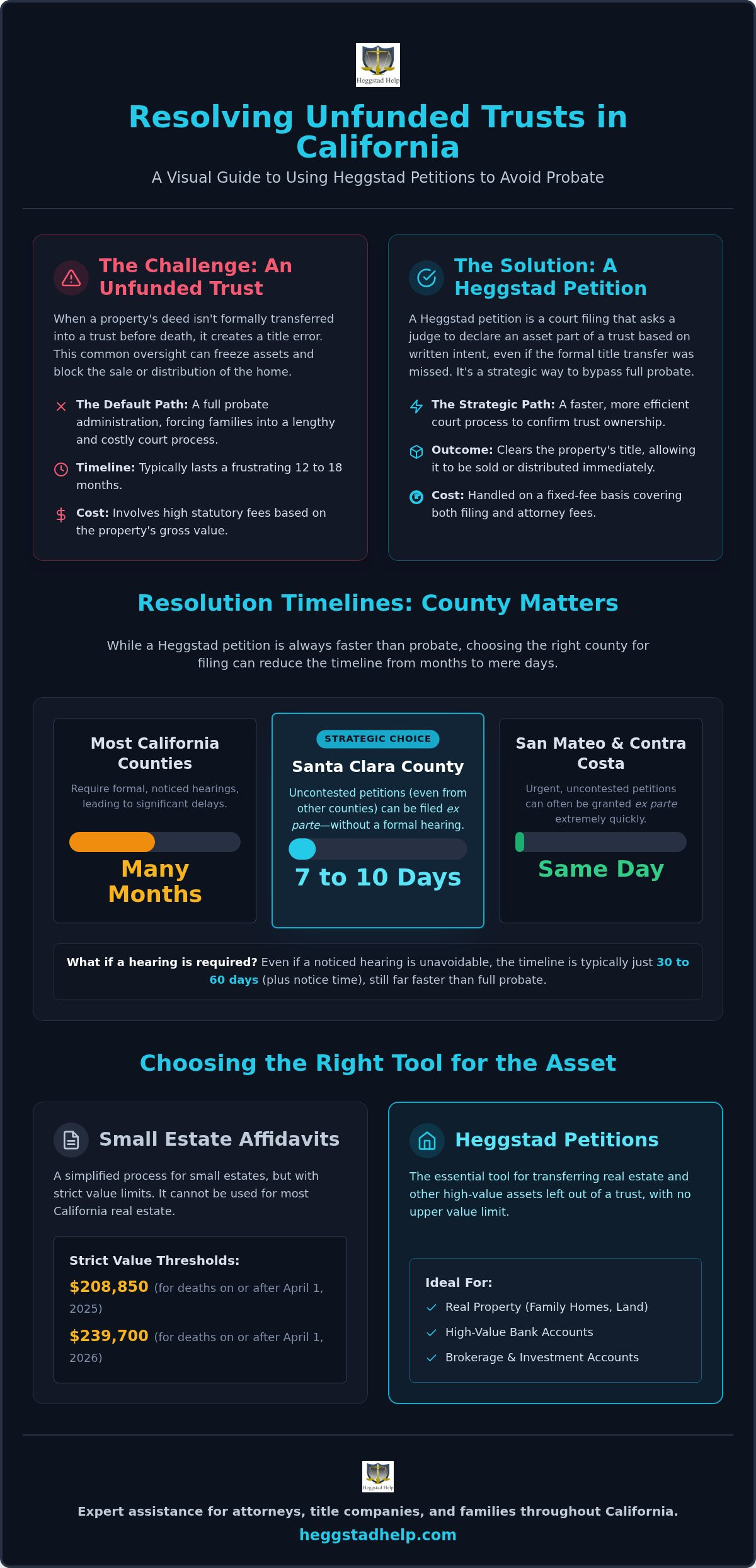
Imagine discovering a forgotten brokerage account left out of a trust, only to have the bank insist on a full probate administration (a court-supervised process for distributing assets) that could take over a year. While families in Los Angeles often face noticed hearings, a Heggstad petition for bank accounts in California under Probate Code Section 850 offers a faster path. This applies if the account exceeds the small estate limit ($208,850 for deaths on or after April 1, 2025, and $239,700 for deaths on or after April 1, 2026).

We’ll show you how to transfer titles quickly using fixed-fee services. We assist families and attorneys statewide by filing uncontested petitions ex parte (without a formal hearing) in Santa Clara County, where orders are granted in 7 to 10 days, or San Mateo, where they are often granted the same day.

Key Takeaways

  • Learn how a Heggstad petition for bank accounts in California bypasses a year-long probate for accounts exceeding the small estate limit of $208,850 (for deaths on or after April 1, 2025) or $239,700 (for deaths on or after April 1, 2026).
  • Identify the specific written evidence, such as a “Schedule of Assets,” General Assignment, or a “pour-over will,” required to prove a decedent’s intent to hold assets in trust under the Probate Code.
  • Discover the strategic advantage of filing ex parte in Santa Clara County to secure a court order in just 7 to 10 days, even for accounts originally opened in Los Angeles, San Diego, Riverside, or other counties throughout California.
  • Understand the benefits of a fixed-fee legal solution that covers both filing and attorney fees for trust asset title correction throughout the entire state of California.

Recovering Bank Accounts in California with a Heggstad Petition

Families often discover that a loved one forgot to retitle a bank account into their trust. Banks typically refuse to release these funds to a Successor Trustee (the person appointed to manage trust assets) without a formal court order. They fear liability and often insist on a full probate administration, which can drag on for 12 to 18 months. A Heggstad petition for bank accounts California acts as a surgical alternative. It’s a specific legal request that asks the court to confirm the trust already owns the account based on the creator’s intent. This process allows the trustee to fulfill their fiduciary duty to the beneficiaries without exhausting delays. HEGGSTAD HELP assists families in Los Angeles, Orange, and San Diego with fixed fees that cover both filing and attorney fees.

Understanding Probate Code Section 850 for Financial Assets

The statutory power behind this request comes from Probate Code Section 850. This law allows the court to fix title errors for personal property like bank or brokerage accounts. To succeed with a Heggstad petition for bank accounts California, you must provide clear and convincing evidence of intent. This means showing the court that the decedent meant for the account to be part of the trust, even if the bank’s paperwork doesn’t reflect it. The legal foundation for this dates back to the landmark case of Estate of Heggstad. When filing a Heggstad petition for bank accounts California, the court focuses on written evidence to bypass the small estate limits ($208,850 for deaths on or after April 1, 2025, and $239,700 for deaths on or after April 1, 2026). You can find more details in our Heggstad Petition Filing guide.

Requirements for a Bank Account Petition in California

To successfully file a Heggstad petition for bank accounts California, the court requires written proof of the decedent’s intent. This evidence usually takes the form of a "Schedule of Assets" (a list of property attached to the trust) or a "General Assignment" document. A "pour-over will" also plays a critical role; it serves as a safety net by expressing a final wish that all assets be transferred into the trust. Our office handles these filings with fixed fees, ensuring the process remains transparent for families and attorneys alike.

Before proceeding, it’s vital to check the account balance against the California Small Estate Affidavit limits. If the total value of the estate’s personal property is below the threshold, a court petition might not be necessary. These limits are $208,850 for deaths occurring on or after April 1, 2025, and $239,700 for deaths occurring on or after April 1, 2026. If the account exceeds these amounts, a Heggstad Petition in California is the most efficient way to avoid a 12-month probate process.

Evidence of Intent for Brokerage and Bank Accounts

Specific account numbers listed in trust documents offer the strongest evidence for the court. However, many trusts use a "general transfer" clause to cover all financial holdings. Robert P. Bergman, a Board-Certified Specialist in Estate Planning, Trust and Probate Law, can review your documents to determine if they meet the "clear and convincing" evidence standard required by the Probate Code. If you’re unsure where to start, you can consult with a specialist to evaluate your case. We assist families and attorneys throughout the entire state, including San Francisco and Santa Cruz, with trust asset title correction.

Heggstad Petition: Avoid Probate for CA Bank Accounts 2026

Fast-Track Ex Parte Orders for Bank Accounts in California

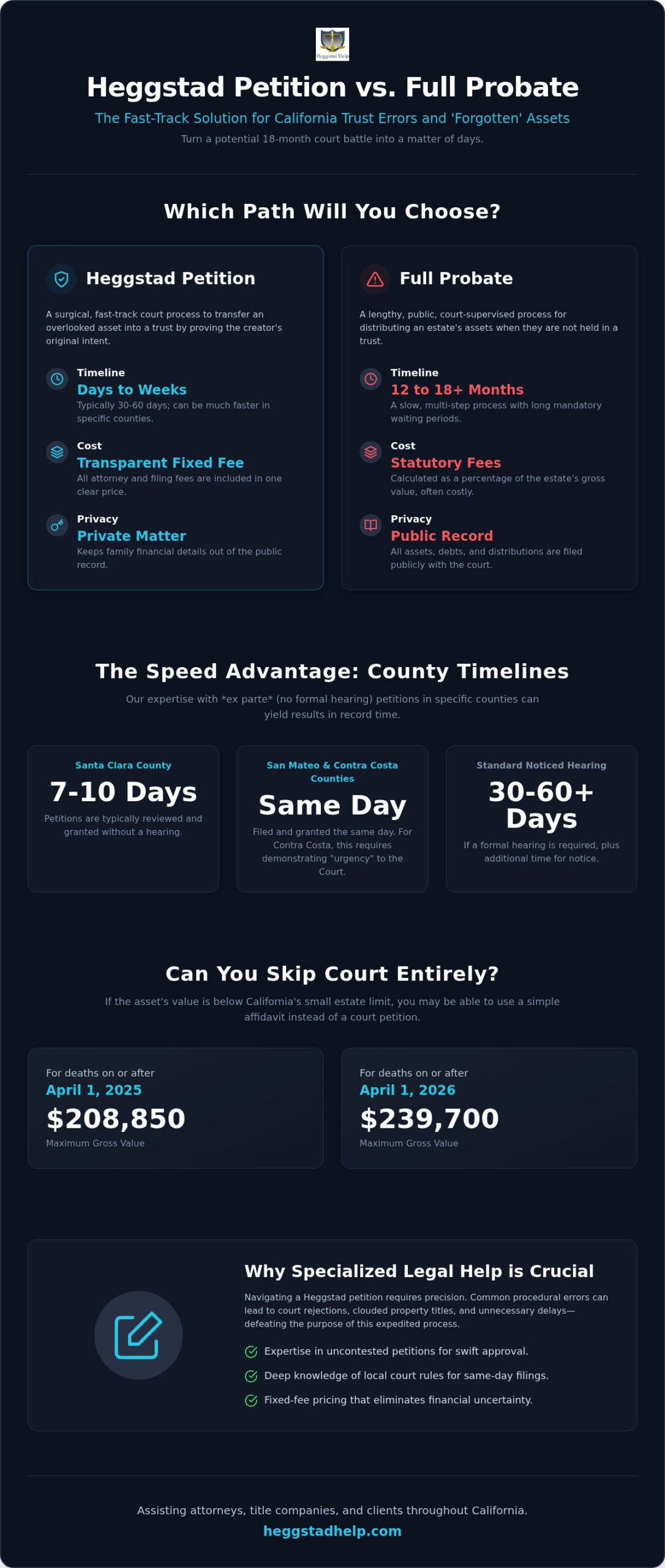
The standard timeline for a noticed hearing (a formal court date where all interested parties receive official notice) in most counties is roughly 30 to 60 days. This long wait is common in Southern California locations like San Bernardino or Riverside. However, a Heggstad petition for bank accounts California can be filed ex parte (without a formal hearing) in specific jurisdictions to bypass these delays. In Santa Clara County, these petitions are typically granted in just 7 to 10 days. For those facing extreme deadlines, San Mateo and Contra Costa Counties can often grant an order the same day, provided urgency is demonstrated.

HEGGSTAD HELP provides a strategic advantage by filing uncontested petitions in these fast-track counties regardless of where the decedent lived. Even if the bank account was opened in Los Angeles or San Diego, an uncontested Heggstad petition for bank accounts California can often be heard in Santa Clara County to secure a court order in about a week. This method avoids the months of waiting required for noticed hearings in other parts of the state. Our office handles the entire process for a fixed fee that covers both the attorney fees and court filing fees.

By using this expedited approach, a Successor Trustee can quickly gain the legal authority needed to manage financial assets. If your case is uncontested, a Heggstad petition for bank accounts California is the most efficient way to resolve title issues without the traditional probate wait times. We recommend consulting with a specialized Heggstad petition lawyer to see if your specific brokerage or bank account qualifies for this accelerated court process.

Secure Your Trust Assets with Expert Guidance

Recovering a forgotten account doesn’t have to trigger a 12 month probate nightmare. By filing a Heggstad petition for bank accounts California, you can use Probate Code Section 850 to confirm trust ownership and bypass the small estate limits of $208,850 (for deaths on or after April 1, 2025) and $239,700 (for deaths on or after April 1, 2026). Robert P. Bergman, a Board-Certified Specialist in Estate Planning, Trust and Probate Law, offers fixed-fee services to families in Los Angeles, Orange, and San Francisco. Our strategic ex parte filings in Santa Clara County provide a 7 to 10 day turnaround, helping you fulfill your fiduciary duties quickly and efficiently.

Take the first step toward resolving these procedural hurdles today. Get a Fixed-Fee Quote for Your Heggstad Petition in California. You don’t have to face complex bank legal departments alone; help is available to ensure your family’s assets are protected.

Frequently Asked Questions

Can I use a Heggstad petition for a bank account if there is no Schedule A?

Yes, you can still file a Heggstad petition for bank accounts in California without a formal Schedule A. The court looks for clear and convincing evidence of the decedent’s intent to hold the asset in trust. This proof is often found in a general assignment of assets or a pour-over will. We help families in Alameda and Marin identify documentation that satisfies the Probate Code.

How much does a Heggstad petition for a bank account cost in California?

Legal costs vary, but our office uses a fixed-fee model that covers both attorney fees and court filing fees. This provides financial certainty for families in San Bernardino and Riverside. While the statewide initial filing fee is $435, our fixed fee ensures you don’t face the stress of unpredictable hourly invoices while seeking trust asset title correction.

What is the difference between a Heggstad petition and a Small Estate Affidavit in 2026?

A Small Estate Affidavit is used only when an estate’s value falls under specific limits. These limits are $208,850 for deaths occurring on or after April 1, 2025, and $239,700 for deaths occurring on or after April 1, 2026. If the account balance is higher, a Heggstad petition for bank accounts in California is required to move the funds into the trust.

Do I need to go to court for a Heggstad petition in Santa Clara County?

No, you typically don’t have to attend a hearing for uncontested petitions in Santa Clara County. These cases are processed ex parte, meaning a judge reviews the file in chambers. This strategy allows for a quick 7 to 10 day turnaround, even for cases originating in Los Angeles, Orange, or San Diego that would otherwise take months.

How long does it take to get a bank account transferred after the court order is signed?

Most banks take two to four weeks to process the transfer once the judge signs the order under the Probate Code. You must present a certified copy of the court order to the bank’s legal department. While processing times at banks in San Francisco or Sacramento vary, the court order provides the legal authority needed to compel the transfer.

Robert P. Bergman, Attorney at Law

Article by

Robert P. Bergman, Attorney at Law

Attorney Robert P. Bergman ("Bob Bergman") has been a Board-Certified Specialist in Estate Planning, Trust and Probate Law since 2011, as certified by the California State Bar Board of Legal Specialization. For several years, Bob has assisted families and the clients of other attorneys with obtaining court orders through Heggstad petitions to avoid the time and expense of Probate administration. Bob is friendly, very approachable, and believes in explaining complex legal topics in clear ordinary language so that his clients understand exactly what they're doing and why they're doing it.
Bob is often able to assist clients who are in other counties than his home county of Santa Clara through his approach to Heggstad petitions.

Disclaimer

This article is for informational purposes only. Nothing in this article is intended to replace legal advice from a competent attorney or be considered legal guidance for anybody's specific legal situation. Nobody should rely on information in this article in making legal decisions without such consultation.


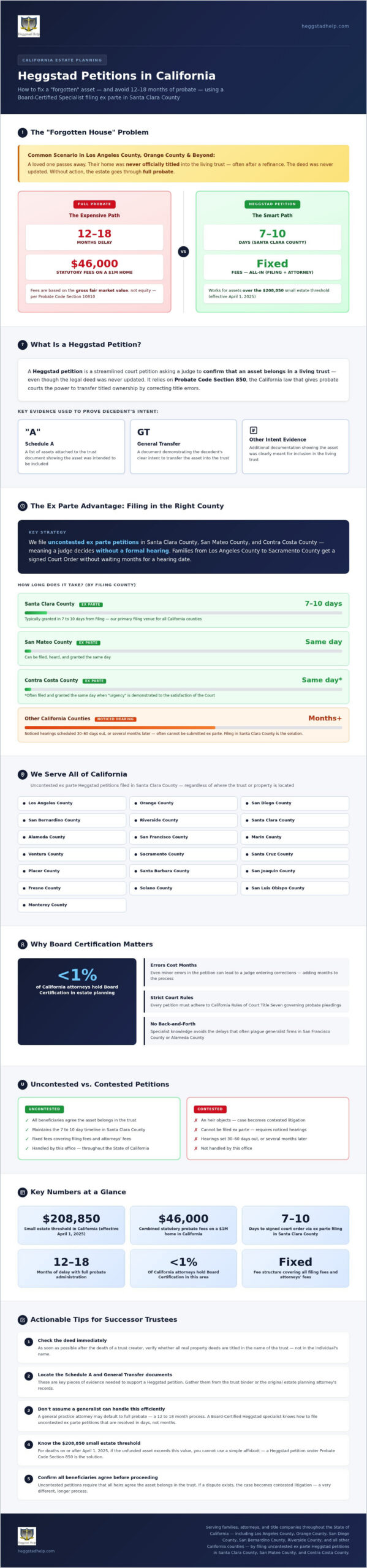
What Happens if a House is Not in a Trust When Someone Dies in California?

A missing deed doesn’t have to mean your family is trapped in probate court for the next year. You might feel overwhelmed discovering that a home was…

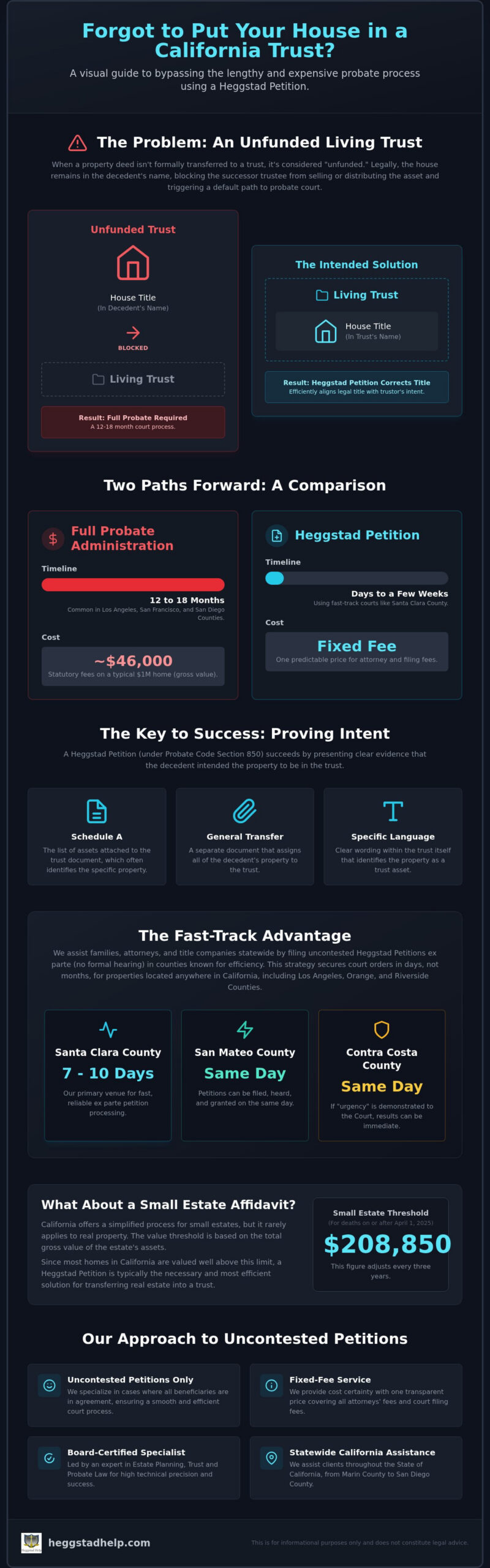
A missing deed doesn’t have to mean your family is trapped in probate court for the next year. You might feel overwhelmed discovering that a home was left out of a living trust, especially when facing the prospect of a 12 to 18 month delay. It’s a common frustration to see a trust exist but realize the deed remains in the individual’s name. Understanding what happens if a house is not in a trust when someone dies California is critical to protecting the estate from high statutory fees. This guide reveals how you can bypass a full probate through a Heggstad petition (a legal procedure under Probate Code Section 850 that asks a judge to recognize the asset as part of the trust). We’ll explain how to secure a fast court order to confirm trust ownership and why fixed-fee legal help is the most efficient path forward.

Key Takeaways

  • Understand that an “unfunded” house (an asset not properly deeded to the trust) remains part of the probate estate and cannot be transferred to beneficiaries until the title is legally corrected.
  • Learn how a Heggstad petition, filed under Probate Code Section 850, bypasses the 12 to 18 month probate process by asking a judge to confirm the home as trust property based on the decedent’s intent.
  • Discover how to secure a court order in as little as 7 to 10 days by filing ex parte (without a formal hearing) in Santa Clara County, a strategy available for properties located throughout the state.
  • Identify the specific legal steps to resolve what happens if a house is not in a trust when someone dies California, including how to use a “Schedule of Assets” to avoid high statutory probate fees.

When someone passes away, families often assume that having a trust document is enough to manage the estate. However, the legal reality changes significantly when the deed to a home was never transferred into the trust’s name. An unfunded trust is a trust that exists on paper but does not legally own the assets intended for it. In this scenario, the property is technically an "unfunded" asset that remains part of the decedent’s probate estate.

Understanding what happens if a house is not in a trust when someone dies California is vital because, without court intervention, the title cannot be transferred to beneficiaries by the successor trustee alone. The county recorder’s office still sees the individual as the owner, which usually triggers a mandatory full probate in California. We support families and attorneys across the state, including those in Los Angeles, Orange, and Riverside, who need to file Heggstad petitions to correct these title errors. The Probate process is the standard court procedure used to settle a person’s debts and distribute their remaining assets as governed by the California Probate Code.

The California Small Estate Threshold in 2026

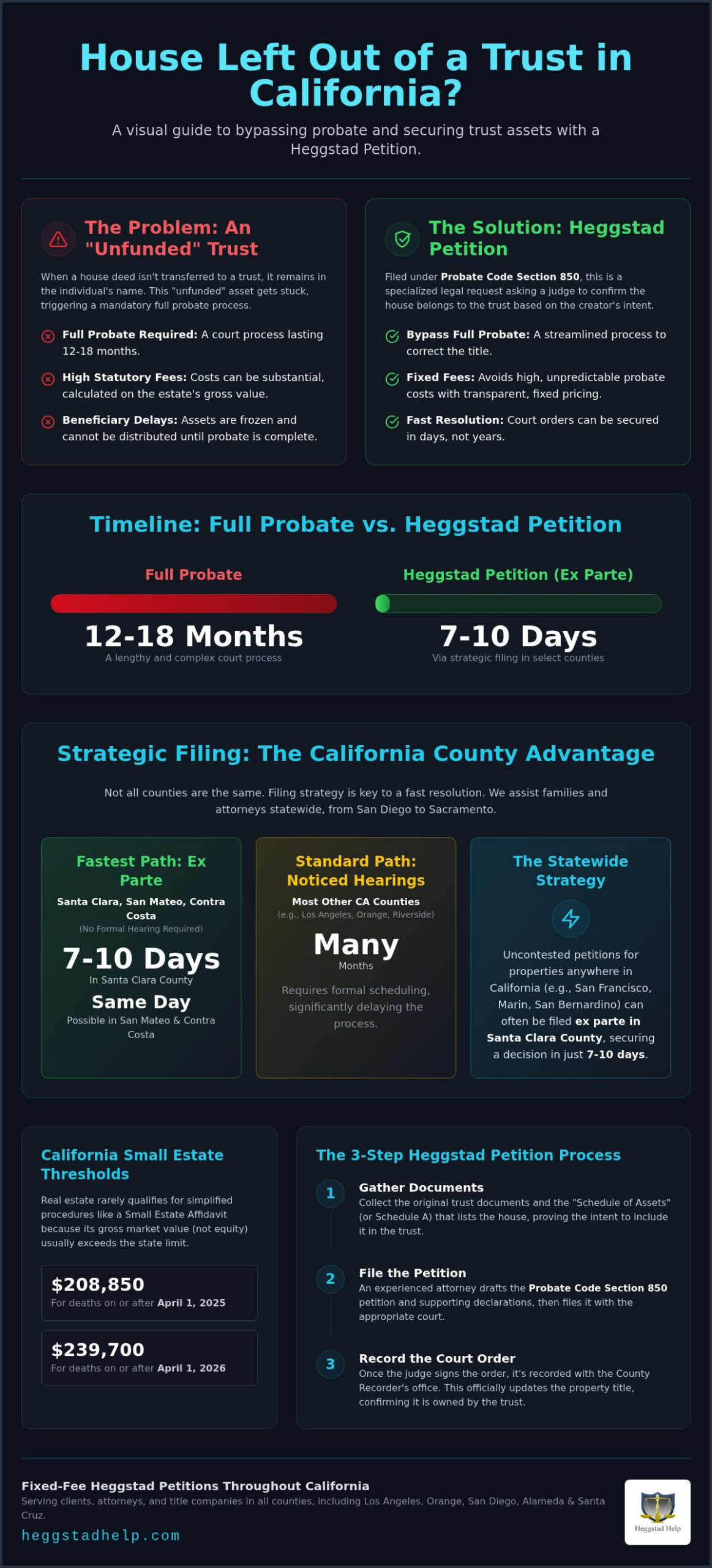
While some smaller assets can be transferred using simplified procedures, real estate rarely qualifies. For deaths occurring on or after April 1, 2025, the Small Estate Affidavit threshold is $208,850, and for deaths occurring on or after April 1, 2026, the threshold increases to $239,700. Since most homes in California exceed these limits, a house usually requires more than a simple affidavit to transfer. Consider these points:

  • The house value is calculated at gross market value, not equity.
  • Successor trustees lack authority to sign deeds for property not officially owned by the trust.
  • Title companies won’t issue insurance without a court order or probate.

Avoiding Full Probate with a Heggstad Petition in California

A Heggstad petition, filed under Probate Code Section 850, is a specialized legal request that asks the court to confirm a house belongs in a trust based on the decedent’s clear intent. This is the primary solution for what happens if a house is not in a trust when someone dies California. Rather than suffering through a year of California probate, this procedure allows a judge to "transfer" the title retroactively. We regularly assist families in Los Angeles, Orange, and San Diego by securing these court orders. This process typically costs a fraction of statutory probate fees and concludes significantly faster than a full probate administration in California.

Strategic Filing: The Santa Clara County Advantage

Timing is everything when managing an estate. In Santa Clara County, uncontested Heggstad petitions are often granted ex parte (without a formal hearing) in just 7 to 10 days. Similarly, San Mateo and Contra Costa Counties can often grant these orders the same day, provided urgency is demonstrated in Contra Costa. While other counties like Riverside, San Francisco, or San Bernardino often require noticed hearings that take many months, we can often have those uncontested petitions heard ex parte in Santa Clara County and decided within 7 to 10 days. Knowing what happens if a house is not in a trust when someone dies California helps you choose the fastest path. Our firm provides ex parte court order services throughout the entire state of California using fixed fees that cover both filing and attorney fees.

What Happens if a House is Not in a Trust When Someone Dies in California?

How to Transfer Your House to the Trust After Death

Recovering a home for a trust requires a methodical approach. First, you must gather the original trust documents and any "Schedule A" (a list of assets intended to be held by the trust) that specifically names the house. While the California Courts Self-Help Guide to Probate outlines the standard path for estates, a Heggstad petition offers a specialized shortcut. You’ll need to engage a specialized Heggstad petition attorney in California to draft the legal petition and supporting declarations. This documentation proves to the court that the decedent intended the home to be trust property despite the title error.

Once the court reviews the evidence, it issues a signed order confirming the house is trust property. You then record this order with the County Recorder to update the title. Our firm handles these filings state-wide, assisting clients in Alameda, Sacramento, and Santa Cruz with fixed fees that cover both attorney time and court filing costs. This transparency is vital for understanding what happens if a house is not in a trust when someone dies California, as it provides a predictable path to resolution without the variable costs of a full probate.

Why Work with a California Board-Certified Specialist?

Robert P. Bergman is a Board-Certified Specialist in Estate Planning, Trust and Probate Law with decades of specialized experience. Choosing a specialist ensures your 850 petition in California is drafted to meet the specific requirements of local courts, whether you’re in San Francisco or Marin. We provide a steady, knowledgeable hand to reduce the stress of navigating the California Probate Code. Our expertise ensures your petition is accurate, increasing the likelihood of a swift, favorable outcome.

Take Control of Your Family’s Estate Recovery

Discovering that a deed was never recorded into a trust can feel like a legal roadblock, but it doesn’t have to lead to a year of court delays. By understanding what happens if a house is not in a trust when someone dies California, you can choose a faster path through a Heggstad petition. This process confirms the decedent’s intent and updates the title without the high costs of full probate. Robert P. Bergman, a Board-Certified Specialist in Estate Planning, Trust and Probate Law, helps families in Los Angeles, Orange, and San Diego secure ex parte orders in as little as 7 to 10 days through strategic filings in Santa Clara County. Ready to bypass the probate process? Get a Fixed-Fee Quote for Your Heggstad Petition today. You have the tools to protect your inheritance and we’re here to guide you every step of the way.

Frequently Asked Questions

Can I sell a house that was left out of a trust in California?

You cannot sell a house left out of a trust until the title is legally corrected. Most California homes exceed the Small Estate Affidavit threshold of $208,850 for deaths on or after April 1, 2025, and $239,700 for deaths on or after April 1, 2026. To address what happens if a house is not in a trust when someone dies California, you must file a Heggstad petition under Probate Code Section 850.

How much does a Heggstad Petition cost compared to full probate?

A Heggstad petition is significantly more cost-effective because it bypasses statutory probate fees. In a full probate, fees are calculated as a percentage of the gross estate value. For instance, a $1 million estate triggers roughly $46,000 in combined statutory fees for the attorney and executor. Our firm offers fixed fees for Heggstad petitions state-wide, providing a predictable and lower-cost alternative to the expensive probate process.

What happens if the house is not listed on a Schedule A?

You can still succeed even if the house isn’t on a Schedule A, provided other evidence of intent exists. A general assignment of all assets or specific trust language often suffices to prove the decedent’s wishes. Courts in counties like San Bernardino or Alameda look for clear and convincing evidence that the decedent meant for the property to be trust-owned, even if the deed was never recorded.

Is a Heggstad Petition possible if there is no written evidence of intent?

A Heggstad petition usually requires some form of written evidence to prove intent. While a Schedule A is standard, a signed "General Assignment" is often accepted. While counties like Riverside or San Diego often require noticed hearings taking many months, we can instead have uncontested petitions from those counties heard ex parte in Santa Clara County and decided within 7 to 10 days.

Robert P. Bergman, Attorney at Law

Article by

Robert P. Bergman, Attorney at Law

Attorney Robert P. Bergman ("Bob Bergman") has been a Board-Certified Specialist in Estate Planning, Trust and Probate Law since 2011, as certified by the California State Bar Board of Legal Specialization. For several years, Bob has assisted families and the clients of other attorneys with obtaining court orders through Heggstad petitions to avoid the time and expense of Probate administration. Bob is friendly, very approachable, and believes in explaining complex legal topics in clear ordinary language so that his clients understand exactly what they're doing and why they're doing it.
Bob is often able to assist clients who are in other counties than his home county of Santa Clara through his approach to Heggstad petitions.

Disclaimer

This article is for informational purposes only. Nothing in this article is intended to replace legal advice from a competent attorney or be considered legal guidance for anybody's specific legal situation. Nobody should rely on information in this article in making legal decisions without such consultation.

Transfer Real Estate to a Living Trust After Death in California: The Heggstad Solution

Imagine the frustration of discovering, weeks after a loved one has passed, that their family home was never formally deeded into their trust. You…

Imagine the frustration of discovering, weeks after a loved one has passed, that their family home was never formally deeded into their trust. You might feel trapped by the prospect of a 12 to 18 month probate process, but a missing deed is a fixable error rather than an automatic sentence to court delays. It’s entirely possible to transfer real estate to a living trust after death in California by using a strategic legal tool known as a Heggstad petition (a request for a court order declaring that a property is a trust asset despite a title error). This approach bypasses full probate administration, saving your family from high statutory fees (legal costs set by state law) and clearing the title for an immediate sale or distribution.

We act as a steady guide for families, title companies, and attorneys, providing a logical path through these procedural hurdles. While many counties require noticed hearings that take many months, we often utilize ex parte (expedited) filings in Santa Clara County to get petitions granted in just 7 to 10 days. In San Mateo and Contra Costa Counties, we can often secure orders the same day. If a noticed hearing is required, the timeline is typically 30 to 60 days plus notice time. For smaller assets, remember that California Small Estate Affidavit thresholds are $208,850 for deaths on or after April 1, 2025, and $239,700 for deaths on or after April 1, 2026. Our fixed-fee Heggstad solutions provide a clear, efficient path to resolving trust funding errors without the stress of a year-long probate.

Key Takeaways

  • Learn how to transfer real estate to a living trust after death in California using a Heggstad petition (a court order confirming trust ownership) to bypass the lengthy probate process.
  • Discover why filing in Santa Clara County is a strategic choice, providing results in 7 to 10 days for uncontested petitions compared to the many months required in other counties.
  • Compare the Heggstad solution to Small Estate Affidavits, which are limited to estates under $208,850 for deaths on or after April 1, 2025, and $239,700 for deaths on or after April 1, 2026.
  • Understand how fixed-fee arrangements and ex parte (expedited) filings can resolve title errors as quickly as the same day in San Mateo and Contra Costa Counties.

The Challenge of an Unfunded Trust in California

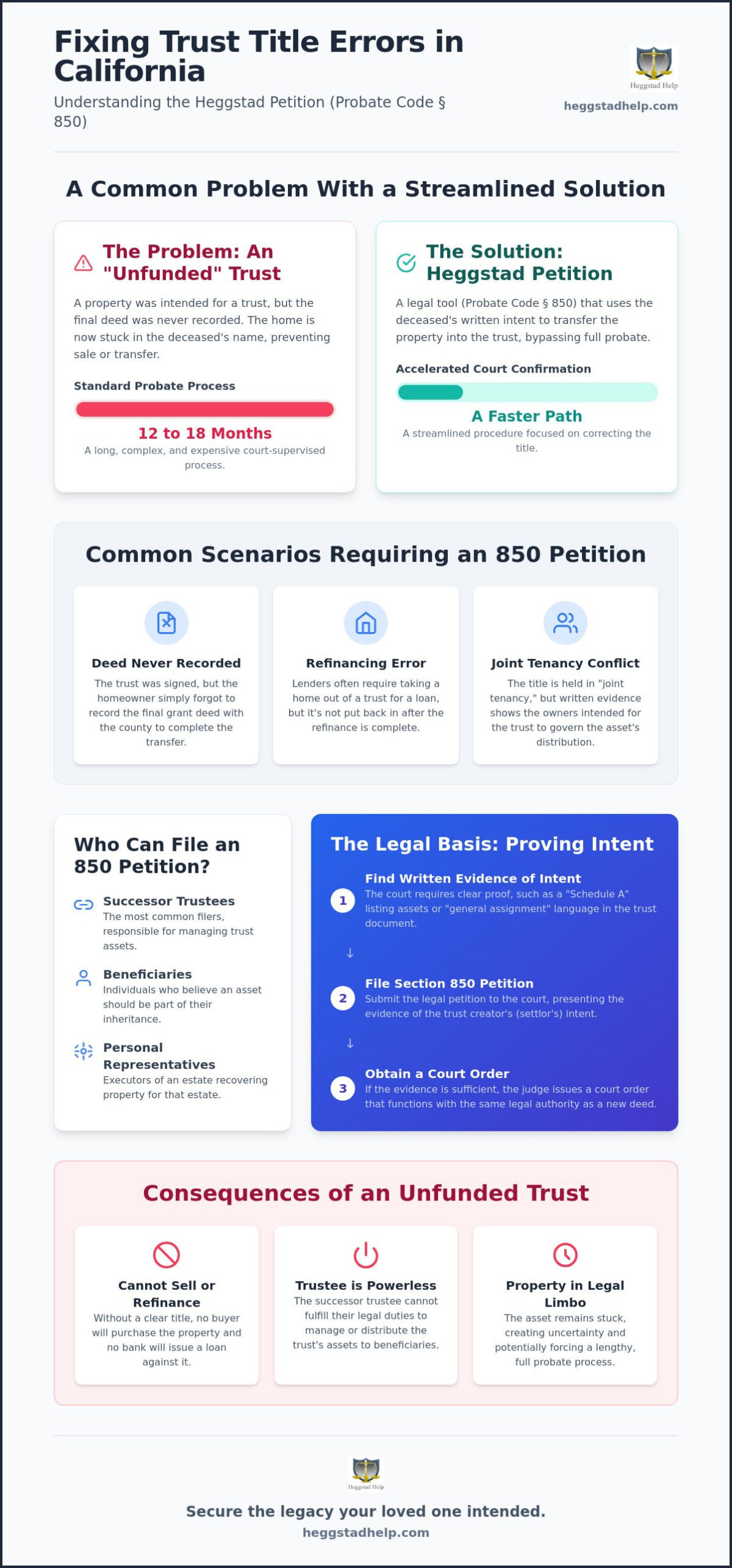
Creating a living trust is a significant step toward protecting your family’s future, but the document itself is only half of the equation. For a trust to function as intended, it must be “funded,” which is the formal process of transferring ownership of your assets from your individual name into the name of the trust. When it comes to your home, this requires signing and recording a new deed with the county recorder. If a parent or loved one passes away and you discover the deed is still in their personal name, the trust is considered “unfunded” regarding that specific property. Even if the trust document explicitly states that the house belongs to the trust, the transfer of title is not automatic under California law.

This oversight creates a legal gap that often prevents successor trustees (the people appointed to manage the trust) from selling the home or distributing it to beneficiaries. Without a recorded deed, title companies generally won’t issue the insurance necessary to close a sale. Fortunately, you can still transfer real estate to living trust after death by utilizing a specific legal remedy known as a Heggstad petition. Named after the landmark case Estate of Heggstad, this procedure allows a court to declare that the property is a trust asset based on the deceased person’s clear written intent, even if the formal deed was never recorded.

Why Real Estate Title Errors Occur

Title errors are surprisingly common, even for those who worked with experienced estate planners. One of the most frequent culprits is a residential refinance. Lenders often require borrowers to move a property out of a trust and back into their individual names to process a new loan; unfortunately, the final step of moving the property back into the trust is frequently forgotten once the paperwork is signed. In other cases, a “Schedule A” (the list of assets attached to the trust) might be too vague, failing to include a specific legal description or the assessor’s parcel number. Procrastination also plays a role, as many people intend to record a deed but simply never get around to the notary or the recorder’s office before they pass away.

The Consequences of Doing Nothing

Ignoring a title error usually results in the property being forced into a full probate administration, a process that typically lasts 12 to 18 months in California. During this time, the asset is effectively frozen, and the estate must pay high statutory fees (legal costs set by the state based on the gross value of the property). If the property value is relatively low, you might consider a Small Estate Affidavit, but these are subject to strict limits. For deaths occurring on or after April 1, 2025, the threshold is $208,850, and for those on or after April 1, 2026, it is $239,700. Because most California real estate exceeds these values, a Heggstad petition is usually the only way to avoid a year-long court battle. The same Heggstad solution that rescues real estate from probate can also be used to transfer business interest to trust after death in California, making it a versatile remedy for many types of forgotten assets. You can read more about the specific hurdles of Selling a House Left Out of a California Trust to understand why acting quickly is essential for clearing the title.

Using Probate Code 850 to Transfer Property in California

The primary legal mechanism for resolving a title error after a loved one passes away is California Probate Code Section 850. This specific statute allows the court to determine the ownership of property and, when appropriate, order its transfer to the rightful party. The foundation for this approach is the 1993 case of Estate of Heggstad, which established that a formal deed isn’t always strictly necessary if the deceased person’s intent to include the property in their trust is clearly documented. This precedent is a powerful tool for successor trustees (the individuals responsible for managing trust assets) who need to transfer real estate to living trust after death without the burden of a full probate administration.

By filing what’s commonly known as a Heggstad petition, you’re asking a judge to confirm that the home is a trust asset despite the missing deed. This process is significantly faster and less expensive than a traditional probate, which often consumes 12 to 18 months of time and thousands of dollars in statutory fees. Our approach focuses on speed and precision, acting as a steady hand for families and title companies across California. If you’re ready to resolve a title issue, you can learn more about our specialized petition services to see how we can help.

Proving Intent to the Court

To succeed with a petition under Section 850, you must provide clear evidence of the settlor’s (the person who created the trust) written intent. Judges typically look first at the trust’s “Schedule of Assets,” often labeled as Schedule A, which lists the properties intended for the trust. If the schedule includes the property’s address or a general description like “my primary residence,” it often serves as sufficient proof. Additionally, many trusts include a “General Assignment” document, which acts as a catch-all statement transferring all of the owner’s property into the trust. Gathering the correct Evidence Required for Heggstad Petition in California is the most critical step in ensuring the court grants your request without unnecessary delays.

Fixed Fees vs. Statutory Probate Commissions

One of the most significant advantages of a Heggstad petition is the cost structure. In a full probate, both the attorney and the executor are entitled to statutory commissions (legal fees set by the state as a percentage of the estate’s gross value). For a million-dollar home, these fees can be tens of thousands of dollars. In contrast, we handle Heggstad petitions using fixed fees that cover both the filing and attorney fees, providing families with financial predictability. Because title companies require a court order before they’ll issue title insurance for a sale, having a Board-Certified Specialist like Robert P. Bergman manage the filing ensures the order is drafted correctly the first time. Our expertise allows us to file uncontested petitions ex parte (without a formal hearing) in Santa Clara County, often securing results in just 7 to 10 days, or even the same day in San Mateo and Contra Costa Counties.

Procedural Timelines: Choosing the Right County in California

The timeline to transfer real estate to living trust after death in California isn’t uniform across the state. In many jurisdictions, a petition requires a “noticed hearing,” which is a formal court appearance scheduled 4 to 6 months after the initial filing. This delay can be catastrophic if you have a pending home sale or are facing financial pressure from a lender. However, our specialized approach leverages the procedural efficiencies of specific Northern California courts to bypass these lengthy queues. By selecting the right venue, we can often turn a half-year ordeal into a matter of days.

In Santa Clara County, we’ve refined a process where uncontested petitions are granted in just 7 to 10 days. For those dealing with property in San Mateo or Contra Costa Counties, we can often secure a signed order the very same day the petition is filed. Understanding that these courts are physically located in the Bay Area is key, as we can often utilize the Santa Clara court to hear uncontested petitions for assets located anywhere in the state. This strategic filing allows us to resolve title errors in a fraction of the time it would take in Southern California or the Central Valley.

Ex Parte vs. Noticed Hearings

The term “ex parte” refers to a legal proceeding where a court order is obtained without a formal, scheduled hearing date that requires months of waiting. While a noticed hearing requires 30 to 60 days of notice time plus the court’s availability, an ex parte filing moves to the front of the line. In Contra Costa County, achieving a same-day order typically requires demonstrating “urgency,” such as an open escrow that is at risk of falling through. If a noticed hearing is required regardless of location, the timeline typically stretches to 30 to 60 days plus notice time, with contested petitions taking much longer. By presenting the case correctly from the start, we help successor trustees avoid the 4 to 6 month wait common in other regions.

Avoiding the “Probate Trap” in High-Volume Counties

High-volume jurisdictions like Los Angeles, Riverside, or San Diego are often backlogged, meaning even a simple petition can sit for many months before a judge reviews it. This “probate trap” can derail estate distributions and cause significant stress for grieving families who just want to move forward. HEGGSTAD HELP acts as a dedicated resource for attorneys and title companies throughout California, helping them navigate these hurdles with expedited filings. If you’re struggling with a missing deed, our Heggstad Petition Filing Guide in California provides more detail on how to recover missing trust assets efficiently. Choosing the right venue for your petition ensures that the title correction process remains a quick resolution rather than a long-term burden.

Transfer Real Estate to a Living Trust After Death in California: The Heggstad Solution

Small Estate Affidavits vs. Heggstad Petitions for Real Estate

When a loved one passes away, families naturally search for the most efficient way to handle the estate. You might have heard of a California Small Estate Affidavit, which is a document used to collect assets without a formal court proceeding. However, this tool is primarily designed for personal property like bank accounts or vehicles. If you need to transfer real estate to living trust after death, an affidavit is rarely the right solution because California law imposes very low financial ceilings on its use. Most real property in our state quickly exceeds these limits, making a Heggstad petition the more appropriate and powerful tool for title correction. Families who find themselves in this situation often benefit most from working with a lawyer to transfer property into trust after death in California who specializes in these expedited petition procedures.

Combining the 2025 and 2026 Thresholds

To determine if an estate qualifies for simplified procedures, you must first identify the date of death. For deaths occurring on or after April 1, 2025, the threshold for a small estate is $208,850. For those occurring on or after April 1, 2026, the threshold increases to $239,700. It’s vital to remember that these figures represent the gross value (the total fair market value) of the assets, not the net value after subtracting mortgages or debts. Because the 2026 figure of $239,700 is tied to inflation adjustments, it must always be viewed alongside the 2025 figure of $208,850 to ensure you’re applying the correct law for the specific year of passing. If the house is worth more than these amounts, the affidavit cannot be used to transfer the title.

Why Real Property Usually Exceeds These Limits

In the California real estate market, it’s rare to find a home valued below the small estate limits. Even a modest condominium or a small plot of land usually exceeds the $208,850 or $239,700 thresholds. When the property value surpasses these limits, the Small Estate Affidavit is no longer an option. This leaves you with two choices: a full probate administration or a Heggstad petition. A Heggstad petition acts as the logical middle ground, allowing you to move high-value real estate into a trust without the 12 to 18 month wait associated with probate.

One actionable tip is to always check the date of death before choosing a filing threshold, as using the wrong year’s limit can lead to court rejections. If the property was intended for the trust but the deed was never recorded, a Heggstad petition is the most efficient way to bypass the “small estate” hurdles. If you aren’t sure which path fits your situation, you can consult with a specialist on Heggstad petitions to verify your eligibility and avoid the costs of a full probate.

Securing Your Court Order and Correcting the Title

The journey to transfer real estate to living trust after death concludes with a signed court order, but the procedural path requires precision to ensure the title is truly cleared. Once we file the petition, the court reviews the evidence of intent we’ve gathered. In Santa Clara County, our ex parte (expedited) process typically results in a granted petition within 7 to 10 days. For those in San Mateo or Contra Costa Counties, we can often secure these orders the same day. After the judge signs the order, it must be recorded with the County Recorder in the county where the property is located. This recorded order serves as the legal bridge, officially moving the property from the deceased individual’s name into the trust.

Working with title companies is a critical part of this final stage. A court order is only useful if a title officer accepts it to issue title insurance for a future sale or refinance. Generalist probate lawyers might provide a standard order, but title companies often require specific language to confirm the court’s jurisdiction and the finality of the decision. We act as the “expert for the experts,” assisting other attorneys and title companies to ensure the court order is bulletproof. This specialized focus prevents title errors from blocking a home sale at the last minute. Families dealing with more complex estates should also be aware that the same Probate Code § 850 framework used for real estate can help transfer business interests to a trust after death in California when an LLC or brokerage account was similarly left out of the trust.

The Role of a Specialized Heggstad Attorney

Generalist probate lawyers often default to the standard 12 to 18 month probate process because they aren’t familiar with the ex parte shortcuts available for Heggstad petitions. Robert P. Bergman, a Board-Certified Specialist in Estate Planning, Trust and Probate Law, brings a sense of calm competence to these high-stress situations. We use fixed fees that cover both the attorney’s time and the court filing costs, so you don’t have to worry about the rising costs of traditional probate commissions. This transparency allows successor trustees to manage the estate’s finances with confidence while resolving complex title hurdles.

Next Steps for Successor Trustees

If you’re ready to move forward, your first step is to gather the original trust document and the most recent deed (the document currently showing the “wrong” title). Even if the estate value is below the thresholds of $208,850 for deaths on or after April 1, 2025, or $239,700 for deaths on or after April 1, 2026, real estate title issues usually require this court-supervised path. You should consult with a specialist to evaluate your trust’s specific language and “Schedule A” to confirm eligibility. You can get expert help with your Heggstad Petition in California to ensure your family’s home is protected and ready for sale or distribution.

Resolve Your Trust Funding Errors with Confidence

Finding a missing deed doesn’t have to mean entering a year-long probate. By using a Heggstad petition, which is a court order that confirms a property belongs in a trust, you can quickly transfer real estate to living trust after death and move forward with your loved one’s wishes. While standard probate procedures in many counties take months, our strategic ex parte (expedited) filings in Santa Clara County regularly secure results in just 7 to 10 days. In San Mateo and Contra Costa Counties, we can often obtain orders the same day. Even if an estate is below the thresholds of $208,850 for deaths on or after April 1, 2025, and $239,700 for deaths on or after April 1, 2026, real estate title issues usually require this specialized path.

Robert P. Bergman is a Board-Certified Specialist in Estate Planning, Trust and Probate Law who provides a steady hand for families and attorneys throughout California. We offer fixed-fee Heggstad filings that provide a clear, predictable path to resolution without the stress of traditional probate commissions. Request a Consultation for Heggstad Petitions in California to confirm your property as a trust asset and clear the title for distribution. We’re here to help you resolve these complications with speed and professional precision.

Frequently Asked Questions

Can I transfer real estate to a living trust after the death of the grantor in California?

Yes, you can transfer real estate to living trust after death by filing a Heggstad petition (a legal request for a court order confirming trust ownership). This procedure is used when a property was intended for the trust but the formal deed was never recorded. It relies on providing written evidence of the deceased person’s intent to include the asset in their trust estate.

How long does a Heggstad petition take to process in Santa Clara County?

In Santa Clara County, uncontested Heggstad petitions are typically granted in just 7 to 10 days. We achieve this speed by filing ex parte (without a formal, scheduled hearing), which bypasses the standard court backlog. This is significantly faster than the 4 to 6 months required for noticed hearings in many other California counties.

What is the California Small Estate threshold for 2025 and 2026?

For deaths occurring on or after April 1, 2025, the small estate threshold is $208,850. For deaths on or after April 1, 2026, the threshold increases to $239,700. Both figures represent the gross fair market value of the estate and must be referenced together to ensure you are using the correct limit based on the date of death.

Do I need to go through full probate if a house was left out of the trust?

No, you can often avoid the 12 to 18 month full probate process by filing a petition under Probate Code Section 850. This “Heggstad” solution is designed specifically to correct title errors for assets that were left out of a trust. It allows you to move the property into the trust quickly and at a much lower cost than traditional probate administration.

What evidence is needed for a Heggstad petition in California?

The court primarily requires written evidence of intent, such as a “Schedule of Assets” (Schedule A) listing the property or a “General Assignment” document. You will also need to provide the trust document itself and the current deed that shows the property in the deceased person’s individual name. These documents help the judge confirm that the omission was a clerical error.

Are Heggstad petition legal fees fixed or hourly in California?

We provide fixed fees for Heggstad petitions in California, which cover both the attorney fees and the court filing costs. This fixed-fee structure offers families financial predictability and avoids the expensive, percentage-based statutory fees found in full probate cases. It’s a transparent way to resolve title issues without worrying about mounting hourly bills.

Can I file a Heggstad petition ex parte in San Mateo or Contra Costa Counties?

Yes, uncontested petitions in San Mateo and Contra Costa Counties are regularly filed ex parte and can often be granted the same day. While Contra Costa County requires a showing of “urgency” for same-day results, both counties provide an expedited path compared to the many months required for noticed hearings in larger California jurisdictions.

What happens if a property was never deeded to the trust before death?

If a property was never deeded, the title remains in the deceased person’s individual name, which prevents the successor trustee from selling or distributing it. To transfer real estate to living trust after death in this situation, you must obtain a court order declaring the home as a trust asset. Without this court intervention, the property remains frozen and cannot be insured by title companies for a sale.

Robert P. Bergman, Attorney at Law

Article by

Robert P. Bergman, Attorney at Law

Attorney Robert P. Bergman ("Bob Bergman") has been a Board-Certified Specialist in Estate Planning, Trust and Probate Law since 2011, as certified by the California State Bar Board of Legal Specialization. For several years, Bob has assisted families and the clients of other attorneys with obtaining court orders through Heggstad petitions to avoid the time and expense of Probate administration. Bob is friendly, very approachable, and believes in explaining complex legal topics in clear ordinary language so that his clients understand exactly what they're doing and why they're doing it.
Bob is often able to assist clients who are in other counties than his home county of Santa Clara through his approach to Heggstad petitions.

Disclaimer

This article is for informational purposes only. Nothing in this article is intended to replace legal advice from a competent attorney or be considered legal guidance for anybody's specific legal situation. Nobody should rely on information in this article in making legal decisions without such consultation.
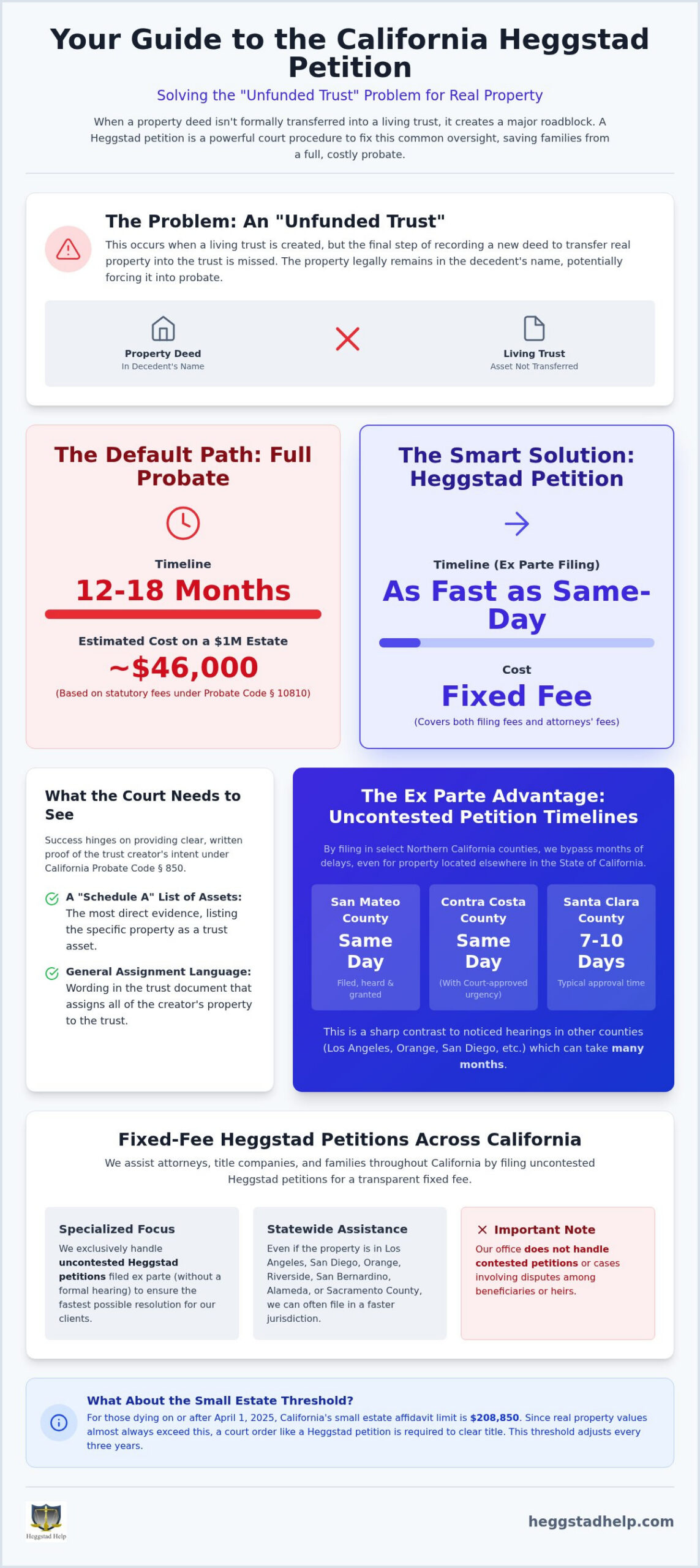
Heggstad Petition vs. Probate in California: 2026 Comparison Guide

What if a single missing signature on a property deed didn’t have to trigger a grueling eighteen-month court battle? You might have recently…

What if a single missing signature on a property deed didn’t have to trigger a grueling eighteen-month court battle? You might have recently discovered that a family home or significant account was never formally titled in the name of a living trust (a legal arrangement where a trustee holds assets for beneficiaries), leaving you facing the daunting prospect of a full court-supervised administration. When weighing the benefits of a Heggstad petition vs probate California, it’s important to realize that a simple administrative oversight doesn’t always require the traditional, expensive, and lengthy probate path.

We understand the anxiety that comes with navigating complex California probate codes while you’re still grieving a loved one. It’s frustrating to realize that a clerical error might subject your family to high statutory fees (set legal costs calculated as a percentage of the estate’s gross value) and public court records. This guide will show you how to bypass those hurdles and transfer assets to the trust in a fraction of the time. We’ll compare the two processes across 2026 court standards, explaining how you can clear title and prepare for a home sale without the typical year-long delay.

Key Takeaways

  • Discover why choosing a Heggstad petition vs probate California can reduce a typical 18-month court process to just a few weeks or even days.
  • Learn how to protect the estate’s value by avoiding statutory probate fees, which are mandatory legal costs calculated as a percentage of the gross value of the property.
  • Identify the Apirl 1, 2026 small estate threshold of $239,700 to determine if you can use a simple affidavit or if a formal court order is necessary for your specific assets.
  • Explore how filing in specific counties like Santa Clara or San Mateo allows for ex parte orders (expedited court rulings) that can clear title in as little as 7 to 10 days.
  • Understand the importance of using specialized legal services to avoid the common procedural errors that lead to court rejections and clouded titles for trust properties.

The ‘Forgotten House’ Dilemma: Heggstad Petition vs. Full Probate Basics

Successor trustees often encounter a frustrating discovery while settling an estate. They find that a primary residence or investment property is still titled in the decedent’s (the person who passed away) individual name rather than the name of their living trust. This discrepancy creates a significant legal hurdle because, without a clear title, the property cannot be sold or distributed to beneficiaries. When you’re faced with this scenario, you generally have two paths: a full probate administration or a Heggstad petition. Understanding the choice between a Heggstad petition vs probate California is the first step toward a more efficient resolution for your family.

Full probate is a comprehensive, court-supervised process used to distribute a deceased person’s estate when no trust exists or when assets are left outside of one. It’s a public and often slow journey through the California court system. Conversely, a Heggstad petition is a specialized legal request filed under California Probate Code Section 850. It asks the court to "transfer" the asset into the trust retroactively by proving it was always intended to be there. In 2026, the concept of "intent" remains the cornerstone of California trust law. If we can demonstrate the grantor (the person who created the trust) intended for the asset to be part of the trust estate, the court has the authority to correct the title without a full probate.

When Assets Are Left Out of a Trust

Funding errors occur more frequently than most families realize. A homeowner might refinance their mortgage and the lender requires the property be moved out of the trust for the transaction, but the deed is never moved back. In other cases, a person might purchase a new property and simply forget to title it correctly at the closing. Often, the trust document includes a "Schedule A" (a list of assets intended for the trust) or a general assignment of assets that clearly mentions real property. If you find yourself in a forgot to put house in trust California situation, don’t assume a year of court delays is inevitable. These documents often provide the necessary evidence to avoid the traditional probate process entirely.

The Legal Basis: California Probate Code Section 850

The modern solution to these errors stems from the landmark 1993 case, Estate of Heggstad. The California Court of Appeal ruled that a written declaration of trust is sufficient to create a trust in real property, even if a formal deed was never recorded. This ruling was eventually codified in Probate Code Section 850, giving the court the power to "perfect" title when evidence of written intent exists. In many instances, we can utilize an ex parte application (a request for a court order made with short notice and without a standard 30-day waiting period) to secure results much faster than traditional litigation. This specialized approach allows us to resolve a Heggstad petition vs probate California dispute with surgical precision, saving both time and estate resources. For a complete walkthrough of each stage, the Heggstad petition process California families must follow is outlined in a detailed 2026 step-by-step guide that covers every filing requirement.

Direct Comparison: Time, Costs, and Privacy in 2026

When evaluating a Heggstad petition vs probate California, the differences are not merely procedural; they represent a fundamental shift in how your family’s resources are preserved. Traditional probate is often described as a ‘sledgehammer’ approach to asset distribution, whereas a Heggstad petition filing acts as a surgical strike, targeting only the specific assets left out of the trust. This precision allows successor trustees to resolve title issues without opening a massive, multi-step court case that could last for years.

Feature Full Probate Administration Heggstad Petition (PC 850)
Typical Timeline 12 to 18 Months 30 to 60 Days (often less)
Legal Fees Statutory (Percentage of gross value) Fixed Fee transparency
Court Appearances Multiple formal hearings Often zero to one hearing
Public Privacy Fully public court record Limited public disclosure

The Cost Difference: Fixed Fees vs. Statutory Percentages

California law dictates statutory fees (mandatory legal costs set by the state) for full probate based on the gross value of the estate. For example, a property valued at $1,000,000 could result in over $46,000 in combined attorney and executor fees, regardless of the mortgage balance. In contrast, specialized firms offer fixed fee transparency, covering both filing and attorney fees in a single, predictable price. To better understand the full breakdown of what families pay, reviewing a detailed guide on Heggstad petition cost California families face can help you plan ahead and avoid unexpected expenses. This avoids the hidden costs of probate, such as appraisal fees, bond premiums (insurance for the executor), and expensive publication costs in local newspapers.

Timeline Realities: 30 Days vs. 12 Months

Standard California probate requires a minimum of one year to complete, largely due to the mandatory ‘Notice to Creditors’ period. This four-month window freezes progress while potential lenders or claimants come forward. A Heggstad petition bypasses this window entirely because the trust is already established and responsible for debts. If you’re working with a specialized firm, you may find that securing an ex parte order can resolve the issue in a a single day in San Mateo County and Contra Costa County, and typically 7-10 days working through Santa Clara County, allowing you to move forward with a home sale or distribution.

Probate is a matter of public record, meaning anyone can view the decedent’s assets, debts, and beneficiary list at the courthouse. Heggstad petitions are significantly more private, focusing only on the specific asset transfer. For a successor trustee, this speed and privacy are invaluable tools for managing the expectations of beneficiaries who may be anxious for their inheritance. It’s much easier to provide a calm, steady hand when the timeline is measured in weeks rather than years.

The 2026 Small Estate Threshold: Is a Heggstad Petition Mandatory?

Determining the most efficient path between a Heggstad petition vs probate California often hinges on the total market value of the assets left outside the trust. Not every funding error requires a formal court petition, but the rules for simpler alternatives are strict and dependent on the date of death. If the total value of the excluded assets falls below a specific dollar amount, you might qualify for a non-court alternative known as a Small Estate Affidavit (a document used to collect property under Probate Code Section 13100).

For decedents dying on or after April 1, 2026, the small estate threshold is $239,700. This figure is adjusted for inflation every three years. If the loved one passed away during the "gap year" between April 1, 2025, and March 31, 2026, the applicable threshold is $208,850. When the combined value of all assets staying outside the trust exceeds these limits, a Heggstad petition vs probate California becomes the primary comparison for a successor trustee. Because California real estate values are historically high, even a modest condominium or a small parcel of land typically pushes an estate well beyond these thresholds, making a court order necessary.

When You Can Use a Small Estate Affidavit

A Small Estate Affidavit is primarily designed for personal property, such as bank accounts, vehicles, or final paychecks. To use this process, you must wait at least 40 days after the date of death before presenting the signed affidavit to the financial institution holding the asset. While this is an excellent tool for liquidating a small savings account, it’s rarely a solution for real estate. Most California title companies refuse to recognize these affidavits for the transfer of land or homes. They require the legal finality and protection of a court decree to ensure the chain of title is clear and unassailable for future buyers.

When the Heggstad Petition is the Only Solution

If the "forgotten" asset is a house or commercial building valued above the small estate limit, a Heggstad petition is often the only way to avoid a full, year-long probate. This remains true even if the decedent left a Pour-Over Will (a backup will that "pours" any remaining assets into the trust). While the will proves the person wanted their assets in the trust, it doesn’t transfer the title by itself. Instead, we use the Pour-Over Will as powerful evidence of intent during the petition process. For a detailed look at the evidentiary requirements for these cases, you can review our guide on unfunded trust probate California. By presenting this evidence through a Heggstad filing, we can secure a court order that instructs the county recorder to update the deed, effectively bypassing the need for a full probate administration.

Heggstad Petition vs. Probate in California: 2026 Comparison Guide

Regional Efficiency: Filing in Santa Clara, San Mateo, and Contra Costa

The physical location of the court often dictates the speed of your asset recovery just as much as the legal merits of your case. While the California Probate Code applies uniformly across the state, local court rules and judicial staffing levels create significant variations in processing times. When evaluating the efficiency of a Heggstad petition vs probate California, understanding these regional nuances allows a successor trustee to set realistic expectations for beneficiaries and potential home buyers. A filing that takes months in one county might be resolved in days in another if handled by a specialist familiar with local judicial rhythms.

In Santa Clara County, the court system is particularly adept at handling uncontested petitions. For well-prepared filings that meet all evidentiary standards, we typically see results in as little as 7 to 10 days. This is a staggering contrast to the standard probate track, which can languish for months before a single hearing is even scheduled. Moving slightly north, San Mateo and Contra Costa counties offer even more streamlined opportunities. In these jurisdictions, it’s often possible to secure same-day petition grants if the paperwork is filed with absolute precision. However, the Contra Costa Court frequently requires a clear demonstration of an ‘Urgency’ factor, such as a pending home sale or an immediate financial need, to move a case to the front of the line.

The Power of Ex Parte Filings

An ex parte filing is a specialized legal request made for the benefit of one party without the requirement of a standard 30-day notice to all other potential interests. By utilizing this method, we can often eliminate the typical 60-day wait for a noticed hearing (a formal court date set on the public calendar). Many generalist probate lawyers are uncomfortable with the ex parte process because it requires a higher level of procedural rigor and an intimate knowledge of local judicial preferences. If the petition isn’t perfect, the court will summarily deny the request, forcing the family back into the slow-moving standard probate queue. Our specialization in ex parte court order services ensures that these requests are positioned for immediate approval.

Successor Trustee Responsibilities in Fast-Track Filings

To achieve these expedited results, the successor trustee must be diligent in the initial discovery phase. This involves gathering a specific set of documents needed for Heggstad petition California, including the original signed trust and any subsequent amendments. It’s vital to verify that you have the most current version of the trust, as any discrepancy can cloud the title correction process and lead to a court rejection.

Actionable Tip: Before assuming a full probate is required, thoroughly search the decedent’s trust binder for a ‘General Transfer’ or ‘Assignment of Assets’ document. This single page often serves as the foundational evidence for proving intent, even if the specific property deed was never updated at the county recorder’s office. Finding this document can be the difference between a same-day order and a year of litigation.

While the data clearly shows the advantages of a Heggstad petition vs probate California in terms of speed and cost, the success of this strategy relies entirely on procedural precision. Attempting a "do-it-yourself" filing or hiring a generalist attorney often results in court rejections that waste valuable months. More dangerously, an improperly drafted petition can lead to clouded titles (unresolved legal questions regarding property ownership), which can halt a home sale at the eleventh hour. Because title companies are risk-averse, they require a court order that is legally unassailable before they will issue title insurance for a future buyer.

Specialized firms often act as a resource for other attorneys and title companies across the state because they understand the specific evidentiary standards required by different judicial officers. By focusing exclusively on these petitions, a specialist can provide a fixed-fee guarantee, which eliminates the stress of "billable hour traps" common in traditional probate litigation. This transparency allows successor trustees to fulfill their fiduciary duties (the legal obligation to act in the best interest of beneficiaries) without depleting the estate’s resources on open-ended legal fees. Families who want a complete picture of what to budget for should consult a thorough resource on Heggstad petition cost California attorneys and courts typically charge, so there are no surprises once the process begins.

Uncontested vs. Contested Petitions

The exceptional speed of a Heggstad filing is most effective when the petition is uncontested, meaning all beneficiaries and heirs are in agreement with the transfer. If a beneficiary objects to the petition, the court cannot grant an ex parte order. Instead, a noticed hearing (a formal court session where all parties have the right to argue their position) becomes mandatory. This shift typically adds at least 60 days to the timeline as the court follows standard litigation protocols. Ensuring all parties are informed and in agreement before filing is a critical step that a seasoned specialist will manage to maintain the fast-track schedule.

Next Steps for Successor Trustees

If you’ve discovered a property left out of a trust, taking organized action is the best way to reduce your personal liability and stress. We recommend following these three steps to secure the estate’s assets:

  • Step 1: Locate the original trust document, all amendments, and the most recent deed for the "forgotten" property.
  • Step 2: Consult with a Board-Certified Estate Planning Specialist who has a documented history of successful Heggstad filings in your specific county.
  • Step 3: Secure a fixed-fee quote to ensure you have a clear understanding of the total cost before the process begins.

Choosing the right path today can save your family from the public, costly, and exhausting experience of a full California probate. If you’re ready to clear title and move forward, get specialized help with your California Heggstad Petition today.

Taking the Next Step Toward Estate Resolution

Navigating the aftermath of a loved one’s passing is difficult enough without the added burden of a "forgotten" asset. Choosing a Heggstad petition vs probate California allows you to bypass the public, year-long court process and secure a clear title in a fraction of the time. By leveraging the 2026 small estate thresholds and regional court efficiencies, you can ensure that the estate’s value remains with the beneficiaries rather than being consumed by statutory probate fees.

As a Board-Certified Specialist in Estate Planning, Trust and Probate Law, Robert P. Bergman provides the seasoned expertise needed to handle these filings with surgical precision. We offer transparent fixed fees that include all court costs, giving you complete financial predictability. In select counties, we even utilize same-day filing options to resolve title issues immediately. You don’t have to face the complexities of the California probate code alone.

Secure a Fixed-Fee Heggstad Petition Consultation today to protect your family’s inheritance and move forward with confidence.

Frequently Asked Questions

Is a Heggstad petition faster than probate in California?

Yes, a Heggstad petition is significantly faster than traditional probate. While a standard California probate typically requires 12 to 18 months to complete, a Heggstad petition can often be resolved in 30 to 60 days. In certain counties where ex parte filings are common, the process can be even shorter, sometimes concluding in just a few weeks. This speed allows successor trustees to distribute assets or close home sales without the year-long wait required by the formal court calendar.

What is the cost of a Heggstad petition vs. full probate?

A Heggstad petition is generally much more cost-effective because it avoids the statutory fees associated with full probate. In California, probate fees are set by law as a percentage of the estate’s gross value, which often totals tens of thousands of dollars for real property. Heggstad filings typically operate on a fixed-fee basis. This transparency helps families avoid the expense of court-appointed appraisals, bond premiums, and lengthy publication requirements that drive up the cost of a standard administration.

Can I file a Heggstad petition myself without a lawyer?

While you can technically file a petition without legal counsel, the risk of court rejection is extremely high for self-represented individuals. California courts require strict adherence to procedural rules and evidentiary standards to prove the decedent’s intent. Any error in the paperwork can lead to a clouded title, which prevents the property from being sold or transferred. Most successor trustees find that hiring a specialist ensures the order is granted correctly the first time, protecting the chain of title. Reviewing the Heggstad petition process California courts require can help you understand the full scope of what a proper filing entails before deciding whether to proceed with professional assistance.

What is the small estate threshold in California for 2026?

The small estate threshold for decedents dying on or after April 1, 2026, is $239,700. This figure represents the total market value of all assets left outside of a trust or named beneficiary designations. If the assets exceed this amount, you cannot use a simple affidavit and must instead compare the merits of a Heggstad petition vs probate California. For deaths occurring between April 2025 and March 2026, the applicable threshold remains $208,850.

How long does it take to get a Heggstad order in Santa Clara County?

In Santa Clara County, well-prepared uncontested petitions typically receive a court order within 7 to 10 days. The local court is efficient at processing these requests when they are filed correctly with all supporting documentation. This timeline assumes that no beneficiaries object to the transfer and that the evidence of the grantor’s intent is clear. Working with a firm familiar with Santa Clara’s specific local rules is the best way to ensure this expedited turnaround.

What happens if I forgot to put my house in my trust?

If a house was left out of a trust, the property’s title remains in the decedent’s individual name, which prevents the trustee from selling or distributing it. You’ll need to obtain a court order to transfer the house into the trust retroactively. By filing a Heggstad petition, you can present evidence to the court showing that the owner intended for the home to be trust property. Once the judge signs the order, you can record it to update the deed.

Do title companies accept Heggstad orders for selling a home?

Yes, California title companies routinely accept valid Heggstad orders to clear title for a home sale. These court orders provide the legal certainty that title insurers require to issue a policy to a new buyer. It’s essential that the petition is drafted with professional precision to ensure the final order contains the specific legal language title companies expect. A properly executed order serves as a definitive link in the chain of ownership, allowing the sale to proceed.

Can a Heggstad petition be used for bank accounts and stocks?

Yes, a Heggstad petition can be used for various types of assets, including bank accounts, brokerage accounts, and stock certificates. While these petitions are most commonly used for real estate, they are equally effective for any significant asset that was intended for the trust but never formally retitled. If the value of these accounts exceeds the 2026 small estate limits, a Heggstad petition vs probate California is the most efficient way to recover those missing trust assets.

Robert P. Bergman, Attorney at Law

Article by

Robert P. Bergman, Attorney at Law

Attorney Robert P. Bergman ("Bob Bergman") has been a Board-Certified Specialist in Estate Planning, Trust and Probate Law since 2011, as certified by the California State Bar Board of Legal Specialization. For several years, Bob has assisted families and the clients of other attorneys with obtaining court orders through Heggstad petitions to avoid the time and expense of Probate administration. Bob is friendly, very approachable, and believes in explaining complex legal topics in clear ordinary language so that his clients understand exactly what they're doing and why they're doing it.
Bob is often able to assist clients who are in other counties than his home county of Santa Clara through his approach to Heggstad petitions.

Disclaimer

This article is for informational purposes only. Nothing in this article is intended to replace legal advice from a competent attorney or be considered legal guidance for anybody's specific legal situation. Nobody should rely on information in this article in making legal decisions without such consultation.

Unfunded Trust Probate in California: A Guide to Heggstad Petitions (2026)

Imagine you’ve just lost a loved one, only to discover that their most valuable asset, such as the family home, was never formally transferred into…

Imagine you’ve just lost a loved one, only to discover that their most valuable asset, such as the family home, was never formally transferred into their living trust. This common oversight often triggers a complex unfunded trust probate California process that can stall an inheritance for over a year. It’s a frustrating realization to find that while the trust documents were signed, the deed remained in the decedent’s (the person who passed away) individual name. You might feel like the estate plan has failed, but this procedural gap doesn’t necessarily mean you’re headed for a full, eighteen month probate ordeal.

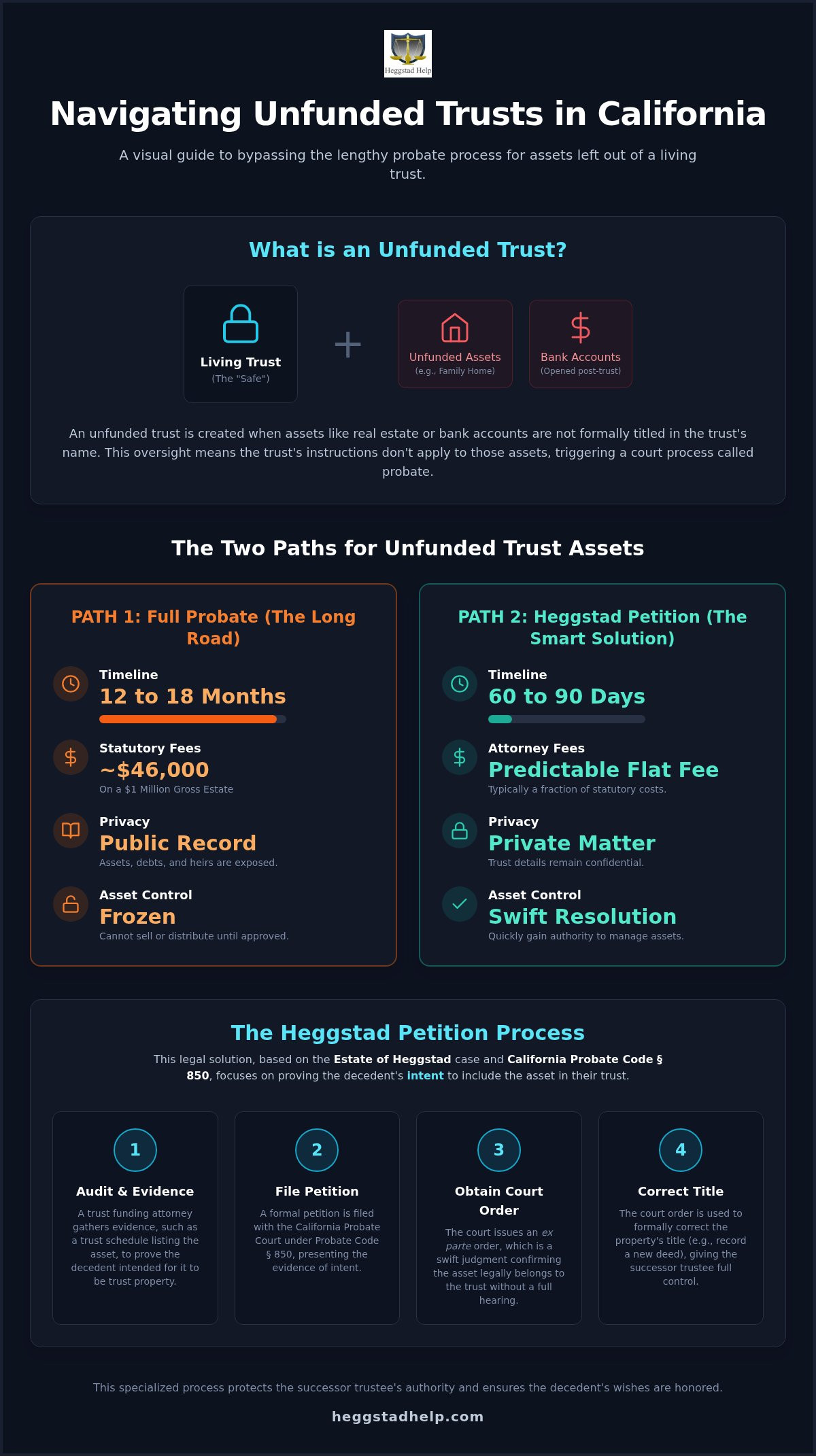
We understand you’re likely feeling the weight of potential court costs and the stress of a long, uncertain timeline. This guide will show you how a specialized California trust funding attorney can utilize a Heggstad petition (a legal request to confirm an asset as trust property) to bypass full probate entirely. We’ll explain how this specific filing can correct title issues in as little as 60 to 90 days, providing the successor trustee with clear instructions and a much faster path to resolution than traditional administration.

Key Takeaways

  • Identify the common “funding gaps,” such as unrecorded real estate deeds or newly opened bank accounts, that prevent a living trust from functioning as intended.
  • Discover how to bypass a 12 to 18-month unfunded trust probate California process by utilizing a specialized Heggstad petition to transfer assets.
  • Learn the legal “intent” standard used by courts to confirm that a decedent (the person who passed away) meant for an asset to be trust property.
  • Compare the efficiency of an ex parte court order against the high statutory fees and procedural delays of full probate administration.
  • Gain clarity on the specific audit and evidence-gathering steps required to correct title issues and protect the successor trustee’s authority.

What is an Unfunded Trust and Why Does it Lead to Probate in California?

An unfunded trust occurs when a valid legal document exists, but the formal transfer of title (the legal ownership record) for specific assets was never completed. Think of a trust as a high-tech safe. You can have the most sophisticated, detailed instructions written on the door, but if the jewelry and cash are sitting on the counter next to it, the safe provides no protection. This procedural oversight often forces families into an unfunded trust probate California proceeding, as the law generally requires that assets be “held” by the trustee to avoid court involvement.

Gaps in trust funding typically arise from forgotten real estate deeds, new bank accounts opened after the trust was established, or errors made during “do it yourself” estate planning. A California trust funding attorney often steps in to audit these omissions, searching for evidence of the decedent’s (the person who passed away) intent to include those assets. This search for intent is rooted in the landmark case of the Estate of Heggstad, which provides the legal framework for correcting these errors without a full probate administration.

The Consequences of Assets Left Out of the Trust

When an asset remains in an individual’s name at the time of their passing, the California Probate Court claims jurisdiction (legal authority) over that property. Without a court order to the contrary, these assets may be distributed according to intestate succession laws (the state’s default rules for inheritance). This creates a significant risk that the decedent’s specific trust instructions will be overridden, potentially leading to distributions that contradict their actual wishes or cause conflict among heirs.

Real Estate and the “Forgotten Deed” Problem

Real estate is the most common asset left out of a trust. A house often “slips out” during a mortgage refinance if a lender requires the property to be moved back into the individual’s name for closing. If the homeowner forgets to record a new deed (the document transferring title) back into the trust afterward, the property is legally unfunded. While a signed trust schedule might list the home, title companies and banks usually require a formal deed or a court order to recognize the trust’s ownership during a sale or transfer. Working with a dedicated attorney for unfunded trust California cases is often the most efficient way to resolve these missing deed situations before they escalate into full probate proceedings.

The Hidden Risks of Unfunded Trust Probate

Falling into the “timeline trap” is the most immediate danger for families dealing with an unfunded trust probate California case. While a standard trust administration is designed to be swift, a formal probate proceeding in California typically stretches between 12 and 18 months. During this time, assets are effectively frozen. You cannot sell the real estate or distribute funds to beneficiaries until the court grants final approval. This delay is particularly painful when compared to the 60 to 90 days it usually takes to resolve a Heggstad petition. Families in Southern California facing these delays may benefit from understanding how a Heggstad petition Los Angeles filing can dramatically shorten this timeline compared to a full probate proceeding at the Stanley Mosk Courthouse.

The financial impact is equally significant. California law sets statutory fees for attorneys and executors based on the gross value of the estate, not the net value. If a house is appraised at $1 million, the combined fees can reach approximately $46,000, even if there’s a $700,000 mortgage on the property. By contrast, correcting a title through a specialized petition often involves a flat fee that’s a fraction of those costs. Beyond the money, you lose your privacy. A trust is a private document, but probate is a public process. Your family’s assets, debts, and the names of all heirs become part of the public court record for anyone to see.

Why General Probate Attorneys May Not Be Enough

Successor trustees often assume any lawyer can handle the situation, but there’s a distinct difference between a generalist and a California estate planning specialist. A generalist might default to a full probate because they aren’t comfortable with the nuances of California Probate Code 850. This specific statute allows you to bypass the year-long wait, provided your attorney knows how to present the “intent” evidence the court requires. If you’re feeling overwhelmed by the court’s requirements, you can consult with a specialist to see if your assets qualify for this faster route.

The Impact on Beneficiaries

Delayed distributions do more than just stall inheritance; they take an emotional toll on family members who may be relying on those funds for end-of-life expenses or property maintenance. When assets are left in legal limbo, the resulting uncertainty frequently triggers heated disputes among heirs over how the remaining property should be managed or divided. A specialized filing restores order by confirming the trust’s authority and getting the estate back on track quickly.

The Heggstad Petition: California’s Solution for Unfunded Assets

When you discover that a critical asset was left out of a trust, California Probate Code Section 850 provides the specific legal remedy known as a Heggstad petition. This procedural tool allows the court to confirm that an asset belongs to the trust, even if the formal title was never changed. Rather than starting a full unfunded trust probate California case, a specialist uses this petition to ask a judge to “fund” the trust retroactively based on the decedent’s (the person who passed away) clear intentions.

The success of this petition hinges on the “Intent” standard. The court doesn’t just look at the deed; it looks for written evidence that the creator of the trust intended for the asset to be included. A California trust funding attorney gathers specific documentation to build this case, including:

  • Trust Schedules: Often called “Schedule A,” these lists specifically name assets intended for the trust.
  • General Assignments: A broad legal document where the creator assigns all their property to the trust.
  • Written Declarations: Correspondence or other signed notes indicating the asset was meant to be trust property.

Heggstad Petition vs. Full Probate

The primary advantage of this route is speed and simplicity. An uncontested Heggstad petition is typically resolved within 60 to 90 days, requiring only a single court hearing. In contrast, a full probate administration often drags on for 12 to 18 months and involves multiple procedural stages. For a deeper look at the legal requirements for property, you can review the details on an 850 petition California real property filing. This streamlined approach avoids the high statutory fees associated with traditional court-supervised distributions.

Correcting Real Estate Titles Post-Death

If the missing asset is a home or land, the court order resulting from a successful petition serves as the legal authority to correct the deed. In urgent situations, a specialist might use ex parte court orders (emergency requests) to expedite the process. The successor trustee with unfunded trust assets plays a vital role here by acting as the primary source of evidence, providing the attorney with the necessary records to prove intent. If you’re ready to secure a court order and avoid the probate trap, contact Heggstad Help today to begin your title correction.

Unfunded Trust Probate in California: A Guide to Heggstad Petitions (2026)

How a California Trust Funding Attorney Resolves Your Estate

Resolving an unfunded trust probate California case requires a methodical approach that moves from initial discovery to final title recording. A specialized attorney begins with a comprehensive audit (a detailed review of all property records) to determine exactly which assets were left outside the trust’s legal umbrella. Once these gaps are identified, the focus shifts to gathering “Heggstad Evidence,” such as the original trust schedules or signed declarations of intent discussed earlier, to build a persuasive case for the court.

After the evidence is organized, the attorney files the formal petition under Probate Code 850. If the judge is satisfied with the proof of intent, they’ll issue a court order confirming that the assets are indeed trust property. The final, critical step involves trust asset title correction (the formal process of updating public ownership records). The attorney ensures the court order is properly recorded with the county recorder, which officially transfers the deed into the trust and allows the successor trustee to manage or sell the property without further court supervision. If you discover a deed was never recorded in the trust’s name, consulting an attorney for unfunded trust California matters early in this process can prevent costly delays and ensure the petition is filed correctly the first time.

Why Robert P. Bergman and Heggstad Help?

Successor trustees often face a steep learning curve when assets are missing, which is why specialized guidance is essential. Robert P. Bergman is a Board-Certified Specialist in Estate Planning, Trust and Probate Law, a credential held by a small percentage of California attorneys. Since 1980, he’s focused on the complexities of trust law, providing a level of expertise that generalists simply can’t match. Heggstad Help operates with an exclusive focus on Heggstad petitions and ex parte court orders, ensuring your filing is handled with the efficiency and precision required to avoid a 12 to 18-month probate delay.

Immediate Steps for Successor Trustees

The moment you realize an asset was left out of the trust, your priority should be document preservation. Successor trustees should secure all trust schedules and original estate documents immediately to preserve the paper trail needed for court. This includes looking for any “General Assignment” documents or letters from the decedent that mention the specific property. Once you’ve gathered these records, your next step is to consult with a specialist who can determine if a Heggstad petition is the right fit for your situation. Schedule a consultation with a Heggstad specialist to begin the recovery process today.

Securing Your Inheritance Without the Probate Delay

Discovering that a family home or financial account was left out of a living trust can feel like a major setback, but it doesn’t have to lead to a total estate failure. By understanding that California law provides a specific pathway to correct these funding gaps, you can take control of the situation before it spirals into a lengthy unfunded trust probate California proceeding. A successful Heggstad petition transforms a complex title issue into a manageable court order, effectively restoring the decedent’s (the person who passed away) original intent and protecting the interests of every beneficiary involved.

Navigating the nuances of Probate Code 850 requires a steady, experienced hand to ensure the court accepts your evidence of intent. Robert P. Bergman is a Board-Certified Specialist in Estate Planning, Trust and Probate Law with over 40 years of legal experience in California trust law. He focuses exclusively on these specialized filings to help families across the state avoid the stress of traditional administration. You don’t have to face these procedural hurdles alone. Contact Heggstad Help for a specialized review of your unfunded trust assets and let a dedicated problem-solver guide you toward a swift resolution.

Frequently Asked Questions

Can I file a Heggstad petition if there is no written schedule of assets?

Yes, you can still file a petition even without a formal “Schedule A” or asset list. While a written schedule is strong evidence, California courts also accept other forms of proof regarding the decedent’s intent. This might include a “General Assignment” document or specific language within the trust itself declaring that all of the individual’s property is now trust property. A specialist will review all estate documents to find the necessary legal evidence required by the court.

How much does a Heggstad petition cost compared to full probate in California?

A Heggstad petition is generally much more cost-effective because it avoids the statutory fees required for a full probate. In a formal probate proceeding, fees are calculated as a percentage of the gross estate value. For an estate valued at $1 million, those combined fees can reach approximately $46,000. Because a petition is a streamlined filing with typically only one hearing, the legal costs are generally a flat fee that’s significantly lower than those statutory mandates.

What happens if the house was never deeded to the trust before death?

If a house was never deeded to the trust, it remains in the decedent’s individual name and technically triggers an unfunded trust probate California proceeding. However, a Heggstad petition allows you to ask the court to “deem” the property as part of the trust retroactively. Once the judge signs the order, you can record that order with the county recorder to correct the title. This process effectively bypasses the 12 to 18 month probate timeline.

Is a Heggstad petition available for bank accounts and brokerage accounts?

Yes, this legal remedy applies to nearly any asset that was intended for the trust but was never formally retitled. This includes bank accounts, brokerage accounts, and even partnership interests or business shares. If the trust document or a separate assignment shows the decedent intended these accounts to be trust property, the court can issue an order to transfer them. This prevents the need for a full probate administration for those specific financial holdings.

How long do I have to file a Heggstad petition after someone dies?

There’s no specific “expiration date” for filing a Heggstad petition in California, but acting quickly is vital for protecting the estate. Delaying the filing can lead to complications with creditors, property tax reassessments, or maintenance issues. Most successor trustees choose to file as soon as they discover an unfunded trust probate California issue to ensure they can manage or sell the assets. Early action helps maintain the property’s value and provides clarity for all beneficiaries.

Robert P. Bergman, Attorney at Law

Article by

Robert P. Bergman, Attorney at Law

Attorney Robert P. Bergman ("Bob Bergman") has been a Board-Certified Specialist in Estate Planning, Trust and Probate Law since 2011, as certified by the California State Bar Board of Legal Specialization. For several years, Bob has assisted families and the clients of other attorneys with obtaining court orders through Heggstad petitions to avoid the time and expense of Probate administration. Bob is friendly, very approachable, and believes in explaining complex legal topics in clear ordinary language so that his clients understand exactly what they're doing and why they're doing it.
Bob is often able to assist clients who are in other counties than his home county of Santa Clara through his approach to Heggstad petitions.

Disclaimer

This article is for informational purposes only. Nothing in this article is intended to replace legal advice from a competent attorney or be considered legal guidance for anybody's specific legal situation. Nobody should rely on information in this article in making legal decisions without such consultation.
California Probate Code Section 850: A Guide to Real Property Petitions

Last month, a grieving daughter discovered that her father’s family home was never officially deeded into his living trust, leaving the property…

Last month, a grieving daughter discovered that her father’s family home was never officially deeded into his living trust, leaving the property stuck in his individual name after he passed. You might be facing a similar sense of anxiety as you realize that a standard probate (a formal court-supervised process for distributing assets) in California typically takes 12 to 18 months to resolve. It’s perfectly natural to feel overwhelmed by the prospect of long court delays or the technical complexity of an 850 petition California real property filing to correct these title errors.

Fortunately, you don’t have to endure a year of uncertainty just to fix a simple paperwork oversight. This specific legal tool, commonly known as a Heggstad Petition, allows a judge to confirm that the property belongs to the trust based on the deceased person’s clear intent. In this guide, you’ll discover how Section 850 allows you to move real property into a trust and bypass months of probate administration. We’ll explain how to obtain a court order for title correction so you can secure the legacy your loved one intended without the exhaustion of a full court proceeding.

Key Takeaways

  • Learn how California Probate Code Section 850 serves as a vital legal mechanism to transfer assets into a trust after a death has occurred.
  • Identify the common title errors that leave real estate outside of a trust and why these mistakes require a court’s confirmation to resolve.
  • Explore how a Heggstad Petition uses the settlor’s written intent to bypass the lengthy and expensive formal probate process.
  • Discover the specific procedural steps for filing an 850 petition California real property to obtain a court order that effectively corrects property titles.
  • Understand how utilizing ex parte court order services can accelerate the legal timeline, allowing you to bypass the standard probate backlog.

What is a California Probate Code Section 850 Petition?

California Probate Code Section 850 functions as a versatile procedural tool that allows the court to resolve disputes regarding the ownership of property. It’s essentially a summary procedure (a streamlined legal process) designed to confirm whether specific assets belong in a trust or a decedent’s estate without the need for a full, year-long probate administration. When a homeowner creates a trust but passes away before recording the final deed, an 850 petition California real property filing becomes the primary legal mechanism to bridge that gap and ensure the home is distributed according to the owner’s wishes.

This petition is most frequently used when a decedent intended to transfer property into their trust but failed to complete the formal deeding process. Instead of forcing the family into a standard probate that can last 12 to 18 months, Section 850 provides a faster path. It allows the court to examine the surrounding evidence and issue an order that effectively “funds” the trust after the fact, correcting the title so the property can be managed or sold by the successor trustee.

Who Can File an 850 Petition?

The law allows several interested parties to initiate this process to protect the integrity of an estate or trust. These typically include:

  • Successor Trustees: These individuals are the most common petitioners, as they’re responsible for recovering and managing trust assets after the original settlor (the person who created the trust) has died.
  • Beneficiaries: If a beneficiary believes a specific piece of real estate should be part of their inheritance, they can file a petition to confirm their interest.
  • Personal Representatives: Executors or administrators of a probate estate may use this tool to recover property that was improperly moved out of the estate.

The Legal Basis for Trust Confirmation

The court doesn’t simply take a petitioner’s word for it; it requires clear, written evidence of the decedent’s intent. This legal standard was largely shaped by the landmark case Estate of Heggstad, which established that a written declaration of trust is often sufficient to create a trust in real property, even if a formal deed wasn’t recorded. Judges typically look for a “Schedule A” (the document often found at the back of a trust listing all assets) or specific “general assignment” language that expresses the owner’s desire to hold their property within the trust. If this written evidence exists, the court can issue an order that functions with the same authority as a deed, correcting the title and avoiding a full probate.

Why Real Property Often Requires an 850 Petition

Unlike personal property, such as jewelry or furniture, real estate ownership is governed by a public record known as the chain of title. This formal system makes errors highly visible and legally problematic for grieving families. If a house is listed in a trust document but the corresponding grant deed (the legal document that transfers ownership) was never recorded with the county, the property is technically “unfunded.” Title companies, which provide essential insurance for buyers and lenders, will generally refuse to issue a policy if the record shows the deceased individual still owns the home personally. To resolve this discrepancy, an 850 petition California real property filing is required to obtain a court order that officially bridges the gap in the chain of title, allowing for a future sale or transfer.

A court order issued under Section 850 acts with the same legal authority as a deed. It provides the successor trustee with the necessary documentation to satisfy title officers and escrow companies. Without this specific intervention, the property remains in legal limbo, preventing the trustee from fulfilling their duties to the beneficiaries.

Common Real Estate Errors Section 850 Can Fix

Several specific scenarios frequently lead to a property being left out of a trust. A homeowner might sign a trust agreement but simply forget to record the grant deed. In other cases, title may be held in “joint tenancy” (a form of shared ownership with right of survivorship), yet the owners clearly intended for the trust to govern the asset. A very common complication occurs during refinancing; lenders often require the house to be taken out of the trust to process the loan, but the homeowner or the lender fails to put it back in once the new loan is secured. Surviving spouses who find themselves in this situation should also explore whether a Heggstad petition for surviving spouse California offers a more targeted path to recovering the missing asset.

The Consequences of Ignoring an Unfunded House

Leaving these title issues unaddressed creates significant hurdles for successor trustees. Without a clear title, it’s impossible to sell or refinance the property, as no bank will lend against it and no buyer will accept the risk. This often leaves families facing the unfunded trust probate California process, which involves higher statutory fees and much longer timelines. If you discover a property was left out, seeking professional trust asset title correction early can save your family from these costly and avoidable delays.

California Probate Code Section 850: A Guide to Real Property Petitions

The Heggstad Petition: The Most Common Use of Section 850

While California Probate Code 850 covers various types of property disputes, its most frequent application is the Heggstad Petition. Named after the landmark 1993 case Estate of Heggstad, this legal procedure allows a judge to declare that a property is part of a trust even if the deed wasn’t properly recorded before the owner died. It’s the preferred legal shortcut for successor trustees because it focuses on the settlor’s written intent rather than a technical clerical error. To succeed, you must provide the court with clear evidence, such as a “Schedule of Assets” or a general assignment clause, that specifically identifies the property as a trust asset.

The court essentially looks for proof that the deceased person (the settlor) intended for the trust to hold the property. If that written intent exists, the judge can issue an order that functions as a corrective deed. This process restores the chain of title and allows the trustee to manage the home without the delays inherent in a standard probate proceeding.

How the Heggstad Process Works

The procedure is methodical and requires precise documentation to satisfy the court’s evidentiary standards. First, you’ll need to gather the original trust document and any supporting schedules that list the home or land. Next, a legal professional drafts the 850 petition California real property filing, clearly outlining the facts of the case and the evidence of intent. Finally, the petition is filed in the Superior Court of the county where the property is located. Because this is a specialized filing, the court will set a hearing date to review the evidence and, if satisfied, issue an order that serves as the new link in the chain of title.

Bypassing Probate with a Heggstad Filing

The primary advantage of this approach is the significant reduction in time and administrative burden. A standard California probate case typically takes between 12 and 18 months, often stretching longer in backlogged counties like Los Angeles. In contrast, a successful petition to transfer real property to trust can often be resolved in just 4 to 6 months. This efficiency saves the estate significant money by avoiding the statutory attorney and executor fees that are based on the gross value of the property. Before committing to either path, families should review a detailed breakdown of Heggstad petition cost vs probate cost California to fully understand the financial stakes of each option. If you’re managing an estate with an unfunded house, starting a Heggstad Petition Filing is the most direct path to securing the assets for the beneficiaries. Widows and widowers navigating this process should also review how a Heggstad petition for surviving spouse in California compares to alternative spousal property procedures before choosing the right legal strategy.

Filing an 850 Petition for California Real Estate

Successfully filing an 850 petition California real property request is a high-stakes endeavor that requires meticulous attention to procedural detail. The process begins with meeting strict notice requirements (the legal obligation to inform all interested parties of the court proceeding). In California, you must serve notice to all heirs and beneficiaries at least 30 days before the scheduled hearing. Failure to notify even one distant relative can result in the court denying the petition or requiring a costly restart of the entire process.

After the judge reviews the evidence and signs the order, the final step involves recording a certified copy of the court order with the County Recorder’s Office in the county where the property is located. This recorded document officially repairs the chain of title. By utilizing ex parte court order services (expedited requests made to the court), a specialist can often resolve these title issues more quickly than through standard calendar hearings, providing the successor trustee with the authority needed to sell or transfer the home.

The Role of an Expert Heggstad Attorney

Generalist probate lawyers often struggle with the specific nuances of Section 850 because they lack the high-volume experience required to anticipate every court objection. Robert P. Bergman, a Board-Certified Specialist in Estate Planning, Trust and Probate Law, has been practicing since 1980 and focuses exclusively on these complex filings. His deep familiarity with the California court system ensures your petition is bulletproof from the start. Correcting trust asset titles promptly is essential to ensure that successor trustee unfunded trust assets California duties are fulfilled without exposing the trustee to personal liability or unnecessary delays.

Next Steps for Successor Trustees

If you suspect a property was left out of a trust, your first priority is to perform a comprehensive title search to identify all assets held in the decedent’s individual name. Once you have identified the “unfunded” property, consult with Heggstad Help for an initial assessment of your case. We will help you determine if the existing written evidence meets the legal standard for a Heggstad filing. Preparing for the transfer of title early allows you to move forward with confidence, knowing that the legacy of your loved one is protected from the burdens of a full probate administration.

Secure Your Real Estate Legacy Today

Discovering that a home was left outside of a trust doesn’t have to lead to a stressful, year-long probate. By utilizing an 850 petition California real property filing, you can effectively correct the chain of title and honor your loved one’s original intent. This legal mechanism provides a streamlined path to confirm trust ownership, allowing you to bypass the standard probate backlog and avoid the high statutory fees associated with full administration.

Robert P. Bergman is a Board-Certified Specialist in Estate Planning, Trust and Probate Law who has maintained a specialized focus on Heggstad petitions since the 1990s. With a California-wide service area, our firm provides the calm competence you need to navigate these complex procedural hurdles. You don’t have to face the court system alone when a seasoned expert can ensure your petition is filed correctly the first time. Get Expert Help with Your California 850 Petition Today. We are here to help you find the most efficient path toward a final resolution.

Frequently Asked Questions

What is the difference between an 850 petition and a Heggstad petition?

An 850 petition is the broad statutory category, while a Heggstad petition is a specific application of that law. While Section 850 of the California Probate Code covers various property ownership disputes, a Heggstad petition specifically asks the court to confirm that an asset belongs in a trust based on the creator’s written intent. It’s essentially the most common version of this legal tool used by successor trustees to fix title errors.

Can I file an 850 petition if there is no written “Schedule A” in the trust?

You can often still file even without a formal “Schedule A” (the list of assets typically attached to the back of a trust document). The court will examine other written evidence, such as a “general assignment” clause (a paragraph stating all the owner’s property belongs to the trust) or specific language within the trust itself. If we can demonstrate the owner’s clear intent to include the home, the petition can still succeed.

How long does the 850 petition process take for California real estate?

The 850 petition California real property process generally takes between 4 and 6 months to complete. This timeline is significantly shorter than the 12 to 18 months required for a full probate administration. The exact duration often depends on the specific county’s court calendar and how quickly we can satisfy the mandatory notice requirements (the 30-day legal warning sent to all interested parties) before the hearing.

Will I have to go to court if my attorney files an 850 petition?

You typically won’t need to step foot in a courtroom if you’ve hired a specialized attorney to handle the filing. In the vast majority of cases, your legal representative appears on your behalf to present the evidence to the judge. Unless the petition is contested (challenged by another heir or beneficiary), the process is handled through written filings and a brief professional appearance by your counsel.

Is an 850 petition cheaper than going through full probate?

Yes, this procedure is almost always more cost-effective than a full probate. Because it avoids the statutory fee schedule (the mandatory percentages paid to executors and attorneys based on the home’s gross value), the estate retains more of its assets. Families who want a detailed side-by-side analysis should review the full comparison of Heggstad petition cost vs probate cost California before making any decisions. By bypassing the long-term court supervision of a standard probate, you also reduce the total court filing fees and administrative costs associated with a year-long legal process.

Robert P. Bergman, Attorney at Law

Article by

Robert P. Bergman, Attorney at Law

Attorney Robert P. Bergman ("Bob Bergman") has been a Board-Certified Specialist in Estate Planning, Trust and Probate Law since 2011, as certified by the California State Bar Board of Legal Specialization. For several years, Bob has assisted families and the clients of other attorneys with obtaining court orders through Heggstad petitions to avoid the time and expense of Probate administration. Bob is friendly, very approachable, and believes in explaining complex legal topics in clear ordinary language so that his clients understand exactly what they're doing and why they're doing it.
Bob is often able to assist clients who are in other counties than his home county of Santa Clara through his approach to Heggstad petitions.

Disclaimer

This article is for informational purposes only. Nothing in this article is intended to replace legal advice from a competent attorney or be considered legal guidance for anybody's specific legal situation. Nobody should rely on information in this article in making legal decisions without such consultation.

The Complete Guide to HEGGSTAD HELP: Bypassing Probate in California

What if a single missing signature on a deed didn’t have to cost your family eighteen months of court delays and thousands of dollars in statutory…

What if a single missing signature on a deed didn’t have to cost your family eighteen months of court delays and thousands of dollars in statutory probate fees? Most successor trustees assume that if a house or account was left out of a living trust, a full probate is the only path forward. It’s a heavy, anxious realization to face when you’re already managing the loss of a loved one. This Complete guide to HEGGSTAD HELP explains why that “obvious” path is often a costly mistake.

We understand the frustration of finding conflicting title documents that seem to trap an estate in the court system. You’ll learn how to use a Heggstad Petition (a specific court request to confirm property as trust assets) to bypass the traditional probate process entirely. By leveraging California Probate Code 850, it’s possible to resolve these oversights in as little as two to six months rather than the standard year or longer. This guide previews the evidence required to prove the decedent’s intent and outlines the steps to transfer title to beneficiaries legally and efficiently.

Key Takeaways

  • Discover how the “Intent vs. Title” principle allows the court to honor a decedent’s wishes and confirm trust ownership even when a formal deed transfer was missed.
  • This Complete guide to HEGGSTAD HELP reveals how to identify common title errors, such as the “Refinance Trap,” that often lead to unnecessary probate delays.
  • Learn the specific steps for gathering evidence, including the use of trust schedules and written declarations, to build a compelling case for the California Probate Court.
  • Explore how specialized ex parte services can fast-track your petition, offering a rapid resolution for time-sensitive situations like a pending home sale or property transfer.
  • Understand the advantage of working with a Board-Certified Specialist to navigate complex procedural hurdles and avoid the high costs of a traditional twelve-month probate.

What is a Heggstad Petition and How Does It Work?

A Heggstad Petition is a specialized legal request filed with the California Probate Court. It asks a judge to confirm that a specific asset, such as a family home or a brokerage account, belongs to a trust even if the formal title was never updated. This Complete guide to HEGGSTAD HELP focuses on the core principle of “Intent vs. Title.” If the person who created the trust (the settlor) clearly intended for an asset to be included, the court has the power to fix the title error without requiring a full probate.

This process applies to both real property and personal property. If a parent forgot to deed their house to the trust or failed to name the trust as a beneficiary on a large bank account, this petition serves as the legal remedy. It effectively bypasses the multi-step, year-long probate process by addressing the title issue through a single, targeted court order. It’s a surgical correction for an administrative oversight.

The Legal Foundation: California Probate Code 850

The authority for this procedure comes from California Probate Code Section 850. This section provides a mechanism for successor trustees to claim property that is technically held in the decedent’s individual name. The practice is named after the landmark 1993 case, Estate of Heggstad. This case established that a written declaration of trust is sufficient to include an asset in that trust, creating a unique “California-only” shortcut for families facing complex title hurdles.

Heggstad Petition vs. Full Probate: A Speed Comparison

Speed is the most significant advantage. While a traditional California probate often takes twelve to eighteen months to resolve, a Heggstad petition is frequently completed within two to six months. Beyond the time savings, this approach avoids the high statutory attorney fees associated with full estate administration. Instead of paying a percentage of the gross estate value, families can use this petition to transfer title to beneficiaries legally and quickly. It’s a far more efficient path for estates that are otherwise well-organized but for a few missing deeds.

Common Reasons Trust Assets Are Left Out of Title

Even the most meticulously drafted estate plan fails if the assets aren’t properly “funded” (the process of transferring title from an individual to the trust). This Complete guide to HEGGSTAD HELP addresses the reality that many families face: a valid trust document exists, but the “suitcase” is empty because the deeds were never signed or recorded. Whether due to a simple oversight or a complex financial transaction, these title gaps create a legal hurdle that prevents the successor trustee from managing the property without court intervention.

The Refinance Trap: A Successor Trustee’s Most Common Problem

Lenders frequently require homeowners to move their property out of a trust and back into their individual names to secure a mortgage or refinance. Banks often prefer individual title because it simplifies their internal risk assessments and loan processing. While the homeowner usually intends to deed the house back into the trust immediately after the loan closes, this final step is frequently forgotten. This creates a “broken chain” in the trust’s history. A house left out of a trust after a refinance is not a lost cause; it is a title error that California law is designed to correct.

Identifying “Loose” Assets After a Death

The first task for a family is to perform a thorough audit of all property records and financial statements. You should look for property tax statements or grant deeds that don’t list the trust as the owner. If a decedent purchased a new home or opened a brokerage account after the trust was created, they might have accidentally used their individual name instead of the trust name. Using a successor trustee guide is essential during this stage to ensure no discrepancies are missed.

Another frequent complication involves “Schedule A” (the list of assets intended for the trust). Sometimes an asset is clearly listed on this schedule, yet no formal deed or transfer document was ever executed. In these cases, California Probate Code § 850 provides the legal bridge to move those assets into the trust. If you discover a significant asset was left out of the title, you can schedule a consultation to determine if a petition is the right path forward for your specific situation.

The Heggstad Petition Process in California

Understanding the procedural requirements of a Heggstad petition requires a methodical approach. This Complete guide to HEGGSTAD HELP breaks the process down into four distinct phases to ensure the court recognizes the decedent’s intent. Unlike a full probate, which involves multiple hearings and inventory filings, this process is focused on a single objective: confirming trust ownership.

  • Step 1: Gathering Evidence of Intent. This involves locating the original trust document, any “Schedule A” asset lists, or general assignment of assets.
  • Step 2: Drafting the Petition. A formal legal document must be prepared, detailing the specific assets and the legal grounds for the transfer under California law.
  • Step 3: Filing and Notice. Once filed, you must serve formal notice to all heirs and beneficiaries. This is a strict legal requirement to ensure transparency.
  • Step 4: The Court Hearing. A probate judge reviews the evidence. If the judge is satisfied, they sign a court order confirming the asset belongs to the trust.

Evidence Required for a Successful Filing

The most critical piece of evidence is often the “General Assignment” or “Schedule of Assets” included in the trust package. These documents act as a clear declaration that the settlor intended for their property to be trust-owned. If a specific list doesn’t exist, we look for other written declarations or evidence of intent. Even in complex cases where a deed was never recorded, a well-documented petition can bridge the gap. If you’re unsure if your documentation is sufficient, you can contact us for a petition review to evaluate your evidence.

Recording the Final Court Order

Winning the case in court is the penultimate step. Once the judge signs the order, it must be recorded with the County Recorder in the county where the real property is located. This recorded order effectively acts as a deed; it officially changes the title from the decedent’s name to the trust. This allows the trustee to legally sell the property or distribute it to beneficiaries without further court oversight. It’s the final piece of the puzzle that restores the trust’s funding and protects the family’s inheritance.

The Complete Guide to HEGGSTAD HELP: Bypassing Probate in California

How HEGGSTAD HELP Corrects Trust Titles Faster

Resolving a title discrepancy requires more than just filling out forms; it requires a deep understanding of how California probate judges evaluate evidence of intent. This Complete guide to HEGGSTAD HELP highlights a specialized approach that prioritizes speed and precision. Unlike general practice firms that manage a wide variety of civil matters, we focus exclusively on surgical title corrections. By narrowing our scope to California Probate Code 850 petitions, we’ve developed a streamlined workflow that eliminates the administrative bloat often found in traditional law offices.

Our process is built on a “Plain English” philosophy. We recognize that successor trustees are often navigating these legal hurdles while grieving, which is why we translate complex procedural jargon into clear, actionable steps. We don’t handle full probate administrations, which allows us to dedicate our entire technical infrastructure to recovering missing trust assets and correcting deeds efficiently.

The Advantage of a Board-Certified Specialist

Robert P. Bergman is a Board-Certified Specialist in Estate Planning, Trust and Probate Law, a rare credential that signifies a high level of expertise recognized by the State Bar of California. With over 40 years of experience practicing since 1980, he has encountered nearly every possible title complication, from ancient “refinance traps” to modern digital evidence of intent. A specialist is better equipped to anticipate court objections and draft petitions that meet the “clear and convincing” evidentiary standard required by California law on the first attempt.

Urgent Title Corrections for Pending Real Estate Sales

The most stressful scenario for a trustee occurs when a house is in escrow and a title company suddenly discovers the property was never deeded into the trust. In these high-stakes moments, a standard court date months away isn’t an option. HEGGSTAD HELP specializes in ex parte court order services (immediate court intervention for urgent matters) to address these crises. By seeking an emergency hearing, we can often secure the necessary court order in a fraction of the usual time, preventing sales from falling through and protecting the estate’s financial interests. If you’re facing a title roadblock, you can contact HEGGSTAD HELP for a consultation on your California trust asset to find a path forward.

Take Decisive Action to Protect the Trust Estate

Discovering that a family home or significant account was left out of a trust doesn’t have to trigger a year-long probate nightmare. By understanding the “Intent vs. Title” principle and utilizing California Probate Code 850, you can correct these technical oversights and transfer property to beneficiaries in a fraction of the usual time. This Complete guide to HEGGSTAD HELP has outlined how surgical legal petitions can bypass the high fees and delays of full estate administration.

Robert P. Bergman has been serving California successor trustees since 1980. As a Board-Certified Specialist in Estate Planning, Trust and Probate Law, he provides a level of precision that generalist attorneys often lack. Our firm maintains a specialized focus on Probate Code 850 petitions to ensure your family’s assets are secured legally and efficiently. You don’t have to navigate these complex procedural hurdles alone.

Request a Consultation with a California Heggstad Specialist today to begin the title correction process. We’re here to provide the steady, knowledgeable hand you need to resolve these complications and move forward with confidence.

Frequently Asked Questions

How much does a Heggstad Petition cost in California?

The initial court filing fee for a Heggstad petition in California is $435. While this fee is standard across all 58 counties, the primary financial advantage is the avoidance of statutory probate fees, which can exceed 4% of the gross value of the estate. This Complete guide to HEGGSTAD HELP emphasizes that while total legal costs depend on the complexity of the title issue, the process remains significantly more affordable than a full, year-long estate administration.

Can I file a Heggstad Petition if the asset isn’t listed on Schedule A?

You can still file a petition even if a specific asset was omitted from Schedule A (the itemized list of property intended for the trust). Success in these cases relies on meeting the “clear and convincing evidence” standard, meaning the evidence must leave no substantial doubt about the decedent’s intent. A general assignment of assets or a pour-over will can often serve as the necessary proof to show the settlor intended for all their property to be held within the trust.

How long does the Heggstad process take compared to probate?

A typical Heggstad petition is resolved within two to six months, which is a major time savings compared to the twelve to eighteen months required for a traditional California probate. For time-sensitive situations, such as a property currently in escrow, ex parte court order services (emergency requests for immediate judicial relief) can be used to seek a faster resolution. This streamlined path allows for a legal title transfer without the exhaustive multi-step requirements of a full probate case.

Do I need a lawyer to file a Heggstad Petition under Probate Code 850?

California law doesn’t strictly require an attorney to file under Probate Code 850, but the procedural requirements are highly technical. This Complete guide to HEGGSTAD HELP notes that judges require specific evidentiary foundations and strict adherence to notice requirements for all heirs and beneficiaries. Because a single procedural error can lead to a petition being denied, many successor trustees choose to work with a Board-Certified Specialist to ensure the filing is handled correctly the first time.

What happens if an heir objects to the Heggstad Petition?

If an heir or beneficiary files a formal objection, the petition becomes a contested matter. The court will typically schedule additional hearings and may allow for discovery (the formal legal process of gathering evidence and testimony). While most petitions are straightforward corrections of administrative oversights, a contest turns the case into a more complex litigation matter where the petitioner must provide robust evidence to uphold the decedent’s original intent for the trust.

Robert P. Bergman, Attorney at Law

Article by

Robert P. Bergman, Attorney at Law

Attorney Robert P. Bergman ("Bob Bergman") has been a Board-Certified Specialist in Estate Planning, Trust and Probate Law since 2011, as certified by the California State Bar Board of Legal Specialization. For several years, Bob has assisted families and the clients of other attorneys with obtaining court orders through Heggstad petitions to avoid the time and expense of Probate administration. Bob is friendly, very approachable, and believes in explaining complex legal topics in clear ordinary language so that his clients understand exactly what they're doing and why they're doing it.
Bob is often able to assist clients who are in other counties than his home county of Santa Clara through his approach to Heggstad petitions.

Disclaimer

This article is for informational purposes only. Nothing in this article is intended to replace legal advice from a competent attorney or be considered legal guidance for anybody's specific legal situation. Nobody should rely on information in this article in making legal decisions without such consultation.
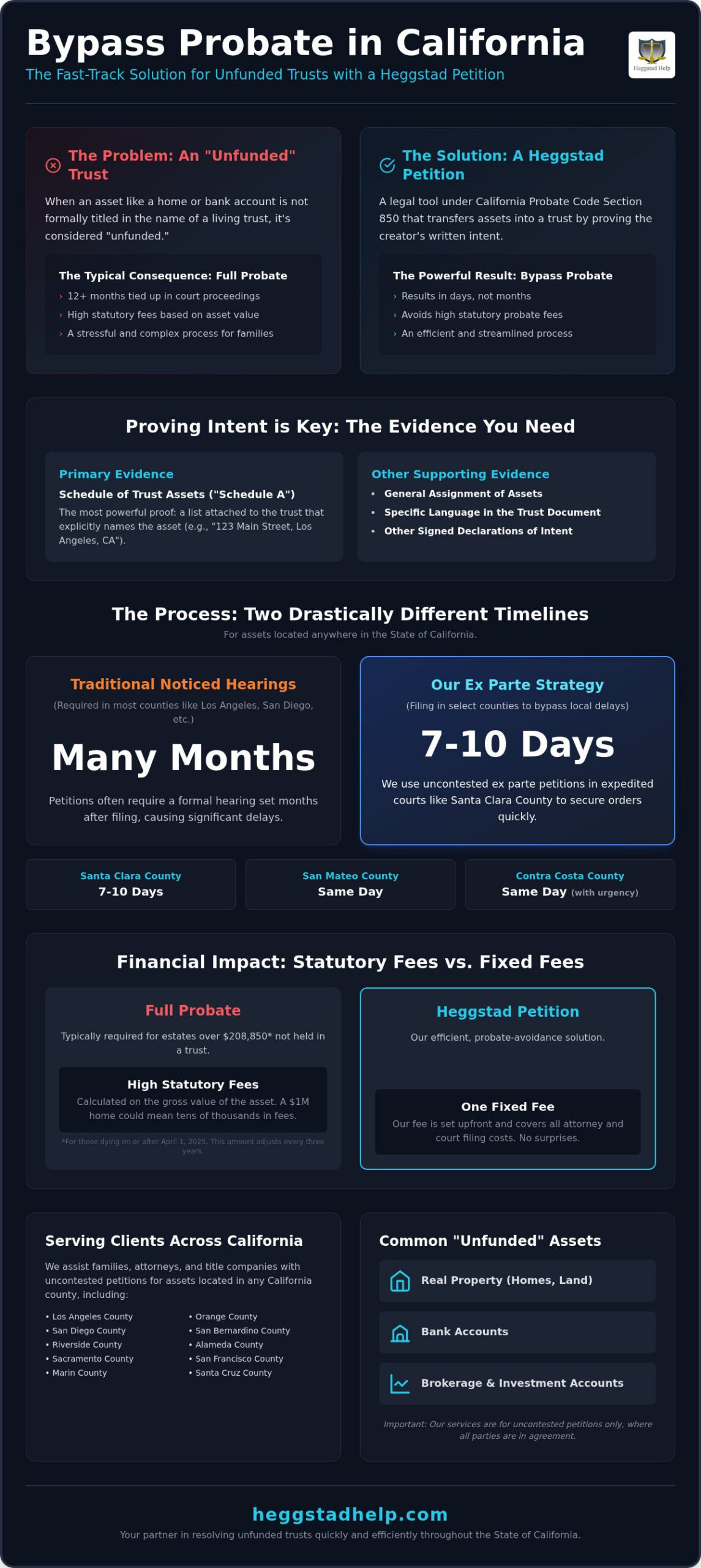
Petition to Transfer Real Property to Trust: The California Heggstad Guide

Imagine the frustration of discovering that your loved one’s most valuable asset was never actually deeded into their living trust. You’re suddenly…

Imagine the frustration of discovering that your loved one’s most valuable asset was never actually deeded into their living trust. You’re suddenly looking at a probate process that can drag on for 12 to 18 months, potentially costing upwards of $46,000 in statutory fees for a $1 million home. It’s a common oversight that feels like a massive roadblock, but a petition to transfer real property to trust offers a specialized path forward. This legal mechanism, often called a Heggstad Petition, allows a judge to recognize the decedent’s clear intent and “rescue” the property from the traditional probate system.

We understand that the thought of navigating Probate Code 850 (the statute governing these transfers) feels overwhelming during a time of grief. In this guide, you’ll learn exactly how to secure a court order confirming the home as a trust asset without the exhaustive delays of full administration. We will walk through the specific evidence required to prove intent, the timeline you can expect, and the final steps to update the title at the County Recorder.

Key Takeaways

  • Understand how a Heggstad Petition functions as a legal “rescue” mechanism to transfer assets into a trust after a death without undergoing a full probate.
  • Identify the critical evidence needed to prove the decedent’s intent, specifically focusing on the importance of the “Schedule A” or a general assignment of assets.
  • Compare the timelines and costs of a petition to transfer real property to trust against traditional probate to see how you can save months of time and significant statutory fees.
  • Follow a structured five-step process to file your petition with the California Superior Court and successfully update the property title at the County Recorder.
  • Recognize the value of specialized legal guidance in navigating Probate Code 850 to avoid the delays and complications often encountered by generalist probate attorneys.

What is a Petition to Transfer Real Property to a Trust?

A Heggstad Petition is a specialized legal request filed under California Probate Code Section 850. It serves as a vital safety net when a property owner intended to place their real estate into a trust but failed to complete the formal deed transfer before passing away. In the legal community, this petition to transfer real property to trust is considered the “gold standard” for correcting trust funding errors (the process of moving assets into the name of the trust) without the burden of a full probate administration.

The legal foundation for this procedure stems from the landmark 1993 case, Estate of Heggstad. In that case, the court determined that if a person’s written intent to include a property in their trust is clear, the formal recording of a deed isn’t strictly necessary to establish trust ownership. This ruling revolutionized California estate law, providing a way for families to avoid the 12 to 18 month delays and high statutory fees associated with formal probate. When you file a petition to transfer real property to trust, you’re essentially asking the court to honor the decedent’s (the person who died) documented wishes rather than letting a clerical oversight dictate the fate of the family home.

When is this Petition Necessary?

A Heggstad filing becomes necessary when the legal title to a property doesn’t match the instructions left in a trust document. This typically happens in three specific scenarios:

  • Documented Intent: The decedent clearly intended the property to be part of the trust but died before the transfer was finalized.
  • Unrecorded Deeds: A grant deed (the document that transfers ownership) was signed and notarized but was never filed with the County Recorder.
  • Schedule of Assets: The property is explicitly listed on the trust’s “Schedule A” (a list of assets intended for the trust), yet the title remains in the individual’s name.

The Legal Basis: California Probate Code 850

The statutory authority for this process is found in California Probate Code Section 850(a)(3). This specific section allows a Successor Trustee (the person appointed to manage the trust after the original trustee dies) to petition the court regarding property that should be under trust control.

It’s important to understand that the court doesn’t technically “transfer” the property in the traditional sense. Instead, the judge issues an order that “confirms” the property was already a trust asset at the time of death based on the evidence of intent. This distinction is crucial because it allows the Successor Trustee to bypass the lengthy probate process entirely, moving directly to updating the title and distributing the asset according to the trust’s terms. For a deeper look at how this statute operates in practice, our guide to California Probate Code Section 850 and real property petitions walks through the full scope of this legal tool.

Proving Intent: The Key to a Successful Transfer

Intent is the central pillar of any successful Heggstad filing. Because you’re asking the court to bypass the traditional deed recording process, the judge needs a solid reason to believe the decedent truly meant for the property to be held in trust. Without this documented desire, the court cannot legally “confirm” the asset’s status. The burden of proof falls on the petitioner to present the requirements for the Heggstad Petition, which primarily focus on written evidence created by the settlor (the person who created the trust) during their lifetime. A well-prepared petition to transfer real property to trust relies on this trail of evidence to prove that the omission was a clerical error rather than a change of heart.

The Power of the Schedule of Assets

Most trust packages include a “Schedule A” or a “Schedule of Assets.” This document is the most powerful piece of evidence in a petition to transfer real property to trust. When a property is listed by its specific legal description or common street address, it provides the court with an unambiguous roadmap of the owner’s wishes.

If the schedule is less specific, perhaps only referring to “all my real property interest in California,” the case becomes slightly more complex but remains winnable. In these instances, the court looks for a nexus between that general statement and the specific property in question. Regardless of the document’s specificity, a judge must find “clear and convincing evidence” of the settlor’s intent before they will grant the order. If you’re looking at a blank schedule, don’t lose hope; other documents can often bridge the gap.

Supporting Documentation and Declarations

Beyond the formal schedule, many trusts contain a “General Assignment” clause. This provision acts as a catch-all, stating that the settlor transfers all their current and future assets into the trust. While not as direct as a specific address, this clause demonstrates a broad intent to avoid probate for all holdings.

Other secondary evidence can bolster your case:

  • Correspondence or emails between the decedent and their estate planning attorney.
  • Handwritten notes or letters expressing the desire to “put the house in the trust.”
  • Drafted but unrecorded deeds that were signed and notarized.

It is vital to remember that oral testimony alone is usually insufficient for real property transfers in California. The law requires a “writing” to satisfy the Statute of Frauds. If you’re unsure if your documentation meets these standards, consulting with a Heggstad specialist can help you determine the strength of your evidence before you file.

Heggstad Petition vs. Full Probate: A Strategic Comparison

Choosing between a Heggstad filing and full probate is often the difference between a swift resolution and a multi-year administrative burden. While a standard California probate typically lasts between 12 and 18 months, a successful petition to transfer real property to trust can often be resolved in a fraction of that time, frequently within 2 to 6 months. This efficiency exists because the court focuses specifically on the intent surrounding a single asset rather than conducting a comprehensive audit of the decedent’s entire financial life. By using this targeted approach, families can avoid the “red tape” of formal estate administration, such as filing inventory and appraisal documents for every personal item owned by the deceased.

Privacy is another significant factor that distinguishes these two paths. A full probate is a public process where the decedent’s entire estate, including debts and beneficiary distributions, becomes a matter of public record. In contrast, a petition to transfer real property to trust is a surgical legal remedy. It creates a targeted court record focused solely on the title of the real estate. While it still requires a court hearing, it doesn’t expose the broader details of the trust administration to public scrutiny. This allows the Successor Trustee (the person managing the trust) to maintain a higher level of confidentiality for the family’s private affairs.

Calculating the Savings

The financial impact of choosing the Heggstad route is often the most compelling reason for beneficiaries to act. In California, statutory probate fees are calculated based on the gross value of the estate assets, not the equity. For example, under Probate Code Section 10810, a $1 million home would trigger approximately $46,000 in combined statutory fees for the attorney and the executor ($23,000 each). This applies even if the home has a $900,000 mortgage. Because a Heggstad petition typically involves fixed legal fees rather than a percentage of the property value, it preserves a much larger portion of the inheritance. For urgent situations, such as a pending home sale, we can often utilize an “ex parte” (an expedited hearing without the standard notice period) court order to secure title correction in weeks rather than months.

When is Probate Still Required?

Despite the advantages of a Heggstad filing, certain scenarios still necessitate a full probate. If there’s absolutely no written evidence of the settlor’s intent to fund the trust, a judge cannot legally confirm the transfer. Probate is also likely required if there are significant creditor disputes or if the validity of the trust itself is being contested in litigation. Additionally, it’s worth checking the “Small Estate” threshold; as of April 1, 2025, estates with personal property valued under $208,850 may be eligible for simplified transfer procedures. However, for real property like a family home, the 850 petition California real property process remains the most effective tool for avoiding the high costs and delays of the formal probate system.

Petition to Transfer Real Property to Trust: The California Heggstad Guide

The 5-Step Process to Transfer Real Property Title

Successfully executing a petition to transfer real property to trust requires a methodical approach that satisfies both the court’s evidentiary standards and the County Recorder’s technical requirements. While the legal theory behind Probate Code 850 is straightforward, the procedural execution must be precise to avoid delays or denials. Following a structured path ensures that the decedent’s intent is honored and the title is corrected efficiently.

  • Step 1: Gathering Evidence and Drafting the 850 Petition. This involves collecting the trust document, the Schedule of Assets, and any supporting evidence of intent to draft the formal petition (the legal document requesting the court order).
  • Step 2: Filing with the Superior Court and Setting a Hearing Date. The petition is submitted to the probate department of the California Superior Court in the county where the property is located.
  • Step 3: Providing Legal Notice to all Heirs and Beneficiaries. You must formally notify all interested parties of the hearing, allowing them the opportunity to review the request.
  • Step 4: The Court Hearing and Obtaining the Signed Order. The judge reviews the evidence during a scheduled hearing and, if satisfied, signs the order confirming the trust’s ownership.
  • Step 5: Recording the Certified Order with the County Recorder. The final step involves filing the court-validated document with the county to update the public title record.

Drafting and Filing Requirements

The technical accuracy of your petition is paramount. You must include the full legal description of the property, including the APN (Assessor’s Parcel Number) and the “metes and bounds” (the geographical description of the property’s boundaries). When you’re ready to file, you’ll need to pay the standard court filing fee, which is approximately $435 in most California counties. Perhaps the most critical procedural step is the Notice of Hearing. This is a jurisdictional requirement, meaning the court cannot legally act on your petition unless every heir and beneficiary has been served with notice at least 30 days before the hearing.

If you’re concerned about meeting these strict procedural deadlines or drafting the technical legal descriptions, our Heggstad Petition Filing service provides the specialized expertise needed to navigate the court system with confidence.

Finalizing the Title Transfer

Once the judge grants the petition, you must obtain a “Certified Copy” of the court order from the court clerk. This version bears an official seal, proving its authenticity to outside agencies. Before recording this order, you’ll also need to complete a PCOR (Preliminary Change of Ownership Report) for the County Assessor to explain the nature of the transfer. Once recorded, the court order acts as a deed, officially moving the property into the trust. This final act clears the title, allowing the Successor Trustee to sell or distribute the home as the trust instructions dictate. If the property is to be kept as a rental, Home Showings Property Management provides professional residential oversight to ensure the asset is managed effectively for the beneficiaries.

Why Work with a California Heggstad Specialist?

Choosing the right legal partner for a petition to transfer real property to trust is a decision that directly impacts both the family’s inheritance and the timeline for resolution. While many attorneys offer broad probate services, a generalist often lacks the deep procedural familiarity required for a successful Heggstad filing. This lack of specialization can lead to a “default” recommendation for full probate administration, which often consumes tens of thousands of dollars in unnecessary statutory fees. By working with a dedicated specialist, you ensure that the specific requirements of Probate Code 850 are met the first time, avoiding the common pitfalls of inadequate notice or insufficient evidence of intent that frequently stall these cases in court.

Successor Trustees (the individuals responsible for managing the trust after a death) often feel the weight of personal liability when assets are left out of a trust. If a trustee fails to properly secure title to real estate or makes a procedural error during the filing, they could be held responsible by the beneficiaries for the resulting delays or financial losses. A specialist acts as a steady, knowledgeable hand, reducing this stress by providing a clear and logical path toward a court order. This focused approach doesn’t just save money; it provides the calm competence needed to resolve complex title issues during an already difficult time. For professionals facing challenges in other legal areas, such as complex regulatory or corporate sectors, the expertise at jzlaw.org offers a similar standard of specialized counsel.

Expertise in California Probate Courts

Each county in California maintains its own set of local rules that can influence how a petition to transfer real property to trust is processed. Whether you’re filing in Santa Clara, San Francisco, or Los Angeles, having an attorney who has managed hundreds of Probate Code 850 filings is a significant advantage. These specialists understand the specific nuances of what a particular judge expects to see in a “Schedule of Assets” or a general assignment clause. They know how to satisfy jurisdictional requirements (the court’s legal authority to hear the case) through proper notice, ensuring the petition isn’t rejected due to a minor clerical oversight.

The Robert P. Bergman Advantage

At Heggstad Help, you gain direct access to Robert P. Bergman, a Board-Certified Specialist in Estate Planning, Trust and Probate Law. This certification is a distinction held by a small percentage of California attorneys, requiring rigorous testing and a proven track record of success. With a practice dating back to 1980, Mr. Bergman brings over four decades of experience to every title correction case. We specialize in using ex parte court orders (expedited hearings) to move transfers forward when a pending home sale or other urgent matter requires immediate action. Our goal is efficiency; we focus on getting the order signed so your family can move forward. Contact Heggstad Help today for a consultation on your missing trust assets.

Secure Your Family’s Inheritance Without the Probate Delay

Discovering that a home was left out of a living trust doesn’t have to result in a 12 to 18 month court battle. By leveraging the decedent’s documented intent, you can bypass the high costs and public nature of a full probate administration. A petition to transfer real property to trust serves as a powerful tool to correct title errors efficiently, ensuring that the successor trustee can manage or sell the property as originally intended. The key to success lies in gathering the right evidence and strictly adhering to the procedural requirements of Probate Code 850 (the statute governing these transfers).

Navigating these complex court rules requires a steady and experienced hand. Robert P. Bergman has been practicing California law since 1980 and is a Board-Certified Specialist in Estate Planning, Trust and Probate Law. At Heggstad Help, we focus exclusively on these specialized filings to provide you with the fastest possible resolution. Don’t let a clerical oversight derail your loved one’s estate plan or drain the inheritance through statutory fees. Get Expert Help with Your Heggstad Petition Today and move forward with the confidence that your family’s legacy is secure.

Frequently Asked Questions

Can I file a Heggstad Petition if there is no written list of assets?

Yes, you can still file if you have other written evidence of the decedent’s intent. While a “Schedule A” is the strongest proof, a “General Assignment” clause within the trust document often serves as a catch-all for forgotten assets. Judges look for clear and convincing evidence that the creator intended the property to be trust-owned. If the trust mentions “all my real property” or if there’s a signed, unrecorded deed, a petition to transfer real property to trust can still succeed.

How long does the Heggstad Petition process take in California?

The process typically takes between 2 and 6 months from the initial filing to the recording of the final order. This timeline is significantly shorter than the 12 to 18 months required for a full probate administration. The exact duration depends on the specific county court’s hearing calendar and whether any heirs object to the transfer. If a home sale is already in escrow, we can sometimes utilize an ex parte hearing to expedite the court’s decision.

Does a Heggstad Petition trigger a property tax reassessment under Prop 19?

The petition itself doesn’t trigger a reassessment; rather, it confirms the trust was the legal owner at the time of death. However, any transfer of real property in California is subject to Proposition 19 rules. If the property passes to a child who makes it their primary residence within one year, they may qualify for a tax exclusion. The court order simply places the property in the trust so these distributions can occur according to the original estate plan.

What is the difference between a Heggstad Petition and a Spousal Property Petition?

These petitions serve different legal goals and rely on different sections of the Probate Code. A Heggstad petition (under Section 850) is used to move assets into a trust that were mistakenly left out. A Spousal Property Petition (under Section 13650) is used to transfer property directly to a surviving spouse without the need for a trust or full probate. If the goal is to keep the property under trust management for multiple beneficiaries, the Heggstad route is the correct choice. For surviving spouses navigating this decision, our detailed comparison of the Heggstad petition for surviving spouse in California can help you determine which path best protects your long-term estate plan.

Can a Heggstad Petition be used for bank accounts or brokerage accounts?

Yes, Probate Code 850 applies to both real estate and personal property like financial accounts. If a decedent created a trust but forgot to update the beneficiary designations or title on a large brokerage account, this petition can “rescue” those funds from probate. As long as there’s written evidence that the owner intended the account to be a trust asset, the court can issue an order confirming the trust as the rightful owner of those funds.

What happens if a beneficiary objects to the Heggstad Petition?

If a beneficiary or heir files a formal objection, the matter becomes a contested proceeding. The court will likely set a trial date and allow both sides to present evidence regarding the decedent’s true intent. Contested cases take much longer to resolve and can become quite expensive. In these scenarios, having a Board-Certified Specialist who understands the nuances of a petition to transfer real property to trust is essential for protecting the trust’s interests and reaching a resolution.

Do I need to go to court for a Heggstad hearing?

In most cases, the Successor Trustee doesn’t need to physically appear in the courtroom. Your attorney typically handles the hearing, and many California counties now allow for remote appearances or “probate notes” where the judge approves the petition based on the paperwork alone. If the petition is uncontested and the evidence of intent is clear, the judge can often sign the order without requiring any live testimony from the family members involved.

Can I sell the house while the Heggstad Petition is pending?

You can list the property and even enter into a purchase agreement, but you cannot officially close escrow until the court order is signed. The title company will require a certified copy of the recorded court order before they will issue title insurance to a buyer. If you have an urgent need to sell, we can request an expedited hearing date. This ensures the title is corrected in time to meet your escrow deadlines without losing the buyer.

Robert P. Bergman, Attorney at Law

Article by

Robert P. Bergman, Attorney at Law

Attorney Robert P. Bergman ("Bob Bergman") has been a Board-Certified Specialist in Estate Planning, Trust and Probate Law since 2011, as certified by the California State Bar Board of Legal Specialization. For several years, Bob has assisted families and the clients of other attorneys with obtaining court orders through Heggstad petitions to avoid the time and expense of Probate administration. Bob is friendly, very approachable, and believes in explaining complex legal topics in clear ordinary language so that his clients understand exactly what they're doing and why they're doing it.
Bob is often able to assist clients who are in other counties than his home county of Santa Clara through his approach to Heggstad petitions.

Disclaimer

This article is for informational purposes only. Nothing in this article is intended to replace legal advice from a competent attorney or be considered legal guidance for anybody's specific legal situation. Nobody should rely on information in this article in making legal decisions without such consultation.