
What if a single missing signature on a deed didn’t have to cost your family eighteen months of court delays and thousands of dollars in statutory probate fees? Most successor trustees assume that if a house or account was left out of a living trust, a full probate is the only path forward. It’s a heavy, anxious realization to face when you’re already managing the loss of a loved one. This Complete guide to HEGGSTAD HELP explains why that “obvious” path is often a costly mistake.
We understand the frustration of finding conflicting title documents that seem to trap an estate in the court system. You’ll learn how to use a Heggstad Petition (a specific court request to confirm property as trust assets) to bypass the traditional probate process entirely. By leveraging California Probate Code 850, it’s possible to resolve these oversights in as little as two to six months rather than the standard year or longer. This guide previews the evidence required to prove the decedent’s intent and outlines the steps to transfer title to beneficiaries legally and efficiently.
Key Takeaways
- Discover how the “Intent vs. Title” principle allows the court to honor a decedent’s wishes and confirm trust ownership even when a formal deed transfer was missed.
- This Complete guide to HEGGSTAD HELP reveals how to identify common title errors, such as the “Refinance Trap,” that often lead to unnecessary probate delays.
- Learn the specific steps for gathering evidence, including the use of trust schedules and written declarations, to build a compelling case for the California Probate Court.
- Explore how specialized ex parte services can fast-track your petition, offering a rapid resolution for time-sensitive situations like a pending home sale or property transfer.
- Understand the advantage of working with a Board-Certified Specialist to navigate complex procedural hurdles and avoid the high costs of a traditional twelve-month probate.
What is a Heggstad Petition and How Does It Work?
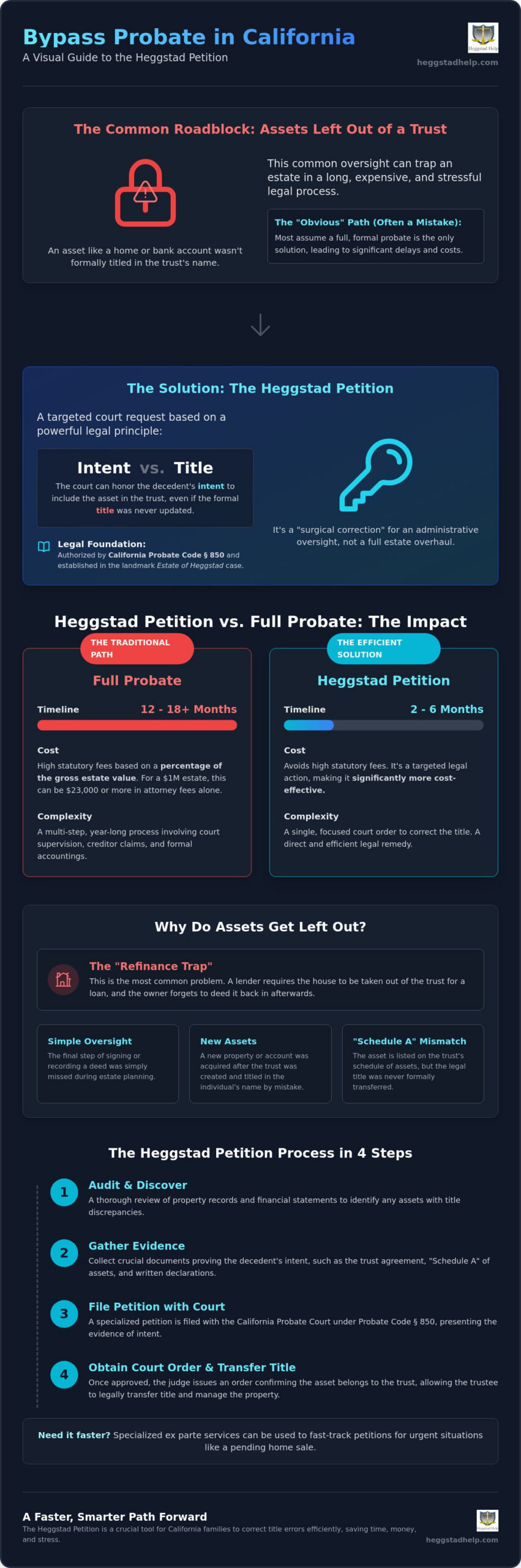
A Heggstad Petition is a specialized legal request filed with the California Probate Court. It asks a judge to confirm that a specific asset, such as a family home or a brokerage account, belongs to a trust even if the formal title was never updated. This Complete guide to HEGGSTAD HELP focuses on the core principle of “Intent vs. Title.” If the person who created the trust (the settlor) clearly intended for an asset to be included, the court has the power to fix the title error without requiring a full probate.
This process applies to both real property and personal property. If a parent forgot to deed their house to the trust or failed to name the trust as a beneficiary on a large bank account, this petition serves as the legal remedy. It effectively bypasses the multi-step, year-long probate process by addressing the title issue through a single, targeted court order. It’s a surgical correction for an administrative oversight.
The Legal Foundation: California Probate Code 850
The authority for this procedure comes from California Probate Code Section 850. This section provides a mechanism for successor trustees to claim property that is technically held in the decedent’s individual name. The practice is named after the landmark 1993 case, Estate of Heggstad. This case established that a written declaration of trust is sufficient to include an asset in that trust, creating a unique “California-only” shortcut for families facing complex title hurdles.
Heggstad Petition vs. Full Probate: A Speed Comparison
Speed is the most significant advantage. While a traditional California probate often takes twelve to eighteen months to resolve, a Heggstad petition is frequently completed within two to six months. Beyond the time savings, this approach avoids the high statutory attorney fees associated with full estate administration. Instead of paying a percentage of the gross estate value, families can use this petition to transfer title to beneficiaries legally and quickly. It’s a far more efficient path for estates that are otherwise well-organized but for a few missing deeds.
Common Reasons Trust Assets Are Left Out of Title
Even the most meticulously drafted estate plan fails if the assets aren’t properly “funded” (the process of transferring title from an individual to the trust). This Complete guide to HEGGSTAD HELP addresses the reality that many families face: a valid trust document exists, but the “suitcase” is empty because the deeds were never signed or recorded. Whether due to a simple oversight or a complex financial transaction, these title gaps create a legal hurdle that prevents the successor trustee from managing the property without court intervention.
The Refinance Trap: A Successor Trustee’s Most Common Problem
Lenders frequently require homeowners to move their property out of a trust and back into their individual names to secure a mortgage or refinance. Banks often prefer individual title because it simplifies their internal risk assessments and loan processing. While the homeowner usually intends to deed the house back into the trust immediately after the loan closes, this final step is frequently forgotten. This creates a “broken chain” in the trust’s history. A house left out of a trust after a refinance is not a lost cause; it is a title error that California law is designed to correct.
Identifying “Loose” Assets After a Death
The first task for a family is to perform a thorough audit of all property records and financial statements. You should look for property tax statements or grant deeds that don’t list the trust as the owner. If a decedent purchased a new home or opened a brokerage account after the trust was created, they might have accidentally used their individual name instead of the trust name. Using a successor trustee guide is essential during this stage to ensure no discrepancies are missed.
Another frequent complication involves “Schedule A” (the list of assets intended for the trust). Sometimes an asset is clearly listed on this schedule, yet no formal deed or transfer document was ever executed. In these cases, California Probate Code § 850 provides the legal bridge to move those assets into the trust. If you discover a significant asset was left out of the title, you can schedule a consultation to determine if a petition is the right path forward for your specific situation.
The Heggstad Petition Process in California
Understanding the procedural requirements of a Heggstad petition requires a methodical approach. This Complete guide to HEGGSTAD HELP breaks the process down into four distinct phases to ensure the court recognizes the decedent’s intent. Unlike a full probate, which involves multiple hearings and inventory filings, this process is focused on a single objective: confirming trust ownership.
- Step 1: Gathering Evidence of Intent. This involves locating the original trust document, any “Schedule A” asset lists, or general assignment of assets.
- Step 2: Drafting the Petition. A formal legal document must be prepared, detailing the specific assets and the legal grounds for the transfer under California law.
- Step 3: Filing and Notice. Once filed, you must serve formal notice to all heirs and beneficiaries. This is a strict legal requirement to ensure transparency.
- Step 4: The Court Hearing. A probate judge reviews the evidence. If the judge is satisfied, they sign a court order confirming the asset belongs to the trust.
Evidence Required for a Successful Filing
The most critical piece of evidence is often the “General Assignment” or “Schedule of Assets” included in the trust package. These documents act as a clear declaration that the settlor intended for their property to be trust-owned. If a specific list doesn’t exist, we look for other written declarations or evidence of intent. Even in complex cases where a deed was never recorded, a well-documented petition can bridge the gap. If you’re unsure if your documentation is sufficient, you can contact us for a petition review to evaluate your evidence.
Recording the Final Court Order
Winning the case in court is the penultimate step. Once the judge signs the order, it must be recorded with the County Recorder in the county where the real property is located. This recorded order effectively acts as a deed; it officially changes the title from the decedent’s name to the trust. This allows the trustee to legally sell the property or distribute it to beneficiaries without further court oversight. It’s the final piece of the puzzle that restores the trust’s funding and protects the family’s inheritance.
How HEGGSTAD HELP Corrects Trust Titles Faster
Resolving a title discrepancy requires more than just filling out forms; it requires a deep understanding of how California probate judges evaluate evidence of intent. This Complete guide to HEGGSTAD HELP highlights a specialized approach that prioritizes speed and precision. Unlike general practice firms that manage a wide variety of civil matters, we focus exclusively on surgical title corrections. By narrowing our scope to California Probate Code 850 petitions, we’ve developed a streamlined workflow that eliminates the administrative bloat often found in traditional law offices.
Our process is built on a “Plain English” philosophy. We recognize that successor trustees are often navigating these legal hurdles while grieving, which is why we translate complex procedural jargon into clear, actionable steps. We don’t handle full probate administrations, which allows us to dedicate our entire technical infrastructure to recovering missing trust assets and correcting deeds efficiently.
The Advantage of a Board-Certified Specialist
Robert P. Bergman is a Board-Certified Specialist in Estate Planning, Trust and Probate Law, a rare credential that signifies a high level of expertise recognized by the State Bar of California. With over 40 years of experience practicing since 1980, he has encountered nearly every possible title complication, from ancient “refinance traps” to modern digital evidence of intent. A specialist is better equipped to anticipate court objections and draft petitions that meet the “clear and convincing” evidentiary standard required by California law on the first attempt.
Urgent Title Corrections for Pending Real Estate Sales
The most stressful scenario for a trustee occurs when a house is in escrow and a title company suddenly discovers the property was never deeded into the trust. In these high-stakes moments, a standard court date months away isn’t an option. HEGGSTAD HELP specializes in ex parte court order services (immediate court intervention for urgent matters) to address these crises. By seeking an emergency hearing, we can often secure the necessary court order in a fraction of the usual time, preventing sales from falling through and protecting the estate’s financial interests. If you’re facing a title roadblock, you can contact HEGGSTAD HELP for a consultation on your California trust asset to find a path forward.
Take Decisive Action to Protect the Trust Estate
Discovering that a family home or significant account was left out of a trust doesn’t have to trigger a year-long probate nightmare. By understanding the “Intent vs. Title” principle and utilizing California Probate Code 850, you can correct these technical oversights and transfer property to beneficiaries in a fraction of the usual time. This Complete guide to HEGGSTAD HELP has outlined how surgical legal petitions can bypass the high fees and delays of full estate administration.
Robert P. Bergman has been serving California successor trustees since 1980. As a Board-Certified Specialist in Estate Planning, Trust and Probate Law, he provides a level of precision that generalist attorneys often lack. Our firm maintains a specialized focus on Probate Code 850 petitions to ensure your family’s assets are secured legally and efficiently. You don’t have to navigate these complex procedural hurdles alone.
Request a Consultation with a California Heggstad Specialist today to begin the title correction process. We’re here to provide the steady, knowledgeable hand you need to resolve these complications and move forward with confidence.
Frequently Asked Questions
How much does a Heggstad Petition cost in California?
The initial court filing fee for a Heggstad petition in California is $435. While this fee is standard across all 58 counties, the primary financial advantage is the avoidance of statutory probate fees, which can exceed 4% of the gross value of the estate. This Complete guide to HEGGSTAD HELP emphasizes that while total legal costs depend on the complexity of the title issue, the process remains significantly more affordable than a full, year-long estate administration.
Can I file a Heggstad Petition if the asset isn’t listed on Schedule A?
You can still file a petition even if a specific asset was omitted from Schedule A (the itemized list of property intended for the trust). Success in these cases relies on meeting the “clear and convincing evidence” standard, meaning the evidence must leave no substantial doubt about the decedent’s intent. A general assignment of assets or a pour-over will can often serve as the necessary proof to show the settlor intended for all their property to be held within the trust.
How long does the Heggstad process take compared to probate?
A typical Heggstad petition is resolved within two to six months, which is a major time savings compared to the twelve to eighteen months required for a traditional California probate. For time-sensitive situations, such as a property currently in escrow, ex parte court order services (emergency requests for immediate judicial relief) can be used to seek a faster resolution. This streamlined path allows for a legal title transfer without the exhaustive multi-step requirements of a full probate case.
Do I need a lawyer to file a Heggstad Petition under Probate Code 850?
California law doesn’t strictly require an attorney to file under Probate Code 850, but the procedural requirements are highly technical. This Complete guide to HEGGSTAD HELP notes that judges require specific evidentiary foundations and strict adherence to notice requirements for all heirs and beneficiaries. Because a single procedural error can lead to a petition being denied, many successor trustees choose to work with a Board-Certified Specialist to ensure the filing is handled correctly the first time.
What happens if an heir objects to the Heggstad Petition?
If an heir or beneficiary files a formal objection, the petition becomes a contested matter. The court will typically schedule additional hearings and may allow for discovery (the formal legal process of gathering evidence and testimony). While most petitions are straightforward corrections of administrative oversights, a contest turns the case into a more complex litigation matter where the petitioner must provide robust evidence to uphold the decedent’s original intent for the trust.

Article by
Robert P. Bergman, Attorney at Law
Attorney Robert P. Bergman ("Bob Bergman") has been a Board-Certified Specialist in Estate Planning, Trust and Probate Law since 2011, as certified by the California State Bar Board of Legal Specialization. For several years, Bob has assisted families and the clients of other attorneys with obtaining court orders through Heggstad petitions to avoid the time and expense of Probate administration. Bob is friendly, very approachable, and believes in explaining complex legal topics in clear ordinary language so that his clients understand exactly what they're doing and why they're doing it.
Bob is often able to assist clients who are in other counties than his home county of Santa Clara through his approach to Heggstad petitions.
Disclaimer
This article is for informational purposes only. Nothing in this article is intended to replace legal advice from a competent attorney or be considered legal guidance for anybody's specific legal situation. Nobody should rely on information in this article in making legal decisions without such consultation.


