
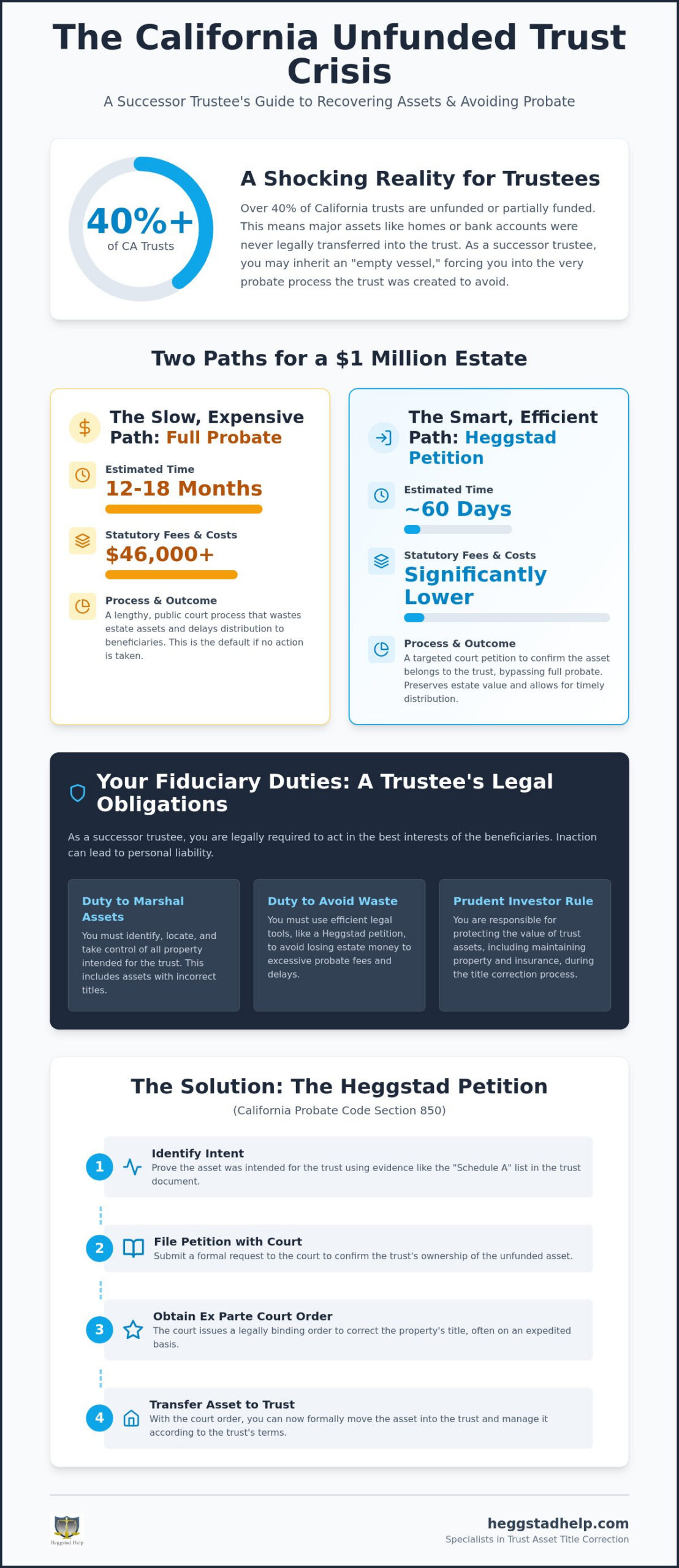
Did you know that over 40% of California trusts are either unfunded or only partially funded? If you have been named a successor trustee unfunded trust assets California, you may be facing the very probate process the trust was meant to avoid. It’s a daunting discovery to find that a primary residence or a significant bank account was never properly titled, especially when you’re already managing the emotional weight of a loved one’s passing. You might worry about personal liability for mismanagement or the high statutory fees, which can exceed $46,000 on a $1 million estate.
We understand that you have a specific legal duty to marshal (the process of identifying and securing) all trust property. This guide will teach you how to fulfill those obligations and recover missing assets using efficient legal tools like the Heggstad petition. We’ll explain how to correct title errors through ex parte (emergency or side-bar) court orders, allowing you to bypass full probate while protecting yourself from potential beneficiary disputes. By the end of this article, you’ll have a clear, logical path toward resolving these procedural hurdles with confidence.
Key Takeaways
- Identify assets that were intended for the trust but remain in the decedent’s individual name to prevent them from being stuck in the court system.
- Understand how your fiduciary duty to avoid waste requires you to seek efficient title correction methods instead of defaulting to a lengthy and expensive probate administration.
- Learn how a successor trustee unfunded trust assets California can use a Heggstad petition (a filing under Probate Code Section 850) to confirm trust ownership of real estate.
- Gain insights into using ex parte court orders to expedite the transfer of property, which may save the estate significant time and statutory fees.
- Discover why working with a specialist focused exclusively on trust asset title correction provides a more reliable path to resolution than hiring a generalist probate attorney.
Understanding the Unfunded Trust Crisis in California
An unfunded trust is a legal entity that exists on paper but does not legally hold title to the intended assets. In these scenarios, property remains in the decedent’s individual name rather than being held by the trust. This creates a significant hurdle for a successor trustee unfunded trust assets California, as they possess the legal authority to manage the trust but lack the actual legal title required to sell or distribute property. Under Trust law, a trust must be properly “funded” (the process of transferring ownership from an individual to the trust) to function as intended. Without this transfer, the trust is essentially an empty vessel.
Common causes for this crisis include failing to record a grant deed after a real estate purchase or forgetting to update the title on brokerage accounts before death. Often, a homeowner might remove a property from their trust to facilitate a refinance and simply neglect to deed it back into the trust once the loan closes. When you discover these omissions, the “Schedule A” (the list of assets typically attached to the back of a trust document) becomes your most vital piece of evidence. It serves as a clear record of the settlor’s (the person who created the trust) intent to include those specific assets in the estate plan. Understanding how unfunded trust probate California proceedings unfold can help you anticipate the challenges ahead and choose the most efficient path to resolution.
The Duty to Marshal Assets
As a successor trustee, you have a strict legal requirement to “marshal” assets. This is the act of gathering, securing, and taking formal title to all property intended for the trust. You can’t simply ignore an unrecorded deed or a forgotten bank account because they seem difficult to access. Doing nothing when an asset is missing can lead to a breach of fiduciary duty (a legal obligation to act in the best interest of the beneficiaries). You must identify which assets were clearly intended for the trust and differentiate them from assets that are legally required to go through a full probate process.
Successor Trustee vs. Executor
Roles can become blurred when a house is left out of a living trust in California. If you are the trustee, your power is limited to what the trust actually owns. If an asset is outside the trust, you may find yourself acting as a “petitioner” in the California court system rather than a standard administrator. While an executor manages assets through the formal probate court, a successor trustee dealing with unfunded assets uses specialized petitions to bring those items back under the trust’s umbrella. This prevents the need for a year-long probate stay while ensuring you fulfill your role as the steady hand guiding the estate. If a pending property sale is at stake, understanding why a house not in trust can’t sell California real estate without court intervention is essential before escrow can move forward.
Fiduciary Duties and the Risk of Personal Liability
Serving as a successor trustee is a significant legal responsibility that carries the weight of fiduciary duty. This means you’re legally obligated to act in the best interests of the beneficiaries with the highest degree of loyalty and care. When you find yourself as a successor trustee unfunded trust assets California, your first priority is the Duty of Diligence. You must investigate the title of every piece of real estate and every financial account mentioned in the estate plan. Simply assuming the trust is fully funded without verifying recorded deeds can lead to severe complications later in the administration process.
Another critical obligation is the Duty to Avoid Waste. In California, a formal probate for a $1 million estate can cost upwards of $46,000 in statutory fees and take 12 to 18 months to conclude. If you allow a property to languish in full probate when a Heggstad petition could have resolved the title issue in about 60 days, beneficiaries may claim you “wasted” estate funds. Under California Probate Code Section 17200, beneficiaries have the right to petition the court to review your actions, potentially leading to a surcharge where you’re forced to pay back the estate from your own pocket.
While the title correction process is underway, you must also adhere to the “Prudent Investor” rule. This requires you to maintain the property’s value by keeping insurance policies active, ensuring the home is secure, and managing any necessary repairs. Clear communication is your best defense. You should inform beneficiaries early that certain assets are currently “outside” the trust but are recoverable through specific legal channels. For a deeper look at how this situation can trigger court involvement, our overview of unfunded trust probate California procedures explains the key steps trustees must take to avoid a full administration.
Potential Liability for Successor Trustees
The risk of personal liability is real if a beneficiary sues because you failed to use an efficient remedy like a Heggstad petition. If your inaction causes the estate to lose money through unnecessary court fees or a decline in property value during a long probate, you could be held responsible. Seeking professional trust asset title correction California ensures that you’re taking the most efficient legal path available, which provides a strong shield against claims of mismanagement.
Standard of Care in California
California law measures your performance against what a “reasonable” trustee would do in a similar situation. A reasonable trustee doesn’t ignore an unrecorded deed; they take active steps to fix it using the tools provided by the Probate Code. If the legal requirements feel complex, engaging specialized counsel can help you meet this high standard of care. Working with a specialist at HEGGSTAD HELP allows you to navigate these hurdles with the calm competence that beneficiaries expect from a steady, knowledgeable hand.
The Heggstad Petition: Your Tool for Fixing Title
When a successor trustee unfunded trust assets California discovers a missing deed or an unrecorded title, the primary legal remedy is found under California Probate Code Section 850. This specific filing, commonly known as a Heggstad Petition, allows the court to confirm that an asset actually belongs to the trust despite a technical error in the title. Instead of enduring the standard 12-to-18-month probate cycle, this petition offers a streamlined path to recovery. It is considered the gold standard for trustees because it honors the decedent’s wishes while protecting the estate’s value from unnecessary court-ordered fees. For a comprehensive overview of how this statute applies to real estate, see our guide to 850 petition California real property filings.
The success of this petition rests almost entirely on the concept of “intent.” If you can provide the court with written evidence that the person who created the trust (the settlor) intended for the property to be included, the judge has the authority to issue a decree confirming trust ownership. This effectively “funds” the trust after the fact, allowing you to manage the property according to the trust’s instructions rather than the rigid rules of intestate succession (the state’s default plan for people who die without a will). Families who discover a missing deed weeks after a loved one has passed can transfer real estate to a living trust after death in California using this targeted approach, bypassing the high statutory fees and lengthy delays of a full probate administration.
Evidence Required for Successor Trustees
To prevail in court, you must present clear documentation of the settlor’s wishes. The most common piece of evidence is the “Schedule A,” which is the list of assets typically found at the back of the trust document. If a Schedule A is missing, a “General Assignment” document (a broad statement transferring all of a person’s property into their trust) can also serve as sufficient proof. You should review the specific evidence required for Heggstad petition California to ensure your filing meets the court’s strict evidentiary standards.
The Step-by-Step Heggstad Process
While every case involves unique complications, the procedural path generally follows these four logical steps:
- Step 1: Identify the missing asset and gather the original, signed trust documents and any associated schedules.
- Step 2: Work with a specialist to draft the legal petition under Probate Code 850, clearly outlining the evidence of intent.
- Step 3: File the petition in the appropriate California Superior Court and provide formal notice to all heirs and interested parties.
- Step 4: Attend the hearing to obtain the court order confirming trust ownership; once received, you’ll record the new deed with the County Recorder to finalize the title.
If you’ve discovered an unrecorded deed and need to secure the estate’s future, you can begin the process today by requesting a professional Heggstad Petition Filing to fix the title error without the delay of a full probate.
Navigating the California Court System with HEGGSTAD HELP
Many generalist probate attorneys default to full probate administration because it is the standard, broad-brush solution for estates with title issues. However, this path is often unnecessary and significantly more expensive for the beneficiaries. When you are a successor trustee unfunded trust assets California, you need a surgical approach rather than a general one. Choosing a specialized Heggstad petition filing with a Board-Certified Specialist like Robert P. Bergman ensures your case is handled with the precision that generalists may lack. Specialized counsel facilitates asset transfers by understanding exactly what a judge needs to see to confirm title, moving you from being a trustee in crisis to one with a court-confirmed title ready for distribution.
Ex Parte Court Order Services
In some situations, waiting for a standard hearing date is not an option, especially if a property sale is pending or a financial hardship exists. Ex Parte Court Order Services (emergency or expedited court sessions) can be used to confirm trust assets in urgent scenarios. These filings require a deep understanding of California’s complex local court rules and the specific requirements of individual judges. A specialist knows how to navigate these procedural nuances to secure a timely resolution when the standard timeline is too slow.
Protecting the Estate’s Value
The financial difference between a Heggstad petition and a full probate is stark. While full probate fees are mandatory and calculated based on the gross value of the estate, a Heggstad petition is a targeted legal action designed to avoid that entire fee-heavy structure. By choosing this path, you are directly fulfilling your duty to avoid waste and preserve the inheritance for the beneficiaries. It’s a strategic choice that prioritizes the financial health of the estate over the standard, slower court processes.
My final advice for successor trustees is to avoid the temptation of “waiting and seeing.” Don’t wait for beneficiaries to complain about delays or for a title company to block a future sale. Taking proactive steps to fund the trust properly through a court order is the most logical way to resolve title errors. This direct action protects the estate’s value and ensures you meet the high standard of care required of your position.
Moving Forward with Confidence and Clarity
You now have a clear understanding of the risks associated with an unfunded trust and the specialized legal tools available to resolve them. By identifying missing assets early and leveraging the power of a Heggstad petition, you can honor the decedent’s true intent without the unnecessary delays of the probate court. Fulfilling your role as a successor trustee unfunded trust assets California requires proactive steps to secure the estate’s value and protect yourself from potential beneficiary claims.
When the path forward involves complex procedural hurdles, HEGGSTAD HELP provides the specialized expertise necessary for a smooth resolution. Led by Robert P. Bergman, a Board-Certified Specialist in Estate Planning, Trust and Probate Law with over 40 years of experience, our firm focuses exclusively on title recovery and Heggstad filings. We understand the nuances of California trust law and the specific requirements of the local court system, allowing us to act as a steady, knowledgeable hand during a difficult time.
Get Expert Help with Your Heggstad Petition Today
Don’t let an unrecorded deed or a forgotten account stall the administration process. You’ve already done the hard work of learning your obligations; now, let us help you finalize the title correction so you can move toward a successful distribution for the beneficiaries.
Frequently Asked Questions
What happens if a house is not deeded to a trust before death in California?
If a house is not properly deeded to the trust, it remains in the decedent’s individual name and technically becomes part of their probate estate. This means the property cannot be managed or distributed by the trustee until the title is corrected. Depending on the value of the property, the estate may be forced into a full probate administration, which can take 12 to 18 months; however, if there is written evidence of the decedent’s intent, you may be able to use a 850 petition California real property filing to bring the home back into the trust.
Can a successor trustee sell a house that is not legally in the trust?
No, a trustee does not have the legal authority to sell property that the trust does not own. Title companies and escrow officers will refuse to close a transaction if the owner of record on the deed does not match the trust entity. To move forward with a sale, a successor trustee unfunded trust assets California must first obtain a court order confirming that the property is a trust asset, which then allows for the recording of a new deed in the name of the trust. Learn more about the specific steps involved when a house not in trust can’t sell California real estate and how a Heggstad petition can unfreeze escrow.
How long does a Heggstad petition take compared to full California probate?
A Heggstad petition is a significantly more efficient process, typically reaching a resolution in about 60 days. This is a stark contrast to a formal California probate, which generally lasts between 12 and 18 months. By using this targeted legal tool, you can bypass the lengthy creditor notice periods and mandatory accounting cycles of a full probate, allowing for a much faster distribution of assets to the beneficiaries.
Is a successor trustee personally liable for assets left out of the trust?
A successor trustee unfunded trust assets California can face personal liability, known as a surcharge, if their inaction or negligence causes financial harm to the estate. If you fail to use an efficient remedy like a Heggstad petition and instead allow the estate to be diminished by the high costs and delays of a full probate, beneficiaries may sue for a breach of fiduciary duty. It’s your legal obligation to act as a prudent investor and avoid “waste” by selecting the most cost-effective path to secure trust property.
What is the average cost of filing a Heggstad petition in California?
The standard court filing fee for a Heggstad petition, which is filed under Probate Code Section 850, is $435. While the total cost includes legal preparation, it is almost always a fraction of the cost of a full probate. For context, the statutory fees for a $1 million estate in a formal probate are approximately $46,000. Choosing a petition to confirm trust assets is a strategic way to preserve the estate’s value and ensure more of the inheritance remains with the beneficiaries.

Article by
Robert P. Bergman, Attorney at Law
Attorney Robert P. Bergman ("Bob Bergman") has been a Board-Certified Specialist in Estate Planning, Trust and Probate Law since 2011, as certified by the California State Bar Board of Legal Specialization. For several years, Bob has assisted families and the clients of other attorneys with obtaining court orders through Heggstad petitions to avoid the time and expense of Probate administration. Bob is friendly, very approachable, and believes in explaining complex legal topics in clear ordinary language so that his clients understand exactly what they're doing and why they're doing it.
Bob is often able to assist clients who are in other counties than his home county of Santa Clara through his approach to Heggstad petitions.
Disclaimer
This article is for informational purposes only. Nothing in this article is intended to replace legal advice from a competent attorney or be considered legal guidance for anybody's specific legal situation. Nobody should rely on information in this article in making legal decisions without such consultation.


