Heggstad Petition for Real Estate in California: Filing, Timing, and Next Steps

A Heggstad petition may ask a California probate court to confirm real estate as a trust asset when the recorded title does not show the trust as…

A Heggstad petition may ask a California probate court to confirm real estate as a trust asset when the recorded title does not show the trust as owner. A Heggstad petition for real estate California residents own may be relevant when the written record supports the owner’s intent to include the property in the trust.

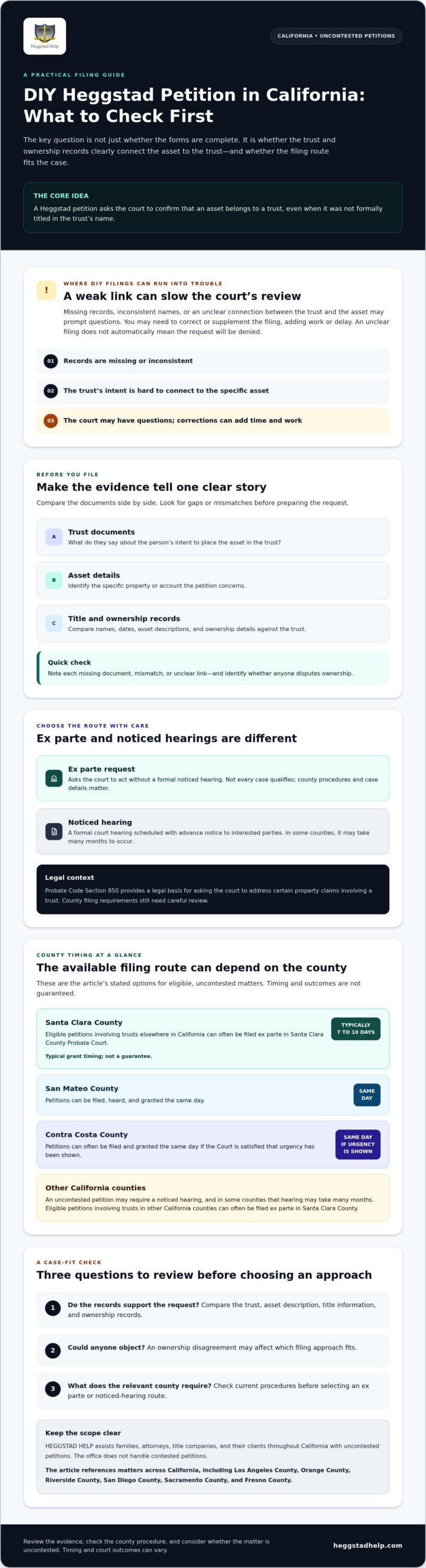
The property’s county and the county where an uncontested petition is filed may differ. HEGGSTAD HELP, a service of attorney Robert P. Bergman, Board-Certified Specialist in Estate Planning, Trust, and Probate Law (California State Bar Board of Legal Specialization), assists families, attorneys, title companies, and their clients throughout California. Uncontested petitions may be filed ex parte, meaning without a formal hearing, in Santa Clara, San Mateo, or Contra Costa County. For property in other counties, including Los Angeles and Orange, the petition is filed in Santa Clara County. Below, learn about the petition, filing routes, typical timing, and how to prepare for a consultation by booking through the consultation link and returning the required worksheets by email or fax.

Key Takeaways

  • When a property’s title record does not show the trust, a successor trustee may need to understand the available Heggstad petition process.
  • A petition under Probate Code Section 850 asks the court to confirm real property as trust property. “Ex parte” means the request is handled without a formal hearing.
  • Filing routes differ for Santa Clara, San Mateo, and Contra Costa Counties and for properties located elsewhere in California.
  • To prepare for a consultation, book through the consultation link, download the worksheets, complete them, and return them by email or fax.

Why a California Heggstad Petition May Matter When Real Estate Was Left Outside a Trust

A Heggstad petition asks the court to confirm real estate as trust property when the recorded title does not name the trust. It may address a difference between the title record and documented intent. Filing a petition does not guarantee a court order or resolve every title issue.

A mismatch can leave a successor trustee unsure how to handle a home or other property. The Heggstad petition filing information explains the service. The petition takes its name from the Estate of Heggstad case, which is associated with court consideration of a person’s intent to place property in a trust.

What does it mean when real estate is outside a trust?

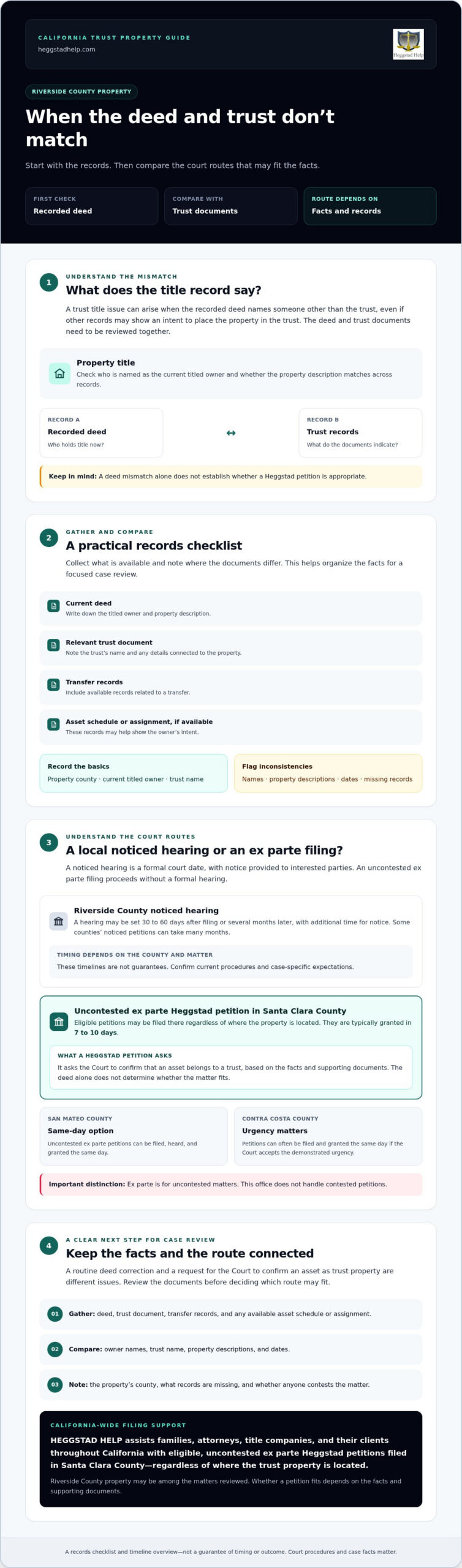
The recorded title may list an individual as owner instead of the trust. For example, a California home might still be titled in a deceased owner’s name even though trust documents refer to the home or show an intention to include it. This difference can raise questions for the successor trustee. A Heggstad petition asks the court to confirm the property’s trust status; the outcome depends on the circumstances and the court’s decision.

A title issue exists when recorded ownership does not show the trust, and a Heggstad petition asks the court to confirm the property’s trust status.

Who may need information about a property title issue?

Successor trustees and families may need to understand why the deed and trust records do not match. Estate-planning attorneys, title companies, and realtors may also encounter a title issue while reviewing property records or a proposed transaction. If you are considering a Heggstad petition for real estate California, start by gathering the recorded title information and the relevant trust documents. Note what each says about ownership and the property. This gives you a clear starting point for a consultation without assuming how the court will rule.

How a Heggstad Petition Relates to Real Property Under Probate Code Section 850

A Heggstad petition under Probate Code Section 850 asks the court to confirm real property as trust property. The request does not automatically change title or guarantee that the court will grant it. Its purpose is to ask the court to decide the property’s status in relation to the trust.

What does Probate Code Section 850 contribute?

Probate Code Section 850 is the basis for the Heggstad petition filing service described here. In plain English, the petition asks the court to decide whether the property should be treated as belonging to the trust, even though the recorded title may not show the trust as owner.

The court considers the petition and the circumstances. To discuss a specific matter, book a consultation and prepare the relevant property and trust information. The Heggstad petition filing information provides further context about the service.

Why does the petition’s purpose matter to title?

A title record shows ownership as recorded. A petition asks the court to determine whether the property is trust property. These are related but distinct steps: requesting an order does not guarantee that the title record will be corrected or that the court will rule a particular way.

A Heggstad petition asks the court to determine whether real property is trust property; it does not guarantee that result.

For an uncontested petition, the service uses an ex parte process, meaning the request is handled without a formal hearing. This describes the filing approach, not a guaranteed decision. To discuss how a Heggstad petition for real estate California may apply to your circumstances, book a consultation with HEGGSTAD HELP.
Heggstad Petition for Real Estate in California: Filing, Timing, and Next Steps

Where California Real Estate Heggstad Petitions Are Filed and How Long They May Take

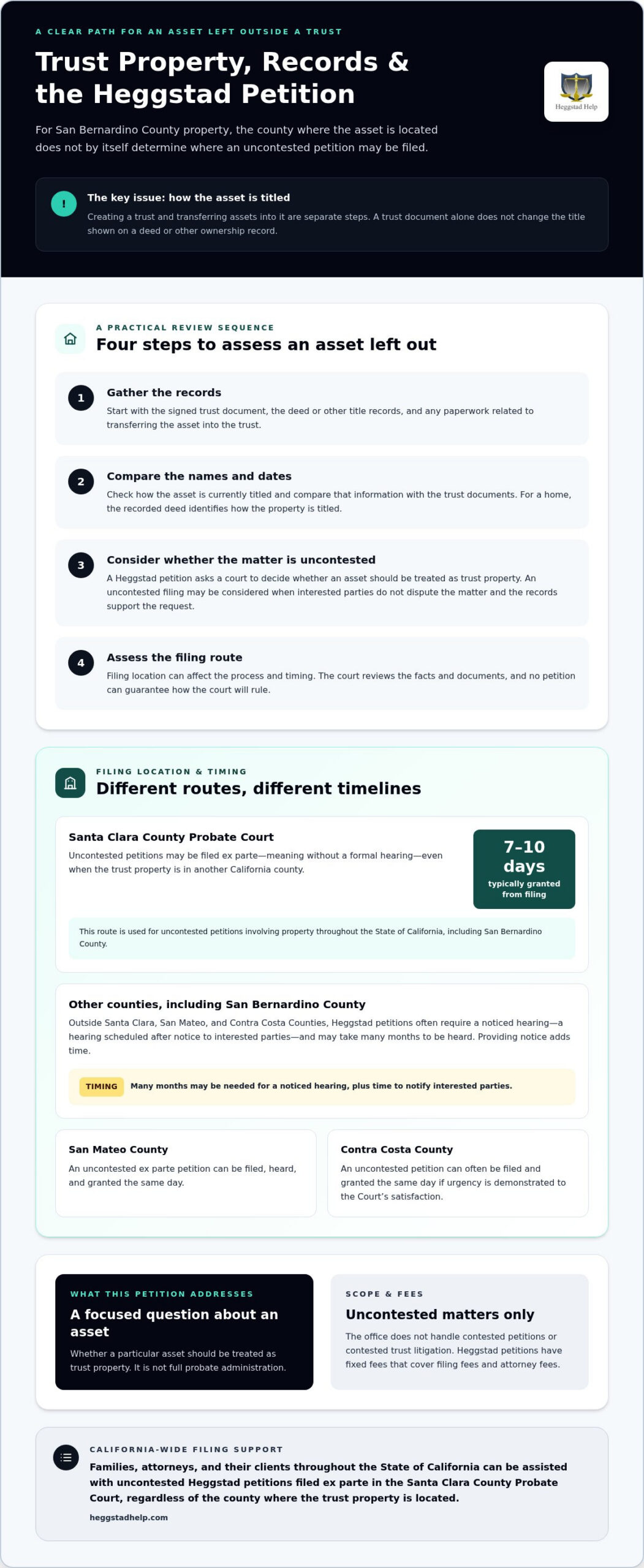
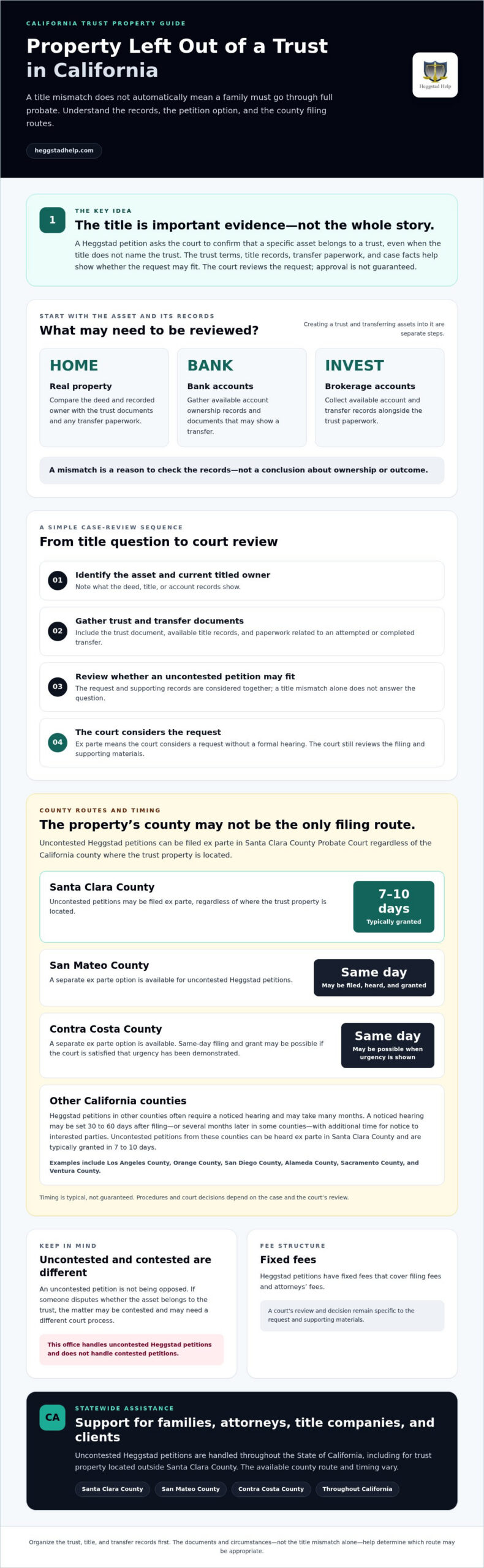
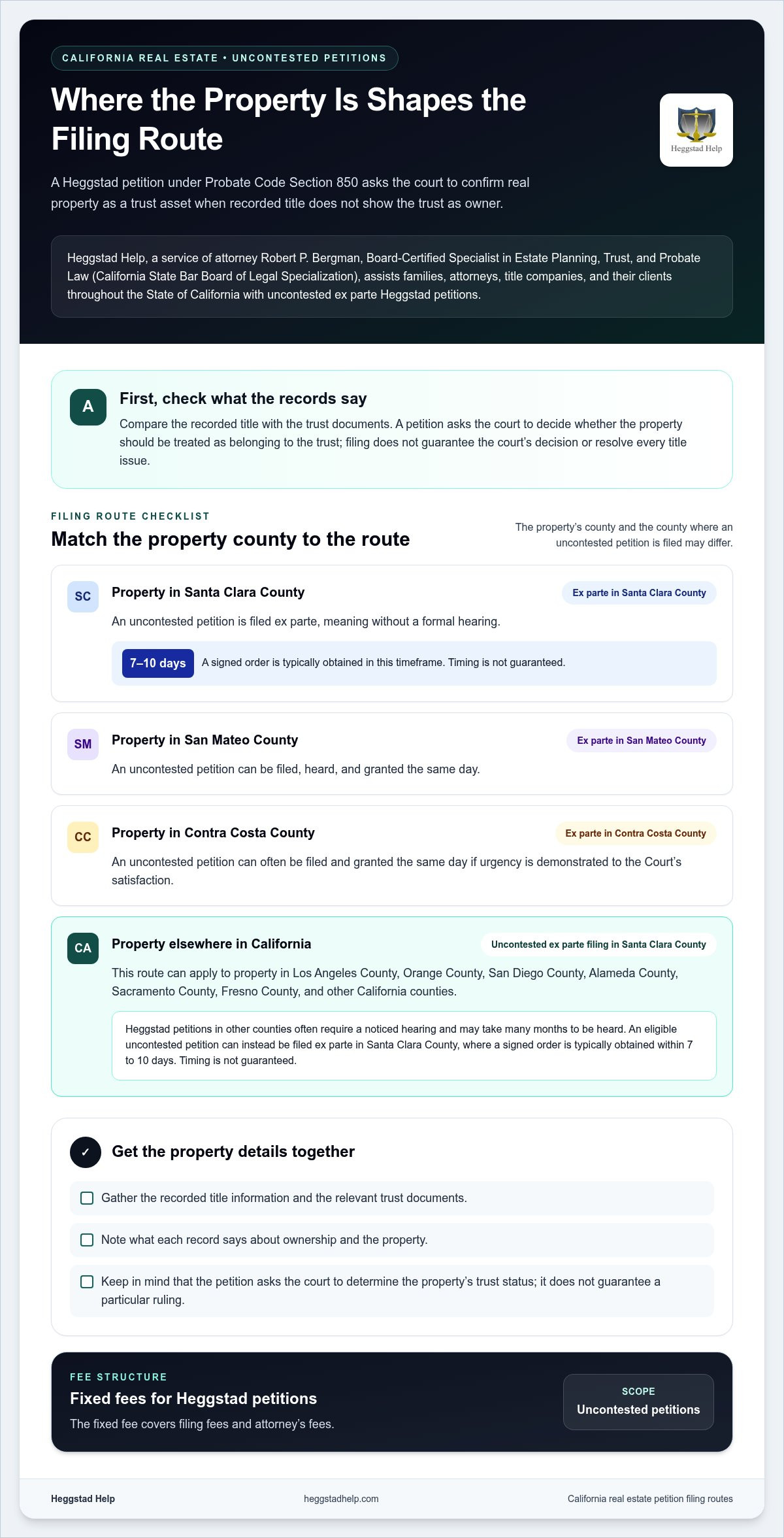
The county where the property is located and the county where an uncontested Heggstad petition is filed may differ. The route depends on whether the property is in Santa Clara, San Mateo, or Contra Costa County, or elsewhere in California.

Property location Filing route Timing to understand
Santa Clara County Uncontested ex parte petition filed in Santa Clara County A signed court order is typically obtained within 7 to 10 days. This is not a guarantee.
San Mateo County Uncontested ex parte petition filed in San Mateo County Same-day filing is possible. This does not establish when an order will issue.
Contra Costa County Uncontested ex parte petition filed in Contra Costa County Same-day filing may be possible if urgency is demonstrated to the Court’s satisfaction. This does not establish when an order will issue.
Other California counties Uncontested ex parte petition filed in Santa Clara County The filing venue is Santa Clara County. A signed order is typically obtained within 7 to 10 days there, but timing is not guaranteed.

What is the stated route for property in other California counties?

For property in counties other than Santa Clara, San Mateo, and Contra Costa, the attorney files an uncontested petition in Santa Clara County. This route applies to property in Los Angeles, Orange, San Diego, Alameda, Sacramento, Fresno, and other California counties. These are property locations, not separate filing venues for this service. In many counties, Heggstad petitions may require a noticed hearing and take many months to be heard. An eligible uncontested petition can instead be filed ex parte in Santa Clara County, where a signed order is typically obtained within 7 to 10 days.

How should readers understand the timing?

The 7 to 10 day timeframe refers to when a signed court order is typically obtained in Santa Clara County. It is not a guaranteed result. In San Mateo County, same-day filing is possible. In Contra Costa County, same-day filing may be possible if urgency is demonstrated to the Court’s satisfaction. Filing on the same day does not mean an order is guaranteed that day.

If you are coordinating a property matter, note the property’s county and gather the title and trust information. Book a consultation about your Heggstad petition to discuss the filing route and next steps.

How to Prepare for a California Real Estate Heggstad Petition Consultation

Prepare for a conversation about the property title issue by following the consultation steps in order: book a consultation, download the worksheets, complete them, and return them by email or fax.

What should readers expect from the consultation process?

Book a short Zoom or in-office consultation through the consultation booking page. After booking, download and complete the Trust Petition Consultation Worksheets. Return the completed worksheets by email to rpb@lawbob.com or by fax to 408-415-4591.

Before completing the worksheets, gather the available property title information and relevant trust documents. Fill in the worksheets as fully as you can. They provide a starting point for discussing the property and trust during the consultation.

When does the stated fixed fee apply?

The fixed fee of $6,500.00, effective January 1, 2026, applies only to a clean ex parte Heggstad petition. A clean petition means: (1) no interested parties object, (2) all interested parties waive notice of a hearing, and (3) all interested parties consent to the petition. The fixed fee does not apply to a petition that does not meet all three conditions.

Additional fees may apply. See the Fees and Costs page for details. If you are preparing for a Heggstad petition for real estate California, complete the worksheets and return them by email or fax before your consultation. This gives you a clear next step and helps focus the discussion on the property and trust information.

Take the Next Step With Clear Property Information

To move a title concern forward, gather the property and trust information you have and arrange a consultation. Be ready to explain what the recorded title shows and identify the question you need addressed. The consultation can cover whether a Heggstad petition for real estate California may fit the circumstances.

Attorney Robert P. Bergman is a Board-Certified Specialist in Estate Planning, Trust and Probate Law and has practiced in Santa Clara County since 1980. A consultation provides an opportunity to discuss the property issue and the petition process, but it cannot promise what a court will decide.

Heggstad Help assists families, attorneys, title companies, and their clients throughout California, including the San Francisco Bay Area, Northern California, Southern California, the Central Valley, San Diego, Sacramento, Fresno, Bakersfield, Greater Los Angeles, Orange County, Riverside County, and San Bernardino County. Book a Heggstad trust petition consultation, then download, complete, and return the worksheets by email or fax before your appointment.

Frequently Asked Questions

Can a Heggstad petition concern assets other than real estate?

Yes. The service can address other trust assets as well as real property, though this article focuses on California real estate. If a family discovers that another asset may not be titled in the trust, the petition’s suitability depends on the asset and circumstances. A court order is not guaranteed. Book a consultation and gather the relevant asset and trust information for discussion.

Can a Heggstad petition be pursued before the trustmaker dies?

Trust asset transfers may be facilitated both before and after a decedent’s death. The appropriate petition approach depends on the asset, trust documents, timing, and other circumstances. If the trustmaker is living, gather the relevant trust and asset information, then book a consultation to discuss the matter. This general information is not legal advice for a specific situation.

Does filing a Heggstad petition guarantee a court order?

No. Filing a Heggstad petition does not guarantee that the court will issue the requested order. The court decides the matter, so the process is not automatic or instant. For a focused discussion, note what the title record says, gather the trust information you have, book a consultation, and complete and return the required worksheets by email or fax.

Can attorneys and title companies use HEGGSTAD HELP?

Yes. Families, attorneys and their clients, title companies, realtors, and others throughout California can use the service for uncontested ex parte Heggstad petitions involving trust assets. The service reaches the San Francisco Bay Area, Northern and Southern California, the Central Valley, San Diego, Sacramento, Fresno, Bakersfield, Greater Los Angeles, Orange County, Riverside County, and San Bernardino County. Professionals can book a consultation, then download, complete, and return the worksheets by email or fax.

Robert P. Bergman, Attorney at Law

Article by

Robert P. Bergman, Attorney at Law

Attorney Robert P. Bergman ("Bob Bergman") has been a Board-Certified Specialist in Estate Planning, Trust and Probate Law since 2011, as certified by the California State Bar Board of Legal Specialization. For several years, Bob has assisted families and the clients of other attorneys with obtaining court orders through Heggstad petitions to avoid the time and expense of Probate administration. Bob is friendly, very approachable, and believes in explaining complex legal topics in clear ordinary language so that his clients understand exactly what they're doing and why they're doing it.
Bob is often able to assist clients who are in other counties than his home county of Santa Clara through his approach to Heggstad petitions.

Disclaimer

This article is for informational purposes only. Nothing in this article is intended to replace legal advice from a competent attorney or be considered legal guidance for anybody's specific legal situation. Nobody should rely on information in this article in making legal decisions without such consultation.

Ex Parte Relief for Trust Funding in California: When a Heggstad Petition May Help

An uncontested Heggstad petition may help when an asset was meant to be part of a trust but its title was never changed. The petition asks the court…

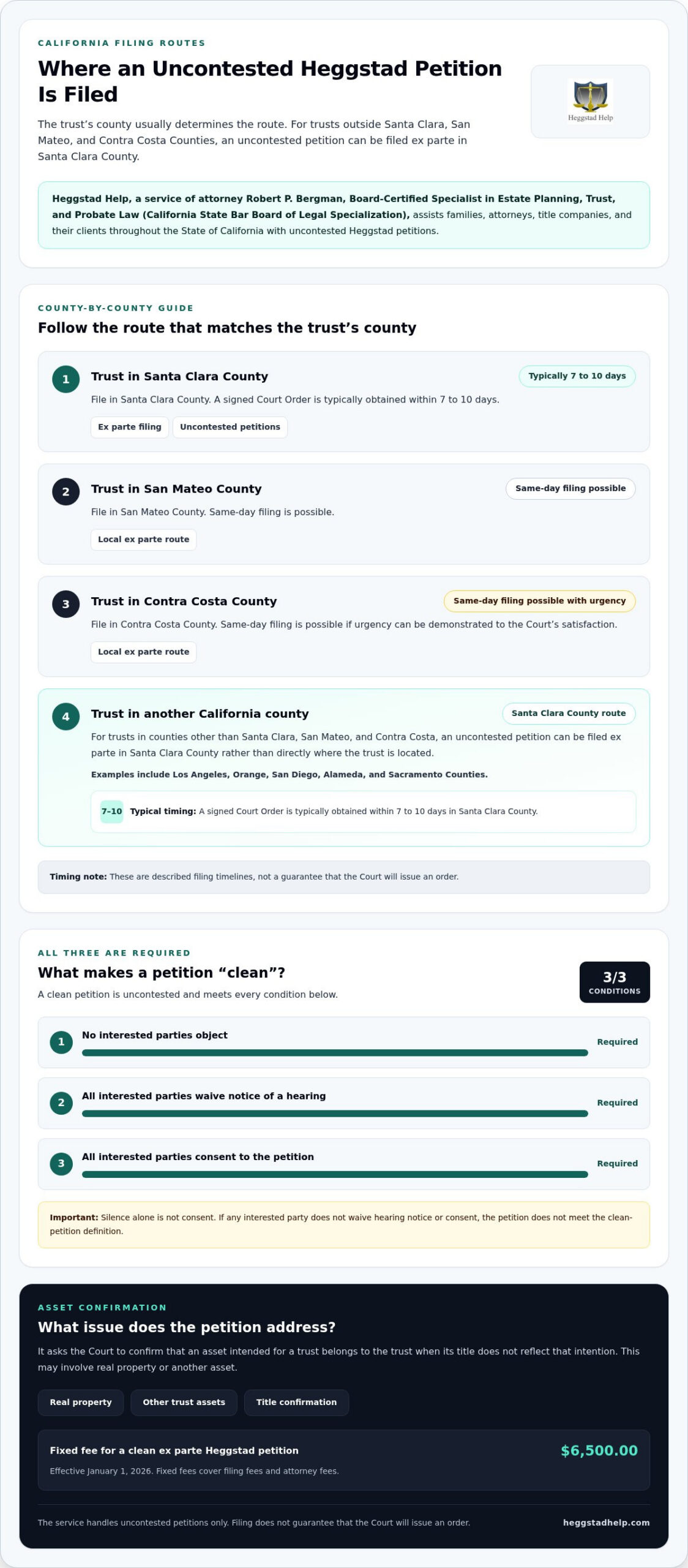
An uncontested Heggstad petition may help when an asset was meant to be part of a trust but its title was never changed. The petition asks the court to confirm the asset as trust property without a formal hearing. For people searching for “ex parte relief for trust funding California,” the key requirement is that all interested parties agree, waive notice of a hearing, and raise no objection.

Heggstad Help, a service of attorney Robert P. Bergman, Board-Certified Specialist in Estate Planning, Trust, and Probate Law (California State Bar Board of Legal Specialization), assists families, attorneys, and their clients throughout the State of California. Uncontested petitions for trusts in counties other than Santa Clara, San Mateo, and Contra Costa are filed in Santa Clara County. A signed Court Order is typically obtained within 7 to 10 days there. Same-day filing is possible in San Mateo County and, if urgency can be demonstrated, in Contra Costa County.

For a clean ex parte Heggstad petition, the fixed fee is $6,500.00, effective January 1, 2026. This article explains what “clean” means, how county filing routes differ, what to prepare for a consultation, and where to find information about additional fees.

Key Takeaways

  • Ex parte relief for trust funding in California may provide a court route to confirm an asset as trust property without a formal noticed hearing.
  • A petition is clean only when no interested parties object, all interested parties waive notice of a hearing, and all interested parties consent to the petition.
  • Petitions for trusts in counties other than Santa Clara, San Mateo, and Contra Costa are filed in Santa Clara County, not directly in the county where the trust is located.
  • To start a consultation, book an appointment, download the Trust Petition Consultation Worksheets, and return them by email or fax.

What Does Ex Parte Relief for Trust Funding in California Mean?

Ex parte relief for trust funding in California is a court process that may confirm an asset as belonging to a trust without a formal noticed hearing. Heggstad Help handles uncontested petitions under Probate Code Section 850 to address trust asset confirmation and title correction. Filing a petition does not guarantee that the court will issue an order.

The service addresses a specific trust-funding issue: an asset was intended for a trust, but the title may not reflect that intention. The petition asks the court to confirm the asset as trust property. This can apply to real property or other assets.

The broader discussion of Ex parte (legal term) highlights the importance of procedural fairness. In this service, the interested parties’ consent and waiver of hearing notice are central to the process. The court considers the petition, and its decision is not assured.

How Is Trust-Funding Relief Different From Emergency Trust Litigation?

This service is for uncontested asset confirmation. It is not an emergency process for allegations that a trustee has acted improperly or for requests to protect assets from immediate harm. The petition addresses whether an asset should be confirmed as trust property, with the required agreement and waiver of hearing notice from interested parties.

For more context, the Heggstad petition filing guide explains the petition’s purpose. To prepare for a consultation, gather the trust documents and records related to the asset and its title. These materials help frame the trust-funding issue for discussion with the attorney.

Who Qualifies for a Clean Ex Parte Heggstad Petition?

The ex parte process and its fixed fee apply only to a clean petition. A petition is clean only if it meets all three requirements below. The absence of a formal hearing does not remove the need for agreement and waived hearing notice.

What Does Clean Mean for This Petition Service?

  1. No interested parties object.
  2. All interested parties waive notice of a hearing.
  3. All interested parties consent to the petition.

Each condition matters. If everyone agrees about the asset but one interested party does not waive notice of a hearing, the petition does not meet the clean-petition definition. Silence alone is not the same as consent. Heggstad Help handles uncontested petitions only, and a court order is not guaranteed.

Which Trust-Funding Situations Does the Service Address?

The petition seeks court confirmation that real property or another asset belongs to a trust when ownership needs to be confirmed. Successor trustees, family members, attorneys, and title professionals may be involved when an asset was not properly titled in the trust. The service focuses on confirming trust property.

For background on the provision named for this service, the Probate Code Section 850 guide provides more context about Heggstad petitions. The California Courts also publish California Rules of Court on Trust Funding, including a rule concerning trusts funded by court order. That general court rule does not predict how a specific petition will be decided.

Successor trustees, family members, attorneys, and title professionals considering an uncontested trust-funding petition can review Heggstad Help’s petition services.

Where Is an Ex Parte Trust-Funding Petition Filed in California?

The filing route depends on the county. Uncontested Heggstad petitions involving trusts in counties other than Santa Clara, San Mateo, and Contra Costa are filed ex parte in Santa Clara County, rather than directly in the county where the trust is located. This route can serve families, attorneys, title companies, and their clients throughout the State of California.

County Filing route Typical timing
Santa Clara File in Santa Clara County A signed Court Order is typically obtained within 7 to 10 days.
San Mateo File in San Mateo County Same-day filing is possible.
Contra Costa File in Contra Costa County Same-day filing is possible if urgency can be demonstrated to the Court’s satisfaction.
Other California counties File in Santa Clara County Use the Santa Clara County filing route.

What Timing Applies in Santa Clara, San Mateo, and Contra Costa Counties?

In Santa Clara County, a signed Court Order is typically obtained within 7 to 10 days. Same-day filing is possible in San Mateo County. In Contra Costa County, same-day filing is possible if urgency can be demonstrated to the Court’s satisfaction. These timelines describe the filing process and do not guarantee a court order.

What Happens When the Trust Is Located in Another California County?

For example, an uncontested petition involving a trust in Los Angeles, Orange, San Diego, Alameda, or Sacramento County can be filed ex parte in Santa Clara County. In counties other than Santa Clara, San Mateo, and Contra Costa, Heggstad petitions often require a noticed hearing and may take many months to be heard. The Santa Clara County route offers an ex parte process for uncontested petitions from those counties, with signed Court Orders typically obtained within 7 to 10 days. For more about the Los Angeles County context, the Heggstad petition filing guide explains the service.

Heggstad Help assists families, attorneys, title companies, and their clients throughout California, including Los Angeles County, Orange County, San Bernardino County, San Diego County, Riverside County, Santa Clara County, Alameda County, San Francisco County, Marin County, Ventura County, Santa Cruz County, Sacramento County, Placer County, Santa Barbara County, San Joaquin County, Fresno County, Solano County, San Luis Obispo County, and Monterey County.

Ex Parte Relief for Trust Funding in California: When a Heggstad Petition May Help

How Do You Start an Ex Parte Heggstad Petition With Heggstad Help?

To begin, book a short Zoom or in-office consultation through the consultation booking link. After booking, download and complete the Trust Petition Consultation Worksheets, then return them by email or fax. This process gives the attorney information about the trust and asset before discussing the petition and next steps.

What Are the Consultation Steps?

  1. Book a short Zoom or in-office consultation through the consultation booking link.
  2. After booking, download and complete the Trust Petition Consultation Worksheets. Gather the trust and asset information requested so the consultation can focus on the matter.
  3. Return the completed worksheets by email to rpb@lawbob.com or by fax to 408-415-4591.

Before the consultation, organize the available trust documents and records about the asset’s current title. This gives you a practical starting point for discussing the filing route and the service process.

What Should You Expect From the Fee and Service Scope?

Effective January 1, 2026, the fixed fee for a clean ex parte Heggstad petition is $6,500.00. A petition is clean only when no interested parties object, all interested parties waive notice of a hearing, and all interested parties consent to the petition. Additional fees may apply; see the Fees and Costs page for information about fees beyond the fixed fee.

The service focuses on Heggstad petitions for trust asset confirmation and title correction. You can review the Heggstad petition services while preparing for the consultation.

Take the Next Step Toward Resolving a Trust-Funding Issue

When an asset’s title does not match the trust, families and professionals may need to clarify how to address the trust-funding issue. If you are considering ex parte relief for trust funding in California, prepare the available trust and title records and identify whether interested parties agree to the petition. Those details can help make a consultation more focused.

Heggstad Help is led by a Board-Certified Specialist in Estate Planning, Trust and Probate Law and assists families, attorneys, and their clients throughout the State of California. For petitions filed in Santa Clara County, signed Court Orders are typically obtained within 7 to 10 days. The court makes the decision on each petition.

Book a Heggstad trust petition consultation to discuss the asset, the available records, and the appropriate filing route.

Frequently Asked Questions

Can a Heggstad petition address assets other than real estate?

Yes. The service can seek confirmation of real property and other assets as trust property. If an asset’s title records do not clearly show the trust as owner, gather those records and the relevant trust documents for the consultation. The phrase “ex parte relief for trust funding California” describes the service focus, not a conclusion that a particular asset qualifies or that a court will grant a petition.

Does a Heggstad petition change the terms of a trust?

No. A Heggstad petition concerns whether an asset should be treated as trust property, rather than asking to rewrite the trust’s terms. For example, a question about who receives property under the trust differs from a question about whether a particular asset belongs to it. The petition service focuses on the latter issue.

Is a court order guaranteed after filing an ex parte petition?

No. Filing a petition does not guarantee that the court will issue the requested order. The court makes that decision, and Heggstad Help handles uncontested petitions only. A consultation can explain the filing service and discuss the available information about the asset, but it cannot promise a result.

Can attorneys and title companies use Heggstad Help for a trust-funding issue?

Yes. Attorneys, title companies, realtors, families, and clients can use the service for an uncontested trust-funding issue. For example, a title professional who encounters a possible mismatch between property records and trust ownership can participate with the client and attorney. The service assists throughout California, including the San Francisco Bay Area, Northern California, Southern California, the Central Valley, San Diego, Sacramento, Fresno, Bakersfield, Greater Los Angeles, Orange County, Riverside County, and San Bernardino County.

Robert P. Bergman, Attorney at Law

Article by

Robert P. Bergman, Attorney at Law

Attorney Robert P. Bergman ("Bob Bergman") has been a Board-Certified Specialist in Estate Planning, Trust and Probate Law since 2011, as certified by the California State Bar Board of Legal Specialization. For several years, Bob has assisted families and the clients of other attorneys with obtaining court orders through Heggstad petitions to avoid the time and expense of Probate administration. Bob is friendly, very approachable, and believes in explaining complex legal topics in clear ordinary language so that his clients understand exactly what they're doing and why they're doing it.
Bob is often able to assist clients who are in other counties than his home county of Santa Clara through his approach to Heggstad petitions.

Disclaimer

This article is for informational purposes only. Nothing in this article is intended to replace legal advice from a competent attorney or be considered legal guidance for anybody's specific legal situation. Nobody should rely on information in this article in making legal decisions without such consultation.

Fixing a Trust With No Schedule of Assets in California

A missing Schedule of Assets does not, by itself, establish that a California trust cannot include a particular asset or that probate is unavoidable….

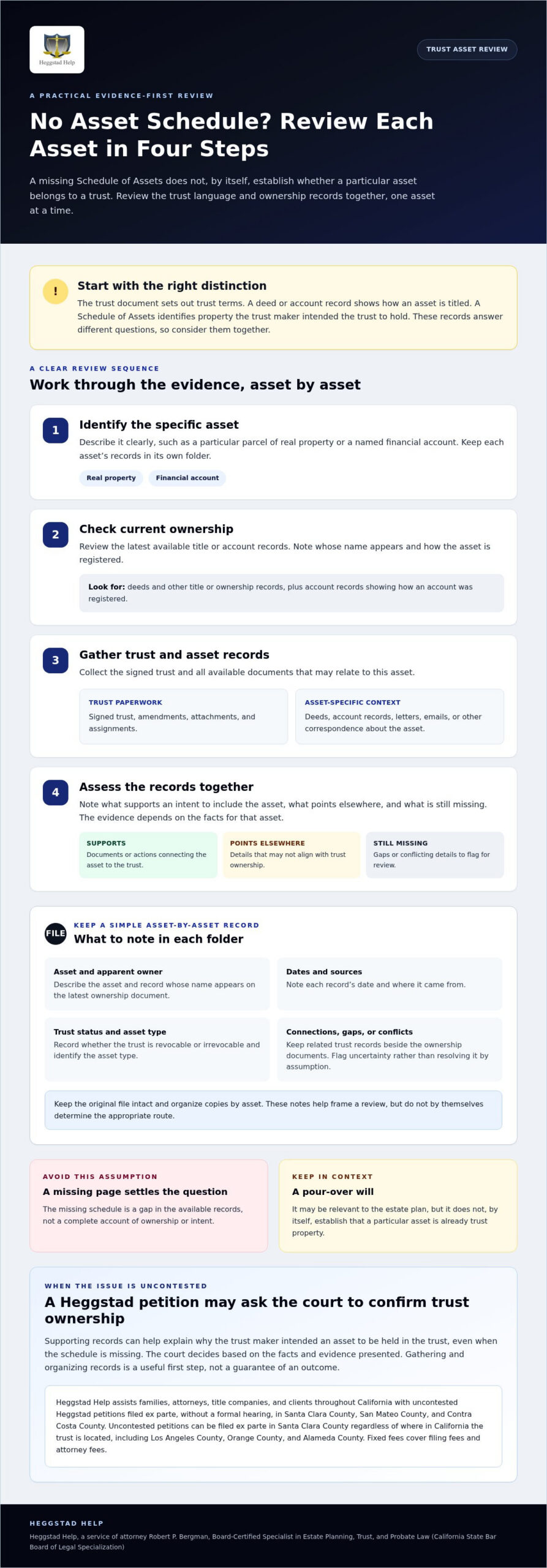
A missing Schedule of Assets does not, by itself, establish that a California trust cannot include a particular asset or that probate is unavoidable. To start fixing a trust with no schedule of assets California families should identify the asset, review the trust and ownership records, and assess whether the documents show the trust maker intended the asset to belong to the trust. When the issue is uncontested, a Heggstad petition may provide a way to ask the court to confirm trust ownership.

Gather the signed trust and any amendments, deeds or account records, and other documents that show how the asset was titled. Organizing these records by asset can make it easier to see what the paperwork supports and what information is missing.

Heggstad Help, a service of attorney Robert P. Bergman, Board-Certified Specialist in Estate Planning, Trust, and Probate Law (California State Bar Board of Legal Specialization), assists families, attorneys, and their clients throughout California with uncontested ex parte Heggstad petitions. These petitions are filed without a formal hearing in Santa Clara County, regardless of the county where the trust is located. This article explains what a missing schedule does and does not establish, which records to organize, and how the petition process may fit.

Key Takeaways

  • A missing Schedule of Assets alone does not establish whether a particular asset was intended to belong to the trust.
  • When fixing a trust with no schedule of assets California, gather the trust and amendments, ownership records, and documents that may show the trust maker’s intent.
  • Review each asset separately: identify it, confirm how it is currently titled, and note its type and the trust’s status.
  • For an uncontested issue, a Heggstad petition may be a path forward. Uncontested petitions can be filed ex parte in Santa Clara County regardless of where in California the trust is located. Fixed fees cover filing fees and attorney fees.

What Does It Mean to Have a California Trust With No Schedule of Assets?

A missing Schedule of Assets does not, by itself, show what happened to a particular asset. The trust may contain language about the trust maker’s intentions, while ownership records show who legally held the asset. These documents answer different questions, so review them together.

A Schedule of Assets is a record identifying property the trust maker intended the trust to hold. It is separate from the trust document, which sets out the trust’s terms, and from ownership records, such as a deed or account statement, which show how an asset is titled. These records should not be treated as interchangeable. To begin fixing a trust with no schedule of assets California, identify the specific asset and review its records alongside the trust paperwork. The general concept of trust law can provide background, but it does not determine ownership of a particular California asset.

Does the missing schedule mean the trust cannot be used?

No. The missing schedule is a gap in the available records, not a complete account of ownership or intent. Read the trust wording and any amendments, attachments, or asset-specific documents that remain. For example, a deed or written assignment may help explain the trust maker’s actions even when no schedule can be found. Keep the documents together, and avoid assuming that one missing page settles the issue.

Why can an asset appear to be outside the trust?

An asset may appear to be outside the trust because the file is incomplete or the available documents do not reflect every step the trust maker took. A property record, account document, or written instruction may provide context that the missing schedule cannot. Note what is known about the asset and where each record came from. For a broader overview of possible recovery steps, see the California trust asset recovery guide. The relevant evidence depends on the facts for each asset.

What Records Can Show Intent When a California Trust Has No Asset Schedule?

Evidence is asset-specific, and a missing Schedule of Assets is only one part of the file. Review the trust maker’s documents and actions alongside records showing who owned the particular asset and how it was titled. No single paper automatically establishes the result; the records need to be considered together.

When fixing a trust with no schedule of assets California, organize the file around each asset rather than treating the trust papers as a complete ownership record. A deed relates to real property, while account records may show how a financial account was held. Correspondence or a written assignment may add context about the trust maker’s intent.

Which documents should a family or successor trustee gather first?

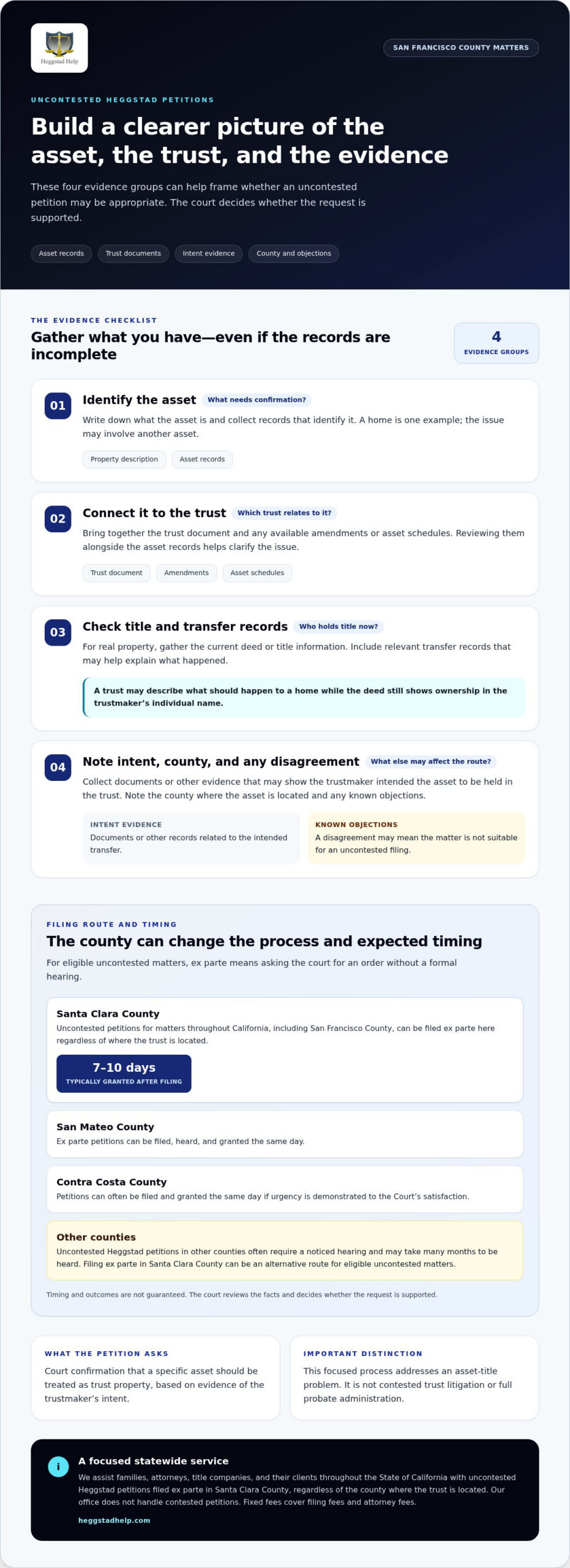
Start with the signed trust and collect every available amendment, attachment, and assignment. Then gather documents tied to the asset under review, such as:

  • Deeds and other title or ownership records
  • Account records showing how an account was registered
  • Letters, emails, or other correspondence about the asset

Sort copies by asset, and note each record’s date and source. Keep the original file intact. Flag gaps or conflicting details rather than trying to resolve them by assumption.

How does a Heggstad petition relate to the evidence?

A Heggstad petition asks a court to confirm that a specific asset belongs to a trust. Supporting records help explain why the trust maker intended the asset to be held in the trust, even if the schedule is missing. The court decides based on the facts and evidence presented, so gathering and organizing records is a useful first step, not a guarantee of an outcome.

If you are organizing records for an uncontested petition, Heggstad petition filing information explains the focused process.

Fixing a Trust With No Schedule of Assets in California

How Should You Review a Trust With No Schedule of Assets Before Choosing a Route?

Review the issue one asset at a time before deciding what to do. A pour-over will, a will designed to direct certain property into a trust, may be relevant to the estate plan. It does not, by itself, establish that a particular asset is already trust property.

  1. Identify the asset. Describe it clearly, such as a specific parcel of real property or a named financial account.
  2. Establish current ownership. Check the latest available title or account records and note whose name appears.
  3. Gather trust records. Collect the signed trust, amendments, attachments, assignments, and records tied to that asset.
  4. Assess the evidence together. Note what supports an intent to include the asset, what points elsewhere, and what information is missing.

How can you organize the review asset by asset?

Create a separate folder for each asset, keeping ownership documents beside the trust records that may relate to it. Write down the apparent owner, relevant dates, and any document or action that connects the asset to the trust. Also record whether the trust is revocable or irrevocable and identify the asset type. These details help frame legal review; they do not, by themselves, determine the appropriate route.

When should the records be assessed for a Heggstad petition?

A Heggstad petition asks a court to confirm that an asset belongs to a trust. It may be considered when the available evidence supports asking the court to confirm trust ownership and the request is uncontested. The outcome depends on the specific facts. For broader context, the Heggstad petition filing guide discusses the process.

Heggstad Help assists families, attorneys, and their clients throughout California with uncontested petitions filed in Santa Clara County, regardless of where the trust is located. Explore help with an uncontested Heggstad petition.

What California Heggstad Petition Path May Fit an Uncontested Trust Asset Issue?

A Heggstad petition may fit when records support asking a court to confirm that an asset belongs to a trust and the request is uncontested. Heggstad Help assists families, attorneys, and their clients throughout the State of California by filing uncontested ex parte petitions, without a formal hearing, in Santa Clara County, San Mateo County, and Contra Costa County.

How do ex parte filing options differ by California county?

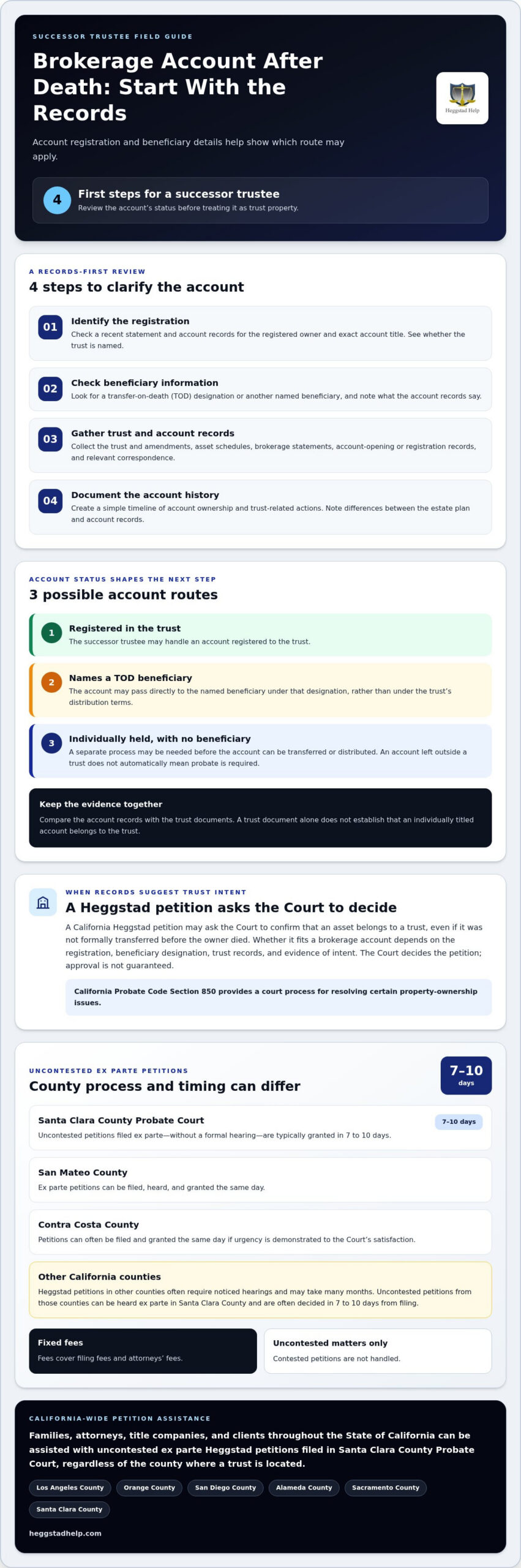
In Santa Clara County, uncontested ex parte Heggstad petitions are typically granted within 7 to 10 days of filing. In San Mateo County, petitions can be filed, heard, and granted the same day. In Contra Costa County, petitions can often be filed and granted the same day if the Court is satisfied that urgency has been demonstrated. These timeframes describe typical or conditional outcomes, not guaranteed results.

What if the trust is located in another California county?

In counties such as Los Angeles, Orange, San Diego, Alameda, or Sacramento, Heggstad petitions often require a noticed hearing, meaning a hearing scheduled with advance notice to interested parties. These hearings can take many months to be heard. An uncontested petition from any California county can instead be filed ex parte in Santa Clara County and is typically granted within 7 to 10 days of filing. Heggstad Help assists with these statewide filings, including for families and attorneys handling trust assets in the San Francisco Bay Area, Northern California, Southern California, the Central Valley, San Diego, Sacramento, Fresno, Bakersfield, Greater Los Angeles, Orange County, Riverside County, and San Bernardino County.

All Heggstad petitions have fixed fees covering filing fees and attorney fees. If you are fixing a trust with no schedule of assets California, organize the asset-specific records to support an uncontested petition. Start with an uncontested Heggstad petition.

Take the Next Step With a Clear Record

A missing schedule can leave families unsure where to begin, but you can start by organizing the file. Make a short inventory of each asset, gather the records connected to it, and note any gaps or inconsistencies. That preparation makes a review of fixing a trust with no schedule of assets California more focused and helps clarify whether an uncontested Heggstad petition may fit.

Robert P. Bergman is Board-Certified in Estate Planning, Trust, and Probate Law by the California State Bar Board of Legal Specialization. Heggstad Help assists families, attorneys, and their clients throughout the State of California with uncontested ex parte petitions filed in Santa Clara County, San Mateo County, and Contra Costa County. Fixed fees cover filing fees and attorney fees.

Bring together the asset-specific records and take the next step toward resolving the title issue. Start an uncontested Heggstad petition.

Frequently Asked Questions

Does a trust need a Schedule of Assets to be valid in California?

No. The absence of a Schedule of Assets alone does not establish that a trust is invalid. The trust instrument and the circumstances of its creation still matter, while ownership of a particular asset is a separate question. If you are fixing a trust with no schedule of assets California, start by reviewing the signed trust and available attachments rather than treating a missing list as a decision about validity or ownership.

Can a pour-over will transfer an asset into a trust without a Schedule of Assets?

A pour-over will may direct property that passes under the will to the trust after the will-maker’s death, but it does not establish that a specific asset was already trust property. The will’s terms and the asset’s title records serve different purposes. Review them separately, and note whether the asset is addressed by name or falls within the will’s broader language.

Can a Heggstad petition address assets other than real property?

Yes. Heggstad petitions may address real property and other assets, although the relevant records and legal questions can vary by asset type. For example, records about an account may differ from documents concerning a home. Identify the particular asset and gather its ownership history before assessing whether a petition may fit. The court’s decision depends on the specific facts and evidence.

Are Heggstad petitions only filed in the county where the trust is located?

No. An uncontested Heggstad petition may be filed ex parte in Santa Clara County regardless of where in California the trust is located. Heggstad Help assists families, attorneys, and their clients statewide, including in the San Francisco Bay Area, Southern California, and the Central Valley. This filing route can serve trust matters involving Los Angeles County, Orange County, San Diego County, Alameda County, and Sacramento County, among others.

Robert P. Bergman, Attorney at Law

Article by

Robert P. Bergman, Attorney at Law

Attorney Robert P. Bergman ("Bob Bergman") has been a Board-Certified Specialist in Estate Planning, Trust and Probate Law since 2011, as certified by the California State Bar Board of Legal Specialization. For several years, Bob has assisted families and the clients of other attorneys with obtaining court orders through Heggstad petitions to avoid the time and expense of Probate administration. Bob is friendly, very approachable, and believes in explaining complex legal topics in clear ordinary language so that his clients understand exactly what they're doing and why they're doing it.
Bob is often able to assist clients who are in other counties than his home county of Santa Clara through his approach to Heggstad petitions.

Disclaimer

This article is for informational purposes only. Nothing in this article is intended to replace legal advice from a competent attorney or be considered legal guidance for anybody's specific legal situation. Nobody should rely on information in this article in making legal decisions without such consultation.
How to Fix Trust Title Errors in California

What if the deed isn’t wrong, but the property was never transferred into the trust? To understand how to fix trust title errors, compare the…

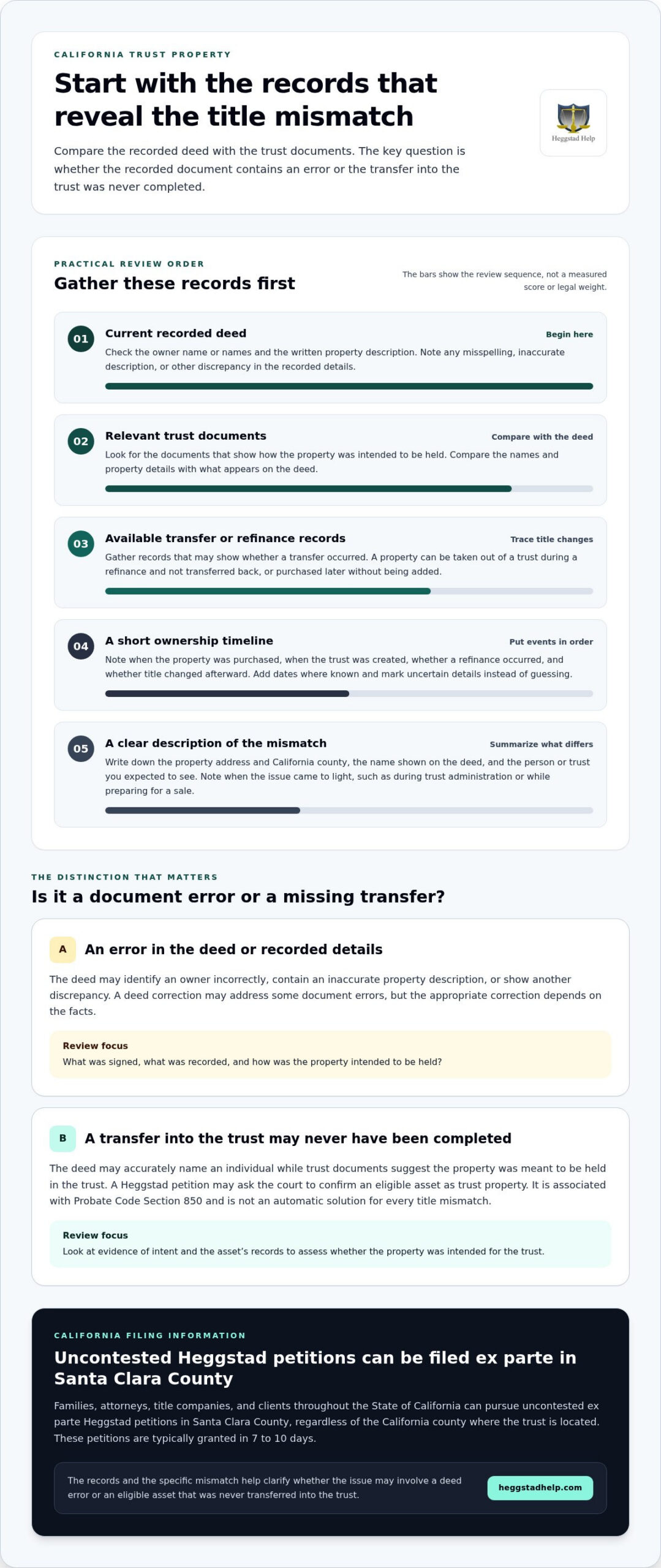
What if the deed isn’t wrong, but the property was never transferred into the trust? To understand how to fix trust title errors, compare the recorded deed with the trust documents and determine whether the deed itself contains an error or the transfer was never completed. A deed correction may address some document errors; an eligible asset intended for the trust but never titled in it may require a Heggstad petition.

This guide explains which records to gather, how to distinguish between these situations, and what California options may help resolve the issue before it delays trust administration or a sale. Heggstad Help, a service of attorney Robert P. Bergman, Board-Certified Specialist in Estate Planning, Trust, and Probate Law (California State Bar Board of Legal Specialization), assists families, attorneys, and their clients throughout the State of California with uncontested ex parte Heggstad petitions filed in Santa Clara County, regardless of where the trust is located. These petitions are typically granted in 7 to 10 days.

Key Takeaways

  • Compare the recorded ownership information with the trust documents to pinpoint where they differ.
  • How to fix trust title errors depends on whether the deed needs correction or a court may need to confirm an eligible asset as trust property.
  • Gather the current recorded deed, relevant trust documents, and available transfer records. Write down the specific mismatch.
  • Families, attorneys, title companies, and clients throughout California can pursue eligible uncontested Heggstad petitions through ex parte filing in Santa Clara County, regardless of where the trust is located.

What Kind of Trust Title Error Do You Have in California?

The right way to address a trust title problem depends on whether the recorded document contains an error or the property was never transferred into the trust. Title is the recorded information showing who owns the property. A mismatch does not automatically mean the entire trust is invalid.

Was the deed recorded incorrectly, or was the property left out?

Start by comparing the current recorded deed with the trust documents. A deed defect may involve an incorrect spelling of an owner’s name or a legal description, the written identification of the property, that does not accurately describe the parcel. These are issues with the deed or its recorded information, although the appropriate correction depends on the facts.

A different issue arises when the deed accurately names an individual, but the trust documents suggest the property was meant to be held in the trust. For example, the deed may still identify a person rather than the trust. In that situation, the question may not be how to correct a typo, but whether the property was ever transferred into the trust. Changing a document and asking a court to confirm an asset as trust property are different paths.

Why can a property and trust record stop matching?

A transfer can be overlooked when someone creates or updates a trust. A property may also be taken out of a trust during a refinance and not transferred back afterward, or purchased later without being added to the trust. These are trust-funding issues: assets may not have been legally placed in the trust as intended. A general overview of trust law can explain how trusts hold and manage assets, but it won’t establish how a particular property is titled.

To narrow down the problem, note the names and property description on the recorded deed, then compare them with the trust’s relevant documents and any transfer records you have. This comparison can help identify the type of issue before you consider a correction.

Can You Correct a Trust Title Error With a Deed or a Heggstad Petition?

How to fix trust title errors depends on what the records show. A deed correction may address an error in a recorded document, while a Heggstad petition may ask the court to confirm property as trust property. A deed error and an unfunded trust asset are not the same problem. The appropriate path depends on the ownership evidence and the specific mismatch.

When is the problem a deed or recording error?

A deed or recording issue appears within the document or its recorded details. The deed might identify an owner incorrectly, contain an inaccurate property description, or reflect another discrepancy. Not every issue can be fixed the same way. Review the recorded deed alongside the trust records and related transfer documents to understand what was signed, what was recorded, and how the property was intended to be held.

When might a Heggstad petition be relevant?

A Heggstad petition may be relevant if the property was intended for the trust but the ownership transfer was never completed. Rather than asking to correct a typo in a deed, the petition asks the court to confirm that an eligible asset belongs to the trust. This court process is associated with Probate Code Section 850. Evidence of intent and the asset’s records matter when evaluating whether this route fits. A petition is not an automatic solution for every title mismatch.

As a practical first step, put the current deed beside the trust document and any available transfer records. Note whether the issue is an inaccuracy in recorded information or a missing transfer into the trust. That distinction helps focus the review. For more information about Heggstad petitions, learn how this court process may apply to eligible trust assets.

What Records Should You Gather Before Addressing a California Trust Title Error?

To understand how to fix trust title errors, gather the documents that show how the property was titled and what the trust records say. A clear set of records and a short timeline can help identify the mismatch without requiring you to reach a legal conclusion on your own.

Which documents help clarify the ownership history?

Start with the current recorded deed, then collect the relevant trust documents and any available records of transfers or title changes. Compare the names and property description across them. Differences may point to a document discrepancy, a missing transfer, or another issue that needs closer review.

Next, arrange the known events in order. Note when the property was purchased, when the trust was created, whether a refinance occurred, and whether title changed afterward. Add dates where you have them, and mark anything uncertain rather than filling in gaps from memory.

How should you describe the mismatch clearly?

Write down the property address and California county, the name or names currently shown on the deed, and the name of the trust or person you expected to see. Include when the mismatch came to light, such as during trust administration or while preparing for a sale. This concise summary makes the records and the issue easier to follow.

  • Current recorded deed and relevant trust documents
  • Available transfer or refinance records
  • A timeline of purchase, trust creation, and later title changes
  • A short description of the difference between the records

If the records suggest the property was intended for the trust but left out, read more about Heggstad petition filing. If the owner has died, don’t assume that preparing a new deed alone resolves the ownership question. Learn about trust asset title correction for help addressing an eligible title issue.

How to Fix Trust Title Errors in California

How Can a Heggstad Petition Address Trust Title Errors Across California?

A Heggstad petition may help when an eligible asset was intended for a trust but wasn’t titled in it. Heggstad Help assists families, attorneys, title companies, and their clients throughout the State of California with uncontested petitions, including for property located in the San Francisco Bay Area, Northern California, Southern California, the Central Valley, San Diego, Sacramento, Fresno, Bakersfield, Greater Los Angeles, Orange County, Riverside County, and San Bernardino County.

How do filing options differ by California county?

Uncontested petitions filed ex parte, meaning without a formal hearing, in the Santa Clara County Probate Court are typically granted in 7 to 10 days. The trust or property may be elsewhere, including Los Angeles County, Orange County, San Diego County, Alameda County, or Sacramento County. Uncontested petitions from these and other California counties can often be filed ex parte in Santa Clara County, regardless of where the trust is located.

Ex parte petitions in San Mateo County can be filed, heard, and granted the same day. In Contra Costa County, petitions can often be filed and granted the same day if the court is satisfied that urgency has been demonstrated. In other counties, Heggstad petitions often require a noticed hearing, meaning interested parties receive notice and the matter is scheduled for court. Those hearings may take many months. This is why uncontested petitions for trusts in counties other than San Mateo and Contra Costa are often filed ex parte in Santa Clara County.

This process can serve families and professionals working with trusts in counties across the State, including San Francisco, Marin, Santa Cruz, Ventura, San Bernardino, Riverside, Santa Barbara, San Joaquin, Fresno, Solano, San Luis Obispo, Monterey, and Placer Counties.

What can families and professionals expect from the service?

The office handles uncontested Heggstad petitions, not contested petitions. Fixed fees cover filing fees and attorneys’ fees. Gathering the deed, trust documents, and available transfer records helps clarify the title issue and supports a focused review of whether a petition may fit.

For information about an eligible, uncontested matter, visit Heggstad Help.

Move From Uncertainty to a Clear Next Step

A title concern can feel larger when everyone involved describes it differently. As you decide how to fix trust title errors, write one concise statement of the unresolved question and share it with the people coordinating the next steps. A common understanding can make conversations more focused and help prevent assumptions from shaping the plan.

You don’t need every answer before taking a thoughtful next step. Start with the question that matters most to your family or the decision currently waiting on clarity, then keep track of what remains unresolved.

If you’re ready to discuss an uncontested Heggstad petition, contact Heggstad Help about your situation.

Frequently Asked Questions

Does a trust title error mean the trust is invalid?

Not necessarily. A question about the trust’s validity is different from a question about whether a particular asset is held by the trust. If concerns extend beyond one property, gather the signed trust document and any amendments, then identify the specific issue, such as questions about the document or changes made to it. This keeps the review focused instead of treating every title concern as the same problem.

Can a Heggstad petition apply to assets other than real estate?

Yes, a Heggstad petition may concern eligible assets beyond real estate, but it doesn’t automatically apply to every type of property. The records need to support that the asset was intended to belong to the trust. Identify the asset and gather relevant trust schedules, ownership records, and written transfer instructions that may help show the trust creator’s intent.

Does a pour-over will automatically change the title to a house?

No. A pour-over will generally directs assets left outside a trust to be transferred into it through the estate process. It doesn’t by itself update a recorded deed or instantly make the trust the owner of a house. If a home remains in an individual’s name, review the deed and estate-planning records rather than assuming the will alone corrected the title.

What if a beneficiary objects to correcting the trust title?

A beneficiary’s objection can turn an otherwise uncontested matter into a dispute, so the request may no longer proceed as an uncontested petition. The reason for the objection and the records supporting each position matter. Keep the written objection with the relevant trust and ownership documents, and note which facts are disputed. Heggstad Help handles uncontested petitions, not contested petitions.

Can refinancing cause a property to be left out of a trust?

It can, but a refinance document by itself doesn’t necessarily show that ownership changed. Review the closing papers for any deed or other document affecting title, and distinguish those from loan documents that secure repayment. Note the dates and parties named on documents related to ownership. This can help clarify whether the refinance changed title or whether the issue lies elsewhere in the property records.

Robert P. Bergman, Attorney at Law

Article by

Robert P. Bergman, Attorney at Law

Attorney Robert P. Bergman ("Bob Bergman") has been a Board-Certified Specialist in Estate Planning, Trust and Probate Law since 2011, as certified by the California State Bar Board of Legal Specialization. For several years, Bob has assisted families and the clients of other attorneys with obtaining court orders through Heggstad petitions to avoid the time and expense of Probate administration. Bob is friendly, very approachable, and believes in explaining complex legal topics in clear ordinary language so that his clients understand exactly what they're doing and why they're doing it.
Bob is often able to assist clients who are in other counties than his home county of Santa Clara through his approach to Heggstad petitions.

Disclaimer

This article is for informational purposes only. Nothing in this article is intended to replace legal advice from a competent attorney or be considered legal guidance for anybody's specific legal situation. Nobody should rely on information in this article in making legal decisions without such consultation.

Selling a House Left Out of a Trust in California: What Happens Next?

A house left out of a trust usually can’t be sold by the successor trustee until its title is addressed. If you’re selling a house left out of trust…

A house left out of a trust usually can’t be sold by the successor trustee until its title is addressed. If you’re selling a house left out of trust California, a Heggstad petition (a request for a court order confirming the home belongs to the trust) may resolve the title problem without requiring full probate, depending on the facts.

It’s understandable to feel pressure when a sale is waiting and it’s unclear which court or process applies. Heggstad Help, a service of attorney Robert P. Bergman, Board-Certified Specialist in Estate Planning, Trust, and Probate Law (California State Bar Board of Legal Specialization), assists families, attorneys, and their clients throughout the State of California by filing uncontested ex parte Heggstad petitions (requests made without a formal hearing) in Santa Clara County, regardless of where the trust property is located. These petitions are typically granted in 7 to 10 days. This article explains how the petition may address title, why counties such as Los Angeles County and Orange County often require noticed hearings that can take many months, and how a Santa Clara County filing may offer a faster next step.

Key Takeaways

  • When selling a house left out of trust California, first identify who holds title, because the trust may need a court order before it can sell the property.
  • A Heggstad petition asks the court to confirm that a house belongs to the trust, which may help address the title issue before a sale.
  • Uncontested petitions in Santa Clara County are typically granted in 7 to 10 days; San Mateo County and Contra Costa County have separate ex parte procedures, with Contra Costa requiring the Court to accept urgency.
  • Start by gathering the title, trust, and property records, then assess the petition path. In many other counties, a noticed hearing may take many months, while an uncontested petition may be filed ex parte in Santa Clara County.

Why Can’t You Sell a California House Left Out of a Trust Right Away?

A sale may need the title resolved before the trust can convey the house. A house left out of a trust is real property that, at the owner’s death, is still titled outside the trust, so the trust’s sale process may not be enough to establish who can transfer it.

This differs from selling a house already titled in a trust: in that situation, the trust is shown as the owner, and the trustee can act under the trust’s terms. A useful way to understand the distinction is that the deed and public title record show who appears to own the house, while the trust document alone may not show that the house was transferred into the trust. The broader principles of trust law help explain why trust documents and ownership of specific property are related but separate questions.

What does it mean that a house was left out of a trust?

Creating and signing a trust document and changing a property’s title are distinct steps. For example, a person may sign a trust naming a successor trustee, but the recorded deed may still name that person individually. If that remains the title at death, the house may not appear to be a trust asset, even if the owner intended it to be included. To avoid these discrepancies, multi-disciplinary wealth advisory teams such as Kotini & Kotini help families coordinate legal, tax, and property titling across their broader estate strategies.

To understand the issue, start with the deed and determine whose name appears as owner. Compare that information with the trust and any property records showing whether title was transferred.

Can a successor trustee sell before title is resolved?

Not necessarily. Being named successor trustee gives someone authority to act for the trust, but it may not establish that the trust owns a house still titled in the deceased owner’s name. The deed matters because a buyer needs a clear record of who is conveying the property.

That doesn’t mean every omitted house follows the same legal path. The relevant documents and circumstances matter, so avoid assuming the property automatically requires full probate or that the trustee can sell it immediately. For families considering selling a house left out of trust California, the practical first step is to review the deed alongside the trust, then determine how the title issue can be addressed before proceeding with a sale.

How Can a Heggstad Petition Help Address the House’s Title?

A Heggstad petition is a request asking a judge to confirm that an asset belongs to a trust, even though title was not formally transferred to the trust. For an omitted house, a court order may help establish trust ownership so the trustee can proceed with a sale under the trust’s terms. The request is not an automatic transfer, and approval isn’t guaranteed. The outcome depends on the facts and evidence presented.

A Heggstad petition is generally brought under Probate Code Section 850. The California Probate Code Section 850 guide explains the legal framework. This process is distinct from probate, which the California Courts: Probate page describes. Whether a petition can address a particular title problem depends on the property’s history and supporting records.

What information helps explain the title problem?

Start by gathering the deed, the trust and any relevant amendments, and records showing how the property was held. These documents can help show what the title says and whether there is evidence the owner intended the house to be part of the trust. The court considers the specific facts and supporting documents presented, not simply the fact that a trust exists.

Does every omitted house qualify for a Heggstad petition?

No single outcome applies to every property. Whether a petition is appropriate depends on the circumstances and available evidence, so a court order should not be treated as certain or as an automatic title change. If the court grants the request, its order may provide a way to address trust ownership before a sale proceeds.

Heggstad Help assists families, attorneys, and their clients throughout the State of California with uncontested ex parte Heggstad petitions filed in Santa Clara County, regardless of where the trust property is located. If you’re selling a house left out of trust California, reviewing the Heggstad petition filing service can help you understand this title-correction path.

What California County Procedures Can Affect the Path to a Sale?

The county where a house is located can affect how quickly an uncontested Heggstad petition is heard. Santa Clara, San Mateo, and Contra Costa Counties have ex parte routes, but the timing and conditions differ. An ex parte filing asks the court to consider a request without a formal hearing; a noticed hearing is scheduled later and requires advance notice to interested parties.

  • Santa Clara County: Uncontested ex parte Heggstad petitions are typically granted in 7 to 10 days.
  • San Mateo County: Ex parte petitions can be filed, heard, and granted the same day.
  • Contra Costa County: Petitions can often be filed and granted the same day if the Court is satisfied that urgency has been demonstrated.

What if the house is in another California county?

In counties such as Los Angeles County and Orange County, an uncontested Heggstad petition often cannot be submitted ex parte and may require a noticed hearing. Those hearings can take many months to be heard, depending on the county’s procedures and calendar. The location of the house does not necessarily mean the petition must be filed in that county: an uncontested petition for trust property elsewhere in California may be filed ex parte in Santa Clara County.

This can matter when a sale is waiting on a title decision. Families, attorneys, and their clients throughout the State of California can pursue this Santa Clara County filing route regardless of the county where the trust property is located.

How do noticed hearings differ from ex parte petitions?

A noticed trust modification petition hearing is typically set 30 to 60 days after filing, or several months later in some counties. The time needed to notify interested parties adds to the schedule, and a contested petition takes longer. By contrast, an uncontested ex parte petition avoids a formal hearing, although the Court still decides whether to grant the request.

If you’re selling a house left out of trust California, county procedure can shape the next step and the expected timeline. Pursue an uncontested Heggstad petition through a Santa Clara County filing, regardless of where the trust property is located.

Selling a House Left Out of a Trust in California: What Happens Next?

What Should Families Do Before Selling a House Left Out of a Trust?

Before arranging a sale, take these steps in order: identify the owner shown on the deed, gather the trust and property records, then assess whether an uncontested Heggstad petition may address the title issue. If the court grants the petition, its order may confirm the house belongs to the trust so the trustee can proceed with a sale under the trust’s terms.

  1. Check the deed. Note the owner named on the recorded title and compare it with the trust’s name and terms.
  2. Gather the records. Collect the trust and any amendments, the deed, and other relevant ownership documents. Keeping these together helps clarify what the records show.
  3. Assess the petition path. The appropriate process depends on the facts and whether the matter is uncontested. A Heggstad petition requests a court order; it does not guarantee approval.

A Heggstad petition filing guide can help explain how the petition may address a house omitted from a trust. Heggstad Help handles uncontested petitions, not contested matters. If there is a disagreement about trust ownership, this filing path may not fit.

Who can Heggstad Help assist across California?

Heggstad Help assists families, attorneys, and their clients throughout the State of California, including those dealing with property in Los Angeles County, Orange County, and San Diego County. Uncontested ex parte petitions can be filed in Santa Clara County regardless of the California county where the trust property is located. Fixed fees cover filing fees and attorney fees.

What is a practical next step for an uncontested petition?

Organize the deed, trust documents, and relevant ownership records before discussing the situation. A clear set of records makes it easier to focus on the title discrepancy and the potential petition path. For more context about a house omitted from a trust, see the related discussion of a house forgotten in a trust.

Discuss an uncontested Heggstad petition when you’re ready to consider the next step.

Move Forward With a Clear Title Path

A title mismatch can make a planned sale feel stalled, but the uncertainty doesn’t have to remain vague. Before setting the sale process in motion, gather the deed and trust records and frame the key question: do the documents support asking the court to confirm the house belongs to the trust? That focused starting point can help clarify whether an uncontested Heggstad petition is a practical next step for your family’s circumstances.

Selling a house left out of trust California involves more than deciding who will sign the sale documents. The ownership record must support the trust’s authority to convey the property, and a court order may be part of resolving that issue. Each situation depends on its records, so treat a petition as a request for the Court’s decision, not a guaranteed result. For property owners and investors managing broader portfolios, proactive financial coordination—such as the advisory approach provided by KHT Accounting & Wealth—can also ensure business and trust assets remain properly structured over time.

Heggstad Help assists with uncontested Heggstad petitions, with Robert P. Bergman bringing his California estate-planning, trust, and probate law experience to this specialized work. If you’re ready to discuss the documents and possible filing path, Discuss an uncontested Heggstad petition. A clear next step can make a complicated title issue feel more manageable.

Frequently Asked Questions

Can you sell a house in California if it was left out of the trust?

Yes, but the trust may need a court order confirming the house is trust property before it can convey title. That differs from a house already titled in the trust, where the title record identifies the trust as owner. For selling a house left out of trust California, compare the deed with the trust documents first; whether a court confirms ownership depends on the evidence and its decision.

Does a Heggstad petition guarantee that the house will be transferred to the trust?

No. Filing a Heggstad petition doesn’t guarantee that the court will grant it or confirm the house as trust property. The judge considers the particular circumstances and evidence presented, which may include documents showing how the owner treated the property. A trust document alone doesn’t ensure a successful petition, and not every house omitted from a trust will qualify. Reviewing the available records can help clarify the issue.

Can a Heggstad petition be filed in a California county different from where the house is located?

Yes. Heggstad Help can assist with uncontested ex parte petitions filed in Santa Clara County even when trust property is elsewhere in California. This can serve families in the San Francisco Bay Area, Northern California, Southern California, the Central Valley, San Diego, Sacramento, Fresno, Bakersfield, Greater Los Angeles, Orange County, Riverside County, and San Bernardino County. Court procedures differ, so the property’s location doesn’t mean every petition follows the same route.

How long does an uncontested ex parte Heggstad petition take in California?

Timing varies, and the stated timelines aren’t guarantees. In Santa Clara County, petitions are typically granted in 7 to 10 days. In San Mateo County, they can be filed, heard, and granted the same day. In Contra Costa County, they can often be filed and granted the same day if the Court is satisfied that urgency has been demonstrated. Court handling and case facts may affect timing.

What if family members disagree about whether the house belongs to the trust?

A disagreement may mean the matter is contested, rather than an uncontested petition. Heggstad Help handles uncontested petitions only. Before assessing the situation, note what each family member disputes and organize the deed, trust documents, and records that relate to ownership. Those steps can help clarify whether the matter is uncontested. If it is, discuss an uncontested Heggstad petition as a possible next step.

Robert P. Bergman, Attorney at Law

Article by

Robert P. Bergman, Attorney at Law

Attorney Robert P. Bergman ("Bob Bergman") has been a Board-Certified Specialist in Estate Planning, Trust and Probate Law since 2011, as certified by the California State Bar Board of Legal Specialization. For several years, Bob has assisted families and the clients of other attorneys with obtaining court orders through Heggstad petitions to avoid the time and expense of Probate administration. Bob is friendly, very approachable, and believes in explaining complex legal topics in clear ordinary language so that his clients understand exactly what they're doing and why they're doing it.
Bob is often able to assist clients who are in other counties than his home county of Santa Clara through his approach to Heggstad petitions.

Disclaimer

This article is for informational purposes only. Nothing in this article is intended to replace legal advice from a competent attorney or be considered legal guidance for anybody's specific legal situation. Nobody should rely on information in this article in making legal decisions without such consultation.
What Constitutes a Valid Schedule of Trust Assets in California?

What constitutes a valid schedule of trust assets is a clear, specific record connecting identifiable property to the trust, but a schedule alone…

What constitutes a valid schedule of trust assets is a clear, specific record connecting identifiable property to the trust, but a schedule alone does not change legal title. If a California home appears on the schedule while the deed names the trust creator individually, that mismatch needs careful review.

Compare each schedule entry with the trust document and the relevant ownership records. Heggstad Help, a service of attorney Robert P. Bergman, Board-Certified Specialist in Estate Planning, Trust, and Probate Law (California State Bar Board of Legal Specialization), assists families, attorneys, title companies, and their clients throughout the State of California with uncontested ex parte Heggstad petitions in Santa Clara County, regardless of where the trust is located.

Key Takeaways

  • What constitutes a valid schedule of trust assets depends on how clearly it identifies property and how it relates to the trust, not on a particular layout alone.
  • Compare each listed asset with ownership records, such as a deed or account record, and flag mismatched names or descriptions.
  • Organize the trust document and schedule, group assets by type, and separate clearly identified trust assets from assets with uncertain ownership.
  • If an asset is listed but titled outside the trust, a Heggstad petition may ask a California court to confirm trust ownership.

What Constitutes a Valid Schedule of Trust Assets?

A schedule is most useful when its entries can be matched to specific property and read alongside the trust document and ownership records. There is no single layout that proves every listed asset belongs to the trust, so use the schedule as part of a document review, not as a replacement for title or account records.

What Is a Schedule of Trust Assets, and What Does It Establish?

A schedule of trust assets is an inventory identifying property associated with a trust. Its significance depends on how the trust instrument, the document that sets out the trust, refers to the schedule and how the listed assets match their ownership records.

Listing an asset on a schedule describes its connection to the trust; it does not, by itself, document or change legal ownership. Treat the schedule as one piece of information to review, not as a substitute for a deed, account record, or other ownership documentation.

Is a schedule the same as a deed or account record?

No. A schedule groups or describes assets, while a deed or account record identifies ownership in a different way. For example, a California home might appear on a trust schedule by address, while the deed names an individual as the owner. The listing does not automatically change the recorded title. Compare the schedule with the deed and the trust’s terms, and note any differences in names or property details.

Why can the document’s role vary?

A schedule’s significance depends on its wording and context, including how the trust instrument refers to it, the type of asset, and the relevant ownership records. Trusts involve roles such as a settlor, the person who creates the trust, a trustee, the person who manages it, and beneficiaries, those intended to benefit. The general overview of Trust (law) explains these terms.

Read the schedule alongside the trust instrument and records for each asset rather than relying on the list alone. Gather the documents and compare the asset descriptions and owner information. This helps distinguish a clear inventory entry from a question about whether title or account ownership was actually placed in the trust.

What Details Make a Schedule of Trust Assets Clear and Useful?

A useful schedule describes assets clearly enough that a successor trustee can tell which property each entry refers to. What constitutes a valid schedule of trust assets depends on the trust’s language and the records for each asset, so treat the examples below as practical clarity tips, not required fields.

Asset category Helpful identifying details Record to review
Real property Property address and a description that distinguishes it from other real estate Deed or recorded title details
Financial account Financial institution, account type, and enough identifying information to distinguish the account Account statement or ownership record
Entity interest Entity name and the interest described as owned by the trust Entity ownership records and related trust documents

How specific should an asset description be?

Use wording that helps a reader distinguish the asset from similar property. For example, “residence” may be less useful than a California property address; “investment account” may be less clear than the institution and account type. These examples improve clarity but are not a checklist of legal requirements.

What records should be compared with the schedule?

Review the trust instrument alongside deeds, account statements, and entity ownership records. Compare names and descriptions across documents, and note differences instead of assuming they match. Matching names and descriptions makes it easier to trace each schedule entry to the record that identifies the asset’s owner.

An LLC interest is distinct from property owned by the LLC. The trust schedule may describe an ownership interest in the entity, while the LLC’s assets remain titled to the entity. The related article Transferring an LLC to Trust After Death: The Heggstad Solution explores this distinction. If an asset’s title needs correction or court confirmation, trust asset title correction may be a relevant next step.

How Can You Prepare and Review a Trust Asset Schedule?

A consistent review helps a successor trustee see what each entry refers to and where the supporting information comes from. Use these four steps to organize the documents and identify questions without changing ownership details.

  1. Gather the trust and schedule. Put the trust instrument, every available version of the schedule, and related ownership records together. Note each document’s date so you can tell which information was current when it was prepared.
  2. Group the assets. Sort entries into useful categories, such as real property, financial accounts, and entity interests. Keep assets that appear trust-related separate from those titled to someone else or whose ownership is unclear.
  3. Compare the records. Check each entry against the trust instrument and available deeds, account statements, or entity ownership documents. The records can help show whether the schedule’s wording and the ownership information refer to the same asset.
  4. Flag discrepancies. Mark missing details, different names, or descriptions that do not clearly match. Keep the original information intact rather than silently changing a record to make it fit.

What should a successor trustee check first?

Start with the schedule’s date and wording, then compare them with the trust instrument and available ownership documents. Record the source of each detail, such as a particular statement or deed, and the date you reviewed it. This gives later reviewers context and makes it easier to follow up on uncertain entries.

How should unclear or changing assets be handled?

Balances and account holdings can change, so note when the schedule or your review was prepared. If an entry is unclear, mark it for follow-up instead of assuming it establishes ownership. Also distinguish an interest in an LLC from property titled to the LLC itself. If the documents leave a question about whether an asset belongs to the trust, court confirmation may be needed. A California Probate Code Section 850 petition is one possible process to address it.

If an asset’s title needs review or correction, explore trust asset title assistance.

What Constitutes a Valid Schedule of Trust Assets in California?

What If an Asset Is Listed but Its Title Is Outside the Trust?

A schedule entry can help show that an asset was intended to be part of a trust, but it does not, by itself, resolve a mismatch in recorded or account ownership. If the trust instrument and related records support the request, a Heggstad petition may ask a California probate court to confirm that an asset belongs to the trust even though title was not formally transferred. The court decides whether the evidence supports that result.

Before considering that step, gather the trust instrument, schedule, and ownership records, then identify exactly where the names or descriptions differ. This gives the petition a clearer factual foundation and helps distinguish a title issue from an asset that may belong to someone else.

Where may a California Heggstad petition be filed?

For an uncontested matter, a petition involving a trust located outside Santa Clara County may be filed ex parte in Santa Clara County, meaning without a formal hearing. In other counties, Heggstad petitions often require a noticed hearing, where interested parties receive notice, and may take many months to be heard. Santa Clara County petitions are typically granted in 7 to 10 days after filing, but no court outcome is guaranteed. For broader context, see Heggstad Petition Filing: The California Guide to Recovering Missing Trust Assets in 2026.

Heggstad Help assists families, attorneys, title companies, and their clients throughout the State of California, including the San Francisco Bay Area, Northern California, Southern California, the Central Valley, San Diego, Sacramento, Fresno, Bakersfield, Greater Los Angeles, Orange County, Riverside County, and San Bernardino County. The practice serves clients with trusts and property in counties including Santa Clara, San Mateo, Contra Costa, Los Angeles, Alameda, San Francisco, Marin, San Diego, Orange, Riverside, Sacramento, Fresno, Ventura, Santa Cruz, Placer, Santa Barbara, San Joaquin, Solano, San Luis Obispo, and Monterey.

How can specialized help make the next step clearer?

Heggstad Help assists families, attorneys, title companies, and their clients throughout the State of California with uncontested ex parte Heggstad petitions. Petitions may be filed in Santa Clara County, San Mateo County, or Contra Costa County. Santa Clara County petitions are typically granted in 7 to 10 days; San Mateo County petitions can be filed, heard, and granted the same day. In Contra Costa County, same-day filing and approval may be possible when the Court is satisfied that urgency has been demonstrated. Fixed fees cover filing fees and attorney fees. For a California title issue, explore uncontested Heggstad petition services.

Turn a Title Question Into a Clear Next Step

A difference between a trust schedule and an ownership record does not have to leave your family guessing. Keep the relevant records together, identify exactly what does not match, and avoid changing ownership details based on the schedule alone. This helps clarify whether the issue is incomplete information or whether the trust’s ownership of an asset needs court confirmation.

Understanding what constitutes a valid schedule of trust assets is useful, but each situation depends on the trust document and the records tied to the asset. If those documents leave a California trust-title issue unresolved, a focused review can help identify a practical path forward.

Explore uncontested Heggstad petition help for guidance on a California title issue. With the relevant records in hand, you can take the next step with greater clarity.

Frequently Asked Questions

Is a schedule of trust assets legally binding?

There is not one answer for every schedule. To understand a particular document’s role, check whether the trust refers to it and whether later trust documents or schedule versions exist. Make a simple timeline of the dates shown on those records, and keep the versions together. This can clarify which documents were in place when the trust creator made decisions about an asset.

Does listing a house on a trust schedule put it into the trust?

No, the schedule entry alone does not establish that the house was transferred into the trust. For a practical review, locate the deed’s legal description, which identifies the property more precisely than a street address, and compare it with the schedule and trust paperwork. Keep the documents unchanged and note any differences for California-specific legal review before drawing conclusions about ownership.

What should a schedule of trust assets include?

Include enough identifying information to distinguish each asset from similar items, with details suited to the asset type. For example, a collection of valuable personal property may need individual descriptions rather than a broad label such as “household items.” As a privacy precaution, avoid placing full account numbers on copies that do not need them; retain relevant records securely for authorized review.

Can an asset be on a trust schedule if an LLC owns it?

A schedule can refer to an ownership interest in an LLC, but do not describe the LLC’s property as though the trust directly owns it. To clarify the records, look for documents that identify the LLC’s members and their interests, such as an operating agreement or membership ledger, if available. Compare those details with the trust paperwork before describing the interest in an inventory.

What can California families do if an asset is listed but titled outside the trust?

Preserve the documents and make a short chronology of relevant events, such as when the trust and schedule were prepared, when the asset was acquired, and whether title-transfer steps were attempted. This can help organize the facts for evaluating a possible Heggstad petition. Heggstad Help handles uncontested petitions; whether a petition is appropriate depends on the trust documents and the evidence for that asset.

Robert P. Bergman, Attorney at Law

Article by

Robert P. Bergman, Attorney at Law

Attorney Robert P. Bergman ("Bob Bergman") has been a Board-Certified Specialist in Estate Planning, Trust and Probate Law since 2011, as certified by the California State Bar Board of Legal Specialization. For several years, Bob has assisted families and the clients of other attorneys with obtaining court orders through Heggstad petitions to avoid the time and expense of Probate administration. Bob is friendly, very approachable, and believes in explaining complex legal topics in clear ordinary language so that his clients understand exactly what they're doing and why they're doing it.
Bob is often able to assist clients who are in other counties than his home county of Santa Clara through his approach to Heggstad petitions.

Disclaimer

This article is for informational purposes only. Nothing in this article is intended to replace legal advice from a competent attorney or be considered legal guidance for anybody's specific legal situation. Nobody should rely on information in this article in making legal decisions without such consultation.

Legal Help for an Unfunded Living Trust in California

What if an asset was meant to be in a living trust but its title was never transferred? That omission can leave families unsure whether the asset can…

What if an asset was meant to be in a living trust but its title was never transferred? That omission can leave families unsure whether the asset can still be addressed or whether probate may be needed. Specialized legal help for unfunded living trust matters may include a Heggstad petition, a court request to confirm that an asset belongs to the trust based on evidence of the creator’s intent.

The right court route depends on the county and whether anyone contests the request. We assist families, attorneys, title companies, and their clients throughout the State of California with uncontested ex parte petitions, meaning petitions submitted without a formal hearing. These can be filed in the Santa Clara County Probate Court regardless of where the trust is located. Santa Clara County petitions are typically granted in 7 to 10 days. San Mateo County petitions can be filed, heard, and granted the same day. Contra Costa County petitions can often be filed and granted the same day if the Court is satisfied that urgency has been demonstrated. In many other counties, a noticed hearing may take months. This article explains the petition process, county differences, and what specialized assistance includes.

Key Takeaways

  • Legal help for unfunded living trust issues can include a Heggstad petition when an asset’s title doesn’t match the trust plan.
  • A Heggstad petition asks the court to confirm that an asset belongs to the trust. The available route can depend on the county and whether the request is contested.
  • Uncontested petitions from across the State of California can often be filed ex parte in Santa Clara County, regardless of where the trust is located.
  • Specialized assistance can prepare an uncontested petition and seek a court order. Gather the trust documents and asset records to help clarify the title issue.

An unfunded living trust may not own an asset its creator intended to place in it. The trust document can describe how property should be managed or distributed, while the asset’s title still names an individual rather than the trust. That mismatch raises practical questions for the people handling the trust, but it doesn’t by itself determine which legal route applies or what a court may decide. Legal help for unfunded living trust concerns can assess whether an uncontested Heggstad petition may address the gap.

How a trust-funding gap can come to light

A house offers a straightforward example. The trust paperwork may identify the home as an intended trust asset, while the recorded title shows ownership in an individual’s name. The records don’t tell the same story, and the discrepancy may come to light when a successor trustee reviews documents or a family needs to manage the property. A Living Trust is a useful starting point for understanding the arrangement. To assess the specific issue, compare the trust documents with the records for the asset.

Who may need help with an unfunded trust

Successor trustees, family members, attorneys, and their clients may encounter this issue while organizing trust records or addressing an asset after the creator’s death. Start by identifying the asset and gathering the trust document and available title records. This helps clarify what appears inconsistent without assuming the answer. A successor trustee’s role may involve broader responsibilities, so review the guide to Heggstad petition assistance alongside guidance on successor trustee duties for an unfunded trust.

The focused question is whether the documents support asking a California court to confirm that the asset belongs to the trust. We help assess that question in uncontested matters. If interested parties dispute the asset’s ownership, the matter is contested, and our office does not handle contested petitions. Treat a title mismatch as a reason to examine the records carefully, not as proof that a particular process or result automatically applies.

How a Heggstad Petition Can Address a California Trust-Asset Gap

A Heggstad petition asks a court to confirm that a particular asset belongs to a trust, even though its ownership record may not show the trust as owner. The petition seeks a court order addressing that gap; it doesn’t automatically transfer ownership or guarantee the court will grant the request. A petition may concern real property or other assets held in connection with a living or irrevocable trust.

What the court order is intended to resolve

If the court grants the petition, its order may help establish the asset’s trust ownership and support correction of the title record. The goal is specific: address the identified trust-asset issue, not administer an entire estate. A petition isn’t a guaranteed substitute for probate in every situation. The appropriate route depends on the asset and the circumstances.

Why the asset’s records and circumstances matter

Before pursuing a petition, an attorney evaluates the trust document and the asset records. For real property, that may mean comparing the trust information with the ownership details shown in the title records. California Probate Code Section 850 is associated with petitions seeking court orders about property claims. Understanding the request and the records behind it helps clarify what the court is being asked to decide.

A Heggstad petition asks the court to confirm trust ownership; it does not, by itself, automatically transfer an asset into the trust. That distinction matters when explaining the issue to family members or organizing documents for review. We handle focused, uncontested Heggstad petitions for living and irrevocable trusts. Learn about our Heggstad petition assistance and how it can address a trust-asset title concern.

Which California Court Route May Fit an Uncontested Heggstad Petition?

The county where a trust or asset is located doesn’t always determine where an uncontested Heggstad petition can be filed. We assist families, attorneys, title companies, and their clients throughout the State of California, filing uncontested petitions ex parte in the Santa Clara County Probate Court regardless of the county where the trust is located. We also file ex parte petitions in San Mateo and Contra Costa Counties.

Timing depends on the court route. In Santa Clara County, ex parte petitions are typically granted in 7 to 10 days. In San Mateo County, petitions can be filed, heard, and granted the same day. In Contra Costa County, petitions can often be filed and granted the same day if the Court is satisfied that urgency has been demonstrated. These are typical or possible timelines, not a guarantee of a court decision.

How the route differs outside Santa Clara, San Mateo, and Contra Costa Counties

In counties such as Los Angeles, Orange, or Sacramento, a Heggstad petition often cannot be submitted ex parte and may require a noticed hearing, which can take many months to reach. For an uncontested petition involving a trust or asset in another California county, filing ex parte in Santa Clara County may provide a different route. The appropriate approach depends on the petition and its circumstances.

Why a noticed hearing can change the timeline

A noticed hearing is a scheduled court hearing for which interested parties must receive notice. A noticed trust-modification petition hearing is typically set 30 to 60 days after filing, or several months later in some counties. Providing notice adds time to the overall schedule. Court calendars and individual circumstances vary, so not every petition follows the same timeline.

If you’re assessing legal help for an unfunded living trust, note the asset’s county and whether anyone disputes the request. Our office handles uncontested petitions only. Learn about our uncontested Heggstad petition filing service.

Legal Help for an Unfunded Living Trust in California

Specialized Heggstad assistance focuses on preparing an uncontested petition and seeking an ex parte court order to confirm that an asset belongs to a trust. The work addresses the specific trust-asset issue, including title correction, rather than managing every aspect of an estate or trust. Our office handles uncontested petitions only, not contested petitions, full probate administration, or trust administration.

Heggstad petitions have fixed fees that cover filing fees and attorney fees. For broader context on the California petition process, see this California Heggstad petition filing guide.

What to have ready for an initial case review

To make an initial review more useful, gather the trust document and any available records showing the asset’s ownership or title. Also note when the funding or title gap came to light and whether the person who created the trust has died. These details help frame the issue and assess whether an uncontested petition may fit.

A focused next step for families and legal professionals

Families, attorneys, title companies, and clients throughout California can receive focused help with an uncontested Heggstad petition. Robert P. Bergman is a California-licensed attorney and a Board-Certified Specialist in Estate Planning, Trust and Probate Law. He assists clients throughout the San Francisco Bay Area, Northern California, Southern California, and the Central Valley, including San Diego, Sacramento, Fresno, Bakersfield, Greater Los Angeles, Orange County, Riverside County, and San Bernardino County. The court, not the filing attorney, decides whether to grant a petition.

To prepare, organize the trust and asset records and write a short timeline of what happened.

Take a Clear Next Step Toward Resolving the Trust-Asset Question

Uncertainty about an asset’s place in a trust can make it hard to know what to do next. Rather than assume that a title discrepancy settles the matter, frame the issue as a specific question for legal review: what do the records show, and is there an uncontested path to ask the court for confirmation? A focused assessment can help families and legal professionals distinguish known facts from unresolved questions.

Keep the discussion centered on the particular asset and the outcome you’re seeking. Clear expectations matter, especially when family members or professional advisors are coordinating around the same issue. We assist families, attorneys, title companies, and their clients across the State of California, including Los Angeles County, Orange County, San Bernardino County, San Diego County, Riverside County, Santa Clara County, Alameda County, San Francisco County, Marin County, Ventura County, Santa Cruz County, Sacramento County, Placer County, Santa Barbara County, San Joaquin County, Fresno County, Solano County, San Luis Obispo County, and Monterey County. Contact HEGGSTAD HELP to discuss an uncontested Heggstad petition.

Frequently Asked Questions

Can an irrevocable trust be involved in a Heggstad petition?

Yes. HEGGSTAD HELP handles petitions involving living and irrevocable trusts. An irrevocable trust isn’t automatically outside the scope of this focused service, but the trust type alone doesn’t establish whether a particular asset can be included. The attorney reviews the trust and asset circumstances, and the court decides whether to grant the request. No petition outcome can be promised in advance.

Can a Heggstad petition address assets other than real estate?

Yes, the service can involve real property and other assets. The work includes seeking court orders to confirm assets as trust property and address related title concerns. The specific asset and surrounding circumstances matter, so the same approach may not apply to every situation. Filing a petition requests court confirmation; it doesn’t guarantee that an asset will be transferred or treated as trust property.

Does filing a Heggstad petition guarantee that the court will confirm an asset as trust property?

No. Filing a petition is a request for court relief, not a guaranteed result. Whether the court confirms an asset as trust property depends on the specific circumstances and the court’s decision. If you’re seeking legal help for an unfunded living trust, keep confirmed facts separate from assumptions and organize available records. That preparation supports a focused review, but no attorney can promise how the court will rule.

What information can help an attorney review an unfunded trust asset?

Gather the trust document, available asset or title records, and a short timeline of when the issue surfaced. Note whether the trust creator has died. This information helps assess whether an uncontested petition may fit. HEGGSTAD HELP assists across the San Francisco Bay Area, Northern and Southern California, the Central Valley, San Diego, Sacramento, Fresno, Bakersfield, Greater Los Angeles, Orange County, Riverside County, and San Bernardino County.

Robert P. Bergman, Attorney at Law

Article by

Robert P. Bergman, Attorney at Law

Attorney Robert P. Bergman ("Bob Bergman") has been a Board-Certified Specialist in Estate Planning, Trust and Probate Law since 2011, as certified by the California State Bar Board of Legal Specialization. For several years, Bob has assisted families and the clients of other attorneys with obtaining court orders through Heggstad petitions to avoid the time and expense of Probate administration. Bob is friendly, very approachable, and believes in explaining complex legal topics in clear ordinary language so that his clients understand exactly what they're doing and why they're doing it.
Bob is often able to assist clients who are in other counties than his home county of Santa Clara through his approach to Heggstad petitions.

Disclaimer

This article is for informational purposes only. Nothing in this article is intended to replace legal advice from a competent attorney or be considered legal guidance for anybody's specific legal situation. Nobody should rely on information in this article in making legal decisions without such consultation.
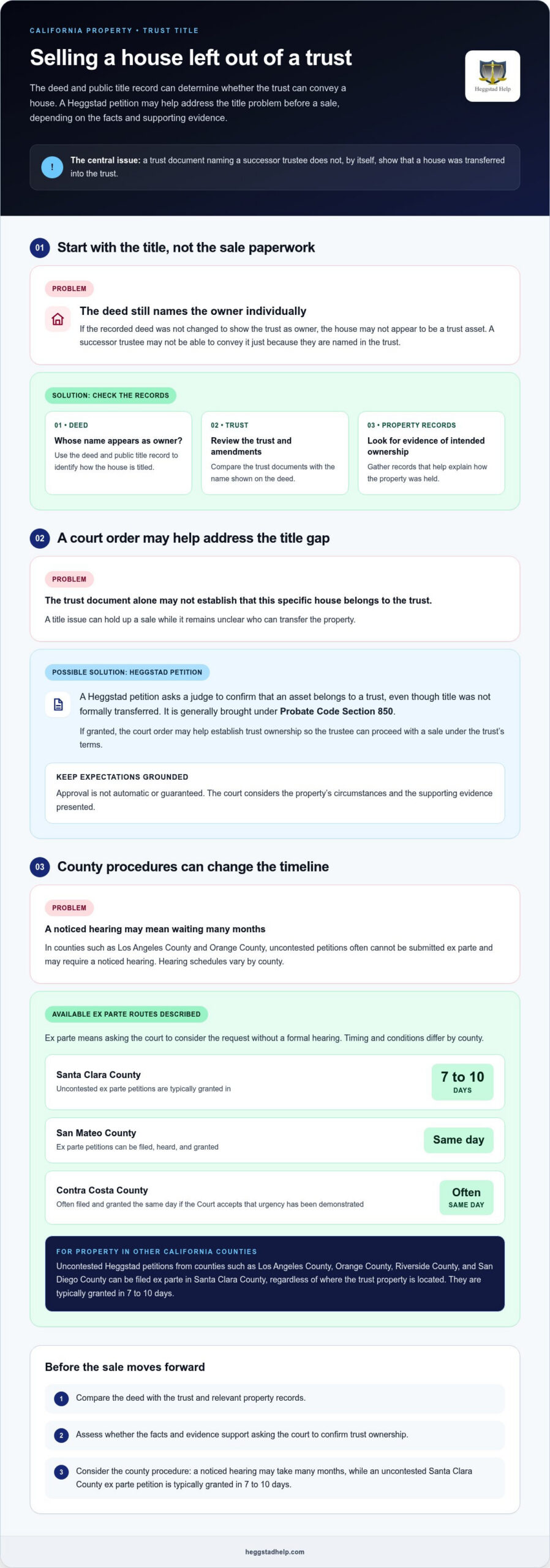
California Trustee Attorney: Assets Not in Trust

What if an asset left outside a trust doesn’t automatically mean full probate? The right attorney for a trustee when assets are not in trust should…

What if an asset left outside a trust doesn’t automatically mean full probate? The right attorney for a trustee when assets are not in trust should assess how the asset was held, what records show about the trust creator’s intent, and whether anyone disputes its connection to the trust. In some cases, an uncontested Heggstad petition, a court request to confirm that an asset belongs to a trust, may provide a focused way to address the title issue.

This article explains what to look for in an attorney, what the court may consider, and how county procedures can affect timing. An uncontested petition involving an asset in Los Angeles County, Orange County, or another California county with long court delays can often instead be filed ex parte in Santa Clara County and is typically granted in 7 to 10 days. In San Mateo County, an ex parte petition can be filed, heard, and granted the same day. In Contra Costa County, a petition can often be filed and granted the same day if the court is satisfied that urgency has been demonstrated. HEGGSTAD HELP assists families, attorneys, title companies, and their clients throughout the State of California with uncontested Heggstad petitions for a fixed fee covering filing fees and attorney fees.

Key Takeaways

  • Before assuming an asset requires full probate, gather trust and asset records that may show the trust creator intended it to be included.
  • Choose an attorney for trustee when assets are not in trust with direct experience in Heggstad petitions and trust asset title correction.
  • Find out whether anyone disputes the asset’s connection to the trust. The petition service described here is for uncontested matters.
  • Compare filing options by county. An uncontested petition involving an asset elsewhere in California may be filed ex parte in Santa Clara County.

When a California Trustee Finds an Asset Outside the Trust, What Comes Next?

A trustee may open a file and discover that a home, account, or other asset doesn’t appear to be titled in the trust’s name. The omission can raise an immediate concern: does the asset have to go through full probate? Not necessarily. A missing transfer is a reason to review the records, not by itself a final answer about how the asset can be handled.

The trust document describes the plan, while separate ownership records show how a particular asset was titled. Start by identifying the asset and its current title. Then gather the trust documents and any evidence of a transfer or an intention to transfer it. An attorney for trustee when assets are not in trust can assess whether those records may support a Heggstad petition, a request for the court to confirm that an asset belongs to the trust.

Why an asset can remain outside a trust

A title transfer may have been started but not completed, or the ownership records may not reflect what the trust creator intended. The reason can’t be determined from the omission alone. A deed, account record, or transfer document may tell a different part of the story than the trust document. The Estate of Heggstad case is the origin of this type of petition in California.

The trustee’s first practical steps

Keep the trust and any amendments together with deeds, account statements, transfer paperwork, and correspondence about the asset. Make a short inventory noting what the asset is, how it is currently titled, and which records may relate to it. Preserve original documents, and don’t assume the trust document alone allows the trustee to transfer or manage an asset titled outside the trust. For related context on a trustee’s role, see this guide to successor trustee duties for an unfunded trust.

This guide focuses on California trust assets and a possible Heggstad petition. The next step depends on the asset, the available records, and whether anyone disputes its connection to the trust.

How to Evaluate an Attorney for a California Heggstad Petition

A trustee facing a title problem needs guidance specific to the proposed court filing. Look for direct experience with Heggstad petitions and trust asset title correction. A focused review should consider the trust documents, current ownership records, and evidence of a transfer or intent to include the asset. These records help assess whether a petition may fit and whether the matter is uncontested.

Questions that reveal whether the service fits

When choosing an attorney for trustee when assets are not in trust, focus your questions on the petition and the evidence. Does the attorney handle Heggstad petitions as a focused service? Has anyone objected to treating the asset as trust property? Which records will help assess the proposed filing? HEGGSTAD HELP handles uncontested petitions, so identifying any dispute at the outset is important.

Bring the records together before review. Note any gaps or conflicting information instead of trying to resolve them yourself. A clear file makes it easier to evaluate the asset, the available evidence, and the proposed petition.

Understand the petition’s legal context

A Heggstad petition may ask the court to confirm that an asset belongs to the trust even though the title records don’t show it in the trust’s name. The attorney should explain how the available documents relate to that request in plain language. For related background, the California Probate Code Section 850 guide discusses petition context.

Fee clarity matters, too. HEGGSTAD HELP charges a fixed fee for Heggstad petitions, covering filing fees and attorney fees. Robert P. Bergman is a California-licensed attorney and Board-Certified Specialist in Estate Planning, Trust and Probate Law. Families, attorneys, title companies, and clients throughout the State of California can learn about focused Heggstad petition assistance.

How California County and Ex Parte Options Can Affect Timing

The court process can affect how quickly an uncontested Heggstad petition is considered. An ex parte filing is a court process without a formal hearing. County procedures matter: some counties often require a noticed hearing, while uncontested petitions can be filed ex parte in Santa Clara County, San Mateo County, and Contra Costa County. Each county has its own timing considerations.

When the trust or property is in another county

For an asset in Los Angeles County, Orange County, San Diego County, Alameda County, Sacramento County, or another California county, a Heggstad petition often cannot be submitted ex parte locally and may require a noticed hearing. Such hearings can take many months to be heard. For an uncontested matter, the petition can instead be filed ex parte in Santa Clara County, even when the trust or asset is located elsewhere in California.

HEGGSTAD HELP assists families, attorneys, title companies, and their clients throughout the State of California with uncontested petitions in the Santa Clara County Probate Court, regardless of the county where the trust is located. This can be relevant for trusts and assets in the San Francisco Bay Area, Northern California, Southern California, the Central Valley, San Diego, Sacramento, Fresno, Bakersfield, Greater Los Angeles, Orange County, Riverside County, or San Bernardino County. An attorney for trustee when assets are not in trust can assess whether the matter is uncontested and prepare the filing.

When a noticed hearing or contested matter changes the path

A noticed trust modification petition hearing is typically set 30 to 60 days after filing, or several months later in some counties. The time required to notify interested parties adds to the overall process. If someone contests the petition, the matter may take longer and won’t follow the uncontested ex parte path described here. HEGGSTAD HELP handles uncontested petitions, not contested matters.

For an uncontested filing, learn about Heggstad petition options.

California Trustee Attorney: Assets Not in Trust

A Focused Next Step for Trustees, Families, Attorneys, and Title Companies

A missing trust transfer can feel like a broad probate problem, but the next step may be more focused: organize the records, identify whether the issue is disputed, and assess whether a Heggstad petition fits. If you’re helping a family member or client, a clear set of documents makes that assessment more productive.

  1. Gather the trust document and any amendments, along with information identifying the asset.
  2. Collect title records and available transfer documents or correspondence.
  3. Identify whether anyone disputes that the asset should belong to the trust, then assess whether an uncontested petition may be appropriate.

What to have ready for an initial discussion

Start with the records you have, even if the file is incomplete. Note the asset’s current title and flag inconsistencies between the trust and ownership records. A focused review can identify what the documents show and which questions remain. This gives an attorney for trustee when assets are not in trust a practical starting point for assessing a petition.

Move forward with a focused petition service

HEGGSTAD HELP assists families, attorneys, title companies, and their clients throughout the State of California with uncontested Heggstad petitions. The practice focuses on Heggstad petition filing, ex parte court orders, and trust asset title correction, including transfers into living or irrevocable trusts. Uncontested petitions can be filed ex parte in Santa Clara County, San Mateo County, and Contra Costa County, including for trusts located elsewhere in California. The office does not handle contested petitions.

Heggstad petition fees are fixed and cover filing fees and attorney fees. For a matter that appears uncontested, review the Heggstad petition services and organize the records. Discuss an uncontested Heggstad petition for the asset and trust involved.

Turn the Record Into a Clear Next Step

Your next move can be practical: make a one-page timeline of what happened to the asset, from the trust’s creation through discovery of the title issue. Note dates you can verify, identify the documents that support each point, and separate confirmed facts from unanswered questions. This gives the review a clear starting point without requiring you to draw legal conclusions.

If you’re a trustee, family member, attorney, or title company representative, keep the timeline with the relevant records so everyone can work from the same information. The right attorney for trustee when assets are not in trust can then focus the discussion on the asset, the available evidence, and a possible petition path.

Robert P. Bergman’s focused practice can help bring structure to an uncertain title issue. To move from gathering information to considering a next step, start a focused Heggstad petition discussion with the relevant trust and asset records.

Frequently Asked Questions

Can a successor trustee hire an attorney when an asset was never transferred into the trust?

Yes. A successor trustee can seek legal help even if an asset was never retitled in the trust’s name. An attorney for trustee when assets are not in trust can review the trust, current ownership records, and available transfer documents to assess whether a Heggstad petition may fit. For a home, gather the deed and trust papers. For an account, keep the account records available for review.

Does a California property have to be in the same county as the court handling a Heggstad petition?

No, not necessarily. An uncontested petition involving an asset elsewhere in California may be filed ex parte in Santa Clara County. This can be relevant for property in the San Francisco Bay Area, Northern California, Southern California, the Central Valley, San Diego, Sacramento, Fresno, Bakersfield, Greater Los Angeles, Orange County, Riverside County, or San Bernardino County. Uncontested petitions can also be filed ex parte in San Mateo County and Contra Costa County. The filing approach and timing depend on the county and the matter.

How long does an uncontested ex parte Heggstad petition take in California?

Uncontested ex parte petitions filed in Santa Clara County are typically granted in 7 to 10 days. In San Mateo County, a petition can be filed, heard, and granted the same day. In Contra Costa County, a petition can often be filed and granted the same day if the court is satisfied that urgency has been demonstrated. A court order and updating the asset’s title are separate steps, so allow for the title correction process after the petition is decided.

Does HEGGSTAD HELP handle a contested Heggstad petition?

No. HEGGSTAD HELP handles uncontested Heggstad petitions, not contested petitions. If a beneficiary or another interested person objects to treating an asset as trust property, the matter may no longer be uncontested. Keep any written objection with the trust and asset records so the issue is clear when the petition is assessed.

Robert P. Bergman, Attorney at Law

Article by

Robert P. Bergman, Attorney at Law

Attorney Robert P. Bergman ("Bob Bergman") has been a Board-Certified Specialist in Estate Planning, Trust and Probate Law since 2011, as certified by the California State Bar Board of Legal Specialization. For several years, Bob has assisted families and the clients of other attorneys with obtaining court orders through Heggstad petitions to avoid the time and expense of Probate administration. Bob is friendly, very approachable, and believes in explaining complex legal topics in clear ordinary language so that his clients understand exactly what they're doing and why they're doing it.
Bob is often able to assist clients who are in other counties than his home county of Santa Clara through his approach to Heggstad petitions.

Disclaimer

This article is for informational purposes only. Nothing in this article is intended to replace legal advice from a competent attorney or be considered legal guidance for anybody's specific legal situation. Nobody should rely on information in this article in making legal decisions without such consultation.

Trust Asset Title Correction in California: What Families Need to Know

What if a home was meant to be held in a trust, but the recorded title still names the trust creator personally? That mismatch can leave families…

What if a home was meant to be held in a trust, but the recorded title still names the trust creator personally? That mismatch can leave families unsure whether the asset belongs to the trust and concerned that administration could stall or require probate.

Trust asset title correction California families may need doesn’t always mean changing the trust itself. The right approach depends on what the trust documents and other records show about the creator’s intent. This article explains the difference between correcting an asset’s ownership record and amending a trust, what evidence may help, and when a Heggstad petition could ask the court to confirm that an asset belongs to the trust.

HEGGSTAD HELP assists families, attorneys, title companies, and their clients throughout the State of California with uncontested ex parte Heggstad petitions in Santa Clara County Probate Court, regardless of where the trust is located. Ex parte means the court can review the petition without a formal hearing. Petitions filed in Santa Clara County are typically granted in 7 to 10 days. We’ll also explain how county procedures affect the filing route and timing.

Key Takeaways

  • Trust asset title correction California families may need can address a mismatch between ownership records and intended trust ownership without changing the trust’s terms.
  • Gather the trust documents, asset schedules, deeds, account records, and transfer paperwork available. These can help show the trust creator’s intent and assess whether a Heggstad petition may fit.
  • Probate Code Section 850 provides a court process for asking whether an asset belongs to a trust. The result depends on the evidence in the case.
  • County procedure affects timing. HEGGSTAD HELP files uncontested petitions ex parte in Santa Clara, San Mateo, and Contra Costa Counties. In other counties, a noticed hearing may be required.

What California Trust Asset Title Correction Means, and Why Ownership Records Matter

Trust asset title correction addresses a gap between how an asset is legally recorded and the trust creator’s apparent intention for it to belong to the trust. It focuses on the asset’s ownership record, not on rewriting the trust’s instructions. For example, a California home may be described in trust documents as part of the trust while the deed still names the creator individually. The deed is important evidence, but it may not answer every question about ownership or intent.

An unfunded asset is an asset whose ownership was not transferred into the trust; an amended trust document changes the trust’s terms. Those are different issues, and resolving one does not automatically resolve the other. To organize the records, compare the trust documents with the deed or account records. Note differences in names, property descriptions, account details, and dates. A trust asset title correction may involve reviewing both the records and the circumstances behind them.

How a title mismatch can arise

A deed may have been prepared or signed to transfer a home into a trust but never recorded. In another situation, the paperwork or timeline may be different. Real property is one example. Bank, brokerage, and other assets have their own ownership records, so the relevant documents depend on the asset. Gather the trust, any property or account records, and available transfer paperwork. Put dated documents in order and note what appears to be missing or inconsistent. One incomplete document does not necessarily tell the whole story.

Why the distinction matters after death

A successor trustee, the person who takes over trust responsibilities, may discover the mismatch while handling trust matters. The records can raise a practical question: can the asset be dealt with as trust property, or is another legal step needed? A title problem alone does not establish that probate is required. The answer depends on the facts and applicable court process. A Heggstad petition takes its name from the Estate of Heggstad, a California case associated with asking a court to determine whether an asset belongs to a trust. Keep documents that may show the creator’s intent, rather than treating the recorded title as the only relevant evidence.

How a Heggstad Petition May Correct Trust Asset Title in California

A Heggstad petition asks a court to determine whether an asset should be treated as property of a trust, based on the evidence in that particular case. Probate Code Section 850 provides a process for asking the court to resolve certain questions about ownership of property. In plain English, it can give a judge a way to decide whether an asset belongs to a trust even though its title record does not show the trust as owner.

A Heggstad petition asks the court to recognize trust ownership when the evidence supports that result. It does not make every title mismatch qualify. It is not a routine deed edit or a way to rewrite trust terms, and a court’s decision is not guaranteed. For families considering trust asset title correction California, the key issue is whether the facts and records support asking for a court determination.

What the court may consider

The court may review documents and circumstances that help show what the trust creator intended regarding the asset. Depending on the situation, these may include the trust document, an asset schedule, property records, or paperwork connected with a planned transfer. This is not a universal checklist. A practical first step is to gather available records and arrange them by date. That can make the transfer history and any gaps easier to understand. Note who prepared or signed transfer documents and whether they were recorded or otherwise completed, if that information is available.

When a court order may be relevant

Sometimes an ownership record can be corrected administratively, without asking a court to decide who owns the asset. A petition may be relevant when the record does not reflect the trust creator’s intent and a court determination is needed. The details matter, so a petition should not be treated as an automatic substitute for an ordinary record correction. For more context on the legal process, review this guide to the California Probate Code Section 850 petition process.

HEGGSTAD HELP files uncontested Heggstad petitions for families, attorneys, and title companies throughout the State of California. The petition can request a court order confirming real property or other assets as trust property, helping correct title without full probate administration when the court grants the petition. The practice focuses on these filings and does not handle contested petitions.

Trust Asset Title Correction in California: What Families Need to Know

Choosing a California Court Path: County, Notice, and Timing

County procedure can affect how an uncontested Heggstad petition is heard. In counties such as Los Angeles, Orange, San Diego, Alameda, and Sacramento, petitions often require a noticed hearing and may take many months to be heard. For an uncontested matter, HEGGSTAD HELP can instead file ex parte in Santa Clara County Probate Court, even when the trust or property is located elsewhere in California. This filing route serves families and their representatives across the San Francisco Bay Area, Northern California, Southern California, and the Central Valley, including Greater Los Angeles, Orange County, Riverside County, San Bernardino County, San Diego, Sacramento, Fresno, and Bakersfield.

How county location affects the filing route

For families considering trust asset title correction California offers different court paths depending on the county and case circumstances. HEGGSTAD HELP assists families, attorneys, title companies, and clients throughout the State of California. Uncontested Heggstad petitions can be filed ex parte in Santa Clara, San Mateo, and Contra Costa Counties. For trusts and property in other counties, including San Francisco, Marin, Ventura, Santa Cruz, Placer, Santa Barbara, San Joaquin, Solano, San Luis Obispo, and Monterey Counties, an uncontested petition can often be filed ex parte in Santa Clara County instead. These timing details are general guidance, not a promise of a hearing date or result.

Filing path What to expect
Noticed hearing in other counties Often required and may take many months to be heard. A noticed trust modification petition hearing may be set 30 to 60 days after filing, or several months later in some counties, with additional time for notice to interested parties.
Santa Clara County, ex parte Uncontested petitions are typically granted in 7 to 10 days.
San Mateo County, ex parte Petitions can be filed, heard, and granted the same day.
Contra Costa County, ex parte Petitions can often be filed and granted the same day if the Court is satisfied that urgency exists.

What ex parte means in this context

Ex parte is the route for asking the court to review an uncontested petition without a formal hearing. It does not guarantee approval or a particular decision date. In counties outside Santa Clara, San Mateo, and Contra Costa, Heggstad petitions often require noticed hearings and may take many months to be heard. An uncontested petition from one of those counties can instead be filed ex parte in Santa Clara County and is typically granted in 7 to 10 days. HEGGSTAD HELP handles uncontested petitions, not contested matters.

HEGGSTAD HELP files uncontested ex parte Heggstad petitions in Santa Clara, San Mateo, and Contra Costa Counties for trust assets throughout California. Fixed fees cover court filing fees and attorney fees.

Get Help With Uncontested Trust Asset Title Correction Across California

A title mismatch can raise practical questions for families, attorneys, title companies, and clients. HEGGSTAD HELP assists with uncontested Heggstad petitions throughout the State of California, including when the trust or its property is located outside the county where the petition is filed. The practice files uncontested ex parte petitions in Santa Clara, San Mateo, and Contra Costa Counties. It does not handle contested petitions. Fixed fees cover court filing fees and attorney fees.

What to gather before discussing a title issue

A little organization can make it easier to explain the issue. Gather the trust document, any available deeds or account records, and paperwork related to the asset or a planned transfer. Put records in date order and note what appears inconsistent. For a home, include the deed and the property description in the trust documents or asset schedule, if available. For another type of asset, collect records showing how it was held and any paperwork connecting it to the trust. These materials provide useful background, but they are not a guarantee that a particular petition is appropriate.

Specialized help for California title concerns

Robert P. Bergman is a California-licensed attorney and Board-Certified Specialist in Estate Planning, Trust and Probate Law. His focused work on Heggstad petitions helps families and their professional representatives address trust ownership questions without treating every title problem as a broader trust or probate administration matter. For a fuller explanation of the petition, see this Heggstad petition filing guide.

If you’re considering trust asset title correction California, a focused review of the available records can help clarify the next step. Learn about Heggstad petition filing assistance for an uncontested matter.

Take the Next Step Toward Resolving the Title Issue

A title concern can feel daunting, especially when family members are unsure what can happen next. Start by keeping the relevant trust and asset records together, then identify the question that needs an answer: whether the records can be corrected administratively or whether a court decision may be needed. A focused review can help clarify that question without assuming the same solution fits every family.

For trust asset title correction California families may need, the next step is to look at the asset, the available records, and whether an uncontested Heggstad petition may be appropriate. You do not need to have every detail sorted out before raising the issue. Start with the records you have and note any gaps or inconsistencies.

Contact HEGGSTAD HELP to discuss an uncontested California Heggstad petition and take a practical step toward resolving the title concern.

Frequently Asked Questions

Is a Heggstad petition the same as amending a trust?

No. They address different goals. Before gathering records, write down the outcome the family needs: recognition of an asset as trust property, or a change to the trust’s instructions. That distinction can help keep discussions focused and make it easier to explain the issue. If both questions are involved, identify them separately rather than assuming one process will resolve both.

Can a Heggstad petition address property in Los Angeles or Orange County?

Yes. The property’s county and the county where an uncontested petition is filed can be different. For a home in Los Angeles or Orange County, note the property’s full address and gather the deed and trust records that relate to it. HEGGSTAD HELP can file an uncontested ex parte Heggstad petition in Santa Clara County Probate Court for trust property located elsewhere in California. The court route and result depend on the circumstances and evidence.

Can a Heggstad petition apply to assets other than real estate?

Yes, a petition may concern an asset other than real estate, depending on the facts. For a non-real-estate asset, gather records showing how it was held and any documents that connect it to the trust. Keep those records together and note differences in names or ownership details. The asset type and available evidence help shape the analysis.

Does a trust schedule automatically change the title to a house?

No. A schedule is not a substitute for checking the property’s recorded information. Compare the property description on the schedule with the deed, paying attention to names and identifying details. If they do not match, note the exact difference instead of assuming it is a harmless typo or a complete answer. That comparison can help clarify what question needs to be resolved.

What if the deed was signed but never recorded?

Preserve a signed but unrecorded deed and review it with the rest of the transfer records. Keep the original if available, along with copies and any paperwork explaining how the deed was prepared and what happened afterward. Note the known dates and who handled the document. Those details can help clarify the history, but the signature alone does not guarantee a particular legal outcome.

Robert P. Bergman, Attorney at Law

Article by

Robert P. Bergman, Attorney at Law

Attorney Robert P. Bergman ("Bob Bergman") has been a Board-Certified Specialist in Estate Planning, Trust and Probate Law since 2011, as certified by the California State Bar Board of Legal Specialization. For several years, Bob has assisted families and the clients of other attorneys with obtaining court orders through Heggstad petitions to avoid the time and expense of Probate administration. Bob is friendly, very approachable, and believes in explaining complex legal topics in clear ordinary language so that his clients understand exactly what they're doing and why they're doing it.
Bob is often able to assist clients who are in other counties than his home county of Santa Clara through his approach to Heggstad petitions.

Disclaimer

This article is for informational purposes only. Nothing in this article is intended to replace legal advice from a competent attorney or be considered legal guidance for anybody's specific legal situation. Nobody should rely on information in this article in making legal decisions without such consultation.
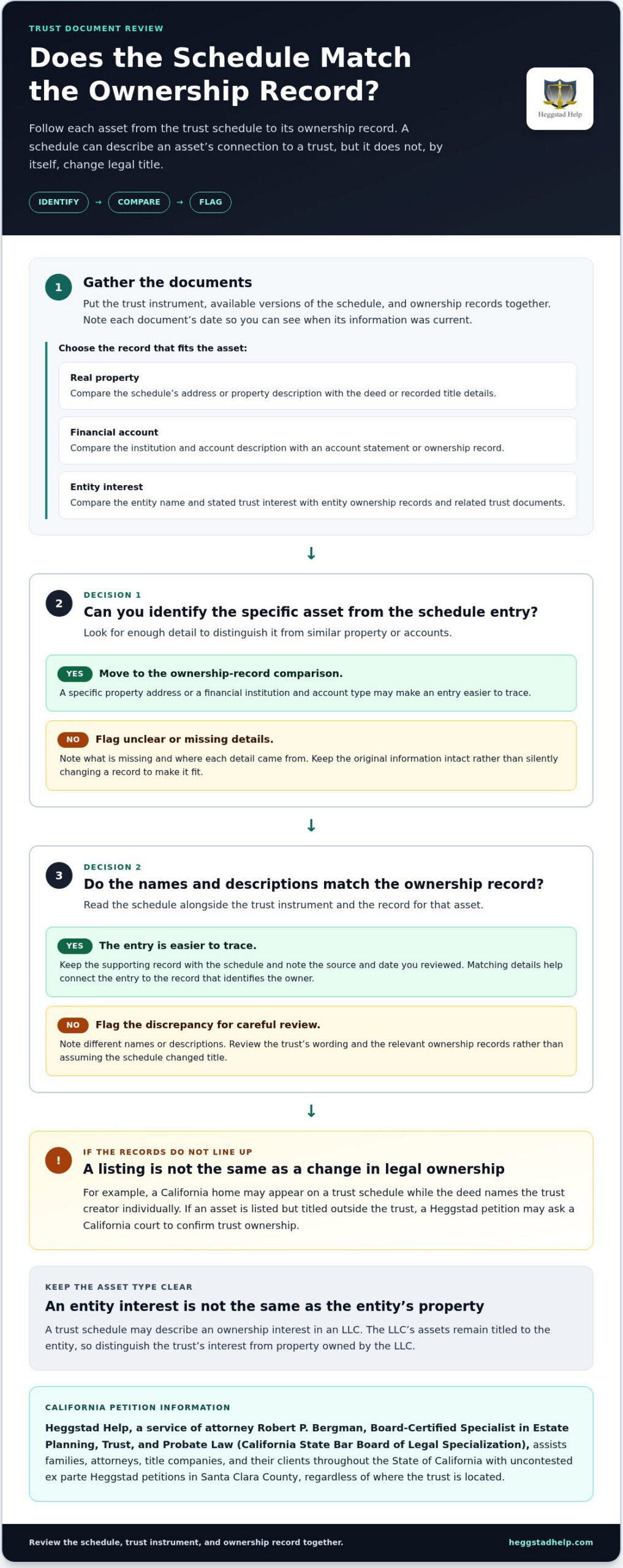
Alameda County Heggstad Petition: Filing Options and Next Steps

What if an Alameda County Heggstad petition does not have to be filed in Alameda County? When an asset was not formally titled in a trust, it can be…

What if an Alameda County Heggstad petition does not have to be filed in Alameda County? When an asset was not formally titled in a trust, it can be difficult to know which court route applies. A formal hearing may add time, but the property’s location does not always determine the most practical route for an uncontested petition.

This article explains the options for Alameda County property and what to gather before an attorney reviews the matter, including trust documents and written evidence of the owner’s intent. In counties outside Santa Clara, San Mateo, and Contra Costa, Heggstad petitions often require a noticed hearing and may take many months. Uncontested petitions can also be filed ex parte, meaning without a formal hearing, in Santa Clara County, where they are typically granted in 7 to 10 days. HEGGSTAD HELP assists families, attorneys, title companies, and their clients throughout California with these focused filings. Here, you’ll learn how to compare the routes and prepare for review.

Key Takeaways

  • A Heggstad petition asks the court to confirm that an asset belongs to a trust. Written records showing the owner’s intent can help an attorney assess the matter.
  • For an Alameda County Heggstad petition, compare the local noticed-hearing route with available ex parte options before deciding how to proceed.
  • Gather the trust and any amendments, details about the asset, and available title or ownership records for an initial attorney review.
  • Uncontested filings can follow different timelines in Santa Clara, San Mateo, and Contra Costa Counties, so the court route can affect the next steps.

Why an Alameda County Heggstad Petition May Raise a Court-Route Question

A family may discover that a home, bank account, or other asset was never formally transferred into a trust. That gap can raise questions about whether the asset must go through probate and which court should consider the issue. A Heggstad petition asks a court to confirm that an asset belongs to a trust, based on evidence of the owner’s intent. The petition does not change title automatically. The court reviews the request and decides whether the asset can be treated as trust property.

The issue connects to trust law principles: a trust holds property for beneficiaries under its terms, while ownership records show how a particular asset is titled. A petition may address a missing transfer, but the documents and circumstances matter. Gather the trust paperwork and asset records before an attorney reviews the situation.

What an Alameda County reader is trying to resolve

The property may be in Alameda County, while the family’s question is which filing route is available for an uncontested matter. Location alone does not answer every procedural question. An attorney can review the trust’s terms and amendments, who created and managed the trust, what the asset records show, and whether anyone disputes the claim. Organizing those details ahead of time makes the review more focused.

Why the court route matters

A noticed hearing and an ex parte request follow different court procedures, and the available route can affect how the matter proceeds. In counties outside Santa Clara, San Mateo, and Contra Costa, Heggstad petitions often require a noticed hearing and may take many months. For an Alameda County Heggstad petition, an uncontested matter can instead be filed ex parte in Santa Clara County and is typically granted in 7 to 10 days. The court decides each request based on its facts and supporting records.

Alameda County Heggstad Petition Routes: Local Hearing or Ex Parte Filing

An Alameda County matter may have more than one possible path. In Alameda County and many other counties, a Heggstad petition often requires a noticed hearing, and the process may take many months. HEGGSTAD HELP files uncontested petitions ex parte in Santa Clara County, San Mateo County, and Contra Costa County. The comparison below summarizes the different routes and typical timelines. The court reviews each petition and decides whether to grant it.

County route What to expect
Alameda County Often requires a noticed hearing, which may take many months.
Santa Clara County Uncontested petitions filed ex parte are typically granted in 7 to 10 days.
San Mateo County Ex parte petitions can be filed, heard, and granted the same day.
Contra Costa County Petitions can often be filed and granted the same day if the Court is satisfied that urgency exists.

When an Alameda County matter may use a different filing path

An uncontested petition involving property in Alameda County can be filed ex parte in Santa Clara County, regardless of where in California the trust is located. This gives families and attorneys another route when a local noticed hearing may add substantial time. Santa Clara County petitions are typically granted in 7 to 10 days. The court still reviews the facts and supporting records before deciding the request.

What ex parte means in this service

Ex parte means requesting a court order without a formal hearing. HEGGSTAD HELP assists families, attorneys, title companies, and their clients throughout California with uncontested petitions filed in Santa Clara County, San Mateo County, and Contra Costa County. San Mateo County petitions can be filed, heard, and granted the same day. Contra Costa County petitions can often be filed and granted the same day when the Court is satisfied that urgency exists. The office handles uncontested petitions, not contested matters where parties disagree about whether an asset belongs to the trust. If you’re assessing an uncontested Alameda County Heggstad petition, review the Heggstad petition filing information as you prepare for attorney review.

How to Prepare for an Uncontested Heggstad Petition Involving Alameda County

For an initial attorney review, focus on organizing the facts rather than preparing court forms yourself. A clear record helps the attorney evaluate whether the asset may qualify for a Heggstad petition and whether the matter appears uncontested.

Information to organize before legal review

  • 1. Identify the asset. Write down its description and location, such as an Alameda County home or a financial account, along with any available account or parcel details.
  • 2. Collect trust documents. Gather the trust and any amendments you have. Note the language about the asset or the person responsible for managing trust property.
  • 3. Assemble ownership records. Include available deeds, account statements, or other records showing how the asset is currently titled and who is listed as owner. Record dates that may help explain when ownership changed or was intended to change.
  • 4. Summarize the intent and timeline. In a short written note, explain when and how the asset was meant to become trust property. Include documents or communications that may support that understanding. Keep original records unchanged.
  • 5. Identify people involved and any concerns. List the trustee, beneficiaries, and others with a potential interest. Tell the attorney promptly if anyone has objected or disagrees.

How to keep the matter within the uncontested process

Be candid about disagreement, even if it seems minor. An objection may affect whether a matter can proceed as an uncontested petition. HEGGSTAD HELP handles uncontested petitions only. The goal of this preparation is to give the attorney an accurate picture, not to resolve disputes or decide the filing route on your own.

For more background on the process, see the Heggstad Petition Filing guide. If you’re organizing records for an Alameda County Heggstad petition, request focused Heggstad petition filing assistance for an uncontested matter.

Alameda County Heggstad Petition: Filing Options and Next Steps

Get Alameda County Heggstad Petition Help for an Uncontested Filing

An asset outside a trust can raise difficult questions for a family, especially when the property is in Alameda County but a practical court route may be elsewhere. HEGGSTAD HELP focuses on uncontested Heggstad petitions for families, attorneys, title companies, and their clients throughout the State of California. Uncontested petitions involving Alameda County property can be filed ex parte in Santa Clara County, regardless of where in California the trust is located.

Robert P. Bergman is a California-licensed attorney and Board-Certified Specialist in Estate Planning, Trust and Probate Law. His focused work includes Heggstad petition filing, ex parte court order services, and trust asset title correction. The fixed fee covers filing fees and attorney fees.

What focused petition assistance includes

The work centers on preparing and filing an uncontested petition and seeking a court order to address an asset that may have been intended for a trust. If the court grants the petition, trust asset title correction may be the next step. This focused service does not include contested petitions or full probate administration. If someone objects or disputes the asset’s status, raise that early so the matter can be assessed accurately.

Taking the next step with the right records

For an initial discussion, organize the trust and amendments, asset description, available title or ownership records, and a short timeline explaining how the asset was meant to become trust property. Include any known objections or disagreements. You can also review the relevant California Probate Code Section 850 information as background while preparing.

HEGGSTAD HELP assists families, attorneys, title companies, and their clients throughout the San Francisco Bay Area, Northern California, Southern California, the Central Valley, and San Diego, including Alameda County, San Francisco County, Marin County, Santa Clara County, Los Angeles County, Orange County, San Bernardino County, Riverside County, Sacramento County, Fresno County, and Bakersfield.

If you’re ready to discuss an uncontested Alameda County Heggstad petition, discuss an uncontested Heggstad petition.

Take the Next Step With a Clear Plan

The most useful next step is to turn scattered paperwork and family recollections into a concise account of the asset’s history. Note what the trust documents say, how ownership is recorded, when the asset was intended to become trust property, and whether anyone has raised an objection. You do not need to decide the court route or prepare a petition yourself. A focused review can help identify what the available records support and what questions remain.

If you’re considering an Alameda County Heggstad petition, bring those details together before discussing the matter. This gives the attorney a practical starting point and keeps the conversation centered on the asset, the trust, and whether an uncontested filing may fit. Fixed fees cover filing fees and attorney fees.

Discuss an uncontested Heggstad petition and take the next step with a clearer understanding of your options. A careful review can make a complicated situation feel more manageable.

Frequently Asked Questions

Can an Alameda County Heggstad petition be filed ex parte in Santa Clara County?

Yes. An uncontested Alameda County Heggstad petition may be filed ex parte in Santa Clara County even though the asset is in Alameda County. An attorney can review the trust terms, ownership history, and supporting records to assess whether that route fits the facts. The Court decides whether to grant the request, so the filing location does not guarantee a particular result.

Does a Heggstad petition only apply to real estate?

No. A Heggstad petition can concern real estate or other assets that may have been intended for a trust, such as a financial account. The key question is whether the available trust documents and ownership records support treating that specific asset as trust property. Gather records identifying the asset and its current owner, since account and title details can vary.

Does the trust have to be located in Alameda County?

No. The trust does not have to be located in Alameda County for an asset connected with that county to be reviewed. An uncontested petition involving an Alameda County asset may be filed in Santa Clara County, regardless of where in California the trust is located. For attorney review, note where the trust is administered, where the asset is located, and who currently holds title or account ownership.

Can a Heggstad petition be filed after the trust creator has died?

Yes. A Heggstad petition may be pursued after the trust creator has died, including when an asset was intended for the trust but remained titled outside it. Gather the trust and amendments, current ownership records, and any materials showing the creator’s intent while living. An attorney can assess whether petition filing may address the asset and identify any information still needed.

What if someone objects to the Heggstad petition?

Tell the attorney promptly and share the nature of the concern, along with any related messages or documents. An objection may mean the matter is no longer uncontested, which affects whether it fits this focused filing service. HEGGSTAD HELP handles uncontested petitions, not contested matters, so include any disagreement in the initial review rather than leaving it out.

Robert P. Bergman, Attorney at Law

Article by

Robert P. Bergman, Attorney at Law

Attorney Robert P. Bergman ("Bob Bergman") has been a Board-Certified Specialist in Estate Planning, Trust and Probate Law since 2011, as certified by the California State Bar Board of Legal Specialization. For several years, Bob has assisted families and the clients of other attorneys with obtaining court orders through Heggstad petitions to avoid the time and expense of Probate administration. Bob is friendly, very approachable, and believes in explaining complex legal topics in clear ordinary language so that his clients understand exactly what they're doing and why they're doing it.
Bob is often able to assist clients who are in other counties than his home county of Santa Clara through his approach to Heggstad petitions.

Disclaimer

This article is for informational purposes only. Nothing in this article is intended to replace legal advice from a competent attorney or be considered legal guidance for anybody's specific legal situation. Nobody should rely on information in this article in making legal decisions without such consultation.

San Bernardino Attorney for an Unfunded Trust: Understand Your California Options

What if property left outside a trust doesn’t have to follow the court process in the county where it’s located? If you’re looking for a San…

What if property left outside a trust doesn’t have to follow the court process in the county where it’s located? If you’re looking for a San Bernardino attorney for unfunded trust property, an uncontested Heggstad petition, a request for the court to recognize property as part of a trust, may offer a focused way to address the issue without full probate administration. The right approach depends on the trust, the asset records, and whether anyone disputes the claim. Filing location can also affect the process and timing.

It’s understandable to worry that resolving a title problem could mean months of waiting. For property in San Bernardino County, an uncontested petition may instead be filed ex parte, meaning without a formal hearing, in Santa Clara County. These petitions are typically granted within 7 to 10 days of filing. We assist families, attorneys, and their clients throughout California with uncontested Heggstad petitions, including matters involving San Bernardino County property. This article explains when a Heggstad petition may apply, how county procedures can affect timing, and what records to gather.

Key Takeaways

  • An asset titled outside a trust may need a court order before it can be treated as trust property. Review the trust and ownership records to understand the issue.
  • A Heggstad petition asks the court to determine whether an asset should be treated as trust property. The trust and asset records help support an uncontested filing.
  • A San Bernardino attorney for unfunded trust matters can pursue an uncontested petition through Santa Clara County. Local procedures in other counties may involve a noticed hearing and longer waits.
  • For an uncontested matter, start by gathering the trust, deed, and other asset records. Robert P. Bergman, a California-licensed attorney and Board-Certified Specialist in Estate Planning, Trust and Probate Law, can review them and prepare a petition when appropriate.

Unfunded Trust Property in San Bernardino County: What the Problem Means

Creating a trust and transferring assets into it are separate steps. An unfunded trust, or one that hasn’t been fully funded, may hold some assets while others remain titled in an individual’s name. A trust document alone doesn’t change the title shown on a deed or other ownership record.

That distinction can matter after the person who created the trust dies. For real estate, the recorded deed identifies how the property is titled. If it names the person rather than the trust, the successor trustee, the person who takes over trust management, may need to determine how the property can be handled. The deed, trust documents, and other facts all matter, so a particular court outcome shouldn’t be assumed.

How a San Bernardino County property can be left outside a trust

For example, someone might sign a trust but leave a San Bernardino County home titled in their individual name. The deed and trust documents may help show whether the home was intended to belong to the trust. Compare the names and dates on those records, and gather any other paperwork related to the property before assessing next steps.

A Heggstad petition is named for the Estate of Heggstad case. It may provide a way to ask a court to determine whether an asset should be treated as trust property.

Who may need help with an unfunded trust

Successor trustees and families may be unsure what to do when an asset appears to be outside the trust. Attorneys and their clients may also need a focused review of the trust and property records to determine whether an uncontested petition could fit the circumstances.

If you’re looking for a San Bernardino attorney for unfunded trust property, start by gathering the signed trust document and available deed or title records. Note the asset’s current title and any paperwork that may relate to transferring it into the trust. These materials give the attorney a practical starting point to assess the issue.

How a Heggstad Petition May Address Trust Property Left Out

A Heggstad petition asks a court to decide whether an asset should be treated as trust property, even if it wasn’t formally titled in the trust’s name. It is a focused request about a particular asset, not a request to manage or distribute an entire estate. The attorney reviews the trust and relevant asset records to assess the circumstances and prepare an uncontested filing.

A Heggstad petition may offer a legal path to address an asset left outside a trust, but no filing can guarantee how the court will rule. The documents and facts guide the legal analysis, and the court makes the decision.

When an uncontested petition may be considered

This office handles uncontested Heggstad petitions only. The matter must not be disputed by interested parties. If the records and circumstances support an uncontested filing, the attorney prepares the petition and seeks a court order. This service does not cover contested proceedings.

To make the review more useful, gather the trust document, deed or other title records, and any related asset paperwork. Comparing these records can help clarify how the asset is currently titled and what documents may support the petition.

What this focused service does not cover

A Heggstad petition addresses whether an asset should be confirmed as trust property. It isn’t full probate administration, and this office does not handle contested petitions or contested trust litigation. For more information about the filing process, read this California Heggstad petition filing guide. Heggstad petitions have fixed fees that cover filing fees and attorney fees.

Families, attorneys, and their clients throughout California can get focused help with an uncontested petition. Review the Heggstad petition services to learn how the firm approaches these matters.

San Bernardino County Property and California Filing Options

The county where a home is located doesn’t by itself prevent a family from pursuing an uncontested Heggstad petition through another California court. In counties such as San Bernardino, an uncontested petition often requires a noticed hearing, meaning a hearing scheduled after notice to interested parties. These hearings may take many months to be heard, with additional time needed to provide notice. For an uncontested petition involving San Bernardino County property, the firm can file ex parte in the Santa Clara County Probate Court instead.

Why filing location matters to a San Bernardino family

Filing location can affect the process and timing. Uncontested ex parte petitions filed in the Santa Clara County Probate Court are typically granted in 7 to 10 days from filing. A San Bernardino attorney for unfunded trust property can help families understand whether this filing path fits the circumstances and prepare the records needed for the petition.

What ex parte means in this process

Ex parte means the petition proceeds without a formal hearing. The firm assists families, attorneys, and their clients throughout the State of California with uncontested petitions filed in the Santa Clara County Probate Court, regardless of the county where the trust property is located. Learn more about the California ex parte Heggstad petition service.

Court location Uncontested petition process and typical timing
Santa Clara County Filed ex parte in the Santa Clara County Probate Court; typically granted in 7 to 10 days.
San Mateo County Ex parte petitions can be filed, heard, and granted the same day.
Contra Costa County May be filed and granted the same day if the Court is satisfied that urgency has been demonstrated.
Other counties, including San Bernardino Often require a noticed hearing, which may take many months; notice adds time.

If you’re considering this route for San Bernardino County property, gather the trust and asset records for review. Learn about help with an uncontested Heggstad petition.

San Bernardino Attorney for an Unfunded Trust: Understand Your California Options

Work With a California Heggstad Attorney for an Unfunded Trust

A focused review can help clarify whether an uncontested Heggstad petition may fit a trust asset matter. Robert P. Bergman is a California-licensed attorney and Board-Certified Specialist in Estate Planning, Trust and Probate Law. He assists families, attorneys, title companies, and their clients throughout the State of California with uncontested Heggstad petitions, including matters involving San Bernardino County property.

The process begins with reviewing the trust and available asset records. If the facts support an uncontested filing, the attorney prepares the petition and seeks a court order. For property in San Bernardino County, an uncontested petition can be filed ex parte in Santa Clara County. These petitions are typically granted within 7 to 10 days of filing. Heggstad petitions have fixed fees that cover filing fees and attorney fees.

What to gather before discussing the matter

To make an initial discussion more useful, organize the trust document, available deeds or other title records, and information about the asset. Check that you have the current deed and any records showing the property’s ownership, along with the trust document. These materials are a helpful starting point, but they aren’t a complete legal checklist and don’t determine eligibility on their own. The relevant documents and circumstances shape the legal analysis.

A focused next step for families and attorneys

If you’re a successor trustee, family member, attorney, title company, or client dealing with an asset that may have been left outside a trust, the practice assists with uncontested Heggstad petitions throughout California. This includes families and professionals with matters involving the San Francisco Bay Area, Northern California, Southern California, the Central Valley, San Diego, Sacramento, Fresno, Bakersfield, Greater Los Angeles, Orange County, Riverside County, and San Bernardino County. Learn more about the California Heggstad petition service.

If you have an uncontested trust asset matter involving San Bernardino County property, reach out to discuss the matter. A review of the available records can help identify a practical next step.

Take the Next Step Toward Resolving an Unfunded Trust

An asset left outside a trust may not automatically be handled as trust property, but an uncontested Heggstad petition may offer a focused way to ask the court to address it. The trust and asset records help determine whether this approach may fit your circumstances. Filing location can also matter: uncontested petitions involving property anywhere in California can be filed ex parte, without a formal hearing, in Santa Clara County. They are typically granted within 7 to 10 days of filing.

For families, attorneys, and their clients, working with a San Bernardino attorney for unfunded trust matters can bring clarity to the records and filing process. Robert P. Bergman is a California-licensed attorney and Board-Certified Specialist in Estate Planning, Trust and Probate Law. Fixed fees for Heggstad petitions cover filing fees and attorney fees.

If you’re dealing with an uncontested trust asset matter, discuss your California Heggstad petition with HEGGSTAD HELP.

Frequently Asked Questions

Can a Heggstad petition help with a house left out of a trust in San Bernardino County?

Possibly. A Heggstad petition asks the court whether an asset should be treated as trust property, even if the deed didn’t formally place it in the trust. Whether this approach may fit a particular house depends on the trust, deed, and other circumstances, and the matter must be uncontested for this office to handle it. A San Bernardino attorney for unfunded trust property can review the records and explain potential next steps.

Does a Heggstad petition have to be filed in San Bernardino County?

No. An uncontested Heggstad petition involving property in San Bernardino County can be filed ex parte in Santa Clara County, meaning it proceeds without a formal hearing. Uncontested petitions for trust assets in other California counties can also be filed there. The county where the property is located doesn’t by itself prevent this filing approach; the facts and court process still matter.

How long does a Heggstad petition take in California?

Timing depends on the filing location and process. Uncontested ex parte petitions in Santa Clara County are typically granted within 7 to 10 days of filing. In other counties, a noticed hearing may take many months to be heard, plus time for notice. San Mateo ex parte petitions can be filed, heard, and granted the same day. Contra Costa petitions may be granted the same day if the Court is satisfied that urgency has been demonstrated.

Can an attorney file an ex parte Heggstad petition for a San Bernardino County property?

Yes. An attorney can file an uncontested ex parte Heggstad petition in Santa Clara County for a trust asset located in San Bernardino County. Ex parte means the process proceeds without a formal hearing. The practice assists families, attorneys, and clients throughout the State of California, including the San Francisco Bay Area, Northern California, Southern California, the Central Valley, San Diego, Sacramento, Fresno, Bakersfield, Greater Los Angeles, Orange County, Riverside County, and San Bernardino County.

What does a fixed fee for a Heggstad petition cover?

The fixed fee covers the court filing fees and attorney fees for the Heggstad petition. This fee arrangement applies to uncontested petitions handled by the office; contested petitions aren’t handled. To make a discussion about a San Bernardino County trust asset more useful, organize the trust document and available deeds or title records so the relevant information is ready for review.

Robert P. Bergman, Attorney at Law

Article by

Robert P. Bergman, Attorney at Law

Attorney Robert P. Bergman ("Bob Bergman") has been a Board-Certified Specialist in Estate Planning, Trust and Probate Law since 2011, as certified by the California State Bar Board of Legal Specialization. For several years, Bob has assisted families and the clients of other attorneys with obtaining court orders through Heggstad petitions to avoid the time and expense of Probate administration. Bob is friendly, very approachable, and believes in explaining complex legal topics in clear ordinary language so that his clients understand exactly what they're doing and why they're doing it.
Bob is often able to assist clients who are in other counties than his home county of Santa Clara through his approach to Heggstad petitions.

Disclaimer

This article is for informational purposes only. Nothing in this article is intended to replace legal advice from a competent attorney or be considered legal guidance for anybody's specific legal situation. Nobody should rely on information in this article in making legal decisions without such consultation.
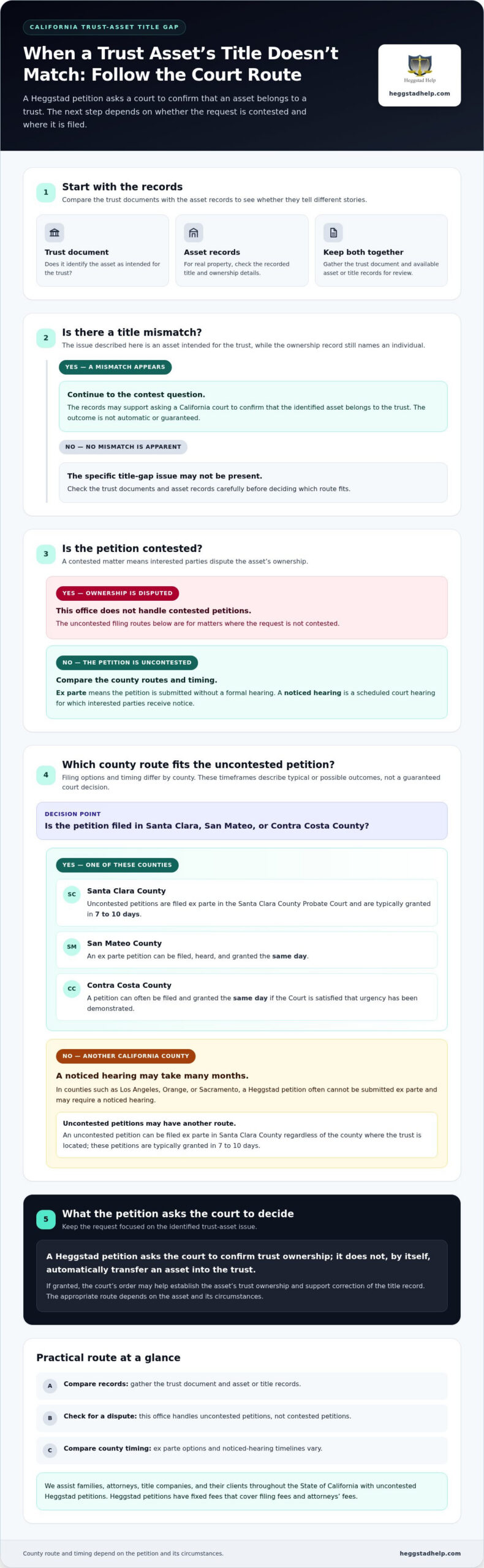
Next Steps After Court Confirms a Trust Asset in California

What if the Court confirms that an asset belongs to a trust, but the ownership records still don’t reflect that decision? That gap can leave families…

What if the Court confirms that an asset belongs to a trust, but the ownership records still don’t reflect that decision? That gap can leave families unsure what to do next. The next steps after court confirms trust asset ownership depend on the order and the type of asset. The Court’s determination resolves an ownership question, but follow-up documentation or title work may still be needed.

If you’re a successor trustee, keep the signed order with the trust documents and records identifying the asset. Then check what the order says and what still needs attention. This article explains the difference between the Court’s decision and ongoing asset administration, which records to organize, and how to approach unresolved title information.

If a different asset still needs court confirmation, an uncontested Heggstad petition may be appropriate. HEGGSTAD HELP assists families, attorneys, title companies, and their clients throughout California with uncontested ex parte Heggstad petitions filed in the Santa Clara County Probate Court, regardless of where the trust is located. These petitions are typically granted in 7 to 10 days.

Key Takeaways

  • A confirmation order recognizes an asset as trust property, but its exact wording guides what steps may follow.
  • For the next steps after court confirms trust asset ownership, preserve the signed order and compare its asset description and trust name with available records.
  • Track unresolved title questions and remaining administration separately. A discrepancy doesn’t by itself mean the Court’s order failed.
  • If another asset still needs court confirmation, HEGGSTAD HELP assists families, attorneys, title companies, and clients throughout California with uncontested ex parte Heggstad petitions filed in the Santa Clara County Probate Court. These petitions are typically granted in 7 to 10 days.

After a California Court Confirms a Trust Asset: What the Order Means

A Court confirmation is an important milestone, but it doesn’t necessarily finish the work. The exact terms of the order guide what follows. In plain English, asset confirmation means the Court has recognized the asset identified in its decision as property of the trust. The order answers that ownership question; it doesn’t automatically update every title, account, or trust record.

A trust is a legal relationship in which a trustee manages property for beneficiaries under the trust’s terms. This helps explain why a Court decision about a particular asset and the later work of administering it are separate steps.

The Court determines whether the identified asset belongs to the trust; the successor trustee or another appropriate representative coordinates the next administrative steps. So, the next steps after court confirms trust asset ownership begin with understanding what the order covers, not assuming every related record has changed.

What does a trust-asset confirmation order establish?

The order addresses the asset described in the Court’s determination. Read that description carefully, then compare it with the trust document and available ownership records. For example, if the order identifies a particular property, don’t assume it also resolves questions about a separate account or another property. Treat the order as applying to the asset it identifies, not to unrelated assets or disputes.

Who should organize the next steps?

The successor trustee, or another appropriate trust representative, can coordinate the follow-up and keep the relevant records together. Depending on the situation, family members, attorneys, and title-company professionals may also be involved. Start by identifying who is coordinating, sharing the order and supporting records with the relevant participants, and noting any differences that still need attention. A discrepancy is a question to investigate, not by itself proof that the Court’s decision failed.

Review the California Court Order Before Changing Asset Records

Before changing or relying on an asset record, read the order carefully. Confirm that it is signed, identify the asset described, check the trust name, and note any directions the Court included. Then compare those details with the relevant trust provisions and available ownership records. Differences between documents don’t automatically mean the order is ineffective, but they do make careful review important.

The order’s wording and the asset it identifies determine the scope of the confirmation. The Court’s decision may resolve the question it addressed, while separate record updates or other administration for that asset may remain. The California Courts Self-Help Guide provides background on petitions to confirm trust assets, including property not titled in the trust’s name. Focus on what the specific order says rather than assuming it updates every record automatically.

Which records should the successor trustee keep together?

Organize the signed order, relevant trust provisions, petition materials, and existing records for the asset in one file. Add a brief status note describing how the asset was recorded before the order and what remains afterward. This gives the successor trustee and others involved a clear reference point, alongside broader guidance such as a “Successor Trustee Duties for an Unfunded Trust” guide.

What if a title or account record still looks different?

Compare the record’s exact description and ownership information with the order’s language. Write down the specific mismatch and any unanswered question instead of assuming the Court’s confirmation failed or that the record changed automatically. For context on petitions involving real property, see a “California Probate Code Section 850: A Guide to Real Property Petitions.” If an unresolved asset issue calls for Heggstad petition assistance, learn about Heggstad petition help.

Follow a Practical Checklist for Trust Assets After Court Confirmation

A simple asset-by-asset checklist can keep Court confirmation separate from follow-up work. For each confirmed asset:

  • Preserve the order. Keep the signed order with the trust and petition records.
  • Match the asset. Compare the order’s description with the asset and its available records.
  • Document its status. Note the order date, what the order addresses, and the asset’s status before and after confirmation.
  • Track remaining administration. Record open questions and follow-up activity without assuming that a difference in records means the order failed.

This record helps the successor trustee see what the Court confirmed and what still needs attention. Keep relevant correspondence and records of steps taken to implement the order with the asset’s file. Don’t add deadlines or duties based on assumptions; look to the trust, the order, and applicable law for guidance.

How should the trustee track a confirmed asset?

Use a separate entry for each asset, including the order date, a clear asset description, and a brief follow-up status. If a question remains, describe the mismatch and what information is still needed. Keep notes factual and update them as the asset’s status becomes clearer. For more background on the petition process, see this Heggstad petition filing guide.

What if another asset remains outside the order?

Confirmation applies to the asset addressed in the order; it doesn’t automatically confirm a different asset. Identify that asset and organize its ownership history and related trust records before considering whether another Court petition may be appropriate. A separate asset issue is not proof that the order for the confirmed asset failed.

If an additional asset still needs Court confirmation, HEGGSTAD HELP assists families, attorneys, title companies, and their clients throughout the State of California with uncontested ex parte Heggstad petitions filed in the Santa Clara County Probate Court, regardless of where the trust is located. Explore Heggstad petition assistance.

Next Steps After Court Confirms a Trust Asset in California

When California Heggstad Petition Help May Still Be Relevant

A confirmation order settles the Court question for the asset it identifies. A separate asset that isn’t covered by that order may still need a Court determination. Keep the two issues distinct: don’t treat a record mismatch for the confirmed asset as automatic proof that another petition is needed, and don’t assume the order also covers other property.

If another asset’s ownership remains unresolved, HEGGSTAD HELP assists families, attorneys, title companies, and their clients throughout the State of California with uncontested Heggstad petitions. An ex parte petition is a request made to the Court without a formal hearing. We file uncontested petitions ex parte in Santa Clara County, including when the trust or asset is located elsewhere in California.

How can the filing path differ across California counties?

For an uncontested ex parte petition filed in Santa Clara County, orders are typically granted in 7 to 10 days. In San Mateo County, petitions can be filed, heard, and granted the same day. Contra Costa County petitions can often be filed and granted the same day if the Court is satisfied that urgency has been demonstrated. These timelines describe the filing paths, not a guarantee of a particular result.

For families in Los Angeles County, Orange County, San Diego County, and other California counties, a Heggstad petition may often require a noticed hearing in that county and take many months to be heard. An uncontested petition can instead be filed ex parte in Santa Clara County, where it is typically granted in 7 to 10 days. HEGGSTAD HELP assists families, attorneys, title companies, and clients throughout California with this filing path, including those in Alameda County, San Francisco County, Marin County, and Sacramento County.

When might a different petition path take longer?

A noticed hearing is a court date scheduled after interested parties receive notice. It may be set 30 to 60 days after filing, or several months later in some counties, with additional time needed for notice. HEGGSTAD HELP handles uncontested petitions only, not contested petitions. Our fixed fees cover filing fees and attorneys’ fees. If a separate asset still needs confirmation, learn about uncontested Heggstad petition assistance and the available filing paths.

Move Forward With a Clear Plan for Each Trust Asset

A Court confirmation is a meaningful step, but the order’s terms define what it resolves. Keep the order and related records together, match its description to the specific asset, and track remaining record updates or administration separately. If another asset isn’t covered, treat that as a separate question rather than assuming the existing order applies.

For an asset that still needs Court confirmation, HEGGSTAD HELP assists families, attorneys, title companies, and clients throughout the State of California with uncontested ex parte Heggstad petitions. Robert P. Bergman is a California-licensed attorney and Board-Certified Specialist in Estate Planning, Trust and Probate Law. Fixed fees cover filing fees and attorneys’ fees. If you’re considering the next steps after court confirms trust asset ownership, or have a different asset that remains unresolved, explore California Heggstad petition assistance.

With the order’s scope clear and each open issue documented, you can approach the work ahead with greater confidence.

Frequently Asked Questions

What happens after a court confirms an asset belongs to a trust?

After the Court confirms an asset belongs to a trust, the successor trustee should review the order, match its description to the asset, and coordinate any follow-up administration that applies. The next steps after court confirms trust asset ownership depend on the order’s terms and the asset’s records. Keep a note of unresolved differences; they don’t, by themselves, mean the Court’s determination failed.

Does a court order confirming trust property automatically change the title?

No. A court order confirms what the Court determined about the identified asset, but it doesn’t necessarily update a deed, account record, or other ownership information automatically. Review the signed order and compare its asset description and trust name with current records. If they differ, document the precise mismatch and identify what follow-up the order and the particular asset may call for.

What documents should a successor trustee keep after a Heggstad order?

Keep the signed court order, relevant trust provisions, petition and supporting materials, and available ownership records together. Also retain related correspondence and a concise asset-status note showing the asset description, order date, what the order confirms, and any follow-up still open. Organizing records asset by asset helps the successor trustee distinguish confirmed property from other assets or questions the order didn’t address.

Can a California Heggstad petition be filed in Santa Clara County for property elsewhere in California?

Yes. HEGGSTAD HELP assists families, attorneys, title companies, and clients throughout the State of California by filing uncontested ex parte Heggstad petitions in the Santa Clara County Probate Court, regardless of where the trust is located. This includes clients in the San Francisco Bay Area, Northern California, Southern California, the Central Valley, San Diego, Sacramento, Fresno, Bakersfield, Greater Los Angeles, Orange County, Riverside County, and San Bernardino County.

How long does a California Heggstad petition take after filing?

Timing depends on the county and filing path. Uncontested ex parte petitions in Santa Clara County are typically granted in 7 to 10 days from filing. In San Mateo County, they can be filed, heard, and granted the same day. Contra Costa County petitions can often be granted the same day if the Court is satisfied that urgency is demonstrated. Elsewhere, noticed hearings may take many months, plus time for notice.

Robert P. Bergman, Attorney at Law

Article by

Robert P. Bergman, Attorney at Law

Attorney Robert P. Bergman ("Bob Bergman") has been a Board-Certified Specialist in Estate Planning, Trust and Probate Law since 2011, as certified by the California State Bar Board of Legal Specialization. For several years, Bob has assisted families and the clients of other attorneys with obtaining court orders through Heggstad petitions to avoid the time and expense of Probate administration. Bob is friendly, very approachable, and believes in explaining complex legal topics in clear ordinary language so that his clients understand exactly what they're doing and why they're doing it.
Bob is often able to assist clients who are in other counties than his home county of Santa Clara through his approach to Heggstad petitions.

Disclaimer

This article is for informational purposes only. Nothing in this article is intended to replace legal advice from a competent attorney or be considered legal guidance for anybody's specific legal situation. Nobody should rely on information in this article in making legal decisions without such consultation.

Heggstad Petition Lawyer in San Francisco: Local Guidance for Trust Assets

A San Francisco family may discover that a home or other asset was never retitled in a loved one’s trust, just as they’re preparing to transfer or…

A San Francisco family may discover that a home or other asset was never retitled in a loved one’s trust, just as they’re preparing to transfer or sell it. A Heggstad petition lawyer that San Francisco families work with can assess whether the available records support asking a court to treat that asset as trust property, potentially avoiding probate for that asset alone.

It’s understandable to wonder why a matter involving San Francisco County might be filed elsewhere, or whether court timing could hold up next steps. For uncontested petitions, we assist families, attorneys, title companies, and their clients throughout California by filing ex parte (without a formal hearing) in Santa Clara County, regardless of where the trust is located. These petitions are typically granted in 7 to 10 days, though timing and outcomes aren’t guaranteed.

This article explains how the petition works, what documents and facts can help evaluate it, and why the filing county matters. You’ll also learn what to expect from focused legal assistance, including fixed fees that cover filing fees and attorney fees. Our office handles uncontested petitions, not contested matters.

Key Takeaways

  • Gather the trust, any asset schedules, title records, and documents showing the trustmaker’s intent to help assess whether a petition may fit.
  • A Heggstad petition lawyer San Francisco families work with can explain how an uncontested San Francisco County matter may be filed ex parte in Santa Clara County.
  • Identify the asset, its current title, and any known disagreement early; those details help determine whether an uncontested petition is appropriate.
  • Robert P. Bergman is a California-licensed attorney and Board-Certified Specialist in Estate Planning, Trust and Probate Law; fixed fees cover filing fees and attorney fees.

Need a Heggstad Petition Lawyer in San Francisco? Start With the Asset Problem

A trust may describe what should happen to a home, yet the deed may still show ownership in the trustmaker’s individual name. That mismatch can leave the successor trustee, the person who takes over managing the trust, unsure how to handle the property. A Heggstad petition asks a court to confirm that a specific asset should be treated as trust property, based on evidence of the trustmaker’s intent.

A Heggstad petition is a request for court confirmation that an asset belongs to a trust; it is not a lawsuit to resolve a contested trust dispute. The remedy comes from the Estate of Heggstad case. The available trust documents, transfer evidence, and asset records help shape whether a petition may be appropriate. A petition doesn’t guarantee the court will grant the request or that probate can always be avoided.

When a San Francisco trust asset may need court confirmation

Real property is a common example. A trust may identify a San Francisco home, or other records may show an intent to transfer it, but the title paperwork may not have been completed as expected. Collect the trust and amendments, deeds, asset schedules, and relevant transfer records. Reviewing them together helps clarify the issue and whether the facts support an uncontested petition.

Who the focused petition service assists

A Heggstad petition lawyer San Francisco families work with can assist families, successor trustees, attorneys, title companies, and their clients. We support clients throughout the State of California by filing uncontested ex parte petitions (court requests handled without a formal hearing) in Santa Clara County, regardless of where the trust is located. This focused service addresses an asset-title problem, not contested trust litigation or full probate administration. For a broader overview, see the California Heggstad petition filing guide.

How San Francisco Heggstad Petitions Use the Ex Parte Filing Route

For an uncontested San Francisco County matter, the petition may be filed ex parte in Santa Clara County. “Ex parte” means requesting a court order without a formal hearing. This filing route can offer a more direct path than a noticed hearing, where interested parties receive formal notice and the hearing may be set much later.

Uncontested Heggstad petitions for San Francisco County matters can be filed ex parte in Santa Clara County, where petitions are typically granted 7 to 10 days after filing, though timing and outcomes aren’t guaranteed. The petition asks the court to confirm how a particular asset should be treated. For background on the legal process, see California Probate Code Section 850.

Why a San Francisco matter may proceed through Santa Clara County

County procedures can differ, so the filing approach isn’t identical everywhere. We assist families, attorneys, title companies, and their clients throughout the State of California with uncontested petitions, including matters involving assets in San Francisco County and Alameda County, by filing in Santa Clara County regardless of where the trust is located. For more context, read this California Probate Code Section 850 guide.

How the stated county timelines differ

Santa Clara County petitions are typically granted in 7 to 10 days from filing. In San Mateo County, ex parte petitions can be filed, heard, and granted the same day. Contra Costa County petitions can often be filed and granted the same day if the Court is satisfied that urgency has been demonstrated.

In other counties, an uncontested petition may require a noticed hearing, and those hearings can take many months. Filing ex parte in Santa Clara County is an alternative route for eligible uncontested matters, not a guarantee of a particular result. If you’re organizing a San Francisco matter, a focused Heggstad petition filing service can help clarify the appropriate route.

Is an Uncontested Heggstad Petition the Right Fit for Your San Francisco Matter?

Start with four questions: What asset is involved? Which trust relates to it? Who currently holds title? Does anyone disagree that the asset was meant to belong to the trust? These details help frame whether an uncontested petition may be suitable, but they aren’t a complete legal checklist or a determination of eligibility.

What information helps assess an uncontested petition

Gather what you have, even if the records don’t tell a complete story:

  • The trust document and any available amendments or asset schedules.
  • Records identifying the property or other asset, including the current deed or title information.
  • Documents or other evidence that may show the person who created the trust intended the asset to be held in it.
  • The county where the asset is located and a note of any known objections or disagreements.

For San Francisco property, a formal hearing in San Francisco County isn’t necessarily the only route. An uncontested matter may be filed ex parte in Santa Clara County. The documents and facts still matter, and the court decides whether the request is supported.

When a contested matter is different

If someone disputes ownership or what the person who created the trust intended, the matter may no longer be appropriate for an uncontested ex parte filing. HEGGSTAD HELP handles uncontested Heggstad petitions, not contested petitions or trust litigation. For general background on potential issues in disputes involving Probate Code Section 850 actions, review the linked discussion, then keep a clear record of any objections you know about.

A Heggstad petition lawyer San Francisco families work with can assess the trust and asset records as part of a focused filing service. Learn more about Heggstad petition legal services, or start organizing your petition information.

Heggstad Petition Lawyer in San Francisco: Local Guidance for Trust Assets

What to Expect From a San Francisco Heggstad Petition Lawyer

A focused Heggstad service centers on the asset that may have been left outside the trust, the records showing what was intended, and the court filing needed to ask for confirmation. For an uncontested matter, the work includes preparing and filing the petition and pursuing an ex parte order (a court request handled without a formal hearing). The court makes the decision, so no attorney can promise a particular result.

What the fixed fee and focused service mean

Heggstad petition fees are fixed and cover filing fees and attorney fees. The practice focuses on Heggstad petitions, ex parte court orders, and trust asset title correction. It does not handle contested petitions, trust litigation, trust administration, or full probate administration.

Robert P. Bergman is a California-licensed attorney and a Board-Certified Specialist in Estate Planning, Trust and Probate Law. That focused background is relevant when assessing trust documents, asset records, and the filing approach for an uncontested petition.

A practical next step for San Francisco families and professionals

Before discussing your matter, gather the trust and any amendments, records identifying the asset, and documents that may show the trustmaker intended it to be trust property. Be ready to identify the county where the asset is located, who currently holds title, and whether anyone has objected. These details help bring the issue into focus.

A Heggstad petition lawyer San Francisco families, attorneys, and title companies work with can assist with uncontested matters involving assets in San Francisco County and throughout the State of California. The filing may be handled in Santa Clara County regardless of where the trust is located, but the court determines the outcome. To take the next step, review our Heggstad petition assistance and bring the relevant records together for a focused discussion.

Take the Next Step With a Focused Petition Approach

An asset left outside a trust can raise real questions, but the right starting point is practical: identify the asset, gather the trust and title records, and note whether anyone objects. For an uncontested San Francisco County matter, a petition may be filed ex parte in Santa Clara County. These petitions are typically granted in 7 to 10 days, though timing and outcomes aren’t guaranteed.

Families, attorneys, title companies, and their clients throughout the State of California can receive help with uncontested Heggstad petitions. Robert P. Bergman is a California-licensed attorney and Board-Certified Specialist in Estate Planning, Trust and Probate Law. The practice focuses on Heggstad petitions and ex parte court order services, with fixed fees covering filing fees and attorney fees.

If you’re considering a Heggstad petition lawyer San Francisco families can turn to for focused guidance, take the next step by gathering your records and discussing an uncontested Heggstad petition. A clear review of the documents can help you understand the path ahead, one step at a time.

Frequently Asked Questions

Is a Heggstad petition for San Francisco property filed in San Francisco County?

Not necessarily. For an uncontested San Francisco County matter, HEGGSTAD HELP can file ex parte in Santa Clara County, regardless of where the trust property is located. Ex parte means a court request handled without a formal hearing. Santa Clara County petitions are typically granted in 7 to 10 days from filing, but neither the timing nor the court’s decision is guaranteed.

How long does a Heggstad petition take in California?

Timing depends on the filing route and the Court. Santa Clara County ex parte petitions are typically granted in 7 to 10 days from filing. In San Mateo County, petitions can be filed, heard, and granted the same day. Contra Costa County petitions can often be filed and granted the same day if the Court is satisfied that urgency has been shown. These timeframes aren’t guarantees.

Can a Heggstad petition be filed ex parte for property outside Santa Clara County?

Yes. HEGGSTAD HELP files uncontested ex parte petitions in Santa Clara County for trust assets elsewhere in California, including San Francisco County. We assist clients across the San Francisco Bay Area, Northern and Southern California, the Central Valley, San Diego, Sacramento, Fresno, Bakersfield, Greater Los Angeles, Orange County, Riverside County, and San Bernardino County. The court’s procedures and decision depend on the matter.

Does HEGGSTAD HELP handle a contested Heggstad petition?

No. HEGGSTAD HELP handles uncontested Heggstad petitions, not contested petitions. A matter may be contested if someone disputes whether an asset belongs to the trust or challenges the trustmaker’s intent. That disagreement can change the appropriate court process, so don’t assume an uncontested ex parte filing route applies when an objection exists.

What does the fixed fee for a Heggstad petition cover?

The fixed fee covers filing fees and attorney fees. It doesn’t imply that services beyond the Heggstad petition are included. To help discuss the matter, gather the trust document, records identifying the asset, and title information. Be ready to share the county where the asset is located and whether anyone has objected. Those details help place the filing question in context.

Robert P. Bergman, Attorney at Law

Article by

Robert P. Bergman, Attorney at Law

Attorney Robert P. Bergman ("Bob Bergman") has been a Board-Certified Specialist in Estate Planning, Trust and Probate Law since 2011, as certified by the California State Bar Board of Legal Specialization. For several years, Bob has assisted families and the clients of other attorneys with obtaining court orders through Heggstad petitions to avoid the time and expense of Probate administration. Bob is friendly, very approachable, and believes in explaining complex legal topics in clear ordinary language so that his clients understand exactly what they're doing and why they're doing it.
Bob is often able to assist clients who are in other counties than his home county of Santa Clara through his approach to Heggstad petitions.

Disclaimer

This article is for informational purposes only. Nothing in this article is intended to replace legal advice from a competent attorney or be considered legal guidance for anybody's specific legal situation. Nobody should rely on information in this article in making legal decisions without such consultation.
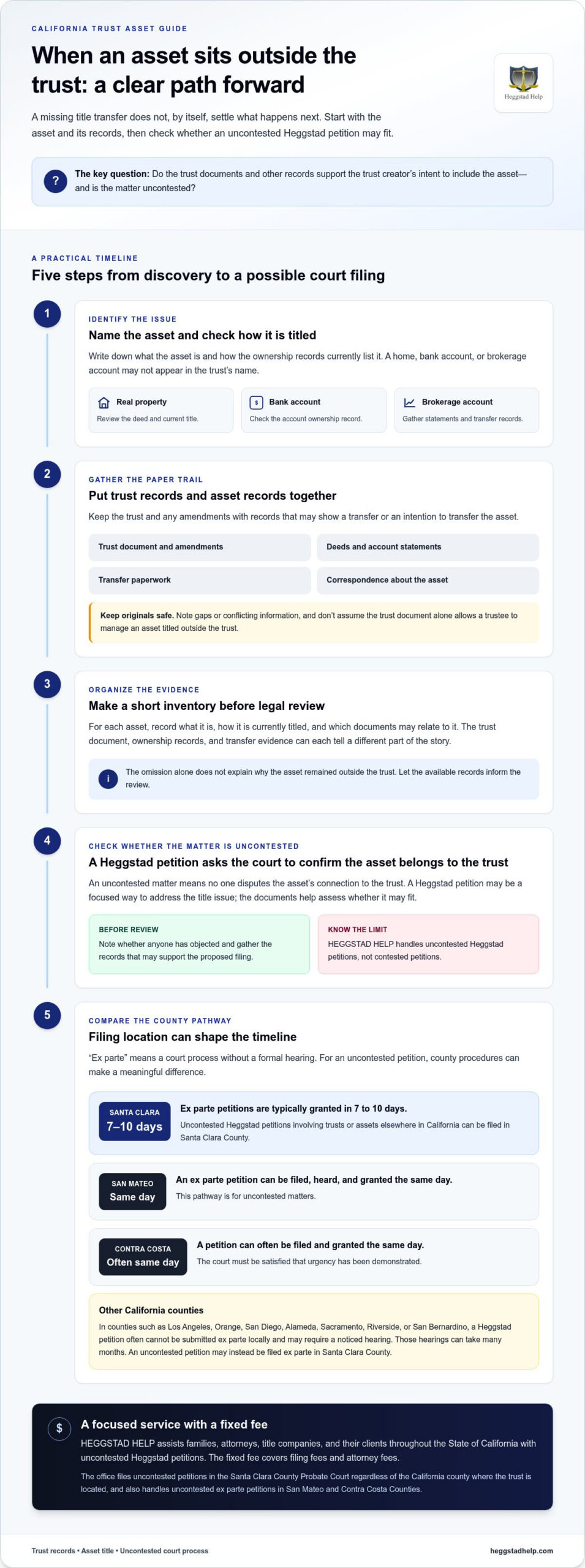
Risks of a DIY Heggstad Petition in California: What to Consider

What if the biggest risk of filing a Heggstad petition yourself isn’t the paperwork, but whether the evidence and filing approach fit your situation?…

What if the biggest risk of filing a Heggstad petition yourself isn’t the paperwork, but whether the evidence and filing approach fit your situation? The risks of DIY Heggstad petition California cases can include delays or a denied request if the documents don’t clearly support the person’s intent to place an asset in the trust, or if filing and notice requirements aren’t handled correctly.

It’s understandable to look for a direct way to address an asset left outside a trust. A Heggstad petition asks the court to confirm that the asset belongs to the trust. The right approach can depend on the available evidence, whether anyone objects, and county procedures. This article explains what to review before self-filing, how ex parte filings, which ask the court to act without a formal noticed hearing, differ from noticed hearings, and when an uncontested ex parte option may fit. HEGGSTAD HELP assists families, attorneys, title companies, and their clients throughout California with uncontested petitions, including eligible matters filed in Santa Clara County involving trusts located elsewhere in California. These petitions are typically granted in 7 to 10 days, but timing and outcomes aren’t guaranteed.

Key Takeaways

  • The risks of DIY Heggstad petition California filings can go beyond completing forms. Review whether the trust and ownership records support the request.
  • Gather the trust, asset details, title information, and related ownership records. Compare them to identify gaps or inconsistencies that may need attention.
  • Check the filing options for the relevant county. Uncontested petitions involving trusts in other California counties may often be filed ex parte in Santa Clara County, where they’re typically granted in 7 to 10 days.
  • Consider whether anyone disputes ownership before choosing a filing approach. HEGGSTAD HELP assists with uncontested petitions statewide but doesn’t handle contested petitions.

What are the risks of a DIY Heggstad petition in California?

An asset may have been intended for a trust but never formally titled in the trust’s name. A Heggstad petition asks the court to confirm that the asset belongs to the trust. The request is associated with Probate Code Section 850, a California law that allows the court to consider claims about who owns certain property. The Estate of Heggstad case provides the historical background for this type of petition.

The risks of DIY Heggstad petition California filings aren’t limited to filling out a form incorrectly. The petition needs to explain the relevant facts and include records that support the request. The court’s review may depend on what the trust says, how specifically the asset is identified, and what the available documents show about the person’s intent.

Why a Heggstad petition is not just a form

A petition needs to connect the trust documents to the particular asset. For example, a trust record may describe an asset generally, while title information identifies a specific property or account under a different name. Compare names, dates, asset descriptions, and ownership records. Note any mismatch, missing document, or unclear link between the trust and the asset before filing.

Some uncontested petitions may be filed ex parte, meaning the request is presented without a formal hearing. That does not eliminate the need for a clear, supported filing. Available procedures depend on the county and the case.

What DIY filing may put at risk

If key records are missing or the connection between the trust and asset isn’t explained, the court may have questions. Depending on the circumstances, you may need to correct or supplement the filing, adding work or delay. An unclear filing doesn’t automatically mean the request will be denied, but it can make review more complicated.

Incomplete information can make it harder for the court to understand why an asset should be treated as trust property. Before proceeding, compare the trust, asset description, and title records. Also identify any ownership disagreement, since that could affect the filing approach.

Where California Heggstad filings can become complicated

The available filing route can depend on county procedure, not just where the trust or asset is located. In counties beyond Santa Clara, San Mateo, and Contra Costa, an uncontested Heggstad petition may require a noticed hearing, a formal court hearing scheduled with advance notice to interested parties. In some counties, that hearing may take many months to occur. Check the current requirements for the intended filing county before selecting a route.

How the stated county options differ

For eligible uncontested matters, HEGGSTAD HELP assists families, attorneys, title companies, and their clients throughout California, including in the San Francisco Bay Area, Northern California, Southern California, the Central Valley, San Diego, Sacramento, Fresno, Bakersfield, Greater Los Angeles, Orange County, Riverside County, and San Bernadino County. A petition involving a trust in another California county can often be filed ex parte in Santa Clara County Probate Court. Ex parte means asking the court to act without a formal hearing.

Santa Clara County petitions are typically granted in 7 to 10 days, though timing and outcomes aren’t guaranteed. In San Mateo County, petitions can be filed, heard, and granted the same day. In Contra Costa County, they can often be filed and granted the same day if the Court is satisfied that urgency has been shown.

Why the filing route matters

An ex parte request and a noticed hearing follow different procedures, and not every case qualifies for an ex parte filing. The California Probate Code Section 850 provides the legal basis for asking the court to address property claims involving a trust. County filing requirements still need careful review.

For an eligible, uncontested petition involving a trust elsewhere in California, Santa Clara County may offer an ex parte filing option, typically decided within 7 to 10 days. If you’re weighing the risks of DIY Heggstad petition California procedures, check the county’s current requirements and consider whether anyone may object. Learn more about uncontested Heggstad petition filing. This office doesn’t handle contested petitions.

Risks of a DIY Heggstad Petition in California: What to Consider

DIY filing or specialized help: how to assess your California case

Whether self-filing feels manageable depends on how clearly you can connect the asset to the trust and follow the applicable court procedure. Before deciding, gather the trust documents, asset description, title information, and any records showing ownership. Then consider:

  • Can you identify the asset and explain the facts supporting the requested ownership confirmation?
  • Do you know which county’s filing route may apply, and whether a noticed hearing may be required?
  • Is the matter uncontested, or could someone challenge who owns the asset?

If you’re unsure about the legal basis, California Probate Code Section 850 is the statute connected to these petitions. A Heggstad petition filing guide can also help explain the process. Neither resource determines whether your specific facts or filing route are appropriate.

What focused help can add

When you prepare a filing yourself, you’re responsible for organizing the facts, identifying potential gaps, and presenting the request in a way that fits the applicable procedure. Focused Heggstad petition assistance can help prepare an eligible uncontested filing and assess available county options. Not every case qualifies for an ex parte request, and a court may not grant a petition.

For eligible uncontested matters, HEGGSTAD HELP assists families, attorneys, and clients throughout California with ex parte petitions in Santa Clara County Probate Court, regardless of where in California the trust is located. These petitions are typically granted in 7 to 10 days, but timing and outcomes aren’t guaranteed. The office also files uncontested ex parte petitions in San Mateo and Contra Costa Counties. Contested petitions are outside its services.

If you’re weighing the risks of DIY Heggstad petition California filing, review Heggstad petition services and compare the available support with the needs of your case.

A practical next step for an uncontested Heggstad petition in California

Before choosing how to proceed, organize records showing what the asset is, how it is currently titled, and how it relates to the trust. Reviewing these items together can help you spot facts that need further attention. A checklist alone can’t confirm that a petition is suitable.

What to have ready for an initial case review

  • The trust document and any available schedules or records that identify the asset.
  • Current title or ownership information, such as records naming the owner of the property or account.
  • A short timeline of relevant events, including when the trust was created and any changes to the asset’s ownership.
  • Notes about any disagreement over ownership, even if you’re unsure whether it amounts to a dispute.

For background, see this California Heggstad petition guide. Use it to understand the process, not as a substitute for reviewing your facts and the applicable filing requirements.

How HEGGSTAD HELP describes its filing service

HEGGSTAD HELP assists families, attorneys, title companies, and their clients throughout California with uncontested ex parte Heggstad petitions. An ex parte filing asks the court to act without a formal hearing. Eligible petitions can be filed in Santa Clara County Probate Court regardless of which California county the trust is located in. Santa Clara County petitions are typically granted in 7 to 10 days, but court timing and outcomes aren’t guaranteed.

The office also files uncontested ex parte petitions in San Mateo County, where petitions can be filed, heard, and granted the same day, and in Contra Costa County, where same-day filing and grant may be possible if the Court is satisfied that urgency exists. Fixed fees cover filing fees and attorneys’ fees. The office doesn’t handle contested petitions.

If the risks of DIY Heggstad petition California filings have you unsure about your next step, you can discuss an uncontested Heggstad petition and whether your matter may fit the service.

Choose a clear path for your Heggstad petition

The risks of DIY Heggstad petition California filings often come down to whether the records connect the asset to the trust clearly and whether you follow an appropriate county filing route. Before proceeding, organize the trust documents, asset details, and title information, and consider whether anyone disputes ownership. These details can help clarify whether an uncontested filing may be suitable.

HEGGSTAD HELP assists families, attorneys, and clients throughout California with uncontested ex parte Heggstad petitions in Santa Clara County, regardless of where the trust is located. The practice also files in San Mateo and Contra Costa Counties. Fixed fees cover filing fees and attorneys’ fees, but court timing and outcomes aren’t guaranteed. Contested petitions aren’t handled by this office.

Robert P. Bergman is a California-licensed attorney and a Board-Certified Specialist in Estate Planning, Trust and Probate Law. His focused practice includes Heggstad petitions and trust asset title correction. To discuss whether your matter may fit, contact HEGGSTAD HELP about an uncontested Heggstad petition.

Frequently Asked Questions

Can I file a Heggstad petition myself in California?

Yes, you can file a Heggstad petition yourself, but you’ll need to present the facts and supporting records clearly and follow the applicable court procedure. The risks of DIY Heggstad petition California filers should consider include unclear evidence, missing information, or choosing a filing route that prompts additional questions or delay. Compare the trust documents, asset details, and title records before deciding whether self-filing feels manageable.

What happens if a Heggstad petition is denied or delayed?

If a petition is delayed, the court may need more information or the filing may need correction, depending on the circumstances. If it’s denied, the asset may remain outside the trust, and another process, potentially probate, may need to be considered. A denial doesn’t automatically determine what happens next. Keep copies of submitted documents and any court response so you can understand what issue needs attention.

Can an uncontested Heggstad petition be filed in Santa Clara County if the trust is elsewhere in California?

Often, an eligible uncontested petition involving a trust elsewhere in California can be filed ex parte in Santa Clara County Probate Court. Ex parte means asking the court to act without a formal hearing. HEGGSTAD HELP assists families, attorneys, and clients statewide, including those in the San Francisco Bay Area, Greater Los Angeles, the Central Valley, and San Diego. Eligibility and court decisions depend on the case.

How long can a California Heggstad petition take?

Timing depends on the county and filing route. Santa Clara County petitions are typically granted in 7 to 10 days, while San Mateo petitions can be filed, heard, and granted the same day. Contra Costa petitions can often be filed and granted the same day if the Court accepts the urgency shown. In other counties, a noticed hearing may take many months. These timelines aren’t guarantees.

Robert P. Bergman, Attorney at Law

Article by

Robert P. Bergman, Attorney at Law

Attorney Robert P. Bergman ("Bob Bergman") has been a Board-Certified Specialist in Estate Planning, Trust and Probate Law since 2011, as certified by the California State Bar Board of Legal Specialization. For several years, Bob has assisted families and the clients of other attorneys with obtaining court orders through Heggstad petitions to avoid the time and expense of Probate administration. Bob is friendly, very approachable, and believes in explaining complex legal topics in clear ordinary language so that his clients understand exactly what they're doing and why they're doing it.
Bob is often able to assist clients who are in other counties than his home county of Santa Clara through his approach to Heggstad petitions.

Disclaimer

This article is for informational purposes only. Nothing in this article is intended to replace legal advice from a competent attorney or be considered legal guidance for anybody's specific legal situation. Nobody should rely on information in this article in making legal decisions without such consultation.

Riverside County Trust Title Correction: How to Fix Trust Property Ownership

If the deed doesn’t show the trust as owner, it’s understandable to worry that the property will have to go through lengthy probate or that the…

If the deed doesn’t show the trust as owner, it’s understandable to worry that the property will have to go through lengthy probate or that the recorded title settles the issue. A Riverside county trust title correction may depend on what the trust documents and other records show, as well as which court route fits the facts. The courthouse closest to the property may not be the only filing path.

This article explains what to gather first, including the deed, trust, and any asset list or assignment that may show the owner intended the property to belong to the trust. You’ll also learn how a local noticed hearing differs from an uncontested ex parte Heggstad petition, which proceeds without a formal hearing. For eligible uncontested matters, HEGGSTAD HELP assists families, attorneys, title companies, and their clients throughout California by filing in Santa Clara County, regardless of where the trust property is located. Petitions there are typically granted in 7 to 10 days. We’ll help you understand whether the matter may fit this focused filing service.

Key Takeaways

  • For Riverside county trust title correction, compare the recorded deed with the trust documents to identify where ownership records and intended trust ownership may differ.
  • Write down the property’s county, the current titled owner, and the trust’s name before reviewing possible filing routes.
  • A Riverside County noticed hearing may take many months, while an eligible uncontested Heggstad petition may be filed ex parte in Santa Clara County and is typically granted in 7 to 10 days.
  • Learn how focused Heggstad petition filing may help families, attorneys, title companies, and clients throughout California, and what to consider when deciding whether a matter is uncontested.

Riverside County Trust Title Correction: Identify the Ownership Problem First

For Riverside County trustees, families, attorneys, and title professionals, start by checking what the recorded documents actually say. A Riverside county trust title correction addresses a mismatch between property records and the ownership the trust was intended to hold. Because a deed records who holds title, review it alongside the trust documents before deciding what the mismatch means. Real property includes land and things attached to it, but the records for a particular property still need careful comparison.

What to check in Riverside County property and trust records

Gather the current deed, the relevant trust document, and any available transfer records. Compare the owner named on the deed with the trust name, and check whether the property description is consistent across the documents. Look for a schedule of trust assets or an assignment, if available. Note differences in names, descriptions, or dates, and flag missing records for focused case review. These checks help organize the facts, but they don’t establish a legal conclusion on their own.

When a title issue may call for a Heggstad petition

A missing or incorrect trust title doesn’t automatically mean a Heggstad petition is appropriate. A routine deed correction and a request for the Court to confirm that an asset belongs to a trust are different issues. A Heggstad petition asks the Court to confirm an asset as trust property based on the facts and supporting documents. Whether the matter fits an uncontested petition depends on those details, so don’t assume eligibility from the deed alone.

HEGGSTAD HELP assists families, attorneys, title companies, and their clients throughout California with uncontested ex parte Heggstad petitions filed in Santa Clara County, regardless of the property’s county. Keep copies of the deed, trust, and transfer records together, and note every inconsistency you find. That gives a case review a clearer starting point.

Riverside Property: Compare a Local Noticed Hearing With an Ex Parte Filing

For Riverside county trust title correction, the filing location can affect how the matter is heard and how long the process may take. A noticed hearing is a formal court date, with notice provided to interested parties. An ex parte filing, as used for an uncontested Heggstad petition in these counties, proceeds without a formal hearing.

Filing path What to expect
Riverside County noticed hearing A hearing is scheduled after filing, with additional time for notice. Depending on the county and matter, a hearing may be set 30 to 60 days later or several months later, and some counties’ noticed petitions can take many months.
Uncontested ex parte filing in Santa Clara County Eligible petitions can be filed in Santa Clara County regardless of where the property is located. Petitions there are typically granted in 7 to 10 days.

These timelines are not guarantees. Confirm current procedures and case-specific expectations before choosing a filing path. For deed-recording details, consult the Riverside County recording requirements. Recording rules and a court petition address different parts of a title issue.

What ex parte means for an uncontested Heggstad petition

Ex parte means the petition is presented without a formal hearing. This route is for uncontested matters, and the facts and documents still need review. This office doesn’t handle contested petitions. For related background, see California Probate Code Section 850: A Guide to Real Property Petitions.

How San Mateo and Contra Costa County options differ

Uncontested ex parte petitions in San Mateo County can be filed, heard, and granted the same day. Contra Costa County petitions can often be granted the same day if the Court accepts the demonstrated urgency. Families, attorneys, title companies, and clients statewide can also seek filing of an eligible uncontested petition in Santa Clara County, regardless of the property’s county. To assess whether that route may fit, review our Heggstad petition filing services.

How to Prepare for Riverside County Trust Title Correction

Organizing the records can make a case review more useful. For Riverside county trust title correction, collect what you know and keep the facts separate from conclusions about eligibility, the correct filing route, or who legally owns the property.

Documents and details to organize before discussing the matter

  1. Record the basics: Note the property’s county, the current titled owner shown on the deed, and the trust’s full name.
  2. Gather available records: Locate the current deed, relevant trust documents, transfer records, and correspondence about the property or trust.
  3. Build a brief timeline: Write down known dates, ownership changes, and any previous court filings. If a record is missing, note that rather than filling in the gap with an assumption.

The evidence needed depends on the specific facts. A Heggstad petition may ask the Court to determine a property claim under Probate Code Section 850, but identifying that law doesn’t establish that a petition fits your situation. For broader background, read Heggstad petition guidance.

Questions to clarify before choosing a filing route

Before discussing next steps, ask whether anyone disputes that the property was intended for the trust and whether a formal hearing has been scheduled or notice sent. Record the answers and gather related letters or court papers. These are facts to share for review, not a determination that the matter is contested or eligible for a particular filing.

Once your records and timeline are organized, you can request a focused review of an uncontested Heggstad petition through Heggstad petition filing services. The firm assists families, attorneys, title companies, and clients throughout California with eligible uncontested petitions.

Riverside County Trust Title Correction: How to Fix Trust Property Ownership

Get Specialized Help With an Uncontested Riverside County Trust Title Matter

A Riverside county trust title correction may call for more than changing a deed. HEGGSTAD HELP focuses on Heggstad petition filing, ex parte court orders, and trust asset title correction. The office assists families, attorneys, title companies, and their clients throughout California with uncontested matters. It does not handle contested petitions or full Probate administration, so confirming whether anyone disputes the trust’s intended ownership is an important first step.

When the firm’s statewide ex parte service may fit

For an eligible, uncontested matter involving Riverside property, the petition may be filed ex parte in the Santa Clara County Probate Court, regardless of the county where the property is located. Ex parte means the filing proceeds without a formal hearing. Santa Clara County petitions are typically granted in 7 to 10 days, but timing and suitability depend on the case and court. HEGGSTAD HELP serves matters across the San Francisco Bay Area, Northern California, Southern California, the Central Valley, San Diego, Sacramento, Fresno, Bakersfield, Greater Los Angeles, Orange County, Riverside County, and San Bernadino County. Robert P. Bergman is a California-licensed attorney and Board-Certified Specialist in Estate Planning, Trust and Probate Law. Learn more about the firm’s Heggstad petition services.

A straightforward next step for trustees and referring professionals

Before requesting a case review, write a short summary of the title discrepancy and gather the current deed, relevant trust records, and any transfer documents or correspondence you already have. Note the property’s county, the titled owner, the trust’s name, and whether anyone objects. These details help clarify whether the matter may fit an uncontested petition, but they don’t establish eligibility by themselves.

If you’re ready to discuss an uncontested petition for Riverside property, discuss your Riverside County trust title matter.

Take the Next Step Toward Resolving the Title Issue

A Riverside county trust title correction starts with understanding the mismatch, not assuming what the deed or trust documents mean on their own. Gather the current deed, relevant trust records, and any transfer documents, then note the property’s county, titled owner, and trust name. Those details can help determine whether a Heggstad petition may fit and whether the matter is uncontested.

For eligible uncontested matters, families, attorneys, title companies, and clients throughout California can be assisted with ex parte Heggstad petitions filed in Santa Clara County, regardless of where the property is located. Petitions there are typically granted in 7 to 10 days, though timing and eligibility depend on the case. Robert P. Bergman is a California-licensed attorney and Board-Certified Specialist in Estate Planning, Trust and Probate Law, and the practice has operated since 1980.

To discuss whether this focused filing service may suit your circumstances, discuss an uncontested Heggstad petition for a Riverside County property. Bring the records you’ve gathered so the relevant facts can be reviewed.

Frequently Asked Questions

Can a Heggstad petition correct title to a Riverside County property?

It may, if the facts and supporting records show that the property was intended to belong to the trust. A Heggstad petition asks the Court to confirm an asset as trust property. It isn’t simply a routine deed correction, and a title mismatch alone doesn’t establish eligibility. For Riverside county trust title correction, compare the deed with the trust and any available asset schedule or assignment, then have the circumstances reviewed.

Does a Riverside County Heggstad petition have to be filed in Riverside County?

No. An eligible uncontested Heggstad petition involving Riverside County property may be filed ex parte in the Santa Clara County Probate Court, regardless of the property’s county. Ex parte means proceeding without a formal hearing. Heggstad petitions in Riverside County and other counties outside Santa Clara, San Mateo, and Contra Costa often require noticed hearings, which may take many months. Confirm the appropriate route for the specific facts and current court procedures.

How long does an uncontested Heggstad petition take in Santa Clara County?

Petitions filed ex parte in Santa Clara County are typically granted in 7 to 10 days, according to the firm’s information. That’s a typical timeframe, not a guaranteed result or a promise that every petition will qualify. The documents, case details, and court procedures can affect timing. Before making plans, ask for case-specific expectations and confirm that the matter is uncontested and suitable for this filing route.

What documents should I gather for a Riverside County trust title correction?

Start with the current deed and relevant trust documents, including any available asset schedule or assignment. Also collect transfer records, correspondence about the property, and papers from any previous court filing. Note the property’s county, the owner named on the deed, the trust’s name, and known ownership-change dates. The evidence needed varies by case, so organizing records doesn’t determine petition eligibility by itself.

Does HEGGSTAD HELP handle contested trust title petitions?

No. HEGGSTAD HELP handles uncontested Heggstad petitions and doesn’t handle contested petitions or full Probate administration. If someone disputes whether the property was intended for the trust, mention that during case review rather than assuming the matter qualifies for an uncontested filing. The practice assists families, attorneys, title companies, and clients throughout California with eligible petitions, including matters involving Riverside County property.

Robert P. Bergman, Attorney at Law

Article by

Robert P. Bergman, Attorney at Law

Attorney Robert P. Bergman ("Bob Bergman") has been a Board-Certified Specialist in Estate Planning, Trust and Probate Law since 2011, as certified by the California State Bar Board of Legal Specialization. For several years, Bob has assisted families and the clients of other attorneys with obtaining court orders through Heggstad petitions to avoid the time and expense of Probate administration. Bob is friendly, very approachable, and believes in explaining complex legal topics in clear ordinary language so that his clients understand exactly what they're doing and why they're doing it.
Bob is often able to assist clients who are in other counties than his home county of Santa Clara through his approach to Heggstad petitions.

Disclaimer

This article is for informational purposes only. Nothing in this article is intended to replace legal advice from a competent attorney or be considered legal guidance for anybody's specific legal situation. Nobody should rely on information in this article in making legal decisions without such consultation.
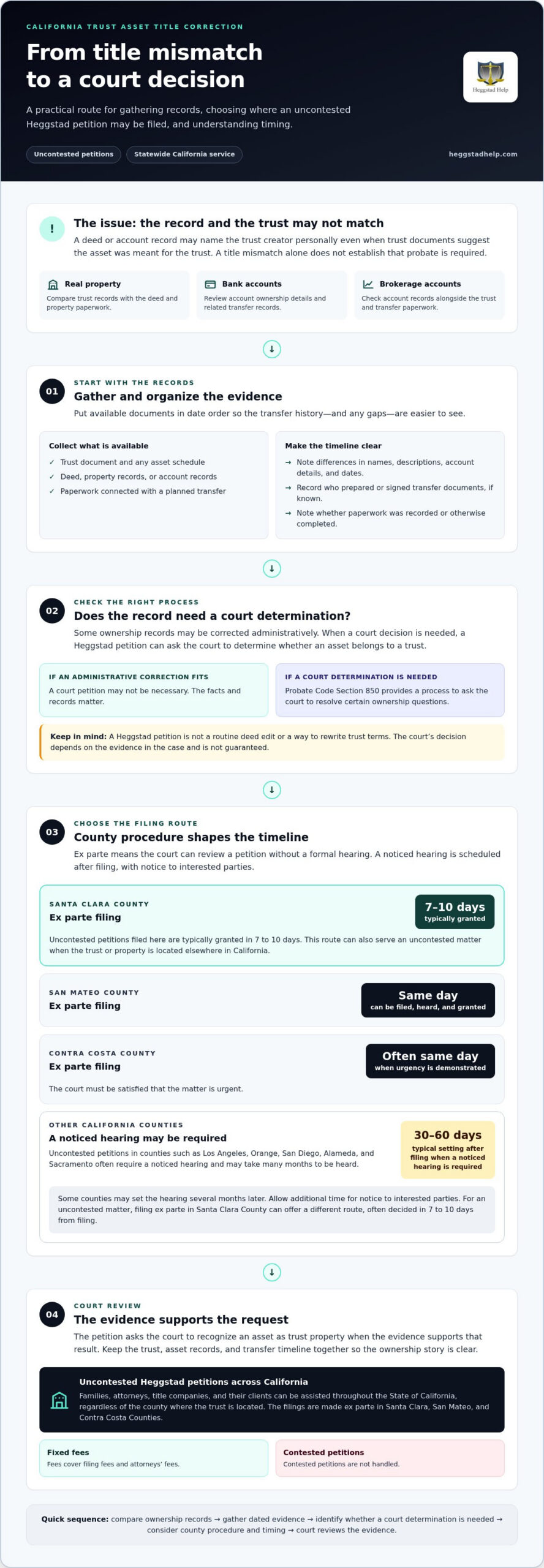
Property Left Out of a Trust in California: What Can Happen Next?

What if a home or other asset is titled outside a trust? That does not automatically mean the family must go through full probate. If you searched…

What if a home or other asset is titled outside a trust? That does not automatically mean the family must go through full probate. If you searched “property left out of trust California,” you may be trying to understand what the title means after a death and whether another route may be available. The property’s location may not dictate the only filing option.

A Heggstad petition asks the court to confirm that an asset belongs to a trust, even if it was not formally retitled in the trust’s name. This article explains why property can be left out, when an uncontested petition may help, and which documents and facts to gather for a case review. It also compares county filing routes: uncontested petitions may be filed ex parte, without a formal hearing, in Santa Clara County regardless of where the trust property is located, and are typically granted in 7 to 10 days. San Mateo and Contra Costa Counties have separate ex parte options, while other counties often require noticed hearings that can take many months. HEGGSTAD HELP assists with uncontested petitions throughout California.

Key Takeaways

  • A deed or title record that doesn’t name the trust can signal a funding issue. Check the available records before deciding what the mismatch means.
  • For a “property left out of trust California” case, a Heggstad petition may ask the court to confirm the asset as trust property. The trust and title records help assess whether the request fits.
  • The county route can affect timing: Santa Clara County petitions are typically granted in 7 to 10 days, while San Mateo and Contra Costa Counties have separate ex parte options.
  • Gather the trust and title documents and note the property’s county. Uncontested petitions may be filed ex parte in Santa Clara County regardless of where the property is located.

Property Left Out of a Trust in California: Why the Title Matters

You’ve found a deed or title record, and the trust isn’t listed as the owner. That mismatch can raise immediate questions, but it does not, by itself, determine what happens to the property. The title is important evidence, but it is not the whole story. If you’re researching “property left out of trust California,” start by comparing the recorded ownership with the trust documents and any paperwork related to a transfer.

Trust funding means transferring or titling assets so the trust owns them. A living trust is a legal arrangement for holding and managing assets, but creating one and transferring assets into it are separate steps. A Heggstad petition asks a court to confirm that specific property belongs to a trust, even when the title record doesn’t show the trust as owner. Whether that request fits depends on the facts and supporting records.

How property can be left outside a California trust

A title transfer may have been missed or left incomplete. For example, a California home might still be recorded in an individual’s name rather than the trust’s name. That example does not establish why the title remained unchanged or what the legal outcome should be. The documents and circumstances need to be reviewed together.

What the successor trustee should establish first

Before deciding what to do, gather the trust document, available title records, and any relevant transfer documents. Include records that may show an attempted or completed transfer, if you have them. Keep copies organized and note the property’s current titled owner. A qualified review can assess how the documents relate to each other and whether a Heggstad petition or another route may be appropriate. The title mismatch alone does not answer the question.

How a California Heggstad Petition May Address Missing Trust Property

A Heggstad petition asks the court to issue an order confirming that an asset belongs to a trust, even though the title may not name the trust as owner. It can offer a way to address property left out of trust California without assuming that full probate is automatically required. The court’s decision depends on the case, including the trust terms and records supporting the request.

A Heggstad petition seeks confirmation that property belongs to a trust; it does not automatically correct every title problem. If the request isn’t appropriate or the court doesn’t grant it, another route may need to be considered. The California Courts’ overview of the probate process can help explain what probate involves, but a case-specific review is needed to assess the options for a particular asset.

What ex parte means for an uncontested petition

“Ex parte” means asking the court to consider a request without a formal hearing. An uncontested petition is one where the request isn’t being opposed. The court still reviews the request and its supporting materials, and neither the process nor the outcome is guaranteed. Uncontested petitions may be filed ex parte in Santa Clara County regardless of where the trust property is located. They’re typically granted in 7 to 10 days from filing.

When the matter may need a different court process

If someone disputes whether the asset belongs to the trust, the matter may be contested. This office handles uncontested Heggstad petitions, not contested petitions. A noticed hearing, a court hearing scheduled after notice to interested parties, may be required in other situations. It may be set 30 to 60 days after filing, or several months later in some counties, with additional time needed to provide notice. To explore whether an uncontested petition may fit, you can review Heggstad petition filing services.

California County Filing Options: Santa Clara, San Mateo, Contra Costa, and Beyond

For a property left out of trust California case, the county where the property is located may not be the only filing route for an uncontested Heggstad petition. Procedures and timing vary by county, so treat the timeframes below as typical, not guaranteed. The court reviews each request, and outcomes depend on the circumstances.

County route Ex parte availability Typical timing
Santa Clara County Uncontested petitions may be filed ex parte in the Santa Clara County Probate Court, regardless of the California county where the trust property is located. Typically granted in 7 to 10 days from filing.
San Mateo County Uncontested petitions may be filed ex parte. Can be filed, heard, and granted the same day.
Contra Costa County Uncontested petitions may be filed ex parte; urgency must satisfy the Court. Can often be filed and granted the same day when the Court accepts the urgency.
Other counties, including Los Angeles and Alameda Petitions often require a noticed hearing rather than an ex parte filing. May take many months to be heard.

Why property in another county may still have an ex parte option

If the property is in Los Angeles, Orange, or another California county outside Santa Clara, an uncontested petition may still be filed ex parte in the Santa Clara County Probate Court. This can offer a different route from local courts where a noticed hearing is often required and may take months. The trust property’s county does not, by itself, rule out this option.

How timing differs from a noticed hearing

A noticed hearing may be set 30 to 60 days after filing, or several months later in some counties. Time is also needed to notify interested parties. These are general timeframes, not promises; court schedules and case details matter. Before choosing a route, gather the trust and title records and confirm whether the petition is uncontested. HEGGSTAD HELP assists families, attorneys, title companies, and clients throughout California, including the San Francisco Bay Area, Northern California, Southern California, the Central Valley, San Diego, Sacramento, Fresno, Bakersfield, Greater Los Angeles, Orange County, Riverside County, and San Bernardino County. Review Heggstad filing options.

Property Left Out of a Trust in California: What Can Happen Next?

Next Steps for Property Left Out of a California Trust

If you’re dealing with property left out of trust California, take a few practical steps before deciding what to do. First, gather the trust document and any available deed, title, or transfer records. Next, identify the county where the property is located and note whether anyone disputes that it belongs to the trust. Then request a case-specific review to understand whether an uncontested Heggstad petition may fit.

Documents and details to prepare for a case review

Start with the records you have. You don’t need to resolve the title question before asking for a review; clear, organized information can help explain what happened.

  • The trust document, including any amendments you have
  • Available deeds or other title records
  • Basic property details, including its location and current titled owner
  • Any documents related to a transfer into the trust
  • A note about whether the matter is uncontested

When to ask about Heggstad petition assistance

The practice focuses on uncontested Heggstad petitions, ex parte court orders, meaning requests considered without a formal hearing, and trust asset title correction. It assists families, attorneys, title companies, and clients throughout California. An uncontested petition may be filed ex parte in Santa Clara County regardless of the California county where the trust property is located. The office does not handle contested petitions.

Heggstad petition fees are fixed and cover filing fees and attorney fees; no amount is listed here. For background on the legal provision associated with these petitions, review this Heggstad petition and Probate Code Section 850 information. If your records suggest the matter is uncontested, use the guide to prepare for a discussion about whether petition filing may be appropriate.

Take the Next Step With Confidence

A title record that doesn’t name the trust can be concerning, but it doesn’t settle the legal outcome by itself. For property left out of trust California cases, gather the trust and title records, note the property’s county, and find out whether anyone disputes the asset’s connection to the trust. A Heggstad petition may ask the court to confirm property as trust property, but whether it fits depends on the facts.

For an uncontested matter, an ex parte filing in Santa Clara County may be an option regardless of where in California the property is located. Robert P. Bergman is a California-licensed attorney and Board-Certified Specialist in Estate Planning, Trust and Probate Law. Fixed fees cover filing fees and attorney fees.

If you’re ready to discuss whether an uncontested petition may fit your situation, discuss an uncontested Heggstad petition. With the right records and a case-specific review, you can take a clearer, more informed next step.

Frequently Asked Questions

Can property left out of a trust be added after death?

In some situations, a Heggstad petition may ask a California court to confirm property as trust property after the trust creator has died. Whether it may apply depends on the trust documents, title records, and other facts. A court outcome isn’t automatic, so gather the available records and have them reviewed before assuming the property can be transferred this way.

Does a house left out of a trust always have to go through probate in California?

No, not always. An uncontested Heggstad petition may offer a court route to request confirmation that a house belongs to a trust, but it isn’t suitable for every case and approval isn’t guaranteed. Whether the property left out of trust California can be addressed this way depends on the documents and circumstances. A case-specific review can help clarify the possible next step.

Can a Heggstad petition be filed in Santa Clara County if the property is elsewhere in California?

Yes. Uncontested Heggstad petitions may be filed ex parte in Santa Clara County regardless of the California county where the trust property is located, including Los Angeles, Orange, or Fresno County. Santa Clara County petitions are typically granted in 7 to 10 days from filing, but timing and outcomes aren’t guaranteed. San Mateo and Contra Costa Counties also have separate ex parte options.

How long does a Heggstad petition take in California?

Timing depends on the county and filing route. Santa Clara County petitions are typically granted in 7 to 10 days. In San Mateo County, an ex parte petition can be filed, heard, and granted the same day. Contra Costa County petitions can often be granted the same day if the Court is satisfied that urgency has been demonstrated. Noticed hearings in other counties may take many months.

What if family members disagree about property left out of a trust?

If family members disagree about whether property belongs to a trust, the matter is contested, and an uncontested ex parte filing shouldn’t be treated as a guaranteed solution. HEGGSTAD HELP handles uncontested Heggstad petitions, not contested petitions. The appropriate court process depends on the dispute, the supporting records, and applicable court requirements. Gather the documents and clarify what is disputed before seeking a case-specific review.

Robert P. Bergman, Attorney at Law

Article by

Robert P. Bergman, Attorney at Law

Attorney Robert P. Bergman ("Bob Bergman") has been a Board-Certified Specialist in Estate Planning, Trust and Probate Law since 2011, as certified by the California State Bar Board of Legal Specialization. For several years, Bob has assisted families and the clients of other attorneys with obtaining court orders through Heggstad petitions to avoid the time and expense of Probate administration. Bob is friendly, very approachable, and believes in explaining complex legal topics in clear ordinary language so that his clients understand exactly what they're doing and why they're doing it.
Bob is often able to assist clients who are in other counties than his home county of Santa Clara through his approach to Heggstad petitions.

Disclaimer

This article is for informational purposes only. Nothing in this article is intended to replace legal advice from a competent attorney or be considered legal guidance for anybody's specific legal situation. Nobody should rely on information in this article in making legal decisions without such consultation.

Confirming Trust Assets in California: 2026 Guide

A trust may be in place, yet an asset still appears in someone’s individual name because the paperwork wasn’t completed as intended. If that’s…

A trust may be in place, yet an asset still appears in someone’s individual name because the paperwork wasn’t completed as intended. If that’s happened in your family, a court order to confirm trust assets may offer a way to ask the court to recognize the asset as trust property. The outcome depends on the available evidence and the procedure that applies.

An asset left outside a trust doesn’t automatically mean full probate administration is the only path to explore. This guide explains what a court order may accomplish, which records can help show the owner’s intent, and when an uncontested Heggstad petition may be appropriate.

HEGGSTAD HELP assists families, attorneys, title companies, and their clients throughout California with qualifying, uncontested ex parte Heggstad petitions. These petitions are filed in the Santa Clara County Probate Court, regardless of the trust’s county, and are typically granted in 7 to 10 days. In other counties, a petition may require a noticed hearing and take many months. Knowing the available options can help you discuss a practical next step with counsel.

Key Takeaways

  • A court order to confirm trust assets is a court determination, not an automatic transfer. Start by comparing the trust documents with the asset’s title or ownership records.
  • A Heggstad petition may ask the Court to confirm an asset belongs to a trust. Gather records that connect the asset to the trust and show the decedent’s or settlor’s intent.
  • “Ex parte” means the request is handled without a formal hearing. Uncontested petitions filed in Santa Clara County are typically granted in 7 to 10 days, including petitions involving trusts located elsewhere in California.
  • Before considering next steps, identify the asset, collect the trust and title records, and describe the ownership issue clearly. Whether the matter is uncontested can help determine which California court path may apply.

How California Trust Asset Confirmation Orders Work

An asset may be connected to a trust in some records, while its deed, account, or other ownership record still names the person who created the trust. That mismatch can leave a successor trustee unsure whether the asset can be handled as trust property or whether another court process may be needed.

A court order to confirm trust assets is a ruling the petitioner asks the Court to make about ownership. It isn’t an automatic transfer. The Court reviews the request and supporting facts, then decides whether to issue an order. A Heggstad petition is one possible way to seek that determination under Probate Code Section 850. For more on the statutory context involving real property, see California Probate Code Section 850: A Guide to Real Property Petitions.

How a petition differs from the court order

A petition is the filing that asks the Court to act. An order is the Court’s decision on that request. Filing a petition doesn’t guarantee approval. The result depends on the facts, the evidence, and the procedure that applies. If no one disputes the request, it may be handled as uncontested. If someone objects, resolving the disagreement may require a contested process.

When a trust may need asset confirmation

For example, trust-related records may refer to a home, while the recorded deed still lists the decedent individually. The successor trustee may need clarity before treating the home as a trust asset. Records that connect the property, the trust, and the owner’s intent can help explain the request. The Estate of Heggstad is the California case associated with this type of petition.

Families, attorneys, title companies, and their clients throughout California can seek help with qualifying, uncontested ex parte Heggstad petitions filed in Santa Clara County, regardless of where the trust is located. HEGGSTAD HELP handles uncontested petitions, not contested petitions.

How Evidence and a Heggstad Petition Support a Trust-Asset Request

A Heggstad petition may give an interested person a way to ask the Court to confirm that an asset belongs to a trust when ownership records are incomplete or don’t clearly reflect the intended transfer. The petition is a request, not a guarantee of a particular ruling. Under California Probate Code Section 850, the Court considers the facts and applicable law before deciding whether to issue an order.

The evidence should tell a coherent story connecting three things: the asset, the trust, and the decedent’s or settlor’s intent to include that asset in the trust. No single document automatically establishes that connection in every case.

What documents may help explain the ownership history?

Depending on the circumstances, counsel may review the trust and any amendments, deeds, and records related to the asset. Compare dates and signatures on a deed with the trust’s terms and timing to help clarify what happened and when. Gather the records you have, note gaps or inconsistencies, and avoid treating the list as a universal checklist. Which materials matter depends on the specific request.

Why uncontested status matters

An uncontested petition is one without an objection or active dispute over the request. If someone challenges ownership or the evidence, the matter may require a different process to resolve the dispute. HEGGSTAD HELP handles uncontested Heggstad petitions, not contested petitions. For a broader overview, see the Heggstad petition filing guide.

Before considering next steps, organize the relevant records and identify any dispute. HEGGSTAD HELP assists clients throughout California with qualifying, uncontested ex parte petitions filed in the Santa Clara County Probate Court, regardless of where the trust is located. Learn more about uncontested Heggstad petition assistance.

California Ex Parte and Noticed-Hearing Paths: What Timing Depends On

The route and timing for seeking a court order to confirm trust assets can depend on whether the request is uncontested and which court handles it. An “ex parte” request is handled without a formal hearing. A noticed hearing involves setting a hearing date and giving notice to interested parties. The petition is made under California Probate Code Section 850, but local filing procedures and the Court’s decision still matter.

How the filing county can affect the path

Uncontested ex parte Heggstad petitions filed in the Santa Clara County Probate Court are typically granted in 7 to 10 days from filing. In San Mateo County, petitions can be filed, heard, and granted the same day. Contra Costa County petitions can often be filed and granted the same day if the Court is satisfied that urgency has been shown.

In counties other than Santa Clara, San Mateo, and Contra Costa, Heggstad petitions often require noticed hearings and may take many months to be heard. A noticed hearing may be set 30 to 60 days after filing, or several months later in some counties, with additional time needed to give notice. Qualifying uncontested petitions involving trusts elsewhere in California can often instead be filed ex parte in the Santa Clara County Probate Court and decided in 7 to 10 days from filing.

Statewide assistance through California court procedures

This option may be relevant to families, attorneys, title companies, and their clients in Los Angeles, Orange, San Diego, Alameda, San Francisco, and Sacramento Counties, among others. HEGGSTAD HELP assists clients throughout California by filing qualifying, uncontested ex parte petitions in the Santa Clara County Probate Court, regardless of where the trust is located. The office does not handle contested petitions. Court procedures can vary and may change, so confirm the applicable filing requirements for the intended filing date.

For information about this option, review uncontested Heggstad petition assistance.

Confirming Trust Assets in California: 2026 Guide

Next Steps for Confirming Trust Assets via Court Order

Before pursuing a court order to confirm trust assets, organize the basic facts so the ownership question is clear. Identify the asset, then gather the trust and any amendments, current title or account records, and documents that may show the intended ownership. Write a short timeline of events and note where the records appear incomplete or inconsistent. This preparation can make a focused review more productive, but it doesn’t determine whether the Court will grant a request.

Questions to clarify before moving forward

Use these questions to frame the issue and identify what still needs review:

  • What asset needs confirmation, where is it located, and whose name appears on its current title or ownership records?
  • Does anyone dispute the trust’s claim to the asset, or is the request uncontested?
  • What trust, title, and asset records are available, and what additional documents may counsel need to assess the facts and possible filing path?

Whether the matter is uncontested and which California court path may apply are important procedural questions. If someone objects, the matter may require a different process. HEGGSTAD HELP handles uncontested petitions and doesn’t handle contested petitions.

How specialized petition support may help

Robert P. Bergman is a California-licensed attorney and Board-Certified Specialist in Estate Planning, Trust and Probate Law. The practice focuses on Heggstad petition filing, ex parte court orders, and trust-asset title correction. It assists families, attorneys, title companies, and their clients throughout California with qualifying, uncontested ex parte Heggstad petitions filed in Santa Clara County, regardless of where the trust is located. Fixed fees cover filing fees and attorneys’ fees; a court outcome isn’t guaranteed.

After gathering the records and clarifying whether anyone disputes the request, learn about California Heggstad petition assistance.

Prepare a Clear Path to Get a Court Order to Confirm Trust Assets

A title or ownership record that doesn’t match the trust can raise difficult questions, but the next step is to clarify the facts. A court order to confirm trust assets is a Court decision, not an automatic transfer. The request depends on the evidence, applicable procedure, and whether anyone disputes the trust’s claim.

Gather the trust documents, amendments, and current asset records, then outline what they show and where the ownership gap remains. For a qualifying uncontested Heggstad petition, the filing county may affect timing. Santa Clara County petitions are typically granted in 7 to 10 days, though no outcome is guaranteed.

Robert P. Bergman is a California-licensed attorney and Board-Certified Specialist in Estate Planning, Trust and Probate Law. HEGGSTAD HELP assists families, attorneys, title companies, and their clients throughout California with uncontested ex parte Heggstad petitions filed in Santa Clara County, regardless of the trust’s county. Fixed fees cover filing fees and attorneys’ fees.

To discuss your records and whether an uncontested petition may fit, request help with a Heggstad petition.

Frequently Asked Questions

What is a court order to confirm trust assets in California?

It’s a Court ruling that determines whether an asset belongs to a trust. A petition is the request asking the Court to make that decision; approval isn’t automatic. For example, a Heggstad petition may ask the Court to confirm an asset as trust property when title records don’t clearly show a transfer. The Court considers the evidence, facts, and applicable procedure.

Can a Heggstad petition confirm property located outside Santa Clara County?

Yes, qualifying uncontested petitions involving property or other assets located elsewhere in California can often be filed ex parte in Santa Clara County, regardless of the trust’s location. HEGGSTAD HELP assists families, attorneys, title companies, and their clients statewide. This may help people in the San Francisco Bay Area, Northern California, Southern California, the Central Valley, San Diego, Sacramento, Fresno, Bakersfield, Greater Los Angeles, Orange County, Riverside County, and San Bernardino County.

How long does it take to get a Heggstad court order in California?

Timing depends on the county and procedure. Uncontested ex parte petitions in Santa Clara County are typically granted in 7 to 10 days. In San Mateo County, petitions can be filed, heard, and granted the same day. Contra Costa County petitions can often be filed and granted the same day if the Court is satisfied that urgency has been shown. Other counties may require noticed hearings and take many months.

Does a court order to confirm trust assets avoid probate?

It may help avoid full probate for an asset if the Court confirms that the asset belongs to the trust, but it doesn’t guarantee that probate will be unnecessary for every asset or issue. A Heggstad petition seeks a court decision about specific trust ownership. To assess whether this path may fit, identify the asset, gather trust and title records, and clarify whether anyone disputes the trust’s claim.

Robert P. Bergman, Attorney at Law

Article by

Robert P. Bergman, Attorney at Law

Attorney Robert P. Bergman ("Bob Bergman") has been a Board-Certified Specialist in Estate Planning, Trust and Probate Law since 2011, as certified by the California State Bar Board of Legal Specialization. For several years, Bob has assisted families and the clients of other attorneys with obtaining court orders through Heggstad petitions to avoid the time and expense of Probate administration. Bob is friendly, very approachable, and believes in explaining complex legal topics in clear ordinary language so that his clients understand exactly what they're doing and why they're doing it.
Bob is often able to assist clients who are in other counties than his home county of Santa Clara through his approach to Heggstad petitions.

Disclaimer

This article is for informational purposes only. Nothing in this article is intended to replace legal advice from a competent attorney or be considered legal guidance for anybody's specific legal situation. Nobody should rely on information in this article in making legal decisions without such consultation.
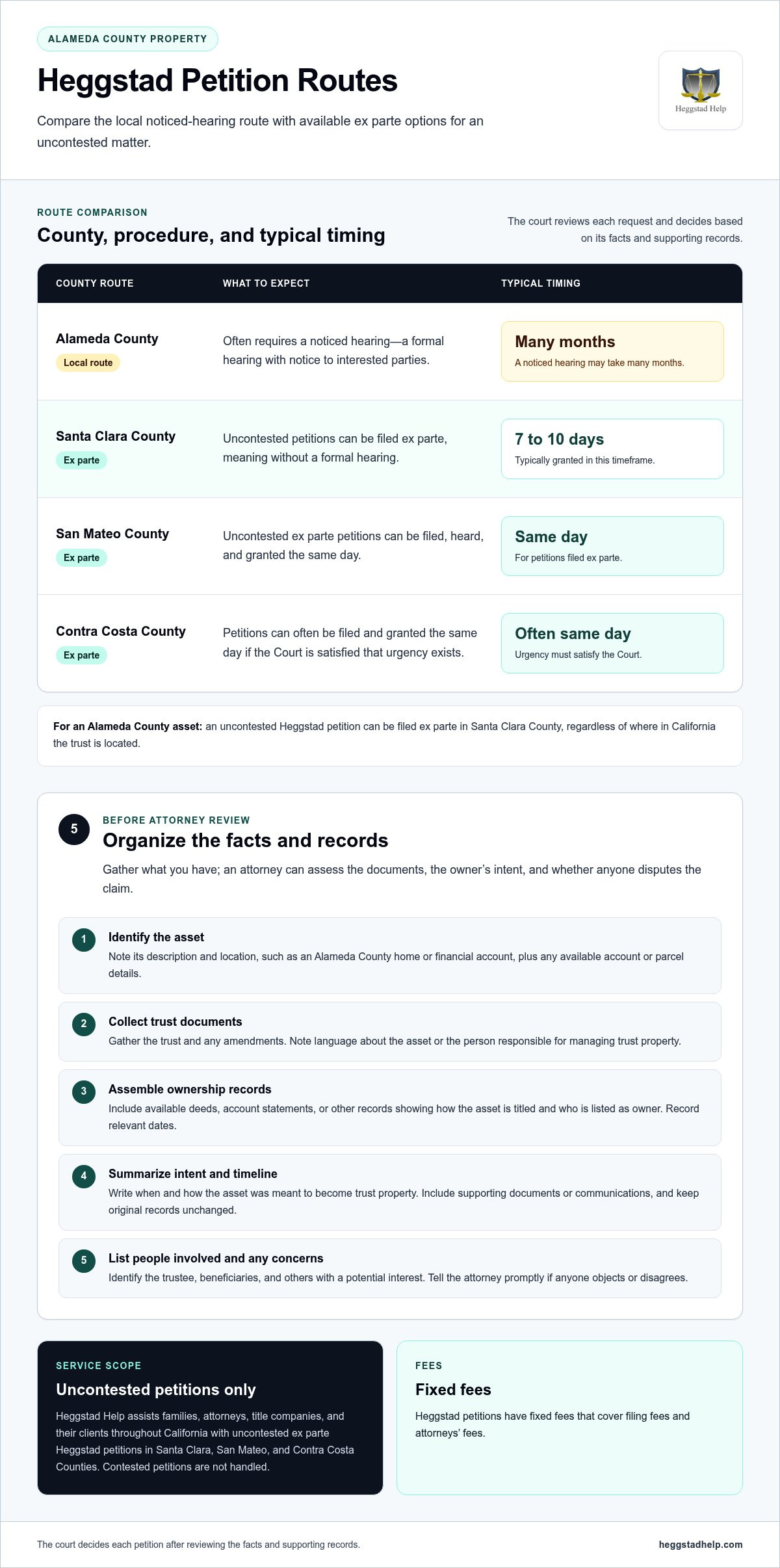
Heggstad Petition Service in Sacramento: How to Get Help

If a Sacramento County home or other asset was left out of a trust, a Sacramento Heggstad petition service may help determine whether the court can…

If a Sacramento County home or other asset was left out of a trust, a Sacramento Heggstad petition service may help determine whether the court can confirm it as trust property. Families may assume the petition must be filed in the county where the property or trust is located. For an uncontested matter, however, another filing route may be available, depending on the facts and court requirements.

HEGGSTAD HELP, a service of estate planning attorney Robert P. Bergman, assists families, attorneys, and title companies throughout California with uncontested ex parte Heggstad petitions filed in Santa Clara County, regardless of where the trust is located. “Ex parte” means the petition is submitted without a formal, scheduled hearing. Sacramento County petitions often require a noticed hearing and may take many months. Santa Clara County petitions are typically granted in 7 to 10 days from filing, subject to court review and the circumstances of the case.

This article explains what a Heggstad petition can address, what records to gather, and what the court considers. It also explains the service’s limits: HEGGSTAD HELP handles uncontested petitions only, and court approval is not guaranteed.

Key Takeaways

  • A Heggstad petition asks the court to confirm an asset as trust property. It may address a title issue when an asset was left outside the trust.
  • An uncontested petition involving a Sacramento County asset may be eligible for ex parte filing in Santa Clara County. The appropriate route depends on the facts and court review.
  • Gather the trust document, asset and title records, and any available documents showing the asset was intended for the trust. These records help assess the petition but do not guarantee approval.
  • When making an initial inquiry, identify the asset, its county, whether a trust is in place, and any known objections. The office’s fixed fees cover filing fees and attorneys’ fees.

Sacramento Heggstad Petition Service: What Help Can Address

A Heggstad petition asks the court to confirm that an asset belongs to a trust, even though it was not formally titled in the trust’s name. The process takes its name from Estate of Heggstad, the case that established this approach. HEGGSTAD HELP assists families, attorneys, and title company professionals throughout California with uncontested petitions. The office does not handle contested disputes.

When a Sacramento County asset may need a petition

For example, someone may have intended to place a Sacramento County home in their trust, but the deed still lists the person individually. That difference in title can create a problem when the family or successor trustee needs to deal with the home as trust property. A petition may ask the court to confirm the home’s trust status. Whether that approach fits depends on the trust, title records, and other circumstances.

Gather the trust document, any schedules identifying assets, and the available deed or ownership records. These materials can help an attorney assess whether the facts support an uncontested petition, but they do not guarantee court approval.

Who the service is designed to assist

Families and successor trustees may need help assessing how to address an asset left outside the trust. Attorneys and title company professionals may also seek focused assistance with an uncontested filing and related title correction. HEGGSTAD HELP can file qualifying uncontested ex parte petitions in Santa Clara County, regardless of where in California the trust or asset is located. The Heggstad petition filing guide provides broader background on the process.

A Sacramento Heggstad petition service can assess the filing route for a particular asset and the records available. If someone objects or there is a dispute, the matter is not an uncontested petition handled by this office.

Where a Sacramento Heggstad Petition May Be Filed

The asset’s location does not always determine the practical filing route for an uncontested Heggstad petition. Sacramento County petitions often require a noticed hearing. That means interested parties receive notice and the matter is scheduled for a hearing. Depending on the court’s schedule and the case, this route may take many months. Check the Sacramento Superior Court for local probate information and current requirements.

Sacramento County versus Santa Clara County filing

For an eligible, uncontested petition involving a Sacramento County asset, HEGGSTAD HELP can file ex parte in the Santa Clara County Probate Court. The petition is submitted without a formal, scheduled hearing. Santa Clara County petitions are typically granted in 7 to 10 days from filing, subject to court review and the circumstances of the case. This option may also be relevant to families in Placer County, but the right filing route depends on the specific matter.

A Sacramento Heggstad petition service should make clear that filing in Santa Clara County is an option for qualifying uncontested cases, not a guarantee of a particular result or timeline. HEGGSTAD HELP assists families, attorneys, and title companies throughout California with these filings, regardless of the county where the trust is located.

When San Mateo or Contra Costa County may be options

San Mateo County ex parte petitions can be filed, heard, and granted the same day. Contra Costa County petitions can often be filed and granted the same day if urgency satisfies the court. These timelines and outcomes remain subject to court review and case circumstances. For more background on the legal basis, see this Probate Code Section 850 petition guide.

If you are unsure which county route fits, you can learn about Heggstad petition filing options and have the specific facts assessed before proceeding.

How to Prepare for an Uncontested Heggstad Petition

Organized records help an attorney assess whether an uncontested Heggstad petition may fit and which filing route to consider. Preparing documents is a useful first step, not a guarantee of eligibility or court approval. California Probate Code Section 850 provides legal context for court requests involving property claimed to belong to a trust.

Records to organize before requesting help

Start with the documents you have. If something is missing, note that when you make an inquiry rather than delaying it.

  • Trust records: Gather the trust and any amendments. Include schedules or other available records that identify the asset.
  • Asset and title records: Collect the deed or other ownership information, along with records identifying the asset.
  • Key facts: Write down where the asset is located, who currently holds title, and any known objections or competing claims.

How the attorney assesses the filing route

The attorney reviews the facts and records, considers whether anyone disputes the trust’s claim to the asset, and assesses available county procedures. For a Sacramento County asset, an uncontested matter may be considered for ex parte filing in Santa Clara County. The facts and court requirements determine whether that route is appropriate. If a dispute or objection exists, the matter is contested and falls outside this office’s service.

If title records are unclear, organize them with the trust documents so the issue can be assessed as a whole. This may help distinguish a title discrepancy from a disagreement about who owns the asset.

To have your records and possible filing route assessed, request help with an uncontested Heggstad petition.

Heggstad Petition Service in Sacramento: How to Get Help

How to Start Sacramento Heggstad Petition Service

Begin with a concise summary of the issue. Identify the asset, the county where it is located, whether a trust was created, and any known objections. For a Sacramento County asset, these details help the attorney assess whether an uncontested Heggstad petition may be appropriate and which filing route to consider.

What to clarify before moving forward

Be candid about disagreements, competing ownership claims, or concerns raised by beneficiaries or other interested people. These issues can affect whether a matter is uncontested or whether a noticed hearing may be needed. HEGGSTAD HELP handles uncontested Heggstad petitions only. The office does not handle contested petitions or full probate administration, so an initial review should establish whether the request fits the service’s scope.

Ask about the fixed fee and confirm what it covers. The office’s Heggstad petition fees cover filing fees and attorneys’ fees. The court decides whether to grant the petition; neither the filing route nor the result can be guaranteed. Timing also depends on court review and the circumstances of the case.

Contact a California Heggstad petition specialist

Robert P. Bergman is a California-licensed attorney and Board-Certified Specialist in Estate Planning, Trust and Probate Law. His focused practice can help families, attorneys, and title company professionals understand options for an uncontested matter, including whether an ex parte filing may fit.

Before reaching out, have the trust and asset or title records nearby if available, and note any known objections. You do not need to resolve every question first. Sharing what you know can help clarify the next step.

If you are considering a Sacramento Heggstad petition service, contact a Heggstad petition specialist to discuss whether your matter appears suitable for an uncontested filing.

Take the Next Step With a Clear Filing Plan

A Sacramento County asset may have an uncontested filing option beyond a local noticed hearing. For eligible matters, HEGGSTAD HELP can file ex parte in Santa Clara County, where petitions are typically granted in 7 to 10 days from filing. The court reviews each petition, so timing and approval are not guaranteed. The office handles uncontested petitions only, not contested disputes.

Before moving forward, gather the trust and available asset or title records, and note the asset’s county and any known objections. These details help assess whether a Heggstad petition may fit and which filing route to consider. The office’s fixed fees cover filing fees and attorneys’ fees.

HEGGSTAD HELP assists clients throughout California, including the San Francisco Bay Area, Northern California, Southern California, the Central Valley, San Diego, Sacramento, Fresno, Bakersfield, Greater Los Angeles, Orange County, Riverside County, and San Bernardino County. Robert P. Bergman is a California-licensed attorney and Board-Certified Specialist in Estate Planning, Trust and Probate Law. Discuss your uncontested Heggstad petition with HEGGSTAD HELP.

Frequently Asked Questions

Can a Heggstad petition for property in Sacramento County be filed in Santa Clara County?

Yes. An uncontested petition involving Sacramento County property may be filed ex parte in the Santa Clara County Probate Court, regardless of where in California the trust is located. Ex parte means submitting the petition without a formal, scheduled hearing. The filing route must fit the facts and court requirements. HEGGSTAD HELP assists clients throughout California, including Sacramento, the San Francisco Bay Area, Northern and Southern California, the Central Valley, San Diego, Fresno, Bakersfield, Greater Los Angeles, Orange County, Riverside County, and San Bernardino County.

How long does a Santa Clara County Heggstad petition usually take?

Uncontested Heggstad petitions in Santa Clara County are typically granted 7 to 10 days from the filing date. This is a typical timeframe, not a promise. The court reviews each petition, and timing can depend on the case and court process. A Sacramento Heggstad petition service using this filing route can help families explore an alternative to a local noticed hearing when the facts support it.

Does a Heggstad petition in Sacramento County require a court hearing?

Sacramento County Heggstad petitions often require a noticed hearing, where interested parties receive notice and the matter is scheduled before the court. Such hearings may take many months, depending on court scheduling and the circumstances. An uncontested petition may instead be eligible for ex parte filing in Santa Clara County. The appropriate route depends on the case facts and current court requirements.

What documents should I gather for a Sacramento Heggstad petition?

Gather the trust and any amendments, along with available schedules or other records identifying the asset. For real property, locate the deed and current title information. For another asset, collect records showing its ownership. Also note the asset’s county and any known objections or competing claims. These documents help an attorney assess whether a petition may fit, but they do not establish eligibility or guarantee that the court will grant it.

Does HEGGSTAD HELP handle contested Heggstad petitions?

No. HEGGSTAD HELP handles uncontested Heggstad petitions and does not take contested matters. If a beneficiary or another person objects, or there are competing claims about ownership, tell the attorney when you make an inquiry. That information helps determine whether the matter fits the office’s service. The court decides whether to grant a petition, and an attorney’s review cannot guarantee a particular result.

Robert P. Bergman, Attorney at Law

Article by

Robert P. Bergman, Attorney at Law

Attorney Robert P. Bergman ("Bob Bergman") has been a Board-Certified Specialist in Estate Planning, Trust and Probate Law since 2011, as certified by the California State Bar Board of Legal Specialization. For several years, Bob has assisted families and the clients of other attorneys with obtaining court orders through Heggstad petitions to avoid the time and expense of Probate administration. Bob is friendly, very approachable, and believes in explaining complex legal topics in clear ordinary language so that his clients understand exactly what they're doing and why they're doing it.
Bob is often able to assist clients who are in other counties than his home county of Santa Clara through his approach to Heggstad petitions.

Disclaimer

This article is for informational purposes only. Nothing in this article is intended to replace legal advice from a competent attorney or be considered legal guidance for anybody's specific legal situation. Nobody should rely on information in this article in making legal decisions without such consultation.
Heggstad Petition Lawyer in Orange County: How to Choose the Right Help

What if some Orange County trust property issues don’t have to be filed in Orange County? When title records don’t match the trust plan, it’s…

What if some Orange County trust property issues don’t have to be filed in Orange County? When title records don’t match the trust plan, it’s understandable to worry that full probate may be required. A Heggstad petition lawyer that Orange County families consult can review the circumstances, assess whether an uncontested petition may fit, and explain possible filing routes.

The filing county can affect the process. HEGGSTAD HELP assists families, attorneys, title companies, and their clients throughout California with uncontested Heggstad petitions filed ex parte, without a formal hearing, in Santa Clara County, regardless of where the trust property is located. These petitions are typically granted in 7 to 10 days, subject to court action.

This article explains what to ask about a lawyer’s experience, scope, fees, and approach to contested issues. It also compares filing routes, including why some counties may require a noticed hearing that can take many months. Use the information to prepare for a conversation about your documents and possible next steps.

Key Takeaways

  • A Heggstad petition asks the court to confirm property as trust property when title records don’t reflect the trust plan.
  • When evaluating a Heggstad petition lawyer Orange County families can ask how much of the lawyer’s work focuses on these petitions and trust asset title correction.
  • Orange County matters may require a noticed hearing. Eligible uncontested petitions can be filed ex parte in Santa Clara County, where decisions are typically made in 7 to 10 days, subject to court action.
  • Gather the trust documents, recorded title information, and relevant correspondence so counsel can review the facts, possible filing routes, and timing.

Need a Heggstad petition lawyer Orange County families can consult? Start with the title problem

A person may have intended a home or another asset to belong to their trust, while recorded title still names them individually. That mismatch can leave family members unsure whether the trust plan can be carried out without another court process. A Heggstad petition asks a court to confirm an asset as trust property even though the title records don’t show the transfer. The name comes from the Estate of Heggstad.

The property’s or trust’s location in Orange County does not, by itself, determine the best filing route or whether a petition is appropriate. The facts and whether anyone objects matter. Some counties may require a noticed hearing, where interested parties receive formal notice before the court considers the request. That process can take many months. Eligible, uncontested petitions involving property anywhere in California can be filed ex parte, without a formal hearing, in Santa Clara County. Those petitions are typically granted in 7 to 10 days, subject to court action. HEGGSTAD HELP handles uncontested petitions, not contested matters.

What should an Orange County family clarify first?

Before speaking with counsel, identify the asset and whose name appears on its current title. Gather the trust documents and any relevant evidence of the intended transfer, such as correspondence or other paperwork that may help explain the decedent’s intent. These records give the lawyer a practical starting point for reviewing the situation.
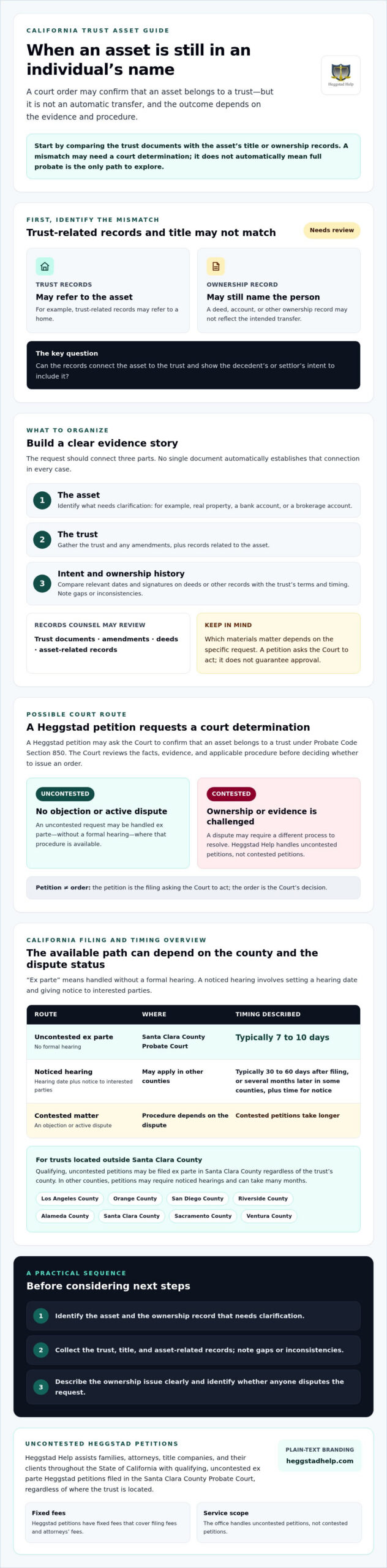
This overview is general information, not a decision about eligibility. A lawyer must review the specific records and circumstances before assessing whether a Heggstad petition may fit, where it could be filed, or how long the process may take. Organize the documents and write down questions about title, possible objections, and timing before the discussion.

How to Choose a Heggstad Petition Lawyer for an Orange County Matter

Look for counsel who can explain the title problem and petition process clearly, rather than relying only on broad probate experience. Ask how much of the attorney’s work involves Heggstad petitions and trust asset title correction. A focused practice can help you understand how the records relate to a request under California Probate Code Section 850 and what evidence may be relevant.

Be direct about whether anyone may object. Ask whether the matter appears uncontested and whether the office accepts contested petitions. HEGGSTAD HELP handles uncontested petitions, not contested matters. Its fixed fees cover filing fees and attorney fees, so ask which work is included and whether any circumstances could change the scope.

Questions to ask before engaging counsel

  • Which filing route may apply, and what facts could affect that recommendation?
  • Who will prepare and handle the petition, and how will the office communicate court updates?
  • What timing is typical for the proposed route, and what could cause a delay?

Specific answers should connect the recommendation to your documents and circumstances. For example, eligible uncontested matters involving trust property in Orange County can be filed ex parte in Santa Clara County, where petitions are typically granted in 7 to 10 days, subject to court action. That estimate is not a guaranteed court decision.
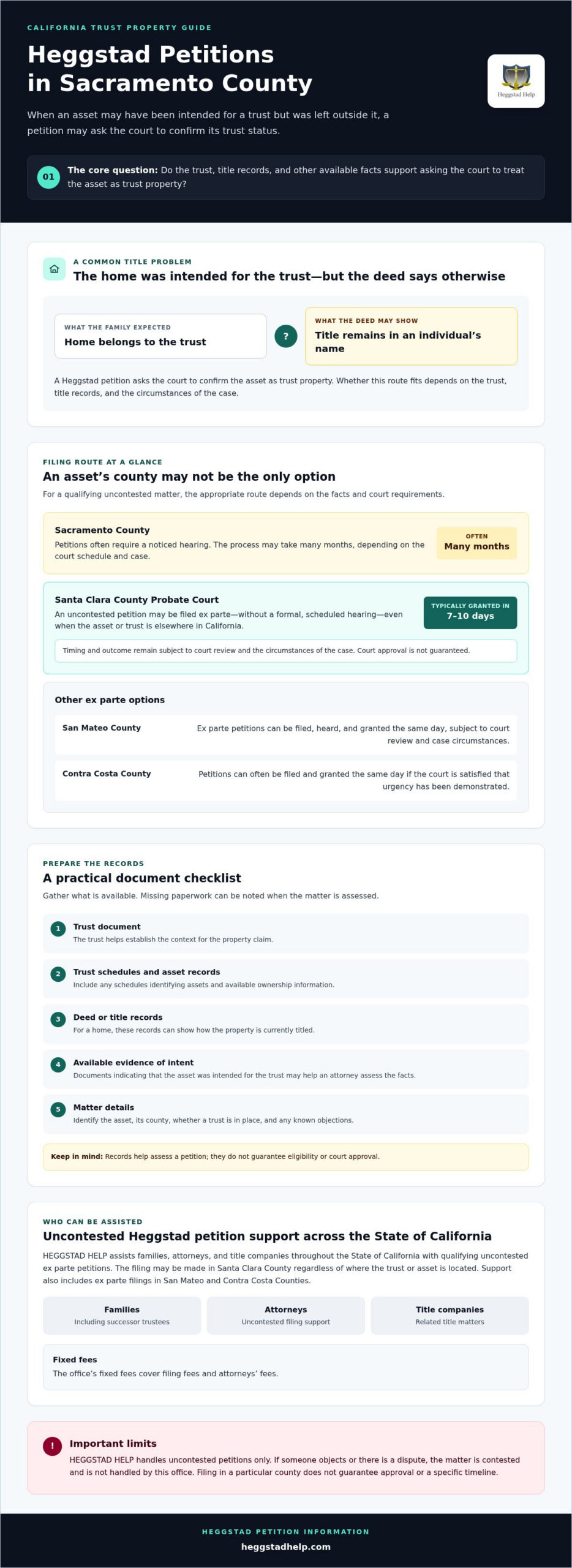

When specialized Heggstad assistance may fit

Focused assistance may suit families, attorneys, and title companies seeking an uncontested petition or trust asset title correction. HEGGSTAD HELP assists clients throughout California, including Orange County, with uncontested ex parte filings in Santa Clara County, regardless of the trust property’s county. To learn about the filing process, review the Heggstad petition filing services. Bring questions about scope, fees, and court communication to your discussion with counsel.
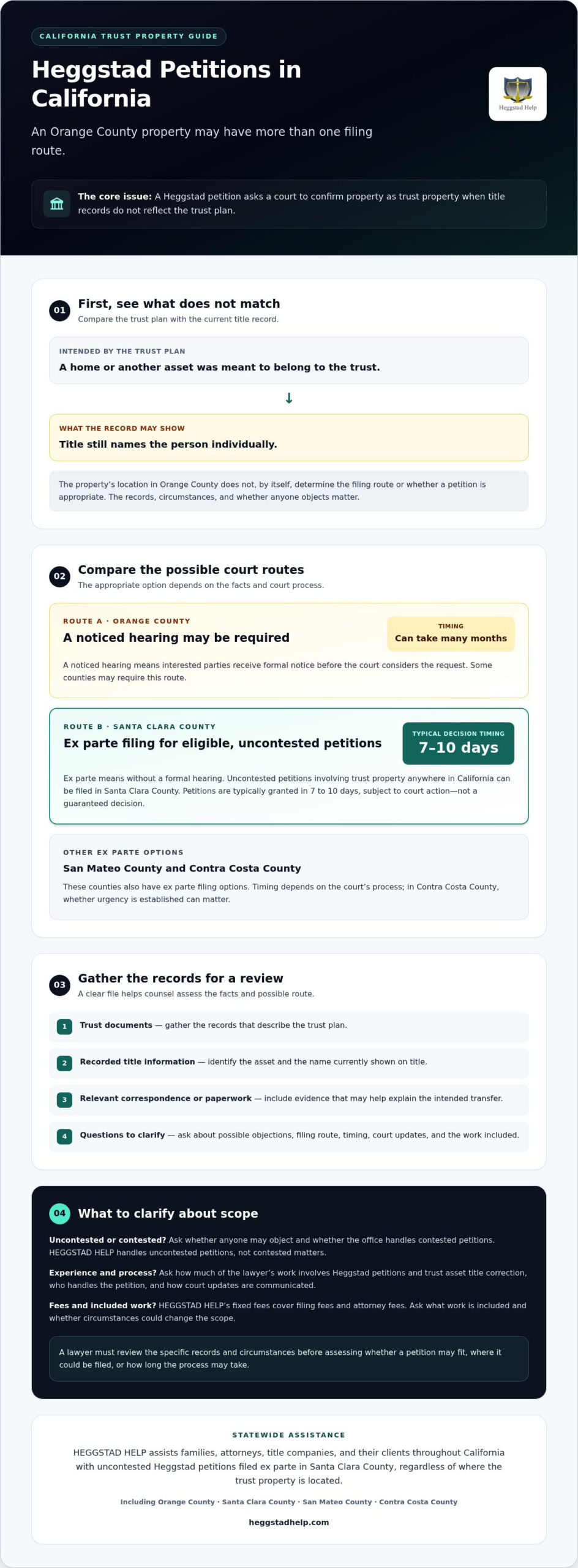
Orange County vs. Ex Parte Filing: Understand the California Court Routes

A Heggstad petition involving property in Orange County may follow a different route from an uncontested petition filed ex parte in another county. Orange County matters may require a noticed hearing, which involves giving formal notice to interested parties. In counties that require this route, a hearing may be set 30 to 60 days after filing or several months later, with additional time needed for notice. Check current court procedures, including information from the Orange County Superior Court, and ask counsel to assess which route may fit the facts.

What timing has HEGGSTAD HELP described?

HEGGSTAD HELP assists families, attorneys, title companies, and clients throughout California with uncontested ex parte Heggstad petitions in Santa Clara County, regardless of where the trust property is located. These petitions are typically granted in 7 to 10 days, subject to court action. San Mateo County petitions can be filed, heard, and granted the same day. Contra Costa County petitions can often be filed and granted the same day if the court is satisfied that urgency has been demonstrated. The office does not handle contested petitions.

Typical processing times are estimates, not guaranteed court decisions. Even with an ex parte filing, the court controls whether and when to grant a petition.

Why Orange County property may involve another county’s court

For eligible, uncontested matters involving property in Orange County and other counties, HEGGSTAD HELP uses ex parte filings in Santa Clara County as an alternative to a potentially longer noticed-hearing route. Filing location alone does not establish eligibility. Ask counsel to explain the recommendation and any facts that could affect timing. For a plain-language overview of the legal process, read the California Probate Code Section 850 guide.

If you’re comparing routes for an uncontested matter, review HEGGSTAD HELP’s Heggstad petition services and prepare your questions about venue and timing.

Heggstad Petition Lawyer in Orange County: How to Choose the Right Help

Next Steps: Discuss Your Orange County Heggstad Petition With a Specialist

A little preparation can make an initial discussion more focused. Gather the trust documents, recorded title information, and correspondence or other records that may help explain the intended transfer. Then note:

  • The property’s location and the current owner shown on title
  • The trust’s name and relevant dates, such as when the trust was created or the transfer was discussed
  • Any disagreement, objection, or time-sensitive concern involving the property

Be candid about possible conflict or urgency. That information helps counsel understand the situation, but it does not mean the office can take a contested matter. HEGGSTAD HELP handles uncontested Heggstad petitions, not contested petitions or full probate administration.

How to take a focused next step

A Heggstad petition lawyer Orange County families consult must review the specific documents and facts before assessing whether a petition may fit, which filing route may be appropriate, or what timing to expect. Families, attorneys, and title companies can ask whether an uncontested ex parte filing in Santa Clara County may be an option for property located in Orange County. The practice assists clients throughout California with these filings, subject to review of the matter.

If your records are ready, you can review Heggstad petition legal services to understand the focused work offered. For a practical starting point, contact HEGGSTAD HELP about Heggstad petition assistance and share the property location, title information, trust documents, and any concerns. A review can help clarify possible next steps without assuming eligibility or promising a court outcome.

Take the Next Step With a Clearer Plan

A title mismatch alone does not establish which court route is right or whether a Heggstad petition fits. Gather the trust documents, title records, and transfer correspondence so counsel can review the facts. If you’re looking for a Heggstad petition lawyer Orange County families can consult about an uncontested matter, ask for a clear explanation of the proposed filing route, expected timing, and what the fee covers.

HEGGSTAD HELP focuses on Heggstad petitions and trust asset title correction. California-licensed attorney Robert P. Bergman is a Board-Certified Specialist in Estate Planning, Trust and Probate Law. Fixed fees cover filing fees and attorney fees. For eligible uncontested matters, filing options include ex parte petitions in Santa Clara County, typically granted in 7 to 10 days subject to court action. San Mateo County may allow filing, a hearing, and a decision the same day. Contra Costa County may do so when the court is satisfied that urgency has been demonstrated. The office does not handle contested petitions.

Families, attorneys, and title companies can contact HEGGSTAD HELP to discuss an uncontested Heggstad petition and clarify possible next steps.

Frequently Asked Questions

Can a Heggstad petition for Orange County property be filed in Santa Clara County?

Yes. An uncontested petition may be filed ex parte in Santa Clara County even when the trust property is in Orange County. HEGGSTAD HELP describes this as its filing approach for eligible matters involving property in other California counties. Whether it fits depends on the case facts and court requirements, so counsel should first review the trust documents, title records, and any potential objections.

How long does a Heggstad petition take in California?

Timing depends on the filing route and the court, and no timeline is guaranteed. HEGGSTAD HELP reports that uncontested Santa Clara County ex parte petitions are typically granted in 7 to 10 days, subject to court action. San Mateo County petitions can be filed, heard, and granted the same day. Contra Costa County petitions may also be granted the same day if the court is satisfied that urgency has been demonstrated.

Do I need an Orange County lawyer for an Orange County Heggstad petition?

Not necessarily. The property’s location alone does not determine the filing route. A Heggstad petition lawyer Orange County families consult should review the trust, title, and circumstances before advising what may fit. HEGGSTAD HELP assists families, attorneys, and clients throughout California, including the San Francisco Bay Area, Northern California, Southern California, Central Valley, San Diego, Sacramento, Fresno, Bakersfield, Greater Los Angeles, Orange County, Riverside County, and San Bernardino County.

What should I ask a Heggstad petition lawyer before hiring them?

Ask how regularly they handle Heggstad petitions, whether your matter needs to be uncontested, which filing route may apply, and what the fee includes. Also ask who will handle the petition and how you’ll receive court updates. HEGGSTAD HELP states that its fixed fees cover filing fees and attorney fees. Request clarity about the scope and fee for your matter rather than assuming a specific amount.

Does HEGGSTAD HELP handle contested Heggstad petitions?

No. HEGGSTAD HELP handles uncontested Heggstad petition filing, ex parte court order services, and trust asset title correction, but not contested petitions or full probate administration. If a family member or another interested person disputes whether an asset belongs in the trust, explain that disagreement before expecting an uncontested filing route. Reviewing the facts can help clarify whether the matter fits the office’s stated scope.

Robert P. Bergman, Attorney at Law

Article by

Robert P. Bergman, Attorney at Law

Attorney Robert P. Bergman ("Bob Bergman") has been a Board-Certified Specialist in Estate Planning, Trust and Probate Law since 2011, as certified by the California State Bar Board of Legal Specialization. For several years, Bob has assisted families and the clients of other attorneys with obtaining court orders through Heggstad petitions to avoid the time and expense of Probate administration. Bob is friendly, very approachable, and believes in explaining complex legal topics in clear ordinary language so that his clients understand exactly what they're doing and why they're doing it.
Bob is often able to assist clients who are in other counties than his home county of Santa Clara through his approach to Heggstad petitions.

Disclaimer

This article is for informational purposes only. Nothing in this article is intended to replace legal advice from a competent attorney or be considered legal guidance for anybody's specific legal situation. Nobody should rely on information in this article in making legal decisions without such consultation.