A Heggstad petition asks a California court to confirm that property not formally titled in a trust was intended to belong to it. A signed declaration of trust, especially one with a schedule identifying the property, can help show that intent. The strength of a declaration of trust as evidence for Heggstad depends on how clearly the written records connect the specific asset to the trust.
A missing deed may feel like a dead end, but the key question is whether the trust documents and other written evidence show that the person who created the trust intended to include the property. A schedule naming the asset can make that connection clearer. Vague or incomplete paperwork can make it harder to establish.
The remedy traces back to the California Court of Appeal’s 1993 decision in Estate of Heggstad, which recognized that a declaration of trust and clear written evidence of intent could establish that property belonged to a trust without a formal deed or transfer document. This article explains what a Heggstad petition does, how trust declarations and schedules may support it, and what the case’s origins reveal about the evidence courts consider.
What are the key takeaways?
A Heggstad petition can ask the court to confirm that property was intended for a trust even if it was never formally titled in the trust.
A signed trust declaration and an attached schedule that clearly identifies the asset can help show the settlor’s intent.
The remedy traces to the 1993 Estate of Heggstad decision, which recognized that written evidence of intent could matter even without a formal deed.
For an uncontested petition involving property located anywhere in California, ex parte filing in Santa Clara County can offer a faster path; petitions there are typically granted in 7 to 10 days.
What Is a Heggstad Petition?
A Heggstad petition asks a California court to confirm that an asset belongs to a trust, even without formal transfer. The 1993 Court of Appeal decision in Estate of Heggstad recognized that a signed declaration and clear written intent could establish trust ownership without a deed.
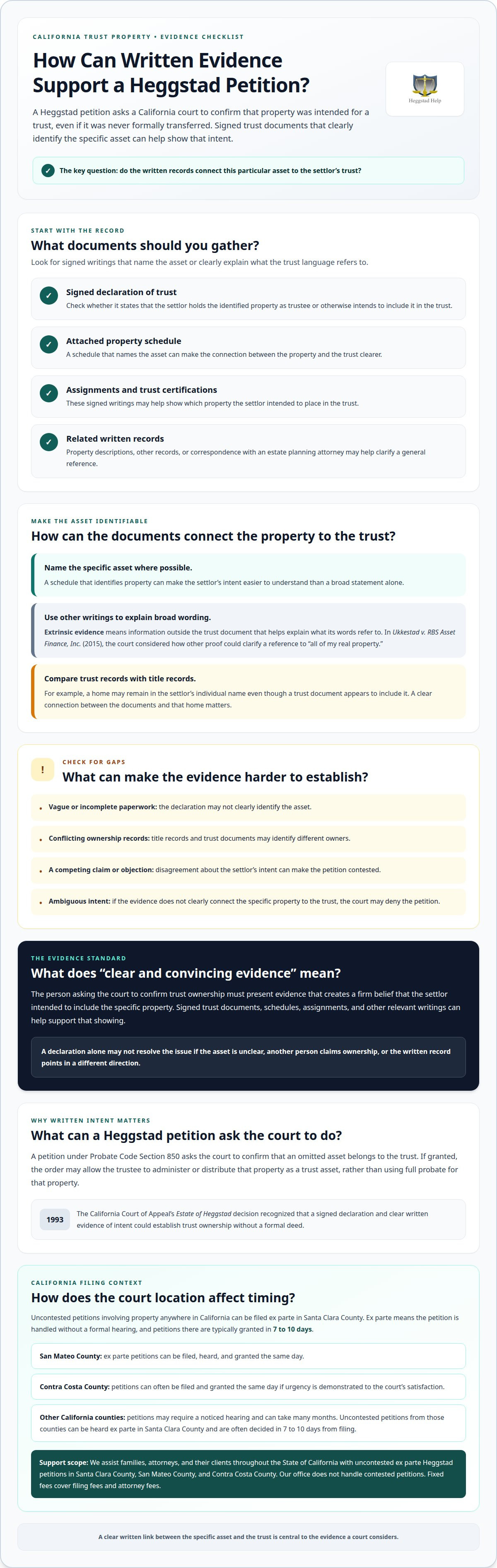
To show intent, a declaration should identify the property or describe it clearly enough to connect it to the trust. A schedule listing the asset or language stating that the settlor holds it as trustee can help establish that connection.
What Is a Written Declaration of Settlor Intent?
A written declaration records the settlor’s intention to hold or include identified property in a trust. In Estate of Heggstad, the signed trust declaration and its property schedule supported the claim despite the absence of a deed. For families reviewing estate planning records, the practical step is to gather signed documents connecting the specific asset to the trust, rather than relying only on someone’s general wish.
When Can Ownership Disputes or Unclear Intent Arise?
An ownership dispute can arise when trust records and title records identify different owners, or when someone challenges the settlor’s intent. For example, a home may remain in the settlor’s individual name even though a trust document appears to include it. If the declaration does not clearly identify the home, or interested parties disagree about what it means, the petition may become contested and require closer examination of the evidence.
What Is Extrinsic Evidence of Intent?
Extrinsic evidence means information outside the trust document that helps explain what its words refer to. In Ukkestad v. RBS Asset Finance, Inc. (2015), the court considered how a broad reference to “all of my real property” could be clarified by other proof. A property description, related written records, or correspondence with an estate planning attorney may help connect general wording to a particular asset.
What Is the Burden and Standard of Proof?
The person asking the court to confirm trust ownership must present supporting evidence. A Heggstad petition generally requires clear and convincing evidence, a demanding standard that requires a firm belief that the settlor intended to include the specific property. The petitioner should gather the signed trust, schedules, assignments, and other relevant writings. If the evidence leaves the asset or intent ambiguous, the court may deny the petition.
What is the purpose of a Heggstad petition?
A California Heggstad petition asks a court to confirm that an omitted asset belongs to a trust. It can address a title gap when a settlor intended to fund a trust but died before completing the formal transfer. If granted, the order may allow the trustee to manage or distribute that asset through the trust, rather than using full probate for that property.
California State Legislature identifies Probate Code Section 850 as the basis for a property petition, which must state the facts supporting the claim. The petition focuses on the particular asset and the evidence connecting it to the trust document. It does not amend the trust agreement; it asks the court to recognize the settlor’s existing intent. A home left outside the trust after refinancing is one example of an asset whose status may need resolution.
A Heggstad petition may not be appropriate when the trust document and other written evidence do not show that the settlor intended to include the asset. Ambiguous records, a competing ownership claim, or an objection can make the matter contested. A declaration alone may not overcome evidence that another person owns the property. In these circumstances, the petition may not provide a straightforward path to trust ownership, and another legal procedure may be needed.
How long does a Heggstad petition take, and what are typical California filing and attorney fees? Timing depends on the court process: a noticed hearing may be set 30 to 60 days after filing, or months later, with additional time for notice. Heggstad petitions have fixed fees covering filing fees and attorney fees, but no dollar amount applies to every case.
The main risk is a gap between the asset being claimed and the settlor’s documented intent. A clear property description, signed trust records, and consistent supporting documents help address that issue. If ownership is challenged or the evidence remains unclear, the court may deny the petition or the dispute may require a contested process.
How can trust asset schedules identify specific property?
A trust schedule or other signed writing can connect an omitted asset to the trust. The property must be identifiable, and supporting records can help explain the declaration.
What written evidence can identify omitted assets?
Written evidence identifies an asset and connects it to the settlor’s trust. A signed declaration, attached property schedule, assignment, or trust certification may help show that connection. Can a declaration establish that property was transferred to a trust for a Heggstad petition? It can support the claim when it clearly identifies the property and reflects the settlor’s intent. A general statement without a clear link to the asset may carry less weight.
How can a court order confirm trust assets?
A court order can confirm that a disputed or omitted asset belongs to the trust. If the court grants the petition, the trustee can then administer or distribute the property as a trust asset. That result may keep the asset from requiring probate administration, though it does not decide ownership disputes unrelated to the petition. The order gives the trustee a formal basis to address the asset’s status and title.
What records can help explain unfunded assets?
Records preserve the paper trail explaining why an asset was meant for a trust but remained outside it. Common causes include an overlooked asset, incomplete transfer paperwork, or a transfer that was started but never finalized. Keep the signed trust and schedule together with assignments, title records, and correspondence with the estate planning attorney. In a later petition, these documents can help explain the funding gap and support the request for the court to confirm ownership.
Can a declaration identify property without a deed?
A declaration that identifies real property may support trust ownership even when no deed was recorded, but the description and evidence matter. California State Legislature states that Probate Code Section 15206 requires a written instrument signed by the trustee, a written instrument conveying the property signed by the settlor, or operation of law. How do courts treat a declaration without a deed? Estate of Heggstad recognized that a signed trust declaration and schedule identifying property could establish trust ownership without a formal deed. Clear identification remains central.
What was the Estate of Heggstad case, and how did it create this remedy?
The Heggstad remedy began with a California Court of Appeal decision in 1993. In Estate of Heggstad, the court considered whether property could belong to a trust without a formal deed transferring it.
The case centered on a signed declaration of trust and a schedule identifying the property. The court concluded that those written records satisfied the real-property writing requirement in that situation. The declaration of trust as evidence for Heggstad therefore rests on a focused principle: a settlor’s signed writing may show that identified property was held in trust, even without a separate transfer document.
That holding did not make a deed irrelevant in every situation. The decision turned on the evidence before the court, including the declaration and its property schedule. For an omitted asset, the practical step is to gather the trust instrument and records showing how they identify the property. A vague statement of intent is not as clear as a signed document tied to a specific asset.
The case also shaped how later petitions address an asset left outside a trust. A Heggstad petition asks the court to recognize the settlor’s intent, rather than to create a new trust or rewrite the trust document. Probate Code Section 850 provides a procedure for asking the court to determine a property claim. If the petition succeeds, an order can allow the asset to be handled through trust administration instead of probate for that property.
The lasting takeaway from the 1993 decision is that evidence of intent must connect the trust to the property at issue. A signed schedule, declaration, or related writing can help establish that connection. If title remains outside the trust after the settlor’s death, never record a quitclaim deed to the trust; the petition process addresses the question of ownership.
To discuss a petition based on the trust records and property involved, explore Heggstad petition assistance.
HEGGSTAD HELP: Trust Asset Title Correction
HEGGSTAD HELP, a service of attorney Robert P. Bergman, Board-Certified Specialist in Estate Planning, Trust, and Probate Law (California State Bar Board of Legal Specialization), assists families, attorneys, title companies, and their clients throughout the State of California with trust asset title issues.
For an uncontested matter, Heggstad Petition Filing and Ex Parte Court Order Services can address an asset that remains titled outside the trust. Petitions may be filed in the Santa Clara County Probate Court regardless of the California county where the trust is located, or in San Mateo and Contra Costa Counties. Santa Clara County petitions are typically granted in 7 to 10 days. After an order confirms the asset’s status, Trust Asset Title Correction can address the title issue. The office handles uncontested petitions, not contested matters.
For help with a trust asset title issue, contact HEGGSTAD HELP.
What Is the Next Step After Reviewing the Property Records?
The next decision is whether the available paperwork supports asking a court to address the property’s status. Consider what the documents establish, whether any ownership issue remains unresolved, and what outcome is needed before the estate can move forward. These points help frame a focused discussion about the property, rather than treating every trust-funding problem as the same.
The declaration of trust as evidence for Heggstad is only one part of the assessment. The relevant question is how the declaration and related records fit together in the specific situation. Understanding that connection can help families and representatives identify the questions that matter and discuss a practical path without making assumptions about the court’s decision.
If you’re ready to discuss the trust property and the records involved, contact HEGGSTAD HELP. A focused conversation can help clarify the next step.
Frequently Asked Questions
When can an omitted asset be brought into a trust?
A court may confirm an omitted asset as trust property when the evidence shows that the settlor intended to include it. For example, a successor trustee might seek confirmation after discovering that a residence remains in the settlor’s name, while a signed trust schedule identifies the residence. The petition focuses on the asset and supporting records. A general wish to fund a trust may not establish the necessary connection.
When might probate still be necessary?
Probate may still be necessary if the court denies the petition, the ownership evidence does not establish trust intent, or another person disputes the claim. It may also remain relevant for estate assets not addressed by the petition. For instance, an order concerning one omitted property does not automatically place every other individually titled asset into the trust or resolve separate ownership claims.
What is a Heggstad petition under California Probate Code Section 850?
A Heggstad petition is a request under California Probate Code Section 850 for the court to determine that specific property belongs to a trust. The petition must state the facts supporting the claim, such as what the trust records say and how they relate to the asset. The court’s order addresses the property in the petition, rather than rewriting the entire trust.
What evidence is required to prove a California Heggstad claim?
The petitioner must provide clear and convincing evidence that the settlor intended to include the specific property in the trust. A declaration of trust as evidence for a Heggstad claim is most useful when its wording identifies the asset or clearly covers it. The court also considers whether the documents are signed, relevant, and consistent with the claim, particularly if title records name someone else.
What other evidence supports a Heggstad petition, such as schedules, deeds, or trustee statements?
Supporting records may include an attached asset schedule, a signed general assignment, an executed but unrecorded deed, a trust certification, or correspondence identifying the property. A trustee’s statement may explain the records and circumstances, but written documents connecting the asset to the trust provide important support. Keep related records together, including the full trust and any schedules, rather than submitting an isolated page.
Which California cases discuss declarations of trust as evidence in Heggstad petitions?
Estate of Heggstad, decided in 1993, recognized that a signed declaration and property schedule could establish trust ownership without a formal deed. In Ukkestad v. RBS Asset Finance, Inc. (2015), the Court of Appeal considered how a broad reference to real property could be clarified through other evidence. Together, these cases show why both the trust’s wording and the asset-specific records matter.
Disclaimer
This article is for informational purposes only. Nothing in this article is intended to replace legal advice from a competent attorney or be considered legal guidance for anybody's specific legal situation. Nobody should rely on information in this article in making legal decisions without such consultation.