
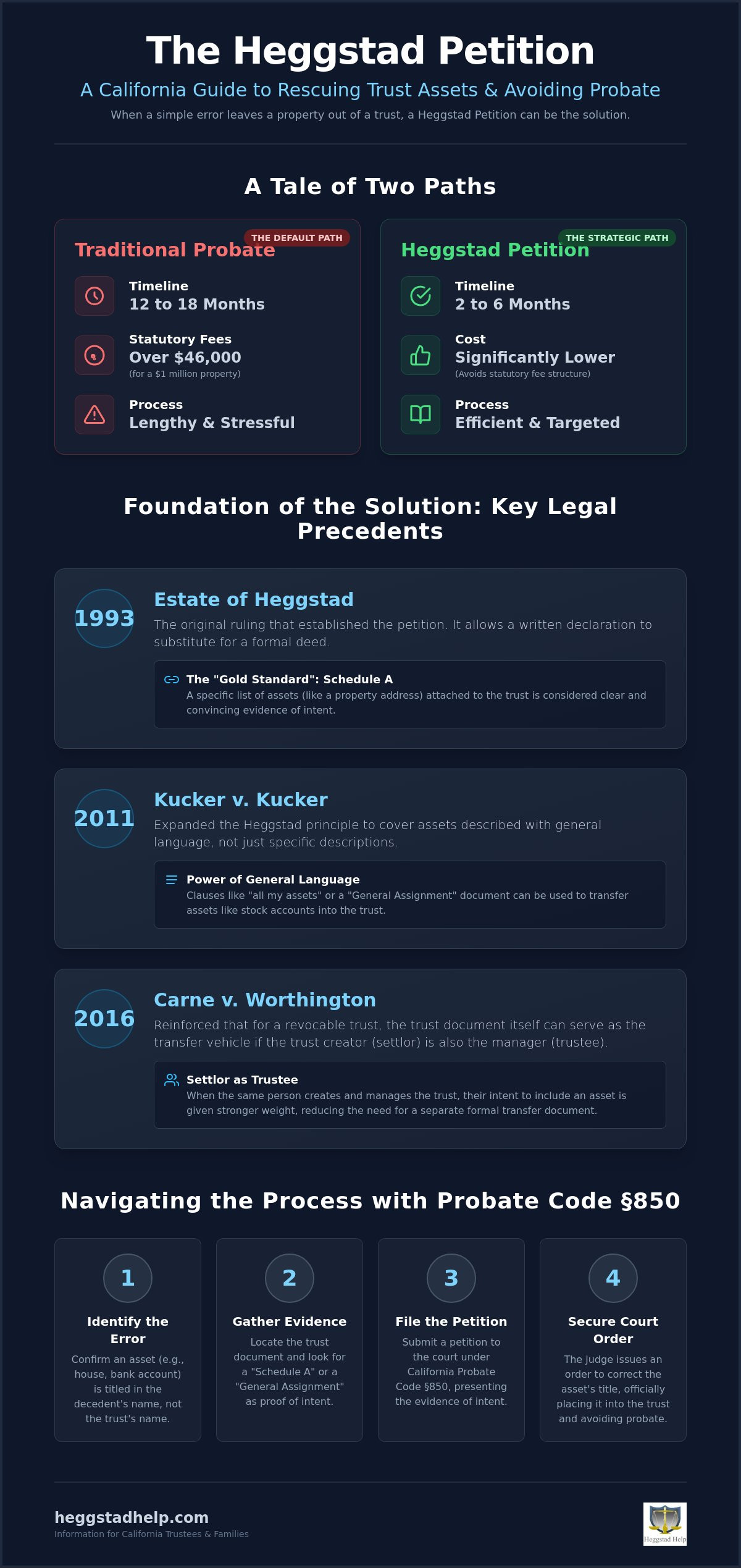
Imagine discovering that your parents’ home, the cornerstone of their estate, was never actually titled in the name of their trust. It’s a common, stressful realization that often leads families to believe they’re trapped in a 12 to 18 month probate process and facing statutory fees (the legal costs set by state law) that could exceed $46,000 for a million-dollar property. You likely feel frustrated that a simple clerical error might undo years of careful planning. It’s disheartening when a missing signature on a deed triggers the very court system you were told to avoid.
By examining Heggstad petition case studies California families have used to successfully rescue assets, you’ll see that legal precedents offer a reliable path to bypass probate and secure the inheritance as intended. This guide explores how specific court victories and the clear and convincing evidence standard (the high level of proof required by judges) can help you fix title errors and restore assets to the trust in just two to six months. You’ll discover how to leverage California Probate Code Section 850 to find a resolution that fits your specific situation and avoids the lengthy delays of traditional probate administration.
Key Takeaways
- Learn how the 1993 *Estate of Heggstad* ruling allows a written declaration to transfer property into a trust even if a formal deed wasn’t signed.
- Discover how general transfer language, such as “all my assets,” can rescue stock accounts and personal property based on the *Kucker v. Kucker* precedent.
- Use these Heggstad petition case studies California families rely on to identify the specific documents, such as a “Schedule A,” needed to prove the decedent’s original intent.
- Understand the process of navigating California Probate Code Section 850 to secure a court order that corrects asset titles in months rather than years.
- See why it’s essential to frame your petition using the historical case law that’s most favorable to your specific county’s court requirements.
The Landmark Case: Estate of Heggstad (1993) and the Birth of the Petition
The case of Estate of Heggstad (1993) changed everything for California families. The conflict began when Halvard Heggstad created a revocable living trust and explicitly listed his real estate on an attached “Schedule A” (a formal list of assets intended to be held by the trust). He passed away before signing a grant deed to officially transfer the title from his name to the trust. This clerical oversight would’ve traditionally forced the property into a standard probate, but the court reached a revolutionary conclusion. They ruled that a written declaration of trust is sufficient to include an asset in the trust, even without a formal title transfer.
When looking at Heggstad petition case studies California courts have processed since then, the primary requirement remains clear: the property must be specifically identified within the trust’s own language. For a successor trustee (the person appointed to manage the trust after the creator dies), this case acts as a powerful legal shield. If you find a detailed address or legal description in the trust binder, you likely have the evidence needed to avoid the 12 to 18 month probate timeline.
Why ‘Schedule A’ Became the Gold Standard
A “Schedule A” is more than just a list; it is a declaration of intent. In the Heggstad ruling, the court focused on the fact that the settlor (the individual who established the trust) had declared themselves the trustee of that specific property. Because they already owned the home and were now acting as the trustee, the court decided that a separate deed was redundant. This logic allows a simple list of assets to override the absence of a recorded deed, provided the description is precise.
The Limitations of the Original Heggstad Ruling
While groundbreaking, the 1993 decision had a narrow focus. It required a specific, unambiguous description of the real property to be successful. This left a significant gap for families whose trusts used “general” language, such as “all my real and personal property,” rather than listing specific street addresses. If your documents lack a detailed schedule, you’ll need to look at later Heggstad petition case studies California legal experts use to address general transfer language and assignment of assets.
Expanding the Scope: Kucker v. Kucker and General Transfer Language
The 2011 case of Kucker v. Kucker moved the needle even further for California families. While the original Heggstad ruling focused on specific property descriptions, Kucker addressed what happens when a trust uses broad language like “all my assets” instead of a specific street address. In this case, the court allowed the transfer of stock accounts into a trust based solely on a general assignment document. This expansion of the law is a critical component of Heggstad petition case studies California trustees use to rescue unfunded assets today.
While real estate typically demands more precision than personal property, these legal precedents offer a clear strategy for brokerage accounts and other holdings. If you’re a successor trustee, don’t assume a missing deed is an automatic ticket to probate. A general transfer clause may be the key to a successful court order. It’s often the difference between a quick resolution and a year spent in the probate system.
The Power of General Assignment Documents
A “General Assignment” is a short, often overlooked document located in the back of most trust binders. It functions as a formal statement of intent, declaring that all of the settlor’s property (the person who created the trust) is now trust property. This is especially helpful for assets purchased after the trust was established. If you’ve located this document, seeking a professional trust asset title correction is often the most efficient next step toward securing the estate.
Carne v. Worthington: When the Trust is Revocable
The 2016 Carne case added another layer of protection by focusing on the settlor’s authority. The court ruled that in a revocable trust where the settlor and trustee are the same person, the trust document itself can serve as the transfer vehicle. This “transfer by trust” logic means you don’t always need a separate, external signature to prove the asset belongs in the trust. This logic is a cornerstone of the Heggstad petition case studies California courts review to determine if a formal deed was actually necessary to fulfill the decedent’s wishes.
Applying Case Law to Your California Heggstad Petition
Moving from legal theory to practical application requires a methodical review of your trust documents. To build a successful case, you must translate the history of Heggstad petition case studies California into a structured legal argument based on your specific facts. Start by examining the physical trust binder for these three critical markers:
- Step 1: Locate the ‘Schedule A’ or ‘Exhibit A’. This is the primary list of assets the creator intended to include. If the missing property is listed here by its specific address, your case aligns directly with the original Heggstad precedent.
- Step 2: Search for a ‘General Transfer’ or ‘Assignment of Assets’ document. Often found near the back of the binder, this document states that all property, even if not specifically listed, belongs to the trust.
- Step 3: Compare your findings to established precedents. If you have a specific address, you’re following the Heggstad (1993) path. If you only have broad language, your petition will likely rely on the Kucker (2011) expansion of the law.
If you discover that a significant asset was left out, review our guide on Successor Trustee duties for an unfunded trust to understand your immediate responsibilities. Taking these steps early can prevent the estate from drifting into a full probate proceeding.
Common Evidence Used in Successful Petitions
While the trust document is the primary evidence, California courts often look at supporting materials to confirm the decedent’s intent. A “pour-over” will (a backup will that directs all assets into a trust) acts as a strong secondary indicator of their wishes. Additionally, previous drafts of the trust or formal letters to estate planning attorneys can bolster a case that might otherwise seem thin. In 2026, a successful petition must meet the clear and convincing evidence standard to prove that the decedent intended the asset to be part of the trust despite the titling error.
Identifying ‘Red Flags’ That Case Studies Warn Against
Not every clerical error can be fixed with a petition. Case law warns that vague descriptions, such as “my house in California,” are often insufficient for a judge to grant an order, especially if the decedent owned multiple properties. Another complication arises with “after-acquired” property. If a house was purchased years after the trust was signed and no general assignment exists, the court may rule that there’s no evidence of intent to include that specific asset. If you’re facing these complications, a professional Heggstad Petition Filing can help you frame the evidence in a way that satisfies the court’s strict requirements.
The Path Forward: Navigating Probate Code 850 in 2026
The landmark decisions discussed in earlier sections aren’t just historical anecdotes; they are the foundation for current law. Specifically, the principles from Heggstad petition case studies California practitioners rely on are now codified into California Probate Code Section 850. This statute provides the formal mechanism for asking the court to confirm trust ownership of assets. A specialized attorney doesn’t just fill out forms; they “frame” the petition by selecting the specific case law that matches your county’s current judicial preferences.
One common concern for successor trustees is whether too much time has passed since the settlor’s death. Fortunately, legal precedents show that petitions can be filed years after a person passes away if the title remains “clouded” (meaning the legal ownership is unclear). As long as the asset hasn’t been distributed through a full probate or otherwise legally transferred, the door remains open to secure the property for the trust and avoid the loss of estate value to unnecessary fees.
The Advantage of an Ex Parte Court Order
When a home sale is pending or a financial emergency arises, the standard two to six month timeline might be too slow. In these scenarios, an ex parte court order (an expedited request for immediate relief) can be used to accelerate the title correction process. Because these filings require a high degree of procedural precision, a Board-Certified Specialist is uniquely equipped to manage the nuances of an emergency petition. Their deep understanding of Heggstad petition case studies California judges respect ensures the request is handled with the necessary urgency and accuracy.
Conclusion: Turning Legal Precedent into Peace of Mind
While the intersection of case law and the probate code is complex, the objective is straightforward: ensuring the decedent’s wishes are honored without the unnecessary burden of a 12 to 18 month probate. A Heggstad petition is almost always the most cost-effective path for a Successor Trustee, saving tens of thousands in statutory fees. If you’re ready to resolve a title issue, you can contact Robert P. Bergman at Heggstad Help to see which case study fits your family’s unique situation.
Securing Your Trust Assets Without the Wait
The evolution of California law from the original 1993 Heggstad ruling to the expanded logic in Kucker v. Kucker has created a reliable safety net for successor trustees. You don’t have to accept a 12 to 18 month probate timeline just because a single deed was left unsigned. By analyzing Heggstad petition case studies California courts have approved, it’s clear that your family’s intent is the most powerful evidence you possess. Whether you have a specific Schedule A or a broad general assignment, there is likely a legal precedent that fits your situation.
Navigating these procedural hurdles requires a steady hand and specialized knowledge. Robert P. Bergman is a Board-Certified Specialist in Estate Planning, Trust and Probate Law who has been practicing in California since 1980. Unlike general practitioners, he maintains an exclusive focus on Heggstad Petitions and title corrections. This expertise ensures your petition is framed correctly from the start, reducing stress and protecting the estate’s value. Get a Specialized Case Review from Robert P. Bergman to determine the most efficient path forward for your trust. You’ve worked hard to manage this estate; the right legal strategy will help you finish the job with confidence.
Frequently Asked Questions
What is the most famous Heggstad petition case study in California?
The most significant case is the 1993 Estate of Heggstad ruling. This landmark decision established that a written schedule of assets (a list of property intended for the trust) is sufficient to prove ownership even if the deed was never formally recorded. It remains the foundational precedent for nearly all Heggstad petition case studies California legal specialists cite when rescuing unfunded real estate from the probate system.
Can a Heggstad petition work if the house was purchased after the trust was created?
Yes, it’s possible if the trust includes a “General Assignment” or specific language regarding “after-acquired” property. While the original 1993 case focused on property owned at the time the trust was signed, subsequent rulings allow for the inclusion of later purchases. You must provide clear and convincing evidence (the high legal standard of proof required in 2026) that the decedent intended for all future holdings to be governed by the trust’s terms.
How did the Kucker v. Kucker case change trust funding for personal property?
The 2011 Kucker v. Kucker decision expanded the law to cover assets like stock accounts and personal property using broad, general language. Before this case, courts often required specific account numbers or addresses to prove intent. Now, if a trust contains a general transfer of “all my assets,” judges can use this precedent to move financial accounts into the trust without a formal title change. This is a common strategy in modern Heggstad petition case studies California practitioners use for non-real estate assets.
What happens if a California judge denies a Heggstad petition?
If a petition is denied, the asset typically must go through the full probate process. This results in the standard 12 to 18 month delay and subjects the estate to statutory fees (the mandatory legal costs based on the estate’s gross value). However, a denial isn’t always the end of the road. In some instances, an attorney can refile the petition with additional evidence or use an ex parte (expedited) request if new documentation of the settlor’s intent is located.
Do I need to go to court personally for a Heggstad petition hearing?
In the vast majority of cases, the successor trustee isn’t required to attend the court hearing. Your attorney represents you and presents the legal arguments to the judge. If the petition is uncontested (meaning no one is fighting the transfer) and the evidence is clear, the judge will usually sign the order in chambers or during a brief morning calendar. This allows you to resolve the title issue without the stress of a public testimony or a long day in the courtroom.

Article by
Robert P. Bergman, Attorney at Law
Attorney Robert P. Bergman ("Bob Bergman") has been a Board-Certified Specialist in Estate Planning, Trust and Probate Law since 2011, as certified by the California State Bar Board of Legal Specialization. For several years, Bob has assisted families and the clients of other attorneys with obtaining court orders through Heggstad petitions to avoid the time and expense of Probate administration. Bob is friendly, very approachable, and believes in explaining complex legal topics in clear ordinary language so that his clients understand exactly what they're doing and why they're doing it.
Bob is often able to assist clients who are in other counties than his home county of Santa Clara through his approach to Heggstad petitions.
Disclaimer
This article is for informational purposes only. Nothing in this article is intended to replace legal advice from a competent attorney or be considered legal guidance for anybody's specific legal situation. Nobody should rely on information in this article in making legal decisions without such consultation.


