Securing Trust Assets: How to Handle Property Left Outside the Trust

An unfunded trust can leave an asset exposed to probate, even when the trust document reflects the owner’s intentions. Securing trust assets that are…

An unfunded trust can leave an asset exposed to probate, even when the trust document reflects the owner’s intentions. Securing trust assets that are not properly titled usually means correcting ownership during the owner’s lifetime. After death, a California Heggstad petition may help transfer qualifying property into the trust without full probate administration. The central question is whether the available records show that the owner intended the specific asset to belong to the trust.

It’s understandable to expect a signed trust to cover everything you own, but ownership records matter too. This article explains how to transfer property into a trust, which assets generally pass by beneficiary designation instead, and what can happen when property remains in an individual’s name. You’ll also learn when a Heggstad petition may be appropriate and why evidence of intent matters, so you can understand options for resolving an untitled asset in California.

Key Takeaways

  • When you acquire property after creating a trust, make sure ownership records reflect the trust where appropriate; the correct transfer method depends on the type of asset.
  • A general assignment may cover personal property, while real estate and business interests can require different transfer documents or records.
  • A California Heggstad petition may help transfer an asset into a trust after death when evidence supports that the owner intended it to be trust property.
  • An asset left in an individual’s name may be subject to probate, so understanding its title and the available transfer options can help clarify the next step.

Assets acquired after creating a trust

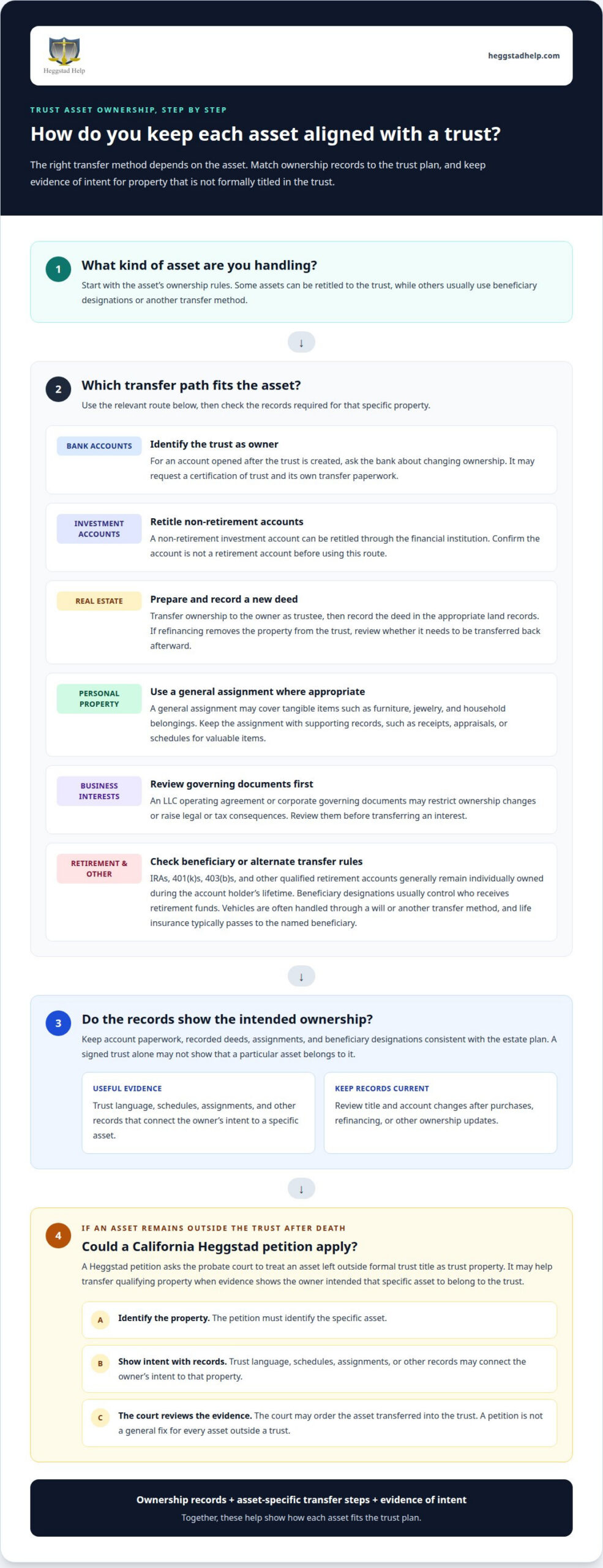
A trust covers an asset only when ownership is properly transferred or otherwise aligned with the trust plan. With a revocable trust, the person who created it can serve as trustee and add property by changing its title. For example, a bank account opened after the trust is created should identify the trust as owner or confirm that the trust holds the account. The bank may request a certification of trust and its own transfer paperwork. Non-retirement investment accounts can also be retitled through the financial institution.

To transfer real estate into a trust, prepare a new deed transferring ownership to the owner as trustee, then record it in the appropriate land records. The deed should accurately reflect the intended trust ownership. If the property remains in the owner’s individual name, it may be outside the trust. When refinancing, review any title changes: property removed from the trust may need to be transferred back afterward.

Not every asset belongs in the trust’s name. IRAs, 401(k)s, 403(b)s, and other qualified retirement accounts generally remain individually owned during the account holder’s lifetime; transferring one may be treated as a withdrawal and create tax consequences or penalties. Instead, beneficiary designations usually control who receives retirement funds. Vehicles are also often handled through a will or another transfer method rather than trust ownership. Review beneficiary designations so they remain consistent with the intended estate plan.

Business interests need a separate review before transfer. An LLC operating agreement or a corporation’s governing documents may restrict ownership changes or create unintended legal or tax consequences. A general assignment may transfer personal property, such as household belongings, without retitling each item separately. Keep trust asset records aligned with later purchases, account changes, and ownership documents. This focused review helps secure trust assets not properly titled by distinguishing straightforward transfers from those that need closer attention.

Assigning personal property to a trust

A general assignment can transfer tangible personal property, such as furniture, jewelry, and household items, without retitling every object individually. The document should identify the property being assigned and connect it to the living trust. For example, trust language covering all personal property wherever situated may help show that an item belongs to the trust, even if the document does not name each possession separately.

Specific records still matter. Jewelry appraised at $75,000 or antique furniture valued at $50,000 can be difficult to handle during trust administration if ownership was never documented. An assignment creates a written record of the owner’s intent, while receipts, appraisals, and schedules can help identify particular items. Keep those records with the estate plan, and update them when valuable property is acquired or transferred.

To retitle bank and brokerage accounts into a revocable living trust, ask the financial institution to change the account owner to the trust and complete its required paperwork. The institution may request a certification of trust, which summarizes key trust information without providing the entire document. For a brokerage account, confirm that it is a non-retirement investment account. Retirement accounts generally remain individually owned during the account holder’s lifetime.

Beneficiary designations require a separate review. Life insurance proceeds typically pass to the named beneficiary rather than through trust ownership. A trust may be named as beneficiary when that fits the estate plan, but this can affect when proceeds are distributed and may have tax implications for a sufficiently large estate or policy. Review designations after changes in family circumstances and coordinate them with the trust’s terms.

If an account or item’s ownership records don’t match the intended plan, Trust Asset Title Correction can help address the discrepancy and clarify the trust’s ownership record.

California Heggstad Petitions

In California, a Heggstad petition asks the probate court to treat an asset left outside formal trust title as trust property. It can provide a court process for transferring eligible property into the trust. The concept comes from Estate of Heggstad, reported at 16 Cal. App. 4th 943. A petition must identify the specific asset and show the trustor intended it to belong to the trust. A signed trust alone may not establish that intent if its language and related records do not connect it to the property.

Evidence may include trust language describing the asset, schedules, assignments, or other records showing the owner’s intent. For example, a trust schedule identifying a particular parcel can help connect that real estate to the trust. The court considers the documents together, including whether they clearly identify the asset. A general wish to fund the trust is different from evidence tied to specific property.

State laws affect how assets are transferred because deed requirements, ownership records, and court procedures vary. For real estate, the property’s location matters. A California Heggstad petition addresses trust funding through a California court; assets located elsewhere may involve different rules. Retirement accounts also require separate treatment because beneficiary designations, rather than trust ownership, commonly determine who receives them.

After reviewing the evidence, the court may order the asset transferred into the trust, where it can be administered and distributed under the trust’s terms. A Heggstad petition is not a general fix for every asset outside a trust. It focuses on whether the specific property was intended to be trust property, not simply on whether the trustor wanted a comprehensive estate plan.

Consult an estate planning attorney when an owner has died and property remains titled individually, or when trust documents and ownership records conflict. An attorney can assess whether the asset is identifiable, whether the documents show intent, and whether a Heggstad petition fits the circumstances. Addressing those questions promptly can clarify how the asset may be transferred and whether probate may otherwise be required.
Securing Trust Assets: How to Handle Property Left Outside the Trust

Consequences of assets left outside a trust

A trustee’s authority generally extends to assets held by the trust, not everything the trustor owned. If a California home remains in an individual’s name, the trust may not control its transfer at death. Probate may then be needed before the property can be distributed. The same issue can arise with personal property when no assignment or other ownership record connects it to the trust.

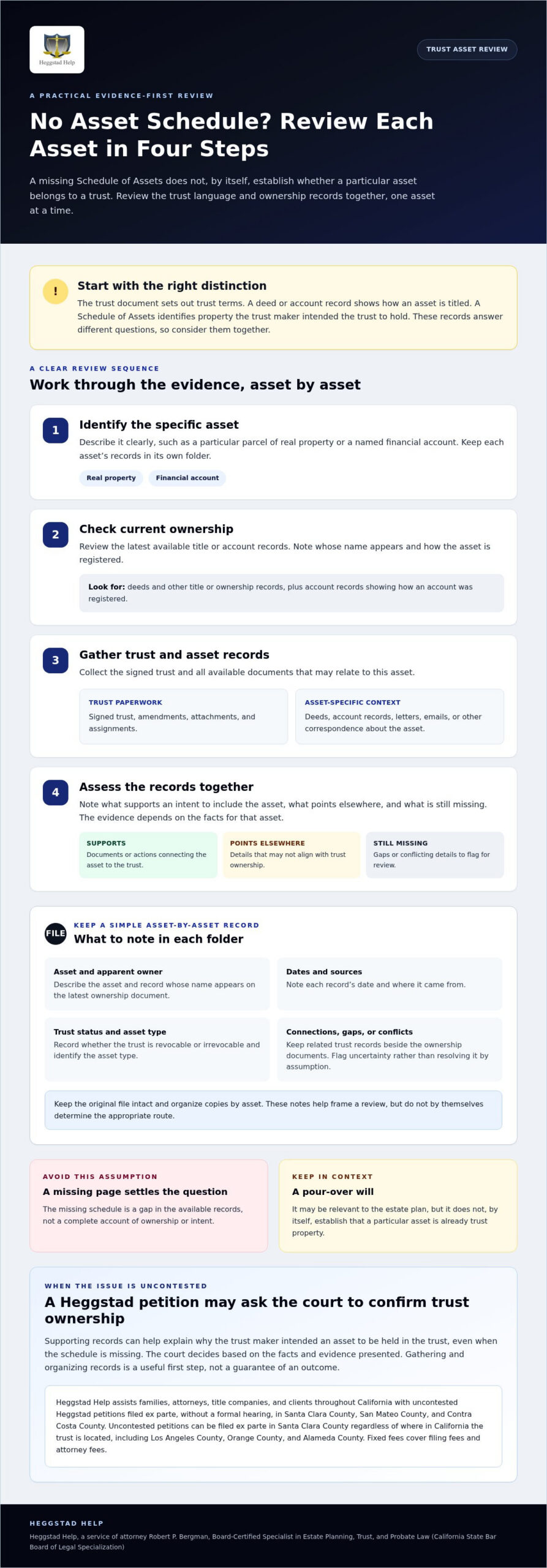
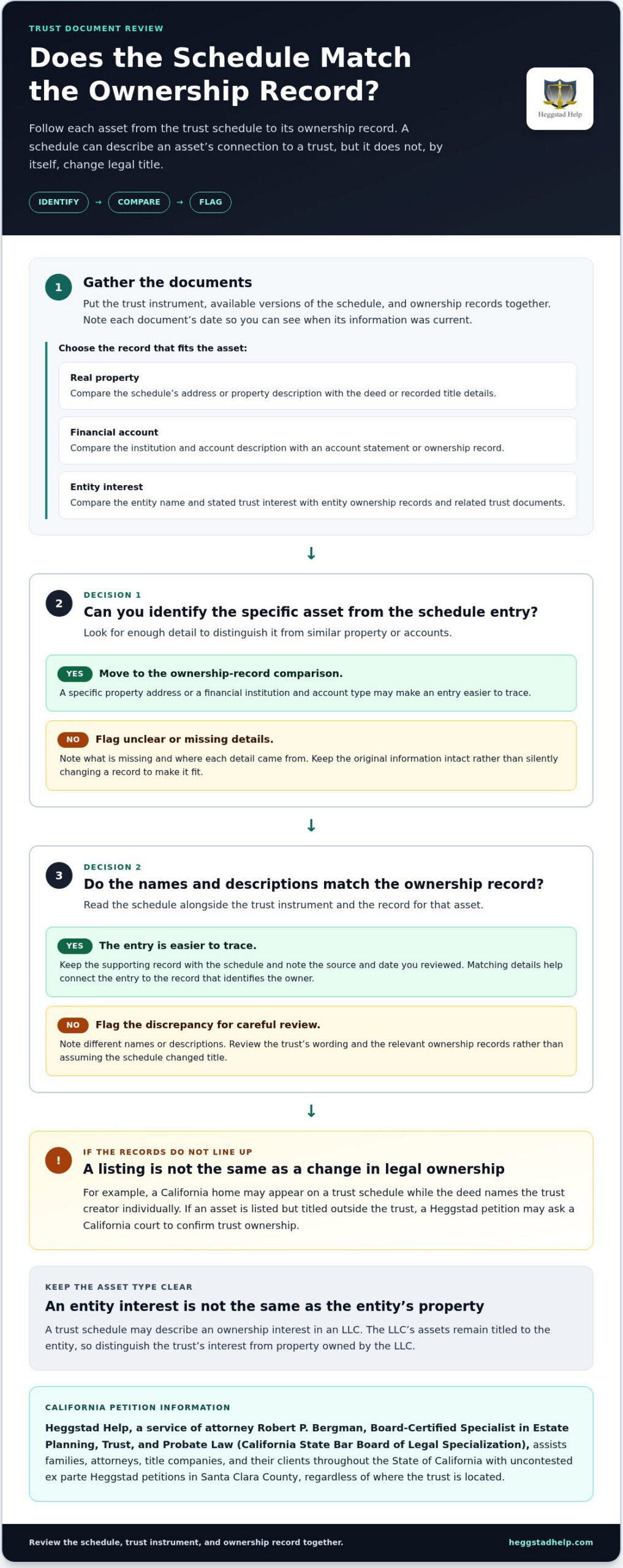
To identify potentially missing assets, compare the trust’s asset schedule and transfer documents with current ownership records. Review real estate deeds, bank and investment account statements, and records for business interests. For personal property, look for a signed assignment or a specific list of valuable items. Note assets opened or acquired after the trust was created, and flag title changes made during refinancing.

An unfunded or partially funded trust can leave beneficiaries facing court filings, added administration, and delayed access to property. For example, a home removed from a trust during refinancing may remain outside it if ownership was never transferred back. A trustee cannot rely on the trust document alone to control an asset still titled to someone else.

Retirement assets require a different review. An IRA or 401(k) generally passes under its beneficiary designation, rather than through trust ownership. If an account names a former spouse or omits an intended beneficiary, the distribution may not match the estate plan. Changing ownership instead of reviewing the designation can also create unintended tax consequences.

Funding should be reviewed after major life events and when accounts, custodians, or ownership records change. Compare each asset’s title and beneficiary designation with the trust plan, then identify whether a transfer, updated designation, or court process may be needed. For help addressing ownership discrepancies, request Trust Asset Title Correction.

HEGGSTAD HELP: Trust Asset Title Correction

HEGGSTAD HELP, a service provided by attorney Robert P. Bergman, a Board Certified Specialist in Estate Planning, Trust and Probate Law, assists families, attorneys, title companies, and their clients throughout California for securing trust assets not properly titled. Its Heggstad petition and trust asset title correction services address assets left outside a trust when title records or trust documents need court-supported resolution.

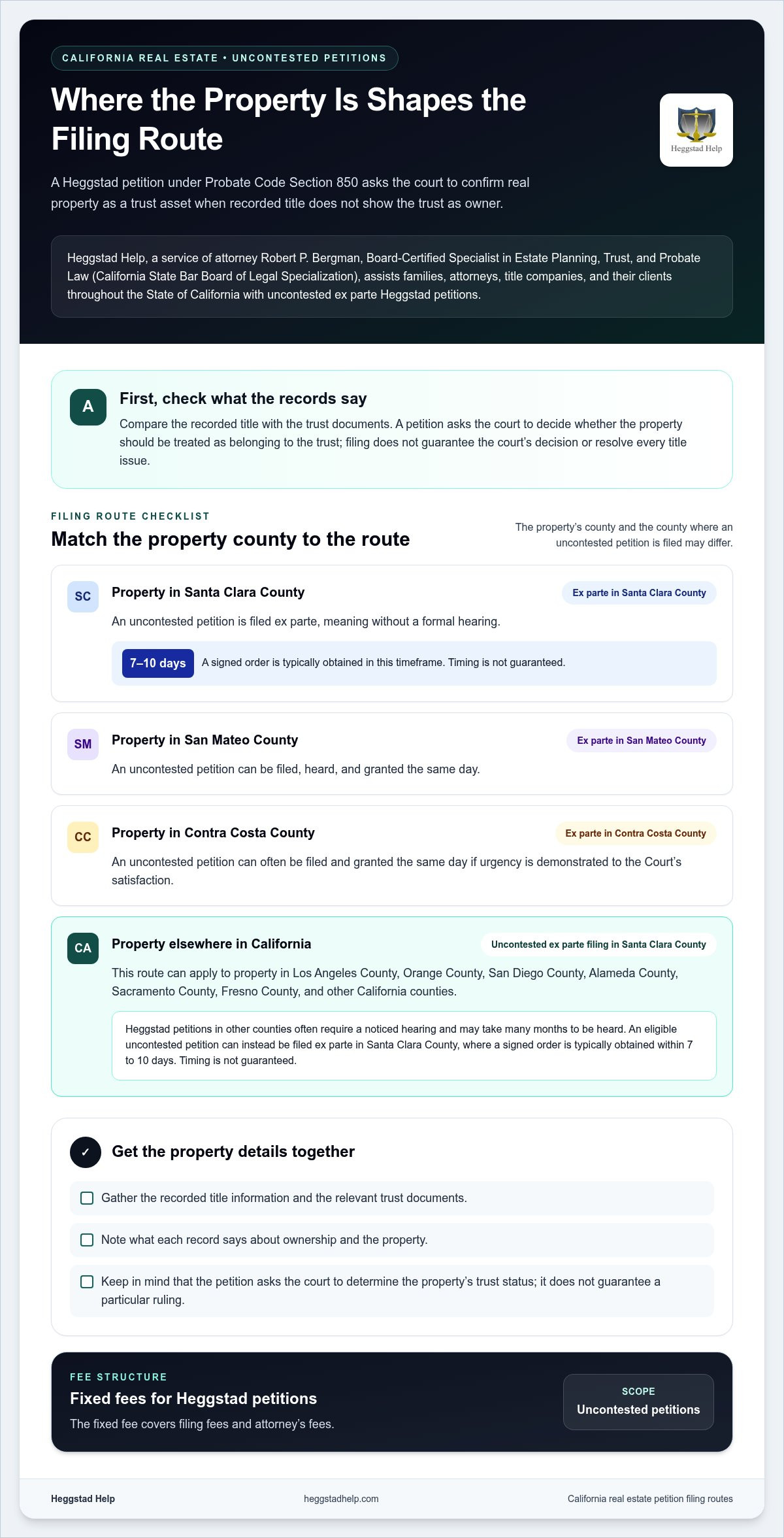
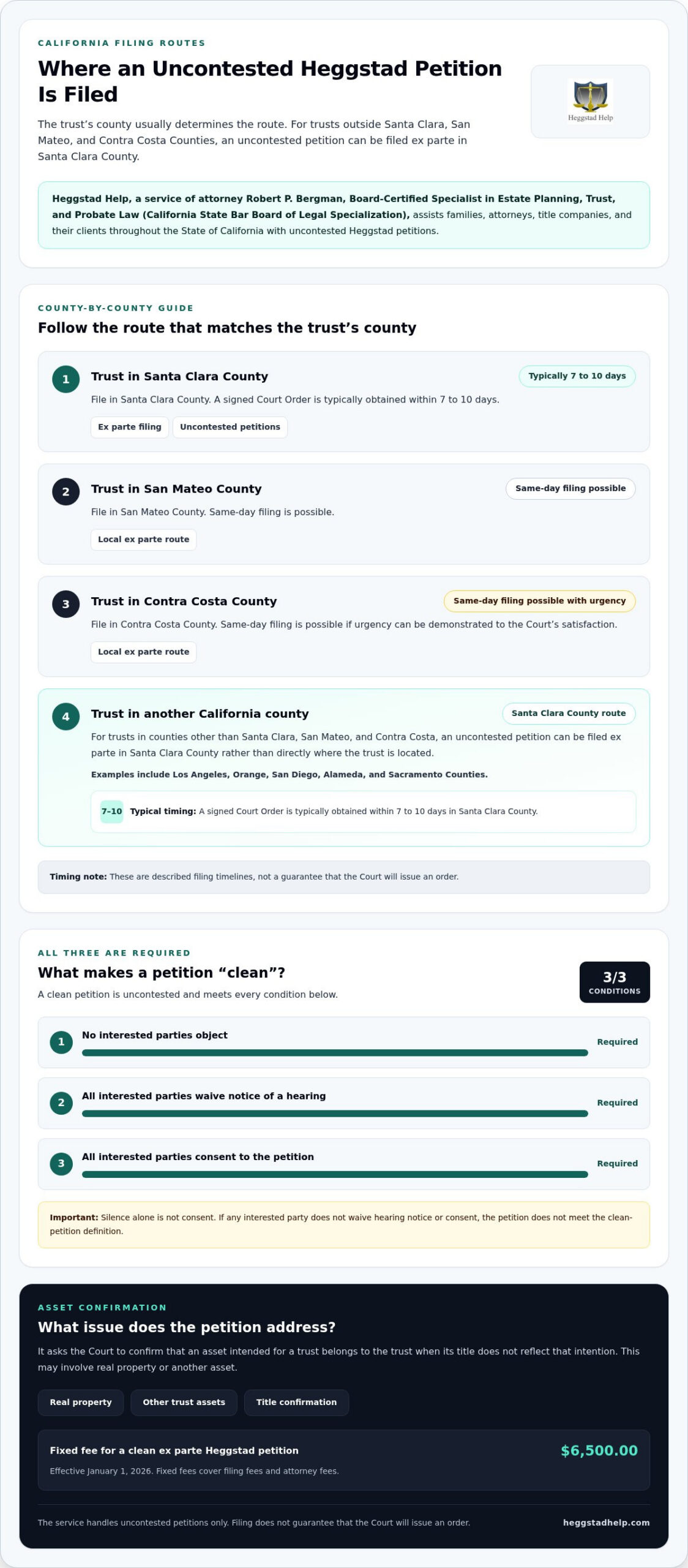
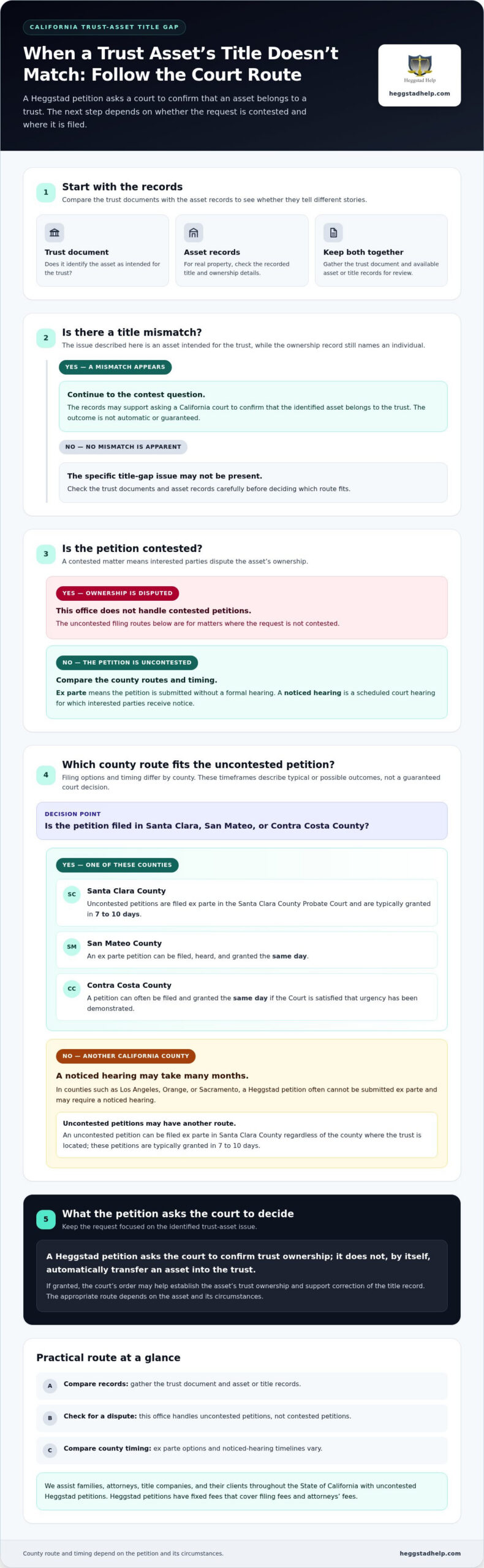
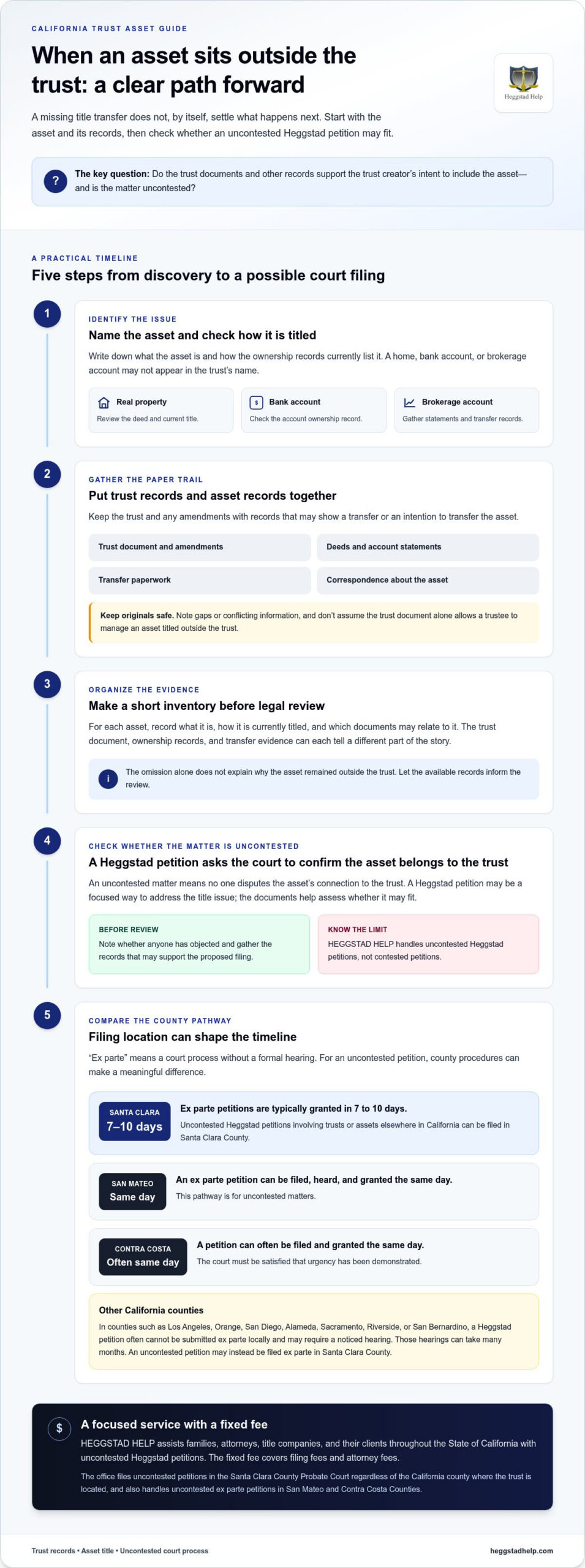
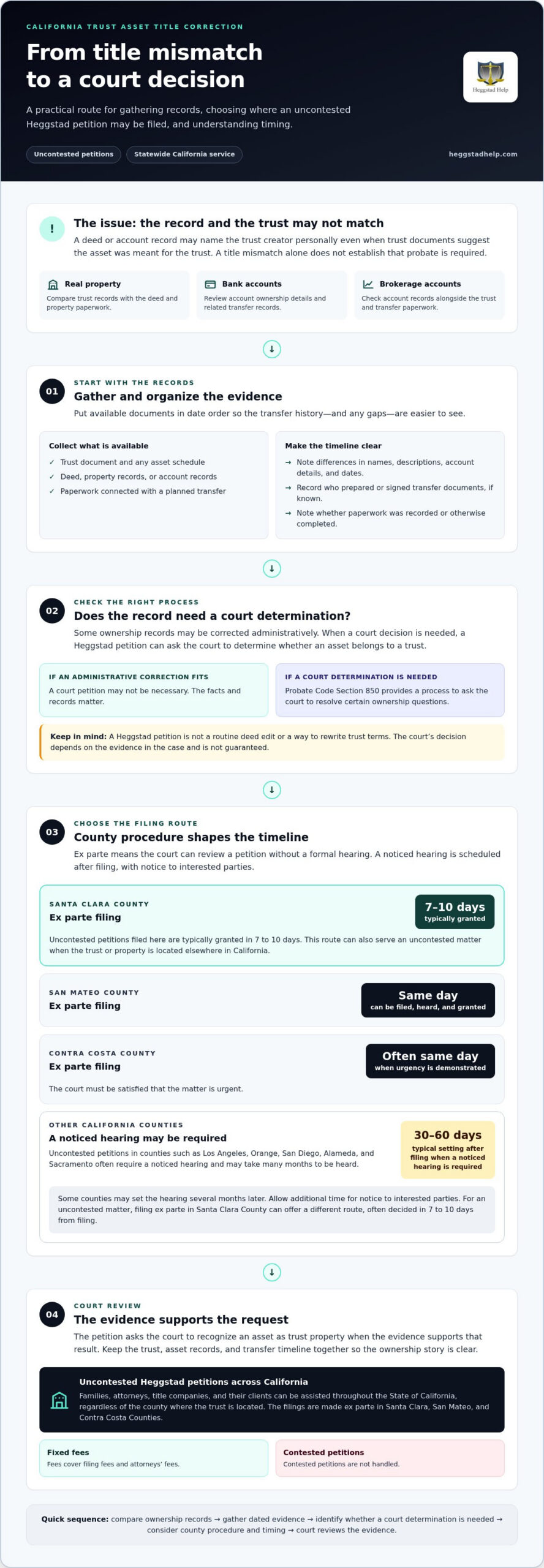
For uncontested petitions involving trusts in counties such as Los Angeles, Orange, or San Diego, filing ex parte in Santa Clara County can offer a faster route; petitions there are typically granted in 7 to 10 days. In San Mateo County, ex parte petitions can be filed, heard, and granted the same day. In Contra Costa County, petitions can often be filed and granted the same day when the court is satisfied that urgency has been demonstrated.

Heggstad petitions have fixed fees that cover filing fees and attorney fees. This office handles uncontested petitions, not contested petitions. Contact HEGGSTAD HELP to discuss an untitled trust asset and the appropriate next step.

Take the Next Step Toward Clear Trust Ownership

The next step is to identify the specific ownership question that remains unresolved: whether an asset needs a title correction, a trust transfer, or a court order. That distinction helps focus the review on the asset’s records and the evidence of the owner’s intent. A focused approach to securing trust assets that are not properly titled can help families and professionals decide what issue needs attention first.

HEGGSTAD HELP offers Trust Asset Title Correction, Heggstad Petition Filing, and Ex Parte Court Order Services. The appropriate path depends on the asset, its current ownership, and the documents connecting it to the trust. If you’re ready to discuss a property or account that remains outside the trust, contact HEGGSTAD HELP for guidance. A clear explanation of the asset and the unresolved title issue can help start a focused conversation. Take the next step when you’re ready, with a clearer understanding of the question that needs to be resolved.

Frequently Asked Questions

What about Probate?

Probate depends on the assets, ownership records, and available transfer methods, not simply on whether someone signed a trust. The estate’s value and asset types affect whether this option applies.

What happens when assets are not properly titled in a trust?

The asset’s legal owner may differ from the person expected to manage it under the trust plan. That mismatch can create practical hurdles, such as needing additional documents to establish who has authority to act. For instance, a successor trustee may have trust paperwork but still need to address an account or deed recorded in the former owner’s individual name.

What are the probate consequences of assets not titled in a trust?

Probate can require the court to establish authority over property before it is distributed, adding steps for the people handling the estate. A will may direct distribution of assets in the probate estate, but it generally does not control property paid directly to a named beneficiary. Identifying how each asset is owned or payable helps clarify which process applies.

Can improperly titled trust assets create tax, creditor, or Medicaid eligibility problems?

Possibly, but an ownership mismatch alone does not determine tax treatment, creditor exposure, or Medicaid eligibility. The analysis can depend on the trust’s terms, whether it is revocable or irrevocable, who owns or can access the asset, and when transfers occurred. Retirement accounts require particular care because changing ownership can create tax consequences or penalties. Consider each issue separately before changing title.

Robert P. Bergman, Attorney at Law

Article by

Robert P. Bergman, Attorney at Law

Attorney Robert P. Bergman ("Bob Bergman") has been a Board-Certified Specialist in Estate Planning, Trust and Probate Law since 2011, as certified by the California State Bar Board of Legal Specialization. For several years, Bob has assisted families and the clients of other attorneys with obtaining court orders through Heggstad petitions to avoid the time and expense of Probate administration. Bob is friendly, very approachable, and believes in explaining complex legal topics in clear ordinary language so that his clients understand exactly what they're doing and why they're doing it.
Bob is often able to assist clients who are in other counties than his home county of Santa Clara through his approach to Heggstad petitions.

Disclaimer

This article is for informational purposes only. Nothing in this article is intended to replace legal advice from a competent attorney or be considered legal guidance for anybody's specific legal situation. Nobody should rely on information in this article in making legal decisions without such consultation.

Heggstad Petition in California: Assets That May Avoid Probate

An asset can be intended for a trust yet remain outside it on paper. A Heggstad petition in California may help you avoid probate by asking the court…

An asset can be intended for a trust yet remain outside it on paper. A Heggstad petition in California may help you avoid probate by asking the court to confirm that an overlooked asset belongs to the trust. Because the petition can be contested, evidence of the trustor’s intent matters.

It’s understandable to worry that a missing deed or account title could lead to probate. A Heggstad petition may apply to real property and certain other assets when documents or records show the trustor intended to place them in the trust. It does not automatically transfer every asset.

This article explains which assets may qualify, how a court order can address property and accounts, and what may happen if someone objects. You’ll also learn how an uncontested petition differs from a contested case, so you can better understand the process.

Key Takeaways

  • Gather trust schedules, assignments, correspondence, and financial records that may show the trustor intended the overlooked asset to belong to the trust.
  • Identify the asset’s current ownership and title details to understand whether a court petition may help bring it into the trust.
  • Expect the court order process to differ for real property and financial accounts, and learn what notice interested parties may receive.
  • Consider whether anyone may object, since evidence of intent and the presence of a dispute can affect the petition’s path.

Can a Heggstad Petition Be Contested?

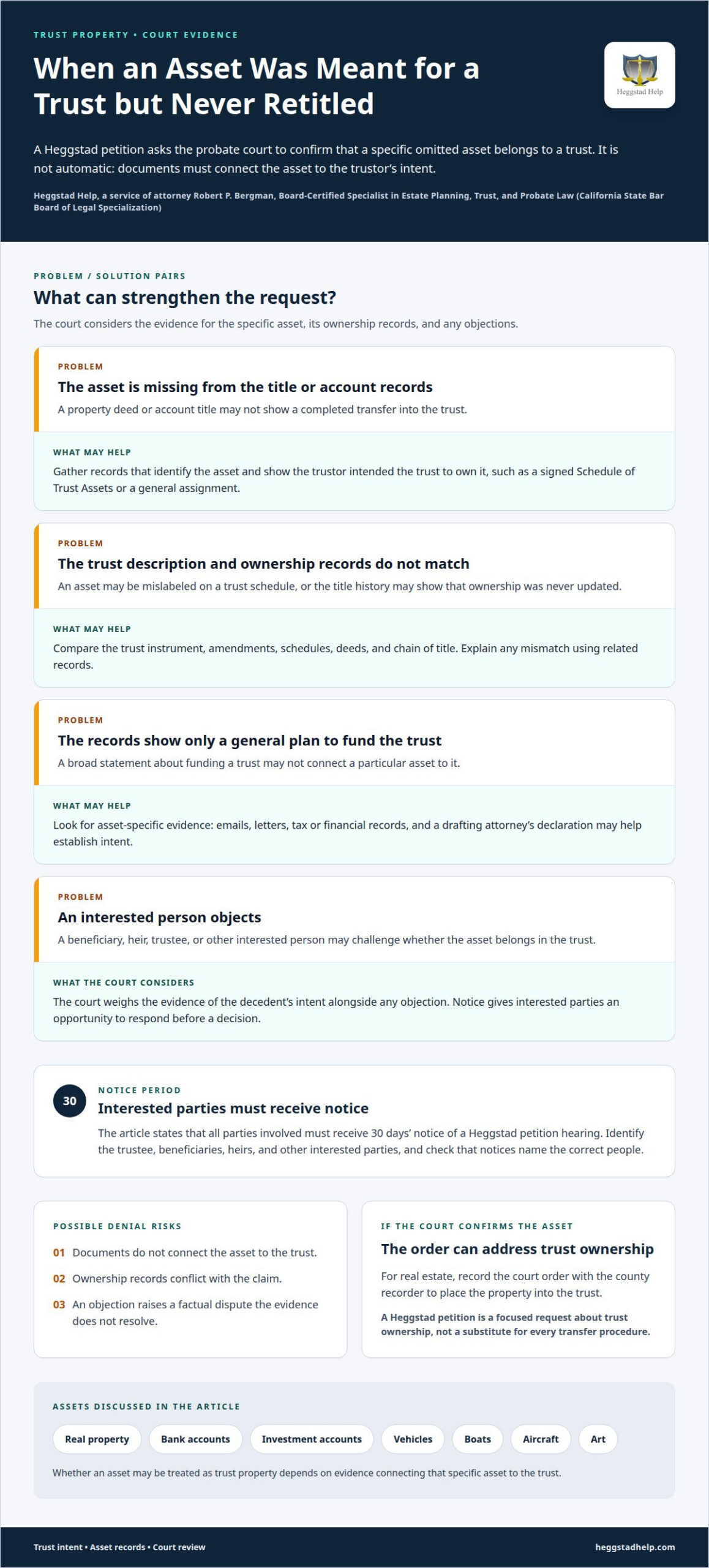
Yes. A beneficiary, heir, trustee, or other interested person may object, making the petition contested. The court weighs evidence of the decedent’s intent and whether the asset belongs in the trust.

Evidence of Intent to Fund the Trust

Look for documents created before the decedent’s death that connect the specific property to the trust. A signed Schedule of Trust Assets, general assignment, emails, letters, tax records, or financial records may support the request. Strong evidence identifies the asset clearly and shows the decedent intended the trust to own it, rather than merely describing a future plan.

Trust Documents and Chain of Title

Compare the trust and its schedules with the property’s title history. For real estate, deeds and the chain of title, meaning the record of ownership transfers, can show whether the decedent retained ownership despite an incomplete transfer. A mismatch, such as a property interest described incorrectly on a trust schedule, may need explanation through related documents. Keep the trust instrument, amendments, schedules, and title records together for review.

Notice to Interested Parties

Notice gives the trustee, beneficiaries, heirs, and other interested parties an opportunity to respond before the court decides the request. According to the California Legislature, all parties involved must receive 30 days’ notice of a Heggstad petition hearing. Review the interested-party list carefully and ensure notices address the correct people. If someone objects, the hearing may become contested, and the court will consider that objection alongside the evidence.

Requirements and Risks of Denial

To obtain relief under Probate Code Section 850, the petitioner must show that the asset should be treated as trust property, supported by evidence of the decedent’s intent. A petition may be denied if the documents do not connect the asset to the trust, ownership records conflict with the claim, or an objection exposes a factual dispute the evidence does not resolve. For example, a general statement about funding a trust may be weaker than a signed schedule naming the property.

The court may issue an order confirming property as trust property; for real estate, record the order with the county recorder to place it into the trust. Heggstad petitions have fixed fees covering filing fees and attorney fees.

Which Assets Can Avoid Probate in California?

A Heggstad petition asks the probate court to confirm that an omitted asset belongs to a trust, based on evidence of the decedent’s intent. Unlike full probate, it focuses on whether a specific asset should be treated as trust property. A spousal property petition addresses a different kind of transfer. A family may avoid probate with a Heggstad petition in California when the court confirms that an asset was intended for the trust.

Bringing Omitted Assets Into a Living Trust

A petition may bring an asset into a California living trust even if the owner did not formally transfer or retitle it before death. Examples include real property, bank or investment accounts, vehicles, boats, aircraft, and art. The court considers whether evidence supports treating that specific asset as trust property, not simply whether the trustor had a general plan to fund the trust. Identify the asset and gather records connecting it to the trust.

Mislabeled and Mistitled Trust Assets

An asset may appear on a trust schedule under an inaccurate description, or its title may never have been updated. In Estate of Heggstad, a property interest appeared on the trust’s Schedule of Assets but was mislabeled as a partnership interest. The court accepted the family’s position that it belonged in the trust. Compare each listed asset with the trust documents and ownership records to identify mismatches that may need explanation in the petition.

Evidence of Intent to Place Assets in Trust

Evidence may include a signed Schedule of Trust Assets, a general assignment to a revocable trust, or another writing identifying the asset. Emails, letters, tax records, financial records, and a drafting attorney’s declaration may also help establish intent. Organize documents by asset, then match each record to its description or account details. Whether a family can avoid probate with a Heggstad petition in California depends on evidence linking the specific asset to the trust, not on a general intention alone.

A Heggstad petition is a focused request about trust ownership, not a substitute for every transfer procedure. Probate addresses estate administration more broadly, while a spousal property petition concerns a different legal relationship. Reviewing the asset’s ownership history alongside the trust records helps clarify which path fits the situation.

Court orders for real property and financial accounts

A Heggstad petition asks the probate court to confirm that an asset belongs to a trust, even if it was not formally transferred. The filing, required notice, and any objections shape what happens before the court issues an order.

Filing Location and Notice

The appropriate filing location may depend on the circumstances, including the decedent’s residence and the property’s location. An uncontested petition may be handled without a formal hearing, depending on the circumstances. According to the California Legislature, all parties involved must receive 30 days’ notice of a Heggstad petition hearing. Identify the trustee, beneficiaries, heirs, and other interested parties before preparing notice.

Notice gives interested people an opportunity to respond. Keep a record of who must be notified and documents showing that notice was given. This step matters even when the family expects no objection, because an interested party may raise concerns about ownership or the decedent’s intent.

Court Hearing and Objections

At a hearing, the probate court reviews the petition, supporting documents, and any objections. For real property, compare the trust’s description with the deed and title records. For a bank or investment account, include records identifying the account and its owner. These details help the court assess whether the specific asset should be confirmed as trust property.

If an interested party disputes the evidence, the court may need to resolve the disagreement before issuing an order. Keep the trust instrument, asset records, and relevant correspondence organized so the request addresses each disputed point clearly.

Petition Timeline and Hearing Outcome

How long does a Heggstad petition take in California? Uncontested ex parte petitions in Santa Clara County are typically granted in 7 to 10 days. In other counties, petitions often require noticed hearings and may take many months, depending on the court’s process and schedule.

At the hearing, the judge considers whether the evidence supports the requested transfer. If the court grants the petition, its order can confirm real property or accounts as trust assets. For real estate, record the order with the county recorder to place the property into the trust. The order addresses a title problem, not unrelated disputes in the estate or trust.

Heggstad Petition in California: Assets That May Avoid Probate

Using a Heggstad petition to avoid probate

Probate Code Section 850 provides the basis for a California probate court request. It asks a judge to confirm that a specific asset belongs to a trust. A Heggstad petition may help avoid full probate for property the decedent intended to place in a living trust but left out of formal title.

The 1993 Estate of Heggstad case established the principle behind this focused petition. The court may consider whether documents and surrounding records show the decedent intended the asset to belong to the trust. For example, a signed trust schedule naming a property interest can support the request, even when the asset’s title was never updated.

Start by identifying each asset separately. Match the trust instrument and schedules to the deed, account statement, or other ownership record. Then organize writings that show the connection, such as an assignment to the trust, correspondence, or financial records. Clear asset descriptions matter: a deed’s legal description or an account’s identifying information helps distinguish the requested property from other estate assets.

This process differs from full probate, which administers estate property more broadly. A Heggstad petition asks the court to decide whether a particular asset belongs to the trust; it does not automatically transfer every asset or resolve unrelated estate disputes. If the judge grants the request, the order can confirm the asset as trust property. For real estate, recording the order with the county recorder helps place the property into the trust.

The practical takeaway is to connect each asset to the trust with specific records before filing. A document that only expresses a general wish to fund a trust may not explain why a particular account or property should be treated as trust-owned. Review the Heggstad petition process as you organize the trust documents and ownership records relevant to your situation.

HEGGSTAD HELP: Heggstad Petition Filing

HEGGSTAD HELP, a service of attorney Robert P. Bergman, Board-Certified Specialist in Estate Planning, Trust, and Probate Law (California State Bar Board of Legal Specialization), assists families, attorneys, and their clients with uncontested Heggstad petitions throughout the State of California. The petition can be filed in the Santa Clara County Probate Court regardless of where in California the trust is located.

For uncontested matters, petitions filed ex parte in Santa Clara County are typically granted in 7 to 10 days. Ex parte means requesting a court order without a formal hearing. Petitions may also be filed ex parte in San Mateo and Contra Costa Counties. If an interested party objects, the matter is contested, and this office does not handle contested petitions.

Heggstad Petition Filing and Ex Parte Court Order Services can address assets intended for a trust but left out of its title records. A fixed fee covers filing fees and attorney fees. For help with an uncontested petition to avoid probate with Heggstad petition California, contact HEGGSTAD HELP.

Prepare the Next Step for the Trust

Before moving forward, make a short inventory of assets still titled outside the trust. For each one, note the current owner, the trust document that may support its inclusion, and the record that needs correction. This gives the next review a practical starting point and helps distinguish a title issue from a request that requires a court order.

For families seeking to avoid probate with a Heggstad petition in California, the next step is matching the asset’s history to the trust documents. Heggstad Help provides trust asset title correction and Heggstad petition services to address records that need to align with the trust. The appropriate approach depends on the asset and the available evidence.

Bring the trust instrument, schedules, deeds, and account records together before proceeding. Contact HEGGSTAD HELP to discuss the next step for an uncontested Heggstad petition, and move forward with a clearer plan for the trust.

Frequently Asked Questions

Do I need an attorney to file a Heggstad petition?

A Heggstad petition is a court filing, and California has no simplified do-it-yourself version of this procedure. The petition must explain why a specific asset should belong to the trust and support that request with records. An attorney can help organize the evidence, prepare the filing, and address notice requirements. That distinction matters: procedural complexity doesn’t itself establish a universal legal requirement to hire an attorney.

What if the asset isn’t specifically listed on the Schedule of Trust Assets?

An asset’s absence from the trust schedule does not automatically end the inquiry. Other writings may support the request, such as a signed general assignment, correspondence, or financial records connecting the asset to the trust. For example, paperwork prepared during a refinancing may help explain why a home’s title remained outside the trust. Focus on records identifying the specific asset and showing the decedent’s intent, rather than relying only on a general estate-planning goal.

What evidence is needed to show the decedent intended to transfer an asset into a trust?

Evidence may include a signed assignment, trust schedules, emails, letters, tax documents, financial records, or a drafting attorney’s declaration. Organize these records into a timeline showing when the trust was created, when the asset was acquired, and what steps were taken to transfer it. For a home, compare trust papers with deed records. For an account, gather documents identifying it and showing how it was treated.

Which assets can and cannot be recovered through a California Heggstad petition?

A petition may cover real property and other assets, including bank or investment accounts, art, aircraft, boats, and vehicles, when evidence supports the trustor’s intent. To avoid probate with a Heggstad petition in California, the evidence must connect the specific asset to the trust; the petition is not a blanket recovery method. Property held in joint tenancy with right of survivorship generally passes automatically to the surviving owner.

What are the steps and forms for filing a Heggstad petition in California?

Begin by identifying the asset and gathering trust, ownership, and intent records. The petition is brought under Probate Code Section 850 and asks the court to confirm the asset as trust property. Identify interested parties and provide required notice. Clearly describe the asset and requested order in the filing. For real property, ensure its description matches title records so the court order can identify the correct property.

Do California Heggstad petition procedures vary by county, including Los Angeles, Orange, and San Diego?

Yes. County court procedures can differ, including whether a petition may proceed ex parte or requires a noticed hearing. In Los Angeles, Orange, and San Diego Counties, petitions often require noticed hearings and may take many months. An uncontested petition from another California county may be filed ex parte in Santa Clara County, even when the trust is located elsewhere. Ex parte treatment requires that all interested parties consent to the petition, waive notice of a hearing, and that no interested party objects.

Robert P. Bergman, Attorney at Law

Article by

Robert P. Bergman, Attorney at Law

Attorney Robert P. Bergman ("Bob Bergman") has been a Board-Certified Specialist in Estate Planning, Trust and Probate Law since 2011, as certified by the California State Bar Board of Legal Specialization. For several years, Bob has assisted families and the clients of other attorneys with obtaining court orders through Heggstad petitions to avoid the time and expense of Probate administration. Bob is friendly, very approachable, and believes in explaining complex legal topics in clear ordinary language so that his clients understand exactly what they're doing and why they're doing it.
Bob is often able to assist clients who are in other counties than his home county of Santa Clara through his approach to Heggstad petitions.

Disclaimer

This article is for informational purposes only. Nothing in this article is intended to replace legal advice from a competent attorney or be considered legal guidance for anybody's specific legal situation. Nobody should rely on information in this article in making legal decisions without such consultation.

Heggstad Petition for Stock Certificates: Which Assets Qualify

A paper stock certificate does not automatically keep shares out of a trust. A Heggstad petition for stock certificates may ask a California court to…

A paper stock certificate does not automatically keep shares out of a trust. A Heggstad petition for stock certificates may ask a California court to recognize shares as trust property when the owner intended to place them in the trust but did not complete the transfer. The key question is whether the available evidence supports that intent, not simply whether a physical certificate exists.

It is understandable to focus on the certificate itself: it represents ownership, and handling it after someone’s death can involve additional practical steps. But the trust documents and other records may help show whether the shares were meant to belong to the trust. Ownership arrangements and beneficiary designations can also affect the analysis.

This article explains which assets a Heggstad petition may address, what records can support a claim involving shares, and how notice and objections fit into the process. It also explains what a court order may accomplish, helping you distinguish an omitted trust asset from a different kind of transfer issue.

Key Takeaways

  • A petition may help establish that an asset belongs to a California trust when ownership was never formally updated, if the evidence shows the owner intended to include it.
  • Trust schedules, written assignments, and ownership records can help support the claim; organize documents that identify the specific asset.
  • Notice gives interested parties an opportunity to object, so identify who may have an interest before the petition proceeds.
  • Physical stock certificates involve transfer and ownership details that differ from brokerage-held shares; gather the certificate and related company records.

Which assets can a Heggstad petition reach?

A California Heggstad petition can ask the probate court to confirm that an omitted asset belongs to a trust. The settlor (the person who created the trust) may have intended to include property but never formally transferred or titled it in the trust’s name. Probate Code Section 850 allows a trustee or interested person to petition concerning property claimed to belong to a trust. Assets may include real estate, financial accounts, personal property, business interests, or stock certificates.

A stock or financial account with a beneficiary designation needs closer review. The designation or another ownership arrangement may determine who receives the asset, so gather account statements and beneficiary records alongside the trust documents. A petition addresses whether the specific asset belongs to the trust; it does not automatically override a separate transfer arrangement.

A Heggstad petition differs from a small estate procedure for stock: it asks the court to determine trust ownership, while a Small Estate Affidavit is a separate transfer procedure.

To file a Heggstad petition for stock in California, the petitioner identifies the shares and explains why the settlor intended them to be trust property. The filing should include supporting trust records and ownership documents, such as a schedule of assets or certificate. A California Superior Court’s probate division considers the petition under Probate Code Section 850.

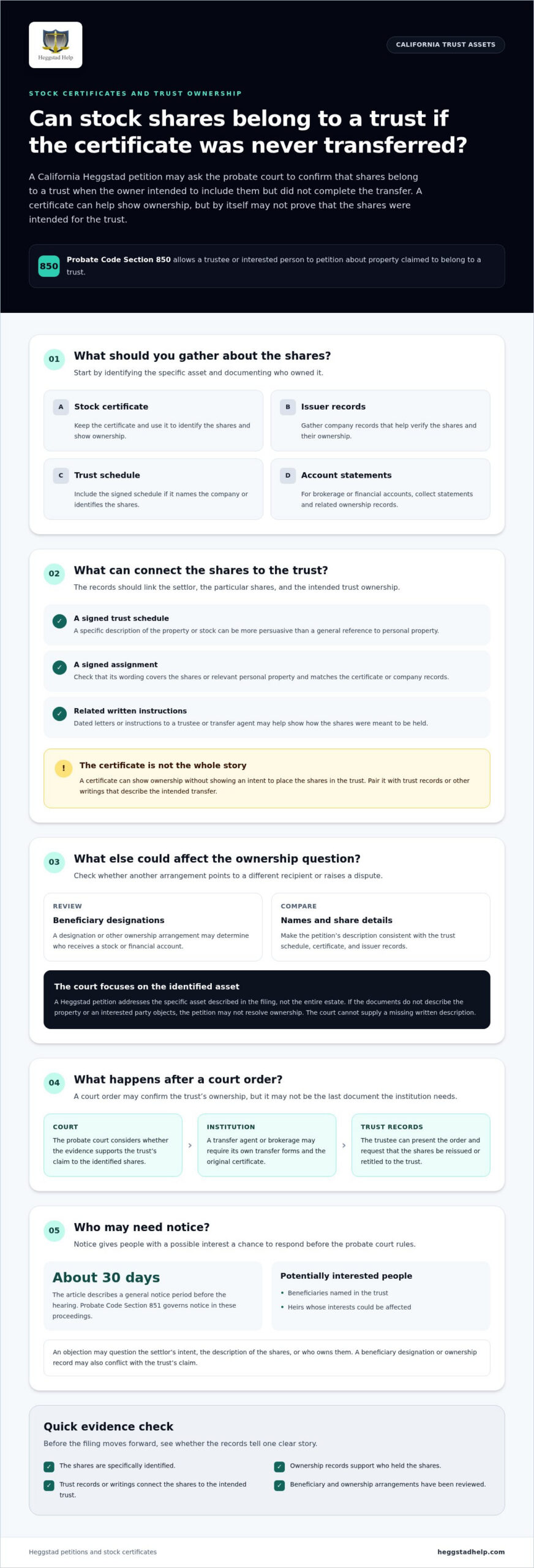
A transfer agent or brokerage may require additional documents before updating its records, even after a court order. The order may confirm the trust’s ownership, but the institution may also require its transfer forms and the original certificate. After receiving the order, the trustee can present it to the transfer agent and request that the shares be reissued or retitled to the trust.

A Heggstad petition addresses the identified asset, not the entire estate. If the documents do not describe the property or an interested party objects, the petition may not resolve ownership. The court cannot supply a missing written description.

Evidence supporting a petition, including trust schedules and written assignments

California probate courts look for evidence connecting the specific property to the settlor’s intent. Relevant records may include a signed trust, its schedule of assets, a general assignment, a stock certificate, or correspondence describing how the shares should be held. The documents should identify the asset clearly enough to distinguish it from other property.

For stock, evidence may include a schedule listing the company and shares, an assignment naming the stock, or written instructions to a trustee or transfer agent. A certificate alone shows ownership but may not show that the settlor intended the shares to belong to the trust. Pair it with trust records or other writings that explain the intended transfer.

In Estate of Heggstad (1993), the court recognized that a settlor’s written declaration of holding property as trustee could create a trust without a separate deed. In Kucker v. Kucker (2011), a general assignment could transfer personal property. These decisions show why written intent matters when an asset was never formally transferred.

  • Trust schedule: Include the signed schedule naming the property or identifying the stock. A generic reference to personal property may be less persuasive than a specific description.
  • Assignment: Provide a signed assignment that covers the shares or relevant personal property. Match its language to the certificate and company records.
  • Ownership documents: Gather the certificate, account statements, and issuer records showing the settlor owned the shares.
  • Related writings: Include dated letters or instructions that link the asset to the trust and identify the intended trustee.

Osswald v. Anderson (1996) marks an important limit: a petition needs a writing describing the property; the court cannot create that missing writing. An attorney can organize the evidence so the parties and judge can follow the link between the settlor, the shares, and the trust. Keep originals and present copies with clear labels. For help preparing a Heggstad petition, organize the trust and stock records together.

Notice requirements and potential objections

Notice gives people with a possible interest in the stock a chance to respond before the probate court rules. California Heggstad petitions generally require a notice period of about 30 days before the hearing, according to California Superior Courts. California Probate Code Section 851 governs notice in these proceedings. Interested parties can include beneficiaries and heirs whose shares of the estate could be affected.

Before filing, identify each beneficiary named in the trust and any heirs who may have an interest. Include accurate names and addresses in the petition materials, then follow the court’s notice requirements. A beneficiary’s written consent or waiver may affect whether formal notice is needed, but the petition must still meet the applicable court requirements.

An objection may dispute the settlor’s intent, the stock description, or who owns the shares. For example, a beneficiary might challenge a schedule that lists company shares without identifying the issuer or quantity. Another party may point to a beneficiary designation or ownership record that conflicts with the trust’s claim. Specific records help the court understand the disagreement.

  • Check the asset description: Compare the petition with the stock certificate, issuer records, and trust schedule.
  • Review the claimed ownership: Identify any joint owner, beneficiary designation, or other arrangement affecting the shares.
  • Track notice: Keep copies of filed notices and proof showing when and how each interested party received them.
  • Address objections: Organize the trust documents and ownership records that respond to each disputed point.

A noticed hearing may be set 30 to 60 days after filing, with additional time needed for notice. In counties outside Santa Clara, San Mateo, and Contra Costa, Heggstad petitions often require noticed hearings and may take many months to be heard. Uncontested petitions from those counties can instead be heard ex parte in Santa Clara County, often with a decision 7 to 10 days after filing. Ex parte means the court considers the petition without a formal hearing; it does not mean interested-party notice requirements disappear.

Heggstad Petition for Stock Certificates: Which Assets Qualify

Using Heggstad petitions for stock certificates

A paper certificate may document shares without showing whether the settlor intended them for a trust. A Heggstad petition for stock certificates asks the California probate court to confirm that connection. Under Probate Code Section 850, the petition seeks a determination about property claimed as trust property. The 1993 Estate of Heggstad decision provides the case name associated with this procedure.

Make the petition specific: identify the company, the shareholder named on the certificate, and the shares at issue. Include the trust’s relevant terms and the signed writing that ties those shares to the trust. Probate Code Section 856 allows the court to order property transferred or confirmed when it finds the trust owns it. A signed order can then support the title update.

The next steps depend partly on whether the shares are publicly traded or belong to a private company. For publicly traded shares held as a physical certificate, the transfer agent typically handles reissuance. For private-company shares, review the shareholder agreement and consult company officers about its transfer provisions. The agreement may provide for reissuance, a company buyout, or another mechanism.

  • Before filing: Match the certificate details to the trust schedule and any signed assignment.
  • In the petition: Explain the settlor’s intent and request an order addressing the identified shares.
  • After the order: Present the signed order to the transfer agent or company, and complete its required transfer documents.

A Heggstad order addresses the trust’s claim to the shares; it doesn’t itself print or reissue a new certificate. The transfer agent or private company may require the original certificate and additional documents to update ownership records. If the shares instead belong to the estate, an executor’s authority and the estate transfer process may apply. For help with a petition concerning stock, request Heggstad petition filing assistance.

HEGGSTAD HELP: Heggstad Petition Filing

Heggstad Help, a service of attorney Robert P. Bergman, a Board-Certified Specialist in Estate Planning, Trust, and Probate Law with the State Bar of California Board of Legal Specialization, assists families, attorneys, and their clients with uncontested Heggstad petitions involving assets such as stock certificates.

For trusts located anywhere in the State of California, uncontested petitions can be filed ex parte in the Santa Clara County Probate Court, meaning without a formal hearing. Those petitions are typically granted in 7 to 10 days. Ex parte filings are also available in San Mateo and Contra Costa Counties, subject to each court’s process.

Heggstad Petition Filing can address the court order needed to confirm trust ownership; Trust Asset Title Correction can help with the follow-up title issue. The office handles uncontested petitions, with fixed fees covering filing fees and attorney fees.

For help with an uncontested petition involving stock or another omitted trust asset, contact Heggstad Help.

Prepare the next step for your stock claim

Before pursuing a court order, clarify what you need it to accomplish. Is the immediate goal to establish who can act for the trust, or to enable the company to update its shareholder records? Defining the desired outcome can help keep the petition focused and make the next administrative step easier to plan.

A Heggstad petition for stock certificates can be one part of resolving an asset issue, with the court request shaped around the specific result sought. If you’re ready to discuss that next step, contact HEGGSTAD HELP for assistance. A clear plan can make a complicated process feel more manageable.

Frequently Asked Questions

Can a beneficiary oppose a Heggstad petition?

Yes. A beneficiary can tell the court why they dispute the requested treatment of the shares. To understand the issue, identify whether the disagreement concerns the settlor’s intent, the trust’s terms, or the beneficiary’s own claimed interest. These are distinct questions, and separating them can clarify what the court is being asked to decide.

How Does the California Petition Process Work?

The petitioner asks the probate court to determine a question about a particular asset, and the court considers the request under California procedure. A useful preparation step is to distinguish the court’s ownership decision from the issuer’s administrative work afterward. The court order addresses the legal claim; the company’s records and certificate-handling requirements concern how its share register is updated.

What Do I Need to Know About the Process of Filing a Heggstad Petition?

Make sure the petition describes the requested court action precisely. For stock, compare the issuer’s legal name, share class, and certificate details across available records, and note any differences in spelling or ownership history. Consistent descriptions help clarify which shares the court is being asked to address, especially when a company has multiple classes or similarly named entities.

What Happens If Someone Opposes the Petition?

The court must consider the objection and the parties’ positions before deciding the ownership question. A practical response begins by identifying the exact assertion being challenged, then organizing records that address it. For example, if the dispute concerns the company’s identity, records from the issuer may be more directly relevant than general correspondence about the trust.

What is a Heggstad petition in California probate law?

A Heggstad petition asks the court to determine whether specific property belongs to a trust, even though the ownership records were not formally updated. The request concerns the asset identified in the filing, such as a particular block of company shares. It does not itself complete the issuer’s administrative steps for changing its shareholder records.

Can a Heggstad petition be used to transfer stock certificates into a living trust?

A Heggstad petition may ask a court to recognize stock as trust property when the settlor intended that result but did not complete the transfer. If the settlor is living, the relevant question is whether the shares can be transferred directly under the trust’s and issuer’s procedures. After death, a court petition may address an omitted asset when the supporting records establish the trust’s claim.

Robert P. Bergman, Attorney at Law

Article by

Robert P. Bergman, Attorney at Law

Attorney Robert P. Bergman ("Bob Bergman") has been a Board-Certified Specialist in Estate Planning, Trust and Probate Law since 2011, as certified by the California State Bar Board of Legal Specialization. For several years, Bob has assisted families and the clients of other attorneys with obtaining court orders through Heggstad petitions to avoid the time and expense of Probate administration. Bob is friendly, very approachable, and believes in explaining complex legal topics in clear ordinary language so that his clients understand exactly what they're doing and why they're doing it.
Bob is often able to assist clients who are in other counties than his home county of Santa Clara through his approach to Heggstad petitions.

Disclaimer

This article is for informational purposes only. Nothing in this article is intended to replace legal advice from a competent attorney or be considered legal guidance for anybody's specific legal situation. Nobody should rely on information in this article in making legal decisions without such consultation.
Why Heggstad Petitions Beat Traditional Probate for California Trusts

The Problem: Why General Probate Attorneys Fall Short for Trust Assets

When a loved one passes away with unfunded trust assets, many successor trustees turn to their local probate attorney expecting straightforward guidance. What they often get instead is a recommendation for full probate proceedings—a process that can take 12 to 18 months and cost thousands in fees.

General probate attorneys typically default to full probate because it’s their standard workflow. The problem is that full probate isn’t always necessary, especially for assets that should have been held in a trust from the start. A general practitioner may not recognize that California law provides faster, more efficient alternatives specifically designed for this situation.

The real cost of missing this opportunity goes beyond time and money. Title companies get stuck in escrow limbo. Real estate transactions collapse due to timing issues. Successor trustees face mounting pressure to resolve the estate while managing their own responsibilities.

We see this pattern repeatedly: clients arrive at our office after consulting with three or four general probate attorneys, none of whom mentioned the streamlined options available under California law. The good news is that recognizing this gap early can save you months and thousands of dollars.

Understanding Heggstad Petitions and Their Advantages

A Heggstad petition is a focused court petition that allows you to transfer specific assets into a trust without initiating full probate proceedings. Named after the landmark case, this remedy exists precisely for situations where a trustor created a trust but failed to formally title certain assets in the trust’s name before death.

The advantages are substantial compared to traditional probate:

  • Assets transfer into the trust in weeks rather than over a year
  • Court costs remain minimal and focused only on the specific property at issue
  • The process is streamlined and designed specifically for trust funding
  • Once the court order is issued, you have clear legal authority to transfer title

California recognizes that full probate can be overkill when the trust document is clear, the beneficiaries are identified, and the asset in question isn’t disputed. A Heggstad petition leverages this recognition to move forward efficiently.

The petition works by asking the court to confirm that the trust was valid and that the trustor intended the asset to be held in the trust. Once the court agrees, the order serves as legal documentation that the asset now belongs to the trust. Title companies accept these orders, and transfers proceed smoothly.

Our Specialized Expertise in California Probate Code Section 850

We have built our practice around Section 850 real property petitions because we understand the nuances that general practitioners often miss. This specific statute is the legal foundation for Heggstad petitions, and mastering it requires focus and repeated application.

Our expertise includes recognizing when a Heggstad petition is the right tool versus when other trust remedies might serve you better. We draft petitions that address probate courts’ common concerns before judges raise them. We know which counties have specific local rules that affect filing strategy, and we structure documents accordingly.

The difference between a competent filing and a masterful one often comes down to anticipating judicial questions. We’ve handled enough petitions in California courts to know what convinces judges to grant relief quickly rather than requesting additional information or scheduling hearings.

When you work with us, you’re working with attorneys who focus exclusively on trust funding solutions. This specialization translates directly into faster approvals, fewer complications, and clearer paths to your goal.

Same-Day Court Orders in San Mateo County

For trusts being administered in San Mateo County, we can file a Heggstad petition and obtain a court order on the same day. This capability sets us apart and reflects our deep relationships with that court system and our efficient filing process.

Same-day orders mean you can begin the asset transfer process immediately. A title company can see the court order before the close of business. Escrow timelines that seemed impossible suddenly become manageable.

This speed is possible because we prepare documentation that anticipates the court’s questions, file electronically at optimal times, and follow up efficiently with the probate clerk. We know the judges’ preferences and structure our petitions to align with their expectations.

If your trust administration involves San Mateo County real property, this capability could eliminate weeks from your timeline. Real estate transactions often fail not because of legal obstacles but because of administrative delays. We eliminate that risk.

Expedited Solutions for Urgent Situations in Contra Costa County

For trusts being administered in Contra Costa County, we can often file a Heggstad petition and obtain a court order on the same day when urgency exists. We define urgency as situations including:

  • A trustor who is terminally ill or of advanced age
  • Real property facing foreclosure
  • Real estate sales transactions where escrow timing is running out
  • Similar time-sensitive circumstances

When urgency applies, courts recognize that full probate proceedings are impractical and grant ex parte Heggstad petitions more readily. The petition itself becomes the mechanism for proving urgency, and our experience drafting these submissions ensures courts understand why delay would cause harm.

We assess your situation against the urgency criteria early in our conversation. If urgency applies, we can often move your petition to the front of the judicial queue and secure an order the same business day.

Many successor trustees don’t realize they qualify for expedited treatment because they assume all Heggstad petitions follow the same timeline. That’s not how California probate court works. Urgency-based petitions receive different handling, and knowing how to invoke this pathway is crucial.

Statewide Accessibility Through Santa Clara County Probate Court

For California trusts where local court timelines aren’t meeting your needs, we can file uncontested ex parte Heggstad petitions in Santa Clara County Probate Court on behalf of clients throughout the state. This opens access to a court system that processes these petitions efficiently regardless of where your trust is being administered.

Santa Clara County’s probate court handles Heggstad petitions in volume, which means the judges and clerks are experienced with this specific remedy. We typically obtain a court order through Santa Clara County within 7 to 10 days from the date we electronically file your petition.

A 7 to 10 day timeline is transformative for successor trustees managing trusts in slower-moving counties. Rather than waiting 6 to 8 weeks for a local court order, you can have it in hand in about a week.

This statewide service keeps California trusts moving forward regardless of geographic location. Whether your trust property is in Humboldt County or Kern County, we can file your petition in Santa Clara County and secure the order you need to proceed with asset transfers.

How Our Ex Parte Process Saves You Time and Money

“Ex parte” means the petition is filed without requiring the other party to appear or respond. For uncontested Heggstad petitions, ex parte filing is appropriate because there is no genuine dispute about the trust’s validity or the trustor’s intent.

Filing ex parte eliminates several expensive steps that traditional probate requires. You don’t need to serve notice on all interested parties and wait for response periods. The court doesn’t need to schedule a hearing where attorneys argue the merits. Instead, the judge reviews the petition, trust documents, and supporting evidence on paper and issues an order.

This streamlined process reduces attorney time dramatically. A traditional probate case involving the same asset might require 20 to 30 hours of attorney work across months. An ex parte Heggstad petition typically requires 4 to 8 hours of focused work. The savings flow directly to you.

Additionally, the filing fees and court costs associated with a Heggstad petition represent a fraction of traditional probate expenses. You’re paying for a specific remedy rather than funding a comprehensive estate administration process.

Common Issues Local Attorneys Miss in Trust Administration

We regularly encounter situations where a general practitioner has already worked on the trust administration and created problems that complicate our Heggstad petition work.

One frequent issue is incomplete documentation. A local attorney might not have gathered all the original trust amendments, pour-over wills, or trust certification documents needed to present a complete picture to the probate court. We must then track down missing documents and file supplemental materials, adding time to the process.

Another common mistake is failing to address whether the trustor had capacity when signing trust amendments. If amendments were executed late in the trustor’s life, a general attorney might not have anticipated the court’s questions about capacity. We structure our petitions to address this proactively.

We also see cases where the trustee or successor trustee was not properly identified, or where the petition doesn’t clearly establish who has authority to maintain the trust. These gaps can trigger court requests for additional information or even denials.

The takeaway is straightforward: when trust funding matters require probate court involvement, specialized experience matters. A generalist attorney is operating outside their normal workflow, which increases the risk of delays and complications.

Supporting Title Companies and Real Estate Transactions

Title companies are essential partners in the trust funding process. They need clear legal documentation showing that an asset now belongs to a trust before they’ll issue a policy or clear a title for sale.

Many title companies have worked with us directly, and they understand our Heggstad petitions because we draft them with title company requirements in mind. We include the specific language and documentation that title insurance underwriters need to proceed with confidence.

When a real estate transaction is on the line, every day matters. We coordinate with title companies to ensure they receive the court order efficiently and understand exactly what steps they can take once the order is in hand. Our involvement often accelerates the closing process because the title company knows what to expect.

For successor trustees managing property sales, this expertise translates into faster closings and fewer last-minute delays. Real estate transactions often fail in the final week because of title issues or administrative delays. Our specialized process removes this risk.

Why Successor Trustees Choose Our Specialized Services

Successor trustees choose to work with us because we reduce their stress and uncertainty. Managing a trust administration is already complex. Adding probate court proceedings multiplies that complexity unless you have experienced guidance.

We provide clear communication throughout the process. You’ll know exactly what documents we need, why we need them, and when we’ll have your petition filed. You’ll understand the timeline and what to expect from the probate court. We don’t use legal jargon to obscure our work or make the process seem more mysterious than it actually is.

Our track record matters too. We’ve handled hundreds of Heggstad petitions across California counties. We know which documents courts will accept and which will trigger additional questions. We’ve worked with title companies, real estate agents, and other professionals involved in trust administration. This experience becomes your advantage.

When you’re a successor trustee managing a deceased person’s affairs, you need counsel who understands that your primary goal is efficient resolution, not maximizing billable hours through unnecessary legal proceedings.

The Cost and Timeline Comparison You Need to Know

A Heggstad petition typically costs between $3,000 and $7,500 in total fees and court costs, depending on complexity and the county involved. Timeline ranges from 7 days (Santa Clara County) to same-day (San Mateo County under our service) to several weeks (other California counties).

Traditional probate for the same asset might cost $15,000 to $40,000 in attorney fees and probate administration costs, stretched across 12 to 18 months.

For a successor trustee managing a $500,000 home that needs to transfer into a trust, the difference between a Heggstad petition and probate is not academic. You’re potentially saving $10,000 to $30,000 and gaining 12 to 14 months of your life back.

Real estate transactions illustrate the timeline impact most clearly. An escrow that closes in 60 days becomes possible if you can secure a Heggstad court order in 7 to 10 days. That same escrow fails if you’re waiting 6 weeks for a probate court order from a slower county.

Get Your Heggstad Petition Filed Today

If you’re a successor trustee managing a California trust with unfunded assets, don’t assume full probate is your only option. Contact us to discuss your specific situation and learn whether a Heggstad petition can accelerate your timeline and reduce your costs.

We can often determine within a single conversation whether your assets qualify, which county courts would handle your petition, and what your realistic timeline looks like. There’s no obligation to move forward, but there’s significant value in understanding your options.

Reach out to Heggstad Help at https://heggstadhelp.com or call to schedule a consultation. The sooner you connect with specialized counsel, the sooner your trust administration can move toward resolution.

Attorney for Trust Funding Mistakes in California: What to Do

A signed California trust doesn’t automatically control property that was never transferred into it. If an asset remains outside the trust when its…

A signed California trust doesn’t automatically control property that was never transferred into it. If an asset remains outside the trust when its owner dies, it may have to go through probate; an attorney for trust funding mistakes in California can assess whether the records show the owner intended the asset to belong to the trust and whether a Heggstad Petition may fit. While the owner is alive, omitted or newly acquired assets can still be addressed by completing the steps needed to transfer or properly assign them.

It’s understandable to assume that signing the trust documents was the main task, especially when a home, account, or investment was meant to be included. The key issue is ownership: a schedule can list intended trust assets, but it does not transfer title by itself. This article explains what may happen when funding is incomplete, how an omitted asset may be addressed after death, and which records can help show the trust creator’s intent. It also covers common funding mistakes, including real estate left outside the trust and beneficiary designations that do not align with the estate plan, so you can identify a practical next step with more confidence.

Key Takeaways

  • Review newly acquired property and account records so intended trust assets don’t get overlooked.
  • Compare beneficiary designations with your estate plan, especially for retirement accounts, insurance policies, and annuities.
  • For real estate, check the recorded deed and address any title issue before relying on the trust to control the property.
  • If an asset was left out, gather documents that show the trust creator’s intent and learn which options may apply before taking the next step.

2. Trust funding reviews and professional assistance

A trust-funding review compares the trust’s asset schedule with current ownership records. For each home, account, or investment, confirm whether the title or assignment places it in the trust. A schedule lists intended property, but it does not change ownership by itself. An attorney can identify gaps and compare beneficiary designations with the overall estate plan. This review can reveal whether account instructions align with the inheritance plan.

Review trust funding after major family changes, including marriage, divorce, or the birth of a child. These events may affect who should receive assets and whether existing trust instructions still match your wishes. Review the trust when you acquire property, too. For example, after buying a home, check its deed and trust records rather than assuming the purchase automatically funds the trust. A new account or investment also deserves attention because it may remain outside the trust unless ownership or beneficiary arrangements are addressed.

Use a recurring schedule, then add reviews when circumstances change. The article recommends reviewing California trust funding every 3-5 years, while an annual review with an estate planning lawyer can help keep the trust and its assets current. Review beneficiary designations annually, including those on insurance policies, retirement accounts, and annuities. These designations may direct assets outside the trust, so compare them with the plan before making changes. Don’t assume every account should name the trust; the right arrangement depends on the asset and the estate plan.

Prepare a simple inventory before a review: list each asset, its current owner, and any named beneficiary. Gather the trust’s asset schedule, recent account statements, and available property records. Mark assets acquired since the last review and any designation that appears inconsistent. A California attorney can assess the records, explain which updates may be appropriate, and identify potential probate concerns if an asset was left outside the trust. This step-by-step check makes a complex funding issue easier to spot and address before it affects inheritance.

3. Transferring real estate into a trust

A California trust generally controls real estate only when ownership is transferred to it or the property is properly assigned. For a home, the deed is central: compare its current owner names with the trust’s name and review the property description. A signed trust document alone doesn’t retitle a house. If the deed still names an individual, the property may remain outside the trust and could face probate after that owner dies.

To fund a trust with real estate, prepare the transfer paperwork and record it with the county where the property is located. For example, a home in Los Angeles County requires attention to that county’s recording process. Keep a copy of the recorded deed with the trust records, then compare the deed with the estate plan. An estate planning attorney can help identify a mismatch in ownership, deed wording, or the intended share being transferred. These details matter because a deed error can complicate title and the trust’s ability to manage the property.

Partial transfers need careful review. If a person owns only a share of a property, the deed and trust documents should reflect the interest intended for transfer, not assume the entire property belongs to that person. Check the current deed for co-owners and ownership details before preparing a change. Refinancing can also interrupt funding: a lender may require the home to leave the trust temporarily, so the owner should plan to retitle it into the trust afterward. Proposition 13 is another California property-tax consideration when transferring real estate.

Ask a lawyer to review the deed before recording if ownership is shared, the legal description appears inconsistent, or a refinance removed the home from the trust. If the owner has died and the deed was never transferred, a Heggstad Petition may seek to place the asset in the trust when records show clear intent. The county where the property sits doesn’t necessarily determine where an uncontested petition can be filed. Learn about the California Heggstad petition process if an omitted property may need this type of court review.

4. Common California trust-funding problems

How long it takes to correct a California trust-funding mistake depends on the asset and the remedy. Updating ownership records may involve preparing and recording documents, while an omitted asset after death may require a court petition. An uncontested ex parte Heggstad petition in Santa Clara County is typically granted in 7 to 10 days; petitions in San Mateo County can be filed, heard, and granted the same day. In Contra Costa County, same-day filing and approval can often occur when the court accepts the demonstrated urgency.

A common problem is a living trust that was signed but never fully funded. A home, bank account, or investment may still be titled individually, even though the trust document or asset schedule names it as intended trust property. After the owner dies, the asset may require probate rather than pass under the trust. A pour-over will does not, by itself, avoid probate for property left outside the trust.

Another frequent mismatch involves beneficiary designations. Life insurance, retirement accounts, annuities, and transfer-on-death accounts may pass directly to named beneficiaries instead of being retitled to the trust. Review those records against the trust plan: inconsistent instructions can confuse beneficiaries and complicate distribution. Retirement accounts generally should not be transferred directly into a trust during the owner’s lifetime because the transfer itself may be treated as a taxable payout.

A trust schedule can also create false confidence. It records assets the creator intended to include, but doesn’t transfer ownership on its own. If the owner has died, collect the schedule, trust document, account or title records, and other evidence showing intent. A Heggstad petition may ask the court to treat an omitted asset as trust property when the evidence supports that request. For properties in counties outside Santa Clara, San Mateo, and Contra Costa, these petitions often require noticed hearings and may take many months; an uncontested petition can instead be heard ex parte in Santa Clara County, typically with a 7-to-10-day decision timeline.

Attorney for Trust Funding Mistakes in California: What to Do

4. How do I find and evaluate a California attorney for trust funding mistakes?

Start by matching the attorney’s experience to the problem. Reviewing an omitted home requires assessing trust records, ownership documents, and possible court procedures. If a bank account is involved, beneficiary designations and account ownership may matter more. Ask how the attorney will identify the asset’s current status, explain available options, and outline the steps involved. A clear explanation should connect your documents to a practical next step.

Prepare a focused set of documents before discussing the matter: the signed trust and amendments, asset schedule, current deed or account statements, and relevant beneficiary forms. Note when each asset was acquired and whether its ownership changed after the trust was signed. For example, if a home was refinanced and retitled, bring the available before-and-after records. An attorney can then explain whether the issue calls for a document update, title correction, or court petition.

Ask how the process may differ by county and whether the matter is uncontested. California procedures can vary: an uncontested Heggstad petition filed ex parte in Santa Clara County is typically granted in 7 to 10 days, while petitions in other counties may require a noticed hearing and take many months. San Mateo and Contra Costa Counties also have ex parte procedures, with timing affected by the court’s process and, in Contra Costa County, whether urgency is demonstrated. These distinctions help you understand the proposed route and timeline.

Before proceeding, request a plain-language explanation of the work, documents needed, expected court steps, and how updates will be communicated. Confirm who will review the trust, supporting records, and proposed filing, rather than relying on a general promise to “handle the issue.” If property ownership is the concern, ask how the deed and trust records will be addressed. To discuss a trust asset title issue, review your next steps with a focused understanding of the documents involved.

HEGGSTAD HELP: Heggstad Petition Filing

HEGGSTAD HELP, a service of attorney Robert P. Bergman, Board-Certified Specialist in Estate Planning, Trust, and Probate Law (California State Bar Board of Legal Specialization), assists families, attorneys, and clients throughout the State of California with uncontested Heggstad petitions. If an asset was intended for a trust but left out, there may be options for addressing the omission. Uncontested petitions for trusts located anywhere in California can be filed in the Santa Clara County Probate Court, and petitions filed there are typically granted in 7 to 10 days.

For a title problem involving trust property, Trust Asset Title Correction may address the ownership record. HEGGSTAD HELP also provides ex parte court order services for eligible, uncontested Heggstad petitions. The practice focuses on Heggstad petitions and related trust asset title issues. To discuss your situation, book a consultation through the HEGGSTAD HELP website.

Take the Next Step With a Clear Plan

Before taking action, write down what needs to be resolved: an ownership record that does not match the trust, an asset omitted from the documents, or uncertainty about what the trust creator intended. Gather the records you have and note any upcoming sale, refinance, or distribution that makes timing important. A concise summary helps focus the discussion on the specific issue and the decision ahead.

Choosing an attorney for trust funding mistakes in California is easier when you can explain the asset, its current title or account ownership, and the outcome you’re seeking. You don’t need to solve the issue before asking for help; start with the facts and the documents available to you. A practical next step can bring clarity to a complicated situation.

Contact HEGGSTAD HELP about your trust funding concern to discuss a path forward. Taking that first step can help you move ahead with greater confidence.

Frequently Asked Questions

What happens if I forget to fund my trust in California?

Forgetting to fund one asset does not automatically invalidate the entire trust. The trust can still govern property properly placed in it, while the omitted asset’s transfer depends on its ownership and any beneficiary instructions. Start by identifying the asset’s legal owner and whether anyone else is named on its account or title. Those details help clarify what route may apply.

Do bank accounts need to be in the trust?

No, not every account must be titled in a trust. The right arrangement depends on the account’s purpose, ownership, and any beneficiary designation. Check the account registration and whether it names a co-owner or payable-on-death beneficiary. Then compare those details with the trust’s distribution plan. Reviewing accounts individually helps avoid treating every bank account the same way.

What does a California trust funding attorney do?

A California trust-funding attorney can help determine what kind of problem the records present and which legal step may address it. For example, a deed showing an individual owner raises a different issue from an account with an outdated beneficiary. Bring the relevant document and explain what outcome the trust creator intended. The attorney can then identify the records and process relevant to that asset.

What are common mistakes when funding a living trust in California?

Common mistakes include assuming a will transfers every omitted asset without probate, transferring a retirement account directly into a trust, or overlooking a change made during refinancing. These errors affect different assets in different ways. Before changing account ownership, identify whether the asset is a retirement account, jointly owned property, or an account with named beneficiaries. That distinction can help prevent an unintended transfer or tax result.

How can an attorney fix assets accidentally left out of a California trust?

The next step depends partly on whether the trust creator is still living. While the creator is alive, the issue may involve completing an appropriate ownership transfer. After death, a court petition may be considered if evidence supports the creator’s intent. Keep original records intact, including dated documents and communications, so the sequence of events can be understood clearly.

What is a California Heggstad petition and when is it used?

A California Heggstad petition asks a court to recognize an asset as trust property when it was left out of the trust’s title records. It may be relevant after the trust creator dies if evidence shows the asset was intended for the trust. The petition is a request for a court order, not a deed or automatic transfer. The court considers the evidence presented about intent.

Robert P. Bergman, Attorney at Law

Article by

Robert P. Bergman, Attorney at Law

Attorney Robert P. Bergman ("Bob Bergman") has been a Board-Certified Specialist in Estate Planning, Trust and Probate Law since 2011, as certified by the California State Bar Board of Legal Specialization. For several years, Bob has assisted families and the clients of other attorneys with obtaining court orders through Heggstad petitions to avoid the time and expense of Probate administration. Bob is friendly, very approachable, and believes in explaining complex legal topics in clear ordinary language so that his clients understand exactly what they're doing and why they're doing it.
Bob is often able to assist clients who are in other counties than his home county of Santa Clara through his approach to Heggstad petitions.

Disclaimer

This article is for informational purposes only. Nothing in this article is intended to replace legal advice from a competent attorney or be considered legal guidance for anybody's specific legal situation. Nobody should rely on information in this article in making legal decisions without such consultation.

California Probate Code 850 Petition: When Can It Be Contested?

A Heggstad petition can be contested when someone disputes whether the property belongs in the trust or has a competing claim to it. The California…

A Heggstad petition can be contested when someone disputes whether the property belongs in the trust or has a competing claim to it. The California Probate Code 850 petition process lets the court consider a claim to bring an omitted asset into a trust, and the petition must explain the facts supporting that claim. Interested persons must receive notice of the hearing, and a person physically possessing the property must be personally served.

It’s understandable to worry that a petition will settle the dispute automatically, but the court must weigh the claim and any opposing evidence. A signed, dated trust asset schedule that identifies the property or clearly records the grantor’s intent may strengthen the petition. This article explains when a challenge can arise, who must receive notice, and the kinds of estate, trust, conservatorship, and guardianship property disputes a Probate Code Section 850 petition can address. It also clarifies how a focused petition differs from full estate administration, so you can better understand the process ahead.

Key Takeaways

  • A challenge may turn on whether the evidence shows the asset was intended to belong to the trust, or whether someone else has a competing ownership claim.
  • Before a hearing, identify interested people and anyone physically holding the property so notice requirements can be addressed.
  • Probate Code Section 850 can address property claims involving trusts, estates, conservatorships, and guardianships, but the dispute must fit the petition process.
  • Gather trust documents, deeds, account records, and related correspondence to help clarify the property’s ownership history and the grantor’s intent.

Can a Heggstad Petition Be Contested?

Yes. A Heggstad petition can be contested if a trustee, beneficiary, heir, or another interested party disputes ownership or the evidence that an asset belongs in the trust. The court considers the claim to the property and its supporting documents, including evidence of the grantor’s intent.

For deaths on or after April 1, 2025, the California Legislature lists a $750,000 limit for transferring a decedent’s primary residence by petition under Probate Code §§ 13150-13158. That is a separate procedure from a Heggstad petition, so identify the property and the legal route being considered before filing.

Deadlines and Response Options

Deadlines and response options are the filing and hearing dates that shape when parties can present their positions. The petition’s hearing schedule matters because notice gives affected parties an opportunity to respond before the court decides ownership.

Interested parties can challenge the claim with evidence, such as a deed showing different ownership or trust records that do not identify the asset. After service, California Probate Code Section 851.1 allows petitioners to begin formal discovery, a process for obtaining relevant information. Sections 852-854 address continuances, jurisdiction challenges, and pausing a petition when a related civil case is pending. Appeal options depend on the order and applicable procedure, so parties should promptly assess the order’s effect and any filing deadline.

Risks, Defenses, and Alternatives

The central risks are an unclear connection between the trust and the property, opposition from an interested party, delay, or denial. A precise description of the asset and dated records supporting the claim can help clarify the case. If an interested party objects, the matter is not an uncontested ex parte petition.

For an omitted asset, compare the trust, any signed asset schedule, a general assignment, and deeds or account records. For example, a signed but unrecorded deed may help show intent to transfer real property, while a schedule naming only “personal property” may leave a specific account’s status disputed. Parties may resolve a disagreement through agreement instead of litigating ownership. A separate small-estate procedure may fit some property claims; for deaths on or after April 1, 2025, California’s Small Estate Affidavit threshold is $208,850. Check whether that route matches the asset and circumstances.

Notice requirements for beneficiaries, heirs, and creditors

Notice gives people with a possible interest a chance to respond before the probate court decides who owns disputed property. In a Probate Code Section 850 matter, the ruling may affect ownership, so identifying interested parties early helps prevent a hearing from proceeding without someone directly affected.

Venue matters, too. A California Heggstad petition is filed in the county where the decedent lived. Before filing, identify that county and list beneficiaries, heirs, trustees, and anyone else whose property rights could be affected. A creditor may need attention if the creditor claims an interest in the specific asset; a general debt alone does not establish an ownership claim.

California Probate Code Section 851 governs hearing notice. Notice is typically given at least 30 days before the hearing. A party physically possessing the property must be personally served, meaning the papers are delivered directly to that person. For example, if a relative holds disputed jewelry, identify that person and account for personal service rather than relying only on mailed notice.

Build a notice list around the asset and the court order being requested. Compare the trust documents with the petition, then identify each person whose ownership or inheritance position could be affected. Record each person’s contact information and connection to the property so the notice requirements can be addressed accurately.

  • Identify the county where the decedent lived.
  • List beneficiaries, heirs, trustees, and other interested people.
  • Determine whether anyone physically possesses the asset.
  • Track the hearing date against the 30-day notice period.

Keep copies of notices and service records with the petition materials. That file helps show which parties were notified and supports orderly consideration at the hearing. For a practical overview of Heggstad petition considerations, review the filing information before organizing the notice list.

Property disputes involving estates, trusts, conservatorships, and guardianships

According to the California Legislature, California Probate Code Sections 850-859 address the conveyance or transfer of property claimed to belong to a decedent or another person. Evidence such as trust documents, deeds, account records, and related correspondence can help show ownership or the grantor’s intent during the California Probate Code 850 petition process.

Disputes Over Estate and Trust Property

A property dispute can arise when an estate, trust, conservatorship, or guardianship claims an asset held or claimed by someone else. Identifying the specific property and the competing claims helps distinguish an ownership petition from the administration of an entire estate.

For example, a decedent may have signed a deed transferring a home to a living trust, but never recorded it. The trustee may seek an order recognizing the home as trust property, while an heir may argue that the property remained in the estate. Probate Code Section 856 allows a court to order a person holding property to transfer it to the rightful owner.

Conservatorship and guardianship matters can also involve property claimed for a protected person. Identify the asset, who holds it, and each interested party’s claim. If related litigation is already pending, that may affect how the court handles the petition. HEGGSTAD HELP focuses on Heggstad petitions, not contested trust litigation or general civil litigation.

Evidence of Ownership or Entitlement

Evidence of ownership or entitlement connects the claimant, the property, and the claimed right. The court needs facts and supporting records for the requested transfer, not only a statement that the grantor intended to fund a trust.

The Estate of Heggstad case, reported at 16 Cal.App.4th 943, applied Probate Code Section 850 to real property not formally transferred before the grantor died. A signed and dated schedule of trust assets, a general assignment, or a signed but unrecorded deed may help show intent. Match each document to a precise asset description, such as the property address or account record.

Gather the trust instrument, relevant amendments, deeds, account records, and correspondence related to the transfer decision. Compare names and property descriptions across the documents. A Heggstad petition should show which asset was intended for the trust and the basis for the claimant’s request.

California Probate Code 850 Petition: When Can It Be Contested?

What a California Probate Code 850 petition is

A Probate Code Section 850 petition asks the probate court to resolve a specific claim about property ownership or possession. It can help determine whether an asset belongs to a trust, an estate, or another person.

Purpose of a Probate Code 850 Petition

A Heggstad petition addresses identified property; it is not a request to administer an entire estate. For example, a trustee may ask the court to recognize a home as trust property when title remained in the decedent’s name. The petition must set out facts linking the asset to the trust and supporting the requested court order.

This distinction helps interested parties understand what the court is being asked to decide. The petition should identify the property precisely, explain the basis for treating it as trust property, and include supporting records. A deed, trust provision, or account record may help establish how the asset was held.

Who May File a Petition

Depending on the circumstances, a personal representative, trustee, interested person, conservator, or guardian may file a Probate Code Section 850 petition. The petitioner’s role should connect to the property claim, such as a trustee seeking an asset for a trust or a conservator asserting a protected person’s interest.

The petition must allege facts and legal grounds supporting the requested order. Explain how a signed trust document, deed, or other record relates to the asset, and identify who currently holds or claims it. Organize the records by property so the court and interested parties can follow the claim.

Under Probate Code Section 856, the court may order a person holding property to transfer it to the rightful owner. Probate Code Section 859 allows double damages when someone wrongfully takes or conceals property covered by that provision. The requested remedy should match the facts alleged and evidence presented.

To organize a property claim and its supporting documents, review Heggstad petition filing options.

HEGGSTAD HELP: Heggstad Petition Filing

Heggstad Help, a service of attorney Robert P. Bergman, assists families, attorneys, and their clients throughout California with uncontested Heggstad petitions. Mr. Bergman is a Board-Certified Specialist in Estate Planning, Trust, and Probate Law by the State Bar of California Board of Legal Specialization.

For trusts located anywhere in California, petitions can be filed ex parte (without a formal hearing) in Santa Clara County Probate Court. Santa Clara County petitions are typically granted in 7 to 10 days. San Mateo County petitions can be filed, heard, and granted the same day; Contra Costa County petitions can often be granted the same day when the court is satisfied urgency exists. The office handles uncontested petitions, not contested petitions.

Heggstad Petition Filing can help address an omitted trust asset, while Trust Asset Title Correction can help resolve a title issue after the court process. If your matter is uncontested, contact Heggstad Help to discuss the next step.

Choose a Practical Next Step

The California Probate Code 850 petition process becomes more manageable when you define the decision you need: which property is at issue, who claims it, and what outcome would resolve the title question? Before moving forward, write down any disagreement that remains and the specific point each party disputes. That can help focus the next discussion on the property claim, rather than unrelated trust or estate concerns.

If you’re helping a family member or advising a client, keep the immediate objective in view: determine whether the matter is uncontested and organize the information needed to evaluate the requested court order. For an uncontested matter, Ex Parte Court Order Services may be relevant to the filing plan. A contested ownership dispute requires a different assessment, so distinguish disagreement over evidence from a question about the filing itself.

Heggstad Help offers focused assistance with eligible petition filings and related title correction. Contact Heggstad Help to discuss your petition and identify a practical next step. A clear question and an organized record can help you move forward with greater confidence.

Frequently Asked Questions

Do I need an attorney to file one?

The right approach depends on your role, the property, and whether anyone objects. An attorney can help you understand the California Probate Code 850 petition process and prepare a claim that connects the requested order to the supporting records. For example, bring the trust, relevant amendments, and any deed or account documents to a discussion about the property at issue.

What Are the Filing Fees and Attorney Costs Associated with the Petition?

A clean petition means no interested parties object, all interested parties waive notice of a hearing, and all interested parties consent to the petition. Additional fees may apply; see the Fees and Costs page for details.

What if the asset isn’t specifically listed on the Schedule of Trust Assets?

Even if an asset is omitted from a trust schedule, other records may support the grantor’s intent. Compare the schedule with a signed assignment, deed, account records, or correspondence created during estate planning. For example, a schedule may refer to “all property” while a separate deed names the home. Check whether the documents identify the same asset and connect it to the trust.

What is a California Probate Code Section 850 petition and when is it used?

The California Probate Code 850 petition process provides a way to ask the court to resolve a specific property ownership or possession claim. It may apply when a trustee, estate representative, conservator, guardian, or interested person claims an asset belongs to someone else. A petition should identify the property, explain the factual basis for the claim, and state the court order requested.

Which California probate court has jurisdiction over an 850 petition?

For a decedent’s estate matter, the petition is generally filed in the probate court in the county where the decedent lived. The appropriate filing location can depend on the petitioner and the property dispute. For example, a trust’s location alone does not establish where every petition belongs. Identify the decedent’s county of residence and the nature of the claim when assessing venue.

What forms and supporting documents are required to file a section 850 petition?

A Heggstad petition sets out the facts supporting the claim and includes documents that support those facts. Depending on the asset, relevant records may include the trust and amendments, a deed, account statements, or a signed assignment. Describe the property clearly and organize the records so each supports a point in the petition. Notice and service documents may also be required.

Robert P. Bergman, Attorney at Law

Article by

Robert P. Bergman, Attorney at Law

Attorney Robert P. Bergman ("Bob Bergman") has been a Board-Certified Specialist in Estate Planning, Trust and Probate Law since 2011, as certified by the California State Bar Board of Legal Specialization. For several years, Bob has assisted families and the clients of other attorneys with obtaining court orders through Heggstad petitions to avoid the time and expense of Probate administration. Bob is friendly, very approachable, and believes in explaining complex legal topics in clear ordinary language so that his clients understand exactly what they're doing and why they're doing it.
Bob is often able to assist clients who are in other counties than his home county of Santa Clara through his approach to Heggstad petitions.

Disclaimer

This article is for informational purposes only. Nothing in this article is intended to replace legal advice from a competent attorney or be considered legal guidance for anybody's specific legal situation. Nobody should rely on information in this article in making legal decisions without such consultation.

Correcting Property Title After Death in California: Is Probate Needed?

Probate isn’t automatic: correcting property title after death in California depends mainly on how the property was titled and whether it was held in…

Probate isn’t automatic: correcting property title after death in California depends mainly on how the property was titled and whether it was held in a trust. According to the California Legislature, a Small Estate Affidavit may be available for eligible estates valued at $208,850 for deaths on or after April 1, 2025, but that threshold doesn’t determine every real-property transfer.

It’s understandable to expect that a will or family agreement will be enough to update a deed. In practice, the deed’s vesting language (the way ownership is legally held), trust documents, and the type and value of the property all affect whether court involvement is needed. A 40-day waiting period applies to certain transfers, including some vehicle transfers, not as a general rule for every home or parcel.

This article explains how joint ownership and trust ownership affect correcting property title after death in California, when probate or a simplified procedure may be necessary, and how the deed’s vesting can change the outcome. You’ll learn how to distinguish a title correction from a transfer that may require a court order, helping you identify the next step for the property.

Key Takeaways

  • Read the deed’s ownership wording first; joint tenancy, tenants in common, and survivorship language can lead to different transfer paths.
  • For property held in a trust, review the trust and recorded deed to see whether title needs a further transfer to beneficiaries.
  • Don’t assume the 40-day waiting period applies to real estate; it relates to certain vehicle transfers, not every property transfer after death.
  • Changes to how property is vested can affect who inherits it and whether a court petition is needed, so understand the current title before taking the next step.

How property title determines the transfer process after death

Correcting property title after death in California starts with the recorded deed: its ownership wording helps determine how the property can transfer. Review the deed alongside any trust documents before preparing a transfer or planning a sale.

Title Types and Transfer Paths

With joint tenancy, the surviving joint tenant generally receives the deceased owner’s interest. Tenants in common, by contrast, hold separate shares, and a deceased owner’s share may require probate even if a will names the co-owner as beneficiary. Community property with right of survivorship passes to the surviving spouse or domestic partner without probate.

A revocable transfer-on-death deed can name beneficiaries, but it cannot transfer property held in joint tenancy or as community property with right of survivorship. Check the deed’s vesting language before assuming the beneficiary designation controls.

Probate Requirements for Real Estate

Probate is the court process for transferring property when no other transfer method applies. Real estate held outside joint tenancy, community property with right of survivorship, or a trust generally requires formal probate. After probate, title may transfer by recording a certified copy of the judge’s Order for Final Distribution.

California’s small-estate limit is $208,850 for deaths on or after April 1, 2025, according to the California Legislature. Eligible estates may use a simplified procedure, but property type and value determine the applicable route.

Before selling inherited real estate, establish who has authority to transfer title and complete the required legal steps. A beneficiary may be considered to acquire title on the owner’s date of death, but that does not complete the formal transfer. For a transfer-on-death deed, confirm that it applies to the property’s vesting before relying on it.

For a mortgaged home, review loan records and maintain payments during the transition. A change in ownership can trigger property-tax reassessment; notify the local assessor within 150 days to avoid penalties. Families correcting a property title after death in California should compare the deed, transfer documents, and trust terms before recording anything.

Property held in trust

Real estate properly held in a living trust generally passes under the trust’s terms rather than through probate. After the trustor, the person who created the trust, dies, the successor trustee administers the trust and transfers property to its beneficiaries. Compare the recorded deed with the trust documents: the trust may name someone to receive the home, but the deed shows whether the property was actually transferred into the trust.

If the property is titled in a revocable living trust, the successor trustee generally prepares and records a deed transferring it to the named beneficiaries. Record the deed in the county where the real estate is located. For example, a successor trustee handling a home in Sacramento County should review the recorded title and trust instructions before preparing the transfer document. Naming a beneficiary in the trust does not, by itself, complete the transfer of ownership.

Timing also matters for property-tax reassessment. For property held in trust, the change-in-ownership reassessment date is the trustor’s and/or present beneficiary’s date of death, not the later date when a successor beneficiary receives the property. Keep the date of death and recorded transfer documents with the trust records to clarify the sequence if the county assessor reviews ownership.

Some transfers into or out of a revocable living trust may qualify for a documentary transfer tax exemption under Revenue and Taxation Code Section 11930. The tax treatment depends on the transfer’s legal basis, so identify the trust and the deed’s exact ownership language before recording. A tenant in common who transfers only a share, for example, has a different ownership record from a sole owner transferring an entire property.

If the decedent’s deed still names them individually, the trust document alone may not complete the title transfer. The next action depends on the deed, trust terms, and how the property was held. For help addressing a deed that needs correction, explore Trust Asset Title Correction.

Correcting Property Title After Death in California: Is Probate Needed?

40-Day waiting period

The 40-day waiting period applies to certain vehicle transfers, not every California real estate transfer. A successor generally must wait 40 days after the vehicle owner’s death before filing DMV Form REG 5 to transfer a qualifying vehicle without probate. So, if you’re handling a home deed, don’t treat that vehicle rule as a required waiting period for recording real estate title.

For a California-titled vehicle, REG 5 is an affidavit, a signed statement used to request a transfer. The process generally requires the vehicle title, a certified death certificate, a completed and signed REG 5, and a smog certificate if one is required. The vehicle must qualify for the simplified procedure, including that the decedent left no other property needing probate and the remaining estate falls within the small-estate limit.

Registered vehicles are excluded from property counted toward that limit under Probate Code Section 13050(b). Vehicle Code Section 5910 authorizes REG 5 for a qualifying California-titled vehicle. The DMV procedure doesn’t allow REG 5 for a vehicle titled outside California. Check the title’s state and the estate’s other property before relying on this affidavit.

A surviving spouse or domestic partner generally uses REG 5; California has no separate DMV form for a surviving spouse’s vehicle transfer. A deceased co-owner’s interest may also be released by an heir using REG 5, an administrator with letters of administration, or an executor with letters testamentary. If the title uses “or” between joint owners, the surviving owner can often transfer it by signing alone.

A trustee handling trust property should distinguish vehicle paperwork from real estate title documents. REG 5 doesn’t correct a house deed. Likewise, an attorney reviewing an estate should identify the asset type and title before applying the 40-day rule. For a home, follow the transfer path that legally applies to its ownership and trust status, rather than waiting 40 days without a reason.

Changing property vesting

Vesting is the wording on a deed that identifies how owners hold property. After a death, it helps determine which documents support a title change and whether a court order may be needed.

Correcting Title After an Owner Dies

To correct title, compare the recorded deed with the ownership arrangement and transfer documents. A surviving joint tenant may record an Affidavit of Death of Joint Tenant to remove the deceased owner’s name. If probate distributed the property, title may instead be transferred by recording a certified copy of the judge’s Order for Final Distribution.

For a spouse’s community property with right of survivorship, ownership passes to the surviving spouse without probate. Do not change the vesting based only on a family member’s understanding of the intended ownership. Use the deed’s wording and the applicable transfer record.

Documents for Removing a Deceased Owner

The required documents depend on how the deceased held title. A joint-tenancy transfer may use an Affidavit of Death of Joint Tenant; a probate transfer may use the certified Order for Final Distribution. For real estate held in a revocable living trust, the successor trustee prepares and records a deed transferring the property to beneficiaries.

Gather the current deed and the document supporting the transfer before filing with the county recorder. If a deed contains an error, compare its legal description and owner names with the recorded documents. Any correction must reflect the actual ownership and basis for the transfer.

Recorder fees and requirements vary by county and document. Confirm the county’s requirements for the specific document and retain the recorded copy with the estate or trust records.

If the title problem involves property intended for a trust, explore help with trust-related title correction.

HEGGSTAD HELP: Heggstad Petition Filing

Heggstad Help, a service of Robert P. Bergman, a California Board-Certified Specialist in Estate Planning, Trust and Probate Law, assists families, attorneys, title companies, and clients with trust property title issues throughout California. If real estate was intended to belong to a trust but remained titled outside it, a Heggstad petition may address that gap by asking the court to confirm the property as trust property.

Some uncontested petitions may be handled without a formal hearing, depending on the circumstances. For trusts located elsewhere in California, a petition may be an option, but the appropriate filing location and timing can depend on the circumstances. The office handles uncontested petitions, not contested petitions.

If a trust-related title issue may need a court petition, contact Heggstad Help to discuss the next step.

Take the next step with a clear title record

Before anyone signs a deed or plans a sale, bring the ownership record and transfer documents together. Compare the recorded deed with the trust or court paperwork, then note any mismatch in names, ownership shares, or vesting language. That gives you a focused starting point for correcting property title after death in California.

If property was meant to be held in a trust but remained titled in the deceased owner’s name, a Heggstad petition may be relevant. Heggstad Help provides Heggstad petition filing, ex parte court order services, and trust asset title correction. The appropriate next step depends on the property’s title history and the documents supporting the transfer.

For help with a trust-related title issue, contact HEGGSTAD HELP. A clear record can help you move forward with greater confidence.

Frequently Asked Questions

Does the estate need to go through probate?

Not always. In California, whether probate is needed depends on how the decedent held the real estate and what else the estate owns. A home in a trust or with survivorship wording may pass outside probate, while a tenants-in-common share may require court proceedings. A will alone does not settle the question. Compare the recorded deed with trust paperwork and any will to identify the applicable transfer route.

Do I Have to Complete Probate on a Property I Inherit?

Not always. If property passes through a trust or survivorship ownership, a separate probate case for that property may not be needed. If probate is handling the estate, the personal representative, the person managing estate matters, gathers property, pays estate bills, and distributes what remains. Before arranging a sale, identify who has authority to sign and which document establishes that authority.

What Happens to Property When Someone Dies?

The deed, trust terms, and any court process determine how property transfers after an owner’s death. A beneficiary may be considered to acquire title on the date of death, but that does not by itself complete the public record. For example, a successor trustee may need to prepare a deed to beneficiaries, while an executor may rely on probate distribution documents. The recorded title helps identify the next step.

Robert P. Bergman, Attorney at Law

Article by

Robert P. Bergman, Attorney at Law

Attorney Robert P. Bergman ("Bob Bergman") has been a Board-Certified Specialist in Estate Planning, Trust and Probate Law since 2011, as certified by the California State Bar Board of Legal Specialization. For several years, Bob has assisted families and the clients of other attorneys with obtaining court orders through Heggstad petitions to avoid the time and expense of Probate administration. Bob is friendly, very approachable, and believes in explaining complex legal topics in clear ordinary language so that his clients understand exactly what they're doing and why they're doing it.
Bob is often able to assist clients who are in other counties than his home county of Santa Clara through his approach to Heggstad petitions.

Disclaimer

This article is for informational purposes only. Nothing in this article is intended to replace legal advice from a competent attorney or be considered legal guidance for anybody's specific legal situation. Nobody should rely on information in this article in making legal decisions without such consultation.

Why to File a Heggstad Petition and When Beneficiaries Can Contest It

A beneficiary’s lack of consent does not automatically prevent a Heggstad petition. A Heggstad petition without beneficiary consent may ask the court…

A beneficiary’s lack of consent does not automatically prevent a Heggstad petition. A Heggstad petition without beneficiary consent may ask the court to confirm that an omitted asset belongs to a trust. Beneficiaries and other interested parties can object, and the court may consider written evidence of the trust creator’s intent. Filing a petition does not guarantee that the court will treat the asset as trust property.

If you’re facing this issue, you may be wondering whether an objection will stop the process or lead to a dispute. This article explains when an omitted asset may be brought into a trust, who might file a petition, how beneficiaries can object, and what evidence may support the request. It also explains the difference between an uncontested petition and a contested matter, so you can understand the process and consider your next steps.

Key Takeaways

  • A beneficiary’s lack of consent doesn’t automatically prevent a Heggstad petition, but the court considers whether the evidence supports treating the omitted asset as trust property.
  • Review the trust, property schedules, and other written records for clear evidence that the trust creator intended to include the asset.
  • Beneficiaries and other interested parties can object; for a noticed hearing, California law requires formal 30-day notice to interested parties, according to the California Legislature.
  • Before choosing a filing path, distinguish an uncontested petition from a contested matter, since objections can add court steps and affect timing.

When can an omitted asset be brought into a trust?

A California court may confirm that an omitted asset belongs to a trust if written evidence shows the creator intended to include it. A Heggstad petition asks the probate court to decide that ownership question.

Establishing Trust Ownership

A Heggstad petition is a request for a California probate court to confirm that specific property belongs to a trust, despite incomplete title transfer. Under Probate Code Section 850, a trustee or beneficiary may petition over whether an asset belongs to a trust. What is a Heggstad petition in California probate? It is a court process for establishing trust ownership of an asset that wasn’t formally transferred. If granted, the order can allow the trustee to handle and distribute the asset under the trust, rather than through full probate. The petition identifies the asset and explains why it should be treated as trust property.

Evidence of the Decedent’s Intent

Evidence of intent includes written trust records connecting the decedent to the asset. The court needs more than a family member’s unsupported belief that the property was meant for the trust. Review the signed trust document and its Schedule of Assets for a property description, ownership interest, or other identifying details. In Estate of Heggstad, a listed property interest was mislabeled as a “partnership interest,” but the schedule supported the decedent’s intent. A pour-over will, which directs remaining assets into a trust, may also be relevant. The specific asset and supporting records still matter.

Transferring Unfunded Assets

A successful petition can establish that an asset belongs to the trust even though its title was never formally transferred. For example, a home may have been refinanced without being retitled in the trust’s name, or an asset may have been omitted from transfer paperwork. Gather the trust, property schedule, and records identifying the asset. If the court grants the petition, its order confirms the property as a trust asset. The trustee can then address title correction and manage the asset under the trust, rather than starting full probate for that property.

Alternatives to a Petition

The available alternatives depend on whether the trust creator is living and how clearly the records identify the property. If the creator can still transfer the asset, completing the title transfer may address the issue without asking a court to establish ownership. After death, probate or trust reformation, a court-requested change to trust terms, may be considered if a Heggstad petition does not fit the evidence or circumstances. What are alternatives to a Heggstad petition for transferring assets into a trust? Depending on the case, they may include a lifetime transfer, probate, or trust reformation. Compare the asset’s title with the trust records before choosing a path.

Can a Heggstad Petition Be Contested?

Yes. Beneficiaries and other interested parties can object, and the court considers their evidence before deciding whether to grant the petition. A Heggstad petition without beneficiary consent may proceed, but an objection can make an otherwise uncontested request a contested matter.

The Court Process

The court process gives interested parties a chance to address the requested order. Must beneficiaries receive notice of a Heggstad petition, and can they object? Yes. For a noticed Heggstad petition hearing, California law requires formal 30-day notice to interested parties, according to the California Legislature. At the hearing, a beneficiary may challenge evidence about the asset’s ownership or its connection to the trust. An attorney can organize records and present a Heggstad petition filing to the probate court. If a party objects, the court process may involve further evidence exchange, written arguments, negotiations, or additional hearings. Probate Code Section 850 does not set a guaranteed completion date.

Notice and Objections

Notice informs interested parties about the petition and gives them an opportunity to respond. The petition should clearly identify the asset and the order requested. An objection may dispute the decedent’s intent, challenge the asset description, or present competing ownership records. For example, a beneficiary might point to a deed that conflicts with the trust’s description. When disagreements lead to formal objections, beneficiaries often turn to counsel like JE Law to handle contentious estate disputes. Organize relevant documents and note any inconsistencies so the court can assess the evidence.

County Court Procedures

Santa Clara County allows uncontested ex parte petitions, meaning the court may act without a formal hearing. These petitions are typically granted in 7 to 10 days. If a beneficiary objects, however, the matter is no longer uncontested and may require additional court steps. In counties outside Santa Clara, San Mateo, and Contra Costa, Heggstad petitions often require noticed hearings and can take many months. An uncontested petition involving a trust or property elsewhere in California may instead be heard ex parte in Santa Clara County. Filing a Heggstad petition without beneficiary consent makes it especially important to understand whether an objection has been raised.

Common reasons to file a Heggstad petition

A Heggstad petition may help when an asset was intended for a trust but remained outside it. The problem often appears after the trust creator dies, when a successor trustee reviews the estate and discovers property still titled individually. Probate Code Section 850 allows a trustee or beneficiary to ask the court to resolve whether an asset belongs to a trust. If the court confirms ownership, the trustee may handle that asset under the trust instead of through full probate.

Can a trustee file a Heggstad petition without the beneficiary’s consent? Yes. A trustee may petition the court without first obtaining beneficiaries’ agreement. Beneficiaries can still receive notice and object, so the trustee should be prepared to present records supporting the request.

Common reasons for filing include an unfinished transfer, an asset left off a trust schedule, or a property interest described incorrectly. For example, a trust document may identify an ownership interest that a later record describes differently. A petition may also be considered when the omission is discovered after death or when the trust has become irrevocable. The key question is whether the available records connect the specific asset to the creator’s intent.

Before filing, gather documents that identify both the trust and the property. A practical starting set includes:

  • The signed trust document and any relevant amendments, to show the trust’s terms.
  • A Schedule of Assets or other written trust record identifying the asset or ownership interest.
  • Title records, deeds, or account documents showing how the asset is currently held.
  • A pour-over will, if one exists, as evidence of the creator’s plan for assets left outside the trust.

A successor trustee generally files because that person is responsible for administering trust property. A beneficiary, heir, or other interested person may file in some situations. Keep the original records together and note any differences between the asset’s description in the trust and its current title. This comparison helps clarify the issue the petition asks the court to decide.

Why to File a Heggstad Petition and When Beneficiaries Can Contest It

Common reasons for filing a Heggstad petition

A Heggstad petition can address a mismatch between a living trust’s terms and an asset’s legal title. For example, a decedent may have intended a home or ownership interest to pass through the trust but never completed the transfer. The court can decide whether that specifically identified asset belongs to the trust. If the petition succeeds, the property may avoid full probate. The petition does not determine how every later-discovered estate asset should be distributed.

The process traces to Estate of Heggstad, decided by the California Court of Appeal in 1993. There, a property interest appeared on the trust’s Schedule of Assets, although it was mislabeled as a “partnership interest.” That example shows why the filing should connect the asset’s description in trust records with the property identified in the court request. Compare those descriptions before filing, and flag any mismatch for explanation.

Venue and filing steps also matter. A Heggstad petition generally proceeds in the probate court associated with the successor trustee’s county. The court file is opened in the trust’s name, even when no formal probate estate is opened. In counties outside Santa Clara, San Mateo, and Contra Costa, these petitions often require a noticed hearing and may take many months to be heard. An uncontested petition from another California county can instead be heard ex parte in Santa Clara County, where decisions often come 7 to 10 days after filing. San Mateo and Contra Costa have separate ex parte procedures.

For a noticed hearing, California law requires formal 30-day notice to interested parties, according to the California Legislature. Gather the trust, property description, title records, and documents supporting the requested order; complete notice as required for the chosen filing route. This gives interested parties a chance to respond and helps define the question before the probate court.

If you’re preparing an uncontested petition, review Heggstad petition filing information to understand the filing route and supporting records.

HEGGSTAD HELP: Heggstad Petition Filing

Heggstad Help, a service of attorney Robert P. Bergman, Board-Certified Specialist in Estate Planning, Trust, and Probate Law (California State Bar Board of Legal Specialization), assists families, attorneys, title companies, and their clients throughout the State of California with uncontested Heggstad petitions.

For trusts located across California, the office can file uncontested ex parte petitions in the Santa Clara County Probate Court. It also files ex parte petitions in San Mateo and Contra Costa Counties. Heggstad Petition Filing and Ex Parte Court Order Services address the court request, while Trust Asset Title Correction can help reflect the resulting order in asset records. These services are for uncontested matters.

If you’re considering an uncontested petition, contact HEGGSTAD HELP or visit heggstadhelp.com to discuss the filing.

Take the Next Step With a Clear Plan

Before moving forward, gather the trust paperwork and asset records so the issue can be assessed as a whole. Identify the outcome you need, such as confirming ownership or correcting an asset’s title, and note any disagreement that could affect whether the matter is uncontested.

If you are considering a Heggstad petition without beneficiary consent, focus first on whether the documents clearly support the request and whether the matter is uncontested. A court filing is a significant step, so understanding the purpose of the petition and the evidence behind it can help you make an informed decision about what happens next.

HEGGSTAD HELP handles Heggstad Petition Filing, Ex Parte Court Order Services, and Trust Asset Title Correction. If you’re ready to discuss your situation, contact HEGGSTAD HELP. A clear next step can make a complex trust issue easier to approach.

Frequently Asked Questions

Do I need an attorney to file one?

A Heggstad petition asks a probate court to decide an asset’s ownership based on trust records, so legal assistance is important. The process is not a self-service alternative like a Small Estate Affidavit. An attorney can organize the trust and title documents, identify the order requested, and address court filing and notice requirements. For example, a deed with a different property description may need to be explained alongside the trust paperwork.

What controls the timeline?

The filing county’s court calendar is a major timing factor, and objections can add steps. A court may require additional evidence, written arguments, negotiations, or another hearing if interested parties dispute the request. The petition’s completeness also matters: missing title records or unclear descriptions can prompt requests for clarification. Before filing, assemble the relevant records and identify any disagreement, so the requested order and supporting materials address the issue directly.

What if the asset isn’t specifically listed on the Schedule of Trust Assets?

An asset’s absence from the schedule does not automatically end the inquiry. Other written records, such as an executed trust document, assignment, or pour-over will, may connect the property to the trust creator’s intent. Compare each record’s asset description with current title documents. A general statement that the creator wanted everything in the trust is less useful than records identifying the specific asset or ownership interest.

What should families do after finding an unfunded trust asset?

Preserve the records and avoid assumptions about who owns or can transfer the asset. Gather the trust and amendments, current title or account statements, and any assignment or correspondence concerning the asset. Note how the asset is described in each document and identify any mismatch. Also establish whether the trust creator is living or deceased, as that affects which transfer options may be available.

When might probate still be necessary?

Probate may still be needed if the court does not confirm the asset as trust property or the records do not support the requested finding. It may also be relevant if other estate assets need a separate transfer process. A Heggstad petition addresses only the specifically identified property before the court; it does not automatically transfer every asset discovered later. Distinguish the petition’s target asset from the rest of the estate.

Who has standing to file a Heggstad petition?

A trustee or beneficiary may petition under Probate Code Section 850 to ask the court to resolve whether property belongs to a trust. A successor trustee commonly takes the lead because that person administers the trust, while an heir or another interested person may be able to file in some situations. The petitioner should explain their connection to the trust and identify the specific asset and requested court decision.

Robert P. Bergman, Attorney at Law

Article by

Robert P. Bergman, Attorney at Law

Attorney Robert P. Bergman ("Bob Bergman") has been a Board-Certified Specialist in Estate Planning, Trust and Probate Law since 2011, as certified by the California State Bar Board of Legal Specialization. For several years, Bob has assisted families and the clients of other attorneys with obtaining court orders through Heggstad petitions to avoid the time and expense of Probate administration. Bob is friendly, very approachable, and believes in explaining complex legal topics in clear ordinary language so that his clients understand exactly what they're doing and why they're doing it.
Bob is often able to assist clients who are in other counties than his home county of Santa Clara through his approach to Heggstad petitions.

Disclaimer

This article is for informational purposes only. Nothing in this article is intended to replace legal advice from a competent attorney or be considered legal guidance for anybody's specific legal situation. Nobody should rely on information in this article in making legal decisions without such consultation.
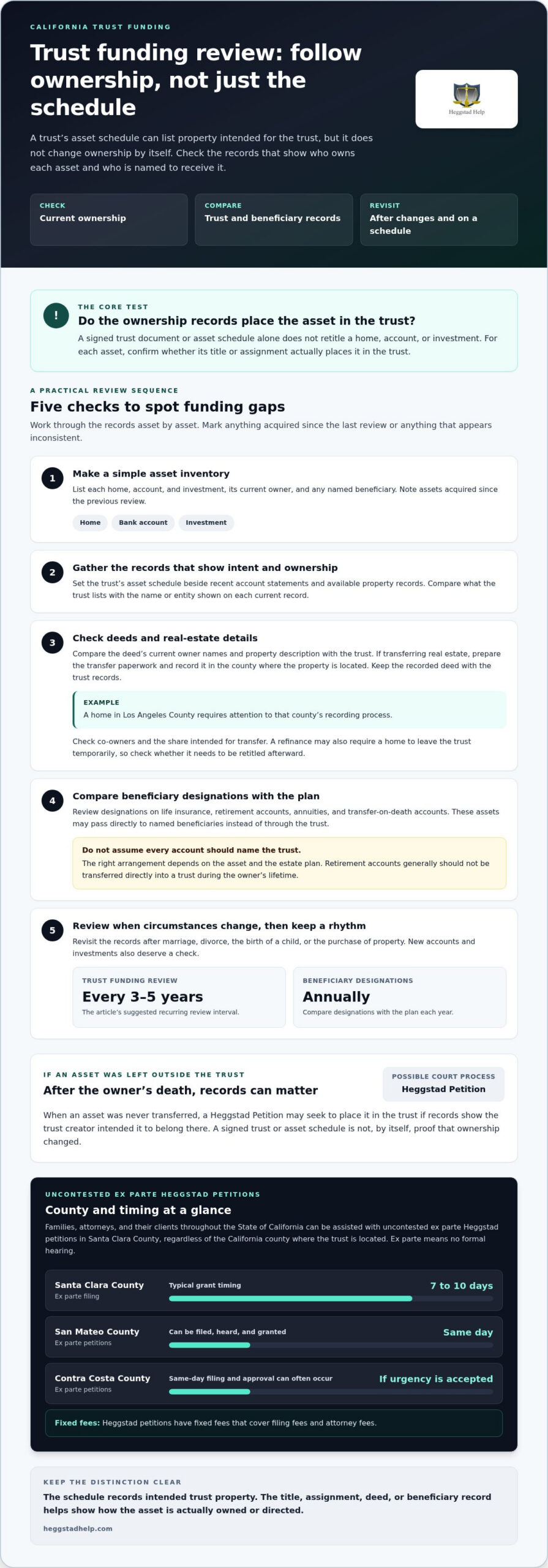
Beneficiary Notice for an 850 Petition in California: What to Expect

A beneficiary notice for an 850 petition in California gives people whose rights may be affected a chance to respond before the court decides who…

A beneficiary notice for an 850 petition in California gives people whose rights may be affected a chance to respond before the court decides who owns or possesses the property. According to the California Legislature, the petitioner must give all parties involved 30 days’ notice of the hearing. In a Heggstad petition, the request is for the court to confirm that omitted property belongs in a trust.

If you’re focused on the notice, it’s understandable to wonder who needs to receive it and what happens after it’s served. The notice is one part of a process that can lead to a court order affecting property ownership. This article explains what a Probate Code Section 850 petition does, which interested parties may need notice, and what to expect at the hearing and judgment stage, so you can follow the process with a clearer sense of what comes next.

Key Takeaways

  • Understand how a Probate Code Section 850 petition can ask the court to resolve whether specific property belongs in a trust.
  • Gather trust documents and property records that help show the trustor intended the asset to be held in the trust.
  • Identify people or organizations whose interests or possession of the property could be affected by the petition.
  • Learn what to expect at the hearing and why the court’s final order may be an important step in correcting property title.

What is a Probate Code 850 petition and how does it work?

Probate Code Section 850 lets a petitioner ask the court to decide who owns or possesses particular property. A Heggstad petition is one use of this procedure. A trustee may ask the judge to confirm that an asset belongs to a trust, even though its title was never formally transferred. The court reviews the claim and supporting evidence before deciding whether to issue an order.

This can matter when a living trust was intended to hold an asset, but funding was incomplete. For example, a home might appear on the trust’s Schedule of Assets, while its deed still names the trustor individually. A bank account, investment account, or business interest may also have been omitted. The petition explains the trustor’s intent and asks the court to recognize the asset as trust property.

Evidence is central. Gather the trust and amendments, Schedule of Assets, relevant deeds or account records, and documents showing the trustor’s intent. A pour-over will or general assignment may also help explain how the asset was intended to be handled. The petitioner must make specific claims about ownership and provide supporting material for the court to evaluate.

Notice gives interested parties an opportunity to respond because an order may affect their rights. According to the California Legislature, a person serving the California notice by mail must be over the age of 18 and not a party to the case. Keep the mailing record with the case documents. If someone physically possesses the disputed property, personal service may be required.

A Heggstad petition can resolve an asset-specific ownership issue without formal probate of that property. It does not automatically avoid probate for every asset or settle every dispute. Full California probate takes at least 7 months, and some proceedings may last 18 months or more; most 850 petitions reach a decision within 60 days of filing. The court’s order can clarify the asset’s status and support the next title or transfer step.

California Probate Code Section 850 petitions

Probate Code Section 850 covers several kinds of property claims in California probate. The correct subsection depends on who is asking and why. Under Section 850(a)(1), a guardian, conservator, or claimant may petition in specified cases involving a minor or conservatee. Section 850(a)(2) addresses certain claims by a personal representative or interested person involving a decedent’s contract or property. Section 850(a)(3) includes specified claims by a trustee or interested person involving trust property.

For a trust-related claim, the petition should identify the property, explain the basis for the claim, and state what order the court is being asked to make. For example, a trustee claiming an asset held by another person or entity should make the ownership dispute clear. Probate Code Section 850 requires the petition to set out the facts supporting the claim.

Probate Code Section 851 concerns notice connected with a Section 850 hearing. The notice tells interested parties what property is involved and what the petitioner wants the court to decide. Form DE-115 is the Judicial Council form for the hearing notice; the petition and proposed order are separately prepared pleadings. For real estate, the notice should identify the property by street address or, if it has no address, location and assessor’s parcel number.

Plan service around the people and entities connected to the property. A person physically possessing disputed property must receive personal service. A financial institution holding the asset may also need personal service. Keep the notice, petition, and proof of service together so the court can see what was sent and to whom.

Probate Code Section 859 may permit double damages when someone takes, conceals, or disposes of specified property in bad faith. That remedy is not automatic; the court considers the circumstances and the evidence. If bad-faith conduct is part of the claim, state the relevant facts clearly and support them with records or other evidence.

Section 850(b) requires the petition to set forth the facts on which the claim is based. Supporting documents may include the trust agreement and amendments, the trust’s Schedule of Assets, and evidence of the successor trustee’s authority.

Prepare a summons, checking with the local court because some courts will not issue one for this type of matter.

Beneficiary Notice for an 850 Petition in California: What to Expect

Notice to interested parties

A beneficiary notice for an 850 petition in California should help each recipient understand how the requested order could affect them. The California Legislature sets the hearing-notice period at 30 days; use that deadline to organize service and track each recipient’s status. Create a list with each person’s name, connection to the asset, delivery method, and service date. This makes it easier to spot missing recipients before the hearing.

Build the list from records tied to the property and the decedent’s estate. Depending on the claim, recipients may include beneficiaries, heirs, a personal representative, creditors, or people who possess the disputed asset. A financial institution holding an account may also have an interest. For each entry, note why that person or organization may be affected, rather than relying on a general contact list.

Charitable interests require attention to the California Attorney General. If the petition may affect a charitable interest, include the Attorney General in the notice plan. Keep the reason for notice clear in the case file, especially when a charitable beneficiary or gift appears in trust documents. A well-organized record helps distinguish this recipient from individual beneficiaries and other interested parties.

Trust terms have a separate notification process under Probate Code Section 16061.7. According to the California Legislature, a trustee generally must serve the required notification within 60 days of the triggering event or learning an entitled person exists. Beneficiaries then have 120 days to contest trust terms after service, according to the California Legislature. These deadlines concern trust terms, not the Section 850 hearing. Keep copies of each notice and its service record in separate, clearly labeled files. A beneficiary notice for an 850 petition in California should not be confused with the trustee’s notice about trust terms, even when some recipients overlap.

Court hearings and judgments

At a noticed hearing, the judge reviews the petition, evidence, and any objections before deciding the property claim. The resulting order explains what the court has decided and may authorize a transfer.

Court Review and Objections

Court review means the judge evaluates the written petition, supporting documents, and responses from people claiming an interest. A person with a property claim may file a written response before the hearing or attend and explain the objection. If someone neither responds nor appears, the court may make an order affecting ownership without that person’s input. Organize evidence around the specific asset and the requested decision.

Hearings and Court Decisions

At the hearing, the petitioner presents supporting documents and explains why the requested order fits the evidence. The judge may ask questions, consider arguments, and decide whether the property belongs to the trust. Most California Probate Code Section 850 petitions reach a decision within 60 days of filing. That is a general timeframe, not a substitute for checking the hearing date and notice requirements in the individual case.

After the court rules, obtain a certified copy of the order. For real estate, record that copy in the county where the property is located. For example, an order concerning a home in Los Angeles County should be recorded there. For accounts or other assets, the order can provide direction for the next transfer step. Keep the signed order and any recording information with the trust’s records.

For an uncontested Heggstad petition, an ex parte request seeks an order without a formal hearing. Petitions filed ex parte in Santa Clara County are typically granted in 7 to 10 days. San Mateo County petitions can be filed, heard, and granted the same day. Contra Costa County petitions can often be filed and granted the same day when the court is satisfied that urgency exists. Explore ex parte court order services for an uncontested Heggstad matter. Contested cases follow a different path and take longer.

HEGGSTAD HELP: Heggstad Petition Filing

HEGGSTAD HELP, a service of attorney Robert P. Bergman, a Board-Certified Specialist in Estate Planning, Trust, and Probate Law with the State Bar of California Board of Legal Specialization, provides Heggstad petition services for trust assets that need court recognition. The practice also handles ex parte petitions for eligible matters and corrects trust asset titles after an order addresses an asset’s status.

If you’re preparing to discuss a petition, gather the trust document, amendments, and records identifying the asset. Note any disagreement or missing information that could affect whether the matter is uncontested. These details help focus the discussion on the petition and the title issue that needs attention.

Contact HEGGSTAD HELP about a Heggstad petition to discuss the next step.

Prepare for the next step with clarity

Before moving forward, bring the property records and trust documents together in one place. Add a short note identifying what still needs to happen, such as clarifying ownership, completing a transfer, or responding to an objection. This gives you a practical starting point for discussing the case and keeps the next decision focused on the asset at issue.

If you’re organizing the beneficiary notice for an 850 petition in California, keep a clear record of the people involved, the documents they received, and any responses. That information can help reveal whether the matter remains uncontested or needs a different approach. A focused review can also help you understand how the petition and the requested court order fit your circumstances.

For help preparing an uncontested Heggstad petition, contact HEGGSTAD HELP about your petition. You can take the next step with a clearer plan and steady support.

Frequently Asked Questions

What is an 850 Petition?

One less obvious use of Probate Code Section 850(a)(3) involves a creditor’s claim against trust property. The subsection also covers specified claims by a trustee or interested person involving trust property. If a creditor is involved, identify the claimed debt and the specific trust asset at issue in the case records. That helps distinguish a creditor-related property claim from a request to confirm an asset belongs to the trust.

Robert P. Bergman, Attorney at Law

Article by

Robert P. Bergman, Attorney at Law

Attorney Robert P. Bergman ("Bob Bergman") has been a Board-Certified Specialist in Estate Planning, Trust and Probate Law since 2011, as certified by the California State Bar Board of Legal Specialization. For several years, Bob has assisted families and the clients of other attorneys with obtaining court orders through Heggstad petitions to avoid the time and expense of Probate administration. Bob is friendly, very approachable, and believes in explaining complex legal topics in clear ordinary language so that his clients understand exactly what they're doing and why they're doing it.
Bob is often able to assist clients who are in other counties than his home county of Santa Clara through his approach to Heggstad petitions.

Disclaimer

This article is for informational purposes only. Nothing in this article is intended to replace legal advice from a competent attorney or be considered legal guidance for anybody's specific legal situation. Nobody should rely on information in this article in making legal decisions without such consultation.

California Heggstad Petition Legal Services and Flat Fees

An asset left out of a trust doesn’t always have to go through probate. A flat fee Heggstad petition lawyer in California can prepare an uncontested…

An asset left out of a trust doesn’t always have to go through probate. A flat fee Heggstad petition lawyer in California can prepare an uncontested court petition asking a judge to recognize property as part of a trust when written evidence supports the trust creator’s intent. The fixed fee covers filing fees and attorney fees, while the court order may help resolve the property’s trust status.

It is understandable to want clear information about the process and cost, especially when a home or other asset was not titled in the trust’s name. The evidence and whether interested parties agree are key considerations. An ex parte petition, submitted without a noticed hearing, may be an option when all interested parties consent and waive notice.

This article explains what a Heggstad petition can do, what evidence may support it, and who must receive notice. It also covers what a fixed fee includes and how filing in Santa Clara County may offer a faster path for eligible petitions involving property elsewhere in California.

Key Takeaways

  • A Heggstad petition may help address property left out of a living trust when written evidence shows the trust creator intended it to belong to the trust.
  • A court order can confirm property as a trust asset; gather trust documents and any writing that identifies the property before preparing a petition.
  • Fixed fees cover filing fees and attorney fees, while whether the petition is uncontested and which court handles it affect the process.
  • According to the California Legislature, all parties involved must receive 30 days’ notice of a Heggstad petition hearing; identifying everyone who needs notice is an important preparation step.

What is a Heggstad petition?

A Heggstad petition asks a California Probate Court to recognize omitted property as part of a trust. It can address an asset the trust creator intended to include but did not formally transfer.

Assets Omitted from a Living Trust

A revocable living trust lets its creator manage property during life and direct its distribution later. But creating a trust document does not, by itself, change title to every asset. For example, a home may remain in the creator’s individual name if its deed was never recorded in the trust’s name. A Heggstad petition asks the court to treat qualifying omitted property as trust property, potentially avoiding full probate administration for that asset.

Trust-Funding Intent and Property Transfers

The petition takes its name from Estate of Heggstad, decided in 1993. That case supports a court recognizing property as trust property when evidence shows the creator intended that result. A successor trustee generally files the petition, presenting the trust documents and other evidence through the California Probate Court process. A Heggstad petition may address real property or other assets omitted from a living trust.

A California court may deny a Heggstad petition if the evidence does not clearly show that the trust creator intended to include the asset, or if the documents do not identify the property convincingly. Compare the asset’s current title with the trust schedule and gather dated writings connecting the asset to the trust. The court’s decision depends on the evidence presented.

Court orders confirming property as a trust asset

A Heggstad petition asks a California Probate Court to decide whether an omitted asset belongs to a trust. If the evidence supports the request, the judge’s order can confirm the asset’s trust status and help guide the next steps for its transfer.

Probate Code Section 850 provides a basis for a petition involving property claimed to belong to a trust. A trustee or beneficiary with an interest in the trust and property may ask the court to decide the ownership question. The petition should identify the specific asset, explain how it relates to the trust, and present documents supporting the requested order.

Organize the evidence so the connection between the asset and trust is clear. For example, match the property description on a deed with the address or legal description in a trust schedule. Include relevant trust pages, amendments, and writings that explain the transaction. A concise timeline can show when the asset was acquired and what steps were taken to place it in the trust.

A final order gives the trustee a court decision to use when addressing the asset’s ownership and administration. For real property, the trustee can use the order as part of the title-correction process and follow the recording requirements for the county where the property is located. For another asset, the order can clarify that it should be treated as trust property. Keep the signed order with the trust records and share it with those handling the transfer.

A reported successful Heggstad petition in Solano County involved personal property worth more than $1 million. That example shows the petition can concern more than a house, but the evidence must identify the particular asset and support its connection to the trust. If you’re preparing a filing, review the court-order petition process and assemble the asset records before submission.

Flat fees for uncontested and regular petitions

Heggstad petition attorneys may charge a fixed fee or bill by the hour. The billing method, filing route, and court requirements affect what the fee covers and how long the process may take.

Flat Fees and Billing Methods

How do flat-fee and hourly billing compare for Heggstad petition lawyers? A flat fee sets the charge for an agreed scope of work, while hourly billing varies with time spent. Ask which preparation and filing tasks the fee covers and how additional work is handled. For an uncontested petition, a fixed fee can make the legal charge more predictable, but it does not mean every petition qualifies.

Fees, Costs, and Timelines

What court filing fees and other costs apply to a California Heggstad petition? The standard filing fee is $435, subject to county surcharges. The listed fixed fee applies only to a clean ex parte petition, and additional fees may apply; consult the Fees and Costs page for those details. Ex parte petitions often have a small additional fee.

Timing depends on the court route. A signed order is typically obtained within 7 to 10 days in Santa Clara County. Same-day filing is possible in San Mateo County and, when urgency is demonstrated, in Contra Costa County. A noticed hearing may be set 30 to 60 days after filing or several months later in some counties.

Factors Affecting Legal Fees

Do Heggstad petition requirements, costs, or timelines vary by California county? Yes. Counties outside Santa Clara, San Mateo, and Contra Costa often require noticed hearings, which may take many months. Eligible, uncontested petitions from other counties can instead be filed ex parte in Santa Clara County, where a signed order is typically obtained within 7 to 10 days.

Agreement among interested parties, complete trustee records, and the need for document corrections can affect the work involved. Before a consultation, organize the trust, asset records, and written evidence of intent. The petition process depends on the case’s filing route and scope.

California Heggstad Petition Legal Services and Flat Fees

Notice to interested parties

Notice gives beneficiaries and other interested people a chance to learn about a Heggstad petition. According to the California Legislature, the court must give all parties involved 30 days’ notice of a Heggstad petition hearing.

Prepare a complete list of names and addresses for everyone who may need notice. Compare the list with the trust, amendments, and estate plan, and note each person’s relationship to the trust. For example, distinguish current beneficiaries from people named in an earlier trust version. Missing someone can delay the filing or require corrected notice.

Trustee notices may also matter. Probate Code Section 16061.7 addresses notice to beneficiaries, according to the California Legislature. Supporting Heggstad petition documents may include that trustee notice. Gather any relevant notice and proof of delivery with the trust records, so the court can review what beneficiaries received and when.

The notice route depends on the situation. A noticed hearing follows the 30-day notice period. An uncontested ex parte petition, meaning a request without a formal hearing, requires interested parties to agree to waive hearing notice, consent to the petition and venue, and present no objector. If even one interested person objects or will not consent, that route may not fit. The circumstances can then require a noticed hearing, which affects when the court considers the petition and when the trustee can distribute the property.

Before filing, check each name and mailing address against current records, and keep copies of notices and delivery documentation. That practical step helps the trustee show who received notice and address questions about what happened. For help preparing an uncontested petition and its notice materials, get assistance with Heggstad petition filing.

HEGGSTAD HELP: Heggstad Petition Filing

HEGGSTAD HELP, a service of attorney Robert P. Bergman, Board-Certified Specialist in Estate Planning, Trust, and Probate Law (California State Bar Board of Legal Specialization), assists families, attorneys, and their clients throughout the State of California with uncontested Heggstad petitions.

For an eligible petition involving an asset in another California county, HEGGSTAD HELP files the ex parte petition in Santa Clara County. A fixed fee applies only to a clean ex parte petition, meaning no interested parties object, all interested parties waive notice of a hearing, and all interested parties consent to the petition. Additional fees may apply; see the Fees and Costs page.

HEGGSTAD HELP also provides Ex Parte Court Order Services and Trust Asset Title Correction. Gather the trust and asset records before arranging next steps. Contact HEGGSTAD HELP to discuss an uncontested petition.

Prepare for a Clear Next Step

Before moving forward, identify what you need the court to resolve and who must be involved. A focused review can help distinguish a straightforward, uncontested matter from one involving objections. When choosing a flat fee Heggstad petition lawyer in California, discuss the case’s status, the requested court order, and the practical steps that follow.

For your first conversation, write down the main question, note any unresolved concerns among interested parties, and gather the information you already have in one place. This preparation helps keep the discussion focused on your circumstances and the decision ahead, rather than scattered details. You don’t have to map every procedural step alone.

Contact HEGGSTAD HELP to discuss the next step for your Heggstad petition. A clear plan can make a complicated process feel more manageable.

Frequently Asked Questions

Property left out of a trust?

First, identify who currently owns the property and whether the trust creator is living. Heggstad petition services can address trust-funding and title issues before or after a decedent’s death. If you are helping a family member, gather current ownership information and note any steps already taken to fund the trust. These details help frame the question for a flat fee Heggstad petition lawyer in California.

What is a Heggstad petition in California probate?

A Heggstad petition is a court request about whether particular property should be treated as belonging to a trust. It concerns the asset identified in the request, rather than asking the court to manage every part of an estate. Trustees and beneficiaries can describe the issue clearly by naming the property, explaining the trust-related question, and identifying the decision needed from the court.

When is a Heggstad petition needed to transfer property into a California living trust?

Consider a Heggstad petition when a trust exists but ownership records do not reflect the intended trust arrangement. Before distributing or retitling the asset, clarify the desired outcome and whether the trust creator’s written plan addresses it. For a property transfer, note the current owner shown on the title and the trust’s exact name.

What documents and evidence are required for a California Heggstad petition?

Along with trust and asset records, prepare a brief timeline of relevant events, such as when the trust was created, when the asset was acquired, and any later title changes. Keep property descriptions consistent across the materials. Before your consultation, download and complete the Trust Petition Consultation Worksheets, then organize them with your records. This helps a flat fee Heggstad petition lawyer in California understand the issue efficiently.

What is the step-by-step process and timeline for filing a Heggstad petition in California?

The practical sequence is to arrange a consultation, complete the worksheets, assemble the trust and asset information, and prepare the petition for the appropriate filing route. The schedule depends on preparation, required notice or consent, and court review. After booking through the consultation link, download the worksheets and return them by email or fax. Allow for title-related steps after the court issues an order.

How much do California probate attorneys charge for a Heggstad petition?

A clean petition means no interested parties object, all interested parties waive notice of a hearing, and all interested parties consent to the petition. Additional fees may apply; see the Fees and Costs page. Book a consultation using the “BOOK A HEGGSTAD TRUST PETITION CONSULTATION” link to discuss your matter.

Robert P. Bergman, Attorney at Law

Article by

Robert P. Bergman, Attorney at Law

Attorney Robert P. Bergman ("Bob Bergman") has been a Board-Certified Specialist in Estate Planning, Trust and Probate Law since 2011, as certified by the California State Bar Board of Legal Specialization. For several years, Bob has assisted families and the clients of other attorneys with obtaining court orders through Heggstad petitions to avoid the time and expense of Probate administration. Bob is friendly, very approachable, and believes in explaining complex legal topics in clear ordinary language so that his clients understand exactly what they're doing and why they're doing it.
Bob is often able to assist clients who are in other counties than his home county of Santa Clara through his approach to Heggstad petitions.

Disclaimer

This article is for informational purposes only. Nothing in this article is intended to replace legal advice from a competent attorney or be considered legal guidance for anybody's specific legal situation. Nobody should rely on information in this article in making legal decisions without such consultation.
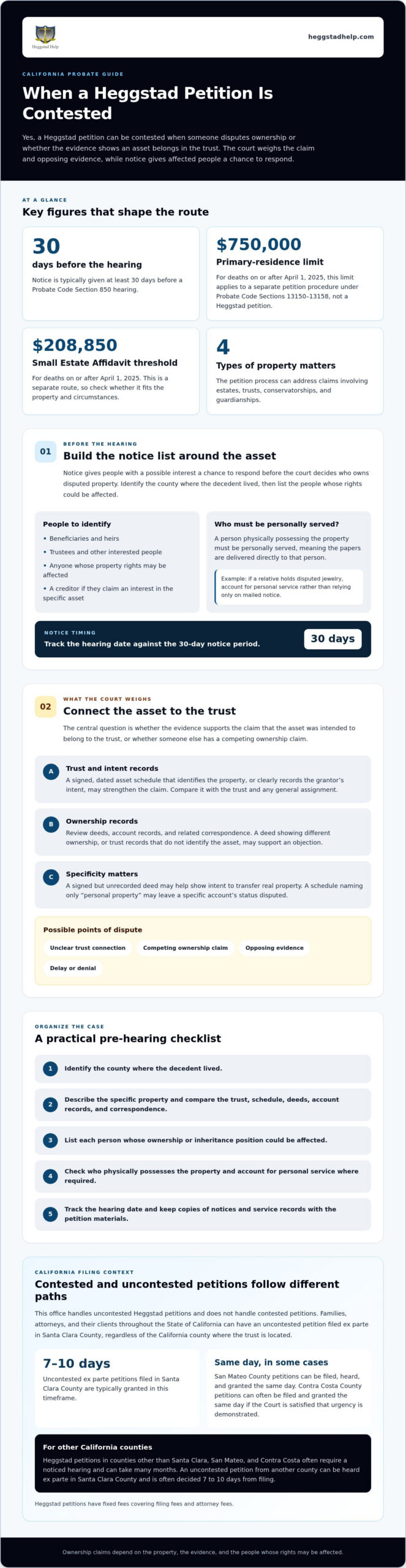
Heggstad Petition for Real Estate in California: Filing, Timing, and Next Steps

A Heggstad petition may ask a California probate court to confirm real estate as a trust asset when the recorded title does not show the trust as…

A Heggstad petition may ask a California probate court to confirm real estate as a trust asset when the recorded title does not show the trust as owner. A Heggstad petition for real estate California residents own may be relevant when the written record supports the owner’s intent to include the property in the trust.

The property’s county and the county where an uncontested petition is filed may differ. HEGGSTAD HELP, a service of attorney Robert P. Bergman, Board-Certified Specialist in Estate Planning, Trust, and Probate Law (California State Bar Board of Legal Specialization), assists families, attorneys, title companies, and their clients throughout California. Uncontested petitions may be filed ex parte, meaning without a formal hearing, in Santa Clara, San Mateo, or Contra Costa County. For property in other counties, including Los Angeles and Orange, the petition is filed in Santa Clara County. Below, learn about the petition, filing routes, typical timing, and how to prepare for a consultation by booking through the consultation link and returning the required worksheets by email or fax.

Key Takeaways

  • When a property’s title record does not show the trust, a successor trustee may need to understand the available Heggstad petition process.
  • A petition under Probate Code Section 850 asks the court to confirm real property as trust property. “Ex parte” means the request is handled without a formal hearing.
  • Filing routes differ for Santa Clara, San Mateo, and Contra Costa Counties and for properties located elsewhere in California.
  • To prepare for a consultation, book through the consultation link, download the worksheets, complete them, and return them by email or fax.

Why a California Heggstad Petition May Matter When Real Estate Was Left Outside a Trust

A Heggstad petition asks the court to confirm real estate as trust property when the recorded title does not name the trust. It may address a difference between the title record and documented intent. Filing a petition does not guarantee a court order or resolve every title issue.

A mismatch can leave a successor trustee unsure how to handle a home or other property. The Heggstad petition filing information explains the service. The petition takes its name from the Estate of Heggstad case, which is associated with court consideration of a person’s intent to place property in a trust.

What does it mean when real estate is outside a trust?

The recorded title may list an individual as owner instead of the trust. For example, a California home might still be titled in a deceased owner’s name even though trust documents refer to the home or show an intention to include it. This difference can raise questions for the successor trustee. A Heggstad petition asks the court to confirm the property’s trust status; the outcome depends on the circumstances and the court’s decision.

A title issue exists when recorded ownership does not show the trust, and a Heggstad petition asks the court to confirm the property’s trust status.

Who may need information about a property title issue?

Successor trustees and families may need to understand why the deed and trust records do not match. Estate-planning attorneys, title companies, and realtors may also encounter a title issue while reviewing property records or a proposed transaction. For trustees and property owners navigating subsequent renovations or capital improvements once ownership is settled, consulting an owner’s representative like Hodge Construction Management & Consulting can provide vital project oversight. If you are considering a Heggstad petition for real estate California, start by gathering the recorded title information and the relevant trust documents. Note what each says about ownership and the property. This gives you a clear starting point for a consultation without assuming how the court will rule.

How a Heggstad Petition Relates to Real Property Under Probate Code Section 850

A Heggstad petition under Probate Code Section 850 asks the court to confirm real property as trust property. The request does not automatically change title or guarantee that the court will grant it. Its purpose is to ask the court to decide the property’s status in relation to the trust.

What does Probate Code Section 850 contribute?

Probate Code Section 850 is the basis for the Heggstad petition filing service described here. In plain English, the petition asks the court to decide whether the property should be treated as belonging to the trust, even though the recorded title may not show the trust as owner.

The court considers the petition and the circumstances. To discuss a specific matter, book a consultation and prepare the relevant property and trust information. The Heggstad petition filing information provides further context about the service.

Why does the petition’s purpose matter to title?

A title record shows ownership as recorded. A petition asks the court to determine whether the property is trust property. These are related but distinct steps: requesting an order does not guarantee that the title record will be corrected or that the court will rule a particular way.

A Heggstad petition asks the court to determine whether real property is trust property; it does not guarantee that result.

For an uncontested petition, the service uses an ex parte process, meaning the request is handled without a formal hearing. This describes the filing approach, not a guaranteed decision. To discuss how a Heggstad petition for real estate California may apply to your circumstances, book a consultation with HEGGSTAD HELP.

Heggstad Petition for Real Estate in California: Filing, Timing, and Next Steps

Where California Real Estate Heggstad Petitions Are Filed and How Long They May Take

The county where the property is located and the county where an uncontested Heggstad petition is filed may differ. The route depends on whether the property is in Santa Clara, San Mateo, or Contra Costa County, or elsewhere in California.

Property location Filing route Timing to understand
Santa Clara County Uncontested ex parte petition filed in Santa Clara County A signed court order is typically obtained within 7 to 10 days. This is not a guarantee.
San Mateo County Uncontested ex parte petition filed in San Mateo County Same-day filing is possible. This does not establish when an order will issue.
Contra Costa County Uncontested ex parte petition filed in Contra Costa County Same-day filing may be possible if urgency is demonstrated to the Court’s satisfaction. This does not establish when an order will issue.
Other California counties Uncontested ex parte petition filed in Santa Clara County The filing venue is Santa Clara County. A signed order is typically obtained within 7 to 10 days there, but timing is not guaranteed.

What is the stated route for property in other California counties?

For property in counties other than Santa Clara, San Mateo, and Contra Costa, the attorney files an uncontested petition in Santa Clara County. This route applies to property in Los Angeles, Orange, San Diego, Alameda, Sacramento, Fresno, and other California counties. These are property locations, not separate filing venues for this service. In many counties, Heggstad petitions may require a noticed hearing and take many months to be heard. An eligible uncontested petition can instead be filed ex parte in Santa Clara County, where a signed order is typically obtained within 7 to 10 days.

How should readers understand the timing?

The 7 to 10 day timeframe refers to when a signed court order is typically obtained in Santa Clara County. It is not a guaranteed result. In San Mateo County, same-day filing is possible. In Contra Costa County, same-day filing may be possible if urgency is demonstrated to the Court’s satisfaction. Filing on the same day does not mean an order is guaranteed that day.

If you are coordinating a property matter, note the property’s county and gather the title and trust information. Book a consultation about your Heggstad petition to discuss the filing route and next steps.

How to Prepare for a California Real Estate Heggstad Petition Consultation

Prepare for a conversation about the property title issue by following the consultation steps in order: book a consultation, download the worksheets, complete them, and return them by email or fax.

What should readers expect from the consultation process?

Book a short Zoom or in-office consultation through the consultation booking page. After booking, download and complete the Trust Petition Consultation Worksheets. Return the completed worksheets by email to rpb@lawbob.com or by fax to 408-415-4591.

Before completing the worksheets, gather the available property title information and relevant trust documents. Fill in the worksheets as fully as you can. They provide a starting point for discussing the property and trust during the consultation.

When does the stated fixed fee apply?

The fixed fee of $6,500.00, effective January 1, 2026, applies only to a clean ex parte Heggstad petition. A clean petition means: (1) no interested parties object, (2) all interested parties waive notice of a hearing, and (3) all interested parties consent to the petition. The fixed fee does not apply to a petition that does not meet all three conditions.

Additional fees may apply. See the Fees and Costs page for details. If you are preparing for a Heggstad petition for real estate California, complete the worksheets and return them by email or fax before your consultation. This gives you a clear next step and helps focus the discussion on the property and trust information.

Take the Next Step With Clear Property Information

To move a title concern forward, gather the property and trust information you have and arrange a consultation. Be ready to explain what the recorded title shows and identify the question you need addressed. The consultation can cover whether a Heggstad petition for real estate California may fit the circumstances.

Attorney Robert P. Bergman is a Board-Certified Specialist in Estate Planning, Trust and Probate Law and has practiced in Santa Clara County since 1980. A consultation provides an opportunity to discuss the property issue and the petition process, but it cannot promise what a court will decide.

Heggstad Help assists families, attorneys, title companies, and their clients throughout California, including the San Francisco Bay Area, Northern California, Southern California, the Central Valley, San Diego, Sacramento, Fresno, Bakersfield, Greater Los Angeles, Orange County, Riverside County, and San Bernardino County. Book a Heggstad trust petition consultation, then download, complete, and return the worksheets by email or fax before your appointment.

Frequently Asked Questions

Can a Heggstad petition concern assets other than real estate?

Yes. The service can address other trust assets as well as real property, though this article focuses on California real estate. If a family discovers that another asset may not be titled in the trust, the petition’s suitability depends on the asset and circumstances. A court order is not guaranteed. Book a consultation and gather the relevant asset and trust information for discussion.

Can a Heggstad petition be pursued before the trustmaker dies?

Trust asset transfers may be facilitated both before and after a decedent’s death. The appropriate petition approach depends on the asset, trust documents, timing, and other circumstances. If the trustmaker is living, gather the relevant trust and asset information, then book a consultation to discuss the matter. This general information is not legal advice for a specific situation.

Does filing a Heggstad petition guarantee a court order?

No. Filing a Heggstad petition does not guarantee that the court will issue the requested order. The court decides the matter, so the process is not automatic or instant. For a focused discussion, note what the title record says, gather the trust information you have, book a consultation, and complete and return the required worksheets by email or fax.

Can attorneys and title companies use HEGGSTAD HELP?

Yes. Families, attorneys and their clients, title companies, realtors, and others throughout California can use the service for uncontested ex parte Heggstad petitions involving trust assets. The service reaches the San Francisco Bay Area, Northern and Southern California, the Central Valley, San Diego, Sacramento, Fresno, Bakersfield, Greater Los Angeles, Orange County, Riverside County, and San Bernardino County. Professionals can book a consultation, then download, complete, and return the worksheets by email or fax.

Robert P. Bergman, Attorney at Law

Article by

Robert P. Bergman, Attorney at Law

Attorney Robert P. Bergman ("Bob Bergman") has been a Board-Certified Specialist in Estate Planning, Trust and Probate Law since 2011, as certified by the California State Bar Board of Legal Specialization. For several years, Bob has assisted families and the clients of other attorneys with obtaining court orders through Heggstad petitions to avoid the time and expense of Probate administration. Bob is friendly, very approachable, and believes in explaining complex legal topics in clear ordinary language so that his clients understand exactly what they're doing and why they're doing it.
Bob is often able to assist clients who are in other counties than his home county of Santa Clara through his approach to Heggstad petitions.

Disclaimer

This article is for informational purposes only. Nothing in this article is intended to replace legal advice from a competent attorney or be considered legal guidance for anybody's specific legal situation. Nobody should rely on information in this article in making legal decisions without such consultation.

Ex Parte Relief for Trust Funding in California: When a Heggstad Petition May Help

An uncontested Heggstad petition may help when an asset was meant to be part of a trust but its title was never changed. The petition asks the court…

An uncontested Heggstad petition may help when an asset was meant to be part of a trust but its title was never changed. The petition asks the court to confirm the asset as trust property without a formal hearing. For people searching for “ex parte relief for trust funding California,” the key requirement is that all interested parties agree, waive notice of a hearing, and raise no objection.

Heggstad Help, a service of attorney Robert P. Bergman, Board-Certified Specialist in Estate Planning, Trust, and Probate Law (California State Bar Board of Legal Specialization), assists families, attorneys, and their clients throughout the State of California. Uncontested petitions for trusts in counties other than Santa Clara, San Mateo, and Contra Costa are filed in Santa Clara County. A signed Court Order is typically obtained within 7 to 10 days there. Same-day filing is possible in San Mateo County and, if urgency can be demonstrated, in Contra Costa County.

For a clean ex parte Heggstad petition, the fixed fee is $6,500.00, effective January 1, 2026. This article explains what “clean” means, how county filing routes differ, what to prepare for a consultation, and where to find information about additional fees.

Key Takeaways

  • Ex parte relief for trust funding in California may provide a court route to confirm an asset as trust property without a formal noticed hearing.
  • A petition is clean only when no interested parties object, all interested parties waive notice of a hearing, and all interested parties consent to the petition.
  • Petitions for trusts in counties other than Santa Clara, San Mateo, and Contra Costa are filed in Santa Clara County, not directly in the county where the trust is located.
  • To start a consultation, book an appointment, download the Trust Petition Consultation Worksheets, and return them by email or fax.

What Does Ex Parte Relief for Trust Funding in California Mean?

Ex parte relief for trust funding in California is a court process that may confirm an asset as belonging to a trust without a formal noticed hearing. Heggstad Help handles uncontested petitions under Probate Code Section 850 to address trust asset confirmation and title correction. Filing a petition does not guarantee that the court will issue an order.

The service addresses a specific trust-funding issue: an asset was intended for a trust, but the title may not reflect that intention. The petition asks the court to confirm the asset as trust property. This can apply to real property or other assets.

The broader discussion of Ex parte (legal term) highlights the importance of procedural fairness. In this service, the interested parties’ consent and waiver of hearing notice are central to the process. The court considers the petition, and its decision is not assured.

How Is Trust-Funding Relief Different From Emergency Trust Litigation?

This service is for uncontested asset confirmation. It is not an emergency process for allegations that a trustee has acted improperly or for requests to protect assets from immediate harm. The petition addresses whether an asset should be confirmed as trust property, with the required agreement and waiver of hearing notice from interested parties.

For more context, the Heggstad petition filing guide explains the petition’s purpose. To prepare for a consultation, gather the trust documents and records related to the asset and its title. These materials help frame the trust-funding issue for discussion with the attorney.

Who Qualifies for a Clean Ex Parte Heggstad Petition?

The ex parte process and its fixed fee apply only to a clean petition. A petition is clean only if it meets all three requirements below. The absence of a formal hearing does not remove the need for agreement and waived hearing notice.

What Does Clean Mean for This Petition Service?

  1. No interested parties object.
  2. All interested parties waive notice of a hearing.
  3. All interested parties consent to the petition.

Each condition matters. If everyone agrees about the asset but one interested party does not waive notice of a hearing, the petition does not meet the clean-petition definition. Silence alone is not the same as consent. Heggstad Help handles uncontested petitions only, and a court order is not guaranteed.

Which Trust-Funding Situations Does the Service Address?

The petition seeks court confirmation that real property or another asset belongs to a trust when ownership needs to be confirmed. Successor trustees, family members, attorneys, and title professionals may be involved when an asset was not properly titled in the trust. The service focuses on confirming trust property.

For background on the provision named for this service, the Probate Code Section 850 guide provides more context about Heggstad petitions. The California Courts also publish California Rules of Court on Trust Funding, including a rule concerning trusts funded by court order. That general court rule does not predict how a specific petition will be decided.

Successor trustees, family members, attorneys, and title professionals considering an uncontested trust-funding petition can review Heggstad Help’s petition services.

Where Is an Ex Parte Trust-Funding Petition Filed in California?

The filing route depends on the county. Uncontested Heggstad petitions involving trusts in counties other than Santa Clara, San Mateo, and Contra Costa are filed ex parte in Santa Clara County, rather than directly in the county where the trust is located. This route can serve families, attorneys, title companies, and their clients throughout the State of California.

County Filing route Typical timing
Santa Clara File in Santa Clara County A signed Court Order is typically obtained within 7 to 10 days.
San Mateo File in San Mateo County Same-day filing is possible.
Contra Costa File in Contra Costa County Same-day filing is possible if urgency can be demonstrated to the Court’s satisfaction.
Other California counties File in Santa Clara County Use the Santa Clara County filing route.

What Timing Applies in Santa Clara, San Mateo, and Contra Costa Counties?

In Santa Clara County, a signed Court Order is typically obtained within 7 to 10 days. Same-day filing is possible in San Mateo County. In Contra Costa County, same-day filing is possible if urgency can be demonstrated to the Court’s satisfaction. These timelines describe the filing process and do not guarantee a court order.

What Happens When the Trust Is Located in Another California County?

For example, an uncontested petition involving a trust in Los Angeles, Orange, San Diego, Alameda, or Sacramento County can be filed ex parte in Santa Clara County. In counties other than Santa Clara, San Mateo, and Contra Costa, Heggstad petitions often require a noticed hearing and may take many months to be heard. The Santa Clara County route offers an ex parte process for uncontested petitions from those counties, with signed Court Orders typically obtained within 7 to 10 days. For more about the Los Angeles County context, the Heggstad petition filing guide explains the service.

Heggstad Help assists families, attorneys, title companies, and their clients throughout California, including Los Angeles County, Orange County, San Bernardino County, San Diego County, Riverside County, Santa Clara County, Alameda County, San Francisco County, Marin County, Ventura County, Santa Cruz County, Sacramento County, Placer County, Santa Barbara County, San Joaquin County, Fresno County, Solano County, San Luis Obispo County, and Monterey County.

Ex Parte Relief for Trust Funding in California: When a Heggstad Petition May Help

How Do You Start an Ex Parte Heggstad Petition With Heggstad Help?

To begin, book a short Zoom or in-office consultation through the consultation booking link. After booking, download and complete the Trust Petition Consultation Worksheets, then return them by email or fax. This process gives the attorney information about the trust and asset before discussing the petition and next steps.

What Are the Consultation Steps?

  1. Book a short Zoom or in-office consultation through the consultation booking link.
  2. After booking, download and complete the Trust Petition Consultation Worksheets. Gather the trust and asset information requested so the consultation can focus on the matter.
  3. Return the completed worksheets by email to rpb@lawbob.com or by fax to 408-415-4591.

Before the consultation, organize the available trust documents and records about the asset’s current title. This gives you a practical starting point for discussing the filing route and the service process.

What Should You Expect From the Fee and Service Scope?

Effective January 1, 2026, the fixed fee for a clean ex parte Heggstad petition is $6,500.00. A petition is clean only when no interested parties object, all interested parties waive notice of a hearing, and all interested parties consent to the petition. Additional fees may apply; see the Fees and Costs page for information about fees beyond the fixed fee.

The service focuses on Heggstad petitions for trust asset confirmation and title correction. You can review the Heggstad petition services while preparing for the consultation.

Take the Next Step Toward Resolving a Trust-Funding Issue

When an asset’s title does not match the trust, families and professionals may need to clarify how to address the trust-funding issue. If you are considering ex parte relief for trust funding in California, prepare the available trust and title records and identify whether interested parties agree to the petition. Those details can help make a consultation more focused.

Heggstad Help is led by a Board-Certified Specialist in Estate Planning, Trust and Probate Law and assists families, attorneys, and their clients throughout the State of California. For petitions filed in Santa Clara County, signed Court Orders are typically obtained within 7 to 10 days. The court makes the decision on each petition.

Book a Heggstad trust petition consultation to discuss the asset, the available records, and the appropriate filing route.

Frequently Asked Questions

Can a Heggstad petition address assets other than real estate?

Yes. The service can seek confirmation of real property and other assets as trust property. If an asset’s title records do not clearly show the trust as owner, gather those records and the relevant trust documents for the consultation. The phrase “ex parte relief for trust funding California” describes the service focus, not a conclusion that a particular asset qualifies or that a court will grant a petition.

Does a Heggstad petition change the terms of a trust?

No. A Heggstad petition concerns whether an asset should be treated as trust property, rather than asking to rewrite the trust’s terms. For example, a question about who receives property under the trust differs from a question about whether a particular asset belongs to it. The petition service focuses on the latter issue.

Is a court order guaranteed after filing an ex parte petition?

No. Filing a petition does not guarantee that the court will issue the requested order. The court makes that decision, and Heggstad Help handles uncontested petitions only. A consultation can explain the filing service and discuss the available information about the asset, but it cannot promise a result.

Can attorneys and title companies use Heggstad Help for a trust-funding issue?

Yes. Attorneys, title companies, realtors, families, and clients can use the service for an uncontested trust-funding issue. For example, a title professional who encounters a possible mismatch between property records and trust ownership can participate with the client and attorney. The service assists throughout California, including the San Francisco Bay Area, Northern California, Southern California, the Central Valley, San Diego, Sacramento, Fresno, Bakersfield, Greater Los Angeles, Orange County, Riverside County, and San Bernardino County.

Robert P. Bergman, Attorney at Law

Article by

Robert P. Bergman, Attorney at Law

Attorney Robert P. Bergman ("Bob Bergman") has been a Board-Certified Specialist in Estate Planning, Trust and Probate Law since 2011, as certified by the California State Bar Board of Legal Specialization. For several years, Bob has assisted families and the clients of other attorneys with obtaining court orders through Heggstad petitions to avoid the time and expense of Probate administration. Bob is friendly, very approachable, and believes in explaining complex legal topics in clear ordinary language so that his clients understand exactly what they're doing and why they're doing it.
Bob is often able to assist clients who are in other counties than his home county of Santa Clara through his approach to Heggstad petitions.

Disclaimer

This article is for informational purposes only. Nothing in this article is intended to replace legal advice from a competent attorney or be considered legal guidance for anybody's specific legal situation. Nobody should rely on information in this article in making legal decisions without such consultation.
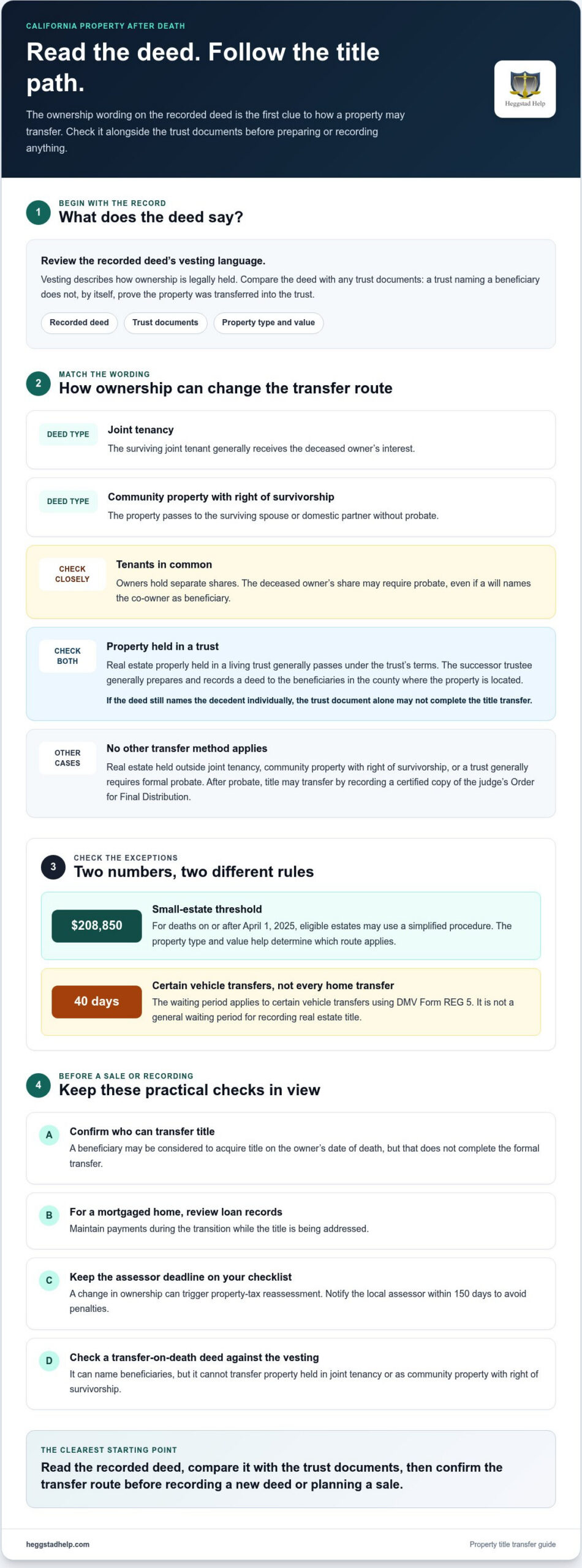
Fixing a Trust With No Schedule of Assets in California

A missing Schedule of Assets does not, by itself, establish that a California trust cannot include a particular asset or that probate is unavoidable….

A missing Schedule of Assets does not, by itself, establish that a California trust cannot include a particular asset or that probate is unavoidable. To start fixing a trust with no schedule of assets California families should identify the asset, review the trust and ownership records, and assess whether the documents show the trust maker intended the asset to belong to the trust. When the issue is uncontested, a Heggstad petition may provide a way to ask the court to confirm trust ownership.

Gather the signed trust and any amendments, deeds or account records, and other documents that show how the asset was titled. Organizing these records by asset can make it easier to see what the paperwork supports and what information is missing.

Heggstad Help, a service of attorney Robert P. Bergman, Board-Certified Specialist in Estate Planning, Trust, and Probate Law (California State Bar Board of Legal Specialization), assists families, attorneys, and their clients throughout California with uncontested ex parte Heggstad petitions. These petitions are filed without a formal hearing in Santa Clara County, regardless of the county where the trust is located. This article explains what a missing schedule does and does not establish, which records to organize, and how the petition process may fit.

Key Takeaways

  • A missing Schedule of Assets alone does not establish whether a particular asset was intended to belong to the trust.
  • When fixing a trust with no schedule of assets California, gather the trust and amendments, ownership records, and documents that may show the trust maker’s intent.
  • Review each asset separately: identify it, confirm how it is currently titled, and note its type and the trust’s status.
  • For an uncontested issue, a Heggstad petition may be a path forward. Uncontested petitions can be filed ex parte in Santa Clara County regardless of where in California the trust is located. Fixed fees cover filing fees and attorney fees.

What Does It Mean to Have a California Trust With No Schedule of Assets?

A missing Schedule of Assets does not, by itself, show what happened to a particular asset. The trust may contain language about the trust maker’s intentions, while ownership records show who legally held the asset. These documents answer different questions, so review them together.

A Schedule of Assets is a record identifying property the trust maker intended the trust to hold. It is separate from the trust document, which sets out the trust’s terms, and from ownership records, such as a deed or account statement, which show how an asset is titled. These records should not be treated as interchangeable. To begin fixing a trust with no schedule of assets California, identify the specific asset and review its records alongside the trust paperwork. The general concept of trust law can provide background, but it does not determine ownership of a particular California asset.

Does the missing schedule mean the trust cannot be used?

No. The missing schedule is a gap in the available records, not a complete account of ownership or intent. Read the trust wording and any amendments, attachments, or asset-specific documents that remain. For example, a deed or written assignment may help explain the trust maker’s actions even when no schedule can be found. Keep the documents together, and avoid assuming that one missing page settles the issue.

Why can an asset appear to be outside the trust?

An asset may appear to be outside the trust because the file is incomplete or the available documents do not reflect every step the trust maker took. A property record, account document, or written instruction may provide context that the missing schedule cannot. Note what is known about the asset and where each record came from. For a broader overview of possible recovery steps, see the California trust asset recovery guide. The relevant evidence depends on the facts for each asset.

What Records Can Show Intent When a California Trust Has No Asset Schedule?

Evidence is asset-specific, and a missing Schedule of Assets is only one part of the file. Review the trust maker’s documents and actions alongside records showing who owned the particular asset and how it was titled. No single paper automatically establishes the result; the records need to be considered together.

When fixing a trust with no schedule of assets California, organize the file around each asset rather than treating the trust papers as a complete ownership record. A deed relates to real property, while account records may show how a financial account was held. Correspondence or a written assignment may add context about the trust maker’s intent.

Which documents should a family or successor trustee gather first?

Start with the signed trust and collect every available amendment, attachment, and assignment. Then gather documents tied to the asset under review, such as:

  • Deeds and other title or ownership records
  • Account records showing how an account was registered
  • Letters, emails, or other correspondence about the asset

Sort copies by asset, and note each record’s date and source. Keep the original file intact. Flag gaps or conflicting details rather than trying to resolve them by assumption.

How does a Heggstad petition relate to the evidence?

A Heggstad petition asks a court to confirm that a specific asset belongs to a trust. Supporting records help explain why the trust maker intended the asset to be held in the trust, even if the schedule is missing. The court decides based on the facts and evidence presented, so gathering and organizing records is a useful first step, not a guarantee of an outcome.

If you are organizing records for an uncontested petition, Heggstad petition filing information explains the focused process.

Fixing a Trust With No Schedule of Assets in California

How Should You Review a Trust With No Schedule of Assets Before Choosing a Route?

Review the issue one asset at a time before deciding what to do. A pour-over will, a will designed to direct certain property into a trust, may be relevant to the estate plan. It does not, by itself, establish that a particular asset is already trust property.

  1. Identify the asset. Describe it clearly, such as a specific parcel of real property or a named financial account.
  2. Establish current ownership. Check the latest available title or account records and note whose name appears.
  3. Gather trust records. Collect the signed trust, amendments, attachments, assignments, and records tied to that asset.
  4. Assess the evidence together. Note what supports an intent to include the asset, what points elsewhere, and what information is missing.

How can you organize the review asset by asset?

Create a separate folder for each asset, keeping ownership documents beside the trust records that may relate to it. Write down the apparent owner, relevant dates, and any document or action that connects the asset to the trust. Also record whether the trust is revocable or irrevocable and identify the asset type. These details help frame legal review; they do not, by themselves, determine the appropriate route.

When should the records be assessed for a Heggstad petition?

A Heggstad petition asks a court to confirm that an asset belongs to a trust. It may be considered when the available evidence supports asking the court to confirm trust ownership and the request is uncontested. The outcome depends on the specific facts. For broader context, the Heggstad petition filing guide discusses the process.

Heggstad Help assists families, attorneys, and their clients throughout California with uncontested petitions filed in Santa Clara County, regardless of where the trust is located. Explore help with an uncontested Heggstad petition.

What California Heggstad Petition Path May Fit an Uncontested Trust Asset Issue?

A Heggstad petition may fit when records support asking a court to confirm that an asset belongs to a trust and the request is uncontested. Heggstad Help assists families, attorneys, and their clients throughout the State of California by filing uncontested ex parte petitions, without a formal hearing, in Santa Clara County, San Mateo County, and Contra Costa County.

How do ex parte filing options differ by California county?

In Santa Clara County, uncontested ex parte Heggstad petitions are typically granted within 7 to 10 days of filing. In San Mateo County, petitions can be filed, heard, and granted the same day. In Contra Costa County, petitions can often be filed and granted the same day if the Court is satisfied that urgency has been demonstrated. These timeframes describe typical or conditional outcomes, not guaranteed results.

What if the trust is located in another California county?

In counties such as Los Angeles, Orange, San Diego, Alameda, or Sacramento, Heggstad petitions often require a noticed hearing, meaning a hearing scheduled with advance notice to interested parties. These hearings can take many months to be heard. An uncontested petition from any California county can instead be filed ex parte in Santa Clara County and is typically granted within 7 to 10 days of filing. Heggstad Help assists with these statewide filings, including for families and attorneys handling trust assets in the San Francisco Bay Area, Northern California, Southern California, the Central Valley, San Diego, Sacramento, Fresno, Bakersfield, Greater Los Angeles, Orange County, Riverside County, and San Bernardino County.

All Heggstad petitions have fixed fees covering filing fees and attorney fees. If you are fixing a trust with no schedule of assets California, organize the asset-specific records to support an uncontested petition. Start with an uncontested Heggstad petition.

Take the Next Step With a Clear Record

A missing schedule can leave families unsure where to begin, but you can start by organizing the file. Make a short inventory of each asset, gather the records connected to it, and note any gaps or inconsistencies. That preparation makes a review of fixing a trust with no schedule of assets California more focused and helps clarify whether an uncontested Heggstad petition may fit.

Robert P. Bergman is Board-Certified in Estate Planning, Trust, and Probate Law by the California State Bar Board of Legal Specialization. Heggstad Help assists families, attorneys, and their clients throughout the State of California with uncontested ex parte petitions filed in Santa Clara County, San Mateo County, and Contra Costa County. Fixed fees cover filing fees and attorney fees.

Bring together the asset-specific records and take the next step toward resolving the title issue. Start an uncontested Heggstad petition.

Frequently Asked Questions

Does a trust need a Schedule of Assets to be valid in California?

No. The absence of a Schedule of Assets alone does not establish that a trust is invalid. The trust instrument and the circumstances of its creation still matter, while ownership of a particular asset is a separate question. If you are fixing a trust with no schedule of assets California, start by reviewing the signed trust and available attachments rather than treating a missing list as a decision about validity or ownership.

Can a pour-over will transfer an asset into a trust without a Schedule of Assets?

A pour-over will may direct property that passes under the will to the trust after the will-maker’s death, but it does not establish that a specific asset was already trust property. The will’s terms and the asset’s title records serve different purposes. Review them separately, and note whether the asset is addressed by name or falls within the will’s broader language.

Can a Heggstad petition address assets other than real property?

Yes. Heggstad petitions may address real property and other assets, although the relevant records and legal questions can vary by asset type. For example, records about an account may differ from documents concerning a home. Identify the particular asset and gather its ownership history before assessing whether a petition may fit. The court’s decision depends on the specific facts and evidence.

Are Heggstad petitions only filed in the county where the trust is located?

No. An uncontested Heggstad petition may be filed ex parte in Santa Clara County regardless of where in California the trust is located. Heggstad Help assists families, attorneys, and their clients statewide, including in the San Francisco Bay Area, Southern California, and the Central Valley. This filing route can serve trust matters involving Los Angeles County, Orange County, San Diego County, Alameda County, and Sacramento County, among others.

Robert P. Bergman, Attorney at Law

Article by

Robert P. Bergman, Attorney at Law

Attorney Robert P. Bergman ("Bob Bergman") has been a Board-Certified Specialist in Estate Planning, Trust and Probate Law since 2011, as certified by the California State Bar Board of Legal Specialization. For several years, Bob has assisted families and the clients of other attorneys with obtaining court orders through Heggstad petitions to avoid the time and expense of Probate administration. Bob is friendly, very approachable, and believes in explaining complex legal topics in clear ordinary language so that his clients understand exactly what they're doing and why they're doing it.
Bob is often able to assist clients who are in other counties than his home county of Santa Clara through his approach to Heggstad petitions.

Disclaimer

This article is for informational purposes only. Nothing in this article is intended to replace legal advice from a competent attorney or be considered legal guidance for anybody's specific legal situation. Nobody should rely on information in this article in making legal decisions without such consultation.

How to Fix Trust Title Errors in California

What if the deed isn’t wrong, but the property was never transferred into the trust? To understand how to fix trust title errors, compare the…

What if the deed isn’t wrong, but the property was never transferred into the trust? To understand how to fix trust title errors, compare the recorded deed with the trust documents and determine whether the deed itself contains an error or the transfer was never completed. A deed correction may address some document errors; an eligible asset intended for the trust but never titled in it may require a Heggstad petition.

This guide explains which records to gather, how to distinguish between these situations, and what California options may help resolve the issue before it delays trust administration or a sale. Heggstad Help, a service of attorney Robert P. Bergman, Board-Certified Specialist in Estate Planning, Trust, and Probate Law (California State Bar Board of Legal Specialization), assists families, attorneys, and their clients throughout the State of California with uncontested ex parte Heggstad petitions filed in Santa Clara County, regardless of where the trust is located. These petitions are typically granted in 7 to 10 days.

Key Takeaways

  • Compare the recorded ownership information with the trust documents to pinpoint where they differ.
  • How to fix trust title errors depends on whether the deed needs correction or a court may need to confirm an eligible asset as trust property.
  • Gather the current recorded deed, relevant trust documents, and available transfer records. Write down the specific mismatch.
  • Families, attorneys, title companies, and clients throughout California can pursue eligible uncontested Heggstad petitions through ex parte filing in Santa Clara County, regardless of where the trust is located.

What Kind of Trust Title Error Do You Have in California?

The right way to address a trust title problem depends on whether the recorded document contains an error or the property was never transferred into the trust. Title is the recorded information showing who owns the property. A mismatch does not automatically mean the entire trust is invalid.

Was the deed recorded incorrectly, or was the property left out?

Start by comparing the current recorded deed with the trust documents. A deed defect may involve an incorrect spelling of an owner’s name or a legal description, the written identification of the property, that does not accurately describe the parcel. These are issues with the deed or its recorded information, although the appropriate correction depends on the facts.

A different issue arises when the deed accurately names an individual, but the trust documents suggest the property was meant to be held in the trust. For example, the deed may still identify a person rather than the trust. In that situation, the question may not be how to correct a typo, but whether the property was ever transferred into the trust. Changing a document and asking a court to confirm an asset as trust property are different paths.

Why can a property and trust record stop matching?

A transfer can be overlooked when someone creates or updates a trust. A property may also be taken out of a trust during a refinance and not transferred back afterward, or purchased later without being added to the trust. These are trust-funding issues: assets may not have been legally placed in the trust as intended. A general overview of trust law can explain how trusts hold and manage assets, but it won’t establish how a particular property is titled.

To narrow down the problem, note the names and property description on the recorded deed, then compare them with the trust’s relevant documents and any transfer records you have. This comparison can help identify the type of issue before you consider a correction.

Can You Correct a Trust Title Error With a Deed or a Heggstad Petition?

How to fix trust title errors depends on what the records show. A deed correction may address an error in a recorded document, while a Heggstad petition may ask the court to confirm property as trust property. A deed error and an unfunded trust asset are not the same problem. The appropriate path depends on the ownership evidence and the specific mismatch.

When is the problem a deed or recording error?

A deed or recording issue appears within the document or its recorded details. The deed might identify an owner incorrectly, contain an inaccurate property description, or reflect another discrepancy. Not every issue can be fixed the same way. Review the recorded deed alongside the trust records and related transfer documents to understand what was signed, what was recorded, and how the property was intended to be held.

When might a Heggstad petition be relevant?

A Heggstad petition may be relevant if the property was intended for the trust but the ownership transfer was never completed. Rather than asking to correct a typo in a deed, the petition asks the court to confirm that an eligible asset belongs to the trust. This court process is associated with Probate Code Section 850. Evidence of intent and the asset’s records matter when evaluating whether this route fits. A petition is not an automatic solution for every title mismatch.

As a practical first step, put the current deed beside the trust document and any available transfer records. Note whether the issue is an inaccuracy in recorded information or a missing transfer into the trust. That distinction helps focus the review. For more information about Heggstad petitions, learn how this court process may apply to eligible trust assets.

What Records Should You Gather Before Addressing a California Trust Title Error?

To understand how to fix trust title errors, gather the documents that show how the property was titled and what the trust records say. A clear set of records and a short timeline can help identify the mismatch without requiring you to reach a legal conclusion on your own.

Which documents help clarify the ownership history?

Start with the current recorded deed, then collect the relevant trust documents and any available records of transfers or title changes. Compare the names and property description across them. Differences may point to a document discrepancy, a missing transfer, or another issue that needs closer review.

Next, arrange the known events in order. Note when the property was purchased, when the trust was created, whether a refinance occurred, and whether title changed afterward. Add dates where you have them, and mark anything uncertain rather than filling in gaps from memory.

How should you describe the mismatch clearly?

Write down the property address and California county, the name or names currently shown on the deed, and the name of the trust or person you expected to see. Include when the mismatch came to light, such as during trust administration or while preparing for a sale. This concise summary makes the records and the issue easier to follow.

  • Current recorded deed and relevant trust documents
  • Available transfer or refinance records
  • A timeline of purchase, trust creation, and later title changes
  • A short description of the difference between the records

If the records suggest the property was intended for the trust but left out, read more about Heggstad petition filing. If the owner has died, don’t assume that preparing a new deed alone resolves the ownership question. Learn about trust asset title correction for help addressing an eligible title issue.

How to Fix Trust Title Errors in California

How Can a Heggstad Petition Address Trust Title Errors Across California?

A Heggstad petition may help when an eligible asset was intended for a trust but wasn’t titled in it. Heggstad Help assists families, attorneys, title companies, and their clients throughout the State of California with uncontested petitions, including for property located in the San Francisco Bay Area, Northern California, Southern California, the Central Valley, San Diego, Sacramento, Fresno, Bakersfield, Greater Los Angeles, Orange County, Riverside County, and San Bernardino County.

How do filing options differ by California county?

Uncontested petitions filed ex parte, meaning without a formal hearing, in the Santa Clara County Probate Court are typically granted in 7 to 10 days. The trust or property may be elsewhere, including Los Angeles County, Orange County, San Diego County, Alameda County, or Sacramento County. Uncontested petitions from these and other California counties can often be filed ex parte in Santa Clara County, regardless of where the trust is located.

Ex parte petitions in San Mateo County can be filed, heard, and granted the same day. In Contra Costa County, petitions can often be filed and granted the same day if the court is satisfied that urgency has been demonstrated. In other counties, Heggstad petitions often require a noticed hearing, meaning interested parties receive notice and the matter is scheduled for court. Those hearings may take many months. This is why uncontested petitions for trusts in counties other than San Mateo and Contra Costa are often filed ex parte in Santa Clara County.

This process can serve families and professionals working with trusts in counties across the State, including San Francisco, Marin, Santa Cruz, Ventura, San Bernardino, Riverside, Santa Barbara, San Joaquin, Fresno, Solano, San Luis Obispo, Monterey, and Placer Counties.

What can families and professionals expect from the service?

The office handles uncontested Heggstad petitions, not contested petitions. Fixed fees cover filing fees and attorneys’ fees. Gathering the deed, trust documents, and available transfer records helps clarify the title issue and supports a focused review of whether a petition may fit.

For information about an eligible, uncontested matter, visit Heggstad Help.

Move From Uncertainty to a Clear Next Step

A title concern can feel larger when everyone involved describes it differently. As you decide how to fix trust title errors, write one concise statement of the unresolved question and share it with the people coordinating the next steps. A common understanding can make conversations more focused and help prevent assumptions from shaping the plan.

You don’t need every answer before taking a thoughtful next step. Start with the question that matters most to your family or the decision currently waiting on clarity, then keep track of what remains unresolved.

If you’re ready to discuss an uncontested Heggstad petition, contact Heggstad Help about your situation.

Frequently Asked Questions

Does a trust title error mean the trust is invalid?

Not necessarily. A question about the trust’s validity is different from a question about whether a particular asset is held by the trust. If concerns extend beyond one property, gather the signed trust document and any amendments, then identify the specific issue, such as questions about the document or changes made to it. This keeps the review focused instead of treating every title concern as the same problem.

Can a Heggstad petition apply to assets other than real estate?

Yes, a Heggstad petition may concern eligible assets beyond real estate, but it doesn’t automatically apply to every type of property. The records need to support that the asset was intended to belong to the trust. Identify the asset and gather relevant trust schedules, ownership records, and written transfer instructions that may help show the trust creator’s intent.

Does a pour-over will automatically change the title to a house?

No. A pour-over will generally directs assets left outside a trust to be transferred into it through the estate process. It doesn’t by itself update a recorded deed or instantly make the trust the owner of a house. If a home remains in an individual’s name, review the deed and estate-planning records rather than assuming the will alone corrected the title.

What if a beneficiary objects to correcting the trust title?

A beneficiary’s objection can turn an otherwise uncontested matter into a dispute, so the request may no longer proceed as an uncontested petition. The reason for the objection and the records supporting each position matter. Keep the written objection with the relevant trust and ownership documents, and note which facts are disputed. Heggstad Help handles uncontested petitions, not contested petitions.

Can refinancing cause a property to be left out of a trust?

It can, but a refinance document by itself doesn’t necessarily show that ownership changed. Review the closing papers for any deed or other document affecting title, and distinguish those from loan documents that secure repayment. Note the dates and parties named on documents related to ownership. This can help clarify whether the refinance changed title or whether the issue lies elsewhere in the property records.

Robert P. Bergman, Attorney at Law

Article by

Robert P. Bergman, Attorney at Law

Attorney Robert P. Bergman ("Bob Bergman") has been a Board-Certified Specialist in Estate Planning, Trust and Probate Law since 2011, as certified by the California State Bar Board of Legal Specialization. For several years, Bob has assisted families and the clients of other attorneys with obtaining court orders through Heggstad petitions to avoid the time and expense of Probate administration. Bob is friendly, very approachable, and believes in explaining complex legal topics in clear ordinary language so that his clients understand exactly what they're doing and why they're doing it.
Bob is often able to assist clients who are in other counties than his home county of Santa Clara through his approach to Heggstad petitions.

Disclaimer

This article is for informational purposes only. Nothing in this article is intended to replace legal advice from a competent attorney or be considered legal guidance for anybody's specific legal situation. Nobody should rely on information in this article in making legal decisions without such consultation.
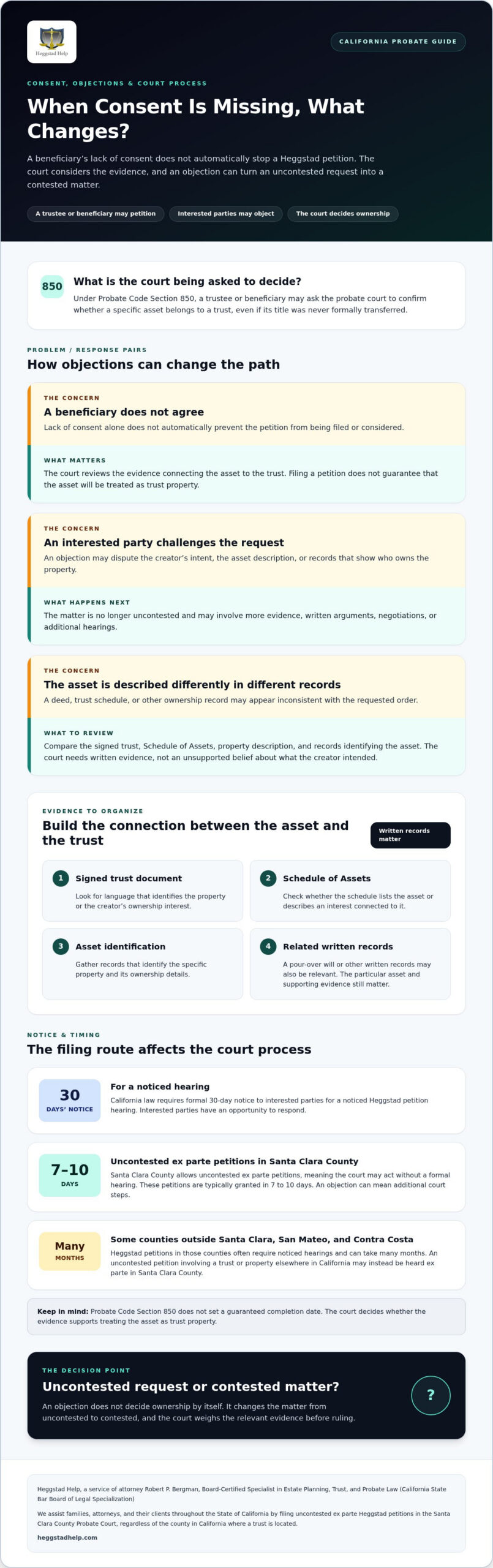
Selling a House Left Out of a Trust in California: What Happens Next?

A house left out of a trust usually can’t be sold by the successor trustee until its title is addressed. If you’re selling a house left out of trust…

A house left out of a trust usually can’t be sold by the successor trustee until its title is addressed. If you’re selling a house left out of trust California, a Heggstad petition (a request for a court order confirming the home belongs to the trust) may resolve the title problem without requiring full probate, depending on the facts.

It’s understandable to feel pressure when a sale is waiting and it’s unclear which court or process applies. Heggstad Help, a service of attorney Robert P. Bergman, Board-Certified Specialist in Estate Planning, Trust, and Probate Law (California State Bar Board of Legal Specialization), assists families, attorneys, and their clients throughout the State of California by filing uncontested ex parte Heggstad petitions (requests made without a formal hearing) in Santa Clara County, regardless of where the trust property is located. These petitions are typically granted in 7 to 10 days. This article explains how the petition may address title, why counties such as Los Angeles County and Orange County often require noticed hearings that can take many months, and how a Santa Clara County filing may offer a faster next step.

Key Takeaways

  • When selling a house left out of trust California, first identify who holds title, because the trust may need a court order before it can sell the property.
  • A Heggstad petition asks the court to confirm that a house belongs to the trust, which may help address the title issue before a sale.
  • Uncontested petitions in Santa Clara County are typically granted in 7 to 10 days; San Mateo County and Contra Costa County have separate ex parte procedures, with Contra Costa requiring the Court to accept urgency.
  • Start by gathering the title, trust, and property records, then assess the petition path. In many other counties, a noticed hearing may take many months, while an uncontested petition may be filed ex parte in Santa Clara County.

Why Can’t You Sell a California House Left Out of a Trust Right Away?

A sale may need the title resolved before the trust can convey the house. A house left out of a trust is real property that, at the owner’s death, is still titled outside the trust, so the trust’s sale process may not be enough to establish who can transfer it.

This differs from selling a house already titled in a trust: in that situation, the trust is shown as the owner, and the trustee can act under the trust’s terms. A useful way to understand the distinction is that the deed and public title record show who appears to own the house, while the trust document alone may not show that the house was transferred into the trust. The broader principles of trust law help explain why trust documents and ownership of specific property are related but separate questions.

What does it mean that a house was left out of a trust?

Creating and signing a trust document and changing a property’s title are distinct steps. For example, a person may sign a trust naming a successor trustee, but the recorded deed may still name that person individually. If that remains the title at death, the house may not appear to be a trust asset, even if the owner intended it to be included. To avoid these discrepancies, multi-disciplinary wealth advisory teams such as Kotini & Kotini help families coordinate legal, tax, and property titling across their broader estate strategies.

To understand the issue, start with the deed and determine whose name appears as owner. Compare that information with the trust and any property records showing whether title was transferred.

Can a successor trustee sell before title is resolved?

Not necessarily. Being named successor trustee gives someone authority to act for the trust, but it may not establish that the trust owns a house still titled in the deceased owner’s name. The deed matters because a buyer needs a clear record of who is conveying the property.

That doesn’t mean every omitted house follows the same legal path. The relevant documents and circumstances matter, so avoid assuming the property automatically requires full probate or that the trustee can sell it immediately. For families considering selling a house left out of trust California, the practical first step is to review the deed alongside the trust, then determine how the title issue can be addressed before proceeding with a sale.

How Can a Heggstad Petition Help Address the House’s Title?

A Heggstad petition is a request asking a judge to confirm that an asset belongs to a trust, even though title was not formally transferred to the trust. For an omitted house, a court order may help establish trust ownership so the trustee can proceed with a sale under the trust’s terms. The request is not an automatic transfer, and approval isn’t guaranteed. The outcome depends on the facts and evidence presented.

A Heggstad petition is generally brought under Probate Code Section 850. The California Probate Code Section 850 guide explains the legal framework. This process is distinct from probate, which the California Courts: Probate page describes. Whether a petition can address a particular title problem depends on the property’s history and supporting records.

What information helps explain the title problem?

Start by gathering the deed, the trust and any relevant amendments, and records showing how the property was held. These documents can help show what the title says and whether there is evidence the owner intended the house to be part of the trust. The court considers the specific facts and supporting documents presented, not simply the fact that a trust exists.

Does every omitted house qualify for a Heggstad petition?

No single outcome applies to every property. Whether a petition is appropriate depends on the circumstances and available evidence, so a court order should not be treated as certain or as an automatic title change. If the court grants the request, its order may provide a way to address trust ownership before a sale proceeds.

Heggstad Help assists families, attorneys, and their clients throughout the State of California with uncontested ex parte Heggstad petitions filed in Santa Clara County, regardless of where the trust property is located. If you’re selling a house left out of trust California, reviewing the Heggstad petition filing service can help you understand this title-correction path.

What California County Procedures Can Affect the Path to a Sale?

The county where a house is located can affect how quickly an uncontested Heggstad petition is heard. Santa Clara, San Mateo, and Contra Costa Counties have ex parte routes, but the timing and conditions differ. An ex parte filing asks the court to consider a request without a formal hearing; a noticed hearing is scheduled later and requires advance notice to interested parties.

  • Santa Clara County: Uncontested ex parte Heggstad petitions are typically granted in 7 to 10 days.
  • San Mateo County: Ex parte petitions can be filed, heard, and granted the same day.
  • Contra Costa County: Petitions can often be filed and granted the same day if the Court is satisfied that urgency has been demonstrated.

What if the house is in another California county?

In counties such as Los Angeles County and Orange County, an uncontested Heggstad petition often cannot be submitted ex parte and may require a noticed hearing. Those hearings can take many months to be heard, depending on the county’s procedures and calendar. The location of the house does not necessarily mean the petition must be filed in that county: an uncontested petition for trust property elsewhere in California may be filed ex parte in Santa Clara County.

This can matter when a sale is waiting on a title decision. Families, attorneys, and their clients throughout the State of California can pursue this Santa Clara County filing route regardless of the county where the trust property is located.

How do noticed hearings differ from ex parte petitions?

A noticed trust modification petition hearing is typically set 30 to 60 days after filing, or several months later in some counties. The time needed to notify interested parties adds to the schedule, and a contested petition takes longer. By contrast, an uncontested ex parte petition avoids a formal hearing, although the Court still decides whether to grant the request.

If you’re selling a house left out of trust California, county procedure can shape the next step and the expected timeline. Pursue an uncontested Heggstad petition through a Santa Clara County filing, regardless of where the trust property is located.

Selling a House Left Out of a Trust in California: What Happens Next?

What Should Families Do Before Selling a House Left Out of a Trust?

Before arranging a sale, take these steps in order: identify the owner shown on the deed, gather the trust and property records, then assess whether an uncontested Heggstad petition may address the title issue. If the court grants the petition, its order may confirm the house belongs to the trust so the trustee can proceed with a sale under the trust’s terms.

  1. Check the deed. Note the owner named on the recorded title and compare it with the trust’s name and terms.
  2. Gather the records. Collect the trust and any amendments, the deed, and other relevant ownership documents. Keeping these together helps clarify what the records show.
  3. Assess the petition path. The appropriate process depends on the facts and whether the matter is uncontested. A Heggstad petition requests a court order; it does not guarantee approval.

A Heggstad petition filing guide can help explain how the petition may address a house omitted from a trust. Heggstad Help handles uncontested petitions, not contested matters. If there is a disagreement about trust ownership, this filing path may not fit.

Who can Heggstad Help assist across California?

Heggstad Help assists families, attorneys, and their clients throughout the State of California, including those dealing with property in Los Angeles County, Orange County, and San Diego County. Uncontested ex parte petitions can be filed in Santa Clara County regardless of the California county where the trust property is located. Fixed fees cover filing fees and attorney fees.

What is a practical next step for an uncontested petition?

Organize the deed, trust documents, and relevant ownership records before discussing the situation. A clear set of records makes it easier to focus on the title discrepancy and the potential petition path. For more context about a house omitted from a trust, see the related discussion of a house forgotten in a trust.

Discuss an uncontested Heggstad petition when you’re ready to consider the next step.

Move Forward With a Clear Title Path

A title mismatch can make a planned sale feel stalled, but the uncertainty doesn’t have to remain vague. Before setting the sale process in motion, gather the deed and trust records and frame the key question: do the documents support asking the court to confirm the house belongs to the trust? That focused starting point can help clarify whether an uncontested Heggstad petition is a practical next step for your family’s circumstances.

Selling a house left out of trust California involves more than deciding who will sign the sale documents. The ownership record must support the trust’s authority to convey the property, and a court order may be part of resolving that issue. Each situation depends on its records, so treat a petition as a request for the Court’s decision, not a guaranteed result. For property owners and investors managing broader portfolios, proactive financial coordination—such as the advisory approach provided by KHT Accounting & Wealth—can also ensure business and trust assets remain properly structured over time.

Heggstad Help assists with uncontested Heggstad petitions, with Robert P. Bergman bringing his California estate-planning, trust, and probate law experience to this specialized work. If you’re ready to discuss the documents and possible filing path, Discuss an uncontested Heggstad petition. A clear next step can make a complicated title issue feel more manageable.

Frequently Asked Questions

Can you sell a house in California if it was left out of the trust?

Yes, but the trust may need a court order confirming the house is trust property before it can convey title. That differs from a house already titled in the trust, where the title record identifies the trust as owner. For selling a house left out of trust California, compare the deed with the trust documents first; whether a court confirms ownership depends on the evidence and its decision.

Does a Heggstad petition guarantee that the house will be transferred to the trust?

No. Filing a Heggstad petition doesn’t guarantee that the court will grant it or confirm the house as trust property. The judge considers the particular circumstances and evidence presented, which may include documents showing how the owner treated the property. A trust document alone doesn’t ensure a successful petition, and not every house omitted from a trust will qualify. Reviewing the available records can help clarify the issue.

Can a Heggstad petition be filed in a California county different from where the house is located?

Yes. Heggstad Help can assist with uncontested ex parte petitions filed in Santa Clara County even when trust property is elsewhere in California. This can serve families in the San Francisco Bay Area, Northern California, Southern California, the Central Valley, San Diego, Sacramento, Fresno, Bakersfield, Greater Los Angeles, Orange County, Riverside County, and San Bernardino County. Court procedures differ, so the property’s location doesn’t mean every petition follows the same route.

How long does an uncontested ex parte Heggstad petition take in California?

Timing varies, and the stated timelines aren’t guarantees. In Santa Clara County, petitions are typically granted in 7 to 10 days. In San Mateo County, they can be filed, heard, and granted the same day. In Contra Costa County, they can often be filed and granted the same day if the Court is satisfied that urgency has been demonstrated. Court handling and case facts may affect timing.

What if family members disagree about whether the house belongs to the trust?

A disagreement may mean the matter is contested, rather than an uncontested petition. Heggstad Help handles uncontested petitions only. Before assessing the situation, note what each family member disputes and organize the deed, trust documents, and records that relate to ownership. Those steps can help clarify whether the matter is uncontested. If it is, discuss an uncontested Heggstad petition as a possible next step.

Robert P. Bergman, Attorney at Law

Article by

Robert P. Bergman, Attorney at Law

Attorney Robert P. Bergman ("Bob Bergman") has been a Board-Certified Specialist in Estate Planning, Trust and Probate Law since 2011, as certified by the California State Bar Board of Legal Specialization. For several years, Bob has assisted families and the clients of other attorneys with obtaining court orders through Heggstad petitions to avoid the time and expense of Probate administration. Bob is friendly, very approachable, and believes in explaining complex legal topics in clear ordinary language so that his clients understand exactly what they're doing and why they're doing it.
Bob is often able to assist clients who are in other counties than his home county of Santa Clara through his approach to Heggstad petitions.

Disclaimer

This article is for informational purposes only. Nothing in this article is intended to replace legal advice from a competent attorney or be considered legal guidance for anybody's specific legal situation. Nobody should rely on information in this article in making legal decisions without such consultation.

What Constitutes a Valid Schedule of Trust Assets in California?

What constitutes a valid schedule of trust assets is a clear, specific record connecting identifiable property to the trust, but a schedule alone…

What constitutes a valid schedule of trust assets is a clear, specific record connecting identifiable property to the trust, but a schedule alone does not change legal title. If a California home appears on the schedule while the deed names the trust creator individually, that mismatch needs careful review.

Compare each schedule entry with the trust document and the relevant ownership records. Heggstad Help, a service of attorney Robert P. Bergman, Board-Certified Specialist in Estate Planning, Trust, and Probate Law (California State Bar Board of Legal Specialization), assists families, attorneys, title companies, and their clients throughout the State of California with uncontested ex parte Heggstad petitions in Santa Clara County, regardless of where the trust is located.

Key Takeaways

  • What constitutes a valid schedule of trust assets depends on how clearly it identifies property and how it relates to the trust, not on a particular layout alone.
  • Compare each listed asset with ownership records, such as a deed or account record, and flag mismatched names or descriptions.
  • Organize the trust document and schedule, group assets by type, and separate clearly identified trust assets from assets with uncertain ownership.
  • If an asset is listed but titled outside the trust, a Heggstad petition may ask a California court to confirm trust ownership.

What Constitutes a Valid Schedule of Trust Assets?

A schedule is most useful when its entries can be matched to specific property and read alongside the trust document and ownership records. There is no single layout that proves every listed asset belongs to the trust, so use the schedule as part of a document review, not as a replacement for title or account records.

What Is a Schedule of Trust Assets, and What Does It Establish?

A schedule of trust assets is an inventory identifying property associated with a trust. Its significance depends on how the trust instrument, the document that sets out the trust, refers to the schedule and how the listed assets match their ownership records.

Listing an asset on a schedule describes its connection to the trust; it does not, by itself, document or change legal ownership. Treat the schedule as one piece of information to review, not as a substitute for a deed, account record, or other ownership documentation.

Is a schedule the same as a deed or account record?

No. A schedule groups or describes assets, while a deed or account record identifies ownership in a different way. For example, a California home might appear on a trust schedule by address, while the deed names an individual as the owner. The listing does not automatically change the recorded title. Compare the schedule with the deed and the trust’s terms, and note any differences in names or property details.

Why can the document’s role vary?

A schedule’s significance depends on its wording and context, including how the trust instrument refers to it, the type of asset, and the relevant ownership records. Trusts involve roles such as a settlor, the person who creates the trust, a trustee, the person who manages it, and beneficiaries, those intended to benefit. The general overview of Trust (law) explains these terms.

Read the schedule alongside the trust instrument and records for each asset rather than relying on the list alone. Gather the documents and compare the asset descriptions and owner information. This helps distinguish a clear inventory entry from a question about whether title or account ownership was actually placed in the trust.

What Details Make a Schedule of Trust Assets Clear and Useful?

A useful schedule describes assets clearly enough that a successor trustee can tell which property each entry refers to. What constitutes a valid schedule of trust assets depends on the trust’s language and the records for each asset, so treat the examples below as practical clarity tips, not required fields.

Asset category Helpful identifying details Record to review
Real property Property address and a description that distinguishes it from other real estate Deed or recorded title details
Financial account Financial institution, account type, and enough identifying information to distinguish the account Account statement or ownership record
Entity interest Entity name and the interest described as owned by the trust Entity ownership records and related trust documents

How specific should an asset description be?

Use wording that helps a reader distinguish the asset from similar property. For example, “residence” may be less useful than a California property address; “investment account” may be less clear than the institution and account type. These examples improve clarity but are not a checklist of legal requirements.

What records should be compared with the schedule?

Review the trust instrument alongside deeds, account statements, and entity ownership records. Compare names and descriptions across documents, and note differences instead of assuming they match. Matching names and descriptions makes it easier to trace each schedule entry to the record that identifies the asset’s owner.

An LLC interest is distinct from property owned by the LLC. The trust schedule may describe an ownership interest in the entity, while the LLC’s assets remain titled to the entity. The related article Transferring an LLC to Trust After Death: The Heggstad Solution explores this distinction. If an asset’s title needs correction or court confirmation, trust asset title correction may be a relevant next step.

How Can You Prepare and Review a Trust Asset Schedule?

A consistent review helps a successor trustee see what each entry refers to and where the supporting information comes from. Use these four steps to organize the documents and identify questions without changing ownership details.

  1. Gather the trust and schedule. Put the trust instrument, every available version of the schedule, and related ownership records together. Note each document’s date so you can tell which information was current when it was prepared.
  2. Group the assets. Sort entries into useful categories, such as real property, financial accounts, and entity interests. Keep assets that appear trust-related separate from those titled to someone else or whose ownership is unclear.
  3. Compare the records. Check each entry against the trust instrument and available deeds, account statements, or entity ownership documents. The records can help show whether the schedule’s wording and the ownership information refer to the same asset.
  4. Flag discrepancies. Mark missing details, different names, or descriptions that do not clearly match. Keep the original information intact rather than silently changing a record to make it fit.

What should a successor trustee check first?

Start with the schedule’s date and wording, then compare them with the trust instrument and available ownership documents. Record the source of each detail, such as a particular statement or deed, and the date you reviewed it. This gives later reviewers context and makes it easier to follow up on uncertain entries.

How should unclear or changing assets be handled?

Balances and account holdings can change, so note when the schedule or your review was prepared. If an entry is unclear, mark it for follow-up instead of assuming it establishes ownership. Also distinguish an interest in an LLC from property titled to the LLC itself. If the documents leave a question about whether an asset belongs to the trust, court confirmation may be needed. A California Probate Code Section 850 petition is one possible process to address it.

If an asset’s title needs review or correction, explore trust asset title assistance.

What Constitutes a Valid Schedule of Trust Assets in California?

What If an Asset Is Listed but Its Title Is Outside the Trust?

A schedule entry can help show that an asset was intended to be part of a trust, but it does not, by itself, resolve a mismatch in recorded or account ownership. If the trust instrument and related records support the request, a Heggstad petition may ask a California probate court to confirm that an asset belongs to the trust even though title was not formally transferred. The court decides whether the evidence supports that result.

Before considering that step, gather the trust instrument, schedule, and ownership records, then identify exactly where the names or descriptions differ. This gives the petition a clearer factual foundation and helps distinguish a title issue from an asset that may belong to someone else.

Where may a California Heggstad petition be filed?

For an uncontested matter, a petition involving a trust located outside Santa Clara County may be filed ex parte in Santa Clara County, meaning without a formal hearing. In other counties, Heggstad petitions often require a noticed hearing, where interested parties receive notice, and may take many months to be heard. Santa Clara County petitions are typically granted in 7 to 10 days after filing, but no court outcome is guaranteed. For broader context, see Heggstad Petition Filing: The California Guide to Recovering Missing Trust Assets in 2026.

Heggstad Help assists families, attorneys, title companies, and their clients throughout the State of California, including the San Francisco Bay Area, Northern California, Southern California, the Central Valley, San Diego, Sacramento, Fresno, Bakersfield, Greater Los Angeles, Orange County, Riverside County, and San Bernardino County. The practice serves clients with trusts and property in counties including Santa Clara, San Mateo, Contra Costa, Los Angeles, Alameda, San Francisco, Marin, San Diego, Orange, Riverside, Sacramento, Fresno, Ventura, Santa Cruz, Placer, Santa Barbara, San Joaquin, Solano, San Luis Obispo, and Monterey.

How can specialized help make the next step clearer?

Heggstad Help assists families, attorneys, title companies, and their clients throughout the State of California with uncontested ex parte Heggstad petitions. Petitions may be filed in Santa Clara County, San Mateo County, or Contra Costa County. Santa Clara County petitions are typically granted in 7 to 10 days; San Mateo County petitions can be filed, heard, and granted the same day. In Contra Costa County, same-day filing and approval may be possible when the Court is satisfied that urgency has been demonstrated. Fixed fees cover filing fees and attorney fees. For a California title issue, explore uncontested Heggstad petition services.

Turn a Title Question Into a Clear Next Step

A difference between a trust schedule and an ownership record does not have to leave your family guessing. Keep the relevant records together, identify exactly what does not match, and avoid changing ownership details based on the schedule alone. This helps clarify whether the issue is incomplete information or whether the trust’s ownership of an asset needs court confirmation.

Understanding what constitutes a valid schedule of trust assets is useful, but each situation depends on the trust document and the records tied to the asset. If those documents leave a California trust-title issue unresolved, a focused review can help identify a practical path forward.

Explore uncontested Heggstad petition help for guidance on a California title issue. With the relevant records in hand, you can take the next step with greater clarity.

Frequently Asked Questions

Is a schedule of trust assets legally binding?

There is not one answer for every schedule. To understand a particular document’s role, check whether the trust refers to it and whether later trust documents or schedule versions exist. Make a simple timeline of the dates shown on those records, and keep the versions together. This can clarify which documents were in place when the trust creator made decisions about an asset.

Does listing a house on a trust schedule put it into the trust?

No, the schedule entry alone does not establish that the house was transferred into the trust. For a practical review, locate the deed’s legal description, which identifies the property more precisely than a street address, and compare it with the schedule and trust paperwork. Keep the documents unchanged and note any differences for California-specific legal review before drawing conclusions about ownership.

What should a schedule of trust assets include?

Include enough identifying information to distinguish each asset from similar items, with details suited to the asset type. For example, a collection of valuable personal property may need individual descriptions rather than a broad label such as “household items.” As a privacy precaution, avoid placing full account numbers on copies that do not need them; retain relevant records securely for authorized review.

Can an asset be on a trust schedule if an LLC owns it?

A schedule can refer to an ownership interest in an LLC, but do not describe the LLC’s property as though the trust directly owns it. To clarify the records, look for documents that identify the LLC’s members and their interests, such as an operating agreement or membership ledger, if available. Compare those details with the trust paperwork before describing the interest in an inventory.

What can California families do if an asset is listed but titled outside the trust?

Preserve the documents and make a short chronology of relevant events, such as when the trust and schedule were prepared, when the asset was acquired, and whether title-transfer steps were attempted. This can help organize the facts for evaluating a possible Heggstad petition. Heggstad Help handles uncontested petitions; whether a petition is appropriate depends on the trust documents and the evidence for that asset.

Robert P. Bergman, Attorney at Law

Article by

Robert P. Bergman, Attorney at Law

Attorney Robert P. Bergman ("Bob Bergman") has been a Board-Certified Specialist in Estate Planning, Trust and Probate Law since 2011, as certified by the California State Bar Board of Legal Specialization. For several years, Bob has assisted families and the clients of other attorneys with obtaining court orders through Heggstad petitions to avoid the time and expense of Probate administration. Bob is friendly, very approachable, and believes in explaining complex legal topics in clear ordinary language so that his clients understand exactly what they're doing and why they're doing it.
Bob is often able to assist clients who are in other counties than his home county of Santa Clara through his approach to Heggstad petitions.

Disclaimer

This article is for informational purposes only. Nothing in this article is intended to replace legal advice from a competent attorney or be considered legal guidance for anybody's specific legal situation. Nobody should rely on information in this article in making legal decisions without such consultation.
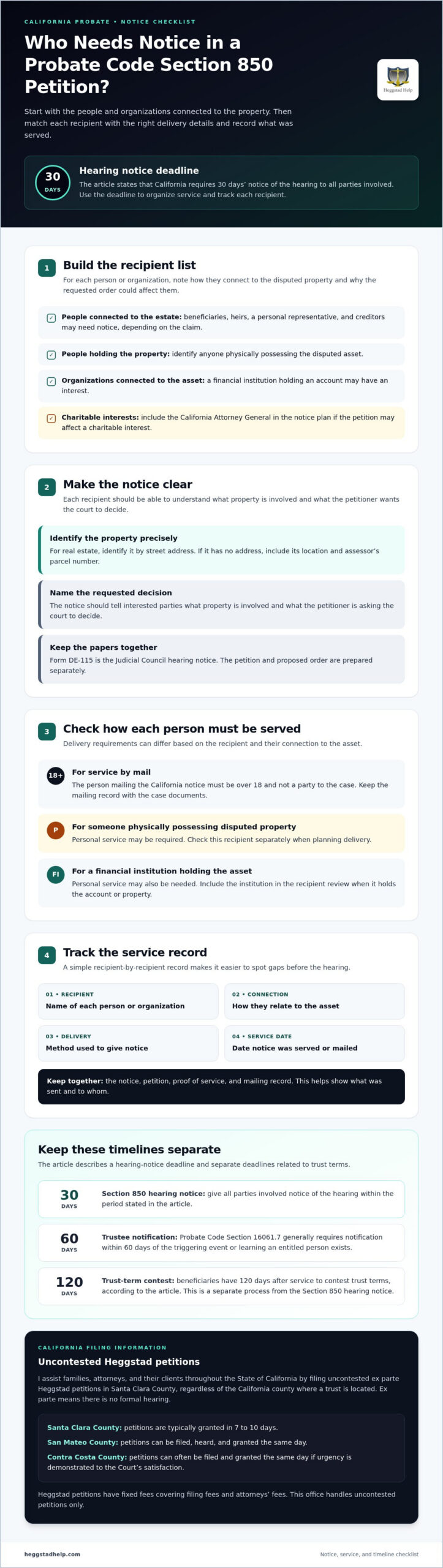
Legal Help for an Unfunded Living Trust in California

What if an asset was meant to be in a living trust but its title was never transferred? That omission can leave families unsure whether the asset can…

What if an asset was meant to be in a living trust but its title was never transferred? That omission can leave families unsure whether the asset can still be addressed or whether probate may be needed. Specialized legal help for unfunded living trust matters may include a Heggstad petition, a court request to confirm that an asset belongs to the trust based on evidence of the creator’s intent.

The right court route depends on the county and whether anyone contests the request. We assist families, attorneys, title companies, and their clients throughout the State of California with uncontested ex parte petitions, meaning petitions submitted without a formal hearing. These can be filed in the Santa Clara County Probate Court regardless of where the trust is located. Santa Clara County petitions are typically granted in 7 to 10 days. San Mateo County petitions can be filed, heard, and granted the same day. Contra Costa County petitions can often be filed and granted the same day if the Court is satisfied that urgency has been demonstrated. In many other counties, a noticed hearing may take months. This article explains the petition process, county differences, and what specialized assistance includes.

Key Takeaways

  • Legal help for unfunded living trust issues can include a Heggstad petition when an asset’s title doesn’t match the trust plan.
  • A Heggstad petition asks the court to confirm that an asset belongs to the trust. The available route can depend on the county and whether the request is contested.
  • Uncontested petitions from across the State of California can often be filed ex parte in Santa Clara County, regardless of where the trust is located.
  • Specialized assistance can prepare an uncontested petition and seek a court order. Gather the trust documents and asset records to help clarify the title issue.

An unfunded living trust may not own an asset its creator intended to place in it. The trust document can describe how property should be managed or distributed, while the asset’s title still names an individual rather than the trust. That mismatch raises practical questions for the people handling the trust, but it doesn’t by itself determine which legal route applies or what a court may decide. Legal help for unfunded living trust concerns can assess whether an uncontested Heggstad petition may address the gap.

How a trust-funding gap can come to light

A house offers a straightforward example. The trust paperwork may identify the home as an intended trust asset, while the recorded title shows ownership in an individual’s name. The records don’t tell the same story, and the discrepancy may come to light when a successor trustee reviews documents or a family needs to manage the property. A Living Trust is a useful starting point for understanding the arrangement. To assess the specific issue, compare the trust documents with the records for the asset.

Who may need help with an unfunded trust

Successor trustees, family members, attorneys, and their clients may encounter this issue while organizing trust records or addressing an asset after the creator’s death. Start by identifying the asset and gathering the trust document and available title records. This helps clarify what appears inconsistent without assuming the answer. A successor trustee’s role may involve broader responsibilities, so review the guide to Heggstad petition assistance alongside guidance on successor trustee duties for an unfunded trust.

The focused question is whether the documents support asking a California court to confirm that the asset belongs to the trust. We help assess that question in uncontested matters. If interested parties dispute the asset’s ownership, the matter is contested, and our office does not handle contested petitions. Treat a title mismatch as a reason to examine the records carefully, not as proof that a particular process or result automatically applies.

How a Heggstad Petition Can Address a California Trust-Asset Gap

A Heggstad petition asks a court to confirm that a particular asset belongs to a trust, even though its ownership record may not show the trust as owner. The petition seeks a court order addressing that gap; it doesn’t automatically transfer ownership or guarantee the court will grant the request. A petition may concern real property or other assets held in connection with a living or irrevocable trust.

What the court order is intended to resolve

If the court grants the petition, its order may help establish the asset’s trust ownership and support correction of the title record. The goal is specific: address the identified trust-asset issue, not administer an entire estate. A petition isn’t a guaranteed substitute for probate in every situation. The appropriate route depends on the asset and the circumstances.

Why the asset’s records and circumstances matter

Before pursuing a petition, an attorney evaluates the trust document and the asset records. For real property, that may mean comparing the trust information with the ownership details shown in the title records. California Probate Code Section 850 is associated with petitions seeking court orders about property claims. Understanding the request and the records behind it helps clarify what the court is being asked to decide.

A Heggstad petition asks the court to confirm trust ownership; it does not, by itself, automatically transfer an asset into the trust. That distinction matters when explaining the issue to family members or organizing documents for review. We handle focused, uncontested Heggstad petitions for living and irrevocable trusts. Learn about our Heggstad petition assistance and how it can address a trust-asset title concern.

Which California Court Route May Fit an Uncontested Heggstad Petition?

The county where a trust or asset is located doesn’t always determine where an uncontested Heggstad petition can be filed. We assist families, attorneys, title companies, and their clients throughout the State of California, filing uncontested petitions ex parte in the Santa Clara County Probate Court regardless of the county where the trust is located. We also file ex parte petitions in San Mateo and Contra Costa Counties.

Timing depends on the court route. In Santa Clara County, ex parte petitions are typically granted in 7 to 10 days. In San Mateo County, petitions can be filed, heard, and granted the same day. In Contra Costa County, petitions can often be filed and granted the same day if the Court is satisfied that urgency has been demonstrated. These are typical or possible timelines, not a guarantee of a court decision.

How the route differs outside Santa Clara, San Mateo, and Contra Costa Counties

In counties such as Los Angeles, Orange, or Sacramento, a Heggstad petition often cannot be submitted ex parte and may require a noticed hearing, which can take many months to reach. For an uncontested petition involving a trust or asset in another California county, filing ex parte in Santa Clara County may provide a different route. The appropriate approach depends on the petition and its circumstances.

Why a noticed hearing can change the timeline

A noticed hearing is a scheduled court hearing for which interested parties must receive notice. A noticed trust-modification petition hearing is typically set 30 to 60 days after filing, or several months later in some counties. Providing notice adds time to the overall schedule. Court calendars and individual circumstances vary, so not every petition follows the same timeline.

If you’re assessing legal help for an unfunded living trust, note the asset’s county and whether anyone disputes the request. Our office handles uncontested petitions only. Learn about our uncontested Heggstad petition filing service.

Legal Help for an Unfunded Living Trust in California

Specialized Heggstad assistance focuses on preparing an uncontested petition and seeking an ex parte court order to confirm that an asset belongs to a trust. The work addresses the specific trust-asset issue, including title correction, rather than managing every aspect of an estate or trust. Our office handles uncontested petitions only, not contested petitions, full probate administration, or trust administration.

Heggstad petitions have fixed fees that cover filing fees and attorney fees. For broader context on the California petition process, see this California Heggstad petition filing guide.

What to have ready for an initial case review

To make an initial review more useful, gather the trust document and any available records showing the asset’s ownership or title. Also note when the funding or title gap came to light and whether the person who created the trust has died. These details help frame the issue and assess whether an uncontested petition may fit.

A focused next step for families and legal professionals

Families, attorneys, title companies, and clients throughout California can receive focused help with an uncontested Heggstad petition. Robert P. Bergman is a California-licensed attorney and a Board-Certified Specialist in Estate Planning, Trust and Probate Law. He assists clients throughout the San Francisco Bay Area, Northern California, Southern California, and the Central Valley, including San Diego, Sacramento, Fresno, Bakersfield, Greater Los Angeles, Orange County, Riverside County, and San Bernardino County. The court, not the filing attorney, decides whether to grant a petition.

To prepare, organize the trust and asset records and write a short timeline of what happened.

Take a Clear Next Step Toward Resolving the Trust-Asset Question

Uncertainty about an asset’s place in a trust can make it hard to know what to do next. Rather than assume that a title discrepancy settles the matter, frame the issue as a specific question for legal review: what do the records show, and is there an uncontested path to ask the court for confirmation? A focused assessment can help families and legal professionals distinguish known facts from unresolved questions.

Keep the discussion centered on the particular asset and the outcome you’re seeking. Clear expectations matter, especially when family members or professional advisors are coordinating around the same issue. We assist families, attorneys, title companies, and their clients across the State of California, including Los Angeles County, Orange County, San Bernardino County, San Diego County, Riverside County, Santa Clara County, Alameda County, San Francisco County, Marin County, Ventura County, Santa Cruz County, Sacramento County, Placer County, Santa Barbara County, San Joaquin County, Fresno County, Solano County, San Luis Obispo County, and Monterey County. Contact HEGGSTAD HELP to discuss an uncontested Heggstad petition.

Frequently Asked Questions

Can an irrevocable trust be involved in a Heggstad petition?

Yes. HEGGSTAD HELP handles petitions involving living and irrevocable trusts. An irrevocable trust isn’t automatically outside the scope of this focused service, but the trust type alone doesn’t establish whether a particular asset can be included. The attorney reviews the trust and asset circumstances, and the court decides whether to grant the request. No petition outcome can be promised in advance.

Can a Heggstad petition address assets other than real estate?

Yes, the service can involve real property and other assets. The work includes seeking court orders to confirm assets as trust property and address related title concerns. The specific asset and surrounding circumstances matter, so the same approach may not apply to every situation. Filing a petition requests court confirmation; it doesn’t guarantee that an asset will be transferred or treated as trust property.

Does filing a Heggstad petition guarantee that the court will confirm an asset as trust property?

No. Filing a petition is a request for court relief, not a guaranteed result. Whether the court confirms an asset as trust property depends on the specific circumstances and the court’s decision. If you’re seeking legal help for an unfunded living trust, keep confirmed facts separate from assumptions and organize available records. That preparation supports a focused review, but no attorney can promise how the court will rule.

What information can help an attorney review an unfunded trust asset?

Gather the trust document, available asset or title records, and a short timeline of when the issue surfaced. Note whether the trust creator has died. This information helps assess whether an uncontested petition may fit. HEGGSTAD HELP assists across the San Francisco Bay Area, Northern and Southern California, the Central Valley, San Diego, Sacramento, Fresno, Bakersfield, Greater Los Angeles, Orange County, Riverside County, and San Bernardino County.

Robert P. Bergman, Attorney at Law

Article by

Robert P. Bergman, Attorney at Law

Attorney Robert P. Bergman ("Bob Bergman") has been a Board-Certified Specialist in Estate Planning, Trust and Probate Law since 2011, as certified by the California State Bar Board of Legal Specialization. For several years, Bob has assisted families and the clients of other attorneys with obtaining court orders through Heggstad petitions to avoid the time and expense of Probate administration. Bob is friendly, very approachable, and believes in explaining complex legal topics in clear ordinary language so that his clients understand exactly what they're doing and why they're doing it.
Bob is often able to assist clients who are in other counties than his home county of Santa Clara through his approach to Heggstad petitions.

Disclaimer

This article is for informational purposes only. Nothing in this article is intended to replace legal advice from a competent attorney or be considered legal guidance for anybody's specific legal situation. Nobody should rely on information in this article in making legal decisions without such consultation.

California Trustee Attorney: Assets Not in Trust

What if an asset left outside a trust doesn’t automatically mean full probate? The right attorney for a trustee when assets are not in trust should…

What if an asset left outside a trust doesn’t automatically mean full probate? The right attorney for a trustee when assets are not in trust should assess how the asset was held, what records show about the trust creator’s intent, and whether anyone disputes its connection to the trust. In some cases, an uncontested Heggstad petition, a court request to confirm that an asset belongs to a trust, may provide a focused way to address the title issue.

This article explains what to look for in an attorney, what the court may consider, and how county procedures can affect timing. An uncontested petition involving an asset in Los Angeles County, Orange County, or another California county with long court delays can often instead be filed ex parte in Santa Clara County and is typically granted in 7 to 10 days. In San Mateo County, an ex parte petition can be filed, heard, and granted the same day. In Contra Costa County, a petition can often be filed and granted the same day if the court is satisfied that urgency has been demonstrated. HEGGSTAD HELP assists families, attorneys, title companies, and their clients throughout the State of California with uncontested Heggstad petitions for a fixed fee covering filing fees and attorney fees.

Key Takeaways

  • Before assuming an asset requires full probate, gather trust and asset records that may show the trust creator intended it to be included.
  • Choose an attorney for trustee when assets are not in trust with direct experience in Heggstad petitions and trust asset title correction.
  • Find out whether anyone disputes the asset’s connection to the trust. The petition service described here is for uncontested matters.
  • Compare filing options by county. An uncontested petition involving an asset elsewhere in California may be filed ex parte in Santa Clara County.

When a California Trustee Finds an Asset Outside the Trust, What Comes Next?

A trustee may open a file and discover that a home, account, or other asset doesn’t appear to be titled in the trust’s name. The omission can raise an immediate concern: does the asset have to go through full probate? Not necessarily. A missing transfer is a reason to review the records, not by itself a final answer about how the asset can be handled.

The trust document describes the plan, while separate ownership records show how a particular asset was titled. Start by identifying the asset and its current title. Then gather the trust documents and any evidence of a transfer or an intention to transfer it. An attorney for trustee when assets are not in trust can assess whether those records may support a Heggstad petition, a request for the court to confirm that an asset belongs to the trust.

Why an asset can remain outside a trust

A title transfer may have been started but not completed, or the ownership records may not reflect what the trust creator intended. The reason can’t be determined from the omission alone. A deed, account record, or transfer document may tell a different part of the story than the trust document. The Estate of Heggstad case is the origin of this type of petition in California.

The trustee’s first practical steps

Keep the trust and any amendments together with deeds, account statements, transfer paperwork, and correspondence about the asset. Make a short inventory noting what the asset is, how it is currently titled, and which records may relate to it. Preserve original documents, and don’t assume the trust document alone allows the trustee to transfer or manage an asset titled outside the trust. For related context on a trustee’s role, see this guide to successor trustee duties for an unfunded trust.

This guide focuses on California trust assets and a possible Heggstad petition. The next step depends on the asset, the available records, and whether anyone disputes its connection to the trust.

How to Evaluate an Attorney for a California Heggstad Petition

A trustee facing a title problem needs guidance specific to the proposed court filing. Look for direct experience with Heggstad petitions and trust asset title correction. A focused review should consider the trust documents, current ownership records, and evidence of a transfer or intent to include the asset. These records help assess whether a petition may fit and whether the matter is uncontested.

Questions that reveal whether the service fits

When choosing an attorney for trustee when assets are not in trust, focus your questions on the petition and the evidence. Does the attorney handle Heggstad petitions as a focused service? Has anyone objected to treating the asset as trust property? Which records will help assess the proposed filing? HEGGSTAD HELP handles uncontested petitions, so identifying any dispute at the outset is important.

Bring the records together before review. Note any gaps or conflicting information instead of trying to resolve them yourself. A clear file makes it easier to evaluate the asset, the available evidence, and the proposed petition.

Understand the petition’s legal context

A Heggstad petition may ask the court to confirm that an asset belongs to the trust even though the title records don’t show it in the trust’s name. The attorney should explain how the available documents relate to that request in plain language. For related background, the California Probate Code Section 850 guide discusses petition context.

Fee clarity matters, too. HEGGSTAD HELP charges a fixed fee for Heggstad petitions, covering filing fees and attorney fees. Robert P. Bergman is a California-licensed attorney and Board-Certified Specialist in Estate Planning, Trust and Probate Law. Families, attorneys, title companies, and clients throughout the State of California can learn about focused Heggstad petition assistance.

How California County and Ex Parte Options Can Affect Timing

The court process can affect how quickly an uncontested Heggstad petition is considered. An ex parte filing is a court process without a formal hearing. County procedures matter: some counties often require a noticed hearing, while uncontested petitions can be filed ex parte in Santa Clara County, San Mateo County, and Contra Costa County. Each county has its own timing considerations.

When the trust or property is in another county

For an asset in Los Angeles County, Orange County, San Diego County, Alameda County, Sacramento County, or another California county, a Heggstad petition often cannot be submitted ex parte locally and may require a noticed hearing. Such hearings can take many months to be heard. For an uncontested matter, the petition can instead be filed ex parte in Santa Clara County, even when the trust or asset is located elsewhere in California.

HEGGSTAD HELP assists families, attorneys, title companies, and their clients throughout the State of California with uncontested petitions in the Santa Clara County Probate Court, regardless of the county where the trust is located. This can be relevant for trusts and assets in the San Francisco Bay Area, Northern California, Southern California, the Central Valley, San Diego, Sacramento, Fresno, Bakersfield, Greater Los Angeles, Orange County, Riverside County, or San Bernardino County. An attorney for trustee when assets are not in trust can assess whether the matter is uncontested and prepare the filing.

When a noticed hearing or contested matter changes the path

A noticed trust modification petition hearing is typically set 30 to 60 days after filing, or several months later in some counties. The time required to notify interested parties adds to the overall process. If someone contests the petition, the matter may take longer and won’t follow the uncontested ex parte path described here. HEGGSTAD HELP handles uncontested petitions, not contested matters.

For an uncontested filing, learn about Heggstad petition options.

California Trustee Attorney: Assets Not in Trust

A Focused Next Step for Trustees, Families, Attorneys, and Title Companies

A missing trust transfer can feel like a broad probate problem, but the next step may be more focused: organize the records, identify whether the issue is disputed, and assess whether a Heggstad petition fits. If you’re helping a family member or client, a clear set of documents makes that assessment more productive.

  1. Gather the trust document and any amendments, along with information identifying the asset.
  2. Collect title records and available transfer documents or correspondence.
  3. Identify whether anyone disputes that the asset should belong to the trust, then assess whether an uncontested petition may be appropriate.

What to have ready for an initial discussion

Start with the records you have, even if the file is incomplete. Note the asset’s current title and flag inconsistencies between the trust and ownership records. A focused review can identify what the documents show and which questions remain. This gives an attorney for trustee when assets are not in trust a practical starting point for assessing a petition.

Move forward with a focused petition service

HEGGSTAD HELP assists families, attorneys, title companies, and their clients throughout the State of California with uncontested Heggstad petitions. The practice focuses on Heggstad petition filing, ex parte court orders, and trust asset title correction, including transfers into living or irrevocable trusts. Uncontested petitions can be filed ex parte in Santa Clara County, San Mateo County, and Contra Costa County, including for trusts located elsewhere in California. The office does not handle contested petitions.

Heggstad petition fees are fixed and cover filing fees and attorney fees. For a matter that appears uncontested, review the Heggstad petition services and organize the records. Discuss an uncontested Heggstad petition for the asset and trust involved.

Turn the Record Into a Clear Next Step

Your next move can be practical: make a one-page timeline of what happened to the asset, from the trust’s creation through discovery of the title issue. Note dates you can verify, identify the documents that support each point, and separate confirmed facts from unanswered questions. This gives the review a clear starting point without requiring you to draw legal conclusions.

If you’re a trustee, family member, attorney, or title company representative, keep the timeline with the relevant records so everyone can work from the same information. The right attorney for trustee when assets are not in trust can then focus the discussion on the asset, the available evidence, and a possible petition path.

Robert P. Bergman’s focused practice can help bring structure to an uncertain title issue. To move from gathering information to considering a next step, start a focused Heggstad petition discussion with the relevant trust and asset records.

Frequently Asked Questions

Can a successor trustee hire an attorney when an asset was never transferred into the trust?

Yes. A successor trustee can seek legal help even if an asset was never retitled in the trust’s name. An attorney for trustee when assets are not in trust can review the trust, current ownership records, and available transfer documents to assess whether a Heggstad petition may fit. For a home, gather the deed and trust papers. For an account, keep the account records available for review.

Does a California property have to be in the same county as the court handling a Heggstad petition?

No, not necessarily. An uncontested petition involving an asset elsewhere in California may be filed ex parte in Santa Clara County. This can be relevant for property in the San Francisco Bay Area, Northern California, Southern California, the Central Valley, San Diego, Sacramento, Fresno, Bakersfield, Greater Los Angeles, Orange County, Riverside County, or San Bernardino County. Uncontested petitions can also be filed ex parte in San Mateo County and Contra Costa County. The filing approach and timing depend on the county and the matter.

How long does an uncontested ex parte Heggstad petition take in California?

Uncontested ex parte petitions filed in Santa Clara County are typically granted in 7 to 10 days. In San Mateo County, a petition can be filed, heard, and granted the same day. In Contra Costa County, a petition can often be filed and granted the same day if the court is satisfied that urgency has been demonstrated. A court order and updating the asset’s title are separate steps, so allow for the title correction process after the petition is decided.

Does HEGGSTAD HELP handle a contested Heggstad petition?

No. HEGGSTAD HELP handles uncontested Heggstad petitions, not contested petitions. If a beneficiary or another interested person objects to treating an asset as trust property, the matter may no longer be uncontested. Keep any written objection with the trust and asset records so the issue is clear when the petition is assessed.

Robert P. Bergman, Attorney at Law

Article by

Robert P. Bergman, Attorney at Law

Attorney Robert P. Bergman ("Bob Bergman") has been a Board-Certified Specialist in Estate Planning, Trust and Probate Law since 2011, as certified by the California State Bar Board of Legal Specialization. For several years, Bob has assisted families and the clients of other attorneys with obtaining court orders through Heggstad petitions to avoid the time and expense of Probate administration. Bob is friendly, very approachable, and believes in explaining complex legal topics in clear ordinary language so that his clients understand exactly what they're doing and why they're doing it.
Bob is often able to assist clients who are in other counties than his home county of Santa Clara through his approach to Heggstad petitions.

Disclaimer

This article is for informational purposes only. Nothing in this article is intended to replace legal advice from a competent attorney or be considered legal guidance for anybody's specific legal situation. Nobody should rely on information in this article in making legal decisions without such consultation.
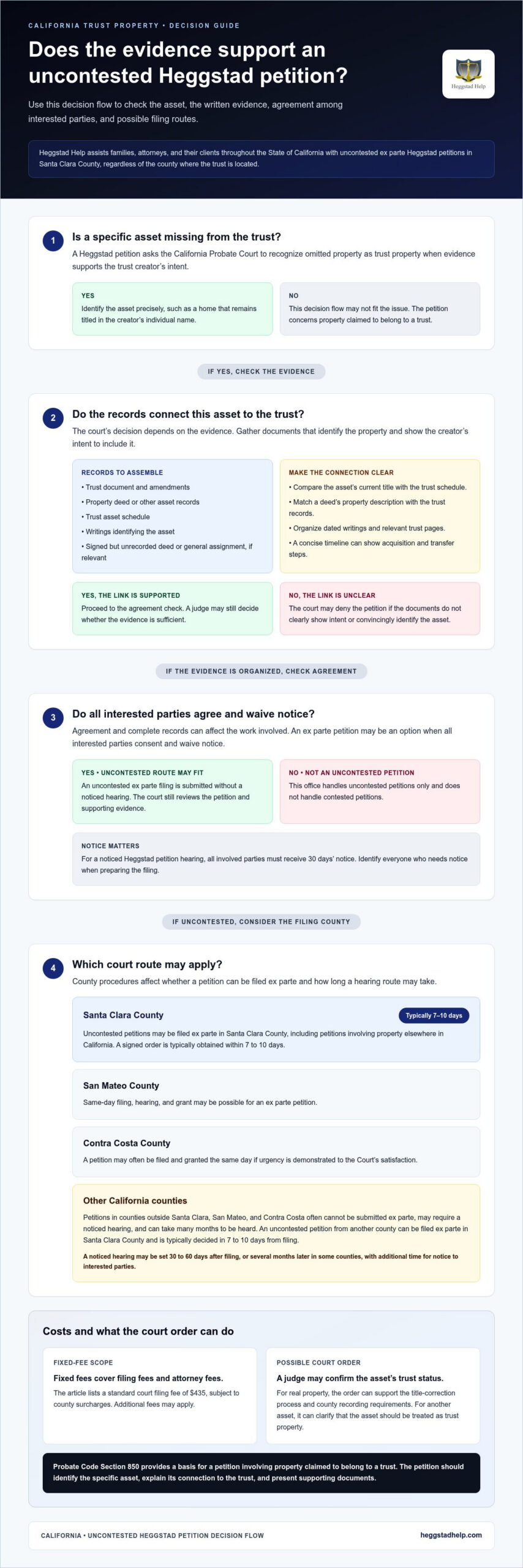
Trust Asset Title Correction in California: What Families Need to Know

What if a home was meant to be held in a trust, but the recorded title still names the trust creator personally? That mismatch can leave families…

What if a home was meant to be held in a trust, but the recorded title still names the trust creator personally? That mismatch can leave families unsure whether the asset belongs to the trust and concerned that administration could stall or require probate.

Trust asset title correction California families may need doesn’t always mean changing the trust itself. The right approach depends on what the trust documents and other records show about the creator’s intent. This article explains the difference between correcting an asset’s ownership record and amending a trust, what evidence may help, and when a Heggstad petition could ask the court to confirm that an asset belongs to the trust.

HEGGSTAD HELP assists families, attorneys, title companies, and their clients throughout the State of California with uncontested ex parte Heggstad petitions in Santa Clara County Probate Court, regardless of where the trust is located. Ex parte means the court can review the petition without a formal hearing. Petitions filed in Santa Clara County are typically granted in 7 to 10 days. We’ll also explain how county procedures affect the filing route and timing.

Key Takeaways

  • Trust asset title correction California families may need can address a mismatch between ownership records and intended trust ownership without changing the trust’s terms.
  • Gather the trust documents, asset schedules, deeds, account records, and transfer paperwork available. These can help show the trust creator’s intent and assess whether a Heggstad petition may fit.
  • Probate Code Section 850 provides a court process for asking whether an asset belongs to a trust. The result depends on the evidence in the case.
  • County procedure affects timing. HEGGSTAD HELP files uncontested petitions ex parte in Santa Clara, San Mateo, and Contra Costa Counties. In other counties, a noticed hearing may be required.

What California Trust Asset Title Correction Means, and Why Ownership Records Matter

Trust asset title correction addresses a gap between how an asset is legally recorded and the trust creator’s apparent intention for it to belong to the trust. It focuses on the asset’s ownership record, not on rewriting the trust’s instructions. For example, a California home may be described in trust documents as part of the trust while the deed still names the creator individually. The deed is important evidence, but it may not answer every question about ownership or intent.

An unfunded asset is an asset whose ownership was not transferred into the trust; an amended trust document changes the trust’s terms. Those are different issues, and resolving one does not automatically resolve the other. To organize the records, compare the trust documents with the deed or account records. Note differences in names, property descriptions, account details, and dates. A trust asset title correction may involve reviewing both the records and the circumstances behind them.

How a title mismatch can arise

A deed may have been prepared or signed to transfer a home into a trust but never recorded. In another situation, the paperwork or timeline may be different. Real property is one example. Bank, brokerage, and other assets have their own ownership records, so the relevant documents depend on the asset. Gather the trust, any property or account records, and available transfer paperwork. Put dated documents in order and note what appears to be missing or inconsistent. One incomplete document does not necessarily tell the whole story.

Why the distinction matters after death

A successor trustee, the person who takes over trust responsibilities, may discover the mismatch while handling trust matters. The records can raise a practical question: can the asset be dealt with as trust property, or is another legal step needed? A title problem alone does not establish that probate is required. The answer depends on the facts and applicable court process. A Heggstad petition takes its name from the Estate of Heggstad, a California case associated with asking a court to determine whether an asset belongs to a trust. Keep documents that may show the creator’s intent, rather than treating the recorded title as the only relevant evidence.

How a Heggstad Petition May Correct Trust Asset Title in California

A Heggstad petition asks a court to determine whether an asset should be treated as property of a trust, based on the evidence in that particular case. Probate Code Section 850 provides a process for asking the court to resolve certain questions about ownership of property. In plain English, it can give a judge a way to decide whether an asset belongs to a trust even though its title record does not show the trust as owner.

A Heggstad petition asks the court to recognize trust ownership when the evidence supports that result. It does not make every title mismatch qualify. It is not a routine deed edit or a way to rewrite trust terms, and a court’s decision is not guaranteed. For families considering trust asset title correction California, the key issue is whether the facts and records support asking for a court determination.

What the court may consider

The court may review documents and circumstances that help show what the trust creator intended regarding the asset. Depending on the situation, these may include the trust document, an asset schedule, property records, or paperwork connected with a planned transfer. This is not a universal checklist. A practical first step is to gather available records and arrange them by date. That can make the transfer history and any gaps easier to understand. Note who prepared or signed transfer documents and whether they were recorded or otherwise completed, if that information is available.

When a court order may be relevant

Sometimes an ownership record can be corrected administratively, without asking a court to decide who owns the asset. A petition may be relevant when the record does not reflect the trust creator’s intent and a court determination is needed. The details matter, so a petition should not be treated as an automatic substitute for an ordinary record correction. For more context on the legal process, review this guide to the California Probate Code Section 850 petition process.

HEGGSTAD HELP files uncontested Heggstad petitions for families, attorneys, and title companies throughout the State of California. The petition can request a court order confirming real property or other assets as trust property, helping correct title without full probate administration when the court grants the petition. The practice focuses on these filings and does not handle contested petitions.

Trust Asset Title Correction in California: What Families Need to Know

Choosing a California Court Path: County, Notice, and Timing

County procedure can affect how an uncontested Heggstad petition is heard. In counties such as Los Angeles, Orange, San Diego, Alameda, and Sacramento, petitions often require a noticed hearing and may take many months to be heard. For an uncontested matter, HEGGSTAD HELP can instead file ex parte in Santa Clara County Probate Court, even when the trust or property is located elsewhere in California. This filing route serves families and their representatives across the San Francisco Bay Area, Northern California, Southern California, and the Central Valley, including Greater Los Angeles, Orange County, Riverside County, San Bernardino County, San Diego, Sacramento, Fresno, and Bakersfield.

How county location affects the filing route

For families considering trust asset title correction California offers different court paths depending on the county and case circumstances. HEGGSTAD HELP assists families, attorneys, title companies, and clients throughout the State of California. Uncontested Heggstad petitions can be filed ex parte in Santa Clara, San Mateo, and Contra Costa Counties. For trusts and property in other counties, including San Francisco, Marin, Ventura, Santa Cruz, Placer, Santa Barbara, San Joaquin, Solano, San Luis Obispo, and Monterey Counties, an uncontested petition can often be filed ex parte in Santa Clara County instead. These timing details are general guidance, not a promise of a hearing date or result.

Filing path What to expect
Noticed hearing in other counties Often required and may take many months to be heard. A noticed trust modification petition hearing may be set 30 to 60 days after filing, or several months later in some counties, with additional time for notice to interested parties.
Santa Clara County, ex parte Uncontested petitions are typically granted in 7 to 10 days.
San Mateo County, ex parte Petitions can be filed, heard, and granted the same day.
Contra Costa County, ex parte Petitions can often be filed and granted the same day if the Court is satisfied that urgency exists.

What ex parte means in this context

Ex parte is the route for asking the court to review an uncontested petition without a formal hearing. It does not guarantee approval or a particular decision date. In counties outside Santa Clara, San Mateo, and Contra Costa, Heggstad petitions often require noticed hearings and may take many months to be heard. An uncontested petition from one of those counties can instead be filed ex parte in Santa Clara County and is typically granted in 7 to 10 days. HEGGSTAD HELP handles uncontested petitions, not contested matters.

HEGGSTAD HELP files uncontested ex parte Heggstad petitions in Santa Clara, San Mateo, and Contra Costa Counties for trust assets throughout California. Fixed fees cover court filing fees and attorney fees.

Get Help With Uncontested Trust Asset Title Correction Across California

A title mismatch can raise practical questions for families, attorneys, title companies, and clients. HEGGSTAD HELP assists with uncontested Heggstad petitions throughout the State of California, including when the trust or its property is located outside the county where the petition is filed. The practice files uncontested ex parte petitions in Santa Clara, San Mateo, and Contra Costa Counties. It does not handle contested petitions. Fixed fees cover court filing fees and attorney fees.

What to gather before discussing a title issue

A little organization can make it easier to explain the issue. Gather the trust document, any available deeds or account records, and paperwork related to the asset or a planned transfer. Put records in date order and note what appears inconsistent. For a home, include the deed and the property description in the trust documents or asset schedule, if available. For another type of asset, collect records showing how it was held and any paperwork connecting it to the trust. These materials provide useful background, but they are not a guarantee that a particular petition is appropriate.

Specialized help for California title concerns

Robert P. Bergman is a California-licensed attorney and Board-Certified Specialist in Estate Planning, Trust and Probate Law. His focused work on Heggstad petitions helps families and their professional representatives address trust ownership questions without treating every title problem as a broader trust or probate administration matter. For a fuller explanation of the petition, see this Heggstad petition filing guide.

If you’re considering trust asset title correction California, a focused review of the available records can help clarify the next step. Learn about Heggstad petition filing assistance for an uncontested matter.

Take the Next Step Toward Resolving the Title Issue

A title concern can feel daunting, especially when family members are unsure what can happen next. Start by keeping the relevant trust and asset records together, then identify the question that needs an answer: whether the records can be corrected administratively or whether a court decision may be needed. A focused review can help clarify that question without assuming the same solution fits every family.

For trust asset title correction California families may need, the next step is to look at the asset, the available records, and whether an uncontested Heggstad petition may be appropriate. You do not need to have every detail sorted out before raising the issue. Start with the records you have and note any gaps or inconsistencies.

Contact HEGGSTAD HELP to discuss an uncontested California Heggstad petition and take a practical step toward resolving the title concern.

Frequently Asked Questions

Is a Heggstad petition the same as amending a trust?

No. They address different goals. Before gathering records, write down the outcome the family needs: recognition of an asset as trust property, or a change to the trust’s instructions. That distinction can help keep discussions focused and make it easier to explain the issue. If both questions are involved, identify them separately rather than assuming one process will resolve both.

Can a Heggstad petition address property in Los Angeles or Orange County?

Yes. The property’s county and the county where an uncontested petition is filed can be different. For a home in Los Angeles or Orange County, note the property’s full address and gather the deed and trust records that relate to it. HEGGSTAD HELP can file an uncontested ex parte Heggstad petition in Santa Clara County Probate Court for trust property located elsewhere in California. The court route and result depend on the circumstances and evidence.

Can a Heggstad petition apply to assets other than real estate?

Yes, a petition may concern an asset other than real estate, depending on the facts. For a non-real-estate asset, gather records showing how it was held and any documents that connect it to the trust. Keep those records together and note differences in names or ownership details. The asset type and available evidence help shape the analysis.

Does a trust schedule automatically change the title to a house?

No. A schedule is not a substitute for checking the property’s recorded information. Compare the property description on the schedule with the deed, paying attention to names and identifying details. If they do not match, note the exact difference instead of assuming it is a harmless typo or a complete answer. That comparison can help clarify what question needs to be resolved.

What if the deed was signed but never recorded?

Preserve a signed but unrecorded deed and review it with the rest of the transfer records. Keep the original if available, along with copies and any paperwork explaining how the deed was prepared and what happened afterward. Note the known dates and who handled the document. Those details can help clarify the history, but the signature alone does not guarantee a particular legal outcome.

Robert P. Bergman, Attorney at Law

Article by

Robert P. Bergman, Attorney at Law

Attorney Robert P. Bergman ("Bob Bergman") has been a Board-Certified Specialist in Estate Planning, Trust and Probate Law since 2011, as certified by the California State Bar Board of Legal Specialization. For several years, Bob has assisted families and the clients of other attorneys with obtaining court orders through Heggstad petitions to avoid the time and expense of Probate administration. Bob is friendly, very approachable, and believes in explaining complex legal topics in clear ordinary language so that his clients understand exactly what they're doing and why they're doing it.
Bob is often able to assist clients who are in other counties than his home county of Santa Clara through his approach to Heggstad petitions.

Disclaimer

This article is for informational purposes only. Nothing in this article is intended to replace legal advice from a competent attorney or be considered legal guidance for anybody's specific legal situation. Nobody should rely on information in this article in making legal decisions without such consultation.

Same-Day Heggstad Orders in Contra Costa County: Why Heggstad Help Wins

When Time is Critical: The Successor Trustee’s Race Against the Clock

You’ve just been named successor trustee. The decedent’s estate includes real property, investment accounts, and other valuable assets that were never formally transferred into the trust during their lifetime. Now creditors are calling, title companies are asking questions, and in some cases, the clock is ticking even faster: a foreclosure notice arrived, an escrow is closing in weeks, or the trustor was in their nineties with known health complications.

This is when a standard probate timeline becomes dangerous. A full probate can take 6 to 12 months or longer. You don’t have that time. The trust needs access to assets now, and the court needs to validate that access within days, not months.

That’s where urgency changes everything. When we evaluate a Contra Costa County Heggstad petition for a successor trustee facing genuine time pressure, we assess whether your situation qualifies for expedited handling. Foreclosure, a closing escrow, terminal illness, or advanced age are the kinds of facts that courts recognize as legitimate urgency.

Actionable takeaway: Document the specific time constraint driving your petition. Whether it’s a formal appraisal deadline, a title company’s requirement, or a lender’s timeline, having that detail ready will strengthen your case and speed the filing process.

Understanding Contra Costa County’s Urgent Heggstad Petition Process

Contra Costa County Probate Court recognizes that some trust situations simply cannot wait. A Heggstad petition is a legal mechanism under Probate Code Section 850 that allows a successor trustee or other interested party to petition the court to declare that specific assets belong in the trust, even if they were never formally titled during the trustor’s lifetime.

Unlike a standard probate, a Heggstad petition is much narrower in scope. We’re not administering the entire estate or going through a multi-month court process. We’re asking the court to make one specific finding: that these particular assets should have been held in the trust and should be transferred in now.

In Contra Costa County, when genuine urgency exists, courts have discretion to handle these petitions on an expedited basis. We’ve successfully filed and obtained same-day orders in cases involving imminent foreclosure, time-sensitive real estate sales, or trustors of advanced age where every week matters.

Actionable takeaway: Have your trust document and a list of untitled assets prepared before you contact us. The faster we can review your specific facts, the sooner we can determine whether Contra Costa County’s expedited pathway is available to you.

Why Traditional Probate Cannot Meet Your Timeline

A full probate in California requires creditor notification periods, asset inventory, court hearings, and often multiple appearances before a judge. Even the simplest probate rarely closes in less than six months. Complex estates routinely take a year or more.

For successor trustees dealing with an urgent situation, this timeline is unworkable. If a property is facing foreclosure, waiting six months for probate approval means the home is gone. If an escrow is closing and the title company needs the trust to own the property, probate won’t produce a court order in time. If the trustor passed at an advanced age and the family business needs immediate access to operating accounts, probate’s slow pace threatens the business itself.

A Heggstad petition sidesteps these delays entirely. The court isn’t scrutinizing the entire estate. It’s making a focused legal determination about specific assets that should have been in the trust. When urgency is present, this can be resolved in hours or days rather than months.

We chose to focus our practice on Heggstad petitions precisely because probate simply doesn’t work when time is the critical factor.

Actionable takeaway: If your situation involves a hard deadline (foreclosure date, escrow close, or other time-specific event), mention it immediately when consulting with us. Urgency is the gateway to same-day processing in Contra Costa County.

How We File and Obtain Orders in a Single Day

The same-day process works because we prepare everything before filing. You contact us, we conduct a focused consultation, we gather the essential documents (trust, death certificate, asset details), and we draft a complete, uncontested ex parte petition.

An ex parte petition is filed without advance notice to other parties because there is no dispute. The successor trustee, the trust terms, and the asset details all align. The court reviews the petition and supporting documents and issues an order the same day or within hours.

In Contra Costa County, we can typically accomplish this when urgency is documented and the petition is truly uncontested. We’ve seen courts issue orders that authorize the successor trustee to record a new deed, contact the financial institution, or take whatever action was necessary to secure the asset.

The key requirement is that nothing about the petition is disputed. If any beneficiary objects, or if there’s a question about whether an asset actually belongs in the trust, the case moves out of the expedited track. But when the facts are clear and the petition is solid, we move fast.

Actionable takeaway: Be prepared to disclose any potential objections from beneficiaries or other parties. Transparency here prevents delays later. If everyone agrees the asset should be in the trust, say so upfront.

Our Ex Parte Heggstad Petition Advantage

We specialize exclusively in Heggstad petitions. This focus means we know Probate Code Section 850 inside out, we understand how each county court applies it, and we have relationships with court staff and judges who handle these petitions regularly.

Our ex parte approach is intentional. We only file uncontested petitions. This isn’t a limitation; it’s a strength. Because we don’t pursue contested cases, we can move with precision and speed on the cases where urgency matters most.

We also support title companies, other attorneys, and successor trustees throughout California. That breadth of experience means we understand the specific pain points: the title company that needs confirmation the trustee owns the property, the attorney managing a trust administration who needs a quick asset transfer, the successor trustee facing a foreclosure deadline.

We’ve built our practice around being the fastest, most reliable option for uncontested Heggstad petitions. That specialization shows up in turnaround times, accuracy, and the relationships we maintain with probate courts.

Actionable takeaway: If you’re working with a title company or another attorney, let us know. We’ve coordinated countless filings with other professionals and can integrate seamlessly into the existing transaction.

Qualifying for Same-Day Relief in Contra Costa County

Not every situation qualifies for same-day handling. The court requires a genuine showing of urgency. We’ve successfully demonstrated urgency in these categories:

  • Real property facing foreclosure with a specific sale date
  • Real estate sales in escrow with a closing deadline
  • Trustors who are terminally ill or of advanced age where timeline is medically relevant
  • Business assets where the trust’s inability to take title threatens ongoing operations
  • Financial accounts or investment positions where delay causes measurable harm

The court evaluates whether waiting for a standard probate timeline would cause actual, documented harm. Vague concerns about “delay” don’t qualify. A foreclosure notice with a sale date on it does.

We assess urgency candidly in our initial consultation. If your situation doesn’t meet the court’s standard, we tell you. If it does, we explain how we’ll present it and what the timeline typically looks like.
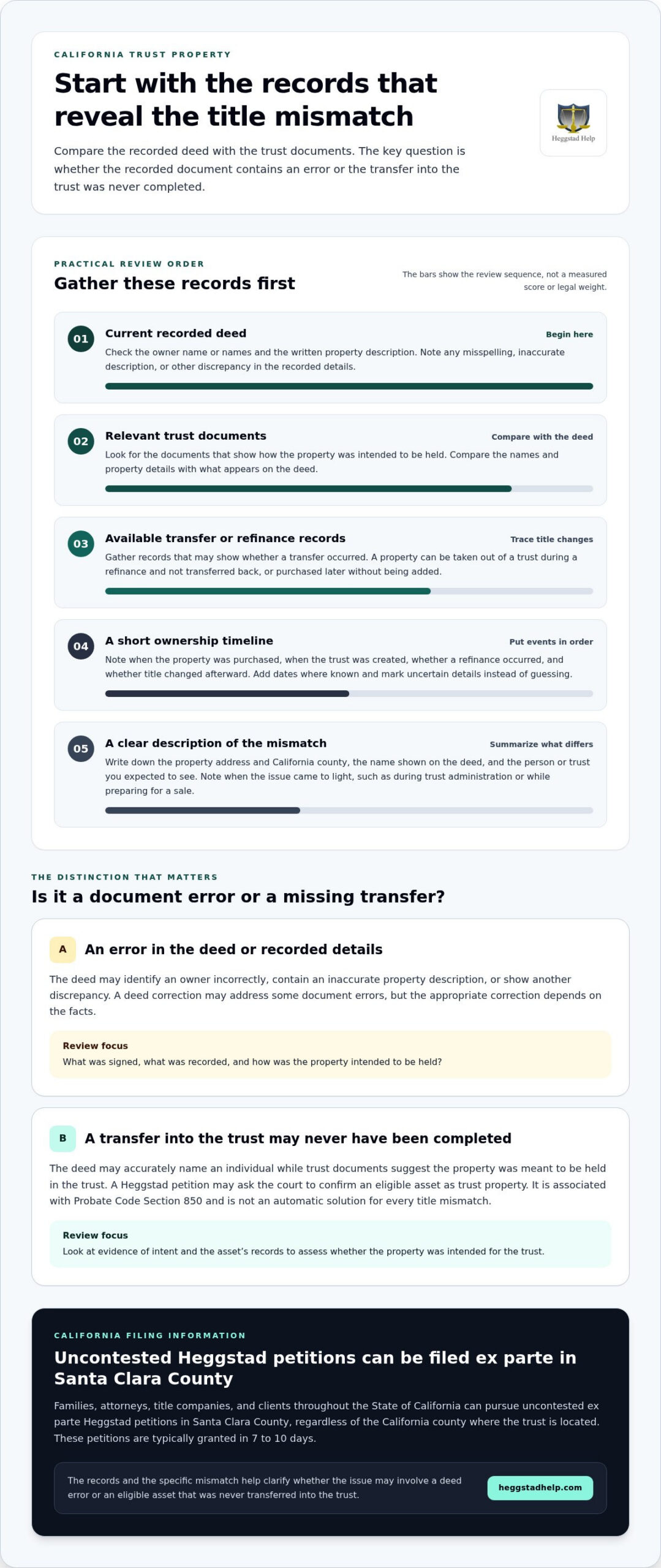
Actionable takeaway: Gather any documents proving urgency: foreclosure notices, escrow instructions with closing dates, medical records showing terminal illness, or similar evidence. These become exhibits in your petition.

The Heggstad Help Process: From Consultation to Court Order

Step one is a detailed consultation. You describe the situation, the asset in question, and the timing constraint. We review your trust document and ask clarifying questions about beneficiaries, prior transfers, and any potential disputes.

Step two is document collection. We obtain the trust, death certificate, the property deed (or account statements for financial assets), and any relevant correspondence showing the asset was meant for the trust.

Step three is petition drafting. We prepare a complete, uncontested Heggstad petition that includes all required legal elements, supporting facts, and declarations from the successor trustee.

Step four is court filing. We file electronically with Contra Costa County Probate Court and immediately coordinate with the court clerk to request same-day or expedited hearing.

Step five is the court order. In urgent cases where the petition is solid and uncontested, the judge signs an order within hours or by end of business.

We keep you informed at every stage. You know exactly where the petition stands and when to expect the order.

Actionable takeaway: Start gathering documents the moment you decide to move forward. The faster you can provide us with a complete file, the faster we can file with the court.

Comparing Speed and Expertise: What Sets Us Apart

Many general probate attorneys handle Heggstad petitions as one item in a broader practice. We do nothing else. That focus translates into faster turnaround, fewer errors, and deeper knowledge of how Contra Costa County specifically handles urgency.

We also have same-day or next-day filing capability in San Mateo County and can typically obtain orders in 7 to 10 days from electronic filing in Santa Clara County. That geographic reach means we can serve successor trustees across the Bay Area and throughout California with expertise tailored to each court’s practices.

Our relationships with court staff, title companies, and other attorneys mean we understand the ecosystem around Heggstad petitions. We know what questions the judge is likely to ask and how to preempt them in our petition.

Speed without accuracy would be worthless. We invest in precise drafting, thorough legal analysis, and complete documentation because a poorly filed petition gets rejected, and that rejection costs you the time you were trying to save.

Actionable takeaway: Ask any attorney you’re considering how many Heggstad petitions they’ve filed in the last year. If the answer is fewer than 10, they’re not a specialist. We file dozens annually, and that volume translates into confidence and speed.

Real-World Scenarios Where Our 1-Day Service Saves the Trust

A successor trustee discovered that her mother’s home was never titled to the trust, even though the trust clearly described it as the primary residence. A foreclosure notice arrived within weeks due to unpaid property taxes. We filed the Heggstad petition in Contra Costa County on a Thursday, obtained the court order by Friday, and the trustee had a recorded deed authorizing her to pay the back taxes and stop the foreclosure. Without same-day processing, the home would have been lost.

Another scenario involved a commercial property in a trust that needed to close escrow on a fixed date. The buyer’s lender required the trust to hold title. A general probate timeline would have missed the closing. We filed the petition, obtained the order same-day, and the deed was recorded with time to spare for the closing.

A third example was an elderly trustor with terminal cancer. His adult daughter became successor trustee and needed to access investment accounts to pay medical bills and trust expenses. A standard probate would have taken months. We obtained the Heggstad order in one day, and the trustee had access to the funds within 48 hours.

These aren’t hypothetical. They’re the situations that drove us to specialize in this practice area. Every one of these outcomes required speed, precision, and expertise in the specific court handling the petition.

Actionable takeaway: If your situation has similar time pressure and asset facts, don’t assume you need full probate. A Heggstad petition might resolve it in days.

Getting Your Heggstad Order Without the Full Probate Burden

A Heggstad order is not probate. It’s a court declaration that specific assets belong in the trust. Once you have the order, you can record it (if it involves real property), present it to a financial institution (if it involves accounts), or take whatever action was blocked by the lack of title.

You don’t go through probate inventory, creditor notification, court appearances, or any of the traditional probate machinery. You get a focused court order authorizing the transfer of the specific asset.

For many successor trustees, this is exactly what they need. The estate is simple enough that it doesn’t require full probate administration. The trustor’s debts are minimal. Beneficiaries agree on distributions. The only problem was that one asset wasn’t titled to the trust, and that one missing title is blocking everything.

A Heggstad petition solves that problem directly and quickly.

Actionable takeaway: Ask yourself: does the trust need full probate administration, or does it just need title to certain assets? If it’s the latter, you’re a candidate for a Heggstad petition.

Next Steps: Filing Your Urgent Petition With Us

If you’re a successor trustee in Contra Costa County facing a time-sensitive situation, contact us for a confidential consultation. We’ll review your trust, your assets, and your timeline, and we’ll give you a straightforward assessment of whether a Heggstad petition is right for you and what the typical process looks like.
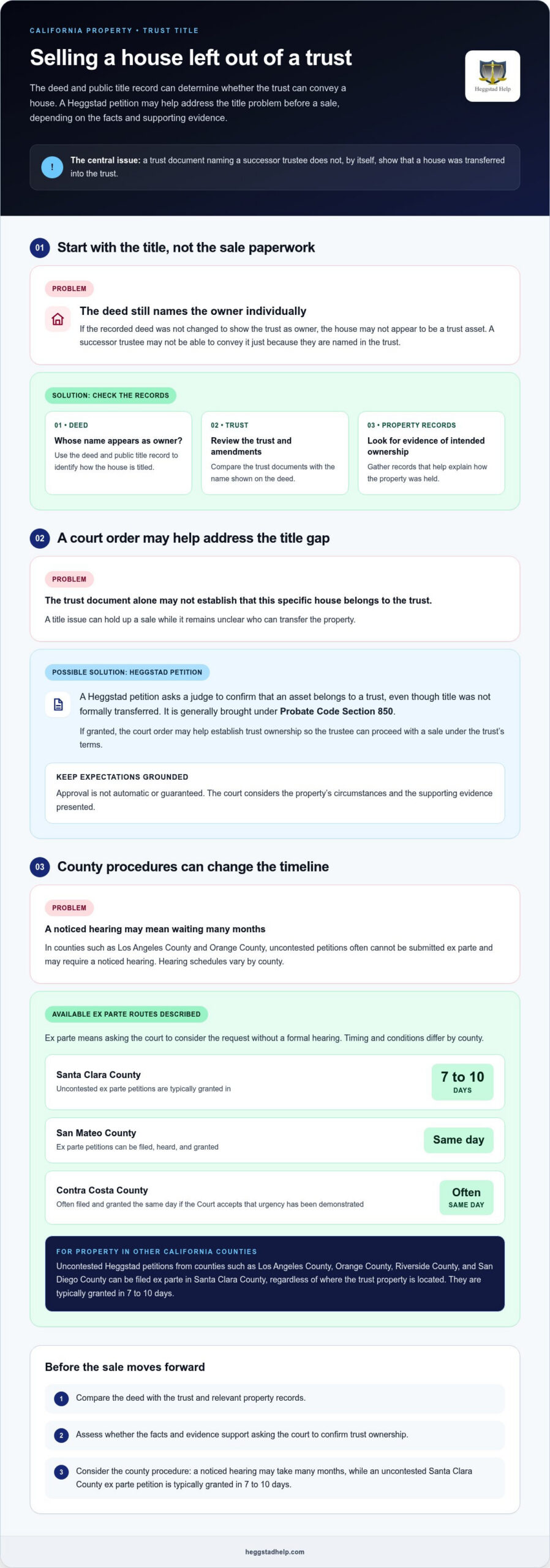
We offer same-day filing and same-day orders in Contra Costa County when urgency is documented and the petition is uncontested. We also serve successor trustees throughout California by filing in Santa Clara County and can handle emergency filings in San Mateo County when applicable.

You can reach us at https://heggstadhelp.com to request a consultation. Have your trust document and a description of the untitled asset ready. The faster you provide information, the faster we can move.


Time is your most valuable resource right now. We’re built to protect it.