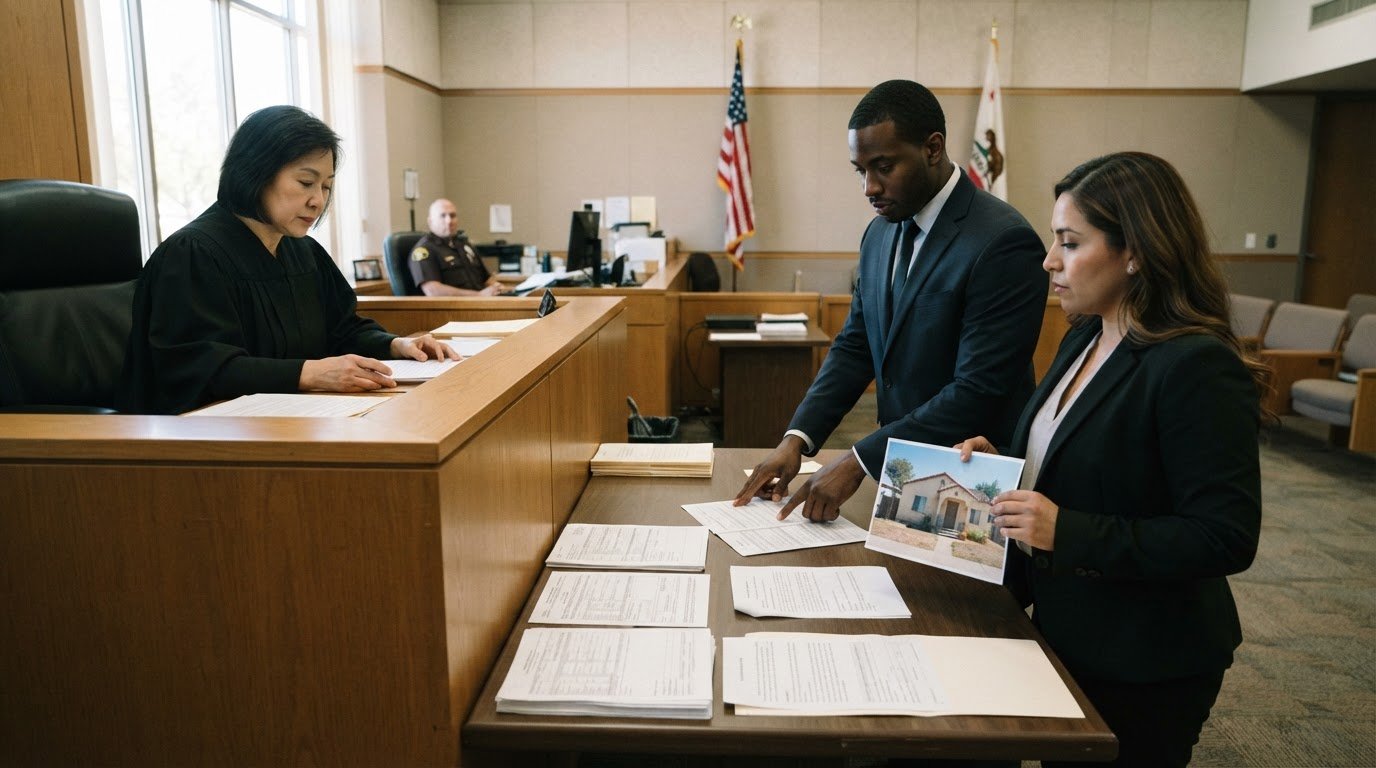
A Heggstad petition for a pour-over will asks a California probate court to confirm that an asset was intended to belong to a trust, even though it was not formally transferred before the trust creator’s death. A pour-over will directs certain assets into the trust, but the petition still requires evidence of that intent and court review. Whether the matter can proceed by ex parte request or requires a noticed hearing depends on whether interested parties agree and on the court’s procedures.
A pour-over will does not, by itself, transfer an asset into a trust during the owner’s lifetime. The key question is whether other written documents support the requested transfer. This article explains what a Heggstad petition does, how filing and notice work, what the court may consider, and how objections or a scheduled hearing can affect the process.
What are the key takeaways?
Understand how a court petition may address assets intended for a trust but left out of its formal title.
Learn why written evidence of the deceased person’s intent can matter when the court reviews an asset claim.
Know who may need notice and how the hearing schedule can affect the timeline.
See how an uncontested ex parte filing may differ from a noticed hearing, including options for eligible cases involving assets in other California counties.
What is a Heggstad petition?
In California, a Heggstad petition asks the probate court to confirm that an asset belongs to a trust despite incomplete title. A Heggstad petition for a pour-over will relies on evidence that the person intended the specific asset to be part of the trust at death.
How Can Omitted Assets Be Funded into a Trust?
A Heggstad petition seeks court confirmation that an omitted asset was intended for a trust. California Probate Code Section 850(a)(3)(B) codifies this procedure. The court considers whether the asset belonged to or was claimed by the trust. If an asset remains outside the trust, a pour-over will may direct it to the trustee, but the asset generally passes through probate first. That can mean additional court administration before the trust receives it.
What Evidence Shows Intent to Transfer?
Evidence of intent should connect a particular asset to the trust, not merely show a general estate-planning goal. For example, a Schedule A listing a home can support a claim that the settlor intended the property to be held in trust. Trust language identifying the asset, written communications, or earlier steps toward transferring it may also help. The court reviews these materials to assess the person’s intent at death.
Which Assets May Qualify?
An asset may qualify when documents show the owner intended it to belong to the trust, even though formal title was not changed. Real property, such as a home, may be considered if the trust schedule or other records identify it. Other assets may also be relevant when the evidence connects them to the trust. The asset description and ownership records matter because they help the court determine exactly what property the petition covers.
How Do Pour-Over Wills Differ from Heggstad Petitions?
A pour-over will directs assets left outside a living trust into the trust, while a Heggstad petition asks a court to recognize an asset as trust property. For a Heggstad petition for a pour-over will, the will alone typically does not establish that the asset was already part of the trust. If the asset must pass under the will, probate generally comes first. By contrast, a Heggstad petition relies on evidence of intent to establish the asset’s trust status. The Heggstad case was decided in 1993 and did not concern a pour-over will.
What notice and filing procedures apply to a Heggstad petition?
An attorney prepares the petition, supporting documents, and proposed order for the probate court. California probate courts handle these petitions, but local filing procedures and hearing schedules can vary by county.
How Do Attorneys Handle Petition Filing and Notice?
Filing means presenting the court with the requested relief and evidence connecting the asset to the trust. Records such as the trust document, asset schedule, and property information help identify what should be confirmed as trust property. The client may need to provide these records and details about beneficiaries and other interested parties.
According to the California Legislature, at least 30 days prior to the day of the hearing, the petitioner must serve notice and a copy of the petition, in the manner provided in Chapter 4 (commencing with Section 413.10) of Title 5 of Part 2 of the Code of Civil Procedure, on applicable persons. This includes interested parties who may have a claim to the property.
How Long Can the Process Take, and What Costs Apply?
A noticed hearing is typically set 30 to 60 days after filing, with additional time needed for notice. In some counties, the hearing may be scheduled several months later. The timeline depends partly on the court’s calendar and the time required to complete service.
Heggstad petitions have fixed fees covering filing fees and attorney fees. A fixed fee clarifies those covered costs, while the court’s schedule and notice requirements affect how soon the case can be heard. Local probate court procedures matter, so the filing county can shape the process as well as the timeline.
How does the court review a Heggstad petition, and what can beneficiaries object to?
A California court compares the requested relief with the trust document and evidence about the asset. The central issue is whether the records show that the person intended the specific property to belong to the trust at death.
For example, the court may review an asset schedule naming a home, trust language describing the property, and records identifying its owner. Estate-planning documents or written communications may help explain why the home was never formally retitled. The court assesses how clearly these materials connect the asset to the trust, not simply whether a trust exists.
A beneficiary may object that the documents do not establish intent, describe a different asset, or conflict with ownership records. For instance, a schedule might identify one parcel while the petition seeks another. A beneficiary could also dispute whether the person owned the property or whether someone else has a claim. These objections identify specific disagreements for the court to consider against the submitted evidence.
If the petition is denied, the court has not confirmed the asset as trust property through that request. The asset may need to be addressed through probate, including under a pour-over will where applicable. The reason for denial matters: a gap in the evidence is different from a dispute over ownership, and each affects what the court has decided.
Keep the petition’s asset description consistent with the trust schedule, title records, and supporting documents. Matching property descriptions across the records helps the court evaluate the request and any beneficiary objection without confusion.
Can a Heggstad petition be filed ex parte or by noticed hearing?
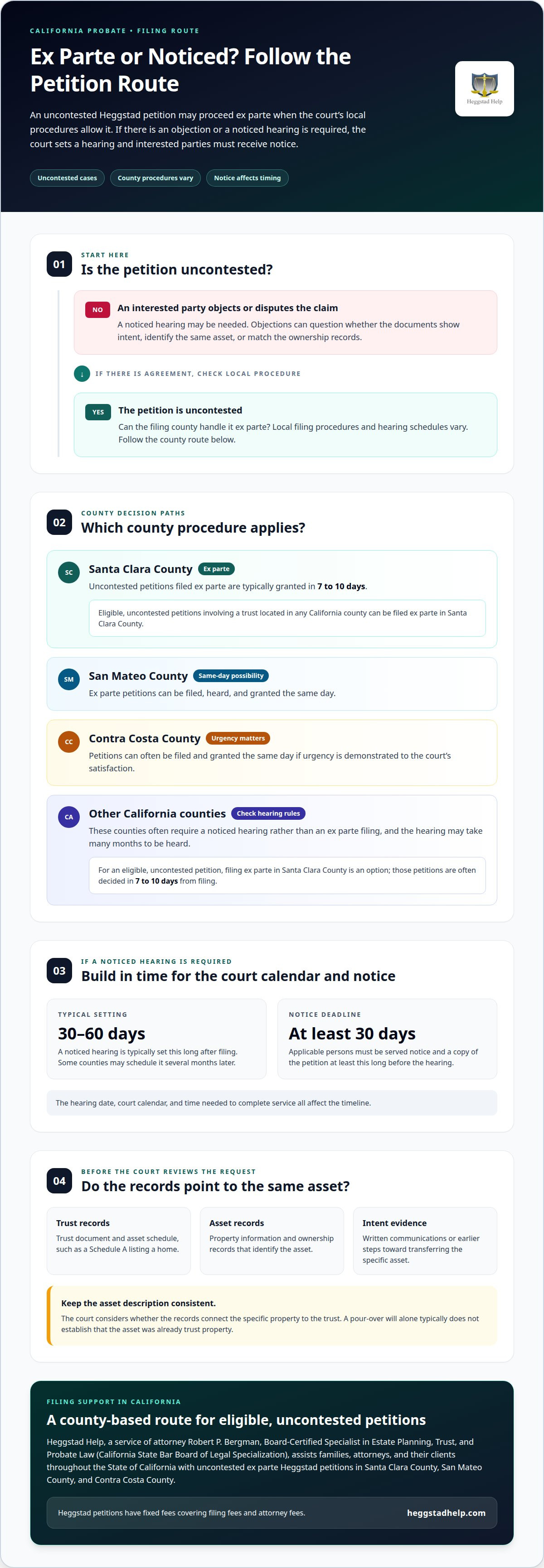
An ex parte petition asks the court to act without a formal hearing, while a noticed petition is scheduled for a hearing. In California, the available route depends on the county, whether the petition is uncontested, and whether interested parties agree.
Uncontested petitions may be filed ex parte in Santa Clara County, San Mateo County, and Contra Costa County. In Santa Clara County, petitions are typically granted 7 to 10 days after filing. In San Mateo County, an ex parte petition can be filed, heard, and granted the same day.
Contra Costa County petitions can often be filed and granted the same day if the court is satisfied that urgency has been demonstrated. Interested parties’ positions may affect whether an ex parte filing is appropriate. Their agreement helps distinguish an uncontested request from one requiring a hearing.
In other counties, including Los Angeles County and Orange County, Heggstad petitions often require noticed hearings and may take many months to be heard. A noticed hearing is typically set 30 to 60 days after filing, or later in some counties. Notice to beneficiaries adds time before the court can consider the request.
For an uncontested petition involving a trust located elsewhere in California, an ex parte filing in Santa Clara County may offer another route. Eligible petitions can often be decided within 7 to 10 days of filing, regardless of the county where the trust is located. The property still needs evidence showing it was intended for the trust, even if it was never formally titled that way.
Choosing between these paths turns on consent, urgency, and local court procedure. If a beneficiary objects, the matter is contested and takes longer. The court process must address that disagreement rather than treat the petition as an uncontested ex parte request.
How can Heggstad Help assist with Heggstad petition filing?
HEGGSTAD HELP, a service of attorney Robert P. Bergman, Board-Certified Specialist in Estate Planning, Trust, and Probate Law (California State Bar Board of Legal Specialization), assists families, attorneys, and their clients throughout the State of California with uncontested Heggstad petitions. This can help when an asset intended for a trust wasn’t transferred before the trust creator’s death. The petition asks the court to confirm the asset’s trust status.
HEGGSTAD HELP prepares and files clean ex parte Heggstad petitions in Santa Clara, San Mateo, and Contra Costa counties. For some uncontested petitions, an ex parte filing may be an option, depending on the circumstances and local procedures. For example, property in Los Angeles County may be the subject of an eligible petition filed in Santa Clara County.
Ex Parte Court Order Services address the court-order process for these uncontested petitions. In Santa Clara County, petitions are typically granted in 7 to 10 days. In San Mateo County, an ex parte petition can be filed, heard, and granted the same day. In Contra Costa County, same-day filing and granting can often occur when the court is satisfied that urgency has been demonstrated.
Trust Asset Title Correction addresses updating an asset’s title to reflect the court’s order and trust ownership. Heggstad petitions have fixed fees covering filing fees and attorney fees. The office handles only uncontested petitions and does not handle contested petitions.
Families, attorneys, and title companies can use these services for eligible matters throughout California. Contact HEGGSTAD HELP to discuss an uncontested Heggstad petition.
What are common questions about pour-over wills and Heggstad petitions?
How Does a Pour-Over Will Work with a Living Trust?
A pour-over will directs property left outside a living trust to the trust’s trustee after the owner dies. The will works alongside the trust, which provides instructions for managing and distributing the property. For example, if a bank account remains individually owned, the will may direct it to the trust, but probate may be needed before the transfer happens.
The Basics: What Is a Pour-Over Will?
A pour-over will directs specified property left outside a trust to that trust. It serves as a backstop for assets that were not placed in the trust during the owner’s lifetime. The will and trust work together, but they are separate documents: the will directs property to the trustee, while the trust explains how the trustee should manage it.
What Is a Pour-Over Will in California?
In California, a pour-over will directs property owned outside a trust to that trust’s trustee after death. Probate may be required before the transfer, depending on the property and circumstances. This applies to trust planning involving places such as the San Francisco Bay Area, Greater Los Angeles, Orange County, Riverside County, San Diego, Sacramento, Fresno, Bakersfield, Northern California, Southern California, and the Central Valley.
What is a Heggstad petition in California probate?
A Heggstad petition asks a California probate court to recognize property as belonging to a trust, even though title wasn’t formally changed. California Probate Code Section 850(a)(3)(B) provides a basis for this type of petition. The request focuses on evidence of the owner’s intent regarding the particular asset. It differs from relying only on a will to direct leftover property into a trust.
Can a Heggstad petition transfer assets to a trust under a pour-over will?
A Heggstad petition may ask the court to confirm that an asset was intended to be trust property, rather than relying on the pour-over will alone to transfer it. A Heggstad petition for a pour-over will therefore depends on evidence linking the specific asset to the trust. If the court doesn’t confirm that status, the will may still direct the asset to the trust through probate.
What evidence is needed to prove an asset was intended to be in a trust?
Useful evidence connects the specific property to the trust and the owner’s intent. Examples include a trust schedule identifying the asset, trust language describing it, or written communications about placing it in the trust. Records of steps already taken toward a transfer may also help. The court considers the evidence together, so consistent asset descriptions across documents can make the connection clearer.
Disclaimer
This article is for informational purposes only. Nothing in this article is intended to replace legal advice from a competent attorney or be considered legal guidance for anybody's specific legal situation. Nobody should rely on information in this article in making legal decisions without such consultation.