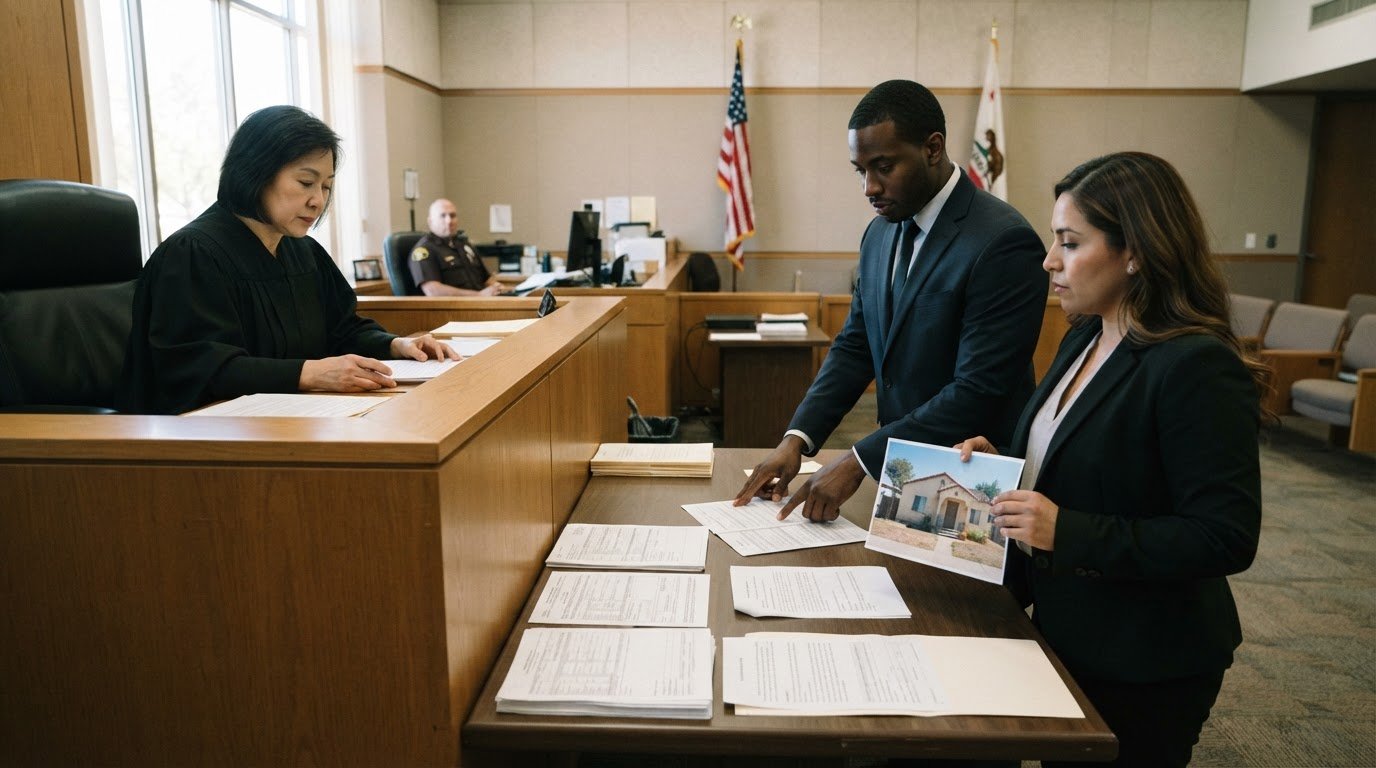
In California, proving intent to fund a trust means showing that the trustor intended a specific asset to belong to the trust, even though the title was never formally changed. A review of the trust documents, ownership records, and other written evidence can help assess whether that intent is supported. If the transfer steps were missed, a Heggstad petition may ask the probate court to recognize the asset as trust property.
An asset still titled in someone’s individual name can create uncertainty for a family, especially after the trustor has died. The central question is whether the records show a clear intention to place that particular asset in the trust. Understanding what helps prove intent to fund a trust in California makes clear why both the trust’s wording and the asset’s ownership history matter.
This article explains what evidence may help establish intent, how a Heggstad petition can address an omitted asset, and what a professional considers when assessing the situation. You’ll also learn how HEGGSTAD HELP, a service of attorney Robert P. Bergman, Board-Certified Specialist in Estate Planning, Trust, and Probate Law (California State Bar Board of Legal Specialization), assists families, attorneys, and their clients throughout California with uncontested petitions.
Key Takeaways
Determine whether an asset is titled to the trust by reviewing ownership records alongside the trust documents.
Build a clear picture of intent from written records and surrounding evidence; a professional also considers the trustor’s capacity.
A Heggstad petition may help address an asset that was intended for a trust but was not formally transferred into it.
For an uncontested petition, the filing route can depend on the county: ex parte filings may be available in Santa Clara, San Mateo, or Contra Costa County, while other counties often require a noticed hearing.
How can a Heggstad petition help recover omitted trust assets?
A Heggstad petition asks a California probate court to recognize an asset as trust property when the trustor intended it for the trust but did not complete the formal transfer. Whether the petition is supported depends on the asset’s records and evidence of the trustor’s intent.
For real estate, the recorded deed is a key ownership record: it shows whether title is held by the trust or an individual. In Santa Clara County, property records can be reviewed through the County Clerk-Recorder’s Office or the County Assessor’s Public Service Unit. Compare the deed’s named owner with the trust documents; a property description alone does not establish ownership.
Records for other assets vary. Account statements or financial institution records may show whether a bank or brokerage account is trust-owned. A signed transfer document, ownership form, or other record naming the trustee can help show that a transfer was completed. For personal property, relevant evidence depends on the item and its associated records.
What are petitions for omitted trust assets?
A Heggstad petition asks the court to recognize an omitted asset as trust property based on evidence of the trustor’s intent. In Estate of Heggstad, a written declaration identified real property as held in trust, although no new deed had been recorded. The petition process may help clarify ownership when the transfer was incomplete but documents support the trustor’s intended arrangement.
What are assets outside the trust?
A pour-over will directs assets left outside the trust at death into the trust for distribution under its terms, but it does not itself change the asset’s ownership records. To determine whether an asset is trust-owned, consider its title or account statements alongside the trust and transfer documents. For example, a house still titled to an individual may need a different analysis from an account naming the trust.
What evidence can prove a trustor’s intent to fund a trust?
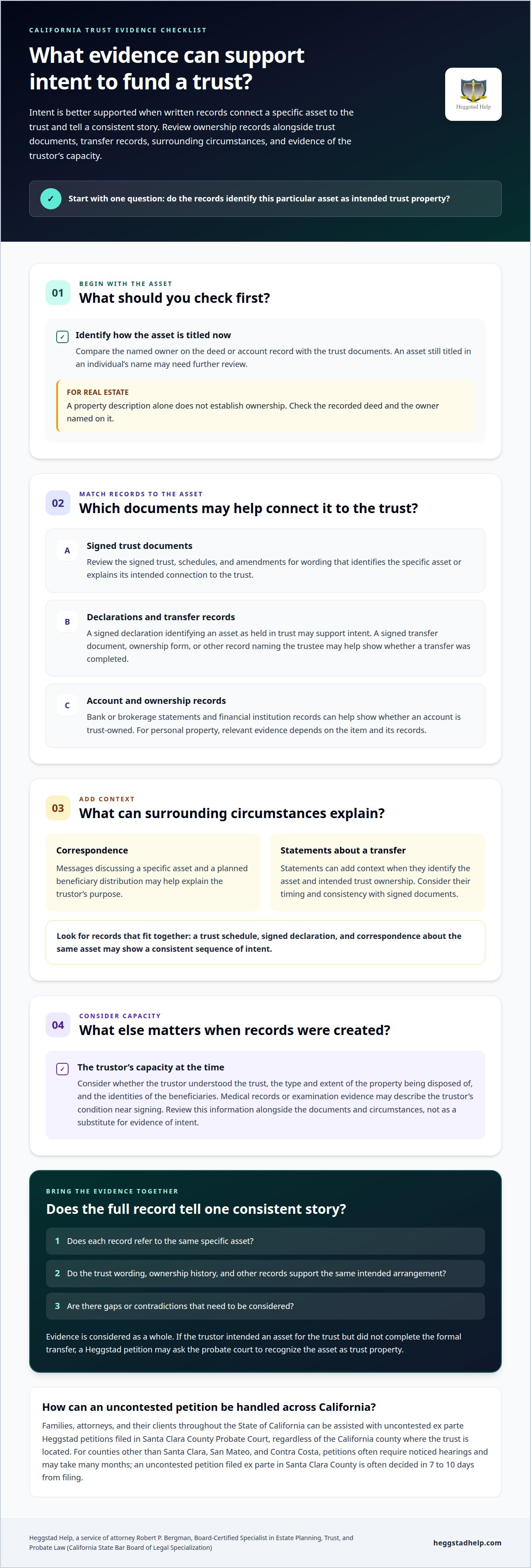
Evidence for proving intent to fund a trust in California should link the trustor’s actions to a specific asset and show a clear purpose. Review the signed trust document alongside other records and the circumstances surrounding the asset. No single item should be considered in isolation.
Which Documents Can Support Intent?
A signed declaration identifying an asset as held in trust may support the trustor’s intent. In Estate of Heggstad, a written declaration identified real property as trust property despite the absence of a newly recorded deed. Other potentially relevant records include trust schedules, amendments, account records, and correspondence. The key is whether the documents consistently identify the asset and explain its intended connection to the trust.
How Do Circumstances Add Context?
The surrounding circumstances can explain why a document was created and what the trustor meant. For example, correspondence discussing a specific asset alongside a planned beneficiary distribution may clarify the trustor’s purpose. Statements about transferring property can add context when they identify the asset and intended trust ownership. Their timing and consistency with signed documents matter.
Why Does the Evidence Need to Be Considered Together?
Several records may tell a clearer story than one document alone. A trust schedule, signed declaration, and correspondence about the same asset can establish a consistent sequence of intent. In a petition, the evidence for proving intent to fund a trust in California is considered as a whole, including gaps or contradictions. Its strength depends on how well the records fit together.
How Can Capacity Evidence Affect the Assessment?
The trustor’s capacity when creating or changing the trust is also relevant. The trustor must understand the trust, the type and extent of the property being disposed of, and the identities of the beneficiaries. Medical records or examination evidence may help describe the trustor’s condition near the time of signing. Consider this information alongside the documents and circumstances, not as a substitute for evidence of intent.
What is a living trust?
A living trust is an arrangement created during a person’s lifetime to hold and manage property under written terms. The person creating it names a trustee, who manages the trust’s assets for the beneficiaries. For example, a California homeowner can place a residence in a revocable living trust, which can be changed during the trustor’s lifetime.
Creating a trust document is only part of the process. To become trust property, an asset generally must be transferred from its owner to the trustee. For a home, this typically involves a deed naming the trust; for a bank account, the financial institution’s ownership records may need updating. If a brokerage account remains in an individual’s name, the trust documents alone may not connect it to the trust.
Once assets are properly connected to a revocable trust, the trust can provide for their distribution without court-supervised probate. For example, a trust may direct that a beneficiary receive an inheritance in stages rather than all at once. Depending on the written terms, it may also address beneficiary asset protection or special needs planning.
A living trust can also matter when an estate includes property in more than one state. For example, a California resident who owns real estate elsewhere may use a revocable trust to help avoid ancillary probate in that state. The trust’s role depends on whether the property was actually transferred into it, so ownership records remain important.
Not every asset should be retitled in the same way. Retirement accounts and life insurance policies are commonly reviewed for beneficiary designations instead of automatically being transferred to a living trust. Retitling an IRA or 401(k) into a trust can be treated by the IRS as a distribution of the account balance, potentially creating immediate income tax liability.
A revocable living trust also has limits. Its assets remain in the trustor’s taxable estate, so the trust does not provide significant estate tax benefits or creditor protection. For example, placing a California residence in a revocable trust does not, by itself, shield it from the trustor’s creditors. The trust’s value depends on how its assets and terms support management and distribution plans.
How can HEGGSTAD HELP assist with trust asset title correction?
HEGGSTAD HELP, a service of attorney Robert P. Bergman, Board-Certified Specialist in Estate Planning, Trust, and Probate Law (California State Bar Board of Legal Specialization), assists families, attorneys, title companies, and their clients throughout the State of California. Its Trust Asset Title Correction service addresses assets intended for a trust when ownership records don’t reflect that intention. The appropriate path depends on the asset, supporting documents, and whether the petition is uncontested.
For an omitted asset, Heggstad Help prepares and files a Heggstad petition presenting evidence of intent and asking the court to recognize the asset as trust property. The practice also handles ex parte court order services for eligible, uncontested petitions. Robert P. Bergman coordinates the process, including the petition and supporting documents. This service focuses on uncontested petitions, not contested litigation.
Filing location can affect the process. Uncontested petitions may be filed ex parte in Santa Clara County, San Mateo County, or Contra Costa County. In Santa Clara County, petitions are typically granted in 7 to 10 days. In San Mateo County, an ex parte petition can be filed, heard, and granted the same day. Contra Costa County petitions can often be granted the same day if the court is satisfied that urgency has been demonstrated.
For a trust located in Los Angeles County, Orange County, or another California county, the local court often requires a noticed hearing rather than an ex parte filing. Such hearings may be set 30 to 60 days after filing, or several months later in some counties, with additional time needed to notify interested parties. An uncontested petition from another county can often instead be filed ex parte in Santa Clara County and decided within 7 to 10 days from filing.
Heggstad petitions have fixed fees that cover filing fees and attorney fees. If a petition is contested, this office does not handle it. For an uncontested trust-title matter, contact HEGGSTAD HELP to discuss the filing.
Frequently Asked Questions
What is Trust Funding and Why is it Essential in California?
Trust funding means aligning an estate plan with how property is legally held or designated. It matters because a trust’s instructions cannot necessarily control an asset that remains outside the trust. For example, an operating agreement may restrict the transfer of a business interest or require consent, affecting how the trust plan applies.
Why can an unfunded trust still lead to probate?
An unfunded trust can leave a successor trustee without a clear record of authority over an asset titled to the deceased person. A will directing property to the trust may express the intended destination, but it does not by itself resolve every title or transfer issue. The asset’s value, ownership records, and applicable transfer process can affect whether probate is needed.
What does California law require to prove intent to fund a trust?
The evidence should link the trustor’s intent to a particular asset, not merely show a general wish to place an estate in a trust. For example, a document identifying a specific parcel or account creates a clearer link than broad language about “all assets.” Also consider whether the records are consistent and whether another document points to a different plan.
How does California Probate Code Section 15200 define creation and funding of a trust?
Probate Code Section 15200 concerns creation of a trust, but its existence does not establish that every asset mentioned in an estate plan became trust property. For an omitted asset, the practical issue is whether the available documents and circumstances connect that specific property to the trust. A court petition may ask the court to resolve that ownership question based on the evidence presented.
What evidence proves a California trust was funded, such as deeds, account records, or schedules?
Consistency across records can strengthen the case that a transfer was intended. For example, the asset description, owner name, and relevant dates should correspond across the trust paperwork and the institution or title records. A vague schedule entry may be harder to connect to a specific account than one naming the institution and identifying details. Differences between records may need closer review.
Can a California trust be valid if the trust document lists assets but title was never transferred?
Yes, a trust may remain valid even if title to a listed asset was never formally changed, but listing the asset does not automatically settle its ownership. The wording and specificity matter. A schedule naming a particular parcel may be more informative than a general reference to household property. Other signed documents and records may clarify whether the trustor intended the asset to be held in trust.
Disclaimer
This article is for informational purposes only. Nothing in this article is intended to replace legal advice from a competent attorney or be considered legal guidance for anybody's specific legal situation. Nobody should rely on information in this article in making legal decisions without such consultation.