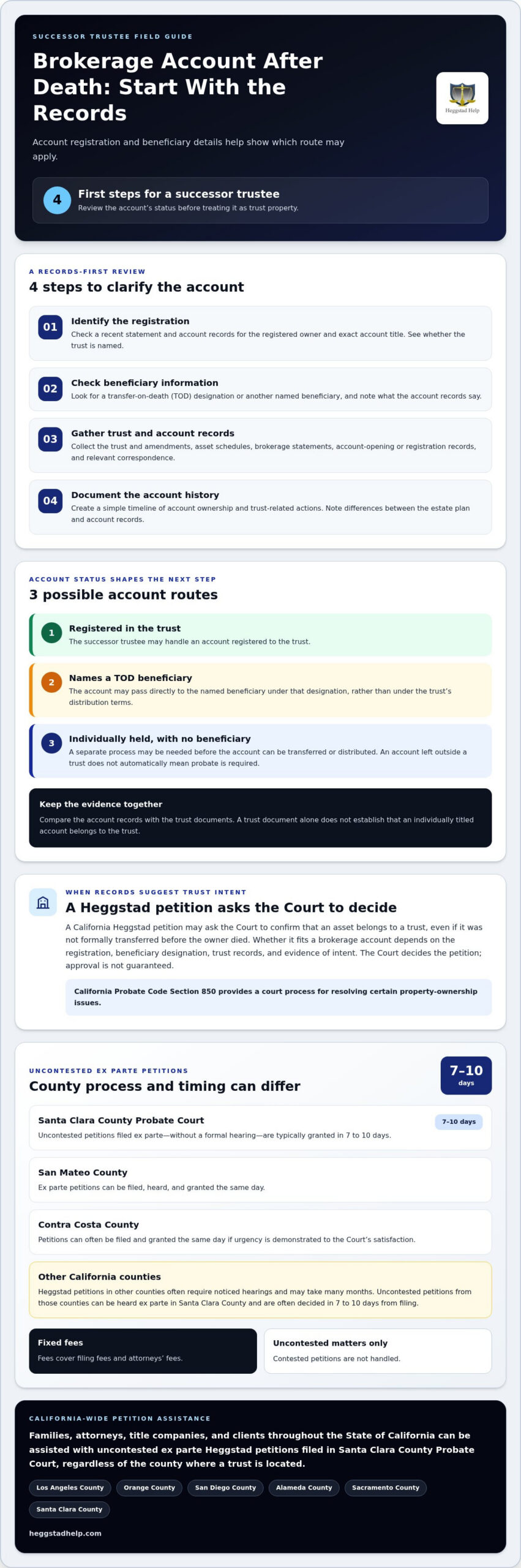
Heggstad Petition for Stock Certificates: Which Assets Qualify

A paper stock certificate does not automatically keep shares out of a trust. A Heggstad petition for stock certificates may ask a California court to…

A paper stock certificate does not automatically keep shares out of a trust. A Heggstad petition for stock certificates may ask a California court to recognize shares as trust property when the owner intended to place them in the trust but did not complete the transfer. The key question is whether the available evidence supports that intent, not simply whether a physical certificate exists.

It is understandable to focus on the certificate itself: it represents ownership, and handling it after someone’s death can involve additional practical steps. But the trust documents and other records may help show whether the shares were meant to belong to the trust. Ownership arrangements and beneficiary designations can also affect the analysis.

This article explains which assets a Heggstad petition may address, what records can support a claim involving shares, and how notice and objections fit into the process. It also explains what a court order may accomplish, helping you distinguish an omitted trust asset from a different kind of transfer issue.

Key Takeaways

  • A petition may help establish that an asset belongs to a California trust when ownership was never formally updated, if the evidence shows the owner intended to include it.
  • Trust schedules, written assignments, and ownership records can help support the claim; organize documents that identify the specific asset.
  • Notice gives interested parties an opportunity to object, so identify who may have an interest before the petition proceeds.
  • Physical stock certificates involve transfer and ownership details that differ from brokerage-held shares; gather the certificate and related company records.

Which assets can a Heggstad petition reach?

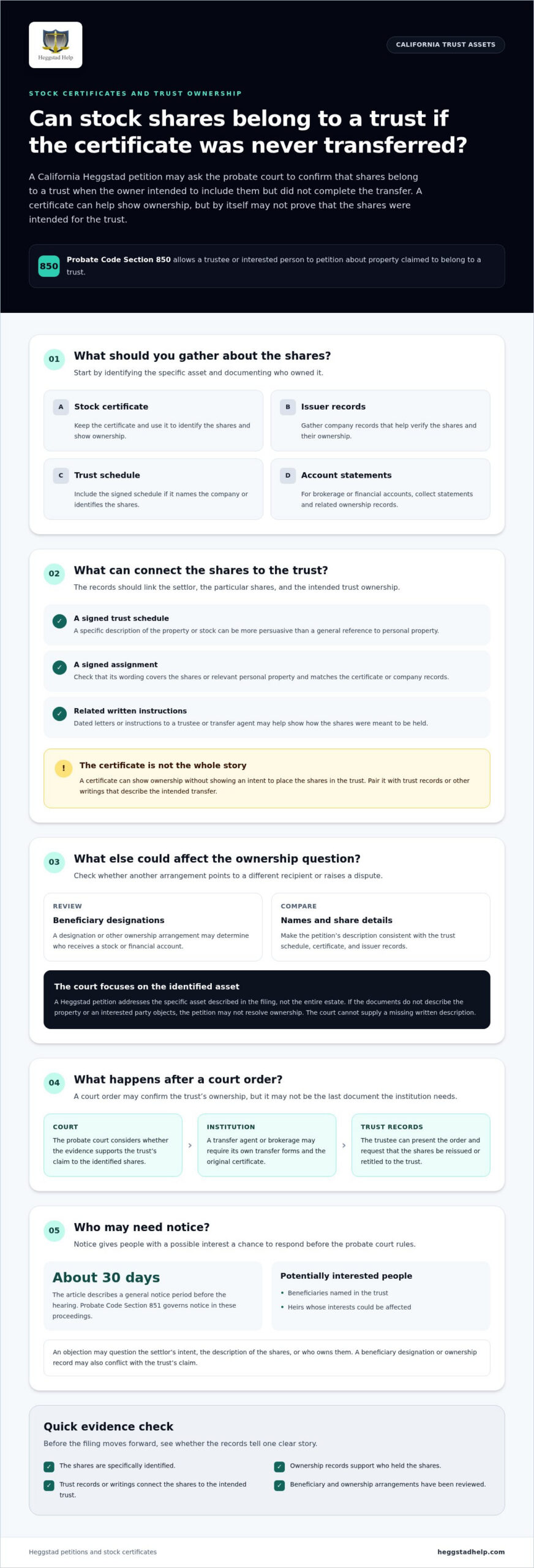
A California Heggstad petition can ask the probate court to confirm that an omitted asset belongs to a trust. The settlor (the person who created the trust) may have intended to include property but never formally transferred or titled it in the trust’s name. Probate Code Section 850 allows a trustee or interested person to petition concerning property claimed to belong to a trust. Assets may include real estate, financial accounts, personal property, business interests, or stock certificates.

A stock or financial account with a beneficiary designation needs closer review. The designation or another ownership arrangement may determine who receives the asset, so gather account statements and beneficiary records alongside the trust documents. A petition addresses whether the specific asset belongs to the trust; it does not automatically override a separate transfer arrangement.

A Heggstad petition differs from a small estate procedure for stock: it asks the court to determine trust ownership, while a Small Estate Affidavit is a separate transfer procedure.

To file a Heggstad petition for stock in California, the petitioner identifies the shares and explains why the settlor intended them to be trust property. The filing should include supporting trust records and ownership documents, such as a schedule of assets or certificate. A California Superior Court’s probate division considers the petition under Probate Code Section 850.

A transfer agent or brokerage may require additional documents before updating its records, even after a court order. The order may confirm the trust’s ownership, but the institution may also require its transfer forms and the original certificate. After receiving the order, the trustee can present it to the transfer agent and request that the shares be reissued or retitled to the trust.

A Heggstad petition addresses the identified asset, not the entire estate. If the documents do not describe the property or an interested party objects, the petition may not resolve ownership. The court cannot supply a missing written description.

Evidence supporting a petition, including trust schedules and written assignments

California probate courts look for evidence connecting the specific property to the settlor’s intent. Relevant records may include a signed trust, its schedule of assets, a general assignment, a stock certificate, or correspondence describing how the shares should be held. The documents should identify the asset clearly enough to distinguish it from other property.

For stock, evidence may include a schedule listing the company and shares, an assignment naming the stock, or written instructions to a trustee or transfer agent. A certificate alone shows ownership but may not show that the settlor intended the shares to belong to the trust. Pair it with trust records or other writings that explain the intended transfer.

In Estate of Heggstad (1993), the court recognized that a settlor’s written declaration of holding property as trustee could create a trust without a separate deed. In Kucker v. Kucker (2011), a general assignment could transfer personal property. These decisions show why written intent matters when an asset was never formally transferred.

  • Trust schedule: Include the signed schedule naming the property or identifying the stock. A generic reference to personal property may be less persuasive than a specific description.
  • Assignment: Provide a signed assignment that covers the shares or relevant personal property. Match its language to the certificate and company records.
  • Ownership documents: Gather the certificate, account statements, and issuer records showing the settlor owned the shares.
  • Related writings: Include dated letters or instructions that link the asset to the trust and identify the intended trustee.

Osswald v. Anderson (1996) marks an important limit: a petition needs a writing describing the property; the court cannot create that missing writing. An attorney can organize the evidence so the parties and judge can follow the link between the settlor, the shares, and the trust. Keep originals and present copies with clear labels. For help preparing a Heggstad petition, organize the trust and stock records together.

Notice requirements and potential objections

Notice gives people with a possible interest in the stock a chance to respond before the probate court rules. California Heggstad petitions generally require a notice period of about 30 days before the hearing, according to California Superior Courts. California Probate Code Section 851 governs notice in these proceedings. Interested parties can include beneficiaries and heirs whose shares of the estate could be affected.

Before filing, identify each beneficiary named in the trust and any heirs who may have an interest. Include accurate names and addresses in the petition materials, then follow the court’s notice requirements. A beneficiary’s written consent or waiver may affect whether formal notice is needed, but the petition must still meet the applicable court requirements.

An objection may dispute the settlor’s intent, the stock description, or who owns the shares. For example, a beneficiary might challenge a schedule that lists company shares without identifying the issuer or quantity. Another party may point to a beneficiary designation or ownership record that conflicts with the trust’s claim. Specific records help the court understand the disagreement.

  • Check the asset description: Compare the petition with the stock certificate, issuer records, and trust schedule.
  • Review the claimed ownership: Identify any joint owner, beneficiary designation, or other arrangement affecting the shares.
  • Track notice: Keep copies of filed notices and proof showing when and how each interested party received them.
  • Address objections: Organize the trust documents and ownership records that respond to each disputed point.

A noticed hearing may be set 30 to 60 days after filing, with additional time needed for notice. In counties outside Santa Clara, San Mateo, and Contra Costa, Heggstad petitions often require noticed hearings and may take many months to be heard. Uncontested petitions from those counties can instead be heard ex parte in Santa Clara County, often with a decision 7 to 10 days after filing. Ex parte means the court considers the petition without a formal hearing; it does not mean interested-party notice requirements disappear.
Heggstad Petition for Stock Certificates: Which Assets Qualify

Using Heggstad petitions for stock certificates

A paper certificate may document shares without showing whether the settlor intended them for a trust. A Heggstad petition for stock certificates asks the California probate court to confirm that connection. Under Probate Code Section 850, the petition seeks a determination about property claimed as trust property. The 1993 Estate of Heggstad decision provides the case name associated with this procedure.

Make the petition specific: identify the company, the shareholder named on the certificate, and the shares at issue. Include the trust’s relevant terms and the signed writing that ties those shares to the trust. Probate Code Section 856 allows the court to order property transferred or confirmed when it finds the trust owns it. A signed order can then support the title update.

The next steps depend partly on whether the shares are publicly traded or belong to a private company. For publicly traded shares held as a physical certificate, the transfer agent typically handles reissuance. For private-company shares, review the shareholder agreement and consult company officers about its transfer provisions. The agreement may provide for reissuance, a company buyout, or another mechanism.

  • Before filing: Match the certificate details to the trust schedule and any signed assignment.
  • In the petition: Explain the settlor’s intent and request an order addressing the identified shares.
  • After the order: Present the signed order to the transfer agent or company, and complete its required transfer documents.

A Heggstad order addresses the trust’s claim to the shares; it doesn’t itself print or reissue a new certificate. The transfer agent or private company may require the original certificate and additional documents to update ownership records. If the shares instead belong to the estate, an executor’s authority and the estate transfer process may apply. For help with a petition concerning stock, request Heggstad petition filing assistance.

HEGGSTAD HELP: Heggstad Petition Filing

Heggstad Help, a service of attorney Robert P. Bergman, a Board-Certified Specialist in Estate Planning, Trust, and Probate Law with the State Bar of California Board of Legal Specialization, assists families, attorneys, and their clients with uncontested Heggstad petitions involving assets such as stock certificates.

For trusts located anywhere in the State of California, uncontested petitions can be filed ex parte in the Santa Clara County Probate Court, meaning without a formal hearing. Those petitions are typically granted in 7 to 10 days. Ex parte filings are also available in San Mateo and Contra Costa Counties, subject to each court’s process.

Heggstad Petition Filing can address the court order needed to confirm trust ownership; Trust Asset Title Correction can help with the follow-up title issue. The office handles uncontested petitions, with fixed fees covering filing fees and attorney fees.

For help with an uncontested petition involving stock or another omitted trust asset, contact Heggstad Help.

Prepare the next step for your stock claim

Before pursuing a court order, clarify what you need it to accomplish. Is the immediate goal to establish who can act for the trust, or to enable the company to update its shareholder records? Defining the desired outcome can help keep the petition focused and make the next administrative step easier to plan.

A Heggstad petition for stock certificates can be one part of resolving an asset issue, with the court request shaped around the specific result sought. If you’re ready to discuss that next step, contact HEGGSTAD HELP for assistance. A clear plan can make a complicated process feel more manageable.

Frequently Asked Questions

Can a beneficiary oppose a Heggstad petition?

Yes. A beneficiary can tell the court why they dispute the requested treatment of the shares. To understand the issue, identify whether the disagreement concerns the settlor’s intent, the trust’s terms, or the beneficiary’s own claimed interest. These are distinct questions, and separating them can clarify what the court is being asked to decide.

How Does the California Petition Process Work?

The petitioner asks the probate court to determine a question about a particular asset, and the court considers the request under California procedure. A useful preparation step is to distinguish the court’s ownership decision from the issuer’s administrative work afterward. The court order addresses the legal claim; the company’s records and certificate-handling requirements concern how its share register is updated.

What Do I Need to Know About the Process of Filing a Heggstad Petition?

Make sure the petition describes the requested court action precisely. For stock, compare the issuer’s legal name, share class, and certificate details across available records, and note any differences in spelling or ownership history. Consistent descriptions help clarify which shares the court is being asked to address, especially when a company has multiple classes or similarly named entities.

What Happens If Someone Opposes the Petition?

The court must consider the objection and the parties’ positions before deciding the ownership question. A practical response begins by identifying the exact assertion being challenged, then organizing records that address it. For example, if the dispute concerns the company’s identity, records from the issuer may be more directly relevant than general correspondence about the trust.

What is a Heggstad petition in California probate law?

A Heggstad petition asks the court to determine whether specific property belongs to a trust, even though the ownership records were not formally updated. The request concerns the asset identified in the filing, such as a particular block of company shares. It does not itself complete the issuer’s administrative steps for changing its shareholder records.

Can a Heggstad petition be used to transfer stock certificates into a living trust?

A Heggstad petition may ask a court to recognize stock as trust property when the settlor intended that result but did not complete the transfer. If the settlor is living, the relevant question is whether the shares can be transferred directly under the trust’s and issuer’s procedures. After death, a court petition may address an omitted asset when the supporting records establish the trust’s claim.

Robert P. Bergman, Attorney at Law

Article by

Robert P. Bergman, Attorney at Law

Attorney Robert P. Bergman ("Bob Bergman") has been a Board-Certified Specialist in Estate Planning, Trust and Probate Law since 2011, as certified by the California State Bar Board of Legal Specialization. For several years, Bob has assisted families and the clients of other attorneys with obtaining court orders through Heggstad petitions to avoid the time and expense of Probate administration. Bob is friendly, very approachable, and believes in explaining complex legal topics in clear ordinary language so that his clients understand exactly what they're doing and why they're doing it.
Bob is often able to assist clients who are in other counties than his home county of Santa Clara through his approach to Heggstad petitions.

Disclaimer

This article is for informational purposes only. Nothing in this article is intended to replace legal advice from a competent attorney or be considered legal guidance for anybody's specific legal situation. Nobody should rely on information in this article in making legal decisions without such consultation.

Attorney for Trust Funding Mistakes in California: What to Do

A signed California trust doesn’t automatically control property that was never transferred into it. If an asset remains outside the trust when its…

A signed California trust doesn’t automatically control property that was never transferred into it. If an asset remains outside the trust when its owner dies, it may have to go through probate; an attorney for trust funding mistakes in California can assess whether the records show the owner intended the asset to belong to the trust and whether a Heggstad Petition may fit. While the owner is alive, omitted or newly acquired assets can still be addressed by completing the steps needed to transfer or properly assign them.

It’s understandable to assume that signing the trust documents was the main task, especially when a home, account, or investment was meant to be included. The key issue is ownership: a schedule can list intended trust assets, but it does not transfer title by itself. This article explains what may happen when funding is incomplete, how an omitted asset may be addressed after death, and which records can help show the trust creator’s intent. It also covers common funding mistakes, including real estate left outside the trust and beneficiary designations that do not align with the estate plan, so you can identify a practical next step with more confidence.

Key Takeaways

  • Review newly acquired property and account records so intended trust assets don’t get overlooked.
  • Compare beneficiary designations with your estate plan, especially for retirement accounts, insurance policies, and annuities.
  • For real estate, check the recorded deed and address any title issue before relying on the trust to control the property.
  • If an asset was left out, gather documents that show the trust creator’s intent and learn which options may apply before taking the next step.

2. Trust funding reviews and professional assistance

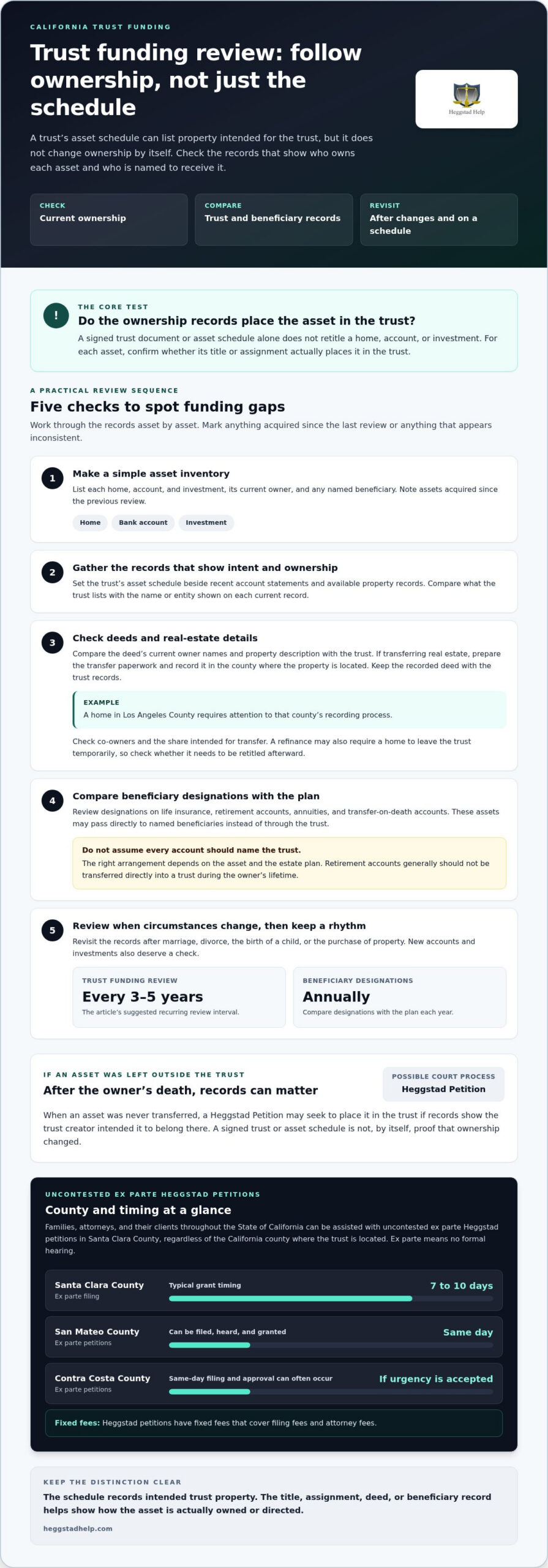
A trust-funding review compares the trust’s asset schedule with current ownership records. For each home, account, or investment, confirm whether the title or assignment places it in the trust. A schedule lists intended property, but it does not change ownership by itself. An attorney can identify gaps and compare beneficiary designations with the overall estate plan. This review can reveal whether account instructions align with the inheritance plan.

Review trust funding after major family changes, including marriage, divorce, or the birth of a child. These events may affect who should receive assets and whether existing trust instructions still match your wishes. Review the trust when you acquire property, too. For example, after buying a home, check its deed and trust records rather than assuming the purchase automatically funds the trust. A new account or investment also deserves attention because it may remain outside the trust unless ownership or beneficiary arrangements are addressed.

Use a recurring schedule, then add reviews when circumstances change. The article recommends reviewing California trust funding every 3-5 years, while an annual review with an estate planning lawyer can help keep the trust and its assets current. Review beneficiary designations annually, including those on insurance policies, retirement accounts, and annuities. These designations may direct assets outside the trust, so compare them with the plan before making changes. Don’t assume every account should name the trust; the right arrangement depends on the asset and the estate plan.

Prepare a simple inventory before a review: list each asset, its current owner, and any named beneficiary. Gather the trust’s asset schedule, recent account statements, and available property records. Mark assets acquired since the last review and any designation that appears inconsistent. A California attorney can assess the records, explain which updates may be appropriate, and identify potential probate concerns if an asset was left outside the trust. This step-by-step check makes a complex funding issue easier to spot and address before it affects inheritance.

3. Transferring real estate into a trust

A California trust generally controls real estate only when ownership is transferred to it or the property is properly assigned. For a home, the deed is central: compare its current owner names with the trust’s name and review the property description. A signed trust document alone doesn’t retitle a house. If the deed still names an individual, the property may remain outside the trust and could face probate after that owner dies.

To fund a trust with real estate, prepare the transfer paperwork and record it with the county where the property is located. For example, a home in Los Angeles County requires attention to that county’s recording process. Keep a copy of the recorded deed with the trust records, then compare the deed with the estate plan. An estate planning attorney can help identify a mismatch in ownership, deed wording, or the intended share being transferred. These details matter because a deed error can complicate title and the trust’s ability to manage the property.

Partial transfers need careful review. If a person owns only a share of a property, the deed and trust documents should reflect the interest intended for transfer, not assume the entire property belongs to that person. Check the current deed for co-owners and ownership details before preparing a change. Refinancing can also interrupt funding: a lender may require the home to leave the trust temporarily, so the owner should plan to retitle it into the trust afterward. Proposition 13 is another California property-tax consideration when transferring real estate.

Ask a lawyer to review the deed before recording if ownership is shared, the legal description appears inconsistent, or a refinance removed the home from the trust. If the owner has died and the deed was never transferred, a Heggstad Petition may seek to place the asset in the trust when records show clear intent. The county where the property sits doesn’t necessarily determine where an uncontested petition can be filed. Learn about the California Heggstad petition process if an omitted property may need this type of court review.

4. Common California trust-funding problems

How long it takes to correct a California trust-funding mistake depends on the asset and the remedy. Updating ownership records may involve preparing and recording documents, while an omitted asset after death may require a court petition. An uncontested ex parte Heggstad petition in Santa Clara County is typically granted in 7 to 10 days; petitions in San Mateo County can be filed, heard, and granted the same day. In Contra Costa County, same-day filing and approval can often occur when the court accepts the demonstrated urgency.

A common problem is a living trust that was signed but never fully funded. A home, bank account, or investment may still be titled individually, even though the trust document or asset schedule names it as intended trust property. After the owner dies, the asset may require probate rather than pass under the trust. A pour-over will does not, by itself, avoid probate for property left outside the trust.

Another frequent mismatch involves beneficiary designations. Life insurance, retirement accounts, annuities, and transfer-on-death accounts may pass directly to named beneficiaries instead of being retitled to the trust. Review those records against the trust plan: inconsistent instructions can confuse beneficiaries and complicate distribution. Retirement accounts generally should not be transferred directly into a trust during the owner’s lifetime because the transfer itself may be treated as a taxable payout.

A trust schedule can also create false confidence. It records assets the creator intended to include, but doesn’t transfer ownership on its own. If the owner has died, collect the schedule, trust document, account or title records, and other evidence showing intent. A Heggstad petition may ask the court to treat an omitted asset as trust property when the evidence supports that request. For properties in counties outside Santa Clara, San Mateo, and Contra Costa, these petitions often require noticed hearings and may take many months; an uncontested petition can instead be heard ex parte in Santa Clara County, typically with a 7-to-10-day decision timeline.

Attorney for Trust Funding Mistakes in California: What to Do

4. How do I find and evaluate a California attorney for trust funding mistakes?

Start by matching the attorney’s experience to the problem. Reviewing an omitted home requires assessing trust records, ownership documents, and possible court procedures. If a bank account is involved, beneficiary designations and account ownership may matter more. Ask how the attorney will identify the asset’s current status, explain available options, and outline the steps involved. A clear explanation should connect your documents to a practical next step.

Prepare a focused set of documents before discussing the matter: the signed trust and amendments, asset schedule, current deed or account statements, and relevant beneficiary forms. Note when each asset was acquired and whether its ownership changed after the trust was signed. For example, if a home was refinanced and retitled, bring the available before-and-after records. An attorney can then explain whether the issue calls for a document update, title correction, or court petition.

Ask how the process may differ by county and whether the matter is uncontested. California procedures can vary: an uncontested Heggstad petition filed ex parte in Santa Clara County is typically granted in 7 to 10 days, while petitions in other counties may require a noticed hearing and take many months. San Mateo and Contra Costa Counties also have ex parte procedures, with timing affected by the court’s process and, in Contra Costa County, whether urgency is demonstrated. These distinctions help you understand the proposed route and timeline.

Before proceeding, request a plain-language explanation of the work, documents needed, expected court steps, and how updates will be communicated. Confirm who will review the trust, supporting records, and proposed filing, rather than relying on a general promise to “handle the issue.” If property ownership is the concern, ask how the deed and trust records will be addressed. To discuss a trust asset title issue, review your next steps with a focused understanding of the documents involved.

HEGGSTAD HELP: Heggstad Petition Filing

HEGGSTAD HELP, a service of attorney Robert P. Bergman, Board-Certified Specialist in Estate Planning, Trust, and Probate Law (California State Bar Board of Legal Specialization), assists families, attorneys, and clients throughout the State of California with uncontested Heggstad petitions. If an asset was intended for a trust but left out, there may be options for addressing the omission. Uncontested petitions for trusts located anywhere in California can be filed in the Santa Clara County Probate Court, and petitions filed there are typically granted in 7 to 10 days.

For a title problem involving trust property, Trust Asset Title Correction may address the ownership record. HEGGSTAD HELP also provides ex parte court order services for eligible, uncontested Heggstad petitions. The practice focuses on Heggstad petitions and related trust asset title issues. To discuss your situation, book a consultation through the HEGGSTAD HELP website.

Take the Next Step With a Clear Plan

Before taking action, write down what needs to be resolved: an ownership record that does not match the trust, an asset omitted from the documents, or uncertainty about what the trust creator intended. Gather the records you have and note any upcoming sale, refinance, or distribution that makes timing important. A concise summary helps focus the discussion on the specific issue and the decision ahead.

Choosing an attorney for trust funding mistakes in California is easier when you can explain the asset, its current title or account ownership, and the outcome you’re seeking. You don’t need to solve the issue before asking for help; start with the facts and the documents available to you. A practical next step can bring clarity to a complicated situation.

Contact HEGGSTAD HELP about your trust funding concern to discuss a path forward. Taking that first step can help you move ahead with greater confidence.

Frequently Asked Questions

What happens if I forget to fund my trust in California?

Forgetting to fund one asset does not automatically invalidate the entire trust. The trust can still govern property properly placed in it, while the omitted asset’s transfer depends on its ownership and any beneficiary instructions. Start by identifying the asset’s legal owner and whether anyone else is named on its account or title. Those details help clarify what route may apply.

Do bank accounts need to be in the trust?

No, not every account must be titled in a trust. The right arrangement depends on the account’s purpose, ownership, and any beneficiary designation. Check the account registration and whether it names a co-owner or payable-on-death beneficiary. Then compare those details with the trust’s distribution plan. Reviewing accounts individually helps avoid treating every bank account the same way.

What does a California trust funding attorney do?

A California trust-funding attorney can help determine what kind of problem the records present and which legal step may address it. For example, a deed showing an individual owner raises a different issue from an account with an outdated beneficiary. Bring the relevant document and explain what outcome the trust creator intended. The attorney can then identify the records and process relevant to that asset.

What are common mistakes when funding a living trust in California?

Common mistakes include assuming a will transfers every omitted asset without probate, transferring a retirement account directly into a trust, or overlooking a change made during refinancing. These errors affect different assets in different ways. Before changing account ownership, identify whether the asset is a retirement account, jointly owned property, or an account with named beneficiaries. That distinction can help prevent an unintended transfer or tax result.

How can an attorney fix assets accidentally left out of a California trust?

The next step depends partly on whether the trust creator is still living. While the creator is alive, the issue may involve completing an appropriate ownership transfer. After death, a court petition may be considered if evidence supports the creator’s intent. Keep original records intact, including dated documents and communications, so the sequence of events can be understood clearly.

What is a California Heggstad petition and when is it used?

A California Heggstad petition asks a court to recognize an asset as trust property when it was left out of the trust’s title records. It may be relevant after the trust creator dies if evidence shows the asset was intended for the trust. The petition is a request for a court order, not a deed or automatic transfer. The court considers the evidence presented about intent.

Robert P. Bergman, Attorney at Law

Article by

Robert P. Bergman, Attorney at Law

Attorney Robert P. Bergman ("Bob Bergman") has been a Board-Certified Specialist in Estate Planning, Trust and Probate Law since 2011, as certified by the California State Bar Board of Legal Specialization. For several years, Bob has assisted families and the clients of other attorneys with obtaining court orders through Heggstad petitions to avoid the time and expense of Probate administration. Bob is friendly, very approachable, and believes in explaining complex legal topics in clear ordinary language so that his clients understand exactly what they're doing and why they're doing it.
Bob is often able to assist clients who are in other counties than his home county of Santa Clara through his approach to Heggstad petitions.

Disclaimer

This article is for informational purposes only. Nothing in this article is intended to replace legal advice from a competent attorney or be considered legal guidance for anybody's specific legal situation. Nobody should rely on information in this article in making legal decisions without such consultation.

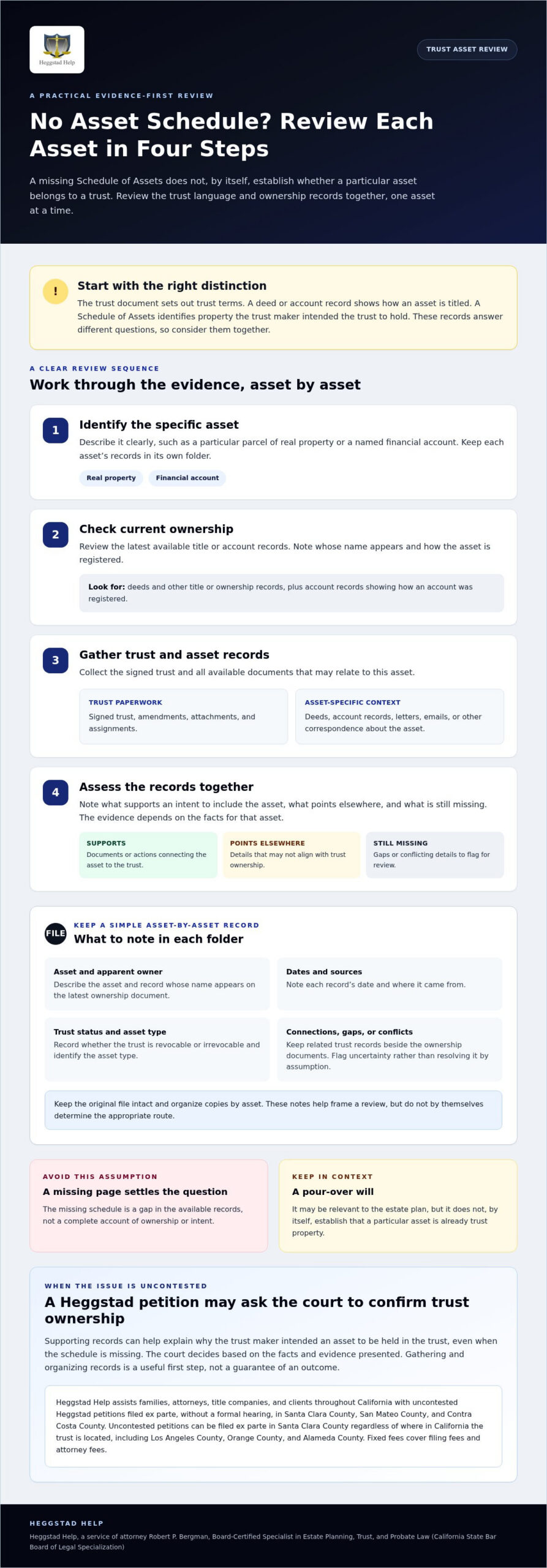
Fixing a Trust With No Schedule of Assets in California

A missing Schedule of Assets does not, by itself, establish that a California trust cannot include a particular asset or that probate is unavoidable….

A missing Schedule of Assets does not, by itself, establish that a California trust cannot include a particular asset or that probate is unavoidable. To start fixing a trust with no schedule of assets California families should identify the asset, review the trust and ownership records, and assess whether the documents show the trust maker intended the asset to belong to the trust. When the issue is uncontested, a Heggstad petition may provide a way to ask the court to confirm trust ownership.

Gather the signed trust and any amendments, deeds or account records, and other documents that show how the asset was titled. Organizing these records by asset can make it easier to see what the paperwork supports and what information is missing.

Heggstad Help, a service of attorney Robert P. Bergman, Board-Certified Specialist in Estate Planning, Trust, and Probate Law (California State Bar Board of Legal Specialization), assists families, attorneys, and their clients throughout California with uncontested ex parte Heggstad petitions. These petitions are filed without a formal hearing in Santa Clara County, regardless of the county where the trust is located. This article explains what a missing schedule does and does not establish, which records to organize, and how the petition process may fit.

Key Takeaways

  • A missing Schedule of Assets alone does not establish whether a particular asset was intended to belong to the trust.
  • When fixing a trust with no schedule of assets California, gather the trust and amendments, ownership records, and documents that may show the trust maker’s intent.
  • Review each asset separately: identify it, confirm how it is currently titled, and note its type and the trust’s status.
  • For an uncontested issue, a Heggstad petition may be a path forward. Uncontested petitions can be filed ex parte in Santa Clara County regardless of where in California the trust is located. Fixed fees cover filing fees and attorney fees.

What Does It Mean to Have a California Trust With No Schedule of Assets?

A missing Schedule of Assets does not, by itself, show what happened to a particular asset. The trust may contain language about the trust maker’s intentions, while ownership records show who legally held the asset. These documents answer different questions, so review them together.

A Schedule of Assets is a record identifying property the trust maker intended the trust to hold. It is separate from the trust document, which sets out the trust’s terms, and from ownership records, such as a deed or account statement, which show how an asset is titled. These records should not be treated as interchangeable. To begin fixing a trust with no schedule of assets California, identify the specific asset and review its records alongside the trust paperwork. The general concept of trust law can provide background, but it does not determine ownership of a particular California asset.

Does the missing schedule mean the trust cannot be used?

No. The missing schedule is a gap in the available records, not a complete account of ownership or intent. Read the trust wording and any amendments, attachments, or asset-specific documents that remain. For example, a deed or written assignment may help explain the trust maker’s actions even when no schedule can be found. Keep the documents together, and avoid assuming that one missing page settles the issue.

Why can an asset appear to be outside the trust?

An asset may appear to be outside the trust because the file is incomplete or the available documents do not reflect every step the trust maker took. A property record, account document, or written instruction may provide context that the missing schedule cannot. Note what is known about the asset and where each record came from. For a broader overview of possible recovery steps, see the California trust asset recovery guide. The relevant evidence depends on the facts for each asset.

What Records Can Show Intent When a California Trust Has No Asset Schedule?

Evidence is asset-specific, and a missing Schedule of Assets is only one part of the file. Review the trust maker’s documents and actions alongside records showing who owned the particular asset and how it was titled. No single paper automatically establishes the result; the records need to be considered together.

When fixing a trust with no schedule of assets California, organize the file around each asset rather than treating the trust papers as a complete ownership record. A deed relates to real property, while account records may show how a financial account was held. Correspondence or a written assignment may add context about the trust maker’s intent.

Which documents should a family or successor trustee gather first?

Start with the signed trust and collect every available amendment, attachment, and assignment. Then gather documents tied to the asset under review, such as:

  • Deeds and other title or ownership records
  • Account records showing how an account was registered
  • Letters, emails, or other correspondence about the asset

Sort copies by asset, and note each record’s date and source. Keep the original file intact. Flag gaps or conflicting details rather than trying to resolve them by assumption.

How does a Heggstad petition relate to the evidence?

A Heggstad petition asks a court to confirm that a specific asset belongs to a trust. Supporting records help explain why the trust maker intended the asset to be held in the trust, even if the schedule is missing. The court decides based on the facts and evidence presented, so gathering and organizing records is a useful first step, not a guarantee of an outcome.

If you are organizing records for an uncontested petition, Heggstad petition filing information explains the focused process.

Fixing a Trust With No Schedule of Assets in California

How Should You Review a Trust With No Schedule of Assets Before Choosing a Route?

Review the issue one asset at a time before deciding what to do. A pour-over will, a will designed to direct certain property into a trust, may be relevant to the estate plan. It does not, by itself, establish that a particular asset is already trust property.

  1. Identify the asset. Describe it clearly, such as a specific parcel of real property or a named financial account.
  2. Establish current ownership. Check the latest available title or account records and note whose name appears.
  3. Gather trust records. Collect the signed trust, amendments, attachments, assignments, and records tied to that asset.
  4. Assess the evidence together. Note what supports an intent to include the asset, what points elsewhere, and what information is missing.

How can you organize the review asset by asset?

Create a separate folder for each asset, keeping ownership documents beside the trust records that may relate to it. Write down the apparent owner, relevant dates, and any document or action that connects the asset to the trust. Also record whether the trust is revocable or irrevocable and identify the asset type. These details help frame legal review; they do not, by themselves, determine the appropriate route.

When should the records be assessed for a Heggstad petition?

A Heggstad petition asks a court to confirm that an asset belongs to a trust. It may be considered when the available evidence supports asking the court to confirm trust ownership and the request is uncontested. The outcome depends on the specific facts. For broader context, the Heggstad petition filing guide discusses the process.

Heggstad Help assists families, attorneys, and their clients throughout California with uncontested petitions filed in Santa Clara County, regardless of where the trust is located. Explore help with an uncontested Heggstad petition.

What California Heggstad Petition Path May Fit an Uncontested Trust Asset Issue?

A Heggstad petition may fit when records support asking a court to confirm that an asset belongs to a trust and the request is uncontested. Heggstad Help assists families, attorneys, and their clients throughout the State of California by filing uncontested ex parte petitions, without a formal hearing, in Santa Clara County, San Mateo County, and Contra Costa County.

How do ex parte filing options differ by California county?

In Santa Clara County, uncontested ex parte Heggstad petitions are typically granted within 7 to 10 days of filing. In San Mateo County, petitions can be filed, heard, and granted the same day. In Contra Costa County, petitions can often be filed and granted the same day if the Court is satisfied that urgency has been demonstrated. These timeframes describe typical or conditional outcomes, not guaranteed results.

What if the trust is located in another California county?

In counties such as Los Angeles, Orange, San Diego, Alameda, or Sacramento, Heggstad petitions often require a noticed hearing, meaning a hearing scheduled with advance notice to interested parties. These hearings can take many months to be heard. An uncontested petition from any California county can instead be filed ex parte in Santa Clara County and is typically granted within 7 to 10 days of filing. Heggstad Help assists with these statewide filings, including for families and attorneys handling trust assets in the San Francisco Bay Area, Northern California, Southern California, the Central Valley, San Diego, Sacramento, Fresno, Bakersfield, Greater Los Angeles, Orange County, Riverside County, and San Bernardino County.

All Heggstad petitions have fixed fees covering filing fees and attorney fees. If you are fixing a trust with no schedule of assets California, organize the asset-specific records to support an uncontested petition. Start with an uncontested Heggstad petition.

Take the Next Step With a Clear Record

A missing schedule can leave families unsure where to begin, but you can start by organizing the file. Make a short inventory of each asset, gather the records connected to it, and note any gaps or inconsistencies. That preparation makes a review of fixing a trust with no schedule of assets California more focused and helps clarify whether an uncontested Heggstad petition may fit.

Robert P. Bergman is Board-Certified in Estate Planning, Trust, and Probate Law by the California State Bar Board of Legal Specialization. Heggstad Help assists families, attorneys, and their clients throughout the State of California with uncontested ex parte petitions filed in Santa Clara County, San Mateo County, and Contra Costa County. Fixed fees cover filing fees and attorney fees.

Bring together the asset-specific records and take the next step toward resolving the title issue. Start an uncontested Heggstad petition.

Frequently Asked Questions

Does a trust need a Schedule of Assets to be valid in California?

No. The absence of a Schedule of Assets alone does not establish that a trust is invalid. The trust instrument and the circumstances of its creation still matter, while ownership of a particular asset is a separate question. If you are fixing a trust with no schedule of assets California, start by reviewing the signed trust and available attachments rather than treating a missing list as a decision about validity or ownership.

Can a pour-over will transfer an asset into a trust without a Schedule of Assets?

A pour-over will may direct property that passes under the will to the trust after the will-maker’s death, but it does not establish that a specific asset was already trust property. The will’s terms and the asset’s title records serve different purposes. Review them separately, and note whether the asset is addressed by name or falls within the will’s broader language.

Can a Heggstad petition address assets other than real property?

Yes. Heggstad petitions may address real property and other assets, although the relevant records and legal questions can vary by asset type. For example, records about an account may differ from documents concerning a home. Identify the particular asset and gather its ownership history before assessing whether a petition may fit. The court’s decision depends on the specific facts and evidence.

Are Heggstad petitions only filed in the county where the trust is located?

No. An uncontested Heggstad petition may be filed ex parte in Santa Clara County regardless of where in California the trust is located. Heggstad Help assists families, attorneys, and their clients statewide, including in the San Francisco Bay Area, Southern California, and the Central Valley. This filing route can serve trust matters involving Los Angeles County, Orange County, San Diego County, Alameda County, and Sacramento County, among others.

Robert P. Bergman, Attorney at Law

Article by

Robert P. Bergman, Attorney at Law

Attorney Robert P. Bergman ("Bob Bergman") has been a Board-Certified Specialist in Estate Planning, Trust and Probate Law since 2011, as certified by the California State Bar Board of Legal Specialization. For several years, Bob has assisted families and the clients of other attorneys with obtaining court orders through Heggstad petitions to avoid the time and expense of Probate administration. Bob is friendly, very approachable, and believes in explaining complex legal topics in clear ordinary language so that his clients understand exactly what they're doing and why they're doing it.
Bob is often able to assist clients who are in other counties than his home county of Santa Clara through his approach to Heggstad petitions.

Disclaimer

This article is for informational purposes only. Nothing in this article is intended to replace legal advice from a competent attorney or be considered legal guidance for anybody's specific legal situation. Nobody should rely on information in this article in making legal decisions without such consultation.
Heggstad Petition Service in Sacramento: How to Get Help

If a Sacramento County home or other asset was left out of a trust, a Sacramento Heggstad petition service may help determine whether the court can…

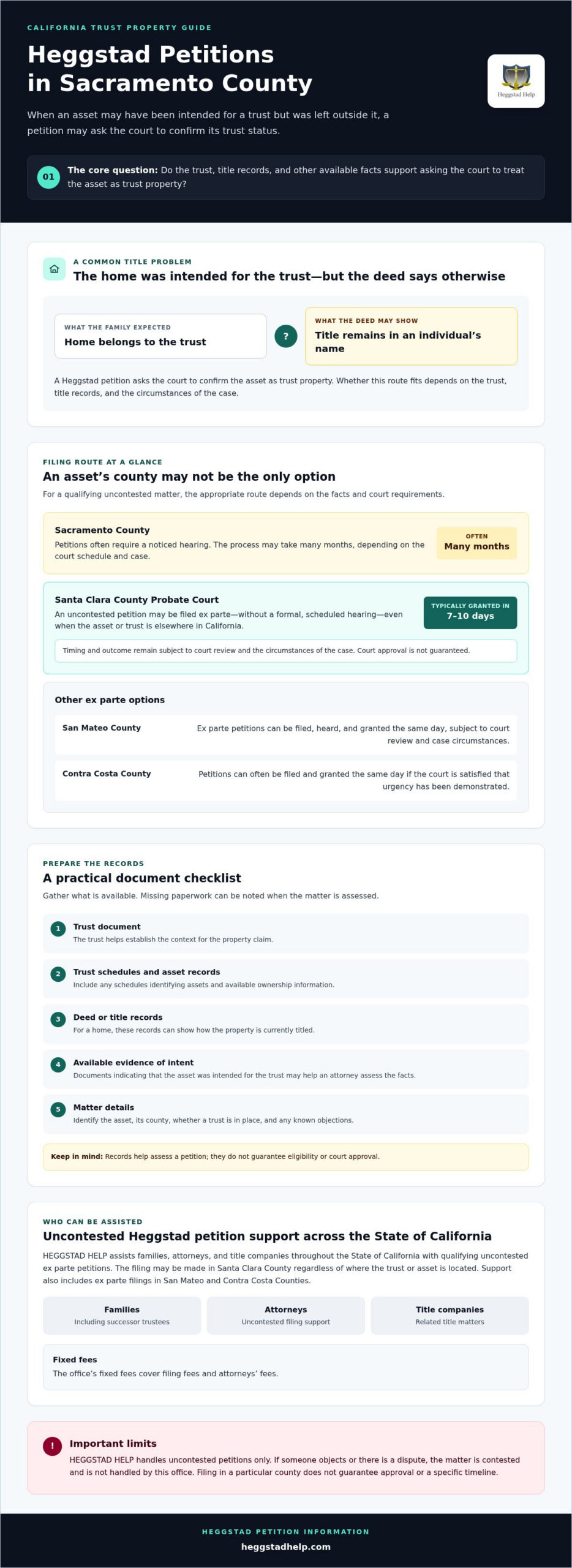
If a Sacramento County home or other asset was left out of a trust, a Sacramento Heggstad petition service may help determine whether the court can confirm it as trust property. Families may assume the petition must be filed in the county where the property or trust is located. For an uncontested matter, however, another filing route may be available, depending on the facts and court requirements.

HEGGSTAD HELP, a service of estate planning attorney Robert P. Bergman, assists families, attorneys, and title companies throughout California with uncontested ex parte Heggstad petitions filed in Santa Clara County, regardless of where the trust is located. “Ex parte” means the petition is submitted without a formal, scheduled hearing. Sacramento County petitions often require a noticed hearing and may take many months. Santa Clara County petitions are typically granted in 7 to 10 days from filing, subject to court review and the circumstances of the case.

This article explains what a Heggstad petition can address, what records to gather, and what the court considers. It also explains the service’s limits: HEGGSTAD HELP handles uncontested petitions only, and court approval is not guaranteed.

Key Takeaways

  • A Heggstad petition asks the court to confirm an asset as trust property. It may address a title issue when an asset was left outside the trust.
  • An uncontested petition involving a Sacramento County asset may be eligible for ex parte filing in Santa Clara County. The appropriate route depends on the facts and court review.
  • Gather the trust document, asset and title records, and any available documents showing the asset was intended for the trust. These records help assess the petition but do not guarantee approval.
  • When making an initial inquiry, identify the asset, its county, whether a trust is in place, and any known objections. The office’s fixed fees cover filing fees and attorneys’ fees.

Sacramento Heggstad Petition Service: What Help Can Address

A Heggstad petition asks the court to confirm that an asset belongs to a trust, even though it was not formally titled in the trust’s name. The process takes its name from Estate of Heggstad, the case that established this approach. HEGGSTAD HELP assists families, attorneys, and title company professionals throughout California with uncontested petitions. The office does not handle contested disputes.

When a Sacramento County asset may need a petition

For example, someone may have intended to place a Sacramento County home in their trust, but the deed still lists the person individually. That difference in title can create a problem when the family or successor trustee needs to deal with the home as trust property. A petition may ask the court to confirm the home’s trust status. Whether that approach fits depends on the trust, title records, and other circumstances.

Gather the trust document, any schedules identifying assets, and the available deed or ownership records. These materials can help an attorney assess whether the facts support an uncontested petition, but they do not guarantee court approval.

Who the service is designed to assist

Families and successor trustees may need help assessing how to address an asset left outside the trust. Attorneys and title company professionals may also seek focused assistance with an uncontested filing and related title correction. HEGGSTAD HELP can file qualifying uncontested ex parte petitions in Santa Clara County, regardless of where in California the trust or asset is located. The Heggstad petition filing guide provides broader background on the process.

A Sacramento Heggstad petition service can assess the filing route for a particular asset and the records available. If someone objects or there is a dispute, the matter is not an uncontested petition handled by this office.

Where a Sacramento Heggstad Petition May Be Filed

The asset’s location does not always determine the practical filing route for an uncontested Heggstad petition. Sacramento County petitions often require a noticed hearing. That means interested parties receive notice and the matter is scheduled for a hearing. Depending on the court’s schedule and the case, this route may take many months. Check the Sacramento Superior Court for local probate information and current requirements.

Sacramento County versus Santa Clara County filing

For an eligible, uncontested petition involving a Sacramento County asset, HEGGSTAD HELP can file ex parte in the Santa Clara County Probate Court. The petition is submitted without a formal, scheduled hearing. Santa Clara County petitions are typically granted in 7 to 10 days from filing, subject to court review and the circumstances of the case. This option may also be relevant to families in Placer County, but the right filing route depends on the specific matter.

A Sacramento Heggstad petition service should make clear that filing in Santa Clara County is an option for qualifying uncontested cases, not a guarantee of a particular result or timeline. HEGGSTAD HELP assists families, attorneys, and title companies throughout California with these filings, regardless of the county where the trust is located.

When San Mateo or Contra Costa County may be options

San Mateo County ex parte petitions can be filed, heard, and granted the same day. Contra Costa County petitions can often be filed and granted the same day if urgency satisfies the court. These timelines and outcomes remain subject to court review and case circumstances. For more background on the legal basis, see this Probate Code Section 850 petition guide.

If you are unsure which county route fits, you can learn about Heggstad petition filing options and have the specific facts assessed before proceeding.

How to Prepare for an Uncontested Heggstad Petition

Organized records help an attorney assess whether an uncontested Heggstad petition may fit and which filing route to consider. Preparing documents is a useful first step, not a guarantee of eligibility or court approval. California Probate Code Section 850 provides legal context for court requests involving property claimed to belong to a trust.

Records to organize before requesting help

Start with the documents you have. If something is missing, note that when you make an inquiry rather than delaying it.

  • Trust records: Gather the trust and any amendments. Include schedules or other available records that identify the asset.
  • Asset and title records: Collect the deed or other ownership information, along with records identifying the asset.
  • Key facts: Write down where the asset is located, who currently holds title, and any known objections or competing claims.

How the attorney assesses the filing route

The attorney reviews the facts and records, considers whether anyone disputes the trust’s claim to the asset, and assesses available county procedures. For a Sacramento County asset, an uncontested matter may be considered for ex parte filing in Santa Clara County. The facts and court requirements determine whether that route is appropriate. If a dispute or objection exists, the matter is contested and falls outside this office’s service.

If title records are unclear, organize them with the trust documents so the issue can be assessed as a whole. This may help distinguish a title discrepancy from a disagreement about who owns the asset.

To have your records and possible filing route assessed, request help with an uncontested Heggstad petition.

Heggstad Petition Service in Sacramento: How to Get Help

How to Start Sacramento Heggstad Petition Service

Begin with a concise summary of the issue. Identify the asset, the county where it is located, whether a trust was created, and any known objections. For a Sacramento County asset, these details help the attorney assess whether an uncontested Heggstad petition may be appropriate and which filing route to consider.

What to clarify before moving forward

Be candid about disagreements, competing ownership claims, or concerns raised by beneficiaries or other interested people. These issues can affect whether a matter is uncontested or whether a noticed hearing may be needed. HEGGSTAD HELP handles uncontested Heggstad petitions only. The office does not handle contested petitions or full probate administration, so an initial review should establish whether the request fits the service’s scope.

Ask about the fixed fee and confirm what it covers. The office’s Heggstad petition fees cover filing fees and attorneys’ fees. The court decides whether to grant the petition; neither the filing route nor the result can be guaranteed. Timing also depends on court review and the circumstances of the case.

Contact a California Heggstad petition specialist

Robert P. Bergman is a California-licensed attorney and Board-Certified Specialist in Estate Planning, Trust and Probate Law. His focused practice can help families, attorneys, and title company professionals understand options for an uncontested matter, including whether an ex parte filing may fit.

Before reaching out, have the trust and asset or title records nearby if available, and note any known objections. You do not need to resolve every question first. Sharing what you know can help clarify the next step.

If you are considering a Sacramento Heggstad petition service, contact a Heggstad petition specialist to discuss whether your matter appears suitable for an uncontested filing.

Take the Next Step With a Clear Filing Plan

A Sacramento County asset may have an uncontested filing option beyond a local noticed hearing. For eligible matters, HEGGSTAD HELP can file ex parte in Santa Clara County, where petitions are typically granted in 7 to 10 days from filing. The court reviews each petition, so timing and approval are not guaranteed. The office handles uncontested petitions only, not contested disputes.

Before moving forward, gather the trust and available asset or title records, and note the asset’s county and any known objections. These details help assess whether a Heggstad petition may fit and which filing route to consider. The office’s fixed fees cover filing fees and attorneys’ fees.

HEGGSTAD HELP assists clients throughout California, including the San Francisco Bay Area, Northern California, Southern California, the Central Valley, San Diego, Sacramento, Fresno, Bakersfield, Greater Los Angeles, Orange County, Riverside County, and San Bernardino County. Robert P. Bergman is a California-licensed attorney and Board-Certified Specialist in Estate Planning, Trust and Probate Law. Discuss your uncontested Heggstad petition with HEGGSTAD HELP.

Frequently Asked Questions

Can a Heggstad petition for property in Sacramento County be filed in Santa Clara County?

Yes. An uncontested petition involving Sacramento County property may be filed ex parte in the Santa Clara County Probate Court, regardless of where in California the trust is located. Ex parte means submitting the petition without a formal, scheduled hearing. The filing route must fit the facts and court requirements. HEGGSTAD HELP assists clients throughout California, including Sacramento, the San Francisco Bay Area, Northern and Southern California, the Central Valley, San Diego, Fresno, Bakersfield, Greater Los Angeles, Orange County, Riverside County, and San Bernardino County.

How long does a Santa Clara County Heggstad petition usually take?

Uncontested Heggstad petitions in Santa Clara County are typically granted 7 to 10 days from the filing date. This is a typical timeframe, not a promise. The court reviews each petition, and timing can depend on the case and court process. A Sacramento Heggstad petition service using this filing route can help families explore an alternative to a local noticed hearing when the facts support it.

Does a Heggstad petition in Sacramento County require a court hearing?

Sacramento County Heggstad petitions often require a noticed hearing, where interested parties receive notice and the matter is scheduled before the court. Such hearings may take many months, depending on court scheduling and the circumstances. An uncontested petition may instead be eligible for ex parte filing in Santa Clara County. The appropriate route depends on the case facts and current court requirements.

What documents should I gather for a Sacramento Heggstad petition?

Gather the trust and any amendments, along with available schedules or other records identifying the asset. For real property, locate the deed and current title information. For another asset, collect records showing its ownership. Also note the asset’s county and any known objections or competing claims. These documents help an attorney assess whether a petition may fit, but they do not establish eligibility or guarantee that the court will grant it.

Does HEGGSTAD HELP handle contested Heggstad petitions?

No. HEGGSTAD HELP handles uncontested Heggstad petitions and does not take contested matters. If a beneficiary or another person objects, or there are competing claims about ownership, tell the attorney when you make an inquiry. That information helps determine whether the matter fits the office’s service. The court decides whether to grant a petition, and an attorney’s review cannot guarantee a particular result.

Robert P. Bergman, Attorney at Law

Article by

Robert P. Bergman, Attorney at Law

Attorney Robert P. Bergman ("Bob Bergman") has been a Board-Certified Specialist in Estate Planning, Trust and Probate Law since 2011, as certified by the California State Bar Board of Legal Specialization. For several years, Bob has assisted families and the clients of other attorneys with obtaining court orders through Heggstad petitions to avoid the time and expense of Probate administration. Bob is friendly, very approachable, and believes in explaining complex legal topics in clear ordinary language so that his clients understand exactly what they're doing and why they're doing it.
Bob is often able to assist clients who are in other counties than his home county of Santa Clara through his approach to Heggstad petitions.

Disclaimer

This article is for informational purposes only. Nothing in this article is intended to replace legal advice from a competent attorney or be considered legal guidance for anybody's specific legal situation. Nobody should rely on information in this article in making legal decisions without such consultation.