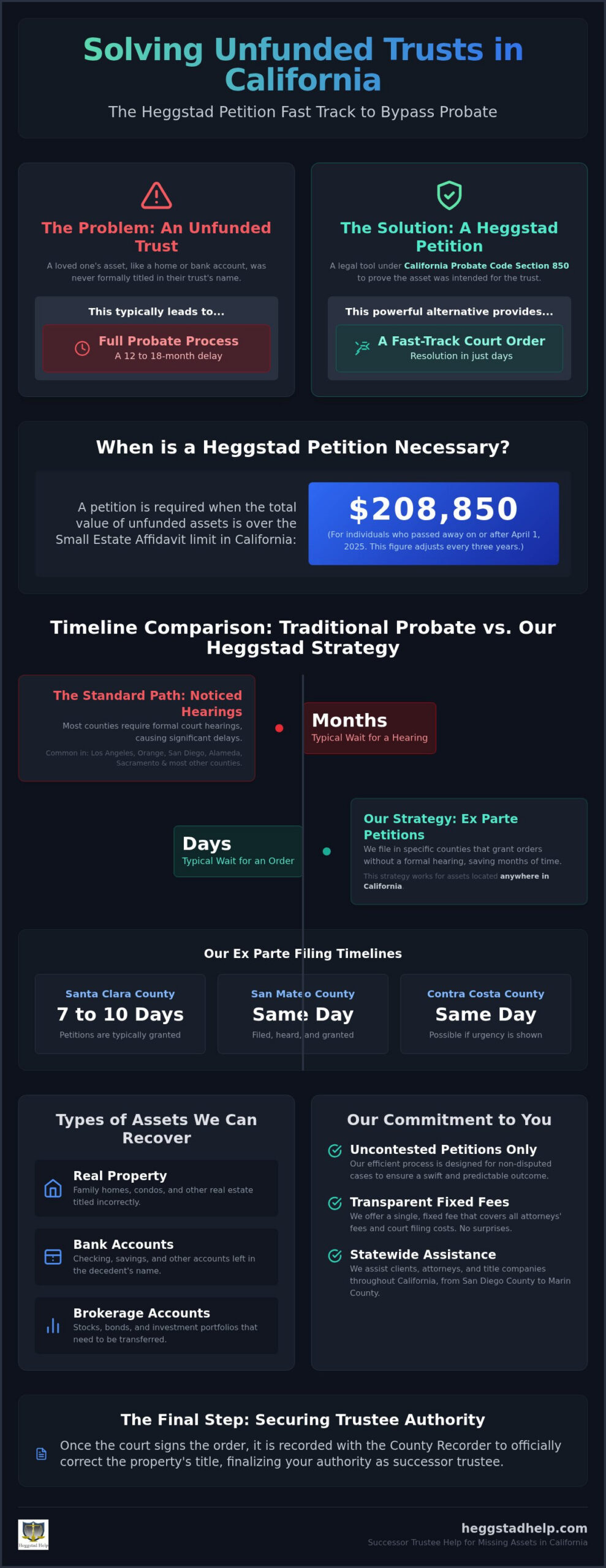
Petition to Confirm CA Trust Assets: 2026 Heggstad Guide

Imagine the relief of finding a trust, only to realize the family home was never legally transferred into it. It’s a common discovery that often…

Imagine the relief of finding a trust, only to realize the family home was never legally transferred into it. It’s a common discovery that often leads to the fear of a long probate delay. You likely feel overwhelmed by the prospect of court hearings and mounting legal fees. Filing a petition to confirm trust assets California is often the most effective way to fix this unfunded trust issue without the burden of a full probate administration.

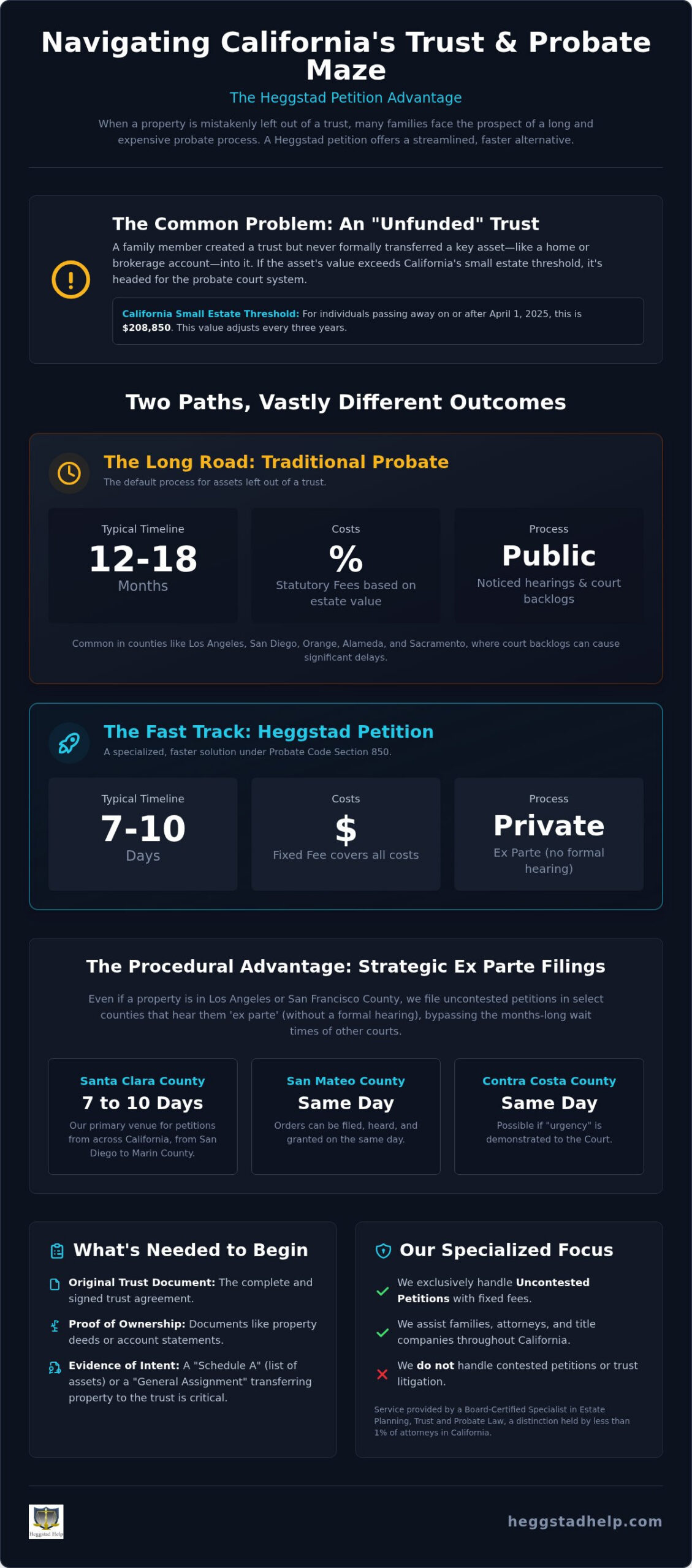
This guide explains how a Heggstad petition, which is a legal request under Probate Code Section 850, can quickly transfer missing assets. We’ll outline the fixed fees that cover both filing and attorney fees and small estate thresholds of $208,850 for deaths on or after April 1, 2025, and $239,700 for those after April 1, 2026. You will also learn why certain counties like Santa Clara can resolve cases in as little as 7 to 10 days while we assist families from Los Angeles County to Sacramento County.

Key Takeaways

  • Learn how a petition to confirm trust assets California families rely on under Probate Code Section 850 can transfer missing property into a trust without the delays of a full probate.
  • Discover how to secure court orders in just 7 to 10 days in Santa Clara County, which can also hear uncontested petitions for properties located in any other California county.
  • Understand the updated small estate thresholds of $208,850 for those dying on or after April 1, 2025, and $239,700 for those dying on or after April 1, 2026.
  • Benefit from fixed fees that cover both filing fees and attorney fees for uncontested Heggstad petitions, providing a predictable path for asset distribution throughout California.

What is a Petition to Confirm Trust Assets in California?

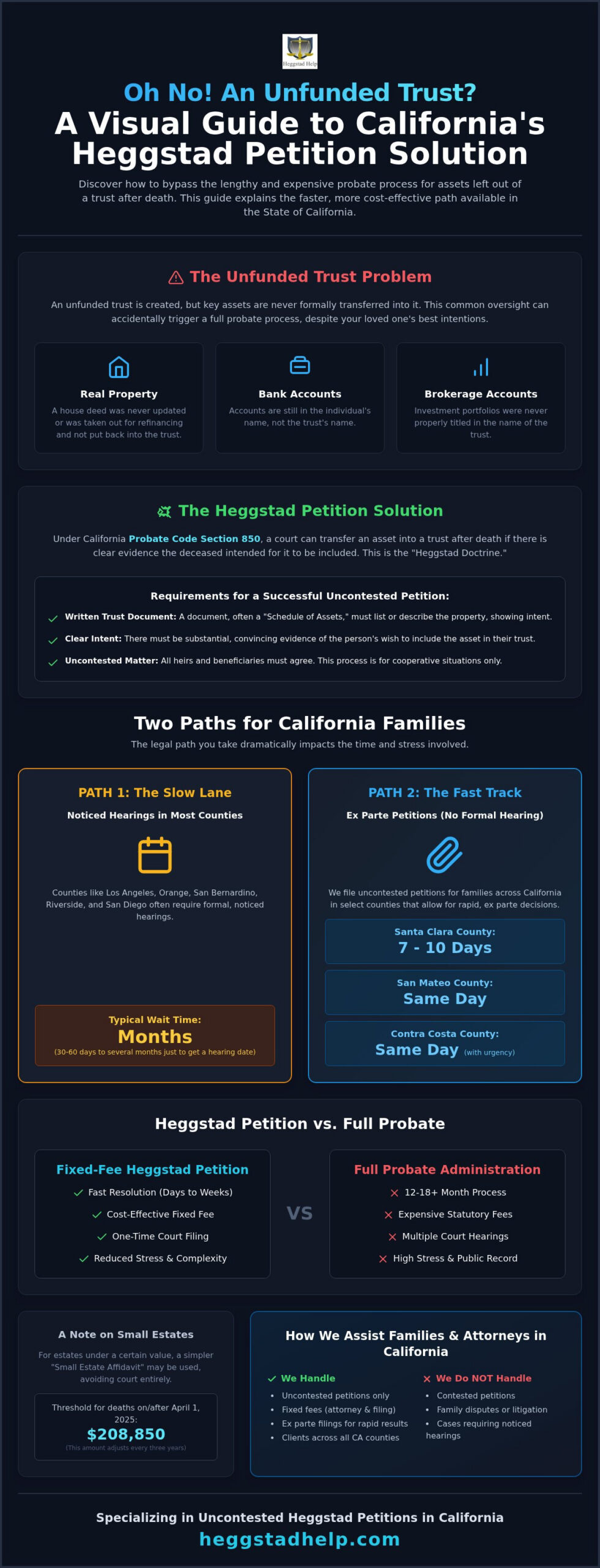
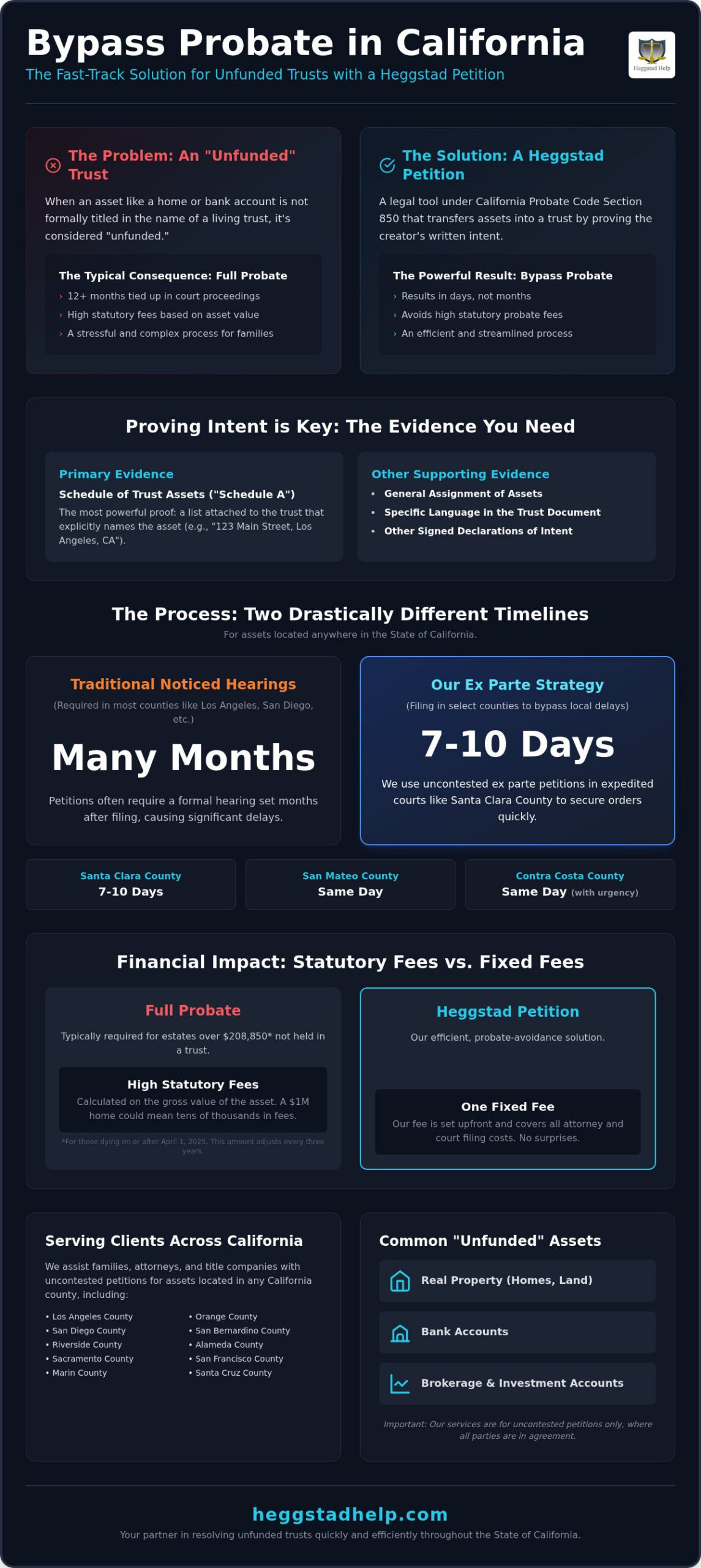
A Heggstad petition is a specialized legal request filed under Probate Code Section 850 to confirm that a specific asset belongs to a trust. This procedure is essential when a person creates a trust but forgets to officially transfer a property title or financial account into it. The landmark case Estate of Heggstad established that clear written intent can sometimes be enough for a judge to rule that an asset is trust property. A Heggstad petition is the primary remedy for unfunded trusts in California.

By using this petition to confirm trust assets California families can avoid the heavy burden of full probate. Traditional probate cases in Alameda County or San Francisco County often take over a year to resolve. In contrast, this petition allows successor trustees to correct title errors efficiently. We provide these services to families, attorneys, and title companies throughout California with fixed fees that cover both filing fees and attorney fees for uncontested matters. Please note that we don’t handle contested petitions.

The Legal Basis: Probate Code Section 850

Under Probate Code Section 850(a)(3), the court has the authority to issue an order confirming title to property even if the deed was never recorded in the name of the trust. This is a vital alternative to full probate administration in Los Angeles County, Orange County, or San Bernardino County. Petitions in those counties often require noticed hearings (formal court dates set by the judge) and can take many months to be heard. However, uncontested Heggstad petitions from those counties can be heard ex parte (without a formal hearing) in Santa Clara County and are often decided within 7 to 10 days of filing. This process is a significant advantage for clients in San Diego County, Riverside County, or Sacramento County who need to resolve title issues quickly.

Requirements for a Successful Heggstad Petition in California

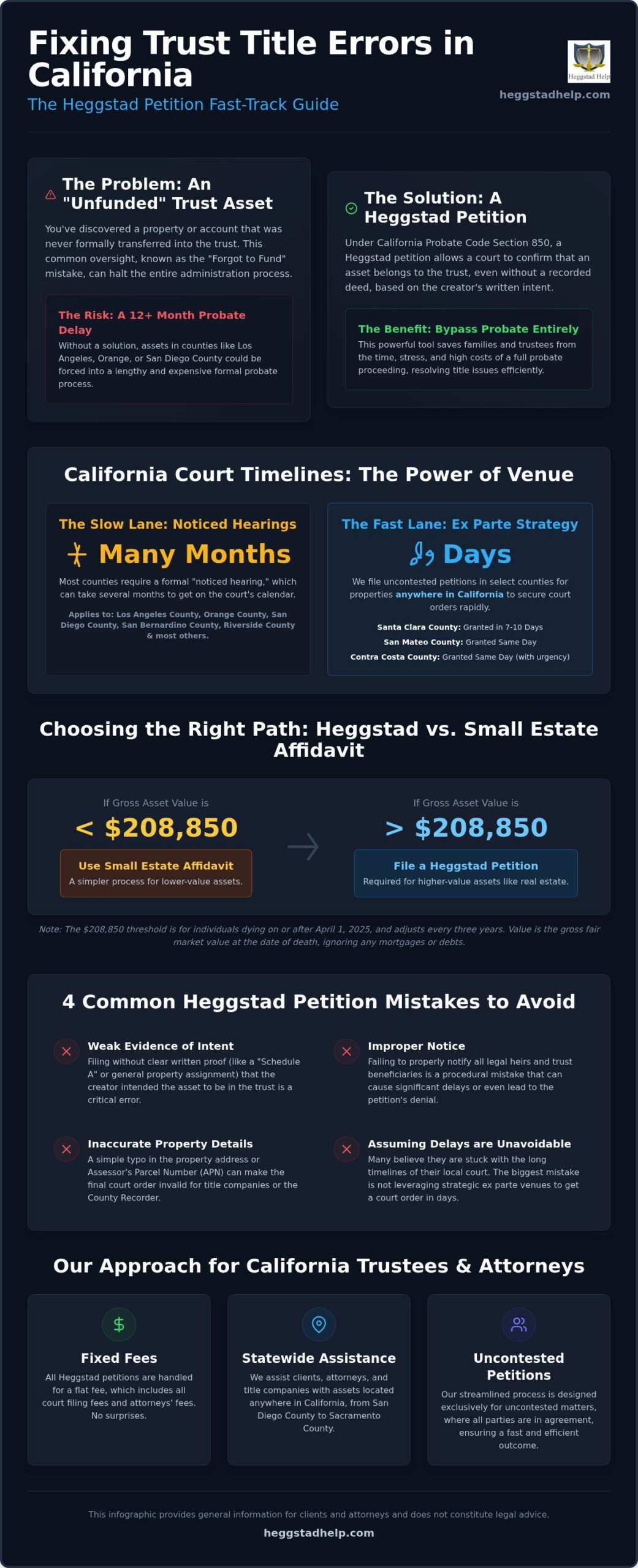
To succeed with a petition to confirm trust assets California courts require specific documentation and clear evidence. First, you must identify the asset with absolute precision. For real property in San Diego County or Riverside County, this involves providing the full legal description rather than just a street address. Second, you should verify if the asset value warrants a petition. For individuals dying on or after April 1, 2025, the small estate threshold is $208,850, and for those dying on or after April 1, 2026, it increases to $239,700. If the asset falls below these amounts, a Small Estate Affidavit might be a simpler alternative. Finally, remember that specialized firms like ours focus on efficiency; we don’t handle contested or litigated trust matters.

Proving the Trust Maker’s Intent

Proving intent is the core of any filing under California Probate Code § 850. A general statement of intent in the trust document is often sufficient to show that the creator wanted their property held in trust. You can find more details in this guide to recovering missing trust assets in California. Common evidence used to support these claims includes:

  • A comprehensive "Schedule of Assets" listing the specific property.
  • Unsigned deeds or recent brokerage statements showing the owner’s name.
  • A "pour-over" will that directs all assets into the trust upon death.

We help families and attorneys in Alameda County and Santa Cruz County gather this evidence to secure an order quickly. Our fixed fees cover both filing fees and attorney fees, ensuring you have a clear path to resolution. If your case is uncontested, our specialist team can help you navigate the process with calm competence.

Petition to Confirm CA Trust Assets: 2026 Heggstad Guide

Filing Timelines and Strategy in California Counties

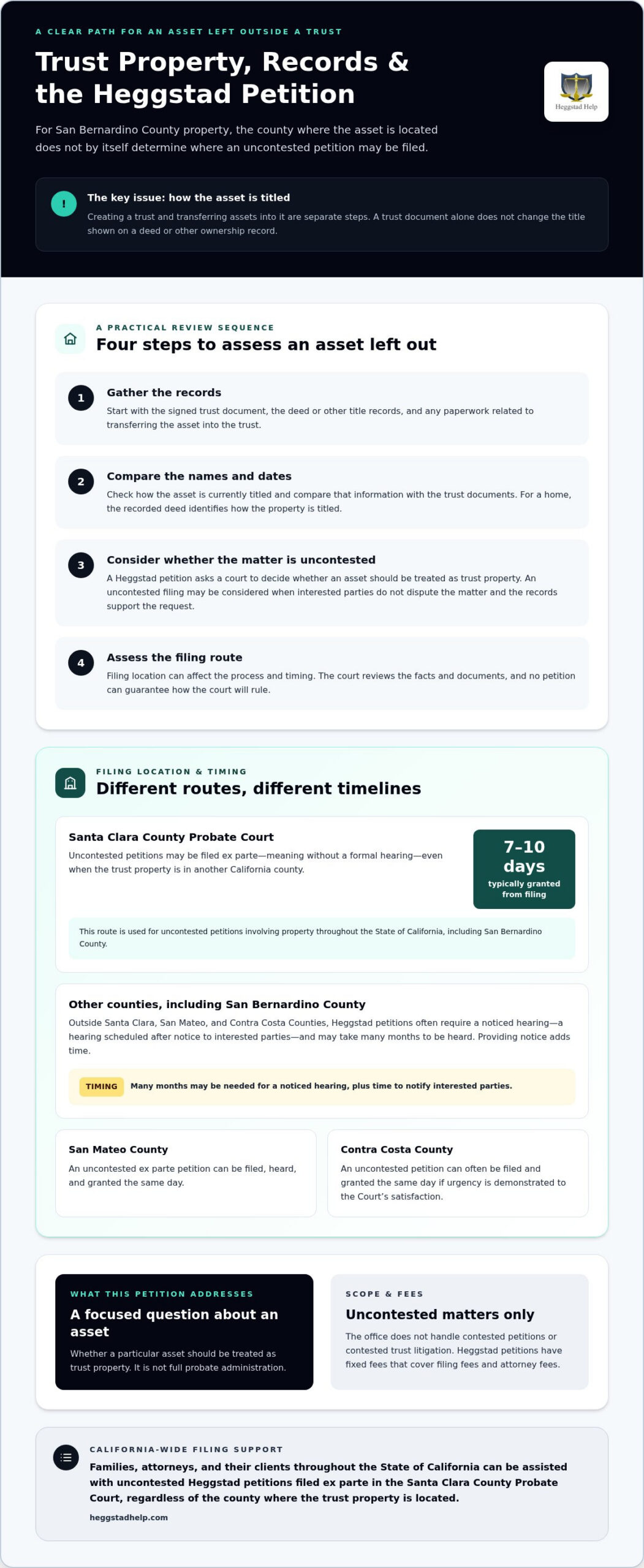
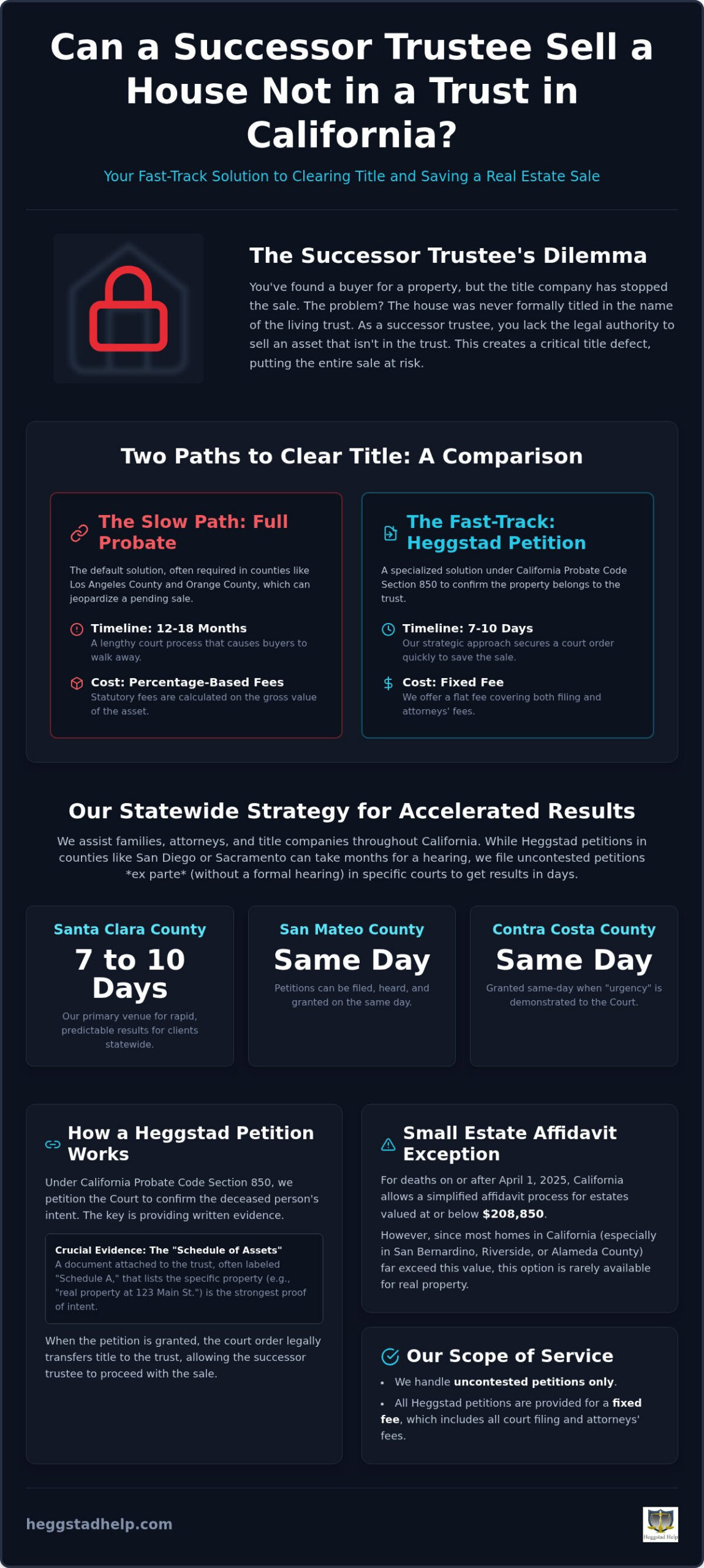
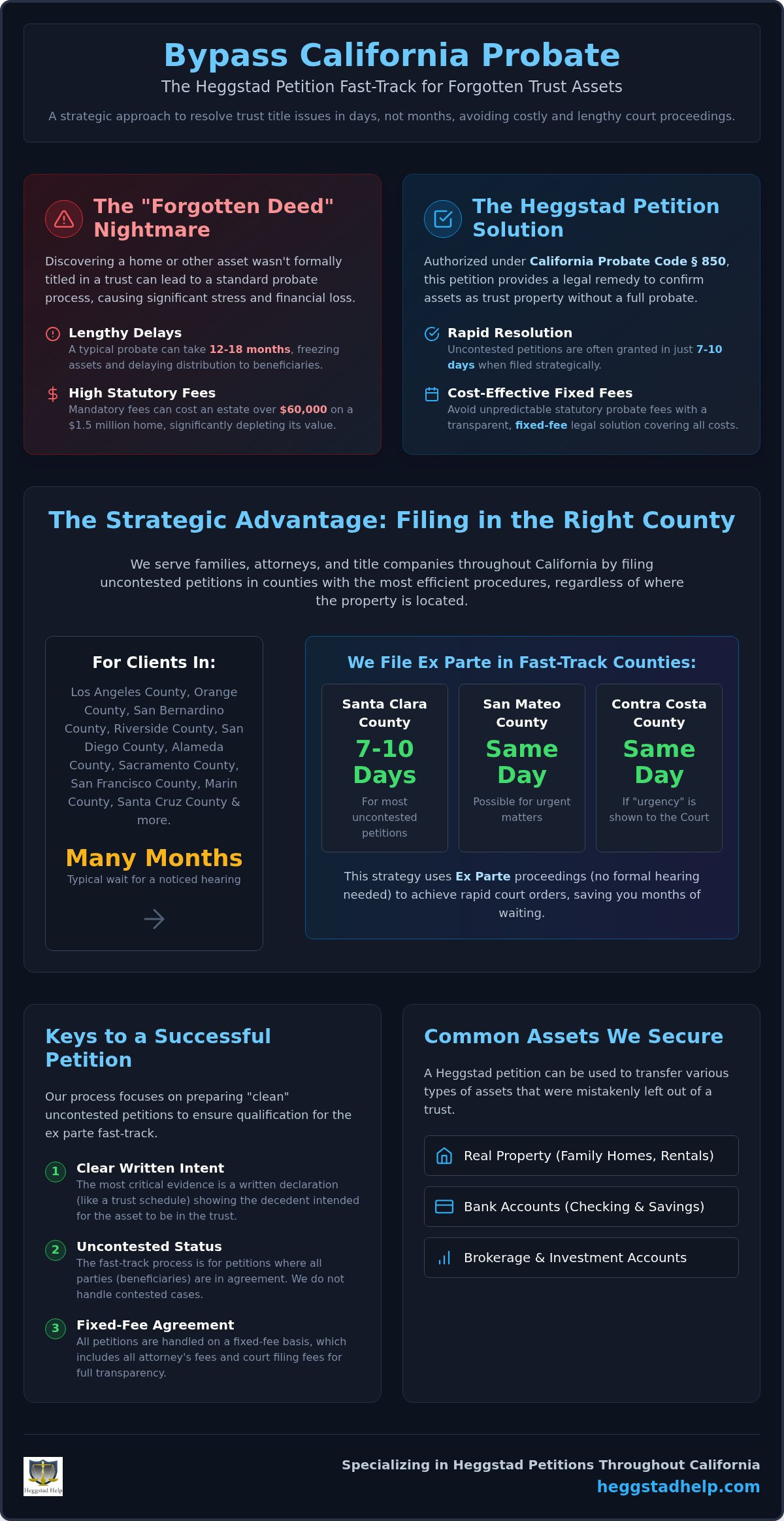
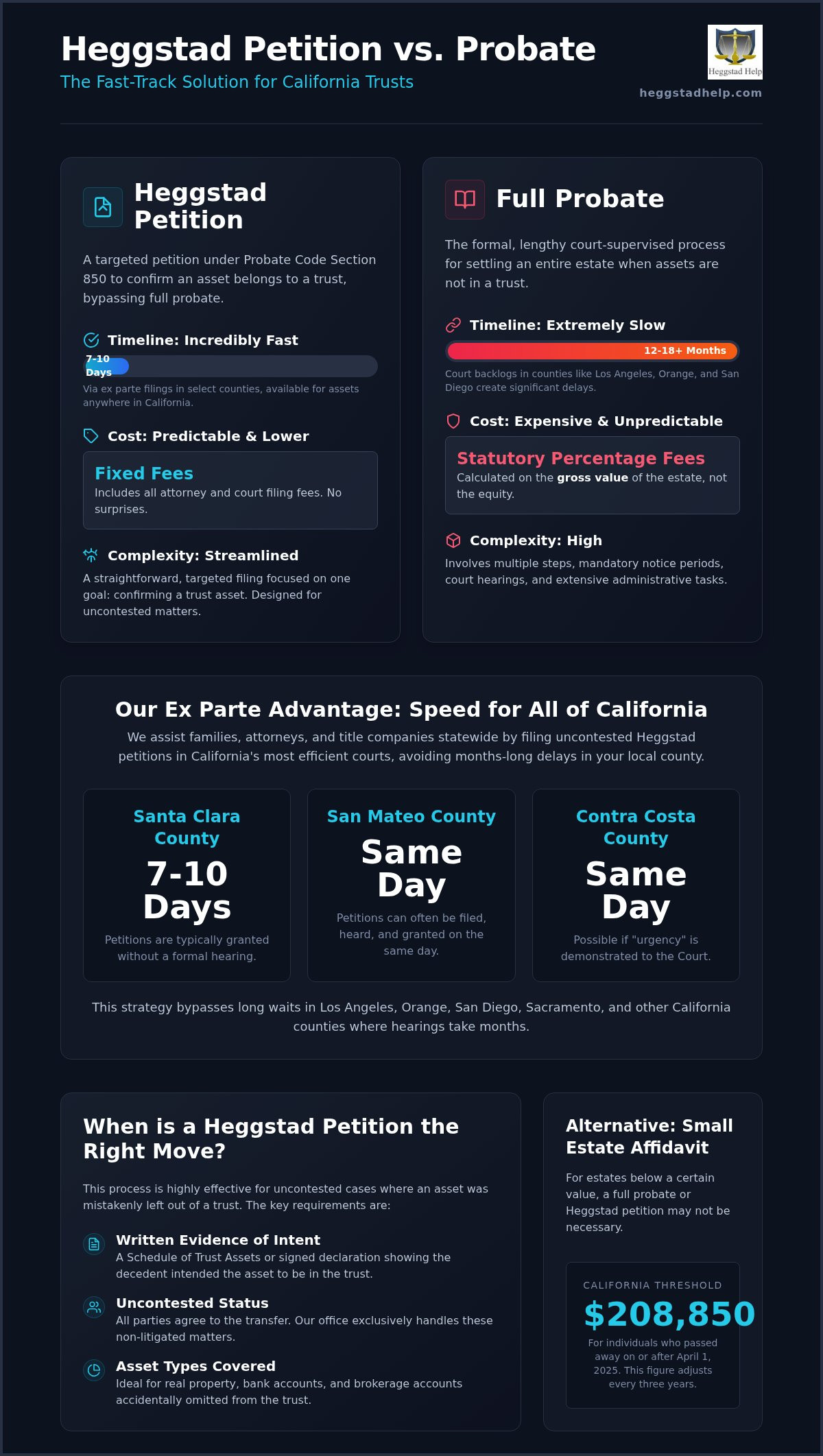
Speed varies significantly depending on the venue where you file. In Santa Clara County, uncontested petitions are typically granted ex parte (without a formal hearing) in 7 to 10 days. San Mateo County offers even faster results; petitions can often be filed, heard, and granted on the same day. For properties in Contra Costa County, same-day grants are possible if you demonstrate "urgency" to the Court’s satisfaction. This efficiency makes these Northern California courts a strategic choice for resolving title issues.

A strategic petition to confirm trust assets California families rely on often involves choosing the most efficient court. Even if the asset is located in Sacramento County or San Francisco County, an uncontested Heggstad petition can be heard ex parte in Santa Clara County. This approach typically results in a decision within 7 to 10 days of filing, bypassing the local backlogs that frequently plague other jurisdictions. We assist attorneys, title companies, and clients throughout California with these specialized filings.

Navigating Delays in Southern California and the Central Valley

In Los Angeles County or San Bernardino County, the court system is often heavily burdened. A noticed Heggstad petition hearing in these areas can take many months to be heard. By working with a specialist who understands how to utilize ex parte filings in Northern California, you can avoid these exhausting delays. We provide this specialized assistance to families in Orange County, Riverside County, and San Diego County to ensure assets are transferred without unnecessary waiting periods.

Our office offers cost certainty through fixed fees that cover both filing fees and attorney fees. While we don’t handle contested cases, we ensure a smooth path for uncontested matters in Marin County, Alameda County, and Santa Cruz County. If a noticed hearing is required, it’s typically set 30 to 60 days after filing, plus time for notice, though some counties take several months longer. This methodical approach helps you move from broad legal complications to a specific, timely resolution.

Take Control of Your Trust Distribution Today

Securing a petition to confirm trust assets California doesn’t have to be a stressful or lengthy ordeal. By utilizing Probate Code Section 850, you can bypass the complexities of a full probate and move forward with confidence. Whether your property is in Los Angeles County or San Diego County, you can benefit from the efficient ex parte procedures available in Northern California. Our Board-Certified Specialist provides fixed fees that cover all filing and attorney costs, ensuring you have total price certainty. We assist families and attorneys throughout the state to resolve these title issues quickly and effectively. If you’re ready to clear the path for your beneficiaries, we’re here to guide you through every step. Get fixed-fee help for your Heggstad petition in California today and rest easy knowing your family’s legacy is secure.

Frequently Asked Questions

How long does a Heggstad petition take in California?

The timeline for a Heggstad petition depends on the county and the specific hearing type required. In Santa Clara County, uncontested petitions are typically granted in 7 to 10 days, while San Mateo County often grants them the same day. While a noticed hearing in many counties can take several months, uncontested petitions from any California county can be heard ex parte (without a formal hearing) in Santa Clara County for a faster resolution.

What are the costs for a petition to confirm trust assets in California?

We provide Heggstad petition services throughout California using a fixed-fee model that ensures predictable costs. These fixed fees cover both the court filing fees and the attorney fees from the start. This approach helps families in San Bernardino County and Riverside County avoid the financial uncertainty of traditional hourly billing. It’s important to remember that our office specializes in uncontested matters and doesn’t handle litigated trust cases.

Can I file a Heggstad petition if the asset is a house in Los Angeles County?

Yes, you can use a petition to confirm trust assets California courts authorize to transfer real property located in Los Angeles County. While a noticed hearing in Los Angeles can take many months to be heard, we can often file uncontested petitions ex parte in Santa Clara County to secure an order in 7 to 10 days. We assist attorneys, title companies, and families throughout Southern California with these specialized filings.

What is the small estate threshold for a Small Estate Affidavit in California for 2026?

The small estate threshold for a Small Estate Affidavit is $208,850 for those dying on or after April 1, 2025, and $239,700 for those dying on or after April 1, 2026. If the value of the missing trust assets exceeds these specific limits, a Heggstad petition is often the most efficient way to avoid a full probate. This process allows successor trustees to distribute assets according to the trust maker’s original intent.

Robert P. Bergman, Attorney at Law

Article by

Robert P. Bergman, Attorney at Law

Attorney Robert P. Bergman ("Bob Bergman") has been a Board-Certified Specialist in Estate Planning, Trust and Probate Law since 2011, as certified by the California State Bar Board of Legal Specialization. For several years, Bob has assisted families and the clients of other attorneys with obtaining court orders through Heggstad petitions to avoid the time and expense of Probate administration. Bob is friendly, very approachable, and believes in explaining complex legal topics in clear ordinary language so that his clients understand exactly what they're doing and why they're doing it.
Bob is often able to assist clients who are in other counties than his home county of Santa Clara through his approach to Heggstad petitions.

Disclaimer

This article is for informational purposes only. Nothing in this article is intended to replace legal advice from a competent attorney or be considered legal guidance for anybody's specific legal situation. Nobody should rely on information in this article in making legal decisions without such consultation.


Transferring Assets to a Trust After Death in California: The 2026 Heggstad Guide

You just discovered that your loved one’s home in Los Angeles or Orange County was never formally deeded into their trust. It’s a heavy realization…

You just discovered that your loved one’s home in Los Angeles or Orange County was never formally deeded into their trust. It’s a heavy realization that brings the fear of a year-long probate. We understand the stress of managing an estate while facing title errors, but transferring assets to a trust after death shouldn’t feel like an impossible hurdle. Using Probate Code Section 850 (the statute allowing for Heggstad petitions), we can often fix these errors without a full probate administration. This guide outlines how families from San Diego to Alameda use this procedure to secure assets. You’ll learn how uncontested petitions from any county can be heard ex parte in Santa Clara County and granted in 7 to 10 days. Whether you face the $208,850 limit for deaths occurring on or after April 1, 2025, or the $239,700 limit for deaths occurring on or after April 1, 2026, this fixed-fee path provides a clear resolution.

Key Takeaways

  • Learn how a Heggstad petition, governed by Probate Code Section 850, can legally move real estate and accounts into a trust after a loved one passes, bypassing the standard year-long probate process.
  • Discover how to avoid long court delays in counties like Los Angeles, Orange, San Diego or Riverside by filing uncontested petitions in Santa Clara County, where court orders are typically granted in just 7 to 10 days.
  • Identify if you can use a simplified affidavit or require a court order by checking the small estate thresholds of $208,850 for deaths on or after April 1, 2025, and $239,700 for deaths on or after April 1, 2026.
  • Gain peace of mind regarding transferring assets to a trust after death with fixed-fee legal services that cover both filing and attorney fees for families and title companies throughout California.

Understanding the Process of Transferring Assets to a Trust After Death

When a loved one passes away, the successor trustee typically steps in to manage assets already held in the trust. This process, often referred to as trust administration, involves following the specific instructions left by the decedent. However, complications arise when a home or bank account was never formally deeded or retitled. These "forgotten" assets are common funding mistakes, often caused by simple oversight or technical errors during the initial setup. Understanding Trusts and how they function is the first step in realizing that a trust doesn’t necessarily fail just because a deed is missing.

In legal terms, transferring assets to a trust after death when title correction is required means proving to the court that the creator intended for the property to be included. We look for written evidence of this intent, such as a "Schedule A" (the list of assets usually attached to the back of a trust) or a "General Assignment" document. If these documents exist, we can often avoid a full probate. Our office helps families in Los Angeles, Orange, and San Bernardino Counties navigate these Heggstad petitions to ensure the estate is settled efficiently and correctly.

The Small Estate Threshold in California for 2026

If the "left out" assets are below a certain value, you might avoid court entirely using procedures outlined in the Probate Code. For deaths occurring on or after April 1, 2025, the Small Estate Affidavit threshold is $208,850. This limit increases to $239,700 for deaths occurring on or after April 1, 2026. If the total value of assets outside the trust exceeds these specific limits, a formal court petition becomes necessary. Without a Heggstad petition, these larger assets would be forced into a standard probate process that can often last 12 to 18 months.

Recovering ‘Forgotten’ Assets Using Probate Code Section 850 in California

The Heggstad Petition, named after the landmark case Estate of Heggstad, provides a specialized path for transferring assets to a trust after death without the burden of a full probate. Under Probate Code Section 850, the court has the authority to confirm that a property belongs to a trust even if the title was never formally updated. This procedure simplifies transferring assets to a trust after death by focusing on the decedent’s intent rather than technical deed errors. While a full probate often lasts 12 to 18 months and involves public filings, a Heggstad petition is faster, more private, and considerably more cost-effective. If you’re managing a trust where assets were left out, reading about Successor Trustee Duties for an Unfunded Trust in California can help you understand your legal obligations during this time.

Eligibility Requirements for a Heggstad Petition

To succeed, you must provide written evidence showing the decedent intended to include the asset in their trust. This evidence often includes a "Schedule A" (the list of assets attached to the trust) or a general assignment of assets. This process works for various holdings, including real property (houses), brokerage accounts, and business interests. Since every trust is unique, you should consult a specialist to review your specific trust language before filing. Our office assists families, attorneys, and title companies throughout the entire state of California, including those in Riverside and San Bernardino. All Heggstad petitions are handled with fixed fees covering both filing and attorney fees. This is especially helpful when assets exceed the small estate thresholds of $208,850 for deaths on or after April 1, 2025, and $239,700 for deaths on or after April 1, 2026. If you’re struggling with an incomplete estate, you can contact us to review your trust documents to see if you qualify.

Transferring Assets to a Trust After Death in California: The 2026 Heggstad Guide

Strategic Filing: How to Accelerate Asset Transfers Throughout California

Navigating the court system for transferring assets to a trust after death requires understanding local procedural nuances. Most counties, such as Los Angeles, Orange, or San Diego, typically require noticed hearings. These hearings usually take 30 to 60 days plus the time needed for legal notice; contested petitions take even longer. However, we utilize ex parte orders (legal requests decided without a formal hearing) to expedite the process. To provide financial clarity, we handle these petitions with a fixed fee that covers both court filing and attorney fees for clients and title companies statewide. For a deeper look at the paperwork involved, see our guide on Heggstad Petition Filing in California.

The Santa Clara County Advantage for Successor Trustees

While some counties take months, Santa Clara County typically grants uncontested ex parte petitions in just 7 to 10 days. This is a vital strategy for families in Riverside or Sacramento because uncontested petitions from any California county can often be heard ex parte in Santa Clara. This approach bypasses the lengthy timelines often described in the California Courts probate guide. If you can demonstrate "urgency" in Contra Costa County or file in San Mateo County, petitions are often granted the same day. This speed is essential when real estate sales are pending or when assets exceed the small estate limits of $208,850 for deaths occurring on or after April 1, 2025, and $239,700 for deaths occurring on or after April 1, 2026. You don’t have to wait for a distant hearing date when a faster path exists.

Secure Your Family’s Legacy Without the Probate Delay

Discovering that a home or account was left out of a trust doesn’t have to lead to a 12 month probate process. By utilizing Probate Code Section 850, we provide a streamlined path for transferring assets to a trust after death. This is vital if the estate exceeds the Small Estate Affidavit thresholds of $208,850 for deaths occurring on or after April 1, 2025, or $239,700 for deaths occurring on or after April 1, 2026. Whether you’re in Los Angeles, Riverside, or Sacramento, you can avoid long court delays by leveraging our specialized filing strategies.

Robert P. Bergman is a California-Licensed Attorney and Board-Certified Specialist who knows how to navigate these technical hurdles. We offer fixed-fee pricing and a proven 7 to 10 day turnaround in Santa Clara County for uncontested petitions. Get a Fixed-Fee Heggstad Petition Consultation Today and move forward with confidence. Let us help you finish this process with calm competence and efficiency.

Frequently Asked Questions

Can I move a house into a trust after the owner has died?

Yes, you can legally move a house into a trust after the owner passes away by filing a Heggstad petition. This procedure, authorized by Probate Code Section 850, allows a judge to confirm the property belongs in the trust based on the decedent’s written intent. It effectively corrects the title without requiring a full probate administration, even if the deed was never formally recorded in the trust’s name.

How long does a Heggstad Petition take in California?

The timeline varies significantly by county. In Santa Clara County, uncontested ex parte petitions are typically granted in 7 to 10 days. San Mateo and Contra Costa Counties can often grant these orders the same day if urgency is shown. In other counties like Los Angeles or San Diego, a noticed hearing usually takes 30 to 60 days; however, we often file in Santa Clara to accelerate the process.

What is the cost of filing a Heggstad Petition in 2026?

We handle Heggstad petitions using a fixed-fee model that includes both attorney fees and court filing costs. This approach provides financial certainty and eliminates the hidden expenses often found in traditional hourly billing.  Our comprehensive service covers all procedural requirements to ensure the final court order is obtained without unexpected financial surprises or hourly billing anxiety.

Does a Heggstad Petition avoid the need for a full probate?

Yes, a successful Heggstad petition completely bypasses the formal probate court system. Instead of enduring a 12 to 18 month process with multiple hearings and statutory fees, this petition targets specific "left out" assets. It’s a highly efficient tool for transferring assets to a trust after death, provided there is clear written evidence that the creator intended for those assets to be trust property.

What happens if a property was left out of a trust in Los Angeles County?

If a property was left out in Los Angeles County, the local court typically requires a noticed hearing that can take several months. However, we strategically file uncontested petitions from Los Angeles in Santa Clara County, where they can be decided within 7 to 10 days. This allows families to resolve title issues quickly regardless of where the real estate is located within the state of California.

Is an attorney required for transferring assets to a trust after death?

While you aren’t legally required to hire an attorney, the technical requirements of the Probate Code make professional guidance essential. This is critical if the estate exceeds the Small Estate Affidavit threshold of $208,850 for deaths on or after April 1, 2025, or the $239,700 limit for deaths on or after April 1, 2026. A specialist ensures your petition for transferring assets to a trust after death is granted.

Robert P. Bergman, Attorney at Law

Article by

Robert P. Bergman, Attorney at Law

Attorney Robert P. Bergman ("Bob Bergman") has been a Board-Certified Specialist in Estate Planning, Trust and Probate Law since 2011, as certified by the California State Bar Board of Legal Specialization. For several years, Bob has assisted families and the clients of other attorneys with obtaining court orders through Heggstad petitions to avoid the time and expense of Probate administration. Bob is friendly, very approachable, and believes in explaining complex legal topics in clear ordinary language so that his clients understand exactly what they're doing and why they're doing it.
Bob is often able to assist clients who are in other counties than his home county of Santa Clara through his approach to Heggstad petitions.

Disclaimer

This article is for informational purposes only. Nothing in this article is intended to replace legal advice from a competent attorney or be considered legal guidance for anybody's specific legal situation. Nobody should rely on information in this article in making legal decisions without such consultation.

Heggstad Petition Timeline in California: How Long Does the Process Take?

What if you could bypass a year-long probate delay and secure an inheritance in just a few days? Families often assume that an unfunded trust, where…

What if you could bypass a year-long probate delay and secure an inheritance in just a few days? Families often assume that an unfunded trust, where a home was never formally transferred, leads to 18 months of delays. It’s stressful to discover property was left out of a trust, but the Heggstad petition timeline California offers a faster path. A Heggstad petition (a petition under Probate Code Section 850) allows a judge to transfer assets into a trust without a full probate.

This guide to the Heggstad Petition Timeline in California explains how to find a resolution in 30 to 60 days. You’ll learn why counties like Santa Clara offer ex parte orders (rulings without a formal hearing) in 7 to 10 days. We cover small estate thresholds, including the $208,850 limit for deaths on or after April 1, 2025, and the $239,700 limit for deaths on or after April 1, 2026. Whether you’re in Los Angeles, Orange, or San Diego, we provide fixed-fee services to find the fastest filing venue.

Key Takeaways

  • Learn how a Heggstad petition in California, filed under Probate Code Section 850, typically resolves in 30 to 60 days compared to 18 months for a full probate.
  • Discover how the Heggstad petition timeline California can be reduced to 7 to 10 days through ex parte filings in Santa Clara, San Mateo, or Contra Costa Counties.
  • Understand why uncontested petitions from counties like Orange or San Diego are often filed in Santa Clara to avoid long court backlogs.
  • See how fixed-fee filing services provide a predictable path for title correction while serving clients and attorneys throughout the entire state.

How Long Does a Heggstad Petition Take in California?

A Heggstad petition (a request under Probate Code Section 850) generally takes between 30 and 60 days for a noticed hearing. This timeline is significantly shorter than full probate administration, which typically lasts 12 to 18 months in California. The Heggstad petition timeline California is heavily influenced by court-specific rules regarding notice requirements. If a court requires a formal noticed hearing, you must provide a minimum of 30 days’ notice to all interested parties. In busy jurisdictions like Los Angeles, Riverside, or San Francisco, court calendars often push these hearing dates out even further.

Strategic filing changes the pace. In Santa Clara County, uncontested petitions are typically granted in 7 to 10 days. San Mateo and Contra Costa Counties can often grant these orders the same day, provided urgency is demonstrated in Contra Costa. While other counties like San Diego, Alameda, or Sacramento often require noticed hearings that take many months, uncontested petitions from those areas can instead be heard ex parte (without a formal hearing) in Santa Clara County and decided within 7 to 10 days. We provide these services for attorneys and families statewide with fixed fees covering both filing and attorney fees.

Heggstad vs. Small Estate Affidavit Thresholds

It’s vital to verify if your assets exceed the California small estate limits before proceeding. For deaths occurring on or after April 1, 2025, the threshold is $208,850. For deaths occurring on or after April 1, 2026, the limit increases to $239,700. If the asset value exceeds these specific figures, a petition is the most efficient way to bypass probate with a Heggstad petition. This is especially helpful for families in Marin, Santa Cruz, or San Bernardino dealing with real estate that was never deeded into a trust.

Factors That Influence the California Heggstad Petition Timeline

The specific California county where you file is the primary factor in determining your wait time. Noticed hearings (proceedings where legal notice is sent to all heirs and creditors) require a minimum of 30 days notice to all interested parties. This procedural requirement often pushes court dates out 60 days or more in busy counties like Los Angeles, Orange, or San Francisco. If a petition is contested, meaning an heir or creditor objects to the transfer, it will move the case into litigation. This shift can add months or years to the Heggstad petition timeline California. Understanding the mechanics of California Probate Code Section 850 in California is essential for managing these expectations.

The Santa Clara Advantage for Faster Results

Speed often depends on whether a court allows an ex parte order (an expedited ruling issued without a formal hearing). In Santa Clara, San Mateo, and Contra Costa Counties, uncontested petitions are regularly handled this way. Petitions in Santa Clara County are typically granted in just 7 to 10 days, while San Mateo can often be granted the same day. Families in Alameda, Sacramento, or Riverside don’t have to wait for their local court’s multi-month backlog. Instead, uncontested petitions from those counties can be heard ex parte in Santa Clara County and decided within 7 to 10 days. We provide these services to attorneys, title companies, and clients throughout the entire state of California. All petitions are handled with fixed fees covering both filing and attorney fees to help you resolve title issues quickly through these expedited venues.

Heggstad Petition Timeline in California: How Long Does the Process Take?

Accelerating Your Asset Transfer with Expert Filing

HEGGSTAD HELP provides specialized services to ensure your Heggstad petition filing is completed accurately to avoid unnecessary procedural delays. Our office assists families, attorneys, and title companies in Orange, San Bernardino, Marin, and Santa Cruz Counties by leveraging the most efficient filing venues available. We operate on a fixed-fee basis that covers both the court filing fees and attorney fees, ensuring you face no surprise costs during the legal process. Working with a Board-Certified Specialist ensures every Probate Code Section requirement is met, which prevents the common court rejections that can reset the Heggstad petition timeline California.

Step-by-Step Timeline from Filing to Final Order

A structured approach is the best way to ensure a fast resolution. While a standard probate can drag on for 18 months, our streamlined process aims for a 30-day window. When you prioritize speed, the Heggstad petition timeline California follows a clear, methodical progression:

  • Day 1-5: We focus on the preparation of the petition. This involves gathering necessary trust documents and property deeds to build a strong legal case.
  • Day 6-15: We file the petition ex parte (an expedited request) in Santa Clara or San Mateo. This strategic move allows for rapid approval without the multi-month wait times found in other counties.
  • Day 16-30: Once the judge signs the court order, we record the new deed. This final step completes the trust asset title correction in California, moving the property into the trust where it belongs.

This efficiency is available throughout the entire state. Even if the property is located in San Diego, Riverside, or Los Angeles, we can often utilize the faster processing times in Santa Clara to secure your inheritance quickly. This focused expertise turns a potentially overwhelming legal hurdle into a manageable, 30-day task.

Securing Your Trust Assets Without the Probate Delay

The Heggstad petition timeline California doesn’t have to be a source of stress. By choosing the right filing venue, you can bypass the standard 18-month probate process and fix title issues in as little as 7 to 10 days. Whether you are dealing with a property in San Bernardino or an unfunded trust in San Francisco, strategic filing in Santa Clara County offers a significant speed advantage. Our office brings over 40 years of experience and the expertise of a Board-Certified Specialist in Estate Planning, Trust and Probate Law to every case. We provide fixed-fee services for all 58 California counties, covering both filing and attorney fees to ensure total cost transparency. You don’t have to navigate these complex procedural hurdles alone. Get a Fixed-Fee Quote for Your Heggstad Petition today and take the first step toward a calm, efficient resolution for your family.

Frequently Asked Questions

How long does a Heggstad petition take in Santa Clara County?

Santa Clara County petitions are typically granted in 7 to 10 days. This rapid turnaround is possible because the court regularly handles uncontested petitions ex parte (without a formal hearing). This efficiency is a cornerstone of the Heggstad petition timeline California, allowing families to avoid the multi-month backlogs common in other counties. We frequently assist clients statewide by utilizing this expedited filing venue.

Can I file a Heggstad petition if the decedent died more than a year ago?

Yes, you can file a petition under Probate Code Section 850 regardless of how much time has passed since the death. There is no strict deadline for correcting trust titles. You should first confirm the asset value exceeds the Small Estate Affidavit limits of $208,850 for deaths starting April 1, 2025, and $239,700 for deaths starting April 1, 2026. If it does, a petition is necessary.

What happens if someone objects to the Heggstad petition timeline?

If an heir or creditor objects, the petition moves into a contested phase, which replaces the expedited timeline with formal litigation. This transition can add months or years to the process as the court requires evidence and testimony. Most cases we handle are uncontested, allowing us to maintain a predictable Heggstad petition timeline California by ensuring all legal requirements are satisfied before filing.

Is a Heggstad petition faster than a regular probate in Los Angeles?

A Heggstad petition is significantly faster than a traditional probate in Los Angeles, which often takes 12 to 18 months. While a noticed hearing in Los Angeles might take 60 days or more, it remains a more efficient choice. For the fastest resolution, we often file uncontested Los Angeles petitions in Santa Clara County to secure an order in just 7 to 10 days.

Robert P. Bergman, Attorney at Law

Article by

Robert P. Bergman, Attorney at Law

Attorney Robert P. Bergman ("Bob Bergman") has been a Board-Certified Specialist in Estate Planning, Trust and Probate Law since 2011, as certified by the California State Bar Board of Legal Specialization. For several years, Bob has assisted families and the clients of other attorneys with obtaining court orders through Heggstad petitions to avoid the time and expense of Probate administration. Bob is friendly, very approachable, and believes in explaining complex legal topics in clear ordinary language so that his clients understand exactly what they're doing and why they're doing it.
Bob is often able to assist clients who are in other counties than his home county of Santa Clara through his approach to Heggstad petitions.

Disclaimer

This article is for informational purposes only. Nothing in this article is intended to replace legal advice from a competent attorney or be considered legal guidance for anybody's specific legal situation. Nobody should rely on information in this article in making legal decisions without such consultation.
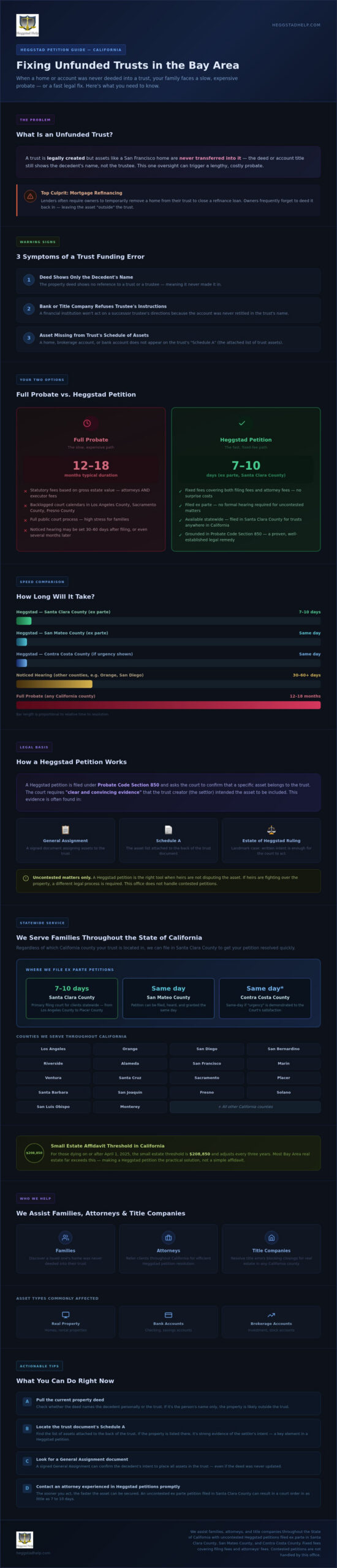
What Happens if a House is Not in a Trust When Someone Dies in California?

A missing deed doesn’t have to mean your family is trapped in probate court for the next year. You might feel overwhelmed discovering that a home was…

A missing deed doesn’t have to mean your family is trapped in probate court for the next year. You might feel overwhelmed discovering that a home was left out of a living trust, especially when facing the prospect of a 12 to 18 month delay. It’s a common frustration to see a trust exist but realize the deed remains in the individual’s name. Understanding what happens if a house is not in a trust when someone dies California is critical to protecting the estate from high statutory fees. This guide reveals how you can bypass a full probate through a Heggstad petition (a legal procedure under Probate Code Section 850 that asks a judge to recognize the asset as part of the trust). We’ll explain how to secure a fast court order to confirm trust ownership and why fixed-fee legal help is the most efficient path forward.

Key Takeaways

  • Understand that an “unfunded” house (an asset not properly deeded to the trust) remains part of the probate estate and cannot be transferred to beneficiaries until the title is legally corrected.
  • Learn how a Heggstad petition, filed under Probate Code Section 850, bypasses the 12 to 18 month probate process by asking a judge to confirm the home as trust property based on the decedent’s intent.
  • Discover how to secure a court order in as little as 7 to 10 days by filing ex parte (without a formal hearing) in Santa Clara County, a strategy available for properties located throughout the state.
  • Identify the specific legal steps to resolve what happens if a house is not in a trust when someone dies California, including how to use a “Schedule of Assets” to avoid high statutory probate fees.

When someone passes away, families often assume that having a trust document is enough to manage the estate. However, the legal reality changes significantly when the deed to a home was never transferred into the trust’s name. An unfunded trust is a trust that exists on paper but does not legally own the assets intended for it. In this scenario, the property is technically an "unfunded" asset that remains part of the decedent’s probate estate.

Understanding what happens if a house is not in a trust when someone dies California is vital because, without court intervention, the title cannot be transferred to beneficiaries by the successor trustee alone. The county recorder’s office still sees the individual as the owner, which usually triggers a mandatory full probate in California. We support families and attorneys across the state, including those in Los Angeles, Orange, and Riverside, who need to file Heggstad petitions to correct these title errors. The Probate process is the standard court procedure used to settle a person’s debts and distribute their remaining assets as governed by the California Probate Code.

The California Small Estate Threshold in 2026

While some smaller assets can be transferred using simplified procedures, real estate rarely qualifies. For deaths occurring on or after April 1, 2025, the Small Estate Affidavit threshold is $208,850, and for deaths occurring on or after April 1, 2026, the threshold increases to $239,700. Since most homes in California exceed these limits, a house usually requires more than a simple affidavit to transfer. Consider these points:

  • The house value is calculated at gross market value, not equity.
  • Successor trustees lack authority to sign deeds for property not officially owned by the trust.
  • Title companies won’t issue insurance without a court order or probate.

Avoiding Full Probate with a Heggstad Petition in California

A Heggstad petition, filed under Probate Code Section 850, is a specialized legal request that asks the court to confirm a house belongs in a trust based on the decedent’s clear intent. This is the primary solution for what happens if a house is not in a trust when someone dies California. Rather than suffering through a year of California probate, this procedure allows a judge to "transfer" the title retroactively. We regularly assist families in Los Angeles, Orange, and San Diego by securing these court orders. This process typically costs a fraction of statutory probate fees and concludes significantly faster than a full probate administration in California.

Strategic Filing: The Santa Clara County Advantage

Timing is everything when managing an estate. In Santa Clara County, uncontested Heggstad petitions are often granted ex parte (without a formal hearing) in just 7 to 10 days. Similarly, San Mateo and Contra Costa Counties can often grant these orders the same day, provided urgency is demonstrated in Contra Costa. While other counties like Riverside, San Francisco, or San Bernardino often require noticed hearings that take many months, we can often have those uncontested petitions heard ex parte in Santa Clara County and decided within 7 to 10 days. Knowing what happens if a house is not in a trust when someone dies California helps you choose the fastest path. Our firm provides ex parte court order services throughout the entire state of California using fixed fees that cover both filing and attorney fees.

What Happens if a House is Not in a Trust When Someone Dies in California?

How to Transfer Your House to the Trust After Death

Recovering a home for a trust requires a methodical approach. First, you must gather the original trust documents and any "Schedule A" (a list of assets intended to be held by the trust) that specifically names the house. While the California Courts Self-Help Guide to Probate outlines the standard path for estates, a Heggstad petition offers a specialized shortcut. You’ll need to engage a specialized Heggstad petition attorney in California to draft the legal petition and supporting declarations. This documentation proves to the court that the decedent intended the home to be trust property despite the title error.

Once the court reviews the evidence, it issues a signed order confirming the house is trust property. You then record this order with the County Recorder to update the title. Our firm handles these filings state-wide, assisting clients in Alameda, Sacramento, and Santa Cruz with fixed fees that cover both attorney time and court filing costs. This transparency is vital for understanding what happens if a house is not in a trust when someone dies California, as it provides a predictable path to resolution without the variable costs of a full probate.

Why Work with a California Board-Certified Specialist?

Robert P. Bergman is a Board-Certified Specialist in Estate Planning, Trust and Probate Law with decades of specialized experience. Choosing a specialist ensures your 850 petition in California is drafted to meet the specific requirements of local courts, whether you’re in San Francisco or Marin. We provide a steady, knowledgeable hand to reduce the stress of navigating the California Probate Code. Our expertise ensures your petition is accurate, increasing the likelihood of a swift, favorable outcome.

Take Control of Your Family’s Estate Recovery

Discovering that a deed was never recorded into a trust can feel like a legal roadblock, but it doesn’t have to lead to a year of court delays. By understanding what happens if a house is not in a trust when someone dies California, you can choose a faster path through a Heggstad petition. This process confirms the decedent’s intent and updates the title without the high costs of full probate. Robert P. Bergman, a Board-Certified Specialist in Estate Planning, Trust and Probate Law, helps families in Los Angeles, Orange, and San Diego secure ex parte orders in as little as 7 to 10 days through strategic filings in Santa Clara County. Ready to bypass the probate process? Get a Fixed-Fee Quote for Your Heggstad Petition today. You have the tools to protect your inheritance and we’re here to guide you every step of the way.

Frequently Asked Questions

Can I sell a house that was left out of a trust in California?

You cannot sell a house left out of a trust until the title is legally corrected. Most California homes exceed the Small Estate Affidavit threshold of $208,850 for deaths on or after April 1, 2025, and $239,700 for deaths on or after April 1, 2026. To address what happens if a house is not in a trust when someone dies California, you must file a Heggstad petition under Probate Code Section 850.

How much does a Heggstad Petition cost compared to full probate?

A Heggstad petition is significantly more cost-effective because it bypasses statutory probate fees. In a full probate, fees are calculated as a percentage of the gross estate value. For instance, a $1 million estate triggers roughly $46,000 in combined statutory fees for the attorney and executor. Our firm offers fixed fees for Heggstad petitions state-wide, providing a predictable and lower-cost alternative to the expensive probate process.

What happens if the house is not listed on a Schedule A?

You can still succeed even if the house isn’t on a Schedule A, provided other evidence of intent exists. A general assignment of all assets or specific trust language often suffices to prove the decedent’s wishes. Courts in counties like San Bernardino or Alameda look for clear and convincing evidence that the decedent meant for the property to be trust-owned, even if the deed was never recorded.

Is a Heggstad Petition possible if there is no written evidence of intent?

A Heggstad petition usually requires some form of written evidence to prove intent. While a Schedule A is standard, a signed "General Assignment" is often accepted. While counties like Riverside or San Diego often require noticed hearings taking many months, we can instead have uncontested petitions from those counties heard ex parte in Santa Clara County and decided within 7 to 10 days.

Robert P. Bergman, Attorney at Law

Article by

Robert P. Bergman, Attorney at Law

Attorney Robert P. Bergman ("Bob Bergman") has been a Board-Certified Specialist in Estate Planning, Trust and Probate Law since 2011, as certified by the California State Bar Board of Legal Specialization. For several years, Bob has assisted families and the clients of other attorneys with obtaining court orders through Heggstad petitions to avoid the time and expense of Probate administration. Bob is friendly, very approachable, and believes in explaining complex legal topics in clear ordinary language so that his clients understand exactly what they're doing and why they're doing it.
Bob is often able to assist clients who are in other counties than his home county of Santa Clara through his approach to Heggstad petitions.

Disclaimer

This article is for informational purposes only. Nothing in this article is intended to replace legal advice from a competent attorney or be considered legal guidance for anybody's specific legal situation. Nobody should rely on information in this article in making legal decisions without such consultation.

California Trust Funding Mistakes: A 2026 Checklist to Avoid Probate

Did you know that 40% of do-it-yourself trusts in California are unfunded? Discovering a family home was never titled in the trust is stressful, but…

Did you know that 40% of do-it-yourself trusts in California are unfunded? Discovering a family home was never titled in the trust is stressful, but California trust funding mistakes don’t have to lead to a 12-month probate. Whether the estate exceeds the $208,850 threshold for deaths on or after April 1, 2025, or the $239,700 limit for deaths on or after April 1, 2026, legal remedies exist.

This guide explains how a Heggstad petition in California (a filing under Probate Code Section 850) transfers assets into a trust quickly. While Los Angeles, Orange County, or San Diego courts often require months of waiting, we help families and attorneys statewide by filing ex parte (without a formal hearing). Orders in Santa Clara County take 7 to 10 days, while San Mateo and Contra Costa can be granted the same day if urgency is shown. We resolve these errors with fixed fees covering both filing and attorney fees.

Key Takeaways

  • Identify common California trust funding mistakes like failing to record a Grant Deed for real property or neglecting to update retirement account beneficiaries.
  • Learn how a Heggstad petition, filed under Probate Code Section 850, can confirm trust ownership of assets even if the formal title transfer was never completed.
  • Discover how to bypass the standard 12-month probate process by using specialized ex parte court order services that can be granted in as little as 7 to 10 days.
  • Understand how to use fixed-fee legal services to correct title errors for properties located in any California county, including Los Angeles, Orange, and San Diego.

Identifying Common Trust Funding Mistakes in California

Many families believe that signing a trust document is the final step in their estate plan. However, what it means to fund a trust actually involves the physical transfer of title from your individual name into the name of the trust. Common California trust funding mistakes occur when this administrative step is overlooked. For example, you might acquire a new brokerage account or a second home in Riverside but forget to update the ownership records. Relying solely on a "Schedule A" (the list of assets often attached to a trust) is a risky strategy because banks and County Recorders require a formal change in legal title to recognize the trust’s authority.

Real Estate and Financial Asset Title Omissions

Whether you own a home in San Francisco or Orange County, a signed trust document alone won’t transfer real estate. You must record a Grant Deed or Quitclaim Deed to finalize the process. A frequent issue we see is the "refinance trap." This happens when a lender moves your home out of the trust to process a loan and you forget to deed it back in afterward. Similarly, neglecting to update beneficiary designations on life insurance or retirement accounts leaves those assets vulnerable. If the total value of assets left outside the trust exceeds the $208,850 threshold (for deaths on or after April 1, 2025) or the $239,700 limit (for deaths on or after April 1, 2026), a full probate is typically required. Even complex business interests like an LLC must be formally assigned to the trust to avoid multi-year court delays. We assist clients in Los Angeles, San Diego, and throughout California with fixed fees to correct these title errors efficiently.

When California trust funding mistakes occur, the primary casualty is the estate’s efficiency. Assets left in an individual’s name must generally pass through Probate Court (the court-supervised process of distributing a decedent’s estate). This isn’t just a minor paperwork hurdle; it’s a 12 to 18 month commitment that involves mandatory statutory fees for both attorneys and executors. These fees are calculated based on the gross value of the estate, often costing families in Los Angeles, San Diego, or Orange County tens of thousands of dollars before any distribution occurs.

To determine if you can avoid this process, you must look at the specific California small estate thresholds. For deaths occurring on or after April 1, 2025, the limit is $208,850; for deaths occurring on or after April 1, 2026, the limit is $239,700. If the total value of assets outside the trust exceeds these figures, a full probate is typically mandatory unless a specialized legal remedy is utilized.

Probate Court Delays and Asset Recovery

Many people mistakenly assume a "pour-over" will (a backup will that transfers assets into a trust) solves funding errors automatically. It doesn’t. A pour-over will still requires a formal probate proceeding to be effective. This delay places immense stress on a successor trustee (the person in charge of the trust after death), particularly if they need to manage or sell a home in San Bernardino or Sacramento. Successor trustees dealing with missing assets in California can often find relief through Probate Code Section 850. This law allows for property transfer petitions that confirm trust ownership without the year-long wait.

California Trust Funding Mistakes: A 2026 Checklist to Avoid Probate

Solving Funding Errors with a Heggstad Petition

A Heggstad petition is a specialized legal request filed under Probate Code Section 850. It asks the court to confirm that an asset belongs in a trust even if the formal title transfer wasn’t completed. To succeed, the court requires "clear intent" showing the decedent meant for the asset to be part of their estate plan. This is often established if the property is listed on a schedule of assets or mentioned specifically within the trust’s purpose. When California trust funding mistakes are identified after death, this petition serves as the primary tool to avoid a full 12-month probate administration.

HEGGSTAD HELP provides these filing services for a fixed fee that covers both the filing and attorney fees. This transparency helps successor trustees manage costs while resolving title issues for clients throughout the entire state. If the petition is granted, the resulting court order allows the trustee to take legal title immediately. This process is essential when assets exceed the Small Estate Affidavit threshold of $208,850 for deaths occurring on or after April 1, 2025, and the $239,700 limit for deaths occurring on or after April 1, 2026.

Procedural Advantages in Santa Clara, San Mateo, and Contra Costa Counties

Timing is critical. In counties like Los Angeles, Orange, or San Diego, noticed hearings often take many months. Strategic filing offers a faster path. Uncontested petitions from those counties can instead be heard ex parte (without a formal hearing) in Santa Clara County, where they’re typically granted in 7 to 10 days. In San Mateo and Contra Costa Counties, orders can often be filed and granted the same day, provided "urgency" is demonstrated in Contra Costa. This specialized approach ensures that assets are recovered quickly and efficiently.

Secure Your Estate Without the Probate Delay

Correcting California trust funding mistakes doesn’t have to be a multi-year ordeal. While an unrecorded deed or forgotten account can trigger probate if the estate exceeds the $208,850 limit (for deaths on or after April 1, 2025) or the $239,700 limit (for deaths on or after April 1, 2026), a Heggstad petition provides a faster resolution. By filing under Probate Code Section 850, you can bypass the standard 12-month court process and secure assets in weeks.

Robert P. Bergman, a Board-Certified Specialist with over 40 years of experience, offers fixed fees for all California Heggstad filings, including rapid 7 to 10 day results in Santa Clara County. Fix your trust funding mistake with a Heggstad Petition today and gain the peace of mind that comes with a properly titled estate. We’re here to help you move forward with confidence.

Frequently Asked Questions

What happens if I forgot to put my house in my trust in California?

If you forgot to deed your house into your trust, the property will likely face probate unless you file a Heggstad petition. This is a frequent example of California trust funding mistakes. Because most homes exceed the small estate limits ($208,850 for deaths on or after April 1, 2025, and $239,700 for deaths on or after April 1, 2026), this petition is the only way to avoid a full probate.

How much does a Heggstad petition cost in California in 2026?

Our office handles Heggstad petitions throughout the state using a fixed-fee structure that covers both the court filing fees and the attorney fees. This provides financial certainty for families in Los Angeles, Orange, and San Diego. We don’t use hourly billing for these specific filings, ensuring that successor trustees can manage the estate’s expenses without any unexpected legal costs.

Can I file a Heggstad petition if there is no Schedule A?

You can often file a petition even without a formal "Schedule A" list of assets. The court looks for evidence of "clear intent" within the trust document or other written declarations. If the trust’s purpose or general language indicates that the creator intended for the property to be included, a judge may grant the order. We help clients identify this evidence.

How long does the Heggstad petition process take in Santa Clara County?

In Santa Clara County, uncontested petitions are typically granted ex parte (without a formal hearing) within 7 to 10 days. This is a major strategic advantage. While courts in Riverside or San Bernardino often require noticed hearings that take many months, uncontested petitions from those counties can instead be heard in Santa Clara County. This allows families state-wide to resolve title issues quickly.

What is the difference between a Heggstad petition and an 850 petition?

A Heggstad petition is simply the common name for a legal filing made under Probate Code Section 850. The name comes from a landmark court case that established this specific procedure. While "850 petition" is the technical term found in the Probate Code, both terms refer to the same process of asking a judge to confirm that an asset belongs in a trust.

Is a Heggstad petition possible for bank accounts or just real estate?

Yes, a Heggstad petition works for bank accounts, brokerage accounts, and business interests. If an account was left in the decedent’s name and exceeds the small estate thresholds ($208,850 for deaths on or after April 1, 2025, and $239,700 for deaths on or after April 1, 2026), this petition can transfer the funds. It’s a faster alternative to a full probate administration.

Robert P. Bergman, Attorney at Law

Article by

Robert P. Bergman, Attorney at Law

Attorney Robert P. Bergman ("Bob Bergman") has been a Board-Certified Specialist in Estate Planning, Trust and Probate Law since 2011, as certified by the California State Bar Board of Legal Specialization. For several years, Bob has assisted families and the clients of other attorneys with obtaining court orders through Heggstad petitions to avoid the time and expense of Probate administration. Bob is friendly, very approachable, and believes in explaining complex legal topics in clear ordinary language so that his clients understand exactly what they're doing and why they're doing it.
Bob is often able to assist clients who are in other counties than his home county of Santa Clara through his approach to Heggstad petitions.

Disclaimer

This article is for informational purposes only. Nothing in this article is intended to replace legal advice from a competent attorney or be considered legal guidance for anybody's specific legal situation. Nobody should rely on information in this article in making legal decisions without such consultation.
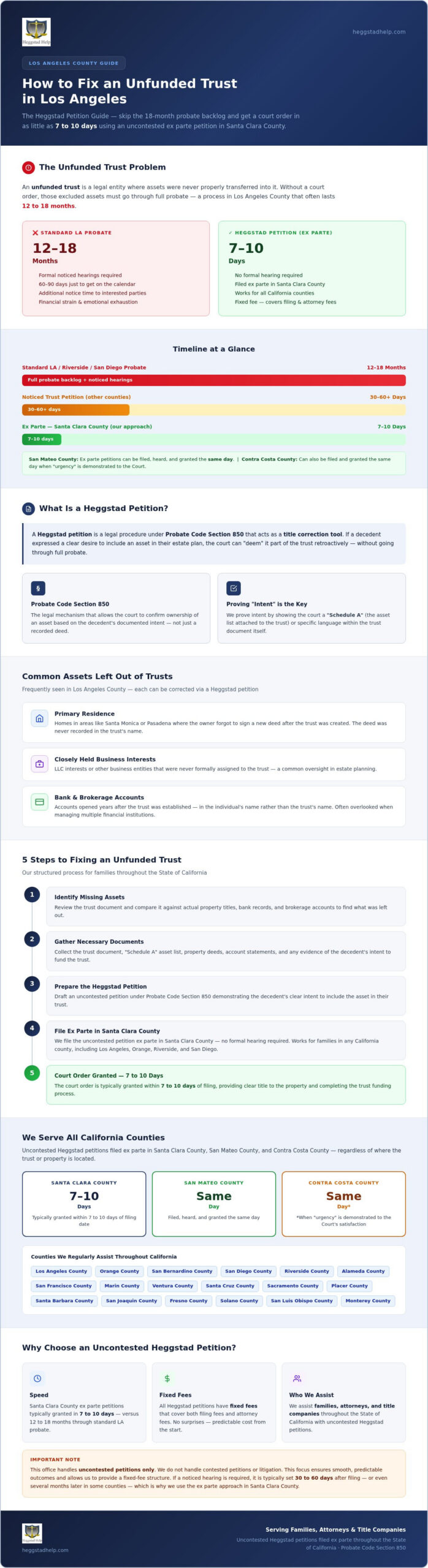
Lawyer to Transfer Property Into Trust After Death in California: The Heggstad Solution

Imagine the frustration of settling a loved one’s estate only to discover their home was never deeded into their living trust. This "unfunded…

Imagine the frustration of settling a loved one’s estate only to discover their home was never deeded into their living trust. This "unfunded trust," where the trust document exists but doesn’t legally own the property, usually forces families into a full probate process that can drag on for over a year. If you’re looking for a lawyer to transfer property into trust after death California, you’re likely facing high statutory fees and long court delays just to clear title for a sale. It’s an exhausting position to be in, especially when you’re already managing the stress of a loss.

Fortunately, a Heggstad Petition in California offers a faster alternative. By filing a petition under Probate Code Section 850, we can often transfer real estate into a trust without full probate. For smaller assets, you might use an affidavit if the value is below $208,850 for deaths on or after April 1, 2025, or $239,700 for deaths on or after April 1, 2026. We provide fixed-fee services covering both filing and attorney fees throughout the state. In Santa Clara County, we typically see results in 7 to 10 days, while San Mateo and Contra Costa Counties can even grant same-day orders. We can even file out-of-county cases in Santa Clara County to bypass months of waiting for a noticed hearing.

Key Takeaways

  • Understand how a Heggstad Petition, filed under Probate Code Section 850, can legally move assets into an unfunded trust and bypass the standard probate process.
  • Find out how working with a lawyer to transfer property into trust after death California can secure a court order to clear title for a home sale in weeks rather than years.
  • Compare the high statutory fees of full probate against a fixed-fee model that covers both court filing and attorney fees for more predictable estate administration.
  • Learn how to use specialized filing strategies in Santa Clara, San Mateo, and Contra Costa Counties to secure ex parte (without a hearing) orders that avoid lengthy delays.
  • Check if your estate meets the small estate thresholds of $208,850 for deaths on or after April 1, 2025, and $239,700 for deaths on or after April 1, 2026, to use simpler transfer methods.

The Problem of the Unfunded Trust: Why Property is Left Out After Death

When a person creates a living trust, the goal is usually to ensure their assets pass to heirs without the burden of a court-supervised probate. However, a trust is merely a legal entity; it only protects the assets it actually owns. An "unfunded trust" occurs when a legal document exists, but the person failed to transfer the legal title of their property into that trust. If you are searching for a lawyer to transfer property into trust after death California, you’ve likely discovered that the decedent’s home is still in their individual name. This oversight often leads to an emotional and financial crisis for families, as it technically triggers a full probate administration that can take a year or longer to resolve.

Funding failures happen for several common reasons. Sometimes, a homeowner creates a trust but simply forgets to sign and record the grant deed. In other cases, they might purchase a new home or refinance an existing mortgage and neglect to move the title back into the trust after the bank’s requirements are met. The "smoking gun" for resolving these issues is often a document called a General Assignment of Assets. This document expresses the decedent’s clear intent that all their property belongs to the trust. This procedural path is based on the landmark case Estate of Heggstad, which established the precedent that a court can "confirm" assets as trust property if the owner’s intent is well-documented.

Identifying Trust Funding Mistakes in California

To determine if you need a lawyer to transfer property into trust after death California, start by checking the last recorded deed at the County Recorder’s office. If the deed lists the individual’s name rather than the name of the trust, the property is unfunded. You should also examine the trust’s "Schedule A," which is the list of assets intended for the trust. If the property is listed there but the deed is incorrect, you have strong evidence of intent. For more details, see our guide on California Trust Funding Mistakes: How to Identify Them.

When a Small Estate Affidavit Isn’t Enough

California provides simplified procedures for small estates, but real estate rarely qualifies. For deaths on or after April 1, 2025, the small estate threshold is $208,850. For deaths on or after April 1, 2026, that limit increases to $239,700. Because most California homes exceed these values, a simple Small Estate Affidavit cannot be used to transfer the title. Changing the title on real property requires a formal deed or a court order. When an affidavit is unavailable due to these mandatory thresholds, a Heggstad Petition under Probate Code Section 850 becomes the most efficient tool to avoid a full, costly probate.

The Heggstad Petition: Using Probate Code Section 850 to Recover Assets

When a property owner dies without properly deeding their home into their trust, many families assume a year-long probate is the only path forward. However, a California Probate Code Section 850 petition, commonly referred to as a Heggstad Petition, provides a surgical legal solution. If you’re working with a lawyer to transfer property into trust after death California, this specific petition asks the court to "confirm" the asset as trust property. The legal theory is that if the decedent clearly intended for the property to be in the trust, the court has the authority to declare it so, even without a recorded deed. This process allows families to skip the standard 12-month probate timeline entirely, often resolving title issues in just a few weeks.

To succeed, the petitioner must present "clear and convincing evidence" of the decedent’s intent. This is a higher legal standard than a simple "preponderance of evidence," meaning the documentation must be highly persuasive to the judge. When this evidence is presented correctly, the court issues a formal order that functions as a deed. This order is then recorded with the County Recorder, effectively moving the property into the trust as if the deed had been signed before death. It’s an efficient way to clear title, especially if there’s a pending home sale that can’t wait for a traditional probate to conclude.

Legal Grounds for a Probate Code Section 850 Petition

The foundation of this procedure rests on the landmark 1993 Estate of Heggstad ruling. In that case, the court decided that a written declaration of trust was sufficient to transfer real property, even if a separate grant deed wasn’t recorded. Today, we often use a "Comprehensive Transfer Document" or a "General Assignment" as the primary evidence to prove this intent. These documents serve as a clear statement that the owner intended all their assets to be governed by the trust’s terms. For a deeper look at the mechanics, you can read our California Probate Code Section 850: A Guide to Real Property Petitions.

The Role of a Board-Certified Specialist

While any probate attorney can technically file a petition, working with a Board-Certified Specialist ensures the petition is drafted to satisfy both the judge and the title company. Every county has its own Local Rules of Court, which are the specific procedural requirements for that jurisdiction. Missing a single local requirement can lead to months of delays. A specialist understands how to navigate these nuances, especially when seeking an ex parte (without a formal hearing) order. At our firm, we specialize in these filings and offer a fixed-fee structure for Heggstad petitions that covers everything from filing fees to attorney time, providing a predictable path toward resolution.

The timeline for recovery varies significantly by jurisdiction. In Santa Clara County, uncontested petitions are typically granted within 7 to 10 days of filing. In San Mateo and Contra Costa Counties, grants can often be obtained on the same day if we can demonstrate urgency. For clients with property in other parts of California where hearings take many months, we often file in Santa Clara County to take advantage of their efficiency, securing an order in about a week rather than waiting for a distant court’s calendar.

Comparing the Costs: Heggstad Petition vs. Full Probate in California

The financial impact of a funding mistake can be shocking for families. In California, the cost of a formal probate is not based on the complexity of the work, but on the gross value of the assets. Under Probate Code Section 10810, statutory fees are set as a percentage of the estate’s total value, without any deduction for mortgages or debts. If you’re looking for a lawyer to transfer property into trust after death California, understanding this math is vital. For example, a home appraised at $1,000,000 carries approximately $46,000 in combined statutory fees for the attorney and the executor. Even if that home has a $700,000 mortgage, the fees are still calculated on the full million dollars.

In contrast, our firm utilizes a fixed-fee structure for Heggstad Petitions that covers both the court filing fees and attorney fees. This approach typically costs only a small fraction of what a formal probate would require. Beyond the attorney fees, probate also involves several "hidden" costs that a Heggstad Petition avoids. These include bond premiums to insure the executor, publication fees to notify creditors in a local newspaper, and probate referee fees (which are 0.1% of the appraised value of non-cash assets). By using a Heggstad Petition to "confirm" the property as a trust asset, you bypass these mandatory expenses entirely.

Time is Money: The Hidden Cost of Delay

A standard probate in California usually takes between 12 and 18 months, during which time the property is effectively frozen. You cannot easily sell or refinance the home while the court process drags on. A Heggstad Petition moves much faster, often resolving in just a few weeks. In Santa Clara County, we frequently see grants within 7 to 10 days, while San Mateo and Contra Costa Counties can sometimes grant orders on the same day if urgency is shown. This speed is critical for families who need to clear title for a pending sale. You can learn more about this in our guide on Selling a House Left Out of a California Trust.

Fixed-Fee Transparency in Trust Litigation

Successor trustees often feel overwhelmed by the prospect of open-ended legal bills. We address this stress by offering fixed-fee transparency, which includes everything from the initial drafting to the service of notice on heirs. This allows trustees to fulfill their duties without the fear of the "billable hour" trap that often accompanies general probate matters. It’s important to remember that while Small Estate Affidavits are cheaper, they are limited to estates valued below $208,850 (for deaths on or after April 1, 2025) or $239,700 (for deaths on or after April 1, 2026). Since most California real estate exceeds these figures, a fixed-fee Heggstad filing is usually the most cost-effective path forward.

Lawyer to Transfer Property Into Trust After Death in California: The Heggstad Solution

Strategic Filing: Timelines and County-Specific Advantages

While Heggstad Petitions are available statewide, the speed of your case often depends on which court has jurisdiction. We assist clients, title companies, and fellow attorneys throughout the state, but we frequently leverage what we call the "Bay Area Advantage" to bypass long court backlogs. If you’re working with a lawyer to transfer property into trust after death California, it’s vital to know that Santa Clara, San Mateo, and Contra Costa Counties allow uncontested petitions to be filed ex parte (without a formal hearing). This procedural shortcut can save you months of waiting for a standard court date.

The timelines in these specific counties are remarkably efficient. In Santa Clara County, we typically see grants within 7 to 10 days of filing. San Mateo and Contra Costa offer even faster results, with the potential for same-day grants. It’s important to remember that Contra Costa requires us to demonstrate a specific "urgency," such as a looming escrow deadline, to qualify for this speed. A major strategic advantage we offer is that uncontested Heggstad Petitions for properties located in other California counties can often be heard ex parte in Santa Clara County. Instead of waiting for a calendar date in a crowded court elsewhere, we can often secure your order in about a week.

Filing in Other California Counties

When filing in Los Angeles, San Diego, or the Central Valley, the process is usually more methodical and time-consuming. These courts often require a "noticed hearing," which typically takes 30 to 60 days to be scheduled, plus additional time to provide legal notice to all heirs and beneficiaries as required by the Probate Code. In some larger counties, backlogs can stretch this timeline to several months. While we handle these cases statewide using our fixed-fee structure that covers both filing and attorney fees, we always look for the most efficient venue to clear your title quickly.

The Ex Parte Process Explained

An ex parte application is a request for a court order that happens outside the normal, lengthy hearing schedule. It’s designed for situations where a standard noticed hearing would cause unnecessary delay, such as a pending home sale that might fall through if title isn’t cleared immediately. While many counties treat Heggstad matters as standard probate items, the Bay Area courts recognize the efficiency of confirming trust assets quickly. If your estate value is below the small estate thresholds, specifically $208,850 for deaths on or after April 1, 2025, and $239,700 for deaths on or after April 1, 2026, you might use a Small Estate Affidavit for personal property. However, for real property exceeding these limits, this strategic filing is often the only way to avoid the year-long probate "sledgehammer." You can explore more about regional nuances in our guide to the Heggstad Petition in Los Angeles.

If you need to fix a title error quickly and avoid the stress of a long court process, our fixed-fee Heggstad filing services provide a clear, predictable path to resolution.

How to Get Started with a California Trust Lawyer

Starting the process of correcting a title error requires more than just a signed trust document. When you engage a lawyer to transfer property into trust after death California, the first task is to assemble a robust evidentiary file. This file serves as the foundation for your Probate Code Section 850 petition. Beyond the trust itself, we look for "intent" documents that bridge the gap between the decedent’s individual name and the trust entity. Without these documents, the court may lack the "clear and convincing" evidence needed to grant the petition.

Identifying all legal heirs and beneficiaries is a critical procedural step that cannot be overlooked. Even in cases where everyone agrees on the outcome, the Probate Code requires that specific parties receive formal notice of the proceedings. Failing to provide proper notice can lead to the court denying the petition or, even worse, a title company refusing to insure the property later. We coordinate directly with title companies throughout this process to ensure the final court order contains the specific legal descriptions and language required for recording. Once the judge signs the order, it is recorded with the County Recorder; this officially updates the chain of title and allows the successor trustee to sell or distribute the property.

Your Consultation Checklist

Before your initial evaluation, gather as much documentation as possible to streamline the process. A complete package typically includes the original Trust Agreement and all subsequent amendments. You should also locate the most recent grant deed for the property in question and any "Schedule A" or list of assets that was attached to the trust. If the decedent signed a General Assignment or Comprehensive Transfer Document, these are often the most valuable pieces of evidence we can present to the court.

Identifying potential objectors early is also vital for setting realistic expectations. If a family member is likely to contest the transfer, the case may move from a fast ex parte track to a noticed hearing timeline of 30 to 60 days plus notice time. For a deeper dive into these requirements, see our Evidence Required for Heggstad Petition in California: A 2026 Guide. This preparation ensures that your petition is handled with the precision necessary to satisfy the court.

Why Choose Robert P. Bergman and Heggstad Help

Robert P. Bergman is a Board-Certified Specialist with over 40 years of experience who focuses exclusively on title correction and Heggstad Petitions. We don’t just help families; we act as a strategic partner for other attorneys and title companies who need specialized speed. Our fixed-fee structure covers both filing and attorney fees, providing total cost transparency from the start. Whether you are dealing with a small estate near the thresholds of $208,850 (for deaths on or after April 1, 2025) and $239,700 (for deaths on or after April 1, 2026) or a multi-million dollar residence, we provide a clear path forward. Contact Heggstad Help for a Free Evaluation of Your Trust Assets and let us help you avoid the delays of a full probate.

Secure Your Loved One’s Legacy Without the Probate Delay

Discovering that a home was left out of a trust doesn’t have to result in a year of court-supervised probate. By utilizing a Heggstad Petition under Probate Code Section 850, you can bypass the high statutory fees and long delays that typically exhaust an estate’s value. Whether you’re navigating the specific ex parte advantages in Santa Clara County or managing a filing in another part of the state, working with an experienced lawyer to transfer property into trust after death California is the most efficient path to clearing title. This surgical legal approach ensures that the decedent’s intent is honored while protecting the equity for the beneficiaries.

Robert P. Bergman is a Board-Certified Specialist in Estate Planning, Trust and Probate Law who has been practicing in California since 1980. Our firm provides fixed-fee transparency for all filings, helping you avoid the unpredictable costs of traditional litigation. We manage the complex procedural details so you can focus on moving forward with confidence. If you’re ready to resolve these title issues quickly, you can Get a Fixed-Fee Quote for Your Heggstad Petition today. We’re here to provide the steady, knowledgeable hand you need to reach a resolution.

Frequently Asked Questions

What is a Heggstad Petition in California?

A Heggstad Petition is a specialized legal request filed under Probate Code Section 850 that asks a judge to confirm an asset as trust property even if the deed was never recorded. It relies on evidence of the decedent’s intent, such as a written declaration or a General Assignment. This procedure allows a successor trustee to "capture" assets into the trust after death, effectively avoiding the year-long probate process.

How much does a lawyer charge to transfer property into a trust after death?

While many firms charge hourly, we use a fixed-fee structure that covers both the court filing fees and the attorney fees for uncontested matters. This provides successor trustees with predictable costs and avoids the expensive statutory fees required by a full probate. Because probate fees are calculated as a percentage of the gross estate value under the Probate Code, a Heggstad filing is almost always the more cost-effective choice.

Can I sell a house while a Heggstad Petition is pending?

You can list the property and enter into a purchase agreement, but you cannot legally transfer the title to a buyer until the court order is signed and recorded. A lawyer to transfer property into trust after death California can help you navigate this by seeking an expedited order in counties like Santa Clara or San Mateo. Once the order is recorded, it clears the chain of title, allowing escrow to close and the sale to finalize.

What is the small estate limit in California for 2026?

The limit for using simplified small estate procedures depends on the specific date of the decedent’s death. For deaths occurring on or after April 1, 2025, the threshold is $208,850. For deaths occurring on or after April 1, 2026, the threshold increases to $239,700. If the value of the property left out of the trust exceeds these mandatory figures, you must typically use a Heggstad Petition or full probate to transfer the assets.

Do I need to go to court for a Heggstad Petition?

In most uncontested cases, you won’t need to step foot in a courtroom. In Santa Clara, San Mateo, and Contra Costa Counties, we regularly file these petitions ex parte (without a formal hearing). The judge reviews our written evidence and signs the order in chambers. Even in counties that require a noticed hearing, your attorney can usually appear on your behalf, saving you the stress of a personal court appearance.

What happens if a Heggstad Petition is contested by an heir?

If an heir or beneficiary objects to the transfer, the court will schedule a formal hearing to evaluate the evidence of the decedent’s intent. Contested matters move away from the expedited ex parte track and follow a more traditional litigation timeline. While most petitions are successful due to clear written evidence, a contest may require a noticed hearing that takes 30 to 60 days plus additional time for legal notice.

Can a Heggstad Petition fix a brokerage account missing from a trust?

Yes, a petition under Probate Code Section 850 applies to personal property like brokerage accounts and stocks just as it does to real estate. If the decedent listed the account on their trust’s Schedule A but failed to update the beneficiary forms, the court can confirm the account as a trust asset. This allows the trustee to collect the funds directly from the financial institution without a full probate administration.

How long does it take to get a court order to confirm trust assets?

The timeline depends heavily on the county of filing, but it’s significantly faster than the 12 to 18 months seen in probate. In Santa Clara County, we typically see grants within 7 to 10 days of filing. San Mateo and Contra Costa Counties can even provide same-day grants if we demonstrate urgency. In other California counties, a noticed hearing might be required, which generally takes between 30 and 60 days plus notice time.

Robert P. Bergman, Attorney at Law

Article by

Robert P. Bergman, Attorney at Law

Attorney Robert P. Bergman ("Bob Bergman") has been a Board-Certified Specialist in Estate Planning, Trust and Probate Law since 2011, as certified by the California State Bar Board of Legal Specialization. For several years, Bob has assisted families and the clients of other attorneys with obtaining court orders through Heggstad petitions to avoid the time and expense of Probate administration. Bob is friendly, very approachable, and believes in explaining complex legal topics in clear ordinary language so that his clients understand exactly what they're doing and why they're doing it.
Bob is often able to assist clients who are in other counties than his home county of Santa Clara through his approach to Heggstad petitions.

Disclaimer

This article is for informational purposes only. Nothing in this article is intended to replace legal advice from a competent attorney or be considered legal guidance for anybody's specific legal situation. Nobody should rely on information in this article in making legal decisions without such consultation.

Transferring Business Interests to a Trust After Death in California: The Heggstad Solution

Imagine the sudden frustration of discovering that your late family member’s LLC or primary brokerage account wasn’t actually titled in their trust,…

Imagine the sudden frustration of discovering that your late family member’s LLC or primary brokerage account wasn’t actually titled in their trust, leaving essential business operations frozen and accounts locked. It’s a common oversight that often leads families to believe they’re trapped in a year-long probate process. You may be wondering if it’s even possible to transfer business interest to trust after death California without a full court proceeding. It’s stressful to watch a legacy stall because of a simple paperwork error, but you’re not alone in facing this hurdle.

The good news is that you don’t have to endure the 12 to 18 months of a full probate administration just to fix a title mistake. This article explains how a Heggstad petition, which is a specialized court filing under Probate Code § 850, allows you to move forgotten assets into a trust in a fraction of the time. We’ll explore how this strategic legal tool can fund a trust post-death, sometimes in as little as 7 to 10 days through an ex parte (without a formal hearing) court order, by proving the decedent’s clear intent to include the asset in their estate plan.

Key Takeaways

  • Learn why business interests often become “stuck” outside of a trust and how to recognize an unfunded (not properly titled) asset before it causes long-term operational delays.
  • Understand how to transfer business interest to trust after death California using Probate Code Section 850, a specialized legal remedy that avoids the 12 to 18-month timeline of a full probate.
  • Discover the critical role of written evidence, such as a Schedule of Assets or a general assignment, in proving the decedent’s intent to a California judge.
  • Differentiate between the Small Estate Affidavit for low-value personal property and the more robust Heggstad petition used for high-value business or brokerage accounts.
  • Find out how ex parte (expedited) court orders can resolve title issues in as little as 7 to 10 days in specific jurisdictions like Santa Clara County.

Why Business Interests and Brokerage Accounts Get ‘Stuck’ Outside of Trusts in California

When a business owner or investor creates a living trust, the primary goal is usually to ensure a seamless transition for their heirs. However, a trust only governs assets that it legally owns. An unfunded business interest occurs when an LLC membership or brokerage account remains in a decedent’s individual name at the time of their passing. This creates a significant legal disconnect. While the trust document may clearly state that the owner intended to leave everything to their beneficiaries, the official title on the account statement or operating agreement still reflects the individual’s name. This oversight often forces families to seek a way to transfer business interest to trust after death California to avoid a lengthy court ordeal.

The immediate consequence of this disconnect is the “frozen asset” trap. Financial institutions and LLC managers typically stop all operations immediately upon receiving a death notice. Banks won’t allow withdrawals, and brokerage firms will not execute trades because they no longer have a living person to take directions from. Many families are surprised to learn that a standard Power of Attorney (a legal document granting someone the authority to act on another’s behalf) loses all its authority the moment the principal passes away. Without a living owner or a trust as the titled owner, the asset sits in a legal vacuum. This same challenge arises when families need a lawyer to transfer property into trust after death California, as real estate left outside a trust faces identical title complications.

A gap exists between intent and title. A judge requires a specific legal mechanism to bridge this divide. This is why the landmark case of the Estate of Heggstad is so vital to California law. It established the precedent that if a decedent’s intent to include an asset in their trust is documented in writing, the court can “confirm” that asset as a trust asset without a full probate. Without this remedy, an unfunded interest might be stuck in probate for over a year.

Common Business Assets Left Out of Trusts

  • LLC Membership Interests: Owners often forget to execute a formal “Assignment of Interest” to their trust, leaving the membership in their personal name despite what the trust says.
  • Brokerage Accounts: Accounts at major firms like Schwab, Fidelity, or Vanguard are frequently left in individual names because the paperwork to retitle them seemed too complex during the owner’s life.
  • Closely Held Stock: Physical stock certificates for small corporations or partnership interests are often stashed in files without being updated to reflect trust ownership.

The Crisis for the Successor Trustee

The successor trustee (the person appointed to manage the trust after the original owner dies) often steps into a chaotic situation. They may need to manage payroll or pay business debts, yet they cannot access the necessary funds because the accounts are frozen. This creates immense pressure, especially when beneficiaries are anxious for their distributions. To understand the full scope of these responsibilities, you can review our detailed guide on Successor Trustee Duties for an Unfunded Trust: The California Guide. Resolving these title issues quickly is the only way to restore operational stability to the business.

Using California Probate Code Section 850 to Transfer Business Interests

The Heggstad petition serves as the primary procedural vehicle for correcting title errors after a trust settlor (the person who created the trust) has passed away. When a successor trustee discovers an unfunded asset, they don’t necessarily have to resign themselves to the lengthy probate process. Instead, they can file a petition under California Probate Code Section 850. This specific statute grants the probate court the authority to “confirm” that a particular asset, such as an LLC interest or a brokerage account, actually belongs to the trust. By focusing on the decedent’s written intent rather than the name on the account statement, the court can bridge the gap between individual ownership and trust ownership.

One of the most compelling reasons to use this petition is the significant time savings it offers. While a standard probate administration in California often consumes 12 to 18 months, a Heggstad petition typically resolves in just two to six months. In some specific jurisdictions, such as Santa Clara County, an experienced attorney can even secure an order in as little as 7 to 10 days through an ex parte (an expedited request without a formal hearing) process. This efficiency is vital when trying to transfer business interest to trust after death California, as it allows the business to regain operational control and access frozen funds before the delay causes permanent financial damage.

The Legal Theory Behind Heggstad

The legal foundation for this process stems from the 1993 Estate of Heggstad case. The California Court of Appeal ruled that a written declaration of trust, which lists an asset on an attached schedule, is sufficient to create a trust in that asset. This remains true even if the formal title was never changed. Effectively, the court “reaches back” to the date of the decedent’s death to confirm that the asset was always intended to be part of the trust estate. Successor trustees should note the difference between a standard noticed hearing, which requires 30 days of notice to all interested parties, and an ex parte order, which can bypass the traditional court calendar in urgent situations.

Evidence Needed for Business Interests

Success is entirely dependent on the quality of the evidence presented to the judge. The court looks for “clear and convincing” proof of the decedent’s intent. This evidence usually includes the trust’s “Schedule A” (the list of assets intended for the trust) or a “General Assignment of Assets” that specifically mentions business interests. For LLCs, we also examine the operating agreement; many modern agreements include provisions expressing a desire for the membership interest to be held in trust. For a more detailed look at the documentation required, you can consult our Evidence Required for Heggstad Petition in California: A 2026 Guide. For those managing complex estates, choosing an expert in Heggstad petitions ensures the process remains on track and avoids common procedural pitfalls.

Small Estate Affidavits vs. Heggstad Petitions for Business Assets in California

When you’re determining how to transfer business interest to trust after death California, you’ll likely encounter two primary simplified procedures: the Small Estate Affidavit and the Heggstad petition. While both aim to avoid the 12 to 18-month delay of a full probate administration, they serve very different purposes. A Small Estate Affidavit (a non-court procedure used to collect personal property) is only available when the total value of the decedent’s property falls below a specific statutory threshold. In contrast, a petition filed under California Probate Code Section 850 has no value limit. It’s the standard tool for moving high-value LLC interests or brokerage accounts into a trust when clear evidence of the owner’s intent exists.

The challenge with Small Estate Affidavits is that many business interests and brokerage accounts quickly exceed the legal limits. Even if an asset is technically under the limit, financial institutions often present a “refusal to transfer.” Banks and LLC managers are cautious. They often fear liability if they release assets based on a simple signed statement from an heir. A Heggstad petition resolves this by providing a formal court order that “confirms” the trust’s ownership, which institutions are legally required to honor.

California Small Estate Thresholds (2025 and 2026)

California law adjusts the maximum value for “small estates” every three years to account for inflation. It’s vital to use the correct figure based on the date of death to avoid a rejected filing. The current thresholds for personal property are:

  • Deaths on or after April 1, 2025: The threshold is $208,850.
  • Deaths on or after April 1, 2026: The threshold increases to $239,700.

If the total value of the assets left outside the trust (including the business interest) exceeds these amounts, the Small Estate Affidavit is no longer an option. You must then look toward a Heggstad petition to avoid a full probate. The same threshold rules apply when working with a lawyer to transfer property into trust after death California, as real property values almost always exceed these limits and require a formal court order rather than a simple affidavit.

Why a Court Order is Often Safer

A Heggstad order provides a level of absolute legal protection that an affidavit cannot match. Major brokerage firms, such as Schwab, Fidelity, or Vanguard, have strict internal compliance rules. They’re far more likely to process a transfer quickly when presented with a certified court order signed by a judge. This is especially true when the total estate value far exceeds the small estate limits, as the court order provides the successor trustee with the definitive authority needed to manage and distribute the business assets as the decedent intended.

Transferring Business Interests to a Trust After Death in California: The Heggstad Solution

Filing a Heggstad Petition for CA Business Interests

The path to successfully completing a transfer business interest to trust after death California involves more than just filling out forms; it requires a strategic understanding of court procedures. The process moves from document collection to judicial confirmation through several critical stages. Successor trustees must follow a methodical sequence to ensure the court has sufficient evidence to grant the order without unnecessary delays. The goal is to move the asset from the decedent’s individual name into the trust’s name as efficiently as the law allows.

The standard procedure for a Heggstad petition generally follows these five steps:

  • Step 1: Gather Documentation. You’ll need the original trust document, any general assignment of assets, and the most recent statement for the brokerage account or LLC membership.
  • Step 2: Draft the Petition. A formal legal petition is prepared under California Probate Code Section 850, detailing the facts of the case and the evidence of the decedent’s intent.
  • Step 3: Strategic Filing. The petition is filed in the appropriate Superior Court. Choosing the right county can significantly impact your timeline.
  • Step 4: Obtain the Court Order. If the petition is uncontested, you may seek an ex parte (expedited) order. Otherwise, you’ll attend a noticed hearing where a judge reviews the evidence.
  • Step 5: Finalize the Transfer. Once the judge signs the order, you present a certified copy to the LLC manager or brokerage firm to update the title on the account.

Strategic Filing in Santa Clara, San Mateo, and Contra Costa Counties

Where you file often dictates how quickly you can unlock frozen accounts. In Santa Clara County, uncontested petitions are typically granted ex parte in just 7 to 10 days, making it one of the most efficient jurisdictions for trust asset title correction. San Mateo and Contra Costa counties also offer streamlined processes where orders can sometimes be granted the same day they’re filed. However, it’s vital to recognize that Contra Costa requirements for same-day grants usually require a specific showing of “urgency,” such as an impending business sale or a critical payroll deadline that cannot be met without account access.

Handling Out-of-County Filings

Successor trustees aren’t always restricted to the county where the decedent lived if the business interest or brokerage firm has a sufficient connection to another jurisdiction. Filing in Santa Clara County is often a strategic alternative for business interests located in other California counties because of the court’s familiarity with these petitions. In many other counties, you might be forced into a noticed hearing schedule that takes 30 to 60 days, or even longer if the court calendar is backed up. A specialist can use ex parte procedures in favorable counties to save months of waiting, ensuring a faster transfer business interest to trust after death California. If you’re facing a frozen business account and need a rapid resolution, you can learn more about our specialized Heggstad petition filing services to see which filing strategy fits your situation.

The process to transfer business interest to trust after death California requires a high level of procedural precision that many generalist probate attorneys simply don’t possess. While a standard probate lawyer may understand the broad strokes of trust law, they often lack the deep experience needed to navigate the ex parte (expedited) nuances of a Heggstad petition. These specialized filings depend on a specific understanding of local court rules and the unique evidentiary requirements that judges look for when confirming business title. Missteps in the initial filing can lead to delays that keep assets frozen for months longer than necessary.

At our firm, we provide a sense of calm competence rooted in over 40 years of experience. Robert P. Bergman is a Board-Certified Specialist in Estate Planning, Trust and Probate Law. This certification signifies a level of expertise that goes beyond basic legal practice, as it requires rigorous testing and a demonstrated track record in this specific field. We don’t just handle these cases for individual trustees; we also frequently assist other attorneys and title companies throughout California who encounter complex title recovery hurdles they cannot resolve on their own. This collaborative approach has made us a trusted resource for professional peers across the state.

Predictable Costs and Timelines

One of the biggest anxieties for successor trustees is the “billable hour” trap, where legal costs can spiral out of control during a long court process. We address this by offering fixed fees for Heggstad petitions, which cover both the filing and attorney fees. This approach ensures predictability and allows you to focus on business continuity rather than mounting legal bills. During your initial consultation for a business interest transfer, we will review your documents and provide a clear roadmap of the expected timeline. For a deeper look at the process, you can read our comprehensive resource: Heggstad Petition Filing: The California Guide to Recovering Missing Trust Assets in 2026.

Next Steps for Successor Trustees

If you’ve discovered an unfunded business asset, the most important step is to act quickly. Frozen accounts and stalled operations can lead to lost revenue and legal liability for the estate. To initiate a review of your situation, you should gather your trust documents and the most recent statements for the assets in question. We can then determine if a Heggstad petition is the right path to transfer business interest to trust after death California. Contacting Robert P. Bergman provides you with the expert guidance of a dedicated problem-solver who knows exactly how to unlock your business assets and restore the momentum of the estate as the decedent intended.

Restoring Business Continuity and Securing the Trust Estate

Discovering that a significant asset was left outside of a trust is a stressful experience for any successor trustee. California law provides a structured path to correct these title errors without the burden of a full probate administration. By utilizing a Heggstad petition, you can honor the decedent’s clear intent and move assets like LLC interests or brokerage accounts into the trust’s name. This process doesn’t just save time; it protects the financial health of the business and ensures beneficiaries receive their intended distributions.

By utilizing this specialized legal remedy, you can effectively transfer business interest to trust after death California while avoiding the 12 to 18-month probate delay. We invite you to Get a Fixed-Fee Quote for Your Heggstad Petition in California. Our services are led by a Board-Certified Specialist in Estate Planning, Trust and Probate Law, offering fixed fees that cover all filing and legal costs for complete predictability. For those filing in Santa Clara County, we can often secure an order in as little as 7 to 10 days. You don’t have to navigate these procedural hurdles alone; specialized help is available to resolve these complications quickly and professionally.

Frequently Asked Questions

Can I transfer a business interest to a trust after the owner has died in California?

Yes, you can transfer business interest to trust after death California by filing a Heggstad petition under Probate Code Section 850. This legal procedure allows a judge to confirm that an asset belongs to a trust if there’s written evidence of the decedent’s intent, such as a schedule of assets or a general assignment. It effectively bypasses the need for a full probate administration and restores control to the successor trustee.

How long does a Heggstad petition take for an LLC in Santa Clara County?

In Santa Clara County, an uncontested Heggstad petition for an LLC interest can often be resolved in as little as 7 to 10 days. This rapid turnaround is possible through an ex parte (expedited) court order process. This is significantly faster than the standard noticed hearing route, which can take several months in many other California jurisdictions.

What are the small estate limits for business assets in California for 2026?

For deaths occurring on or after April 1, 2026, the small estate threshold for personal property, which includes LLC interests and brokerage accounts, is $239,700. If the total value of assets left outside the trust exceeds this amount, you cannot use a simple Small Estate Affidavit. Instead, a Heggstad petition becomes the necessary legal tool to move those assets into the trust’s name.

Do I need a formal court hearing for a Heggstad petition in San Mateo County?

San Mateo County often allows for ex parte orders that can be granted the same day they’re filed, potentially avoiding a formal noticed hearing altogether. While some counties require a 30 day notice period to all beneficiaries, the specific procedural rules in San Mateo permit a more rapid resolution for uncontested matters. This efficiency helps successor trustees restore business operations without months of waiting.

What happens if a brokerage firm refuses to transfer an account to a trust?

If a brokerage firm like Schwab or Fidelity refuses to transfer an account based on a Small Estate Affidavit, you should obtain a Heggstad court order. Financial institutions are legally required to honor a certified court order confirming trust ownership. This provides the firm with the liability protection they need to release the frozen funds to the successor trustee immediately.

Is a Heggstad petition faster than probate for a California business?

A Heggstad petition is substantially faster than formal probate. While a full probate in California typically lasts 12 to 18 months, a Heggstad petition usually concludes within 2 to 6 months. In expedited cases, it can be finished in a matter of days. This speed is vital when you need to transfer business interest to trust after death California to maintain business continuity and pay employees.

Can I file a Heggstad petition in Santa Clara if the decedent lived in another county?

You may be able to file in Santa Clara County even if the decedent resided elsewhere, provided the business entity or brokerage account has a legal connection to that jurisdiction. This is often a strategic choice because of the court’s efficient handling of ex parte petitions. A specialist can evaluate the venue rules to see if this fast track is available for your specific case.

What is the cost of a Heggstad petition for a brokerage account in California?

The cost includes a standard court filing fee of $435 in most California counties, plus potential appraisal fees if a probate referee is required. While attorney fees vary across the industry, our firm uses a fixed fee model to provide predictability for successor trustees. This covers both the filing and legal representation, helping you avoid the uncertainty of the billable hour during a difficult transition.

Robert P. Bergman, Attorney at Law

Article by

Robert P. Bergman, Attorney at Law

Attorney Robert P. Bergman ("Bob Bergman") has been a Board-Certified Specialist in Estate Planning, Trust and Probate Law since 2011, as certified by the California State Bar Board of Legal Specialization. For several years, Bob has assisted families and the clients of other attorneys with obtaining court orders through Heggstad petitions to avoid the time and expense of Probate administration. Bob is friendly, very approachable, and believes in explaining complex legal topics in clear ordinary language so that his clients understand exactly what they're doing and why they're doing it.
Bob is often able to assist clients who are in other counties than his home county of Santa Clara through his approach to Heggstad petitions.

Disclaimer

This article is for informational purposes only. Nothing in this article is intended to replace legal advice from a competent attorney or be considered legal guidance for anybody's specific legal situation. Nobody should rely on information in this article in making legal decisions without such consultation.
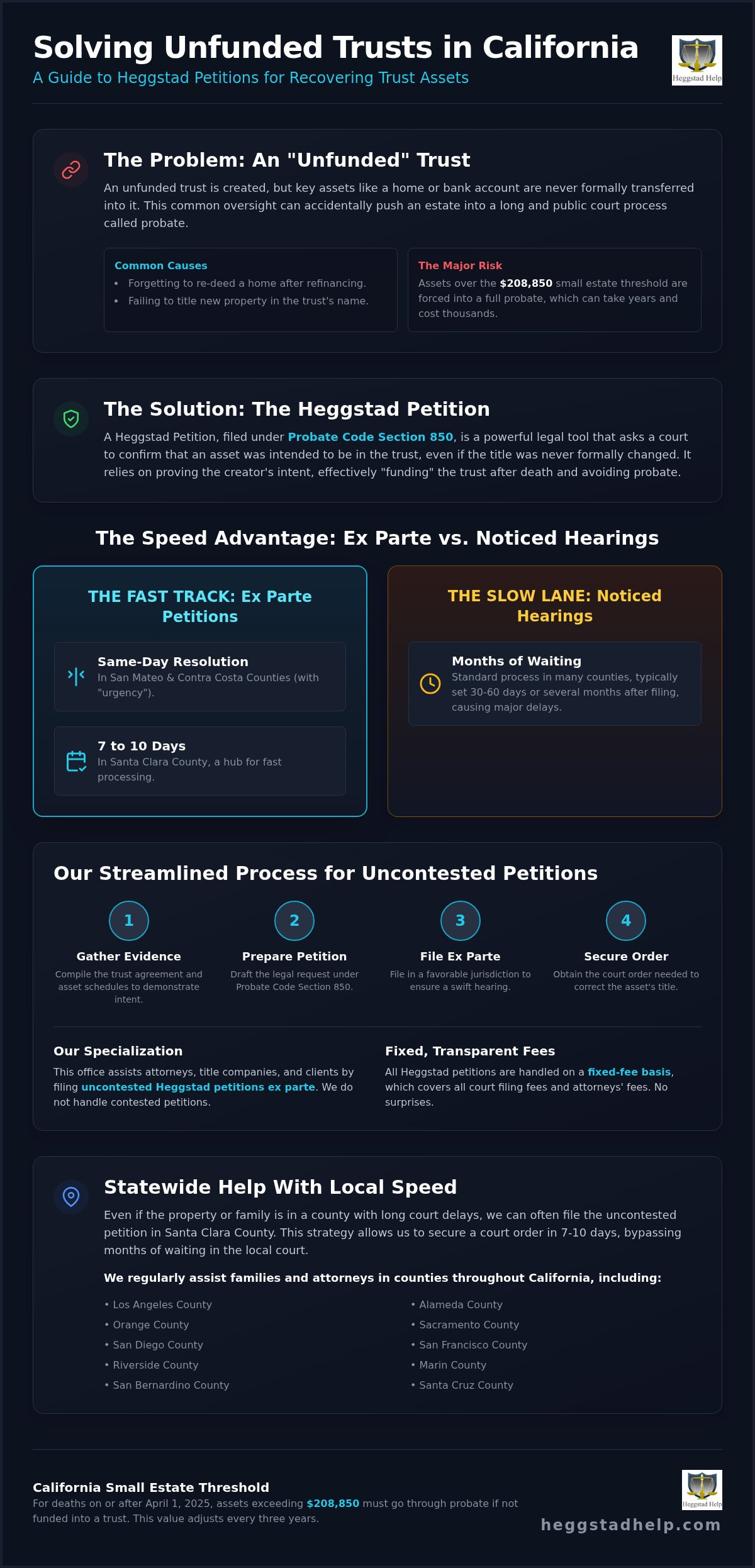
Heggstad Petition Los Angeles: Expert Legal Help for Unfunded Trusts (2026)

Did you know that Los Angeles County handles nearly 30% of all probate filings in California? This massive volume often results in a 12 to 18-month…

Did you know that Los Angeles County handles nearly 30% of all probate filings in California? This massive volume often results in a 12 to 18-month wait at the Stanley Mosk Courthouse. It’s incredibly stressful to discover that a family home was never formally deeded into a trust, especially when you’re facing high statutory fees and complex court procedures. You want a resolution that doesn’t involve years of litigation. By filing a Heggstad petition Los Angeles, you can often transfer an "unfunded" asset into the trust without a full probate.

This article explains how to secure a clear title and fast-track asset distribution using a fixed-fee legal model. We’ll show you how to bypass the typical delays found in Southern California; for instance, while local noticed hearings can take months, we can often file in Santa Clara County to get a decision in just 7 to 10 days. We also cover essential updates for 2026, such as the new small estate affidavit threshold of $239,700 for deaths occurring on or after April 1. Whether you’re a trustee, an attorney, or a title company, you’ll find a clear, logical path to resolving these title complications.

Key Takeaways

  • Learn how a Heggstad petition Los Angeles can transfer a house or asset into a trust without the 12 to 18 month delay of a full probate.
  • Discover how to bypass months of waiting by filing uncontested petitions ex parte, which can lead to court orders in as little as 7 to 10 days in specific counties.
  • Understand the specific evidence needed, such as a Schedule A or written declaration, to prove the decedent’s intent to include an asset in their trust.
  • Access specialized assistance for attorneys, title companies, and clients throughout California using a fixed-fee model for all filing and attorney costs.
  • Determine if you qualify for simplified procedures based on the 2026 small estate threshold of $239,700 for deaths occurring on or after April 1.

What is a Heggstad Petition in Los Angeles?

If you’ve discovered that a family home or a significant investment account was left out of a trust after a loved one passed away, you’re likely facing the prospect of a lengthy probate. A Heggstad petition Los Angeles is a specific legal request filed under California Probate Code Section 850. It asks the court to "confirm" that an asset belongs to a trust, even though the formal title transfer (the process of re-titling the asset in the name of the trust) was never completed during the owner’s lifetime. When successful, the court issues an order that functions just like a deed, allowing the trustee to manage or sell the property without going through the full, 12 to 18-month probate process.

The Legal Basis: Probate Code Section 850

The foundation of this procedure is the landmark 1993 case, Estate of Heggstad. This case established that a "written declaration of trust" (a document stating that certain assets are held in trust) is sufficient evidence of an owner’s intent to include those assets. California courts generally prioritize the decedent’s (the deceased person’s) documented intent over a missing signature on a deed or a clerical oversight. Under Section 850, a judge has the authority to rectify title errors if you can provide clear and convincing evidence that the creator of the trust intended for the asset to be part of their estate plan. This is a vital remedy because it honors the spirit of the trust while avoiding the high statutory fees associated with traditional probate.

Common Scenarios for LA Successor Trustees

Most title complications we see in Los Angeles arise from simple human error or the complexities of modern financing. Common situations include:

  • The "Forgotten House": A property purchased years after the original trust was established, where the owner simply forgot to title the new deed in the name of the trust.
  • Refinancing Errors: Lenders often require owners to take a home out of a trust to process a new loan. Frequently, the property is never deeded back into the trust after the refinance is finalized.
  • Missing Trust Designations: Brokerage accounts, business interests, or LLC memberships that were listed on a "Schedule A" (the list of assets typically attached to a trust) but never formally assigned to the trust entity. If you are dealing specifically with a business interest that was never moved into the trust, our guide on transferring an LLC to trust after death in California explains how the Heggstad petition can restore order without a full probate.

It’s important to note that if the total value of assets left outside the trust is relatively small, you might use a Small Estate Affidavit instead. For individuals dying on or after April 1, 2026, this threshold is $239,700. However, for real estate in Los Angeles, a Heggstad petition Los Angeles is almost always the necessary path. At HEGGSTAD HELP, we assist trustees and attorneys throughout California with a fixed-fee model that covers all filing and attorney costs. While local courts are often backlogged, we can frequently file uncontested petitions ex parte (without a formal hearing) in Santa Clara County to secure a much faster resolution for your family.

Heggstad Petition vs. Full Probate in Los Angeles

Choosing between a full probate administration and a Heggstad petition Los Angeles is often the difference between a year of stress and a few weeks of focused legal work. In Los Angeles County, which handles nearly 30% of all California probate filings, a standard probate case at the Stanley Mosk Courthouse typically drags on for 12 to 18 months. This delay occurs because full probate is a public, multi-step process requiring court-supervised appraisals, bond requirements, and multiple hearings. By contrast, a Heggstad petition is a targeted legal action designed to fix a specific title error, allowing you to bypass the broader probate system entirely.

Cost Savings and Fee Structures

The financial impact of choosing the right path is significant. California law sets statutory fees for full probate based on the gross value of the estate’s assets, regardless of how much debt or mortgage remains. For a $1 million Los Angeles home, the attorney fee is $23,000 and the executor fee is another $23,000, totaling $46,000 in mandatory costs. Utilizing HEGGSTAD HELP’s fixed-fee structure provides predictable budgeting by covering both filing and attorney fees for a fraction of those statutory costs. You’ll also save the estate thousands by avoiding probate referee appraisals and the cost of a fiduciary bond.

Timeline and Efficiency

Efficiency is where the Heggstad process truly shines. While Los Angeles courts are often backed up for months, we can frequently utilize ex parte filings, which are requests made without a formal, noticed hearing, to speed up the results. If you file in Los Angeles, you may still face a 30 to 60 day notice period plus notice time. However, we often assist clients by filing uncontested petitions in other counties to secure faster outcomes. For example:

  • Santa Clara County: Petitions are typically granted in 7 to 10 days.
  • San Mateo County: Petitions can often be filed, heard, and granted on the same day.
  • Contra Costa County: Same-day grants are possible if we demonstrate urgency to the court’s satisfaction.

If your case involves an LA property but the petition is uncontested, we can often move the matter to Santa Clara County to take advantage of that 7 to 10 day window. This is much faster than waiting months for a noticed hearing in Southern California. If you are unsure which path is right for your specific situation, you can review our Heggstad petition services to see how we simplify the process. For smaller estates, remember that the threshold for a Small Estate Affidavit is $208,850 for deaths on or after April 1, 2025, and increases to $239,700 for deaths on or after April 1, 2026. If a home is involved, a Heggstad petition Los Angeles remains your best "fast track" option.

Eligibility: Can You Use a Heggstad Petition?

Determining whether you qualify for a Heggstad petition Los Angeles is the first step toward avoiding a full probate administration. While the process is powerful, it isn’t a universal fix for every missing asset. To succeed, you must first have a valid, written California Living Trust or Irrevocable Trust already in existence. The court doesn’t have the authority to create a trust where none exists; instead, it uses California Probate Code § 850 to confirm that a specific asset should be recognized as part of that existing trust. This remedy is most effective when the transfer is uncontested by other heirs or beneficiaries. Before you begin the filing process, it’s wise to review the Heggstad petition requirements in California to ensure your documentation is in order.

Required Evidence and Documentation

The court requires "clear and convincing evidence" that the person who created the trust intended for the asset to be included. The most common piece of evidence is a "Schedule A" (the list of assets typically found at the back of a trust document) or an "Attachment 1" that specifically names the property. However, even if a property isn’t listed on a schedule, you can often succeed by pointing to general assignment language within the trust. This language often states that the settlor (the person who created the trust) transfers all their current and future property to the trust. Other supporting documents can include prior deeds where the owner attempted to title the property correctly, or mortgage documents where they checked a box identifying themselves as a "Trustee." A well-prepared Heggstad petition Los Angeles will weave these facts together to present a logical, undeniable case of intent to the judge.

Small Estate Alternatives for 2026

If the total value of the assets left outside the trust is relatively low, you might not need a court order at all. California allows for a simplified Small Estate Affidavit process, but the eligibility thresholds are strictly tied to the date of death. These figures are adjusted periodically for inflation. For individuals dying on or after April 1, 2025, the small estate threshold is $208,850. For those dying on or after April 1, 2026, the limit increases to $239,700. If the asset in question is a bank account or a vehicle that falls under these amounts, the affidavit is a faster, cheaper path. However, because real estate values in Los Angeles almost always exceed these limits, a Heggstad petition remains the primary tool for correcting title to a family home or commercial building. We assist clients in evaluating these thresholds to ensure you choose the most efficient path forward.

Heggstad Petition Los Angeles: Expert Legal Help for Unfunded Trusts (2026)

The Heggstad Process and Los Angeles Court Timelines

The timeline for a Heggstad petition Los Angeles depends heavily on whether the matter is contested and which court hears the case. In a standard noticed hearing at the Stanley Mosk Courthouse, you can expect a wait of 30 to 60 days just to get on the calendar. This doesn’t include the time required to serve notice to all heirs and interested parties, which typically adds another 30 days to the process. If a petition is contested by a disgruntled family member, the timeline can stretch into many months or even years. However, most title correction cases are uncontested, allowing for much faster "ex parte" (without a formal hearing) options. You can read a detailed breakdown of the Heggstad petition process in Los Angeles to understand these procedural steps more clearly.

The Santa Clara County Advantage

One of the most effective strategies we use to bypass the Southern California backlog is filing in Northern California. Uncontested petitions for assets located anywhere in the state, including Los Angeles, can often be heard ex parte in Santa Clara County. While a Los Angeles judge might require a full noticed hearing, the Santa Clara court typically reviews and grants these orders within 7 to 10 days of filing. This "legal shortcut" is a game-changer for trustees who need to sell a property or distribute assets quickly. In other counties like San Mateo, orders can sometimes be granted the same day they’re filed. In Contra Costa County, we can often secure a same-day grant if we can demonstrate a specific "urgency," such as a pending real estate sale, to the court’s satisfaction.

Why Choose a Board-Certified Heggstad Petition Expert?

Robert P. Bergman is a Board-Certified Specialist in Estate Planning, Trust, and Probate Law. This distinction is held by only a small fraction of California attorneys and represents a commitment to a high level of expertise in this specific field. When you are dealing with a **Heggstad petition **for property in Los Angeles, choosing a specialist means you aren’t paying for a generalist’s learning curve. We focus exclusively on Heggstad petitions and trust title correction, which allows us to identify procedural "fast tracks" that others might overlook. We don’t just work with families; we also act as a resource for title companies and fellow attorneys who need a precise, efficient resolution to a title complication.

The Value of Specialization

A generalist probate lawyer might default to a standard noticed hearing at the Stanley Mosk Courthouse, potentially subjecting you to a months-long wait. A specialized Heggstad petition lawyer knows that if the petition is uncontested, we can often file ex parte (without a formal hearing) in Santa Clara County instead. This strategy can result in a granted order in as little as 7 to 10 days, even for a property located in Southern California. Correcting these title errors quickly is essential if you’re in the middle of a home sale or a refinance that’s been stalled by a missing deed. If you’re currently vetting legal help, we recommend reviewing our guide on questions to ask a Heggstad petition lawyer to ensure your counsel understands these specific venue advantages.

A Streamlined, Stress-Free Experience

We aim to provide a sense of calm competence to reduce the stress that often accompanies the death of a loved one. Our fixed-fee structure is a key part of this reassurance; it covers both the court filing fees and the attorney fees, eliminating the anxiety of unpredictable billable hours. This transparency allows trustees to budget accurately for the estate’s expenses without fear of "scope creep" or hidden costs. We believe in providing a service-oriented posture that treats your case with the specialized attention it deserves.

For successor trustees living outside of California, we handle the entire process remotely. You won’t need to travel to Northern California to resolve these issues. You’ll have direct access to Robert P. Bergman throughout the petition process, ensuring that you receive authoritative guidance from a seasoned expert. Whether your case involves a complex commercial property or ensuring you meet the 2026 small estate threshold of $239,700 for deaths occurring on or after April 1, our goal is to provide a logical, organized path toward a successful resolution. A Heggstad petition Los Angeles doesn’t have to be a burden when you have a dedicated problem-solver leading the way.

Secure a Faster Path to Trust Distribution

Dealing with an unfunded trust doesn’t have to mean entering a multi-year legal battle at the Stanley Mosk Courthouse. By utilizing a **Heggstad petition, **you can correct title errors and secure a court order that functions as a deed, saving the estate thousands in statutory probate fees. Whether you’re dealing with a property that was never transferred or a refinance error, the law provides a clear path to honor the decedent’s intent without the stress of a full probate administration. It’s a logical, organized way to move forward when the paperwork hasn’t kept pace with your family’s estate planning goals.

Robert P. Bergman, a Board-Certified Specialist in Estate Planning, Trust and Probate Law with over 40 years of experience, offers a fixed-fee structure that covers both filing and attorney costs. We specialize in finding procedural advantages, such as filing uncontested petitions ex parte in Santa Clara County to achieve results in as little as 7 to 10 days. Even as the small estate threshold increases to $239,700 for deaths on or after April 1, 2026, a Heggstad filing remains the gold standard for real estate title correction. Get a Fixed-Fee Quote for Your Los Angeles Heggstad Petition today and take the first step toward a stress-free resolution for your family.

Frequently Asked Questions

How long does a Heggstad petition take in Los Angeles?

A standard Heggstad petition Los Angeles typically takes 30 to 60 days plus notice time if a hearing is required at the Stanley Mosk Courthouse. However, we can often bypass this long wait by filing uncontested petitions on an ex parte basis (without a formal hearing) in Santa Clara County, where orders are usually granted within 7 to 10 days.

What is the cost of a Heggstad petition vs. full probate?

A Heggstad petition is much more cost-effective than full probate because it avoids statutory fees that are based on the estate’s gross asset value. For example, a $1 million home in a full probate would trigger $46,000 in mandatory fees for the attorney and executor. We utilize a fixed-fee structure that covers both filing and attorney fees, providing you with predictable costs and peace of mind without hidden billable hour surprises.

Can I file a Heggstad petition if there is no Schedule A?

You can still file even if the trust lacks a Schedule A (the list of assets typically attached to the back of the document). We look for "general assignment" language within the trust or other evidence like prior deeds and mortgage applications that show the owner’s intent. If we can demonstrate clear intent to include the asset in the trust, the court has the authority to grant the petition under Probate Code Section 850.

Is a Heggstad petition public record?

Like most court filings, a **Heggstad petition **is a matter of public record, but it is far less intrusive than a full probate administration. Probate involves a public accounting of all debts and assets over 12 to 18 months. A Heggstad petition is a targeted legal action that focuses only on specific title errors, making the process much more discrete and significantly faster for the beneficiaries involved.

Do I need to go to court for a Heggstad petition hearing?

In most cases, you won’t need to step foot in a courtroom. If the petition is uncontested and we file it ex parte, the judge reviews the evidence in their chambers without a formal hearing. We handle the entire filing process on your behalf, which is especially helpful for out-of-state successor trustees who cannot easily travel to a California probate court to resolve title issues.

Can a Heggstad petition be used for bank accounts or stocks?

Yes, this procedure is frequently used for brokerage accounts, stocks, and bank accounts that were never properly assigned to the trust entity. If these financial assets were intended to be part of the estate plan, a Heggstad petition can correct the title error. This allows the trustee to manage the accounts and distribute funds to beneficiaries without the delays and costs associated with a full probate proceeding.

What is the small estate threshold in California for 2026?

The threshold for using a Small Estate Affidavit depends strictly on the date of death. For individuals dying on or after April 1, 2026, the threshold increases to $239,700. For those who passed away on or after April 1, 2025, the limit is $208,850. If the assets left outside the trust fall below these specific amounts, you might avoid a court petition entirely by using the affidavit process instead.

What happens if someone objects to the Heggstad petition?

This office only handles uncontested Heggstad petitions. In noticed hearings for Heggatgad, If an heir or interested party objects, the petition becomes a contested matter and will more hearings and expense. The court will then set a calendar date for both sides to present their evidence and arguments.

Robert P. Bergman, Attorney at Law

Article by

Robert P. Bergman, Attorney at Law

Attorney Robert P. Bergman ("Bob Bergman") has been a Board-Certified Specialist in Estate Planning, Trust and Probate Law since 2011, as certified by the California State Bar Board of Legal Specialization. For several years, Bob has assisted families and the clients of other attorneys with obtaining court orders through Heggstad petitions to avoid the time and expense of Probate administration. Bob is friendly, very approachable, and believes in explaining complex legal topics in clear ordinary language so that his clients understand exactly what they're doing and why they're doing it.
Bob is often able to assist clients who are in other counties than his home county of Santa Clara through his approach to Heggstad petitions.

Disclaimer

This article is for informational purposes only. Nothing in this article is intended to replace legal advice from a competent attorney or be considered legal guidance for anybody's specific legal situation. Nobody should rely on information in this article in making legal decisions without such consultation.

Fixing Unfunded Living Trusts in California: 2026 Legal Guide

When a loved one passes away, the last thing a family expects is a legal crisis. Yet, for many California families, that’s precisely what happens…

When a loved one passes away, the last thing a family expects is a legal crisis. Yet, for many California families, that’s precisely what happens when they discover a critical asset—usually the family home—was never formally transferred into the deceased’s living trust. This simple oversight, often a forgotten deed recording after a refinance, can derail the entire estate plan, raising the terrifying prospect of a long, expensive, and public probate court proceeding.

The common belief is that once the trust creator (the grantor) has died, it’s too late to fix the error. The trust, like an empty bucket, seems useless. But in California, this is a costly misconception. A powerful and highly specific legal tool exists to correct these funding errors after death, allowing you to transfer the property into the trust and avoid the probate system entirely.

This solution is the Heggstad Petition. This guide will walk you through exactly how this specialized court petition works, how it can save your family from a 12-to-18-month probate ordeal, and how you can resolve the issue in as little as 1-10 days depending on the county.

The Crisis of the Unfunded Living Trust: Why an "Empty Bucket" Fails

A living trust is a powerful estate planning tool designed to hold your assets for your benefit during your lifetime and distribute them to your beneficiaries after your death, all without court intervention. Think of it as a legal bucket. For the trust to work, you must place your assets inside that bucket. If an asset remains outside, the trust has no control over it.

An "unfunded" or "partially funded" trust is one where the legal documents were signed, but the formal process of retitling assets into the trust’s name was never completed. The trust exists on paper, but it’s an empty shell. When the grantor dies, any assets not legally titled in the name of the trust are stuck outside, triggering the need for probate court to determine their new owner.

The number one cause of this crisis in California is real estate. A homeowner might create a trust, sign all the documents, but fail to execute and record a new deed transferring their property from their individual name to themselves as trustee of their trust. This is the final, crucial step that many people miss, leaving their most valuable asset exposed to the probate system.

To be clear, "funding a trust after death" isn’t a simple administrative task. You cannot just sign a new deed on behalf of the deceased. It requires a specific court order, obtained through a petition under California Probate Code Section 850, to legally transfer the title.

What Does "Funding a Trust" Mean in 2026?

Properly funding a trust is a meticulous process of changing the legal title of your assets. For a trust to be considered fully funded, the following steps must have been taken:

  • Real Estate: New deeds (e.g., a Quitclaim Deed or Grant Deed) must be signed and recorded with the county, transferring ownership from you as an individual to you as the trustee of your trust.
  • Bank and Brokerage Accounts: Accounts must be retitled into the name of the trust, or the trust must be named as the "pay-on-death" beneficiary.
  • Personal Property: Tangible items like furniture, art, and jewelry should be formally transferred to the trust, typically through a document called a "general assignment" or by being listed on a "Schedule A" attached to the trust.

Common Assets Left Out of California Trusts

While any asset can be accidentally omitted, certain ones are more commonly left out, creating significant problems for the Successor Trustee and beneficiaries:

  • Primary Residences: Often, a home is properly deeded to the trust initially, but later refinanced. During the refinancing process, lenders frequently require the property to be taken out of the trust and retitled in the owner’s individual name. The critical mistake occurs when a new deed putting the property back into the trust is never recorded.
  • Vacation Homes and Rental Properties: Real estate purchased after the trust was created is a frequent oversight. The owner may forget to take title in the name of the trust at the time of purchase.
  • Newly Opened Investment Accounts: A new brokerage or bank account opened years after the trust was established may have been overlooked during the funding process.

The High Cost of Inaction: How Unfunded Assets Trigger Full California Probate

When a major asset like a house is left out of a trust, the default legal process is a full probate administration. For Successor Trustees and beneficiaries who believed a trust would let them avoid court, this comes as a rude shock. Probate is precisely the system that a living trust is designed to bypass.

The consequences of being forced into probate are severe:

  • A 12-to-18 Month Timeline: A standard, uncontested probate in California can easily take over a year to complete. During this time, the assets are effectively frozen, and beneficiaries must wait for their inheritance.
  • Loss of Privacy: Probate is a public court proceeding. All of your family’s financial information, including a list of assets, debts, and the identities of beneficiaries, becomes part of the public record, accessible to anyone.
  • High Statutory Fees: California probate law sets attorney and executor fees based on a percentage of the estate’s gross value. For a $1 million home, statutory fees for the attorney alone can be $23,000, regardless of how much work is involved.
  • Title Deadlock: An unfunded house cannot be sold, refinanced, or distributed to heirs until the probate court grants the authority to do so. This can cause immense financial and emotional strain, especially if the family needs to sell the property to cover expenses.

California Small Estate Thresholds for 2026

For smaller estates, California law provides a simplified process that avoids full probate, known as a Small Estate Affidavit. However, this option is only available if the total value of the assets left outside the trust is below a specific, legally defined threshold. Because of inflation, these thresholds are adjusted periodically.

It is critical to know the correct threshold based on the date of death:

  • For deaths occurring on or after April 1, 2026, the gross value of the decedent’s real and personal property in California cannot exceed $239,700.
  • For deaths occurring on or after April 1, 2025 (but before April 1, 2026), the threshold is $208,850.

If the value of the unfunded asset (like a home) exceeds this limit—which is almost always the case with real estate—the Small Estate Affidavit is not an option, and you are on the path to full probate unless you take alternative action.

Why Successor Trustees Need Immediate Title Correction

As a Successor Trustee, you have a legal and fiduciary duty to take control of and manage all trust assets for the benefit of the beneficiaries. If a property’s title is not in the trust’s name, you have no legal authority over it. You cannot sell it, rent it, or transfer it to the rightful heirs.

Failing to act swiftly to secure and correct the title of a missing asset can expose you to potential liability. Beneficiaries could argue that your inaction caused financial harm, such as lost rental income or a decline in property value. Securing a court order to correct the title is not just a practical step; it’s a necessary part of fulfilling your duties as trustee. For more guidance on this role, see our Successor Trustee help for missing assets resource.

Fortunately, California law provides a direct and powerful solution: the Heggstad Petition. Named after the 1993 court case Estate of Heggstad, this legal action is the primary remedy for fixing an unfunded trust after the grantor’s death. It is a streamlined court process that allows you to avoid the time, cost, and publicity of a full probate administration.

A Heggstad Petition is not about changing or modifying the trust. Instead, it asks a probate judge to issue a court order "confirming" that an asset left out of the trust was intended to be trust property. If the judge agrees, they will sign an order that legally retitles the asset into the trust’s name, as if it had been done correctly from the start. This order acts as the missing link, officially funding the trust post-death and allowing the Successor Trustee to manage and distribute the asset according to the trust’s terms.

This is a highly specialized area of law. Successfully navigating it requires deep expertise in probate court procedures. Robert P. Bergman, the founder of HEGGSTAD HELP, is a Board-Certified Specialist in Estate Planning, Trust and Probate Law, focusing exclusively on these types of title correction petitions.

Understanding California Probate Code Section 850

The legal authority for a Heggstad Petition comes from California Probate Code § 850. This statute provides the formal legal vehicle for a trustee or other interested party to file a petition asking the court to make an order regarding the title of a property. Specifically, an "850 Petition" can be used to ask the court to rule that the deceased person had already transferred the property to their trust in their capacity as trustee, even if the deed was not properly recorded.

The core of the petition is proving the decedent’s intent. The court will examine the available evidence to determine whether the grantor meant for the asset to be part of their trust. If the evidence is clear, the court can grant the petition and correct the title. You can learn more in our detailed guide to California Probate Code Section 850.

Proving "Intent" to the Court

A successful Heggstad Petition hinges on presenting clear and convincing evidence of the grantor’s intent to include the asset in the trust. The strongest evidence typically comes from the trust document itself:

  • Schedule of Assets ("Schedule A"): Many trusts include a "Schedule A," which is a list of assets intended to be part of the trust. If the unfunded property is specifically listed on this schedule, it serves as powerful evidence of intent.
  • General Assignment Language: Well-drafted trusts often contain a "general assignment of assets" clause. This is broad language stating that the grantor assigns all of their property to the trust, even if not specifically listed. This clause can be instrumental in saving a missing asset.
  • Other Written Declarations: Any other written document, such as a signed letter, personal notes, or even language in a will, that expresses the desire to have the property in the trust can be used as supporting evidence.

Drafting the petition requires a specialist’s touch. The legal arguments must be framed precisely to meet the court’s requirements, ensuring the evidence of intent is presented in the most persuasive way possible.

Fixing Unfunded Living Trusts in California: 2026 Legal Guide

Ex Parte Success: How to Bypass Formal Court Hearings

One of the most significant advantages of a Heggstad Petition is the potential for speed, but this often depends on the county where the petition is filed. In many California counties, any court petition requires a formal, "noticed" hearing, which must be set 30-60 days in the future to allow all interested parties to respond. This can add months to the process.

However, in certain counties, an uncontested Heggstad Petition can be presented to a judge "ex parte." This means you can obtain a judge’s signature on the final order without a formal, scheduled public hearing. This is the fastest possible way to correct a trust title error. To qualify for this expedited process, the petition must be unopposed by any beneficiaries or heirs.

HEGGSTAD HELP specializes in leveraging these ex parte procedures to deliver rapid results for clients, attorneys, and title companies across California.

County Timelines: Santa Clara, San Mateo, Contra Costa, and San Francisco

The probate courts in several San Francisco Bay Area counties are known for their efficiency in handling uncontested ex parte matters:

  • Santa Clara County: Petitions are typically reviewed and granted by the court within 7 to 10 days of filing.
  • San Mateo County: It is often possible for a petition to be filed, heard, and granted on the same day.
  • Contra Costa County: Same-day grants are also available, particularly if a compelling reason for "urgency" can be demonstrated to the court.
  • San Francisco County: As a major Bay Area hub, San Francisco’s court also offers efficient processing for well-prepared, uncontested Heggstad petitions.

The "Santa Clara Advantage" for Other Counties

What if the property is located in Los Angeles County, Orange County, San Diego County,  or other counties in California where local courts are often backlogged and a "noticed hearing" can take many months to schedule? This is where a unique strategic advantage comes into play.

For an uncontested Heggstad Petition, California law often allows the case to be heard in the county where the trustee resides. More importantly, it can also be filed in Santa Clara County, even if the property and trustee are located elsewhere. This strategy, which we call the "Santa Clara Advantage," allows a Successor Trustee from a slower county to bypass their local court’s delay and benefit from Santa Clara’s 7-to-10-day ex parte review process.

This approach can save a family months of waiting and uncertainty, providing the fastest legal path to correct a title when a deed was not recorded to a trust.

Securing Specialized Help: Fixed-Fee Solutions for Trustees

When faced with an unfunded trust, many people turn to a general practice attorney who may charge by the hour. This creates uncertainty, as you have no idea what the final bill will be. The process can be complicated by the attorney’s lack of familiarity with the niche procedures of Heggstad petitions, leading to delays or even court rejections.

At HEGGSTAD HELP, we handle these petitions on a fixed-fee basis. Our fee is transparent and agreed upon upfront, covering all court filing costs and attorney fees. This provides our clients with cost certainty during a stressful time and eliminates the risk of unpredictable hourly bills.

We believe in a "plain English" approach, translating the complexities of the California Probate Code into clear, actionable steps. Our goal is to empower Successor Trustees to resolve title issues efficiently and confidently.

Why a Board-Certified Specialist Matters

The State Bar of California’s Board of Legal Specialization certifies a small percentage of attorneys as specialists in specific areas of law, such as Estate Planning, Trust and Probate Law. This certification is a mark of the highest level of expertise and experience.

Working with a Board-Certified Specialist like Robert P. Bergman ensures your case is handled by a true expert. This specialization translates into a deeper understanding of court requirements, fewer administrative errors, and a much higher likelihood of a swift, successful outcome. With experience handling complex title corrections since 1980, Mr. Bergman has the knowledge to navigate even the most challenging cases.

Your First Steps Toward Title Recovery

If you have discovered an asset was left out of a trust, the path forward is clear. Taking these first steps can put you on the road to a fast resolution:

  1. Gather Key Documents: Collect the trust document (including all amendments), the Schedule A (if one exists), and the most recent deed for the property in question.
  2. Request a Professional Review: A specialist can review your documents to quickly determine if your case has the necessary evidence of intent to qualify for a successful Heggstad Petition.
  3. Get a Fixed-Fee Quote: Understand the full cost to resolve the issue from start to finish, with no hidden fees or surprises.

Don’t let a simple funding error force your family into a year-long probate. A Heggstad Petition is the solution, and specialized help is available.

Get a Fixed-Fee Quote for Your Heggstad Petition

Frequently Asked Questions (FAQs)

Can I fund a trust after the grantor has died in California?

Yes. While you cannot sign new documents on behalf of the deceased, you can use a legal process called a Heggstad Petition to ask a California court to issue an order that formally transfers the asset into the trust. This is the legally recognized way to fund a trust after death.

How much does a Heggstad Petition cost?

The cost is significantly less than full probate. At HEGGSTAD HELP, we handle these petitions on a fixed-fee basis, which includes all court filing fees and attorney fees, providing cost certainty. A full probate, by contrast, involves statutory fees that can easily reach tens of thousands of dollars for a typical California home.

What is the California small estate threshold for 2026?

For individuals who pass away on or after April 1, 2026, the small estate threshold in California is $239,700. If the assets outside the trust are valued below this amount, you may be able to use a simplified affidavit process instead of full probate or a Heggstad Petition.

How long does it take to get a Heggstad Petition granted?

The timeline depends on the county. In efficient counties like Santa Clara, an uncontested petition can be granted ex parte (without a formal hearing) in about 7-10 days. In other counties that require a noticed hearing, the process can take 30-60 days or longer.

Do I have to go to court for a Heggstad Petition?

In most cases, no. If the petition is uncontested and filed in a county that allows for ex parte proceedings, the entire process can be handled by your attorney without you ever needing to appear in court.

What happens if a house is not deeded to a trust before death?

If a house is not deeded to the trust and its value exceeds the small estate threshold, it will be subject to the California probate process. The only way to avoid this lengthy and expensive court proceeding is to file a successful Heggstad Petition to have the court transfer the title to the trust.

Can a Heggstad Petition be used for bank accounts or just real estate?

A Heggstad Petition can be used for a wide variety of assets, including bank accounts, brokerage accounts, and business interests, not just real estate. The key is demonstrating the decedent’s clear intent to have held that specific asset in their trust.

Is a Heggstad Petition public record like probate?

While the petition itself is a court filing, it is a far more private and discreet process than a full probate. Probate requires a public inventory of all estate assets and debts, which is not required for a Heggstad Petition. The process is faster and exposes far less of the family’s financial information to the public.

Robert P. Bergman, Attorney at Law

Article by

Robert P. Bergman, Attorney at Law

Attorney Robert P. Bergman ("Bob Bergman") has been a Board-Certified Specialist in Estate Planning, Trust and Probate Law since 2011, as certified by the California State Bar Board of Legal Specialization. For several years, Bob has assisted families and the clients of other attorneys with obtaining court orders through Heggstad petitions to avoid the time and expense of Probate administration. Bob is friendly, very approachable, and believes in explaining complex legal topics in clear ordinary language so that his clients understand exactly what they're doing and why they're doing it.
Bob is often able to assist clients who are in other counties than his home county of Santa Clara through his approach to Heggstad petitions.

Disclaimer

This article is for informational purposes only. Nothing in this article is intended to replace legal advice from a competent attorney or be considered legal guidance for anybody's specific legal situation. Nobody should rely on information in this article in making legal decisions without such consultation.
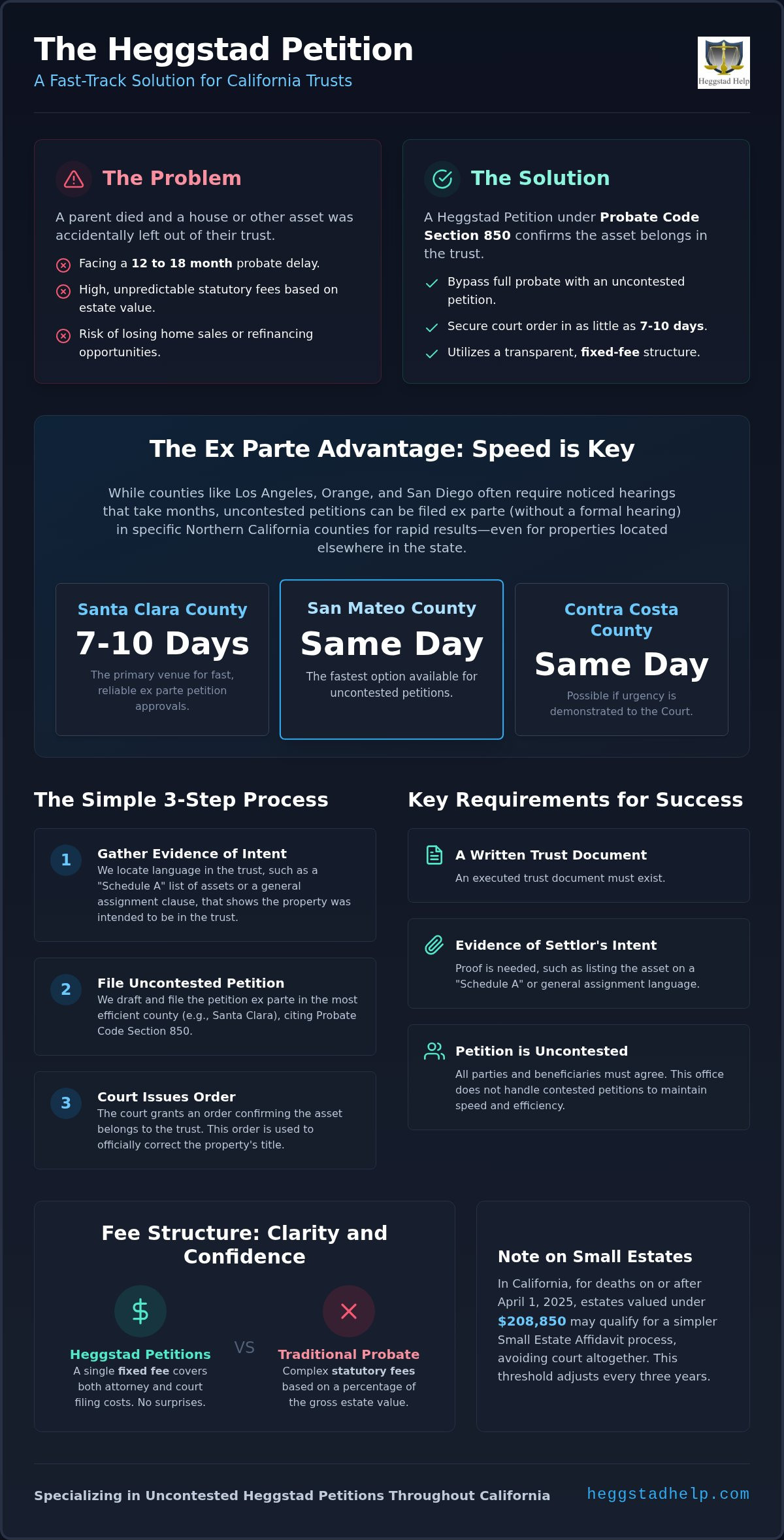
Selling a House Left Out of a California Trust

You finally have a buyer for your loved one’s home, but then the title company delivers the crushing news: the house was never deeded to the trust,…

You finally have a buyer for your loved one’s home, but then the title company delivers the crushing news: the house was never deeded to the trust, and escrow is frozen. It’s a common nightmare where you’re told a house not in trust can’t sell California real estate without a full probate process lasting over a year. You’re likely feeling the weight of managing an empty property while facing a daunting legal hurdle that seems to have no end in sight.

We understand this frustration, but a title error doesn’t have to mean a 12-to-18 month delay. You can often legally fix this using a Heggstad petition (a court order that confirms an asset belongs in a trust even if the deed was never updated). As a Board-Certified Specialist, Robert P. Bergman helps families across California navigate this process with a transparent, fixed-fee structure that covers both filing and attorney fees.

In this guide, you’ll learn how to bypass full probate and secure a court order to finalize your sale. We’ll explain how we achieve same-day results in San Mateo County or 7 to 10 day turnarounds in Santa Clara County. We’ll even show how cases from other counties can often be heard quickly in Santa Clara to avoid the months of waiting typical in other jurisdictions.

Key Takeaways

  • Discover why a house not in trust can’t sell California property and how an “unfunded trust” creates a roadblock for title companies during escrow.
  • Learn how a Heggstad Petition under Probate Code Section 850 can legally transfer a home into a trust after death by proving the owner’s original intent.
  • Find out how specific counties like San Mateo and Santa Clara allow for accelerated “ex parte” orders that can fix title issues in as little as one to ten days.
  • Identify the essential evidence required to win your case, including the “Schedule of Assets” and broad “General Assignment” language found in many trust documents.
  • Understand the advantages of working with a Board-Certified Specialist who offers a fixed-fee structure covering both attorney fees and court filing costs.

The Unfunded Trust Crisis: Why You Can’t Sell the House

Imagine you’ve signed a listing agreement and found a motivated buyer; then the title company calls with bad news. They’ve discovered that while your parents had a trust, they never actually deeded the family home into it. This situation creates what we call an "unfunded trust." In simple terms, an unfunded trust occurs when someone creates the legal document but fails to complete the funding (the formal process of transferring legal title from an individual name to the trust’s name). It’s a common mistake that brings real estate transactions to a grinding halt.

This oversight is the primary reason why a house not in trust can’t sell California real estate without court intervention. Even if the trust document explicitly names you as the Successor Trustee and grants you the "power to sell" all assets, that power only applies to assets the trust actually owns. Because the deed still lists the deceased individual as the owner, the title company cannot legally recognize your authority to sign closing documents. This roadblock often stems from a simple oversight; perhaps a bank required the house be moved out of the trust during a refinance and it was never moved back, or a DIY trust kit was completed without recording the necessary deeds at the County Recorder’s office. The same funding problem that affects real estate can also impact other estate assets, and families dealing with forgotten LLCs or business accounts may need to transfer business interest to trust after death in California using the same Heggstad petition process.

How to Check the Current Title Status

If you’re unsure about the status of a property, your first step should be to obtain a Preliminary Title Report (a document prepared by an escrow or title company that shows the current owner and any liens on the property). Look specifically for the "Grantee" section. If the Grantee is listed as an individual name rather than "The [Name] Family Trust," the property is unfunded. Many people assume that listing the house on a "Schedule of Assets" (a list of items intended to be in the trust) is enough to transfer ownership. Unfortunately, for California real property, a written list does not replace the requirement for a recorded deed.

The Legal Consequences of an Unfunded Home

When a house not in trust can’t sell California law typically points toward a default path: full probate administration. This is a court-supervised process that can easily take 12 to 18 months to complete. Until the title is corrected, the property is essentially frozen. You cannot legally finalize a sale, and the expenses of maintaining an empty home continue to mount while legal issues linger. You don’t have to accept this "probate nightmare" as your only option. At Heggstad Help, we specialize in assisting attorneys, title companies, and families with a faster alternative that corrects these title errors through a fixed-fee structure that covers both filing and attorney fees, ensuring transparency and peace of mind.

Heggstad Petitions: The California Solution for Missing Assets

When a title company informs you that a house not in trust can’t sell California real estate, the most efficient path forward is often a Heggstad Petition. This legal request, filed under California Probate Code Section 850, asks the court to confirm that a property belongs in a trust even if the deed was never formally updated. It’s a powerful tool because it focuses on the decedent’s intent rather than just the paperwork. If you can show the court that the owner meant for the house to be trust property, the judge can issue an order that functions just like a recorded deed. This process acts as a vital shortcut, allowing you to bypass the multi-step probate process and move straight to a court order that satisfies title insurance requirements. Learn how a Heggstad Petition saves time compared to probate and keeps your real estate transaction on track.

Eligibility Requirements for a Heggstad Petition

To successfully file this petition, certain criteria must be met. First, a written trust document must exist; you cannot use this process for a purely oral agreement. Second, you must provide evidence of intent. This is typically found in a "Schedule of Assets" (a list attached to the trust) or specific language within the trust document itself that mentions the property. Finally, the petition must be filed in the proper venue, which is usually the county where the property is located or where the trust is currently being administered. If you’re dealing with a stalled sale, you may want to consult a specialist to review your trust documents for these specific requirements.

Small Estate Alternatives in 2026

Some families wonder if they can use a simpler Small Estate Affidavit instead of a Heggstad Petition. However, California sets strict financial thresholds for these affidavits based on the date of death. For individuals dying on or after April 1, 2025, the small estate threshold is $208,850. For those dying on or after April 1, 2026, the threshold increases to $239,700. Since most California real estate values far exceed these amounts, a Heggstad Petition is usually the only viable alternative to full probate. Consider the financial impact: a standard probate for a $1 million home can result in a 4% statutory fee (the fee set by law) totaling $40,000 or more in combined costs. In contrast, our fixed-fee Heggstad services provide a much more cost-effective way to correct the title and finalize your home sale.

Timelines: How Quickly Can You Fix the Title and Sell?

Speed is the primary concern when a house not in trust can’t sell California real estate. While standard probate administration often drags on for 12 to 18 months, a Heggstad Petition offers a significantly faster route. The actual duration of your case depends largely on whether the petition is uncontested and which county court handles the filing. Our goal is always to secure a "Confirmation of Trust Assets" court order, which provides the legal certainty title companies require to close escrow and finalize the sale.

In most California counties, a "noticed hearing" (a scheduled court appearance where all interested parties are formally notified of the legal action) is the standard requirement. This process typically takes 30 to 60 days, plus the additional time required for legal notice. If heirs or beneficiaries disagree on the property’s status, the case becomes contested, which can lead to significant delays. However, for most families dealing with a simple paperwork error, we can often utilize "ex parte" procedures (legal actions taken without a formal, long-lead hearing) to move much faster.

County-Specific Speed Lanes in Northern California

We leverage specific court procedures in the Bay Area to move much faster than the standard timeline. In San Mateo County, we can often file, hear, and have an ex parte petition granted on the same day. In Contra Costa County, same-day grants are also possible if we demonstrate "urgency" to the court’s satisfaction, such as a pending escrow with a buyer who is ready to walk away. Santa Clara County is also remarkably efficient; uncontested petitions there are typically decided and granted within 7 to 10 days of filing.

The ‘Santa Clara Advantage’ for Other Counties

This is where our specialized knowledge provides a distinct benefit for clients outside of Northern California. If you’re dealing with a property in Los Angeles, San Diego, or other counties with significant court backlogs, a noticed hearing might take many months. This delay is often unacceptable when a house not in trust can’t sell California property because the buyer might lose their mortgage rate lock or find another home.

There’s a strategic solution to this problem. Uncontested Heggstad petitions for properties located in those other counties can often be heard ex parte in Santa Clara County instead. This allows us to secure a court order in just 7 to 10 days rather than waiting half a year or more in a backlogged Southern California court. By utilizing this "Santa Clara Advantage," we help successor trustees resolve title issues quickly and keep their home sales on track.

Selling a House Left Out of a California Trust

Evidence Required to Win Your Heggstad Petition

Securing a court order depends entirely on your ability to demonstrate "decedent intent" (the clear desire of the person who passed away to have their home owned by the trust). When a house not in trust can’t sell California real estate, the judge needs to see more than just a signature on a trust document. We must present specific evidence that bridges the gap between the trust’s creation and the missing deed. The most powerful piece of evidence is the "Schedule of Assets" (a list typically found at the back of a trust document that identifies which properties are included in the trust estate). If the home’s address or legal description appears on this list, your case for a Heggstad order is very strong.

If a specific list doesn’t exist, we look for "General Assignment" language. This is a broad clause within the trust or a separate document where the creator states they are transferring "all real and personal property" to the trust. While less specific than an address, it serves as a legal catch-all that often satisfies the court’s requirements. This same General Assignment language is equally important when families need to transfer business interest to trust after death in California, covering forgotten LLCs or brokerage accounts alongside real property. To strengthen the case, we frequently include supporting declarations (written statements signed under penalty of perjury) from the attorney who drafted the trust or from witnesses who can testify to the decedent’s wishes. Read our full guide on required evidence for Heggstad Petitions to see how these documents work together.

Document Checklist for Successor Trustees

Gathering the right paperwork early prevents delays in the filing process. You’ll need to provide the following items to your legal specialist:

  • The original Trust Agreement along with any signed amendments.
  • The most recently recorded deed (even if it still shows the individual name of the deceased).
  • The pending Purchase Agreement if the property is currently in escrow and needs a quick resolution.

Common Pitfalls in Evidence

One common hurdle is a missing "Schedule A" or list of assets. Don’t panic if you can’t find this specific page. Even without a perfect "Schedule A," a skilled specialist can often find alternative proof of intent through other trust provisions or external documents. Another potential issue involves conflicting documents, such as a Will written after the trust that seems to give the house to someone else. These complications require careful handling to ensure the Heggstad petition isn’t contested by other heirs. If you’re unsure if your documents are sufficient, you can get expert help with your Heggstad petition to review your evidence before filing.

Next Steps: Fixing the Title with Heggstad Help

When you’re stuck because a house not in trust can’t sell California real estate, the path toward a resolution starts with expert intervention. You don’t need a general practitioner who handles everything from traffic tickets to divorces; you need a specialist who understands the specific "speed lanes" within the California probate court system. Robert P. Bergman is a Board-Certified Specialist in Estate Planning, Trust and Probate Law with over 40 years of experience. Our office assists successor trustees, attorneys, and title companies throughout the state to clear stalled titles and keep escrows moving forward.

We believe in total transparency, which is why we utilize a fixed-fee structure. This single fee covers both the court’s filing fees and all attorney fees required to secure your order. You won’t have to worry about unpredictable hourly billing or surprise costs while you’re already managing the stress of a loved one’s estate. To initiate the process, we offer a simple consultation to review your trust documents and determine the most efficient county for your filing. If you’re ready to move past the legal roadblocks, we’re here to provide a steady, knowledgeable hand.

Why Choose a Specialist Over a Generalist?

Choosing a specialist gives you access to deep knowledge of local court procedures that generalists often overlook. For instance, we know exactly how to navigate the ex parte (emergency) rules in Santa Clara County to secure orders in just 7 to 10 days. We also understand how to help clients with properties in backlogged areas like Los Angeles or San Diego by utilizing the "Santa Clara Advantage," where we file uncontested petitions in Santa Clara to avoid months of waiting. Our goal is always efficiency; we file specifically to avoid the standard, months-long noticed hearing process whenever possible. Learn more about our Heggstad Petition services and how we can accelerate your timeline.

Getting the House Back on the Market

Once the judge signs the Heggstad order, the legal "fix" is nearly complete. We take that signed court order and ensure it is recorded with the County Recorder in the county where the property is located. This recorded order acts as the formal bridge in the chain of title, effectively moving the home into the trust as of the date of the decedent’s death. Many families are surprised to learn that it is possible to transfer real estate to a living trust after death through this court-ordered process, bypassing the need for full probate administration entirely.

At this point, the title is officially "cleared." The title company will recognize the Successor Trustee’s authority to sign the grant deed for the buyer, allowing escrow to close without further delay. You can finally finalize the sale, pay off any remaining property expenses, and distribute the proceeds to the beneficiaries according to the instructions in the trust. It’s the resolution you’ve been waiting for, achieved in weeks rather than years.

Secure Your Property Sale and Protect the Estate

Facing the reality that a house not in trust can’t sell California real estate is stressful, but it’s a solvable problem. By utilizing a Heggstad petition, you can bypass the lengthy probate process and secure the court order needed to clear the title. Your loved one’s original intent, documented in the trust or a schedule of assets, is the key to unlocking this legal shortcut. Whether you’re dealing with a property in San Mateo, Santa Clara, or anywhere else in the state, there’s a path to finalize your home sale in weeks rather than years.

Robert P. Bergman is a Board-Certified Specialist who has spent over 40 years helping families navigate these specific hurdles. We offer a transparent, fixed-fee structure that covers both filing and attorney fees, so you don’t have to worry about hidden costs. With our ability to file ex parte petitions, we can often achieve results in as little as 7 to 10 days. Don’t let a missing deed derail your progress any longer.

Fix Your Trust Title Error Today – Contact Heggstad Help

You’ve already done the hard work of managing the estate; let us handle the technical legal fix to get your property back on the market and your escrow closed.

Frequently Asked Questions

Can I sell a house if the deed is not in the trust’s name?

No, you generally cannot finalize the sale because the title company will refuse to close escrow. Since a house not in trust can’t sell California real estate without a clear chain of title, the Successor Trustee lacks the legal authority to sign the grant deed. You must first correct the title error through a court order, such as a Heggstad Petition, before the sale can proceed.

How long does a Heggstad Petition take in California?

The timeline depends on the county and whether the petition is uncontested. In San Mateo County, we can often have a petition heard and granted the same day. In Santa Clara County, it typically takes 7 to 10 days. Other counties often require a noticed hearing, which usually takes 30 to 60 days plus notice time, though court backlogs can extend this significantly.

What is the cost of a Heggstad Petition versus full probate?

A Heggstad Petition is significantly more affordable than full probate, which involves statutory fees based on the gross value of the estate. For example, a $1 million home in probate could trigger over $40,000 in fees. We provide a fixed-fee structure that covers both filing and attorney fees, offering a transparent and predictable cost compared to the percentage-based fees of probate.

Do I need a noticed hearing to fix a trust title error?

Not always. While many counties default to a noticed hearing (a formal court date scheduled weeks in advance), we can often file uncontested petitions ex parte. This "ex parte" process allows us to seek a court order without a long-lead hearing in specific counties like Santa Clara or San Mateo, drastically shortening the time it takes to clear title.

What is the small estate threshold for California in 2026?

For individuals dying on or after April 1, 2026, the small estate threshold is $239,700. If the individual died on or after April 1, 2025, the threshold is $208,850. Because most California homes are worth more than these amounts, a house not in trust can’t sell California property using a simple Small Estate Affidavit and will require a Heggstad Petition instead.

Can a Heggstad Petition be filed if there is no ‘Schedule A’?

Yes, you can still file even if the "Schedule A" or list of assets is missing. We can often prove the owner’s intent by using "General Assignment" language found within the trust document or by providing supporting declarations from the drafting attorney. A missing list is a common hurdle, but it’s rarely a dead end for a skilled specialist.

Do all beneficiaries have to agree to a Heggstad Petition?

While the law doesn’t strictly require every beneficiary to sign off, the process is much faster if the petition is uncontested. If all beneficiaries agree, we can often use the expedited ex parte procedures mentioned earlier. If someone objects, the case becomes contested, requiring a noticed hearing and a longer legal process to resolve the dispute.

Can I file a Heggstad Petition in Santa Clara for a property in Los Angeles?

Yes, if the petition is uncontested, we can often have it heard in Santa Clara County regardless of where the property is located. This is a major advantage because backlogged courts in Southern California can take many months to hear a case. Filing in Santa Clara allows us to secure a court order in just 7 to 10 days, saving you months of waiting.

Robert P. Bergman, Attorney at Law

Article by

Robert P. Bergman, Attorney at Law

Attorney Robert P. Bergman ("Bob Bergman") has been a Board-Certified Specialist in Estate Planning, Trust and Probate Law since 2011, as certified by the California State Bar Board of Legal Specialization. For several years, Bob has assisted families and the clients of other attorneys with obtaining court orders through Heggstad petitions to avoid the time and expense of Probate administration. Bob is friendly, very approachable, and believes in explaining complex legal topics in clear ordinary language so that his clients understand exactly what they're doing and why they're doing it.
Bob is often able to assist clients who are in other counties than his home county of Santa Clara through his approach to Heggstad petitions.

Disclaimer

This article is for informational purposes only. Nothing in this article is intended to replace legal advice from a competent attorney or be considered legal guidance for anybody's specific legal situation. Nobody should rely on information in this article in making legal decisions without such consultation.

How to Fix Trust Title Errors on California Real Property: A 2026 Legal Guide

Imagine you have finally found a buyer for your late parent’s home, only to have the title company halt the sale because the deed was never formally…

Imagine you have finally found a buyer for your late parent’s home, only to have the title company halt the sale because the deed was never formally moved into the trust. This discovery often brings the severe consequences of incorrect trust property title California families face into sharp focus, potentially triggering a probate process that can last 12 to 18 months. It’s a stressful situation, especially when you are already dealing with the loss of a loved one and the weight of technical terms like vesting (the legal way a property’s ownership is officially recorded on a deed).

You likely want a solution that avoids the high costs of a traditional court case. This guide will teach you how to identify title mistakes and correct them using a Heggstad petition, which is a specialized court order used to confirm assets as trust property. We’ll explain how to bypass full probate, whether your situation qualifies for an ex parte (a request for a court order without a formal hearing) filing, and how counties like San Mateo can often grant these the same day. You’ll also learn about the 2026 small estate threshold of $239,700 and how fixed fees help attorneys and clients move forward with confidence.

Key Takeaways

  • Discover why a California trust cannot technically hold title and how incorrect vesting (the legal way ownership is listed) often leads to rejected deeds at the title company.
  • Understand the severe consequences of incorrect trust property title California families face, including a frozen chain of title that prevents you from selling or refinancing the home.
  • Learn how to use a Heggstad petition to fix an “unfunded” trust without a 12-month probate, specifically through fast-tracked ex parte filings (court orders granted without a formal hearing).
  • Identify if your estate qualifies for simplified procedures based on the 2026 threshold of $239,700 for those dying on or after April 1, 2026.
  • Get clarity on costs with fixed-fee arrangements that cover both filing and attorney fees, ensuring there are no hidden financial surprises during the legal process.

Understanding Trust Title Errors: Why Your Deed Might Be Invalid

When you examine a property deed, you are looking at the “vesting” (the formal legal method through which ownership is officially recorded). A common misconception is that a trust is a distinct legal entity, similar to a corporation, that can own property in its own name. In reality, a trust is a fiduciary relationship. One of the most significant consequences of incorrect trust property title California homeowners encounter is a “clouded” title that prevents a house from being sold or refinanced. This occurs because California law dictates that a trust cannot hold title; only the trustee (the person or entity managing the trust assets) can hold the legal title to the property.

To understand why this matters, it helps to look at What is a Trust in Property Law to see the distinction between legal and equitable title. The trustee holds the legal title, which provides the authority to sign deeds and manage the asset. The beneficiaries hold the equitable title, which gives them the right to benefit from the property. If a deed is made out to “The Miller Family Trust” instead of “John Miller, as Trustee of the Miller Family Trust,” the chain of title is technically broken. The “vesting deed” must clearly show that the trustee has the legal power to act, or title insurance companies will likely refuse to clear the transaction.

The Trust vs. Trustee Distinction

Naming the trust itself as the owner is a frequent error that can lead to a rejected sale. While the 2023 case Boshernitsan v. Bach provided some relief by suggesting that courts can look at the intent of the parties, title companies remain extremely risk-averse. They often require a court order to prove the property is actually a trust asset. If you find yourself in this position, Heggstad Help can assist in securing an ex parte (a request for a court order without a formal hearing) order to resolve the discrepancy quickly.

Common Scenarios for Title Mistakes

Errors often stem from simple human oversight or technical lapses. You might find typographical errors in the trust’s name or the date the trust was created, which creates a mismatch with the trust documents. In other cases, a deed was simply never recorded after the trust was signed, leaving the trust “unfunded.” This is particularly problematic if the estate’s value exceeds the California small estate thresholds ($208,850 for deaths on or after April 1, 2025, and $239,700 for those on or after April 1, 2026). Additionally, deeds that still name a predecessor trustee who has since passed away can halt a sale until a successor trustee’s authority is legally confirmed. The same Heggstad petition process that resolves real estate title errors also applies to business interests, such as when transferring an LLC to trust after death in California becomes necessary because a membership interest was never formally moved into the living trust.

Fixing these errors doesn’t have to take years. While a noticed hearing can take 30 to 60 days, we specialize in fast-tracking uncontested petitions. In Santa Clara County, these are typically granted in 7 to 10 days. In San Mateo and Contra Costa Counties, we can often have them filed and granted the same day, provided we can demonstrate urgency to the court. Our services use fixed fees that cover both the filing fees and attorney fees, so you don’t have to worry about escalating legal costs while trying to secure your property’s title.

Consequences of Incorrect Trust Property Title in California

Discovering an error on a property deed usually happens at the worst possible moment, such as during the final days of an escrow period. The consequences of incorrect trust property title California residents face are not merely clerical; they can halt a multi-million dollar sale or prevent a family from accessing their inheritance for years. When the “chain of title” (the historical record of property ownership) is broken by an incorrect vesting, the property is effectively frozen. Title insurance companies will refuse to issue a policy on what they call a “dirty” title, meaning the buyer cannot secure a loan and the seller cannot transfer the home.

Lenders are equally strict. If you’re trying to refinance a home held in a trust, the bank’s underwriters will scrutinize the deed to ensure the trustee has the legal authority to pledge the property as collateral. If the vesting is technically incorrect under the California Probate Code on Trust Law, the lender will likely deny the application until a court order corrects the record. This creates a significant roadblock for families who need to access home equity for medical expenses or other urgent needs.

The most expensive consequence is the “probate trap.” If a property owner dies with a title error that leaves the home outside the trust, the property may be forced into full probate administration. In California, a standard probate for a $1 million home can take 9 to 18 months and cost upwards of $46,000 in statutory fees (fees set by law that both the attorney and executor are entitled to receive). This is a stark contrast to the fixed-fee Heggstad petition process, which resolves the issue in a fraction of the time. Additionally, improper title transfers can trigger a loss of Proposition 19 protections. For 2026, the exclusion for an inherited primary residence is capped at the parent’s assessed value plus $1,044,586; a title error that results in a “change in ownership” could lead to a massive property tax reassessment.

Why Title Companies Reject Incorrect Vesting

Title officers flag errors when the deed names an entity that cannot legally hold title, such as the trust itself rather than the trustee. This places the property “outside the chain of title,” making it impossible for the officer to verify who actually has the power to sign the closing documents. While a “Correction Deed” (a document used to fix minor typos) might work for a misspelled name, it cannot fix a situation where the property was never transferred to the trust in the first place, especially if the original grantor is deceased and cannot sign a new deed. Understanding common California trust funding mistakes before they occur is the most effective way to prevent your family from facing this exact scenario.

The Financial and Time Costs of Inaction

Ignoring a title error only makes the eventual fix more expensive and time-consuming. A full probate process in Los Angeles or the Bay Area can stretch toward two years, while an uncontested Heggstad petition can often be resolved in 60 to 90 days. If you’re managing an estate with missing assets, you can find more details in our guide on Successor Trustee Help for Missing Assets. If you’re unsure if your deed is valid, reviewing our specialized Heggstad petition services can provide clarity. Remember that in counties like Santa Clara, we can often secure these orders in 7 to 10 days, and in San Mateo or Contra Costa, we can occasionally achieve same-day results for urgent cases.

Identifying the Right Fix: Simple Deed Corrections vs. Heggstad Petitions

Fixing a title error requires a clear understanding of whether you are dealing with a minor clerical slip or a fundamental failure to “fund” (transfer ownership into) the trust. If you choose the wrong remedy, you could waste months in administrative loops while the consequences of incorrect trust property title California laws impose continue to stall your home sale. Generally, the path you take depends on whether the error is a “scrivener’s error” (a simple typo made by the person drafting the document) or a complete omission of the property from the trust’s legal chain of ownership.

For major errors where a property was left out of the trust entirely, the legal engine for a fix is Probate Code Section 850. This section allows a judge to declare that a property belongs in a trust even if the deed was never recorded. This is commonly known as a Heggstad petition. Because we specialize in this niche, we often utilize ex parte (a request for a court order without a formal hearing) filings to bypass the standard court calendar. While a noticed hearing might take 60 days, our ex parte expertise allows us to secure orders in Santa Clara County within 7 to 10 days. In San Mateo and Contra Costa Counties, we can often have petitions filed and granted the same day, provided we can show the court a sense of urgency, such as a pending home sale.

When a Correction Deed Works

A Correction Deed is a simple document used to fix minor mistakes like a misspelled name or an incorrect trust date on an existing deed. This is a cost-effective solution, but it has one strict limitation: all parties, including the grantor (the person giving the property) and the grantee (the person receiving it), must be alive to sign the new document. If the original owner has passed away, you cannot simply “correct” the deed because the person with the legal authority to grant the property is no longer here. In these cases, a simple affidavit won’t satisfy a title company, and a court order becomes necessary.

When You Need a Heggstad Petition

If the property was never deeded to the trust at all, you must prove the owner’s intent to include it. This often involves using a “General Assignment” (a document stating all assets are moved to the trust) or a “Schedule A” (the list of assets typically found at the back of a trust document). As noted in this Heggstad petition guide, this process is the primary way to avoid a 12-month probate for an unfunded California home. The same petition process applies equally when transferring an LLC to trust after death in California, where a deceased owner’s membership interest was never formally assigned to the trust.

Using this petition is vital if the property value exceeds the small estate threshold, which is $208,850 for deaths on or after April 1, 2025, and increases to $239,700 for those on or after April 1, 2026. At Heggstad Help, we provide these services with fixed fees that cover both the attorney fees and court filing fees. This transparency ensures you know the total cost upfront while we work to secure your property’s chain of title through the most efficient legal channels available.

How to Fix Trust Title Errors on California Real Property: A 2026 Legal Guide

Step-by-Step Guide to Correcting California Trust Title Issues

Correcting a title error requires a methodical approach to satisfy both the court and the title insurance company. When you’re managing the consequences of incorrect trust property title California law creates, you need a clear path to move from a rejected deed to a clean title. Following a structured sequence helps you avoid the “probate trap” and ensures your property is legally secured within the trust’s protection. Here’s how to navigate the process effectively.

The first step is gathering the “smoking gun” evidence that proves the property was intended to be part of the trust. You’ll need the original trust document and any specific evidence of intent, such as a “Schedule A” (the list of assets intended for the trust) or an “Omnibus Assignment” (a document that assigns all current and future property to the trust). If you’re looking for specific evidence tips, our guide on Deed Not Recorded to Trust in California: Legal Remedies provides a deep dive into what courts look for. Once the evidence is in hand, you must determine the best legal vehicle for the fix.

Evaluating the Estate Value

Before filing a court petition, it’s essential to check if the estate qualifies for simplified procedures. For deaths occurring on or after April 1, 2025, the Small Estate Affidavit threshold is $208,850. This limit increases to $239,700 for deaths occurring on or after April 1, 2026. While these thresholds are helpful for bank accounts or vehicles, California real estate almost always exceeds these limits. Because the home’s value usually pushes the estate over the threshold, a Heggstad petition under Probate Code Section 850 is typically the only way to avoid a full, 12-month probate administration. Reviewing a comprehensive checklist of California trust funding mistakes to avoid in 2026 can help successor trustees identify gaps before they become costly legal problems.

Gathering Evidence of Intent

Successor trustees should search the decedent’s estate planning binder for an “Assignment of Assets” or a “Purpose” clause within the trust itself. These clauses often state that the person intended to include all their real property in the trust. This documentation is vital because it allows us to prepare a petition that clearly demonstrates the owner’s intent to the judge. By presenting a strong case, we can often file these petitions ex parte (a request for a court order without a formal hearing), which significantly speeds up the timeline.

Efficiency is our priority. In Santa Clara County, we typically see petitions granted in 7 to 10 days. In San Mateo and Contra Costa Counties, we can often have a petition filed and granted on the same day, provided we can show the court a clear sense of urgency. Once the judge signs the order, the final step is recording a certified copy of that order with the County Recorder to officially “clean” the title. We handle this entire process through our Heggstad petition services, using a fixed-fee model that covers all filing and attorney costs so you have total price transparency from day one.

Fast-Tracking Your Title Correction with Heggstad Help

One of the most daunting consequences of incorrect trust property title California families deal with is the prospect of a long, drawn-out probate. While a general probate lawyer might guide you through a process that lasts 12 to 18 months, a specialist focusing on Heggstad petitions operates on a completely different timeline. By narrowing our focus to trust title corrections, we’ve developed a methodical approach that prioritizes speed and precision. We assist attorneys, title companies, and private clients throughout the state to resolve these issues before they cause a real estate transaction to collapse.

Our service model is built on transparency, which is why we utilize a fixed-fee structure. This single fee covers both the court’s filing fees and all attorney fees, ensuring you won’t face unexpected bills as your case progresses. This clarity is especially important when you’re managing an estate that exceeds the California small estate thresholds ($208,850 for deaths on or after April 1, 2025, and $239,700 for those on or after April 1, 2026). When real estate values push an estate over these limits, our specialized knowledge becomes the most efficient tool for securing the property’s chain of title.

The Ex Parte Advantage

The secret to our speed lies in our expertise with ex parte (a request for a court order without a formal hearing) filings. By presenting an uncontested petition directly to a judge, we can often bypass the standard 30 to 60 day notice period required for formal hearings. This regional efficiency is a hallmark of our practice. In Santa Clara County, we typically see petitions granted in just 7 to 10 days. In San Mateo and Contra Costa Counties, we can often file and receive a granted order on the same day, provided we can demonstrate a clear sense of urgency to the court. This rapid resolution is essential for successor trustees who are in the middle of a 30-day escrow.

Ready to Secure Your Trust Property?

Waiting to fix a title error is a risky strategy. As time passes, evidence of intent can be lost, and the legal hurdles only become more complex. Robert P. Bergman uses over 40 years of specialized experience to navigate the intricacies of the California court system, ensuring that your property is legally confirmed as a trust asset without the need for full probate administration. If you’re facing a rejected deed or a clouded title, taking action now can save your family tens of thousands of dollars in statutory probate fees. You can take the first step toward a resolution today and Get a Fixed-Fee Quote for Your Heggstad Petition.

Securing Your Real Estate Legacy Without the Probate Delay

Vesting errors on a deed don’t have to result in a multi-year legal nightmare for your family. By understanding the severe consequences of incorrect trust property title California law imposes, you can take the necessary steps to restore your property’s chain of title. The Heggstad petition remains the most powerful tool for successor trustees to fix “unfunded” trusts and avoid the high costs of full probate administration. Whether you’re navigating the 2026 small estate thresholds or racing against a 30-day escrow, a specialized court order provides the finality you need.

We assist families, title companies, and attorneys statewide by leveraging regional court efficiencies. Our team provides ex parte expertise that can secure orders in 7 to 10 days in Santa Clara County, with same-day filing available in San Mateo and Contra Costa Counties when urgency is demonstrated. Led by a California Board-Certified Specialist since 1980, our service uses fixed fees that include all court costs to ensure you have complete financial certainty. You can resolve these title complications quickly and move forward with confidence.

Start Your Heggstad Petition with a Fixed-Fee Specialist

Protecting your property and your beneficiaries’ inheritance is just one step away with the help of a dedicated guide.

Frequently Asked Questions

What is a Heggstad Petition and how does it fix title errors?

A Heggstad Petition is a specific legal request made under Probate Code Section 850 that asks a judge to declare that a property is part of a trust. It fixes title errors by providing a court order that serves as a legal bridge for a broken chain of title (the official record of ownership). This process is essential when the consequences of incorrect trust property title California families face include a rejected home sale due to a deed that was never properly recorded.

How much does it cost to file a Heggstad Petition in California in 2026?

We provide Heggstad Petition services using a transparent, fixed-fee model that covers both the attorney fees and the required court filing fees. This approach eliminates the stress of hourly billing and ensures you know the total cost before the process begins. By choosing a fixed fee, you avoid the unpredictable expenses often associated with traditional probate litigation while working to secure your property’s legal standing.

Can I sell my house while the Heggstad Petition is pending in court?

You can open escrow and find a buyer, but you cannot officially close the sale until the petition is granted and the certified court order is recorded. Title insurance companies require this order to “clean” the title before they’ll issue a policy to the new owner. If you’re in a hurry, we use ex parte (a request for an order without a formal hearing) filings to speed up the court’s decision.

What happens if a deed was never recorded to the trust before the owner died?

If a deed wasn’t recorded, the property is technically “unfunded” and remains in the decedent’s individual name. This often triggers a full probate process unless you file a Heggstad Petition to prove the owner’s intent to include the house in their trust. We look for “evidence of intent” in the trust’s Schedule A (the list of assets) or a general assignment document to convince the judge to move the property into the trust posthumously (after death).

How long does the Heggstad Petition process take in Santa Clara County?

In Santa Clara County, uncontested Heggstad Petitions are typically granted in just 7 to 10 days. This rapid timeline is possible because we specialize in ex parte applications that bypass the standard court calendar. In neighboring counties like San Mateo and Contra Costa, we can often see petitions filed and granted the same day, though Contra Costa requires demonstrating “urgency” to the court to achieve that speed.

Is a Heggstad Petition the same as a full California probate?

No, a Heggstad Petition is a streamlined alternative that is much faster and less expensive than a full probate. While a standard probate can take 12 to 18 months and involves high statutory fees (fees set by law based on the estate’s value), a Heggstad Petition focuses only on the specific title error. It’s a targeted solution designed to resolve the consequences of incorrect trust property title California residents encounter without the burden of a year-long court case.

Can I fix a trust title error if the original grantor is still alive?

If the grantor (the person who created the trust) is still alive and has the mental capacity to sign documents, you don’t need a court petition. You can simply prepare and record a new deed with the correct vesting (the legal way ownership is held) at the County Recorder’s office. A Heggstad Petition is only necessary if the grantor has passed away or is no longer legally able to sign a new deed to correct the mistake.

What is the small estate threshold for California in 2026?

For individuals who pass away on or after April 1, 2026, the California small estate threshold is $239,700. This is an increase from the $208,850 limit set for those dying on or after April 1, 2025. While these thresholds allow for simplified transfers of bank accounts or vehicles, real estate in California almost always exceeds these values, which is why a Heggstad Petition is usually required to move a home into a trust.

Robert P. Bergman, Attorney at Law

Article by

Robert P. Bergman, Attorney at Law

Attorney Robert P. Bergman ("Bob Bergman") has been a Board-Certified Specialist in Estate Planning, Trust and Probate Law since 2011, as certified by the California State Bar Board of Legal Specialization. For several years, Bob has assisted families and the clients of other attorneys with obtaining court orders through Heggstad petitions to avoid the time and expense of Probate administration. Bob is friendly, very approachable, and believes in explaining complex legal topics in clear ordinary language so that his clients understand exactly what they're doing and why they're doing it.
Bob is often able to assist clients who are in other counties than his home county of Santa Clara through his approach to Heggstad petitions.

Disclaimer

This article is for informational purposes only. Nothing in this article is intended to replace legal advice from a competent attorney or be considered legal guidance for anybody's specific legal situation. Nobody should rely on information in this article in making legal decisions without such consultation.
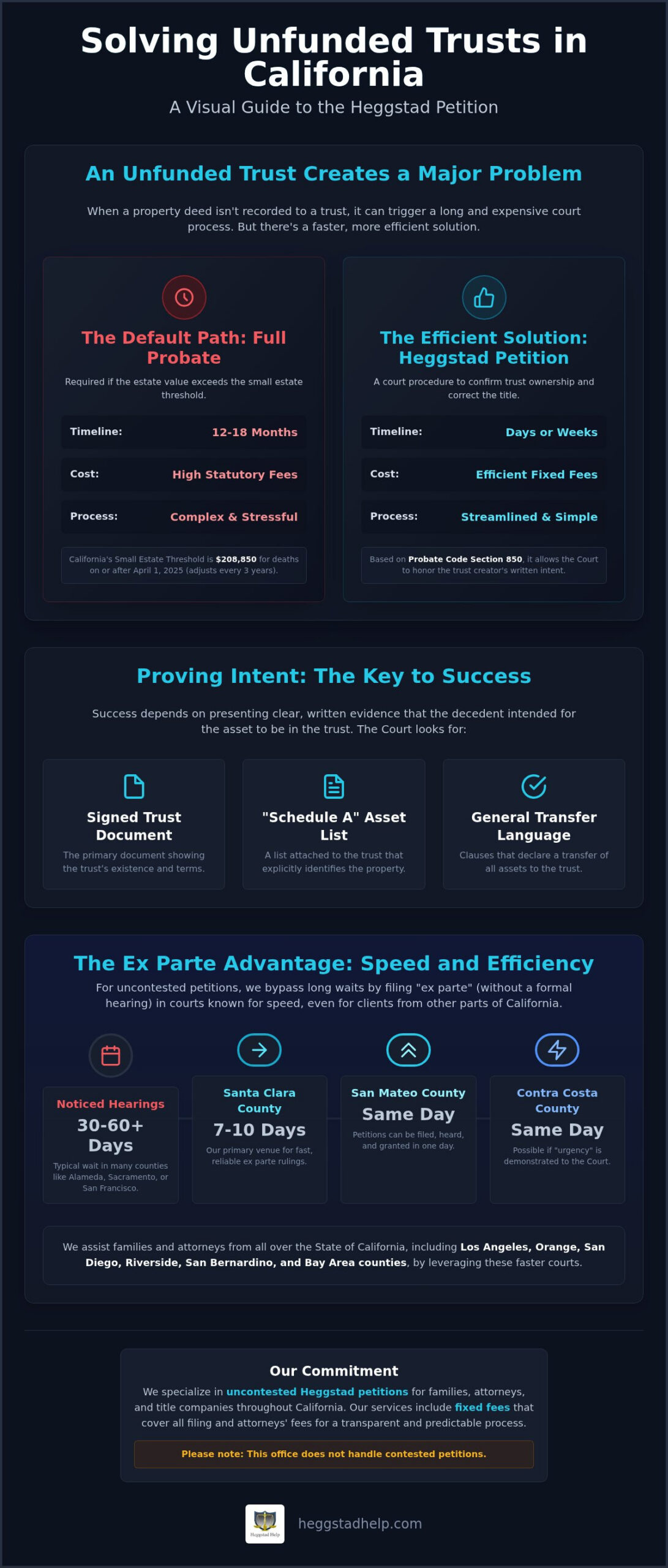
Successor Trustee Help for Missing Assets: A California Resource Guide

Imagine you’re weeks into managing an estate when you discover a stray property deed or an old brokerage statement that doesn’t mention the trust at…

Imagine you’re weeks into managing an estate when you discover a stray property deed or an old brokerage statement that doesn’t mention the trust at all. It’s a common hurdle, but it often triggers a wave of panic about a 12 to 18 month probate process and mounting pressure from beneficiaries who are waiting for their distribution. If you’re searching for successor trustee help for missing assets, you’ve likely realized that a simple oversight by the original grantor can stall the entire administration.

You don’t have to resign yourself to a lengthy court battle or high statutory fees just because an asset was left "unfunded" (a term for property that was intended for the trust but never formally retitled). In California, a Heggstad Petition, filed under Probate Code section 850, can often transfer these assets into the trust retroactively. This guide will walk you through the practical steps of locating missing records and explain how a targeted court order can bypass the traditional probate timeline. You’ll learn exactly how to identify these missing pieces and the logical path toward securing a court’s confirmation of trust ownership.

Key Takeaways

  • Fulfilling your fiduciary duty requires identifying all property intended for the trust, and professional successor trustee help for missing assets can assist in resolving title errors that would otherwise halt administration.
  • A systematic search of the decedent’s “Schedule A” (the list of assets typically attached to the back of a trust document) and digital footprints is the first step in locating property that was never formally retitled.
  • You can often avoid a 12 to 18 month probate by filing a Heggstad Petition, which is a specialized legal request used to confirm trust ownership based on the grantor’s documented intent.
  • Under California Probate Code section 850, trustees have a specific mechanism to “fix” funding mistakes and move unfunded assets into the trust without the cost of a full probate.
  • In certain Bay Area counties, such as San Mateo and Contra Costa, uncontented ex parte (i.e., no formal hearing) Heggstad petitions may be filed and decided on the same day, while such uncontested Heggstad petitions from the rest of California may be filed in Santa Clara County through my office and decided in 7-10 days.

The Successor Trustee’s Duty to Locate and Secure Trust Assets

Being appointed as a successor trustee brings a significant legal and ethical fiduciary duty to identify, marshal, and protect every piece of property intended for the trust. This responsibility isn’t limited to the items clearly listed in a binder; it extends to discovering assets that may have been overlooked or improperly titled. When families seek successor trustee help for missing assets, they often find that "missing" takes two forms. It might be physical property, such as jewelry or collectibles, that has vanished from a residence. More commonly, however, the asset is "missing" from the trust itself because the title was never updated to reflect trust ownership.

These "unfunded" assets, such as a family home still held in the decedent’s individual name, create a procedural crisis. Without a clear title, you cannot sell the property or distribute it to beneficiaries. While this situation used to mean an automatic trip to probate court, California Probate Code section 850 now provides a streamlined remedy to confirm trust ownership without a 12 month delay. It allows the court to "fix" the title if you can prove the grantor intended the asset to be part of their estate plan.

Understanding the Risks of Unfunded Assets

If property worth more than the current small estate thresholds is left outside the trust, it typically triggers a mandatory probate process. For deaths occurring on or after April 1, 2025, the threshold for personal property is $208,850, meaning even a modest brokerage account can force your hand. The consequences are often severe: beneficiaries may face 12 to 18 months of waiting, and the estate will incur thousands in statutory attorney and executor fees. You can find more detail on these specific obligations in our guide on Successor Trustee Duties for an Unfunded Trust.

Identifying the Scope of Your Search

Your search must be comprehensive, covering both tangible personal property and real estate. While physical items are located through a walkthrough, real property requires a deeper dive into county records. You aren’t just looking for a deed; you’re looking for evidence of the grantor’s intent. If a document exists stating their desire for the house to be in the trust, you have the foundation for a successful title correction. Professional successor trustee help for missing assets often starts here, by connecting the dots between old records and current legal requirements.

A Resource Checklist for Locating Missing California Property

Finding every asset requires a methodical investigation that begins with the trust document itself. You should first review the "Schedule A" (the list of assets typically found at the back of the trust binder) or any general assignment of assets. These documents often serve as a clear statement of the grantor’s intent, even if the formal title was never updated. Next, you’ll need to scour the decedent’s physical mail, tax returns from the last three years, and digital footprints. Tax returns are especially useful because they disclose interest, dividends, or property taxes paid on accounts or real estate you might not know exist.

Your search should also extend to public records and government databases. Conduct a search at the County Recorder’s office in each county where the decedent lived or owned property to identify any deeds still in their individual name. Additionally, check California’s Official Unclaimed Property Database. This resource often holds forgotten bank accounts or insurance proceeds that haven’t seen activity in years. If these steps reveal significant gaps in the trust’s funding, seeking successor trustee help for missing assets can help you determine the best legal path to secure them.

Searching Real Estate and Title Records

It’s standard practice to request a "Preliminary Title Report" from a title company to uncover hidden title defects. You might find property mistakenly held in joint tenancy or discover a deed not recorded to the trust despite being signed years ago. These errors are common, but they prevent you from selling or transferring the home until they’re corrected by the court. Understanding the full consequences of incorrect trust property title California families face is essential, as even a single misfiled deed can halt a pending sale and trigger a lengthy probate process.

Investigating Financial and Digital Assets

Contact the decedent’s financial advisors and banks to verify account ownership status. If you find accounts outside the trust, check for a "Pour-Over Will." This document acts as a safety net, stating that any assets found outside the trust should be "poured" into it. While the will provides evidence of intent, you’ll still need a court order to move the assets without a full 12 month probate. Professional successor trustee help for missing assets can simplify this transition by ensuring the right evidence is presented to the judge.

Successor Trustee Help for Missing Assets: A California Resource Guide

Once you’ve identified a property or account that was intended for the trust but never formally retitled, the next step is seeking a court order to correct the record. A Heggstad Petition, formally filed under California Probate Code section 850, is a specialized legal request used to confirm that property belongs in the trust based on the grantor’s documented intent. This process is the most effective form of successor trustee help for missing assets because it allows you to "fix" funding mistakes without the 12 to 18 month delay of a traditional probate.

The core of a successful petition is proving "intent." If the decedent signed a document expressing the desire for their assets to be held in trust, the court can rule that the property is a trust asset even if the deed was never recorded. This court order is essential for title companies, as they generally won’t issue title insurance (a policy protecting against ownership disputes) on a sale unless the chain of title clearly reflects the trust’s authority. Without this judicial confirmation, the asset remains in a legal limbo that prevents distribution or sale.

When is a Heggstad Petition Appropriate?

This remedy is appropriate when you discover a house was never deeded into the trust or a significant bank account was never retitled. Clear evidence, such as a signed "General Assignment" (a broad legal document transferring all of a person’s property into their trust), is often the key to a favorable ruling. You can see if your missing assets qualify for a Heggstad Petition by reviewing your specific trust documents for these types of supporting clauses.

Avoiding the Costs of Full Probate

Probate fees in California are set by statute and can be incredibly high; for a $1 million estate, the combined statutory fees for the attorney and executor are approximately $46,000. In contrast, a Heggstad filing offers a more efficient, fixed-fee alternative that bypasses the graduated fee scale of the Probate Code. At Heggstad Help, we specialize in these filings, often acting as the expert resource that other attorneys and title companies turn to when they encounter complex title errors. If you’re ready to resolve these issues, our Heggstad Petition Filing services provide a logical, streamlined path toward distributing the estate to the beneficiaries.

The final hurdle in your journey as a trustee is the court filing itself. While California’s legal system can be slow, the procedural path you choose significantly impacts your timeline. You’ll generally face a choice between a noticed hearing and an ex parte (expedited) application. A noticed hearing is the standard route, usually requiring 30 to 60 days to secure a court date because it allows all interested parties time to receive formal notification. However, if you’re seeking successor trustee help for missing assets due to a pending real estate sale or another urgent matter, an ex parte petition might be possible to resolve the issue much faster.

Choosing a fixed-fee structure for these filings provides essential transparency during a stressful time. Instead of worrying about hourly billing that fluctuates with every court delay, you’ll know the costs for attorney services and the $435 court filing fee upfront. This predictability is often a relief for trustees who are already managing the high expectations and pressures of beneficiaries. It allows you to focus on the logical progression of the estate rather than the mounting costs of litigation.

Expedited Results in the Bay Area

In certain SF Bay Area counties, the speed of resolution is a major advantage for those who act quickly. Our experience with ex parte court order services shows that San Mateo and Contra Costa courts can often process urgent, uncontested petitions on the same day they’re filed. In Santa Clara, you might expect a turnaround of 7 to 10 days, which can apply to matters from throughout California. Demonstrating "urgency" to the judge is the key here; if a home is in escrow and the title company is waiting on a court order to close the sale, the court is much more likely to expedite your request. Managing beneficiary expectations during this window is easier when you have a clear, documented timeline from the court.

Next Steps for Successor Trustees

To move forward, you’ll need to gather your evidence: the original trust document, the problematic deed, and the "Schedule A" or general assignment. Having these records organized is the first step toward a successful trust asset title correction. Consulting with a Board-Certified Specialist in Estate Planning, Trust and Probate Law ensures your petition is drafted to meet specific local court requirements, reducing the risk of a denial or a "kick back" from the court clerk. You can contact Robert P. Bergman for Heggstad Petition assistance today to begin the process of securing your trust’s assets and fulfilling your duties to the beneficiaries.

Securing the Estate’s Legacy Without Probate

Discovering a missing deed or an unfunded account doesn’t have to derail your administration. By combining a methodical search of records with the legal framework of California Probate Code Section 850, you can move assets into the trust without the burden of a full probate. This transition protects the estate’s value and ensures beneficiaries receive their inheritance months sooner than they would through traditional court channels. It’s a logical, efficient way to fulfill your fiduciary duties while minimizing stress for everyone involved.

When you need successor trustee help for missing assets, working with a specialist ensures the petition is handled with precision. Robert P. Bergman is a Board-Certified Specialist in Estate Planning, Trust and Probate Law who provides fixed-fee structures for all Heggstad filings, ensuring transparency from the start. Get Expert Help with Your Heggstad Petition today to secure the property and move forward with confidence. You’ve done the hard work of locating the assets; now let us handle the legal steps to make them official.

Frequently Asked Questions

What happens if a successor trustee cannot locate all trust assets?

A successor trustee must make reasonable, documented efforts to identify and safeguard all property intended for the trust to satisfy their fiduciary duty. If assets remain missing after a thorough search of tax returns, mail, and county records, the trustee should document their search process to protect themselves from potential liability. Seeking professional successor trustee help for missing assets can ensure that all resources, including California’s unclaimed property records, are fully exhausted before concluding the search.

How long does a Heggstad Petition take in California?

The timeline for a Heggstad Petition depends on the county and whether the matter is handled through a standard noticed hearing or an expedited process. A standard noticed hearing typically takes 30 to 60 days to reach a court date. However, in Bay Area counties like San Mateo or Contra Costa, ex parte (i.e., no formal hearing) filings can often be resolved on the same day if a critical deadline, such as a real estate closing, is pending. Filings in Santa Clara County, which can be for Santa Clara County and the rest of the California counties, typically are decided within 7 to 10 from the date of filing.

Can a house be moved into a trust after the owner has died?

Yes, a house can be transferred into a trust after the owner’s death if you can prove they intended the property to be a trust asset. This is the primary purpose of a Heggstad Petition under Probate Code section 850. If the decedent signed a "Schedule A" or a general assignment of assets, the court has the authority to issue an order confirming trust ownership, effectively bypassing the need for a 12 to 18 month probate.

What is the cost of a Heggstad Petition compared to probate?

A Heggstad Petition is generally far less expensive than a full probate administration because it avoids statutory attorney and executor fees. In California, probate fees are calculated as a percentage of the gross estate value; for instance, a $1 million estate triggers approximately $46,000 in combined statutory fees for the attorney and executor. A Heggstad filing uses a fixed-fee model that covers the court filing fee and specialized legal work, providing a more efficient resolution for unfunded assets.

Does a Heggstad Petition require a formal court hearing?

Yes, a Heggstad Petition requires a court hearing, though it doesn’t always involve a lengthy trial. Most cases are uncontested and are decided based on the written evidence of the grantor’s intent provided in the filing. While a judge must sign the final order to correct the title, the process is significantly streamlined compared to the multi-step requirements and long timelines of a formal probate proceeding.

Robert P. Bergman, Attorney at Law

Article by

Robert P. Bergman, Attorney at Law

Attorney Robert P. Bergman ("Bob Bergman") has been a Board-Certified Specialist in Estate Planning, Trust and Probate Law since 2011, as certified by the California State Bar Board of Legal Specialization. For several years, Bob has assisted families and the clients of other attorneys with obtaining court orders through Heggstad petitions to avoid the time and expense of Probate administration. Bob is friendly, very approachable, and believes in explaining complex legal topics in clear ordinary language so that his clients understand exactly what they're doing and why they're doing it.
Bob is often able to assist clients who are in other counties than his home county of Santa Clara through his approach to Heggstad petitions.

Disclaimer

This article is for informational purposes only. Nothing in this article is intended to replace legal advice from a competent attorney or be considered legal guidance for anybody's specific legal situation. Nobody should rely on information in this article in making legal decisions without such consultation.

Attorney for Unfunded Trust California: Fixing Missing Deeds with a Heggstad Petition (2026)

Imagine you are in the middle of selling your late parent’s home, only to discover the deed was never actually recorded in the name of their trust….

Imagine you are in the middle of selling your late parent’s home, only to discover the deed was never actually recorded in the name of their trust. This "unfunded trust" (a trust that doesn’t actually own the assets listed in it) can feel like a one way ticket to a twelve month probate nightmare. If you find yourself in this position, finding a specialized attorney for unfunded trust California matters is the first step toward avoiding high statutory fees and public court delays. It’s an incredibly stressful realization, but there is a logical path forward that bypasses the traditional probate system.

We specialize in filing Heggstad petitions to "cure" these missing deeds by proving the deceased person’s intent to the court. We frequently assist other attorneys and title companies throughout California with these filings to ensure assets are transferred correctly, often filing them ex parte in Santa Clara County (see below).

In San Mateo County, we can often have a petition filed and granted on the same day. In Santa Clara County, it typically takes seven to ten days, while Contra Costa County can also offer same day results if we can demonstrate urgency. This article will show you how to use ex parte (without a formal hearing) orders and fixed fee arrangements to secure your property and clear your title in days rather than months.

Key Takeaways

  • Learn how to “cure” an unfunded trust (a trust that exists but doesn’t yet hold title to assets) by using a Heggstad petition to bypass the 12-month probate process.
  • Discover how a dedicated attorney for unfunded trust California can often secure ex parte (without a formal hearing) court orders in as little as one day.
  • Understand specific court timelines for the Bay Area, ranging from same-day results in San Mateo and Contra Costa to 7-to-10-day turnarounds in Santa Clara.
  • Recognize that results for Heggstad petitions for other counties can be handled in Santa Clara County with the same 7-to-10 day turnaround once filed. 
  • See how fixed-fee arrangements provide price certainty for families and title companies so you don’t have to face the high costs of traditional probate.

Table of Contents

What Is an Unfunded Trust and Why Does It Require a California Attorney?

An unfunded trust is a common but stressful complication where the trust documents exist legally, but the title to a specific asset, such as a family home or a brokerage account, was never formally transferred. This usually happens because of a forgotten deed, an asset purchased after the trust was signed, or a simple administrative oversight. When the title remains in an individual’s name rather than the trust’s name, the asset is technically "outside" the trust at the time of death. This creates a legal gap that prevents a successor trustee from managing or selling the property without court intervention.

If you find yourself in this position, you’ll likely need an attorney for unfunded trust California to avoid a full probate administration. Without a specialized petition, these missing assets typically trigger a court process that can last 12 to 18 months. While many families have a "Pour-Over Will" (a backup document designed to catch assets left out of a trust), it’s a common misconception that this will solves the problem instantly. In reality, a Pour-Over Will still requires a probate court’s oversight to move the assets into the trust, meaning you’re still stuck in the traditional probate system unless you use a more efficient legal tool.

The Legal Reality of Missing Trust Deeds

Successor trustees often face a confusing split between the "probate estate" and the "trust estate." The probate estate includes any assets that require court authorization to transfer, while the trust estate includes assets already titled correctly. This split causes a significant title blockage during a home sale because title companies cannot verify ownership. Handling unfunded trust probate California issues through a standard probate is the slow way to clear this hurdle, often costing the estate thousands in statutory fees.

Why a Generalist Attorney Might Miss the Heggstad Solution

Many general practice lawyers default to a full probate because they lack specific experience with Probate Code 850 petitions. This is a missed opportunity for the family. Using the precedent set by the Estate of Heggstad, we can pursue "intent-based" title recovery. By filing a 850 petition California real property, we ask the court to recognize that the decedent intended for the property to be part of the trust. This specialized focus is why we can often secure orders in San Mateo or Contra Costa County on the same day, rather than waiting a year for probate to conclude.

The Heggstad Petition: A Specialized Tool to Cure Missing Trust Titles

The Heggstad petition is a surgical legal remedy named after the landmark 1993 California case, Estate of Heggstad. It serves as a formal request to the court to confirm that a specific asset belongs to a trust, even if the formal title transfer was never completed. For families dealing with a sudden "title blockage," this petition is the most effective way to bypass the public and expensive California probate process. Working with a specialized attorney for unfunded trust California allows you to prove that the decedent intended for the property to be held in the trust, effectively "curing" the missing deed without a year of court oversight.

This legal procedure is authorized under California Probate Code § 850, which gives judges the power to determine ownership of property. Robert P. Bergman focuses exclusively on uncontested petitions, where all heirs and beneficiaries agree on the outcome. This lack of conflict is what allows the process to move at such a rapid pace. If you are unsure if your situation qualifies, you can explore how we review trust documents to determine the best path forward.

The Ex Parte Advantage: Bypassing the 60-Day Wait

The primary reason we can achieve such fast results is through "ex parte" filings. An ex parte request is a court application made without the standard 30 to 60 day noticed hearing period. While a generalist might wait months for a spot on the court calendar, a focused attorney for unfunded trust California can often present the Heggstad petition filing directly to a judge. In counties like San Mateo and Contra Costa, this can lead to a granted order in a single day, provided the paperwork is perfect and no one objects.

Evidence Required for a Successful Petition

To win a Heggstad case, the court requires "clear and convincing evidence" of the decedent’s intent. Judges look for specific documentation to verify that the omission was an oversight rather than a change of heart. Key evidence includes:

  • The original trust document and any amendments that mention the asset.

  • A "Schedule A" or asset list that explicitly names the property or account.

  • Written declarations, letters, or emails from the decedent regarding the asset.

  • Financial statements or insurance policies that reference the trust as the owner.

Attorney for Unfunded Trust California: Fixing Missing Deeds with a Heggstad Petition (2026)

Filing Your Petition: Timelines for Santa Clara, San Mateo, and Contra Costa

Heggstad Help provides specialized assistance to attorneys, title companies, and individual clients throughout the entire state of California. The process of moving an asset into a trust begins with gathering essential documents, such as the original trust instrument and proof of the decedent’s intent. Once these are secured, we draft a formal Petition for Order Confirming Trust Assets and file it with the appropriate Superior Court. While many people worry about the 12 to 18 month probate timeline, a focused attorney for unfunded trust California can often resolve these issues much faster using the ex parte (without a formal hearing) process.

It’s important to manage expectations regarding court schedules. If a judge determines that a noticed hearing is required, the court date is typically set 30 to 60 days after the initial filing. This period allows for the legally required notice to be sent to all interested parties. However, if the petition is uncontested and filed ex parte, the resolution can happen in a fraction of that time. If you are facing a looming deadline for a home sale, you can consult with us to determine the fastest filing strategy for your specific county.

Specific Local Timelines for Ex Parte Filings

Court efficiency varies significantly by county. In Santa Clara County, well-prepared petitions from withing Santa Clara County and from other parts of the State are typically granted within 7 to 10 days. San Mateo County is even more efficient; it’s often possible to have a petition filed and granted on the same day. In Contra Costa County, same day grants are also achievable if we can demonstrate "urgency" (such as a pending close of escrow) to the satisfaction of the Court. These rapid turnarounds are only possible when the petition is uncontested and the evidence of intent is clear.

Successor Trustee Duties and Asset Recovery

A successor trustee unfunded trust assets California has a strict fiduciary duty (a legal obligation to act in the best interest of the beneficiaries) to recover missing property. Failing to utilize a Heggstad petition when it is available could be viewed as a breach of this duty, especially if it results in the estate paying unnecessary statutory probate fees. Hiring an attorney for unfunded trust California ensures that you are fulfilling your legal obligations while protecting the estate’s value and avoiding the public probate process.

Choosing a California Heggstad Specialist: Fixed Fees and Expert Results

Selecting the right attorney for unfunded trust California issues is about more than just finding a lawyer; it’s about securing a specialist who understands the nuances of title correction. Robert P. Bergman is a Board-Certified Specialist in Estate Planning, Trust and Probate Law. This specific certification means he has met rigorous experience and education requirements set by the State Bar of California, providing a level of certainty that a general practice lawyer cannot match. Since 1980, we’ve focused exclusively on these complex procedural hurdles, ensuring that families don’t lose their inheritance to the high costs of statutory probate.

We don’t just file paperwork; we act as a bridge between the court system and the real estate industry. Heggstad Help works directly with title companies to ensure that the court order we obtain is sufficient to clear a title blockage and allow a pending home sale to close. This proactive approach prevents the sale from falling through due to avoidable legal delays. By coordinating with the title officers early in the process, we make sure the final order meets their specific requirements for issuing a title insurance policy.

The Fixed-Fee Model for Heggstad Petitions

One of the biggest anxieties for a successor trustee is the unpredictable nature of billable hours. We eliminate this stress by handling all uncontested Heggstad petitions with a transparent fixed-fee model. This single price covers both the court filing fees and the attorney fees, so the estate knows exactly what the cost will be from day one. There aren’t any surprise invoices or hidden administrative charges, allowing you to focus on settling the estate rather than managing legal bills.

Taking the Next Step: Your Heggstad Evaluation

If you’ve recently discovered that you or a loved one forgot to put house in trust California, the clock is often ticking, especially if a sale is pending. We recommend that you review your "Schedule A" list of assets and your current property deeds immediately to identify any discrepancies. Once you’ve identified a missing asset, the next logical step is to seek a professional review. You can Request a Heggstad Petition Evaluation from Robert P. Bergman today to confirm if your case qualifies for an ex parte order and a rapid resolution.

Secure Your Trust Assets with Professional Guidance

Discovering that a family home was never deeded into a trust is a high-stakes complication, but it doesn’t have to lead to a twelve-month probate delay. By working with a specialized attorney for unfunded trust California, you can utilize a Heggstad petition (a court order confirming trust ownership) to align your legal title with your loved one’s true intentions. This approach bypasses the public probate process and secures the clear title you need for a pending home sale or final distribution. Whether you’re facing a seven-day timeline in Santa Clara or seeking a same-day order in San Mateo, a logical and structured path forward exists.

Robert P. Bergman is a Board-Certified Specialist in Estate Planning, Trust and Probate Law with over 40 years of experience. We provide fixed-fee pricing for all Heggstad filings, which covers both the attorney fees and court costs to ensure total transparency for the estate. We regularly assist families, title companies, and other legal professionals in resolving these title blockages with calm competence. Request a Heggstad Petition Evaluation from Heggstad Help today to begin the process of correcting your trust’s title. You don’t have to navigate these procedural hurdles alone.

Frequently Asked Questions

Is it too late to put a house in a trust after the owner has died?

No, it is not too late if you use a Heggstad petition. This legal procedure allows the court to transfer a house or other assets into a trust after the owner has passed away. By presenting evidence of the owner’s intent, such as a "Schedule A" (the written list of assets intended for the trust), we can ask a judge to confirm the property as a trust asset. This effectively "cures" the missing deed and allows the successor trustee to manage the property without a full probate administration.

How much does a Heggstad petition cost in California?

We handle these petitions using a fixed-fee model that provides total price transparency for the estate. This single fee covers both the attorney fees and the court filing fees, so you don’t have to worry about the unpredictability of billable hours. This is typically a much more affordable option than a traditional probate, where the costs are calculated as a percentage of the estate’s gross value under California’s statutory fee schedule.

What is the difference between an 850 petition and a Heggstad petition?

A Heggstad petition is a specific type of filing performed under California Probate Code Section 850. While Section 850 is the broad law used to resolve various property ownership disputes, a Heggstad petition is the specific version used when an asset was left out of a trust by mistake. Working with a specialized attorney for unfunded trust California ensures your petition is drafted to meet the specific "intent-based" requirements that judges look for in these cases.

Can I sell a house while a Heggstad petition is pending?

You can list the home and enter into a purchase contract, but you generally cannot close escrow until the court grants the petition and the order is recorded. Title companies require a clear chain of ownership before they will issue a title insurance policy to a buyer. This is why the speed of our process is so vital; in San Mateo and Contra Costa, we can often obtain these orders on the same day they are filed to ensure a pending sale stays on track.

What happens if a Heggstad petition is contested by an heir?

If an heir or beneficiary objects to the transfer, the court will move the case to a noticed hearing calendar, which is usually set 30 to 60 days out. Contested petitions take much longer to resolve because they require a formal hearing and more extensive evidence. We focus on uncontested petitions, which allow us to utilize the ex parte (expedited) process in counties like Santa Clara to get results in as little as seven to ten days.

Robert P. Bergman, Attorney at Law

Article by

Robert P. Bergman, Attorney at Law

Attorney Robert P. Bergman ("Bob Bergman") has been a Board-Certified Specialist in Estate Planning, Trust and Probate Law since 2011, as certified by the California State Bar Board of Legal Specialization. For several years, Bob has assisted families and the clients of other attorneys with obtaining court orders through Heggstad petitions to avoid the time and expense of Probate administration. Bob is friendly, very approachable, and believes in explaining complex legal topics in clear ordinary language so that his clients understand exactly what they're doing and why they're doing it.
Bob is often able to assist clients who are in other counties than his home county of Santa Clara through his approach to Heggstad petitions.

Disclaimer

This article is for informational purposes only. Nothing in this article is intended to replace legal advice from a competent attorney or be considered legal guidance for anybody's specific legal situation. Nobody should rely on information in this article in making legal decisions without such consultation.
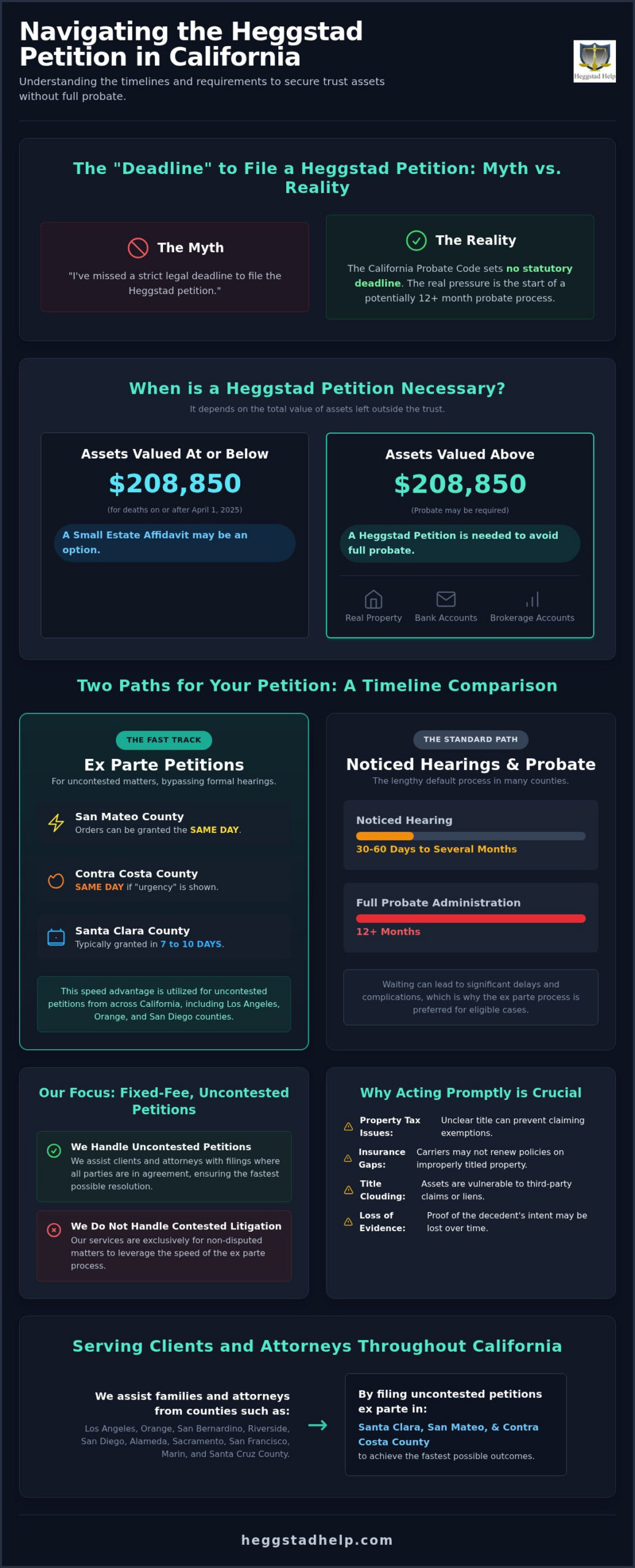
Unfunded Trust Probate in California: A Guide to Heggstad Petitions (2026)

Imagine you’ve just lost a loved one, only to discover that their most valuable asset, such as the family home, was never formally transferred into…

Imagine you’ve just lost a loved one, only to discover that their most valuable asset, such as the family home, was never formally transferred into their living trust. This common oversight often triggers a complex unfunded trust probate California process that can stall an inheritance for over a year. It’s a frustrating realization to find that while the trust documents were signed, the deed remained in the decedent’s (the person who passed away) individual name. You might feel like the estate plan has failed, but this procedural gap doesn’t necessarily mean you’re headed for a full, eighteen month probate ordeal.

We understand you’re likely feeling the weight of potential court costs and the stress of a long, uncertain timeline. This guide will show you how a specialized California trust funding attorney can utilize a Heggstad petition (a legal request to confirm an asset as trust property) to bypass full probate entirely. We’ll explain how this specific filing can correct title issues in as little as 60 to 90 days, providing the successor trustee with clear instructions and a much faster path to resolution than traditional administration.

Key Takeaways

  • Identify the common “funding gaps,” such as unrecorded real estate deeds or newly opened bank accounts, that prevent a living trust from functioning as intended.
  • Discover how to bypass a 12 to 18-month unfunded trust probate California process by utilizing a specialized Heggstad petition to transfer assets.
  • Learn the legal “intent” standard used by courts to confirm that a decedent (the person who passed away) meant for an asset to be trust property.
  • Compare the efficiency of an ex parte court order against the high statutory fees and procedural delays of full probate administration.
  • Gain clarity on the specific audit and evidence-gathering steps required to correct title issues and protect the successor trustee’s authority.

What is an Unfunded Trust and Why Does it Lead to Probate in California?

An unfunded trust occurs when a valid legal document exists, but the formal transfer of title (the legal ownership record) for specific assets was never completed. Think of a trust as a high-tech safe. You can have the most sophisticated, detailed instructions written on the door, but if the jewelry and cash are sitting on the counter next to it, the safe provides no protection. This procedural oversight often forces families into an unfunded trust probate California proceeding, as the law generally requires that assets be “held” by the trustee to avoid court involvement.

Gaps in trust funding typically arise from forgotten real estate deeds, new bank accounts opened after the trust was established, or errors made during “do it yourself” estate planning. A California trust funding attorney often steps in to audit these omissions, searching for evidence of the decedent’s (the person who passed away) intent to include those assets. This search for intent is rooted in the landmark case of the Estate of Heggstad, which provides the legal framework for correcting these errors without a full probate administration.

The Consequences of Assets Left Out of the Trust

When an asset remains in an individual’s name at the time of their passing, the California Probate Court claims jurisdiction (legal authority) over that property. Without a court order to the contrary, these assets may be distributed according to intestate succession laws (the state’s default rules for inheritance). This creates a significant risk that the decedent’s specific trust instructions will be overridden, potentially leading to distributions that contradict their actual wishes or cause conflict among heirs.

Real Estate and the “Forgotten Deed” Problem

Real estate is the most common asset left out of a trust. A house often “slips out” during a mortgage refinance if a lender requires the property to be moved back into the individual’s name for closing. If the homeowner forgets to record a new deed (the document transferring title) back into the trust afterward, the property is legally unfunded. While a signed trust schedule might list the home, title companies and banks usually require a formal deed or a court order to recognize the trust’s ownership during a sale or transfer. Working with a dedicated attorney for unfunded trust California cases is often the most efficient way to resolve these missing deed situations before they escalate into full probate proceedings.

The Hidden Risks of Unfunded Trust Probate

Falling into the “timeline trap” is the most immediate danger for families dealing with an unfunded trust probate California case. While a standard trust administration is designed to be swift, a formal probate proceeding in California typically stretches between 12 and 18 months. During this time, assets are effectively frozen. You cannot sell the real estate or distribute funds to beneficiaries until the court grants final approval. This delay is particularly painful when compared to the 60 to 90 days it usually takes to resolve a Heggstad petition. Families in Southern California facing these delays may benefit from understanding how a Heggstad petition Los Angeles filing can dramatically shorten this timeline compared to a full probate proceeding at the Stanley Mosk Courthouse.

The financial impact is equally significant. California law sets statutory fees for attorneys and executors based on the gross value of the estate, not the net value. If a house is appraised at $1 million, the combined fees can reach approximately $46,000, even if there’s a $700,000 mortgage on the property. By contrast, correcting a title through a specialized petition often involves a flat fee that’s a fraction of those costs. Beyond the money, you lose your privacy. A trust is a private document, but probate is a public process. Your family’s assets, debts, and the names of all heirs become part of the public court record for anyone to see.

Why General Probate Attorneys May Not Be Enough

Successor trustees often assume any lawyer can handle the situation, but there’s a distinct difference between a generalist and a California estate planning specialist. A generalist might default to a full probate because they aren’t comfortable with the nuances of California Probate Code 850. This specific statute allows you to bypass the year-long wait, provided your attorney knows how to present the “intent” evidence the court requires. If you’re feeling overwhelmed by the court’s requirements, you can consult with a specialist to see if your assets qualify for this faster route.

The Impact on Beneficiaries

Delayed distributions do more than just stall inheritance; they take an emotional toll on family members who may be relying on those funds for end-of-life expenses or property maintenance. When assets are left in legal limbo, the resulting uncertainty frequently triggers heated disputes among heirs over how the remaining property should be managed or divided. A specialized filing restores order by confirming the trust’s authority and getting the estate back on track quickly.

The Heggstad Petition: California’s Solution for Unfunded Assets

When you discover that a critical asset was left out of a trust, California Probate Code Section 850 provides the specific legal remedy known as a Heggstad petition. This procedural tool allows the court to confirm that an asset belongs to the trust, even if the formal title was never changed. Rather than starting a full unfunded trust probate California case, a specialist uses this petition to ask a judge to “fund” the trust retroactively based on the decedent’s (the person who passed away) clear intentions.

The success of this petition hinges on the “Intent” standard. The court doesn’t just look at the deed; it looks for written evidence that the creator of the trust intended for the asset to be included. A California trust funding attorney gathers specific documentation to build this case, including:

  • Trust Schedules: Often called “Schedule A,” these lists specifically name assets intended for the trust.
  • General Assignments: A broad legal document where the creator assigns all their property to the trust.
  • Written Declarations: Correspondence or other signed notes indicating the asset was meant to be trust property.

Heggstad Petition vs. Full Probate

The primary advantage of this route is speed and simplicity. An uncontested Heggstad petition is typically resolved within 60 to 90 days, requiring only a single court hearing. In contrast, a full probate administration often drags on for 12 to 18 months and involves multiple procedural stages. For a deeper look at the legal requirements for property, you can review the details on an 850 petition California real property filing. This streamlined approach avoids the high statutory fees associated with traditional court-supervised distributions.

Correcting Real Estate Titles Post-Death

If the missing asset is a home or land, the court order resulting from a successful petition serves as the legal authority to correct the deed. In urgent situations, a specialist might use ex parte court orders (emergency requests) to expedite the process. The successor trustee with unfunded trust assets plays a vital role here by acting as the primary source of evidence, providing the attorney with the necessary records to prove intent. If you’re ready to secure a court order and avoid the probate trap, contact Heggstad Help today to begin your title correction.

Unfunded Trust Probate in California: A Guide to Heggstad Petitions (2026)

How a California Trust Funding Attorney Resolves Your Estate

Resolving an unfunded trust probate California case requires a methodical approach that moves from initial discovery to final title recording. A specialized attorney begins with a comprehensive audit (a detailed review of all property records) to determine exactly which assets were left outside the trust’s legal umbrella. Once these gaps are identified, the focus shifts to gathering “Heggstad Evidence,” such as the original trust schedules or signed declarations of intent discussed earlier, to build a persuasive case for the court.

After the evidence is organized, the attorney files the formal petition under Probate Code 850. If the judge is satisfied with the proof of intent, they’ll issue a court order confirming that the assets are indeed trust property. The final, critical step involves trust asset title correction (the formal process of updating public ownership records). The attorney ensures the court order is properly recorded with the county recorder, which officially transfers the deed into the trust and allows the successor trustee to manage or sell the property without further court supervision. If you discover a deed was never recorded in the trust’s name, consulting an attorney for unfunded trust California matters early in this process can prevent costly delays and ensure the petition is filed correctly the first time.

Why Robert P. Bergman and Heggstad Help?

Successor trustees often face a steep learning curve when assets are missing, which is why specialized guidance is essential. Robert P. Bergman is a Board-Certified Specialist in Estate Planning, Trust and Probate Law, a credential held by a small percentage of California attorneys. Since 1980, he’s focused on the complexities of trust law, providing a level of expertise that generalists simply can’t match. Heggstad Help operates with an exclusive focus on Heggstad petitions and ex parte court orders, ensuring your filing is handled with the efficiency and precision required to avoid a 12 to 18-month probate delay.

Immediate Steps for Successor Trustees

The moment you realize an asset was left out of the trust, your priority should be document preservation. Successor trustees should secure all trust schedules and original estate documents immediately to preserve the paper trail needed for court. This includes looking for any “General Assignment” documents or letters from the decedent that mention the specific property. Once you’ve gathered these records, your next step is to consult with a specialist who can determine if a Heggstad petition is the right fit for your situation. Schedule a consultation with a Heggstad specialist to begin the recovery process today.

Securing Your Inheritance Without the Probate Delay

Discovering that a family home or financial account was left out of a living trust can feel like a major setback, but it doesn’t have to lead to a total estate failure. By understanding that California law provides a specific pathway to correct these funding gaps, you can take control of the situation before it spirals into a lengthy unfunded trust probate California proceeding. A successful Heggstad petition transforms a complex title issue into a manageable court order, effectively restoring the decedent’s (the person who passed away) original intent and protecting the interests of every beneficiary involved.

Navigating the nuances of Probate Code 850 requires a steady, experienced hand to ensure the court accepts your evidence of intent. Robert P. Bergman is a Board-Certified Specialist in Estate Planning, Trust and Probate Law with over 40 years of legal experience in California trust law. He focuses exclusively on these specialized filings to help families across the state avoid the stress of traditional administration. You don’t have to face these procedural hurdles alone. Contact Heggstad Help for a specialized review of your unfunded trust assets and let a dedicated problem-solver guide you toward a swift resolution.

Frequently Asked Questions

Can I file a Heggstad petition if there is no written schedule of assets?

Yes, you can still file a petition even without a formal “Schedule A” or asset list. While a written schedule is strong evidence, California courts also accept other forms of proof regarding the decedent’s intent. This might include a “General Assignment” document or specific language within the trust itself declaring that all of the individual’s property is now trust property. A specialist will review all estate documents to find the necessary legal evidence required by the court.

How much does a Heggstad petition cost compared to full probate in California?

A Heggstad petition is generally much more cost-effective because it avoids the statutory fees required for a full probate. In a formal probate proceeding, fees are calculated as a percentage of the gross estate value. For an estate valued at $1 million, those combined fees can reach approximately $46,000. Because a petition is a streamlined filing with typically only one hearing, the legal costs are generally a flat fee that’s significantly lower than those statutory mandates.

What happens if the house was never deeded to the trust before death?

If a house was never deeded to the trust, it remains in the decedent’s individual name and technically triggers an unfunded trust probate California proceeding. However, a Heggstad petition allows you to ask the court to “deem” the property as part of the trust retroactively. Once the judge signs the order, you can record that order with the county recorder to correct the title. This process effectively bypasses the 12 to 18 month probate timeline.

Is a Heggstad petition available for bank accounts and brokerage accounts?

Yes, this legal remedy applies to nearly any asset that was intended for the trust but was never formally retitled. This includes bank accounts, brokerage accounts, and even partnership interests or business shares. If the trust document or a separate assignment shows the decedent intended these accounts to be trust property, the court can issue an order to transfer them. This prevents the need for a full probate administration for those specific financial holdings.

How long do I have to file a Heggstad petition after someone dies?

There’s no specific “expiration date” for filing a Heggstad petition in California, but acting quickly is vital for protecting the estate. Delaying the filing can lead to complications with creditors, property tax reassessments, or maintenance issues. Most successor trustees choose to file as soon as they discover an unfunded trust probate California issue to ensure they can manage or sell the assets. Early action helps maintain the property’s value and provides clarity for all beneficiaries.

Robert P. Bergman, Attorney at Law

Article by

Robert P. Bergman, Attorney at Law

Attorney Robert P. Bergman ("Bob Bergman") has been a Board-Certified Specialist in Estate Planning, Trust and Probate Law since 2011, as certified by the California State Bar Board of Legal Specialization. For several years, Bob has assisted families and the clients of other attorneys with obtaining court orders through Heggstad petitions to avoid the time and expense of Probate administration. Bob is friendly, very approachable, and believes in explaining complex legal topics in clear ordinary language so that his clients understand exactly what they're doing and why they're doing it.
Bob is often able to assist clients who are in other counties than his home county of Santa Clara through his approach to Heggstad petitions.

Disclaimer

This article is for informational purposes only. Nothing in this article is intended to replace legal advice from a competent attorney or be considered legal guidance for anybody's specific legal situation. Nobody should rely on information in this article in making legal decisions without such consultation.

When to Use a Heggstad Petition in California: A 2026 Strategic Guide

Imagine discovering that your parents’ most valuable asset, their family home, was never actually titled in their trust. It’s a common oversight that…

Imagine discovering that your parents’ most valuable asset, their family home, was never actually titled in their trust. It’s a common oversight that often leads to the realization that a full probate process, which is the court-supervised procedure for distributing a deceased person’s estate, could cost your family tens of thousands in statutory fees and over a year of delays. It is incredibly frustrating to feel like a simple paperwork error might drain the inheritance your loved ones worked so hard to build. However, understanding exactly when to use a Heggstad petition can provide a specialized legal shortcut to bypass these administrative hurdles entirely.

You likely feel the weight of your responsibility as a successor trustee (the person designated to manage trust assets after the original trustee passes away) and want to fulfill your duties without getting bogged down in California’s complex court system. This 2026 strategic guide will show you how to rescue an inheritance from the delays and costs of full probate administration. We’ll examine the specific legal scenarios where “clear and convincing evidence” of a decedent’s intent can be used to transfer title to the trust quickly, often saving ten to twelve months of time. By the end of this article, you’ll know how to leverage Probate Code Section 850 to protect your family’s legacy and save thousands in unnecessary expenses.

Key Takeaways

  • Identify the specific legal triggers for when to use a Heggstad petition to confirm that real estate or financial accounts belong in a trust despite technical title errors.
  • Understand how California Probate Code Section 850 acts as a specialized alternative to full probate, significantly reducing the administrative burden on successor trustees.
  • Determine if your documentation, such as a formal Schedule of Assets or a general assignment, meets the “Written Intent” requirement necessary for a successful court order.
  • Evaluate the strategic advantages of the Heggstad process, including enhanced privacy for the estate and a faster path to title correction compared to traditional, public court proceedings.

Understanding the Heggstad Petition as a Probate Alternative

A Heggstad petition is a specialized legal request filed under California Probate Code Section 850. Its primary purpose is to ask the court to confirm that a specific asset, such as a family home or a brokerage account, belongs to a trust even if the formal title was never updated before the owner passed away. This procedure acts as a vital safety valve for families who discover that a loved one’s estate plan was left incomplete. Knowing when to use a Heggstad petition is essential because it allows the California Superior Court to prioritize the clear, written intentions of the trustor (the person who created the trust) over technical errors in a deed or title document.

In these proceedings, the petitioner, who is usually the successor trustee, presents evidence to the court showing that the deceased person intended for the asset to be trust property. If the court is satisfied with the “clear and convincing evidence” provided, it issues a court order that transfers the title into the trust. This effectively funds the trust retroactively, allowing the trustee to manage or sell the asset without the oversight of a probate judge.

The Legal Origin: Estate of Heggstad (1993)

The authority for this process comes from a landmark California appellate case known as the Estate of Heggstad. In 1993, the court ruled that a written declaration of trust, which specifically listed a property on an attached schedule, was sufficient to transfer that property into the trust even without a recorded deed. This ruling changed the legal landscape for successor trustee unfunded trust assets California cases. It established that the decedent’s intent, when documented in writing, is the most critical factor in determining trust ownership.

Heggstad Petition vs. Full Probate

Choosing a Heggstad petition over full probate administration offers significant advantages in both speed and cost. While a full probate often lasts 12 to 18 months, a Heggstad petition is typically resolved within two to six months. This efficiency is particularly valuable for families who need to sell real estate or access funds quickly to pay for estate expenses.

The financial impact is equally substantial. Probate involves statutory fees (legal fees set by California law based on the gross value of the estate). For a $1.5 million home, these mandatory fees can reach approximately $56,000 when accounting for both the attorney and the executor. A Heggstad petition avoids these rigid percentages, which can save a family tens of thousands of dollars in administrative costs. Understanding when to use a Heggstad petition is the first step toward protecting the value of an inheritance from the high costs of traditional court oversight.

Three Critical Scenarios: When to File a Heggstad Petition

Identifying when to use a Heggstad petition often starts with a review of the decedent’s most valuable holdings. While many people assume this process is only for those who have already passed away, it actually serves as a versatile tool for resolving title defects in several distinct circumstances. These scenarios typically involve assets that were clearly intended for the trust but remain legally tethered to the individual’s name due to administrative oversight or timing issues.

The “Forgotten” Real Estate Problem

Real property is the most frequent trigger for a petition because its value almost always exceeds the California small estate threshold. A common scenario involves a homeowner who refinances their mortgage. During the refinancing process, lenders often require the property to be “pulled out” of the trust and placed back into the individual’s name to secure the loan. If the owner forgets to deed the property back into the trust after the loan closes, the asset remains stuck in their individual name at the time of death. In these cases, the court looks at the original trust documents to confirm the property was intended to be trust-owned.

Beyond Real Property: Personal Assets and Accounts

The scope of this legal tool extends far beyond physical land. It’s equally effective for transferring brokerage accounts, bank accounts, or business interests that lack a “transfer on death” (TOD) or “payable on death” (POD) designation. If an asset is listed on a “Schedule A” (the document attached to the trust listing intended assets) but was never formally retitled, a Heggstad petition filing can recover that missing property. This is a crucial step for successor trustees who find themselves managing a partially funded trust.

A highly strategic but less discussed application involves pre-death title correction. If a trustor is still alive but has become mentally incapacitated, a successor trustee can use an ex parte court order to fix title errors. This proactive approach ensures the trust is properly funded before a death occurs, preventing future probate entirely. Similarly, the petition can resolve “incomplete transfers” where a deed was signed but the trustor passed away before it could be recorded with the county. If you find yourself in one of these time-sensitive situations, exploring ex parte court order services may be the most efficient path forward.

When to Use a Heggstad Petition in California: A 2026 Strategic Guide

Eligibility and Evidence: Can You Use Probate Code 850?

Determining when to use a Heggstad petition requires a careful evaluation of the evidence available to prove the decedent’s intent. Under California Probate Code Section 850, the court doesn’t simply take your word for it; you must provide “clear and convincing evidence” that the asset was meant to be trust property. This legal standard is higher than a typical civil case, making the quality of your documentation the deciding factor in a successful filing.

Before proceeding, it’s vital to compare the asset’s value against the 2026 California small estate thresholds. For estates where personal property, excluding real estate, is valued under $208,850, a Small Estate Affidavit might be a simpler alternative. However, because most California real property exceeds these limits, a Heggstad petition remains the primary tool for houses and land. Additionally, a “Pour-Over Will” (a specific type of will that directs any remaining assets into a trust) serves as powerful secondary evidence, reinforcing the trustor’s global intent to avoid probate.

Essential Evidence for a Successful Filing

A Board-Certified Specialist evaluates your case by looking for specific “links” between the asset and the trust. Strong evidence typically includes:

  • The original Trust Agreement and any amendments.
  • A formal “Schedule A” or “Schedule of Assets” listing the property.
  • A General Assignment of Assets, which acts as a “catch-all” transfer document.
  • Unrecorded deeds or relevant correspondence with financial institutions.

If your evidence seems “weak,” such as a vague mention in a letter, a specialist can help determine if supplementary metadata or digital drafts can bridge the gap. If you aren’t sure if your documents qualify, you can request a review of your trust asset title correction options to see if a petition is viable.

The Role of the Successor Trustee

As a successor trustee, you have a fiduciary duty (a legal obligation to act in the best interest of beneficiaries) to recover any assets that belong in the trust. Waiting too long to file can complicate the process, as “interested parties,” such as heirs who might inherit through a traditional probate, must be notified of your petition. These parties have the right to object, so moving quickly while evidence is fresh and witnesses are available is a strategic necessity. Prompt action helps fulfill your duties and ensures the inheritance is distributed according to your loved one’s actual wishes.

Strategic Advantages of the Heggstad Process over Full Probate

Choosing when to use a Heggstad petition is often a decision driven by a desire for efficiency and privacy. Unlike a full probate administration, which requires multiple court hearings and a public inventory of all estate assets, the Heggstad process is a targeted legal action. It focuses solely on confirming the trust’s ownership of specific property. This surgical approach results in a drastic reduction in court appearances, sparing the family from the emotional and administrative burden of a year-long legal proceeding.

Privacy remains a significant advantage for many California families. Because full probate is a public record, any curious party can view the details of an inheritance and the value of the estate. In contrast, Heggstad orders are more discreet, providing a faster path to a clear title (a title free from any legal claims or doubts) without exposing the entire estate to public scrutiny. This allows the successor trustee to resolve “clouded” title issues quickly, ensuring the property can be sold or distributed to beneficiaries according to the trustor’s original timeline.

The financial benefits are equally compelling. Probate fees in California are statutory (set by law) and calculated based on the gross value of the estate assets. By successfully using a Heggstad petition, the estate avoids these rigid percentage-based fees, preserving a larger portion of the inheritance for the intended heirs. It’s a logical path forward for those who value both speed and fiscal responsibility.

Why a Specialized Heggstad Attorney Matters

Generalist probate lawyers often default to the traditional probate process because they lack the specialized experience required for complex title corrections. Robert P. Bergman, a Board-Certified Specialist in Estate Planning, Trust and Probate Law, focuses exclusively on Heggstad filings and ex parte court order services. This high level of specialization ensures that petitions are drafted with the precision necessary to meet the “clear and convincing” evidence standard on the first attempt, avoiding the common pitfalls that can lead to court delays.

Taking the First Step: The Consultation

Successor trustees should act promptly to prevent assets from becoming locked in legal limbo, which can happen if creditors or other heirs file competing claims. For an initial review, you should gather the trust agreement, any amendments, and the specific title documents for the asset in question. Taking this first step ensures you fulfill your fiduciary duties while securing the most efficient path toward when to use a Heggstad petition for your family’s benefit.

Securing Your Trust’s Legacy with Precision

Navigating the aftermath of a loved one’s passing is difficult enough without the added stress of discovering an unfunded trust. As we’ve explored, the Heggstad process serves as a powerful remedy for technical title defects; it allows you to honor the decedent’s true wishes while avoiding the public and costly nature of full probate. Understanding exactly when to use a Heggstad petition ensures that a single clerical error doesn’t dismantle years of careful estate planning. By focusing on clear evidence of intent, you can protect the estate’s value and expedite the distribution of assets to beneficiaries.

Success as a successor trustee depends on acting with both speed and specialized knowledge. Robert P. Bergman is a Board-Certified Specialist in Estate Planning, Trust and Probate Law who has practiced since 1980, focusing exclusively on California Heggstad filings and title correction. This level of dedication means your case is handled with the calm competence required to navigate the Superior Court system efficiently. Don’t let your inheritance remain in legal limbo. You can Request a Specialized Heggstad Petition Review with Robert P. Bergman today to confirm your path forward. Taking this step brings the clarity and resolution your family deserves.

Frequently Asked Questions

Can I file a Heggstad petition if there is no Schedule of Assets?

Yes, you can still file even if a formal Schedule of Assets is missing. While a specific list is the most direct evidence of intent, California courts also accept a “General Assignment of Assets” or specific “catch-all” language within the trust document itself. Success depends on presenting other written proof, such as bank correspondence or digital drafts, that clearly shows the trustor’s plan to include the property in their trust.

How long does the Heggstad petition process take in California in 2026?

The Heggstad petition process typically takes between two and six months to reach a final resolution. This timeline is a major advantage for families, as it’s significantly faster than the 12 to 18 months required for a full probate administration. The exact duration often depends on the specific county’s court calendar and whether any interested parties, such as heirs or creditors, file an objection to the petition.

What happens if a Heggstad petition is denied by the court?

If the court denies your petition, the asset in question will generally have to go through the full probate process. This means the property will be subject to the standard, court-supervised procedure for distributing a deceased person’s estate. However, a denial is often preventable if the initial filing is prepared by a specialist who understands exactly when to use a Heggstad petition to meet the high “clear and convincing” evidence standard required by judges.

Is a Heggstad petition cheaper than a full probate case?

Yes, this process is almost always more cost-effective because it avoids the mandatory statutory fees associated with probate. In California, probate attorneys and executors are paid a legal percentage of the estate’s gross value, which can reach tens of thousands of dollars for a single family home. By using this specialized petition, you bypass those rigid, percentage-based costs and preserve a much larger portion of the inheritance for the beneficiaries.

Can I use a Heggstad petition for a bank account that has no beneficiary?

You can use a Heggstad petition for bank accounts, brokerage accounts, or business interests that lack a designated “transfer on death” beneficiary. The legal requirement remains the same: you must provide written evidence that the trustor intended for the account to be held within the trust. A general assignment of assets or a trust schedule that references the account is often sufficient for the court to grant a title transfer order.

Robert P. Bergman, Attorney at Law

Article by

Robert P. Bergman, Attorney at Law

Attorney Robert P. Bergman ("Bob Bergman") has been a Board-Certified Specialist in Estate Planning, Trust and Probate Law since 2011, as certified by the California State Bar Board of Legal Specialization. For several years, Bob has assisted families and the clients of other attorneys with obtaining court orders through Heggstad petitions to avoid the time and expense of Probate administration. Bob is friendly, very approachable, and believes in explaining complex legal topics in clear ordinary language so that his clients understand exactly what they're doing and why they're doing it.
Bob is often able to assist clients who are in other counties than his home county of Santa Clara through his approach to Heggstad petitions.

Disclaimer

This article is for informational purposes only. Nothing in this article is intended to replace legal advice from a competent attorney or be considered legal guidance for anybody's specific legal situation. Nobody should rely on information in this article in making legal decisions without such consultation.
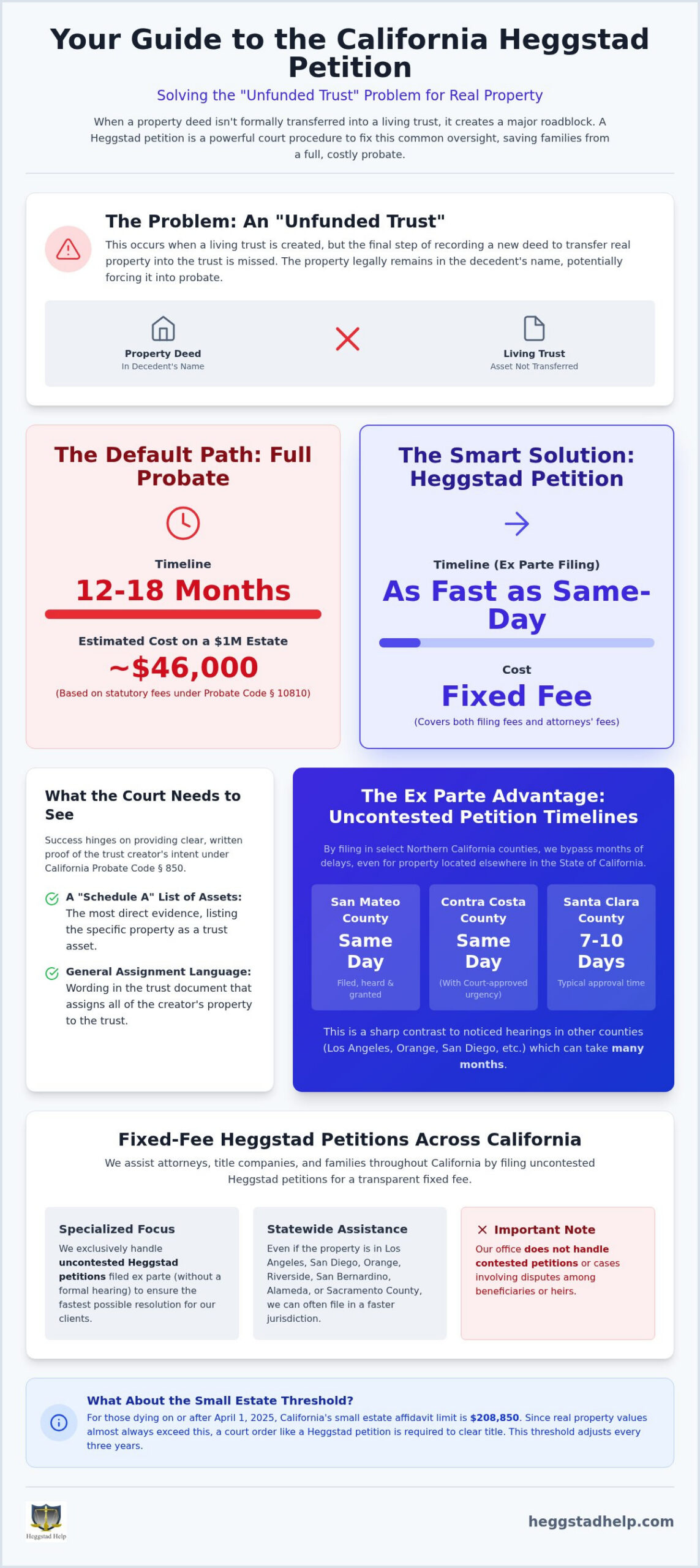
Successor Trustee Duties for an Unfunded Trust: The California Guide

Did you know that over 40% of California trusts are either unfunded or only partially funded? If you have been named a successor trustee unfunded…

Did you know that over 40% of California trusts are either unfunded or only partially funded? If you have been named a successor trustee unfunded trust assets California, you may be facing the very probate process the trust was meant to avoid. It’s a daunting discovery to find that a primary residence or a significant bank account was never properly titled, especially when you’re already managing the emotional weight of a loved one’s passing. You might worry about personal liability for mismanagement or the high statutory fees, which can exceed $46,000 on a $1 million estate.

We understand that you have a specific legal duty to marshal (the process of identifying and securing) all trust property. This guide will teach you how to fulfill those obligations and recover missing assets using efficient legal tools like the Heggstad petition. We’ll explain how to correct title errors through ex parte (emergency or side-bar) court orders, allowing you to bypass full probate while protecting yourself from potential beneficiary disputes. By the end of this article, you’ll have a clear, logical path toward resolving these procedural hurdles with confidence.

Key Takeaways

  • Identify assets that were intended for the trust but remain in the decedent’s individual name to prevent them from being stuck in the court system.
  • Understand how your fiduciary duty to avoid waste requires you to seek efficient title correction methods instead of defaulting to a lengthy and expensive probate administration.
  • Learn how a successor trustee unfunded trust assets California can use a Heggstad petition (a filing under Probate Code Section 850) to confirm trust ownership of real estate.
  • Gain insights into using ex parte court orders to expedite the transfer of property, which may save the estate significant time and statutory fees.
  • Discover why working with a specialist focused exclusively on trust asset title correction provides a more reliable path to resolution than hiring a generalist probate attorney.

Understanding the Unfunded Trust Crisis in California

An unfunded trust is a legal entity that exists on paper but does not legally hold title to the intended assets. In these scenarios, property remains in the decedent’s individual name rather than being held by the trust. This creates a significant hurdle for a successor trustee unfunded trust assets California, as they possess the legal authority to manage the trust but lack the actual legal title required to sell or distribute property. Under Trust law, a trust must be properly “funded” (the process of transferring ownership from an individual to the trust) to function as intended. Without this transfer, the trust is essentially an empty vessel.

Common causes for this crisis include failing to record a grant deed after a real estate purchase or forgetting to update the title on brokerage accounts before death. Often, a homeowner might remove a property from their trust to facilitate a refinance and simply neglect to deed it back into the trust once the loan closes. When you discover these omissions, the “Schedule A” (the list of assets typically attached to the back of a trust document) becomes your most vital piece of evidence. It serves as a clear record of the settlor’s (the person who created the trust) intent to include those specific assets in the estate plan. Understanding how unfunded trust probate California proceedings unfold can help you anticipate the challenges ahead and choose the most efficient path to resolution.

The Duty to Marshal Assets

As a successor trustee, you have a strict legal requirement to “marshal” assets. This is the act of gathering, securing, and taking formal title to all property intended for the trust. You can’t simply ignore an unrecorded deed or a forgotten bank account because they seem difficult to access. Doing nothing when an asset is missing can lead to a breach of fiduciary duty (a legal obligation to act in the best interest of the beneficiaries). You must identify which assets were clearly intended for the trust and differentiate them from assets that are legally required to go through a full probate process.

Successor Trustee vs. Executor

Roles can become blurred when a house is left out of a living trust in California. If you are the trustee, your power is limited to what the trust actually owns. If an asset is outside the trust, you may find yourself acting as a “petitioner” in the California court system rather than a standard administrator. While an executor manages assets through the formal probate court, a successor trustee dealing with unfunded assets uses specialized petitions to bring those items back under the trust’s umbrella. This prevents the need for a year-long probate stay while ensuring you fulfill your role as the steady hand guiding the estate. If a pending property sale is at stake, understanding why a house not in trust can’t sell California real estate without court intervention is essential before escrow can move forward.

Fiduciary Duties and the Risk of Personal Liability

Serving as a successor trustee is a significant legal responsibility that carries the weight of fiduciary duty. This means you’re legally obligated to act in the best interests of the beneficiaries with the highest degree of loyalty and care. When you find yourself as a successor trustee unfunded trust assets California, your first priority is the Duty of Diligence. You must investigate the title of every piece of real estate and every financial account mentioned in the estate plan. Simply assuming the trust is fully funded without verifying recorded deeds can lead to severe complications later in the administration process.

Another critical obligation is the Duty to Avoid Waste. In California, a formal probate for a $1 million estate can cost upwards of $46,000 in statutory fees and take 12 to 18 months to conclude. If you allow a property to languish in full probate when a Heggstad petition could have resolved the title issue in about 60 days, beneficiaries may claim you “wasted” estate funds. Under California Probate Code Section 17200, beneficiaries have the right to petition the court to review your actions, potentially leading to a surcharge where you’re forced to pay back the estate from your own pocket.

While the title correction process is underway, you must also adhere to the “Prudent Investor” rule. This requires you to maintain the property’s value by keeping insurance policies active, ensuring the home is secure, and managing any necessary repairs. Clear communication is your best defense. You should inform beneficiaries early that certain assets are currently “outside” the trust but are recoverable through specific legal channels. For a deeper look at how this situation can trigger court involvement, our overview of unfunded trust probate California procedures explains the key steps trustees must take to avoid a full administration.

Potential Liability for Successor Trustees

The risk of personal liability is real if a beneficiary sues because you failed to use an efficient remedy like a Heggstad petition. If your inaction causes the estate to lose money through unnecessary court fees or a decline in property value during a long probate, you could be held responsible. Seeking professional trust asset title correction California ensures that you’re taking the most efficient legal path available, which provides a strong shield against claims of mismanagement.

Standard of Care in California

California law measures your performance against what a “reasonable” trustee would do in a similar situation. A reasonable trustee doesn’t ignore an unrecorded deed; they take active steps to fix it using the tools provided by the Probate Code. If the legal requirements feel complex, engaging specialized counsel can help you meet this high standard of care. Working with a specialist at HEGGSTAD HELP allows you to navigate these hurdles with the calm competence that beneficiaries expect from a steady, knowledgeable hand.

Successor Trustee Duties for an Unfunded Trust: The California Guide

The Heggstad Petition: Your Tool for Fixing Title

When a successor trustee unfunded trust assets California discovers a missing deed or an unrecorded title, the primary legal remedy is found under California Probate Code Section 850. This specific filing, commonly known as a Heggstad Petition, allows the court to confirm that an asset actually belongs to the trust despite a technical error in the title. Instead of enduring the standard 12-to-18-month probate cycle, this petition offers a streamlined path to recovery. It is considered the gold standard for trustees because it honors the decedent’s wishes while protecting the estate’s value from unnecessary court-ordered fees. For a comprehensive overview of how this statute applies to real estate, see our guide to 850 petition California real property filings.

The success of this petition rests almost entirely on the concept of “intent.” If you can provide the court with written evidence that the person who created the trust (the settlor) intended for the property to be included, the judge has the authority to issue a decree confirming trust ownership. This effectively “funds” the trust after the fact, allowing you to manage the property according to the trust’s instructions rather than the rigid rules of intestate succession (the state’s default plan for people who die without a will). Families who discover a missing deed weeks after a loved one has passed can transfer real estate to a living trust after death in California using this targeted approach, bypassing the high statutory fees and lengthy delays of a full probate administration.

Evidence Required for Successor Trustees

To prevail in court, you must present clear documentation of the settlor’s wishes. The most common piece of evidence is the “Schedule A,” which is the list of assets typically found at the back of the trust document. If a Schedule A is missing, a “General Assignment” document (a broad statement transferring all of a person’s property into their trust) can also serve as sufficient proof. You should review the specific evidence required for Heggstad petition California to ensure your filing meets the court’s strict evidentiary standards.

The Step-by-Step Heggstad Process

While every case involves unique complications, the procedural path generally follows these four logical steps:

  • Step 1: Identify the missing asset and gather the original, signed trust documents and any associated schedules.
  • Step 2: Work with a specialist to draft the legal petition under Probate Code 850, clearly outlining the evidence of intent.
  • Step 3: File the petition in the appropriate California Superior Court and provide formal notice to all heirs and interested parties.
  • Step 4: Attend the hearing to obtain the court order confirming trust ownership; once received, you’ll record the new deed with the County Recorder to finalize the title.

If you’ve discovered an unrecorded deed and need to secure the estate’s future, you can begin the process today by requesting a professional Heggstad Petition Filing to fix the title error without the delay of a full probate.

Many generalist probate attorneys default to full probate administration because it is the standard, broad-brush solution for estates with title issues. However, this path is often unnecessary and significantly more expensive for the beneficiaries. When you are a successor trustee unfunded trust assets California, you need a surgical approach rather than a general one. Choosing a specialized Heggstad petition filing with a Board-Certified Specialist like Robert P. Bergman ensures your case is handled with the precision that generalists may lack. Specialized counsel facilitates asset transfers by understanding exactly what a judge needs to see to confirm title, moving you from being a trustee in crisis to one with a court-confirmed title ready for distribution.

Ex Parte Court Order Services

In some situations, waiting for a standard hearing date is not an option, especially if a property sale is pending or a financial hardship exists. Ex Parte Court Order Services (emergency or expedited court sessions) can be used to confirm trust assets in urgent scenarios. These filings require a deep understanding of California’s complex local court rules and the specific requirements of individual judges. A specialist knows how to navigate these procedural nuances to secure a timely resolution when the standard timeline is too slow.

Protecting the Estate’s Value

The financial difference between a Heggstad petition and a full probate is stark. While full probate fees are mandatory and calculated based on the gross value of the estate, a Heggstad petition is a targeted legal action designed to avoid that entire fee-heavy structure. By choosing this path, you are directly fulfilling your duty to avoid waste and preserve the inheritance for the beneficiaries. It’s a strategic choice that prioritizes the financial health of the estate over the standard, slower court processes.

My final advice for successor trustees is to avoid the temptation of “waiting and seeing.” Don’t wait for beneficiaries to complain about delays or for a title company to block a future sale. Taking proactive steps to fund the trust properly through a court order is the most logical way to resolve title errors. This direct action protects the estate’s value and ensures you meet the high standard of care required of your position.

Moving Forward with Confidence and Clarity

You now have a clear understanding of the risks associated with an unfunded trust and the specialized legal tools available to resolve them. By identifying missing assets early and leveraging the power of a Heggstad petition, you can honor the decedent’s true intent without the unnecessary delays of the probate court. Fulfilling your role as a successor trustee unfunded trust assets California requires proactive steps to secure the estate’s value and protect yourself from potential beneficiary claims.

When the path forward involves complex procedural hurdles, HEGGSTAD HELP provides the specialized expertise necessary for a smooth resolution. Led by Robert P. Bergman, a Board-Certified Specialist in Estate Planning, Trust and Probate Law with over 40 years of experience, our firm focuses exclusively on title recovery and Heggstad filings. We understand the nuances of California trust law and the specific requirements of the local court system, allowing us to act as a steady, knowledgeable hand during a difficult time.

Get Expert Help with Your Heggstad Petition Today

Don’t let an unrecorded deed or a forgotten account stall the administration process. You’ve already done the hard work of learning your obligations; now, let us help you finalize the title correction so you can move toward a successful distribution for the beneficiaries.

Frequently Asked Questions

What happens if a house is not deeded to a trust before death in California?

If a house is not properly deeded to the trust, it remains in the decedent’s individual name and technically becomes part of their probate estate. This means the property cannot be managed or distributed by the trustee until the title is corrected. Depending on the value of the property, the estate may be forced into a full probate administration, which can take 12 to 18 months; however, if there is written evidence of the decedent’s intent, you may be able to use a 850 petition California real property filing to bring the home back into the trust.

Can a successor trustee sell a house that is not legally in the trust?

No, a trustee does not have the legal authority to sell property that the trust does not own. Title companies and escrow officers will refuse to close a transaction if the owner of record on the deed does not match the trust entity. To move forward with a sale, a successor trustee unfunded trust assets California must first obtain a court order confirming that the property is a trust asset, which then allows for the recording of a new deed in the name of the trust. Learn more about the specific steps involved when a house not in trust can’t sell California real estate and how a Heggstad petition can unfreeze escrow.

How long does a Heggstad petition take compared to full California probate?

A Heggstad petition is a significantly more efficient process, typically reaching a resolution in about 60 days. This is a stark contrast to a formal California probate, which generally lasts between 12 and 18 months. By using this targeted legal tool, you can bypass the lengthy creditor notice periods and mandatory accounting cycles of a full probate, allowing for a much faster distribution of assets to the beneficiaries.

Is a successor trustee personally liable for assets left out of the trust?

A successor trustee unfunded trust assets California can face personal liability, known as a surcharge, if their inaction or negligence causes financial harm to the estate. If you fail to use an efficient remedy like a Heggstad petition and instead allow the estate to be diminished by the high costs and delays of a full probate, beneficiaries may sue for a breach of fiduciary duty. It’s your legal obligation to act as a prudent investor and avoid “waste” by selecting the most cost-effective path to secure trust property.

What is the average cost of filing a Heggstad petition in California?

The standard court filing fee for a Heggstad petition, which is filed under Probate Code Section 850, is $435. While the total cost includes legal preparation, it is almost always a fraction of the cost of a full probate. For context, the statutory fees for a $1 million estate in a formal probate are approximately $46,000. Choosing a petition to confirm trust assets is a strategic way to preserve the estate’s value and ensure more of the inheritance remains with the beneficiaries.

Robert P. Bergman, Attorney at Law

Article by

Robert P. Bergman, Attorney at Law

Attorney Robert P. Bergman ("Bob Bergman") has been a Board-Certified Specialist in Estate Planning, Trust and Probate Law since 2011, as certified by the California State Bar Board of Legal Specialization. For several years, Bob has assisted families and the clients of other attorneys with obtaining court orders through Heggstad petitions to avoid the time and expense of Probate administration. Bob is friendly, very approachable, and believes in explaining complex legal topics in clear ordinary language so that his clients understand exactly what they're doing and why they're doing it.
Bob is often able to assist clients who are in other counties than his home county of Santa Clara through his approach to Heggstad petitions.

Disclaimer

This article is for informational purposes only. Nothing in this article is intended to replace legal advice from a competent attorney or be considered legal guidance for anybody's specific legal situation. Nobody should rely on information in this article in making legal decisions without such consultation.

Transferring a Bank Account to a Trust After Death in California (2026 Guide)

What if the bank’s refusal to release a forgotten account isn’t a final verdict, but simply a procedural hurdle you can clear without a full probate?…

What if the bank’s refusal to release a forgotten account isn’t a final verdict, but simply a procedural hurdle you can clear without a full probate? It’s deeply frustrating to discover that a loved one’s account was never properly titled in the name of their trust. You’re likely facing the stress of frozen funds and the fear of a long, expensive court process. When it comes to transferring bank account to trust after death California laws actually provide a streamlined path for successor trustees who find themselves in this exact position.

You don’t have to accept a broken trust as a permanent mistake. This guide reveals how you can move these assets into the trust legally and permanently without the delays of a formal probate administration. We’ll walk through the mechanics of a Heggstad petition (a specific court request to confirm trust ownership) and explain how this specialized process can restore your access to estate funds in a fraction of the time you might expect. By understanding your options, you can correct the title error and move forward with the calm competence required to fulfill your duties as a trustee.
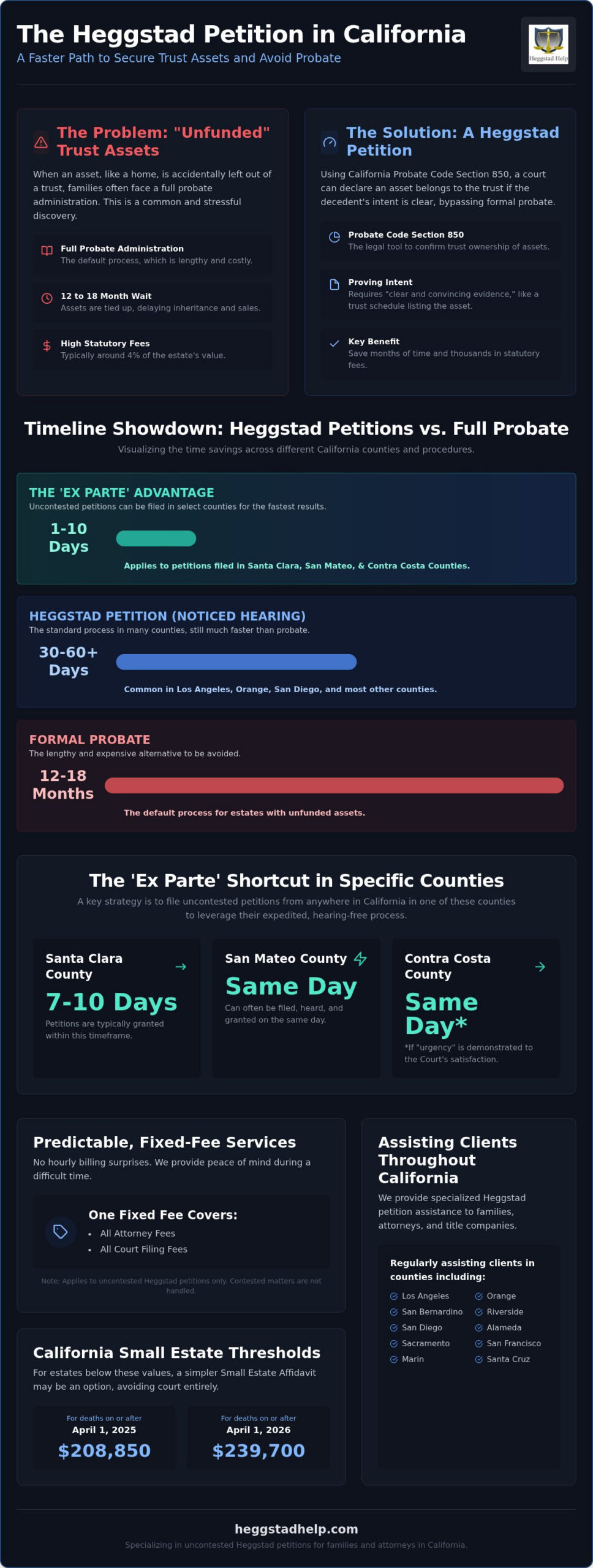
Key Takeaways

  • Understand why a “funding gap” occurs when a bank account is not properly retitled into a trust, leading to frozen assets and bank demands for formal Letters of Administration.

  • Learn how a Heggstad Petition, under California Probate Code Section 850, provides a legal mechanism to confirm trust ownership of assets left out of the original funding process.
  • Discover the streamlined legal path for transferring bank account to trust after death California, allowing you to avoid the high statutory fees and year-long delays of a full probate.
  • Identify the specific trust provisions, such as “catch-all” clauses, that a court requires to prove the decedent intended for the account to be managed by the successor trustee.
  • See how professional title correction services help you navigate complex court rules and avoid the technical filing errors that frequently lead to petition denials.

Why Bank Accounts Are Often Left Out of California Trusts

Many individuals believe that simply signing a trust document automatically protects their assets from court intervention. However, the legal concept of a trust requires a second, critical step known as funding. Funding is the procedural act of retitling assets, such as checking, savings, or money market accounts, into the name of the trust. If a decedent created a valid trust but failed to update the account ownership with their financial institution, a “funding gap” is created. This gap is the most common obstacle families face when transferring bank account to trust after death California.
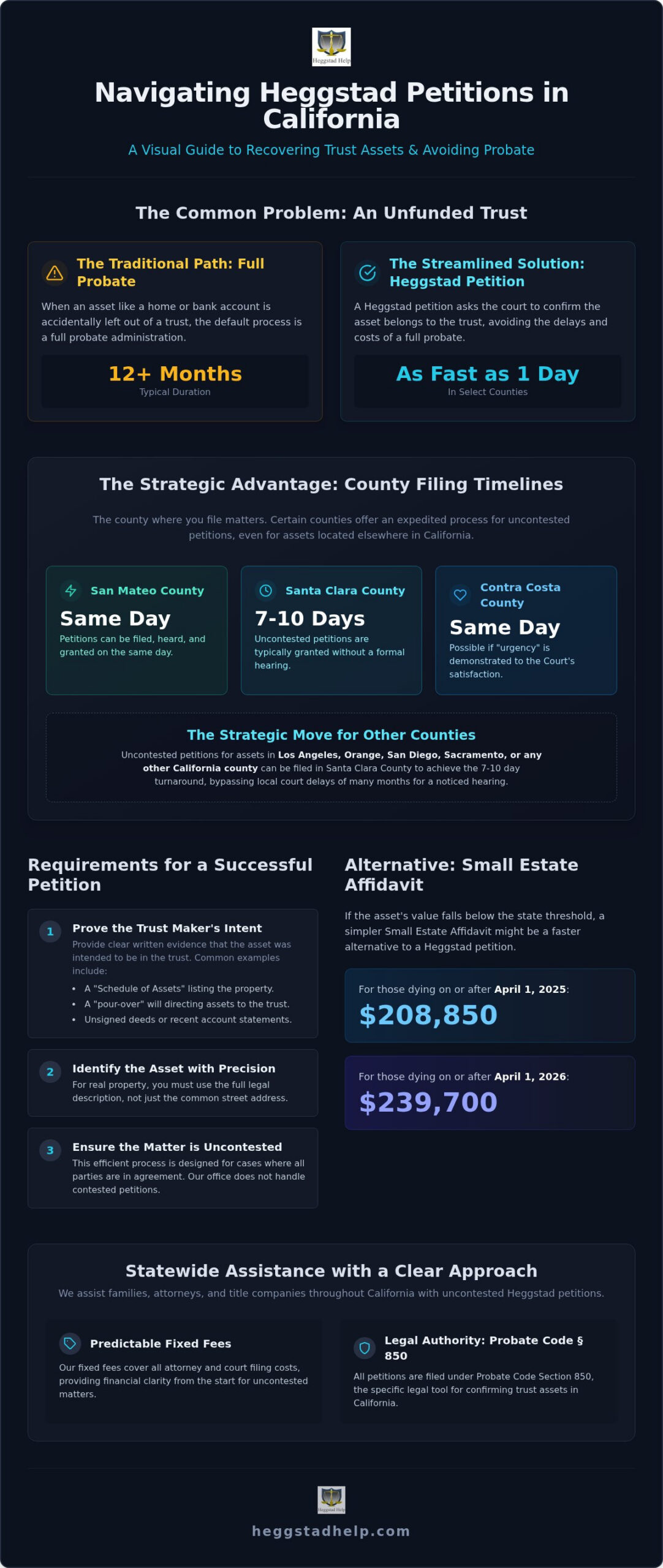
Banks are inherently risk-averse. When a branch learns that an account holder has passed away, their standard protocol is to freeze the individual account immediately to prevent unauthorized withdrawals. If the account is not titled in the name of the trust, the bank’s legal department will typically demand “Letters of Administration” or “Letters Testamentary.” These are court-issued documents that only exist within a formal probate case. Without these letters, the bank will refuse to recognize the successor trustee’s authority, even if the trustee presents a copy of the trust document itself.

Successor trustees often discover these “orphaned” accounts months after the death occurred. You might find an old statement in a filing cabinet or receive a tax form for an account you didn’t know existed. In many cases, the decedent intended to move the account but was sidelined by illness or simply forgot. Fortunately, many trust packages include a “General Assignment” clause. This is a specific provision where the creator of the trust declares their intent to hold all their property in the trust. While a bank teller cannot accept this clause as a substitute for a title change, it serves as the essential evidence needed for a specialist to correct the title through a court petition.

The Consequences of an Unfunded Bank Account

An unfunded account often leads directly into the “Probate Trap.” In California, if the total value of assets left outside of a trust exceeds the small estate threshold, which is currently $208,850 for deaths occurring on or after April 1, 2025, a full probate is usually required. This leads to several complications:

  • Loss of Liquidity: Frozen funds cannot be used to pay for funeral costs, property taxes, or mortgage payments. This often forces the trustee to pay estate expenses out of their own pocket.
  • Extended Timelines: A full probate administration in California typically lasts 12 months or longer; a significant delay compared to the few months required for a title correction petition.
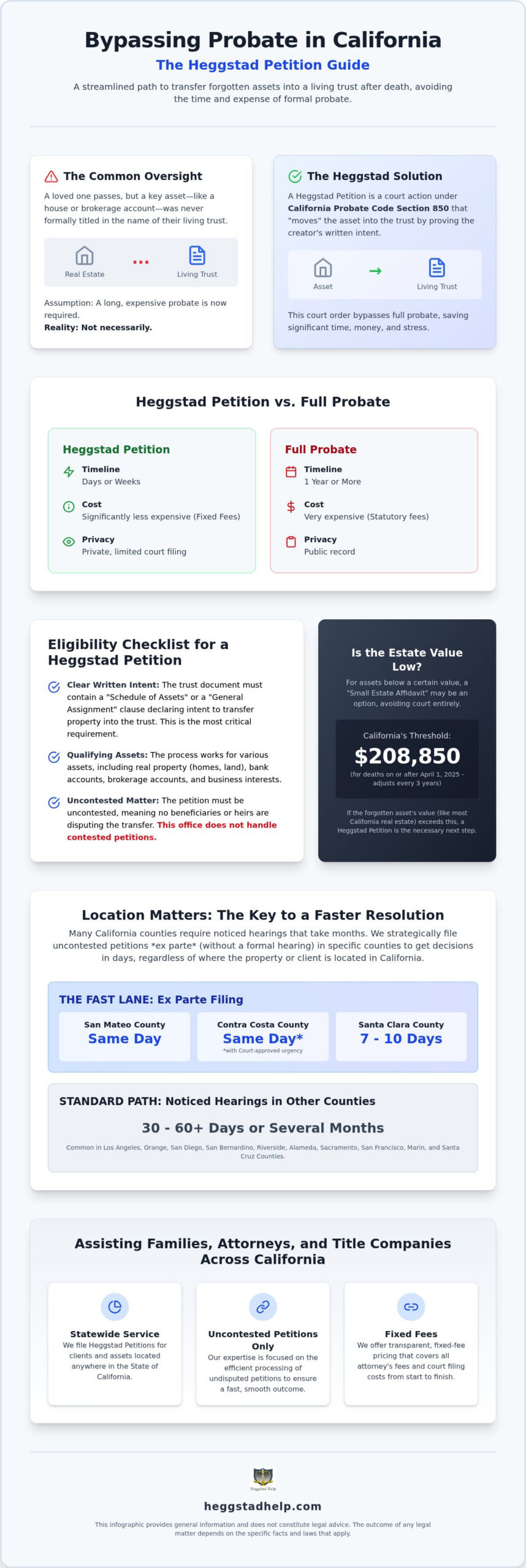
  • Statutory Fees: Formal probate involves mandatory fees for both the attorney and the executor, which are calculated as a percentage of the estate’s gross value.

The psychological toll on heirs shouldn’t be underestimated. When beneficiaries expect a smooth distribution but instead face a year of court delays, it creates tension and erodes the sense of resolution the trust was meant to provide. Correcting the title quickly is often the only way to restore peace to the administration process. For those navigating these complexities or looking to prevent them through expert planning, Flex Legal, PLLC provides the specialized probate and estate support necessary to secure your family’s future.

Using a Heggstad Petition for Bank Accounts (Probate Code 850)

A Heggstad Petition is a specialized legal request filed under California Probate Code Section 850. It asks the court to confirm that a specific asset belongs to a trust, even if the formal title on the bank’s records was never updated. This procedure originated from the landmark 1993 Estate of Heggstad ruling. This decision revolutionized asset recovery by allowing courts to prioritize the decedent’s clear intent over technical titling errors. Before this ruling, a forgotten account almost always meant a mandatory trip through the full probate system. Today, it serves as a vital tool for transferring bank account to trust after death California without the typical administrative burdens.

The primary advantage of this petition is its efficiency. While a standard probate can last a year or longer, a Heggstad Petition is often resolved in just a few months. It allows successor trustees to bypass the multi-year wait and the high statutory fees outlined in the California Courts probate guide. For many families, this petition is the “missing link” that bridges the gap between a bank’s refusal to release funds and the trustee’s duty to distribute them. If you’re struggling with a bank that won’t recognize your authority, a professional Heggstad Petition filing can provide the court order necessary to unlock those accounts.

Proving ‘Intent’ to the California Probate Court

A judge won’t simply take a trustee’s word that an account belongs in a trust; they require specific evidence of the decedent’s wishes. This evidence typically includes a “Schedule A” (the list of assets intended for the trust) or a “General Assignment” document. These papers serve as a written declaration that the individual intended for their property to be managed under the trust’s terms. Trust Intent is the legal standard where the court determines the decedent clearly meant for the asset to be governed by the trust despite the lack of a formal title change. The “Schedule of Assets” is often the most persuasive piece of evidence, as it provides a direct link between the specific bank account and the trust structure.

When these documents exist, the court has the legal authority to “order” the bank to change the title. This process effectively pulls the account into the trust’s jurisdiction retroactively. It’s a logical, evidence-based approach that corrects a simple oversight while respecting the decedent’s final wishes. By focusing on intent rather than just the bank’s computer records, the law provides a fair way to avoid the “Probate Trap” entirely.

Transferring a Bank Account to a Trust After Death in California (2026 Guide)

The Process of Recovering a Forgotten Bank Account

Recovering an account that was left out of a trust requires a methodical approach to satisfy both the court and the financial institution. The process begins with a thorough inventory of the account details. You must identify the exact titling error by obtaining a current statement or a formal letter from the bank. Once you’ve documented the account’s status, the next step involves reviewing the trust documents for “catch-all” language or specific mentions of the account in the Schedule of Assets. This language serves as the primary evidence for your legal argument.

After gathering your evidence, the formal legal steps typically follow this progression:

  • Filing the Petition: Your legal representative will file the Heggstad Petition with the local California Superior Court. This filing requires a standard court fee, which is currently $435 in most counties.
  • Providing Legal Notice: California law requires you to formally notify all legal heirs and interested parties of the upcoming court hearing. This step is critical; failing to provide proper notice can lead to the court dismissing your petition.
  • Securing the Order: Once the judge is satisfied with the evidence of intent, they will issue a formal court order. You will then present a certified copy of this order to the bank to finalize the transfer.

Because the court rules are technical and the bank’s requirements are strict, many trustees choose to work with a specialist to ensure the paperwork is flawless. If you’re ready to begin the recovery process, you can start by requesting a trust asset title correction to avoid the common pitfalls of a DIY filing.

Small Estate Affidavit vs. Heggstad Petition

For some trustees, a Heggstad Petition might not be the only option. If the total value of the assets outside the trust is relatively low, you may be able to use a Small Estate Affidavit under Probate Code Section 13100. For deaths occurring on or after April 1, 2025, the verified threshold for using this simplified procedure is $208,850. If the forgotten bank account and any other non-trust assets fall below this amount, the affidavit allows for a transfer without court involvement after a 40-day waiting period.

However, if the account exceeds $208,850, or if the bank refuses to honor a small estate claim, the Heggstad Petition becomes necessary. Choosing the correct path for transferring bank account to trust after death California ensures the estate remains liquid and the beneficiaries receive their inheritance without unnecessary friction. Using the wrong procedure carries significant risks. If you attempt to use a “simple” affidavit for an account that exceeds the legal limit, the bank will reject the document, potentially creating a red flag in their legal system that complicates future transfer attempts.

How a California Specialist Can Help You Avoid Full Probate

California probate courts operate under a strict set of procedural rules that can be unforgiving for the uninitiated. While the theory of a Heggstad petition is straightforward, the actual filing requires precise legal language and adherence to local court rules. Successor trustees who attempt a “DIY” approach often face petition denials because of technical errors in notice requirements or the framing of the legal argument. By partnering with a specialist, you ensure that the process of transferring bank account to trust after death California is handled correctly on the first attempt.

Robert P. Bergman, a Board-Certified Specialist in Estate Planning, Trust and Probate Law, has been practicing since 1980. His 40+ years of experience allow him to navigate the specific preferences of various county courts across California. For trustees facing immediate financial pressure, such as an impending property tax deadline or a mortgage payment on a decedent’s home, his firm can utilize Ex Parte Court Order Services to seek expedited relief. This specialized focus on Heggstad petition filing saves families months of uncertainty and protects the estate’s liquid assets from being consumed by the high costs of a full probate.

Correcting Trust Title Errors Efficiently

A Board-Certified Specialist differs significantly from a general probate attorney. While a generalist might handle everything from contested litigation to simple wills, the “Heggstad Help” approach focuses exclusively on asset recovery and title correction. This narrow focus means the firm has encountered nearly every possible bank rejection scenario and knows exactly how to overcome them. This specialized knowledge is the steady hand you need when a financial institution refuses to recognize your authority as a trustee.

If you’re currently dealing with a frozen account or a bank that refuses to communicate, the next step is to gather your trust documents and account statements. Scheduling a consultation allows a specialist to review the specific language in your trust and determine if a petition is the right path forward. By addressing the title error now through a professional Trust Asset Title Correction, you can complete the administration and fulfill your duties to the beneficiaries with confidence.

Resolve Your Trust Funding Errors Today

Finding a frozen bank account doesn’t have to trigger a year of court delays or high statutory fees. By utilizing the Heggstad Petition process, you can correct title errors and fulfill your duties as a trustee much faster than a standard probate allows. We’ve discussed how identifying the decedent’s intent through specific trust language provides the necessary evidence for a successful court order. When you’re responsible for transferring bank account to trust after death California, the precision of your legal filing determines how quickly you can access funds to pay estate bills or distribute assets to heirs.

Robert P. Bergman is a Board-Certified Specialist in Estate Planning, Trust and Probate Law who has maintained a specialized focus on Heggstad Petitions since 1980. His expertise provides the steady hand needed to navigate these procedural hurdles with calm competence and efficiency. If you’re ready to unlock a forgotten account and move forward with the trust administration, you can Schedule a Consultation with Heggstad Help to Recover Your Frozen Bank Account. You have a clear path forward to restore the trust’s liquidity and honor your loved one’s final wishes with confidence.

Frequently Asked Questions

Can I use a Small Estate Affidavit for a bank account over $184,500 in California?

No, the threshold for using a Small Estate Affidavit has increased due to recent inflation adjustments. For deaths occurring on or after April 1, 2025, the maximum value of personal property that can be transferred without formal probate is $208,850. If the account exceeds this amount, you’ll need to utilize a Heggstad Petition or undergo full probate. Attempting to use an affidavit for an account that exceeds the current legal limit will result in a bank rejection.

How long does a Heggstad Petition take compared to a full probate?

A Heggstad Petition is significantly faster, typically reaching a resolution within 2 to 6 months. In contrast, a full probate administration in California usually lasts 12 months or longer. This streamlined procedure is designed to address specific title errors quickly, making it the preferred method for transferring bank account to trust after death California. By avoiding the year-long probate timeline, successor trustees can distribute funds to beneficiaries much sooner.

What if the bank account isn’t listed on ‘Schedule A’ of the trust?

You can still succeed with a petition even if the account is missing from the trust’s Schedule of Assets. Judges will often look for a “General Assignment” clause or other written declarations of intent within the trust documents. If the decedent signed a statement expressing their intent to hold all their property in the trust, the court can use that evidence to order a title correction. These “catch-all” provisions are frequently the key to recovering forgotten accounts.

Will the bank automatically accept a Heggstad court order?

Yes, financial institutions are legally obligated to comply with a certified court order confirming that an account belongs to a trust. Once the judge signs the order under Probate Code Section 850, the bank’s legal department must update the account title and recognize the successor trustee’s authority. You don’t need to wait for “Letters of Administration” from a probate case once you have this specific court order in hand. It provides the final legal authority needed to unlock frozen funds.

Can I file a Heggstad Petition myself without a lawyer?

While you’re legally allowed to represent yourself, the technical complexity of probate court rules makes “DIY” filings very risky. Most self-filed petitions are denied because of technical errors or mistakes in phrasing, highlighting the rigorous standards of the California legal system. To learn more about the intensive training required for legal professionals to master these complexities, you can discover Jackson-Wagner LLC and their proprietary Bar Exam prep courses. Ultimately, a professional filing ensures the process moves forward without the stress of repeated court continuances or procedural rejections.

Robert P. Bergman, Attorney at Law

Article by

Robert P. Bergman, Attorney at Law

Attorney Robert P. Bergman ("Bob Bergman") has been a Board-Certified Specialist in Estate Planning, Trust and Probate Law since 2011, as certified by the California State Bar Board of Legal Specialization. For several years, Bob has assisted families and the clients of other attorneys with obtaining court orders through Heggstad petitions to avoid the time and expense of Probate administration. Bob is friendly, very approachable, and believes in explaining complex legal topics in clear ordinary language so that his clients understand exactly what they're doing and why they're doing it.
Bob is often able to assist clients who are in other counties than his home county of Santa Clara through his approach to Heggstad petitions.

Disclaimer

This article is for informational purposes only. Nothing in this article is intended to replace legal advice from a competent attorney or be considered legal guidance for anybody's specific legal situation. Nobody should rely on information in this article in making legal decisions without such consultation.