
When a loved one passes away, discovering that a significant asset like their house was never formally transferred into their living trust can be a moment of panic. The common assumption is that this oversight automatically triggers a lengthy and expensive probate court process. For many families in California, however, this is not the case. A powerful legal tool exists specifically for this situation, allowing you to finalize the transfer after death and completely bypass the formal probate system.
In California, a trust doesn’t automatically fail just because a deed was forgotten or an account was never retitled. A specific court procedure, known as a Heggstad Petition, provides a streamlined path to prove the decedent’s intent and move the asset into the trust where it belongs. This guide explains how this process works and why it is the preferred solution for successor trustees facing an unfunded trust.
Understanding the Process of Transferring Assets to a Trust After Death
Typically, a successor trustee’s job is to manage and distribute assets that are already legally owned by the trust. This involves following the trust’s instructions, notifying beneficiaries, and eventually distributing the property. The process becomes complicated when an asset’s legal title remains in the deceased person’s individual name.
- Standard Successor Trustee Duties: When a trust is fully funded, the successor trustee simply steps in to manage assets already titled in the trust’s name. The process is private and avoids court intervention.
- Common Funding Mistakes: People often create a trust but neglect the final step of funding it. This can happen when they refinance a home and the lender requires them to take it out of the trust, but they forget to deed it back in. Other times, they may simply overlook transferring a brokerage account or other financial asset.
- The Legal Challenge: “Transferring assets to a trust after death” is a form of title correction. Because the person who created the trust (the settlor) is no longer alive to sign a new deed or title document, a court order is required to authorize the transfer.
- Evidence of Intent: The key to resolving this issue lies in the trust document itself. Most well-drafted trusts include a “Schedule A” listing the assets intended to be part of the trust or a “General Assignment” that declares all of the settlor’s property is being transferred to the trust. This written evidence is crucial for a successful court petition.
The Small Estate Threshold in California for 2026
For smaller estates, California law provides a simplified process that avoids formal probate, but the limits are strict. If a “forgotten” asset’s value is below the state’s threshold, you may be able to use a Small Estate Affidavit to transfer it without a full court proceeding.
- For individuals who passed away on or after April 1, 2025, the Small Estate Affidavit threshold in California is $208,850.
- This threshold is adjusted for inflation every three years, so it’s important to verify the current limit based on the date of death.
- If the total value of the assets left out of the trust exceeds this limit—as is common with real estate in California—a Small Estate Affidavit is not an option. You will need a court order, which is precisely what a Heggstad Petition provides without the burden of a full probate.
Recovering ‘Forgotten’ Assets Using Probate Code Section 850 in California
When an asset’s value exceeds the small estate limit, the Heggstad Petition becomes the most effective tool for transferring it into the trust. This legal action is named after the landmark case, Estate of Heggstad, where a California court ruled that written evidence of intent to hold property in a trust was sufficient, even if the real estate deed had not been formally recorded.
This petition is filed under California Probate Code Section 850, which gives the court authority to issue an order confirming that a specific asset belongs to the trust. This court order effectively completes the transfer, allowing the successor trustee to take control of the property.
- Introduction to the Heggstad Petition: It is a formal request asking a judge to confirm that the deceased person intended for an asset to be in their trust. It is not a lawsuit but a petition for a court order to correct the title.
- Probate Code Section 850: This section of the law is the mechanism that allows a trustee to ask the court to rule on questions of property title. It is the legal foundation for a Heggstad Petition.
- Benefits vs. Full Probate: A Heggstad Petition offers significant advantages over traditional probate. It is typically much faster (weeks versus a year or more), far less expensive, and keeps the family’s financial affairs private, as it is a more limited and focused court action. For a detailed comparison, see our guide on Heggstad Petition vs. Probate in California: Key Differences for Successor Trustees (2026).
Eligibility Requirements for a Heggstad Petition
To successfully use a Heggstad Petition, you must be able to demonstrate the decedent’s intent to the court. Without clear evidence, a judge is unlikely to grant the order.
- Written Evidence of Intent: This is the most critical requirement. The trust document must contain a schedule of assets (even if it’s a general statement) or a declaration that assigns all of the person’s property to the trust. A simple mention of “my house at 123 Main Street” can be sufficient.
- Qualifying Assets: The petition can be used to transfer various assets, including real property (houses, condos, land), bank and brokerage accounts, and interests in a business.
- Specialist Consultation: The specific language in the trust document is paramount. Before filing, it is essential to have the trust reviewed by a specialist who focuses on Heggstad petitions to confirm you have a strong case for the court.
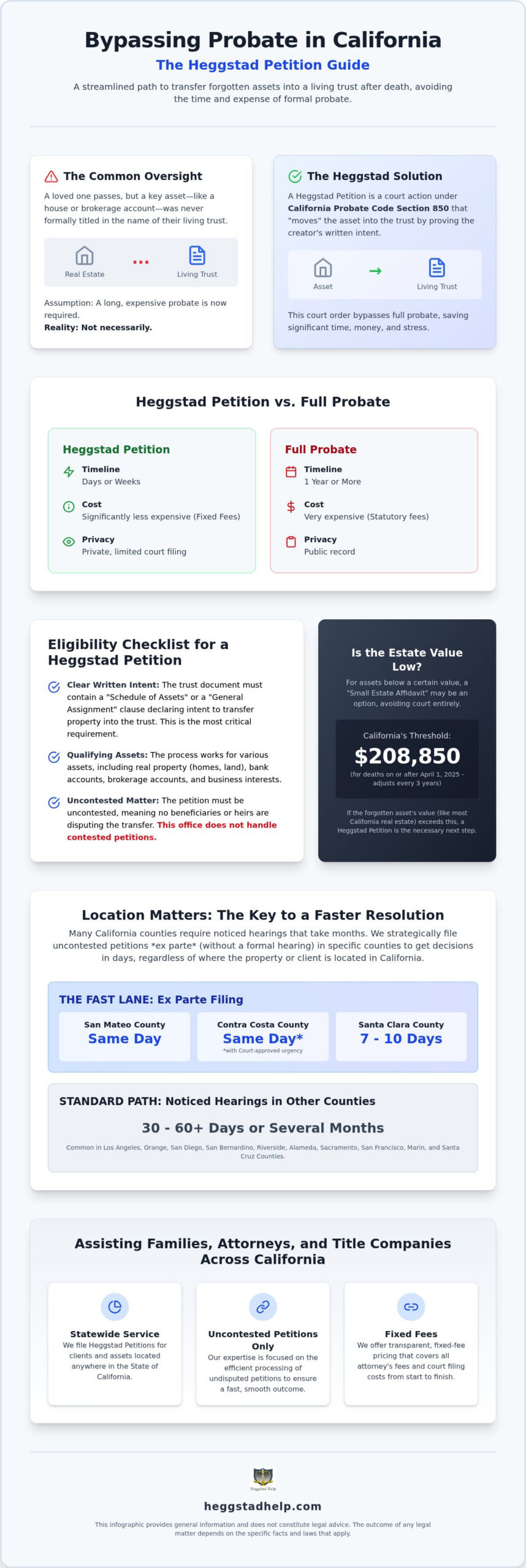
Strategic Filing: How to Accelerate Asset Transfers Throughout California
Even within the streamlined Heggstad process, the county where you file can dramatically impact the timeline. Many county courts, including those in Los Angeles County, Orange County, and San Diego County, require a “Noticed Hearing,” which can take months to schedule. However, California law allows for a much faster alternative.
Our office assists families, attorneys, and title companies throughout California by strategically filing uncontested Heggstad petitions to achieve the fastest possible outcomes.
- Noticed Hearings vs. Ex Parte Orders: A noticed hearing is a formal court date set 30 to 60 days—or often several months—in the future, requiring all interested parties to be formally notified. An “ex parte” order, by contrast, is requested without a formal hearing, often based on the written petition alone, and can be granted almost immediately if unopposed.
- Fixed-Fee Services: To provide financial certainty during a stressful time, we handle all uncontested Heggstad petitions for a fixed fee. This fee covers all court filing costs and attorneys’ fees, so there are no surprise expenses.
- Statewide Assistance: We regularly help clients with properties in Riverside County, San Bernardino County, Alameda County, and Sacramento County avoid the long delays in their local courts by leveraging more efficient procedures available elsewhere.
The Santa Clara County Advantage for Successor Trustees
A few California counties have highly efficient probate departments that process uncontested petitions quickly. By filing in these specific jurisdictions, we can secure court orders for properties located anywhere in the state in a fraction of the time it would take in the local county court.
- Santa Clara County (7-10 Days): For uncontested petitions, the Santa Clara County Superior Court typically reviews and grants Heggstad orders within 7 to 10 days of filing, without requiring a formal hearing.
- San Mateo and Contra Costa Counties (Same-Day): For urgent matters, San Mateo County can often hear and grant a petition on the same day it is filed. In Contra Costa County, a same-day order is also possible if a compelling “urgency” can be demonstrated to the court.
- A Statewide Solution: The key advantage is that an uncontested petition concerning a property in San Francisco County or Marin County can be filed ex parte in Santa Clara County. The resulting court order is valid and enforceable statewide, allowing you to avoid months of waiting. This is why our office files all uncontested petitions in one of these three counties.
Frequently Asked Questions
- Can I move a house into a trust after the owner has died?
- Yes. In California, if there is written proof that the deceased owner intended the house to be in the trust, you can use a Heggstad Petition to obtain a court order that officially transfers the title to the trust, avoiding a full probate.
- How long does a Heggstad Petition take in California?
- The timeline depends entirely on the filing strategy. If filed ex parte in an efficient county like Santa Clara, an uncontested petition can be granted in 7 to 10 days. If filed in a county that requires a noticed hearing, the process can take several months.
- What is the cost of filing a Heggstad Petition in 2026?
- The cost includes court filing fees and attorney fees. Our office handles these petitions on a fixed-fee basis, which includes all costs, to provide clients with financial predictability. You can learn more about our 2026 California Heggstad Petition fees and expenses here.
- Does a Heggstad Petition avoid the need for a full probate?
- Yes, absolutely. The primary purpose of a Heggstad Petition is to avoid the time, expense, and public nature of a formal probate proceeding by providing a direct, court-approved path to fund the trust.
- What happens if a property was left out of a trust in Los Angeles County?
- While filing in Los Angeles County would likely require a noticed hearing and a delay of several months, an uncontested petition for an L.A. property can be filed ex parte in Santa Clara County. This strategy allows you to obtain a court order in 7 to 10 days, which is then used to correct the property title with the Los Angeles County Recorder’s office.
- Is an attorney required for transferring assets to a trust after death?
- While an individual can technically file a Heggstad Petition on their own, the process involves complex legal arguments, specific evidence requirements, and strategic procedural decisions. Working with a specialist attorney who focuses on these petitions is highly recommended to ensure it is done correctly and as quickly as possible. Our office only handles uncontested petitions.
If you have discovered that a house or another valuable asset was left out of a loved one’s trust, do not assume that a long and costly probate is your only option. A Heggstad Petition offers a direct and efficient solution to honor their intentions and secure the asset for the trust beneficiaries.
To confirm if your situation qualifies for this streamlined process, contact our office for a consultation. As a California-licensed attorney and Board-Certified Specialist in Estate Planning, Trust and Probate Law, Robert P. Bergman provides fixed-fee Heggstad Petition services to clients, attorneys, and title companies throughout the State of California, with a proven track record of securing court orders in 7-10 days.

Article by
Robert P. Bergman, Attorney at Law
Attorney Robert P. Bergman ("Bob Bergman") has been a Board-Certified Specialist in Estate Planning, Trust and Probate Law since 2011, as certified by the California State Bar Board of Legal Specialization. For several years, Bob has assisted families and the clients of other attorneys with obtaining court orders through Heggstad petitions to avoid the time and expense of Probate administration. Bob is friendly, very approachable, and believes in explaining complex legal topics in clear ordinary language so that his clients understand exactly what they're doing and why they're doing it.
Bob is often able to assist clients who are in other counties than his home county of Santa Clara through his approach to Heggstad petitions.
Disclaimer
This article is for informational purposes only. Nothing in this article is intended to replace legal advice from a competent attorney or be considered legal guidance for anybody's specific legal situation. Nobody should rely on information in this article in making legal decisions without such consultation.


