
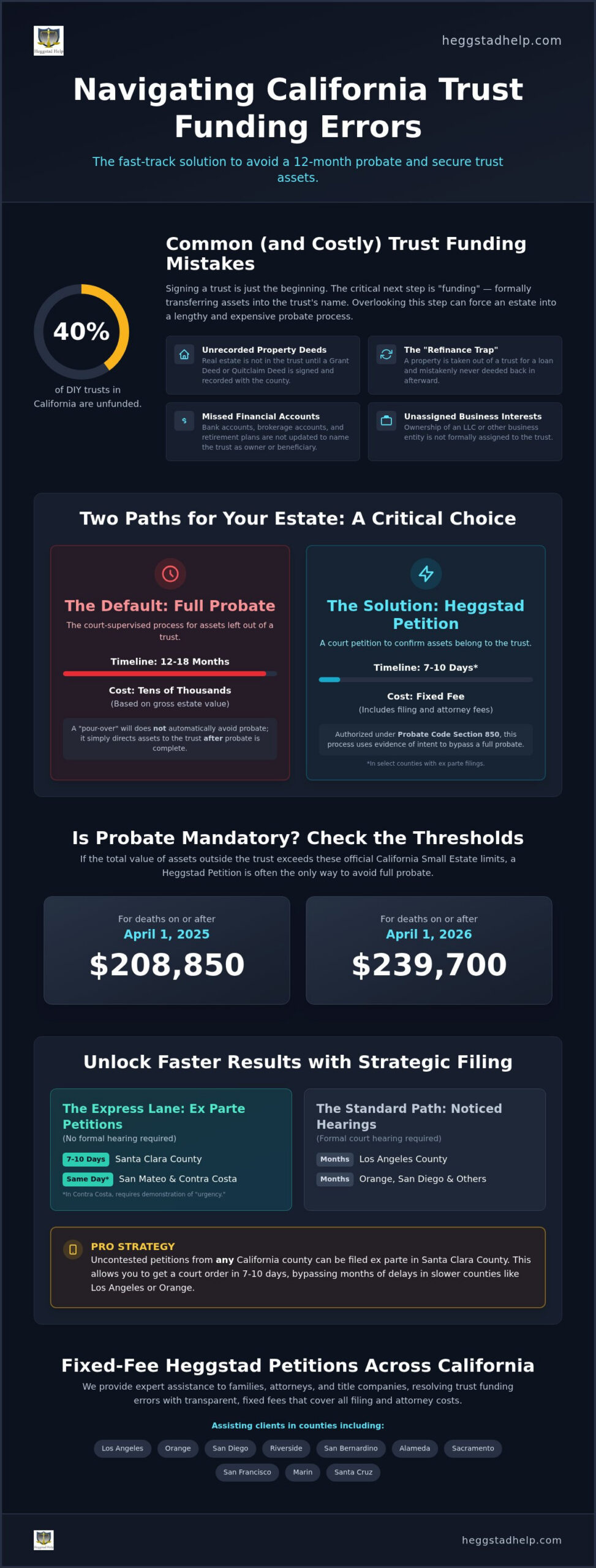
Did you know that 40% of do-it-yourself trusts in California are unfunded? Discovering a family home was never titled in the trust is stressful, but California trust funding mistakes don’t have to lead to a 12-month probate.
This guide explains how a Heggstad petition in California (a filing under Probate Code Section 850) transfers assets into a trust quickly. While Los Angeles, Orange County, or San Diego courts often require months of waiting, we help families and attorneys statewide by filing ex parte (without a formal hearing). Orders in Santa Clara County take 7 to 10 days, while San Mateo and Contra Costa can be granted the same day if urgency is shown. We resolve these errors with fixed fees covering both filing and attorney fees.
Key Takeaways
- Identify common California trust funding mistakes like failing to record a Grant Deed for real property or neglecting to update retirement account beneficiaries.
- Learn how a Heggstad petition, filed under Probate Code Section 850, can confirm trust ownership of assets even if the formal title transfer was never completed.
- Discover how to bypass the standard 12-month probate process by using specialized ex parte court order services that can be granted in as little as 7 to 10 days.
- Understand how to use fixed-fee legal services to correct title errors for properties located in any California county, including Los Angeles, Orange, and San Diego.
Identifying Common Trust Funding Mistakes in California
Many families believe that signing a trust document is the final step in their estate plan. However, what it means to fund a trust actually involves the physical transfer of title from your individual name into the name of the trust. Common California trust funding mistakes occur when this administrative step is overlooked. For example, you might acquire a new brokerage account or a second home in Riverside but forget to update the ownership records. Relying solely on a "Schedule A" (the list of assets often attached to a trust) is a risky strategy because banks and County Recorders require a formal change in legal title to recognize the trust’s authority.
Real Estate and Financial Asset Title Omissions
Whether you own a home in San Francisco or Orange County, a signed trust document alone won’t transfer real estate. You must record a Grant Deed or Quitclaim Deed to finalize the process. A frequent issue we see is the "refinance trap." This happens when a lender moves your home out of the trust to process a loan and you forget to deed it back in afterward. Similarly, neglecting to update beneficiary designations on life insurance or retirement accounts leaves those assets vulnerable. If the total value of assets left outside the trust exceeds the $208,850 threshold for deaths on or after April 1, 2025., a full probate is typically required. Even complex business interests like an LLC must be formally assigned to the trust to avoid multi-year court delays. We assist clients in Los Angeles, San Diego, and throughout California with fixed fees to correct these title errors efficiently.
The Legal Consequences of Unfunded Assets in 2026
When California trust funding mistakes occur, the primary casualty is the estate’s efficiency. Assets left in an individual’s name must generally pass through Probate Court (the court-supervised process of distributing a decedent’s estate). This isn’t just a minor paperwork hurdle; it’s a 12 to 18 month commitment that involves mandatory statutory fees for both attorneys and executors. These fees are calculated based on the gross value of the estate, often costing families in Los Angeles, San Diego, or Orange County tens of thousands of dollars before any distribution occurs.
To determine if you can avoid this process, you must look at the specific California small estate thresholds. For deaths occurring on or after April 1, 2025, the limit is $208,850. If the total value of assets outside the trust exceeds this figure, a full probate is typically mandatory unless a specialized legal remedy is utilized.
Probate Court Delays and Asset Recovery
Many people mistakenly assume a "pour-over" will (a backup will that transfers assets into a trust) solves funding errors automatically. It doesn’t. A pour-over will still requires a formal probate proceeding to be effective. This delay places immense stress on a successor trustee (the person in charge of the trust after death), particularly if they need to manage or sell a home in San Bernardino or Sacramento. Successor trustees dealing with missing assets in California can often find relief through Probate Code Section 850. This law allows for property transfer petitions that confirm trust ownership without the year-long wait.
Solving Funding Errors with a Heggstad Petition
A Heggstad petition is a specialized legal request filed under Probate Code Section 850. It asks the court to confirm that an asset belongs in a trust even if the formal title transfer wasn’t completed. To succeed, the court requires "clear intent" showing the decedent meant for the asset to be part of their estate plan. This is often established if the property is listed on a schedule of assets or mentioned specifically within the trust’s purpose. When California trust funding mistakes are identified after death, this petition serves as the primary tool to avoid a full 12-month probate administration.
HEGGSTAD HELP provides these filing services for a fixed fee that covers both the filing and attorney fees. This transparency helps successor trustees manage costs while resolving title issues for clients throughout the entire state. If the petition is granted, the resulting court order allows the trustee to take legal title immediately. This process is essential when assets exceed the Small Estate Affidavit threshold of $208,850 for deaths occurring on or after April 1, 2025.
Procedural Advantages in Santa Clara, San Mateo, and Contra Costa Counties
Timing is critical. In counties like Los Angeles, Orange, or San Diego, noticed hearings often take many months. Strategic filing offers a faster path. Uncontested petitions from those counties can instead be heard ex parte (without a formal hearing) in Santa Clara County, where they’re typically granted in 7 to 10 days. In San Mateo and Contra Costa Counties, orders can often be filed and granted the same day, provided "urgency" is demonstrated in Contra Costa. This specialized approach ensures that assets are recovered quickly and efficiently.
Secure Your Estate Without the Probate Delay
Correcting California trust funding mistakes doesn’t have to be a multi-year ordeal. While an unrecorded deed or forgotten account can trigger probate if the estate exceeds the $208,850 limit for deaths on or after April 1, 2025, a Heggstad petition provides a faster resolution. By filing under Probate Code Section 850, you can bypass the standard 12-month court process and secure assets in weeks.
Robert P. Bergman, a Board-Certified Specialist with over 40 years of experience, offers fixed fees for all California Heggstad filings, including rapid 7 to 10 day results in Santa Clara County. Fix your trust funding mistake with a Heggstad Petition today and gain the peace of mind that comes with a properly titled estate. We’re here to help you move forward with confidence.
Frequently Asked Questions
What happens if I forgot to put my house in my trust in California?
If you forgot to deed your house into your trust, the property will likely face probate unless you file a Heggstad petition. This is a frequent example of California trust funding mistakes. Because most homes exceed the small estate limit of $208,850 for deaths on or after April 1, 2025, this petition is the only way to avoid a full probate.
How much does a Heggstad petition cost in California in 2026?
Our office handles Heggstad petitions throughout the state using a fixed-fee structure that covers both the court filing fees and the attorney fees. This provides financial certainty for families in Los Angeles, Orange, and San Diego. We don’t use hourly billing for these specific filings, ensuring that successor trustees can manage the estate’s expenses without any unexpected legal costs.
Can I file a Heggstad petition if there is no Schedule A?
You can often file a petition even without a formal "Schedule A" list of assets. The court looks for evidence of "clear intent" within the trust document or other written declarations. If the trust’s purpose or general language indicates that the creator intended for the property to be included, a judge may grant the order. We help clients identify this evidence.
How long does the Heggstad petition process take in Santa Clara County?
In Santa Clara County, uncontested petitions are typically granted ex parte (without a formal hearing) within 7 to 10 days. This is a major strategic advantage. While courts in Riverside or San Bernardino often require noticed hearings that take many months, uncontested petitions from those counties can instead be heard in Santa Clara County. This allows families state-wide to resolve title issues quickly.
What is the difference between a Heggstad petition and an 850 petition?
A Heggstad petition is simply the common name for a legal filing made under Probate Code Section 850. The name comes from a landmark court case that established this specific procedure. While "850 petition" is the technical term found in the Probate Code, both terms refer to the same process of asking a judge to confirm that an asset belongs in a trust.
Is a Heggstad petition possible for bank accounts or just real estate?
Yes, a Heggstad petition works for bank accounts, brokerage accounts, and business interests. If an account was left in the decedent’s name and exceeds the small estate threshold of $208,850 for deaths on or after April 1, 2025, this petition can transfer the funds. It’s a faster alternative to a full probate administration.

Article by
Robert P. Bergman, Attorney at Law
Attorney Robert P. Bergman ("Bob Bergman") has been a Board-Certified Specialist in Estate Planning, Trust and Probate Law since 2011, as certified by the California State Bar Board of Legal Specialization. For several years, Bob has assisted families and the clients of other attorneys with obtaining court orders through Heggstad petitions to avoid the time and expense of Probate administration. Bob is friendly, very approachable, and believes in explaining complex legal topics in clear ordinary language so that his clients understand exactly what they're doing and why they're doing it.
Bob is often able to assist clients who are in other counties than his home county of Santa Clara through his approach to Heggstad petitions.
Disclaimer
This article is for informational purposes only. Nothing in this article is intended to replace legal advice from a competent attorney or be considered legal guidance for anybody's specific legal situation. Nobody should rely on information in this article in making legal decisions without such consultation.


