Selling a House Left Out of a California Trust

You finally have a buyer for your loved one’s home, but then the title company delivers the crushing news: the house was never deeded to the trust,…

You finally have a buyer for your loved one’s home, but then the title company delivers the crushing news: the house was never deeded to the trust, and escrow is frozen. It’s a common nightmare where you’re told a house not in trust can’t sell California real estate without a full probate process lasting over a year. You’re likely feeling the weight of managing an empty property while facing a daunting legal hurdle that seems to have no end in sight.

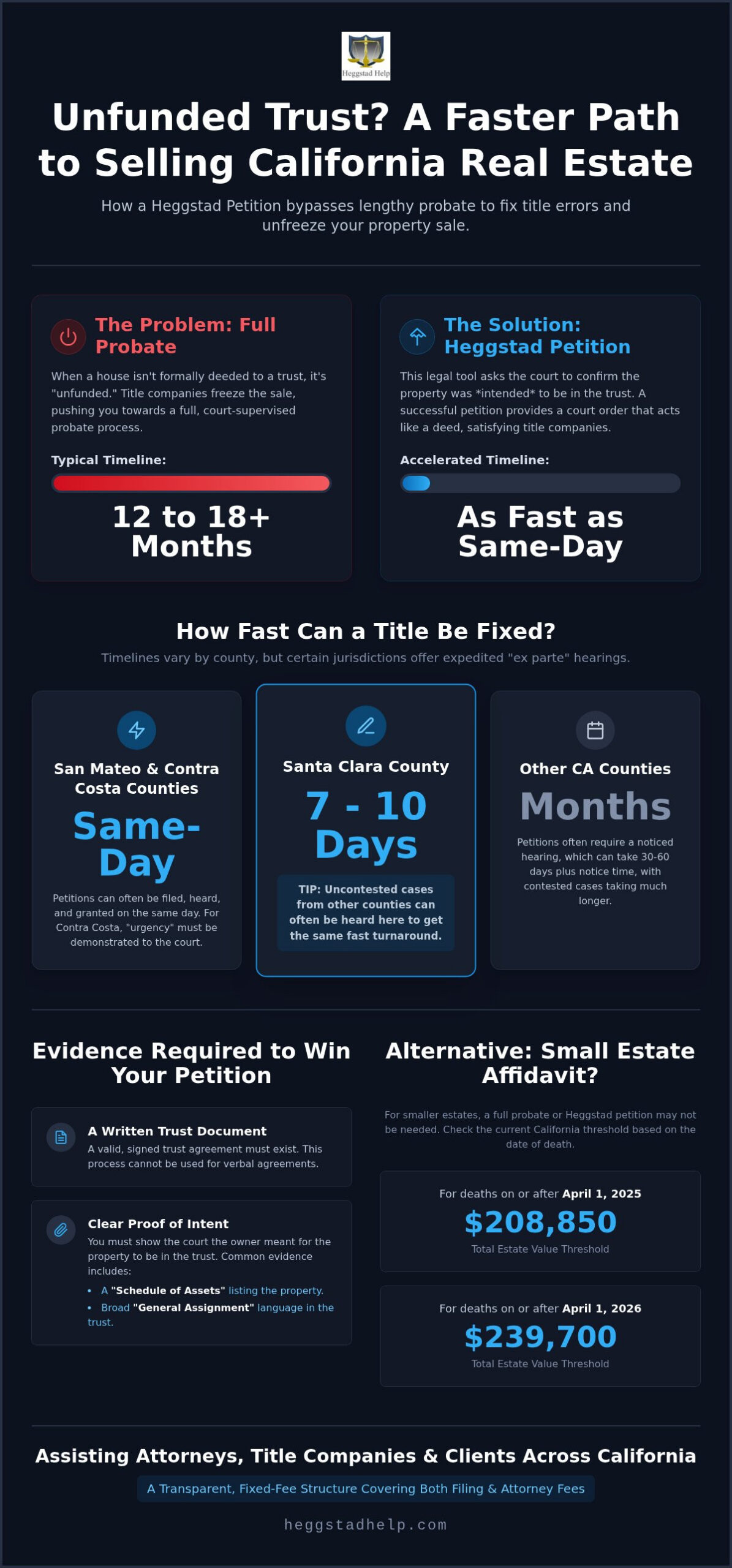
We understand this frustration, but a title error doesn’t have to mean a 12-to-18 month delay. You can often legally fix this using a Heggstad petition (a court order that confirms an asset belongs in a trust even if the deed was never updated). As a Board-Certified Specialist, Robert P. Bergman helps families across California navigate this process with a transparent, fixed-fee structure that covers both filing and attorney fees.

In this guide, you’ll learn how to bypass full probate and secure a court order to finalize your sale. We’ll explain how we achieve same-day results in San Mateo County or 7 to 10 day turnarounds in Santa Clara County. We’ll even show how cases from other counties can often be heard quickly in Santa Clara to avoid the months of waiting typical in other jurisdictions.

Key Takeaways

  • Discover why a house not in trust can’t sell California property and how an “unfunded trust” creates a roadblock for title companies during escrow.
  • Learn how a Heggstad Petition under Probate Code Section 850 can legally transfer a home into a trust after death by proving the owner’s original intent.
  • Find out how specific counties like San Mateo and Santa Clara allow for accelerated “ex parte” orders that can fix title issues in as little as one to ten days.
  • Identify the essential evidence required to win your case, including the “Schedule of Assets” and broad “General Assignment” language found in many trust documents.
  • Understand the advantages of working with a Board-Certified Specialist who offers a fixed-fee structure covering both attorney fees and court filing costs.

The Unfunded Trust Crisis: Why You Can’t Sell the House

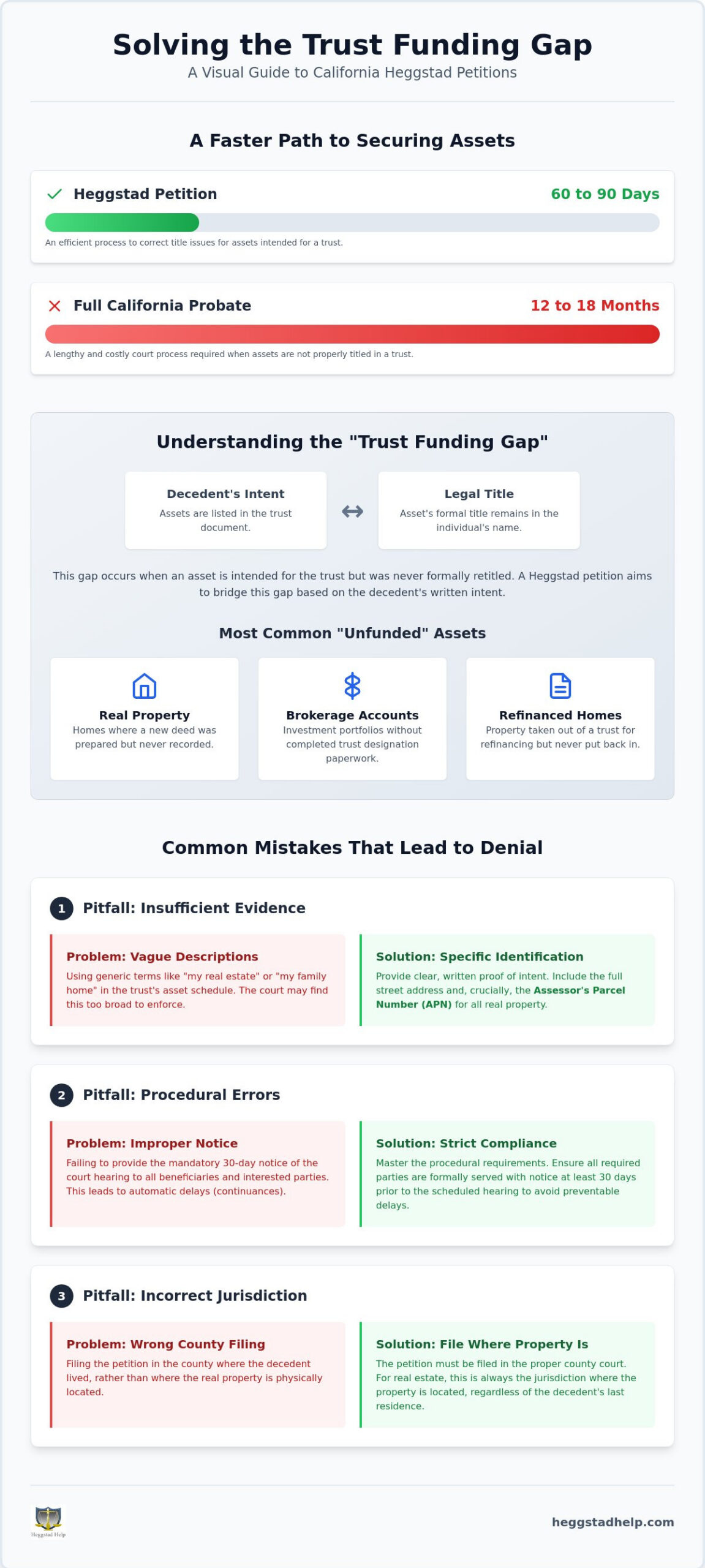
Imagine you’ve signed a listing agreement and found a motivated buyer; then the title company calls with bad news. They’ve discovered that while your parents had a trust, they never actually deeded the family home into it. This situation creates what we call an "unfunded trust." In simple terms, an unfunded trust occurs when someone creates the legal document but fails to complete the funding (the formal process of transferring legal title from an individual name to the trust’s name). It’s a common mistake that brings real estate transactions to a grinding halt.

This oversight is the primary reason why a house not in trust can’t sell California real estate without court intervention. Even if the trust document explicitly names you as the Successor Trustee and grants you the "power to sell" all assets, that power only applies to assets the trust actually owns. Because the deed still lists the deceased individual as the owner, the title company cannot legally recognize your authority to sign closing documents. This roadblock often stems from a simple oversight; perhaps a bank required the house be moved out of the trust during a refinance and it was never moved back, or a DIY trust kit was completed without recording the necessary deeds at the County Recorder’s office. The same funding problem that affects real estate can also impact other estate assets, and families dealing with forgotten LLCs or business accounts may need to transfer business interest to trust after death in California using the same Heggstad petition process.

How to Check the Current Title Status

If you’re unsure about the status of a property, your first step should be to obtain a Preliminary Title Report (a document prepared by an escrow or title company that shows the current owner and any liens on the property). Look specifically for the "Grantee" section. If the Grantee is listed as an individual name rather than "The [Name] Family Trust," the property is unfunded. Many people assume that listing the house on a "Schedule of Assets" (a list of items intended to be in the trust) is enough to transfer ownership. Unfortunately, for California real property, a written list does not replace the requirement for a recorded deed.

The Legal Consequences of an Unfunded Home

When a house not in trust can’t sell California law typically points toward a default path: full probate administration. This is a court-supervised process that can easily take 12 to 18 months to complete. Until the title is corrected, the property is essentially frozen. You cannot legally finalize a sale, and the expenses of maintaining an empty home continue to mount while legal issues linger. You don’t have to accept this "probate nightmare" as your only option. At Heggstad Help, we specialize in assisting attorneys, title companies, and families with a faster alternative that corrects these title errors through a fixed-fee structure that covers both filing and attorney fees, ensuring transparency and peace of mind.

Heggstad Petitions: The California Solution for Missing Assets

When a title company informs you that a house not in trust can’t sell California real estate, the most efficient path forward is often a Heggstad Petition. This legal request, filed under California Probate Code Section 850, asks the court to confirm that a property belongs in a trust even if the deed was never formally updated. It’s a powerful tool because it focuses on the decedent’s intent rather than just the paperwork. If you can show the court that the owner meant for the house to be trust property, the judge can issue an order that functions just like a recorded deed. This process acts as a vital shortcut, allowing you to bypass the multi-step probate process and move straight to a court order that satisfies title insurance requirements. Learn how a Heggstad Petition saves time compared to probate and keeps your real estate transaction on track.

Eligibility Requirements for a Heggstad Petition

To successfully file this petition, certain criteria must be met. First, a written trust document must exist; you cannot use this process for a purely oral agreement. Second, you must provide evidence of intent. This is typically found in a "Schedule of Assets" (a list attached to the trust) or specific language within the trust document itself that mentions the property. Finally, the petition must be filed in the proper venue, which is usually the county where the property is located or where the trust is currently being administered. If you’re dealing with a stalled sale, you may want to consult a specialist to review your trust documents for these specific requirements.

Small Estate Alternatives in 2026

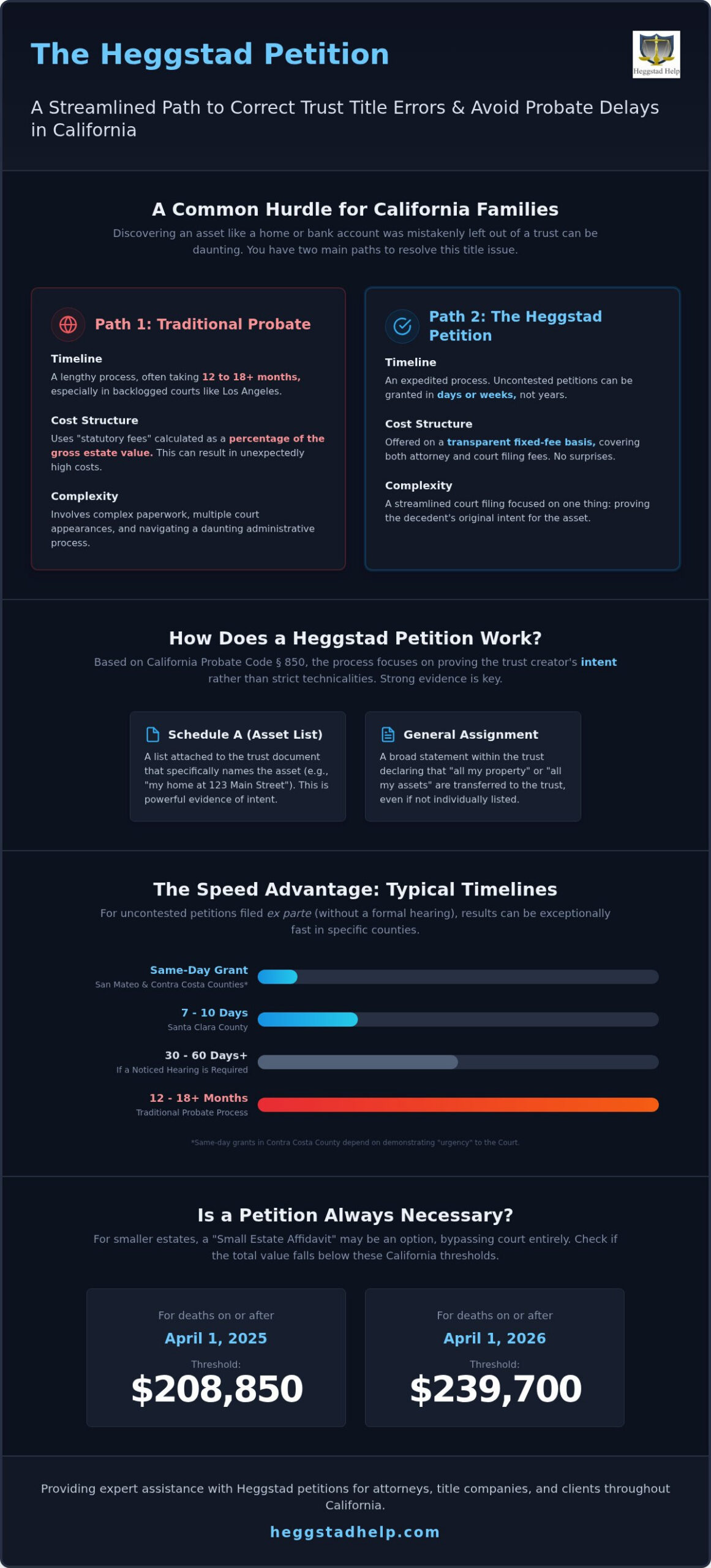
Some families wonder if they can use a simpler Small Estate Affidavit instead of a Heggstad Petition. However, California sets strict financial thresholds for these affidavits based on the date of death. For individuals dying on or after April 1, 2025, the small estate threshold is $208,850. For those dying on or after April 1, 2026, the threshold increases to $239,700. Since most California real estate values far exceed these amounts, a Heggstad Petition is usually the only viable alternative to full probate. Consider the financial impact: a standard probate for a $1 million home can result in a 4% statutory fee (the fee set by law) totaling $40,000 or more in combined costs. In contrast, our fixed-fee Heggstad services provide a much more cost-effective way to correct the title and finalize your home sale.

Timelines: How Quickly Can You Fix the Title and Sell?

Speed is the primary concern when a house not in trust can’t sell California real estate. While standard probate administration often drags on for 12 to 18 months, a Heggstad Petition offers a significantly faster route. The actual duration of your case depends largely on whether the petition is uncontested and which county court handles the filing. Our goal is always to secure a "Confirmation of Trust Assets" court order, which provides the legal certainty title companies require to close escrow and finalize the sale.

In most California counties, a "noticed hearing" (a scheduled court appearance where all interested parties are formally notified of the legal action) is the standard requirement. This process typically takes 30 to 60 days, plus the additional time required for legal notice. If heirs or beneficiaries disagree on the property’s status, the case becomes contested, which can lead to significant delays. However, for most families dealing with a simple paperwork error, we can often utilize "ex parte" procedures (legal actions taken without a formal, long-lead hearing) to move much faster.

County-Specific Speed Lanes in Northern California

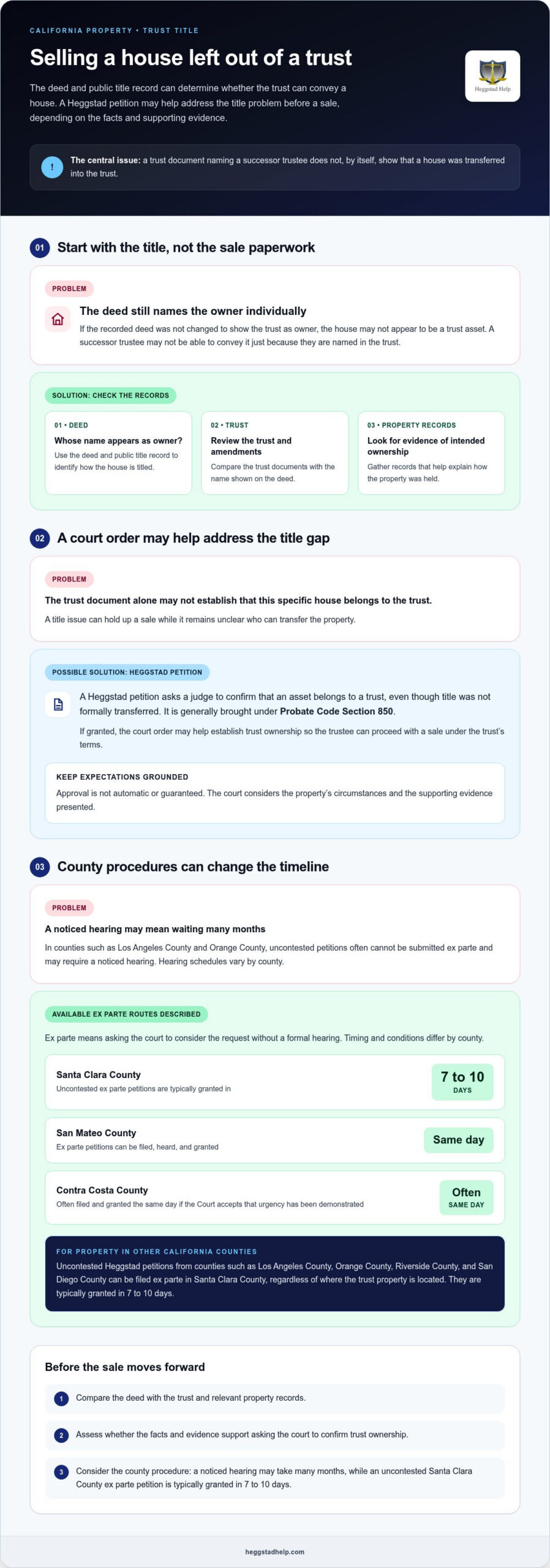
We leverage specific court procedures in the Bay Area to move much faster than the standard timeline. In San Mateo County, we can often file, hear, and have an ex parte petition granted on the same day. In Contra Costa County, same-day grants are also possible if we demonstrate "urgency" to the court’s satisfaction, such as a pending escrow with a buyer who is ready to walk away. Santa Clara County is also remarkably efficient; uncontested petitions there are typically decided and granted within 7 to 10 days of filing.

The ‘Santa Clara Advantage’ for Other Counties

This is where our specialized knowledge provides a distinct benefit for clients outside of Northern California. If you’re dealing with a property in Los Angeles, San Diego, or other counties with significant court backlogs, a noticed hearing might take many months. This delay is often unacceptable when a house not in trust can’t sell California property because the buyer might lose their mortgage rate lock or find another home.

There’s a strategic solution to this problem. Uncontested Heggstad petitions for properties located in those other counties can often be heard ex parte in Santa Clara County instead. This allows us to secure a court order in just 7 to 10 days rather than waiting half a year or more in a backlogged Southern California court. By utilizing this "Santa Clara Advantage," we help successor trustees resolve title issues quickly and keep their home sales on track.

Selling a House Left Out of a California Trust

Evidence Required to Win Your Heggstad Petition

Securing a court order depends entirely on your ability to demonstrate "decedent intent" (the clear desire of the person who passed away to have their home owned by the trust). When a house not in trust can’t sell California real estate, the judge needs to see more than just a signature on a trust document. We must present specific evidence that bridges the gap between the trust’s creation and the missing deed. The most powerful piece of evidence is the "Schedule of Assets" (a list typically found at the back of a trust document that identifies which properties are included in the trust estate). If the home’s address or legal description appears on this list, your case for a Heggstad order is very strong.

If a specific list doesn’t exist, we look for "General Assignment" language. This is a broad clause within the trust or a separate document where the creator states they are transferring "all real and personal property" to the trust. While less specific than an address, it serves as a legal catch-all that often satisfies the court’s requirements. This same General Assignment language is equally important when families need to transfer business interest to trust after death in California, covering forgotten LLCs or brokerage accounts alongside real property. To strengthen the case, we frequently include supporting declarations (written statements signed under penalty of perjury) from the attorney who drafted the trust or from witnesses who can testify to the decedent’s wishes. Read our full guide on required evidence for Heggstad Petitions to see how these documents work together.

Document Checklist for Successor Trustees

Gathering the right paperwork early prevents delays in the filing process. You’ll need to provide the following items to your legal specialist:

  • The original Trust Agreement along with any signed amendments.
  • The most recently recorded deed (even if it still shows the individual name of the deceased).
  • The pending Purchase Agreement if the property is currently in escrow and needs a quick resolution.

Common Pitfalls in Evidence

One common hurdle is a missing "Schedule A" or list of assets. Don’t panic if you can’t find this specific page. Even without a perfect "Schedule A," a skilled specialist can often find alternative proof of intent through other trust provisions or external documents. Another potential issue involves conflicting documents, such as a Will written after the trust that seems to give the house to someone else. These complications require careful handling to ensure the Heggstad petition isn’t contested by other heirs. If you’re unsure if your documents are sufficient, you can get expert help with your Heggstad petition to review your evidence before filing.

Next Steps: Fixing the Title with Heggstad Help

When you’re stuck because a house not in trust can’t sell California real estate, the path toward a resolution starts with expert intervention. You don’t need a general practitioner who handles everything from traffic tickets to divorces; you need a specialist who understands the specific "speed lanes" within the California probate court system. Robert P. Bergman is a Board-Certified Specialist in Estate Planning, Trust and Probate Law with over 40 years of experience. Our office assists successor trustees, attorneys, and title companies throughout the state to clear stalled titles and keep escrows moving forward.

We believe in total transparency, which is why we utilize a fixed-fee structure. This single fee covers both the court’s filing fees and all attorney fees required to secure your order. You won’t have to worry about unpredictable hourly billing or surprise costs while you’re already managing the stress of a loved one’s estate. To initiate the process, we offer a simple consultation to review your trust documents and determine the most efficient county for your filing. If you’re ready to move past the legal roadblocks, we’re here to provide a steady, knowledgeable hand.

Why Choose a Specialist Over a Generalist?

Choosing a specialist gives you access to deep knowledge of local court procedures that generalists often overlook. For instance, we know exactly how to navigate the ex parte (emergency) rules in Santa Clara County to secure orders in just 7 to 10 days. We also understand how to help clients with properties in backlogged areas like Los Angeles or San Diego by utilizing the "Santa Clara Advantage," where we file uncontested petitions in Santa Clara to avoid months of waiting. Our goal is always efficiency; we file specifically to avoid the standard, months-long noticed hearing process whenever possible. Learn more about our Heggstad Petition services and how we can accelerate your timeline.

Getting the House Back on the Market

Once the judge signs the Heggstad order, the legal "fix" is nearly complete. We take that signed court order and ensure it is recorded with the County Recorder in the county where the property is located. This recorded order acts as the formal bridge in the chain of title, effectively moving the home into the trust as of the date of the decedent’s death. Many families are surprised to learn that it is possible to transfer real estate to a living trust after death through this court-ordered process, bypassing the need for full probate administration entirely.

At this point, the title is officially "cleared." The title company will recognize the Successor Trustee’s authority to sign the grant deed for the buyer, allowing escrow to close without further delay. You can finally finalize the sale, pay off any remaining property expenses, and distribute the proceeds to the beneficiaries according to the instructions in the trust. It’s the resolution you’ve been waiting for, achieved in weeks rather than years.

Secure Your Property Sale and Protect the Estate

Facing the reality that a house not in trust can’t sell California real estate is stressful, but it’s a solvable problem. By utilizing a Heggstad petition, you can bypass the lengthy probate process and secure the court order needed to clear the title. Your loved one’s original intent, documented in the trust or a schedule of assets, is the key to unlocking this legal shortcut. Whether you’re dealing with a property in San Mateo, Santa Clara, or anywhere else in the state, there’s a path to finalize your home sale in weeks rather than years.

Robert P. Bergman is a Board-Certified Specialist who has spent over 40 years helping families navigate these specific hurdles. We offer a transparent, fixed-fee structure that covers both filing and attorney fees, so you don’t have to worry about hidden costs. With our ability to file ex parte petitions, we can often achieve results in as little as 7 to 10 days. Don’t let a missing deed derail your progress any longer.

Fix Your Trust Title Error Today – Contact Heggstad Help

You’ve already done the hard work of managing the estate; let us handle the technical legal fix to get your property back on the market and your escrow closed.

Frequently Asked Questions

Can I sell a house if the deed is not in the trust’s name?

No, you generally cannot finalize the sale because the title company will refuse to close escrow. Since a house not in trust can’t sell California real estate without a clear chain of title, the Successor Trustee lacks the legal authority to sign the grant deed. You must first correct the title error through a court order, such as a Heggstad Petition, before the sale can proceed.

How long does a Heggstad Petition take in California?

The timeline depends on the county and whether the petition is uncontested. In San Mateo County, we can often have a petition heard and granted the same day. In Santa Clara County, it typically takes 7 to 10 days. Other counties often require a noticed hearing, which usually takes 30 to 60 days plus notice time, though court backlogs can extend this significantly.

What is the cost of a Heggstad Petition versus full probate?

A Heggstad Petition is significantly more affordable than full probate, which involves statutory fees based on the gross value of the estate. For example, a $1 million home in probate could trigger over $40,000 in fees. We provide a fixed-fee structure that covers both filing and attorney fees, offering a transparent and predictable cost compared to the percentage-based fees of probate.

Do I need a noticed hearing to fix a trust title error?

Not always. While many counties default to a noticed hearing (a formal court date scheduled weeks in advance), we can often file uncontested petitions ex parte. This "ex parte" process allows us to seek a court order without a long-lead hearing in specific counties like Santa Clara or San Mateo, drastically shortening the time it takes to clear title.

What is the small estate threshold for California in 2026?

For individuals dying on or after April 1, 2026, the small estate threshold is $239,700. If the individual died on or after April 1, 2025, the threshold is $208,850. Because most California homes are worth more than these amounts, a house not in trust can’t sell California property using a simple Small Estate Affidavit and will require a Heggstad Petition instead.

Can a Heggstad Petition be filed if there is no ‘Schedule A’?

Yes, you can still file even if the "Schedule A" or list of assets is missing. We can often prove the owner’s intent by using "General Assignment" language found within the trust document or by providing supporting declarations from the drafting attorney. A missing list is a common hurdle, but it’s rarely a dead end for a skilled specialist.

Do all beneficiaries have to agree to a Heggstad Petition?

While the law doesn’t strictly require every beneficiary to sign off, the process is much faster if the petition is uncontested. If all beneficiaries agree, we can often use the expedited ex parte procedures mentioned earlier. If someone objects, the case becomes contested, requiring a noticed hearing and a longer legal process to resolve the dispute.

Can I file a Heggstad Petition in Santa Clara for a property in Los Angeles?

Yes, if the petition is uncontested, we can often have it heard in Santa Clara County regardless of where the property is located. This is a major advantage because backlogged courts in Southern California can take many months to hear a case. Filing in Santa Clara allows us to secure a court order in just 7 to 10 days, saving you months of waiting.

Robert P. Bergman, Attorney at Law

Article by

Robert P. Bergman, Attorney at Law

Attorney Robert P. Bergman ("Bob Bergman") has been a Board-Certified Specialist in Estate Planning, Trust and Probate Law since 2011, as certified by the California State Bar Board of Legal Specialization. For several years, Bob has assisted families and the clients of other attorneys with obtaining court orders through Heggstad petitions to avoid the time and expense of Probate administration. Bob is friendly, very approachable, and believes in explaining complex legal topics in clear ordinary language so that his clients understand exactly what they're doing and why they're doing it.
Bob is often able to assist clients who are in other counties than his home county of Santa Clara through his approach to Heggstad petitions.

Disclaimer

This article is for informational purposes only. Nothing in this article is intended to replace legal advice from a competent attorney or be considered legal guidance for anybody's specific legal situation. Nobody should rely on information in this article in making legal decisions without such consultation.

Heggstad Petition Los Angeles County: How to Fix a Missing Trust Asset Without Probate (2026 Guide)

A single missing signature on a deed doesn’t have to mean two years of probate court delays and thousands of dollars in lost fees. If you’ve…

A single missing signature on a deed doesn’t have to mean two years of probate court delays and thousands of dollars in lost fees. If you’ve discovered an asset was left out of a trust in Los Angeles County, the prospect of facing the 18-month backlog at the Stanley Mosk Courthouse is understandably daunting. Most families worry about the high statutory costs and the complex paperwork required to fix title issues. However, filing a **Heggstad petition **offers a streamlined path to confirm the asset belongs to the trust, effectively bypassing the traditional probate marathon.

We believe that legal solutions should be accessible and reassuring rather than cold or detached. In this 2026 guide, you’ll learn exactly how to recover property and correct real estate titles using this specialized court order. We’ll also cover critical updates, such as the California small estate thresholds of $208,850 for deaths on or after April 1, 2025, and $239,700 for those occurring on or after April 1, 2026. This overview provides a clear, logical progression from procedural confusion to a successful resolution for your trust assets.

Key Takeaways

  • Bypass the 18-month probate backlog at Stanley Mosk by using a Heggstad petition to confirm trust ownership of missing assets.
  • Gather written evidence like an asset list (Schedule A) or a General Assignment to prove the decedent’s intent to include the property in their trust.
  • Benefit from transparent, fixed-fee pricing that covers both filing and attorney fees for your ex parte (expedited) court order.
  • Identify if you meet the 2026 small estate threshold of $239,700 (or $208,850 for 2025) to determine the most efficient path for asset recovery.

Understanding the Heggstad Petition in Los Angeles County

Discovering that a family home or a significant bank account was never officially transferred into a trust is a common hurdle for many Los Angeles County families. If you find yourself in this position, you don’t necessarily have to resign yourself to the two-year probate process at the Stanley Mosk Courthouse. A **Heggstad petition **is a specific legal request that asks the court to declare that an asset belongs to a trust, even if the formal title transfer was never completed. This process relies on proving that the person who created the trust intended for that specific asset to be included, despite the clerical error on the deed or account title.

The court prioritizes "intent" over technicalities. If your loved one listed their home on a "Schedule A" (a list of assets attached to the trust) or signed a "General Assignment" stating all their property belongs to the trust, the law often views these documents as sufficient proof. You might encounter this need in several typical scenarios. Perhaps a house was refinanced and the bank required it to be taken out of the trust but it was never put back. Maybe a brokerage account was opened years after the trust was formed and the owner simply forgot to link it. In these cases, a petition can correct the title without the need for a full probate administration.

The Legal Basis: California Probate Code Section 850

The authority for this procedure comes from California Probate Code Section 850. This statute allows the court to "transfer" property to a trustee if there is clear evidence of the decedent’s wishes. The entire concept grew from the landmark Estate of Heggstad case in 1993. That ruling established that a written declaration of trust by the owner of the property is enough to create a trust in that property, even if they don’t sign a separate deed. Our team at Heggstad Help assists attorneys and clients throughout California to use this precedent to fix title errors efficiently.

Why LA Families Choose Heggstad Over Probate

Choosing this path is primarily about saving time and protecting the estate’s value. While a full probate in Los Angeles can drag on for 12 to 18 months, an ex parte (i.e., no format hearing) expedited Heggstad petition can be resolved in as little as 7 to 10 days, if filed in a county like Santa Clara County through our office at Heggstad Help. If the estate is small, you might consider a Small Estate Affidavit instead. However, the thresholds are strict: $208,850 for those dying on or after April 1, 2025, and $239,700 for those dying on or after April 1, 2026. For real estate, which usually exceeds these amounts, a petition is the standard solution.

Cost transparency is another major factor. Traditional probate fees are "statutory," meaning they are calculated as a percentage of the gross value of the estate. This can lead to massive bills for a single house. We provide Heggstad petition filing with fixed fees that cover both the filing and attorney fees, ensuring you know exactly what the process costs from the start. While Los Angeles County has its own pace, our expertise in other counties allows for even faster results. For example, we often see petitions granted in 7 to 10 days in Santa Clara County, or even the same day in San Mateo and Contra Costa Counties when we can demonstrate urgency to the court.

Filing legal documents in a county with over 10 million residents requires an exacting focus on local procedure. When you submit a **Heggstad petition **in Los Angeles County, you aren’t just navigating state law; you’re entering a system that handled 12,051 estate and trust filings in the 2024-2025 fiscal year alone. This volume is larger than the probate caseloads of Orange, Riverside, San Bernardino, and San Diego counties combined. Because of this massive scale, the court system is divided into districts, but almost all trust-related petitions are funneled into the Central District.

Determining the correct venue is your first hurdle. Generally, you must file in the county where the successor trustee of the decedent’s trust is located, even if that is not Los Angeles County. If a successor trustee is from outside of California, in any county where the decedent owned real property is a proper county for venue for a Heggstad petition for. Getting this right is vital because an incorrectly filed petition will be transferred or dismissed, costing you months of time and unnecessary filing fees.

The Role of the Stanley Mosk Courthouse

The Stanley Mosk Courthouse, located at 111 N. Hill St., Los Angeles, CA 90012, serves as the hub for probate matters in the county. Its probate departments are some of the busiest in the world. Judges here manage hundreds of cases simultaneously, which means they have very little patience for incomplete filings. Precision isn’t just a preference; it’s a requirement for a successful outcome in this high-volume environment.

One specific requirement often overlooked by those filing without specialized help is the mandatory local form PRO-010. This is the Probate Case Cover Sheet and Certificate of Grounds for Assignment. It functions as a roadmap for the court clerk, confirming exactly why the case belongs in the Central District rather than a regional branch. If you’re managing this process, remember that all filings in 2026 must be submitted electronically through an approved e-filing service provider. Mistakes on these digital forms can lead to immediate rejections by the clerk’s office.

Avoiding Procedural Delays in LA County

In the Los Angeles system, the "probate note" is either your best friend or your worst enemy. These are notes written by court staff who review your petition several days before your hearing. They highlight missing information or legal flaws that the judge will want you to address. If you don’t check these notes and fix the issues before you appear, the judge will likely "continue" (postpone) your hearing by another 60 to 90 days.

You can view these notes online through the court’s portal, and you should also check for tentative rulings. For those who can’t make it to downtown LA, the court allows remote appearances via LACourtConnect, which doesn’t require a reservation. While the process is rigorous, our team specializes in managing these ex parte court order services to ensure your paperwork is perfect the first time, helping you bypass the common delays that plague unrepresented filers.

Heggstad Petition Los Angeles County: How to Fix a Missing Trust Asset Without Probate (2026 Guide)

Eligibility and Evidence: Does Your LA Property Qualify?

Determining whether your missing asset qualifies for a simplified transfer depends almost entirely on the "paper trail" left behind by the decedent. To succeed with a Heggstad petition Los Angeles filing, you must provide the court with clear, written evidence that the property was intended to be part of the trust. The most common piece of evidence is the "Schedule A," which is the list of assets typically attached to the back of a trust document. If the property address or account number is clearly written on this list, your chances of a successful petition are high. You can review the full Heggstad petition requirements California to see how these evidence standards apply across the state.

Beyond the asset list, judges also look for a "General Assignment" (a legal document stating that all of the person’s assets are transferred to their trust). Even if a specific house isn’t named, a well-drafted General Assignment can act as a safety net. Another helpful tool is a "Pour-Over Will" (a specific type of will that directs any assets left outside of a trust to be "poured" into it upon death). While a Pour-Over Will usually triggers a full probate, it serves as powerful secondary evidence of intent when used in a Heggstad filing.

Real estate presents unique challenges, particularly when a deed was signed but never recorded with the Los Angeles County Registrar-Recorder. If you find an unrecorded deed in a file cabinet or safe deposit box, it serves as nearly indisputable evidence of intent. The court can use your petition to "validate" that deed, effectively backdating the transfer to the trust. This is a common fix for families who realized too late that a title company or attorney missed a filing step years ago.

Common Evidence Used in LA Probate Courts

Success at the Stanley Mosk Courthouse often comes down to the details. Judges look for specific trust language, such as a clause where the creator says, "I hereby transfer my residence at 123 LA Street to my trust." They may also look for estate planning notes, letters to financial advisors, or even emails that discuss moving an account into the trust.

When a Heggstad Petition Might Not Work

This process isn’t a "cure-all" for every missing asset. If there’s absolutely no written mention of the asset in the trust documents or supporting papers, the court cannot guess at the decedent’s intent. Additionally, if other heirs or beneficiaries contest the petition, the case moves from an uncontested matter to trust litigation. At Heggstad Help, we specialize in uncontested ex parte filings, we always provide transparent, fixed fees that cover both filing and attorney fees so you know the cost upfront. If your case is straightforward, we can often secure orders in 7 to 10 days in Santa Clara County, or even the same day in San Mateo and Contra Costa Counties, depending on the court’s schedule.

If you’re unsure if your evidence is strong enough, we can review your documents to see if you qualify for our specialized petition services.

Why a Specialist Matters for Your Heggstad Petition Filing

When filing a **Heggstad petition, **working with a Board-Certified Specialist in Estate Planning, Trust and Probate Law provides a distinct advantage. Judges and court staff recognize this certification as a mark of high expertise, which can lead to a smoother review process. Attorney Robert P. Bergman has specialized in estate planning, including asset recovery and title correction since 1980, bringing over 40 years of specialized experience to every case. This deep familiarity with the system helps prevent the "probate notes" (court corrections) that often sideline unrepresented families for months. Working with a specialized Heggstad petition lawyer rather than a general probate attorney can make the critical difference between a swift resolution and months of unnecessary delays.

The "Ex Parte" Advantage

One of the primary ways we help families avoid the 12 to 18 month probate wait is through ex parte (expedited court hearing) services. An ex parte filing allows us to bypass the standard 60 to 90 day notice period in specific circumstances. For instance, we typically see petitions granted in 7 to 10 days in Santa Clara County. In San Mateo and Contra Costa Counties, we can often have a petition filed and granted on the same day if we can prove the necessary urgency to the court.

Correcting the Title After the Order

The process doesn’t end when the judge signs the order. To truly fix the problem, the court order must be recorded with the County Recorder in the county where the property is located. This title correction ensures that the property is legally held in the name of the trust, allowing the trustee to sell or distribute it as intended.

We believe in complete transparency regarding costs. All of our Heggstad petitions are handled with fixed fees that cover both the filing fees and the attorney fees. This approach eliminates the stress of unpredictable billing and ensures you know the total investment required to recover your family’s assets. Whether the estate is just above the 2026 small estate threshold of $239,700 (or $208,850 for deaths after April 1, 2025) or involves high-value real estate, our goal is a logical, efficient resolution. For Southern California families dealing with unfunded trusts in Los Angeles, understanding your options early can make a significant difference in both time and cost.

Contact Robert P. Bergman for a consultation on your Heggstad petition

Take the First Step Toward Asset Recovery

Recovering a home or account left out of a trust doesn’t have to be an endless battle with the legal system. By choosing a **Heggstad petition, **you can often avoid the high statutory fees and the 18-month wait time often found at the Stanley Mosk Courthouse. Whether you’re dealing with an unrecorded deed or a missing brokerage account, the right evidence can secure a court order that corrects the title and honors your loved one’s true intent.

Robert P. Bergman is a California Board-Certified Specialist with over 40 years of probate experience and an exclusive focus on asset recovery. This specialized knowledge allows for a logical path through complex procedural hurdles, often utilizing ex parte filings to expedite your resolution. We provide complete transparency with fixed fees that cover everything from filing to attorney costs, ensuring you can move forward with confidence. Get Expert Help with Your Heggstad Petition today. You have the tools to protect your family’s legacy, and we’re here to guide you every step of the way.

Frequently Asked Questions

How long does a Heggstad petition take in Los Angeles County?

An uncontested petition in Los Angeles usually takes 2 to 4 months from the initial filing to the final court order. This is significantly faster than the 12 to 24 months required for a full probate administration at the Stanley Mosk Courthouse. Regardless, we can avoid even the 2-to-4 month delay by filing in Santa Clara County, with results in as little as 7 to 10 days.

Where is the Los Angeles probate court located?

All probate matters are filed at the Stanley Mosk Courthouse. The address is 111 N. Hill Street, Los Angeles, CA 90012. Most trust-related petitions are heard within the Central District’s specialized probate departments. Because this is one of the busiest courts in the world, ensure your paperwork is submitted electronically through an approved e-filing service provider to avoid immediate rejection by the clerk’s office.

Can I file a Heggstad petition without a lawyer in LA?

While you can legally file on your own, the high volume of cases in Los Angeles means the court has very little tolerance for procedural errors. Small mistakes on local forms like the PRO-010 can trigger probate notes (written corrections from court staff) that delay your hearing by several months.

What happens if the house was never deeded to the trust?

If a house was never deeded to the trust, the court can issue an order transferring the title if you can prove the decedent intended for the property to be a trust asset. The court looks for written evidence, such as the property being listed on a Schedule A (the list of assets attached to the trust). If the total value of assets outside the trust is below the small estate threshold, which is $239,700 for deaths on or after April 1, 2026, or $208,850 for deaths after April 1, 2025, you might have other options, but real estate almost always requires a court order.

Robert P. Bergman, Attorney at Law

Article by

Robert P. Bergman, Attorney at Law

Attorney Robert P. Bergman ("Bob Bergman") has been a Board-Certified Specialist in Estate Planning, Trust and Probate Law since 2011, as certified by the California State Bar Board of Legal Specialization. For several years, Bob has assisted families and the clients of other attorneys with obtaining court orders through Heggstad petitions to avoid the time and expense of Probate administration. Bob is friendly, very approachable, and believes in explaining complex legal topics in clear ordinary language so that his clients understand exactly what they're doing and why they're doing it.
Bob is often able to assist clients who are in other counties than his home county of Santa Clara through his approach to Heggstad petitions.

Disclaimer

This article is for informational purposes only. Nothing in this article is intended to replace legal advice from a competent attorney or be considered legal guidance for anybody's specific legal situation. Nobody should rely on information in this article in making legal decisions without such consultation.

Forgot to Put Your House in a Trust? California’s Heggstad Solution

A forgotten deed doesn’t have to derail everything your loved one worked so hard to protect. If you’re dealing with a situation where someone forgot…

A forgotten deed doesn’t have to derail everything your loved one worked so hard to protect. If you’re dealing with a situation where someone forgot to put a house in a trust in California, you’re probably staring down the prospect of a 12 to 18 month probate process, thousands of dollars in statutory fees, and a stack of court forms that seem designed to confuse. That fear is completely understandable, and it’s one of the most common complications families face after losing someone.

Here’s the reassuring truth: California law provides a powerful remedy called a Heggstad Petition, and in many cases it can transfer real estate into a trust in a matter of days, not years. No full probate hearing required. No drawn-out court calendar. Just a targeted legal filing that confirms the property always belonged in the trust.

In this article, you’ll learn exactly how a Heggstad Petition works, who qualifies, and how the process unfolds in California courts, including specific timelines for counties where petitions can move especially fast. Whether you’re an attorney, a title company, or a family trying to clear title so you can sell or distribute a property, this guide will walk you through every step.

Key Takeaways

  • If you forgot to put a house in a trust in California, a Heggstad Petition can often resolve the problem in days rather than months — no full probate required.
  • California courts look at the grantor’s intent, not just the deed, which means a trust document, Schedule A, or Pour-Over Will can be enough to confirm ownership and keep the property out of probate.
  • In Santa Clara, San Mateo, and Contra Costa Counties, petitions can be filed ex parte (without a formal hearing), with Santa Clara typically resolving cases in 7 to 10 days and same-day orders possible in the other two counties under the right circumstances.
  • If the total value of assets left outside the trust is below $208,850 (for deaths on or after April 1, 2025, rising to $239,700 on or after April 1, 2026), a simpler Small Estate Affidavit may be all you need.
  • Attorneys, title companies, and families across California can work with a Board-Certified Specialist on a fixed-fee basis — meaning no billing surprises for filing fees or attorney fees.

Myth vs. Reality: Does a Forgotten Deed Always Mean Probate?

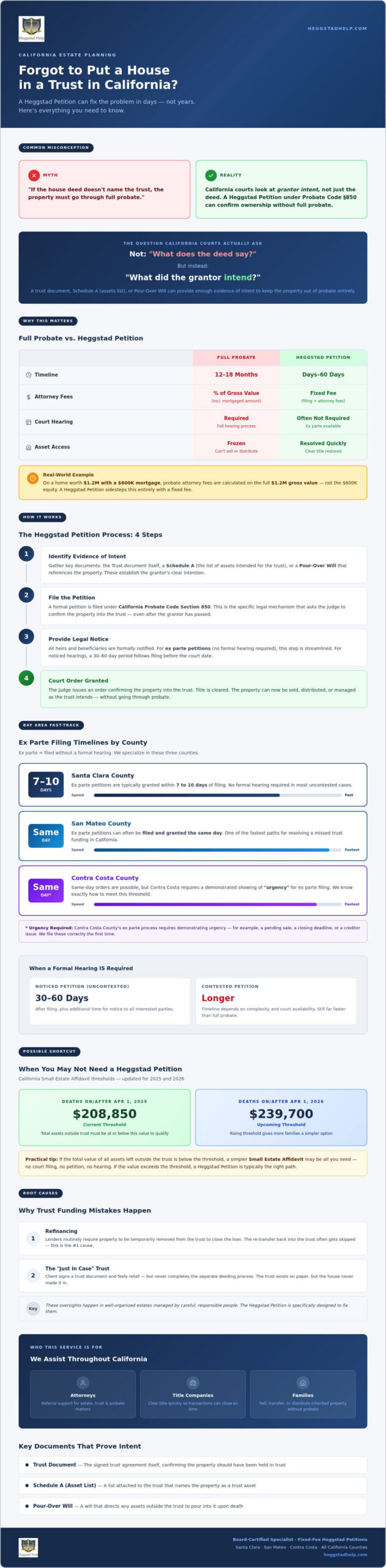
Let’s clear up the most persistent misconception families run into after a loved one passes: if the house deed doesn’t name the trust, the property must go through full probate. That’s simply not true in California, and believing it can cost a family an enormous amount of time and money.

The reality is that California Probate Code Section 850 gives courts the authority to confirm that an asset belongs to a trust even when the deed was never formally transferred. This is the legal foundation of a Heggstad Petition. Instead of asking "what does the deed say?", a California court applying Section 850 asks a more important question: what did the grantor intend? If the trust document, a Schedule of Assets (a list attached to the trust identifying property meant to be held in it), or a Pour-Over Will clearly identifies the property as a trust asset, that evidence of intent can be enough to confirm ownership without triggering a full probate process.

This is a critical distinction that many general-practice attorneys and even some online resources miss entirely. Intent, documented in the right places, carries real legal weight in California courts.

Why Trust Funding Mistakes Happen

Most people don’t forget to fund their trust out of carelessness. The most common culprit is refinancing. When a homeowner refinances their mortgage, lenders routinely require the property to be temporarily transferred out of the trust and back into the borrower’s personal name to close the loan. After funding, the property is supposed to be deeded back into the trust. That step gets skipped far more often than it should.

Another common scenario involves what estate planning attorneys sometimes call the "just in case" trust: the client signs a beautifully drafted trust document, feels a sense of relief, and never follows through on the separate deeding process. The trust exists on paper, but the house never officially made it inside. For a deeper look at how this plays out procedurally, the Heggstad Petition Filing: The California Guide walks through the mechanics in detail.

If you forgot to put a house in a trust in California, you’re not alone. These oversights happen in well-organized estates managed by careful, responsible people.

The Cost of Doing Nothing

Choosing to ignore the problem isn’t a neutral decision. A full probate administration in California typically runs 12 to 18 months from start to finish, and the statutory attorney fees alone are calculated as a percentage of the property’s gross value, not its equity. On a home worth $1.2 million with a $600,000 mortgage, the fee calculation still starts from $1.2 million. That means thousands of dollars in unavoidable fees, a frozen asset your family can’t sell or distribute, and a court calendar that moves on its own schedule, not yours.

A Heggstad Petition, by contrast, can resolve the same problem in a fraction of the time. Understanding the full Heggstad petition vs probate California cost and timeline differences can help families make a more informed decision before committing to either path. In counties like Santa Clara, San Mateo, and Contra Costa, petitions filed ex parte (without a formal hearing) can be resolved in as little as 7 to 10 days, or even the same day in urgent circumstances. For cases that require a noticed hearing, the timeline is typically 30 to 60 days after filing. Either path is dramatically faster and less expensive than full probate.

How the Heggstad Petition Process Works in California

The Heggstad Petition process is a methodical legal path that moves much faster than traditional probate. If you’ve realized someone forgot to put a house in a trust in California, the procedure focuses on gathering specific documentation that demonstrates the deceased person’s clear desire for the property to be trust-held. The process typically follows these four steps:

  • Step 1: Identify Evidence of Intent. We look for documents like the Trust document itself, a "Schedule A" (the list of assets intended for the trust), or a Pour-Over Will that references the property.
  • Step 2: File the Petition. A formal petition is filed under California Probate Code Section 850. This is the specific legal mechanism that asks the judge to "transfer" the property into the trust posthumously.
  • Step 3: Provide Legal Notice. All heirs and beneficiaries must be notified. For standard noticed hearings, this usually results in a court date set 30 to 60 days after filing. However, in certain counties, we can bypass this wait through an ex parte filing, getting a signed order in as little as the date of filing the petition in San Mateo and Contra Costa Counties, and 7 to 10 days through Santa Clara County.
  • Step 4: Obtain the Court Order. Once the judge signs the order, it is recorded with the county. This officially clears the title, allowing the successor trustee to sell or distribute the home.

Evidence Needed for a Successful Filing

The court requires "clear and convincing" evidence of the grantor’s intent. The most common proof is a Schedule of Assets or an "Exhibit A" that specifically lists the real estate by its address or legal description. If these aren’t available, a Pour-Over Will acts as a vital safety net because it explicitly states that any property left outside the trust should be moved into it upon death. You can find a full list of required items in our guide to Documents Needed for Heggstad Petition filings. Understanding these requirements is especially important when the property value exceeds the California small estate threshold, making a Heggstad Petition the most efficient way to avoid a full probate.

Fixed Fees vs. Hourly Legal Billing

Managing an estate is stressful enough without worrying about unpredictable legal bills. That’s why we handle these petitions with fixed fees that cover both the court filing fees and attorney fees. This approach provides successor trustees with total financial predictability, ensuring that estate funds are preserved for the beneficiaries rather than being consumed by hourly billing. For a detailed breakdown of what those fees typically look like and how they compare to statutory probate costs, the Heggstad petition cost California families face in 2026 is covered comprehensively in our dedicated cost guide. If you need help determining if your documents qualify, our Heggstad petition services can provide the clarity you need to move forward confidently.

Local Speed: Filing in Santa Clara, San Mateo, and Contra Costa

Not every California county handles Heggstad petitions the same way. If you forgot to put a house in a trust in California and the property happens to be located in Santa Clara, San Mateo, or Contra Costa County, you’re in a genuinely advantageous position. These three counties allow what’s called an ex parte filing, which simply means you’re asking the court for a ruling without scheduling a formal, noticed hearing. The practical effect is dramatic: instead of waiting months for a court date, the petition can be resolved in days.

Here’s how the timelines break down by county:

  • Santa Clara County: Ex parte Heggstad petitions are typically granted within 7 to 10 days of filing. No hearing required, no crowded court calendar to navigate.
  • San Mateo County: Under the right circumstances, petitions can be filed and granted the same day.
  • Contra Costa County: Same-day filing and granting is also possible, but the court requires a demonstrated showing of urgency. A pending real estate sale with an imminent closing date is a classic example of circumstances that satisfy this requirement.

That urgency requirement in Contra Costa isn’t a barrier; it’s simply a threshold to meet. A well-prepared filing that documents the time-sensitive nature of the situation will typically satisfy the court’s standard.

Why Local Expertise Matters for Successor Trustees

Each county maintains its own local rules governing how Probate Code Section 850 petitions must be formatted, submitted, and supported. A filing that works cleanly in Santa Clara may need to be structured differently for Contra Costa. This is where working with a specialist who files regularly in these specific courts makes a real difference. Attorneys and title companies across California rely on this kind of local knowledge precisely because a misstep in procedure can delay a pending sale or cause a title company to hold up a transaction. Fixed fees cover both filing fees and attorney fees, so there are no billing surprises regardless of which county the property sits in.

Noticed Hearings for Other Counties

If the property is in a county that doesn’t permit ex parte Heggstad filings, the process follows a noticed hearing path. That means all interested parties must receive formal legal notice, and the court sets a hearing date. Realistically, expect the hearing to be scheduled 30 to 60 days after the petition is filed, with additional time built in for the notice period itself. Contested petitions will take longer. It’s still dramatically faster than full probate, but if you’re working against a sale deadline, county location matters more than most families initially realize.

If you’re facing a time-sensitive title issue, explore how our Heggstad petition services can move your case forward efficiently based on the specific county and circumstances involved.

When a Heggstad Petition Isn’t Needed: 2026 Thresholds

A Heggstad Petition is a powerful tool, but it’s not always the right one. If the total value of assets left outside the trust is relatively modest, California law offers a simpler path: the Small Estate Affidavit. This is a straightforward legal declaration that allows successor trustees or heirs to collect and transfer assets without any court involvement at all.

The thresholds are specific and recently updated:

  • Deaths on or after April 1, 2025: The small estate limit is $208,850.
  • Deaths on or after April 1, 2026: That limit rises to $239,700.

Here’s the practical reality: if someone forgot to put a house in a trust in California, the property almost certainly exceeds these thresholds. California real estate values being what they are, even a modest home will push the total well past $239,700. That’s why the Heggstad Petition remains the primary tool for real property, while the Small Estate Affidavit handles the smaller assets sitting alongside it. For a detailed side-by-side breakdown of costs, timelines, and procedural requirements, the Heggstad petition vs probate California 2026 comparison guide offers a comprehensive look at when each path makes the most sense.

Combining Tools for a Clean Estate Transfer

These two approaches aren’t mutually exclusive. A well-organized estate transfer often uses both: a Heggstad Petition to clear title on the home, and a Small Estate Affidavit to collect a forgotten bank account or transfer a small brokerage balance. For brokerage accounts and other titled assets, a separate title correction process may be required, depending on how the account was held. The goal is matching the right legal tool to each specific asset rather than forcing everything through the same procedure.

Next Steps for Successor Trustees

The single most important thing a successor trustee can do right now is consult with a Board-Certified Specialist to evaluate which assets qualify for which approach. Don’t guess, and don’t improvise.

One critical warning: do not attempt to record a "correction deed" after the grantor’s death. It seems like a logical shortcut, but title companies will almost certainly reject it, and it can create additional complications that slow the process down rather than speeding it up. The correct path runs through the court, not around it.

Whether you’re an attorney, a title company holding a transaction open, or a family trying to figure out what comes next after someone forgot to put a house in a trust in California, the right evaluation starts with understanding exactly what’s in the estate and what tools apply. Contact Heggstad Help for a fixed-fee evaluation of your California trust assets and get a clear answer on the fastest, most cost-effective path forward.

Your Next Step Toward Clearing Title and Moving Forward

If someone forgot to put a house in a trust in California, the situation feels overwhelming at first, but the path forward is clearer than most families expect. California law gives courts the authority to confirm a property belongs in a trust based on intent, not just paperwork. The right petition, filed in the right county, can resolve the problem in days rather than months.

The key points to carry forward are straightforward: a Heggstad Petition is almost always faster and less expensive than full probate, county location directly affects your timeline, and working with a specialist matters more than most people realize until a filing goes sideways.

Robert P. Bergman is a Board-Certified Specialist in Estate Planning, Trust and Probate Law with over 40 years of California legal experience. Every petition is handled on a fixed-fee basis, so attorneys, title companies, and families know exactly what to expect from day one.

Get a fixed-fee evaluation for your Heggstad Petition today and find out how quickly your specific situation can be resolved. The process is more manageable than it looks right now.

Frequently Asked Questions

Can I file a Heggstad petition if there is no Schedule of Assets?

Yes, a missing Schedule of Assets doesn’t automatically disqualify a petition. California courts look at the totality of evidence showing the grantor’s intent, so a Pour-Over Will that directs assets into the trust, language within the trust document itself referencing the property, or other written communications from the grantor can all serve as supporting evidence. The stronger and more specific your documentation, the better positioned your petition will be.

That said, cases without a Schedule of Assets do require more careful preparation. Working with a Board-Certified Specialist who files these petitions regularly helps ensure that the available evidence is presented in the way California courts find most persuasive, rather than leaving gaps that could slow the process down or invite objections from interested parties.

How long does a Heggstad petition take in California?

Timeline depends heavily on the county where the property is located. In Santa Clara County, ex parte petitions (those filed without a formal hearing) are typically granted within 7 to 10 days of filing. In San Mateo and Contra Costa Counties, same-day resolution is possible under the right circumstances, though Contra Costa requires a demonstrated showing of urgency, such as a pending sale with an imminent closing date.

For counties that don’t permit ex parte filings, the process follows a noticed hearing path. All interested parties receive formal legal notice, and the court sets a hearing date that’s typically 30 to 60 days after the petition is filed. Contested petitions take longer. Either way, it’s a fraction of the 12 to 18 months a full probate administration would require.

What is the cost of a Heggstad petition compared to probate?

The cost difference between a Heggstad petition and full probate is substantial. California’s statutory probate fees are calculated as a percentage of the property’s gross value, not its equity, so a $1.2 million home with a $600,000 mortgage still generates fees based on $1.2 million. Those fees accumulate quickly and are unavoidable. A Heggstad petition, by contrast, is handled on a fixed-fee basis covering both filing fees and attorney fees, giving successor trustees complete financial predictability from day one. For a full breakdown of what to expect, our guide to Heggstad petition cost California families encounter in 2026 covers every line item in detail.

Beyond the direct cost savings, avoiding probate also means avoiding 12 to 18 months of a frozen asset your family can’t sell or distribute. The combination of lower fees and dramatically faster resolution makes a Heggstad petition the more cost-effective path in virtually every situation involving California real estate that was forgotten to be put in a trust.

Can I sell the house while the Heggstad petition is pending?

In most cases, no. Title companies won’t insure a sale until the court order is recorded, because the title can’t be confirmed as belonging to the trust until a judge signs off. Trying to close escrow before the order is in place will typically result in the title company holding the transaction open, which is exactly the kind of delay that frustrates buyers and can put a sale at risk.

The good news is that a pending sale with a closing deadline is precisely the kind of urgency that supports an expedited filing in counties like Contra Costa, and it’s consistent with the circumstances that make ex parte petitions appropriate in Santa Clara and San Mateo. If you’re working against a sale deadline, that timing pressure isn’t a problem; it’s actually a reason to move quickly and file as soon as possible.

Do I need a lawyer to file a Heggstad petition in California?

Technically, California law doesn’t prohibit a self-represented successor trustee from filing a Heggstad petition. Practically speaking, though, the procedural requirements are specific enough that errors in formatting, notice, or supporting documentation can delay the case or cause the court to deny the petition entirely. Each county has its own local rules, and what works in Santa Clara may need to be structured differently for another court.

For attorneys and title companies handling estates across California, working with a specialist who focuses exclusively on Heggstad petitions provides both efficiency and predictability. If you forgot to put a house in a trust in California and you’re now managing a time-sensitive title issue, the fixed-fee structure means you know the full cost upfront, and the specialized experience means the filing is done right the first time.

Robert P. Bergman, Attorney at Law

Article by

Robert P. Bergman, Attorney at Law

Attorney Robert P. Bergman ("Bob Bergman") has been a Board-Certified Specialist in Estate Planning, Trust and Probate Law since 2011, as certified by the California State Bar Board of Legal Specialization. For several years, Bob has assisted families and the clients of other attorneys with obtaining court orders through Heggstad petitions to avoid the time and expense of Probate administration. Bob is friendly, very approachable, and believes in explaining complex legal topics in clear ordinary language so that his clients understand exactly what they're doing and why they're doing it.
Bob is often able to assist clients who are in other counties than his home county of Santa Clara through his approach to Heggstad petitions.

Disclaimer

This article is for informational purposes only. Nothing in this article is intended to replace legal advice from a competent attorney or be considered legal guidance for anybody's specific legal situation. Nobody should rely on information in this article in making legal decisions without such consultation.
How Long Does a Heggstad Petition Take in California? 2026 Timeline Guide

You finally have a signed contract for the family home, but a title search reveals the property was never officially deeded into the trust. Suddenly,…

You finally have a signed contract for the family home, but a title search reveals the property was never officially deeded into the trust. Suddenly, your real estate transaction is on hold while you face the daunting prospect of a traditional probate. You’re likely wondering how long does a Heggstad petition take in California and whether it can save your sale before the buyer walks away. In most cases, this specialized legal tool (a petition filed under Probate Code section 850) offers a much faster resolution than a full probate, which currently averages 12 to 18 months in the California court system.

We understand the anxiety that comes with court delays and the confusion over varying county backlogs. It’s frustrating to feel like your life is on hold because of a simple administrative oversight. This guide provides a realistic 2026 timeline for the Heggstad process, showing you how to navigate the 3 to 11 month window effectively. You’ll learn which factors influence specific wait times and how an ex parte (emergency) hearing might expedite your case. By understanding these procedural steps, you can move forward with the confidence that your title issues will be resolved as quickly as the law allows.

Key Takeaways

  • A Heggstad petition offers a streamlined path to title correction, typically concluding in less than a year compared to the 12 to 18 months required for a standard California probate.
  • The primary factor in how long does a Heggstad petition take in California is the specific county court’s backlog, with processing times generally ranging from 3 to 11 months.
  • You can potentially accelerate the timeline through an ex parte application (an emergency court request) if you are facing an urgent property sale or significant financial hardship.
  • Precision in the initial filing is critical, as a single error in notifying heirs or beneficiaries can reset the mandatory 30-day notice clock and add months to the process.
  • Utilizing a Board-Certified Specialist ensures your petition is structured correctly the first time, preventing court-ordered amendments that would otherwise delay asset distribution.

The Realistic Heggstad Petition Timeline in California

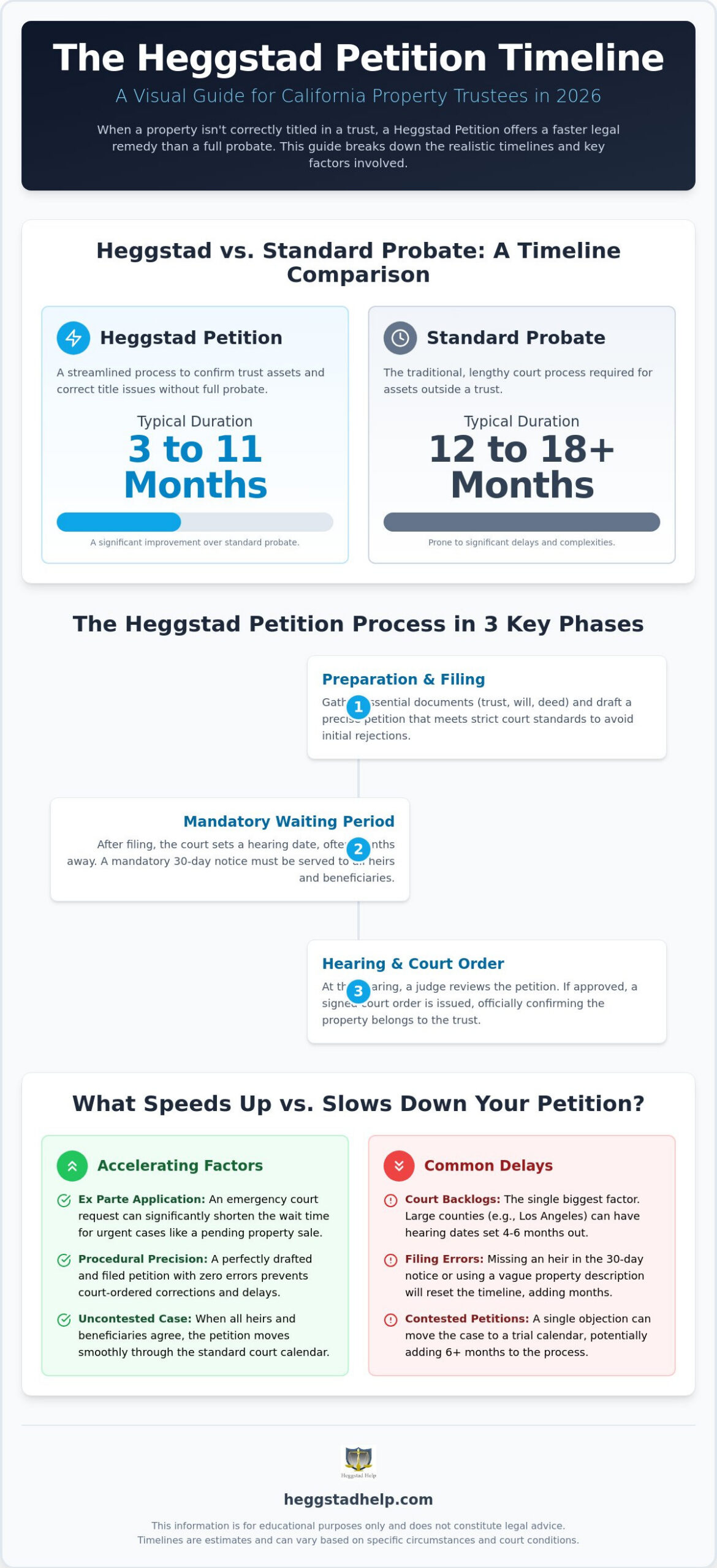
A Heggstad petition is a Probate Code 850 procedure used to confirm trust assets without full probate. This legal mechanism allows successor trustees to transfer assets that were intended for the trust but were never formally titled in the trust’s name. It is based on the legal precedent set by the Estate of Heggstad, which recognized that a clear statement of intent in trust documents can sometimes override the lack of a recorded deed. While the specific duration depends on your local court, a Heggstad petition typically takes between 3 and 10 months from the initial filing to receiving a signed court order. This is a substantial improvement over a standard California probate, which often takes 12 to 18 months at minimum.

Phase 1: Document Preparation and Filing

The first stage involves gathering the necessary evidence to prove the decedent’s intent. You’ll need to locate the original trust document, the pour-over will, and the most recent property deed. If these documents aren’t readily available, the preparation phase can stretch from days into weeks. Once we have the evidence, we draft the petition to meet the strict evidentiary standards of the local probate court. Precision matters here. If the petition lacks specific language required by a particular judge, the court may issue a probate note requesting corrections, which can add weeks to your timeline. After the paperwork is finalized, we file the petition with the Superior Court in the county where the property is located.

Phase 2: The Mandatory Waiting Period

After filing, the court assigns a hearing date. This is the primary variable when determining how long does a Heggstad petition take in California. Most courts are scheduled months in advance. During this time, you must comply with a mandatory 30-day notice requirement. This means every legal heir and beneficiary named in the trust or will must receive formal notice of the hearing. If you miss a single person, the judge will likely continue, or postpone, the hearing, effectively resetting your timeline. You can learn more about these specific requirements in our guide to Heggstad petition filing. Understanding how long does a Heggstad petition take in California requires looking at county-specific backlogs, as some jurisdictions process these requests much faster than others.

Factors That Speed Up or Delay Your Heggstad Petition

While the standard timeline provides a helpful baseline, the specific answer to how long does a Heggstad petition take in California often depends on local court efficiency. Large jurisdictions like Los Angeles or Alameda County frequently struggle with significant caseloads, which can result in hearing dates being set four to six months after your initial filing. In contrast, smaller or more well-funded counties might offer dates in as little as eight to ten weeks. Staffing levels are a primary driver of these variances, though some courts have begun utilizing remote hearings (video conference appearances) to help manage backlogs and provide more flexible scheduling options.

The Impact of Procedural Precision

Procedural errors are the most common reason for unexpected delays. If you fail to identify and serve a single legal heir or beneficiary during the mandatory 30-day notice period, the judge will likely refuse to sign the order at your hearing. This oversight forces a continuance, effectively resetting your notice clock and adding at least another month to the process. Furthermore, vague property descriptions are the leading cause of “Probate Notes” (written deficiencies or objections issued by court examiners). If your petition’s legal description doesn’t perfectly align with the county recorder’s records, the court will halt the proceedings until you file a formal supplement to correct the record.

Uncontested vs. Contested Petitions

The vast majority of Heggstad petitions are uncontested, meaning all parties agree that the decedent intended for the asset to be part of the trust. These cases typically move through the system according to the court’s standard calendar. however, if an heir objects to the petition, the case may be moved to a contested trial calendar. A single objection can transform a relatively short process into a lengthy legal dispute, potentially adding six months or more to the resolution. Identifying potential family conflicts early is essential for maintaining a predictable timeline. Working with an expert to ensure your filing is bulletproof can help discourage meritless objections and facilitate a smoother trust asset title correction.

A Board-Certified specialist provides a distinct “specialist advantage” by anticipating these hurdles before they occur. By ensuring every document meets the specific evidentiary standards of your local probate department, you avoid the clerical errors that typically cause two to three months of unnecessary delays. This level of preparation is the most effective way to manage expectations regarding how long does a Heggstad petition take in California while protecting the interests of the beneficiaries.

How to Expedite the Process: Ex Parte Court Orders

While the standard court calendar often dictates how long does a Heggstad petition take in California, certain urgent circumstances allow for a faster resolution. An ex parte order (an emergency court request made with short notice to interested parties) can sometimes be heard in a matter of days rather than months. These requests are designed for situations where waiting for a standard hearing would cause irreparable harm, which refers to legal or financial damage that cannot be easily undone. HEGGSTAD HELP focuses specifically on these ex parte court order services to assist families facing time-sensitive hurdles.

Using Ex Parte for Real Estate Sales

The most frequent justification for an expedited hearing is a pending real estate sale. It’s common for successor trustees to discover that a home was never deeded into the trust only after the property enters escrow. If the buyer threatens to walk away due to title issues, the estate faces a clear financial loss. In these instances, we can file an ex parte petition alongside the standard Heggstad filing. If the judge finds the emergency is genuine, they may issue an order confirming the trust’s ownership immediately, allowing the sale to close on schedule. This effectively bypasses the usual four to six month wait time common in larger California counties.

The Limits of Expedited Requests

It’s vital to understand that judges are exceptionally strict regarding what constitutes a true emergency. A simple desire to finish the process quickly isn’t enough to jump the line. Beyond real estate sales, justifications might include an immediate need for funds to pay for a beneficiary’s medical care or the imminent loss of a favorable interest rate. Because an ex parte request asks the court to act before the typical 30-day notice period ends, your petition must be legally bulletproof. Any ambiguity in your evidence of intent or errors in your paperwork will result in an immediate denial. Success in these urgent matters requires a high level of professional precision to ensure the court feels confident granting the order on an accelerated basis.

How Long Does a Heggstad Petition Take in California? 2026 Timeline Guide

Preparation: The Key to a 90-Day Resolution

The total duration of your case often hinges on the quality of your initial submission. While court backlogs are a reality, the fastest resolutions occur when a petition is filed with zero clerical or evidentiary errors. When determining how long does a Heggstad petition take in California, you must account for the court’s review process. A perfectly prepared petition allows the probate examiner to clear the case for the judge’s signature without requesting additional information. This precision is why working with a Board-Certified Specialist in Estate Planning, Trust and Probate Law is critical for speed. Robert P. Bergman utilizes decades of experience to ensure your filing anticipates local court preferences, often securing a signed order at the very first hearing.

Gathering Your Essential ‘Heggstad Checklist’

Efficiency begins with document collection. To start your petition, we typically require four specific items. If you’re missing an original deed or the trust document has been misplaced, we can often utilize secondary evidence or recorded copies to maintain the timeline. Having these ready allows us to draft the petition immediately:

  • The Complete Trust Agreement: Including all signed amendments.
  • The Pour-Over Will: This document often contains the critical language of intent needed for the court.
  • The Current Property Deed: Or the most recent account statement for financial assets.
  • The Death Certificate: A certified copy is required to establish the court’s jurisdiction.

Why ‘Doing it Yourself’ Often Doubles the Timeline

Successor trustees who attempt a DIY filing frequently encounter “Probate Notes.” These are written deficiencies issued by court staff days before the hearing. If you receive a note regarding a notice error or a vague property description, the judge will likely continue the hearing to a future date. In busy counties, this functions as a 60-day setback, effectively doubling your wait time. Professional trust asset title correction California ensures that these common hurdles are cleared before the paperwork ever reaches the clerk’s desk. By getting it right the first time, you avoid the administrative loops that complicate the question of how long does a Heggstad petition take in California, allowing you to fund the trust and distribute assets as the decedent intended.

Take Control of Your Trust Timeline

Navigating the legal complexities of a missing trust asset doesn’t have to be a year-long ordeal. By understanding how long does a Heggstad petition take in California, you can make informed decisions that protect your family’s inheritance and your peace of mind. Whether you’re facing a standard 3 to 11 month court window or require an emergency ex parte order to save a pending real estate sale, the key to success lies in procedural precision. A single notice error or a vague property description can easily derail your timeline and force a lengthy continuance that stretches for months.

Robert P. Bergman is a California Board-Certified Specialist in Estate Planning, Trust and Probate Law who has been practicing since 1980. With an exclusive focus on Heggstad petitions and title correction, our firm provides the steady hand you need to avoid the pitfalls of a full probate. Schedule a consultation with Board-Certified Specialist Robert P. Bergman to expedite your Heggstad petition today. We’re here to help you resolve these title issues quickly and correctly so you can move forward with total confidence.

Frequently Asked Questions

Is a Heggstad petition faster than probate in California?

Yes, a Heggstad petition is significantly faster than a traditional probate proceeding. While a full California probate typically requires 12 to 18 months to conclude, a Heggstad petition generally wraps up within 3 to 11 months. This efficiency exists because the process bypasses the time-consuming requirements of formal probate, such as the four-month creditor claim period and the mandatory appointment of a probate referee for asset appraisals.

Can I sell a house while a Heggstad petition is pending?

You can certainly list the property and enter into a purchase agreement, but you cannot legally transfer title to the buyer until the court order is signed and recorded. Most buyers are willing to wait if they see a clear legal path forward. In urgent situations, your attorney can file for an ex parte order to speed up the process. This is a common strategy when trying to manage how long does a Heggstad petition take in California during a time-sensitive real estate transaction.

What is the fastest a Heggstad petition can be completed?

The fastest a Heggstad petition can realistically be completed is approximately 60 to 90 days. This accelerated timeline is only possible in counties with minimal backlogs and requires a filing with no errors. You must still account for the mandatory 30-day notice period required for all heirs and beneficiaries. Proper preparation is the most effective way to minimize how long does a Heggstad petition take in California for your specific case.

Do I have to appear in court for a Heggstad hearing?

In most cases, the successor trustee doesn’t need to physically step into a courtroom. Your attorney typically handles the hearing on your behalf; additionally, many California probate courts now utilize remote appearance technology or clear petitions based on the written record before the hearing date even arrives. If the paperwork is handled by a specialist, the judge may sign the order without requiring any oral testimony or personal attendance.

What happens if a Heggstad petition is denied due to timing?

If a petition is denied due to timing, it usually means the hearing has been continued, or postponed, to a future date. This typically happens because the 30-day notice wasn’t served correctly or the court’s calendar was overbooked. If the court determines that the evidence of intent is insufficient and denies the petition on its merits, you’ll likely be forced to start a full probate administration. This reset can add a year or more to your total resolution time.

Robert P. Bergman, Attorney at Law

Article by

Robert P. Bergman, Attorney at Law

Attorney Robert P. Bergman ("Bob Bergman") has been a Board-Certified Specialist in Estate Planning, Trust and Probate Law since 2011, as certified by the California State Bar Board of Legal Specialization. For several years, Bob has assisted families and the clients of other attorneys with obtaining court orders through Heggstad petitions to avoid the time and expense of Probate administration. Bob is friendly, very approachable, and believes in explaining complex legal topics in clear ordinary language so that his clients understand exactly what they're doing and why they're doing it.
Bob is often able to assist clients who are in other counties than his home county of Santa Clara through his approach to Heggstad petitions.

Disclaimer

This article is for informational purposes only. Nothing in this article is intended to replace legal advice from a competent attorney or be considered legal guidance for anybody's specific legal situation. Nobody should rely on information in this article in making legal decisions without such consultation.

Common Mistakes in California Heggstad Petitions: A Successor Trustee’s Guide

Did you know that a properly executed Heggstad petition can often resolve title issues in just 60 to 90 days, while a full California probate can…

Did you know that a properly executed Heggstad petition can often resolve title issues in just 60 to 90 days, while a full California probate can drag on for 12 to 18 months? It’s a powerful tool for successor trustees, but the margin for error is surprisingly thin. Many people assume that because a house was mentioned in a trust document, the transfer is a mere formality. However, failing to account for common mistakes Heggstad petition filers often encounter can lead to a flat denial from the court, forcing you back into the lengthy probate process you worked so hard to avoid.

We understand the stress of managing a decedent’s estate when titles are missing or outdated. It’s natural to feel overwhelmed by the technical requirements of Probate Code 850 (the specific law that allows a judge to transfer property into a trust after death). This guide will help you identify the critical procedural and evidentiary pitfalls that cause these petitions to fail in California courts. You’ll learn how to present clear evidence of intent and satisfy the strict notice requirements of the judicial system. By understanding these nuances, you can ensure a successful transfer of real property into the trust while minimizing unnecessary legal delays and court costs.

Key Takeaways

  • Identify the “Trust Funding Gap,” which is the mismatch between legal title and trust intent, and why a Heggstad petition is the most efficient remedy for un-titled assets.
  • Learn how to avoid the common mistakes Heggstad petition filers make by providing specific evidence, such as property addresses and assessor’s parcel numbers, rather than vague descriptions.
  • Master the procedural requirements, such as the mandatory 30-day notice to all beneficiaries, to prevent avoidable court continuances (delays in your hearing).
  • Determine the correct California jurisdiction for your filing to ensure your petition is heard in the proper county court where the property is located.
  • Understand the advantage of working with a Board-Certified Specialist to navigate the nuances of specialized trust asset title correction and ex parte court orders.

Why Heggstad Petitions Fail: Identifying the “Trust Funding Gap”

When a person creates a revocable living trust, their primary goal is to ensure their assets pass to beneficiaries without the delay and expense of a full probate. However, a trust is only effective if it is properly “funded.” If an asset is not formally retitled into the name of the trust, a “Trust Funding Gap” occurs. This term describes the discrepancy between the decedent’s clear intent to include an asset in their estate plan and the actual legal title on record at the time of their death. If the title remains in the decedent’s individual name, the asset is technically outside the trust’s reach.

The primary remedy for this gap is a petition filed under California Probate Code Section 850, which provides the modern statutory framework for these filings. This legal procedure is widely known as a Heggstad petition, named after the landmark case Estate of Heggstad. This case established that a written declaration of trust can be sufficient to transfer property even if the formal deed was never recorded. While this is a powerful tool, you must remember that a court order is not an automatic right. It’s a formal request to a judge; common mistakes Heggstad petition filers make often involve assuming the court will simply approve the request without rigorous proof of intent.

The Most Common Assets Left Out of California Trusts

In our specialized practice, we frequently see specific assets fall through the cracks of a traditional estate plan. These include:

  • Real property: This includes primary residences or rental units where a deed was prepared but never actually recorded with the County Recorder.
  • Brokerage accounts: Many investment portfolios remain in an individual’s name because the owner failed to complete the trust designation or “transfer on death” (a designation that names a beneficiary) paperwork.
  • Refinanced homes: This is a particularly frequent issue. Lenders often require a property to be moved out of a trust and into an individual’s name during the refinancing process. If the owner passes away before retitling the property back into the trust, the asset remains legally “unfunded.”

If you find yourself managing an estate with these “forgotten” assets, identifying the gap is the first step toward a resolution. Avoiding the common mistakes Heggstad petition candidates face requires a methodical approach to gathering evidence and presenting a clear, logical case to the California court system.

The Evidence Trap: Why a Trust Schedule Isn’t Always Enough

A frequent misconception among successor trustees is the belief that any mention of an asset within the trust documents guarantees a successful court order. In reality, evidentiary insufficiency is one of the most common mistakes Heggstad petition filers encounter. California judges require clear and convincing evidence of the decedent’s intent to hold a specific asset in trust. If your documentation is vague or contradictory, the court may determine that the legal requirements have not been met, leaving the property stuck in probate.

The “Vague Schedule” mistake is a primary culprit for petition denials. If a trust’s “Schedule A” (the list of assets intended for the trust) simply states “real estate” or “my family home” without providing a specific street address or Assessor’s Parcel Number (APN; the unique number assigned to a property by the county tax assessor), the court may find the description too broad to enforce. Similarly, the “Missing Link” error occurs when a trustee fails to provide a document that explicitly connects the trust agreement to the specific asset in question. Without this direct link, the judge cannot legally confirm that the property belongs to the trust estate.

Reliance on oral testimony is another pitfall. While family members may recall the decedent’s desire to “put the house in the trust,” California courts prioritize written evidence over verbal recollections. Inconsistent documentation can also derail your case; for example, if a deed was signed in an individual’s name after the trust was created, the court might view this as a deliberate choice to remove the asset from the trust. If you are unsure if your current documentation is sufficient, consulting with a specialist in trust asset title correction can help clarify your standing before you file.

The Gold Standard of Evidence for Probate Code 850

To avoid these evidentiary traps, successor trustees should aim for a “gold standard” of proof that leaves little room for judicial doubt. This typically includes:

  • Detailed Property Descriptions: Your petition should include the full legal description found on the most recent deed along with the APN to ensure the court can identify the exact parcel of land.
  • Referenced Exhibits: Ensure that any asset list is clearly referenced within the body of the trust agreement itself, establishing it as an integral part of the estate plan.
  • Supporting Declarations: Written statements from the original drafting attorney or witnesses who were present during the trust’s creation can provide the necessary context to confirm the decedent’s intent.

Procedural Errors That Stall Heggstad Petitions in California Courts

Even if you have gathered the “gold standard” of evidence discussed previously, procedural slips can derail your progress. These common mistakes Heggstad petition applicants make often result in a “continuance” (a court order delaying the hearing to a future date), which can add months to the resolution of the estate. While the court is generally helpful, judges cannot overlook statutory requirements regarding how a case is filed and who is notified.

Jurisdictional mistakes are a frequent hurdle. Generally, a petition under Probate Code 850 must be filed in the county where the real property is located or where the trust is currently administered. Filing in the wrong venue can lead to a dismissal, forcing you to restart the process from scratch. Additionally, the language in your proposed order must be precise. If the order lacks a full legal description or the specific “title correction” wording required by the County Recorder, you may find yourself with a court order that cannot be used to actually transfer the deed.

For trustees facing a pending sale, failing to utilize the “Ex Parte” (an expedited or emergency) procedure is a critical error. If a property is already in escrow, a standard court date may be too far in the future, risking a breach of contract. We specialize in managing the Heggstad petition filing process to ensure these time-sensitive procedural requirements are met without the need for multiple court appearances.

Navigating California’s Strict Notice Requirements

The most frequent reason for a stalled petition is defective notice. California law requires that all “interested persons” receive a formal 30-day notice of the hearing. This group includes all current beneficiaries and, crucially, any legal heirs who would have inherited if there were no trust (even if they were intentionally disinherited). You must use the correct Judicial Council form, DE-120 (Notice of Hearing—Decedent’s Estate or Trust), and ensure the proof of service is filed with the court well before the hearing date. A single missing recipient or a late mailing can push your resolution back by 60 to 90 days, significantly increasing the stress of the administration.

If you encounter difficulties in locating specific heirs or beneficiaries to fulfill these legal obligations, you may visit HubHound to access professional investigative services that can help track down necessary parties and ensure your filing moves forward without delay.

Common Mistakes in California Heggstad Petitions: A Successor Trustee’s Guide

Securing a Successful Court Order: Best Practices for Successor Trustees

Successor trustees often start the estate administration process with a generalist attorney, but a Heggstad filing is a specialized legal instrument that requires a surgical approach. While many probate lawyers are proficient in full court administrations, they may lack the specific experience needed to navigate the unique evidentiary hurdles of a Probate Code 850 petition. A Board-Certified Specialist in Estate Planning, Trust and Probate Law understands exactly how to frame the decedent’s intent to satisfy a skeptical judge. This level of precision is the best defense against the common mistakes Heggstad petition applicants frequently make, such as providing insufficient proof of asset funding.

This requirement for specialized knowledge isn’t limited to California; for those managing estates with assets in other jurisdictions, consulting an estate planning attorney New York can ensure that similar title issues are addressed according to local probate laws and that your overall estate plan is secure.

If you are facing a looming deadline, such as a pending real estate sale, the timing of your filing is critical. Utilizing professional Heggstad petition filing services ensures that your “Order Confirming Trust Assets” is drafted with the exact legal descriptions required by the County Recorder. This prevents the order from being rejected after you’ve already left the courtroom. For urgent cases, we often leverage ex parte procedures (emergency court applications) to confirm assets quickly; this allows you to meet escrow deadlines without the typical 90-day wait.

The Successor Trustee Checklist for Asset Recovery

  • Locate Original Documents: Find the original signed trust agreement and all subsequent amendments immediately; these are the foundation of your evidence.
  • Gather Asset Records: Collect the most recent deeds for real property or account statements for brokerage accounts that were left in the individual’s name.
  • Validate Evidence: Consult with a specialist to determine if your documentation meets the “clear and convincing” standard required by California law before you pay filing fees.

Next Steps: Correcting the Title Without Full Probate

The path forward involves drafting a petition that specifically requests a title correction under Probate Code 850. Once the judge signs the order, it must be recorded with the California County Recorder’s office in the county where the property is located. This recording acts as the final bridge, officially moving the property from the decedent’s name into the trust. If you feel overwhelmed by the technical requirements, contact Heggstad Help for a specialized review of your trust asset recovery case. We focus exclusively on these filings to help you avoid the common mistakes Heggstad petition filers encounter and secure the assets for your beneficiaries.

Take Decisive Action to Resolve Your Trust Funding Gap

Navigating the complexities of California Probate Code 850 requires more than just a signed trust document; it demands a precise alignment of evidence and procedure. By identifying the trust funding gap early and avoiding the common mistakes Heggstad petition filers often make, such as providing vague property descriptions or failing to notify all legal heirs, you can successfully bypass the lengthy probate process. This methodical approach ensures that real property is transferred quickly, preserving the estate’s value and honoring the decedent’s true intent.

If you’re feeling the pressure of a pending sale or the weight of managing missing titles, you don’t have to face the court system alone. Robert P. Bergman is a Board-Certified Specialist in Estate Planning, Trust and Probate Law who has been practicing in California since 1980. With a specialized focus on trust asset title correction and Heggstad filings, our firm offers the expertise required to secure a recordable court order without unnecessary delays. Get Expert Help with Your Heggstad Petition to ensure your estate administration remains on the right track. You can resolve these title issues and move forward with the peace of mind that the estate is finally complete.

Frequently Asked Questions

Can I file a Heggstad petition if there is no written schedule of assets?

Yes, you can still file a petition even if there is no formal schedule of assets (the list of property intended for the trust) attached to the document. While a “Schedule A” provides the clearest evidence, California courts may accept a general assignment of all the decedent’s property to the trust. You must provide other written evidence of the creator’s intent to avoid the common mistakes Heggstad petition filers make when documentation is sparse.

How long does the Heggstad petition process take in California?

The Heggstad petition process typically takes between 60 and 90 days to reach a final court order in California. This timeline is significantly more efficient than a full probate administration, which often lasts 12 to 18 months or longer. The exact duration depends on the specific county court’s calendar and whether your initial filing is procedurally perfect, as any errors in notice can lead to a continuance (a court-ordered delay of your hearing).

What happens if a Heggstad petition is denied by the judge?

If a judge denies your petition, the asset must generally go through a full California probate process to transfer the title to the beneficiaries. However, if the denial is “without prejudice,” the court is allowing you to refile the petition after you have gathered better evidence or corrected procedural flaws. Understanding the common mistakes Heggstad petition applicants face before you file is the best way to prevent this outcome and the associated costs of a full probate.

Is a Heggstad petition cheaper than a full California probate?

Yes, a Heggstad petition is a much more cost-effective alternative to a full probate administration. In California, probate fees are statutory (legal fees calculated as a fixed percentage of the gross estate value), which can be quite expensive for real property. Because a petition is a targeted legal request rather than a comprehensive estate oversight, the legal fees and court costs are substantially lower, allowing more of the estate’s value to pass directly to the heirs.

Do I need to notify disinherited family members about the Heggstad petition?

Yes, you are legally required to provide formal notice to all legal heirs, including those who were intentionally disinherited. California law dictates that all “interested persons” (individuals who would have inherited the property under state law if the trust did not exist) must receive a 30-day notice of the hearing. Skipping this step is a major procedural error that will cause the judge to delay your case until all parties are properly served and proof of service is filed.

Robert P. Bergman, Attorney at Law

Article by

Robert P. Bergman, Attorney at Law

Attorney Robert P. Bergman ("Bob Bergman") has been a Board-Certified Specialist in Estate Planning, Trust and Probate Law since 2011, as certified by the California State Bar Board of Legal Specialization. For several years, Bob has assisted families and the clients of other attorneys with obtaining court orders through Heggstad petitions to avoid the time and expense of Probate administration. Bob is friendly, very approachable, and believes in explaining complex legal topics in clear ordinary language so that his clients understand exactly what they're doing and why they're doing it.
Bob is often able to assist clients who are in other counties than his home county of Santa Clara through his approach to Heggstad petitions.

Disclaimer

This article is for informational purposes only. Nothing in this article is intended to replace legal advice from a competent attorney or be considered legal guidance for anybody's specific legal situation. Nobody should rely on information in this article in making legal decisions without such consultation.