How to Fix Trust Title Errors in California

What if the deed isn’t wrong, but the property was never transferred into the trust? To understand how to fix trust title errors, compare the…

What if the deed isn’t wrong, but the property was never transferred into the trust? To understand how to fix trust title errors, compare the recorded deed with the trust documents and determine whether the deed itself contains an error or the transfer was never completed. A deed correction may address some document errors; an eligible asset intended for the trust but never titled in it may require a Heggstad petition.

This guide explains which records to gather, how to distinguish between these situations, and what California options may help resolve the issue before it delays trust administration or a sale. Heggstad Help, a service of attorney Robert P. Bergman, Board-Certified Specialist in Estate Planning, Trust, and Probate Law (California State Bar Board of Legal Specialization), assists families, attorneys, and their clients throughout the State of California with uncontested ex parte Heggstad petitions filed in Santa Clara County, regardless of where the trust is located. These petitions are typically granted in 7 to 10 days.

Key Takeaways

  • Compare the recorded ownership information with the trust documents to pinpoint where they differ.
  • How to fix trust title errors depends on whether the deed needs correction or a court may need to confirm an eligible asset as trust property.
  • Gather the current recorded deed, relevant trust documents, and available transfer records. Write down the specific mismatch.
  • Families, attorneys, title companies, and clients throughout California can pursue eligible uncontested Heggstad petitions through ex parte filing in Santa Clara County, regardless of where the trust is located.

What Kind of Trust Title Error Do You Have in California?

The right way to address a trust title problem depends on whether the recorded document contains an error or the property was never transferred into the trust. Title is the recorded information showing who owns the property. A mismatch does not automatically mean the entire trust is invalid.

Was the deed recorded incorrectly, or was the property left out?

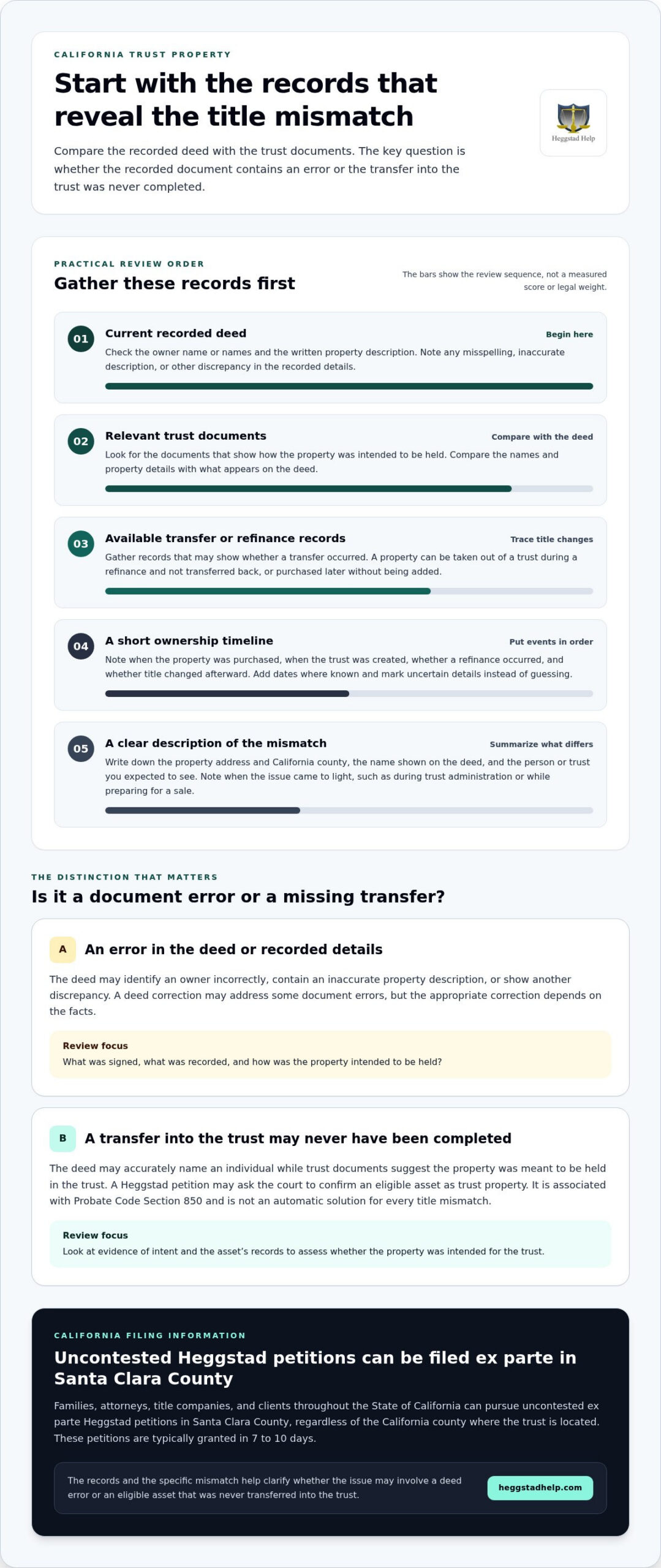
Start by comparing the current recorded deed with the trust documents. A deed defect may involve an incorrect spelling of an owner’s name or a legal description, the written identification of the property, that does not accurately describe the parcel. These are issues with the deed or its recorded information, although the appropriate correction depends on the facts.

A different issue arises when the deed accurately names an individual, but the trust documents suggest the property was meant to be held in the trust. For example, the deed may still identify a person rather than the trust. In that situation, the question may not be how to correct a typo, but whether the property was ever transferred into the trust. Changing a document and asking a court to confirm an asset as trust property are different paths.

Why can a property and trust record stop matching?

A transfer can be overlooked when someone creates or updates a trust. A property may also be taken out of a trust during a refinance and not transferred back afterward, or purchased later without being added to the trust. These are trust-funding issues: assets may not have been legally placed in the trust as intended. A general overview of trust law can explain how trusts hold and manage assets, but it won’t establish how a particular property is titled.

To narrow down the problem, note the names and property description on the recorded deed, then compare them with the trust’s relevant documents and any transfer records you have. This comparison can help identify the type of issue before you consider a correction.

Can You Correct a Trust Title Error With a Deed or a Heggstad Petition?

How to fix trust title errors depends on what the records show. A deed correction may address an error in a recorded document, while a Heggstad petition may ask the court to confirm property as trust property. A deed error and an unfunded trust asset are not the same problem. The appropriate path depends on the ownership evidence and the specific mismatch.

When is the problem a deed or recording error?

A deed or recording issue appears within the document or its recorded details. The deed might identify an owner incorrectly, contain an inaccurate property description, or reflect another discrepancy. Not every issue can be fixed the same way. Review the recorded deed alongside the trust records and related transfer documents to understand what was signed, what was recorded, and how the property was intended to be held.

When might a Heggstad petition be relevant?

A Heggstad petition may be relevant if the property was intended for the trust but the ownership transfer was never completed. Rather than asking to correct a typo in a deed, the petition asks the court to confirm that an eligible asset belongs to the trust. This court process is associated with Probate Code Section 850. Evidence of intent and the asset’s records matter when evaluating whether this route fits. A petition is not an automatic solution for every title mismatch.

As a practical first step, put the current deed beside the trust document and any available transfer records. Note whether the issue is an inaccuracy in recorded information or a missing transfer into the trust. That distinction helps focus the review. For more information about Heggstad petitions, learn how this court process may apply to eligible trust assets.

What Records Should You Gather Before Addressing a California Trust Title Error?

To understand how to fix trust title errors, gather the documents that show how the property was titled and what the trust records say. A clear set of records and a short timeline can help identify the mismatch without requiring you to reach a legal conclusion on your own.

Which documents help clarify the ownership history?

Start with the current recorded deed, then collect the relevant trust documents and any available records of transfers or title changes. Compare the names and property description across them. Differences may point to a document discrepancy, a missing transfer, or another issue that needs closer review.

Next, arrange the known events in order. Note when the property was purchased, when the trust was created, whether a refinance occurred, and whether title changed afterward. Add dates where you have them, and mark anything uncertain rather than filling in gaps from memory.

How should you describe the mismatch clearly?

Write down the property address and California county, the name or names currently shown on the deed, and the name of the trust or person you expected to see. Include when the mismatch came to light, such as during trust administration or while preparing for a sale. This concise summary makes the records and the issue easier to follow.

  • Current recorded deed and relevant trust documents
  • Available transfer or refinance records
  • A timeline of purchase, trust creation, and later title changes
  • A short description of the difference between the records

If the records suggest the property was intended for the trust but left out, read more about Heggstad petition filing. If the owner has died, don’t assume that preparing a new deed alone resolves the ownership question. Learn about trust asset title correction for help addressing an eligible title issue.
How to Fix Trust Title Errors in California

How Can a Heggstad Petition Address Trust Title Errors Across California?

A Heggstad petition may help when an eligible asset was intended for a trust but wasn’t titled in it. Heggstad Help assists families, attorneys, title companies, and their clients throughout the State of California with uncontested petitions, including for property located in the San Francisco Bay Area, Northern California, Southern California, the Central Valley, San Diego, Sacramento, Fresno, Bakersfield, Greater Los Angeles, Orange County, Riverside County, and San Bernardino County.

How do filing options differ by California county?

Uncontested petitions filed ex parte, meaning without a formal hearing, in the Santa Clara County Probate Court are typically granted in 7 to 10 days. The trust or property may be elsewhere, including Los Angeles County, Orange County, San Diego County, Alameda County, or Sacramento County. Uncontested petitions from these and other California counties can often be filed ex parte in Santa Clara County, regardless of where the trust is located.

Ex parte petitions in San Mateo County can be filed, heard, and granted the same day. In Contra Costa County, petitions can often be filed and granted the same day if the court is satisfied that urgency has been demonstrated. In other counties, Heggstad petitions often require a noticed hearing, meaning interested parties receive notice and the matter is scheduled for court. Those hearings may take many months. This is why uncontested petitions for trusts in counties other than San Mateo and Contra Costa are often filed ex parte in Santa Clara County.

This process can serve families and professionals working with trusts in counties across the State, including San Francisco, Marin, Santa Cruz, Ventura, San Bernardino, Riverside, Santa Barbara, San Joaquin, Fresno, Solano, San Luis Obispo, Monterey, and Placer Counties.

What can families and professionals expect from the service?

The office handles uncontested Heggstad petitions, not contested petitions. Fixed fees cover filing fees and attorneys’ fees. Gathering the deed, trust documents, and available transfer records helps clarify the title issue and supports a focused review of whether a petition may fit.

For information about an eligible, uncontested matter, visit Heggstad Help.

Move From Uncertainty to a Clear Next Step

A title concern can feel larger when everyone involved describes it differently. As you decide how to fix trust title errors, write one concise statement of the unresolved question and share it with the people coordinating the next steps. A common understanding can make conversations more focused and help prevent assumptions from shaping the plan.

You don’t need every answer before taking a thoughtful next step. Start with the question that matters most to your family or the decision currently waiting on clarity, then keep track of what remains unresolved.

If you’re ready to discuss an uncontested Heggstad petition, contact Heggstad Help about your situation.

Frequently Asked Questions

Does a trust title error mean the trust is invalid?

Not necessarily. A question about the trust’s validity is different from a question about whether a particular asset is held by the trust. If concerns extend beyond one property, gather the signed trust document and any amendments, then identify the specific issue, such as questions about the document or changes made to it. This keeps the review focused instead of treating every title concern as the same problem.

Can a Heggstad petition apply to assets other than real estate?

Yes, a Heggstad petition may concern eligible assets beyond real estate, but it doesn’t automatically apply to every type of property. The records need to support that the asset was intended to belong to the trust. Identify the asset and gather relevant trust schedules, ownership records, and written transfer instructions that may help show the trust creator’s intent.

Does a pour-over will automatically change the title to a house?

No. A pour-over will generally directs assets left outside a trust to be transferred into it through the estate process. It doesn’t by itself update a recorded deed or instantly make the trust the owner of a house. If a home remains in an individual’s name, review the deed and estate-planning records rather than assuming the will alone corrected the title.

What if a beneficiary objects to correcting the trust title?

A beneficiary’s objection can turn an otherwise uncontested matter into a dispute, so the request may no longer proceed as an uncontested petition. The reason for the objection and the records supporting each position matter. Keep the written objection with the relevant trust and ownership documents, and note which facts are disputed. Heggstad Help handles uncontested petitions, not contested petitions.

Can refinancing cause a property to be left out of a trust?

It can, but a refinance document by itself doesn’t necessarily show that ownership changed. Review the closing papers for any deed or other document affecting title, and distinguish those from loan documents that secure repayment. Note the dates and parties named on documents related to ownership. This can help clarify whether the refinance changed title or whether the issue lies elsewhere in the property records.

Robert P. Bergman, Attorney at Law

Article by

Robert P. Bergman, Attorney at Law

Attorney Robert P. Bergman ("Bob Bergman") has been a Board-Certified Specialist in Estate Planning, Trust and Probate Law since 2011, as certified by the California State Bar Board of Legal Specialization. For several years, Bob has assisted families and the clients of other attorneys with obtaining court orders through Heggstad petitions to avoid the time and expense of Probate administration. Bob is friendly, very approachable, and believes in explaining complex legal topics in clear ordinary language so that his clients understand exactly what they're doing and why they're doing it.
Bob is often able to assist clients who are in other counties than his home county of Santa Clara through his approach to Heggstad petitions.

Disclaimer

This article is for informational purposes only. Nothing in this article is intended to replace legal advice from a competent attorney or be considered legal guidance for anybody's specific legal situation. Nobody should rely on information in this article in making legal decisions without such consultation.

Selling a House Left Out of a Trust in California: What Happens Next?

A house left out of a trust usually can’t be sold by the successor trustee until its title is addressed. If you’re selling a house left out of trust…

A house left out of a trust usually can’t be sold by the successor trustee until its title is addressed. If you’re selling a house left out of trust California, a Heggstad petition (a request for a court order confirming the home belongs to the trust) may resolve the title problem without requiring full probate, depending on the facts.

It’s understandable to feel pressure when a sale is waiting and it’s unclear which court or process applies. Heggstad Help, a service of attorney Robert P. Bergman, Board-Certified Specialist in Estate Planning, Trust, and Probate Law (California State Bar Board of Legal Specialization), assists families, attorneys, and their clients throughout the State of California by filing uncontested ex parte Heggstad petitions (requests made without a formal hearing) in Santa Clara County, regardless of where the trust property is located. These petitions are typically granted in 7 to 10 days. This article explains how the petition may address title, why counties such as Los Angeles County and Orange County often require noticed hearings that can take many months, and how a Santa Clara County filing may offer a faster next step.

Key Takeaways

  • When selling a house left out of trust California, first identify who holds title, because the trust may need a court order before it can sell the property.
  • A Heggstad petition asks the court to confirm that a house belongs to the trust, which may help address the title issue before a sale.
  • Uncontested petitions in Santa Clara County are typically granted in 7 to 10 days; San Mateo County and Contra Costa County have separate ex parte procedures, with Contra Costa requiring the Court to accept urgency.
  • Start by gathering the title, trust, and property records, then assess the petition path. In many other counties, a noticed hearing may take many months, while an uncontested petition may be filed ex parte in Santa Clara County.

Why Can’t You Sell a California House Left Out of a Trust Right Away?

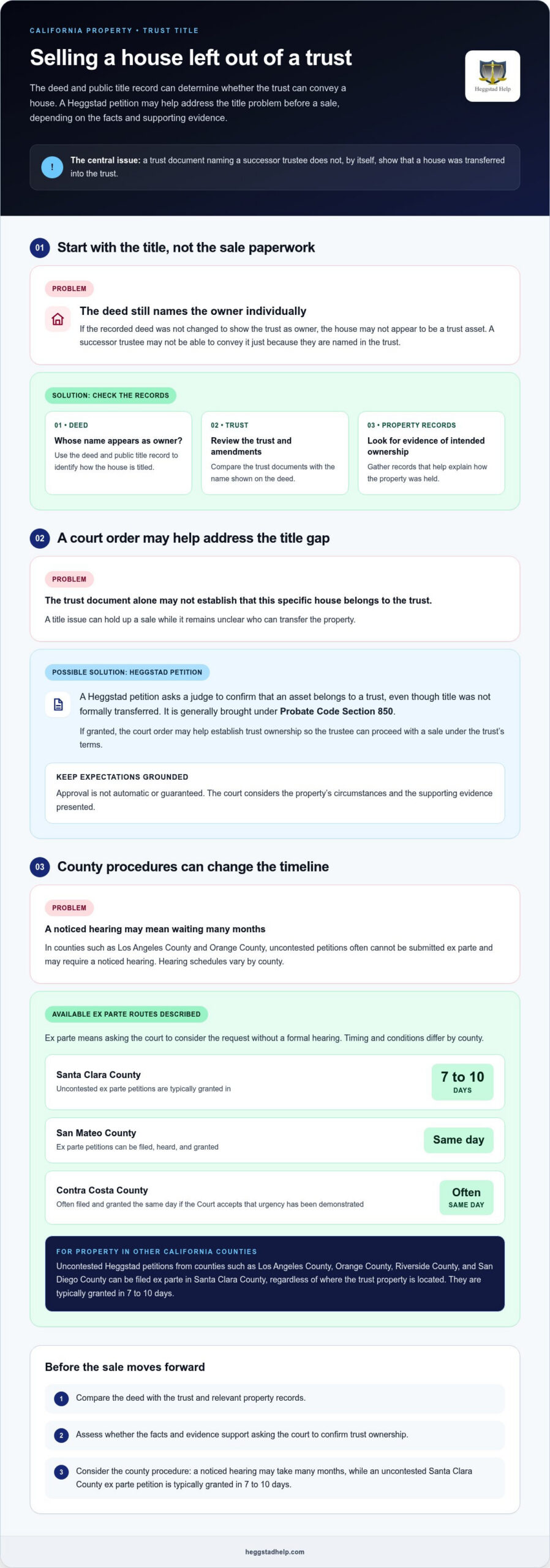
A sale may need the title resolved before the trust can convey the house. A house left out of a trust is real property that, at the owner’s death, is still titled outside the trust, so the trust’s sale process may not be enough to establish who can transfer it.

This differs from selling a house already titled in a trust: in that situation, the trust is shown as the owner, and the trustee can act under the trust’s terms. A useful way to understand the distinction is that the deed and public title record show who appears to own the house, while the trust document alone may not show that the house was transferred into the trust. The broader principles of trust law help explain why trust documents and ownership of specific property are related but separate questions.

What does it mean that a house was left out of a trust?

Creating and signing a trust document and changing a property’s title are distinct steps. For example, a person may sign a trust naming a successor trustee, but the recorded deed may still name that person individually. If that remains the title at death, the house may not appear to be a trust asset, even if the owner intended it to be included. To avoid these discrepancies, multi-disciplinary wealth advisory teams such as Kotini & Kotini help families coordinate legal, tax, and property titling across their broader estate strategies.

To understand the issue, start with the deed and determine whose name appears as owner. Compare that information with the trust and any property records showing whether title was transferred.

Can a successor trustee sell before title is resolved?

Not necessarily. Being named successor trustee gives someone authority to act for the trust, but it may not establish that the trust owns a house still titled in the deceased owner’s name. The deed matters because a buyer needs a clear record of who is conveying the property.

That doesn’t mean every omitted house follows the same legal path. The relevant documents and circumstances matter, so avoid assuming the property automatically requires full probate or that the trustee can sell it immediately. For families considering selling a house left out of trust California, the practical first step is to review the deed alongside the trust, then determine how the title issue can be addressed before proceeding with a sale.

How Can a Heggstad Petition Help Address the House’s Title?

A Heggstad petition is a request asking a judge to confirm that an asset belongs to a trust, even though title was not formally transferred to the trust. For an omitted house, a court order may help establish trust ownership so the trustee can proceed with a sale under the trust’s terms. The request is not an automatic transfer, and approval isn’t guaranteed. The outcome depends on the facts and evidence presented.

A Heggstad petition is generally brought under Probate Code Section 850. The California Probate Code Section 850 guide explains the legal framework. This process is distinct from probate, which the California Courts: Probate page describes. Whether a petition can address a particular title problem depends on the property’s history and supporting records.

What information helps explain the title problem?

Start by gathering the deed, the trust and any relevant amendments, and records showing how the property was held. These documents can help show what the title says and whether there is evidence the owner intended the house to be part of the trust. The court considers the specific facts and supporting documents presented, not simply the fact that a trust exists.

Does every omitted house qualify for a Heggstad petition?

No single outcome applies to every property. Whether a petition is appropriate depends on the circumstances and available evidence, so a court order should not be treated as certain or as an automatic title change. If the court grants the request, its order may provide a way to address trust ownership before a sale proceeds.

Heggstad Help assists families, attorneys, and their clients throughout the State of California with uncontested ex parte Heggstad petitions filed in Santa Clara County, regardless of where the trust property is located. If you’re selling a house left out of trust California, reviewing the Heggstad petition filing service can help you understand this title-correction path.

What California County Procedures Can Affect the Path to a Sale?

The county where a house is located can affect how quickly an uncontested Heggstad petition is heard. Santa Clara, San Mateo, and Contra Costa Counties have ex parte routes, but the timing and conditions differ. An ex parte filing asks the court to consider a request without a formal hearing; a noticed hearing is scheduled later and requires advance notice to interested parties.

  • Santa Clara County: Uncontested ex parte Heggstad petitions are typically granted in 7 to 10 days.
  • San Mateo County: Ex parte petitions can be filed, heard, and granted the same day.
  • Contra Costa County: Petitions can often be filed and granted the same day if the Court is satisfied that urgency has been demonstrated.

What if the house is in another California county?

In counties such as Los Angeles County and Orange County, an uncontested Heggstad petition often cannot be submitted ex parte and may require a noticed hearing. Those hearings can take many months to be heard, depending on the county’s procedures and calendar. The location of the house does not necessarily mean the petition must be filed in that county: an uncontested petition for trust property elsewhere in California may be filed ex parte in Santa Clara County.

This can matter when a sale is waiting on a title decision. Families, attorneys, and their clients throughout the State of California can pursue this Santa Clara County filing route regardless of the county where the trust property is located.

How do noticed hearings differ from ex parte petitions?

A noticed trust modification petition hearing is typically set 30 to 60 days after filing, or several months later in some counties. The time needed to notify interested parties adds to the schedule, and a contested petition takes longer. By contrast, an uncontested ex parte petition avoids a formal hearing, although the Court still decides whether to grant the request.

If you’re selling a house left out of trust California, county procedure can shape the next step and the expected timeline. Pursue an uncontested Heggstad petition through a Santa Clara County filing, regardless of where the trust property is located.

Selling a House Left Out of a Trust in California: What Happens Next?

What Should Families Do Before Selling a House Left Out of a Trust?

Before arranging a sale, take these steps in order: identify the owner shown on the deed, gather the trust and property records, then assess whether an uncontested Heggstad petition may address the title issue. If the court grants the petition, its order may confirm the house belongs to the trust so the trustee can proceed with a sale under the trust’s terms.

  1. Check the deed. Note the owner named on the recorded title and compare it with the trust’s name and terms.
  2. Gather the records. Collect the trust and any amendments, the deed, and other relevant ownership documents. Keeping these together helps clarify what the records show.
  3. Assess the petition path. The appropriate process depends on the facts and whether the matter is uncontested. A Heggstad petition requests a court order; it does not guarantee approval.

A Heggstad petition filing guide can help explain how the petition may address a house omitted from a trust. Heggstad Help handles uncontested petitions, not contested matters. If there is a disagreement about trust ownership, this filing path may not fit.

Who can Heggstad Help assist across California?

Heggstad Help assists families, attorneys, and their clients throughout the State of California, including those dealing with property in Los Angeles County, Orange County, and San Diego County. Uncontested ex parte petitions can be filed in Santa Clara County regardless of the California county where the trust property is located. Fixed fees cover filing fees and attorney fees.

What is a practical next step for an uncontested petition?

Organize the deed, trust documents, and relevant ownership records before discussing the situation. A clear set of records makes it easier to focus on the title discrepancy and the potential petition path. For more context about a house omitted from a trust, see the related discussion of a house forgotten in a trust.

Discuss an uncontested Heggstad petition when you’re ready to consider the next step.

Move Forward With a Clear Title Path

A title mismatch can make a planned sale feel stalled, but the uncertainty doesn’t have to remain vague. Before setting the sale process in motion, gather the deed and trust records and frame the key question: do the documents support asking the court to confirm the house belongs to the trust? That focused starting point can help clarify whether an uncontested Heggstad petition is a practical next step for your family’s circumstances.

Selling a house left out of trust California involves more than deciding who will sign the sale documents. The ownership record must support the trust’s authority to convey the property, and a court order may be part of resolving that issue. Each situation depends on its records, so treat a petition as a request for the Court’s decision, not a guaranteed result. For property owners and investors managing broader portfolios, proactive financial coordination—such as the advisory approach provided by KHT Accounting & Wealth—can also ensure business and trust assets remain properly structured over time.

Heggstad Help assists with uncontested Heggstad petitions, with Robert P. Bergman bringing his California estate-planning, trust, and probate law experience to this specialized work. If you’re ready to discuss the documents and possible filing path, Discuss an uncontested Heggstad petition. A clear next step can make a complicated title issue feel more manageable.

Frequently Asked Questions

Can you sell a house in California if it was left out of the trust?

Yes, but the trust may need a court order confirming the house is trust property before it can convey title. That differs from a house already titled in the trust, where the title record identifies the trust as owner. For selling a house left out of trust California, compare the deed with the trust documents first; whether a court confirms ownership depends on the evidence and its decision.

Does a Heggstad petition guarantee that the house will be transferred to the trust?

No. Filing a Heggstad petition doesn’t guarantee that the court will grant it or confirm the house as trust property. The judge considers the particular circumstances and evidence presented, which may include documents showing how the owner treated the property. A trust document alone doesn’t ensure a successful petition, and not every house omitted from a trust will qualify. Reviewing the available records can help clarify the issue.

Can a Heggstad petition be filed in a California county different from where the house is located?

Yes. Heggstad Help can assist with uncontested ex parte petitions filed in Santa Clara County even when trust property is elsewhere in California. This can serve families in the San Francisco Bay Area, Northern California, Southern California, the Central Valley, San Diego, Sacramento, Fresno, Bakersfield, Greater Los Angeles, Orange County, Riverside County, and San Bernardino County. Court procedures differ, so the property’s location doesn’t mean every petition follows the same route.

How long does an uncontested ex parte Heggstad petition take in California?

Timing varies, and the stated timelines aren’t guarantees. In Santa Clara County, petitions are typically granted in 7 to 10 days. In San Mateo County, they can be filed, heard, and granted the same day. In Contra Costa County, they can often be filed and granted the same day if the Court is satisfied that urgency has been demonstrated. Court handling and case facts may affect timing.

What if family members disagree about whether the house belongs to the trust?

A disagreement may mean the matter is contested, rather than an uncontested petition. Heggstad Help handles uncontested petitions only. Before assessing the situation, note what each family member disputes and organize the deed, trust documents, and records that relate to ownership. Those steps can help clarify whether the matter is uncontested. If it is, discuss an uncontested Heggstad petition as a possible next step.

Robert P. Bergman, Attorney at Law

Article by

Robert P. Bergman, Attorney at Law

Attorney Robert P. Bergman ("Bob Bergman") has been a Board-Certified Specialist in Estate Planning, Trust and Probate Law since 2011, as certified by the California State Bar Board of Legal Specialization. For several years, Bob has assisted families and the clients of other attorneys with obtaining court orders through Heggstad petitions to avoid the time and expense of Probate administration. Bob is friendly, very approachable, and believes in explaining complex legal topics in clear ordinary language so that his clients understand exactly what they're doing and why they're doing it.
Bob is often able to assist clients who are in other counties than his home county of Santa Clara through his approach to Heggstad petitions.

Disclaimer

This article is for informational purposes only. Nothing in this article is intended to replace legal advice from a competent attorney or be considered legal guidance for anybody's specific legal situation. Nobody should rely on information in this article in making legal decisions without such consultation.

California Trust Asset Petitions: Complete Guide (2026)

What if discovering that a family home or financial account was left in a decedent’s individual name didn’t mean facing 12 to 18 months of stressful…

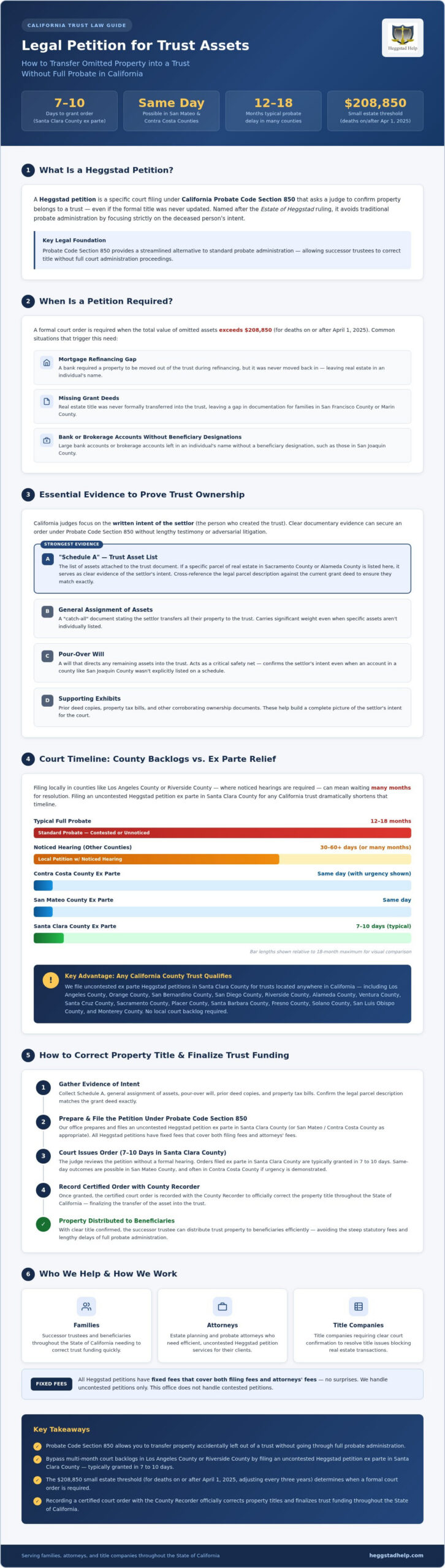
What if discovering that a family home or financial account was left in a decedent’s individual name didn’t mean facing 12 to 18 months of stressful probate court delays? It’s completely understandable to feel overwhelmed by confusing statutory requirements when you’re trying to manage a loved one’s estate. Fortunately, filing a legal petition for trust assets under California Probate Code Section 850 allows you to transfer omitted property directly into the trust without traditional probate administration.

Whether the trust is located in Los Angeles County, Orange County, or San Diego County, you don’t have to endure local court backlogs. Our office helps families and attorneys throughout the State of California secure clear court confirmation by filing uncontested Heggstad petitions ex parte (meaning without a formal hearing) in Santa Clara County, where orders are typically granted in just 7 to 10 days. In this guide, you’ll learn exactly how to fast-track the title transfer process, avoid steep statutory fees, and distribute property to beneficiaries efficiently.

Key Takeaways

  • Understand how filing a legal petition for trust assets under California Probate Code Section 850 allows you to transfer property that was accidentally left out of a trust without a full probate.
  • Discover how to bypass multi-month court backlogs in Los Angeles County or Riverside County by filing an uncontested Heggstad petition ex parte (meaning without a formal hearing) in Santa Clara County.
  • Identify the essential evidence, such as written intent or a list of assets, required to prove that property legally belongs to the trust.
  • Learn the procedural steps to record a certified court order with the County Recorder to officially correct property titles and finalize trust funding throughout the State of California.

A legal petition for trust assets is a specific court filing that asks a judge to confirm that property belongs to a trust, even if the formal title was never updated. This procedure is grounded in California Probate Code Section 850: A Guide to Real Property Petitions, which provides a streamlined alternative to standard probate administration. While a typical probate in Los Angeles County or Orange County can take over a year, an uncontested petition under Probate Code Section 850 focuses strictly on the deceased person’s intent. This remedy was famously established by the Estate of Heggstad ruling, creating what we now call a Heggstad petition.

Understanding California Probate Code Section 850 and Heggstad Petitions

Under California trust law, a Heggstad petition serves as a vital tool for successor trustees. It allows the court to declare that a specific asset (such as a family home) is trust property because the creator of the trust clearly intended it to be there. We specialize in filing these uncontested Heggstad petitions ex parte (meaning a request made to the court without a formal, noticed hearing) in Santa Clara County, San Mateo County, and Contra Costa County. While a noticed hearing in San Bernardino County might take months, petitions filed ex parte in Santa Clara County are typically granted in just 7 to 10 days. In San Mateo County, these can often be granted the same day.

When Is a Legal Petition Necessary for Trust Property?

Title transfer roadblocks often appear after a mortgage refinancing, where a bank requires a property to be moved out of a trust but it’s never moved back in. If the total value of omitted assets exceeds the California small estate threshold of $208,850 (for deaths on or after April 1, 2025), a formal court order is required to avoid full probate. This process is essential for families in San Francisco County or Marin County dealing with real estate with missing grant deeds, brokerage accounts without beneficiary designations, or large bank accounts left in an individual’s name. Filing in Santa Clara County provides a faster resolution for families throughout the State of California.

Essential Evidence Needed to Prove Trust Asset Ownership

When you file a legal petition for trust assets, the court’s primary focus is the written intent of the settlor (the person who created the trust). California judges don’t require a full trial if you provide clear documentary evidence showing that an asset was meant to be trust property. Providing this proof allows the court to issue an order under California Probate Code § 850 without the need for lengthy testimony or adversarial litigation. Success often depends on how well you organize these foundational documents.

The Critical Role of Trust Schedules and General Assignments

The most powerful piece of evidence is usually "Schedule A," which is the list of assets attached to the trust document. If a specific parcel of real estate in Sacramento County or Alameda County is listed on this schedule, it serves as clear evidence of the settlor’s intent. A general assignment of assets also carries significant weight. This document acts as a catch-all, stating that the settlor transfers all their property to the trust. It’s helpful to cross-reference the legal parcel description on your trust exhibits against the current grant deed to ensure they match exactly, as this prevents technical delays in the State of California court system.

Pour-Over Wills and Supporting Documentation

A pour-over will (a specific type of will that directs any remaining assets into a trust) acts as a critical safety net for your petition. Even if an account in San Joaquin County wasn’t explicitly listed on a schedule, the will confirms the settlor wanted all their property to follow the trust’s terms. You should also gather supporting exhibits like prior deed copies and property tax bills to corroborate ownership. For a detailed breakdown of what to collect, see our guide on Successor Trustee Duties for an Unfunded Trust: The California Guide. If you have these records ready, we can help you secure a court order to finalize the trust funding efficiently.

The Court Process: County Backlogs vs. Santa Clara County Ex Parte Relief

The speed at which you resolve a legal petition for trust assets depends heavily on where the filing occurs. In many parts of the State of California, probate courts are severely congested. If you file a noticed petition (a request requiring formal notice to all interested parties and a scheduled courtroom appearance) in Los Angeles County, Orange County, or Riverside County, you’ll likely wait four to six months just for your first hearing date. During this time, the estate remains in limbo, which can be financially devastating if a pending home sale is frozen by these probate delays.

Hearing Delays Across California Superior Courts

Similar backlogs affect families in Alameda County and Sacramento County, where noticed hearing waits often reach several months. In regions like San Diego County, Fresno County, and San Bernardino County, the timeline is equally taxing. These delays aren’t just frustrating; they’re expensive. Because we focus strictly on uncontested matters, we help families avoid the adversarial atmosphere of these crowded courtrooms. By bypassing the standard noticed hearing process, we ensure that your trust administration doesn’t stall. All our Heggstad petitions use fixed fees that cover both filing fees and attorneys’ fees, so you don’t have to worry about unpredictable costs.

Filing Ex Parte in Santa Clara County for Accelerated Orders

We provide a faster path by filing uncontested Heggstad petitions ex parte (meaning a request for a court order without a formal, in-person hearing) in the Santa Clara County Probate Court. While other counties require noticed hearings, Santa Clara County allows us to secure orders for a legal petition for trust assets in typically 7 to 10 days. We also assist clients in San Mateo County, where orders can often be granted the same day. In Contra Costa County, we can secure same-day orders if we can demonstrate "urgency" to the court. If you want to avoid months of waiting, you can start your expedited petition process today.

California Trust Asset Petitions: Complete Guide (2026)

How to Correct Property Title and Finalize Trust Funding

Securing a signed order for your legal petition for trust assets is a major milestone, but the process isn’t complete until the title is officially corrected. Once the judge signs the order, you must move from the legal phase into the administrative phase to ensure the property is marketable (meaning it can be sold or insured by a title company). This final stage involves specific filings with the County Recorder and the County Assessor to reflect the trust’s ownership interest.

Recording the Certified Court Order with County Recorders

You’ll first need to obtain certified copies (official court documents validated by the probate clerk) of the signed order. These must be recorded in the specific county where the real property is situated, such as Solano County or Santa Barbara County. Along with the order, you must submit a Preliminary Change of Ownership Report (PCOR) to avoid unnecessary property tax reassessments. For comprehensive guidance on post-order administration, refer to Heggstad Petition Filing: The California Guide to Recovering Missing Trust Assets in 2026. Recording these documents correctly ensures that the chain of title is clear for future transactions.

Securing Fixed-Fee Legal Representation for California Trusts

Navigating a legal petition for trust assets shouldn’t involve the financial uncertainty of hourly billing or the high costs of statutory probate commissions (fees mandated by the Probate Code based on a percentage of the gross estate). We provide uncontested services on a transparent fixed-fee basis that covers both the court filing fees and all attorney fees. This approach protects the estate’s value while providing a fast resolution through the State of California court system. Whether your trust is based in Placer County or Ventura County, we can help you bypass delays. You can request a free consultation with Robert P. Bergman at HEGGSTAD HELP to begin the process of correcting your trust’s title today.

Secure Your Family Legacy Without Probate Delays

Recovering omitted property doesn’t have to be a multi-year ordeal. By filing a legal petition for trust assets under Probate Code Section 850, you can honor your loved one’s intent while protecting estate funds from high statutory probate fees. Whether your property is in San Diego County or Fresno County, the Santa Clara County Probate Court provides a reliable, expedited path for uncontested filings. Robert P. Bergman, a Board-Certified Specialist with over 40 years of experience, leads our team in securing court orders in typically 7 to 10 days. We use transparent fixed fees that cover all filing and attorney costs, ensuring your family has a clear, predictable road ahead. You can bypass months of probate court delays with an expedited Heggstad petition from HEGGSTAD HELP. Taking this step now allows you to finalize trust funding and distribute assets without the stress of local court backlogs. It’s time to move forward with confidence.

Frequently Asked Questions

What is a legal petition for trust assets under California law?

A legal petition for trust assets is a specialized filing under Probate Code Section 850 that asks a judge to confirm property belongs to a trust. It’s used when a settlor (the trust creator) intended for an asset to be in the trust but didn’t update the formal title. This procedure provides a streamlined alternative to full probate administration, allowing successor trustees to recover omitted real estate or financial accounts efficiently.

How long does it take for a California court to approve a trust asset petition?

Timelines depend on the county and whether the filing is ex parte or requires a noticed hearing. While a noticed hearing in Los Angeles County or Riverside County can take several months, uncontested petitions filed ex parte in Santa Clara County are typically granted in 7 to 10 days. In San Mateo County, these orders are often granted the same day. Filing in Santa Clara County helps families avoid lengthy court backlogs.

Can an asset be transferred to a trust after the owner dies in California?

Yes, you can transfer property after a death through a Heggstad petition, provided there’s written evidence of the owner’s intent. This is crucial when assets exceed the $208,850 small estate threshold for deaths on or after April 1, 2025. Whether the asset is a home in Monterey County or a business interest in Ventura County, this legal petition for trust assets bypasses the 12 to 18 month probate delay.

Can I file a petition in Santa Clara County if the trust property is in another county?

Yes, you can file in Santa Clara County regardless of where the trust property is located. We assist families and attorneys throughout the State of California by filing uncontested ex parte petitions in Santa Clara County Superior Court. This allows clients with property in San Diego County or Orange County to secure a court order much faster than they would by waiting for a noticed hearing in their local county court.

What happens if someone contests a legal petition for trust assets in California?

If a party contests the filing, the matter becomes trust litigation and can no longer proceed through the expedited uncontested process. Our office focuses exclusively on uncontested petitions to keep fees fixed and timelines short. A contested petition requires formal hearings and extensive courtroom time, often taking many months or even years to resolve. We don’t handle these adversarial proceedings, as our goal is efficient, predictable asset recovery.

Robert P. Bergman, Attorney at Law

Article by

Robert P. Bergman, Attorney at Law

Attorney Robert P. Bergman ("Bob Bergman") has been a Board-Certified Specialist in Estate Planning, Trust and Probate Law since 2011, as certified by the California State Bar Board of Legal Specialization. For several years, Bob has assisted families and the clients of other attorneys with obtaining court orders through Heggstad petitions to avoid the time and expense of Probate administration. Bob is friendly, very approachable, and believes in explaining complex legal topics in clear ordinary language so that his clients understand exactly what they're doing and why they're doing it.
Bob is often able to assist clients who are in other counties than his home county of Santa Clara through his approach to Heggstad petitions.

Disclaimer

This article is for informational purposes only. Nothing in this article is intended to replace legal advice from a competent attorney or be considered legal guidance for anybody's specific legal situation. Nobody should rely on information in this article in making legal decisions without such consultation.