How to Fix Trust Title Errors in California

What if the deed isn’t wrong, but the property was never transferred into the trust? To understand how to fix trust title errors, compare the…

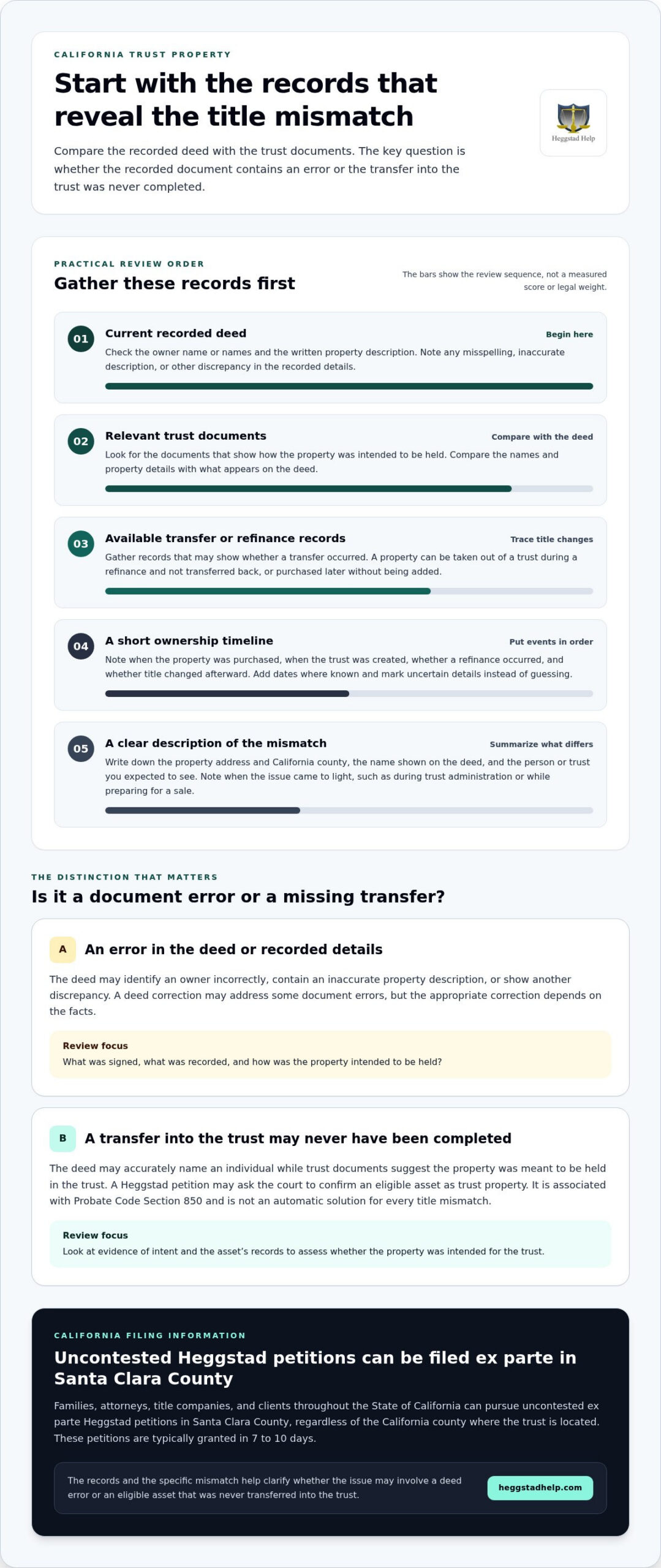
What if the deed isn’t wrong, but the property was never transferred into the trust? To understand how to fix trust title errors, compare the recorded deed with the trust documents and determine whether the deed itself contains an error or the transfer was never completed. A deed correction may address some document errors; an eligible asset intended for the trust but never titled in it may require a Heggstad petition.

This guide explains which records to gather, how to distinguish between these situations, and what California options may help resolve the issue before it delays trust administration or a sale. Heggstad Help, a service of attorney Robert P. Bergman, Board-Certified Specialist in Estate Planning, Trust, and Probate Law (California State Bar Board of Legal Specialization), assists families, attorneys, and their clients throughout the State of California with uncontested ex parte Heggstad petitions filed in Santa Clara County, regardless of where the trust is located. These petitions are typically granted in 7 to 10 days.

Key Takeaways

  • Compare the recorded ownership information with the trust documents to pinpoint where they differ.
  • How to fix trust title errors depends on whether the deed needs correction or a court may need to confirm an eligible asset as trust property.
  • Gather the current recorded deed, relevant trust documents, and available transfer records. Write down the specific mismatch.
  • Families, attorneys, title companies, and clients throughout California can pursue eligible uncontested Heggstad petitions through ex parte filing in Santa Clara County, regardless of where the trust is located.

What Kind of Trust Title Error Do You Have in California?

The right way to address a trust title problem depends on whether the recorded document contains an error or the property was never transferred into the trust. Title is the recorded information showing who owns the property. A mismatch does not automatically mean the entire trust is invalid.

Was the deed recorded incorrectly, or was the property left out?

Start by comparing the current recorded deed with the trust documents. A deed defect may involve an incorrect spelling of an owner’s name or a legal description, the written identification of the property, that does not accurately describe the parcel. These are issues with the deed or its recorded information, although the appropriate correction depends on the facts.

A different issue arises when the deed accurately names an individual, but the trust documents suggest the property was meant to be held in the trust. For example, the deed may still identify a person rather than the trust. In that situation, the question may not be how to correct a typo, but whether the property was ever transferred into the trust. Changing a document and asking a court to confirm an asset as trust property are different paths.

Why can a property and trust record stop matching?

A transfer can be overlooked when someone creates or updates a trust. A property may also be taken out of a trust during a refinance and not transferred back afterward, or purchased later without being added to the trust. These are trust-funding issues: assets may not have been legally placed in the trust as intended. A general overview of trust law can explain how trusts hold and manage assets, but it won’t establish how a particular property is titled.

To narrow down the problem, note the names and property description on the recorded deed, then compare them with the trust’s relevant documents and any transfer records you have. This comparison can help identify the type of issue before you consider a correction.

Can You Correct a Trust Title Error With a Deed or a Heggstad Petition?

How to fix trust title errors depends on what the records show. A deed correction may address an error in a recorded document, while a Heggstad petition may ask the court to confirm property as trust property. A deed error and an unfunded trust asset are not the same problem. The appropriate path depends on the ownership evidence and the specific mismatch.

When is the problem a deed or recording error?

A deed or recording issue appears within the document or its recorded details. The deed might identify an owner incorrectly, contain an inaccurate property description, or reflect another discrepancy. Not every issue can be fixed the same way. Review the recorded deed alongside the trust records and related transfer documents to understand what was signed, what was recorded, and how the property was intended to be held.

When might a Heggstad petition be relevant?

A Heggstad petition may be relevant if the property was intended for the trust but the ownership transfer was never completed. Rather than asking to correct a typo in a deed, the petition asks the court to confirm that an eligible asset belongs to the trust. This court process is associated with Probate Code Section 850. Evidence of intent and the asset’s records matter when evaluating whether this route fits. A petition is not an automatic solution for every title mismatch.

As a practical first step, put the current deed beside the trust document and any available transfer records. Note whether the issue is an inaccuracy in recorded information or a missing transfer into the trust. That distinction helps focus the review. For more information about Heggstad petitions, learn how this court process may apply to eligible trust assets.

What Records Should You Gather Before Addressing a California Trust Title Error?

To understand how to fix trust title errors, gather the documents that show how the property was titled and what the trust records say. A clear set of records and a short timeline can help identify the mismatch without requiring you to reach a legal conclusion on your own.

Which documents help clarify the ownership history?

Start with the current recorded deed, then collect the relevant trust documents and any available records of transfers or title changes. Compare the names and property description across them. Differences may point to a document discrepancy, a missing transfer, or another issue that needs closer review.

Next, arrange the known events in order. Note when the property was purchased, when the trust was created, whether a refinance occurred, and whether title changed afterward. Add dates where you have them, and mark anything uncertain rather than filling in gaps from memory.

How should you describe the mismatch clearly?

Write down the property address and California county, the name or names currently shown on the deed, and the name of the trust or person you expected to see. Include when the mismatch came to light, such as during trust administration or while preparing for a sale. This concise summary makes the records and the issue easier to follow.

  • Current recorded deed and relevant trust documents
  • Available transfer or refinance records
  • A timeline of purchase, trust creation, and later title changes
  • A short description of the difference between the records

If the records suggest the property was intended for the trust but left out, read more about Heggstad petition filing. If the owner has died, don’t assume that preparing a new deed alone resolves the ownership question. Learn about trust asset title correction for help addressing an eligible title issue.
How to Fix Trust Title Errors in California

How Can a Heggstad Petition Address Trust Title Errors Across California?

A Heggstad petition may help when an eligible asset was intended for a trust but wasn’t titled in it. Heggstad Help assists families, attorneys, title companies, and their clients throughout the State of California with uncontested petitions, including for property located in the San Francisco Bay Area, Northern California, Southern California, the Central Valley, San Diego, Sacramento, Fresno, Bakersfield, Greater Los Angeles, Orange County, Riverside County, and San Bernardino County.

How do filing options differ by California county?

Uncontested petitions filed ex parte, meaning without a formal hearing, in the Santa Clara County Probate Court are typically granted in 7 to 10 days. The trust or property may be elsewhere, including Los Angeles County, Orange County, San Diego County, Alameda County, or Sacramento County. Uncontested petitions from these and other California counties can often be filed ex parte in Santa Clara County, regardless of where the trust is located.

Ex parte petitions in San Mateo County can be filed, heard, and granted the same day. In Contra Costa County, petitions can often be filed and granted the same day if the court is satisfied that urgency has been demonstrated. In other counties, Heggstad petitions often require a noticed hearing, meaning interested parties receive notice and the matter is scheduled for court. Those hearings may take many months. This is why uncontested petitions for trusts in counties other than San Mateo and Contra Costa are often filed ex parte in Santa Clara County.

This process can serve families and professionals working with trusts in counties across the State, including San Francisco, Marin, Santa Cruz, Ventura, San Bernardino, Riverside, Santa Barbara, San Joaquin, Fresno, Solano, San Luis Obispo, Monterey, and Placer Counties.

What can families and professionals expect from the service?

The office handles uncontested Heggstad petitions, not contested petitions. Fixed fees cover filing fees and attorneys’ fees. Gathering the deed, trust documents, and available transfer records helps clarify the title issue and supports a focused review of whether a petition may fit.

For information about an eligible, uncontested matter, visit Heggstad Help.

Move From Uncertainty to a Clear Next Step

A title concern can feel larger when everyone involved describes it differently. As you decide how to fix trust title errors, write one concise statement of the unresolved question and share it with the people coordinating the next steps. A common understanding can make conversations more focused and help prevent assumptions from shaping the plan.

You don’t need every answer before taking a thoughtful next step. Start with the question that matters most to your family or the decision currently waiting on clarity, then keep track of what remains unresolved.

If you’re ready to discuss an uncontested Heggstad petition, contact Heggstad Help about your situation.

Frequently Asked Questions

Does a trust title error mean the trust is invalid?

Not necessarily. A question about the trust’s validity is different from a question about whether a particular asset is held by the trust. If concerns extend beyond one property, gather the signed trust document and any amendments, then identify the specific issue, such as questions about the document or changes made to it. This keeps the review focused instead of treating every title concern as the same problem.

Can a Heggstad petition apply to assets other than real estate?

Yes, a Heggstad petition may concern eligible assets beyond real estate, but it doesn’t automatically apply to every type of property. The records need to support that the asset was intended to belong to the trust. Identify the asset and gather relevant trust schedules, ownership records, and written transfer instructions that may help show the trust creator’s intent.

Does a pour-over will automatically change the title to a house?

No. A pour-over will generally directs assets left outside a trust to be transferred into it through the estate process. It doesn’t by itself update a recorded deed or instantly make the trust the owner of a house. If a home remains in an individual’s name, review the deed and estate-planning records rather than assuming the will alone corrected the title.

What if a beneficiary objects to correcting the trust title?

A beneficiary’s objection can turn an otherwise uncontested matter into a dispute, so the request may no longer proceed as an uncontested petition. The reason for the objection and the records supporting each position matter. Keep the written objection with the relevant trust and ownership documents, and note which facts are disputed. Heggstad Help handles uncontested petitions, not contested petitions.

Can refinancing cause a property to be left out of a trust?

It can, but a refinance document by itself doesn’t necessarily show that ownership changed. Review the closing papers for any deed or other document affecting title, and distinguish those from loan documents that secure repayment. Note the dates and parties named on documents related to ownership. This can help clarify whether the refinance changed title or whether the issue lies elsewhere in the property records.

Robert P. Bergman, Attorney at Law

Article by

Robert P. Bergman, Attorney at Law

Attorney Robert P. Bergman ("Bob Bergman") has been a Board-Certified Specialist in Estate Planning, Trust and Probate Law since 2011, as certified by the California State Bar Board of Legal Specialization. For several years, Bob has assisted families and the clients of other attorneys with obtaining court orders through Heggstad petitions to avoid the time and expense of Probate administration. Bob is friendly, very approachable, and believes in explaining complex legal topics in clear ordinary language so that his clients understand exactly what they're doing and why they're doing it.
Bob is often able to assist clients who are in other counties than his home county of Santa Clara through his approach to Heggstad petitions.

Disclaimer

This article is for informational purposes only. Nothing in this article is intended to replace legal advice from a competent attorney or be considered legal guidance for anybody's specific legal situation. Nobody should rely on information in this article in making legal decisions without such consultation.

Trust Asset Title Correction in California: What Families Need to Know

What if a home was meant to be held in a trust, but the recorded title still names the trust creator personally? That mismatch can leave families…

What if a home was meant to be held in a trust, but the recorded title still names the trust creator personally? That mismatch can leave families unsure whether the asset belongs to the trust and concerned that administration could stall or require probate.

Trust asset title correction California families may need doesn’t always mean changing the trust itself. The right approach depends on what the trust documents and other records show about the creator’s intent. This article explains the difference between correcting an asset’s ownership record and amending a trust, what evidence may help, and when a Heggstad petition could ask the court to confirm that an asset belongs to the trust.

HEGGSTAD HELP assists families, attorneys, title companies, and their clients throughout the State of California with uncontested ex parte Heggstad petitions in Santa Clara County Probate Court, regardless of where the trust is located. Ex parte means the court can review the petition without a formal hearing. Petitions filed in Santa Clara County are typically granted in 7 to 10 days. We’ll also explain how county procedures affect the filing route and timing.

Key Takeaways

  • Trust asset title correction California families may need can address a mismatch between ownership records and intended trust ownership without changing the trust’s terms.
  • Gather the trust documents, asset schedules, deeds, account records, and transfer paperwork available. These can help show the trust creator’s intent and assess whether a Heggstad petition may fit.
  • Probate Code Section 850 provides a court process for asking whether an asset belongs to a trust. The result depends on the evidence in the case.
  • County procedure affects timing. HEGGSTAD HELP files uncontested petitions ex parte in Santa Clara, San Mateo, and Contra Costa Counties. In other counties, a noticed hearing may be required.

What California Trust Asset Title Correction Means, and Why Ownership Records Matter

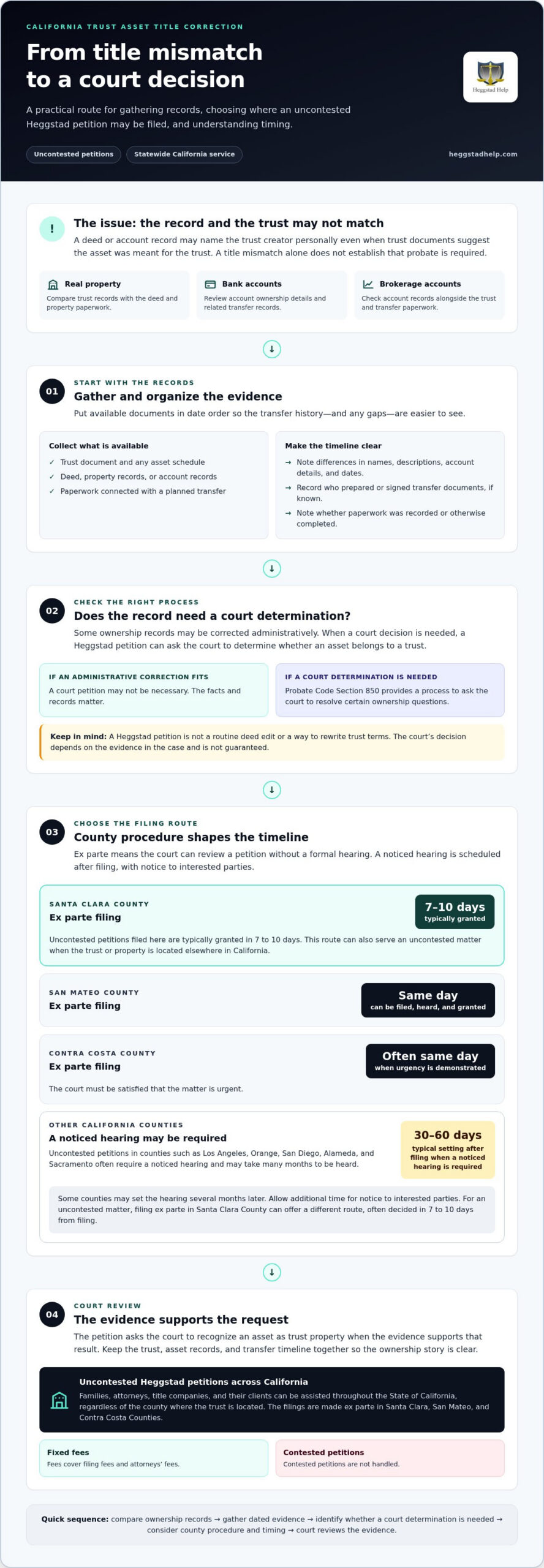
Trust asset title correction addresses a gap between how an asset is legally recorded and the trust creator’s apparent intention for it to belong to the trust. It focuses on the asset’s ownership record, not on rewriting the trust’s instructions. For example, a California home may be described in trust documents as part of the trust while the deed still names the creator individually. The deed is important evidence, but it may not answer every question about ownership or intent.

An unfunded asset is an asset whose ownership was not transferred into the trust; an amended trust document changes the trust’s terms. Those are different issues, and resolving one does not automatically resolve the other. To organize the records, compare the trust documents with the deed or account records. Note differences in names, property descriptions, account details, and dates. A trust asset title correction may involve reviewing both the records and the circumstances behind them.

How a title mismatch can arise

A deed may have been prepared or signed to transfer a home into a trust but never recorded. In another situation, the paperwork or timeline may be different. Real property is one example. Bank, brokerage, and other assets have their own ownership records, so the relevant documents depend on the asset. Gather the trust, any property or account records, and available transfer paperwork. Put dated documents in order and note what appears to be missing or inconsistent. One incomplete document does not necessarily tell the whole story.

Why the distinction matters after death

A successor trustee, the person who takes over trust responsibilities, may discover the mismatch while handling trust matters. The records can raise a practical question: can the asset be dealt with as trust property, or is another legal step needed? A title problem alone does not establish that probate is required. The answer depends on the facts and applicable court process. A Heggstad petition takes its name from the Estate of Heggstad, a California case associated with asking a court to determine whether an asset belongs to a trust. Keep documents that may show the creator’s intent, rather than treating the recorded title as the only relevant evidence.

How a Heggstad Petition May Correct Trust Asset Title in California

A Heggstad petition asks a court to determine whether an asset should be treated as property of a trust, based on the evidence in that particular case. Probate Code Section 850 provides a process for asking the court to resolve certain questions about ownership of property. In plain English, it can give a judge a way to decide whether an asset belongs to a trust even though its title record does not show the trust as owner.

A Heggstad petition asks the court to recognize trust ownership when the evidence supports that result. It does not make every title mismatch qualify. It is not a routine deed edit or a way to rewrite trust terms, and a court’s decision is not guaranteed. For families considering trust asset title correction California, the key issue is whether the facts and records support asking for a court determination.

What the court may consider

The court may review documents and circumstances that help show what the trust creator intended regarding the asset. Depending on the situation, these may include the trust document, an asset schedule, property records, or paperwork connected with a planned transfer. This is not a universal checklist. A practical first step is to gather available records and arrange them by date. That can make the transfer history and any gaps easier to understand. Note who prepared or signed transfer documents and whether they were recorded or otherwise completed, if that information is available.

When a court order may be relevant

Sometimes an ownership record can be corrected administratively, without asking a court to decide who owns the asset. A petition may be relevant when the record does not reflect the trust creator’s intent and a court determination is needed. The details matter, so a petition should not be treated as an automatic substitute for an ordinary record correction. For more context on the legal process, review this guide to the California Probate Code Section 850 petition process.

HEGGSTAD HELP files uncontested Heggstad petitions for families, attorneys, and title companies throughout the State of California. The petition can request a court order confirming real property or other assets as trust property, helping correct title without full probate administration when the court grants the petition. The practice focuses on these filings and does not handle contested petitions.

Trust Asset Title Correction in California: What Families Need to Know

Choosing a California Court Path: County, Notice, and Timing

County procedure can affect how an uncontested Heggstad petition is heard. In counties such as Los Angeles, Orange, San Diego, Alameda, and Sacramento, petitions often require a noticed hearing and may take many months to be heard. For an uncontested matter, HEGGSTAD HELP can instead file ex parte in Santa Clara County Probate Court, even when the trust or property is located elsewhere in California. This filing route serves families and their representatives across the San Francisco Bay Area, Northern California, Southern California, and the Central Valley, including Greater Los Angeles, Orange County, Riverside County, San Bernardino County, San Diego, Sacramento, Fresno, and Bakersfield.

How county location affects the filing route

For families considering trust asset title correction California offers different court paths depending on the county and case circumstances. HEGGSTAD HELP assists families, attorneys, title companies, and clients throughout the State of California. Uncontested Heggstad petitions can be filed ex parte in Santa Clara, San Mateo, and Contra Costa Counties. For trusts and property in other counties, including San Francisco, Marin, Ventura, Santa Cruz, Placer, Santa Barbara, San Joaquin, Solano, San Luis Obispo, and Monterey Counties, an uncontested petition can often be filed ex parte in Santa Clara County instead. These timing details are general guidance, not a promise of a hearing date or result.

Filing path What to expect
Noticed hearing in other counties Often required and may take many months to be heard. A noticed trust modification petition hearing may be set 30 to 60 days after filing, or several months later in some counties, with additional time for notice to interested parties.
Santa Clara County, ex parte Uncontested petitions are typically granted in 7 to 10 days.
San Mateo County, ex parte Petitions can be filed, heard, and granted the same day.
Contra Costa County, ex parte Petitions can often be filed and granted the same day if the Court is satisfied that urgency exists.

What ex parte means in this context

Ex parte is the route for asking the court to review an uncontested petition without a formal hearing. It does not guarantee approval or a particular decision date. In counties outside Santa Clara, San Mateo, and Contra Costa, Heggstad petitions often require noticed hearings and may take many months to be heard. An uncontested petition from one of those counties can instead be filed ex parte in Santa Clara County and is typically granted in 7 to 10 days. HEGGSTAD HELP handles uncontested petitions, not contested matters.

HEGGSTAD HELP files uncontested ex parte Heggstad petitions in Santa Clara, San Mateo, and Contra Costa Counties for trust assets throughout California. Fixed fees cover court filing fees and attorney fees.

Get Help With Uncontested Trust Asset Title Correction Across California

A title mismatch can raise practical questions for families, attorneys, title companies, and clients. HEGGSTAD HELP assists with uncontested Heggstad petitions throughout the State of California, including when the trust or its property is located outside the county where the petition is filed. The practice files uncontested ex parte petitions in Santa Clara, San Mateo, and Contra Costa Counties. It does not handle contested petitions. Fixed fees cover court filing fees and attorney fees.

What to gather before discussing a title issue

A little organization can make it easier to explain the issue. Gather the trust document, any available deeds or account records, and paperwork related to the asset or a planned transfer. Put records in date order and note what appears inconsistent. For a home, include the deed and the property description in the trust documents or asset schedule, if available. For another type of asset, collect records showing how it was held and any paperwork connecting it to the trust. These materials provide useful background, but they are not a guarantee that a particular petition is appropriate.

Specialized help for California title concerns

Robert P. Bergman is a California-licensed attorney and Board-Certified Specialist in Estate Planning, Trust and Probate Law. His focused work on Heggstad petitions helps families and their professional representatives address trust ownership questions without treating every title problem as a broader trust or probate administration matter. For a fuller explanation of the petition, see this Heggstad petition filing guide.

If you’re considering trust asset title correction California, a focused review of the available records can help clarify the next step. Learn about Heggstad petition filing assistance for an uncontested matter.

Take the Next Step Toward Resolving the Title Issue

A title concern can feel daunting, especially when family members are unsure what can happen next. Start by keeping the relevant trust and asset records together, then identify the question that needs an answer: whether the records can be corrected administratively or whether a court decision may be needed. A focused review can help clarify that question without assuming the same solution fits every family.

For trust asset title correction California families may need, the next step is to look at the asset, the available records, and whether an uncontested Heggstad petition may be appropriate. You do not need to have every detail sorted out before raising the issue. Start with the records you have and note any gaps or inconsistencies.

Contact HEGGSTAD HELP to discuss an uncontested California Heggstad petition and take a practical step toward resolving the title concern.

Frequently Asked Questions

Is a Heggstad petition the same as amending a trust?

No. They address different goals. Before gathering records, write down the outcome the family needs: recognition of an asset as trust property, or a change to the trust’s instructions. That distinction can help keep discussions focused and make it easier to explain the issue. If both questions are involved, identify them separately rather than assuming one process will resolve both.

Can a Heggstad petition address property in Los Angeles or Orange County?

Yes. The property’s county and the county where an uncontested petition is filed can be different. For a home in Los Angeles or Orange County, note the property’s full address and gather the deed and trust records that relate to it. HEGGSTAD HELP can file an uncontested ex parte Heggstad petition in Santa Clara County Probate Court for trust property located elsewhere in California. The court route and result depend on the circumstances and evidence.

Can a Heggstad petition apply to assets other than real estate?

Yes, a petition may concern an asset other than real estate, depending on the facts. For a non-real-estate asset, gather records showing how it was held and any documents that connect it to the trust. Keep those records together and note differences in names or ownership details. The asset type and available evidence help shape the analysis.

Does a trust schedule automatically change the title to a house?

No. A schedule is not a substitute for checking the property’s recorded information. Compare the property description on the schedule with the deed, paying attention to names and identifying details. If they do not match, note the exact difference instead of assuming it is a harmless typo or a complete answer. That comparison can help clarify what question needs to be resolved.

What if the deed was signed but never recorded?

Preserve a signed but unrecorded deed and review it with the rest of the transfer records. Keep the original if available, along with copies and any paperwork explaining how the deed was prepared and what happened afterward. Note the known dates and who handled the document. Those details can help clarify the history, but the signature alone does not guarantee a particular legal outcome.

Robert P. Bergman, Attorney at Law

Article by

Robert P. Bergman, Attorney at Law

Attorney Robert P. Bergman ("Bob Bergman") has been a Board-Certified Specialist in Estate Planning, Trust and Probate Law since 2011, as certified by the California State Bar Board of Legal Specialization. For several years, Bob has assisted families and the clients of other attorneys with obtaining court orders through Heggstad petitions to avoid the time and expense of Probate administration. Bob is friendly, very approachable, and believes in explaining complex legal topics in clear ordinary language so that his clients understand exactly what they're doing and why they're doing it.
Bob is often able to assist clients who are in other counties than his home county of Santa Clara through his approach to Heggstad petitions.

Disclaimer

This article is for informational purposes only. Nothing in this article is intended to replace legal advice from a competent attorney or be considered legal guidance for anybody's specific legal situation. Nobody should rely on information in this article in making legal decisions without such consultation.

Riverside County Trust Title Correction: How to Fix Trust Property Ownership

If the deed doesn’t show the trust as owner, it’s understandable to worry that the property will have to go through lengthy probate or that the…

If the deed doesn’t show the trust as owner, it’s understandable to worry that the property will have to go through lengthy probate or that the recorded title settles the issue. A Riverside county trust title correction may depend on what the trust documents and other records show, as well as which court route fits the facts. The courthouse closest to the property may not be the only filing path.

This article explains what to gather first, including the deed, trust, and any asset list or assignment that may show the owner intended the property to belong to the trust. You’ll also learn how a local noticed hearing differs from an uncontested ex parte Heggstad petition, which proceeds without a formal hearing. For eligible uncontested matters, HEGGSTAD HELP assists families, attorneys, title companies, and their clients throughout California by filing in Santa Clara County, regardless of where the trust property is located. Petitions there are typically granted in 7 to 10 days. We’ll help you understand whether the matter may fit this focused filing service.

Key Takeaways

  • For Riverside county trust title correction, compare the recorded deed with the trust documents to identify where ownership records and intended trust ownership may differ.
  • Write down the property’s county, the current titled owner, and the trust’s name before reviewing possible filing routes.
  • A Riverside County noticed hearing may take many months, while an eligible uncontested Heggstad petition may be filed ex parte in Santa Clara County and is typically granted in 7 to 10 days.
  • Learn how focused Heggstad petition filing may help families, attorneys, title companies, and clients throughout California, and what to consider when deciding whether a matter is uncontested.

Riverside County Trust Title Correction: Identify the Ownership Problem First

For Riverside County trustees, families, attorneys, and title professionals, start by checking what the recorded documents actually say. A Riverside county trust title correction addresses a mismatch between property records and the ownership the trust was intended to hold. Because a deed records who holds title, review it alongside the trust documents before deciding what the mismatch means. Real property includes land and things attached to it, but the records for a particular property still need careful comparison.

What to check in Riverside County property and trust records

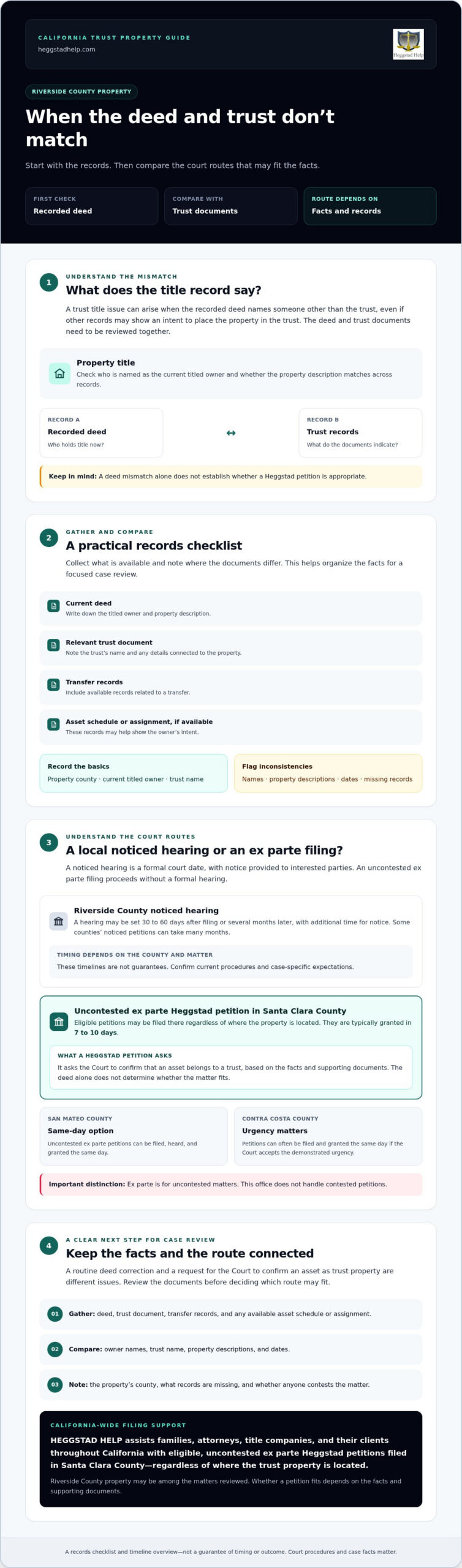
Gather the current deed, the relevant trust document, and any available transfer records. Compare the owner named on the deed with the trust name, and check whether the property description is consistent across the documents. Look for a schedule of trust assets or an assignment, if available. Note differences in names, descriptions, or dates, and flag missing records for focused case review. These checks help organize the facts, but they don’t establish a legal conclusion on their own.

When a title issue may call for a Heggstad petition

A missing or incorrect trust title doesn’t automatically mean a Heggstad petition is appropriate. A routine deed correction and a request for the Court to confirm that an asset belongs to a trust are different issues. A Heggstad petition asks the Court to confirm an asset as trust property based on the facts and supporting documents. Whether the matter fits an uncontested petition depends on those details, so don’t assume eligibility from the deed alone.

HEGGSTAD HELP assists families, attorneys, title companies, and their clients throughout California with uncontested ex parte Heggstad petitions filed in Santa Clara County, regardless of the property’s county. Keep copies of the deed, trust, and transfer records together, and note every inconsistency you find. That gives a case review a clearer starting point.

Riverside Property: Compare a Local Noticed Hearing With an Ex Parte Filing

For Riverside county trust title correction, the filing location can affect how the matter is heard and how long the process may take. A noticed hearing is a formal court date, with notice provided to interested parties. An ex parte filing, as used for an uncontested Heggstad petition in these counties, proceeds without a formal hearing.

Filing path What to expect
Riverside County noticed hearing A hearing is scheduled after filing, with additional time for notice. Depending on the county and matter, a hearing may be set 30 to 60 days later or several months later, and some counties’ noticed petitions can take many months.
Uncontested ex parte filing in Santa Clara County Eligible petitions can be filed in Santa Clara County regardless of where the property is located. Petitions there are typically granted in 7 to 10 days.

These timelines are not guarantees. Confirm current procedures and case-specific expectations before choosing a filing path. For deed-recording details, consult the Riverside County recording requirements. Recording rules and a court petition address different parts of a title issue.

What ex parte means for an uncontested Heggstad petition

Ex parte means the petition is presented without a formal hearing. This route is for uncontested matters, and the facts and documents still need review. This office doesn’t handle contested petitions. For related background, see California Probate Code Section 850: A Guide to Real Property Petitions.

How San Mateo and Contra Costa County options differ

Uncontested ex parte petitions in San Mateo County can be filed, heard, and granted the same day. Contra Costa County petitions can often be granted the same day if the Court accepts the demonstrated urgency. Families, attorneys, title companies, and clients statewide can also seek filing of an eligible uncontested petition in Santa Clara County, regardless of the property’s county. To assess whether that route may fit, review our Heggstad petition filing services.

How to Prepare for Riverside County Trust Title Correction

Organizing the records can make a case review more useful. For Riverside county trust title correction, collect what you know and keep the facts separate from conclusions about eligibility, the correct filing route, or who legally owns the property.

Documents and details to organize before discussing the matter

  1. Record the basics: Note the property’s county, the current titled owner shown on the deed, and the trust’s full name.
  2. Gather available records: Locate the current deed, relevant trust documents, transfer records, and correspondence about the property or trust.
  3. Build a brief timeline: Write down known dates, ownership changes, and any previous court filings. If a record is missing, note that rather than filling in the gap with an assumption.

The evidence needed depends on the specific facts. A Heggstad petition may ask the Court to determine a property claim under Probate Code Section 850, but identifying that law doesn’t establish that a petition fits your situation. For broader background, read Heggstad petition guidance.

Questions to clarify before choosing a filing route

Before discussing next steps, ask whether anyone disputes that the property was intended for the trust and whether a formal hearing has been scheduled or notice sent. Record the answers and gather related letters or court papers. These are facts to share for review, not a determination that the matter is contested or eligible for a particular filing.

Once your records and timeline are organized, you can request a focused review of an uncontested Heggstad petition through Heggstad petition filing services. The firm assists families, attorneys, title companies, and clients throughout California with eligible uncontested petitions.

Riverside County Trust Title Correction: How to Fix Trust Property Ownership

Get Specialized Help With an Uncontested Riverside County Trust Title Matter

A Riverside county trust title correction may call for more than changing a deed. HEGGSTAD HELP focuses on Heggstad petition filing, ex parte court orders, and trust asset title correction. The office assists families, attorneys, title companies, and their clients throughout California with uncontested matters. It does not handle contested petitions or full Probate administration, so confirming whether anyone disputes the trust’s intended ownership is an important first step.

When the firm’s statewide ex parte service may fit

For an eligible, uncontested matter involving Riverside property, the petition may be filed ex parte in the Santa Clara County Probate Court, regardless of the county where the property is located. Ex parte means the filing proceeds without a formal hearing. Santa Clara County petitions are typically granted in 7 to 10 days, but timing and suitability depend on the case and court. HEGGSTAD HELP serves matters across the San Francisco Bay Area, Northern California, Southern California, the Central Valley, San Diego, Sacramento, Fresno, Bakersfield, Greater Los Angeles, Orange County, Riverside County, and San Bernadino County. Robert P. Bergman is a California-licensed attorney and Board-Certified Specialist in Estate Planning, Trust and Probate Law. Learn more about the firm’s Heggstad petition services.

A straightforward next step for trustees and referring professionals

Before requesting a case review, write a short summary of the title discrepancy and gather the current deed, relevant trust records, and any transfer documents or correspondence you already have. Note the property’s county, the titled owner, the trust’s name, and whether anyone objects. These details help clarify whether the matter may fit an uncontested petition, but they don’t establish eligibility by themselves.

If you’re ready to discuss an uncontested petition for Riverside property, discuss your Riverside County trust title matter.

Take the Next Step Toward Resolving the Title Issue

A Riverside county trust title correction starts with understanding the mismatch, not assuming what the deed or trust documents mean on their own. Gather the current deed, relevant trust records, and any transfer documents, then note the property’s county, titled owner, and trust name. Those details can help determine whether a Heggstad petition may fit and whether the matter is uncontested.

For eligible uncontested matters, families, attorneys, title companies, and clients throughout California can be assisted with ex parte Heggstad petitions filed in Santa Clara County, regardless of where the property is located. Petitions there are typically granted in 7 to 10 days, though timing and eligibility depend on the case. Robert P. Bergman is a California-licensed attorney and Board-Certified Specialist in Estate Planning, Trust and Probate Law, and the practice has operated since 1980.

To discuss whether this focused filing service may suit your circumstances, discuss an uncontested Heggstad petition for a Riverside County property. Bring the records you’ve gathered so the relevant facts can be reviewed.

Frequently Asked Questions

Can a Heggstad petition correct title to a Riverside County property?

It may, if the facts and supporting records show that the property was intended to belong to the trust. A Heggstad petition asks the Court to confirm an asset as trust property. It isn’t simply a routine deed correction, and a title mismatch alone doesn’t establish eligibility. For Riverside county trust title correction, compare the deed with the trust and any available asset schedule or assignment, then have the circumstances reviewed.

Does a Riverside County Heggstad petition have to be filed in Riverside County?

No. An eligible uncontested Heggstad petition involving Riverside County property may be filed ex parte in the Santa Clara County Probate Court, regardless of the property’s county. Ex parte means proceeding without a formal hearing. Heggstad petitions in Riverside County and other counties outside Santa Clara, San Mateo, and Contra Costa often require noticed hearings, which may take many months. Confirm the appropriate route for the specific facts and current court procedures.

How long does an uncontested Heggstad petition take in Santa Clara County?

Petitions filed ex parte in Santa Clara County are typically granted in 7 to 10 days, according to the firm’s information. That’s a typical timeframe, not a guaranteed result or a promise that every petition will qualify. The documents, case details, and court procedures can affect timing. Before making plans, ask for case-specific expectations and confirm that the matter is uncontested and suitable for this filing route.

What documents should I gather for a Riverside County trust title correction?

Start with the current deed and relevant trust documents, including any available asset schedule or assignment. Also collect transfer records, correspondence about the property, and papers from any previous court filing. Note the property’s county, the owner named on the deed, the trust’s name, and known ownership-change dates. The evidence needed varies by case, so organizing records doesn’t determine petition eligibility by itself.

Does HEGGSTAD HELP handle contested trust title petitions?

No. HEGGSTAD HELP handles uncontested Heggstad petitions and doesn’t handle contested petitions or full Probate administration. If someone disputes whether the property was intended for the trust, mention that during case review rather than assuming the matter qualifies for an uncontested filing. The practice assists families, attorneys, title companies, and clients throughout California with eligible petitions, including matters involving Riverside County property.

Robert P. Bergman, Attorney at Law

Article by

Robert P. Bergman, Attorney at Law

Attorney Robert P. Bergman ("Bob Bergman") has been a Board-Certified Specialist in Estate Planning, Trust and Probate Law since 2011, as certified by the California State Bar Board of Legal Specialization. For several years, Bob has assisted families and the clients of other attorneys with obtaining court orders through Heggstad petitions to avoid the time and expense of Probate administration. Bob is friendly, very approachable, and believes in explaining complex legal topics in clear ordinary language so that his clients understand exactly what they're doing and why they're doing it.
Bob is often able to assist clients who are in other counties than his home county of Santa Clara through his approach to Heggstad petitions.

Disclaimer

This article is for informational purposes only. Nothing in this article is intended to replace legal advice from a competent attorney or be considered legal guidance for anybody's specific legal situation. Nobody should rely on information in this article in making legal decisions without such consultation.