
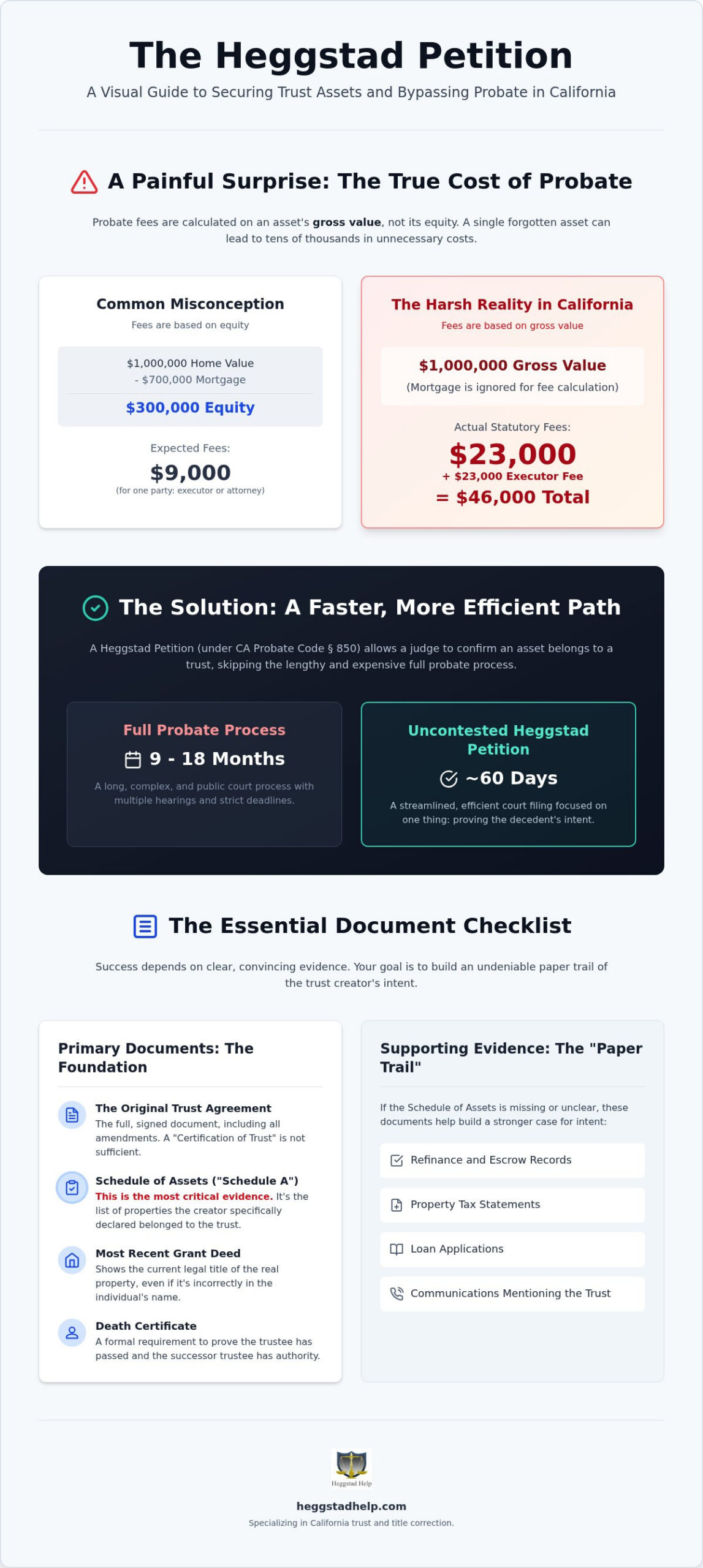
If you believe a $1 million home only costs $26,000 in cmobined probate fees because of a $700,000 mortgage, you’re in for a painful surprise. In California, the court calculates statutory fees based on the gross value (the total market price) of the property rather than the equity, meaning a single asset left out of a trust could cost your family $46,000 or more in unnecessary legal and executor fees. You’re likely feeling the weight of this potential loss, coupled with the confusion of identifying the specific documents needed for Heggstad petition California filings to fix the title. It’s a common frustration to realize a forgotten asset might trigger a full probate process that often lasts 9 to 18 months.
We understand that you want a fast, logical resolution that honors your loved one’s true intentions. This guide provides a comprehensive checklist of the essential records and evidence required to successfully bypass probate and confirm your trust assets through a Heggstad petition (a legal request to include assets in a trust after death). We’ll outline how to build a clear paper trail of intent, from the initial trust instrument to specific property schedules, ensuring you have the proof a judge requires to issue a successful court order.
Key Takeaways
- Learn how California Probate Code Section 850 allows you to skip the standard 12-month probate process by confirming trust ownership of misplaced assets.
- Identify the primary documents needed for Heggstad petition California filings, specifically focusing on the original trust agreement and the essential “Schedule of Assets.”
- Discover how to leverage secondary evidence, such as refinance records and property tax statements, to build a “paper trail of intent” that satisfies the court.
- Understand the procedural requirements for filing your petition in the correct Superior Court to secure a court order that formally corrects asset titles.
Table of Contents
What is a Heggstad Petition and Why are Documents Critical?
A Heggstad petition serves as a corrective legal procedure designed to rescue assets that were intended for a trust but never formally retitled. Based on the landmark 1993 case Estate of Heggstad, this petition allows a judge to declare that an asset is part of the trust estate even if the deed or account remains in the decedent’s individual name. This process relies on California Probate Code Section 850, providing a streamlined path for successor trustees to bypass the traditional probate system.
The primary benefit is the "bypass effect." While a full probate administration can easily stretch across 12 to 18 months, an uncontested Heggstad petition often reaches a resolution in approximately 60 days. This efficiency depends entirely on the quality of your evidence. To succeed, you must meet the "burden of proof" by providing clear and convincing evidence of the decedent’s intent. This is why gathering the specific documents needed for Heggstad petition California cases is the most critical step in the entire process. Without a verifiable paper trail, the court cannot legally confirm the transfer, potentially leaving the estate vulnerable to the high statutory fees of a full probate. Before diving into the specific records required, it’s worth understanding the full cost and time differences outlined in this Heggstad petition vs probate California comparison guide to appreciate why this alternative path matters so much.
The Role of the Successor Trustee in Document Gathering
As a successor trustee, you have a legal duty to "marshal," or collect, all assets belonging to the trust. This responsibility includes securing the records that prove those assets were meant to be there. Acting quickly to find these records prevents title complications and avoids long delays. Your goal is to present a complete package that leaves no doubt about the creator’s wishes. If you don’t secure these files early, you might lose access to critical digital or physical records that the court requires.
When the Heggstad Petition is the Right Solution
This procedure is ideal for "omitted" assets such as real estate, brokerage accounts, or business interests that were listed in a trust document but never formally deeded. A frequent scenario is the "refinance trap." This occurs when a lender requires a homeowner to move a house out of the trust to secure a loan; the owner then passes away before they can transfer the title back. In these instances, the documents needed for Heggstad petition California filings will include the escrow instructions or loan applications that demonstrate the intent to keep the property as a trust asset despite the temporary title change. If you’re dealing with a situation where someone forgot to put a house in a trust in California, understanding which records support your petition is the essential first step.
The Essential Document Checklist for a Successful Filing
To secure a favorable ruling under California Probate Code § 850, you must present a cohesive evidentiary file. The court does not simply take your word for the decedent’s intent; it requires a physical record that proves the asset was meant to be part of the trust. These items comprise the core documents needed for Heggstad petition California cases, serving as the foundation for your legal argument. Compiling this checklist early allows you to identify any gaps in your "paper trail" before you reach the courthouse.
-
The Original Trust Agreement: This includes the main trust document along with all subsequent amendments and restatements.
-
The "Schedule of Assets" (Schedule A): This is the most critical piece of evidence. It specifically lists the assets the creator intended to hold within the trust.
-
The Most Recent Grant Deed: This shows the current legal title, even if it is currently in the decedent’s individual name.
-
The Death Certificate: This is a jurisdictional requirement that proves the decedent has passed and the trust is now active or irrevocable.
Primary Trust Documents: The Foundation of Your Case
You cannot rely on a "Certification of Trust" (a shortened summary used for banking) for this procedure. The court requires the full, original trust agreement to verify the specific language regarding asset transfers. If you find yourself dealing with missing pages or unsigned amendments, it’s often wise to consider consulting a title correction specialist to evaluate the strength of your remaining evidence. For more details on handling these specific trust issues, you can review our guide on unfunded trust probate in California.
Real Property Records: Securing the Deed
If your petition involves a home or land, the Grant Deed is indispensable. You must obtain a certified copy from the County Recorder’s office where the property is located. This document provides the "Legal Description," which is the formal, technical definition of the property boundaries. The court will need this exact description to draft a valid order that the County Recorder will eventually accept to update the title.
Proving Intent: Supporting Evidence and Secondary Documents
While the trust agreement and deed provide the legal framework for your case, the court frequently demands supplemental proof to meet the "clear and convincing" evidentiary standard. These secondary documents needed for Heggstad petition California filings serve to bridge the gap between a technical titling error and the decedent’s actual wishes. Under California Probate Code § 850, a judge looks for consistent behavior that confirms the asset was intended to be held in trust.
Refinance records are particularly persuasive in California courts. If a lender required the decedent to transfer a home out of the trust to secure a mortgage, the "Instructions to Escrow" or the loan application itself often state that the property should be returned to the trust immediately after closing. Similarly, property tax statements and homeowners insurance policies that list the trust (or the decedent as trustee) as the primary owner or "additional insured" (an entity protected by the policy) provide logical proof that the owner considered the trust the true proprietor of the asset. Statements from the drafting attorney or witnesses can also be submitted as written declarations to clarify the decedent’s specific instructions at the time the trust was created.
The "Paper Trail" of Intent
Beyond formal records, informal evidence can be vital. This includes letters, emails, or handwritten notes where the decedent discussed the trust’s ownership of a specific property. One of the most powerful tools is a "General Assignment," which is a document that transfers all of a person’s interest in their property to their trust. This "catch-all" record can often save a case when a specific deed is missing. Families who discover that someone forgot to put their house in a trust in California frequently rely on exactly this type of secondary evidence to establish the decedent’s clear intent. If you’re unsure if your records are sufficient, our Heggstad Petition Filing specialists can help you audit your evidence.
Financial and Brokerage Account Statements
For non-real estate assets like stocks or private business interests, you should gather the most recent statements or stock certificates. If a bank account was never formally moved into the trust, you might prove intent by showing that the account was used exclusively to pay trust-related expenses. These documents needed for Heggstad petition California cases, such as records showing the account paid for trust property taxes or administration fees, help the court see a pattern of trust-focused management.
Filing Your Petition and Securing the Court Order
Once you’ve assembled the necessary evidence, the final phase involves translating those records into a formal legal request. Drafting the petition requires you to incorporate the documents needed for Heggstad petition California courts expect as numbered "Exhibits" (supporting attachments that prove your claims). You’ll file this package with the Superior Court in the county where the property is located or where the trust is currently being administered. In most California counties, this requires a $435 filing fee to initiate the "first paper" process, which is a significant saving compared to the thousands of dollars required for full probate fees. Families weighing their options will find a detailed breakdown of these cost differences in this guide comparing Heggstad petition vs probate in California, which illustrates exactly how much the streamlined petition process can save an estate.
After filing, you must satisfy strict notice requirements. California law mandates that you provide a 30-day notice of the hearing to all beneficiaries and "interested parties" (individuals who have a legal right to receive notice of the proceedings). At the hearing, the judge will review your document package to ensure the evidence of intent is sufficient. If the court is satisfied that you’ve met the clear and convincing standard, they’ll sign the order confirming trust ownership.
Why Precision Matters in Heggstad Filings
Minor errors in legal descriptions or missing signatures on your exhibits can lead to costly court delays or outright denials. The court’s scrutiny is high because this order bypasses the standard probate protections. This is why many families rely on a Board-Certified Specialist to ensure the petition is technically perfect. Having an expert review your documents needed for Heggstad petition California ensures your filing is prepared to withstand judicial review. For a deeper look at the procedural steps, see our guide on Heggstad Petition Filing: The California Guide to Recovering Missing Trust Assets in 2026.
Securing the Final Court Order
The signed court order is your most valuable asset. It functions essentially as a "Deed" to transfer the title from the decedent’s individual name into the trust. However, the process isn’t complete until you record a certified copy of this order with the County Recorder’s office in the county where the real estate is situated. This final step updates the public record and allows you to sell, refinance, or distribute the property without further probate interference. If you’re ready to resolve these title issues and protect the estate’s value, contact Robert P. Bergman at Heggstad Help for expert assistance in gathering and filing your petition documents.
Secure Your Trust Assets and Avoid Probate Delays
Gathering the documents needed for Heggstad petition California filings is the most critical step in reclaiming an estate and honoring a loved one’s true intentions. By organizing the original trust agreement, certified property deeds, and a clear paper trail of intent, you can effectively bypass the 12 to 18 month probate timeline. This organized approach doesn’t just resolve a title error; it protects the estate from the high statutory fees that often accompany a full court administration.
If you’re uncertain whether your evidence will satisfy the court’s "clear and convincing" standard, specialized expertise can provide a steady hand. Robert P. Bergman is a Board-Certified Specialist in Estate Planning, Trust and Probate Law with over 40 years of California legal experience. His practice focuses exclusively on Heggstad petitions and title corrections, ensuring your filing is precise and prepared for judicial review. You don’t have to navigate these complex procedural hurdles alone. Schedule a Consultation with Robert P. Bergman for Your Heggstad Filing to secure your family’s legacy and move forward with confidence.
Frequently Asked Questions
What is the single most important document for a Heggstad petition?
The Trust Agreement, specifically the portion containing the "Schedule of Assets" or "Schedule A," is the most critical record in your filing. This document provides the primary evidence of the decedent’s intent to include the specific asset within the trust estate. Without this written confirmation, the court lacks the essential baseline required to confirm that the asset was omitted by mistake rather than by a deliberate choice of the settlor.
Can I file a Heggstad petition if the trust ‘Schedule A’ is missing?
You can still file if the "Schedule A" is missing, provided you have other persuasive evidence of intent. In these cases, documents needed for Heggstad petition California filings often include a "General Assignment" of all assets or specific written instructions to an attorney. Success depends on building a logical "paper trail" that replaces the missing schedule with other credible records that demonstrate the decedent’s clear wishes.
Do I need the original, wet-signature trust document to file in California?
You typically don’t need the "wet-signature" original trust document to initiate the filing process. A complete and legible photocopy is usually accepted by the court as an exhibit to your petition. However, if a beneficiary or another interested party contests the validity of the trust, the judge may require the production of the original document to verify its authenticity and ensure that no pages have been altered.
What documents are needed if the property was taken out of the trust for a refinance?
If a refinance caused the title issue, you must gather the "Instructions to Escrow" and the loan application. These documents needed for Heggstad petition California cases often explicitly state that the property was transferred out of the trust solely to satisfy lender requirements. Proving that the decedent intended to return the property to the trust immediately after the loan closed is essential for securing a successful court order.
How do I get a copy of the deed if I can’t find it in the decedent’s files?
You can obtain a certified copy of the deed by visiting the County Recorder’s office in the county where the real estate is located. Most counties allow you to request these records in person or through their online portal for a small fee. This certified copy is necessary because it contains the formal legal description of the property, which the judge must include in the final order to update the title.

Article by
Robert P. Bergman, Attorney at Law
Attorney Robert P. Bergman ("Bob Bergman") has been a Board-Certified Specialist in Estate Planning, Trust and Probate Law since 2011, as certified by the California State Bar Board of Legal Specialization. For several years, Bob has assisted families and the clients of other attorneys with obtaining court orders through Heggstad petitions to avoid the time and expense of Probate administration. Bob is friendly, very approachable, and believes in explaining complex legal topics in clear ordinary language so that his clients understand exactly what they're doing and why they're doing it.
Bob is often able to assist clients who are in other counties than his home county of Santa Clara through his approach to Heggstad petitions.
Disclaimer
This article is for informational purposes only. Nothing in this article is intended to replace legal advice from a competent attorney or be considered legal guidance for anybody's specific legal situation. Nobody should rely on information in this article in making legal decisions without such consultation.


