
Imagine the sudden frustration of discovering that your late family member’s LLC or primary brokerage account wasn’t actually titled in their trust, leaving essential business operations frozen and accounts locked. It’s a common oversight that often leads families to believe they’re trapped in a year-long probate process. You may be wondering if it’s even possible to transfer business interest to trust after death California without a full court proceeding. It’s stressful to watch a legacy stall because of a simple paperwork error, but you’re not alone in facing this hurdle.
The good news is that you don’t have to endure the 12 to 18 months of a full probate administration just to fix a title mistake. This article explains how a Heggstad petition, which is a specialized court filing under Probate Code § 850, allows you to move forgotten assets into a trust in a fraction of the time. We’ll explore how this strategic legal tool can fund a trust post-death, sometimes in as little as 7 to 10 days through an ex parte (without a formal hearing) court order, by proving the decedent’s clear intent to include the asset in their estate plan.
Key Takeaways
- Learn why business interests often become “stuck” outside of a trust and how to recognize an unfunded (not properly titled) asset before it causes long-term operational delays.
- Understand how to transfer business interest to trust after death California using Probate Code Section 850, a specialized legal remedy that avoids the 12 to 18-month timeline of a full probate.
- Discover the critical role of written evidence, such as a Schedule of Assets or a general assignment, in proving the decedent’s intent to a California judge.
- Differentiate between the Small Estate Affidavit for low-value personal property and the more robust Heggstad petition used for high-value business or brokerage accounts.
- Find out how ex parte (expedited) court orders can resolve title issues in as little as 7 to 10 days in specific jurisdictions like Santa Clara County.
Why Business Interests and Brokerage Accounts Get ‘Stuck’ Outside of Trusts in California
When a business owner or investor creates a living trust, the primary goal is usually to ensure a seamless transition for their heirs. However, a trust only governs assets that it legally owns. An unfunded business interest occurs when an LLC membership or brokerage account remains in a decedent’s individual name at the time of their passing. This creates a significant legal disconnect. While the trust document may clearly state that the owner intended to leave everything to their beneficiaries, the official title on the account statement or operating agreement still reflects the individual’s name. This oversight often forces families to seek a way to transfer business interest to trust after death California to avoid a lengthy court ordeal.
The immediate consequence of this disconnect is the “frozen asset” trap. Financial institutions and LLC managers typically stop all operations immediately upon receiving a death notice. Banks won’t allow withdrawals, and brokerage firms will not execute trades because they no longer have a living person to take directions from. Many families are surprised to learn that a standard Power of Attorney (a legal document granting someone the authority to act on another’s behalf) loses all its authority the moment the principal passes away. Without a living owner or a trust as the titled owner, the asset sits in a legal vacuum. This same challenge arises when families need a lawyer to transfer property into trust after death California, as real estate left outside a trust faces identical title complications.
A gap exists between intent and title. A judge requires a specific legal mechanism to bridge this divide. This is why the landmark case of the Estate of Heggstad is so vital to California law. It established the precedent that if a decedent’s intent to include an asset in their trust is documented in writing, the court can “confirm” that asset as a trust asset without a full probate. Without this remedy, an unfunded interest might be stuck in probate for over a year.
Common Business Assets Left Out of Trusts
- LLC Membership Interests: Owners often forget to execute a formal “Assignment of Interest” to their trust, leaving the membership in their personal name despite what the trust says.
- Brokerage Accounts: Accounts at major firms like Schwab, Fidelity, or Vanguard are frequently left in individual names because the paperwork to retitle them seemed too complex during the owner’s life.
- Closely Held Stock: Physical stock certificates for small corporations or partnership interests are often stashed in files without being updated to reflect trust ownership.
The Crisis for the Successor Trustee
The successor trustee (the person appointed to manage the trust after the original owner dies) often steps into a chaotic situation. They may need to manage payroll or pay business debts, yet they cannot access the necessary funds because the accounts are frozen. This creates immense pressure, especially when beneficiaries are anxious for their distributions. To understand the full scope of these responsibilities, you can review our detailed guide on Successor Trustee Duties for an Unfunded Trust: The California Guide. Resolving these title issues quickly is the only way to restore operational stability to the business.
Using California Probate Code Section 850 to Transfer Business Interests
The Heggstad petition serves as the primary procedural vehicle for correcting title errors after a trust settlor (the person who created the trust) has passed away. When a successor trustee discovers an unfunded asset, they don’t necessarily have to resign themselves to the lengthy probate process. Instead, they can file a petition under California Probate Code Section 850. This specific statute grants the probate court the authority to “confirm” that a particular asset, such as an LLC interest or a brokerage account, actually belongs to the trust. By focusing on the decedent’s written intent rather than the name on the account statement, the court can bridge the gap between individual ownership and trust ownership.
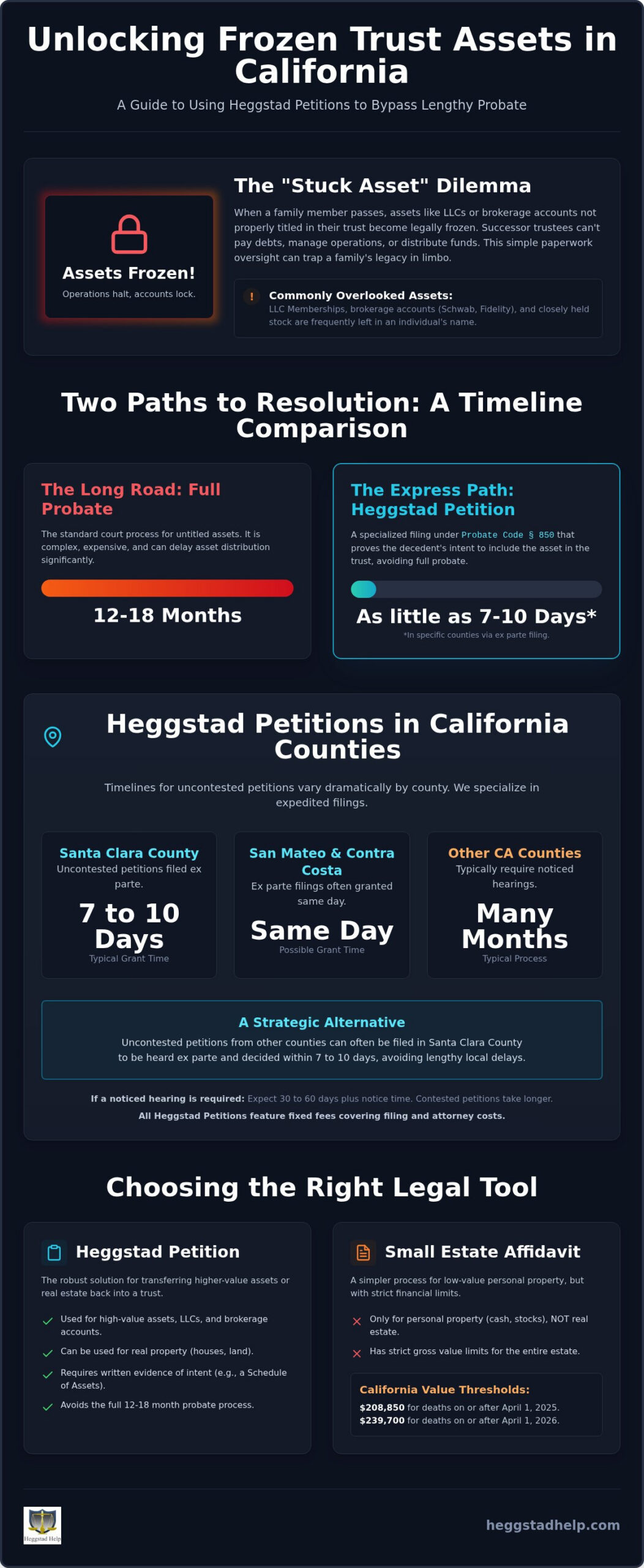
One of the most compelling reasons to use this petition is the significant time savings it offers. While a standard probate administration in California often consumes 12 to 18 months, a Heggstad petition typically resolves in just two to six months. In some specific jurisdictions, such as Santa Clara County, an experienced attorney can even secure an order in as little as 7 to 10 days through an ex parte (an expedited request without a formal hearing) process. This efficiency is vital when trying to transfer business interest to trust after death California, as it allows the business to regain operational control and access frozen funds before the delay causes permanent financial damage.
The Legal Theory Behind Heggstad
The legal foundation for this process stems from the 1993 Estate of Heggstad case. The California Court of Appeal ruled that a written declaration of trust, which lists an asset on an attached schedule, is sufficient to create a trust in that asset. This remains true even if the formal title was never changed. Effectively, the court “reaches back” to the date of the decedent’s death to confirm that the asset was always intended to be part of the trust estate. Successor trustees should note the difference between a standard noticed hearing, which requires 30 days of notice to all interested parties, and an ex parte order, which can bypass the traditional court calendar in urgent situations.
Evidence Needed for Business Interests
Success is entirely dependent on the quality of the evidence presented to the judge. The court looks for “clear and convincing” proof of the decedent’s intent. This evidence usually includes the trust’s “Schedule A” (the list of assets intended for the trust) or a “General Assignment of Assets” that specifically mentions business interests. For LLCs, we also examine the operating agreement; many modern agreements include provisions expressing a desire for the membership interest to be held in trust. For a more detailed look at the documentation required, you can consult our Evidence Required for Heggstad Petition in California: A 2026 Guide. For those managing complex estates, choosing an expert in Heggstad petitions ensures the process remains on track and avoids common procedural pitfalls.
Small Estate Affidavits vs. Heggstad Petitions for Business Assets in California
When you’re determining how to transfer business interest to trust after death California, you’ll likely encounter two primary simplified procedures: the Small Estate Affidavit and the Heggstad petition. While both aim to avoid the 12 to 18-month delay of a full probate administration, they serve very different purposes. A Small Estate Affidavit (a non-court procedure used to collect personal property) is only available when the total value of the decedent’s property falls below a specific statutory threshold. In contrast, a petition filed under California Probate Code Section 850 has no value limit. It’s the standard tool for moving high-value LLC interests or brokerage accounts into a trust when clear evidence of the owner’s intent exists.
The challenge with Small Estate Affidavits is that many business interests and brokerage accounts quickly exceed the legal limits. Even if an asset is technically under the limit, financial institutions often present a “refusal to transfer.” Banks and LLC managers are cautious. They often fear liability if they release assets based on a simple signed statement from an heir. A Heggstad petition resolves this by providing a formal court order that “confirms” the trust’s ownership, which institutions are legally required to honor.
California Small Estate Thresholds (2025 and 2026)
California law adjusts the maximum value for “small estates” every three years to account for inflation. It’s vital to use the correct figure based on the date of death to avoid a rejected filing. The current thresholds for personal property are:
- Deaths on or after April 1, 2025: The threshold is $208,850.
- Deaths on or after April 1, 2026: The threshold increases to $239,700.
If the total value of the assets left outside the trust (including the business interest) exceeds these amounts, the Small Estate Affidavit is no longer an option. You must then look toward a Heggstad petition to avoid a full probate. The same threshold rules apply when working with a lawyer to transfer property into trust after death California, as real property values almost always exceed these limits and require a formal court order rather than a simple affidavit.
Why a Court Order is Often Safer
A Heggstad order provides a level of absolute legal protection that an affidavit cannot match. Major brokerage firms, such as Schwab, Fidelity, or Vanguard, have strict internal compliance rules. They’re far more likely to process a transfer quickly when presented with a certified court order signed by a judge. This is especially true when the total estate value far exceeds the small estate limits, as the court order provides the successor trustee with the definitive authority needed to manage and distribute the business assets as the decedent intended.
Filing a Heggstad Petition for CA Business Interests
The path to successfully completing a transfer business interest to trust after death California involves more than just filling out forms; it requires a strategic understanding of court procedures. The process moves from document collection to judicial confirmation through several critical stages. Successor trustees must follow a methodical sequence to ensure the court has sufficient evidence to grant the order without unnecessary delays. The goal is to move the asset from the decedent’s individual name into the trust’s name as efficiently as the law allows.
The standard procedure for a Heggstad petition generally follows these five steps:
- Step 1: Gather Documentation. You’ll need the original trust document, any general assignment of assets, and the most recent statement for the brokerage account or LLC membership.
- Step 2: Draft the Petition. A formal legal petition is prepared under California Probate Code Section 850, detailing the facts of the case and the evidence of the decedent’s intent.
- Step 3: Strategic Filing. The petition is filed in the appropriate Superior Court. Choosing the right county can significantly impact your timeline.
- Step 4: Obtain the Court Order. If the petition is uncontested, you may seek an ex parte (expedited) order. Otherwise, you’ll attend a noticed hearing where a judge reviews the evidence.
- Step 5: Finalize the Transfer. Once the judge signs the order, you present a certified copy to the LLC manager or brokerage firm to update the title on the account.
Strategic Filing in Santa Clara, San Mateo, and Contra Costa Counties
Where you file often dictates how quickly you can unlock frozen accounts. In Santa Clara County, uncontested petitions are typically granted ex parte in just 7 to 10 days, making it one of the most efficient jurisdictions for trust asset title correction. San Mateo and Contra Costa counties also offer streamlined processes where orders can sometimes be granted the same day they’re filed. However, it’s vital to recognize that Contra Costa requirements for same-day grants usually require a specific showing of “urgency,” such as an impending business sale or a critical payroll deadline that cannot be met without account access.
Handling Out-of-County Filings
Successor trustees aren’t always restricted to the county where the decedent lived if the business interest or brokerage firm has a sufficient connection to another jurisdiction. Filing in Santa Clara County is often a strategic alternative for business interests located in other California counties because of the court’s familiarity with these petitions. In many other counties, you might be forced into a noticed hearing schedule that takes 30 to 60 days, or even longer if the court calendar is backed up. A specialist can use ex parte procedures in favorable counties to save months of waiting, ensuring a faster transfer business interest to trust after death California. If you’re facing a frozen business account and need a rapid resolution, you can learn more about our specialized Heggstad petition filing services to see which filing strategy fits your situation.
Specialized Legal Help for Trust Asset Title Correction in California
The process to transfer business interest to trust after death California requires a high level of procedural precision that many generalist probate attorneys simply don’t possess. While a standard probate lawyer may understand the broad strokes of trust law, they often lack the deep experience needed to navigate the ex parte (expedited) nuances of a Heggstad petition. These specialized filings depend on a specific understanding of local court rules and the unique evidentiary requirements that judges look for when confirming business title. Missteps in the initial filing can lead to delays that keep assets frozen for months longer than necessary.
At our firm, we provide a sense of calm competence rooted in over 40 years of experience. Robert P. Bergman is a Board-Certified Specialist in Estate Planning, Trust and Probate Law. This certification signifies a level of expertise that goes beyond basic legal practice, as it requires rigorous testing and a demonstrated track record in this specific field. We don’t just handle these cases for individual trustees; we also frequently assist other attorneys and title companies throughout California who encounter complex title recovery hurdles they cannot resolve on their own. This collaborative approach has made us a trusted resource for professional peers across the state.
Predictable Costs and Timelines
One of the biggest anxieties for successor trustees is the “billable hour” trap, where legal costs can spiral out of control during a long court process. We address this by offering fixed fees for Heggstad petitions, which cover both the filing and attorney fees. This approach ensures predictability and allows you to focus on business continuity rather than mounting legal bills. During your initial consultation for a business interest transfer, we will review your documents and provide a clear roadmap of the expected timeline. For a deeper look at the process, you can read our comprehensive resource: Heggstad Petition Filing: The California Guide to Recovering Missing Trust Assets in 2026.
Next Steps for Successor Trustees
If you’ve discovered an unfunded business asset, the most important step is to act quickly. Frozen accounts and stalled operations can lead to lost revenue and legal liability for the estate. To initiate a review of your situation, you should gather your trust documents and the most recent statements for the assets in question. We can then determine if a Heggstad petition is the right path to transfer business interest to trust after death California. Contacting Robert P. Bergman provides you with the expert guidance of a dedicated problem-solver who knows exactly how to unlock your business assets and restore the momentum of the estate as the decedent intended.
Restoring Business Continuity and Securing the Trust Estate
Discovering that a significant asset was left outside of a trust is a stressful experience for any successor trustee. California law provides a structured path to correct these title errors without the burden of a full probate administration. By utilizing a Heggstad petition, you can honor the decedent’s clear intent and move assets like LLC interests or brokerage accounts into the trust’s name. This process doesn’t just save time; it protects the financial health of the business and ensures beneficiaries receive their intended distributions.
By utilizing this specialized legal remedy, you can effectively transfer business interest to trust after death California while avoiding the 12 to 18-month probate delay. We invite you to Get a Fixed-Fee Quote for Your Heggstad Petition in California. Our services are led by a Board-Certified Specialist in Estate Planning, Trust and Probate Law, offering fixed fees that cover all filing and legal costs for complete predictability. For those filing in Santa Clara County, we can often secure an order in as little as 7 to 10 days. You don’t have to navigate these procedural hurdles alone; specialized help is available to resolve these complications quickly and professionally.
Frequently Asked Questions
Can I transfer a business interest to a trust after the owner has died in California?
Yes, you can transfer business interest to trust after death California by filing a Heggstad petition under Probate Code Section 850. This legal procedure allows a judge to confirm that an asset belongs to a trust if there’s written evidence of the decedent’s intent, such as a schedule of assets or a general assignment. It effectively bypasses the need for a full probate administration and restores control to the successor trustee.
How long does a Heggstad petition take for an LLC in Santa Clara County?
In Santa Clara County, an uncontested Heggstad petition for an LLC interest can often be resolved in as little as 7 to 10 days. This rapid turnaround is possible through an ex parte (expedited) court order process. This is significantly faster than the standard noticed hearing route, which can take several months in many other California jurisdictions.
What are the small estate limits for business assets in California for 2026?
For deaths occurring on or after April 1, 2026, the small estate threshold for personal property, which includes LLC interests and brokerage accounts, is $239,700. If the total value of assets left outside the trust exceeds this amount, you cannot use a simple Small Estate Affidavit. Instead, a Heggstad petition becomes the necessary legal tool to move those assets into the trust’s name.
Do I need a formal court hearing for a Heggstad petition in San Mateo County?
San Mateo County often allows for ex parte orders that can be granted the same day they’re filed, potentially avoiding a formal noticed hearing altogether. While some counties require a 30 day notice period to all beneficiaries, the specific procedural rules in San Mateo permit a more rapid resolution for uncontested matters. This efficiency helps successor trustees restore business operations without months of waiting.
What happens if a brokerage firm refuses to transfer an account to a trust?
If a brokerage firm like Schwab or Fidelity refuses to transfer an account based on a Small Estate Affidavit, you should obtain a Heggstad court order. Financial institutions are legally required to honor a certified court order confirming trust ownership. This provides the firm with the liability protection they need to release the frozen funds to the successor trustee immediately.
Is a Heggstad petition faster than probate for a California business?
A Heggstad petition is substantially faster than formal probate. While a full probate in California typically lasts 12 to 18 months, a Heggstad petition usually concludes within 2 to 6 months. In expedited cases, it can be finished in a matter of days. This speed is vital when you need to transfer business interest to trust after death California to maintain business continuity and pay employees.
Can I file a Heggstad petition in Santa Clara if the decedent lived in another county?
You may be able to file in Santa Clara County even if the decedent resided elsewhere, provided the business entity or brokerage account has a legal connection to that jurisdiction. This is often a strategic choice because of the court’s efficient handling of ex parte petitions. A specialist can evaluate the venue rules to see if this fast track is available for your specific case.
What is the cost of a Heggstad petition for a brokerage account in California?
The cost includes a standard court filing fee of $435 in most California counties, plus potential appraisal fees if a probate referee is required. While attorney fees vary across the industry, our firm uses a fixed fee model to provide predictability for successor trustees. This covers both the filing and legal representation, helping you avoid the uncertainty of the billable hour during a difficult transition.

Article by
Robert P. Bergman, Attorney at Law
Attorney Robert P. Bergman ("Bob Bergman") has been a Board-Certified Specialist in Estate Planning, Trust and Probate Law since 2011, as certified by the California State Bar Board of Legal Specialization. For several years, Bob has assisted families and the clients of other attorneys with obtaining court orders through Heggstad petitions to avoid the time and expense of Probate administration. Bob is friendly, very approachable, and believes in explaining complex legal topics in clear ordinary language so that his clients understand exactly what they're doing and why they're doing it.
Bob is often able to assist clients who are in other counties than his home county of Santa Clara through his approach to Heggstad petitions.
Disclaimer
This article is for informational purposes only. Nothing in this article is intended to replace legal advice from a competent attorney or be considered legal guidance for anybody's specific legal situation. Nobody should rely on information in this article in making legal decisions without such consultation.


