
Transferring Business Interests to a Trust After Death in California: The Heggstad Solution

Imagine the sudden frustration of discovering that your late family member’s LLC or primary brokerage account wasn’t actually titled in their trust,…

Imagine the sudden frustration of discovering that your late family member’s LLC or primary brokerage account wasn’t actually titled in their trust, leaving essential business operations frozen and accounts locked. It’s a common oversight that often leads families to believe they’re trapped in a year-long probate process. You may be wondering if it’s even possible to transfer business interest to trust after death California without a full court proceeding. It’s stressful to watch a legacy stall because of a simple paperwork error, but you’re not alone in facing this hurdle.

The good news is that you don’t have to endure the 12 to 18 months of a full probate administration just to fix a title mistake. This article explains how a Heggstad petition, which is a specialized court filing under Probate Code ยง 850, allows you to move forgotten assets into a trust in a fraction of the time. We’ll explore how this strategic legal tool can fund a trust post-death, sometimes in as little as 7 to 10 days through an ex parte (without a formal hearing) court order, by proving the decedent’s clear intent to include the asset in their estate plan.

Key Takeaways

  • Learn why business interests often become “stuck” outside of a trust and how to recognize an unfunded (not properly titled) asset before it causes long-term operational delays.
  • Understand how to transfer business interest to trust after death California using Probate Code Section 850, a specialized legal remedy that avoids the 12 to 18-month timeline of a full probate.
  • Discover the critical role of written evidence, such as a Schedule of Assets or a general assignment, in proving the decedent’s intent to a California judge.
  • Differentiate between the Small Estate Affidavit for low-value personal property and the more robust Heggstad petition used for high-value business or brokerage accounts.
  • Find out how ex parte (expedited) court orders can resolve title issues in as little as 7 to 10 days in specific jurisdictions like Santa Clara County.

Why Business Interests and Brokerage Accounts Get ‘Stuck’ Outside of Trusts in California

When a business owner or investor creates a living trust, the primary goal is usually to ensure a seamless transition for their heirs. However, a trust only governs assets that it legally owns. An unfunded business interest occurs when an LLC membership or brokerage account remains in a decedent’s individual name at the time of their passing. This creates a significant legal disconnect. While the trust document may clearly state that the owner intended to leave everything to their beneficiaries, the official title on the account statement or operating agreement still reflects the individual’s name. This oversight often forces families to seek a way to transfer business interest to trust after death California to avoid a lengthy court ordeal.

The immediate consequence of this disconnect is the “frozen asset” trap. Financial institutions and LLC managers typically stop all operations immediately upon receiving a death notice. Banks won’t allow withdrawals, and brokerage firms will not execute trades because they no longer have a living person to take directions from. Many families are surprised to learn that a standard Power of Attorney (a legal document granting someone the authority to act on another’s behalf) loses all its authority the moment the principal passes away. Without a living owner or a trust as the titled owner, the asset sits in a legal vacuum. This same challenge arises when families need a lawyer to transfer property into trust after death California, as real estate left outside a trust faces identical title complications.

A gap exists between intent and title. A judge requires a specific legal mechanism to bridge this divide. This is why the landmark case of the Estate of Heggstad is so vital to California law. It established the precedent that if a decedent’s intent to include an asset in their trust is documented in writing, the court can “confirm” that asset as a trust asset without a full probate. Without this remedy, an unfunded interest might be stuck in probate for over a year.

Common Business Assets Left Out of Trusts

  • LLC Membership Interests: Owners often forget to execute a formal “Assignment of Interest” to their trust, leaving the membership in their personal name despite what the trust says.
  • Brokerage Accounts: Accounts at major firms like Schwab, Fidelity, or Vanguard are frequently left in individual names because the paperwork to retitle them seemed too complex during the owner’s life.
  • Closely Held Stock: Physical stock certificates for small corporations or partnership interests are often stashed in files without being updated to reflect trust ownership.

The Crisis for the Successor Trustee

The successor trustee (the person appointed to manage the trust after the original owner dies) often steps into a chaotic situation. They may need to manage payroll or pay business debts, yet they cannot access the necessary funds because the accounts are frozen. This creates immense pressure, especially when beneficiaries are anxious for their distributions. To understand the full scope of these responsibilities, you can review our detailed guide on Successor Trustee Duties for an Unfunded Trust: The California Guide. Resolving these title issues quickly is the only way to restore operational stability to the business.

Using California Probate Code Section 850 to Transfer Business Interests

The Heggstad petition serves as the primary procedural vehicle for correcting title errors after a trust settlor (the person who created the trust) has passed away. When a successor trustee discovers an unfunded asset, they don’t necessarily have to resign themselves to the lengthy probate process. Instead, they can file a petition under California Probate Code Section 850. This specific statute grants the probate court the authority to “confirm” that a particular asset, such as an LLC interest or a brokerage account, actually belongs to the trust. By focusing on the decedent’s written intent rather than the name on the account statement, the court can bridge the gap between individual ownership and trust ownership.

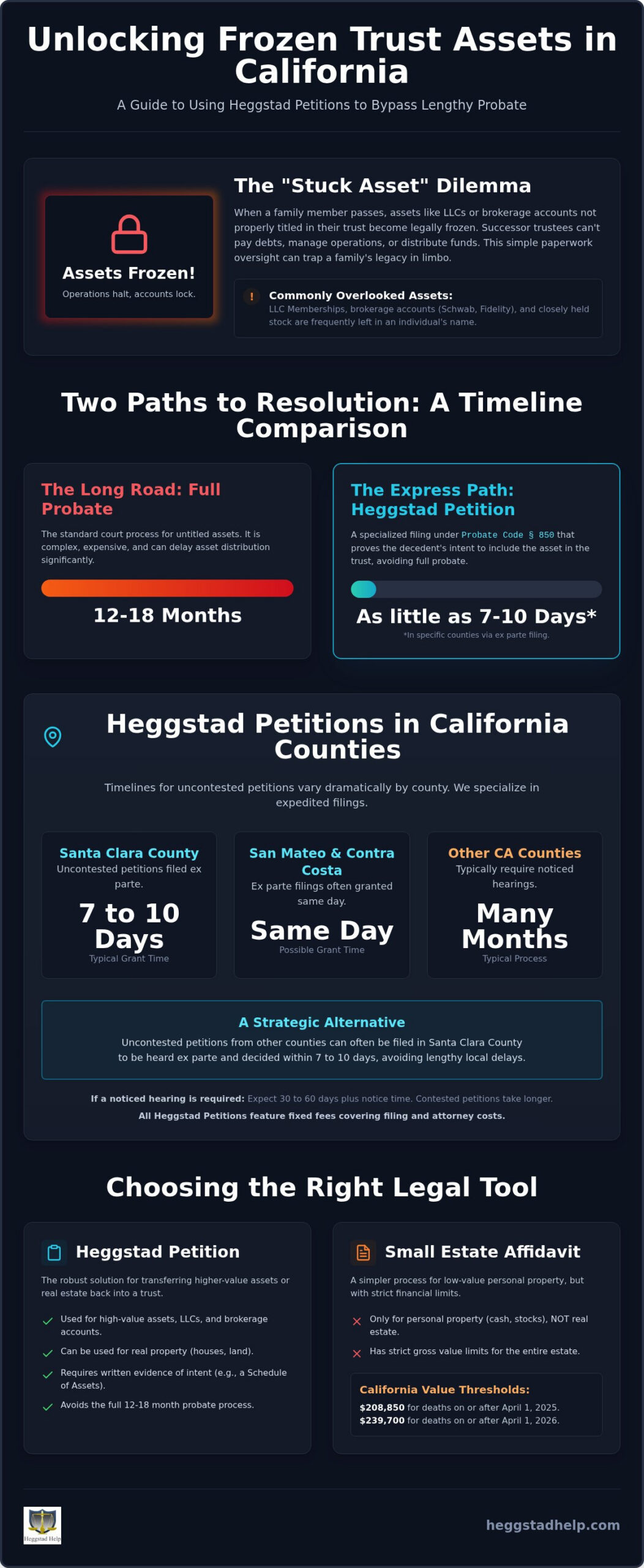
One of the most compelling reasons to use this petition is the significant time savings it offers. While a standard probate administration in California often consumes 12 to 18 months, a Heggstad petition typically resolves in just two to six months. In some specific jurisdictions, such as Santa Clara County, an experienced attorney can even secure an order in as little as 7 to 10 days through an ex parte (an expedited request without a formal hearing) process. This efficiency is vital when trying to transfer business interest to trust after death California, as it allows the business to regain operational control and access frozen funds before the delay causes permanent financial damage.

The Legal Theory Behind Heggstad

The legal foundation for this process stems from the 1993 Estate of Heggstad case. The California Court of Appeal ruled that a written declaration of trust, which lists an asset on an attached schedule, is sufficient to create a trust in that asset. This remains true even if the formal title was never changed. Effectively, the court “reaches back” to the date of the decedent’s death to confirm that the asset was always intended to be part of the trust estate. Successor trustees should note the difference between a standard noticed hearing, which requires 30 days of notice to all interested parties, and an ex parte order, which can bypass the traditional court calendar in urgent situations.

Evidence Needed for Business Interests

Success is entirely dependent on the quality of the evidence presented to the judge. The court looks for “clear and convincing” proof of the decedent’s intent. This evidence usually includes the trust’s “Schedule A” (the list of assets intended for the trust) or a “General Assignment of Assets” that specifically mentions business interests. For LLCs, we also examine the operating agreement; many modern agreements include provisions expressing a desire for the membership interest to be held in trust. For a more detailed look at the documentation required, you can consult our Evidence Required for Heggstad Petition in California: A 2026 Guide. For those managing complex estates, choosing an expert in Heggstad petitions ensures the process remains on track and avoids common procedural pitfalls.

Small Estate Affidavits vs. Heggstad Petitions for Business Assets in California

When you’re determining how to transfer business interest to trust after death California, you’ll likely encounter two primary simplified procedures: the Small Estate Affidavit and the Heggstad petition. While both aim to avoid the 12 to 18-month delay of a full probate administration, they serve very different purposes. A Small Estate Affidavit (a non-court procedure used to collect personal property) is only available when the total value of the decedent’s property falls below a specific statutory threshold. In contrast, a petition filed under California Probate Code Section 850 has no value limit. It’s the standard tool for moving high-value LLC interests or brokerage accounts into a trust when clear evidence of the owner’s intent exists.

The challenge with Small Estate Affidavits is that many business interests and brokerage accounts quickly exceed the legal limits. Even if an asset is technically under the limit, financial institutions often present a “refusal to transfer.” Banks and LLC managers are cautious. They often fear liability if they release assets based on a simple signed statement from an heir. A Heggstad petition resolves this by providing a formal court order that “confirms” the trust’s ownership, which institutions are legally required to honor.

California Small Estate Thresholds (2025 and 2026)

California law adjusts the maximum value for “small estates” every three years to account for inflation. It’s vital to use the correct figure based on the date of death to avoid a rejected filing. The current thresholds for personal property are:

  • Deaths on or after April 1, 2025: The threshold is $208,850.
  • Deaths on or after April 1, 2026: The threshold increases to $239,700.

If the total value of the assets left outside the trust (including the business interest) exceeds these amounts, the Small Estate Affidavit is no longer an option. You must then look toward a Heggstad petition to avoid a full probate. The same threshold rules apply when working with a lawyer to transfer property into trust after death California, as real property values almost always exceed these limits and require a formal court order rather than a simple affidavit.

Why a Court Order is Often Safer

A Heggstad order provides a level of absolute legal protection that an affidavit cannot match. Major brokerage firms, such as Schwab, Fidelity, or Vanguard, have strict internal compliance rules. They’re far more likely to process a transfer quickly when presented with a certified court order signed by a judge. This is especially true when the total estate value far exceeds the small estate limits, as the court order provides the successor trustee with the definitive authority needed to manage and distribute the business assets as the decedent intended.
Transferring Business Interests to a Trust After Death in California: The Heggstad Solution

Filing a Heggstad Petition for CA Business Interests

The path to successfully completing a transfer business interest to trust after death California involves more than just filling out forms; it requires a strategic understanding of court procedures. The process moves from document collection to judicial confirmation through several critical stages. Successor trustees must follow a methodical sequence to ensure the court has sufficient evidence to grant the order without unnecessary delays. The goal is to move the asset from the decedent’s individual name into the trust’s name as efficiently as the law allows.

The standard procedure for a Heggstad petition generally follows these five steps:

  • Step 1: Gather Documentation. You’ll need the original trust document, any general assignment of assets, and the most recent statement for the brokerage account or LLC membership.
  • Step 2: Draft the Petition. A formal legal petition is prepared under California Probate Code Section 850, detailing the facts of the case and the evidence of the decedent’s intent.
  • Step 3: Strategic Filing. The petition is filed in the appropriate Superior Court. Choosing the right county can significantly impact your timeline.
  • Step 4: Obtain the Court Order. If the petition is uncontested, you may seek an ex parte (expedited) order. Otherwise, you’ll attend a noticed hearing where a judge reviews the evidence.
  • Step 5: Finalize the Transfer. Once the judge signs the order, you present a certified copy to the LLC manager or brokerage firm to update the title on the account.

Strategic Filing in Santa Clara, San Mateo, and Contra Costa Counties

Where you file often dictates how quickly you can unlock frozen accounts. In Santa Clara County, uncontested petitions are typically granted ex parte in just 7 to 10 days, making it one of the most efficient jurisdictions for trust asset title correction. San Mateo and Contra Costa counties also offer streamlined processes where orders can sometimes be granted the same day they’re filed. However, it’s vital to recognize that Contra Costa requirements for same-day grants usually require a specific showing of “urgency,” such as an impending business sale or a critical payroll deadline that cannot be met without account access.

Handling Out-of-County Filings

Successor trustees aren’t always restricted to the county where the decedent lived if the business interest or brokerage firm has a sufficient connection to another jurisdiction. Filing in Santa Clara County is often a strategic alternative for business interests located in other California counties because of the court’s familiarity with these petitions. In many other counties, you might be forced into a noticed hearing schedule that takes 30 to 60 days, or even longer if the court calendar is backed up. A specialist can use ex parte procedures in favorable counties to save months of waiting, ensuring a faster transfer business interest to trust after death California. If you’re facing a frozen business account and need a rapid resolution, you can learn more about our specialized Heggstad petition filing services to see which filing strategy fits your situation.

The process to transfer business interest to trust after death California requires a high level of procedural precision that many generalist probate attorneys simply don’t possess. While a standard probate lawyer may understand the broad strokes of trust law, they often lack the deep experience needed to navigate the ex parte (expedited) nuances of a Heggstad petition. These specialized filings depend on a specific understanding of local court rules and the unique evidentiary requirements that judges look for when confirming business title. Missteps in the initial filing can lead to delays that keep assets frozen for months longer than necessary.

At our firm, we provide a sense of calm competence rooted in over 40 years of experience. Robert P. Bergman is a Board-Certified Specialist in Estate Planning, Trust and Probate Law. This certification signifies a level of expertise that goes beyond basic legal practice, as it requires rigorous testing and a demonstrated track record in this specific field. We don’t just handle these cases for individual trustees; we also frequently assist other attorneys and title companies throughout California who encounter complex title recovery hurdles they cannot resolve on their own. This collaborative approach has made us a trusted resource for professional peers across the state.

Predictable Costs and Timelines

One of the biggest anxieties for successor trustees is the “billable hour” trap, where legal costs can spiral out of control during a long court process. We address this by offering fixed fees for Heggstad petitions, which cover both the filing and attorney fees. This approach ensures predictability and allows you to focus on business continuity rather than mounting legal bills. During your initial consultation for a business interest transfer, we will review your documents and provide a clear roadmap of the expected timeline. For a deeper look at the process, you can read our comprehensive resource: Heggstad Petition Filing: The California Guide to Recovering Missing Trust Assets in 2026.

Next Steps for Successor Trustees

If you’ve discovered an unfunded business asset, the most important step is to act quickly. Frozen accounts and stalled operations can lead to lost revenue and legal liability for the estate. To initiate a review of your situation, you should gather your trust documents and the most recent statements for the assets in question. We can then determine if a Heggstad petition is the right path to transfer business interest to trust after death California. Contacting Robert P. Bergman provides you with the expert guidance of a dedicated problem-solver who knows exactly how to unlock your business assets and restore the momentum of the estate as the decedent intended.

Restoring Business Continuity and Securing the Trust Estate

Discovering that a significant asset was left outside of a trust is a stressful experience for any successor trustee. California law provides a structured path to correct these title errors without the burden of a full probate administration. By utilizing a Heggstad petition, you can honor the decedent’s clear intent and move assets like LLC interests or brokerage accounts into the trust’s name. This process doesn’t just save time; it protects the financial health of the business and ensures beneficiaries receive their intended distributions.

By utilizing this specialized legal remedy, you can effectively transfer business interest to trust after death California while avoiding the 12 to 18-month probate delay. We invite you to Get a Fixed-Fee Quote for Your Heggstad Petition in California. Our services are led by a Board-Certified Specialist in Estate Planning, Trust and Probate Law, offering fixed fees that cover all filing and legal costs for complete predictability. For those filing in Santa Clara County, we can often secure an order in as little as 7 to 10 days. You don’t have to navigate these procedural hurdles alone; specialized help is available to resolve these complications quickly and professionally.

Frequently Asked Questions

Can I transfer a business interest to a trust after the owner has died in California?

Yes, you can transfer business interest to trust after death California by filing a Heggstad petition under Probate Code Section 850. This legal procedure allows a judge to confirm that an asset belongs to a trust if there’s written evidence of the decedent’s intent, such as a schedule of assets or a general assignment. It effectively bypasses the need for a full probate administration and restores control to the successor trustee.

How long does a Heggstad petition take for an LLC in Santa Clara County?

In Santa Clara County, an uncontested Heggstad petition for an LLC interest can often be resolved in as little as 7 to 10 days. This rapid turnaround is possible through an ex parte (expedited) court order process. This is significantly faster than the standard noticed hearing route, which can take several months in many other California jurisdictions.

What are the small estate limits for business assets in California for 2026?

For deaths occurring on or after April 1, 2026, the small estate threshold for personal property, which includes LLC interests and brokerage accounts, is $239,700. If the total value of assets left outside the trust exceeds this amount, you cannot use a simple Small Estate Affidavit. Instead, a Heggstad petition becomes the necessary legal tool to move those assets into the trust’s name.

Do I need a formal court hearing for a Heggstad petition in San Mateo County?

San Mateo County often allows for ex parte orders that can be granted the same day they’re filed, potentially avoiding a formal noticed hearing altogether. While some counties require a 30 day notice period to all beneficiaries, the specific procedural rules in San Mateo permit a more rapid resolution for uncontested matters. This efficiency helps successor trustees restore business operations without months of waiting.

What happens if a brokerage firm refuses to transfer an account to a trust?

If a brokerage firm like Schwab or Fidelity refuses to transfer an account based on a Small Estate Affidavit, you should obtain a Heggstad court order. Financial institutions are legally required to honor a certified court order confirming trust ownership. This provides the firm with the liability protection they need to release the frozen funds to the successor trustee immediately.

Is a Heggstad petition faster than probate for a California business?

A Heggstad petition is substantially faster than formal probate. While a full probate in California typically lasts 12 to 18 months, a Heggstad petition usually concludes within 2 to 6 months. In expedited cases, it can be finished in a matter of days. This speed is vital when you need to transfer business interest to trust after death California to maintain business continuity and pay employees.

Can I file a Heggstad petition in Santa Clara if the decedent lived in another county?

You may be able to file in Santa Clara County even if the decedent resided elsewhere, provided the business entity or brokerage account has a legal connection to that jurisdiction. This is often a strategic choice because of the court’s efficient handling of ex parte petitions. A specialist can evaluate the venue rules to see if this fast track is available for your specific case.

What is the cost of a Heggstad petition for a brokerage account in California?

The cost includes a standard court filing fee of $435 in most California counties, plus potential appraisal fees if a probate referee is required. While attorney fees vary across the industry, our firm uses a fixed fee model to provide predictability for successor trustees. This covers both the filing and legal representation, helping you avoid the uncertainty of the billable hour during a difficult transition.

Robert P. Bergman, Attorney at Law

Article by

Robert P. Bergman, Attorney at Law

Attorney Robert P. Bergman ("Bob Bergman") has been a Board-Certified Specialist in Estate Planning, Trust and Probate Law since 2011, as certified by the California State Bar Board of Legal Specialization. For several years, Bob has assisted families and the clients of other attorneys with obtaining court orders through Heggstad petitions to avoid the time and expense of Probate administration. Bob is friendly, very approachable, and believes in explaining complex legal topics in clear ordinary language so that his clients understand exactly what they're doing and why they're doing it.
Bob is often able to assist clients who are in other counties than his home county of Santa Clara through his approach to Heggstad petitions.

Disclaimer

This article is for informational purposes only. Nothing in this article is intended to replace legal advice from a competent attorney or be considered legal guidance for anybody's specific legal situation. Nobody should rely on information in this article in making legal decisions without such consultation.

Transferring an LLC to Trust After Death: The Heggstad Solution

Imagine the frustration of realizing a late loved one’s business is effectively frozen because their membership interest (the legal right to own and…

Imagine the frustration of realizing a late loved one’s business is effectively frozen because their membership interest (the legal right to own and manage the company) was never formally moved into their living trust. You’re likely worried that transferring an LLC to trust after death in California will mean a grueling twelve to eighteen month wait in probate court while operations stall and expenses mount. It’s a stressful situation, and it’s perfectly normal to feel overwhelmed by the technical distinction between a physical asset and a membership interest.

There’s a faster way to restore order. You can utilize a Heggstad Petition, which is a specialized court filing under Probate Code Section 850 that asks a judge to recognize the trust’s ownership of an asset that was left out. This article explains how you can bypass full probate and correct the title through a streamlined process. You’ll discover how certain counties like Santa Clara can grant these petitions in seven to ten days, and why a fixed-fee legal service can provide the calm competence you need to resolve this hurdle quickly. Whether you’re dealing with a small estate under the $208,850 threshold for 2025 or a larger business interest, we’ll show you how to regain control without the delays of traditional court supervision.

Key Takeaways

  • Learn how a Heggstad Petition (Probate Code 850) serves as a streamlined “title correction” to move business assets into a trust without the typical 12 to 18-month delay of full probate.
  • Discover how evidence of intent, such as a trust’s Schedule A or a general assignment document, can successfully facilitate transferring an LLC to trust after death in California.
  • Compare the financial benefits of a fixed-fee legal model against the expensive, percentage-based statutory fees required in traditional California probate cases.
  • Identify specific Bay Area counties where ex parte filings (petitions heard without a formal hearing) can grant your request in as little as one to ten days.
  • Understand how to bypass long wait times in other counties by filing uncontested Heggstad petitions in Santa Clara County for a decision typically within 7 to 10 days.

The Crisis of the ‘Forgotten’ LLC: Why Business Assets Face California Probate

A "forgotten" LLC occurs when a business owner intends for their company to be part of their trust but passes away before formally recording the transfer of interest. In California, this oversight creates a significant legal hurdle because the law treats un-transferred LLC interests as personal property. Unless the title is corrected, these interests are subject to formal probate. This means that transferring an LLC to trust after death in California often feels like an impossible task for grieving families who find themselves locked out of the company’s daily operations.

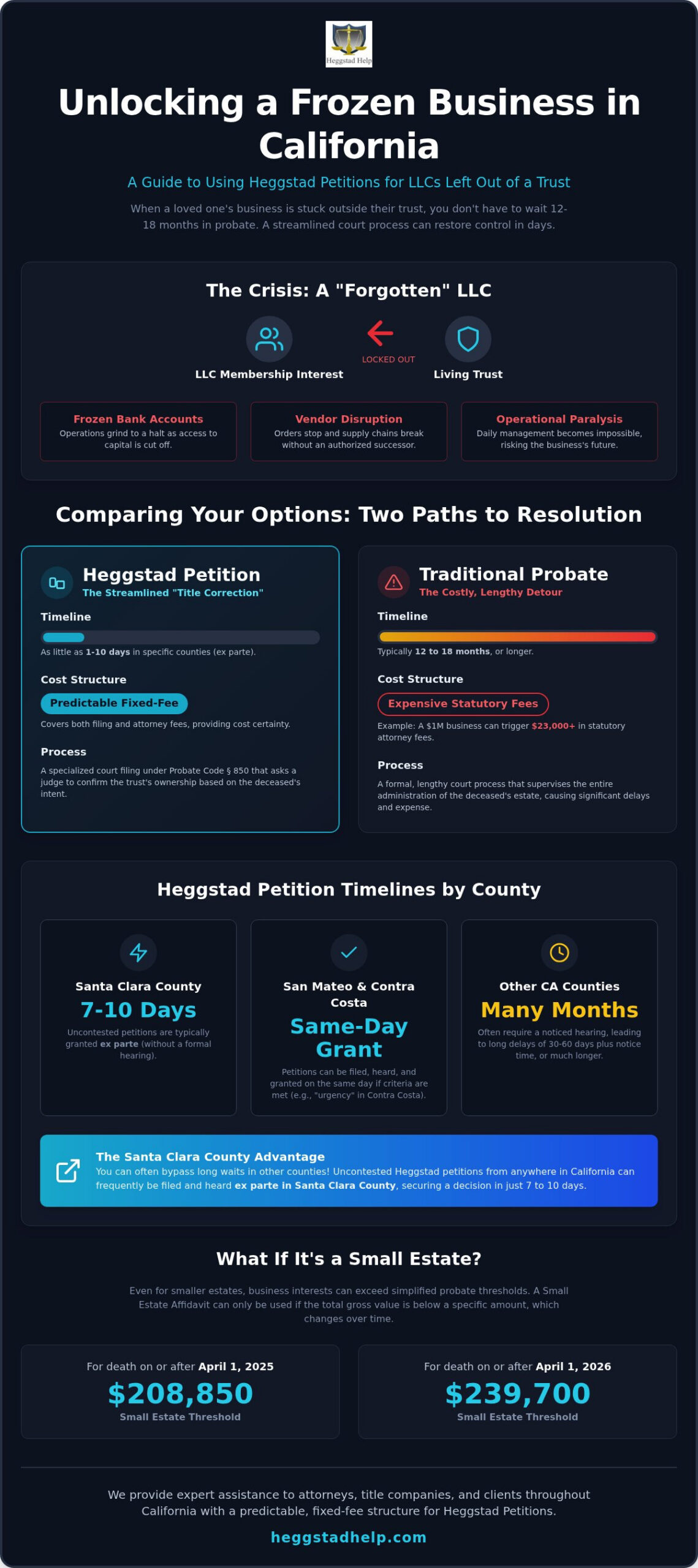
The consequences of this title error are immediate and often severe. Banks typically freeze business accounts upon learning of a member’s death, and vendors may stop fulfilling orders without a clear, authorized successor. Beyond the operational paralysis, the financial burden is heavy. California probate fees are statutory (set by law) and based on the gross value of the asset. For instance, a business valued at $1,000,000 could trigger over $23,000 in attorney fees and an equal amount in executor fees. This is why many families look toward the precedent set in the Estate of Heggstad to find a more efficient path forward.

Membership Interests vs. Physical Assets

It’s vital to understand that a trust must own the actual membership interest (the intangible right to profits and control) rather than just the physical tools or bank accounts used by the business. Title errors are common in California business succession planning, often because owners assume that mentioning the business in their will is sufficient. However, the LLC Operating Agreement (the contract governing the company’s internal affairs) must allow for trust ownership. If the paperwork doesn’t match the owner’s intent, the business remains in legal limbo. Even if the estate is relatively small, business interests often exceed the simplified probate thresholds, which sit at $208,850 for individuals dying on or after April 1, 2025, and increased to $239,700 on or after April 1, 2026. These situations are among the most common California trust funding mistakes that families encounter when a loved one passes away without completing the transfer of business interests.

The Role of the Successor Trustee

The successor trustee has a fiduciary duty (a high legal obligation to act in the beneficiaries’ best interests) to recover any assets that were intended for the trust. This includes tracking down "missing" LLC interests to ensure the business doesn’t face involuntary dissolution by the state. For those overwhelmed by this responsibility, finding Successor Trustee Help for Missing Assets is a critical first step. Waiting too long to fix a title error only increases the risk of permanent business failure. When transferring an LLC to trust after death in California, the trustee must act decisively to secure the business’s future and protect its value for the beneficiaries.

California Probate Code 850: How a Heggstad Petition Corrects LLC Title Errors

While the frozen business operations described earlier are daunting, California law provides a specific remedy known as a Heggstad Petition. This legal mechanism, formally brought under Probate Code Section 850, allows a judge to confirm that a trust owns an asset even if the formal title was never updated. It effectively bypasses the lengthy probate process by "correcting" the title to reflect the deceased owner’s clear intentions. While commonly used for real estate, a Heggstad petition for an LLC is often the most efficient way to resolve membership interest disputes. This process is versatile; it applies to business interests, brokerage accounts, and various other assets that were meant to be held within the trust’s protection. Utilizing a fixed-fee model that covers both filing and attorney fees can help successor trustees manage these costs predictably while transferring LLC to trust after death California.

The success of this petition relies heavily on the "Intent Rule." California courts look for written evidence that the grantor (the person who created the trust) meant for the LLC to be a trust asset. If you can provide this proof, the court can issue an order declaring the trust as the rightful owner. This avoids the need for a court-supervised executor to manage the business for a year or more, allowing the successor trustee to step into their role with full legal authority.

Evidence of Intent for LLC Transfers

To prove intent, we typically look for a "Schedule of Assets" (a list often found at the back of a trust document) or a "General Assignment of Assets" (a broad statement transferring all of a person’s property into their trust). These documents serve as a clear paper trail for the court. Written declarations within the trust document itself, such as a statement that "I hereby transfer all my business interests to this trust," can also satisfy the legal requirements. Probate Code 850 is the specific statutory authority that grants California courts the power to confirm trust assets and correct title errors after a grantor has passed away. This is a vital tool when business interests exceed the California small estate threshold of $208,850 for deaths occurring on or after April 1, 2025.

Correcting the Title at the Secretary of State

Once the court grants the petition, the work isn’t quite finished. The successor trustee must use the certified court order to update the LLC’s records with the California Secretary of State. This usually involves filing a new Statement of Information (the public document listing the LLC’s managers or members) to reflect that the trust is now the member. It’s critical to ensure the LLC remains in "Good Standing" (a status showing the business has paid its taxes and filed its required reports) during this time. If the business is suspended, the court may delay the petition until the entity is revived. For a deeper look at how these rules apply to different types of property, you can review this California Probate Code Section 850: A Guide.

If you’re unsure if your documentation is sufficient, consulting with a specialist can clarify your path forward through professional Heggstad petition services.

Comparing Your Options: Heggstad Petition vs. Full Probate for LLC Interests

When faced with a "frozen" business, the choice between a full probate and a Heggstad petition is often a matter of months versus years. Transferring an LLC interest to trust after death California through the full probate system is a slow, public, and expensive journey. A typical California probate case takes 12 to 18 months, requiring multiple court hearings and formal appraisals by a probate referee (a court-appointed official who values assets). In contrast, an uncontested Heggstad petition is a targeted filing that can often be resolved in 7 to 60 days, depending on the county.

The financial difference is equally stark. Probate fees are statutory, meaning they are a fixed percentage of the gross value of the estate. If an LLC owns a property worth $1,000,000, the statutory fees for the attorney and executor could exceed $46,000 combined. By choosing a Heggstad petition, you can utilize a fixed-fee legal service that covers both filing and attorney fees, providing a predictable and often significantly lower cost. Beyond the money, there is the matter of privacy. Probate is a wide-open public record where every asset and beneficiary is listed for the world to see, while a Heggstad petition is a focused procedure designed to correct a specific title error.

The speed of this process varies significantly across California. In Santa Clara County, uncontested petitions are typically granted in 7 to 10 days. In San Mateo County, they can be filed, heard, and granted the same day. Contra Costa County also offers same-day grants if "urgency" is demonstrated to the Court’s satisfaction. Petitions in other counties often require noticed hearings that can take many months. However, uncontested Heggstad petitions from those other counties can often be heard ex parte (without a formal hearing) in Santa Clara County instead, where they are typically decided within 7 to 10 days of filing.

The 2026 Small Estate Affidavit Thresholds

Some families wonder if they can avoid court entirely using a Small Estate Affidavit. This is only possible if the total value of the deceased’s assets falls below specific thresholds. For individuals dying on or after April 1, 2025, the small estate threshold is $208,850. For those dying on or after April 1, 2026, this threshold increases to $239,700. While this might cover a very small business, most California LLCs, particularly those holding real estate or significant equipment, will quickly exceed these limits. When an LLC is valued above these figures, a court order is required to transfer ownership. Understanding these thresholds is essential to avoiding the most costly California trust funding mistakes that can force a family into full probate when a simpler remedy may be available.

When is a Heggstad Petition Not Enough?

A Heggstad petition is a powerful tool, but it is not a universal solution. It works best when there is clear, written evidence of the owner’s intent, such as a mention of the business in the trust’s Schedule A. If there is zero written evidence of intent, the court may deny the petition. Additionally, if beneficiaries disagree on the transfer and the petition becomes contested (meaning someone formally objects), the process will take much longer and may require a full trial. In these complex scenarios, or when dealing with intricate multi-member business structures, the guidance of an expert Heggstad petition lawyer is essential to navigate the procedural hurdles.

Transferring an LLC to Trust After Death: The Heggstad Solution

Timelines and Procedures: Navigating California Courts for LLC Transfers

The speed of your recovery process depends largely on the county where the petition is filed and the specific procedural path chosen. While a full probate takes over a year, a Heggstad petition can utilize ex parte filings (legal requests heard by a judge without a formal noticed hearing). This streamlined approach is the most effective way of transferring an LLC to trust after death California when time is of the essence. Our firm assists attorneys, title companies, and individual clients throughout the state by leveraging these expedited procedures through a fixed-fee structure that covers all filing and attorney costs.

In the Bay Area, certain courts are particularly efficient with uncontested petitions. Santa Clara County typically grants these orders within seven to ten days of filing. In San Mateo County, it’s often possible to have a petition filed, heard, and granted on the very same day. Contra Costa County also allows for same-day grants, provided the court is satisfied that "urgency" exists. For clients dealing with properties or business interests in other California counties, we often employ the "Santa Clara Strategy." Because uncontested Heggstad petitions from other counties can frequently be heard ex parte in Santa Clara County instead, we can bypass the months of delays common in other jurisdictions and secure a decision in that same seven to ten-day window.

The Noticed Hearing Timeline

If a county does not allow for ex parte petitions or if the court determines a formal hearing is necessary, the timeline shifts to a noticed hearing schedule. This typically involves a thirty to sixty-day wait period plus the time required to serve legal notice to all interested parties. In counties outside of our primary Bay Area focus, these noticed hearings can sometimes take many months to resolve. If a petition becomes contested (meaning a beneficiary or creditor formally objects), the process can drag on significantly longer, potentially moving into the realm of traditional litigation.

Demonstrating Urgency to the Court

To secure a same-day grant in counties like Contra Costa, a lawyer must craft a detailed ex parte declaration that clearly outlines the necessity for immediate action. Common examples of LLC urgency include an impending sale of business real estate, the need to meet payroll for employees, or preventing a default on a business loan that requires a member’s signature. Proving these facts requires specialized knowledge of how judges evaluate business risks. For a broader look at how these rules apply to various assets, you can read our guide on how to fix trust title errors on California real property. Regardless of the complexity, we provide the steady hand needed to navigate these court requirements.

If your business operations are currently frozen, you can start the process of regaining control today by contacting our team for expert Heggstad petition assistance.

Expert Assistance with Trust Asset Title Correction and Heggstad Filings

When you are tasked with transferring an LLC to trust after death, the technical requirements can feel like a moving target. You need a partner who understands the nuance of Probate Code 850 and how it interacts with business law. We provide a steady, knowledgeable hand through our Heggstad Help services, utilizing a fixed-fee structure that covers both filing and attorney fees. This model ensures that successor trustees, title companies, and other attorneys across the state have a predictable path forward without the uncertainty of hourly billing or the high cost of statutory probate fees.

Our firm is uniquely positioned to assist with uncontested petitions throughout California. We leverage the "Santa Clara Strategy" to help clients in counties where the court system is backlogged. While a noticed hearing in many jurisdictions can take months, we can often file uncontested petitions ex parte (without a formal hearing) in Santa Clara County, where they are typically decided within seven to ten days. We also facilitate same-day grants in San Mateo and Contra Costa counties when urgency is demonstrated. This level of specialized knowledge is essential for business assets that cannot afford to remain in legal limbo while the probate threshold for small estates continues to rise, reaching $208,850 on or after April 1, 2025, and $239,700 on or after April 1, 2026

A Specialized Approach to Business Assets

Robert P. Bergman is a Board-Certified Specialist in Estate Planning, Trust, and Probate Law with over 40 years of experience navigating the California court system. Working with a firm that exclusively handles Heggstad filings provides a distinct advantage when dealing with complex business structures. We focus on ensuring that the transfer of membership interests is handled with precision to keep the LLC’s liability shield (the legal barrier that protects your personal assets from business debts) fully intact. By gathering your LLC Operating Agreement and the original Trust documents, including any Schedule A or general assignment language, we can build a compelling case for the court that honors the grantor’s original intent.

Get Started with a Case Evaluation

Determining if your LLC interest qualifies for a Heggstad filing is the first step toward regaining control of the business. You should act quickly to prevent frozen assets from impacting payroll, vendor relationships, or property sales. We recommend gathering all relevant documents to verify that the owner intended the business to be held in trust. Once we review these materials, we can determine the most efficient county for filing and provide a clear timeline for resolution. If you are ready to move past the delays of probate and secure the business’s future, you can Request a Heggstad Petition Consultation to discuss your specific case.

Restore Business Continuity with a Heggstad Petition

Dealing with a "forgotten" business interest doesn’t have to mean enduring the long, public, and expensive California probate process. By choosing a Heggstad Petition, you can utilize a streamlined title correction to move membership interests into a trust in a fraction of the time. Whether you’re a successor trustee or a professional partner, the path to transferring an LLC to trust after death in California is much clearer when you bypass traditional court delays. You’ve learned that while some counties take months, our specialized "Santa Clara Strategy" can often secure a court order in just seven to ten days for uncontested filings throughout the state.

Our firm, led by a Board-Certified Specialist in Estate Planning, Trust and Probate Law, is here to provide the calm competence you need during a complex time. We offer a fixed-fee structure that covers all filing and attorney fees, giving you total cost predictability from the start. Don’t let frozen assets stall your loved one’s legacy or disrupt company operations any longer. You have the tools to correct this error and regain control of the business today. Secure Your Business Legacy with a Fixed-Fee Heggstad Petition. We are ready to help you navigate this process with specialized expertise and a focus on your success.

Frequently Asked Questions

Can an LLC be transferred to a trust after the owner has already died?

Yes, you can transfer an LLC interest to a trust after death by filing a Heggstad Petition under Probate Code Section 850. This legal procedure allows a judge to confirm that the business interest belongs in the trust based on evidence of the deceased owner’s intent. It’s a specialized solution for families who discover that a membership interest (the legal right to own and manage the company) was never formally re-titled before the grantor passed away.

What is the small estate threshold for California in 2026?

For individuals dying on or after April 1, 2026, the California small estate threshold is $239,700. If the total value of the estate falls below this figure, beneficiaries might use a simplified affidavit process instead of court. For those who pass away on or after April 1, 2025, the threshold is $208,850. Most business interests exceed these amounts, meaning a Heggstad Petition is often required to move the asset without a full probate.

How long does a Heggstad Petition take in Santa Clara County?

In Santa Clara County, uncontested Heggstad petitions are typically granted within seven to ten days of filing. This rapid turnaround is possible because the court allows these petitions to be heard ex parte (without a formal, noticed hearing). This is significantly faster than the traditional probate process, which usually lasts twelve to eighteen months, providing a quick resolution for business owners and their families.

Do I need a full probate if the LLC deed was never recorded?

You generally don’t need a full probate if you can provide the court with written evidence of the owner’s intent to include the LLC in their trust. A Heggstad Petition serves as a title correction mechanism that bypasses the need for formal probate administration. By obtaining a court order, the successor trustee gains the legal authority to manage the business without the high statutory fees and long delays of the probate court.

Can I file a Heggstad Petition for an LLC in Los Angeles or other counties through the Santa Clara court?

Yes, uncontested Heggstad petitions for assets located in other counties, such as Los Angeles, can often be heard ex parte in Santa Clara County. This "Santa Clara Strategy" allows you to secure a court order in seven to ten days rather than waiting many months for a noticed hearing in a backlogged local court. It’s an efficient way to resolve title issues for business interests located anywhere in California.

What evidence is needed to prove an LLC belongs in a trust?

The court typically looks for a "Schedule A" (a list of assets attached to the trust) or a "General Assignment of Assets" that mentions business interests. Written declarations within the trust document itself can also serve as clear and convincing evidence of the owner’s intent. These documents prove to the judge that the owner meant for the trust to hold the membership interest, even if the formal paperwork was never completed.

Is there a fixed fee for filing a Heggstad Petition in California?

Our firm uses a fixed-fee structure that covers both the required court filing fees and all attorney fees for the petition process. This model offers total cost predictability for successor trustees and is almost always more affordable than the percentage-based fees required in a full probate. We specialize in transferring LLC to trust after death California using this transparent pricing model to help families regain control of business assets quickly.

What happens to an LLC’s bank account if it wasn’t in the trust?

Banks will usually freeze an LLC’s accounts once they are notified of the member’s death if a successor hasn’t been legally established. This can paralyze business operations, making it impossible to pay employees or vendors. A successful Heggstad Petition results in a court order that the bank must recognize, allowing the successor trustee to access the funds and keep the business running without further interruption.

Robert P. Bergman, Attorney at Law

Article by

Robert P. Bergman, Attorney at Law

Attorney Robert P. Bergman ("Bob Bergman") has been a Board-Certified Specialist in Estate Planning, Trust and Probate Law since 2011, as certified by the California State Bar Board of Legal Specialization. For several years, Bob has assisted families and the clients of other attorneys with obtaining court orders through Heggstad petitions to avoid the time and expense of Probate administration. Bob is friendly, very approachable, and believes in explaining complex legal topics in clear ordinary language so that his clients understand exactly what they're doing and why they're doing it.
Bob is often able to assist clients who are in other counties than his home county of Santa Clara through his approach to Heggstad petitions.

Disclaimer

This article is for informational purposes only. Nothing in this article is intended to replace legal advice from a competent attorney or be considered legal guidance for anybody's specific legal situation. Nobody should rely on information in this article in making legal decisions without such consultation.
