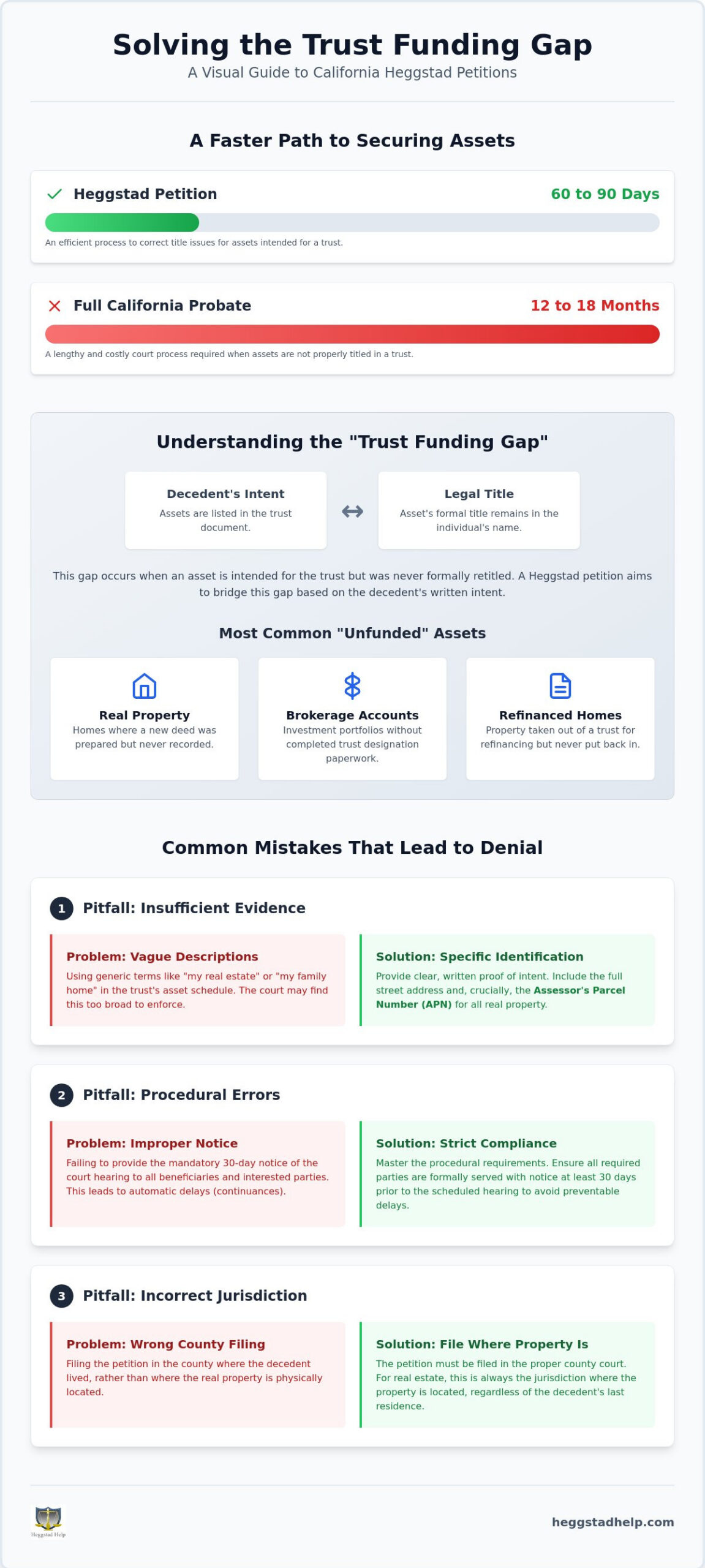
Did you know that a properly executed Heggstad petition can often resolve title issues in just 60 to 90 days, while a full California probate can drag on for 12 to 18 months? It’s a powerful tool for successor trustees, but the margin for error is surprisingly thin. Many people assume that because a house was mentioned in a trust document, the transfer is a mere formality. However, failing to account for common mistakes Heggstad petition filers often encounter can lead to a flat denial from the court, forcing you back into the lengthy probate process you worked so hard to avoid.
We understand the stress of managing a decedent’s estate when titles are missing or outdated. It’s natural to feel overwhelmed by the technical requirements of Probate Code 850 (the specific law that allows a judge to transfer property into a trust after death). This guide will help you identify the critical procedural and evidentiary pitfalls that cause these petitions to fail in California courts. You’ll learn how to present clear evidence of intent and satisfy the strict notice requirements of the judicial system. By understanding these nuances, you can ensure a successful transfer of real property into the trust while minimizing unnecessary legal delays and court costs.
Key Takeaways
- Identify the “Trust Funding Gap,” which is the mismatch between legal title and trust intent, and why a Heggstad petition is the most efficient remedy for un-titled assets.
- Learn how to avoid the common mistakes Heggstad petition filers make by providing specific evidence, such as property addresses and assessor’s parcel numbers, rather than vague descriptions.
- Master the procedural requirements, such as the mandatory 30-day notice to all beneficiaries, to prevent avoidable court continuances (delays in your hearing).
- Determine the correct California jurisdiction for your filing to ensure your petition is heard in the proper county court where the property is located.
- Understand the advantage of working with a Board-Certified Specialist to navigate the nuances of specialized trust asset title correction and ex parte court orders.
Why Heggstad Petitions Fail: Identifying the “Trust Funding Gap”
When a person creates a revocable living trust, their primary goal is to ensure their assets pass to beneficiaries without the delay and expense of a full probate. However, a trust is only effective if it is properly “funded.” If an asset is not formally retitled into the name of the trust, a “Trust Funding Gap” occurs. This term describes the discrepancy between the decedent’s clear intent to include an asset in their estate plan and the actual legal title on record at the time of their death. If the title remains in the decedent’s individual name, the asset is technically outside the trust’s reach.
The primary remedy for this gap is a petition filed under California Probate Code Section 850, which provides the modern statutory framework for these filings. This legal procedure is widely known as a Heggstad petition, named after the landmark case Estate of Heggstad. This case established that a written declaration of trust can be sufficient to transfer property even if the formal deed was never recorded. While this is a powerful tool, you must remember that a court order is not an automatic right. It’s a formal request to a judge; common mistakes Heggstad petition filers make often involve assuming the court will simply approve the request without rigorous proof of intent.
The Most Common Assets Left Out of California Trusts
In our specialized practice, we frequently see specific assets fall through the cracks of a traditional estate plan. These include:
- Real property: This includes primary residences or rental units where a deed was prepared but never actually recorded with the County Recorder.
- Brokerage accounts: Many investment portfolios remain in an individual’s name because the owner failed to complete the trust designation or “transfer on death” (a designation that names a beneficiary) paperwork.
- Refinanced homes: This is a particularly frequent issue. Lenders often require a property to be moved out of a trust and into an individual’s name during the refinancing process. If the owner passes away before retitling the property back into the trust, the asset remains legally “unfunded.”
If you find yourself managing an estate with these “forgotten” assets, identifying the gap is the first step toward a resolution. Avoiding the common mistakes Heggstad petition candidates face requires a methodical approach to gathering evidence and presenting a clear, logical case to the California court system.
The Evidence Trap: Why a Trust Schedule Isn’t Always Enough
A frequent misconception among successor trustees is the belief that any mention of an asset within the trust documents guarantees a successful court order. In reality, evidentiary insufficiency is one of the most common mistakes Heggstad petition filers encounter. California judges require clear and convincing evidence of the decedent’s intent to hold a specific asset in trust. If your documentation is vague or contradictory, the court may determine that the legal requirements have not been met, leaving the property stuck in probate.
The “Vague Schedule” mistake is a primary culprit for petition denials. If a trust’s “Schedule A” (the list of assets intended for the trust) simply states “real estate” or “my family home” without providing a specific street address or Assessor’s Parcel Number (APN; the unique number assigned to a property by the county tax assessor), the court may find the description too broad to enforce. Similarly, the “Missing Link” error occurs when a trustee fails to provide a document that explicitly connects the trust agreement to the specific asset in question. Without this direct link, the judge cannot legally confirm that the property belongs to the trust estate.
Reliance on oral testimony is another pitfall. While family members may recall the decedent’s desire to “put the house in the trust,” California courts prioritize written evidence over verbal recollections. Inconsistent documentation can also derail your case; for example, if a deed was signed in an individual’s name after the trust was created, the court might view this as a deliberate choice to remove the asset from the trust. If you are unsure if your current documentation is sufficient, consulting with a specialist in trust asset title correction can help clarify your standing before you file.
The Gold Standard of Evidence for Probate Code 850
To avoid these evidentiary traps, successor trustees should aim for a “gold standard” of proof that leaves little room for judicial doubt. This typically includes:
- Detailed Property Descriptions: Your petition should include the full legal description found on the most recent deed along with the APN to ensure the court can identify the exact parcel of land.
- Referenced Exhibits: Ensure that any asset list is clearly referenced within the body of the trust agreement itself, establishing it as an integral part of the estate plan.
- Supporting Declarations: Written statements from the original drafting attorney or witnesses who were present during the trust’s creation can provide the necessary context to confirm the decedent’s intent.
Procedural Errors That Stall Heggstad Petitions in California Courts
Even if you have gathered the “gold standard” of evidence discussed previously, procedural slips can derail your progress. These common mistakes Heggstad petition applicants make often result in a “continuance” (a court order delaying the hearing to a future date), which can add months to the resolution of the estate. While the court is generally helpful, judges cannot overlook statutory requirements regarding how a case is filed and who is notified.
Jurisdictional mistakes are a frequent hurdle. Generally, a petition under Probate Code 850 must be filed in the county where the real property is located or where the trust is currently administered. Filing in the wrong venue can lead to a dismissal, forcing you to restart the process from scratch. Additionally, the language in your proposed order must be precise. If the order lacks a full legal description or the specific “title correction” wording required by the County Recorder, you may find yourself with a court order that cannot be used to actually transfer the deed.
For trustees facing a pending sale, failing to utilize the “Ex Parte” (an expedited or emergency) procedure is a critical error. If a property is already in escrow, a standard court date may be too far in the future, risking a breach of contract. We specialize in managing the Heggstad petition filing process to ensure these time-sensitive procedural requirements are met without the need for multiple court appearances.
Navigating California’s Strict Notice Requirements
The most frequent reason for a stalled petition is defective notice. California law requires that all “interested persons” receive a formal 30-day notice of the hearing. This group includes all current beneficiaries and, crucially, any legal heirs who would have inherited if there were no trust (even if they were intentionally disinherited). You must use the correct Judicial Council form, DE-120 (Notice of Hearing—Decedent’s Estate or Trust), and ensure the proof of service is filed with the court well before the hearing date. A single missing recipient or a late mailing can push your resolution back by 60 to 90 days, significantly increasing the stress of the administration.
If you encounter difficulties in locating specific heirs or beneficiaries to fulfill these legal obligations, you may visit HubHound to access professional investigative services that can help track down necessary parties and ensure your filing moves forward without delay.
Securing a Successful Court Order: Best Practices for Successor Trustees
Successor trustees often start the estate administration process with a generalist attorney, but a Heggstad filing is a specialized legal instrument that requires a surgical approach. While many probate lawyers are proficient in full court administrations, they may lack the specific experience needed to navigate the unique evidentiary hurdles of a Probate Code 850 petition. A Board-Certified Specialist in Estate Planning, Trust and Probate Law understands exactly how to frame the decedent’s intent to satisfy a skeptical judge. This level of precision is the best defense against the common mistakes Heggstad petition applicants frequently make, such as providing insufficient proof of asset funding.
This requirement for specialized knowledge isn’t limited to California; for those managing estates with assets in other jurisdictions, consulting an estate planning attorney New York can ensure that similar title issues are addressed according to local probate laws and that your overall estate plan is secure.
If you are facing a looming deadline, such as a pending real estate sale, the timing of your filing is critical. Utilizing professional Heggstad petition filing services ensures that your “Order Confirming Trust Assets” is drafted with the exact legal descriptions required by the County Recorder. This prevents the order from being rejected after you’ve already left the courtroom. For urgent cases, we often leverage ex parte procedures (emergency court applications) to confirm assets quickly; this allows you to meet escrow deadlines without the typical 90-day wait.
The Successor Trustee Checklist for Asset Recovery
- Locate Original Documents: Find the original signed trust agreement and all subsequent amendments immediately; these are the foundation of your evidence.
- Gather Asset Records: Collect the most recent deeds for real property or account statements for brokerage accounts that were left in the individual’s name.
- Validate Evidence: Consult with a specialist to determine if your documentation meets the “clear and convincing” standard required by California law before you pay filing fees.
Next Steps: Correcting the Title Without Full Probate
The path forward involves drafting a petition that specifically requests a title correction under Probate Code 850. Once the judge signs the order, it must be recorded with the California County Recorder’s office in the county where the property is located. This recording acts as the final bridge, officially moving the property from the decedent’s name into the trust. If you feel overwhelmed by the technical requirements, contact Heggstad Help for a specialized review of your trust asset recovery case. We focus exclusively on these filings to help you avoid the common mistakes Heggstad petition filers encounter and secure the assets for your beneficiaries.
Take Decisive Action to Resolve Your Trust Funding Gap
Navigating the complexities of California Probate Code 850 requires more than just a signed trust document; it demands a precise alignment of evidence and procedure. By identifying the trust funding gap early and avoiding the common mistakes Heggstad petition filers often make, such as providing vague property descriptions or failing to notify all legal heirs, you can successfully bypass the lengthy probate process. This methodical approach ensures that real property is transferred quickly, preserving the estate’s value and honoring the decedent’s true intent.
If you’re feeling the pressure of a pending sale or the weight of managing missing titles, you don’t have to face the court system alone. Robert P. Bergman is a Board-Certified Specialist in Estate Planning, Trust and Probate Law who has been practicing in California since 1980. With a specialized focus on trust asset title correction and Heggstad filings, our firm offers the expertise required to secure a recordable court order without unnecessary delays. Get Expert Help with Your Heggstad Petition to ensure your estate administration remains on the right track. You can resolve these title issues and move forward with the peace of mind that the estate is finally complete.
Frequently Asked Questions
Can I file a Heggstad petition if there is no written schedule of assets?
Yes, you can still file a petition even if there is no formal schedule of assets (the list of property intended for the trust) attached to the document. While a “Schedule A” provides the clearest evidence, California courts may accept a general assignment of all the decedent’s property to the trust. You must provide other written evidence of the creator’s intent to avoid the common mistakes Heggstad petition filers make when documentation is sparse.
How long does the Heggstad petition process take in California?
The Heggstad petition process typically takes between 60 and 90 days to reach a final court order in California. This timeline is significantly more efficient than a full probate administration, which often lasts 12 to 18 months or longer. The exact duration depends on the specific county court’s calendar and whether your initial filing is procedurally perfect, as any errors in notice can lead to a continuance (a court-ordered delay of your hearing).
What happens if a Heggstad petition is denied by the judge?
If a judge denies your petition, the asset must generally go through a full California probate process to transfer the title to the beneficiaries. However, if the denial is “without prejudice,” the court is allowing you to refile the petition after you have gathered better evidence or corrected procedural flaws. Understanding the common mistakes Heggstad petition applicants face before you file is the best way to prevent this outcome and the associated costs of a full probate.
Is a Heggstad petition cheaper than a full California probate?
Yes, a Heggstad petition is a much more cost-effective alternative to a full probate administration. In California, probate fees are statutory (legal fees calculated as a fixed percentage of the gross estate value), which can be quite expensive for real property. Because a petition is a targeted legal request rather than a comprehensive estate oversight, the legal fees and court costs are substantially lower, allowing more of the estate’s value to pass directly to the heirs.
Do I need to notify disinherited family members about the Heggstad petition?
Yes, you are legally required to provide formal notice to all legal heirs, including those who were intentionally disinherited. California law dictates that all “interested persons” (individuals who would have inherited the property under state law if the trust did not exist) must receive a 30-day notice of the hearing. Skipping this step is a major procedural error that will cause the judge to delay your case until all parties are properly served and proof of service is filed.

Article by
Robert P. Bergman, Attorney at Law
Attorney Robert P. Bergman ("Bob Bergman") has been a Board-Certified Specialist in Estate Planning, Trust and Probate Law since 2011, as certified by the California State Bar Board of Legal Specialization. For several years, Bob has assisted families and the clients of other attorneys with obtaining court orders through Heggstad petitions to avoid the time and expense of Probate administration. Bob is friendly, very approachable, and believes in explaining complex legal topics in clear ordinary language so that his clients understand exactly what they're doing and why they're doing it.
Bob is often able to assist clients who are in other counties than his home county of Santa Clara through his approach to Heggstad petitions.
Disclaimer
This article is for informational purposes only. Nothing in this article is intended to replace legal advice from a competent attorney or be considered legal guidance for anybody's specific legal situation. Nobody should rely on information in this article in making legal decisions without such consultation.


