How to Fix Trust Title Errors on California Real Property: A 2026 Legal Guide

Imagine you have finally found a buyer for your late parent’s home, only to have the title company halt the sale because the deed was never formally…

Imagine you have finally found a buyer for your late parent’s home, only to have the title company halt the sale because the deed was never formally moved into the trust. This discovery often brings the severe consequences of incorrect trust property title California families face into sharp focus, potentially triggering a probate process that can last 12 to 18 months. It’s a stressful situation, especially when you are already dealing with the loss of a loved one and the weight of technical terms like vesting (the legal way a property’s ownership is officially recorded on a deed).

You likely want a solution that avoids the high costs of a traditional court case. This guide will teach you how to identify title mistakes and correct them using a Heggstad petition, which is a specialized court order used to confirm assets as trust property. We’ll explain how to bypass full probate, whether your situation qualifies for an ex parte (a request for a court order without a formal hearing) filing, and how counties like San Mateo can often grant these the same day. You’ll also learn about the 2026 small estate threshold of $239,700 and how fixed fees help attorneys and clients move forward with confidence.

Key Takeaways

  • Discover why a California trust cannot technically hold title and how incorrect vesting (the legal way ownership is listed) often leads to rejected deeds at the title company.
  • Understand the severe consequences of incorrect trust property title California families face, including a frozen chain of title that prevents you from selling or refinancing the home.
  • Learn how to use a Heggstad petition to fix an “unfunded” trust without a 12-month probate, specifically through fast-tracked ex parte filings (court orders granted without a formal hearing).
  • Identify if your estate qualifies for simplified procedures based on the 2026 threshold of $239,700 for those dying on or after April 1, 2026.
  • Get clarity on costs with fixed-fee arrangements that cover both filing and attorney fees, ensuring there are no hidden financial surprises during the legal process.

Understanding Trust Title Errors: Why Your Deed Might Be Invalid

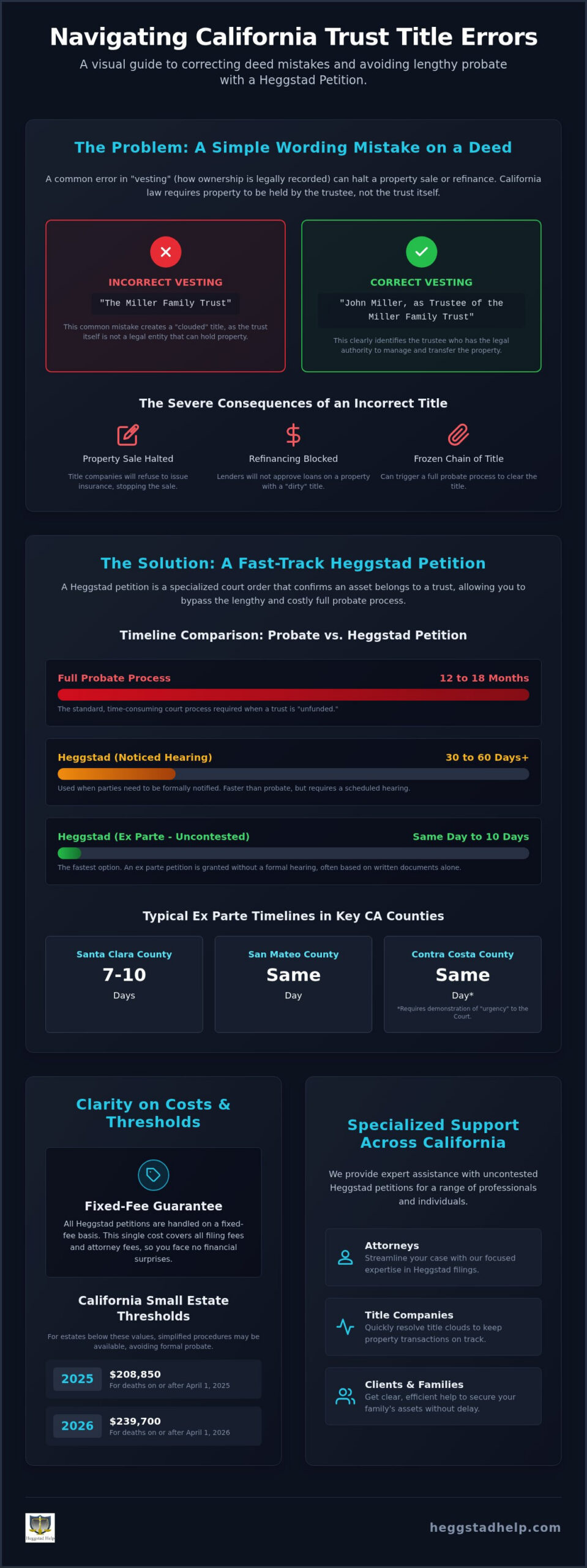
When you examine a property deed, you are looking at the “vesting” (the formal legal method through which ownership is officially recorded). A common misconception is that a trust is a distinct legal entity, similar to a corporation, that can own property in its own name. In reality, a trust is a fiduciary relationship. One of the most significant consequences of incorrect trust property title California homeowners encounter is a “clouded” title that prevents a house from being sold or refinanced. This occurs because California law dictates that a trust cannot hold title; only the trustee (the person or entity managing the trust assets) can hold the legal title to the property.

To understand why this matters, it helps to look at What is a Trust in Property Law to see the distinction between legal and equitable title. The trustee holds the legal title, which provides the authority to sign deeds and manage the asset. The beneficiaries hold the equitable title, which gives them the right to benefit from the property. If a deed is made out to “The Miller Family Trust” instead of “John Miller, as Trustee of the Miller Family Trust,” the chain of title is technically broken. The “vesting deed” must clearly show that the trustee has the legal power to act, or title insurance companies will likely refuse to clear the transaction.

The Trust vs. Trustee Distinction

Naming the trust itself as the owner is a frequent error that can lead to a rejected sale. While the 2023 case Boshernitsan v. Bach provided some relief by suggesting that courts can look at the intent of the parties, title companies remain extremely risk-averse. They often require a court order to prove the property is actually a trust asset. If you find yourself in this position, Heggstad Help can assist in securing an ex parte (a request for a court order without a formal hearing) order to resolve the discrepancy quickly.

Common Scenarios for Title Mistakes

Errors often stem from simple human oversight or technical lapses. You might find typographical errors in the trust’s name or the date the trust was created, which creates a mismatch with the trust documents. In other cases, a deed was simply never recorded after the trust was signed, leaving the trust “unfunded.” This is particularly problematic if the estate’s value exceeds the California small estate thresholds ($208,850 for deaths on or after April 1, 2025, and $239,700 for those on or after April 1, 2026). Additionally, deeds that still name a predecessor trustee who has since passed away can halt a sale until a successor trustee’s authority is legally confirmed.

Fixing these errors doesn’t have to take years. While a noticed hearing can take 30 to 60 days, we specialize in fast-tracking uncontested petitions. In Santa Clara County, these are typically granted in 7 to 10 days. In San Mateo and Contra Costa Counties, we can often have them filed and granted the same day, provided we can demonstrate urgency to the court. Our services use fixed fees that cover both the filing fees and attorney fees, so you don’t have to worry about escalating legal costs while trying to secure your property’s title.

Consequences of Incorrect Trust Property Title in California

Discovering an error on a property deed usually happens at the worst possible moment, such as during the final days of an escrow period. The consequences of incorrect trust property title California residents face are not merely clerical; they can halt a multi-million dollar sale or prevent a family from accessing their inheritance for years. When the “chain of title” (the historical record of property ownership) is broken by an incorrect vesting, the property is effectively frozen. Title insurance companies will refuse to issue a policy on what they call a “dirty” title, meaning the buyer cannot secure a loan and the seller cannot transfer the home.

Lenders are equally strict. If you’re trying to refinance a home held in a trust, the bank’s underwriters will scrutinize the deed to ensure the trustee has the legal authority to pledge the property as collateral. If the vesting is technically incorrect under the California Probate Code on Trust Law, the lender will likely deny the application until a court order corrects the record. This creates a significant roadblock for families who need to access home equity for medical expenses or other urgent needs.

The most expensive consequence is the “probate trap.” If a property owner dies with a title error that leaves the home outside the trust, the property may be forced into full probate administration. In California, a standard probate for a $1 million home can take 9 to 18 months and cost upwards of $46,000 in statutory fees (fees set by law that both the attorney and executor are entitled to receive). This is a stark contrast to the fixed-fee Heggstad petition process, which resolves the issue in a fraction of the time. Additionally, improper title transfers can trigger a loss of Proposition 19 protections. For 2026, the exclusion for an inherited primary residence is capped at the parent’s assessed value plus $1,044,586; a title error that results in a “change in ownership” could lead to a massive property tax reassessment.

Why Title Companies Reject Incorrect Vesting

Title officers flag errors when the deed names an entity that cannot legally hold title, such as the trust itself rather than the trustee. This places the property “outside the chain of title,” making it impossible for the officer to verify who actually has the power to sign the closing documents. While a “Correction Deed” (a document used to fix minor typos) might work for a misspelled name, it cannot fix a situation where the property was never transferred to the trust in the first place, especially if the original grantor is deceased and cannot sign a new deed.

The Financial and Time Costs of Inaction

Ignoring a title error only makes the eventual fix more expensive and time-consuming. A full probate process in Los Angeles or the Bay Area can stretch toward two years, while an uncontested Heggstad petition can often be resolved in 60 to 90 days. If you’re managing an estate with missing assets, you can find more details in our guide on Successor Trustee Help for Missing Assets. If you’re unsure if your deed is valid, reviewing our specialized Heggstad petition services can provide clarity. Remember that in counties like Santa Clara, we can often secure these orders in 7 to 10 days, and in San Mateo or Contra Costa, we can occasionally achieve same-day results for urgent cases.

Identifying the Right Fix: Simple Deed Corrections vs. Heggstad Petitions

Fixing a title error requires a clear understanding of whether you are dealing with a minor clerical slip or a fundamental failure to “fund” (transfer ownership into) the trust. If you choose the wrong remedy, you could waste months in administrative loops while the consequences of incorrect trust property title California laws impose continue to stall your home sale. Generally, the path you take depends on whether the error is a “scrivener’s error” (a simple typo made by the person drafting the document) or a complete omission of the property from the trust’s legal chain of ownership.

For major errors where a property was left out of the trust entirely, the legal engine for a fix is Probate Code Section 850. This section allows a judge to declare that a property belongs in a trust even if the deed was never recorded. This is commonly known as a Heggstad petition. Because we specialize in this niche, we often utilize ex parte (a request for a court order without a formal hearing) filings to bypass the standard court calendar. While a noticed hearing might take 60 days, our ex parte expertise allows us to secure orders in Santa Clara County within 7 to 10 days. In San Mateo and Contra Costa Counties, we can often have petitions filed and granted the same day, provided we can show the court a sense of urgency, such as a pending home sale.

When a Correction Deed Works

A Correction Deed is a simple document used to fix minor mistakes like a misspelled name or an incorrect trust date on an existing deed. This is a cost-effective solution, but it has one strict limitation: all parties, including the grantor (the person giving the property) and the grantee (the person receiving it), must be alive to sign the new document. If the original owner has passed away, you cannot simply “correct” the deed because the person with the legal authority to grant the property is no longer here. In these cases, a simple affidavit won’t satisfy a title company, and a court order becomes necessary.

When You Need a Heggstad Petition

If the property was never deeded to the trust at all, you must prove the owner’s intent to include it. This often involves using a “General Assignment” (a document stating all assets are moved to the trust) or a “Schedule A” (the list of assets typically found at the back of a trust document). As noted in this Heggstad petition guide, this process is the primary way to avoid a 12-month probate for an unfunded California home.

Using this petition is vital if the property value exceeds the small estate threshold, which is $208,850 for deaths on or after April 1, 2025, and increases to $239,700 for those on or after April 1, 2026. At Heggstad Help, we provide these services with fixed fees that cover both the attorney fees and court filing fees. This transparency ensures you know the total cost upfront while we work to secure your property’s chain of title through the most efficient legal channels available.
Step-by-Step Guide to Correcting California Trust Title Issues

Correcting a title error requires a methodical approach to satisfy both the court and the title insurance company. When you’re managing the consequences of incorrect trust property title California law creates, you need a clear path to move from a rejected deed to a clean title. Following a structured sequence helps you avoid the “probate trap” and ensures your property is legally secured within the trust’s protection. Here’s how to navigate the process effectively.

The first step is gathering the “smoking gun” evidence that proves the property was intended to be part of the trust. You’ll need the original trust document and any specific evidence of intent, such as a “Schedule A” (the list of assets intended for the trust) or an “Omnibus Assignment” (a document that assigns all current and future property to the trust). If you’re looking for specific evidence tips, our guide on Deed Not Recorded to Trust in California: Legal Remedies provides a deep dive into what courts look for. Once the evidence is in hand, you must determine the best legal vehicle for the fix.

Evaluating the Estate Value

Before filing a court petition, it’s essential to check if the estate qualifies for simplified procedures. For deaths occurring on or after April 1, 2025, the Small Estate Affidavit threshold is $208,850. This limit increases to $239,700 for deaths occurring on or after April 1, 2026. While these thresholds are helpful for bank accounts or vehicles, California real estate almost always exceeds these limits. Because the home’s value usually pushes the estate over the threshold, a Heggstad petition under Probate Code Section 850 is typically the only way to avoid a full, 12-month probate administration.

Gathering Evidence of Intent

Successor trustees should search the decedent’s estate planning binder for an “Assignment of Assets” or a “Purpose” clause within the trust itself. These clauses often state that the person intended to include all their real property in the trust. This documentation is vital because it allows us to prepare a petition that clearly demonstrates the owner’s intent to the judge. By presenting a strong case, we can often file these petitions ex parte (a request for a court order without a formal hearing), which significantly speeds up the timeline.

Efficiency is our priority. In Santa Clara County, we typically see petitions granted in 7 to 10 days. In San Mateo and Contra Costa Counties, we can often have a petition filed and granted on the same day, provided we can show the court a clear sense of urgency. Once the judge signs the order, the final step is recording a certified copy of that order with the County Recorder to officially “clean” the title. We handle this entire process through our Heggstad petition services, using a fixed-fee model that covers all filing and attorney costs so you have total price transparency from day one.

Fast-Tracking Your Title Correction with Heggstad Help

One of the most daunting consequences of incorrect trust property title California families deal with is the prospect of a long, drawn-out probate. While a general probate lawyer might guide you through a process that lasts 12 to 18 months, a specialist focusing on Heggstad petitions operates on a completely different timeline. By narrowing our focus to trust title corrections, we’ve developed a methodical approach that prioritizes speed and precision. We assist attorneys, title companies, and private clients throughout the state to resolve these issues before they cause a real estate transaction to collapse.

Our service model is built on transparency, which is why we utilize a fixed-fee structure. This single fee covers both the court’s filing fees and all attorney fees, ensuring you won’t face unexpected bills as your case progresses. This clarity is especially important when you’re managing an estate that exceeds the California small estate thresholds ($208,850 for deaths on or after April 1, 2025, and $239,700 for those on or after April 1, 2026). When real estate values push an estate over these limits, our specialized knowledge becomes the most efficient tool for securing the property’s chain of title.

The Ex Parte Advantage

The secret to our speed lies in our expertise with ex parte (a request for a court order without a formal hearing) filings. By presenting an uncontested petition directly to a judge, we can often bypass the standard 30 to 60 day notice period required for formal hearings. This regional efficiency is a hallmark of our practice. In Santa Clara County, we typically see petitions granted in just 7 to 10 days. In San Mateo and Contra Costa Counties, we can often file and receive a granted order on the same day, provided we can demonstrate a clear sense of urgency to the court. This rapid resolution is essential for successor trustees who are in the middle of a 30-day escrow.

Ready to Secure Your Trust Property?

Waiting to fix a title error is a risky strategy. As time passes, evidence of intent can be lost, and the legal hurdles only become more complex. Robert P. Bergman uses over 40 years of specialized experience to navigate the intricacies of the California court system, ensuring that your property is legally confirmed as a trust asset without the need for full probate administration. If you’re facing a rejected deed or a clouded title, taking action now can save your family tens of thousands of dollars in statutory probate fees. You can take the first step toward a resolution today and Get a Fixed-Fee Quote for Your Heggstad Petition.

Securing Your Real Estate Legacy Without the Probate Delay

Vesting errors on a deed don’t have to result in a multi-year legal nightmare for your family. By understanding the severe consequences of incorrect trust property title California law imposes, you can take the necessary steps to restore your property’s chain of title. The Heggstad petition remains the most powerful tool for successor trustees to fix “unfunded” trusts and avoid the high costs of full probate administration. Whether you’re navigating the 2026 small estate thresholds or racing against a 30-day escrow, a specialized court order provides the finality you need.

We assist families, title companies, and attorneys statewide by leveraging regional court efficiencies. Our team provides ex parte expertise that can secure orders in 7 to 10 days in Santa Clara County, with same-day filing available in San Mateo and Contra Costa Counties when urgency is demonstrated. Led by a California Board-Certified Specialist since 1980, our service uses fixed fees that include all court costs to ensure you have complete financial certainty. You can resolve these title complications quickly and move forward with confidence.

Start Your Heggstad Petition with a Fixed-Fee Specialist

Protecting your property and your beneficiaries’ inheritance is just one step away with the help of a dedicated guide.

Frequently Asked Questions

What is a Heggstad Petition and how does it fix title errors?

A Heggstad Petition is a specific legal request made under Probate Code Section 850 that asks a judge to declare that a property is part of a trust. It fixes title errors by providing a court order that serves as a legal bridge for a broken chain of title (the official record of ownership). This process is essential when the consequences of incorrect trust property title California families face include a rejected home sale due to a deed that was never properly recorded.

How much does it cost to file a Heggstad Petition in California in 2026?

We provide Heggstad Petition services using a transparent, fixed-fee model that covers both the attorney fees and the required court filing fees. This approach eliminates the stress of hourly billing and ensures you know the total cost before the process begins. By choosing a fixed fee, you avoid the unpredictable expenses often associated with traditional probate litigation while working to secure your property’s legal standing.

Can I sell my house while the Heggstad Petition is pending in court?

You can open escrow and find a buyer, but you cannot officially close the sale until the petition is granted and the certified court order is recorded. Title insurance companies require this order to “clean” the title before they’ll issue a policy to the new owner. If you’re in a hurry, we use ex parte (a request for an order without a formal hearing) filings to speed up the court’s decision.

What happens if a deed was never recorded to the trust before the owner died?

If a deed wasn’t recorded, the property is technically “unfunded” and remains in the decedent’s individual name. This often triggers a full probate process unless you file a Heggstad Petition to prove the owner’s intent to include the house in their trust. We look for “evidence of intent” in the trust’s Schedule A (the list of assets) or a general assignment document to convince the judge to move the property into the trust posthumously (after death).

How long does the Heggstad Petition process take in Santa Clara County?

In Santa Clara County, uncontested Heggstad Petitions are typically granted in just 7 to 10 days. This rapid timeline is possible because we specialize in ex parte applications that bypass the standard court calendar. In neighboring counties like San Mateo and Contra Costa, we can often see petitions filed and granted the same day, though Contra Costa requires demonstrating “urgency” to the court to achieve that speed.

Is a Heggstad Petition the same as a full California probate?

No, a Heggstad Petition is a streamlined alternative that is much faster and less expensive than a full probate. While a standard probate can take 12 to 18 months and involves high statutory fees (fees set by law based on the estate’s value), a Heggstad Petition focuses only on the specific title error. It’s a targeted solution designed to resolve the consequences of incorrect trust property title California residents encounter without the burden of a year-long court case.

Can I fix a trust title error if the original grantor is still alive?

If the grantor (the person who created the trust) is still alive and has the mental capacity to sign documents, you don’t need a court petition. You can simply prepare and record a new deed with the correct vesting (the legal way ownership is held) at the County Recorder’s office. A Heggstad Petition is only necessary if the grantor has passed away or is no longer legally able to sign a new deed to correct the mistake.

What is the small estate threshold for California in 2026?

For individuals who pass away on or after April 1, 2026, the California small estate threshold is $239,700. This is an increase from the $208,850 limit set for those dying on or after April 1, 2025. While these thresholds allow for simplified transfers of bank accounts or vehicles, real estate in California almost always exceeds these values, which is why a Heggstad Petition is usually required to move a home into a trust.

Robert P. Bergman, Attorney at Law

Article by

Robert P. Bergman, Attorney at Law

Attorney Robert P. Bergman ("Bob Bergman") has been a Board-Certified Specialist in Estate Planning, Trust and Probate Law since 2011, as certified by the California State Bar Board of Legal Specialization. For several years, Bob has assisted families and the clients of other attorneys with obtaining court orders through Heggstad petitions to avoid the time and expense of Probate administration. Bob is friendly, very approachable, and believes in explaining complex legal topics in clear ordinary language so that his clients understand exactly what they're doing and why they're doing it.
Bob is often able to assist clients who are in other counties than his home county of Santa Clara through his approach to Heggstad petitions.

Disclaimer

This article is for informational purposes only. Nothing in this article is intended to replace legal advice from a competent attorney or be considered legal guidance for anybody's specific legal situation. Nobody should rely on information in this article in making legal decisions without such consultation.

Successor Trustee Help for Missing Assets: A California Resource Guide

Imagine you’re weeks into managing an estate when you discover a stray property deed or an old brokerage statement that doesn’t mention the trust at…

Imagine you’re weeks into managing an estate when you discover a stray property deed or an old brokerage statement that doesn’t mention the trust at all. It’s a common hurdle, but it often triggers a wave of panic about a 12 to 18 month probate process and mounting pressure from beneficiaries who are waiting for their distribution. If you’re searching for successor trustee help for missing assets, you’ve likely realized that a simple oversight by the original grantor can stall the entire administration.

You don’t have to resign yourself to a lengthy court battle or high statutory fees just because an asset was left "unfunded" (a term for property that was intended for the trust but never formally retitled). In California, a Heggstad Petition, filed under Probate Code section 850, can often transfer these assets into the trust retroactively. This guide will walk you through the practical steps of locating missing records and explain how a targeted court order can bypass the traditional probate timeline. You’ll learn exactly how to identify these missing pieces and the logical path toward securing a court’s confirmation of trust ownership.

Key Takeaways

  • Fulfilling your fiduciary duty requires identifying all property intended for the trust, and professional successor trustee help for missing assets can assist in resolving title errors that would otherwise halt administration.
  • A systematic search of the decedent’s “Schedule A” (the list of assets typically attached to the back of a trust document) and digital footprints is the first step in locating property that was never formally retitled.
  • You can often avoid a 12 to 18 month probate by filing a Heggstad Petition, which is a specialized legal request used to confirm trust ownership based on the grantor’s documented intent.
  • Under California Probate Code section 850, trustees have a specific mechanism to “fix” funding mistakes and move unfunded assets into the trust without the cost of a full probate.
  • In certain Bay Area counties, such as San Mateo and Contra Costa, uncontented ex parte (i.e., no formal hearing) Heggstad petitions may be filed and decided on the same day, while such uncontested Heggstad petitions from the rest of California may be filed in Santa Clara County through my office and decided in 7-10 days.

Table of Contents

The Successor Trustee’s Duty to Locate and Secure Trust Assets

Being appointed as a successor trustee brings a significant legal and ethical fiduciary duty to identify, marshal, and protect every piece of property intended for the trust. This responsibility isn’t limited to the items clearly listed in a binder; it extends to discovering assets that may have been overlooked or improperly titled. When families seek successor trustee help for missing assets, they often find that "missing" takes two forms. It might be physical property, such as jewelry or collectibles, that has vanished from a residence. More commonly, however, the asset is "missing" from the trust itself because the title was never updated to reflect trust ownership.

These "unfunded" assets, such as a family home still held in the decedent’s individual name, create a procedural crisis. Without a clear title, you cannot sell the property or distribute it to beneficiaries. While this situation used to mean an automatic trip to probate court, California Probate Code section 850 now provides a streamlined remedy to confirm trust ownership without a 12 month delay. It allows the court to "fix" the title if you can prove the grantor intended the asset to be part of their estate plan.

Understanding the Risks of Unfunded Assets

If property worth more than the current small estate thresholds is left outside the trust, it typically triggers a mandatory probate process. For deaths occurring on or after April 1, 2025, the threshold for personal property is $208,850, meaning even a modest brokerage account can force your hand. The consequences are often severe: beneficiaries may face 12 to 18 months of waiting, and the estate will incur thousands in statutory attorney and executor fees. You can find more detail on these specific obligations in our guide on Successor Trustee Duties for an Unfunded Trust.

Identifying the Scope of Your Search

Your search must be comprehensive, covering both tangible personal property and real estate. While physical items are located through a walkthrough, real property requires a deeper dive into county records. You aren’t just looking for a deed; you’re looking for evidence of the grantor’s intent. If a document exists stating their desire for the house to be in the trust, you have the foundation for a successful title correction. Professional successor trustee help for missing assets often starts here, by connecting the dots between old records and current legal requirements.

A Resource Checklist for Locating Missing California Property

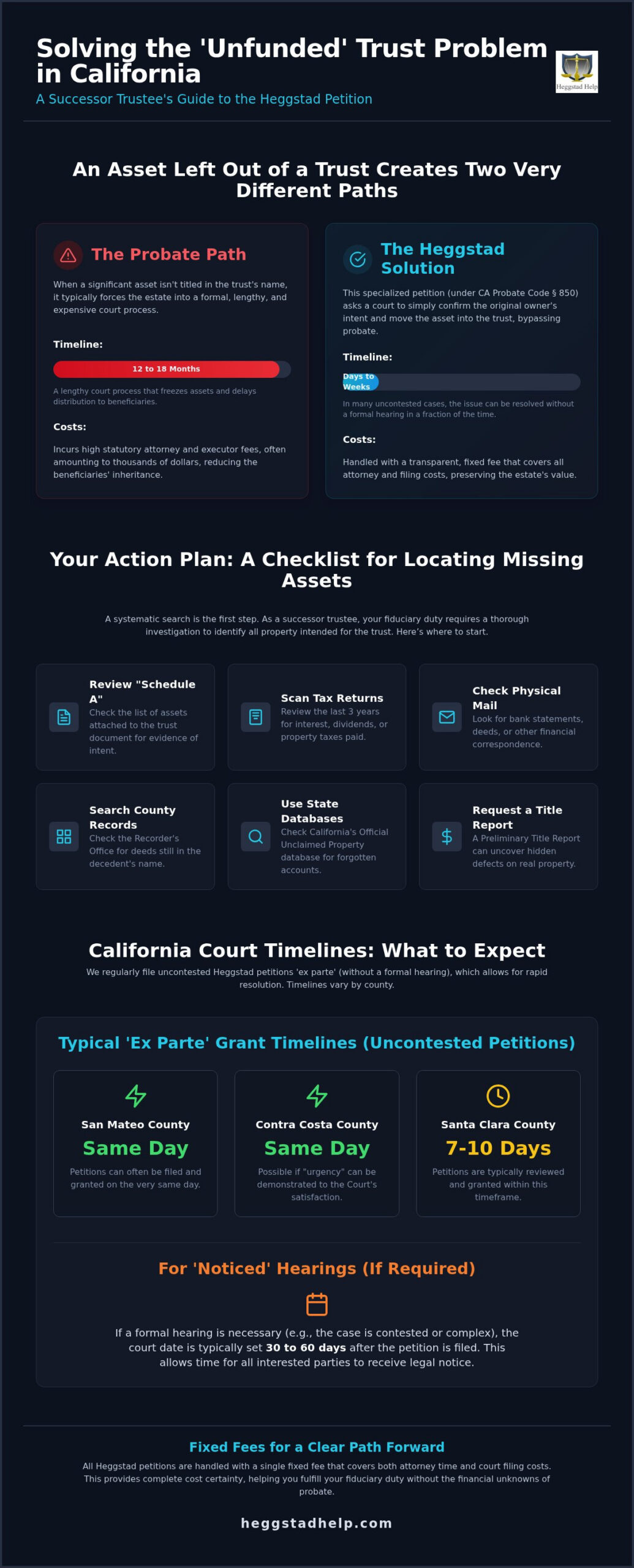
Finding every asset requires a methodical investigation that begins with the trust document itself. You should first review the "Schedule A" (the list of assets typically found at the back of the trust binder) or any general assignment of assets. These documents often serve as a clear statement of the grantor’s intent, even if the formal title was never updated. Next, you’ll need to scour the decedent’s physical mail, tax returns from the last three years, and digital footprints. Tax returns are especially useful because they disclose interest, dividends, or property taxes paid on accounts or real estate you might not know exist.

Your search should also extend to public records and government databases. Conduct a search at the County Recorder’s office in each county where the decedent lived or owned property to identify any deeds still in their individual name. Additionally, check California’s Official Unclaimed Property Database. This resource often holds forgotten bank accounts or insurance proceeds that haven’t seen activity in years. If these steps reveal significant gaps in the trust’s funding, seeking successor trustee help for missing assets can help you determine the best legal path to secure them.

Searching Real Estate and Title Records

It’s standard practice to request a "Preliminary Title Report" from a title company to uncover hidden title defects. You might find property mistakenly held in joint tenancy or discover a deed not recorded to the trust despite being signed years ago. These errors are common, but they prevent you from selling or transferring the home until they’re corrected by the court. Understanding the full consequences of incorrect trust property title California families face is essential, as even a single misfiled deed can halt a pending sale and trigger a lengthy probate process.

Investigating Financial and Digital Assets

Contact the decedent’s financial advisors and banks to verify account ownership status. If you find accounts outside the trust, check for a "Pour-Over Will." This document acts as a safety net, stating that any assets found outside the trust should be "poured" into it. While the will provides evidence of intent, you’ll still need a court order to move the assets without a full 12 month probate. Professional successor trustee help for missing assets can simplify this transition by ensuring the right evidence is presented to the judge.

Successor Trustee Help for Missing Assets: A California Resource Guide

Once you’ve identified a property or account that was intended for the trust but never formally retitled, the next step is seeking a court order to correct the record. A Heggstad Petition, formally filed under California Probate Code section 850, is a specialized legal request used to confirm that property belongs in the trust based on the grantor’s documented intent. This process is the most effective form of successor trustee help for missing assets because it allows you to "fix" funding mistakes without the 12 to 18 month delay of a traditional probate.

The core of a successful petition is proving "intent." If the decedent signed a document expressing the desire for their assets to be held in trust, the court can rule that the property is a trust asset even if the deed was never recorded. This court order is essential for title companies, as they generally won’t issue title insurance (a policy protecting against ownership disputes) on a sale unless the chain of title clearly reflects the trust’s authority. Without this judicial confirmation, the asset remains in a legal limbo that prevents distribution or sale.

When is a Heggstad Petition Appropriate?

This remedy is appropriate when you discover a house was never deeded into the trust or a significant bank account was never retitled. Clear evidence, such as a signed "General Assignment" (a broad legal document transferring all of a person’s property into their trust), is often the key to a favorable ruling. You can see if your missing assets qualify for a Heggstad Petition by reviewing your specific trust documents for these types of supporting clauses.

Avoiding the Costs of Full Probate

Probate fees in California are set by statute and can be incredibly high; for a $1 million estate, the combined statutory fees for the attorney and executor are approximately $46,000. In contrast, a Heggstad filing offers a more efficient, fixed-fee alternative that bypasses the graduated fee scale of the Probate Code. At Heggstad Help, we specialize in these filings, often acting as the expert resource that other attorneys and title companies turn to when they encounter complex title errors. If you’re ready to resolve these issues, our Heggstad Petition Filing services provide a logical, streamlined path toward distributing the estate to the beneficiaries.

The final hurdle in your journey as a trustee is the court filing itself. While California’s legal system can be slow, the procedural path you choose significantly impacts your timeline. You’ll generally face a choice between a noticed hearing and an ex parte (expedited) application. A noticed hearing is the standard route, usually requiring 30 to 60 days to secure a court date because it allows all interested parties time to receive formal notification. However, if you’re seeking successor trustee help for missing assets due to a pending real estate sale or another urgent matter, an ex parte petition might be possible to resolve the issue much faster.

Choosing a fixed-fee structure for these filings provides essential transparency during a stressful time. Instead of worrying about hourly billing that fluctuates with every court delay, you’ll know the costs for attorney services and the $435 court filing fee upfront. This predictability is often a relief for trustees who are already managing the high expectations and pressures of beneficiaries. It allows you to focus on the logical progression of the estate rather than the mounting costs of litigation.

Expedited Results in the Bay Area

In certain SF Bay Area counties, the speed of resolution is a major advantage for those who act quickly. Our experience with ex parte court order services shows that San Mateo and Contra Costa courts can often process urgent, uncontested petitions on the same day they’re filed. In Santa Clara, you might expect a turnaround of 7 to 10 days, which can apply to matters from throughout California. Demonstrating "urgency" to the judge is the key here; if a home is in escrow and the title company is waiting on a court order to close the sale, the court is much more likely to expedite your request. Managing beneficiary expectations during this window is easier when you have a clear, documented timeline from the court.

Next Steps for Successor Trustees

To move forward, you’ll need to gather your evidence: the original trust document, the problematic deed, and the "Schedule A" or general assignment. Having these records organized is the first step toward a successful trust asset title correction. Consulting with a Board-Certified Specialist in Estate Planning, Trust and Probate Law ensures your petition is drafted to meet specific local court requirements, reducing the risk of a denial or a "kick back" from the court clerk. You can contact Robert P. Bergman for Heggstad Petition assistance today to begin the process of securing your trust’s assets and fulfilling your duties to the beneficiaries.

Securing the Estate’s Legacy Without Probate

Discovering a missing deed or an unfunded account doesn’t have to derail your administration. By combining a methodical search of records with the legal framework of California Probate Code Section 850, you can move assets into the trust without the burden of a full probate. This transition protects the estate’s value and ensures beneficiaries receive their inheritance months sooner than they would through traditional court channels. It’s a logical, efficient way to fulfill your fiduciary duties while minimizing stress for everyone involved.

When you need successor trustee help for missing assets, working with a specialist ensures the petition is handled with precision. Robert P. Bergman is a Board-Certified Specialist in Estate Planning, Trust and Probate Law who provides fixed-fee structures for all Heggstad filings, ensuring transparency from the start. Get Expert Help with Your Heggstad Petition today to secure the property and move forward with confidence. You’ve done the hard work of locating the assets; now let us handle the legal steps to make them official.

Frequently Asked Questions

What happens if a successor trustee cannot locate all trust assets?

A successor trustee must make reasonable, documented efforts to identify and safeguard all property intended for the trust to satisfy their fiduciary duty. If assets remain missing after a thorough search of tax returns, mail, and county records, the trustee should document their search process to protect themselves from potential liability. Seeking professional successor trustee help for missing assets can ensure that all resources, including California’s unclaimed property records, are fully exhausted before concluding the search.

How long does a Heggstad Petition take in California?

The timeline for a Heggstad Petition depends on the county and whether the matter is handled through a standard noticed hearing or an expedited process. A standard noticed hearing typically takes 30 to 60 days to reach a court date. However, in Bay Area counties like San Mateo or Contra Costa, ex parte (i.e., no formal hearing) filings can often be resolved on the same day if a critical deadline, such as a real estate closing, is pending. Filings in Santa Clara County, which can be for Santa Clara County and the rest of the California counties, typically are decided within 7 to 10 from the date of filing.

Can a house be moved into a trust after the owner has died?

Yes, a house can be transferred into a trust after the owner’s death if you can prove they intended the property to be a trust asset. This is the primary purpose of a Heggstad Petition under Probate Code section 850. If the decedent signed a "Schedule A" or a general assignment of assets, the court has the authority to issue an order confirming trust ownership, effectively bypassing the need for a 12 to 18 month probate.

What is the cost of a Heggstad Petition compared to probate?

A Heggstad Petition is generally far less expensive than a full probate administration because it avoids statutory attorney and executor fees. In California, probate fees are calculated as a percentage of the gross estate value; for instance, a $1 million estate triggers approximately $46,000 in combined statutory fees for the attorney and executor. A Heggstad filing uses a fixed-fee model that covers the court filing fee and specialized legal work, providing a more efficient resolution for unfunded assets.

Does a Heggstad Petition require a formal court hearing?

Yes, a Heggstad Petition requires a court hearing, though it doesn’t always involve a lengthy trial. Most cases are uncontested and are decided based on the written evidence of the grantor’s intent provided in the filing. While a judge must sign the final order to correct the title, the process is significantly streamlined compared to the multi-step requirements and long timelines of a formal probate proceeding.

Robert P. Bergman, Attorney at Law

Article by

Robert P. Bergman, Attorney at Law

Attorney Robert P. Bergman ("Bob Bergman") has been a Board-Certified Specialist in Estate Planning, Trust and Probate Law since 2011, as certified by the California State Bar Board of Legal Specialization. For several years, Bob has assisted families and the clients of other attorneys with obtaining court orders through Heggstad petitions to avoid the time and expense of Probate administration. Bob is friendly, very approachable, and believes in explaining complex legal topics in clear ordinary language so that his clients understand exactly what they're doing and why they're doing it.
Bob is often able to assist clients who are in other counties than his home county of Santa Clara through his approach to Heggstad petitions.

Disclaimer

This article is for informational purposes only. Nothing in this article is intended to replace legal advice from a competent attorney or be considered legal guidance for anybody's specific legal situation. Nobody should rely on information in this article in making legal decisions without such consultation.

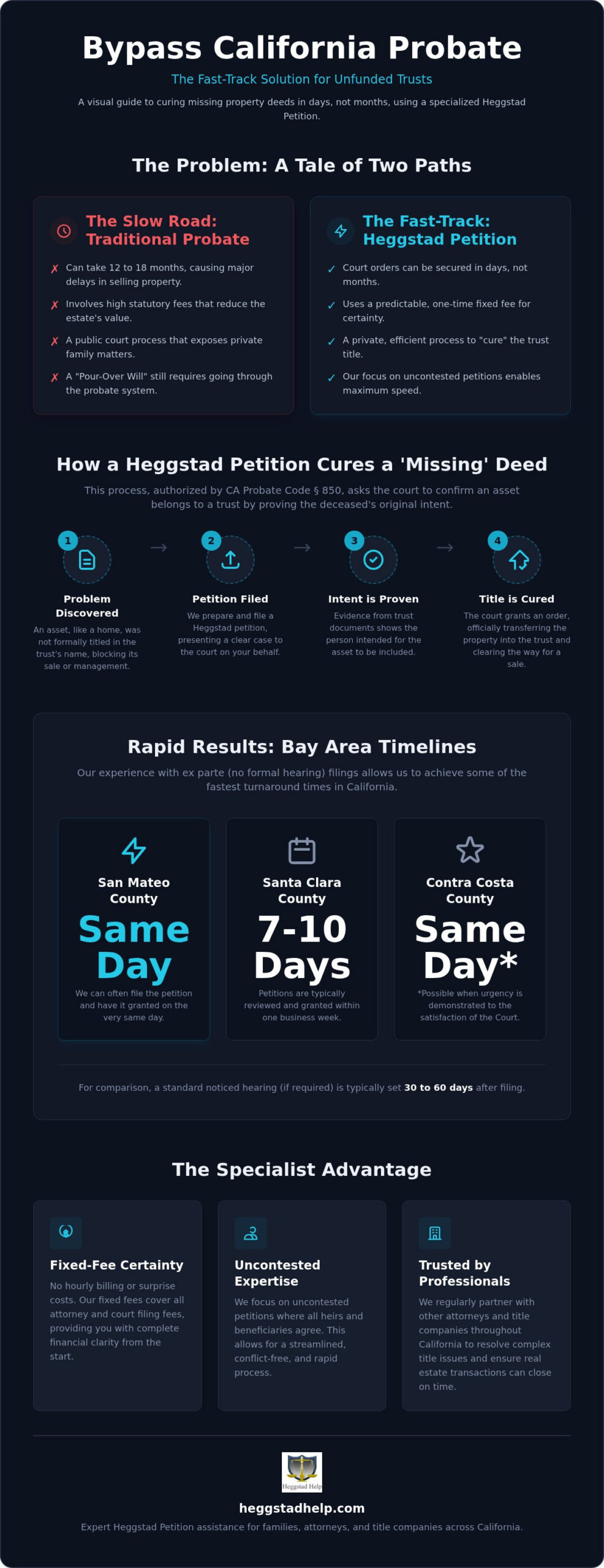
Attorney for Unfunded Trust California: Fixing Missing Deeds with a Heggstad Petition (2026)

Imagine you are in the middle of selling your late parent’s home, only to discover the deed was never actually recorded in the name of their trust….

Imagine you are in the middle of selling your late parent’s home, only to discover the deed was never actually recorded in the name of their trust. This "unfunded trust" (a trust that doesn’t actually own the assets listed in it) can feel like a one way ticket to a twelve month probate nightmare. If you find yourself in this position, finding a specialized attorney for unfunded trust California matters is the first step toward avoiding high statutory fees and public court delays. It’s an incredibly stressful realization, but there is a logical path forward that bypasses the traditional probate system.

We specialize in filing Heggstad petitions to "cure" these missing deeds by proving the deceased person’s intent to the court. We frequently assist other attorneys and title companies throughout California with these filings to ensure assets are transferred correctly, often filing them ex parte in Santa Clara County (see below).

In San Mateo County, we can often have a petition filed and granted on the same day. In Santa Clara County, it typically takes seven to ten days, while Contra Costa County can also offer same day results if we can demonstrate urgency. This article will show you how to use ex parte (without a formal hearing) orders and fixed fee arrangements to secure your property and clear your title in days rather than months.

Key Takeaways

  • Learn how to “cure” an unfunded trust (a trust that exists but doesn’t yet hold title to assets) by using a Heggstad petition to bypass the 12-month probate process.
  • Discover how a dedicated attorney for unfunded trust California can often secure ex parte (without a formal hearing) court orders in as little as one day.
  • Understand specific court timelines for the Bay Area, ranging from same-day results in San Mateo and Contra Costa to 7-to-10-day turnarounds in Santa Clara.
  • Recognize that results for Heggstad petitions for other counties can be handled in Santa Clara County with the same 7-to-10 day turnaround once filed. 
  • See how fixed-fee arrangements provide price certainty for families and title companies so you don’t have to face the high costs of traditional probate.

Table of Contents

What Is an Unfunded Trust and Why Does It Require a California Attorney?

An unfunded trust is a common but stressful complication where the trust documents exist legally, but the title to a specific asset, such as a family home or a brokerage account, was never formally transferred. This usually happens because of a forgotten deed, an asset purchased after the trust was signed, or a simple administrative oversight. When the title remains in an individual’s name rather than the trust’s name, the asset is technically "outside" the trust at the time of death. This creates a legal gap that prevents a successor trustee from managing or selling the property without court intervention.

If you find yourself in this position, you’ll likely need an attorney for unfunded trust California to avoid a full probate administration. Without a specialized petition, these missing assets typically trigger a court process that can last 12 to 18 months. While many families have a "Pour-Over Will" (a backup document designed to catch assets left out of a trust), it’s a common misconception that this will solves the problem instantly. In reality, a Pour-Over Will still requires a probate court’s oversight to move the assets into the trust, meaning you’re still stuck in the traditional probate system unless you use a more efficient legal tool.

The Legal Reality of Missing Trust Deeds

Successor trustees often face a confusing split between the "probate estate" and the "trust estate." The probate estate includes any assets that require court authorization to transfer, while the trust estate includes assets already titled correctly. This split causes a significant title blockage during a home sale because title companies cannot verify ownership. Handling unfunded trust probate California issues through a standard probate is the slow way to clear this hurdle, often costing the estate thousands in statutory fees.

Why a Generalist Attorney Might Miss the Heggstad Solution

Many general practice lawyers default to a full probate because they lack specific experience with Probate Code 850 petitions. This is a missed opportunity for the family. Using the precedent set by the Estate of Heggstad, we can pursue "intent-based" title recovery. By filing a 850 petition California real property, we ask the court to recognize that the decedent intended for the property to be part of the trust. This specialized focus is why we can often secure orders in San Mateo or Contra Costa County on the same day, rather than waiting a year for probate to conclude.

The Heggstad Petition: A Specialized Tool to Cure Missing Trust Titles

The Heggstad petition is a surgical legal remedy named after the landmark 1993 California case, Estate of Heggstad. It serves as a formal request to the court to confirm that a specific asset belongs to a trust, even if the formal title transfer was never completed. For families dealing with a sudden "title blockage," this petition is the most effective way to bypass the public and expensive California probate process. Working with a specialized attorney for unfunded trust California allows you to prove that the decedent intended for the property to be held in the trust, effectively "curing" the missing deed without a year of court oversight.

This legal procedure is authorized under California Probate Code ยง 850, which gives judges the power to determine ownership of property. Robert P. Bergman focuses exclusively on uncontested petitions, where all heirs and beneficiaries agree on the outcome. This lack of conflict is what allows the process to move at such a rapid pace. If you are unsure if your situation qualifies, you can explore how we review trust documents to determine the best path forward.

The Ex Parte Advantage: Bypassing the 60-Day Wait

The primary reason we can achieve such fast results is through "ex parte" filings. An ex parte request is a court application made without the standard 30 to 60 day noticed hearing period. While a generalist might wait months for a spot on the court calendar, a focused attorney for unfunded trust California can often present the Heggstad petition filing directly to a judge. In counties like San Mateo and Contra Costa, this can lead to a granted order in a single day, provided the paperwork is perfect and no one objects.

Evidence Required for a Successful Petition

To win a Heggstad case, the court requires "clear and convincing evidence" of the decedent’s intent. Judges look for specific documentation to verify that the omission was an oversight rather than a change of heart. Key evidence includes:

  • The original trust document and any amendments that mention the asset.

  • A "Schedule A" or asset list that explicitly names the property or account.

  • Written declarations, letters, or emails from the decedent regarding the asset.

  • Financial statements or insurance policies that reference the trust as the owner.

Attorney for Unfunded Trust California: Fixing Missing Deeds with a Heggstad Petition (2026)

Filing Your Petition: Timelines for Santa Clara, San Mateo, and Contra Costa

Heggstad Help provides specialized assistance to attorneys, title companies, and individual clients throughout the entire state of California. The process of moving an asset into a trust begins with gathering essential documents, such as the original trust instrument and proof of the decedent’s intent. Once these are secured, we draft a formal Petition for Order Confirming Trust Assets and file it with the appropriate Superior Court. While many people worry about the 12 to 18 month probate timeline, a focused attorney for unfunded trust California can often resolve these issues much faster using the ex parte (without a formal hearing) process.

It’s important to manage expectations regarding court schedules. If a judge determines that a noticed hearing is required, the court date is typically set 30 to 60 days after the initial filing. This period allows for the legally required notice to be sent to all interested parties. However, if the petition is uncontested and filed ex parte, the resolution can happen in a fraction of that time. If you are facing a looming deadline for a home sale, you can consult with us to determine the fastest filing strategy for your specific county.

Specific Local Timelines for Ex Parte Filings

Court efficiency varies significantly by county. In Santa Clara County, well-prepared petitions from withing Santa Clara County and from other parts of the State are typically granted within 7 to 10 days. San Mateo County is even more efficient; it’s often possible to have a petition filed and granted on the same day. In Contra Costa County, same day grants are also achievable if we can demonstrate "urgency" (such as a pending close of escrow) to the satisfaction of the Court. These rapid turnarounds are only possible when the petition is uncontested and the evidence of intent is clear.

Successor Trustee Duties and Asset Recovery

A successor trustee unfunded trust assets California has a strict fiduciary duty (a legal obligation to act in the best interest of the beneficiaries) to recover missing property. Failing to utilize a Heggstad petition when it is available could be viewed as a breach of this duty, especially if it results in the estate paying unnecessary statutory probate fees. Hiring an attorney for unfunded trust California ensures that you are fulfilling your legal obligations while protecting the estate’s value and avoiding the public probate process.

Choosing a California Heggstad Specialist: Fixed Fees and Expert Results

Selecting the right attorney for unfunded trust California issues is about more than just finding a lawyer; it’s about securing a specialist who understands the nuances of title correction. Robert P. Bergman is a Board-Certified Specialist in Estate Planning, Trust and Probate Law. This specific certification means he has met rigorous experience and education requirements set by the State Bar of California, providing a level of certainty that a general practice lawyer cannot match. Since 1980, we’ve focused exclusively on these complex procedural hurdles, ensuring that families don’t lose their inheritance to the high costs of statutory probate.

We don’t just file paperwork; we act as a bridge between the court system and the real estate industry. Heggstad Help works directly with title companies to ensure that the court order we obtain is sufficient to clear a title blockage and allow a pending home sale to close. This proactive approach prevents the sale from falling through due to avoidable legal delays. By coordinating with the title officers early in the process, we make sure the final order meets their specific requirements for issuing a title insurance policy.

The Fixed-Fee Model for Heggstad Petitions

One of the biggest anxieties for a successor trustee is the unpredictable nature of billable hours. We eliminate this stress by handling all uncontested Heggstad petitions with a transparent fixed-fee model. This single price covers both the court filing fees and the attorney fees, so the estate knows exactly what the cost will be from day one. There aren’t any surprise invoices or hidden administrative charges, allowing you to focus on settling the estate rather than managing legal bills.

Taking the Next Step: Your Heggstad Evaluation

If you’ve recently discovered that you or a loved one forgot to put house in trust California, the clock is often ticking, especially if a sale is pending. We recommend that you review your "Schedule A" list of assets and your current property deeds immediately to identify any discrepancies. Once you’ve identified a missing asset, the next logical step is to seek a professional review. You can Request a Heggstad Petition Evaluation from Robert P. Bergman today to confirm if your case qualifies for an ex parte order and a rapid resolution.

Secure Your Trust Assets with Professional Guidance

Discovering that a family home was never deeded into a trust is a high-stakes complication, but it doesn’t have to lead to a twelve-month probate delay. By working with a specialized attorney for unfunded trust California, you can utilize a Heggstad petition (a court order confirming trust ownership) to align your legal title with your loved one’s true intentions. This approach bypasses the public probate process and secures the clear title you need for a pending home sale or final distribution. Whether you’re facing a seven-day timeline in Santa Clara or seeking a same-day order in San Mateo, a logical and structured path forward exists.

Robert P. Bergman is a Board-Certified Specialist in Estate Planning, Trust and Probate Law with over 40 years of experience. We provide fixed-fee pricing for all Heggstad filings, which covers both the attorney fees and court costs to ensure total transparency for the estate. We regularly assist families, title companies, and other legal professionals in resolving these title blockages with calm competence. Request a Heggstad Petition Evaluation from Heggstad Help today to begin the process of correcting your trust’s title. You don’t have to navigate these procedural hurdles alone.

Frequently Asked Questions

Is it too late to put a house in a trust after the owner has died?

No, it is not too late if you use a Heggstad petition. This legal procedure allows the court to transfer a house or other assets into a trust after the owner has passed away. By presenting evidence of the owner’s intent, such as a "Schedule A" (the written list of assets intended for the trust), we can ask a judge to confirm the property as a trust asset. This effectively "cures" the missing deed and allows the successor trustee to manage the property without a full probate administration.

How much does a Heggstad petition cost in California?

We handle these petitions using a fixed-fee model that provides total price transparency for the estate. This single fee covers both the attorney fees and the court filing fees, so you don’t have to worry about the unpredictability of billable hours. This is typically a much more affordable option than a traditional probate, where the costs are calculated as a percentage of the estate’s gross value under California’s statutory fee schedule.

What is the difference between an 850 petition and a Heggstad petition?

A Heggstad petition is a specific type of filing performed under California Probate Code Section 850. While Section 850 is the broad law used to resolve various property ownership disputes, a Heggstad petition is the specific version used when an asset was left out of a trust by mistake. Working with a specialized attorney for unfunded trust California ensures your petition is drafted to meet the specific "intent-based" requirements that judges look for in these cases.

Can I sell a house while a Heggstad petition is pending?

You can list the home and enter into a purchase contract, but you generally cannot close escrow until the court grants the petition and the order is recorded. Title companies require a clear chain of ownership before they will issue a title insurance policy to a buyer. This is why the speed of our process is so vital; in San Mateo and Contra Costa, we can often obtain these orders on the same day they are filed to ensure a pending sale stays on track.

What happens if a Heggstad petition is contested by an heir?

If an heir or beneficiary objects to the transfer, the court will move the case to a noticed hearing calendar, which is usually set 30 to 60 days out. Contested petitions take much longer to resolve because they require a formal hearing and more extensive evidence. We focus on uncontested petitions, which allow us to utilize the ex parte (expedited) process in counties like Santa Clara to get results in as little as seven to ten days.

Robert P. Bergman, Attorney at Law

Article by

Robert P. Bergman, Attorney at Law

Attorney Robert P. Bergman ("Bob Bergman") has been a Board-Certified Specialist in Estate Planning, Trust and Probate Law since 2011, as certified by the California State Bar Board of Legal Specialization. For several years, Bob has assisted families and the clients of other attorneys with obtaining court orders through Heggstad petitions to avoid the time and expense of Probate administration. Bob is friendly, very approachable, and believes in explaining complex legal topics in clear ordinary language so that his clients understand exactly what they're doing and why they're doing it.
Bob is often able to assist clients who are in other counties than his home county of Santa Clara through his approach to Heggstad petitions.

Disclaimer

This article is for informational purposes only. Nothing in this article is intended to replace legal advice from a competent attorney or be considered legal guidance for anybody's specific legal situation. Nobody should rely on information in this article in making legal decisions without such consultation.