
A signed general assignment can help show that someone intended to place property in a trust, even if the asset was left out of the trust paperwork. Using a general assignment for a Heggstad petition may support a request involving real or personal property, but the document is more useful when other records also connect the specific asset to the trust. The court considers the evidence of that intent.
It’s understandable to wonder whether a broad document covering “all assets” is enough when a particular account, business interest, or home was never formally transferred. A general assignment can support the request, but its value depends on how it fits with the trust documents and records identifying the property.
This article explains which assets a Heggstad petition may cover, what evidence can strengthen a petition, and how a general assignment may help when property was left out of a trust. It also explains why records identifying the asset and documenting the settlor’s intent matter when asking a court to confirm that property belongs to the trust.
Key Takeaways
A general assignment can help show intent to fund a trust, but its strength depends on how well other records connect the asset to that trust.
A Heggstad petition may help address an omitted house when trust documents and related records support the claim that it was intended to be trust property.
Potential assets can include real property and certain personal property, such as accounts or business interests, depending on the evidence and circumstances.
For a petition hearing, California law requires at least 30 days’ notice to heirs and interested parties, which can affect the case timeline.
What evidence wins a Heggstad petition?
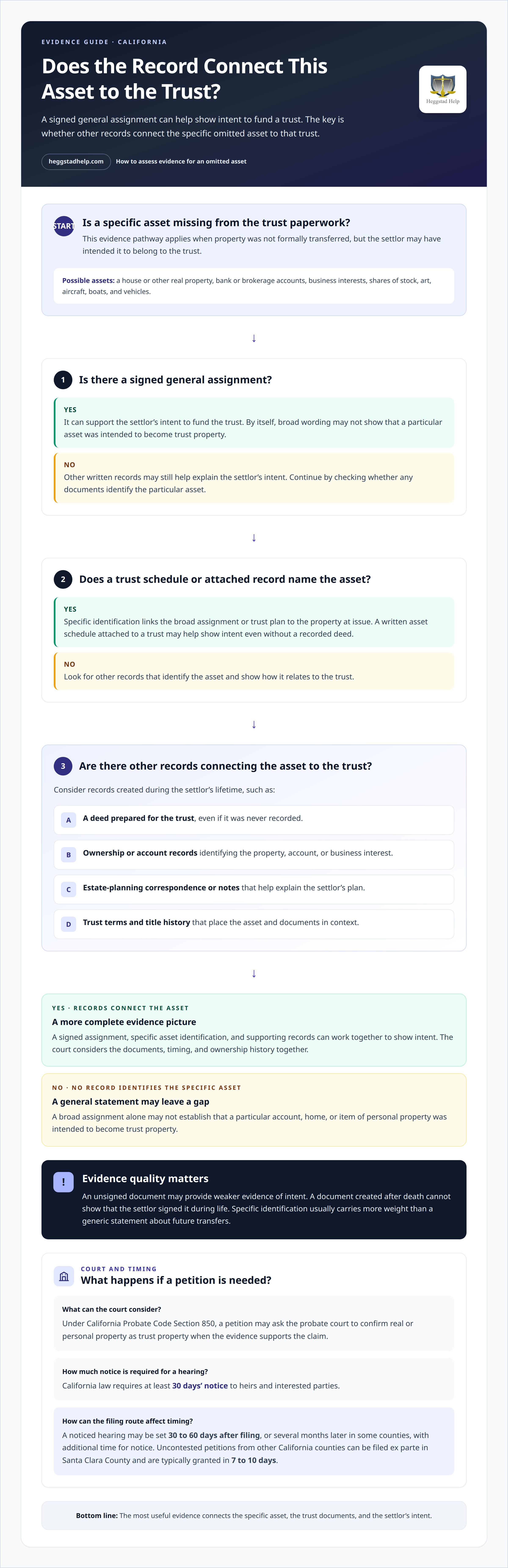
A Heggstad petition is stronger when records show the settlor intended specific property to belong to the trust. Courts consider the signed trust documents, asset records, and timing together.
Evidence of Trust Funding Intent
Evidence of trust-funding intent is documentation connecting the settlor’s estate plan to an asset that was never formally transferred. It matters because a general wish to fund a trust may not establish that a particular account, home, or item of personal property was intended to become trust property.
For example, a signed assignment covering all assets can support the case, especially when an attached schedule identifies specific property. A deed prepared for the trust but never recorded may add context. A strong presentation explains how each record fits the settlor’s estate plan and the asset’s ownership history.
Written and Extrinsic Evidence
Written evidence includes trust schedules, assignments, signed deeds, and other records created at the time; extrinsic evidence means relevant information outside the trust itself. Both can help explain whether the settlor intended an asset to be held by the trust.
Correspondence with an estate-planning advisor, planning notes, and records identifying an account or property may support the written documents. The Estate of Heggstad precedent, decided in 1993, recognized that a written asset schedule attached to a trust could show intent even without a recorded deed. Specific identification usually carries more weight than a generic statement about future transfers.
California law requires at least 30 days’ notice of a Heggstad petition hearing to all heirs and interested parties, according to the California Legislature. A complete petition therefore needs evidence organized for review alongside proper notice.
Our Heggstad petitions have fixed fees that cover filing fees and attorneys’ fees.
Timing depends on whether the matter proceeds by noticed hearing or an available ex parte process. A noticed hearing may be set 30 to 60 days after filing, or several months later in some counties, with additional time for notice.
A vague assignment may not connect a particular asset to the trust, while an unsigned document may provide weaker evidence of the settlor’s intent. A document created after death cannot show that the settlor signed it during life.
Can a House Left Out of a Trust Still Avoid Full Probate?
Yes. A California Heggstad petition may ask the probate court to confirm an omitted house as living trust property. If the court grants the petition, the house may be handled under the trust rather than through full probate.
Assignments and Trust Schedules
A general assignment and a trust asset schedule are written records that may show the decedent intended a house to belong to the trust. Together, they can help explain why a deed was never recorded in the trust’s name.
For example, an assignment covering the settlor’s assets may support the request, while a schedule identifying the house connects that broad language to specific property. A signed but unrecorded deed can add another link. The petition should present these records in context, including the trust terms and property’s title history, rather than relying on an assignment alone.
Governing Code Sections and Local Procedures
California Probate Code Section 850 authorizes a probate court to make orders about trust property titled to or possessed by another party. A petition involving a house may rely on that authority when evidence supports the claim that the decedent intended the property for the trust.
County procedures can differ. Heggstad petitions outside Santa Clara, San Mateo, and Contra Costa Counties often require noticed hearings and may take many months. Uncontested petitions from other California counties can be filed ex parte in Santa Clara County, where they are typically granted in 7 to 10 days. Local filing requirements and whether a court accepts an ex parte request affect the route.
For instance, a house in Los Angeles County may involve a different local process than one in Santa Clara County. An attorney preparing the petition considers the property’s location, the applicable court procedure, and whether interested parties object. California Probate Code Section 850 provides the statutory basis; local court practices shape how the request proceeds.
When the house’s title needs correction after the court confirms trust ownership, California Heggstad petition support can be a relevant next step.
Which assets can a Heggstad petition reach?
Under Probate Code Section 850, a Heggstad petition may ask the court to confirm real or personal property as trust property. The evidence must connect the asset to the trust and the settlor’s intent.
Assets Suited to Heggstad Relief
Heggstad relief may involve property titled to or held by someone other than the trust. Examples include bank accounts, brokerage accounts, business interests, and shares of stock. Ownership records help identify the asset and connect it to the trust.
Courts have also confirmed items such as art, aircraft, boats, and vehicles as trust assets. For an LLC interest, relevant records might show the decedent’s ownership and how the trust documents address personal property or business interests. The key question is whether the evidence supports the requested change in trust administration.
Assignments, Schedules, and Other Assets
A signed general assignment may help establish intent to transfer assets to a trust, while a schedule can identify particular property. Read together, these documents can make a broad assignment more specific. For example, a schedule naming a brokerage account gives the court a clearer connection than a general reference to all personal property.
Other records can add context, including a trust instrument, account statements, and correspondence about the estate plan. An attorney can organize these documents so the petition identifies each asset and explains its claimed link to the trust. A financial institution’s ownership records may clarify whether the account belonged to the decedent.
International property may also be involved, but an overseas asset can add procedural requirements. For example, service under the Hague Convention may be necessary, depending on the circumstances. The property’s location and the parties who must receive notice can affect how the petition proceeds.
For each asset, the petition should distinguish proof of ownership from evidence of trust intent. A bank statement can show that an account existed; a signed assignment or trust schedule can help explain why the court is asked to treat it as trust property.
How can an attorney use a general assignment to support a Heggstad petition?
A signed general assignment can support the settlor’s intent to place property in the trust. Its value increases when the petition connects its language to records identifying the specific asset.
First, the attorney reviews the assignment’s signature, date, and scope alongside the trust instrument. A broad phrase covering all personal property may support intent, but it may not identify a particular account or business interest. The attorney can compare it with a trust schedule, account statement, or ownership record. For a house, a prepared but unrecorded deed may help explain why title was never formally transferred.
Next, the attorney builds a clear record linking the settlor, the asset, and the trust. For example, an assignment, a schedule naming a brokerage account, and a statement showing the settlor’s ownership each address a different part of that connection. The petition should explain any mismatch, such as an account titled in the settlor’s name despite trust-funding documents.
Under California Probate Code Section 850, a probate court may issue orders concerning property claimed as trust property. The attorney frames the requested order around the particular asset and explains how the documents support the settlor’s intent. That focused request can help the court resolve title or ownership questions before trust administration or distribution proceeds.
Evidence should be presented accurately, including records that create uncertainty. A generic assignment without supporting documents may leave the asset’s connection to the trust unclear. If an heir or another interested person disputes ownership, additional proceedings may be needed. An attorney’s analysis helps distinguish a document showing ownership from one showing intent to place that property in the trust.
For help preparing an uncontested petition based on trust-funding records, discuss Heggstad petition filing.
HEGGSTAD HELP: Heggstad Petition Filing
HEGGSTAD HELP, a service of attorney Robert P. Bergman, Board-Certified Specialist in Estate Planning, Trust, and Probate Law (California State Bar Board of Legal Specialization), assists families, attorneys, and their clients throughout the State of California with uncontested Heggstad petitions.
When a general assignment and related records support trust ownership, Heggstad Petition Filing can help seek a court order addressing the omitted asset. Uncontested petitions can be filed ex parte in Santa Clara County Probate Court, regardless of where the trust is located in California. Ex parte means the petition is submitted without a formal hearing; petitions filed there are typically granted in 7 to 10 days.
After an order confirms ownership, Trust Asset Title Correction may help address the asset’s title records.
For help with an uncontested petition, contact HEGGSTAD HELP.
Decide on the Next Step for the Omitted Asset
The next step is to identify the court order needed to resolve the asset’s current ownership problem. A home still titled in a decedent’s name may need a different order and follow-up than a financial account whose custodian needs confirmation of trust ownership. Keeping that practical goal clear helps focus the petition on the result the trustee needs.
When evaluating using a general assignment for a Heggstad petition, consider whether the documents tell a consistent story about the settlor’s intention and the specific asset. If the records leave an important gap, identify it before filing so the petition can address the issue directly. The needed work may involve Heggstad Petition Filing, Ex Parte Court Order Services, or Trust Asset Title Correction, depending on the matter.
For guidance on the next step for your circumstances, contact HEGGSTAD HELP to discuss your case. A clear plan can help move an omitted asset toward resolution.
Frequently Asked Questions
Heggstad petition or probate: what is the difference?
A Heggstad petition asks the court to decide whether a particular asset belongs to a trust; probate generally concerns administration of a decedent’s estate outside the trust. For example, if a home was intended for a living trust but remained individually titled, the petition can seek an order addressing that home. If the court confirms trust ownership, the asset may be handled under the trust rather than through a separate probate of that property.
What is a Heggstad Petition and How Does it Work in San Martin?
A Heggstad petition for property connected to San Martin asks the court to confirm that the asset belongs to a trust. The filing location identified for a San Martin petition is the Downtown Superior Court, 191 North First Street in San Jose. The petition presents the trust and ownership records supporting the request. The court process and required supporting documents depend on the case and applicable local procedures.
Can a Heggstad petition be used for bank accounts?
Yes. A Heggstad petition may ask a California probate court to confirm a bank account as trust property. Evidence can include a signed general assignment, trust documents, and account records showing the decedent owned the account. For example, an account statement may establish ownership, while a trust schedule or assignment may help show intent. The documents need to connect the specific account to the trust.
Does Schedule A prove that property belongs to the Trust?
Schedule A can be persuasive evidence, especially when it specifically identifies the property, but it does not automatically establish trust ownership. For a house, the schedule’s address or description should be considered alongside the trust, assignment, and deed history. Differences in names or legal descriptions across documents can matter. The petition should explain how the records relate to the same property.
What Happens After the Petition Is Granted?
After the court grants a Heggstad petition, the order confirms the asset’s trust ownership. For real property, the order may need to be recorded so the public title record reflects the court’s decision. For a bank or brokerage account, the trustee can provide the order to the institution as evidence of the ruling. The asset can then be handled under the trust’s terms.
What is a Heggstad petition in California probate?
In California probate, a Heggstad petition asks the probate court to confirm that an asset belongs to a trust despite a title or transfer problem. It is associated with Probate Code Section 850, which addresses court orders concerning property claimed by a trust. For instance, a successor trustee may seek an order for an omitted asset when records support the settlor’s intent to place it in the trust.
Disclaimer
This article is for informational purposes only. Nothing in this article is intended to replace legal advice from a competent attorney or be considered legal guidance for anybody's specific legal situation. Nobody should rely on information in this article in making legal decisions without such consultation.