
What if an Alameda County Heggstad petition does not have to be filed in Alameda County? When an asset was not formally titled in a trust, it can be difficult to know which court route applies. A formal hearing may add time, but the property’s location does not always determine the most practical route for an uncontested petition.
This article explains the options for Alameda County property and what to gather before an attorney reviews the matter, including trust documents and written evidence of the owner’s intent. In counties outside Santa Clara, San Mateo, and Contra Costa, Heggstad petitions often require a noticed hearing and may take many months. Uncontested petitions can also be filed ex parte, meaning without a formal hearing, in Santa Clara County, where they are typically granted in 7 to 10 days. HEGGSTAD HELP assists families, attorneys, title companies, and their clients throughout California with these focused filings. Here, you’ll learn how to compare the routes and prepare for review.
Key Takeaways
- A Heggstad petition asks the court to confirm that an asset belongs to a trust. Written records showing the owner’s intent can help an attorney assess the matter.
- For an Alameda County Heggstad petition, compare the local noticed-hearing route with available ex parte options before deciding how to proceed.
- Gather the trust and any amendments, details about the asset, and available title or ownership records for an initial attorney review.
- Uncontested filings can follow different timelines in Santa Clara, San Mateo, and Contra Costa Counties, so the court route can affect the next steps.
Why an Alameda County Heggstad Petition May Raise a Court-Route Question
A family may discover that a home, bank account, or other asset was never formally transferred into a trust. That gap can raise questions about whether the asset must go through probate and which court should consider the issue. A Heggstad petition asks a court to confirm that an asset belongs to a trust, based on evidence of the owner’s intent. The petition does not change title automatically. The court reviews the request and decides whether the asset can be treated as trust property.
The issue connects to trust law principles: a trust holds property for beneficiaries under its terms, while ownership records show how a particular asset is titled. A petition may address a missing transfer, but the documents and circumstances matter. Gather the trust paperwork and asset records before an attorney reviews the situation.
What an Alameda County reader is trying to resolve
The property may be in Alameda County, while the family’s question is which filing route is available for an uncontested matter. Location alone does not answer every procedural question. An attorney can review the trust’s terms and amendments, who created and managed the trust, what the asset records show, and whether anyone disputes the claim. Organizing those details ahead of time makes the review more focused.
Why the court route matters
A noticed hearing and an ex parte request follow different court procedures, and the available route can affect how the matter proceeds. In counties outside Santa Clara, San Mateo, and Contra Costa, Heggstad petitions often require a noticed hearing and may take many months. For an Alameda County Heggstad petition, an uncontested matter can instead be filed ex parte in Santa Clara County and is typically granted in 7 to 10 days. The court decides each request based on its facts and supporting records.
Alameda County Heggstad Petition Routes: Local Hearing or Ex Parte Filing
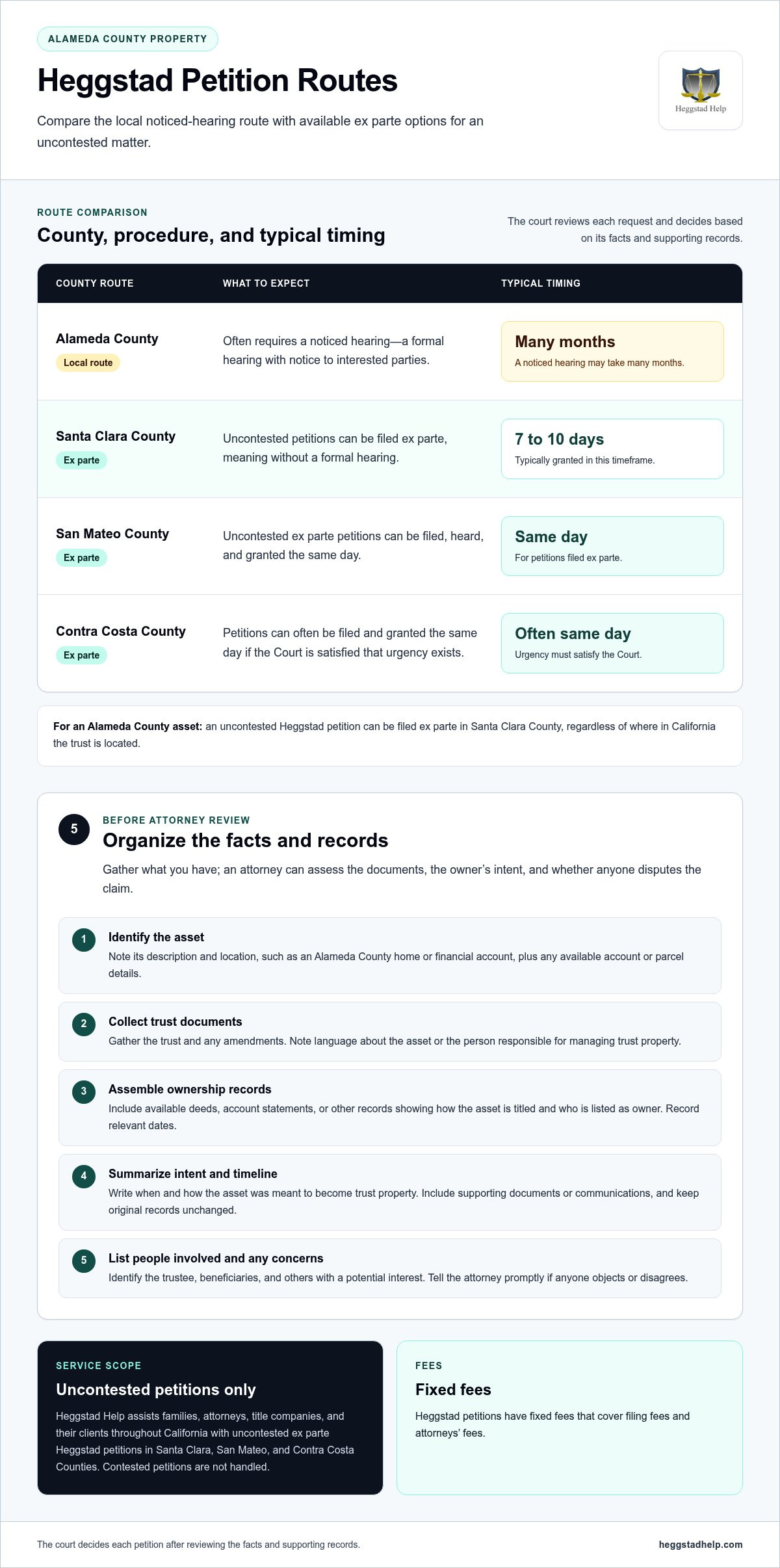
An Alameda County matter may have more than one possible path. In Alameda County and many other counties, a Heggstad petition often requires a noticed hearing, and the process may take many months. HEGGSTAD HELP files uncontested petitions ex parte in Santa Clara County, San Mateo County, and Contra Costa County. The comparison below summarizes the different routes and typical timelines. The court reviews each petition and decides whether to grant it.
| County route | What to expect |
|---|---|
| Alameda County | Often requires a noticed hearing, which may take many months. |
| Santa Clara County | Uncontested petitions filed ex parte are typically granted in 7 to 10 days. |
| San Mateo County | Ex parte petitions can be filed, heard, and granted the same day. |
| Contra Costa County | Petitions can often be filed and granted the same day if the Court is satisfied that urgency exists. |
When an Alameda County matter may use a different filing path
An uncontested petition involving property in Alameda County can be filed ex parte in Santa Clara County, regardless of where in California the trust is located. This gives families and attorneys another route when a local noticed hearing may add substantial time. Santa Clara County petitions are typically granted in 7 to 10 days. The court still reviews the facts and supporting records before deciding the request.
What ex parte means in this service
Ex parte means requesting a court order without a formal hearing. HEGGSTAD HELP assists families, attorneys, title companies, and their clients throughout California with uncontested petitions filed in Santa Clara County, San Mateo County, and Contra Costa County. San Mateo County petitions can be filed, heard, and granted the same day. Contra Costa County petitions can often be filed and granted the same day when the Court is satisfied that urgency exists. The office handles uncontested petitions, not contested matters where parties disagree about whether an asset belongs to the trust. If you’re assessing an uncontested Alameda County Heggstad petition, review the Heggstad petition filing information as you prepare for attorney review.
How to Prepare for an Uncontested Heggstad Petition Involving Alameda County
For an initial attorney review, focus on organizing the facts rather than preparing court forms yourself. A clear record helps the attorney evaluate whether the asset may qualify for a Heggstad petition and whether the matter appears uncontested.
Information to organize before legal review
- 1. Identify the asset. Write down its description and location, such as an Alameda County home or a financial account, along with any available account or parcel details.
- 2. Collect trust documents. Gather the trust and any amendments you have. Note the language about the asset or the person responsible for managing trust property.
- 3. Assemble ownership records. Include available deeds, account statements, or other records showing how the asset is currently titled and who is listed as owner. Record dates that may help explain when ownership changed or was intended to change.
- 4. Summarize the intent and timeline. In a short written note, explain when and how the asset was meant to become trust property. Include documents or communications that may support that understanding. Keep original records unchanged.
- 5. Identify people involved and any concerns. List the trustee, beneficiaries, and others with a potential interest. Tell the attorney promptly if anyone has objected or disagrees.
How to keep the matter within the uncontested process
Be candid about disagreement, even if it seems minor. An objection may affect whether a matter can proceed as an uncontested petition. HEGGSTAD HELP handles uncontested petitions only. The goal of this preparation is to give the attorney an accurate picture, not to resolve disputes or decide the filing route on your own.
For more background on the process, see the Heggstad Petition Filing guide. If you’re organizing records for an Alameda County Heggstad petition, request focused Heggstad petition filing assistance for an uncontested matter.
Get Alameda County Heggstad Petition Help for an Uncontested Filing
An asset outside a trust can raise difficult questions for a family, especially when the property is in Alameda County but a practical court route may be elsewhere. HEGGSTAD HELP focuses on uncontested Heggstad petitions for families, attorneys, title companies, and their clients throughout the State of California. Uncontested petitions involving Alameda County property can be filed ex parte in Santa Clara County, regardless of where in California the trust is located.
Robert P. Bergman is a California-licensed attorney and Board-Certified Specialist in Estate Planning, Trust and Probate Law. His focused work includes Heggstad petition filing, ex parte court order services, and trust asset title correction. The fixed fee covers filing fees and attorney fees.
What focused petition assistance includes
The work centers on preparing and filing an uncontested petition and seeking a court order to address an asset that may have been intended for a trust. If the court grants the petition, trust asset title correction may be the next step. This focused service does not include contested petitions or full probate administration. If someone objects or disputes the asset’s status, raise that early so the matter can be assessed accurately.
Taking the next step with the right records
For an initial discussion, organize the trust and amendments, asset description, available title or ownership records, and a short timeline explaining how the asset was meant to become trust property. Include any known objections or disagreements. You can also review the relevant California Probate Code Section 850 information as background while preparing.
HEGGSTAD HELP assists families, attorneys, title companies, and their clients throughout the San Francisco Bay Area, Northern California, Southern California, the Central Valley, and San Diego, including Alameda County, San Francisco County, Marin County, Santa Clara County, Los Angeles County, Orange County, San Bernardino County, Riverside County, Sacramento County, Fresno County, and Bakersfield.
If you’re ready to discuss an uncontested Alameda County Heggstad petition, discuss an uncontested Heggstad petition.
Take the Next Step With a Clear Plan
The most useful next step is to turn scattered paperwork and family recollections into a concise account of the asset’s history. Note what the trust documents say, how ownership is recorded, when the asset was intended to become trust property, and whether anyone has raised an objection. You do not need to decide the court route or prepare a petition yourself. A focused review can help identify what the available records support and what questions remain.
If you’re considering an Alameda County Heggstad petition, bring those details together before discussing the matter. This gives the attorney a practical starting point and keeps the conversation centered on the asset, the trust, and whether an uncontested filing may fit. Fixed fees cover filing fees and attorney fees.
Discuss an uncontested Heggstad petition and take the next step with a clearer understanding of your options. A careful review can make a complicated situation feel more manageable.
Frequently Asked Questions
Can an Alameda County Heggstad petition be filed ex parte in Santa Clara County?
Yes. An uncontested Alameda County Heggstad petition may be filed ex parte in Santa Clara County even though the asset is in Alameda County. An attorney can review the trust terms, ownership history, and supporting records to assess whether that route fits the facts. The Court decides whether to grant the request, so the filing location does not guarantee a particular result.
Does a Heggstad petition only apply to real estate?
No. A Heggstad petition can concern real estate or other assets that may have been intended for a trust, such as a financial account. The key question is whether the available trust documents and ownership records support treating that specific asset as trust property. Gather records identifying the asset and its current owner, since account and title details can vary.
Does the trust have to be located in Alameda County?
No. The trust does not have to be located in Alameda County for an asset connected with that county to be reviewed. An uncontested petition involving an Alameda County asset may be filed in Santa Clara County, regardless of where in California the trust is located. For attorney review, note where the trust is administered, where the asset is located, and who currently holds title or account ownership.
Can a Heggstad petition be filed after the trust creator has died?
Yes. A Heggstad petition may be pursued after the trust creator has died, including when an asset was intended for the trust but remained titled outside it. Gather the trust and amendments, current ownership records, and any materials showing the creator’s intent while living. An attorney can assess whether petition filing may address the asset and identify any information still needed.
What if someone objects to the Heggstad petition?
Tell the attorney promptly and share the nature of the concern, along with any related messages or documents. An objection may mean the matter is no longer uncontested, which affects whether it fits this focused filing service. HEGGSTAD HELP handles uncontested petitions, not contested matters, so include any disagreement in the initial review rather than leaving it out.

Article by
Robert P. Bergman, Attorney at Law
Attorney Robert P. Bergman ("Bob Bergman") has been a Board-Certified Specialist in Estate Planning, Trust and Probate Law since 2011, as certified by the California State Bar Board of Legal Specialization. For several years, Bob has assisted families and the clients of other attorneys with obtaining court orders through Heggstad petitions to avoid the time and expense of Probate administration. Bob is friendly, very approachable, and believes in explaining complex legal topics in clear ordinary language so that his clients understand exactly what they're doing and why they're doing it.
Bob is often able to assist clients who are in other counties than his home county of Santa Clara through his approach to Heggstad petitions.
Disclaimer
This article is for informational purposes only. Nothing in this article is intended to replace legal advice from a competent attorney or be considered legal guidance for anybody's specific legal situation. Nobody should rely on information in this article in making legal decisions without such consultation.


