Heggstad Petition Granted: What Happens Next in California

After a Heggstad petition is granted, the court order confirms the identified asset as trust property, and the successor trustee can manage or…

After a Heggstad petition is granted, the court order confirms the identified asset as trust property, and the successor trustee can manage or distribute it under the trust’s terms. For real estate, recording the order with the County Recorder is an important next step because it updates the public title record. What happens next depends on the asset and the wording of the order.

A court ruling can bring clarity, but there are still practical steps to take, especially when property must be retitled or handled for beneficiaries. The successor trustee uses the order to address the confirmed asset and then follows the trust’s directions.

This article explains what the order means, what the successor trustee typically handles, and why the practical timeline can vary by county and filing route. It also covers how fixed fees for Heggstad petitions can include filing fees and attorney fees, so you can understand the process without confusing the petition’s costs with the tasks that follow the court’s decision.

Key Takeaways

  • Identify whether the order covers real estate or another asset, since the steps to update ownership records can differ.
  • Use the trust’s terms to guide how the successor trustee manages or distributes the newly confirmed asset.
  • Understand how notice, consent, and any objections can affect the petition process and what happens next.
  • Compare filing routes and timelines: uncontested ex parte petitions in Santa Clara County are typically granted in 7 to 10 days, and Heggstad petitions have fixed fees covering filing fees and attorneys’ fees.

What Is a Heggstad Petition in California?

A Heggstad petition asks a California probate court to determine whether omitted property belongs to a trust. A granted order can confirm the identified asset as trust property and keep that asset out of full probate. It applies only to the property the court identifies, not every asset in the estate. The court considers evidence of the deceased person’s intent despite an incomplete transfer.

Probate Code Section 850 allows a petition asking the court to confirm property as trust property. A successor trustee typically files it with evidence of intent, such as a signed trust schedule, deed, or transfer record. Interested parties, including heirs and beneficiaries, receive notice and an opportunity to object. Depending on the county and filing route, the court reviews papers ex parte, without a formal hearing, or at a noticed hearing. At a hearing, the judge reviews the petition, evidence, and objections before ruling.

If the petition is granted, the order confirms the identified property as trust property. For real estate, record the order with the County Recorder in the county where the property is located. Recording places the ruling in the public land records and documents the court-authorized change in ownership. The recorded order can help update title records so the trustee can manage, sell, or distribute the property under the trust’s terms.

The order resolves only the covered asset’s trust status; it does not transfer unrelated estate property. Once granted, the Heggstad matter generally ends in probate court, and the successor trustee proceeds under the trust’s terms without ongoing court supervision of that asset. Keep the signed order and recording information with trust records, as they document why the title changed.

What Is the Successor Trustee’s Role After the Petition Is Granted?

After the order, the successor trustee handles the confirmed asset under the trust’s terms. The practical steps depend on the asset, its title, and the beneficiaries’ interests.

How Does the Trustee Clear Title and Administer the Trust?

Clearing title means updating ownership records to reflect the court’s ruling and the trust’s interest. For real property, the trustee records the order with the County Recorder if that step remains outstanding. Keep the signed order and recording details with the trust records. These documents help explain the transfer when managing, selling, or distributing the property.

What Happens to Assets Left Outside the Trust?

Assets can remain outside a living trust when a transfer was overlooked, paperwork was incomplete, or ownership records were never updated. For example, a deceased person may have signed a trust schedule listing a home but not completed its title transfer. A Heggstad order addresses only the property it covers. Other assets may require a separate transfer procedure or probate, depending on their ownership and circumstances. Do not try to transfer real property into a trust after death by filing a quitclaim deed.

The successor trustee’s role is to safeguard the confirmed asset, follow the trust’s directions, and keep clear records of decisions affecting beneficiaries. This includes identifying the asset covered by the order, coordinating any title update, and determining whether the trust calls for management, sale, or distribution. If an asset falls outside the order, distinguish it from the property the court confirmed rather than treating all estate assets as trust property.

If title records still need attention after the order, get help resolving a trust title issue.

What Happens to Notice and Objections After the Petition Is Granted?

Notice in a Heggstad matter gives heirs, beneficiaries, and other interested people an opportunity to respond before the court rules. After the order, a trustee’s separate notice duties may still apply under Probate Code Section 16061.7.

What Is Notice to Interested Parties?

Notice is the formal delivery of information about a petition or trust administration to people with a legal interest. For a Heggstad petition, interested parties can include beneficiaries and heirs of the deceased person. Probate Code Section 851 addresses notice in these petitions. Notice matters because it gives recipients a chance to review the request and raise concerns before the court confirms property as part of a living trust.

After the petition is granted, the successor trustee should distinguish notice of the court ruling from notices connected to administering and distributing trust assets. The order resolves the property question presented to the court; it does not automatically complete every notice step required for trust administration.

What Are Consent and Waiver of Notice?

Consent means an interested person agrees with the requested result; a waiver means that person gives up a particular notice or hearing right. They are related but distinct. For an uncontested matter from another California county to proceed ex parte in Santa Clara County, all interested parties must consent to the petition and waive notice of a hearing.

Any written agreement should clearly state what the person accepts. The successor trustee should not assume that silence means consent. Clear, documented agreement helps show that the matter is uncontested and that the required waiver applies.

If an heir or beneficiary objects, the court may need additional evidence, a hearing, or further proceedings before deciding whether to confirm the asset. For example, an objection disputing the deceased person’s intent may require closer review of trust schedules, deeds, or transfer records. An order already granted settles the petition addressed by that ruling, but it does not resolve separate disputes about other assets or trust decisions. Keep the order and notice records together so the trustee can identify what the court decided and what remains unresolved.

Heggstad Petition Granted: What Happens Next in California

How Much Does a Heggstad Petition Cost, and How Long Does It Take?

Heggstad petitions have fixed fees covering filing fees and attorney fees. After an order is granted, the practical next step depends on the asset: real property orders are recorded with the County Recorder to document the trust’s ownership. The signed order and property records help guide the successor trustee’s next actions.

There is no single timeline for every California petition. The filing route, county procedure, notice, and whether interested parties agree can affect how quickly a judge rules. After the court grants the petition, follow the order’s terms and complete the records needed for the asset’s transfer. The order itself does not create a statewide post-order filing deadline.

For an uncontested petition filed ex parte in Santa Clara County, the order is typically granted in 7 to 10 days. In San Mateo County, an ex parte petition can be filed, heard, and granted the same day. Contra Costa County petitions can often be filed and granted the same day when the court is satisfied that the matter is urgent. An ex parte request may be handled without the usual noticed hearing.

In other California counties, petitions often require a noticed hearing and may take many months. That route includes giving interested parties notice and waiting for the court calendar. An uncontested petition concerning a trust located anywhere in California can instead be heard ex parte in Santa Clara County, where petitions are typically granted in 7 to 10 days. All interested parties must consent and waive hearing notice for this route.

For a clear view of the filing route and timing for an uncontested matter, discuss your Heggstad petition options.

How Can HEGGSTAD HELP Assist With Heggstad Petition Filing?

HEGGSTAD HELP, a service of attorney Robert P. Bergman, Board-Certified Specialist in Estate Planning, Trust, and Probate Law (California State Bar Board of Legal Specialization), assists families, attorneys, title companies, and their clients throughout the State of California with uncontested Heggstad petitions. Its work helps address trust assets that were not formally transferred before the trust creator’s death. The office handles uncontested petitions only and does not handle contested petitions.

Heggstad petition filing seeks a court order confirming that an identified asset belongs to the trust. For an uncontested matter, HEGGSTAD HELP can file an ex parte petition in Santa Clara County Probate Court, regardless of where in California the trust is located. A petition qualifies for ex parte treatment only when there are no interested parties that would object to the action being taken; all interested parties agree to waive notice of a hearing; and all interested parties consent to the petition.

This statewide approach can be useful when property is in Los Angeles County, Orange County, or another county where a noticed hearing may take many months. Uncontested petitions filed ex parte in Santa Clara County are typically granted in 7 to 10 days. San Mateo County petitions can be filed, heard, and granted the same day. Contra Costa County petitions can often be filed and granted the same day when the court is satisfied that the matter is urgent.

After the order, Trust Asset Title Correction can help address ownership records for the confirmed property. Ex Parte Court Order Services support the court-order process for eligible uncontested matters. The fixed fee for a Heggstad petition covers filing fees and attorney fees, giving families and referring attorneys a clear fee structure for the petition itself.

If you’re handling an omitted trust asset, contact HEGGSTAD HELP to discuss the petition process.

What Should You Do After the Court Rules?

If you’re asking what happens after a Heggstad petition is granted, focus on reflecting the ruling in the relevant records and decisions. Keep the signed order with the trust documents and make its scope clear to everyone involved in handling the affected asset. A precise record helps the successor trustee distinguish the property covered by the order from other estate matters.

Clear records also support practical conversations with beneficiaries and attorneys. Explain what the court confirmed, what remains outside the order, and which trust provisions guide the next decision. If real property is involved, keep the recording details with the order so future title questions can be addressed using the same documents. Careful follow-through turns the court’s decision into an organized trust record.

For help with an uncontested Heggstad matter or the related title correction, contact HEGGSTAD HELP. A clear next step can make it easier to move forward with confidence.

Frequently Asked Questions

What if someone objects to the petition?

Before a ruling, an objection can prompt the judge to request more evidence or hear arguments. For example, an heir might dispute whether the deceased person intended a particular parcel to belong to the living trust. If the order has already been granted, an objection does not automatically erase it. The person raising concerns may need to seek further court action, and the order’s wording matters.

What is a Heggstad petition and what does the court order establish?

A Heggstad petition asks a California probate court to determine whether an asset should be treated as trust property despite an incomplete transfer. The resulting order establishes the court’s determination for the asset it identifies. For example, an order concerning a specific home does not, by itself, establish that a separate bank account belongs to the trust.

What steps follow after a California Heggstad petition is granted?

After the petition is granted, the successor trustee should review the signed order, identify each asset it covers, and carry out the trust’s directions for that property. For a home, this may mean updating title records before a sale or distribution. Keep the order with the trust records, and do not treat other estate assets as covered unless the ruling identifies them.

How do you record a Heggstad order with the county recorder?

For real property, submit the court order to the County Recorder in the county where the property is located. Match the property description in the order to the parcel being recorded, then retain the recording information with the trust records. An order covering one parcel should not be used as proof of a transfer for a different property.

What documents are needed to transfer or retitle property after a Heggstad order?

Start with the signed court order and the property’s existing deed, and keep the trust document and any asset schedule available to explain the ownership history. The order should identify the property being confirmed. Do not file a quitclaim deed to transfer real property into a trust after someone has died. Use the order and related title records to document the court-authorized change.

How do you notify the trustee and beneficiaries after the petition is granted?

The successor trustee should keep beneficiaries informed about the ruling and what it means for the asset, using the trust’s terms to guide administration. Notice related to trust administration is distinct from notice of the Heggstad petition. For example, explain whether the confirmed property will be managed, sold, or distributed, and preserve copies of the order and relevant communications.

Robert P. Bergman, Attorney at Law

Article by

Robert P. Bergman, Attorney at Law

Attorney Robert P. Bergman ("Bob Bergman") has been a Board-Certified Specialist in Estate Planning, Trust and Probate Law since 2011, as certified by the California State Bar Board of Legal Specialization. For several years, Bob has assisted families and the clients of other attorneys with obtaining court orders through Heggstad petitions to avoid the time and expense of Probate administration. Bob is friendly, very approachable, and believes in explaining complex legal topics in clear ordinary language so that his clients understand exactly what they're doing and why they're doing it.
Bob is often able to assist clients who are in other counties than his home county of Santa Clara through his approach to Heggstad petitions.

Disclaimer

This article is for informational purposes only. Nothing in this article is intended to replace legal advice from a competent attorney or be considered legal guidance for anybody's specific legal situation. Nobody should rely on information in this article in making legal decisions without such consultation.

Heggstad Petition for Stock Certificates: Which Assets Qualify

A paper stock certificate does not automatically keep shares out of a trust. A Heggstad petition for stock certificates may ask a California court to…

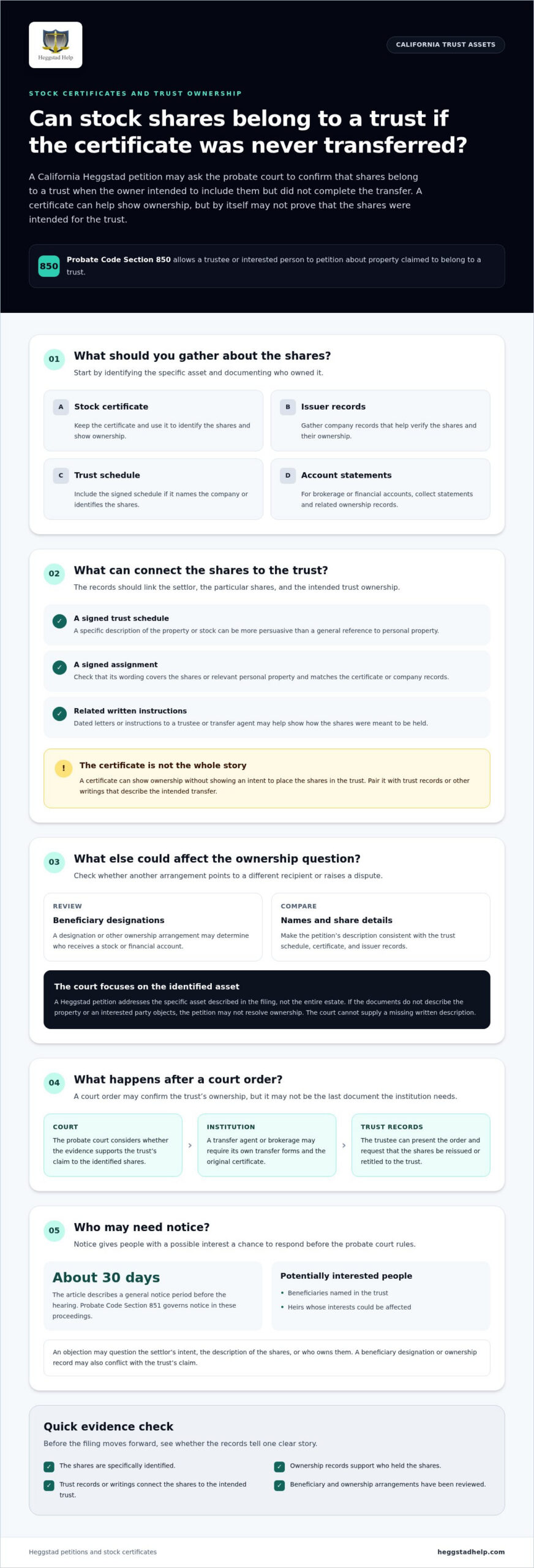
A paper stock certificate does not automatically keep shares out of a trust. A Heggstad petition for stock certificates may ask a California court to recognize shares as trust property when the owner intended to place them in the trust but did not complete the transfer. The key question is whether the available evidence supports that intent, not simply whether a physical certificate exists.

It is understandable to focus on the certificate itself: it represents ownership, and handling it after someone’s death can involve additional practical steps. But the trust documents and other records may help show whether the shares were meant to belong to the trust. Ownership arrangements and beneficiary designations can also affect the analysis.

This article explains which assets a Heggstad petition may address, what records can support a claim involving shares, and how notice and objections fit into the process. It also explains what a court order may accomplish, helping you distinguish an omitted trust asset from a different kind of transfer issue.

Key Takeaways

  • A petition may help establish that an asset belongs to a California trust when ownership was never formally updated, if the evidence shows the owner intended to include it.
  • Trust schedules, written assignments, and ownership records can help support the claim; organize documents that identify the specific asset.
  • Notice gives interested parties an opportunity to object, so identify who may have an interest before the petition proceeds.
  • Physical stock certificates involve transfer and ownership details that differ from brokerage-held shares; gather the certificate and related company records.

Which assets can a Heggstad petition reach?

A California Heggstad petition can ask the probate court to confirm that an omitted asset belongs to a trust. The settlor (the person who created the trust) may have intended to include property but never formally transferred or titled it in the trust’s name. Probate Code Section 850 allows a trustee or interested person to petition concerning property claimed to belong to a trust. Assets may include real estate, financial accounts, personal property, business interests, or stock certificates.

A stock or financial account with a beneficiary designation needs closer review. The designation or another ownership arrangement may determine who receives the asset, so gather account statements and beneficiary records alongside the trust documents. A petition addresses whether the specific asset belongs to the trust; it does not automatically override a separate transfer arrangement.

A Heggstad petition differs from a small estate procedure for stock: it asks the court to determine trust ownership, while a Small Estate Affidavit is a separate transfer procedure.

To file a Heggstad petition for stock in California, the petitioner identifies the shares and explains why the settlor intended them to be trust property. The filing should include supporting trust records and ownership documents, such as a schedule of assets or certificate. A California Superior Court’s probate division considers the petition under Probate Code Section 850.

A transfer agent or brokerage may require additional documents before updating its records, even after a court order. The order may confirm the trust’s ownership, but the institution may also require its transfer forms and the original certificate. After receiving the order, the trustee can present it to the transfer agent and request that the shares be reissued or retitled to the trust.

A Heggstad petition addresses the identified asset, not the entire estate. If the documents do not describe the property or an interested party objects, the petition may not resolve ownership. The court cannot supply a missing written description.

Evidence supporting a petition, including trust schedules and written assignments

California probate courts look for evidence connecting the specific property to the settlor’s intent. Relevant records may include a signed trust, its schedule of assets, a general assignment, a stock certificate, or correspondence describing how the shares should be held. The documents should identify the asset clearly enough to distinguish it from other property.

For stock, evidence may include a schedule listing the company and shares, an assignment naming the stock, or written instructions to a trustee or transfer agent. A certificate alone shows ownership but may not show that the settlor intended the shares to belong to the trust. Pair it with trust records or other writings that explain the intended transfer.

In Estate of Heggstad (1993), the court recognized that a settlor’s written declaration of holding property as trustee could create a trust without a separate deed. In Kucker v. Kucker (2011), a general assignment could transfer personal property. These decisions show why written intent matters when an asset was never formally transferred.

  • Trust schedule: Include the signed schedule naming the property or identifying the stock. A generic reference to personal property may be less persuasive than a specific description.
  • Assignment: Provide a signed assignment that covers the shares or relevant personal property. Match its language to the certificate and company records.
  • Ownership documents: Gather the certificate, account statements, and issuer records showing the settlor owned the shares.
  • Related writings: Include dated letters or instructions that link the asset to the trust and identify the intended trustee.

Osswald v. Anderson (1996) marks an important limit: a petition needs a writing describing the property; the court cannot create that missing writing. An attorney can organize the evidence so the parties and judge can follow the link between the settlor, the shares, and the trust. Keep originals and present copies with clear labels. For help preparing a Heggstad petition, organize the trust and stock records together.

Notice requirements and potential objections

Notice gives people with a possible interest in the stock a chance to respond before the probate court rules. California Heggstad petitions generally require a notice period of about 30 days before the hearing, according to California Superior Courts. California Probate Code Section 851 governs notice in these proceedings. Interested parties can include beneficiaries and heirs whose shares of the estate could be affected.

Before filing, identify each beneficiary named in the trust and any heirs who may have an interest. Include accurate names and addresses in the petition materials, then follow the court’s notice requirements. A beneficiary’s written consent or waiver may affect whether formal notice is needed, but the petition must still meet the applicable court requirements.

An objection may dispute the settlor’s intent, the stock description, or who owns the shares. For example, a beneficiary might challenge a schedule that lists company shares without identifying the issuer or quantity. Another party may point to a beneficiary designation or ownership record that conflicts with the trust’s claim. Specific records help the court understand the disagreement.

  • Check the asset description: Compare the petition with the stock certificate, issuer records, and trust schedule.
  • Review the claimed ownership: Identify any joint owner, beneficiary designation, or other arrangement affecting the shares.
  • Track notice: Keep copies of filed notices and proof showing when and how each interested party received them.
  • Address objections: Organize the trust documents and ownership records that respond to each disputed point.

A noticed hearing may be set 30 to 60 days after filing, with additional time needed for notice. In counties outside Santa Clara, San Mateo, and Contra Costa, Heggstad petitions often require noticed hearings and may take many months to be heard. Uncontested petitions from those counties can instead be heard ex parte in Santa Clara County, often with a decision 7 to 10 days after filing. Ex parte means the court considers the petition without a formal hearing; it does not mean interested-party notice requirements disappear.

Heggstad Petition for Stock Certificates: Which Assets Qualify

Using Heggstad petitions for stock certificates

A paper certificate may document shares without showing whether the settlor intended them for a trust. A Heggstad petition for stock certificates asks the California probate court to confirm that connection. Under Probate Code Section 850, the petition seeks a determination about property claimed as trust property. The 1993 Estate of Heggstad decision provides the case name associated with this procedure.

Make the petition specific: identify the company, the shareholder named on the certificate, and the shares at issue. Include the trust’s relevant terms and the signed writing that ties those shares to the trust. Probate Code Section 856 allows the court to order property transferred or confirmed when it finds the trust owns it. A signed order can then support the title update.

The next steps depend partly on whether the shares are publicly traded or belong to a private company. For publicly traded shares held as a physical certificate, the transfer agent typically handles reissuance. For private-company shares, review the shareholder agreement and consult company officers about its transfer provisions. The agreement may provide for reissuance, a company buyout, or another mechanism.

  • Before filing: Match the certificate details to the trust schedule and any signed assignment.
  • In the petition: Explain the settlor’s intent and request an order addressing the identified shares.
  • After the order: Present the signed order to the transfer agent or company, and complete its required transfer documents.

A Heggstad order addresses the trust’s claim to the shares; it doesn’t itself print or reissue a new certificate. The transfer agent or private company may require the original certificate and additional documents to update ownership records. If the shares instead belong to the estate, an executor’s authority and the estate transfer process may apply. For help with a petition concerning stock, request Heggstad petition filing assistance.

HEGGSTAD HELP: Heggstad Petition Filing

Heggstad Help, a service of attorney Robert P. Bergman, a Board-Certified Specialist in Estate Planning, Trust, and Probate Law with the State Bar of California Board of Legal Specialization, assists families, attorneys, and their clients with uncontested Heggstad petitions involving assets such as stock certificates.

For trusts located anywhere in the State of California, uncontested petitions can be filed ex parte in the Santa Clara County Probate Court, meaning without a formal hearing. Those petitions are typically granted in 7 to 10 days. Ex parte filings are also available in San Mateo and Contra Costa Counties, subject to each court’s process.

Heggstad Petition Filing can address the court order needed to confirm trust ownership; Trust Asset Title Correction can help with the follow-up title issue. The office handles uncontested petitions, with fixed fees covering filing fees and attorney fees.

For help with an uncontested petition involving stock or another omitted trust asset, contact Heggstad Help.

Prepare the next step for your stock claim

Before pursuing a court order, clarify what you need it to accomplish. Is the immediate goal to establish who can act for the trust, or to enable the company to update its shareholder records? Defining the desired outcome can help keep the petition focused and make the next administrative step easier to plan.

A Heggstad petition for stock certificates can be one part of resolving an asset issue, with the court request shaped around the specific result sought. If you’re ready to discuss that next step, contact HEGGSTAD HELP for assistance. A clear plan can make a complicated process feel more manageable.

Frequently Asked Questions

Can a beneficiary oppose a Heggstad petition?

Yes. A beneficiary can tell the court why they dispute the requested treatment of the shares. To understand the issue, identify whether the disagreement concerns the settlor’s intent, the trust’s terms, or the beneficiary’s own claimed interest. These are distinct questions, and separating them can clarify what the court is being asked to decide.

How Does the California Petition Process Work?

The petitioner asks the probate court to determine a question about a particular asset, and the court considers the request under California procedure. A useful preparation step is to distinguish the court’s ownership decision from the issuer’s administrative work afterward. The court order addresses the legal claim; the company’s records and certificate-handling requirements concern how its share register is updated.

What Do I Need to Know About the Process of Filing a Heggstad Petition?

Make sure the petition describes the requested court action precisely. For stock, compare the issuer’s legal name, share class, and certificate details across available records, and note any differences in spelling or ownership history. Consistent descriptions help clarify which shares the court is being asked to address, especially when a company has multiple classes or similarly named entities.

What Happens If Someone Opposes the Petition?

The court must consider the objection and the parties’ positions before deciding the ownership question. A practical response begins by identifying the exact assertion being challenged, then organizing records that address it. For example, if the dispute concerns the company’s identity, records from the issuer may be more directly relevant than general correspondence about the trust.

What is a Heggstad petition in California probate law?

A Heggstad petition asks the court to determine whether specific property belongs to a trust, even though the ownership records were not formally updated. The request concerns the asset identified in the filing, such as a particular block of company shares. It does not itself complete the issuer’s administrative steps for changing its shareholder records.

Can a Heggstad petition be used to transfer stock certificates into a living trust?

A Heggstad petition may ask a court to recognize stock as trust property when the settlor intended that result but did not complete the transfer. If the settlor is living, the relevant question is whether the shares can be transferred directly under the trust’s and issuer’s procedures. After death, a court petition may address an omitted asset when the supporting records establish the trust’s claim.

Robert P. Bergman, Attorney at Law

Article by

Robert P. Bergman, Attorney at Law

Attorney Robert P. Bergman ("Bob Bergman") has been a Board-Certified Specialist in Estate Planning, Trust and Probate Law since 2011, as certified by the California State Bar Board of Legal Specialization. For several years, Bob has assisted families and the clients of other attorneys with obtaining court orders through Heggstad petitions to avoid the time and expense of Probate administration. Bob is friendly, very approachable, and believes in explaining complex legal topics in clear ordinary language so that his clients understand exactly what they're doing and why they're doing it.
Bob is often able to assist clients who are in other counties than his home county of Santa Clara through his approach to Heggstad petitions.

Disclaimer

This article is for informational purposes only. Nothing in this article is intended to replace legal advice from a competent attorney or be considered legal guidance for anybody's specific legal situation. Nobody should rely on information in this article in making legal decisions without such consultation.
