
Imagine the frustration of discovering that your loved one’s most valuable asset was never actually deeded into their living trust. You’re suddenly looking at a probate process that can drag on for 12 to 18 months, potentially costing upwards of $46,000 in statutory fees for a $1 million home. It’s a common oversight that feels like a massive roadblock, but a petition to transfer real property to trust offers a specialized path forward. This legal mechanism, often called a Heggstad Petition, allows a judge to recognize the decedent’s clear intent and “rescue” the property from the traditional probate system.
We understand that the thought of navigating Probate Code 850 (the statute governing these transfers) feels overwhelming during a time of grief. In this guide, you’ll learn exactly how to secure a court order confirming the home as a trust asset without the exhaustive delays of full administration. We will walk through the specific evidence required to prove intent, the timeline you can expect, and the final steps to update the title at the County Recorder.
Key Takeaways
- Understand how a Heggstad Petition functions as a legal “rescue” mechanism to transfer assets into a trust after a death without undergoing a full probate.
- Identify the critical evidence needed to prove the decedent’s intent, specifically focusing on the importance of the “Schedule A” or a general assignment of assets.
- Compare the timelines and costs of a petition to transfer real property to trust against traditional probate to see how you can save months of time and significant statutory fees.
- Follow a structured five-step process to file your petition with the California Superior Court and successfully update the property title at the County Recorder.
- Recognize the value of specialized legal guidance in navigating Probate Code 850 to avoid the delays and complications often encountered by generalist probate attorneys.
What is a Petition to Transfer Real Property to a Trust?
A Heggstad Petition is a specialized legal request filed under California Probate Code Section 850. It serves as a vital safety net when a property owner intended to place their real estate into a trust but failed to complete the formal deed transfer before passing away. In the legal community, this petition to transfer real property to trust is considered the “gold standard” for correcting trust funding errors (the process of moving assets into the name of the trust) without the burden of a full probate administration.
The legal foundation for this procedure stems from the landmark 1993 case, Estate of Heggstad. In that case, the court determined that if a person’s written intent to include a property in their trust is clear, the formal recording of a deed isn’t strictly necessary to establish trust ownership. This ruling revolutionized California estate law, providing a way for families to avoid the 12 to 18 month delays and high statutory fees associated with formal probate. When you file a petition to transfer real property to trust, you’re essentially asking the court to honor the decedent’s (the person who died) documented wishes rather than letting a clerical oversight dictate the fate of the family home.
When is this Petition Necessary?
A Heggstad filing becomes necessary when the legal title to a property doesn’t match the instructions left in a trust document. This typically happens in three specific scenarios:
- Documented Intent: The decedent clearly intended the property to be part of the trust but died before the transfer was finalized.
- Unrecorded Deeds: A grant deed (the document that transfers ownership) was signed and notarized but was never filed with the County Recorder.
- Schedule of Assets: The property is explicitly listed on the trust’s “Schedule A” (a list of assets intended for the trust), yet the title remains in the individual’s name.
The Legal Basis: California Probate Code 850
The statutory authority for this process is found in California Probate Code Section 850(a)(3). This specific section allows a Successor Trustee (the person appointed to manage the trust after the original trustee dies) to petition the court regarding property that should be under trust control.
It’s important to understand that the court doesn’t technically “transfer” the property in the traditional sense. Instead, the judge issues an order that “confirms” the property was already a trust asset at the time of death based on the evidence of intent. This distinction is crucial because it allows the Successor Trustee to bypass the lengthy probate process entirely, moving directly to updating the title and distributing the asset according to the trust’s terms. For a deeper look at how this statute operates in practice, our guide to California Probate Code Section 850 and real property petitions walks through the full scope of this legal tool.
Proving Intent: The Key to a Successful Transfer
Intent is the central pillar of any successful Heggstad filing. Because you’re asking the court to bypass the traditional deed recording process, the judge needs a solid reason to believe the decedent truly meant for the property to be held in trust. Without this documented desire, the court cannot legally “confirm” the asset’s status. The burden of proof falls on the petitioner to present the requirements for the Heggstad Petition, which primarily focus on written evidence created by the settlor (the person who created the trust) during their lifetime. A well-prepared petition to transfer real property to trust relies on this trail of evidence to prove that the omission was a clerical error rather than a change of heart.
The Power of the Schedule of Assets
Most trust packages include a “Schedule A” or a “Schedule of Assets.” This document is the most powerful piece of evidence in a petition to transfer real property to trust. When a property is listed by its specific legal description or common street address, it provides the court with an unambiguous roadmap of the owner’s wishes.
If the schedule is less specific, perhaps only referring to “all my real property interest in California,” the case becomes slightly more complex but remains winnable. In these instances, the court looks for a nexus between that general statement and the specific property in question. Regardless of the document’s specificity, a judge must find “clear and convincing evidence” of the settlor’s intent before they will grant the order. If you’re looking at a blank schedule, don’t lose hope; other documents can often bridge the gap.
Supporting Documentation and Declarations
Beyond the formal schedule, many trusts contain a “General Assignment” clause. This provision acts as a catch-all, stating that the settlor transfers all their current and future assets into the trust. While not as direct as a specific address, this clause demonstrates a broad intent to avoid probate for all holdings.
Other secondary evidence can bolster your case:
- Correspondence or emails between the decedent and their estate planning attorney.
- Handwritten notes or letters expressing the desire to “put the house in the trust.”
- Drafted but unrecorded deeds that were signed and notarized.
It is vital to remember that oral testimony alone is usually insufficient for real property transfers in California. The law requires a “writing” to satisfy the Statute of Frauds. If you’re unsure if your documentation meets these standards, consulting with a Heggstad specialist can help you determine the strength of your evidence before you file.
Heggstad Petition vs. Full Probate: A Strategic Comparison
Choosing between a Heggstad filing and full probate is often the difference between a swift resolution and a multi-year administrative burden. While a standard California probate typically lasts between 12 and 18 months, a successful petition to transfer real property to trust can often be resolved in a fraction of that time, frequently within 2 to 6 months. This efficiency exists because the court focuses specifically on the intent surrounding a single asset rather than conducting a comprehensive audit of the decedent’s entire financial life. By using this targeted approach, families can avoid the “red tape” of formal estate administration, such as filing inventory and appraisal documents for every personal item owned by the deceased.
Privacy is another significant factor that distinguishes these two paths. A full probate is a public process where the decedent’s entire estate, including debts and beneficiary distributions, becomes a matter of public record. In contrast, a petition to transfer real property to trust is a surgical legal remedy. It creates a targeted court record focused solely on the title of the real estate. While it still requires a court hearing, it doesn’t expose the broader details of the trust administration to public scrutiny. This allows the Successor Trustee (the person managing the trust) to maintain a higher level of confidentiality for the family’s private affairs.
Calculating the Savings
The financial impact of choosing the Heggstad route is often the most compelling reason for beneficiaries to act. In California, statutory probate fees are calculated based on the gross value of the estate assets, not the equity. For example, under Probate Code Section 10810, a $1 million home would trigger approximately $46,000 in combined statutory fees for the attorney and the executor ($23,000 each). This applies even if the home has a $900,000 mortgage. Because a Heggstad petition typically involves fixed legal fees rather than a percentage of the property value, it preserves a much larger portion of the inheritance. For urgent situations, such as a pending home sale, we can often utilize an “ex parte” (an expedited hearing without the standard notice period) court order to secure title correction in weeks rather than months.
When is Probate Still Required?
Despite the advantages of a Heggstad filing, certain scenarios still necessitate a full probate. If there’s absolutely no written evidence of the settlor’s intent to fund the trust, a judge cannot legally confirm the transfer. Probate is also likely required if there are significant creditor disputes or if the validity of the trust itself is being contested in litigation. Additionally, it’s worth checking the “Small Estate” threshold; as of April 1, 2025, estates with personal property valued under $208,850 may be eligible for simplified transfer procedures. However, for real property like a family home, the 850 petition California real property process remains the most effective tool for avoiding the high costs and delays of the formal probate system.
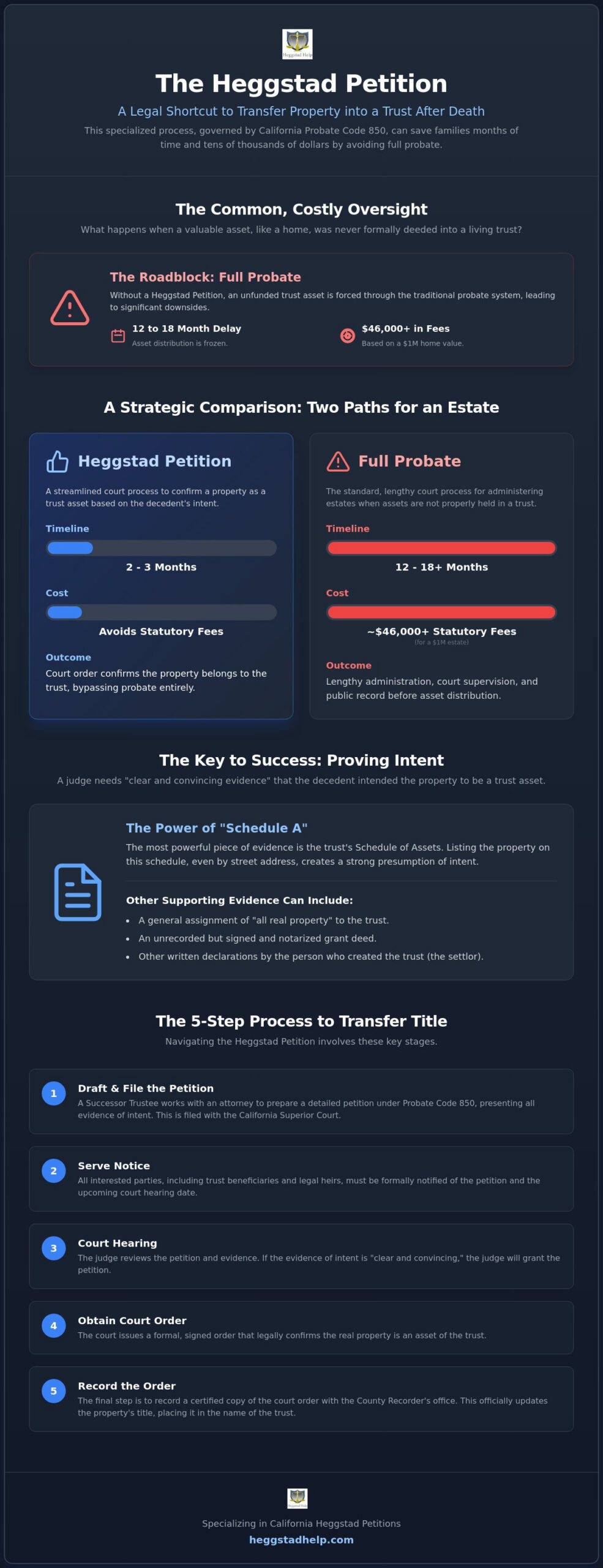
The 5-Step Process to Transfer Real Property Title
Successfully executing a petition to transfer real property to trust requires a methodical approach that satisfies both the court’s evidentiary standards and the County Recorder’s technical requirements. While the legal theory behind Probate Code 850 is straightforward, the procedural execution must be precise to avoid delays or denials. Following a structured path ensures that the decedent’s intent is honored and the title is corrected efficiently.
- Step 1: Gathering Evidence and Drafting the 850 Petition. This involves collecting the trust document, the Schedule of Assets, and any supporting evidence of intent to draft the formal petition (the legal document requesting the court order).
- Step 2: Filing with the Superior Court and Setting a Hearing Date. The petition is submitted to the probate department of the California Superior Court in the county where the property is located.
- Step 3: Providing Legal Notice to all Heirs and Beneficiaries. You must formally notify all interested parties of the hearing, allowing them the opportunity to review the request.
- Step 4: The Court Hearing and Obtaining the Signed Order. The judge reviews the evidence during a scheduled hearing and, if satisfied, signs the order confirming the trust’s ownership.
- Step 5: Recording the Certified Order with the County Recorder. The final step involves filing the court-validated document with the county to update the public title record.
Drafting and Filing Requirements
The technical accuracy of your petition is paramount. You must include the full legal description of the property, including the APN (Assessor’s Parcel Number) and the “metes and bounds” (the geographical description of the property’s boundaries). When you’re ready to file, you’ll need to pay the standard court filing fee, which is approximately $435 in most California counties. Perhaps the most critical procedural step is the Notice of Hearing. This is a jurisdictional requirement, meaning the court cannot legally act on your petition unless every heir and beneficiary has been served with notice at least 30 days before the hearing.
If you’re concerned about meeting these strict procedural deadlines or drafting the technical legal descriptions, our Heggstad Petition Filing service provides the specialized expertise needed to navigate the court system with confidence.
Finalizing the Title Transfer
Once the judge grants the petition, you must obtain a “Certified Copy” of the court order from the court clerk. This version bears an official seal, proving its authenticity to outside agencies. Before recording this order, you’ll also need to complete a PCOR (Preliminary Change of Ownership Report) for the County Assessor to explain the nature of the transfer. Once recorded, the court order acts as a deed, officially moving the property into the trust. This final act clears the title, allowing the Successor Trustee to sell or distribute the home as the trust instructions dictate. If the property is to be kept as a rental, Home Showings Property Management provides professional residential oversight to ensure the asset is managed effectively for the beneficiaries.
Why Work with a California Heggstad Specialist?
Choosing the right legal partner for a petition to transfer real property to trust is a decision that directly impacts both the family’s inheritance and the timeline for resolution. While many attorneys offer broad probate services, a generalist often lacks the deep procedural familiarity required for a successful Heggstad filing. This lack of specialization can lead to a “default” recommendation for full probate administration, which often consumes tens of thousands of dollars in unnecessary statutory fees. By working with a dedicated specialist, you ensure that the specific requirements of Probate Code 850 are met the first time, avoiding the common pitfalls of inadequate notice or insufficient evidence of intent that frequently stall these cases in court.
Successor Trustees (the individuals responsible for managing the trust after a death) often feel the weight of personal liability when assets are left out of a trust. If a trustee fails to properly secure title to real estate or makes a procedural error during the filing, they could be held responsible by the beneficiaries for the resulting delays or financial losses. A specialist acts as a steady, knowledgeable hand, reducing this stress by providing a clear and logical path toward a court order. This focused approach doesn’t just save money; it provides the calm competence needed to resolve complex title issues during an already difficult time. For professionals facing challenges in other legal areas, such as complex regulatory or corporate sectors, the expertise at jzlaw.org offers a similar standard of specialized counsel.
Expertise in California Probate Courts
Each county in California maintains its own set of local rules that can influence how a petition to transfer real property to trust is processed. Whether you’re filing in Santa Clara, San Francisco, or Los Angeles, having an attorney who has managed hundreds of Probate Code 850 filings is a significant advantage. These specialists understand the specific nuances of what a particular judge expects to see in a “Schedule of Assets” or a general assignment clause. They know how to satisfy jurisdictional requirements (the court’s legal authority to hear the case) through proper notice, ensuring the petition isn’t rejected due to a minor clerical oversight.
The Robert P. Bergman Advantage
At Heggstad Help, you gain direct access to Robert P. Bergman, a Board-Certified Specialist in Estate Planning, Trust and Probate Law. This certification is a distinction held by a small percentage of California attorneys, requiring rigorous testing and a proven track record of success. With a practice dating back to 1980, Mr. Bergman brings over four decades of experience to every title correction case. We specialize in using ex parte court orders (expedited hearings) to move transfers forward when a pending home sale or other urgent matter requires immediate action. Our goal is efficiency; we focus on getting the order signed so your family can move forward. Contact Heggstad Help today for a consultation on your missing trust assets.
Secure Your Family’s Inheritance Without the Probate Delay
Discovering that a home was left out of a living trust doesn’t have to result in a 12 to 18 month court battle. By leveraging the decedent’s documented intent, you can bypass the high costs and public nature of a full probate administration. A petition to transfer real property to trust serves as a powerful tool to correct title errors efficiently, ensuring that the successor trustee can manage or sell the property as originally intended. The key to success lies in gathering the right evidence and strictly adhering to the procedural requirements of Probate Code 850 (the statute governing these transfers).
Navigating these complex court rules requires a steady and experienced hand. Robert P. Bergman has been practicing California law since 1980 and is a Board-Certified Specialist in Estate Planning, Trust and Probate Law. At Heggstad Help, we focus exclusively on these specialized filings to provide you with the fastest possible resolution. Don’t let a clerical oversight derail your loved one’s estate plan or drain the inheritance through statutory fees. Get Expert Help with Your Heggstad Petition Today and move forward with the confidence that your family’s legacy is secure.
Frequently Asked Questions
Can I file a Heggstad Petition if there is no written list of assets?
Yes, you can still file if you have other written evidence of the decedent’s intent. While a “Schedule A” is the strongest proof, a “General Assignment” clause within the trust document often serves as a catch-all for forgotten assets. Judges look for clear and convincing evidence that the creator intended the property to be trust-owned. If the trust mentions “all my real property” or if there’s a signed, unrecorded deed, a petition to transfer real property to trust can still succeed.
How long does the Heggstad Petition process take in California?
The process typically takes between 2 and 6 months from the initial filing to the recording of the final order. This timeline is significantly shorter than the 12 to 18 months required for a full probate administration. The exact duration depends on the specific county court’s hearing calendar and whether any heirs object to the transfer. If a home sale is already in escrow, we can sometimes utilize an ex parte hearing to expedite the court’s decision.
Does a Heggstad Petition trigger a property tax reassessment under Prop 19?
The petition itself doesn’t trigger a reassessment; rather, it confirms the trust was the legal owner at the time of death. However, any transfer of real property in California is subject to Proposition 19 rules. If the property passes to a child who makes it their primary residence within one year, they may qualify for a tax exclusion. The court order simply places the property in the trust so these distributions can occur according to the original estate plan.
What is the difference between a Heggstad Petition and a Spousal Property Petition?
These petitions serve different legal goals and rely on different sections of the Probate Code. A Heggstad petition (under Section 850) is used to move assets into a trust that were mistakenly left out. A Spousal Property Petition (under Section 13650) is used to transfer property directly to a surviving spouse without the need for a trust or full probate. If the goal is to keep the property under trust management for multiple beneficiaries, the Heggstad route is the correct choice. For surviving spouses navigating this decision, our detailed comparison of the Heggstad petition for surviving spouse in California can help you determine which path best protects your long-term estate plan.
Can a Heggstad Petition be used for bank accounts or brokerage accounts?
Yes, Probate Code 850 applies to both real estate and personal property like financial accounts. If a decedent created a trust but forgot to update the beneficiary designations or title on a large brokerage account, this petition can “rescue” those funds from probate. As long as there’s written evidence that the owner intended the account to be a trust asset, the court can issue an order confirming the trust as the rightful owner of those funds.
What happens if a beneficiary objects to the Heggstad Petition?
If a beneficiary or heir files a formal objection, the matter becomes a contested proceeding. The court will likely set a trial date and allow both sides to present evidence regarding the decedent’s true intent. Contested cases take much longer to resolve and can become quite expensive. In these scenarios, having a Board-Certified Specialist who understands the nuances of a petition to transfer real property to trust is essential for protecting the trust’s interests and reaching a resolution.
Do I need to go to court for a Heggstad hearing?
In most cases, the Successor Trustee doesn’t need to physically appear in the courtroom. Your attorney typically handles the hearing, and many California counties now allow for remote appearances or “probate notes” where the judge approves the petition based on the paperwork alone. If the petition is uncontested and the evidence of intent is clear, the judge can often sign the order without requiring any live testimony from the family members involved.
Can I sell the house while the Heggstad Petition is pending?
You can list the property and even enter into a purchase agreement, but you cannot officially close escrow until the court order is signed. The title company will require a certified copy of the recorded court order before they will issue title insurance to a buyer. If you have an urgent need to sell, we can request an expedited hearing date. This ensures the title is corrected in time to meet your escrow deadlines without losing the buyer.

Article by
Robert P. Bergman, Attorney at Law
Attorney Robert P. Bergman ("Bob Bergman") has been a Board-Certified Specialist in Estate Planning, Trust and Probate Law since 2011, as certified by the California State Bar Board of Legal Specialization. For several years, Bob has assisted families and the clients of other attorneys with obtaining court orders through Heggstad petitions to avoid the time and expense of Probate administration. Bob is friendly, very approachable, and believes in explaining complex legal topics in clear ordinary language so that his clients understand exactly what they're doing and why they're doing it.
Bob is often able to assist clients who are in other counties than his home county of Santa Clara through his approach to Heggstad petitions.
Disclaimer
This article is for informational purposes only. Nothing in this article is intended to replace legal advice from a competent attorney or be considered legal guidance for anybody's specific legal situation. Nobody should rely on information in this article in making legal decisions without such consultation.


