Imagine the frustration of discovering, weeks after a loved one has passed, that their family home was never formally deeded into their trust. You might feel trapped by the prospect of a 12 to 18 month probate process, but a missing deed is a fixable error rather than an automatic sentence to court delays. It’s entirely possible to transfer real estate to a living trust after death in California by using a strategic legal tool known as a Heggstad petition (a request for a court order declaring that a property is a trust asset despite a title error). This approach bypasses full probate administration, saving your family from high statutory fees (legal costs set by state law) and clearing the title for an immediate sale or distribution.
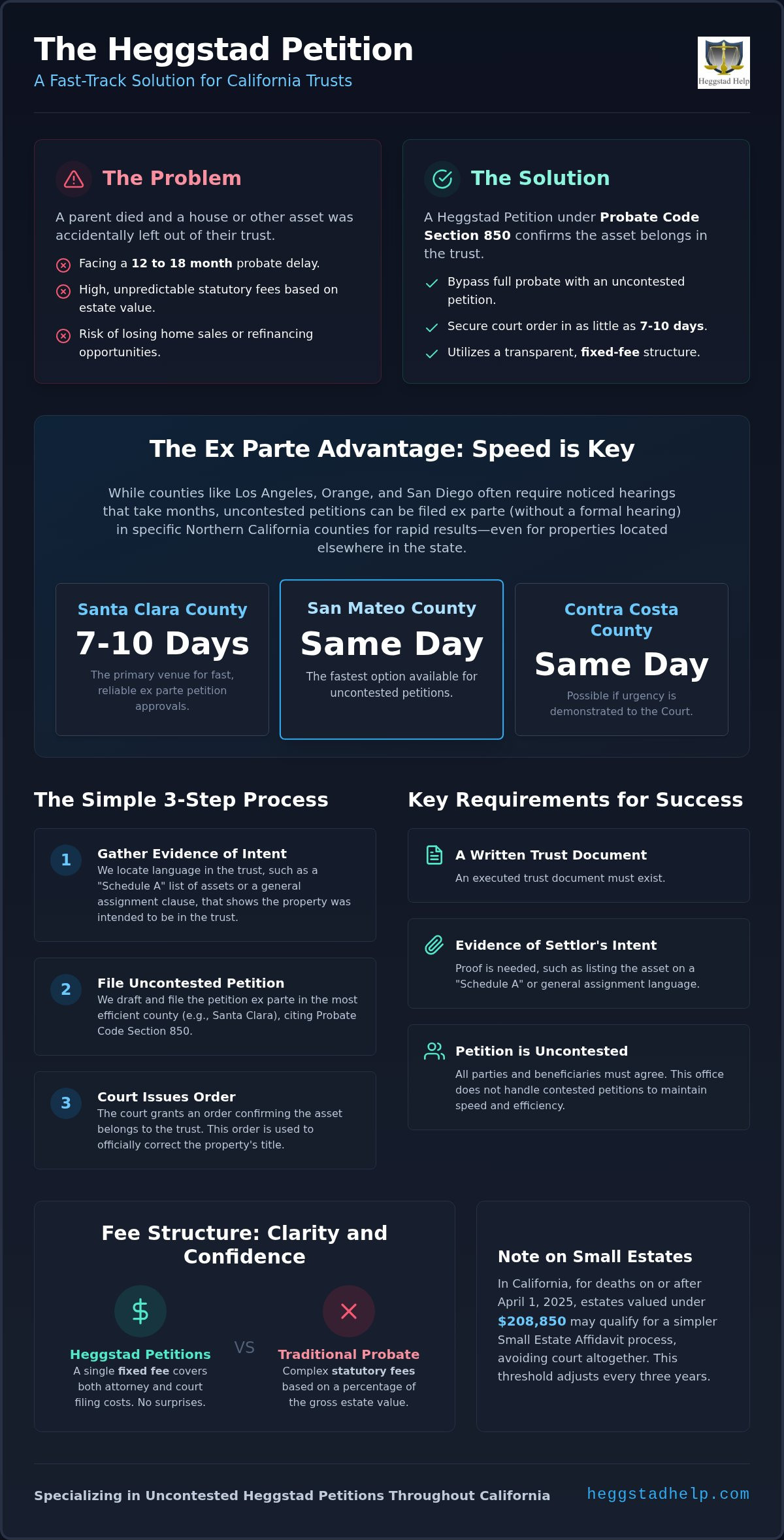
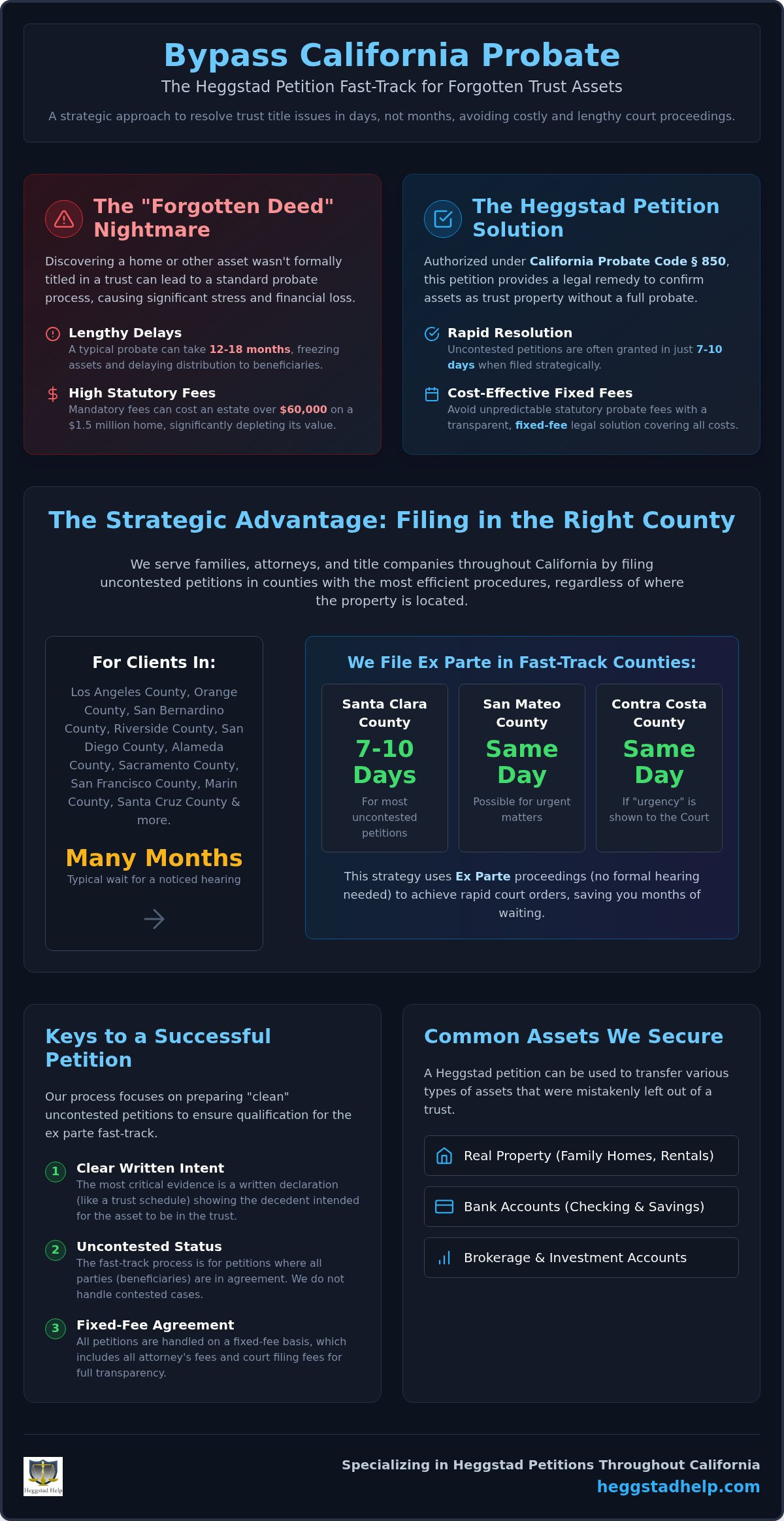
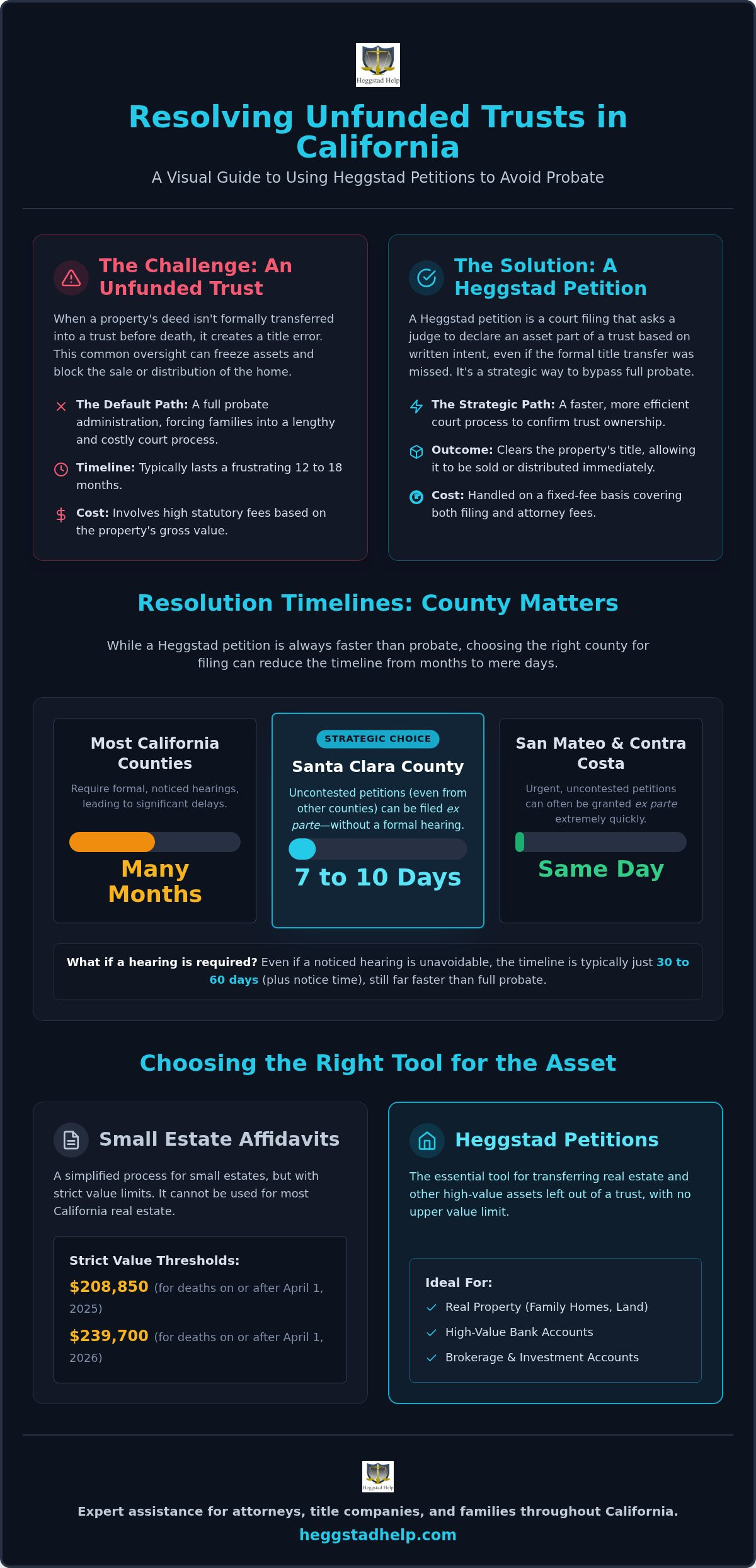
We act as a steady guide for families, title companies, and attorneys, providing a logical path through these procedural hurdles. While many counties require noticed hearings that take many months, we often utilize ex parte (expedited) filings in Santa Clara County to get petitions granted in just 7 to 10 days. In San Mateo and Contra Costa Counties, we can often secure orders the same day. If a noticed hearing is required, the timeline is typically 30 to 60 days plus notice time. For smaller assets, remember that California Small Estate Affidavit thresholds are $208,850 for deaths on or after April 1, 2025, and $239,700 for deaths on or after April 1, 2026. Our fixed-fee Heggstad solutions provide a clear, efficient path to resolving trust funding errors without the stress of a year-long probate.
Key Takeaways
- Learn how to transfer real estate to a living trust after death in California using a Heggstad petition (a court order confirming trust ownership) to bypass the lengthy probate process.
- Discover why filing in Santa Clara County is a strategic choice, providing results in 7 to 10 days for uncontested petitions compared to the many months required in other counties.
- Compare the Heggstad solution to Small Estate Affidavits, which are limited to estates under $208,850 for deaths on or after April 1, 2025, and $239,700 for deaths on or after April 1, 2026.
- Understand how fixed-fee arrangements and ex parte (expedited) filings can resolve title errors as quickly as the same day in San Mateo and Contra Costa Counties.
The Challenge of an Unfunded Trust in California
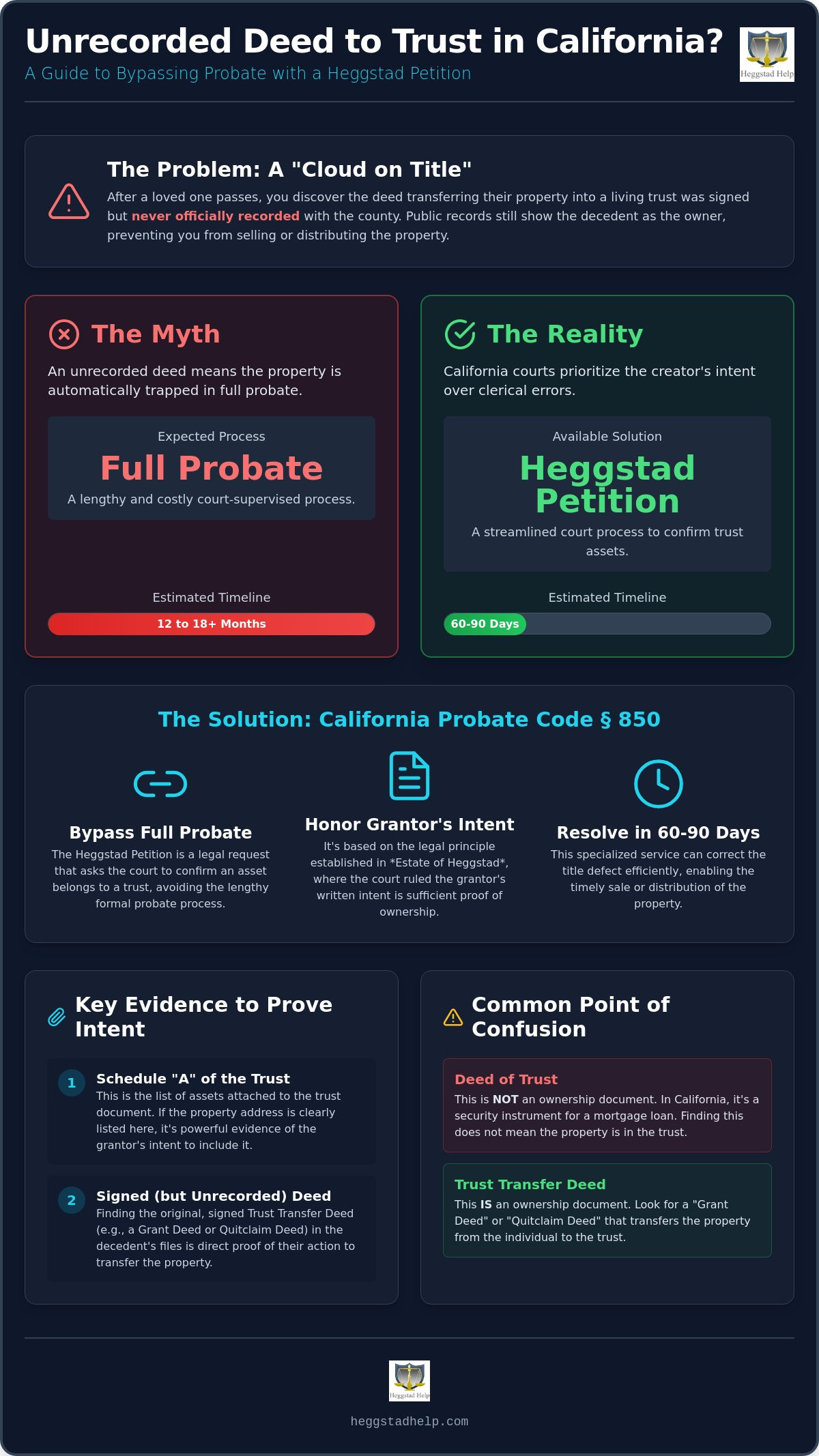
Creating a living trust is a significant step toward protecting your family’s future, but the document itself is only half of the equation. For a trust to function as intended, it must be “funded,” which is the formal process of transferring ownership of your assets from your individual name into the name of the trust. When it comes to your home, this requires signing and recording a new deed with the county recorder. If a parent or loved one passes away and you discover the deed is still in their personal name, the trust is considered “unfunded” regarding that specific property. Even if the trust document explicitly states that the house belongs to the trust, the transfer of title is not automatic under California law.
This oversight creates a legal gap that often prevents successor trustees (the people appointed to manage the trust) from selling the home or distributing it to beneficiaries. Without a recorded deed, title companies generally won’t issue the insurance necessary to close a sale. Fortunately, you can still transfer real estate to living trust after death by utilizing a specific legal remedy known as a Heggstad petition. Named after the landmark case Estate of Heggstad, this procedure allows a court to declare that the property is a trust asset based on the deceased person’s clear written intent, even if the formal deed was never recorded.
Why Real Estate Title Errors Occur
Title errors are surprisingly common, even for those who worked with experienced estate planners. One of the most frequent culprits is a residential refinance. Lenders often require borrowers to move a property out of a trust and back into their individual names to process a new loan; unfortunately, the final step of moving the property back into the trust is frequently forgotten once the paperwork is signed. In other cases, a “Schedule A” (the list of assets attached to the trust) might be too vague, failing to include a specific legal description or the assessor’s parcel number. Procrastination also plays a role, as many people intend to record a deed but simply never get around to the notary or the recorder’s office before they pass away.
The Consequences of Doing Nothing
Ignoring a title error usually results in the property being forced into a full probate administration, a process that typically lasts 12 to 18 months in California. During this time, the asset is effectively frozen, and the estate must pay high statutory fees (legal costs set by the state based on the gross value of the property). If the property value is relatively low, you might consider a Small Estate Affidavit, but these are subject to strict limits. For deaths occurring on or after April 1, 2025, the threshold is $208,850, and for those on or after April 1, 2026, it is $239,700. Because most California real estate exceeds these values, a Heggstad petition is usually the only way to avoid a year-long court battle. The same Heggstad solution that rescues real estate from probate can also be used to transfer business interest to trust after death in California, making it a versatile remedy for many types of forgotten assets. You can read more about the specific hurdles of Selling a House Left Out of a California Trust to understand why acting quickly is essential for clearing the title.
Using Probate Code 850 to Transfer Property in California
The primary legal mechanism for resolving a title error after a loved one passes away is California Probate Code Section 850. This specific statute allows the court to determine the ownership of property and, when appropriate, order its transfer to the rightful party. The foundation for this approach is the 1993 case of Estate of Heggstad, which established that a formal deed isn’t always strictly necessary if the deceased person’s intent to include the property in their trust is clearly documented. This precedent is a powerful tool for successor trustees (the individuals responsible for managing trust assets) who need to transfer real estate to living trust after death without the burden of a full probate administration.
By filing what’s commonly known as a Heggstad petition, you’re asking a judge to confirm that the home is a trust asset despite the missing deed. This process is significantly faster and less expensive than a traditional probate, which often consumes 12 to 18 months of time and thousands of dollars in statutory fees. Our approach focuses on speed and precision, acting as a steady hand for families and title companies across California. If you’re ready to resolve a title issue, you can learn more about our specialized petition services to see how we can help.
Proving Intent to the Court
To succeed with a petition under Section 850, you must provide clear evidence of the settlor’s (the person who created the trust) written intent. Judges typically look first at the trust’s “Schedule of Assets,” often labeled as Schedule A, which lists the properties intended for the trust. If the schedule includes the property’s address or a general description like “my primary residence,” it often serves as sufficient proof. Additionally, many trusts include a “General Assignment” document, which acts as a catch-all statement transferring all of the owner’s property into the trust. Gathering the correct Evidence Required for Heggstad Petition in California is the most critical step in ensuring the court grants your request without unnecessary delays.
Fixed Fees vs. Statutory Probate Commissions
One of the most significant advantages of a Heggstad petition is the cost structure. In a full probate, both the attorney and the executor are entitled to statutory commissions (legal fees set by the state as a percentage of the estate’s gross value). For a million-dollar home, these fees can be tens of thousands of dollars. In contrast, we handle Heggstad petitions using fixed fees that cover both the filing and attorney fees, providing families with financial predictability. Because title companies require a court order before they’ll issue title insurance for a sale, having a Board-Certified Specialist like Robert P. Bergman manage the filing ensures the order is drafted correctly the first time. Our expertise allows us to file uncontested petitions ex parte (without a formal hearing) in Santa Clara County, often securing results in just 7 to 10 days, or even the same day in San Mateo and Contra Costa Counties.
Procedural Timelines: Choosing the Right County in California
The timeline to transfer real estate to living trust after death in California isn’t uniform across the state. In many jurisdictions, a petition requires a “noticed hearing,” which is a formal court appearance scheduled 4 to 6 months after the initial filing. This delay can be catastrophic if you have a pending home sale or are facing financial pressure from a lender. However, our specialized approach leverages the procedural efficiencies of specific Northern California courts to bypass these lengthy queues. By selecting the right venue, we can often turn a half-year ordeal into a matter of days.
In Santa Clara County, we’ve refined a process where uncontested petitions are granted in just 7 to 10 days. For those dealing with property in San Mateo or Contra Costa Counties, we can often secure a signed order the very same day the petition is filed. Understanding that these courts are physically located in the Bay Area is key, as we can often utilize the Santa Clara court to hear uncontested petitions for assets located anywhere in the state. This strategic filing allows us to resolve title errors in a fraction of the time it would take in Southern California or the Central Valley.
Ex Parte vs. Noticed Hearings
The term “ex parte” refers to a legal proceeding where a court order is obtained without a formal, scheduled hearing date that requires months of waiting. While a noticed hearing requires 30 to 60 days of notice time plus the court’s availability, an ex parte filing moves to the front of the line. In Contra Costa County, achieving a same-day order typically requires demonstrating “urgency,” such as an open escrow that is at risk of falling through. If a noticed hearing is required regardless of location, the timeline typically stretches to 30 to 60 days plus notice time, with contested petitions taking much longer. By presenting the case correctly from the start, we help successor trustees avoid the 4 to 6 month wait common in other regions.
Avoiding the “Probate Trap” in High-Volume Counties
High-volume jurisdictions like Los Angeles, Riverside, or San Diego are often backlogged, meaning even a simple petition can sit for many months before a judge reviews it. This “probate trap” can derail estate distributions and cause significant stress for grieving families who just want to move forward. HEGGSTAD HELP acts as a dedicated resource for attorneys and title companies throughout California, helping them navigate these hurdles with expedited filings. If you’re struggling with a missing deed, our Heggstad Petition Filing Guide in California provides more detail on how to recover missing trust assets efficiently. Choosing the right venue for your petition ensures that the title correction process remains a quick resolution rather than a long-term burden.
Small Estate Affidavits vs. Heggstad Petitions for Real Estate
When a loved one passes away, families naturally search for the most efficient way to handle the estate. You might have heard of a California Small Estate Affidavit, which is a document used to collect assets without a formal court proceeding. However, this tool is primarily designed for personal property like bank accounts or vehicles. If you need to transfer real estate to living trust after death, an affidavit is rarely the right solution because California law imposes very low financial ceilings on its use. Most real property in our state quickly exceeds these limits, making a Heggstad petition the more appropriate and powerful tool for title correction. Families who find themselves in this situation often benefit most from working with a lawyer to transfer property into trust after death in California who specializes in these expedited petition procedures.
Combining the 2025 and 2026 Thresholds
To determine if an estate qualifies for simplified procedures, you must first identify the date of death. For deaths occurring on or after April 1, 2025, the threshold for a small estate is $208,850. For those occurring on or after April 1, 2026, the threshold increases to $239,700. It’s vital to remember that these figures represent the gross value (the total fair market value) of the assets, not the net value after subtracting mortgages or debts. Because the 2026 figure of $239,700 is tied to inflation adjustments, it must always be viewed alongside the 2025 figure of $208,850 to ensure you’re applying the correct law for the specific year of passing. If the house is worth more than these amounts, the affidavit cannot be used to transfer the title.
Why Real Property Usually Exceeds These Limits
In the California real estate market, it’s rare to find a home valued below the small estate limits. Even a modest condominium or a small plot of land usually exceeds the $208,850 or $239,700 thresholds. When the property value surpasses these limits, the Small Estate Affidavit is no longer an option. This leaves you with two choices: a full probate administration or a Heggstad petition. A Heggstad petition acts as the logical middle ground, allowing you to move high-value real estate into a trust without the 12 to 18 month wait associated with probate.
One actionable tip is to always check the date of death before choosing a filing threshold, as using the wrong year’s limit can lead to court rejections. If the property was intended for the trust but the deed was never recorded, a Heggstad petition is the most efficient way to bypass the “small estate” hurdles. If you aren’t sure which path fits your situation, you can consult with a specialist on Heggstad petitions to verify your eligibility and avoid the costs of a full probate.
Securing Your Court Order and Correcting the Title
The journey to transfer real estate to living trust after death concludes with a signed court order, but the procedural path requires precision to ensure the title is truly cleared. Once we file the petition, the court reviews the evidence of intent we’ve gathered. In Santa Clara County, our ex parte (expedited) process typically results in a granted petition within 7 to 10 days. For those in San Mateo or Contra Costa Counties, we can often secure these orders the same day. After the judge signs the order, it must be recorded with the County Recorder in the county where the property is located. This recorded order serves as the legal bridge, officially moving the property from the deceased individual’s name into the trust.
Working with title companies is a critical part of this final stage. A court order is only useful if a title officer accepts it to issue title insurance for a future sale or refinance. Generalist probate lawyers might provide a standard order, but title companies often require specific language to confirm the court’s jurisdiction and the finality of the decision. We act as the “expert for the experts,” assisting other attorneys and title companies to ensure the court order is bulletproof. This specialized focus prevents title errors from blocking a home sale at the last minute. Families dealing with more complex estates should also be aware that the same Probate Code § 850 framework used for real estate can help transfer business interests to a trust after death in California when an LLC or brokerage account was similarly left out of the trust.
The Role of a Specialized Heggstad Attorney
Generalist probate lawyers often default to the standard 12 to 18 month probate process because they aren’t familiar with the ex parte shortcuts available for Heggstad petitions. Robert P. Bergman, a Board-Certified Specialist in Estate Planning, Trust and Probate Law, brings a sense of calm competence to these high-stress situations. We use fixed fees that cover both the attorney’s time and the court filing costs, so you don’t have to worry about the rising costs of traditional probate commissions. This transparency allows successor trustees to manage the estate’s finances with confidence while resolving complex title hurdles.
Next Steps for Successor Trustees
If you’re ready to move forward, your first step is to gather the original trust document and the most recent deed (the document currently showing the “wrong” title). Even if the estate value is below the thresholds of $208,850 for deaths on or after April 1, 2025, or $239,700 for deaths on or after April 1, 2026, real estate title issues usually require this court-supervised path. You should consult with a specialist to evaluate your trust’s specific language and “Schedule A” to confirm eligibility. You can get expert help with your Heggstad Petition in California to ensure your family’s home is protected and ready for sale or distribution.
Resolve Your Trust Funding Errors with Confidence
Finding a missing deed doesn’t have to mean entering a year-long probate. By using a Heggstad petition, which is a court order that confirms a property belongs in a trust, you can quickly transfer real estate to living trust after death and move forward with your loved one’s wishes. While standard probate procedures in many counties take months, our strategic ex parte (expedited) filings in Santa Clara County regularly secure results in just 7 to 10 days. In San Mateo and Contra Costa Counties, we can often obtain orders the same day. Even if an estate is below the thresholds of $208,850 for deaths on or after April 1, 2025, and $239,700 for deaths on or after April 1, 2026, real estate title issues usually require this specialized path.
Robert P. Bergman is a Board-Certified Specialist in Estate Planning, Trust and Probate Law who provides a steady hand for families and attorneys throughout California. We offer fixed-fee Heggstad filings that provide a clear, predictable path to resolution without the stress of traditional probate commissions. Request a Consultation for Heggstad Petitions in California to confirm your property as a trust asset and clear the title for distribution. We’re here to help you resolve these complications with speed and professional precision.
Frequently Asked Questions
Can I transfer real estate to a living trust after the death of the grantor in California?
Yes, you can transfer real estate to living trust after death by filing a Heggstad petition (a legal request for a court order confirming trust ownership). This procedure is used when a property was intended for the trust but the formal deed was never recorded. It relies on providing written evidence of the deceased person’s intent to include the asset in their trust estate.
How long does a Heggstad petition take to process in Santa Clara County?
In Santa Clara County, uncontested Heggstad petitions are typically granted in just 7 to 10 days. We achieve this speed by filing ex parte (without a formal, scheduled hearing), which bypasses the standard court backlog. This is significantly faster than the 4 to 6 months required for noticed hearings in many other California counties.
What is the California Small Estate threshold for 2025 and 2026?
For deaths occurring on or after April 1, 2025, the small estate threshold is $208,850. For deaths on or after April 1, 2026, the threshold increases to $239,700. Both figures represent the gross fair market value of the estate and must be referenced together to ensure you are using the correct limit based on the date of death.
Do I need to go through full probate if a house was left out of the trust?
No, you can often avoid the 12 to 18 month full probate process by filing a petition under Probate Code Section 850. This “Heggstad” solution is designed specifically to correct title errors for assets that were left out of a trust. It allows you to move the property into the trust quickly and at a much lower cost than traditional probate administration.
What evidence is needed for a Heggstad petition in California?
The court primarily requires written evidence of intent, such as a “Schedule of Assets” (Schedule A) listing the property or a “General Assignment” document. You will also need to provide the trust document itself and the current deed that shows the property in the deceased person’s individual name. These documents help the judge confirm that the omission was a clerical error.
Are Heggstad petition legal fees fixed or hourly in California?
We provide fixed fees for Heggstad petitions in California, which cover both the attorney fees and the court filing costs. This fixed-fee structure offers families financial predictability and avoids the expensive, percentage-based statutory fees found in full probate cases. It’s a transparent way to resolve title issues without worrying about mounting hourly bills.
Can I file a Heggstad petition ex parte in San Mateo or Contra Costa Counties?
Yes, uncontested petitions in San Mateo and Contra Costa Counties are regularly filed ex parte and can often be granted the same day. While Contra Costa County requires a showing of “urgency” for same-day results, both counties provide an expedited path compared to the many months required for noticed hearings in larger California jurisdictions.
What happens if a property was never deeded to the trust before death?
If a property was never deeded, the title remains in the deceased person’s individual name, which prevents the successor trustee from selling or distributing it. To transfer real estate to living trust after death in this situation, you must obtain a court order declaring the home as a trust asset. Without this court intervention, the property remains frozen and cannot be insured by title companies for a sale.

Article by
Robert P. Bergman, Attorney at Law
Attorney Robert P. Bergman ("Bob Bergman") has been a Board-Certified Specialist in Estate Planning, Trust and Probate Law since 2011, as certified by the California State Bar Board of Legal Specialization. For several years, Bob has assisted families and the clients of other attorneys with obtaining court orders through Heggstad petitions to avoid the time and expense of Probate administration. Bob is friendly, very approachable, and believes in explaining complex legal topics in clear ordinary language so that his clients understand exactly what they're doing and why they're doing it.
Bob is often able to assist clients who are in other counties than his home county of Santa Clara through his approach to Heggstad petitions.
Disclaimer
This article is for informational purposes only. Nothing in this article is intended to replace legal advice from a competent attorney or be considered legal guidance for anybody's specific legal situation. Nobody should rely on information in this article in making legal decisions without such consultation.