
What if the 18-month probate nightmare you’re dreading could be resolved in as little as 60 to 90 days? It’s a common and deeply frustrating discovery to find a deed not recorded to trust California property after a loved one passes away. You’re likely worried that a single clerical oversight will trap the estate in a lengthy court backlog, leading to high statutory fees (the mandatory costs paid to executors and attorneys) and months of uncertainty. It’s natural to feel overwhelmed when legal documents seem to conflict, but a missing recording date doesn’t have to result in a full probate administration.
You can still secure the title to real property and honor the grantor’s original intent without the traditional 12-to-18-month wait. This article explains how to use a Heggstad Petition (a specialized legal request under Probate Code Section 850) to confirm that an asset belongs in a trust. We’ll walk through the process of correcting title defects, avoiding the formal probate process, and ensuring the property is ready for sale or distribution. By understanding this logical bypass, you can navigate these procedural hurdles with calm competence and resolve the estate efficiently.
Key Takeaways
- Learn why a deed not recorded to trust California property is not a “probate sentence,” as courts prioritize the grantor’s intent (the creator’s original plan) over clerical recording errors.
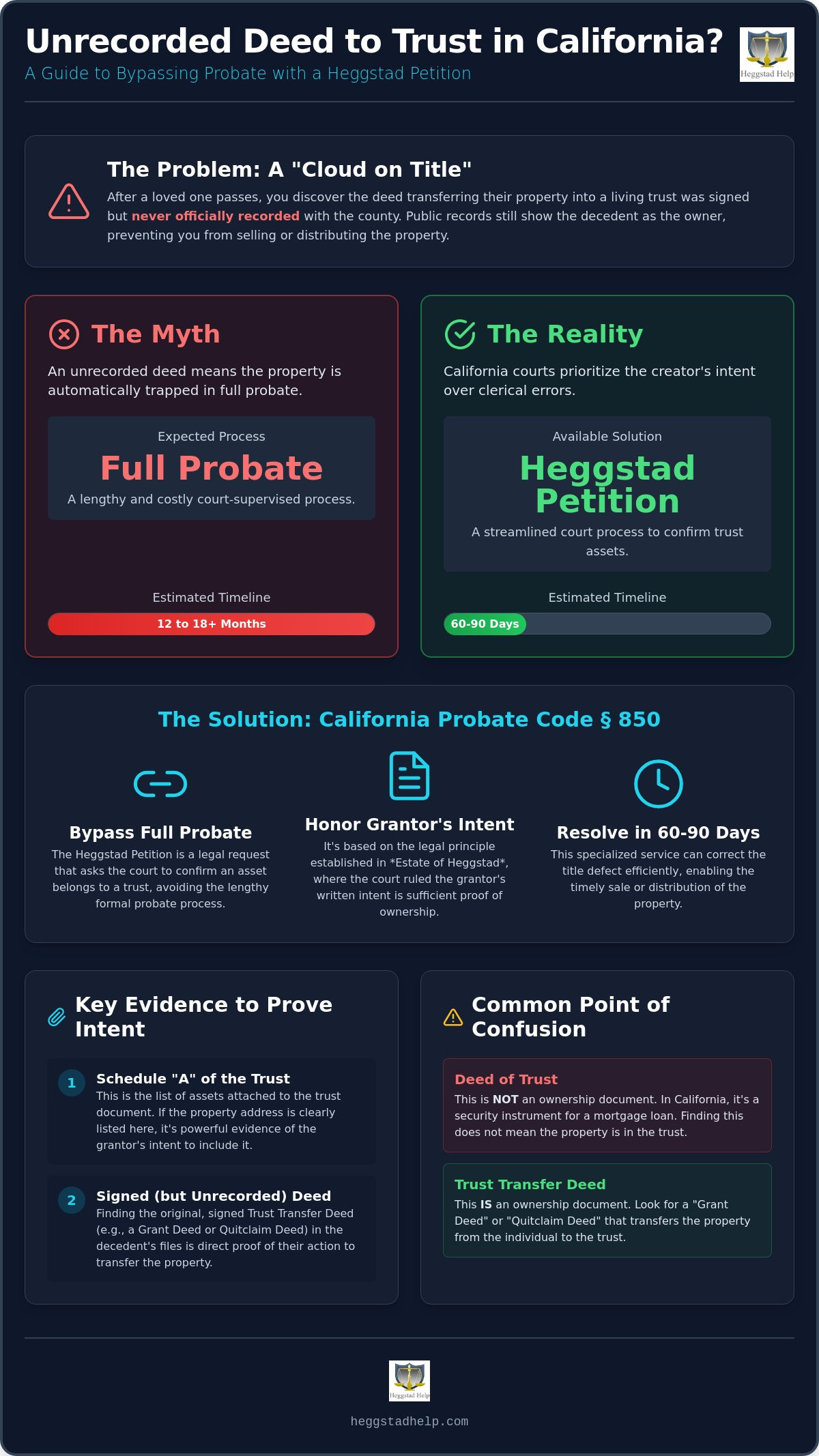
- Understand how a Heggstad Petition, which is a specific legal request under Probate Code 850, can bypass the 12-to-18-month probate process by confirming property as a trust asset.
- Identify the critical documents needed to prove ownership, such as the “Schedule A” (the list of assets attached to a trust) and original signed transfer documents.
- Discover how specialized title correction services can resolve unrecorded deed issues in approximately 60 to 90 days, facilitating the timely sale or distribution of the estate.
Understanding the Legal Impact of a Deed Not Recorded to a Trust in California
To move real property into a trust, a grantor (the person creating the trust) must execute a Trust Transfer Deed. This document acts as the legal vehicle for changing ownership from an individual’s name to the name of the trust. While the signature of the grantor makes the transfer valid between the parties, the document should be filed with the County Recorder to provide “constructive notice” (a legal term meaning the public is officially aware of the change) to the world. Without this step, the chain of title remains broken in the eyes of the public and the courts.
When a deed not recorded to trust California situation occurs, it’s often the result of simple clerical oversights or a fundamental misunderstanding of the “funding” process. Some homeowners believe that signing the trust agreement itself is sufficient to transfer the house. Others may have prepared the deed but neglected to mail it to the recorder; alternatively, a title company might have failed to record the document following a mortgage refinance. This creates a state of legal limbo where the trust document lists the home as an asset, but the public record shows the decedent as the individual owner.
To avoid these types of administrative gaps, families often seek professional guidance from firms like Northeast Legal Team to ensure their comprehensive estate planning is executed correctly and all assets are properly funded.
Deed of Trust vs. Trust Transfer Deed: Clearing the Confusion
It’s quite common for families to search through recorded documents and find a “Deed of Trust,” mistakenly believing this proves the house is in the trust. In California, a Deed of Trust is actually a mortgage-like security instrument for a loan; it doesn’t transfer ownership to your living trust. To fund a trust, you must use a Grant Deed or a Quitclaim Deed. If you only see a Deed of Trust in the county records, the property likely remains outside the trust’s legal umbrella, regardless of what the name on the mortgage suggests.
The Consequences of an Unfunded Trust
An unrecorded deed leads to what title companies call a “cloud on title” (a defect or dispute that prevents a clean transfer of ownership). This defect makes it impossible to sell or refinance the home until the record is corrected by a court order. If you’ve discovered a deed not recorded to trust California after a death, the primary consequence is that the property is technically stuck in the decedent’s individual name. If the property’s value exceeds the small estate limit, which is currently $208,850 for deaths on or after April 1, 2025, the estate faces the risk of a mandatory full probate administration. An unfunded trust is a legal state where a trust exists but holds no legal title to its intended assets. Understanding the full consequences of incorrect trust property title California families encounter is essential before taking action. Fortunately, the landmark Estate of Heggstad case established that the court can look at the grantor’s intent to fix these funding errors without a full probate.
Myth vs. Reality: Is it Too Late if the Deed Wasn’t Recorded Before Death?
Many families are paralyzed by the fear that a clerical oversight has doomed them to a 12 to 18 month probate process. There’s a persistent myth that if a deed not recorded to trust California property wasn’t processed at the County Recorder’s office before the owner passed away, the asset automatically falls into the probate estate. This misconception suggests that the public record is the final word on ownership. In reality, while recording is the gold standard for public notice, California law recognizes that life is often more complicated than a filing date suggests.
The courts look primarily at the “intent” of the grantor (the individual who established the trust). If you can demonstrate that the decedent intended for the property to be part of their trust, the lack of a recorded deed becomes a fixable technicality rather than a legal dead end. This intent is often found in the trust document itself, specifically within a “Schedule A” (the list of assets intended for the trust). When a property is clearly listed on this schedule, or if a signed but unrecorded deed is found in the decedent’s files, the court has the authority to confirm the property as a trust asset.
The Power of the Grantor’s Intent
The legal landscape regarding unrecorded deeds changed significantly with the landmark Estate of Heggstad case. This ruling established that a written declaration of trust, where the grantor lists specific real property as trust property, is sufficient to create a valid trust even without a separate recorded deed. This principle is codified under California Probate Code 850, which provides a procedural path to ask the court to confirm ownership. Beyond the trust documents, other evidence can support this intent, such as property tax records or insurance policies paid by the trust rather than the individual.
Why “Signing” is Often More Important Than “Recording” for Trusts
There’s a critical legal distinction between the “delivery” of a deed and its “recording.” Under California law, a deed is considered effective once it’s signed and delivered to the trustee. Recording is simply the act of notifying the public. If a grantor signed a deed but it was tucked away in a desk drawer or lost in the mail, the legal transfer between the parties still occurred. It isn’t “lost” property; it’s simply “misplaced” in the eyes of the law. If you find yourself holding a signed document that was never filed, you can still pursue trust asset title correction to avoid the high statutory fees and delays of a full probate administration.
California Probate Code 850: The Remedy for Missing Trust Deeds
A petition filed under California Probate Code 850 is a formal legal request for the court to confirm property ownership. When a deed not recorded to trust California issue is discovered after a death, the Successor Trustee (the individual tasked with managing trust assets) doesn’t have to settle for a lengthy probate. Instead, they can use this petition to ask a judge to declare that the property is already a trust asset. This specific type of filing is widely known as a “Heggstad Petition,” named after the landmark case that established this remedy. The ultimate goal of this process is to secure a court order that effectively replaces the missing deed. Once this order is recorded with the County Recorder, the title is corrected, and the property can be sold or distributed to beneficiaries.
How the Heggstad Petition Bypasses Full Probate
The most immediate benefit of this procedure is the significant reduction in time. While a standard probate administration in California typically lasts between 12 and 18 months, a Heggstad Petition is generally resolved within 60 to 90 days. This speed is especially critical if there’s an urgent need to sell the home or if the family wants to avoid the high statutory fees associated with probate. In California, probate fees are set by law and are based on the gross value of the estate, starting at 4% of the first $100,000 and 3% of the next $100,000. When dealing with a deed not recorded to trust California, an 850 petition allows you to bypass these mandatory costs entirely. For situations involving a pending escrow or other time-sensitive pressures, an Ex Parte Court Order Service may be available to move the process forward even faster.
Legal Requirements for a Successful 850 Petition
To succeed, the petition must present clear evidence of the grantor’s intent. This evidence usually begins with a written “Declaration of Trust” or a “Schedule of Assets” (the list typically found at the back of a trust document) that specifically mentions the property. Even if the property wasn’t explicitly listed, a petition can still be successful if other documents prove the grantor intended for the home to be trust property. Framing these arguments requires a high level of professional precision. A Board-Certified Specialist in Estate Planning, Trust and Probate Law knows how to structure the petition to satisfy the judge’s requirements, ensuring the intent is legally undeniable. This specialized expertise is the difference between a quick resolution and a rejected petition that forces the family back into full probate.
Steps to Fix an Unrecorded Deed After the Grantor’s Death
When you discover a deed not recorded to trust California property, the path to resolution is methodical and evidence-based. Successor trustees often feel an immediate sense of urgency; however, the most effective first step is a thorough audit of the decedent’s records. This process isn’t merely about finding a single piece of paper. It’s about building a compelling narrative of intent that a judge will find legally indisputable. By following a structured approach, you can transform a title defect into a clear path toward distribution. If you’re also encountering other unfunded assets during this audit, a dedicated resource on successor trustee help for missing assets can guide you through locating and recovering property that was never formally retitled into the trust.
Gathering Evidence of Trust Funding
Start by locating the original trust binder and looking specifically for a “Schedule A” or any list of assets intended for the trust. You should also search for a “General Assignment of Assets,” which is a document frequently included in estate plans to act as a catch-all transfer for personal and real property. These documents are vital because they provide the written proof of intent required by the court. To strengthen your case, you should also look for the following items:
- Original, signed (but unrecorded) deeds tucked away in physical files or safe deposit boxes.
- Digital copies of deeds or correspondence in the decedent’s email or cloud storage.
- Correspondence from the original drafting attorney regarding the intent to record the deed.
- Homeowners insurance policies or property tax records that list the trust as the owner.
Once you’ve gathered these materials, it’s essential to consult with a specialized attorney to evaluate the strength of your evidence. They’ll help determine if the documentation is sufficient to satisfy the court’s requirements for a Heggstad Petition. If you’re ready to move forward, you can begin a Heggstad Petition filing to secure the title and avoid the high costs of a full probate administration.
The Court Hearing and Final Recording
After the evidence is compiled, a Petition to Confirm Trust Assets is filed in the Superior Court of the county where the property is located. At the hearing, the judge reviews the evidence to ensure it meets the standards for confirming the grantor’s intent. Unlike a full probate that requires multiple hearings over many months, this process is focused and efficient. The judge’s role is to verify that the property was meant to be a trust asset despite the recording error.
If the petition is successful, the judge signs a judicial order. This signed order is the most critical piece of the puzzle because it effectively becomes your “new deed.” You must take a certified copy of this order to the County Recorder’s office for formal filing. Once the order is recorded, the “cloud on title” is cleared, and the property is legally recognized as a trust asset. This final step allows the trustee to sell the home or distribute it to beneficiaries without the shadow of a title defect or the 12 to 18 month delay of a traditional probate.
How Heggstad Help Restores Title to Your California Trust
Discovering a deed not recorded to trust California property creates a specific type of legal crisis that requires a surgical approach. While many law firms offer general probate services, Heggstad Help functions as a specialized “emergency room” for trust funding errors. By focusing exclusively on Heggstad Petition filings and trust asset title correction, the firm avoids the distractions of general civil litigation. This narrow focus ensures that your case is handled with the methodical organization required to bypass the standard probate courts efficiently.
Why Specialization Matters for PC 850 Petitions
Generalist attorneys often treat a Probate Code 850 petition as a secondary task; however, proving the grantor’s intent requires a deep understanding of evolving case law and local court preferences. Robert P. Bergman is a Board-Certified Specialist in Estate Planning, Trust and Probate Law who has been practicing since 1980. This level of experience is critical because a poorly drafted petition risks a summary denial by the judge, which could force your family back into a 12 to 18 month probate administration. Our approach prioritizes transparency through clear communication and a logical progression toward a court order.
Efficiency is the hallmark of our service. While a typical probate case in California involves significant statutory fees and lengthy delays, our specialized title correction process aims for a resolution in approximately 60 to 90 days. We serve clients across all California counties from a central expert hub, ensuring that distance is never a barrier to high-quality legal representation. We understand that successor trustees are often managing these hurdles during a time of grief, so we maintain a service-oriented posture that emphasizes logic and clarity over archaic legalese.
This focus on clarity is shared by financial experts such as Wright CPAs, LLC, who provide the architecture of financial clarity needed to manage the complex tax and accounting requirements of a trust estate.
Contact Heggstad Help Today
Taking the first step toward correcting a title defect doesn’t have to be stressful. We provide a clear, accessible path for successor trustees to submit their estate planning documents for a professional review. Our firm is built on a foundation of calm competence, designed to reduce the anxiety often associated with complex procedural hurdles. If you’ve found an unrecorded deed, we’re here to provide the steady, knowledgeable hand you need to secure the estate’s future.
Request a Consultation with Heggstad Help
Securing Your Family’s Legacy Without Probate Delays
Discovering a deed not recorded to trust California property is a significant procedural hurdle; however, it is one that can be resolved with logical, methodical steps. By prioritizing the grantor’s intent (the original plan for the asset) over clerical recording errors, California law provides a clear bypass through the Heggstad Petition process. This specialized remedy allows you to avoid the high statutory fees and the 12 to 18 month timeline of a full probate administration, often restoring title in just 60 to 90 days. You have the power to protect the estate’s value while honoring the wishes of your loved one.
You don’t have to navigate these complex requirements alone. Robert P. Bergman is a Board-Certified Specialist in Estate Planning, Trust and Probate Law who has been practicing in California since 1980. With an exclusive focus on Heggstad and Probate Code 850 petitions (legal requests to confirm trust ownership), he provides the calm competence needed to correct title defects efficiently. Bypass Probate with a Heggstad Petition: Contact Robert P. Bergman Today. Securing your loved one’s legacy is entirely possible, and the right legal path is closer than you think.
Frequently Asked Questions
Does a living trust have to be recorded in California?
No, a living trust is a private document and does not need to be recorded with the County Recorder. Only the deeds (the specific documents that transfer real property) are recorded to provide public notice of ownership. If you have a deed not recorded to trust California, the public record will still show the property in the decedent’s individual name, which requires a court order to correct after they pass away.
What happens if I found a signed deed that was never recorded?
A signed but unrecorded deed is considered excellent evidence of the grantor’s intent to transfer the property into the trust. Under California law, a deed is technically effective once it’s signed and delivered to the trustee, even if it hasn’t reached the County Recorder’s office. You can use this document as the basis for a Heggstad petition to have the court formally recognize the trust’s ownership.
How much does a Heggstad Petition cost compared to probate?
A Heggstad petition is generally much more cost-effective than a full probate because it avoids mandatory statutory fees. In California, probate fees for executors and attorneys are set by law as a percentage of the gross estate value, starting at 4% of the first $100,000 and 3% of the next $100,000. By resolving the title issue through a single petition, you avoid these escalating costs and the expenses of a year-long court process.
Can I sell the house while the Heggstad Petition is pending?
You can list the property and open an escrow account while the petition is moving through the court system. However, you won’t be able to close the sale or transfer the title to a buyer until the judge signs the court order and it’s recorded with the county. For urgent situations like a pending sale, we can often use Ex Parte Court Order Services to request an expedited hearing from the judge.
What if the property is not listed on the Trust Schedule A?
Success is still possible even if the property is missing from the Schedule A (the asset list attached to the trust). The court will look for other evidence of intent, such as a “General Assignment” of assets or records showing the trust paid for property expenses like taxes or insurance. A specialized attorney knows how to gather and present this secondary evidence to satisfy the court’s requirements.
How long does it take to get a court order confirming trust assets?
It typically takes between 60 and 90 days to obtain a court order confirming that an asset belongs to a trust. This timeline is significantly shorter than a full probate administration, which averages 12 to 18 months in California. The exact duration depends on the specific county’s court backlog and whether your case requires an expedited hearing due to a pending real estate transaction.
Do I need to go to court for a Heggstad Petition?
In the majority of cases, the Successor Trustee isn’t required to attend the court hearing in person. Your attorney will handle the filing and appear before the judge to present the evidence regarding the deed not recorded to trust California. This allows you to manage the practical aspects of the estate while a specialist navigates the procedural requirements of the probate code.
Is a Heggstad Petition the same as a 850 Petition?
Yes, a Heggstad petition is a specific application of California Probate Code Section 850. “Heggstad” is the nickname used by legal professionals in honor of the landmark 1993 court case that established this remedy. While Section 850 covers various types of property disputes, the Heggstad version is the industry standard for confirming that an asset was intended to be part of a trust. For a comprehensive overview of how to identify and resolve these issues, the guide on how to fix trust title errors on California real property provides an in-depth look at the full correction process.

Article by
Robert P. Bergman, Attorney at Law
Attorney Robert P. Bergman ("Bob Bergman") has been a Board-Certified Specialist in Estate Planning, Trust and Probate Law since 2011, as certified by the California State Bar Board of Legal Specialization. For several years, Bob has assisted families and the clients of other attorneys with obtaining court orders through Heggstad petitions to avoid the time and expense of Probate administration. Bob is friendly, very approachable, and believes in explaining complex legal topics in clear ordinary language so that his clients understand exactly what they're doing and why they're doing it.
Bob is often able to assist clients who are in other counties than his home county of Santa Clara through his approach to Heggstad petitions.
Disclaimer
This article is for informational purposes only. Nothing in this article is intended to replace legal advice from a competent attorney or be considered legal guidance for anybody's specific legal situation. Nobody should rely on information in this article in making legal decisions without such consultation.


