
Heggstad Petition in California: Assets That May Avoid Probate

An asset can be intended for a trust yet remain outside it on paper. A Heggstad petition in California may help you avoid probate by asking the court…

An asset can be intended for a trust yet remain outside it on paper. A Heggstad petition in California may help you avoid probate by asking the court to confirm that an overlooked asset belongs to the trust. Because the petition can be contested, evidence of the trustor’s intent matters.

It’s understandable to worry that a missing deed or account title could lead to probate. A Heggstad petition may apply to real property and certain other assets when documents or records show the trustor intended to place them in the trust. It does not automatically transfer every asset.

This article explains which assets may qualify, how a court order can address property and accounts, and what may happen if someone objects. You’ll also learn how an uncontested petition differs from a contested case, so you can better understand the process.

Key Takeaways

  • Gather trust schedules, assignments, correspondence, and financial records that may show the trustor intended the overlooked asset to belong to the trust.
  • Identify the asset’s current ownership and title details to understand whether a court petition may help bring it into the trust.
  • Expect the court order process to differ for real property and financial accounts, and learn what notice interested parties may receive.
  • Consider whether anyone may object, since evidence of intent and the presence of a dispute can affect the petition’s path.

Can a Heggstad Petition Be Contested?

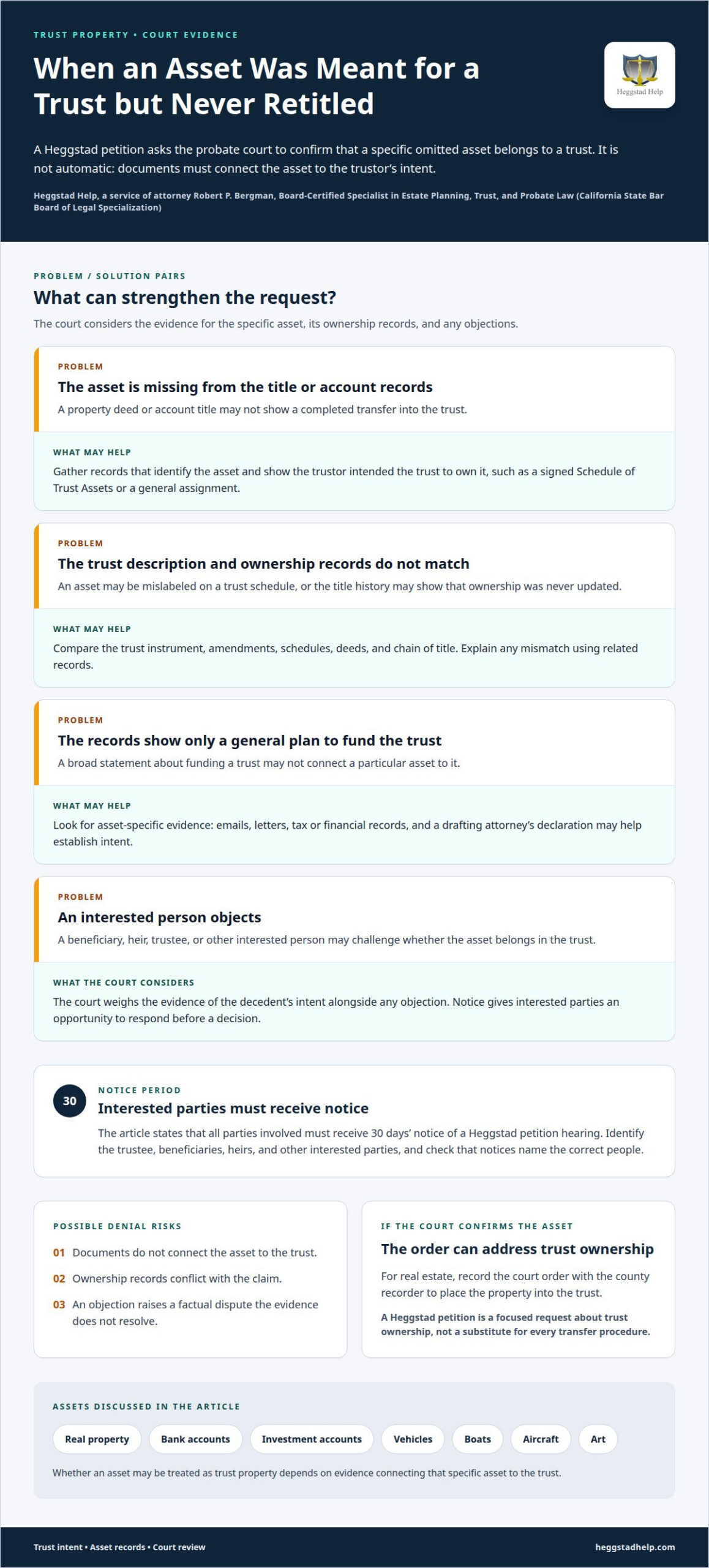
Yes. A beneficiary, heir, trustee, or other interested person may object, making the petition contested. The court weighs evidence of the decedent’s intent and whether the asset belongs in the trust.

Evidence of Intent to Fund the Trust

Look for documents created before the decedent’s death that connect the specific property to the trust. A signed Schedule of Trust Assets, general assignment, emails, letters, tax records, or financial records may support the request. Strong evidence identifies the asset clearly and shows the decedent intended the trust to own it, rather than merely describing a future plan.

Trust Documents and Chain of Title

Compare the trust and its schedules with the property’s title history. For real estate, deeds and the chain of title, meaning the record of ownership transfers, can show whether the decedent retained ownership despite an incomplete transfer. A mismatch, such as a property interest described incorrectly on a trust schedule, may need explanation through related documents. Keep the trust instrument, amendments, schedules, and title records together for review.

Notice to Interested Parties

Notice gives the trustee, beneficiaries, heirs, and other interested parties an opportunity to respond before the court decides the request. According to the California Legislature, all parties involved must receive 30 days’ notice of a Heggstad petition hearing. Review the interested-party list carefully and ensure notices address the correct people. If someone objects, the hearing may become contested, and the court will consider that objection alongside the evidence.

Requirements and Risks of Denial

To obtain relief under Probate Code Section 850, the petitioner must show that the asset should be treated as trust property, supported by evidence of the decedent’s intent. A petition may be denied if the documents do not connect the asset to the trust, ownership records conflict with the claim, or an objection exposes a factual dispute the evidence does not resolve. For example, a general statement about funding a trust may be weaker than a signed schedule naming the property.

The court may issue an order confirming property as trust property; for real estate, record the order with the county recorder to place it into the trust. Heggstad petitions have fixed fees covering filing fees and attorney fees.

Which Assets Can Avoid Probate in California?

A Heggstad petition asks the probate court to confirm that an omitted asset belongs to a trust, based on evidence of the decedent’s intent. Unlike full probate, it focuses on whether a specific asset should be treated as trust property. A spousal property petition addresses a different kind of transfer. A family may avoid probate with a Heggstad petition in California when the court confirms that an asset was intended for the trust.

Bringing Omitted Assets Into a Living Trust

A petition may bring an asset into a California living trust even if the owner did not formally transfer or retitle it before death. Examples include real property, bank or investment accounts, vehicles, boats, aircraft, and art. The court considers whether evidence supports treating that specific asset as trust property, not simply whether the trustor had a general plan to fund the trust. Identify the asset and gather records connecting it to the trust.

Mislabeled and Mistitled Trust Assets

An asset may appear on a trust schedule under an inaccurate description, or its title may never have been updated. In Estate of Heggstad, a property interest appeared on the trust’s Schedule of Assets but was mislabeled as a partnership interest. The court accepted the family’s position that it belonged in the trust. Compare each listed asset with the trust documents and ownership records to identify mismatches that may need explanation in the petition.

Evidence of Intent to Place Assets in Trust

Evidence may include a signed Schedule of Trust Assets, a general assignment to a revocable trust, or another writing identifying the asset. Emails, letters, tax records, financial records, and a drafting attorney’s declaration may also help establish intent. Organize documents by asset, then match each record to its description or account details. Whether a family can avoid probate with a Heggstad petition in California depends on evidence linking the specific asset to the trust, not on a general intention alone.

A Heggstad petition is a focused request about trust ownership, not a substitute for every transfer procedure. Probate addresses estate administration more broadly, while a spousal property petition concerns a different legal relationship. Reviewing the asset’s ownership history alongside the trust records helps clarify which path fits the situation.

Court orders for real property and financial accounts

A Heggstad petition asks the probate court to confirm that an asset belongs to a trust, even if it was not formally transferred. The filing, required notice, and any objections shape what happens before the court issues an order.

Filing Location and Notice

The appropriate filing location may depend on the circumstances, including the decedent’s residence and the property’s location. An uncontested petition may be handled without a formal hearing, depending on the circumstances. According to the California Legislature, all parties involved must receive 30 days’ notice of a Heggstad petition hearing. Identify the trustee, beneficiaries, heirs, and other interested parties before preparing notice.

Notice gives interested people an opportunity to respond. Keep a record of who must be notified and documents showing that notice was given. This step matters even when the family expects no objection, because an interested party may raise concerns about ownership or the decedent’s intent.

Court Hearing and Objections

At a hearing, the probate court reviews the petition, supporting documents, and any objections. For real property, compare the trust’s description with the deed and title records. For a bank or investment account, include records identifying the account and its owner. These details help the court assess whether the specific asset should be confirmed as trust property.

If an interested party disputes the evidence, the court may need to resolve the disagreement before issuing an order. Keep the trust instrument, asset records, and relevant correspondence organized so the request addresses each disputed point clearly.

Petition Timeline and Hearing Outcome

How long does a Heggstad petition take in California? Uncontested ex parte petitions in Santa Clara County are typically granted in 7 to 10 days. In other counties, petitions often require noticed hearings and may take many months, depending on the court’s process and schedule.

At the hearing, the judge considers whether the evidence supports the requested transfer. If the court grants the petition, its order can confirm real property or accounts as trust assets. For real estate, record the order with the county recorder to place the property into the trust. The order addresses a title problem, not unrelated disputes in the estate or trust.
Heggstad Petition in California: Assets That May Avoid Probate

Using a Heggstad petition to avoid probate

Probate Code Section 850 provides the basis for a California probate court request. It asks a judge to confirm that a specific asset belongs to a trust. A Heggstad petition may help avoid full probate for property the decedent intended to place in a living trust but left out of formal title.

The 1993 Estate of Heggstad case established the principle behind this focused petition. The court may consider whether documents and surrounding records show the decedent intended the asset to belong to the trust. For example, a signed trust schedule naming a property interest can support the request, even when the asset’s title was never updated.

Start by identifying each asset separately. Match the trust instrument and schedules to the deed, account statement, or other ownership record. Then organize writings that show the connection, such as an assignment to the trust, correspondence, or financial records. Clear asset descriptions matter: a deed’s legal description or an account’s identifying information helps distinguish the requested property from other estate assets.

This process differs from full probate, which administers estate property more broadly. A Heggstad petition asks the court to decide whether a particular asset belongs to the trust; it does not automatically transfer every asset or resolve unrelated estate disputes. If the judge grants the request, the order can confirm the asset as trust property. For real estate, recording the order with the county recorder helps place the property into the trust.

The practical takeaway is to connect each asset to the trust with specific records before filing. A document that only expresses a general wish to fund a trust may not explain why a particular account or property should be treated as trust-owned. Review the Heggstad petition process as you organize the trust documents and ownership records relevant to your situation.

HEGGSTAD HELP: Heggstad Petition Filing

HEGGSTAD HELP, a service of attorney Robert P. Bergman, Board-Certified Specialist in Estate Planning, Trust, and Probate Law (California State Bar Board of Legal Specialization), assists families, attorneys, and their clients with uncontested Heggstad petitions throughout the State of California. The petition can be filed in the Santa Clara County Probate Court regardless of where in California the trust is located.

For uncontested matters, petitions filed ex parte in Santa Clara County are typically granted in 7 to 10 days. Ex parte means requesting a court order without a formal hearing. Petitions may also be filed ex parte in San Mateo and Contra Costa Counties. If an interested party objects, the matter is contested, and this office does not handle contested petitions.

Heggstad Petition Filing and Ex Parte Court Order Services can address assets intended for a trust but left out of its title records. A fixed fee covers filing fees and attorney fees. For help with an uncontested petition to avoid probate with Heggstad petition California, contact HEGGSTAD HELP.

Prepare the Next Step for the Trust

Before moving forward, make a short inventory of assets still titled outside the trust. For each one, note the current owner, the trust document that may support its inclusion, and the record that needs correction. This gives the next review a practical starting point and helps distinguish a title issue from a request that requires a court order.

For families seeking to avoid probate with a Heggstad petition in California, the next step is matching the asset’s history to the trust documents. Heggstad Help provides trust asset title correction and Heggstad petition services to address records that need to align with the trust. The appropriate approach depends on the asset and the available evidence.

Bring the trust instrument, schedules, deeds, and account records together before proceeding. Contact HEGGSTAD HELP to discuss the next step for an uncontested Heggstad petition, and move forward with a clearer plan for the trust.

Frequently Asked Questions

Do I need an attorney to file a Heggstad petition?

A Heggstad petition is a court filing, and California has no simplified do-it-yourself version of this procedure. The petition must explain why a specific asset should belong to the trust and support that request with records. An attorney can help organize the evidence, prepare the filing, and address notice requirements. That distinction matters: procedural complexity doesn’t itself establish a universal legal requirement to hire an attorney.

What if the asset isn’t specifically listed on the Schedule of Trust Assets?

An asset’s absence from the trust schedule does not automatically end the inquiry. Other writings may support the request, such as a signed general assignment, correspondence, or financial records connecting the asset to the trust. For example, paperwork prepared during a refinancing may help explain why a home’s title remained outside the trust. Focus on records identifying the specific asset and showing the decedent’s intent, rather than relying only on a general estate-planning goal.

What evidence is needed to show the decedent intended to transfer an asset into a trust?

Evidence may include a signed assignment, trust schedules, emails, letters, tax documents, financial records, or a drafting attorney’s declaration. Organize these records into a timeline showing when the trust was created, when the asset was acquired, and what steps were taken to transfer it. For a home, compare trust papers with deed records. For an account, gather documents identifying it and showing how it was treated.

Which assets can and cannot be recovered through a California Heggstad petition?

A petition may cover real property and other assets, including bank or investment accounts, art, aircraft, boats, and vehicles, when evidence supports the trustor’s intent. To avoid probate with a Heggstad petition in California, the evidence must connect the specific asset to the trust; the petition is not a blanket recovery method. Property held in joint tenancy with right of survivorship generally passes automatically to the surviving owner.

What are the steps and forms for filing a Heggstad petition in California?

Begin by identifying the asset and gathering trust, ownership, and intent records. The petition is brought under Probate Code Section 850 and asks the court to confirm the asset as trust property. Identify interested parties and provide required notice. Clearly describe the asset and requested order in the filing. For real property, ensure its description matches title records so the court order can identify the correct property.

Do California Heggstad petition procedures vary by county, including Los Angeles, Orange, and San Diego?

Yes. County court procedures can differ, including whether a petition may proceed ex parte or requires a noticed hearing. In Los Angeles, Orange, and San Diego Counties, petitions often require noticed hearings and may take many months. An uncontested petition from another California county may be filed ex parte in Santa Clara County, even when the trust is located elsewhere. Ex parte treatment requires that all interested parties consent to the petition, waive notice of a hearing, and that no interested party objects.

Robert P. Bergman, Attorney at Law

Article by

Robert P. Bergman, Attorney at Law

Attorney Robert P. Bergman ("Bob Bergman") has been a Board-Certified Specialist in Estate Planning, Trust and Probate Law since 2011, as certified by the California State Bar Board of Legal Specialization. For several years, Bob has assisted families and the clients of other attorneys with obtaining court orders through Heggstad petitions to avoid the time and expense of Probate administration. Bob is friendly, very approachable, and believes in explaining complex legal topics in clear ordinary language so that his clients understand exactly what they're doing and why they're doing it.
Bob is often able to assist clients who are in other counties than his home county of Santa Clara through his approach to Heggstad petitions.

Disclaimer

This article is for informational purposes only. Nothing in this article is intended to replace legal advice from a competent attorney or be considered legal guidance for anybody's specific legal situation. Nobody should rely on information in this article in making legal decisions without such consultation.

California Probate Code Section 850: A Guide to Real Property Petitions

Last month, a grieving daughter discovered that her father’s family home was never officially deeded into his living trust, leaving the property…

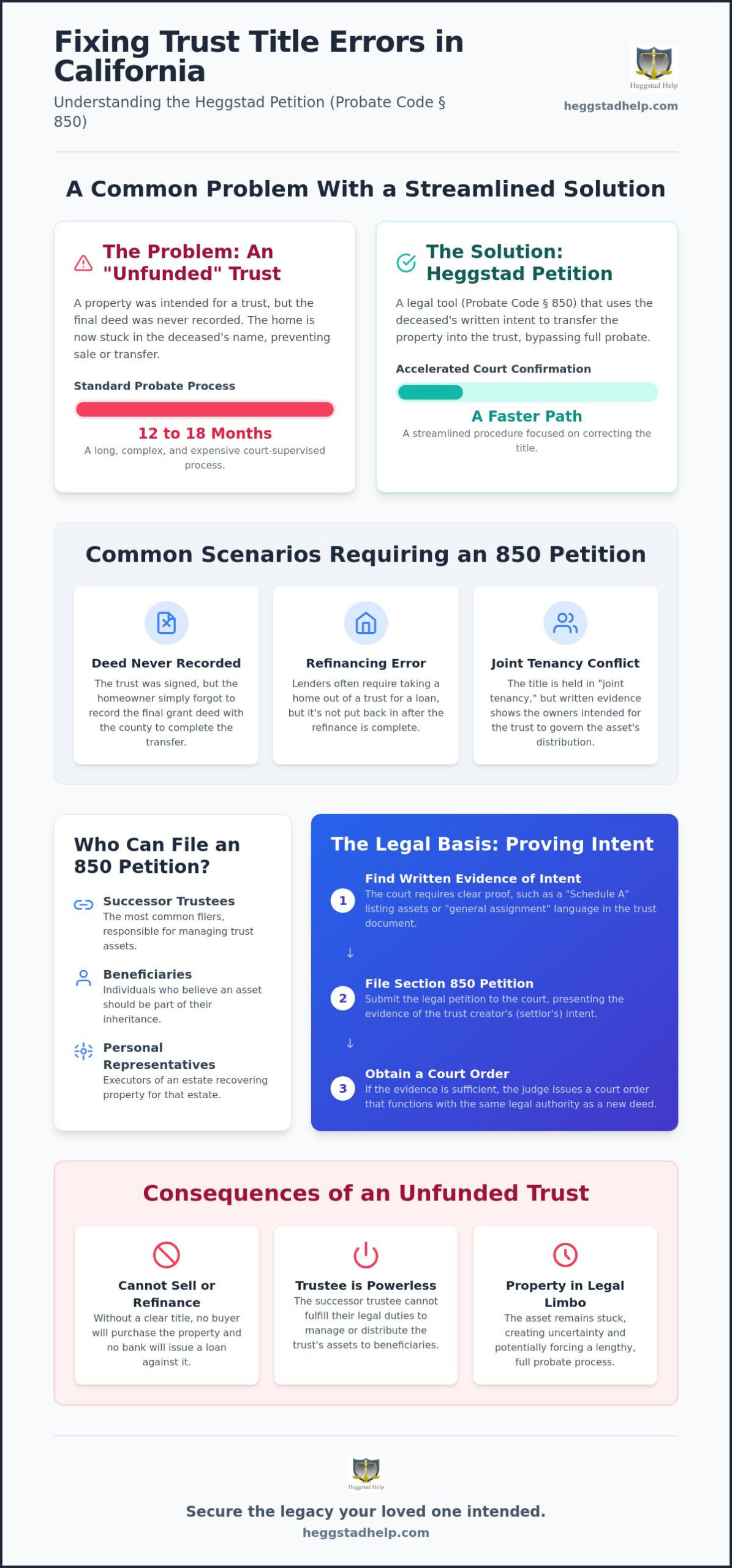
Last month, a grieving daughter discovered that her father’s family home was never officially deeded into his living trust, leaving the property stuck in his individual name after he passed. You might be facing a similar sense of anxiety as you realize that a standard probate (a formal court-supervised process for distributing assets) in California typically takes 12 to 18 months to resolve. It’s perfectly natural to feel overwhelmed by the prospect of long court delays or the technical complexity of an 850 petition California real property filing to correct these title errors.

Fortunately, you don’t have to endure a year of uncertainty just to fix a simple paperwork oversight. This specific legal tool, commonly known as a Heggstad Petition, allows a judge to confirm that the property belongs to the trust based on the deceased person’s clear intent. In this guide, you’ll discover how Section 850 allows you to move real property into a trust and bypass months of probate administration. We’ll explain how to obtain a court order for title correction so you can secure the legacy your loved one intended without the exhaustion of a full court proceeding.

Key Takeaways

  • Learn how California Probate Code Section 850 serves as a vital legal mechanism to transfer assets into a trust after a death has occurred.
  • Identify the common title errors that leave real estate outside of a trust and why these mistakes require a court’s confirmation to resolve.
  • Explore how a Heggstad Petition uses the settlor’s written intent to bypass the lengthy and expensive formal probate process.
  • Discover the specific procedural steps for filing an 850 petition California real property to obtain a court order that effectively corrects property titles.
  • Understand how utilizing ex parte court order services can accelerate the legal timeline, allowing you to bypass the standard probate backlog.

What is a California Probate Code Section 850 Petition?

California Probate Code Section 850 functions as a versatile procedural tool that allows the court to resolve disputes regarding the ownership of property. It’s essentially a summary procedure (a streamlined legal process) designed to confirm whether specific assets belong in a trust or a decedent’s estate without the need for a full, year-long probate administration. When a homeowner creates a trust but passes away before recording the final deed, an 850 petition California real property filing becomes the primary legal mechanism to bridge that gap and ensure the home is distributed according to the owner’s wishes.

This petition is most frequently used when a decedent intended to transfer property into their trust but failed to complete the formal deeding process. Instead of forcing the family into a standard probate that can last 12 to 18 months, Section 850 provides a faster path. It allows the court to examine the surrounding evidence and issue an order that effectively “funds” the trust after the fact, correcting the title so the property can be managed or sold by the successor trustee.

Who Can File an 850 Petition?

The law allows several interested parties to initiate this process to protect the integrity of an estate or trust. These typically include:

  • Successor Trustees: These individuals are the most common petitioners, as they’re responsible for recovering and managing trust assets after the original settlor (the person who created the trust) has died.
  • Beneficiaries: If a beneficiary believes a specific piece of real estate should be part of their inheritance, they can file a petition to confirm their interest.
  • Personal Representatives: Executors or administrators of a probate estate may use this tool to recover property that was improperly moved out of the estate.

The Legal Basis for Trust Confirmation

The court doesn’t simply take a petitioner’s word for it; it requires clear, written evidence of the decedent’s intent. This legal standard was largely shaped by the landmark case Estate of Heggstad, which established that a written declaration of trust is often sufficient to create a trust in real property, even if a formal deed wasn’t recorded. Judges typically look for a “Schedule A” (the document often found at the back of a trust listing all assets) or specific “general assignment” language that expresses the owner’s desire to hold their property within the trust. If this written evidence exists, the court can issue an order that functions with the same authority as a deed, correcting the title and avoiding a full probate.

Why Real Property Often Requires an 850 Petition

Unlike personal property, such as jewelry or furniture, real estate ownership is governed by a public record known as the chain of title. This formal system makes errors highly visible and legally problematic for grieving families. If a house is listed in a trust document but the corresponding grant deed (the legal document that transfers ownership) was never recorded with the county, the property is technically “unfunded.” Title companies, which provide essential insurance for buyers and lenders, will generally refuse to issue a policy if the record shows the deceased individual still owns the home personally. To resolve this discrepancy, an 850 petition California real property filing is required to obtain a court order that officially bridges the gap in the chain of title, allowing for a future sale or transfer.

A court order issued under Section 850 acts with the same legal authority as a deed. It provides the successor trustee with the necessary documentation to satisfy title officers and escrow companies. Without this specific intervention, the property remains in legal limbo, preventing the trustee from fulfilling their duties to the beneficiaries.

Common Real Estate Errors Section 850 Can Fix

Several specific scenarios frequently lead to a property being left out of a trust. A homeowner might sign a trust agreement but simply forget to record the grant deed. In other cases, title may be held in “joint tenancy” (a form of shared ownership with right of survivorship), yet the owners clearly intended for the trust to govern the asset. A very common complication occurs during refinancing; lenders often require the house to be taken out of the trust to process the loan, but the homeowner or the lender fails to put it back in once the new loan is secured. Surviving spouses who find themselves in this situation should also explore whether a Heggstad petition for surviving spouse California offers a more targeted path to recovering the missing asset.

The Consequences of Ignoring an Unfunded House

Leaving these title issues unaddressed creates significant hurdles for successor trustees. Without a clear title, it’s impossible to sell or refinance the property, as no bank will lend against it and no buyer will accept the risk. This often leaves families facing the unfunded trust probate California process, which involves higher statutory fees and much longer timelines. If you discover a property was left out, seeking professional trust asset title correction early can save your family from these costly and avoidable delays.

California Probate Code Section 850: A Guide to Real Property Petitions

The Heggstad Petition: The Most Common Use of Section 850

While California Probate Code 850 covers various types of property disputes, its most frequent application is the Heggstad Petition. Named after the landmark 1993 case Estate of Heggstad, this legal procedure allows a judge to declare that a property is part of a trust even if the deed wasn’t properly recorded before the owner died. It’s the preferred legal shortcut for successor trustees because it focuses on the settlor’s written intent rather than a technical clerical error. To succeed, you must provide the court with clear evidence, such as a “Schedule of Assets” or a general assignment clause, that specifically identifies the property as a trust asset.

The court essentially looks for proof that the deceased person (the settlor) intended for the trust to hold the property. If that written intent exists, the judge can issue an order that functions as a corrective deed. This process restores the chain of title and allows the trustee to manage the home without the delays inherent in a standard probate proceeding.

How the Heggstad Process Works

The procedure is methodical and requires precise documentation to satisfy the court’s evidentiary standards. First, you’ll need to gather the original trust document and any supporting schedules that list the home or land. Next, a legal professional drafts the 850 petition California real property filing, clearly outlining the facts of the case and the evidence of intent. Finally, the petition is filed in the Superior Court of the county where the property is located. Because this is a specialized filing, the court will set a hearing date to review the evidence and, if satisfied, issue an order that serves as the new link in the chain of title.

Bypassing Probate with a Heggstad Filing

The primary advantage of this approach is the significant reduction in time and administrative burden. A standard California probate case typically takes between 12 and 18 months, often stretching longer in backlogged counties like Los Angeles. In contrast, a successful petition to transfer real property to trust can often be resolved in just 4 to 6 months. This efficiency saves the estate significant money by avoiding the statutory attorney and executor fees that are based on the gross value of the property. Before committing to either path, families should review a detailed breakdown of Heggstad petition cost vs probate cost California to fully understand the financial stakes of each option. If you’re managing an estate with an unfunded house, starting a Heggstad Petition Filing is the most direct path to securing the assets for the beneficiaries. Widows and widowers navigating this process should also review how a Heggstad petition for surviving spouse in California compares to alternative spousal property procedures before choosing the right legal strategy.

Filing an 850 Petition for California Real Estate

Successfully filing an 850 petition California real property request is a high-stakes endeavor that requires meticulous attention to procedural detail. The process begins with meeting strict notice requirements (the legal obligation to inform all interested parties of the court proceeding). In California, you must serve notice to all heirs and beneficiaries at least 30 days before the scheduled hearing. Failure to notify even one distant relative can result in the court denying the petition or requiring a costly restart of the entire process.

After the judge reviews the evidence and signs the order, the final step involves recording a certified copy of the court order with the County Recorder’s Office in the county where the property is located. This recorded document officially repairs the chain of title. By utilizing ex parte court order services (expedited requests made to the court), a specialist can often resolve these title issues more quickly than through standard calendar hearings, providing the successor trustee with the authority needed to sell or transfer the home.

The Role of an Expert Heggstad Attorney

Generalist probate lawyers often struggle with the specific nuances of Section 850 because they lack the high-volume experience required to anticipate every court objection. Robert P. Bergman, a Board-Certified Specialist in Estate Planning, Trust and Probate Law, has been practicing since 1980 and focuses exclusively on these complex filings. His deep familiarity with the California court system ensures your petition is bulletproof from the start. Correcting trust asset titles promptly is essential to ensure that successor trustee unfunded trust assets California duties are fulfilled without exposing the trustee to personal liability or unnecessary delays.

Next Steps for Successor Trustees

If you suspect a property was left out of a trust, your first priority is to perform a comprehensive title search to identify all assets held in the decedent’s individual name. Once you have identified the “unfunded” property, consult with Heggstad Help for an initial assessment of your case. We will help you determine if the existing written evidence meets the legal standard for a Heggstad filing. Preparing for the transfer of title early allows you to move forward with confidence, knowing that the legacy of your loved one is protected from the burdens of a full probate administration.

Secure Your Real Estate Legacy Today

Discovering that a home was left outside of a trust doesn’t have to lead to a stressful, year-long probate. By utilizing an 850 petition California real property filing, you can effectively correct the chain of title and honor your loved one’s original intent. This legal mechanism provides a streamlined path to confirm trust ownership, allowing you to bypass the standard probate backlog and avoid the high statutory fees associated with full administration.

Robert P. Bergman is a Board-Certified Specialist in Estate Planning, Trust and Probate Law who has maintained a specialized focus on Heggstad petitions since the 1990s. With a California-wide service area, our firm provides the calm competence you need to navigate these complex procedural hurdles. You don’t have to face the court system alone when a seasoned expert can ensure your petition is filed correctly the first time. Get Expert Help with Your California 850 Petition Today. We are here to help you find the most efficient path toward a final resolution.

Frequently Asked Questions

What is the difference between an 850 petition and a Heggstad petition?

An 850 petition is the broad statutory category, while a Heggstad petition is a specific application of that law. While Section 850 of the California Probate Code covers various property ownership disputes, a Heggstad petition specifically asks the court to confirm that an asset belongs in a trust based on the creator’s written intent. It’s essentially the most common version of this legal tool used by successor trustees to fix title errors.

Can I file an 850 petition if there is no written “Schedule A” in the trust?

You can often still file even without a formal “Schedule A” (the list of assets typically attached to the back of a trust document). The court will examine other written evidence, such as a “general assignment” clause (a paragraph stating all the owner’s property belongs to the trust) or specific language within the trust itself. If we can demonstrate the owner’s clear intent to include the home, the petition can still succeed.

How long does the 850 petition process take for California real estate?

The 850 petition California real property process generally takes between 4 and 6 months to complete. This timeline is significantly shorter than the 12 to 18 months required for a full probate administration. The exact duration often depends on the specific county’s court calendar and how quickly we can satisfy the mandatory notice requirements (the 30-day legal warning sent to all interested parties) before the hearing.

Will I have to go to court if my attorney files an 850 petition?

You typically won’t need to step foot in a courtroom if you’ve hired a specialized attorney to handle the filing. In the vast majority of cases, your legal representative appears on your behalf to present the evidence to the judge. Unless the petition is contested (challenged by another heir or beneficiary), the process is handled through written filings and a brief professional appearance by your counsel.

Is an 850 petition cheaper than going through full probate?

Yes, this procedure is almost always more cost-effective than a full probate. Because it avoids the statutory fee schedule (the mandatory percentages paid to executors and attorneys based on the home’s gross value), the estate retains more of its assets. Families who want a detailed side-by-side analysis should review the full comparison of Heggstad petition cost vs probate cost California before making any decisions. By bypassing the long-term court supervision of a standard probate, you also reduce the total court filing fees and administrative costs associated with a year-long legal process.

Robert P. Bergman, Attorney at Law

Article by

Robert P. Bergman, Attorney at Law

Attorney Robert P. Bergman ("Bob Bergman") has been a Board-Certified Specialist in Estate Planning, Trust and Probate Law since 2011, as certified by the California State Bar Board of Legal Specialization. For several years, Bob has assisted families and the clients of other attorneys with obtaining court orders through Heggstad petitions to avoid the time and expense of Probate administration. Bob is friendly, very approachable, and believes in explaining complex legal topics in clear ordinary language so that his clients understand exactly what they're doing and why they're doing it.
Bob is often able to assist clients who are in other counties than his home county of Santa Clara through his approach to Heggstad petitions.

Disclaimer

This article is for informational purposes only. Nothing in this article is intended to replace legal advice from a competent attorney or be considered legal guidance for anybody's specific legal situation. Nobody should rely on information in this article in making legal decisions without such consultation.
