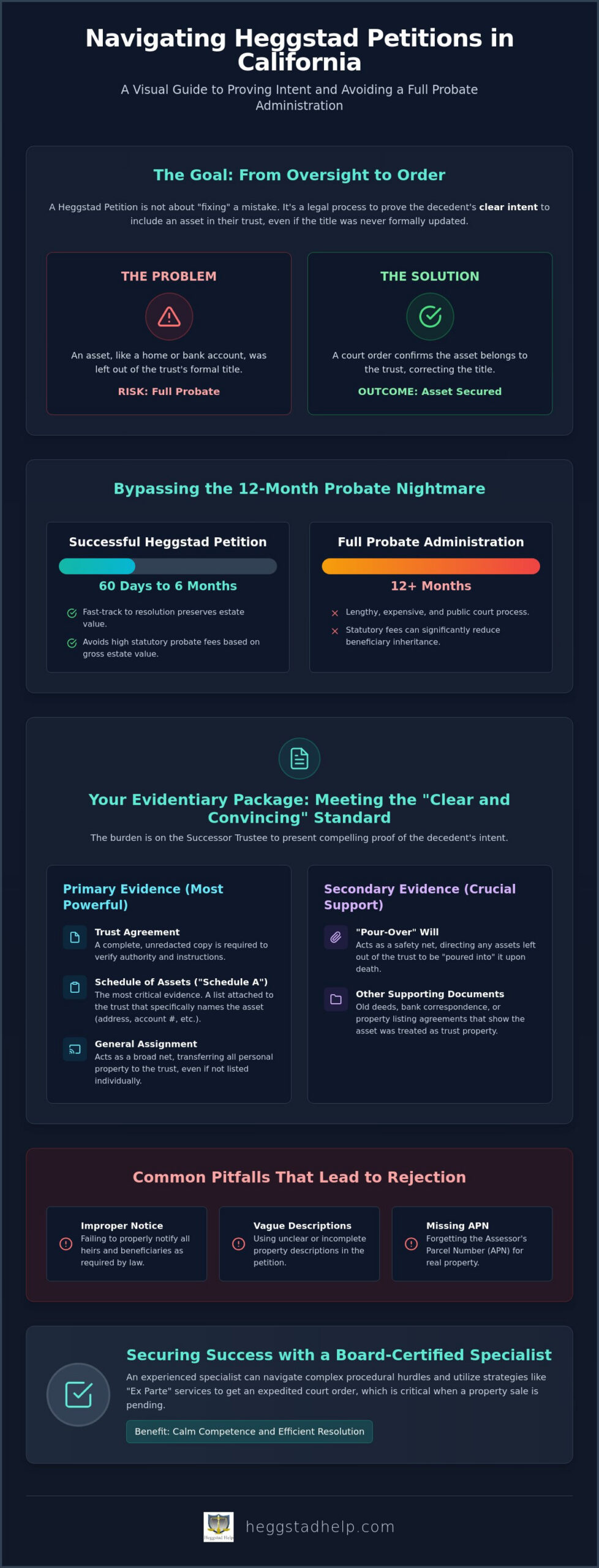
A missing Schedule of Assets does not, by itself, establish that a California trust cannot include a particular asset or that probate is unavoidable. To start fixing a trust with no schedule of assets California families should identify the asset, review the trust and ownership records, and assess whether the documents show the trust maker intended the asset to belong to the trust. When the issue is uncontested, a Heggstad petition may provide a way to ask the court to confirm trust ownership.
Gather the signed trust and any amendments, deeds or account records, and other documents that show how the asset was titled. Organizing these records by asset can make it easier to see what the paperwork supports and what information is missing.
Heggstad Help, a service of attorney Robert P. Bergman, Board-Certified Specialist in Estate Planning, Trust, and Probate Law (California State Bar Board of Legal Specialization), assists families, attorneys, and their clients throughout California with uncontested ex parte Heggstad petitions. These petitions are filed without a formal hearing in Santa Clara County, regardless of the county where the trust is located. This article explains what a missing schedule does and does not establish, which records to organize, and how the petition process may fit.
Key Takeaways
- A missing Schedule of Assets alone does not establish whether a particular asset was intended to belong to the trust.
- When fixing a trust with no schedule of assets California, gather the trust and amendments, ownership records, and documents that may show the trust maker’s intent.
- Review each asset separately: identify it, confirm how it is currently titled, and note its type and the trust’s status.
- For an uncontested issue, a Heggstad petition may be a path forward. Uncontested petitions can be filed ex parte in Santa Clara County regardless of where in California the trust is located. Fixed fees cover filing fees and attorney fees.
What Does It Mean to Have a California Trust With No Schedule of Assets?
A missing Schedule of Assets does not, by itself, show what happened to a particular asset. The trust may contain language about the trust maker’s intentions, while ownership records show who legally held the asset. These documents answer different questions, so review them together.
A Schedule of Assets is a record identifying property the trust maker intended the trust to hold. It is separate from the trust document, which sets out the trust’s terms, and from ownership records, such as a deed or account statement, which show how an asset is titled. These records should not be treated as interchangeable. To begin fixing a trust with no schedule of assets California, identify the specific asset and review its records alongside the trust paperwork. The general concept of trust law can provide background, but it does not determine ownership of a particular California asset.
Does the missing schedule mean the trust cannot be used?
No. The missing schedule is a gap in the available records, not a complete account of ownership or intent. Read the trust wording and any amendments, attachments, or asset-specific documents that remain. For example, a deed or written assignment may help explain the trust maker’s actions even when no schedule can be found. Keep the documents together, and avoid assuming that one missing page settles the issue.
Why can an asset appear to be outside the trust?
An asset may appear to be outside the trust because the file is incomplete or the available documents do not reflect every step the trust maker took. A property record, account document, or written instruction may provide context that the missing schedule cannot. Note what is known about the asset and where each record came from. For a broader overview of possible recovery steps, see the California trust asset recovery guide. The relevant evidence depends on the facts for each asset.
What Records Can Show Intent When a California Trust Has No Asset Schedule?
Evidence is asset-specific, and a missing Schedule of Assets is only one part of the file. Review the trust maker’s documents and actions alongside records showing who owned the particular asset and how it was titled. No single paper automatically establishes the result; the records need to be considered together.
When fixing a trust with no schedule of assets California, organize the file around each asset rather than treating the trust papers as a complete ownership record. A deed relates to real property, while account records may show how a financial account was held. Correspondence or a written assignment may add context about the trust maker’s intent.
Which documents should a family or successor trustee gather first?
Start with the signed trust and collect every available amendment, attachment, and assignment. Then gather documents tied to the asset under review, such as:
- Deeds and other title or ownership records
- Account records showing how an account was registered
- Letters, emails, or other correspondence about the asset
Sort copies by asset, and note each record’s date and source. Keep the original file intact. Flag gaps or conflicting details rather than trying to resolve them by assumption.
How does a Heggstad petition relate to the evidence?
A Heggstad petition asks a court to confirm that a specific asset belongs to a trust. Supporting records help explain why the trust maker intended the asset to be held in the trust, even if the schedule is missing. The court decides based on the facts and evidence presented, so gathering and organizing records is a useful first step, not a guarantee of an outcome.
If you are organizing records for an uncontested petition, Heggstad petition filing information explains the focused process.
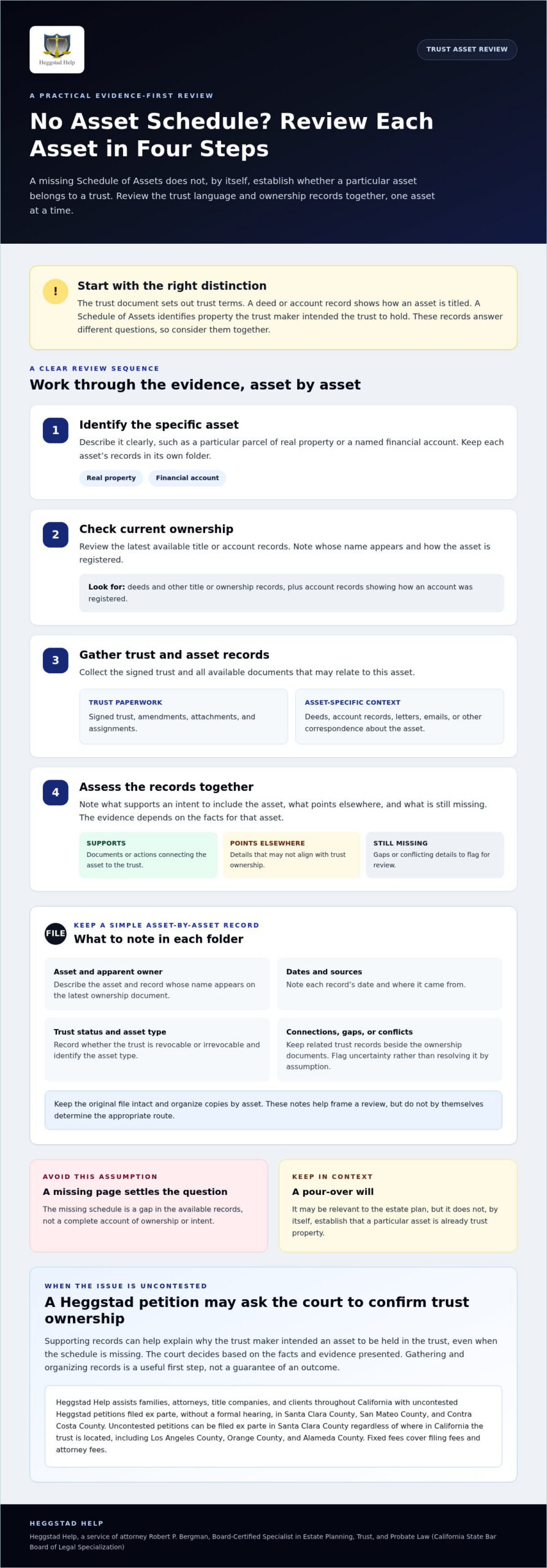
How Should You Review a Trust With No Schedule of Assets Before Choosing a Route?
Review the issue one asset at a time before deciding what to do. A pour-over will, a will designed to direct certain property into a trust, may be relevant to the estate plan. It does not, by itself, establish that a particular asset is already trust property.
- Identify the asset. Describe it clearly, such as a specific parcel of real property or a named financial account.
- Establish current ownership. Check the latest available title or account records and note whose name appears.
- Gather trust records. Collect the signed trust, amendments, attachments, assignments, and records tied to that asset.
- Assess the evidence together. Note what supports an intent to include the asset, what points elsewhere, and what information is missing.
How can you organize the review asset by asset?
Create a separate folder for each asset, keeping ownership documents beside the trust records that may relate to it. Write down the apparent owner, relevant dates, and any document or action that connects the asset to the trust. Also record whether the trust is revocable or irrevocable and identify the asset type. These details help frame legal review; they do not, by themselves, determine the appropriate route.
When should the records be assessed for a Heggstad petition?
A Heggstad petition asks a court to confirm that an asset belongs to a trust. It may be considered when the available evidence supports asking the court to confirm trust ownership and the request is uncontested. The outcome depends on the specific facts. For broader context, the Heggstad petition filing guide discusses the process.
Heggstad Help assists families, attorneys, and their clients throughout California with uncontested petitions filed in Santa Clara County, regardless of where the trust is located. Explore help with an uncontested Heggstad petition.
What California Heggstad Petition Path May Fit an Uncontested Trust Asset Issue?
A Heggstad petition may fit when records support asking a court to confirm that an asset belongs to a trust and the request is uncontested. Heggstad Help assists families, attorneys, and their clients throughout the State of California by filing uncontested ex parte petitions, without a formal hearing, in Santa Clara County, San Mateo County, and Contra Costa County.
How do ex parte filing options differ by California county?
In Santa Clara County, uncontested ex parte Heggstad petitions are typically granted within 7 to 10 days of filing. In San Mateo County, petitions can be filed, heard, and granted the same day. In Contra Costa County, petitions can often be filed and granted the same day if the Court is satisfied that urgency has been demonstrated. These timeframes describe typical or conditional outcomes, not guaranteed results.
What if the trust is located in another California county?
In counties such as Los Angeles, Orange, San Diego, Alameda, or Sacramento, Heggstad petitions often require a noticed hearing, meaning a hearing scheduled with advance notice to interested parties. These hearings can take many months to be heard. An uncontested petition from any California county can instead be filed ex parte in Santa Clara County and is typically granted within 7 to 10 days of filing. Heggstad Help assists with these statewide filings, including for families and attorneys handling trust assets in the San Francisco Bay Area, Northern California, Southern California, the Central Valley, San Diego, Sacramento, Fresno, Bakersfield, Greater Los Angeles, Orange County, Riverside County, and San Bernardino County.
All Heggstad petitions have fixed fees covering filing fees and attorney fees. If you are fixing a trust with no schedule of assets California, organize the asset-specific records to support an uncontested petition. Start with an uncontested Heggstad petition.
Take the Next Step With a Clear Record
A missing schedule can leave families unsure where to begin, but you can start by organizing the file. Make a short inventory of each asset, gather the records connected to it, and note any gaps or inconsistencies. That preparation makes a review of fixing a trust with no schedule of assets California more focused and helps clarify whether an uncontested Heggstad petition may fit.
Robert P. Bergman is Board-Certified in Estate Planning, Trust, and Probate Law by the California State Bar Board of Legal Specialization. Heggstad Help assists families, attorneys, and their clients throughout the State of California with uncontested ex parte petitions filed in Santa Clara County, San Mateo County, and Contra Costa County. Fixed fees cover filing fees and attorney fees.
Bring together the asset-specific records and take the next step toward resolving the title issue. Start an uncontested Heggstad petition.
Frequently Asked Questions
Does a trust need a Schedule of Assets to be valid in California?
No. The absence of a Schedule of Assets alone does not establish that a trust is invalid. The trust instrument and the circumstances of its creation still matter, while ownership of a particular asset is a separate question. If you are fixing a trust with no schedule of assets California, start by reviewing the signed trust and available attachments rather than treating a missing list as a decision about validity or ownership.
Can a pour-over will transfer an asset into a trust without a Schedule of Assets?
A pour-over will may direct property that passes under the will to the trust after the will-maker’s death, but it does not establish that a specific asset was already trust property. The will’s terms and the asset’s title records serve different purposes. Review them separately, and note whether the asset is addressed by name or falls within the will’s broader language.
Can a Heggstad petition address assets other than real property?
Yes. Heggstad petitions may address real property and other assets, although the relevant records and legal questions can vary by asset type. For example, records about an account may differ from documents concerning a home. Identify the particular asset and gather its ownership history before assessing whether a petition may fit. The court’s decision depends on the specific facts and evidence.
Are Heggstad petitions only filed in the county where the trust is located?
No. An uncontested Heggstad petition may be filed ex parte in Santa Clara County regardless of where in California the trust is located. Heggstad Help assists families, attorneys, and their clients statewide, including in the San Francisco Bay Area, Southern California, and the Central Valley. This filing route can serve trust matters involving Los Angeles County, Orange County, San Diego County, Alameda County, and Sacramento County, among others.

Article by
Robert P. Bergman, Attorney at Law
Attorney Robert P. Bergman ("Bob Bergman") has been a Board-Certified Specialist in Estate Planning, Trust and Probate Law since 2011, as certified by the California State Bar Board of Legal Specialization. For several years, Bob has assisted families and the clients of other attorneys with obtaining court orders through Heggstad petitions to avoid the time and expense of Probate administration. Bob is friendly, very approachable, and believes in explaining complex legal topics in clear ordinary language so that his clients understand exactly what they're doing and why they're doing it.
Bob is often able to assist clients who are in other counties than his home county of Santa Clara through his approach to Heggstad petitions.
Disclaimer
This article is for informational purposes only. Nothing in this article is intended to replace legal advice from a competent attorney or be considered legal guidance for anybody's specific legal situation. Nobody should rely on information in this article in making legal decisions without such consultation.