Imagine the sinking feeling of discovering a family home or a bank account was never officially transferred into a living trust after a loved one passes away. Most successor trustees feel an immediate wave of anxiety, fearing a grueling 12-month probate delay. If you’re searching for successor trustee help for missing assets, you aren’t alone in this frustration. It’s a common complication that feels like a legal dead end, but it doesn’t have to be.
This guide explains how you can use a Heggstad petition to move property into the trust in California in as little as 7 to 10 days, bypassing the costly probate process entirely. We’ll explore the mechanics of Probate Code Section 850 and how filing ex parte in Santa Clara, San Mateo, or Contra Costa can resolve title issues for assets located in Los Angeles County, Orange County, San Diego County, or Alameda County. Whether the property is in Riverside County, San Bernardino County, Sacramento County, San Francisco County, Marin County, or Santa Cruz County, you’ll learn how to resolve these legal hurdles and secure the estate’s future without the typical year-long wait.
Key Takeaways
- Learn how to identify unfunded assets by comparing property deeds and account statements against your trust inventory to determine if a Heggstad petition is required.
- Access specialized successor trustee help for missing assets to utilize Probate Code Section 850, which allows you to move property into a trust without a full probate.
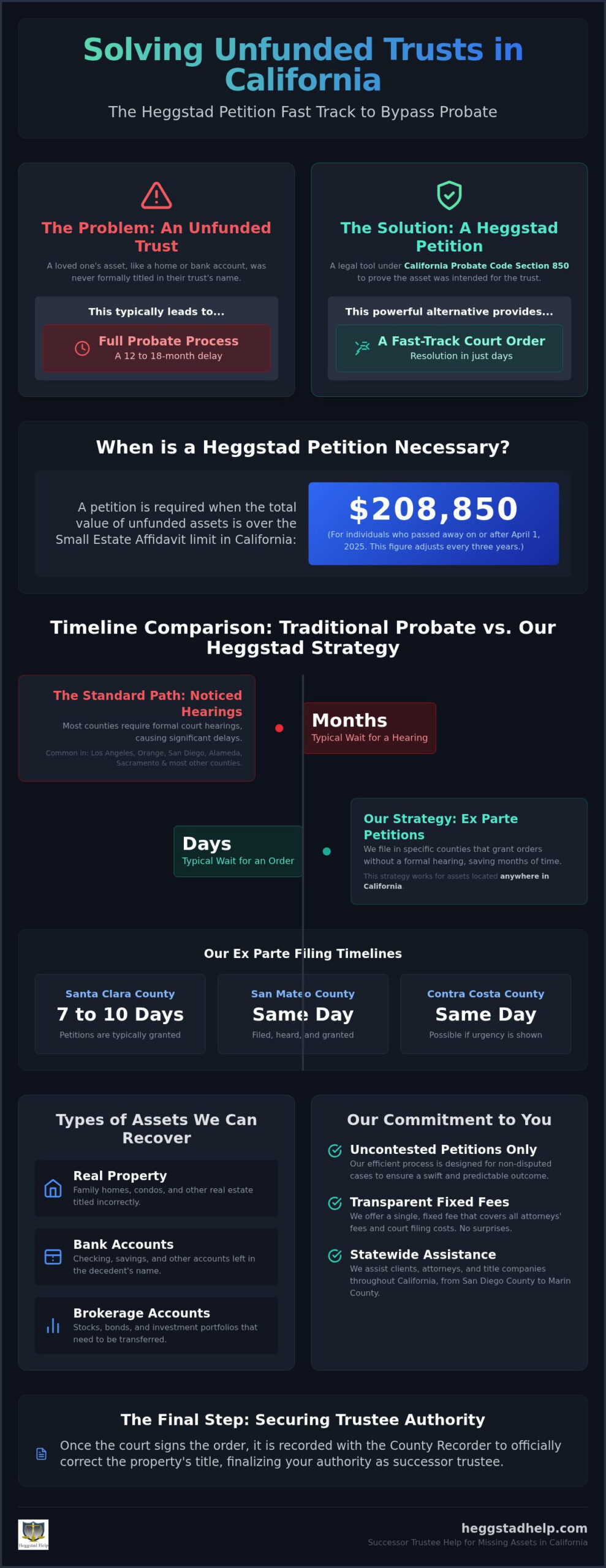
- Discover how filing an uncontested ex parte (no formal hearing) petition in Santa Clara County can secure a court order in just 7 to 10 days for assets located anywhere in California.
- Understand the final steps for recording a signed court order with the County Recorder to officially correct title errors and secure your authority as a successor trustee in California.
Identifying Missing or Unfunded Assets in California
The first step in your journey is a thorough review of the trust’s "Schedule A" (the document listing assets intended for the trust). You’ll need to compare this inventory against current property deeds and account statements. If you discover a house in Los Angeles County or a brokerage account in San Diego County still titled in the decedent’s individual name, the trust is "unfunded."
Securing professional successor trustee help for missing assets is vital when asset values exceed the California Small Estate threshold. For individuals who passed away on or after April 1, 2025, that threshold is exactly $208,850. If the missing asset is a home or high value account, a simple affidavit won’t work. You’ll likely face a 12 to 18 month probate delay unless you take corrective action under the California Probate Code.
The Difference Between Trust and Probate Assets
Assets titled in the trust’s name bypass the court system. When an asset remains in a person’s individual name, it triggers the probate process. This often happens because a homeowner forgot to record a new deed after creating their trust. In these cases, we look to the "Pour-Over Will" (a specific type of will that directs assets into a trust) to establish the decedent’s intent.
Expert successor trustee help for missing assets ensures you use the legal precedent set by the Estate of Heggstad. By proving the creator intended for the property to be trust property, you avoid full probate. For more details, see our guide on Successor Trustee Duties for an Unfunded Trust in California. We regularly assist clients in Orange County, Riverside County, Alameda County, and San Bernardino County with these complex title corrections.
The Heggstad Petition Solution under Probate Code Section 850
A Heggstad petition is a specialized legal request used to confirm that property belongs to a trust, even if the formal title was never updated. This procedure relies on California Probate Code Section 850 to prove that the decedent intended to include the asset in their estate plan. To be eligible, you must provide written evidence of this intent, such as a reference in the trust document or a mention in a general assignment of assets.
When you need successor trustee help for missing assets, this petition serves as a powerful alternative to the traditional probate system. Instead of waiting for a court to oversee the entire distribution of an estate, a Heggstad petition focuses solely on correcting the title of the specific missing property. This targeted approach is significantly faster and more cost-effective for families in Los Angeles County, Orange County, and San Diego County.
How Probate Code Section 850 Saves Time and Money
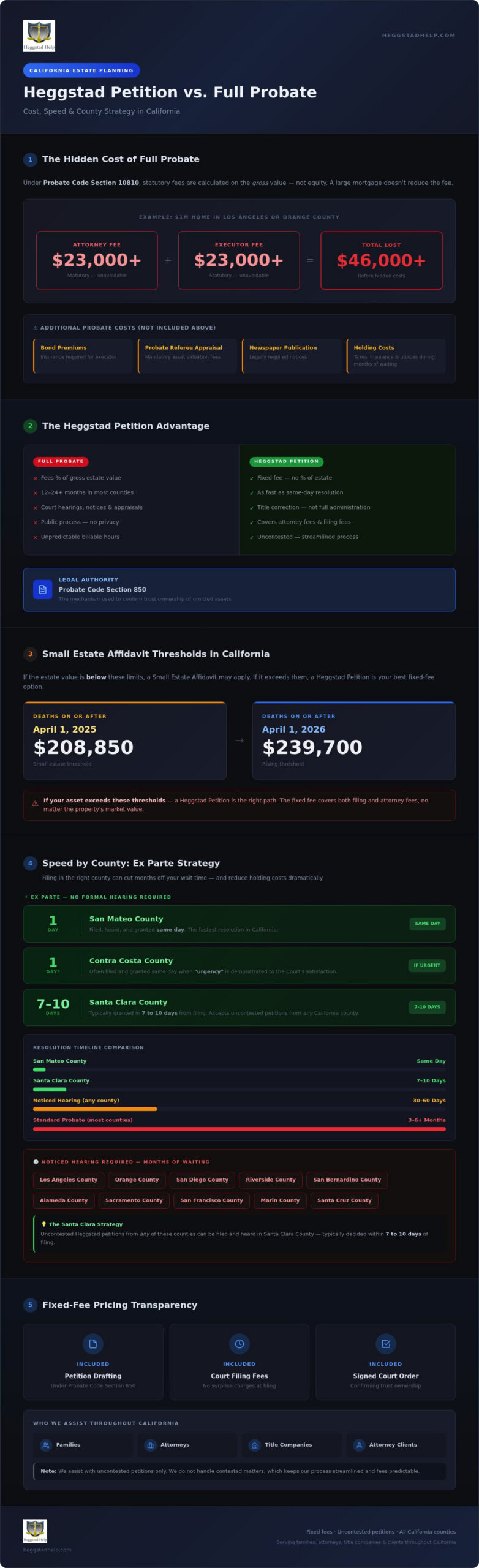
Standard probate administration in the State of California typically lasts 12 to 18 months and involves statutory fees based on the gross value of the estate. In contrast, an uncontested Heggstad petition can resolve title issues in a fraction of that time. At HEGGSTAD HELP, we offer fixed fees for these petitions that cover both the filing fees and the attorneys’ fees, providing financial predictability during a stressful time.
If you’re weighing your options, our guide on Heggstad Petition vs. Probate in California offers a deeper comparison. We specialize in using ex parte filings (petitions heard without a formal hearing) in Santa Clara County to achieve results in 7 to 10 days for clients across Riverside County and San Bernardino County. If you’re feeling overwhelmed by the paperwork, reaching out for successor trustee help for missing assets can simplify the path forward.
Filing Timelines and County-Specific Strategies in California
The speed at which you can recover a missing asset depends heavily on which court hears your petition. In most of the State of California, filing a petition to transfer property into a trust involves a "noticed hearing." This means the court clerk sets a date several months in the future, often leaving the estate in limbo. For families in Los Angeles County, Orange County, or San Diego County, these local court backlogs can be a significant source of stress.
Our office bypasses these delays by focusing on specific Northern California counties that offer more efficient procedures. We assist attorneys, title companies, and clients throughout the State of California by filing uncontested Heggstad petitions ex parte, which means the request is handled without a formal, scheduled hearing. This strategy allows us to achieve a 7 to 10-day turnaround in Santa Clara County, even if the property itself is located hundreds of miles away.
Leveraging Ex Parte Filings for Faster Results
While Santa Clara County is our primary hub for rapid results, other jurisdictions offer even faster timelines under specific conditions. In San Mateo County, petitions can often be filed, heard, and granted on the same day. Similarly, Contra Costa County allows for same-day results if we can demonstrate a specific "urgency" to the Court. These options provide a vital escape hatch for successor trustees who need to close a real estate sale or pay off urgent estate debts.
Whether the missing asset is a residence in San Bernardino County or a bank account in Riverside County, we can help. We provide successor trustee help for missing assets in Alameda County, Sacramento County, San Francisco County, Marin County, and Santa Cruz County by utilizing these streamlined court systems. If a noticed trust modification petition hearing is required, it is typically set 30 to 60 days after filing, or much later in some counties. To avoid these long waits, you can file your Heggstad petition with our team to secure a court order as quickly as possible.
Correcting Title and Securing Authority as a Successor Trustee
Once the Court grants your petition, you’ll receive a signed court order confirming the asset is indeed trust property. Receiving this document is a significant milestone, but your work as a trustee continues until the title is officially corrected. For real property located in San Bernardino County, Marin County, or Santa Cruz County, you must record a certified copy of the order with the County Recorder. This recording acts as the legal bridge that fixes the title error, allowing you to eventually sell the property or distribute it to beneficiaries.
For financial assets, such as a brokerage account in San Francisco County or a bank account in Sacramento County, you’ll present the certified court order to the institution’s legal department. This order provides the necessary authority to move funds from the decedent’s individual name into a trust account. Obtaining professional successor trustee help for missing assets ensures these final administrative steps are handled without technical mistakes that could further delay the distribution of the estate.
Next Steps After a Successful Heggstad Petition
After the assets are officially titled in the name of the trust, you should update the trust inventory and notify all beneficiaries of the recovery. This transparency is a key part of your fiduciary duty. It’s also a prudent time to double-check any remaining assets in Los Angeles County, Orange County, or San Diego County to ensure nothing else was overlooked. Properly titling all future assets is the only way to avoid the need for secondary petitions or a full probate in the State of California.
Finalizing the inventory allows you to proceed with standard trust administration, such as paying final debts and making distributions. If you need more technical information on the statutes involved, our California Probate Code Section 850 Guide offers a deep dive into real property petitions. By following this structured path, you can fulfill your loved one’s wishes with the confidence that the estate is legally secure.
Finalizing Your Path to Trust Asset Recovery
Discovering that a family home or investment account was left out of a living trust doesn’t have to result in a year-long probate nightmare. By leveraging Probate Code Section 850, you can efficiently move property into the trust and fulfill your fiduciary duties. Whether the assets are in San Diego County, Sacramento County, or Marin County, our office provides specialized successor trustee help for missing assets to bypass local court backlogs. By filing uncontested Heggstad petitions ex parte in Santa Clara County, we achieve results in 7 to 10 days for clients throughout the State of California.
Our team, led by a Board-Certified Specialist, offers fixed fees that cover all legal and filing expenses. This approach provides financial certainty and a clear timeline for resolution. If you’re ready to secure the estate’s future without the stress of traditional probate, Get Expert Help Recovering Missing Trust Assets in California. You can correct these title errors quickly and move forward with confidence.
Frequently Asked Questions
Can a successor trustee file a Heggstad petition without an attorney in California?
While you can legally file on your own, the procedural requirements in the State of California are incredibly strict. Most people seek professional successor trustee help for missing assets to ensure the petition meets the specific standards of the Probate Code. A single technical error can cause a court to reject your filing, forcing the estate into a standard probate process that lasts over a year in Sacramento County or San Francisco County.
How much does a Heggstad petition cost in California compared to probate?
Heggstad petitions are much more cost-effective because they avoid the statutory fees associated with full probate administration. Instead of paying a percentage of the estate’s value, we provide fixed fees that cover both the court filing fees and the attorneys’ fees. For estates that exceed the $208,850 Small Estate threshold in California, this provides a predictable solution for families in Orange County and Riverside County to manage costs efficiently.
What evidence is needed to prove intent for a Heggstad petition under Probate Code Section 850?
To succeed under Probate Code Section 850, you must present written proof of the decedent’s intent. This typically includes the trust’s Schedule A, a general assignment of assets, or even a Pour-Over Will. Whether the property is in Los Angeles County or San Diego County, the court requires clear evidence that the creator intended for the asset to be trust property, even if the formal deed was never updated.
How long does it take to move a house into a trust after death in Los Angeles County?
Standard filings in Los Angeles County often require noticed hearings that take many months to reach a judge. By utilizing ex parte filings in Santa Clara County, we can often move a house into a trust in 7 to 10 days. This efficient strategy serves clients in Alameda County and San Bernardino County, allowing for a rapid resolution that bypasses the typical 12 to 18-month timeline of a full California probate.
What happens if a Heggstad petition is contested by a beneficiary?
If a beneficiary contests the filing, the matter moves into trust litigation, which our office does not handle. However, most petitions we file for missing assets are uncontested and proceed smoothly. For families in Marin County or Santa Cruz County, obtaining successor trustee help for missing assets ensures the petition is prepared correctly from the start, minimizing the risk of confusion or disputes among the heirs during the administration process.

Article by
Robert P. Bergman, Attorney at Law
Attorney Robert P. Bergman ("Bob Bergman") has been a Board-Certified Specialist in Estate Planning, Trust and Probate Law since 2011, as certified by the California State Bar Board of Legal Specialization. For several years, Bob has assisted families and the clients of other attorneys with obtaining court orders through Heggstad petitions to avoid the time and expense of Probate administration. Bob is friendly, very approachable, and believes in explaining complex legal topics in clear ordinary language so that his clients understand exactly what they're doing and why they're doing it.
Bob is often able to assist clients who are in other counties than his home county of Santa Clara through his approach to Heggstad petitions.
Disclaimer
This article is for informational purposes only. Nothing in this article is intended to replace legal advice from a competent attorney or be considered legal guidance for anybody's specific legal situation. Nobody should rely on information in this article in making legal decisions without such consultation.