How to Fix Trust Title Errors in California

What if the deed isn’t wrong, but the property was never transferred into the trust? To understand how to fix trust title errors, compare the…

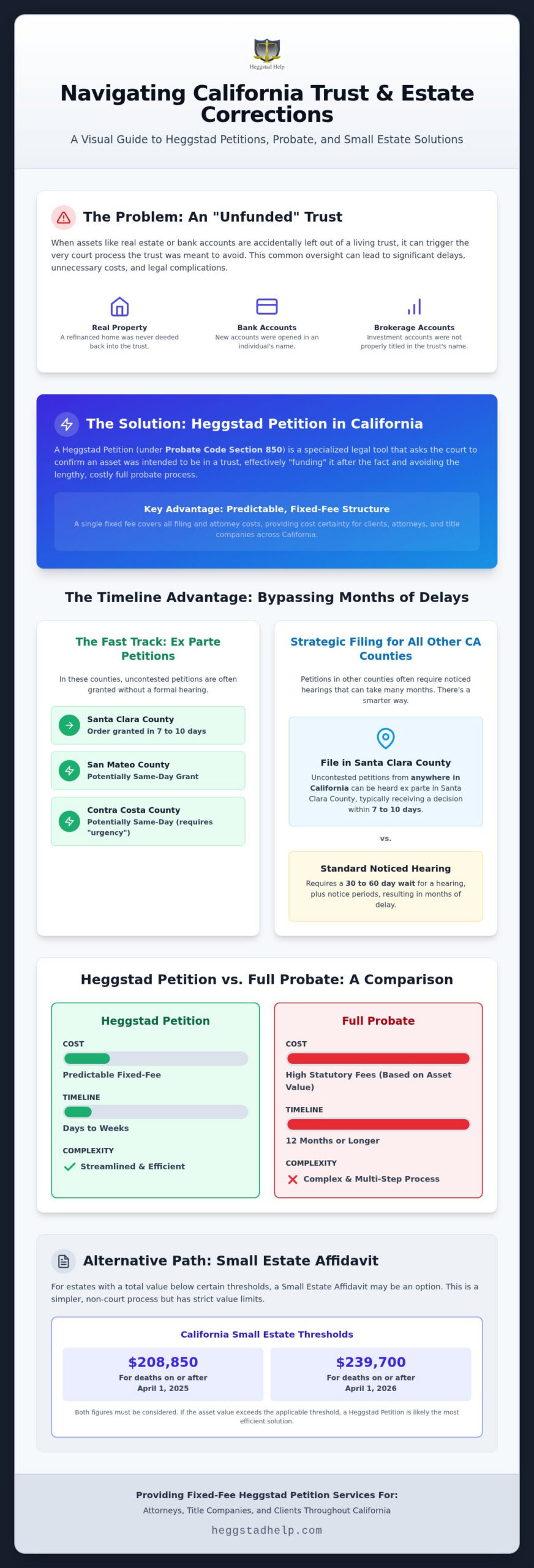
What if the deed isn’t wrong, but the property was never transferred into the trust? To understand how to fix trust title errors, compare the recorded deed with the trust documents and determine whether the deed itself contains an error or the transfer was never completed. A deed correction may address some document errors; an eligible asset intended for the trust but never titled in it may require a Heggstad petition.

This guide explains which records to gather, how to distinguish between these situations, and what California options may help resolve the issue before it delays trust administration or a sale. Heggstad Help, a service of attorney Robert P. Bergman, Board-Certified Specialist in Estate Planning, Trust, and Probate Law (California State Bar Board of Legal Specialization), assists families, attorneys, and their clients throughout the State of California with uncontested ex parte Heggstad petitions filed in Santa Clara County, regardless of where the trust is located. These petitions are typically granted in 7 to 10 days.

Key Takeaways

  • Compare the recorded ownership information with the trust documents to pinpoint where they differ.
  • How to fix trust title errors depends on whether the deed needs correction or a court may need to confirm an eligible asset as trust property.
  • Gather the current recorded deed, relevant trust documents, and available transfer records. Write down the specific mismatch.
  • Families, attorneys, title companies, and clients throughout California can pursue eligible uncontested Heggstad petitions through ex parte filing in Santa Clara County, regardless of where the trust is located.

What Kind of Trust Title Error Do You Have in California?

The right way to address a trust title problem depends on whether the recorded document contains an error or the property was never transferred into the trust. Title is the recorded information showing who owns the property. A mismatch does not automatically mean the entire trust is invalid.

Was the deed recorded incorrectly, or was the property left out?

Start by comparing the current recorded deed with the trust documents. A deed defect may involve an incorrect spelling of an owner’s name or a legal description, the written identification of the property, that does not accurately describe the parcel. These are issues with the deed or its recorded information, although the appropriate correction depends on the facts.

A different issue arises when the deed accurately names an individual, but the trust documents suggest the property was meant to be held in the trust. For example, the deed may still identify a person rather than the trust. In that situation, the question may not be how to correct a typo, but whether the property was ever transferred into the trust. Changing a document and asking a court to confirm an asset as trust property are different paths.

Why can a property and trust record stop matching?

A transfer can be overlooked when someone creates or updates a trust. A property may also be taken out of a trust during a refinance and not transferred back afterward, or purchased later without being added to the trust. These are trust-funding issues: assets may not have been legally placed in the trust as intended. A general overview of trust law can explain how trusts hold and manage assets, but it won’t establish how a particular property is titled.

To narrow down the problem, note the names and property description on the recorded deed, then compare them with the trust’s relevant documents and any transfer records you have. This comparison can help identify the type of issue before you consider a correction.

Can You Correct a Trust Title Error With a Deed or a Heggstad Petition?

How to fix trust title errors depends on what the records show. A deed correction may address an error in a recorded document, while a Heggstad petition may ask the court to confirm property as trust property. A deed error and an unfunded trust asset are not the same problem. The appropriate path depends on the ownership evidence and the specific mismatch.

When is the problem a deed or recording error?

A deed or recording issue appears within the document or its recorded details. The deed might identify an owner incorrectly, contain an inaccurate property description, or reflect another discrepancy. Not every issue can be fixed the same way. Review the recorded deed alongside the trust records and related transfer documents to understand what was signed, what was recorded, and how the property was intended to be held.

When might a Heggstad petition be relevant?

A Heggstad petition may be relevant if the property was intended for the trust but the ownership transfer was never completed. Rather than asking to correct a typo in a deed, the petition asks the court to confirm that an eligible asset belongs to the trust. This court process is associated with Probate Code Section 850. Evidence of intent and the asset’s records matter when evaluating whether this route fits. A petition is not an automatic solution for every title mismatch.

As a practical first step, put the current deed beside the trust document and any available transfer records. Note whether the issue is an inaccuracy in recorded information or a missing transfer into the trust. That distinction helps focus the review. For more information about Heggstad petitions, learn how this court process may apply to eligible trust assets.

What Records Should You Gather Before Addressing a California Trust Title Error?

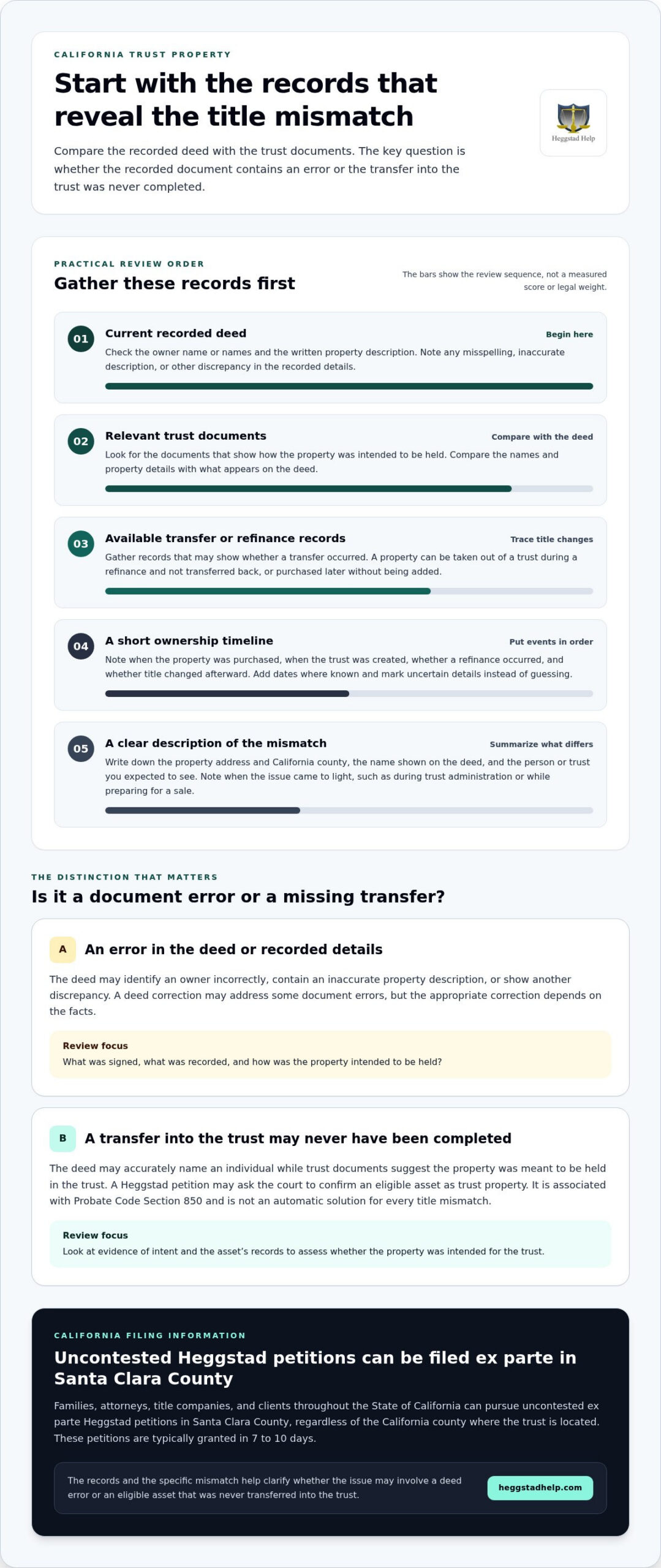
To understand how to fix trust title errors, gather the documents that show how the property was titled and what the trust records say. A clear set of records and a short timeline can help identify the mismatch without requiring you to reach a legal conclusion on your own.

Which documents help clarify the ownership history?

Start with the current recorded deed, then collect the relevant trust documents and any available records of transfers or title changes. Compare the names and property description across them. Differences may point to a document discrepancy, a missing transfer, or another issue that needs closer review.

Next, arrange the known events in order. Note when the property was purchased, when the trust was created, whether a refinance occurred, and whether title changed afterward. Add dates where you have them, and mark anything uncertain rather than filling in gaps from memory.

How should you describe the mismatch clearly?

Write down the property address and California county, the name or names currently shown on the deed, and the name of the trust or person you expected to see. Include when the mismatch came to light, such as during trust administration or while preparing for a sale. This concise summary makes the records and the issue easier to follow.

  • Current recorded deed and relevant trust documents
  • Available transfer or refinance records
  • A timeline of purchase, trust creation, and later title changes
  • A short description of the difference between the records

If the records suggest the property was intended for the trust but left out, read more about Heggstad petition filing. If the owner has died, don’t assume that preparing a new deed alone resolves the ownership question. Learn about trust asset title correction for help addressing an eligible title issue.
How to Fix Trust Title Errors in California

How Can a Heggstad Petition Address Trust Title Errors Across California?

A Heggstad petition may help when an eligible asset was intended for a trust but wasn’t titled in it. Heggstad Help assists families, attorneys, title companies, and their clients throughout the State of California with uncontested petitions, including for property located in the San Francisco Bay Area, Northern California, Southern California, the Central Valley, San Diego, Sacramento, Fresno, Bakersfield, Greater Los Angeles, Orange County, Riverside County, and San Bernardino County.

How do filing options differ by California county?

Uncontested petitions filed ex parte, meaning without a formal hearing, in the Santa Clara County Probate Court are typically granted in 7 to 10 days. The trust or property may be elsewhere, including Los Angeles County, Orange County, San Diego County, Alameda County, or Sacramento County. Uncontested petitions from these and other California counties can often be filed ex parte in Santa Clara County, regardless of where the trust is located.

Ex parte petitions in San Mateo County can be filed, heard, and granted the same day. In Contra Costa County, petitions can often be filed and granted the same day if the court is satisfied that urgency has been demonstrated. In other counties, Heggstad petitions often require a noticed hearing, meaning interested parties receive notice and the matter is scheduled for court. Those hearings may take many months. This is why uncontested petitions for trusts in counties other than San Mateo and Contra Costa are often filed ex parte in Santa Clara County.

This process can serve families and professionals working with trusts in counties across the State, including San Francisco, Marin, Santa Cruz, Ventura, San Bernardino, Riverside, Santa Barbara, San Joaquin, Fresno, Solano, San Luis Obispo, Monterey, and Placer Counties.

What can families and professionals expect from the service?

The office handles uncontested Heggstad petitions, not contested petitions. Fixed fees cover filing fees and attorneys’ fees. Gathering the deed, trust documents, and available transfer records helps clarify the title issue and supports a focused review of whether a petition may fit.

For information about an eligible, uncontested matter, visit Heggstad Help.

Move From Uncertainty to a Clear Next Step

A title concern can feel larger when everyone involved describes it differently. As you decide how to fix trust title errors, write one concise statement of the unresolved question and share it with the people coordinating the next steps. A common understanding can make conversations more focused and help prevent assumptions from shaping the plan.

You don’t need every answer before taking a thoughtful next step. Start with the question that matters most to your family or the decision currently waiting on clarity, then keep track of what remains unresolved.

If you’re ready to discuss an uncontested Heggstad petition, contact Heggstad Help about your situation.

Frequently Asked Questions

Does a trust title error mean the trust is invalid?

Not necessarily. A question about the trust’s validity is different from a question about whether a particular asset is held by the trust. If concerns extend beyond one property, gather the signed trust document and any amendments, then identify the specific issue, such as questions about the document or changes made to it. This keeps the review focused instead of treating every title concern as the same problem.

Can a Heggstad petition apply to assets other than real estate?

Yes, a Heggstad petition may concern eligible assets beyond real estate, but it doesn’t automatically apply to every type of property. The records need to support that the asset was intended to belong to the trust. Identify the asset and gather relevant trust schedules, ownership records, and written transfer instructions that may help show the trust creator’s intent.

Does a pour-over will automatically change the title to a house?

No. A pour-over will generally directs assets left outside a trust to be transferred into it through the estate process. It doesn’t by itself update a recorded deed or instantly make the trust the owner of a house. If a home remains in an individual’s name, review the deed and estate-planning records rather than assuming the will alone corrected the title.

What if a beneficiary objects to correcting the trust title?

A beneficiary’s objection can turn an otherwise uncontested matter into a dispute, so the request may no longer proceed as an uncontested petition. The reason for the objection and the records supporting each position matter. Keep the written objection with the relevant trust and ownership documents, and note which facts are disputed. Heggstad Help handles uncontested petitions, not contested petitions.

Can refinancing cause a property to be left out of a trust?

It can, but a refinance document by itself doesn’t necessarily show that ownership changed. Review the closing papers for any deed or other document affecting title, and distinguish those from loan documents that secure repayment. Note the dates and parties named on documents related to ownership. This can help clarify whether the refinance changed title or whether the issue lies elsewhere in the property records.

Robert P. Bergman, Attorney at Law

Article by

Robert P. Bergman, Attorney at Law

Attorney Robert P. Bergman ("Bob Bergman") has been a Board-Certified Specialist in Estate Planning, Trust and Probate Law since 2011, as certified by the California State Bar Board of Legal Specialization. For several years, Bob has assisted families and the clients of other attorneys with obtaining court orders through Heggstad petitions to avoid the time and expense of Probate administration. Bob is friendly, very approachable, and believes in explaining complex legal topics in clear ordinary language so that his clients understand exactly what they're doing and why they're doing it.
Bob is often able to assist clients who are in other counties than his home county of Santa Clara through his approach to Heggstad petitions.

Disclaimer

This article is for informational purposes only. Nothing in this article is intended to replace legal advice from a competent attorney or be considered legal guidance for anybody's specific legal situation. Nobody should rely on information in this article in making legal decisions without such consultation.

What Constitutes a Valid Schedule of Trust Assets in California?

What constitutes a valid schedule of trust assets is a clear, specific record connecting identifiable property to the trust, but a schedule alone…

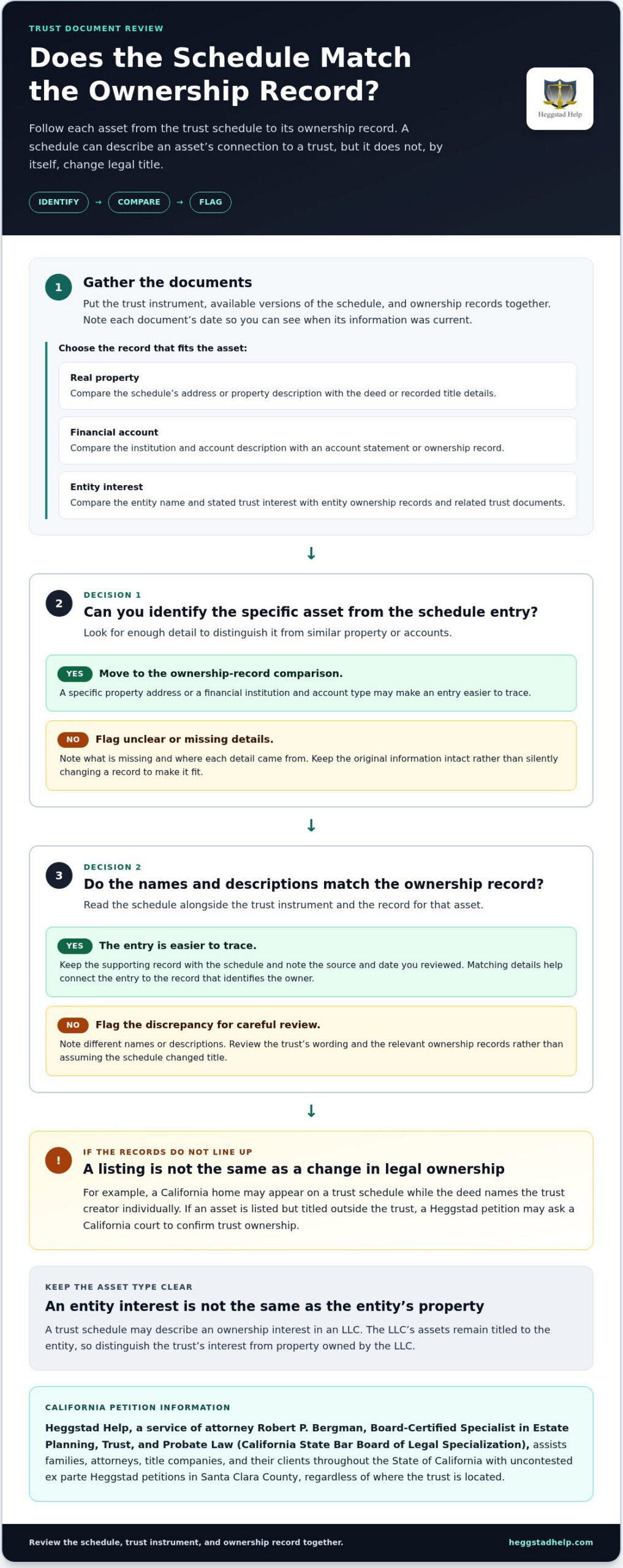
What constitutes a valid schedule of trust assets is a clear, specific record connecting identifiable property to the trust, but a schedule alone does not change legal title. If a California home appears on the schedule while the deed names the trust creator individually, that mismatch needs careful review.

Compare each schedule entry with the trust document and the relevant ownership records. Heggstad Help, a service of attorney Robert P. Bergman, Board-Certified Specialist in Estate Planning, Trust, and Probate Law (California State Bar Board of Legal Specialization), assists families, attorneys, title companies, and their clients throughout the State of California with uncontested ex parte Heggstad petitions in Santa Clara County, regardless of where the trust is located.

Key Takeaways

  • What constitutes a valid schedule of trust assets depends on how clearly it identifies property and how it relates to the trust, not on a particular layout alone.
  • Compare each listed asset with ownership records, such as a deed or account record, and flag mismatched names or descriptions.
  • Organize the trust document and schedule, group assets by type, and separate clearly identified trust assets from assets with uncertain ownership.
  • If an asset is listed but titled outside the trust, a Heggstad petition may ask a California court to confirm trust ownership.

What Constitutes a Valid Schedule of Trust Assets?

A schedule is most useful when its entries can be matched to specific property and read alongside the trust document and ownership records. There is no single layout that proves every listed asset belongs to the trust, so use the schedule as part of a document review, not as a replacement for title or account records.

What Is a Schedule of Trust Assets, and What Does It Establish?

A schedule of trust assets is an inventory identifying property associated with a trust. Its significance depends on how the trust instrument, the document that sets out the trust, refers to the schedule and how the listed assets match their ownership records.

Listing an asset on a schedule describes its connection to the trust; it does not, by itself, document or change legal ownership. Treat the schedule as one piece of information to review, not as a substitute for a deed, account record, or other ownership documentation.

Is a schedule the same as a deed or account record?

No. A schedule groups or describes assets, while a deed or account record identifies ownership in a different way. For example, a California home might appear on a trust schedule by address, while the deed names an individual as the owner. The listing does not automatically change the recorded title. Compare the schedule with the deed and the trust’s terms, and note any differences in names or property details.

Why can the document’s role vary?

A schedule’s significance depends on its wording and context, including how the trust instrument refers to it, the type of asset, and the relevant ownership records. Trusts involve roles such as a settlor, the person who creates the trust, a trustee, the person who manages it, and beneficiaries, those intended to benefit. The general overview of Trust (law) explains these terms.

Read the schedule alongside the trust instrument and records for each asset rather than relying on the list alone. Gather the documents and compare the asset descriptions and owner information. This helps distinguish a clear inventory entry from a question about whether title or account ownership was actually placed in the trust.

What Details Make a Schedule of Trust Assets Clear and Useful?

A useful schedule describes assets clearly enough that a successor trustee can tell which property each entry refers to. What constitutes a valid schedule of trust assets depends on the trust’s language and the records for each asset, so treat the examples below as practical clarity tips, not required fields.

Asset category Helpful identifying details Record to review
Real property Property address and a description that distinguishes it from other real estate Deed or recorded title details
Financial account Financial institution, account type, and enough identifying information to distinguish the account Account statement or ownership record
Entity interest Entity name and the interest described as owned by the trust Entity ownership records and related trust documents

How specific should an asset description be?

Use wording that helps a reader distinguish the asset from similar property. For example, “residence” may be less useful than a California property address; “investment account” may be less clear than the institution and account type. These examples improve clarity but are not a checklist of legal requirements.

What records should be compared with the schedule?

Review the trust instrument alongside deeds, account statements, and entity ownership records. Compare names and descriptions across documents, and note differences instead of assuming they match. Matching names and descriptions makes it easier to trace each schedule entry to the record that identifies the asset’s owner.

An LLC interest is distinct from property owned by the LLC. The trust schedule may describe an ownership interest in the entity, while the LLC’s assets remain titled to the entity. The related article Transferring an LLC to Trust After Death: The Heggstad Solution explores this distinction. If an asset’s title needs correction or court confirmation, trust asset title correction may be a relevant next step.

How Can You Prepare and Review a Trust Asset Schedule?

A consistent review helps a successor trustee see what each entry refers to and where the supporting information comes from. Use these four steps to organize the documents and identify questions without changing ownership details.

  1. Gather the trust and schedule. Put the trust instrument, every available version of the schedule, and related ownership records together. Note each document’s date so you can tell which information was current when it was prepared.
  2. Group the assets. Sort entries into useful categories, such as real property, financial accounts, and entity interests. Keep assets that appear trust-related separate from those titled to someone else or whose ownership is unclear.
  3. Compare the records. Check each entry against the trust instrument and available deeds, account statements, or entity ownership documents. The records can help show whether the schedule’s wording and the ownership information refer to the same asset.
  4. Flag discrepancies. Mark missing details, different names, or descriptions that do not clearly match. Keep the original information intact rather than silently changing a record to make it fit.

What should a successor trustee check first?

Start with the schedule’s date and wording, then compare them with the trust instrument and available ownership documents. Record the source of each detail, such as a particular statement or deed, and the date you reviewed it. This gives later reviewers context and makes it easier to follow up on uncertain entries.

How should unclear or changing assets be handled?

Balances and account holdings can change, so note when the schedule or your review was prepared. If an entry is unclear, mark it for follow-up instead of assuming it establishes ownership. Also distinguish an interest in an LLC from property titled to the LLC itself. If the documents leave a question about whether an asset belongs to the trust, court confirmation may be needed. A California Probate Code Section 850 petition is one possible process to address it.

If an asset’s title needs review or correction, explore trust asset title assistance.

What Constitutes a Valid Schedule of Trust Assets in California?

What If an Asset Is Listed but Its Title Is Outside the Trust?

A schedule entry can help show that an asset was intended to be part of a trust, but it does not, by itself, resolve a mismatch in recorded or account ownership. If the trust instrument and related records support the request, a Heggstad petition may ask a California probate court to confirm that an asset belongs to the trust even though title was not formally transferred. The court decides whether the evidence supports that result.

Before considering that step, gather the trust instrument, schedule, and ownership records, then identify exactly where the names or descriptions differ. This gives the petition a clearer factual foundation and helps distinguish a title issue from an asset that may belong to someone else.

Where may a California Heggstad petition be filed?

For an uncontested matter, a petition involving a trust located outside Santa Clara County may be filed ex parte in Santa Clara County, meaning without a formal hearing. In other counties, Heggstad petitions often require a noticed hearing, where interested parties receive notice, and may take many months to be heard. Santa Clara County petitions are typically granted in 7 to 10 days after filing, but no court outcome is guaranteed. For broader context, see Heggstad Petition Filing: The California Guide to Recovering Missing Trust Assets in 2026.

Heggstad Help assists families, attorneys, title companies, and their clients throughout the State of California, including the San Francisco Bay Area, Northern California, Southern California, the Central Valley, San Diego, Sacramento, Fresno, Bakersfield, Greater Los Angeles, Orange County, Riverside County, and San Bernardino County. The practice serves clients with trusts and property in counties including Santa Clara, San Mateo, Contra Costa, Los Angeles, Alameda, San Francisco, Marin, San Diego, Orange, Riverside, Sacramento, Fresno, Ventura, Santa Cruz, Placer, Santa Barbara, San Joaquin, Solano, San Luis Obispo, and Monterey.

How can specialized help make the next step clearer?

Heggstad Help assists families, attorneys, title companies, and their clients throughout the State of California with uncontested ex parte Heggstad petitions. Petitions may be filed in Santa Clara County, San Mateo County, or Contra Costa County. Santa Clara County petitions are typically granted in 7 to 10 days; San Mateo County petitions can be filed, heard, and granted the same day. In Contra Costa County, same-day filing and approval may be possible when the Court is satisfied that urgency has been demonstrated. Fixed fees cover filing fees and attorney fees. For a California title issue, explore uncontested Heggstad petition services.

Turn a Title Question Into a Clear Next Step

A difference between a trust schedule and an ownership record does not have to leave your family guessing. Keep the relevant records together, identify exactly what does not match, and avoid changing ownership details based on the schedule alone. This helps clarify whether the issue is incomplete information or whether the trust’s ownership of an asset needs court confirmation.

Understanding what constitutes a valid schedule of trust assets is useful, but each situation depends on the trust document and the records tied to the asset. If those documents leave a California trust-title issue unresolved, a focused review can help identify a practical path forward.

Explore uncontested Heggstad petition help for guidance on a California title issue. With the relevant records in hand, you can take the next step with greater clarity.

Frequently Asked Questions

Is a schedule of trust assets legally binding?

There is not one answer for every schedule. To understand a particular document’s role, check whether the trust refers to it and whether later trust documents or schedule versions exist. Make a simple timeline of the dates shown on those records, and keep the versions together. This can clarify which documents were in place when the trust creator made decisions about an asset.

Does listing a house on a trust schedule put it into the trust?

No, the schedule entry alone does not establish that the house was transferred into the trust. For a practical review, locate the deed’s legal description, which identifies the property more precisely than a street address, and compare it with the schedule and trust paperwork. Keep the documents unchanged and note any differences for California-specific legal review before drawing conclusions about ownership.

What should a schedule of trust assets include?

Include enough identifying information to distinguish each asset from similar items, with details suited to the asset type. For example, a collection of valuable personal property may need individual descriptions rather than a broad label such as “household items.” As a privacy precaution, avoid placing full account numbers on copies that do not need them; retain relevant records securely for authorized review.

Can an asset be on a trust schedule if an LLC owns it?

A schedule can refer to an ownership interest in an LLC, but do not describe the LLC’s property as though the trust directly owns it. To clarify the records, look for documents that identify the LLC’s members and their interests, such as an operating agreement or membership ledger, if available. Compare those details with the trust paperwork before describing the interest in an inventory.

What can California families do if an asset is listed but titled outside the trust?

Preserve the documents and make a short chronology of relevant events, such as when the trust and schedule were prepared, when the asset was acquired, and whether title-transfer steps were attempted. This can help organize the facts for evaluating a possible Heggstad petition. Heggstad Help handles uncontested petitions; whether a petition is appropriate depends on the trust documents and the evidence for that asset.

Robert P. Bergman, Attorney at Law

Article by

Robert P. Bergman, Attorney at Law

Attorney Robert P. Bergman ("Bob Bergman") has been a Board-Certified Specialist in Estate Planning, Trust and Probate Law since 2011, as certified by the California State Bar Board of Legal Specialization. For several years, Bob has assisted families and the clients of other attorneys with obtaining court orders through Heggstad petitions to avoid the time and expense of Probate administration. Bob is friendly, very approachable, and believes in explaining complex legal topics in clear ordinary language so that his clients understand exactly what they're doing and why they're doing it.
Bob is often able to assist clients who are in other counties than his home county of Santa Clara through his approach to Heggstad petitions.

Disclaimer

This article is for informational purposes only. Nothing in this article is intended to replace legal advice from a competent attorney or be considered legal guidance for anybody's specific legal situation. Nobody should rely on information in this article in making legal decisions without such consultation.
California Trustee Attorney: Assets Not in Trust

What if an asset left outside a trust doesn’t automatically mean full probate? The right attorney for a trustee when assets are not in trust should…

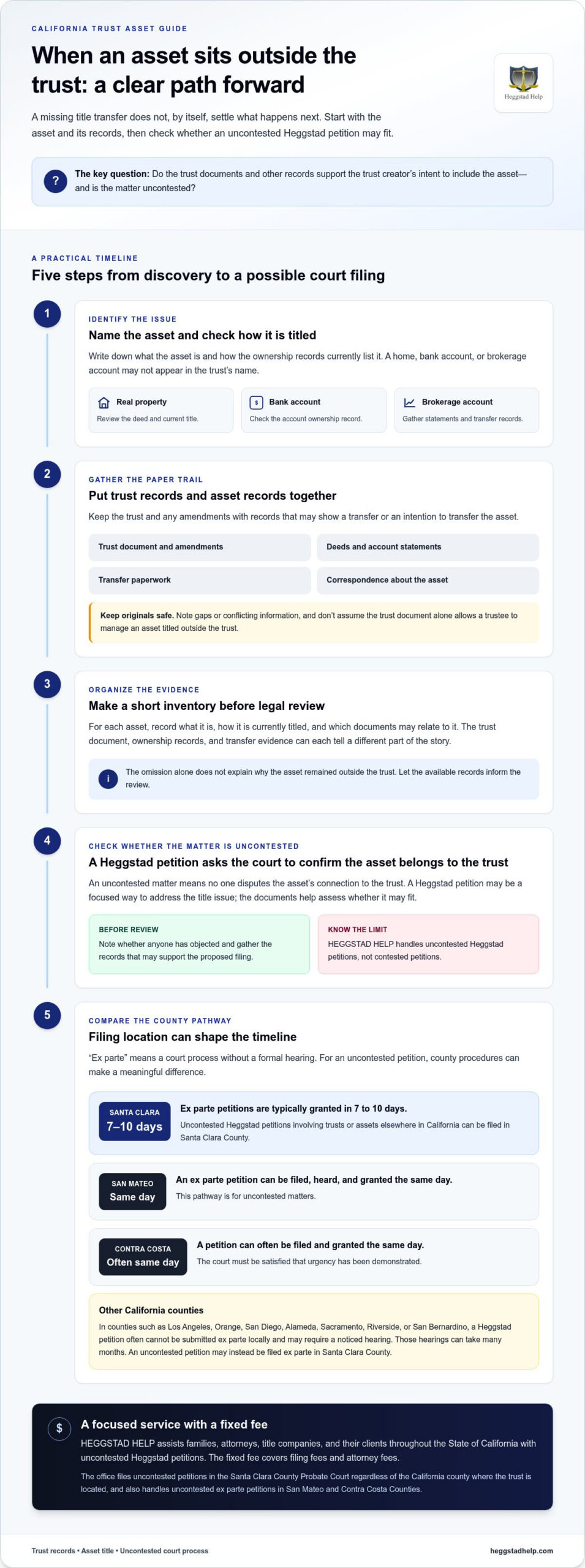
What if an asset left outside a trust doesn’t automatically mean full probate? The right attorney for a trustee when assets are not in trust should assess how the asset was held, what records show about the trust creator’s intent, and whether anyone disputes its connection to the trust. In some cases, an uncontested Heggstad petition, a court request to confirm that an asset belongs to a trust, may provide a focused way to address the title issue.

This article explains what to look for in an attorney, what the court may consider, and how county procedures can affect timing. An uncontested petition involving an asset in Los Angeles County, Orange County, or another California county with long court delays can often instead be filed ex parte in Santa Clara County and is typically granted in 7 to 10 days. In San Mateo County, an ex parte petition can be filed, heard, and granted the same day. In Contra Costa County, a petition can often be filed and granted the same day if the court is satisfied that urgency has been demonstrated. HEGGSTAD HELP assists families, attorneys, title companies, and their clients throughout the State of California with uncontested Heggstad petitions for a fixed fee covering filing fees and attorney fees.

Key Takeaways

  • Before assuming an asset requires full probate, gather trust and asset records that may show the trust creator intended it to be included.
  • Choose an attorney for trustee when assets are not in trust with direct experience in Heggstad petitions and trust asset title correction.
  • Find out whether anyone disputes the asset’s connection to the trust. The petition service described here is for uncontested matters.
  • Compare filing options by county. An uncontested petition involving an asset elsewhere in California may be filed ex parte in Santa Clara County.

When a California Trustee Finds an Asset Outside the Trust, What Comes Next?

A trustee may open a file and discover that a home, account, or other asset doesn’t appear to be titled in the trust’s name. The omission can raise an immediate concern: does the asset have to go through full probate? Not necessarily. A missing transfer is a reason to review the records, not by itself a final answer about how the asset can be handled.

The trust document describes the plan, while separate ownership records show how a particular asset was titled. Start by identifying the asset and its current title. Then gather the trust documents and any evidence of a transfer or an intention to transfer it. An attorney for trustee when assets are not in trust can assess whether those records may support a Heggstad petition, a request for the court to confirm that an asset belongs to the trust.

Why an asset can remain outside a trust

A title transfer may have been started but not completed, or the ownership records may not reflect what the trust creator intended. The reason can’t be determined from the omission alone. A deed, account record, or transfer document may tell a different part of the story than the trust document. The Estate of Heggstad case is the origin of this type of petition in California.

The trustee’s first practical steps

Keep the trust and any amendments together with deeds, account statements, transfer paperwork, and correspondence about the asset. Make a short inventory noting what the asset is, how it is currently titled, and which records may relate to it. Preserve original documents, and don’t assume the trust document alone allows the trustee to transfer or manage an asset titled outside the trust. For related context on a trustee’s role, see this guide to successor trustee duties for an unfunded trust.

This guide focuses on California trust assets and a possible Heggstad petition. The next step depends on the asset, the available records, and whether anyone disputes its connection to the trust.

How to Evaluate an Attorney for a California Heggstad Petition

A trustee facing a title problem needs guidance specific to the proposed court filing. Look for direct experience with Heggstad petitions and trust asset title correction. A focused review should consider the trust documents, current ownership records, and evidence of a transfer or intent to include the asset. These records help assess whether a petition may fit and whether the matter is uncontested.

Questions that reveal whether the service fits

When choosing an attorney for trustee when assets are not in trust, focus your questions on the petition and the evidence. Does the attorney handle Heggstad petitions as a focused service? Has anyone objected to treating the asset as trust property? Which records will help assess the proposed filing? HEGGSTAD HELP handles uncontested petitions, so identifying any dispute at the outset is important.

Bring the records together before review. Note any gaps or conflicting information instead of trying to resolve them yourself. A clear file makes it easier to evaluate the asset, the available evidence, and the proposed petition.

Understand the petition’s legal context

A Heggstad petition may ask the court to confirm that an asset belongs to the trust even though the title records don’t show it in the trust’s name. The attorney should explain how the available documents relate to that request in plain language. For related background, the California Probate Code Section 850 guide discusses petition context.

Fee clarity matters, too. HEGGSTAD HELP charges a fixed fee for Heggstad petitions, covering filing fees and attorney fees. Robert P. Bergman is a California-licensed attorney and Board-Certified Specialist in Estate Planning, Trust and Probate Law. Families, attorneys, title companies, and clients throughout the State of California can learn about focused Heggstad petition assistance.

How California County and Ex Parte Options Can Affect Timing

The court process can affect how quickly an uncontested Heggstad petition is considered. An ex parte filing is a court process without a formal hearing. County procedures matter: some counties often require a noticed hearing, while uncontested petitions can be filed ex parte in Santa Clara County, San Mateo County, and Contra Costa County. Each county has its own timing considerations.

When the trust or property is in another county

For an asset in Los Angeles County, Orange County, San Diego County, Alameda County, Sacramento County, or another California county, a Heggstad petition often cannot be submitted ex parte locally and may require a noticed hearing. Such hearings can take many months to be heard. For an uncontested matter, the petition can instead be filed ex parte in Santa Clara County, even when the trust or asset is located elsewhere in California.

HEGGSTAD HELP assists families, attorneys, title companies, and their clients throughout the State of California with uncontested petitions in the Santa Clara County Probate Court, regardless of the county where the trust is located. This can be relevant for trusts and assets in the San Francisco Bay Area, Northern California, Southern California, the Central Valley, San Diego, Sacramento, Fresno, Bakersfield, Greater Los Angeles, Orange County, Riverside County, or San Bernardino County. An attorney for trustee when assets are not in trust can assess whether the matter is uncontested and prepare the filing.

When a noticed hearing or contested matter changes the path

A noticed trust modification petition hearing is typically set 30 to 60 days after filing, or several months later in some counties. The time required to notify interested parties adds to the overall process. If someone contests the petition, the matter may take longer and won’t follow the uncontested ex parte path described here. HEGGSTAD HELP handles uncontested petitions, not contested matters.

For an uncontested filing, learn about Heggstad petition options.

California Trustee Attorney: Assets Not in Trust

A Focused Next Step for Trustees, Families, Attorneys, and Title Companies

A missing trust transfer can feel like a broad probate problem, but the next step may be more focused: organize the records, identify whether the issue is disputed, and assess whether a Heggstad petition fits. If you’re helping a family member or client, a clear set of documents makes that assessment more productive.

  1. Gather the trust document and any amendments, along with information identifying the asset.
  2. Collect title records and available transfer documents or correspondence.
  3. Identify whether anyone disputes that the asset should belong to the trust, then assess whether an uncontested petition may be appropriate.

What to have ready for an initial discussion

Start with the records you have, even if the file is incomplete. Note the asset’s current title and flag inconsistencies between the trust and ownership records. A focused review can identify what the documents show and which questions remain. This gives an attorney for trustee when assets are not in trust a practical starting point for assessing a petition.

Move forward with a focused petition service

HEGGSTAD HELP assists families, attorneys, title companies, and their clients throughout the State of California with uncontested Heggstad petitions. The practice focuses on Heggstad petition filing, ex parte court orders, and trust asset title correction, including transfers into living or irrevocable trusts. Uncontested petitions can be filed ex parte in Santa Clara County, San Mateo County, and Contra Costa County, including for trusts located elsewhere in California. The office does not handle contested petitions.

Heggstad petition fees are fixed and cover filing fees and attorney fees. For a matter that appears uncontested, review the Heggstad petition services and organize the records. Discuss an uncontested Heggstad petition for the asset and trust involved.

Turn the Record Into a Clear Next Step

Your next move can be practical: make a one-page timeline of what happened to the asset, from the trust’s creation through discovery of the title issue. Note dates you can verify, identify the documents that support each point, and separate confirmed facts from unanswered questions. This gives the review a clear starting point without requiring you to draw legal conclusions.

If you’re a trustee, family member, attorney, or title company representative, keep the timeline with the relevant records so everyone can work from the same information. The right attorney for trustee when assets are not in trust can then focus the discussion on the asset, the available evidence, and a possible petition path.

Robert P. Bergman’s focused practice can help bring structure to an uncertain title issue. To move from gathering information to considering a next step, start a focused Heggstad petition discussion with the relevant trust and asset records.

Frequently Asked Questions

Can a successor trustee hire an attorney when an asset was never transferred into the trust?

Yes. A successor trustee can seek legal help even if an asset was never retitled in the trust’s name. An attorney for trustee when assets are not in trust can review the trust, current ownership records, and available transfer documents to assess whether a Heggstad petition may fit. For a home, gather the deed and trust papers. For an account, keep the account records available for review.

Does a California property have to be in the same county as the court handling a Heggstad petition?

No, not necessarily. An uncontested petition involving an asset elsewhere in California may be filed ex parte in Santa Clara County. This can be relevant for property in the San Francisco Bay Area, Northern California, Southern California, the Central Valley, San Diego, Sacramento, Fresno, Bakersfield, Greater Los Angeles, Orange County, Riverside County, or San Bernardino County. Uncontested petitions can also be filed ex parte in San Mateo County and Contra Costa County. The filing approach and timing depend on the county and the matter.

How long does an uncontested ex parte Heggstad petition take in California?

Uncontested ex parte petitions filed in Santa Clara County are typically granted in 7 to 10 days. In San Mateo County, a petition can be filed, heard, and granted the same day. In Contra Costa County, a petition can often be filed and granted the same day if the court is satisfied that urgency has been demonstrated. A court order and updating the asset’s title are separate steps, so allow for the title correction process after the petition is decided.

Does HEGGSTAD HELP handle a contested Heggstad petition?

No. HEGGSTAD HELP handles uncontested Heggstad petitions, not contested petitions. If a beneficiary or another interested person objects to treating an asset as trust property, the matter may no longer be uncontested. Keep any written objection with the trust and asset records so the issue is clear when the petition is assessed.

Robert P. Bergman, Attorney at Law

Article by

Robert P. Bergman, Attorney at Law

Attorney Robert P. Bergman ("Bob Bergman") has been a Board-Certified Specialist in Estate Planning, Trust and Probate Law since 2011, as certified by the California State Bar Board of Legal Specialization. For several years, Bob has assisted families and the clients of other attorneys with obtaining court orders through Heggstad petitions to avoid the time and expense of Probate administration. Bob is friendly, very approachable, and believes in explaining complex legal topics in clear ordinary language so that his clients understand exactly what they're doing and why they're doing it.
Bob is often able to assist clients who are in other counties than his home county of Santa Clara through his approach to Heggstad petitions.

Disclaimer

This article is for informational purposes only. Nothing in this article is intended to replace legal advice from a competent attorney or be considered legal guidance for anybody's specific legal situation. Nobody should rely on information in this article in making legal decisions without such consultation.
Deadline to File a Heggstad Petition in California: Timing and Speed Guide (2026)

A surprising fact regarding the deadline to file Heggstad petition California is that a legal statute of limitations doesn’t actually exist. While…

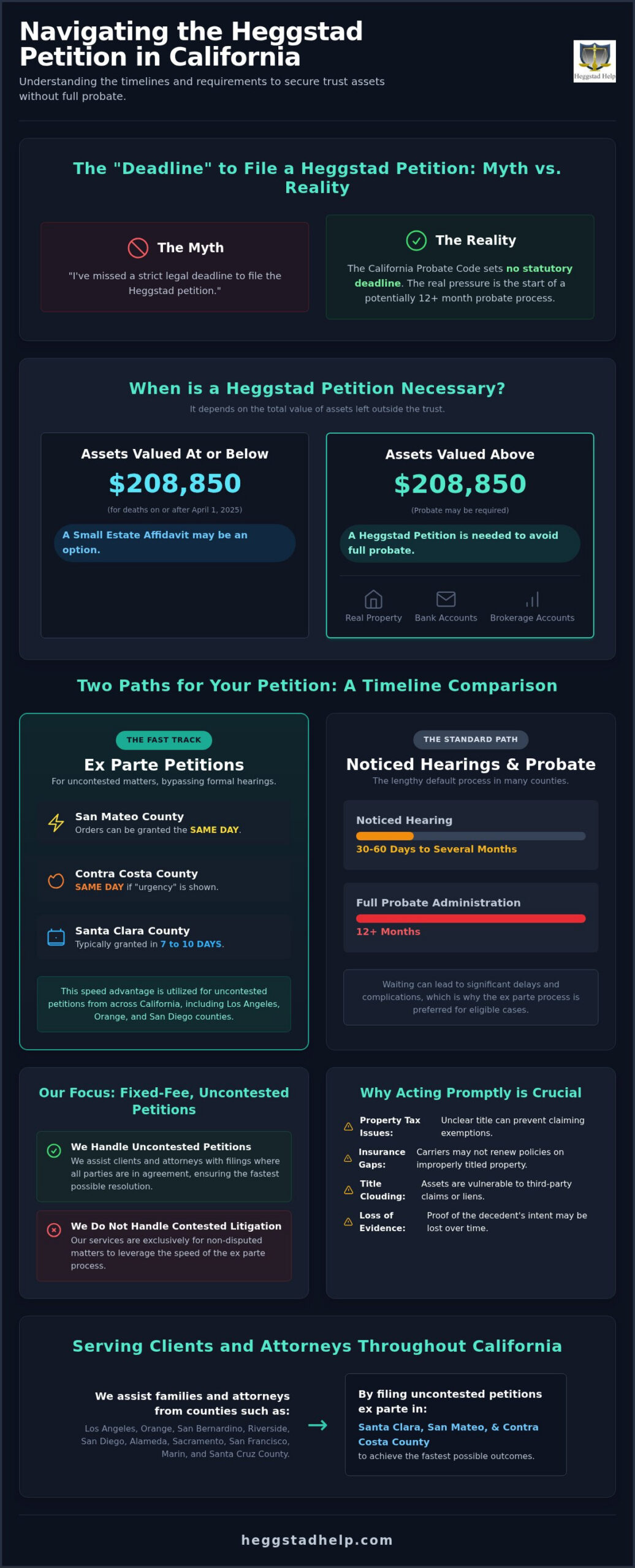
A surprising fact regarding the deadline to file Heggstad petition California is that a legal statute of limitations doesn’t actually exist. While many worry they’ve run out of time, the real pressure isn’t a calendar date set by the State of California; it’s the looming threat of a 12-month probate. You’re likely feeling the stress of managing property exceeding the small estate threshold of $208,850 for deaths on or after April 1, 2025. Our office assists attorneys and clients throughout California with these uncontested matters for a fixed fee, though we don’t handle contested litigation.

In this guide, you’ll learn how to use the Probate Code to file a Heggstad petition in California and recover assets in weeks. We’ll explore tactical timelines, from the 7 to 10 day turnaround in Santa Clara County to same-day results in San Mateo County, helping you correct titles efficiently.

Key Takeaways

  • Understand that while the Probate Code does not set a strict statutory deadline to file Heggstad petition California, acting before probate concludes is vital for recovering trust assets.
  • Learn how uncontested ex parte petitions can bypass months of waiting, with orders granted in 7 to 10 days in Santa Clara County and potentially the same day in San Mateo County.
  • Identify the requirements for assets exceeding the $208,850 small estate threshold to ensure real property is correctly transferred into the trust without a full probate.
  • Find out how to leverage fixed-fee services to handle filings throughout the State of California, specifically for uncontested matters that don’t involve litigation.

Is There a Statutory Deadline to File a Heggstad Petition in California?

One of the most common questions families ask is whether they’ve missed the deadline to file Heggstad petition California. Unlike many legal actions that expire after a year or two, the California Probate Code doesn’t set a strict statute of limitations for filing this specific petition. This legal remedy, established by the landmark case Estate of Heggstad, allows a court to declare that property is part of a trust even if the deed wasn’t formally recorded. Our office assists attorneys and families throughout the State of California, including Los Angeles County and Orange County, with these uncontested filings using a fixed-fee model.

You shouldn’t mistake the lack of a legal expiration date for a reason to delay. While there isn’t a “hard” deadline to file Heggstad petition California, practical deadlines exist. If other assets are already being distributed through a full probate administration, waiting can complicate the title correction process. Whether you’re dealing with a living trust or an irrevocable trust, the goal is to align the asset with the decedent’s (the person who died) clear intent as quickly as possible.

Why Waiting to File in California Can Risk Your Trust Assets

Delaying the filing process often leads to avoidable complications for the Successor Trustee (the person named to manage the trust). Over time, critical evidence of the decedent’s intent may be lost. Additionally, failing to record a deed can trigger:

  • Property Tax Issues: Unclear title may prevent you from claiming specific exemptions.
  • Insurance Gaps: Carriers might refuse to renew policies if the record owner is incorrect.
  • Title Clouding: Assets outside the trust are vulnerable to third-party claims or liens.

To protect the estate, you should review the Successor Trustee Duties for an Unfunded Trust in California and act before documentation disappears.

Strategic Timing: Ex Parte vs. Noticed Hearings in California

The actual deadline to file Heggstad petition California is effectively defined by how fast the court can process your paperwork. While a standard noticed hearing (a formal proceeding requiring at least 30 days of notice to all interested parties) can take 60 days or several months, our office utilizes ex parte petitions (requests for immediate orders without a formal hearing) to save time. Under California Probate Code § 850, we bypass these delays for uncontested matters, which we handle for a fixed fee. We do not handle contested petitions.

Petitions in Santa Clara County are typically granted in 7 to 10 days. In San Mateo County, orders can often be granted the same day they’re filed. This efficiency is a massive advantage compared to the slow pace of a Heggstad Petition in Los Angeles, Orange County, or San Diego County. We frequently assist families in San Bernardino County and Riverside County by filing their uncontested petitions in Santa Clara County to achieve that 7 to 10 day resolution.

Speed Advantages for Uncontested Petitions in Northern California

In Contra Costa County, petitions can often be filed and granted the same day if we demonstrate “urgency” to the Court’s satisfaction. Our firm helps attorneys and families in Sacramento County, San Francisco County, and Marin County avoid the “noticed hearing” wait times that plague many jurisdictions. By leveraging the faster ex parte procedures in Northern California, we provide a streamlined path for clients in Alameda County and Santa Cruz County. If you’re facing a complex title issue, you can consult our team to see if your case qualifies for these accelerated timelines.

Deadline to File a Heggstad Petition in California: Timing and Speed Guide (2026)

Requirements and Thresholds for Filing in California

Determining whether you need to meet the deadline to file Heggstad petition California often depends on the value of the assets left outside the trust. For individuals dying on or after April 1, 2025, the small estate threshold in California is $208,850. If the unfunded assets (property not correctly titled in the trust’s name) exceed this amount, a Small Estate Affidavit isn’t an option. Instead, you’ll need to file a petition under Probate Code Section 850 to avoid a full probate administration, which can last over a year.

The core requirement for a successful filing is proving the decedent’s intent. You must show the court that the person who died intended for the asset to be governed by the trust. This office exclusively handles uncontested petitions to ensure the fastest possible resolution for families in Alameda County, Sacramento County, and Santa Cruz County. While local courts in those areas might take months for a noticed hearing, we can often file ex parte in Santa Clara County to have the matter decided in 7 to 10 days. By focusing on non-litigated cases, we maintain the speed and reliability our clients expect.

Fixed Fees for a Heggstad Petition in California

We believe in financial transparency during a stressful time. All Heggstad petitions at this firm are handled for fixed fees that cover both the court’s filing fees and the attorneys’ fees. This simplified pricing applies whether the property is located in San Francisco County or Marin County. Working with a Board Certified Specialist in Estate Planning, Trust and Probate Law ensures the petition is prepared accurately, which is why we can often secure orders ex parte (without a formal hearing).

After the court grants the petition, your final step is title correction. You’ll take the certified court order and record it with the local County Recorder. This officially moves the property into the trust, allowing the Successor Trustee to manage or sell the asset without further court involvement. If you’re managing an estate in San Diego County or Orange County, don’t let the lack of a statutory deadline to file Heggstad petition California lead to procrastination; starting the process now prevents future title clouds.

Secure Your Trust Assets Without the Probate Delay

While there’s no strict statutory deadline to file Heggstad petition California, the practical risks of waiting are significant. By acting now, you avoid the 12-month probate cycle and protect assets exceeding the $208,850 small estate threshold. Our office specializes in uncontested petitions filed ex parte, allowing families in Los Angeles County and San Diego County to bypass local delays. We secure orders in Santa Clara County in just 7 to 10 days, or even same-day in San Mateo County.

Our Board-Certified Specialist provides fixed-fee representation for all uncontested filings, ensuring you have a steady, knowledgeable hand guiding you through the Probate Code. If you’re ready to correct title issues quickly and efficiently, Get Expert Help with Your Heggstad Petition in California. Taking this step today brings a logical resolution to complex procedural hurdles and ensures the decedent’s intent is finally honored.

Frequently Asked Questions

How long does a Heggstad petition take in California?

The timeline depends on the county and the filing method used. In Santa Clara County, uncontested ex parte petitions (requests made without a formal hearing) are typically granted in 7 to 10 days. San Mateo County often grants them the same day they are filed. In contrast, a noticed hearing in Los Angeles County or Orange County can take several months to resolve.

Can I file a Heggstad petition if the decedent died years ago?

Yes, you can file at any time because there is no statutory deadline to file Heggstad petition California. You can correct title errors years after a death as long as you can prove the decedent’s intent to include the asset in their trust. It is generally better to act quickly before documentation is lost or property tax complications arise for the estate.

What is the small estate threshold in California for 2026?

For individuals dying on or after April 1, 2025, the small estate threshold is $208,850. This figure remains in effect for 2026 and is scheduled for an inflation adjustment on April 1, 2028. If assets left outside a trust exceed this amount, a Heggstad petition is often the most efficient way to transfer property without the delays of a full probate administration.

Is a Heggstad petition faster than probate in California?

A Heggstad petition is significantly faster than a full probate, which typically lasts 12 to 18 months. While probate involves a mandatory four-month creditor claim period, an uncontested petition filed ex parte can be completed in weeks. This allows families in San Diego County, Riverside County, and San Bernardino County to secure title to real property and distribute assets much sooner.

Robert P. Bergman, Attorney at Law

Article by

Robert P. Bergman, Attorney at Law

Attorney Robert P. Bergman ("Bob Bergman") has been a Board-Certified Specialist in Estate Planning, Trust and Probate Law since 2011, as certified by the California State Bar Board of Legal Specialization. For several years, Bob has assisted families and the clients of other attorneys with obtaining court orders through Heggstad petitions to avoid the time and expense of Probate administration. Bob is friendly, very approachable, and believes in explaining complex legal topics in clear ordinary language so that his clients understand exactly what they're doing and why they're doing it.
Bob is often able to assist clients who are in other counties than his home county of Santa Clara through his approach to Heggstad petitions.

Disclaimer

This article is for informational purposes only. Nothing in this article is intended to replace legal advice from a competent attorney or be considered legal guidance for anybody's specific legal situation. Nobody should rely on information in this article in making legal decisions without such consultation.

Petition to Confirm Trust Assets in California: The Heggstad Solution

What if you could bypass the grueling 18 month probate process simply because a single deed was never signed? It’s a common and stressful discovery…

What if you could bypass the grueling 18 month probate process simply because a single deed was never signed? It’s a common and stressful discovery to find that a family home was left out of a living trust, seemingly forcing you into a public and costly court battle. You’re likely worried about high statutory fees and confusing language in the Probate Code. A petition to confirm trust assets in California is often the most efficient way to resolve this hurdle.

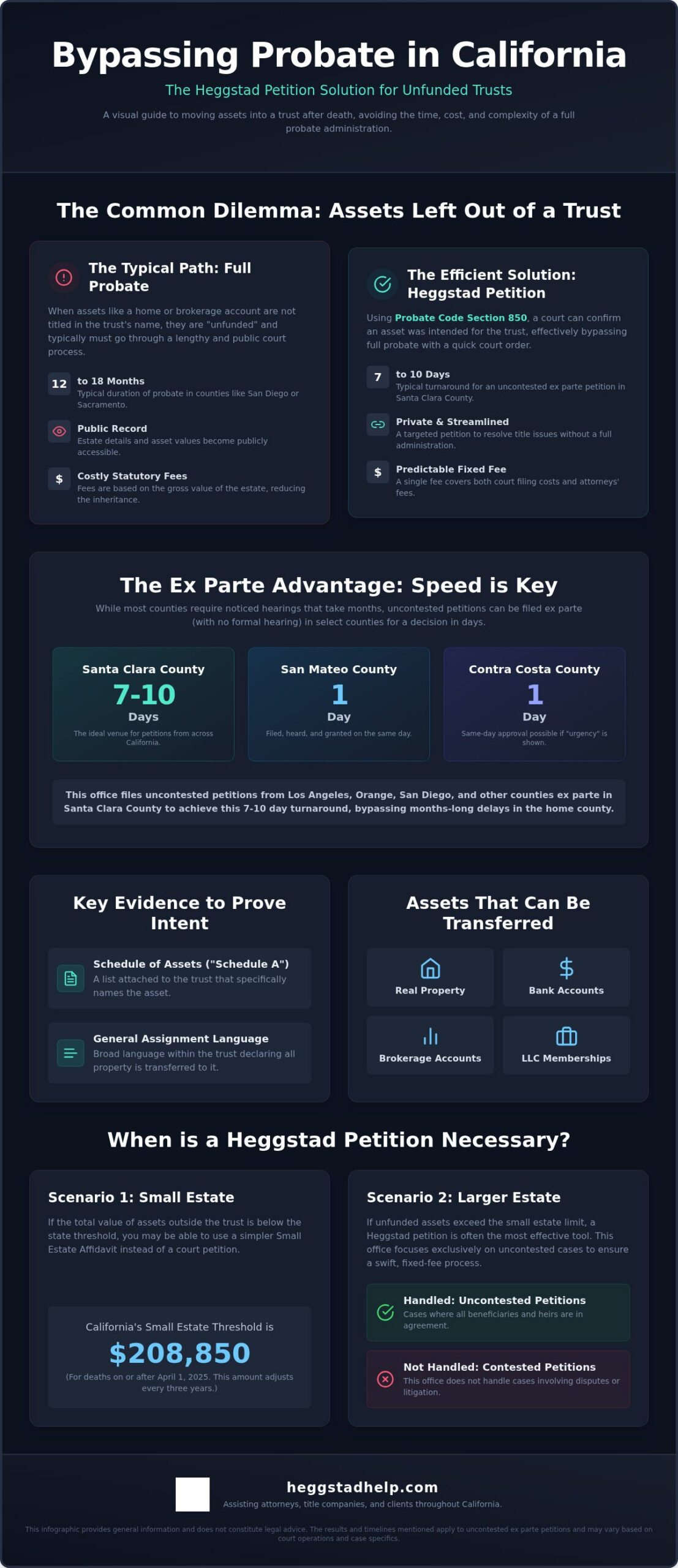
This article explains how a Heggstad petition (a legal procedure used to move property into a trust after death) can often offer a faster path. You’ll discover how families from Los Angeles County to Sacramento County can secure an uncontested court order ex parte (with no formal hearing) in as little as 7 to 10 days in Santa Clara County. We’ll outline how to resolve these title issues using a fixed fee approach.

Key Takeaways

  • Learn how a petition to confirm trust assets in California allows you to transfer real property into a trust without the 12 to 18 month delay of a traditional probate.
  • Discover how uncontested matters can be resolved via ex parte petitions in as little as 7 to 10 days in Santa Clara County, bypassing the months-long wait for noticed hearings.
  • Understand the benefits of a fixed-fee legal model that covers both filing and attorneys’ fees, providing financial predictability during a complex transition.
  • Determine if your situation qualifies for a Heggstad solution or if the assets fall under the $208,850 small estate threshold applicable to deaths on or after April 1, 2025.

Why Assets Are Often Left Out of a Living Trust in California

Creating a trust is only half the battle of estate planning. Many families throughout the State of California discover too late that real estate or financial accounts were never formally retitled into the trust’s name. This "unfunded trust" dilemma occurs when a decedent clearly intended to include an asset but failed to record the deed or update the account registration. If the value of these omitted assets exceeds $208,850 for those dying on or after April 1, 2025, the law typically requires a full probate administration. This threshold is adjusted for inflation every three years, but even modest homes in California often exceed this limit. Fortunately, a petition to confirm trust assets in California can often resolve these clerical errors without a year of court delays.

Identifying Trust Funding Errors in California

To determine if an asset was properly transferred, you should check the last recorded deed. If the deed lists an individual name rather than the trust name, the property is likely unfunded. You may also see signs of incomplete transfers in brokerage statements that don’t reference the trust. While many people believe a "Pour-Over Will" solves this, it’s actually just a safety net that still requires court action to move the asset. The Estate of Heggstad case established the legal precedent that written intent can be sufficient to confirm ownership, allowing a specialized attorney to fix these titling mistakes efficiently.

The Cost of Doing Nothing: Probate vs. Petition

A standard probate in counties like San Diego County or Sacramento County typically lasts 12 to 18 months. During this lengthy process, statutory fees based on the gross value of the estate can significantly reduce the inheritance. By contrast, a Heggstad petition offers a fixed-fee legal solution that provides financial predictability. Understanding Successor Trustee Duties for an Unfunded Trust is vital for anyone managing an estate. Filing a petition to confirm trust assets in California allows families to avoid the public and expensive probate process while securing the title in a fraction of the time.

What is a Petition to Confirm Trust Assets under Probate Code Section 850?

A petition to confirm trust assets in California relies on Probate Code Section 850, which grants the court authority to determine ownership of property. This procedure helps families in Los Angeles County and Orange County avoid full probate by declaring that an asset was intended for the trust. The process is often called a Heggstad petition, named after a landmark 1993 case. In that matter, the court ruled that a settlor’s (the person who created the trust) written intent to include an asset was sufficient to establish ownership. It’s a request for the court to confirm that the asset is already part of the trust estate rather than a new transfer of title.

Key Evidence Needed for a Heggstad Petition in California

Success depends on proving the deceased person’s intent through specific documentation. Courts typically look for a "Schedule A" (a list of assets) attached to the trust document. If that’s missing, we often rely on general assignment language within the trust that declares all property belongs to the trust entity. For a deeper look at these requirements, see our California Probate Code Section 850 Guide. Since these petitions are uncontested, the evidence must be clear and compelling to satisfy the court’s requirements.

Types of Assets Recoverable via Probate Code Section 850

This remedy isn’t limited to family homes. It applies to various holdings, including real property such as land or commercial buildings, financial accounts, and brokerage holdings. It’s even a viable path for transferring an LLC to trust after death. If you’re managing assets in San Bernardino County or Riverside County, you can find a fixed-fee solution to evaluate your documents and secure a court order without the complexity of a full probate case.

The Ex Parte Advantage: Speeding Up the Heggstad Process in California

Many people believe that obtaining a court order always requires a formal hearing scheduled months in advance. In many jurisdictions, a noticed hearing (a court date where all interested parties are formally notified to appear) is typically set 30 to 60 days after filing, or even several months later depending on the specific court’s backlog. You don’t have to wait that long. A petition to confirm trust assets in California can often be handled ex parte (with no formal hearing). This approach allows for a rapid resolution that completely bypasses the standard 12 to 18 month probate process.

County-Specific Timelines for Heggstad Petitions

Procedural speed depends heavily on where the matter is heard. In Santa Clara County, uncontested petitions are typically granted in just 7 to 10 days. San Mateo County provides even more immediate results, as petitions can often be filed, heard, and granted on the same day. In Contra Costa County, a same-day order is also possible if "urgency" is demonstrated to the Court’s satisfaction. By focusing on these specific jurisdictions, we provide a faster alternative to the delays common in other California courts.

Statewide Assistance for California Families

Our office assists families, attorneys, and title companies throughout the State of California, including those in Los Angeles County, Orange County, and San Diego County. While courts in Sacramento County or San Francisco County often require noticed hearings that take many months, we can file uncontested petitions from those areas ex parte in Santa Clara County to secure a decision in days. This specialized strategy serves clients in Alameda County, Riverside County, San Bernardino County, Marin County, and Santa Cruz County. You can secure an ex parte court order to correct your trust title quickly and efficiently.

Petition to Confirm Trust Assets in California: The Heggstad Solution

Choosing the right legal representation is the most important step in resolving an unfunded trust. While a generalist probate lawyer might suggest a full administration, a specialist focuses on the specific mechanics of a petition to confirm trust assets in California. To begin, successor trustees should collect the original trust agreement and the most recent property deed. These documents are essential. They provide the evidence needed to demonstrate the settlor’s intent to the court. Our office assists attorneys and families across the State of California, ensuring that the transition of title is handled with calm competence.

Fixed Fees and Predictable Outcomes

We provide a fixed-fee model for all Heggstad matters. This fee is transparent and covers both the court filing fees and all attorneys’ fees. This approach allows you to avoid the high statutory fees associated with traditional probate. Our office focuses exclusively on uncontested petitions to ensure maximum speed and efficiency. We don’t handle contested petitions (cases where a party formally objects to the transfer). For a complete breakdown of the requirements, see our Heggstad Petition Filing Guide for 2026.

Working with HEGGSTAD HELP

Working with a Board-Certified Specialist like Robert P. Bergman provides a level of expertise that general practitioners often lack. We coordinate with title companies and legal professionals from San Diego County and Riverside County to San Bernardino County. While a noticed hearing in Sacramento County or San Francisco County can take several months, we can file ex parte in Santa Clara County to secure an order in 7 to 10 days. This rapid service is also available for clients in Los Angeles County, Orange County, Alameda County, Marin County, and Santa Cruz County. If you’re ready to resolve title issues, Contact HEGGSTAD HELP for a consultation on your missing trust assets.

Secure Your Family’s Legacy with a Heggstad Petition

Discovering an unfunded trust doesn’t have to lead to a year of court delays. By utilizing Probate Code Section 850, you can transfer title to the trust and honor the settlor’s intent. Whether you’re managing property in Los Angeles County, Orange County, or San Diego County, our specialized approach ensures efficiency. Filing a petition to confirm trust assets in California through an ex parte process in Santa Clara County typically results in a court order within 7 to 10 days.

Robert P. Bergman, a Board-Certified Specialist, provides the calm competence needed to navigate these hurdles. We offer fixed fees that cover both filing and attorneys’ fees for uncontested matters, providing financial transparency. You don’t have to face this situation alone. Get a Fixed-Fee Quote for Your Heggstad Petition in California and resolve your title issues with confidence.

Frequently Asked Questions

What is the small estate threshold in California for 2026?

The small estate threshold for a Small Estate Affidavit in California is $208,850 for individuals dying on or after April 1, 2025. This value remains at this level throughout 2026. If the total value of assets left outside the trust in Sacramento County or Alameda County is below this amount, you may use a simplified affidavit process instead of filing a formal Heggstad petition in court.

How long does a Heggstad petition take in Santa Clara County?

An uncontested petition to confirm trust assets in California typically takes 7 to 10 days to be granted in Santa Clara County. This rapid timeline is possible because the matter is heard ex parte (without a formal hearing). While jurisdictions like San Diego County or Orange County may take months for a noticed hearing, we often file in Santa Clara to provide a faster resolution.

Can I file a Heggstad petition if there is no Schedule A attached to the trust?

Yes, you can still file a Heggstad petition even if a formal Schedule A (the list of assets intended for the trust) is missing. Courts often accept a "general assignment" clause within the trust document as sufficient evidence of the settlor’s intent. We help families in Los Angeles County and Riverside County review their documents to find the necessary language to support a successful court filing.

What is the difference between a noticed hearing and an ex parte petition?

A noticed hearing is a formal court date set 30 to 60 days after filing, or several months later in backlogged counties like Marin County or San Francisco County. An ex parte petition is a request for a court order without a formal hearing, which is significantly faster. For example, San Mateo County can grant these orders the same day they are filed, bypassing the schedule entirely.

Does a Heggstad petition avoid the need for a full probate?

Yes, a successful petition to confirm trust assets in California completely avoids the need for full probate administration. Instead of a 12 to 18 month court process and high statutory fees, this procedure allows you to transfer title to the trust in just days. This office provides a fixed-fee solution for uncontested petitions throughout Santa Cruz County and San Bernardino County.

Robert P. Bergman, Attorney at Law

Article by

Robert P. Bergman, Attorney at Law

Attorney Robert P. Bergman ("Bob Bergman") has been a Board-Certified Specialist in Estate Planning, Trust and Probate Law since 2011, as certified by the California State Bar Board of Legal Specialization. For several years, Bob has assisted families and the clients of other attorneys with obtaining court orders through Heggstad petitions to avoid the time and expense of Probate administration. Bob is friendly, very approachable, and believes in explaining complex legal topics in clear ordinary language so that his clients understand exactly what they're doing and why they're doing it.
Bob is often able to assist clients who are in other counties than his home county of Santa Clara through his approach to Heggstad petitions.

Disclaimer

This article is for informational purposes only. Nothing in this article is intended to replace legal advice from a competent attorney or be considered legal guidance for anybody's specific legal situation. Nobody should rely on information in this article in making legal decisions without such consultation.
Ex Parte Heggstad Petition: California Trust Funding 2026

Imagine you’re days from closing a sale in Los Angeles, only to discover the deed was never transferred into the living trust. You’re likely facing…

Imagine you’re days from closing a sale in Los Angeles, only to discover the deed was never transferred into the living trust. You’re likely facing the stress of a 12-to-18-month probate delay while your buyer walks away. It’s a common complication, but you don’t have to lose the deal. By filing an ex parte Heggstad petition in California, you can bypass the standard Probate Code timeline and secure a court order (a formal judicial decree confirming the asset belongs to the trust) in as little as 72 hours.

This article explains how we help families statewide secure these orders with fixed fees covering both filing and attorney fees. We’ll preview the rapid 7-to-10-day process in Santa Clara County, same-day options in San Mateo and Contra Costa, and explain the Small Estate Affidavit threshold of $208,850 for deaths on or after April 1, 2025. We’ll also show how petitions from other counties can be heard in Santa Clara for faster results.

Key Takeaways

  • Learn how an ex parte Heggstad petition in California can transfer assets into a trust in as little as 72 hours, allowing you to bypass the standard 12-to-18-month probate delay.
  • Discover strategic filing techniques in Santa Clara County to secure court orders in 7 to 10 days, even for properties located in Los Angeles, Orange, or San Diego.
  • Understand the specific Small Estate Affidavit threshold of $208,850 for deaths on or after April 1, 2025, to determine the most efficient path forward.
  • Benefit from fixed-fee legal services that cover both filing and attorney fees, providing cost certainty for successor trustees and attorneys throughout the entire state of California.

Understanding the Ex Parte Heggstad Petition in California

A Heggstad petition is a specialized legal request under Probate Code Section 850. Our team at HEGGSTAD HELP uses this to ask the court to confirm trust ownership of assets that were never formally retitled. This remedy stems from the landmark case Estate of Heggstad, which proved that a written declaration of trust is often sufficient to show intent. This process is vital when a "forgotten house" deed remains in the decedent’s name rather than the trust’s name.

The standard process requires a noticed hearing that can take several months. However, an ex parte Heggstad petition in California acts as a fast-track mechanism. It allows for an emergency hearing that bypasses the standard 30-to-60-day notice period. Success requires clear evidence of the decedent’s intent, such as a "Schedule A" document listing the property as a trust asset.

When Urgency Justifies an Ex Parte Filing

Courts require a valid reason to expedite a hearing. If you’re facing a pending real estate sale in Los Angeles or an imminent foreclosure in Riverside, these emergencies often justify ex parte relief. Obtaining written consent from all heirs is the fastest way to secure a court decision. In jurisdictions like Santa Clara, courts may even allow ex parte filings for uncontested matters simply to clear backlogs.

If an estate is small, you might consider a Small Estate Affidavit. This applies if the total value is under $208,850 for deaths on or after April 1, 2025. For larger real property, an ex parte Heggstad petition in California remains the most efficient path to avoid the 12-to-18-month probate delay.

County-Specific Timelines for a Heggstad Petition in California

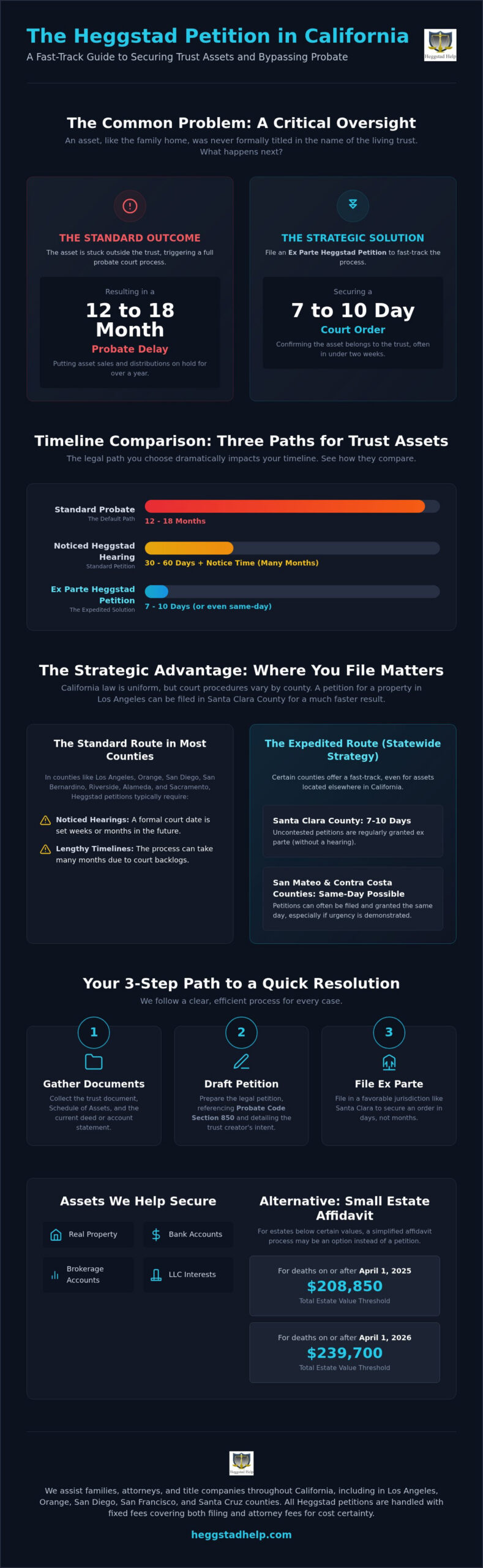
While California law is uniform, local court procedures vary significantly. In Los Angeles, Orange, or San Diego, a noticed hearing can take several months including notice time. If a petition is contested, the timeline extends much further. Conversely, Santa Clara, San Mateo, and Contra Costa Counties offer a fast-track through an ex parte Heggstad petition in California. In Santa Clara, uncontested petitions are regularly granted in 7 to 10 days without a formal hearing. San Mateo and Contra Costa can often grant these the same day, provided you demonstrate sufficient urgency in Contra Costa.

Many people assume they must file in the county where the property is located. However, a strategic advantage exists: uncontested petitions from any county, including Alameda, Sacramento, San Francisco, or Santa Cruz, can often be heard ex parte in Santa Clara County. This allows you to secure an order in days rather than waiting months for a noticed hearing in a backlogged jurisdiction. Using a Heggstad Petition to Avoid Probate in this manner is a powerful tool for successor trustees. Our office assists clients throughout the entire state of California with fixed fees covering both filing and attorney fees. If you’re managing an estate in San Bernardino or Riverside, reaching out to a specialist can clarify if this expedited path fits your needs.

The Process for Successor Trustees and Attorneys

To navigate this effectively, follow these three steps:

  • Step 1: Gather the trust document, the "Schedule of Assets," other written evidence of intention concerning the assets and the current deed or account statement.
  • Step 2: Draft the petition referencing Probate Code Section 850 and the specific facts showing the decedent’s intent.
  • Step 3: File ex parte in a favorable jurisdiction like Santa Clara to secure an order in 7 to 10 days.

If the estate value is below the Small Estate Affidavit threshold, which is $208,850 for deaths on or after April 1, 2025.different simplified procedures might apply. For most real estate, however, the ex parte route remains the most reliable way to maintain a closing schedule.

Ex Parte Heggstad Petition: California Trust Funding 2026

Robert P. Bergman is a Board-Certified Specialist in Estate Planning, Trust and Probate Law who has practiced since 1980. His team at HEGGSTAD HELP serves as a specialized partner for families, title companies, and probate attorneys across the state. We specialize in correcting title errors for complex holdings, including LLC interests or brokerage accounts that were inadvertently left out of a trust. By filing an ex parte Heggstad petition in California, we provide a structured, logical path to resolution that avoids the stress of traditional litigation. We regularly assist professionals in counties like Alameda, San Francisco, and Riverside to ensure that sudden title hurdles don’t derail an entire administration.

Successor trustees often appreciate the clarity provided by our fixed-fee model. This approach ensures total cost certainty because the fee covers both the court filing costs and all attorney fees. You won’t have to worry about the unpredictable nature of hourly billing while trying to resolve a "forgotten" asset. We act as a friendly, reliable guide, providing the specialized knowledge required to navigate the Probate Code with confidence.

Navigating the Small Estate Thresholds in 2026

A petition is typically necessary when the value of the unfunded assets exceeds the California Small Estate Affidavit limits. It’s critical to use the threshold matching the date of death. For deaths occurring on or after April 1, 2025, the limit is $208,850. If your assets exceed these specific values, an ex parte Heggstad petition in California is the most efficient way to maintain your timeline and avoid a 12-to-18-month probate delay.

Securing Your Trust Assets Without Delay

Navigating the aftermath of a loved one’s death is difficult, but correcting a title error doesn’t have to add months of stress. By filing an ex parte Heggstad petition in California, you can often secure trust assets in as little as 72 hours and bypass the 12-to-18-month probate delay. Whether the property is in Orange, San Bernardino, or Marin, our strategic filing in Santa Clara County provides a 7-to-10-day turnaround for uncontested matters. We offer cost certainty with fixed fees that cover both filing and attorney costs, ensuring your family’s inheritance remains protected. If the estate exceeds the Small Estate Affidavit threshold of $208,850 for deaths on or after April 1, 2025, this is your most efficient path forward. Contact Robert P. Bergman, a Board-Certified Specialist, for a Fixed-Fee Heggstad Petition Consultation and move forward with confidence.

Frequently Asked Questions

How long does a Heggstad petition in California take to complete?

The timeline depends on the county and whether you’re using a noticed hearing or an ex parte process. Noticed hearings in counties like Los Angeles or Orange typically take several months. However, an ex parte Heggstad petition in California filed in Santa Clara County is usually granted in 7 to 10 days.

Can I file an ex parte Heggstad petition if there is no pending sale?

Yes, you can file ex parte in certain jurisdictions even without an immediate real estate closing. While Contra Costa County requires demonstrated urgency, such as a pending sale or foreclosure, Santa Clara County regularly allows ex parte filings for uncontested matters to clear court backlogs. This helps successor trustees secure trust assets without waiting for a standard hearing date.

What evidence is needed to win a Probate Code Section 850 petition?

You must provide clear evidence that the decedent intended the asset to be part of the trust. This typically includes a "Schedule of Assets" (a list of property attached to the trust document) or a specific declaration within the trust itself. Under Probate Code Section 850, the court requires this proof of intent to confirm the trust’s ownership.

Is a Heggstad petition cheaper than a full probate in California?

Yes, it’s significantly more cost-effective because it avoids statutory probate fees based on the estate’s gross value. A petition is necessary when assets exceed the Small Estate Affidavit threshold of $208,850 for deaths on or after April 1, 2025, and $239,700 for deaths on or after April 1, 2026. Our office uses fixed fees for an ex parte Heggstad petition in California.

Can an attorney from Santa Clara handle a Heggstad petition in Los Angeles?

Yes, and there is often a strategic advantage to doing so. We assist families and attorneys throughout the entire state of California, including San Diego, Riverside, and San Francisco. Uncontested petitions for property located in Los Angeles or Orange County can often be heard ex parte in Santa Clara County and decided within 7 to 10 days.

What happens if a Heggstad petition is contested by a beneficiary?

The court will move the matter to a noticed hearing if a beneficiary or heir objects to the petition. Contested petitions take much longer to resolve than uncontested ones and may require formal litigation. Most Heggstad matters remain uncontested because they simply fulfill the decedent’s documented intent to keep assets in the trust and avoid the probate process.

Robert P. Bergman, Attorney at Law

Article by

Robert P. Bergman, Attorney at Law

Attorney Robert P. Bergman ("Bob Bergman") has been a Board-Certified Specialist in Estate Planning, Trust and Probate Law since 2011, as certified by the California State Bar Board of Legal Specialization. For several years, Bob has assisted families and the clients of other attorneys with obtaining court orders through Heggstad petitions to avoid the time and expense of Probate administration. Bob is friendly, very approachable, and believes in explaining complex legal topics in clear ordinary language so that his clients understand exactly what they're doing and why they're doing it.
Bob is often able to assist clients who are in other counties than his home county of Santa Clara through his approach to Heggstad petitions.

Disclaimer

This article is for informational purposes only. Nothing in this article is intended to replace legal advice from a competent attorney or be considered legal guidance for anybody's specific legal situation. Nobody should rely on information in this article in making legal decisions without such consultation.

California Heggstad Petition Cost: Fees, Legal Expenses, and Savings in 2026

What if you could bypass a year of court delays and thousands in statutory probate fees just by filing a single document? Many families realize too…

What if you could bypass a year of court delays and thousands in statutory probate fees just by filing a single document? Many families realize too late that a home or account was never deeded into a trust, triggering anxiety about the Heggstad petition cost California families face when trying to correct a title. It’s understandable to feel overwhelmed by the prospect of high hourly rates and confusing court filing fees, especially when you’re already managing the emotional weight of a loved one’s passing.

This guide provides a clear breakdown of the expenses you’ll encounter, from court fees to the benefits of a fixed-fee model that covers both filing and attorney fees for clients, title companies, and fellow attorneys. You’ll learn how a Heggstad Petition in California (a specialized legal request to include "forgotten" assets in a trust) can be resolved in as little as 7 to 10 days in Santa Clara County, or even same-day in San Mateo and Contra Costa Counties. We’ll also cover the Probate Code thresholds, which are $208,850 for deaths on or after April 1, 2025, and $239,700 for deaths on or after April 1, 2026, to help you choose the most efficient path forward.

Key Takeaways

  • Learn how a fixed-fee structure provides cost certainty by covering both filing and attorney fees for your trust asset transfer.
  • Discover how to bypass months of delays by filing ex parte in Santa Clara, San Mateo, or Contra Costa Counties, where orders can be granted in as little as 7 to 10 days.
  • Compare the total Heggstad petition cost California families encounter against the significantly higher statutory fees required for a full probate under the Probate Code.
  • Understand the strategic benefit of filing statewide cases in Santa Clara County to avoid the lengthy noticed hearings required in other jurisdictions.
  • Identify the correct path forward by comparing your asset value to the Small Estate Affidavit thresholds of $208,850 (for deaths on or after April 1, 2025) and $239,700 (for deaths on or after April 1, 2026).

The Financial Impact of an Unfunded Trust in California

Creating a living trust is a vital step in protecting your family’s future, but the document itself is only half of the equation. For a trust to function as intended, it must be "funded," which means legal title to your assets must be transferred into the trust’s name. When a house or financial account is left out of a trust, it creates an "unfunded trust" problem. This oversight often forces families into the very probate process they tried to avoid, leading to concerns about the total Heggstad petition cost California residents will face to fix the error.

Inaction can be expensive. While a home sits in legal limbo, you might face lost property value, mounting maintenance costs, and complex tax complications. Successor trustees, beneficiaries, and even title companies often find themselves stuck when they realize the deceased person’s intent to include an asset in their trust wasn’t matched by a recorded deed. Fortunately, California law provides a specialized remedy to correct these title errors without a year-long probate stay. By taking proactive steps, you can secure the asset and move forward with the administration of the estate.

Why Assets Are Frequently Left Out of Trusts

Title errors happen more often than you might think. A common scenario involves refinancing a home in California; lenders frequently require the property to be moved out of the trust and back into the individual’s name to process the loan. If the owner forgets to record a new deed putting the house back into the trust afterward, the asset remains "unfunded." Other times, a person might create a trust but simply fail to follow through with the deed recording for a new purchase. A Heggstad petition in California serves as a corrective tool, allowing the court to confirm that the asset belongs to the trust based on the creator’s clear written intent.

The Role of Probate Code Section 850

The legal foundation for this procedure is found in Probate Code Section 850. This section allows the court to transfer property to its rightful owner when there is evidence of a contract or intent to convey that property. This approach became the "gold standard" for title recovery following the landmark case of the Estate of Heggstad. By using this specific Probate Code Section, Robert P. Bergman assists families and professionals with a fixed-fee resolution that provides cost certainty. This is especially helpful if the estate exceeds the small estate thresholds of $208,850 (for deaths on or after April 1, 2025) or $239,700 (for deaths on or after April 1, 2026), making a full probate the only other alternative.

Breaking Down the Heggstad Petition Cost in California

Understanding the Heggstad petition cost California families can expect involves looking at both the check you write to the court clerk and the invoice from your legal representative. While the total expense is significantly lower than a full probate, the costs are split into two primary categories: mandatory administrative fees and professional legal fees. For those managing an estate, having a clear picture of these numbers is the first step toward reducing the stress of a title correction.

Standard filing fees for a petition under California Probate Code 850 typically range between $435 and $500 as of 2026. These fees are set by the state and vary slightly depending on county surcharges. If the asset value is below the Small Estate Affidavit limits ($208,850 for deaths on or after April 1, 2025, and $239,700 for deaths on or after April 1, 2026), you might have other options. However, for real property exceeding these amounts, the petition remains the most economical path forward.

Court Filing Fees and Administrative Costs

Beyond the initial filing fee at the clerk’s window, you’ll encounter a few smaller administrative expenses. Recording the final court order with the County Recorder ( the process of updating public records to show the trust owns the property) usually costs less than $100. You’ll also want to budget for certified copies of the order to provide to title companies or financial institutions. When compared to the thousands of dollars required for a full probate administration, these administrative costs are remarkably low. In counties like Santa Clara, San Mateo, and Contra Costa, where we can often resolve cases ex parte (without a formal hearing), you also save on the costs associated with multiple court appearances.

Legal Fees: Hourly vs. Fixed-Fee Models

The most variable part of the Heggstad petition cost California residents face is the attorney’s fee. Many firms bill hourly, with rates for experienced specialists ranging from $450 to over $800 per hour. This can lead to "fee creep," where a seemingly simple matter becomes expensive due to administrative back-and-forth. To solve this, the Heggstad Help fixed-fee structure provides a single, transparent price that covers both the filing fees and the legal work. This model is particularly beneficial for title companies and other attorneys who need a predictable cost for their clients. If you’re looking for a way to secure a fixed-price solution for title correction, this approach eliminates the uncertainty of hourly billing. By streamlining the process, we help you avoid the high statutory fees that would otherwise be calculated based on the property’s gross value.

Cost Comparison: Heggstad Petition vs. Full Probate Fees

When you’re dealing with an unfunded trust, the financial stakes are high. In California, traditional probate is often viewed as a "probate tax" because the costs are determined by the gross value of the estate rather than the amount of work performed. Under Probate Code Section 10800 and Probate Code Section 10810, the law sets mandatory statutory fees for both the attorney and the executor. These fees are non-negotiable and apply to the total value of the property, regardless of how much debt or mortgage is owed on it. This is why the Heggstad petition cost California families typically pay is a fraction of the price of a full probate administration.

Beyond the immediate financial expense, you must also consider the cost of time. A standard probate in California rarely takes less than 12 months, and in many counties, the timeline can stretch toward 18 months or longer. During this period, assets are often locked, preventing beneficiaries from selling property or accessing funds. In contrast, an uncontested Heggstad petition can be resolved in as little as 7 to 10 days in Santa Clara County when filed ex parte (a request for a court order without a formal, scheduled hearing). Even in San Mateo and Contra Costa Counties, these orders can potentially be granted the same day they are filed, provided you can demonstrate the necessary urgency. To understand exactly how this Heggstad petition process California courts follow works from start to finish, reviewing a detailed step-by-step breakdown can help you prepare for each stage.

Statutory Fee Math: A Real-World Example

To see the savings, let’s look at the math for a $1,000,000 California home. In a full probate, the statutory fees would be approximately $23,000 for the attorney and another $23,000 for the executor, totaling $46,000. For a $500,000 asset, the combined fees would still reach $26,000. Because a Heggstad petition bypasses the traditional probate process, it often saves families 70% to 90% in total costs. Legal professionals frequently discuss these efficiencies, as seen in resources from the Placer County Bar Association on Probate §850 Petitions. For a deeper dive into these numbers, you can review our Heggstad Petition vs. Probate in California: 2026 Comparison Guide.

The 2026 Small Estate Threshold Limits

Before proceeding with a petition, it’s essential to check if the estate qualifies for a Small Estate Affidavit. This is a simplified process, but it only applies if the total value of the estate is below specific legal limits. For deaths occurring on or after April 1, 2025, the threshold is $208,850. For deaths occurring on or after April 1, 2026, the threshold increases to $239,700. If the value of the "forgotten" asset exceeds these figures, a Small Estate Affidavit is not an option. In these cases, a Heggstad petition remains the most financially superior and time-efficient alternative to a full, year-long probate process.

California Heggstad Petition Cost: Fees, Legal Expenses, and Savings in 2026

Geographic Factors Affecting Your Heggstad Petition Timeline and Expense

Where you file your petition in California matters as much as the legal arguments within the document. Each county’s probate court operates under its own set of local rules and scheduling backlogs. These geographic variations directly influence the Heggstad petition cost California residents encounter, mainly because a long wait for a hearing date can lead to increased property holding costs, such as taxes, utilities, and insurance. If you’re managing a home that needs to be sold quickly, a six-month delay in a busy court like Los Angeles or San Diego isn’t just frustrating; it’s expensive.

Fortunately, certain counties offer a distinct "Ex Parte Advantage." This procedural shortcut allows a judge to sign an order without requiring a formal, noticed hearing on the court’s regular calendar. By bypassing the standard wait times, we can resolve title issues in a fraction of the time required for a full probate. This efficiency is a cornerstone of how we help attorneys and title companies maintain momentum during trust administrations. It’s a strategic move that keeps the process moving while minimizing the stress of legal uncertainty.

Fast-Track Counties: Santa Clara, San Mateo, and Contra Costa

The probate courts in Santa Clara, San Mateo, and Contra Costa Counties are among the most efficient for these types of filings. In Santa Clara County, we regularly see uncontested petitions granted within 7 to 10 days of filing. San Mateo and Contra Costa Counties offer even more rapid results, with the potential for same-day grants. It’s worth noting that Contra Costa County requires a demonstrated "urgency" to qualify for this expedited treatment. Because these counties allow ex parte filings, the amount of legal labor is reduced, which helps us keep our services affordable and predictable through a fixed-fee model that covers both filing and attorney fees.

Handling Petitions in Other California Counties

In most other California counties, the court will require a noticed hearing. This usually adds 30 to 60 days to the timeline, plus the time needed to serve notice to all interested parties. If the petition is contested, the process can take much longer. However, there is a strategic solution for petitions originating in these slower jurisdictions. Uncontested Heggstad petitions from other counties can often be heard ex parte in Santa Clara County. This allows us to secure a court order within 7 to 10 days, avoiding the months of waiting typical in other courts. This venue selection is a vital tool for estates that exceed the small estate thresholds of $208,850 (for deaths on or after April 1, 2025) and $239,700 (for deaths on or after April 1, 2026). If you need to move quickly, utilizing our Ex Parte Court Order Services can save your family significant time and money.

When you are faced with the realization that a significant asset was left out of a trust, the path forward should be defined by clarity rather than financial guesswork. Many law firms operate on an hourly basis, which can make the total Heggstad petition cost California families pay unpredictable and stressful. Heggstad Help was founded on the principle of transparent, fixed-fee legal assistance. By offering a single price that covers both attorney fees and court filing fees, we provide a reliable solution for successor trustees, beneficiaries, and the professional partners who support them.

Our service extends beyond individual clients to assist attorneys and title companies throughout California who need a specialized hand to correct title errors efficiently. Whether the property is a family home or a commercial building, our goal is to resolve the "unfunded trust" problem without the complexity of a full probate. Because we handle these petitions daily, we have streamlined the process to ensure that every filing meets the strict requirements of the court, reducing the risk of costly delays or rejections.

Specialized Expertise vs. General Practice

Choosing a legal representative for a Probate Code Section 850 petition involves more than just finding a lawyer. Robert P. Bergman is a Board-Certified Specialist in Estate Planning, Trust and Probate Law. This certification means he has met rigorous standards of experience and passed a second bar exam specifically in this field. This level of expertise allows us to avoid the "learning curve" costs often associated with generalist probate lawyers who may only handle a few Heggstad matters a year. For a deeper look at the procedural requirements, you can check out our Heggstad Petition Filing Guide, which outlines how we navigate the system to recover missing assets.

Getting Started with Heggstad Help

The first step in our process is a thorough review of your trust documents and the current title of the asset in question. We help you determine if a petition is the correct tool by comparing your asset value to the California small estate thresholds. These limits are currently $208,850 for deaths on or after April 1, 2025, and $239,700 for deaths on or after April 1, 2026. If the asset exceeds these amounts, we move forward with the intake for Heggstad Petitions in California. To begin, you’ll simply need to provide the trust document, any amendments, and the most recent deed or account statement. From there, we provide a fixed-fee quote and a clear timeline for your specific county, ensuring you can recover your missing trust assets with confidence and financial certainty.

Securing Your Family’s Trust Assets

Navigating the Heggstad petition cost California families face doesn’t have to be a source of financial anxiety. By choosing a fixed-fee approach, you eliminate the threat of high statutory probate fees and the uncertainty of hourly billing. Whether your estate assets fall above the small estate limits of $208,850 (for deaths on or after April 1, 2025) and $239,700 (for deaths on or after April 1, 2026), or you simply need to move property into a trust quickly, there’s a clear path forward.

With over 40 years of California legal experience, Robert P. Bergman, a Board-Certified Specialist in Estate Planning, Trust and Probate Law, provides the steady hand you need. Our fixed-fee structure covers all filing and attorney fees; this ensures there are no surprises as we work to secure your family’s legacy. If you’re ready to bypass the 12-month probate delay and correct your title in as little as 7 to 10 days in Santa Clara County, we’re ready to assist you.

Get a Fixed-Fee Quote for Your California Heggstad Petition and take the first step toward resolving your trust asset issues today. You’ve worked hard for your home and investments, and we’re dedicated to making sure they stay exactly where they belong.

Frequently Asked Questions

How much does a Heggstad petition cost in California in 2026?

The total Heggstad petition cost California residents encounter includes the court filing fee, which typically ranges from $435 to $500 in 2026, and professional legal fees. While many firms bill hourly at rates between $450 and $800, we utilize a fixed-fee structure that covers both the filing fees and the attorney fees. This approach provides cost certainty and prevents the "fee creep" often associated with traditional probate matters.

Is a Heggstad petition cheaper than probate?

Yes, a Heggstad petition is significantly more affordable than a full probate administration. Probate fees are statutory (meaning they are set by law) under Probate Code Section 10800 and are based on the gross value of the estate. For example, a $1 million home could trigger $46,000 in statutory fees. A Heggstad petition bypasses these costs by using a single court order to confirm trust ownership.

How long does the Heggstad petition process take?

The timeline varies by county and the type of hearing required. In Santa Clara County, uncontested petitions are typically decided in 7 to 10 days. San Mateo and Contra Costa Counties can offer same-day grants, though Contra Costa requires demonstrated "urgency." In other counties, a noticed hearing (a formal court date where all parties are notified) usually takes 30 to 60 days plus additional time for notice. For a complete walkthrough of each stage, our California Heggstad petition step-by-step guide for 2026 covers the full process from document gathering to receiving your court order.

Can I file a Heggstad petition without an attorney?

While self-filing is technically possible, it’s rarely advisable because title companies and the court require very specific legal language to transfer property ownership. Errors in the petition can lead to rejected orders or a title that remains "unmarketable," meaning you can’t sell or refinance the home. A Board-Certified Specialist ensures the petition is drafted correctly the first time, avoiding the high cost of corrective legal work later.

What is the small estate limit in California for 2026?

California has two specific thresholds you must know. For deaths occurring on or after April 1, 2025, the small estate threshold is $208,850. For deaths occurring on or after April 1, 2026, the threshold increases to $239,700. If the asset you’re trying to recover exceeds these amounts, a Heggstad Petition in California is usually the most efficient legal tool to avoid a full, year-long probate process.

Do all California counties allow ex parte Heggstad petitions?

No, most California counties require a formal noticed hearing, which can take several months to be heard. However, uncontested petitions from any county can be heard ex parte (without a formal hearing) in Santa Clara County. This strategic move allows us to secure a court order in 7 to 10 days, providing a much faster resolution for clients regardless of where the property is located.

What happens if a Heggstad petition is contested?

If a beneficiary or another interested party objects to the petition, the court will require a noticed hearing regardless of the county. This moves the case onto the regular probate calendar, and the timeline will typically extend beyond 60 days. Contested matters are more complex and generally fall outside of a standard fixed-fee structure because they require traditional litigation services and additional court appearances.

Can a Heggstad petition be used for out-of-state property?

A California court only has the authority to correct title for real property located within California. If a deceased person left a house or land in another state out of their trust, you’ll likely need to file for ancillary probate (a secondary probate process) in that specific state. The Heggstad petition is a unique tool created under the Probate Code specifically for California trust asset title correction.

Robert P. Bergman, Attorney at Law

Article by

Robert P. Bergman, Attorney at Law

Attorney Robert P. Bergman ("Bob Bergman") has been a Board-Certified Specialist in Estate Planning, Trust and Probate Law since 2011, as certified by the California State Bar Board of Legal Specialization. For several years, Bob has assisted families and the clients of other attorneys with obtaining court orders through Heggstad petitions to avoid the time and expense of Probate administration. Bob is friendly, very approachable, and believes in explaining complex legal topics in clear ordinary language so that his clients understand exactly what they're doing and why they're doing it.
Bob is often able to assist clients who are in other counties than his home county of Santa Clara through his approach to Heggstad petitions.

Disclaimer

This article is for informational purposes only. Nothing in this article is intended to replace legal advice from a competent attorney or be considered legal guidance for anybody's specific legal situation. Nobody should rely on information in this article in making legal decisions without such consultation.