
What is a Petition to Confirm Trust Property in California? (2026 Guide)

Imagine discovering that your late parent’s home was never formally transferred into their trust, potentially triggering a probate process that lasts…

Imagine discovering that your late parent’s home was never formally transferred into their trust, potentially triggering a probate process that lasts over a year. It’s a stressful realization for many families in Los Angeles County and Orange County facing title errors. You’re likely asking, what is a petition to confirm trust property, and can it save you from a full probate? Most assume an omitted asset makes probate mandatory, but there’s a more efficient path forward.

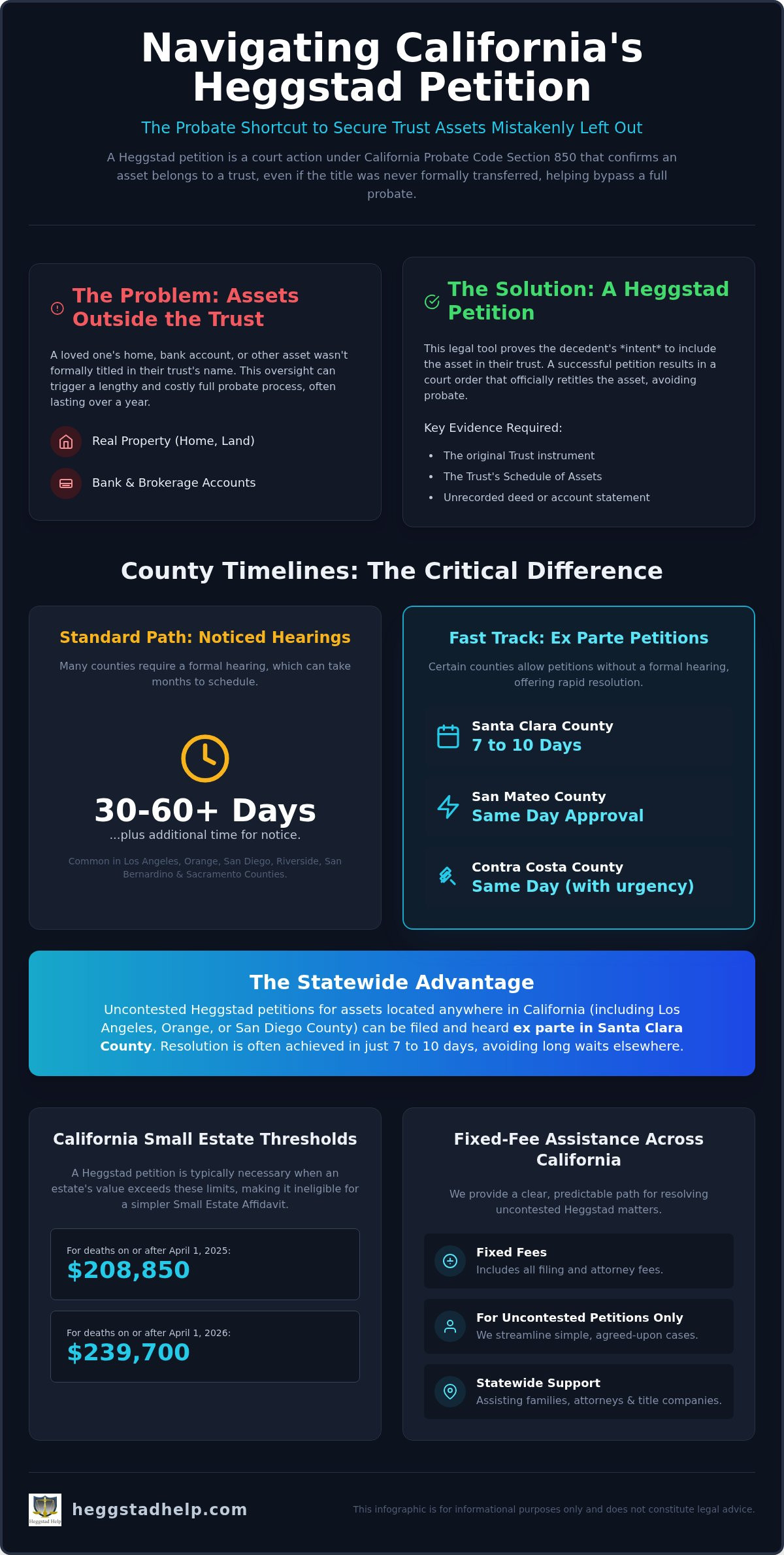
This guide explains how a Heggstad (a court order confirming trust ownership) petition under Probate Code Section 850 can bypass probate for assets accidentally left out of a trust. We’ll cover how petitions in Santa Clara County can be granted in 7 to 10 days, and how we assist attorneys and families with fixed-fee, uncontested petitions throughout California. We also clarify the small estate thresholds of $208,850 for deaths on or after April 1, 2025, and $239,700 for those on or after April 1, 2026.

Key Takeaways

  • Learn what is a petition to confirm trust property (a judicial request to declare an asset as part of a trust) and how this procedural shortcut honors the decedent’s intent without the burden of a full probate.
  • Discover how uncontested Heggstad petitions from Los Angeles County, Orange County, or San Diego County can be heard in Santa Clara County and granted in as little as 7 to 10 days.
  • Identify the critical evidence needed for a filing under Probate Code Section 850, such as the trust instrument and the Schedule of Assets, to fix title errors on real property.
  • Understand the efficiency of fixed-fee services that assist attorneys, title companies, and families in California, providing a predictable path toward asset resolution for uncontested matters.

Understanding the Petition to Confirm Trust Property in California

When you discover that a loved one didn’t finish transferring their home or bank account into their living trust, you might worry that a long, expensive court process is inevitable. To answer what is a petition to confirm trust property, it’s helpful to view it as a legal rescue mechanism. Commonly known as a Heggstad petition, this is a formal request to the court to declare that an asset belongs to a trust despite a technical title error. This procedure bypasses the standard, 12-month full probate administration in California. It’s essential when assets exceed the small estate limit of $208,850 for those dying on or after April 1, 2025, or $239,700 for those dying on or after April 1, 2026.

Successor trustees use this tool when a decedent intended for a property to be in their trust but forgot to record the final deed. Whether you’re in Los Angeles County, Orange County, or San Diego County, our office assists families and attorneys with these filings throughout California. We provide fixed fees that cover both filing and attorney fees for uncontested matters. While we don’t handle contested petitions, we help families and title companies correct title issues quickly. Understanding the Petition to Confirm Trust Property starts with recognizing that a simple oversight shouldn’t lead to years of probate.

The Legal Basis: California Probate Code Section 850

The authority for this process is found in Probate Code Section 850(a)(3). This Probate Code Section allows the court to confirm ownership when a decedent (the person who passed away) clearly intended to transfer property but didn’t finish the paperwork. The 1993 Estate of Heggstad case established the precedent for these petitions, proving that a trust’s schedule of assets is often enough evidence of intent. For families in Sacramento County or Marin County, this tool honors a loved one’s wishes without the high costs of probate.

Filing Requirements and Timelines in California Counties

To successfully file, you must provide clear evidence of the decedent’s intent to include the asset in their estate plan. This documentation typically includes:

  • The original trust instrument
  • The Schedule of Assets (often referred to as Schedule A)
  • The unrecorded deed or account statement in question
  • Other documents that show written evidence of intent

While we assist families, attorneys, and title companies in Los Angeles County, Orange County, and San Diego County, the local Filing Requirements and Timelines in California Counties vary significantly. Most counties require a noticed hearing set 30 to 60 days after filing. However, if you’re wondering what is a petition to confirm trust property in terms of speed, an ex parte (without a formal hearing) order is the gold standard. This is vital when assets exceed $208,850 for those dying on or after April 1, 2025, and $239,700 for those dying on or after April 1, 2026.

Petitions in Southern California often take many months to be heard. Crucially, uncontested Heggstad petitions from those counties can be heard ex parte in Santa Clara County and are often decided within 7 to 10 days of filing. This allows families in Riverside County or San Bernardino County to fix title errors quickly. If you need help, our fixed-fee Heggstad services cover both filing and attorney fees, providing a predictable path for attorneys and clients alike.

County-Specific Procedural Advantages for Heggstad Petitions

Specific Northern California courts offer unique efficiencies for determining what is a petition to confirm trust property. Santa Clara County petitions are typically granted in 7 to 10 days. San Mateo County can grant them the same day they are filed. Contra Costa County also offers same-day grants if urgency is demonstrated to the court’s satisfaction. These timelines are much faster than wait times in Alameda, Sacramento, San Francisco, Marin, or Santa Cruz Counties. Please note that our office does not handle contested petitions.
What is a Petition to Confirm Trust Property in California? (2026 Guide)

Securing a Court Order to Confirm Trust Assets in California

Once the judge reviews your evidence and grants the request, the court issues a formal order. This document serves as the official declaration that the asset is, in fact, trust property. For real property, this order must be recorded with the County Recorder in the specific county where the land is located, such as Sacramento County or Santa Cruz County. This recording corrects the chain of title, allowing the successor trustee to sell or distribute the home without a full probate. When people ask what is a petition to confirm trust property, they’re often looking for this specific resolution: a clear, marketable title.

Working with a Board Certified Specialist in Estate Planning, Trust and Probate Law ensures that your petition meets every requirement of Probate Code Section 850. At Heggstad Help, we offer fixed fees that cover both the court filing fees and all attorney fees for uncontested matters. We regularly assist families, title companies, and other attorneys in San Bernardino County, Alameda County, and Riverside County. By providing a predictable cost structure, we help reduce the financial anxiety often associated with legal proceedings throughout California.

Next Steps for Successor Trustees and Title Correction

After the order is recorded, you can proceed with trust administration just as if the asset had been properly titled from the start. You’ll use a certified copy of the order to transfer brokerage accounts or update real estate deeds. To prevent future complications, it’s vital to ensure all other assets are funded (formally transferred) into the trust immediately. This proactive step avoids the need for another Heggstad petition filing in the future. For a deeper look at this process, see our Heggstad Petition Filing: The California Guide to Recovering Missing Trust Assets in 2026. Remember, while we don’t handle contested cases, we provide a streamlined path for estates exceeding $208,850 (deaths on or after April 1, 2025) or $239,700 (deaths on or after April 1, 2026).

Resolve Your Trust Funding Issues Quickly

Understanding what is a petition to confirm trust property helps you rescue assets from a lengthy probate. By utilizing Probate Code Section 850, families in Los Angeles County and Orange County can bypass probate and correct title errors. This is vital for estates exceeding the small estate limits of $208,850 for deaths on or after April 1, 2025, and $239,700 for those on or after April 1, 2026. Robert P. Bergman, a Board Certified Specialist in Estate Planning, Trust and Probate Law, provides fixed-fee assistance for uncontested matters throughout California. These fees cover both filing and attorney costs. We leverage the 7 to 10 day turnaround in Santa Clara County to help clients in San Diego County resolve cases quickly. If you’re ready to secure your family’s future, Get Expert Help with Your Heggstad Petition in California. You’ve worked hard for your legacy; let’s keep it in the trust.

Frequently Asked Questions

What is the small estate threshold for a Small Estate Affidavit in California?

The threshold for a Small Estate Affidavit in California depends on the date of death. For those dying on or after April 1, 2025, the figure is $208,850. For individuals dying on or after April 1, 2026, the threshold increases to $239,700. If the estate value exceeds these amounts, a Heggstad petition or full probate is typically required to transfer assets.

Can I file a Heggstad petition if the decedent didn’t leave a written list of assets?

Filing a Heggstad petition generally requires written evidence of the decedent’s intent to include the asset in their trust. This usually takes the form of a Schedule of Assets, specific language within the trust document, or a signed but unrecorded deed. Without some form of written intent, it’s difficult to answer what is a petition to confirm trust property with a successful court order.

How long does a Heggstad petition take in Los Angeles County versus Santa Clara County?

Timelines vary by county. In Los Angeles County, petitions often require noticed hearings and can take many months to be heard. Conversely, petitions in Santa Clara County are regularly filed ex parte and typically granted in 7 to 10 days. Uncontested petitions from Los Angeles can often be heard ex parte in Santa Clara County for faster results, which is a service we provide throughout California.

What happens if a Heggstad petition is contested by a beneficiary?

If a beneficiary or third party contests the petition, the case becomes a litigated matter. While a standard noticed hearing is set 30 to 60 days after filing, contested petitions take much longer to resolve. It’s important to note that Heggstad Help only handles uncontested petitions. We assist families and attorneys with fixed-fee filings to ensure a clear, efficient path for non-disputed trust assets.

Robert P. Bergman, Attorney at Law

Article by

Robert P. Bergman, Attorney at Law

Attorney Robert P. Bergman ("Bob Bergman") has been a Board-Certified Specialist in Estate Planning, Trust and Probate Law since 2011, as certified by the California State Bar Board of Legal Specialization. For several years, Bob has assisted families and the clients of other attorneys with obtaining court orders through Heggstad petitions to avoid the time and expense of Probate administration. Bob is friendly, very approachable, and believes in explaining complex legal topics in clear ordinary language so that his clients understand exactly what they're doing and why they're doing it.
Bob is often able to assist clients who are in other counties than his home county of Santa Clara through his approach to Heggstad petitions.

Disclaimer

This article is for informational purposes only. Nothing in this article is intended to replace legal advice from a competent attorney or be considered legal guidance for anybody's specific legal situation. Nobody should rely on information in this article in making legal decisions without such consultation.

California Ex Parte Court Order: Fast-Track Heggstad Petitions in 2026

What if you could bypass a twelve-month probate delay and fix a missing trust asset in less than two weeks? It’s incredibly frustrating when a title…

What if you could bypass a twelve-month probate delay and fix a missing trust asset in less than two weeks? It’s incredibly frustrating when a title company refuses to close a sale in Los Angeles or San Diego because a property was never deeded into the trust. You likely feel the weight of this procedural hurdle, especially when navigating the complexities of Probate Code Section 850. We understand that you need a resolution measured in weeks, not years. This is why we help families and attorneys secure a **California ex parte Heggstad court order **(a fast-track legal request handled without a formal, lengthy hearing) to move assets into a trust immediately.

We’ll explain how Heggstad petitions in California can be fast-tracked using fixed-fee legal services. While courts in Orange, Riverside, or San Bernardino may take months, we leverage streamlined procedures in Santa Clara County to get orders granted in 7 to 10 days. In San Mateo and Contra Costa Counties, we can often secure orders the same day. We’ll also clarify the 2026 small estate threshold, specifically the $208,850 limit for deaths on or after April 1, 2025, a so you can determine the most efficient path forward for your estate.

Key Takeaways

  • Learn how to bypass the standard 12-month probate process by using a Heggstad petition to secure a California ex parte court order for missing assets.
  • Discover why choosing the right venue, such as Santa Clara or San Mateo Counties, can reduce your wait time for a court order from several months to as little as 7 to 10 days.
  • Find out how families and attorneys in Los Angeles, Orange, and San Diego can access statewide fixed-fee services that cover both filing and attorney fees.
  • Master the requirements of Probate Code Section 850 to satisfy title company demands and successfully close property sales that are currently stalled.
  • Understand the 2026 small estate threshold, including the $208,850 limit for deaths on or after April 1, 2025.

Understanding Ex Parte Court Orders for Trust Assets in California

An ex parte court order (an expedited order issued by a judge without a lengthy waiting period) provides the fastest path to confirming that an asset belongs in a trust. While many people associate "ex parte" with high-conflict litigation, it’s actually a vital tool for correcting title errors. By securing a California ex parte court order, you can avoid the 12-month probate process that often stalls property sales in Los Angeles or Orange County. In 2026, an ex parte order is superior to a noticed hearing because it resolves uncontested title issues in days rather than months, provided the court has clear evidence of the grantor’s intent.

When is a Heggstad Petition Necessary?

If a loved one intended to place a home in a trust but died before signing the deed, a petition under Probate Code Section 850 is usually required. This process is essential when the estate value exceeds the Small Estate Affidavit threshold. Specifically, for deaths occurring on or after April 1, 2025, the limit is $208,850.  You can determine if your situation fits these criteria by reviewing our California Probate Code Section 850 guide. We assist families throughout the state, from San Diego to Sacramento, with fixed fees that cover both filing and attorney fees.

The Role of Probate Code Section 850

This section of the Probate Code allows a judge to "confirm" trust ownership based on the grantor’s written intent. It effectively "funds" the trust after the creator has passed away. Once the order is signed, the successor trustee can immediately sell or distribute the property. This legal precedent, established by the Estate of Heggstad, ensures that a simple clerical error doesn’t force a family into a full probate administration. Whether the asset is a primary residence or a brokerage account, the court uses this section to align the legal title with the owner’s true wishes.

The Strategic Advantage: Santa Clara, San Mateo, and Contra Costa Procedures

While the asset you need to transfer might be located in Los Angeles or Riverside, the court where you file your petition can drastically change your experience. Choosing the right venue is a critical strategic decision. Many successor trustees assume they must file in the county where the decedent lived or where the real property sits. However, if you’re seeking a California ex parte court order to fix a title error, moving the matter to a faster jurisdiction can save you months of frustration.

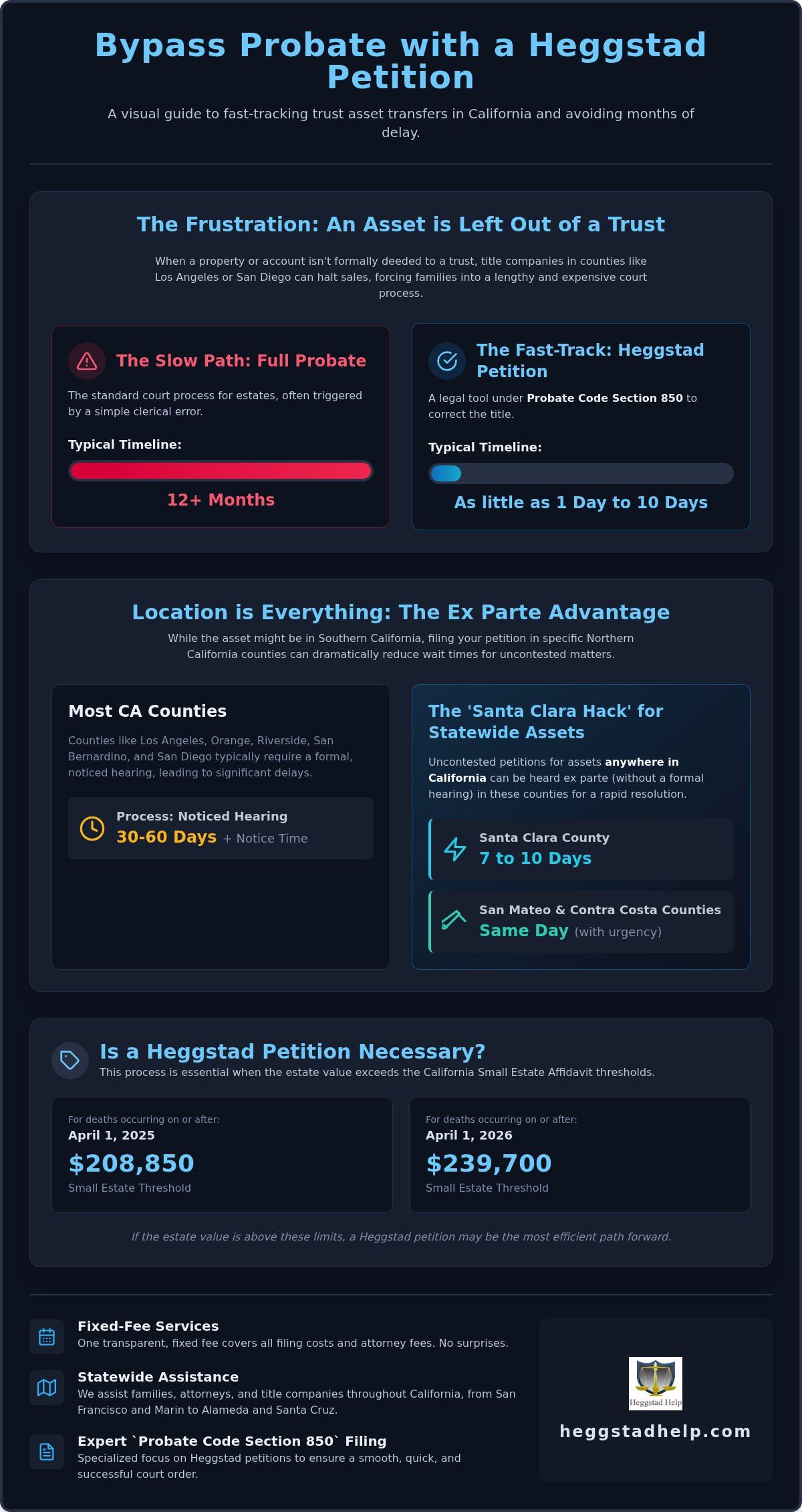
In Santa Clara County, uncontested Heggstad petitions are regularly filed ex parte and are typically granted within 7 to 10 days. San Mateo and Contra Costa Counties offer even faster turnarounds, often granting orders the same day if you can demonstrate "urgency," such as a pending home sale that’s about to fall through. Compare this to a noticed hearing in San Diego or Orange County, where you might wait 60 days just for a court date, followed by additional time for notice requirements.

The ‘Santa Clara Hack’ for Statewide Assets

You don’t have to live in Northern California to benefit from these faster timelines. Uncontested petitions for property located anywhere in the state, from Sacramento to San Bernardino, can be heard ex parte in Santa Clara County. This strategy is a game changer for families who need to resolve title issues quickly to satisfy a title company. Our office assists attorneys, title companies, and clients throughout the entire state via Heggstad Help, utilizing fixed fees that cover both filing and attorney fees.

Timelines: Ex Parte vs. Noticed Hearings

The difference in speed is stark. Under California Probate Code 850, the standard noticed hearing process in most counties takes 30 to 60 days plus notice time, often totaling four to five months. If you’re dealing with an estate that exceeds the Small Estate Affidavit threshold of $208,850 for deaths on or after April 1, 2025, you can’t afford to wait. An ex parte filing in Santa Clara provides a resolution in about a week. It’s important to remember that contested petitions, where a beneficiary objects, aren’t eligible for this fast track and will always take longer.

California Ex Parte Court Order: Fast-Track Heggstad Petitions in 2026

Securing Your Order with Expert Heggstad Petition Filing

Navigating the complex nuances of the Probate Code requires a specialist who understands the specific local rules of both Northern and Southern California courts. Robert P. Bergman, a Board-Certified Specialist in Estate Planning, Trust and Probate Law, provides a streamlined process aimed at reducing the stress often felt by successor trustees. Whether the property you’re managing is located in San Francisco, Marin, or Santa Cruz, our primary goal is to secure a clean title and facilitate a quick distribution to beneficiaries. We handle the entire California ex parte court order process with a sense of calm competence, ensuring that procedural hurdles don’t stand in the way of your family’s inheritance.

One of the most significant advantages of working with our office is our transparent pricing. Heggstad Help operates on a fixed-fee basis, which includes both the court filing fees and all attorney fees. This approach ensures you won’t face surprise costs or hidden expenses as we move through the legal system. We believe in providing a steady, knowledgeable hand to guide you through these specialized requirements, treating your case with the individual attention it deserves.

How Heggstad Help Simplifies the Process

We manage every aspect of the Heggstad petition filing in California, from the initial drafting of documents to the final court order. Our team frequently coordinates with title companies to ensure the court order is formatted correctly for immediate recording. This level of detail is crucial for resolving title issues without the need for a full probate. We provide dedicated support for families and attorneys in Alameda, Riverside, and throughout the Central Valley, ensuring that every petition meets the strict standards of the Probate Code Section governing these transfers.

Next Steps for Successor Trustees

If you’ve discovered that an asset was left out of a trust, your first step is to gather the existing trust document and the deed to the unrecorded property. You’ll also want to verify if the estate value falls below the Small Estate Affidavit threshold. This limit is $208,850 for deaths occurring on or after April 1, 2025. If the asset value exceeds this limit, a Heggstad petition is usually your best option. You can consult with a specialist to determine if an ex parte filing in Santa Clara is the right move for your specific case. Contact Robert P. Bergman at the Law Offices of Robert P. Bergman for a fixed-fee quote and a clear path toward resolution.

Take Control of Your Trust Distribution Today

Securing a California ex parte court order trust doesn’t have to be a stressful or drawn-out experience. By leveraging the strategic procedural advantages in Santa Clara County, you can resolve title errors in as little as 7 to 10 days rather than waiting many months in other jurisdictions. This fast-track approach is particularly vital if your estate exceeds the Small Estate Affidavit threshold of $208,850 for deaths on or after April 1, 2025. Whether you’re managing property in San Diego, San Francisco, or Alameda, our statewide fixed-fee service ensures you have total cost certainty from start to finish.

Robert P. Bergman, a Board-Certified Specialist in Estate Planning, Trust and Probate Law, is ready to help you navigate the complexities of the Probate Code with confidence. We provide a steady hand to ensure your trust assets are correctly titled and ready for immediate distribution or sale. Don’t let a missing deed stall your progress for another year. Reach out to our team to Get a Fixed-Fee Quote for Your Heggstad Petition and move forward with the peace of mind you deserve. You’re just a few weeks away from a resolution that protects your family’s legacy.

Frequently Asked Questions

What is an ex parte court order in a California trust case?

An ex parte court order is an expedited legal directive issued by a judge with shortened notice to other parties, or sometimes without any formal hearing at all. In the context of a California ex parte court order, it serves as a fast-track mechanism to confirm that an asset belongs in a trust despite a title error. This process allows a successor trustee to bypass the standard, months-long probate queue and receive a signed order in a matter of days.

Can I file a Heggstad petition ex parte if the property is in Los Angeles?

Yes, you can strategically file your petition in Santa Clara County to secure a faster result, even if the real property is located in Los Angeles, Orange, or San Diego. While Southern California courts often require noticed hearings that take many months, we utilize the streamlined procedures in Santa Clara to obtain orders in 7 to 10 days. This "Santa Clara strategy" is available for uncontested petitions involving assets located anywhere in the state.

How much does a Heggstad petition cost in California in 2026?

Our office handles Heggstad petitions on a fixed-fee basis, which provides total cost certainty by covering both the court filing fees and all attorney fees. While the statewide initial filing fee for probate matters is set by the state (currently $435 under the Government Code), our fixed-fee model ensures you don’t face unpredictable hourly billing. This approach is designed to reduce the financial stress for families in San Bernardino, Riverside, and Sacramento who are already managing complex estate affairs.

What happens if a Heggstad petition is contested?

If a beneficiary or interested party objects to the petition, the matter can no longer be handled through the expedited ex parte process. Contested petitions are moved to a standard litigation calendar, which typically takes 30 to 60 days for an initial hearing plus additional time for notice and discovery. It’s important to note that the 7-day fast track in Santa Clara or the same-day service in San Mateo only applies to uncontested matters where everyone is in agreement.

Do I need to go to court for an ex parte trust hearing?

In many instances, you won’t need to step foot in a courtroom for an uncontested petition. In Santa Clara, San Mateo, and Contra Costa Counties, these matters are frequently handled "in chambers" (meaning the judge reviews the paperwork and signs the order without a public hearing). This is particularly helpful for clients in Marin, Santa Cruz, or Alameda who want to resolve title issues efficiently without the time and expense of a formal court appearance.

Is there a deadline to file an ex parte petition after someone dies?

There is no specific statutory deadline to file, but delaying the process can lead to complications with title companies or pending property sales. If the estate value is below the Small Estate Affidavit threshold of $208,850 for deaths on or after April 1, 2025, you might have other options. However, for real property or larger accounts, filing as soon as possible ensures the successor trustee has the legal authority to manage the assets without a 12-month probate delay.

Robert P. Bergman, Attorney at Law

Article by

Robert P. Bergman, Attorney at Law

Attorney Robert P. Bergman ("Bob Bergman") has been a Board-Certified Specialist in Estate Planning, Trust and Probate Law since 2011, as certified by the California State Bar Board of Legal Specialization. For several years, Bob has assisted families and the clients of other attorneys with obtaining court orders through Heggstad petitions to avoid the time and expense of Probate administration. Bob is friendly, very approachable, and believes in explaining complex legal topics in clear ordinary language so that his clients understand exactly what they're doing and why they're doing it.
Bob is often able to assist clients who are in other counties than his home county of Santa Clara through his approach to Heggstad petitions.

Disclaimer

This article is for informational purposes only. Nothing in this article is intended to replace legal advice from a competent attorney or be considered legal guidance for anybody's specific legal situation. Nobody should rely on information in this article in making legal decisions without such consultation.
