
Imagine discovering that your late parent’s home was never formally transferred into their trust, potentially triggering a probate process that lasts over a year. It’s a stressful realization for many families in Los Angeles County and Orange County facing title errors. You’re likely asking, what is a petition to confirm trust property, and can it save you from a full probate? Most assume an omitted asset makes probate mandatory, but there’s a more efficient path forward.
This guide explains how a Heggstad (a court order confirming trust ownership) petition under Probate Code Section 850 can bypass probate for assets accidentally left out of a trust. We’ll cover how petitions in Santa Clara County can be granted in 7 to 10 days, and how we assist attorneys and families with fixed-fee, uncontested petitions throughout California. We also clarify the small estate thresholds of $208,850 for deaths on or after April 1, 2025, and $239,700 for those on or after April 1, 2026.
Key Takeaways
- Learn what is a petition to confirm trust property (a judicial request to declare an asset as part of a trust) and how this procedural shortcut honors the decedent’s intent without the burden of a full probate.
- Discover how uncontested Heggstad petitions from Los Angeles County, Orange County, or San Diego County can be heard in Santa Clara County and granted in as little as 7 to 10 days.
- Identify the critical evidence needed for a filing under Probate Code Section 850, such as the trust instrument and the Schedule of Assets, to fix title errors on real property.
- Understand the efficiency of fixed-fee services that assist attorneys, title companies, and families in California, providing a predictable path toward asset resolution for uncontested matters.
Understanding the Petition to Confirm Trust Property in California
When you discover that a loved one didn’t finish transferring their home or bank account into their living trust, you might worry that a long, expensive court process is inevitable. To answer what is a petition to confirm trust property, it’s helpful to view it as a legal rescue mechanism. Commonly known as a Heggstad petition, this is a formal request to the court to declare that an asset belongs to a trust despite a technical title error. This procedure bypasses the standard, 12-month full probate administration in California. It’s essential when assets exceed the small estate limit of $208,850 for those dying on or after April 1, 2025, or $239,700 for those dying on or after April 1, 2026.
Successor trustees use this tool when a decedent intended for a property to be in their trust but forgot to record the final deed. Whether you’re in Los Angeles County, Orange County, or San Diego County, our office assists families and attorneys with these filings throughout California. We provide fixed fees that cover both filing and attorney fees for uncontested matters. While we don’t handle contested petitions, we help families and title companies correct title issues quickly. Understanding the Petition to Confirm Trust Property starts with recognizing that a simple oversight shouldn’t lead to years of probate.
The Legal Basis: California Probate Code Section 850
The authority for this process is found in Probate Code Section 850(a)(3). This Probate Code Section allows the court to confirm ownership when a decedent (the person who passed away) clearly intended to transfer property but didn’t finish the paperwork. The 1993 Estate of Heggstad case established the precedent for these petitions, proving that a trust’s schedule of assets is often enough evidence of intent. For families in Sacramento County or Marin County, this tool honors a loved one’s wishes without the high costs of probate.
Filing Requirements and Timelines in California Counties
To successfully file, you must provide clear evidence of the decedent’s intent to include the asset in their estate plan. This documentation typically includes:
- The original trust instrument
- The Schedule of Assets (often referred to as Schedule A)
- The unrecorded deed or account statement in question
- Other documents that show written evidence of intent
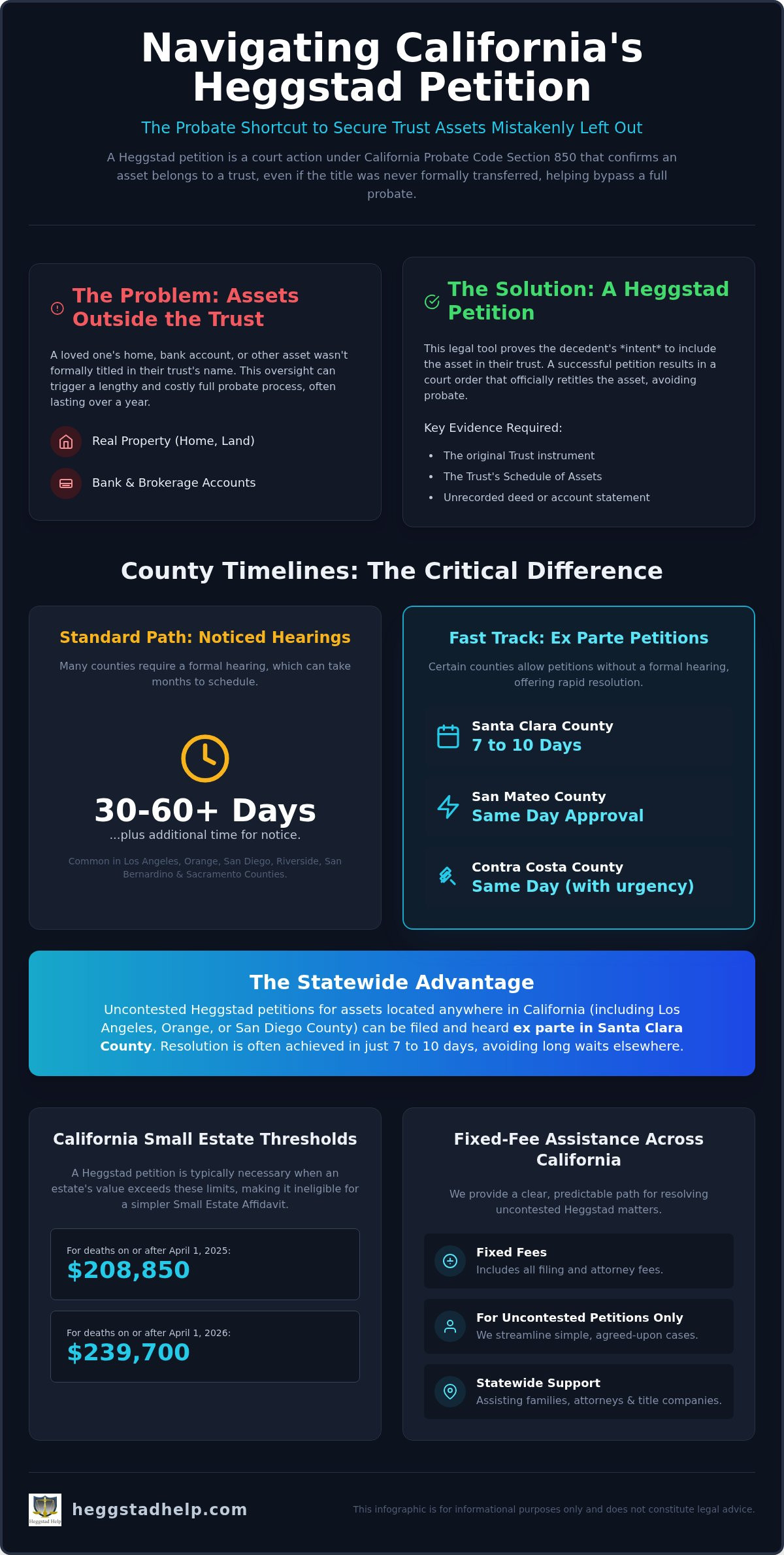
While we assist families, attorneys, and title companies in Los Angeles County, Orange County, and San Diego County, the local Filing Requirements and Timelines in California Counties vary significantly. Most counties require a noticed hearing set 30 to 60 days after filing. However, if you’re wondering what is a petition to confirm trust property in terms of speed, an ex parte (without a formal hearing) order is the gold standard. This is vital when assets exceed $208,850 for those dying on or after April 1, 2025, and $239,700 for those dying on or after April 1, 2026.
Petitions in Southern California often take many months to be heard. Crucially, uncontested Heggstad petitions from those counties can be heard ex parte in Santa Clara County and are often decided within 7 to 10 days of filing. This allows families in Riverside County or San Bernardino County to fix title errors quickly. If you need help, our fixed-fee Heggstad services cover both filing and attorney fees, providing a predictable path for attorneys and clients alike.
County-Specific Procedural Advantages for Heggstad Petitions
Specific Northern California courts offer unique efficiencies for determining what is a petition to confirm trust property. Santa Clara County petitions are typically granted in 7 to 10 days. San Mateo County can grant them the same day they are filed. Contra Costa County also offers same-day grants if urgency is demonstrated to the court’s satisfaction. These timelines are much faster than wait times in Alameda, Sacramento, San Francisco, Marin, or Santa Cruz Counties. Please note that our office does not handle contested petitions.
Securing a Court Order to Confirm Trust Assets in California
Once the judge reviews your evidence and grants the request, the court issues a formal order. This document serves as the official declaration that the asset is, in fact, trust property. For real property, this order must be recorded with the County Recorder in the specific county where the land is located, such as Sacramento County or Santa Cruz County. This recording corrects the chain of title, allowing the successor trustee to sell or distribute the home without a full probate. When people ask what is a petition to confirm trust property, they’re often looking for this specific resolution: a clear, marketable title.
Working with a Board Certified Specialist in Estate Planning, Trust and Probate Law ensures that your petition meets every requirement of Probate Code Section 850. At Heggstad Help, we offer fixed fees that cover both the court filing fees and all attorney fees for uncontested matters. We regularly assist families, title companies, and other attorneys in San Bernardino County, Alameda County, and Riverside County. By providing a predictable cost structure, we help reduce the financial anxiety often associated with legal proceedings throughout California.
Next Steps for Successor Trustees and Title Correction
After the order is recorded, you can proceed with trust administration just as if the asset had been properly titled from the start. You’ll use a certified copy of the order to transfer brokerage accounts or update real estate deeds. To prevent future complications, it’s vital to ensure all other assets are funded (formally transferred) into the trust immediately. This proactive step avoids the need for another Heggstad petition filing in the future. For a deeper look at this process, see our Heggstad Petition Filing: The California Guide to Recovering Missing Trust Assets in 2026. Remember, while we don’t handle contested cases, we provide a streamlined path for estates exceeding $208,850 (deaths on or after April 1, 2025) or $239,700 (deaths on or after April 1, 2026).
Resolve Your Trust Funding Issues Quickly
Understanding what is a petition to confirm trust property helps you rescue assets from a lengthy probate. By utilizing Probate Code Section 850, families in Los Angeles County and Orange County can bypass probate and correct title errors. This is vital for estates exceeding the small estate limits of $208,850 for deaths on or after April 1, 2025, and $239,700 for those on or after April 1, 2026. Robert P. Bergman, a Board Certified Specialist in Estate Planning, Trust and Probate Law, provides fixed-fee assistance for uncontested matters throughout California. These fees cover both filing and attorney costs. We leverage the 7 to 10 day turnaround in Santa Clara County to help clients in San Diego County resolve cases quickly. If you’re ready to secure your family’s future, Get Expert Help with Your Heggstad Petition in California. You’ve worked hard for your legacy; let’s keep it in the trust.
Frequently Asked Questions
What is the small estate threshold for a Small Estate Affidavit in California?
The threshold for a Small Estate Affidavit in California depends on the date of death. For those dying on or after April 1, 2025, the figure is $208,850. For individuals dying on or after April 1, 2026, the threshold increases to $239,700. If the estate value exceeds these amounts, a Heggstad petition or full probate is typically required to transfer assets.
Can I file a Heggstad petition if the decedent didn’t leave a written list of assets?
Filing a Heggstad petition generally requires written evidence of the decedent’s intent to include the asset in their trust. This usually takes the form of a Schedule of Assets, specific language within the trust document, or a signed but unrecorded deed. Without some form of written intent, it’s difficult to answer what is a petition to confirm trust property with a successful court order.
How long does a Heggstad petition take in Los Angeles County versus Santa Clara County?
Timelines vary by county. In Los Angeles County, petitions often require noticed hearings and can take many months to be heard. Conversely, petitions in Santa Clara County are regularly filed ex parte and typically granted in 7 to 10 days. Uncontested petitions from Los Angeles can often be heard ex parte in Santa Clara County for faster results, which is a service we provide throughout California.
What happens if a Heggstad petition is contested by a beneficiary?
If a beneficiary or third party contests the petition, the case becomes a litigated matter. While a standard noticed hearing is set 30 to 60 days after filing, contested petitions take much longer to resolve. It’s important to note that Heggstad Help only handles uncontested petitions. We assist families and attorneys with fixed-fee filings to ensure a clear, efficient path for non-disputed trust assets.

Article by
Robert P. Bergman, Attorney at Law
Attorney Robert P. Bergman ("Bob Bergman") has been a Board-Certified Specialist in Estate Planning, Trust and Probate Law since 2011, as certified by the California State Bar Board of Legal Specialization. For several years, Bob has assisted families and the clients of other attorneys with obtaining court orders through Heggstad petitions to avoid the time and expense of Probate administration. Bob is friendly, very approachable, and believes in explaining complex legal topics in clear ordinary language so that his clients understand exactly what they're doing and why they're doing it.
Bob is often able to assist clients who are in other counties than his home county of Santa Clara through his approach to Heggstad petitions.
Disclaimer
This article is for informational purposes only. Nothing in this article is intended to replace legal advice from a competent attorney or be considered legal guidance for anybody's specific legal situation. Nobody should rely on information in this article in making legal decisions without such consultation.


