Why a Bank Account Not in Trust in California Triggers Probate
When a person in the State of California creates a living trust, their goal is to transfer ownership of their assets—like bank accounts, real estate, and investments—from their individual name into the name of the trust. This process is called “funding” the trust. However, it is a common and stressful discovery for a successor trustee to find a bank account that was never properly titled in the trust’s name. This creates what is known as an “unfunded trust” problem.
If a bank account is held solely in the decedent’s name without a designated Payable-on-Death (POD) beneficiary, the bank is legally prohibited from releasing the funds to the successor trustee. The trustee’s authority extends only to assets held by the trust, and from the bank’s perspective, this account is not one of them. This titling error forces the asset into the jurisdiction of the California Probate Court, leading to several significant consequences:
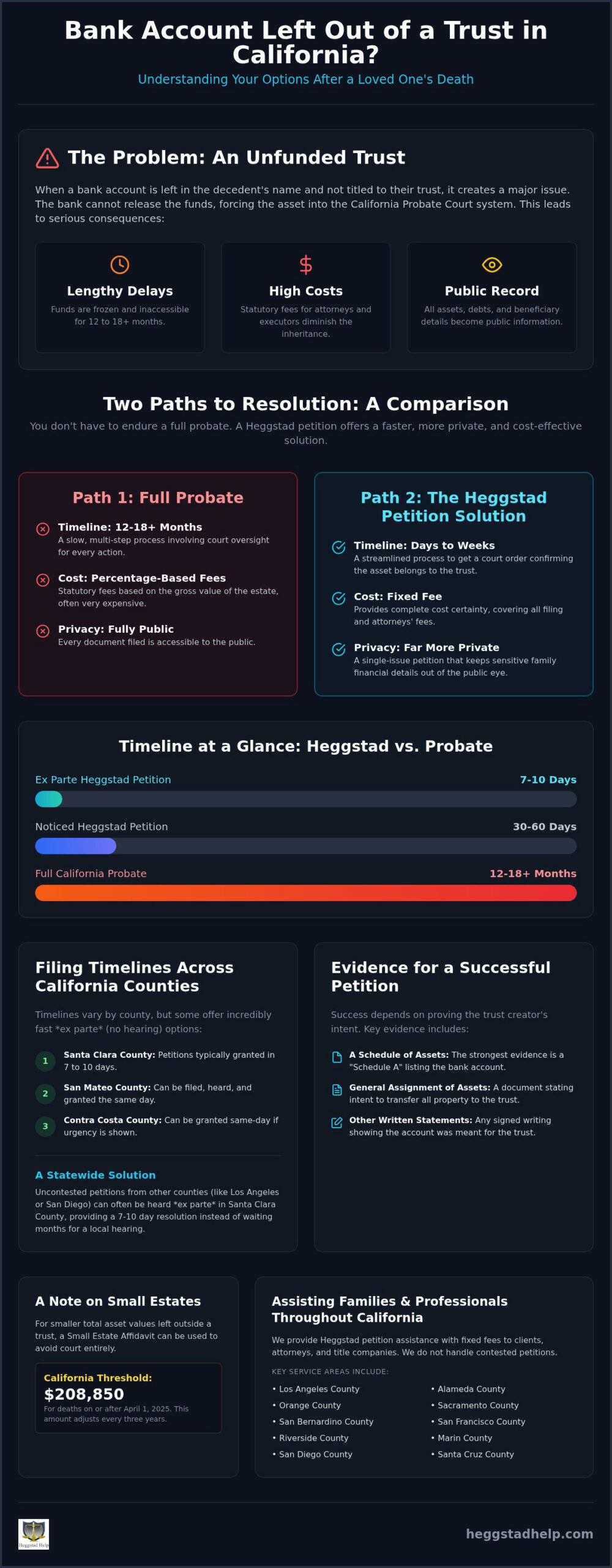
- Lengthy Delays: A full probate administration in California can take 12 to 18 months, or even longer, to complete. During this time, the funds are frozen and inaccessible to the beneficiaries.
- High Costs: Probate involves statutory fees for both the attorney and the executor, which are calculated as a percentage of the estate’s gross value. These fees can quickly diminish the inheritance.
- Public Record: All probate filings are public, meaning the decedent’s assets, debts, and beneficiary distributions become publicly accessible information.
For accounts with a lower value, the first line of defense is often a Small Estate Affidavit, which allows for the collection of assets without formal court administration.
The Small Estate Threshold in California
In the State of California, a simplified procedure called a Small Estate Affidavit can be used to collect assets outside of a trust if their total value does not exceed a specific limit. For individuals who passed away on or after April 1, 2025, this threshold is $208,850. It is important to note that this figure is subject to adjustment for inflation every three years.
If the total value of all assets left outside the trust (including the bank account) is over this limit, the Small Estate Affidavit cannot be used. At that point, a formal court petition becomes mandatory to transfer the account and avoid the lengthy process of full probate.
The Role of the Pour-Over Will
Many estate plans include a “pour-over will,” a document designed as a safety net to catch any assets that were mistakenly left out of the trust. While helpful, it is crucial to understand that a pour-over will does not avoid probate. Instead, it directs the probate court to transfer (or “pour over”) the omitted asset into the trust after the probate process is complete.
Therefore, while the will ensures the bank account eventually ends up in the trust as intended, it still requires navigating the probate system. Fortunately, a far more efficient legal tool, the Heggstad petition, works with the trust’s language to fix the funding gap and bypass probate entirely.
The Heggstad Petition in California: A Legal Shortcut
A Heggstad petition is a legal remedy based on California Probate Code Section 850. It allows a successor trustee to ask the court for an order confirming that an asset, like a bank account not in trust after death in California, was intended to be part of the trust and should be legally treated as such. It is a powerful tool for correcting simple funding errors without the time and expense of a full probate.
The success of a Heggstad petition hinges on demonstrating the trust creator’s (the “Settlor’s”) intent. You must provide clear evidence that the Settlor meant for the bank account to be included in their trust. This petition transforms a potential 18-month probate ordeal into a streamlined administrative fix.
The primary benefits of using a Heggstad petition for an omitted bank account include:
- Speed: As discussed below, these petitions can be resolved in a matter of days or weeks, not years.
- Cost-Effectiveness: It avoids the high, percentage-based statutory fees of probate. At HEGGSTAD HELP, we handle all uncontested Heggstad petitions on a fixed-fee basis, providing complete cost certainty from the start.
- Privacy: The process is far more private than a full probate proceeding.
This process is formally known as a “Petition to Confirm Trust Ownership” and is the preferred remedy for successor trustees facing this common but frustrating issue. For a detailed comparison, see our guide on the Heggstad Petition vs. Probate in California.
Evidence Needed for Bank Account Petitions
To prove the Settlor’s intent to the court, you will need to gather specific documents. The stronger the evidence, the more likely the court is to grant the petition quickly. Key pieces of evidence include:
- A Schedule of Assets: Many trusts include a “Schedule A” or a similar list that identifies the assets intended to be held by the trust. If the bank account is listed here, it is the strongest form of evidence.
- A General Assignment of Assets: This is a separate document, often signed with the trust, where the Settlor states their intent to transfer all their property (or specific categories of property) to the trust.
- Other Written Statements: Any other signed writing from the Settlor that mentions the account in the context of the trust can be used as supporting evidence.
A lawyer experienced in fixing trust funding errors can help you identify and present the necessary evidence effectively.
Probate Code Section 850 vs. Full Probate
A petition under Probate Code Section 850 is a focused, single-issue proceeding. Its only goal is to get a court order changing the title of the omitted bank account. In contrast, full probate is a comprehensive, multi-step process that includes formally notifying all creditors, preparing detailed asset inventories, and obtaining court approval for nearly every action.
For a successor trustee, the choice is clear. The Heggstad petition offers a direct, efficient, and cost-effective path to fulfilling the Settlor’s wishes and completing the trust administration without unnecessary delay.
Filing Timelines Across California Counties
A critical factor that many families and even some attorneys overlook is that the timeline for getting a Heggstad petition approved varies dramatically from one county to another in the State of California. The local court’s procedures and backlog determine whether you face a delay of many months or get a resolution in just a few days.
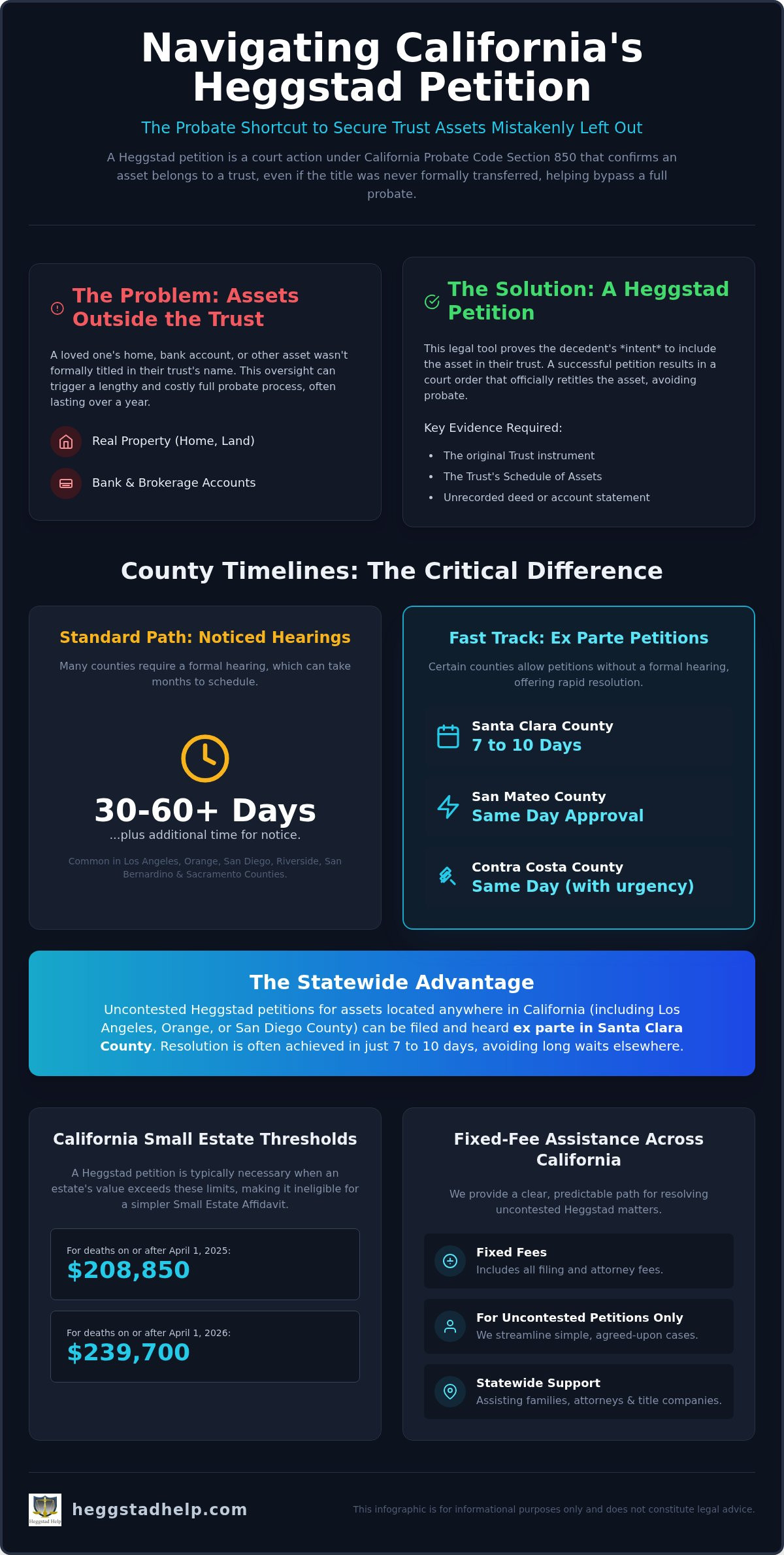
- The ‘Slow Track’ Counties: In many major metropolitan areas, including Los Angeles County, Orange County, San Diego County, and Riverside County, filing a Heggstad petition typically requires a formally noticed hearing. Due to court congestion, it can take many months to get a hearing date, delaying the transfer of the bank account.
- The ‘Fast Track’ Counties: A few counties in Northern California, most notably Santa Clara County, San Mateo County, and Contra Costa County, allow uncontested Heggstad petitions to be heard “ex parte.” This means a petition can be reviewed and approved by a judge without a formal, scheduled hearing, dramatically accelerating the process.
At HEGGSTAD HELP, we regularly assist families, attorneys, and title companies with these petitions in counties across the state, including San Bernardino County, Alameda County, Sacramento County, and San Francisco County, by leveraging the efficiency of these fast-track courts.
The Santa Clara County Advantage
The most significant strategic advantage for resolving an unfunded trust lies in Santa Clara County. Uncontested petitions filed ex parte in Santa Clara are routinely reviewed and granted by the court in just 7 to 10 days.
Crucially, you do not have to live in Santa Clara County to benefit from this speed. Our office can file uncontested Heggstad petitions from any California county—including Los Angeles or Orange County—in Santa Clara for an ex parte review. This jurisdictional strategy allows our clients in Southern California and the Central Valley to bypass their local court’s backlog of many months and secure a court order in a little over a week. For more information, read our guide on the Heggstad Petition in Los Angeles.
Same-Day Results in San Mateo and Contra Costa
Other Bay Area counties also offer remarkable efficiency. In San Mateo County, it is often possible for an attorney to file a Heggstad petition and have it granted by a judge on the very same day. Similarly, Contra Costa County’s court may grant a same-day order if a compelling reason for “urgency” can be demonstrated.
This stands in stark contrast to the standard procedure in counties like Marin County or Santa Cruz County, where even a simple, uncontested petition may be set for a hearing months in the future. The ability to choose the correct venue is key to a fast resolution.
How Heggstad Help Corrects Trust Asset Titles
At HEGGSTAD HELP, our practice is dedicated exclusively to one thing: fixing trust funding errors with Heggstad petitions. Our founder, Robert P. Bergman, is a Board-Certified Specialist in Estate Planning, Trust and Probate Law, practicing since 1980. This deep specialization allows us to navigate the court system with maximum efficiency to achieve Trust Asset Title Correction for our clients.
We provide expert assistance to successor trustees, families, title companies, and other attorneys throughout the State of California who need a court order to confirm trust property. By focusing solely on uncontested petitions, we ensure a streamlined and predictable process for every client. We do not handle contested trust litigation, allowing us to maintain our focus on fast, cooperative resolutions.
The Fixed-Fee Guarantee for Heggstad Petitions
Fear of unpredictable legal bills should not stand in the way of settling a loved one’s affairs. That is why we handle every uncontested Heggstad petition for a fixed fee. This fee, quoted to you upfront after a review of your documents, covers all court filing fees and attorney fees required to secure the court order.
This model provides peace of mind and is vastly superior to the statutory percentage fees charged in a full probate, which can consume a significant portion of the bank account’s value. You can learn more about our transparent pricing in our guide to Heggstad Petition Fees and Expenses.
Starting the Title Recovery Process
Getting started is straightforward. To quickly assess your case and provide a fixed-fee quote, we typically only need three documents:
- The signed Trust Agreement.
- A recent bank statement for the account in question.
- Any schedules or lists of assets attached to the trust.
Whether you are in Sacramento, Santa Cruz, or Alameda County, our team is ready to help you correct the title on an omitted bank account and finalize the trust administration. Contact us today to get the process started.
Secure Your Fixed-Fee Heggstad Petition Quote Today

Article by
Robert P. Bergman, Attorney at Law
Attorney Robert P. Bergman ("Bob Bergman") has been a Board-Certified Specialist in Estate Planning, Trust and Probate Law since 2011, as certified by the California State Bar Board of Legal Specialization. For several years, Bob has assisted families and the clients of other attorneys with obtaining court orders through Heggstad petitions to avoid the time and expense of Probate administration. Bob is friendly, very approachable, and believes in explaining complex legal topics in clear ordinary language so that his clients understand exactly what they're doing and why they're doing it.
Bob is often able to assist clients who are in other counties than his home county of Santa Clara through his approach to Heggstad petitions.
Disclaimer
This article is for informational purposes only. Nothing in this article is intended to replace legal advice from a competent attorney or be considered legal guidance for anybody's specific legal situation. Nobody should rely on information in this article in making legal decisions without such consultation.