
Imagine the sinking feeling of realizing your parents spent years maintaining a living trust, only to discover they forgot to put house in trust California after they passed away. You likely feel a mix of confusion and anxiety, wondering if this single clerical oversight will force the entire estate into a grueling 12 to 18 month probate process. It’s a common frustration for many families who find that while the intent was clear, the final deed was never recorded. You’re right to be concerned about the high statutory fees, which can cost tens of thousands of dollars for a typical California home.
The good news is that a forgotten deed doesn’t have to mean a full probate administration. You can often resolve this using a Heggstad Petition (a legal request under Probate Code Section 850) that corrects title issues by proving the decedent’s original intent. This article explains how you can legally transfer the house into the trust in just a few weeks, rather than years. We’ll explore how to bypass the standard probate timeline, avoid excessive court costs, and ensure your loved one’s final wishes are honored through an efficient title correction.
Key Takeaways
- Learn how a Heggstad Petition serves as a legal title correction to move property into a trust without the 12 to 18 month delay of a full probate administration.
- If you forgot to put house in trust California, you can fulfill the decedent’s wishes by presenting evidence of intent, such as a Schedule A, under Probate Code Section 850.
- Discover how strategic filing in fast-track courts, such as those in Santa Clara County, can resolve title issues in as little as 7 to 10 days.
- Understand the advantages of a fixed-fee service for Heggstad Petitions that offers cost certainty for families and successor trustees across the State of California.
Forgot to Put House in California Trust? What Happens
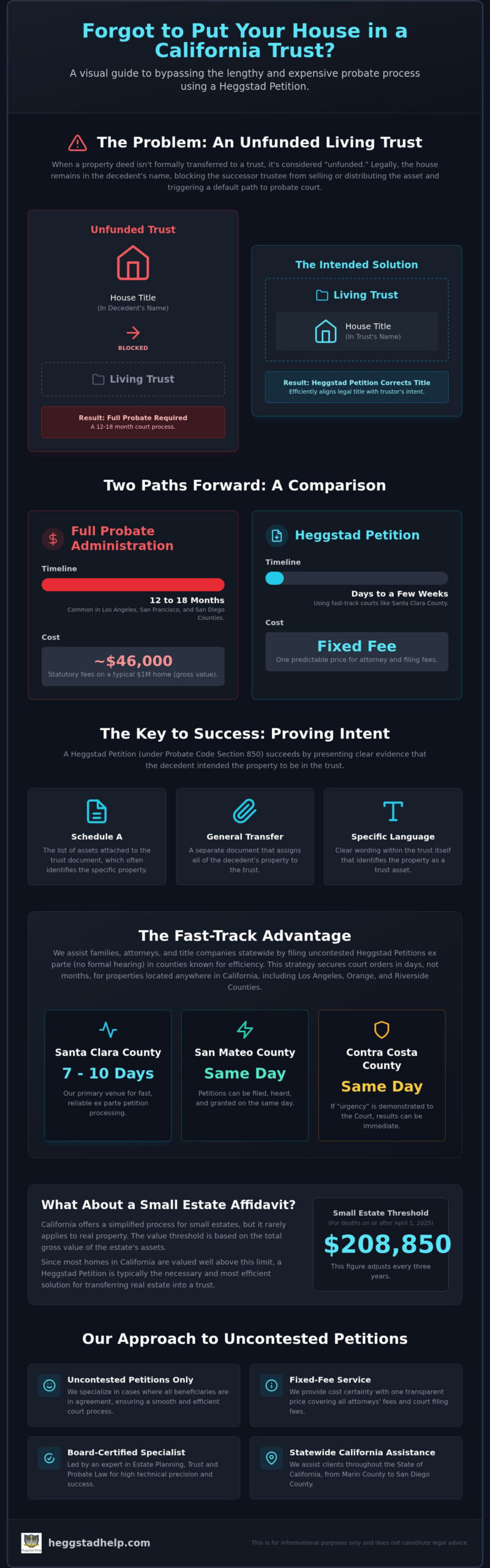
A living trust operates much like an empty bucket; it only protects the assets you actually place inside it. If you forgot to put house in trust California, that "bucket" remains empty regarding your most valuable asset. Legally, this creates an unfunded trust. Because the deed was never updated to reflect the trust as the owner, the property remains in the decedent’s individual name. This technicality usually prevents the successor trustee from selling or distributing the home, as title companies require a clear chain of ownership.
Without a deed, the default legal path is a full probate administration. However, the legal precedent established in the Estate of Heggstad provides a vital alternative. A Heggstad Petition is a judicial declaration that honors the decedent’s intent to fund the trust by confirming the asset belongs to the trust despite the missing deed.
The Risk of a 12-Month Probate in California
In counties like Los Angeles County or San Francisco County, the probate backlog is significant. You can expect a timeline of 12 to 18 months before the estate is settled. During this period, the family must pay high statutory fees calculated on the gross value of the house, not just the equity. For a $1 million home, combined statutory fees for the attorney and executor total approximately $46,000. Understanding successor trustee unfunded trust assets California is critical to avoiding these costly delays.
When the Small Estate Affidavit Does Not Apply
California offers simplified procedures for smaller estates, but these rarely cover real estate. For deaths occurring on or after April 1, 2025, the Small Estate threshold is exactly $208,850. Since most California homes are valued well above this limit, a Small Estate Affidavit cannot transfer the property. If you forgot to put house in trust California, this threshold usually forces you into more formal court proceedings. This makes a Heggstad Petition the most efficient way to correct the title without a full court-supervised probate.
Solving the Problem with a Heggstad Petition and Probate Code Section 850
When a family realized they forgot to put house in trust California, the legal remedy lies in California Probate Code Section 850. This statute empowers the court to declare that a property belongs to a trust if the petitioner can prove the decedent intended for it to be there. This process is specifically designed for uncontested situations where all beneficiaries agree on the trust’s ownership of the asset. It acts as a bridge between the decedent’s clear wishes and the technical requirements of the county recorder’s office.
Proving this intent requires specific documentation. The most common evidence is "Schedule A," which is the list of assets typically attached to the back of a trust document. Other evidence includes a "General Transfer" document or specific language within the trust instrument itself that references the property. You can learn more about filing an 850 petition California real property to see which documents apply to your specific situation.
Correcting Trust Asset Titles Without Full Probate
A successful Heggstad Petition results in a court order that functions as a title correction. Title companies in the State of California generally refuse to recognize trust ownership without a recorded deed or a formal court order. If you forgot to put house in trust California, this streamlined approach targets the specific title error without the need for a years-long probate. It provides the legal authority needed to move forward with trust administration quickly.
The Role of a Board-Certified Specialist
Navigating these requirements involves high technical precision. Robert P. Bergman is a Board-Certified Specialist in Estate Planning, Trust and Probate Law, a distinction held by few practitioners in the state. This specialized knowledge is vital because court clerks often reject petitions for minor procedural errors or insufficient evidence of intent. Working with an expert ensures the petition is structured correctly from the start. If you need assistance, we offer fixed-fee Heggstad Petition services to provide clarity and resolution.
Fast-Track Timelines: Santa Clara, San Mateo, and Contra Costa Counties
While many legal practitioners assume that all court proceedings require months of waiting, our office utilizes specific procedural shortcuts to resolve title issues quickly. If you forgot to put house in trust California, the traditional route involves a noticed hearing (a formal court date set weeks or months in advance). However, we strategically use ex parte filing strategies (requests made to the court for immediate action without a formal hearing) in specific jurisdictions to bypass these delays.
In Santa Clara County, our petitions are typically granted in just 7 to 10 days. San Mateo County offers even faster results, where petitions are filed, heard, and granted on the same day. Similarly, in Contra Costa County, the court may grant a petition the same day if we can demonstrate "urgency" to the judge. These timelines provide a stark contrast to the 12 to 18 months required for a standard probate.
Assisting Clients in Southern California and the Central Valley
Families in Southern California, including Los Angeles County, Orange County, Ventura County. San Diego County, San Bernardino County, and Riverside County, often face significant backlogs in their local courts. To assist them, we frequently utilize the fast-track venues in Northern California. When a family forgot to put house in trust California, the location of the house doesn’t always dictate where the petition must be heard. By filing uncontested petitions in Santa Clara County, we save clients months of waiting that would otherwise be required in their home counties.
Ex Parte vs. Noticed Hearings
The primary difference in speed comes down to the type of hearing requested. An ex parte application is a streamlined request for a court order, which results in rapid resolution. In contrast, a noticed hearing typically takes 30 to 60 days, or even longer depending on the specific county’s calendar. If you need to resolve a deed issue quickly, contact us to see if an ex parte filing is right for your case.
Taking Action: Fixed-Fee Heggstad Petition Services in California
Many successor trustees and families worry about the unpredictable costs of legal proceedings, especially when facing hourly billing. Our approach eliminates this anxiety by utilizing a fixed-fee model for every Heggstad Petition we file. This single, transparent price includes both the mandatory court filing fees and all professional attorney fees. If you forgot to put house in trust California, this structure provides the financial certainty you need while navigating the complexities of estate administration. We frequently assist families, title companies, and other attorneys throughout the State of California who need to correct funding errors quickly.
We focus exclusively on efficient, uncontested title recovery to ensure the fastest possible resolution for our clients. If the heirs and beneficiaries agree on the decedent’s intent, Heggstad petition filing is the most effective way to secure a court order. Because we don’t handle contested litigation, we can dedicate our full expertise to the specialized procedural requirements of Probate Code Section 850. This specialization allows us to navigate the court system with a level of precision that general practitioners may lack.
Serving Families from Sacramento to San Diego
Our services reach every corner of the state, from the suburbs of Sacramento to the coastal communities of San Diego. We regularly assist clients in Marin County, Santa Cruz County, Alameda County, and San Bernardino County. In each case, we act as a steady, knowledgeable hand, reducing the stress caused by procedural hurdles. Our goal is to provide a sense of calm competence while resolving the technical errors that stand between you and a completed trust administration.
Next Steps for Successor Trustees
If you forgot to put house in trust California, it’s not too late to honor the decedent’s wishes. Taking the right steps now can save months of delay later. Use this checklist to organize your next moves:
- Locate the original trust instrument and any attached Schedule A or asset lists.
- Find the most recent deed recorded in the decedent’s individual name.
- Contact Heggstad Help for a consultation to evaluate your evidence of intent.
By gathering these documents early, you’ll be prepared to move forward with a title correction that avoids the full probate process entirely. We are here to ensure the transition is handled with the professional precision your family deserves.
Securing Your Family’s Legacy Without Probate Delay
Discovering you forgot to put house in trust California shouldn’t lead to a year of legal frustration or high statutory fees. By utilizing a Heggstad Petition, you can correct the title and honor the decedent’s true intentions in a fraction of the time required for a full probate. This judicial declaration serves as the vital link between an unfunded trust and the clear title needed for distribution. It ensures that a simple clerical oversight doesn’t derail an entire estate plan or burden your family with unnecessary court oversight.
You don’t have to navigate these complex procedural hurdles alone. Robert P. Bergman brings over 40 years of legal experience as a Board-Certified Specialist in Estate Planning, Trust and Probate Law to every case. With fixed fees for all uncontested petitions, you gain total cost certainty while we handle the technical filing requirements across the State of California. It’s time to resolve this title error and move forward with peace of mind. Contact Robert P. Bergman at Heggstad Help to fix your unfunded trust today.
Frequently Asked Questions
Is it too late to put a house in a trust if the owner has already died in California?
No, it is not too late. Even after a death has occurred, a Heggstad Petition (a specialized court procedure under Probate Code Section 850) allows a judge to transfer the property into the trust. This remedy is available if you forgot to put house in trust California but have evidence of the decedent’s intent. Such evidence often includes a written list of assets or specific language within the trust instrument itself.
How much does a Heggstad Petition cost in California?
The cost of a Heggstad Petition varies by firm, but we utilize a fixed-fee model to provide families with total cost certainty. This single fee encompasses all professional attorney services and the mandatory court filing fees, which are approximately $435 in most jurisdictions. By avoiding the percentage-based statutory fees required in a full probate, this approach often saves the estate tens of thousands of dollars in legal expenses.
What is the difference between a Heggstad Petition and a full probate?
A Heggstad Petition is a streamlined title correction, while a full probate is a comprehensive, court-supervised process. Probate typically requires 12 to 18 months to complete and involves high statutory fees based on the home’s gross value. In contrast, a petition under Probate Code Section 850 focuses solely on confirming trust ownership. This allows successor trustees to bypass the lengthy delays and complex requirements of a formal probate administration.
Can I file a Heggstad Petition if the house is located in Los Angeles County but the lawyer is in San Jose?
Yes, you can file the petition even if the property and attorney are in different regions. We assist families in Los Angeles County and across the State of California by filing in fast-track jurisdictions like Santa Clara County. If you forgot to put house in trust California, this strategic approach allows us to avoid backlogged courts. This ensures your petition is heard and granted much faster than local filing might allow.
How long does it take to get a court order to confirm trust assets?
While traditional court hearings can take months, our strategic filing methods significantly reduce this wait. In Santa Clara County, petitions are typically granted in just 7 to 10 days through our office. Other fast-track venues like San Mateo County or Contra Costa County may even grant orders on the same day. This efficiency allows families to correct title issues and distribute trust assets without the standard 12-month probate delay.

Article by
Robert P. Bergman, Attorney at Law
Attorney Robert P. Bergman ("Bob Bergman") has been a Board-Certified Specialist in Estate Planning, Trust and Probate Law since 2011, as certified by the California State Bar Board of Legal Specialization. For several years, Bob has assisted families and the clients of other attorneys with obtaining court orders through Heggstad petitions to avoid the time and expense of Probate administration. Bob is friendly, very approachable, and believes in explaining complex legal topics in clear ordinary language so that his clients understand exactly what they're doing and why they're doing it.
Bob is often able to assist clients who are in other counties than his home county of Santa Clara through his approach to Heggstad petitions.
Disclaimer
This article is for informational purposes only. Nothing in this article is intended to replace legal advice from a competent attorney or be considered legal guidance for anybody's specific legal situation. Nobody should rely on information in this article in making legal decisions without such consultation.


