
What if you could bypass a year of court delays and thousands in statutory probate fees just by filing a single document? Many families realize too late that a home or account was never deeded into a trust, triggering anxiety about the Heggstad petition cost California families face when trying to correct a title. It’s understandable to feel overwhelmed by the prospect of high hourly rates and confusing court filing fees, especially when you’re already managing the emotional weight of a loved one’s passing.
This guide provides a clear breakdown of the expenses you’ll encounter, from court fees to the benefits of a fixed-fee model that covers both filing and attorney fees for clients, title companies, and fellow attorneys. You’ll learn how a Heggstad Petition in California (a specialized legal request to include "forgotten" assets in a trust) can be resolved in as little as 7 to 10 days in Santa Clara County, or even same-day in San Mateo and Contra Costa Counties. We’ll also cover the Probate Code thresholds, which are $208,850 for deaths on or after April 1, 2025, and $239,700 for deaths on or after April 1, 2026, to help you choose the most efficient path forward.
Key Takeaways
- Learn how a fixed-fee structure provides cost certainty by covering both filing and attorney fees for your trust asset transfer.
- Discover how to bypass months of delays by filing ex parte in Santa Clara, San Mateo, or Contra Costa Counties, where orders can be granted in as little as 7 to 10 days.
- Compare the total Heggstad petition cost California families encounter against the significantly higher statutory fees required for a full probate under the Probate Code.
- Understand the strategic benefit of filing statewide cases in Santa Clara County to avoid the lengthy noticed hearings required in other jurisdictions.
- Identify the correct path forward by comparing your asset value to the Small Estate Affidavit thresholds of $208,850 (for deaths on or after April 1, 2025) and $239,700 (for deaths on or after April 1, 2026).
The Financial Impact of an Unfunded Trust in California
Creating a living trust is a vital step in protecting your family’s future, but the document itself is only half of the equation. For a trust to function as intended, it must be "funded," which means legal title to your assets must be transferred into the trust’s name. When a house or financial account is left out of a trust, it creates an "unfunded trust" problem. This oversight often forces families into the very probate process they tried to avoid, leading to concerns about the total Heggstad petition cost California residents will face to fix the error.
Inaction can be expensive. While a home sits in legal limbo, you might face lost property value, mounting maintenance costs, and complex tax complications. Successor trustees, beneficiaries, and even title companies often find themselves stuck when they realize the deceased person’s intent to include an asset in their trust wasn’t matched by a recorded deed. Fortunately, California law provides a specialized remedy to correct these title errors without a year-long probate stay. By taking proactive steps, you can secure the asset and move forward with the administration of the estate.
Why Assets Are Frequently Left Out of Trusts
Title errors happen more often than you might think. A common scenario involves refinancing a home in California; lenders frequently require the property to be moved out of the trust and back into the individual’s name to process the loan. If the owner forgets to record a new deed putting the house back into the trust afterward, the asset remains "unfunded." Other times, a person might create a trust but simply fail to follow through with the deed recording for a new purchase. A Heggstad petition in California serves as a corrective tool, allowing the court to confirm that the asset belongs to the trust based on the creator’s clear written intent.
The Role of Probate Code Section 850
The legal foundation for this procedure is found in Probate Code Section 850. This section allows the court to transfer property to its rightful owner when there is evidence of a contract or intent to convey that property. This approach became the "gold standard" for title recovery following the landmark case of the Estate of Heggstad. By using this specific Probate Code Section, Robert P. Bergman assists families and professionals with a fixed-fee resolution that provides cost certainty. This is especially helpful if the estate exceeds the small estate thresholds of $208,850 (for deaths on or after April 1, 2025) or $239,700 (for deaths on or after April 1, 2026), making a full probate the only other alternative.
Breaking Down the Heggstad Petition Cost in California
Understanding the Heggstad petition cost California families can expect involves looking at both the check you write to the court clerk and the invoice from your legal representative. While the total expense is significantly lower than a full probate, the costs are split into two primary categories: mandatory administrative fees and professional legal fees. For those managing an estate, having a clear picture of these numbers is the first step toward reducing the stress of a title correction.
Standard filing fees for a petition under California Probate Code 850 typically range between $435 and $500 as of 2026. These fees are set by the state and vary slightly depending on county surcharges. If the asset value is below the Small Estate Affidavit limits ($208,850 for deaths on or after April 1, 2025, and $239,700 for deaths on or after April 1, 2026), you might have other options. However, for real property exceeding these amounts, the petition remains the most economical path forward.
Court Filing Fees and Administrative Costs
Beyond the initial filing fee at the clerk’s window, you’ll encounter a few smaller administrative expenses. Recording the final court order with the County Recorder ( the process of updating public records to show the trust owns the property) usually costs less than $100. You’ll also want to budget for certified copies of the order to provide to title companies or financial institutions. When compared to the thousands of dollars required for a full probate administration, these administrative costs are remarkably low. In counties like Santa Clara, San Mateo, and Contra Costa, where we can often resolve cases ex parte (without a formal hearing), you also save on the costs associated with multiple court appearances.
Legal Fees: Hourly vs. Fixed-Fee Models
The most variable part of the Heggstad petition cost California residents face is the attorney’s fee. Many firms bill hourly, with rates for experienced specialists ranging from $450 to over $800 per hour. This can lead to "fee creep," where a seemingly simple matter becomes expensive due to administrative back-and-forth. To solve this, the Heggstad Help fixed-fee structure provides a single, transparent price that covers both the filing fees and the legal work. This model is particularly beneficial for title companies and other attorneys who need a predictable cost for their clients. If you’re looking for a way to secure a fixed-price solution for title correction, this approach eliminates the uncertainty of hourly billing. By streamlining the process, we help you avoid the high statutory fees that would otherwise be calculated based on the property’s gross value.
Cost Comparison: Heggstad Petition vs. Full Probate Fees
When you’re dealing with an unfunded trust, the financial stakes are high. In California, traditional probate is often viewed as a "probate tax" because the costs are determined by the gross value of the estate rather than the amount of work performed. Under Probate Code Section 10800 and Probate Code Section 10810, the law sets mandatory statutory fees for both the attorney and the executor. These fees are non-negotiable and apply to the total value of the property, regardless of how much debt or mortgage is owed on it. This is why the Heggstad petition cost California families typically pay is a fraction of the price of a full probate administration.
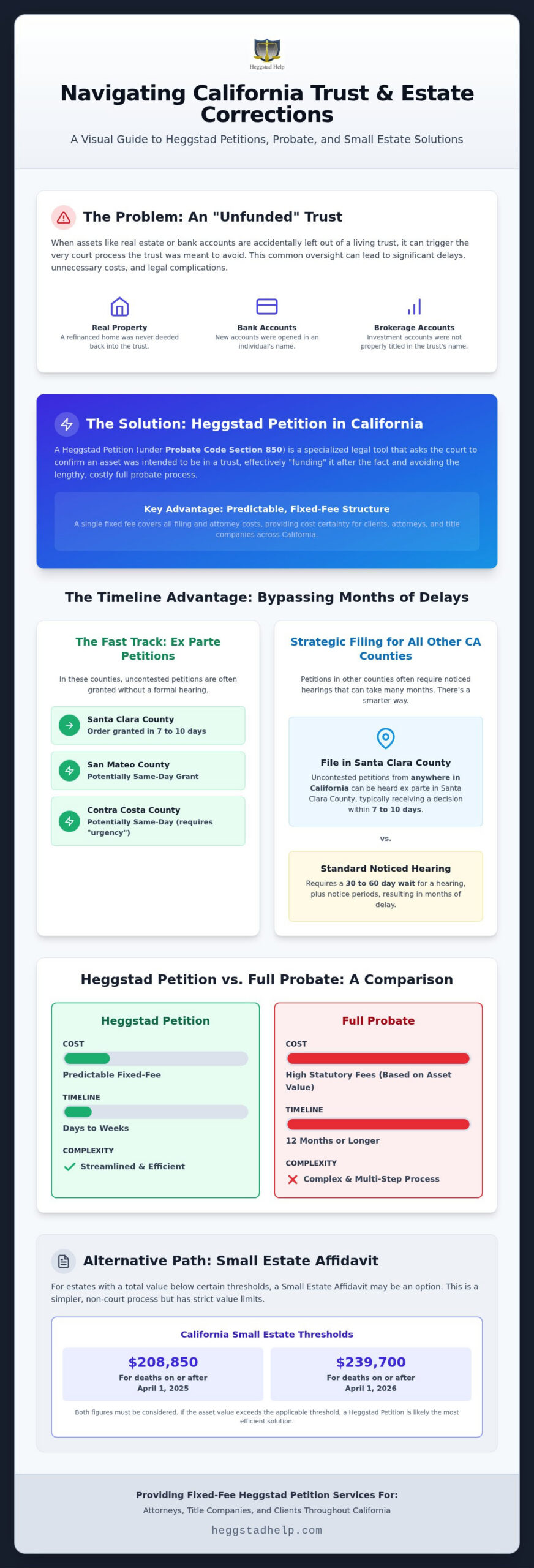
Beyond the immediate financial expense, you must also consider the cost of time. A standard probate in California rarely takes less than 12 months, and in many counties, the timeline can stretch toward 18 months or longer. During this period, assets are often locked, preventing beneficiaries from selling property or accessing funds. In contrast, an uncontested Heggstad petition can be resolved in as little as 7 to 10 days in Santa Clara County when filed ex parte (a request for a court order without a formal, scheduled hearing). Even in San Mateo and Contra Costa Counties, these orders can potentially be granted the same day they are filed, provided you can demonstrate the necessary urgency. To understand exactly how this Heggstad petition process California courts follow works from start to finish, reviewing a detailed step-by-step breakdown can help you prepare for each stage.
Statutory Fee Math: A Real-World Example
To see the savings, let’s look at the math for a $1,000,000 California home. In a full probate, the statutory fees would be approximately $23,000 for the attorney and another $23,000 for the executor, totaling $46,000. For a $500,000 asset, the combined fees would still reach $26,000. Because a Heggstad petition bypasses the traditional probate process, it often saves families 70% to 90% in total costs. Legal professionals frequently discuss these efficiencies, as seen in resources from the Placer County Bar Association on Probate §850 Petitions. For a deeper dive into these numbers, you can review our Heggstad Petition vs. Probate in California: 2026 Comparison Guide.
The 2026 Small Estate Threshold Limits
Before proceeding with a petition, it’s essential to check if the estate qualifies for a Small Estate Affidavit. This is a simplified process, but it only applies if the total value of the estate is below specific legal limits. For deaths occurring on or after April 1, 2025, the threshold is $208,850. For deaths occurring on or after April 1, 2026, the threshold increases to $239,700. If the value of the "forgotten" asset exceeds these figures, a Small Estate Affidavit is not an option. In these cases, a Heggstad petition remains the most financially superior and time-efficient alternative to a full, year-long probate process.
Geographic Factors Affecting Your Heggstad Petition Timeline and Expense
Where you file your petition in California matters as much as the legal arguments within the document. Each county’s probate court operates under its own set of local rules and scheduling backlogs. These geographic variations directly influence the Heggstad petition cost California residents encounter, mainly because a long wait for a hearing date can lead to increased property holding costs, such as taxes, utilities, and insurance. If you’re managing a home that needs to be sold quickly, a six-month delay in a busy court like Los Angeles or San Diego isn’t just frustrating; it’s expensive.
Fortunately, certain counties offer a distinct "Ex Parte Advantage." This procedural shortcut allows a judge to sign an order without requiring a formal, noticed hearing on the court’s regular calendar. By bypassing the standard wait times, we can resolve title issues in a fraction of the time required for a full probate. This efficiency is a cornerstone of how we help attorneys and title companies maintain momentum during trust administrations. It’s a strategic move that keeps the process moving while minimizing the stress of legal uncertainty.
Fast-Track Counties: Santa Clara, San Mateo, and Contra Costa
The probate courts in Santa Clara, San Mateo, and Contra Costa Counties are among the most efficient for these types of filings. In Santa Clara County, we regularly see uncontested petitions granted within 7 to 10 days of filing. San Mateo and Contra Costa Counties offer even more rapid results, with the potential for same-day grants. It’s worth noting that Contra Costa County requires a demonstrated "urgency" to qualify for this expedited treatment. Because these counties allow ex parte filings, the amount of legal labor is reduced, which helps us keep our services affordable and predictable through a fixed-fee model that covers both filing and attorney fees.
Handling Petitions in Other California Counties
In most other California counties, the court will require a noticed hearing. This usually adds 30 to 60 days to the timeline, plus the time needed to serve notice to all interested parties. If the petition is contested, the process can take much longer. However, there is a strategic solution for petitions originating in these slower jurisdictions. Uncontested Heggstad petitions from other counties can often be heard ex parte in Santa Clara County. This allows us to secure a court order within 7 to 10 days, avoiding the months of waiting typical in other courts. This venue selection is a vital tool for estates that exceed the small estate thresholds of $208,850 (for deaths on or after April 1, 2025) and $239,700 (for deaths on or after April 1, 2026). If you need to move quickly, utilizing our Ex Parte Court Order Services can save your family significant time and money.
Fixed-Fee Heggstad Petition Services in California: Transparent Legal Help
When you are faced with the realization that a significant asset was left out of a trust, the path forward should be defined by clarity rather than financial guesswork. Many law firms operate on an hourly basis, which can make the total Heggstad petition cost California families pay unpredictable and stressful. Heggstad Help was founded on the principle of transparent, fixed-fee legal assistance. By offering a single price that covers both attorney fees and court filing fees, we provide a reliable solution for successor trustees, beneficiaries, and the professional partners who support them.
Our service extends beyond individual clients to assist attorneys and title companies throughout California who need a specialized hand to correct title errors efficiently. Whether the property is a family home or a commercial building, our goal is to resolve the "unfunded trust" problem without the complexity of a full probate. Because we handle these petitions daily, we have streamlined the process to ensure that every filing meets the strict requirements of the court, reducing the risk of costly delays or rejections.
Specialized Expertise vs. General Practice
Choosing a legal representative for a Probate Code Section 850 petition involves more than just finding a lawyer. Robert P. Bergman is a Board-Certified Specialist in Estate Planning, Trust and Probate Law. This certification means he has met rigorous standards of experience and passed a second bar exam specifically in this field. This level of expertise allows us to avoid the "learning curve" costs often associated with generalist probate lawyers who may only handle a few Heggstad matters a year. For a deeper look at the procedural requirements, you can check out our Heggstad Petition Filing Guide, which outlines how we navigate the system to recover missing assets.
Getting Started with Heggstad Help
The first step in our process is a thorough review of your trust documents and the current title of the asset in question. We help you determine if a petition is the correct tool by comparing your asset value to the California small estate thresholds. These limits are currently $208,850 for deaths on or after April 1, 2025, and $239,700 for deaths on or after April 1, 2026. If the asset exceeds these amounts, we move forward with the intake for Heggstad Petitions in California. To begin, you’ll simply need to provide the trust document, any amendments, and the most recent deed or account statement. From there, we provide a fixed-fee quote and a clear timeline for your specific county, ensuring you can recover your missing trust assets with confidence and financial certainty.
Securing Your Family’s Trust Assets
Navigating the Heggstad petition cost California families face doesn’t have to be a source of financial anxiety. By choosing a fixed-fee approach, you eliminate the threat of high statutory probate fees and the uncertainty of hourly billing. Whether your estate assets fall above the small estate limits of $208,850 (for deaths on or after April 1, 2025) and $239,700 (for deaths on or after April 1, 2026), or you simply need to move property into a trust quickly, there’s a clear path forward.
With over 40 years of California legal experience, Robert P. Bergman, a Board-Certified Specialist in Estate Planning, Trust and Probate Law, provides the steady hand you need. Our fixed-fee structure covers all filing and attorney fees; this ensures there are no surprises as we work to secure your family’s legacy. If you’re ready to bypass the 12-month probate delay and correct your title in as little as 7 to 10 days in Santa Clara County, we’re ready to assist you.
Get a Fixed-Fee Quote for Your California Heggstad Petition and take the first step toward resolving your trust asset issues today. You’ve worked hard for your home and investments, and we’re dedicated to making sure they stay exactly where they belong.
Frequently Asked Questions
How much does a Heggstad petition cost in California in 2026?
The total Heggstad petition cost California residents encounter includes the court filing fee, which typically ranges from $435 to $500 in 2026, and professional legal fees. While many firms bill hourly at rates between $450 and $800, we utilize a fixed-fee structure that covers both the filing fees and the attorney fees. This approach provides cost certainty and prevents the "fee creep" often associated with traditional probate matters.
Is a Heggstad petition cheaper than probate?
Yes, a Heggstad petition is significantly more affordable than a full probate administration. Probate fees are statutory (meaning they are set by law) under Probate Code Section 10800 and are based on the gross value of the estate. For example, a $1 million home could trigger $46,000 in statutory fees. A Heggstad petition bypasses these costs by using a single court order to confirm trust ownership.
How long does the Heggstad petition process take?
The timeline varies by county and the type of hearing required. In Santa Clara County, uncontested petitions are typically decided in 7 to 10 days. San Mateo and Contra Costa Counties can offer same-day grants, though Contra Costa requires demonstrated "urgency." In other counties, a noticed hearing (a formal court date where all parties are notified) usually takes 30 to 60 days plus additional time for notice. For a complete walkthrough of each stage, our California Heggstad petition step-by-step guide for 2026 covers the full process from document gathering to receiving your court order.
Can I file a Heggstad petition without an attorney?
While self-filing is technically possible, it’s rarely advisable because title companies and the court require very specific legal language to transfer property ownership. Errors in the petition can lead to rejected orders or a title that remains "unmarketable," meaning you can’t sell or refinance the home. A Board-Certified Specialist ensures the petition is drafted correctly the first time, avoiding the high cost of corrective legal work later.
What is the small estate limit in California for 2026?
California has two specific thresholds you must know. For deaths occurring on or after April 1, 2025, the small estate threshold is $208,850. For deaths occurring on or after April 1, 2026, the threshold increases to $239,700. If the asset you’re trying to recover exceeds these amounts, a Heggstad Petition in California is usually the most efficient legal tool to avoid a full, year-long probate process.
Do all California counties allow ex parte Heggstad petitions?
No, most California counties require a formal noticed hearing, which can take several months to be heard. However, uncontested petitions from any county can be heard ex parte (without a formal hearing) in Santa Clara County. This strategic move allows us to secure a court order in 7 to 10 days, providing a much faster resolution for clients regardless of where the property is located.
What happens if a Heggstad petition is contested?
If a beneficiary or another interested party objects to the petition, the court will require a noticed hearing regardless of the county. This moves the case onto the regular probate calendar, and the timeline will typically extend beyond 60 days. Contested matters are more complex and generally fall outside of a standard fixed-fee structure because they require traditional litigation services and additional court appearances.
Can a Heggstad petition be used for out-of-state property?
A California court only has the authority to correct title for real property located within California. If a deceased person left a house or land in another state out of their trust, you’ll likely need to file for ancillary probate (a secondary probate process) in that specific state. The Heggstad petition is a unique tool created under the Probate Code specifically for California trust asset title correction.

Article by
Robert P. Bergman, Attorney at Law
Attorney Robert P. Bergman ("Bob Bergman") has been a Board-Certified Specialist in Estate Planning, Trust and Probate Law since 2011, as certified by the California State Bar Board of Legal Specialization. For several years, Bob has assisted families and the clients of other attorneys with obtaining court orders through Heggstad petitions to avoid the time and expense of Probate administration. Bob is friendly, very approachable, and believes in explaining complex legal topics in clear ordinary language so that his clients understand exactly what they're doing and why they're doing it.
Bob is often able to assist clients who are in other counties than his home county of Santa Clara through his approach to Heggstad petitions.
Disclaimer
This article is for informational purposes only. Nothing in this article is intended to replace legal advice from a competent attorney or be considered legal guidance for anybody's specific legal situation. Nobody should rely on information in this article in making legal decisions without such consultation.


