
An asset can be intended for a trust yet remain outside it on paper. A Heggstad petition in California may help you avoid probate by asking the court to confirm that an overlooked asset belongs to the trust. Because the petition can be contested, evidence of the trustor’s intent matters.
It’s understandable to worry that a missing deed or account title could lead to probate. A Heggstad petition may apply to real property and certain other assets when documents or records show the trustor intended to place them in the trust. It does not automatically transfer every asset.
This article explains which assets may qualify, how a court order can address property and accounts, and what may happen if someone objects. You’ll also learn how an uncontested petition differs from a contested case, so you can better understand the process.
Key Takeaways
- Gather trust schedules, assignments, correspondence, and financial records that may show the trustor intended the overlooked asset to belong to the trust.
- Identify the asset’s current ownership and title details to understand whether a court petition may help bring it into the trust.
- Expect the court order process to differ for real property and financial accounts, and learn what notice interested parties may receive.
- Consider whether anyone may object, since evidence of intent and the presence of a dispute can affect the petition’s path.
Can a Heggstad Petition Be Contested?
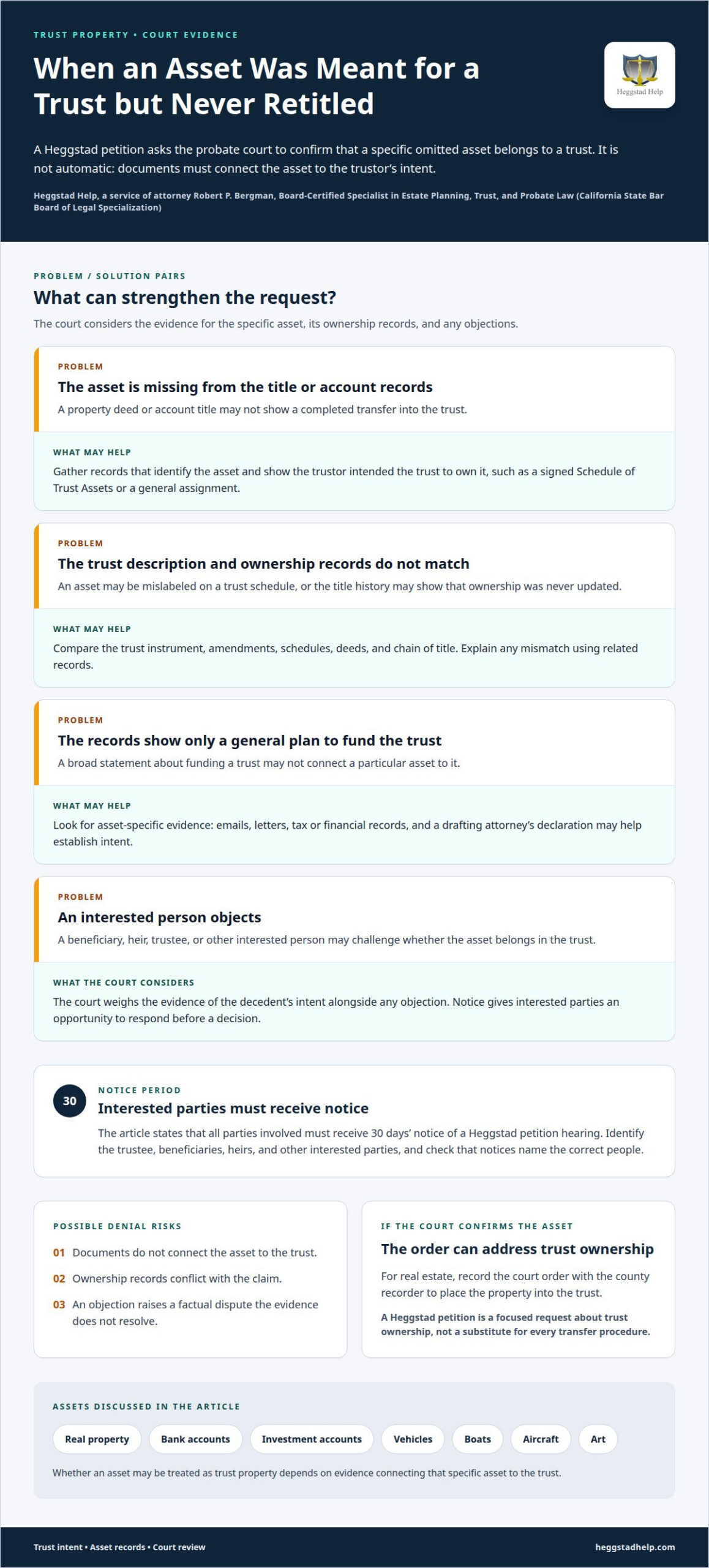
Yes. A beneficiary, heir, trustee, or other interested person may object, making the petition contested. The court weighs evidence of the decedent’s intent and whether the asset belongs in the trust.
Evidence of Intent to Fund the Trust
Look for documents created before the decedent’s death that connect the specific property to the trust. A signed Schedule of Trust Assets, general assignment, emails, letters, tax records, or financial records may support the request. Strong evidence identifies the asset clearly and shows the decedent intended the trust to own it, rather than merely describing a future plan.
Trust Documents and Chain of Title
Compare the trust and its schedules with the property’s title history. For real estate, deeds and the chain of title, meaning the record of ownership transfers, can show whether the decedent retained ownership despite an incomplete transfer. A mismatch, such as a property interest described incorrectly on a trust schedule, may need explanation through related documents. Keep the trust instrument, amendments, schedules, and title records together for review.
Notice to Interested Parties
Notice gives the trustee, beneficiaries, heirs, and other interested parties an opportunity to respond before the court decides the request. According to the California Legislature, all parties involved must receive 30 days’ notice of a Heggstad petition hearing. Review the interested-party list carefully and ensure notices address the correct people. If someone objects, the hearing may become contested, and the court will consider that objection alongside the evidence.
Requirements and Risks of Denial
To obtain relief under Probate Code Section 850, the petitioner must show that the asset should be treated as trust property, supported by evidence of the decedent’s intent. A petition may be denied if the documents do not connect the asset to the trust, ownership records conflict with the claim, or an objection exposes a factual dispute the evidence does not resolve. For example, a general statement about funding a trust may be weaker than a signed schedule naming the property.
The court may issue an order confirming property as trust property; for real estate, record the order with the county recorder to place it into the trust. Heggstad petitions have fixed fees covering filing fees and attorney fees.
Which Assets Can Avoid Probate in California?
A Heggstad petition asks the probate court to confirm that an omitted asset belongs to a trust, based on evidence of the decedent’s intent. Unlike full probate, it focuses on whether a specific asset should be treated as trust property. A spousal property petition addresses a different kind of transfer. A family may avoid probate with a Heggstad petition in California when the court confirms that an asset was intended for the trust.
Bringing Omitted Assets Into a Living Trust
A petition may bring an asset into a California living trust even if the owner did not formally transfer or retitle it before death. Examples include real property, bank or investment accounts, vehicles, boats, aircraft, and art. The court considers whether evidence supports treating that specific asset as trust property, not simply whether the trustor had a general plan to fund the trust. Identify the asset and gather records connecting it to the trust.
Mislabeled and Mistitled Trust Assets
An asset may appear on a trust schedule under an inaccurate description, or its title may never have been updated. In Estate of Heggstad, a property interest appeared on the trust’s Schedule of Assets but was mislabeled as a partnership interest. The court accepted the family’s position that it belonged in the trust. Compare each listed asset with the trust documents and ownership records to identify mismatches that may need explanation in the petition.
Evidence of Intent to Place Assets in Trust
Evidence may include a signed Schedule of Trust Assets, a general assignment to a revocable trust, or another writing identifying the asset. Emails, letters, tax records, financial records, and a drafting attorney’s declaration may also help establish intent. Organize documents by asset, then match each record to its description or account details. Whether a family can avoid probate with a Heggstad petition in California depends on evidence linking the specific asset to the trust, not on a general intention alone.
A Heggstad petition is a focused request about trust ownership, not a substitute for every transfer procedure. Probate addresses estate administration more broadly, while a spousal property petition concerns a different legal relationship. Reviewing the asset’s ownership history alongside the trust records helps clarify which path fits the situation.
Court orders for real property and financial accounts
A Heggstad petition asks the probate court to confirm that an asset belongs to a trust, even if it was not formally transferred. The filing, required notice, and any objections shape what happens before the court issues an order.
Filing Location and Notice
The appropriate filing location may depend on the circumstances, including the decedent’s residence and the property’s location. An uncontested petition may be handled without a formal hearing, depending on the circumstances. According to the California Legislature, all parties involved must receive 30 days’ notice of a Heggstad petition hearing. Identify the trustee, beneficiaries, heirs, and other interested parties before preparing notice.
Notice gives interested people an opportunity to respond. Keep a record of who must be notified and documents showing that notice was given. This step matters even when the family expects no objection, because an interested party may raise concerns about ownership or the decedent’s intent.
Court Hearing and Objections
At a hearing, the probate court reviews the petition, supporting documents, and any objections. For real property, compare the trust’s description with the deed and title records. For a bank or investment account, include records identifying the account and its owner. These details help the court assess whether the specific asset should be confirmed as trust property.
If an interested party disputes the evidence, the court may need to resolve the disagreement before issuing an order. Keep the trust instrument, asset records, and relevant correspondence organized so the request addresses each disputed point clearly.
Petition Timeline and Hearing Outcome
How long does a Heggstad petition take in California? Uncontested ex parte petitions in Santa Clara County are typically granted in 7 to 10 days. In other counties, petitions often require noticed hearings and may take many months, depending on the court’s process and schedule.
At the hearing, the judge considers whether the evidence supports the requested transfer. If the court grants the petition, its order can confirm real property or accounts as trust assets. For real estate, record the order with the county recorder to place the property into the trust. The order addresses a title problem, not unrelated disputes in the estate or trust.
Using a Heggstad petition to avoid probate
Probate Code Section 850 provides the basis for a California probate court request. It asks a judge to confirm that a specific asset belongs to a trust. A Heggstad petition may help avoid full probate for property the decedent intended to place in a living trust but left out of formal title.
The 1993 Estate of Heggstad case established the principle behind this focused petition. The court may consider whether documents and surrounding records show the decedent intended the asset to belong to the trust. For example, a signed trust schedule naming a property interest can support the request, even when the asset’s title was never updated.
Start by identifying each asset separately. Match the trust instrument and schedules to the deed, account statement, or other ownership record. Then organize writings that show the connection, such as an assignment to the trust, correspondence, or financial records. Clear asset descriptions matter: a deed’s legal description or an account’s identifying information helps distinguish the requested property from other estate assets.
This process differs from full probate, which administers estate property more broadly. A Heggstad petition asks the court to decide whether a particular asset belongs to the trust; it does not automatically transfer every asset or resolve unrelated estate disputes. If the judge grants the request, the order can confirm the asset as trust property. For real estate, recording the order with the county recorder helps place the property into the trust.
The practical takeaway is to connect each asset to the trust with specific records before filing. A document that only expresses a general wish to fund a trust may not explain why a particular account or property should be treated as trust-owned. Review the Heggstad petition process as you organize the trust documents and ownership records relevant to your situation.
HEGGSTAD HELP: Heggstad Petition Filing
HEGGSTAD HELP, a service of attorney Robert P. Bergman, Board-Certified Specialist in Estate Planning, Trust, and Probate Law (California State Bar Board of Legal Specialization), assists families, attorneys, and their clients with uncontested Heggstad petitions throughout the State of California. The petition can be filed in the Santa Clara County Probate Court regardless of where in California the trust is located.
For uncontested matters, petitions filed ex parte in Santa Clara County are typically granted in 7 to 10 days. Ex parte means requesting a court order without a formal hearing. Petitions may also be filed ex parte in San Mateo and Contra Costa Counties. If an interested party objects, the matter is contested, and this office does not handle contested petitions.
Heggstad Petition Filing and Ex Parte Court Order Services can address assets intended for a trust but left out of its title records. A fixed fee covers filing fees and attorney fees. For help with an uncontested petition to avoid probate with Heggstad petition California, contact HEGGSTAD HELP.
Prepare the Next Step for the Trust
Before moving forward, make a short inventory of assets still titled outside the trust. For each one, note the current owner, the trust document that may support its inclusion, and the record that needs correction. This gives the next review a practical starting point and helps distinguish a title issue from a request that requires a court order.
For families seeking to avoid probate with a Heggstad petition in California, the next step is matching the asset’s history to the trust documents. Heggstad Help provides trust asset title correction and Heggstad petition services to address records that need to align with the trust. The appropriate approach depends on the asset and the available evidence.
Bring the trust instrument, schedules, deeds, and account records together before proceeding. Contact HEGGSTAD HELP to discuss the next step for an uncontested Heggstad petition, and move forward with a clearer plan for the trust.
Frequently Asked Questions
Do I need an attorney to file a Heggstad petition?
A Heggstad petition is a court filing, and California has no simplified do-it-yourself version of this procedure. The petition must explain why a specific asset should belong to the trust and support that request with records. An attorney can help organize the evidence, prepare the filing, and address notice requirements. That distinction matters: procedural complexity doesn’t itself establish a universal legal requirement to hire an attorney.
What if the asset isn’t specifically listed on the Schedule of Trust Assets?
An asset’s absence from the trust schedule does not automatically end the inquiry. Other writings may support the request, such as a signed general assignment, correspondence, or financial records connecting the asset to the trust. For example, paperwork prepared during a refinancing may help explain why a home’s title remained outside the trust. Focus on records identifying the specific asset and showing the decedent’s intent, rather than relying only on a general estate-planning goal.
What evidence is needed to show the decedent intended to transfer an asset into a trust?
Evidence may include a signed assignment, trust schedules, emails, letters, tax documents, financial records, or a drafting attorney’s declaration. Organize these records into a timeline showing when the trust was created, when the asset was acquired, and what steps were taken to transfer it. For a home, compare trust papers with deed records. For an account, gather documents identifying it and showing how it was treated.
Which assets can and cannot be recovered through a California Heggstad petition?
A petition may cover real property and other assets, including bank or investment accounts, art, aircraft, boats, and vehicles, when evidence supports the trustor’s intent. To avoid probate with a Heggstad petition in California, the evidence must connect the specific asset to the trust; the petition is not a blanket recovery method. Property held in joint tenancy with right of survivorship generally passes automatically to the surviving owner.
What are the steps and forms for filing a Heggstad petition in California?
Begin by identifying the asset and gathering trust, ownership, and intent records. The petition is brought under Probate Code Section 850 and asks the court to confirm the asset as trust property. Identify interested parties and provide required notice. Clearly describe the asset and requested order in the filing. For real property, ensure its description matches title records so the court order can identify the correct property.
Do California Heggstad petition procedures vary by county, including Los Angeles, Orange, and San Diego?
Yes. County court procedures can differ, including whether a petition may proceed ex parte or requires a noticed hearing. In Los Angeles, Orange, and San Diego Counties, petitions often require noticed hearings and may take many months. An uncontested petition from another California county may be filed ex parte in Santa Clara County, even when the trust is located elsewhere. Ex parte treatment requires that all interested parties consent to the petition, waive notice of a hearing, and that no interested party objects.

Article by
Robert P. Bergman, Attorney at Law
Attorney Robert P. Bergman ("Bob Bergman") has been a Board-Certified Specialist in Estate Planning, Trust and Probate Law since 2011, as certified by the California State Bar Board of Legal Specialization. For several years, Bob has assisted families and the clients of other attorneys with obtaining court orders through Heggstad petitions to avoid the time and expense of Probate administration. Bob is friendly, very approachable, and believes in explaining complex legal topics in clear ordinary language so that his clients understand exactly what they're doing and why they're doing it.
Bob is often able to assist clients who are in other counties than his home county of Santa Clara through his approach to Heggstad petitions.
Disclaimer
This article is for informational purposes only. Nothing in this article is intended to replace legal advice from a competent attorney or be considered legal guidance for anybody's specific legal situation. Nobody should rely on information in this article in making legal decisions without such consultation.


