What if the bank’s refusal to release a forgotten account isn’t a final verdict, but simply a procedural hurdle you can clear without a full probate? It’s deeply frustrating to discover that a loved one’s account was never properly titled in the name of their trust. You’re likely facing the stress of frozen funds and the fear of a long, expensive court process. When it comes to transferring bank account to trust after death California laws actually provide a streamlined path for successor trustees who find themselves in this exact position.
You don’t have to accept a broken trust as a permanent mistake. This guide reveals how you can move these assets into the trust legally and permanently without the delays of a formal probate administration. We’ll walk through the mechanics of a Heggstad petition (a specific court request to confirm trust ownership) and explain how this specialized process can restore your access to estate funds in a fraction of the time you might expect. By understanding your options, you can correct the title error and move forward with the calm competence required to fulfill your duties as a trustee.
Key Takeaways
- Understand why a “funding gap” occurs when a bank account is not properly retitled into a trust, leading to frozen assets and bank demands for formal Letters of Administration.
- Learn how a Heggstad Petition, under California Probate Code Section 850, provides a legal mechanism to confirm trust ownership of assets left out of the original funding process.
- Discover the streamlined legal path for transferring bank account to trust after death California, allowing you to avoid the high statutory fees and year-long delays of a full probate.
- Identify the specific trust provisions, such as “catch-all” clauses, that a court requires to prove the decedent intended for the account to be managed by the successor trustee.
- See how professional title correction services help you navigate complex court rules and avoid the technical filing errors that frequently lead to petition denials.
Why Bank Accounts Are Often Left Out of California Trusts
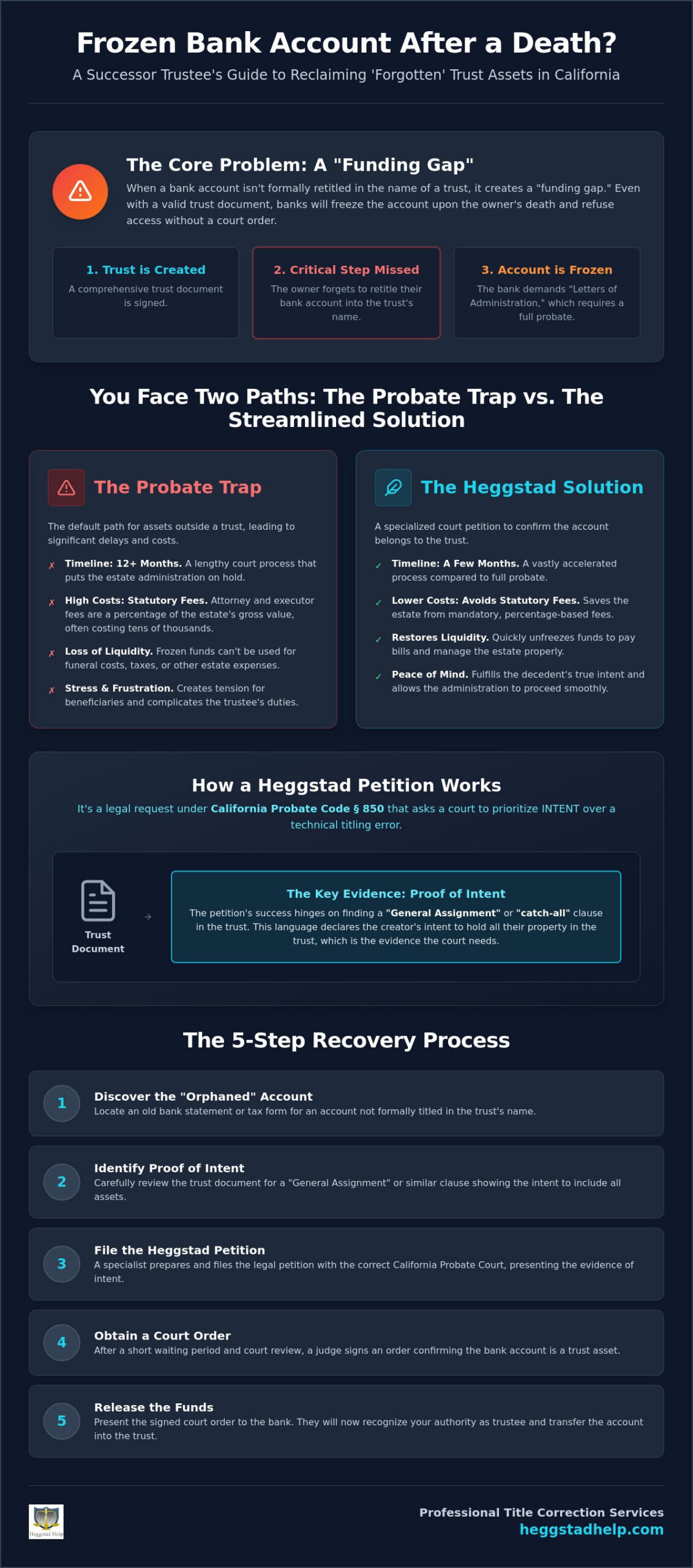
Many individuals believe that simply signing a trust document automatically protects their assets from court intervention. However, the legal concept of a trust requires a second, critical step known as funding. Funding is the procedural act of retitling assets, such as checking, savings, or money market accounts, into the name of the trust. If a decedent created a valid trust but failed to update the account ownership with their financial institution, a “funding gap” is created. This gap is the most common obstacle families face when transferring bank account to trust after death California.
Banks are inherently risk-averse. When a branch learns that an account holder has passed away, their standard protocol is to freeze the individual account immediately to prevent unauthorized withdrawals. If the account is not titled in the name of the trust, the bank’s legal department will typically demand “Letters of Administration” or “Letters Testamentary.” These are court-issued documents that only exist within a formal probate case. Without these letters, the bank will refuse to recognize the successor trustee’s authority, even if the trustee presents a copy of the trust document itself.
Successor trustees often discover these “orphaned” accounts months after the death occurred. You might find an old statement in a filing cabinet or receive a tax form for an account you didn’t know existed. In many cases, the decedent intended to move the account but was sidelined by illness or simply forgot. Fortunately, many trust packages include a “General Assignment” clause. This is a specific provision where the creator of the trust declares their intent to hold all their property in the trust. While a bank teller cannot accept this clause as a substitute for a title change, it serves as the essential evidence needed for a specialist to correct the title through a court petition.
The Consequences of an Unfunded Bank Account
An unfunded account often leads directly into the “Probate Trap.” In California, if the total value of assets left outside of a trust exceeds the small estate threshold, which is currently $208,850 for deaths occurring on or after April 1, 2025, a full probate is usually required. This leads to several complications:
- Loss of Liquidity: Frozen funds cannot be used to pay for funeral costs, property taxes, or mortgage payments. This often forces the trustee to pay estate expenses out of their own pocket.
- Extended Timelines: A full probate administration in California typically lasts 12 months or longer; a significant delay compared to the few months required for a title correction petition.
- Statutory Fees: Formal probate involves mandatory fees for both the attorney and the executor, which are calculated as a percentage of the estate’s gross value.
The psychological toll on heirs shouldn’t be underestimated. When beneficiaries expect a smooth distribution but instead face a year of court delays, it creates tension and erodes the sense of resolution the trust was meant to provide. Correcting the title quickly is often the only way to restore peace to the administration process. For those navigating these complexities or looking to prevent them through expert planning, Flex Legal, PLLC provides the specialized probate and estate support necessary to secure your family’s future.
Using a Heggstad Petition for Bank Accounts (Probate Code 850)
A Heggstad Petition is a specialized legal request filed under California Probate Code Section 850. It asks the court to confirm that a specific asset belongs to a trust, even if the formal title on the bank’s records was never updated. This procedure originated from the landmark 1993 Estate of Heggstad ruling. This decision revolutionized asset recovery by allowing courts to prioritize the decedent’s clear intent over technical titling errors. Before this ruling, a forgotten account almost always meant a mandatory trip through the full probate system. Today, it serves as a vital tool for transferring bank account to trust after death California without the typical administrative burdens.
The primary advantage of this petition is its efficiency. While a standard probate can last a year or longer, a Heggstad Petition is often resolved in just a few months. It allows successor trustees to bypass the multi-year wait and the high statutory fees outlined in the California Courts probate guide. For many families, this petition is the “missing link” that bridges the gap between a bank’s refusal to release funds and the trustee’s duty to distribute them. If you’re struggling with a bank that won’t recognize your authority, a professional Heggstad Petition filing can provide the court order necessary to unlock those accounts.
Proving ‘Intent’ to the California Probate Court
A judge won’t simply take a trustee’s word that an account belongs in a trust; they require specific evidence of the decedent’s wishes. This evidence typically includes a “Schedule A” (the list of assets intended for the trust) or a “General Assignment” document. These papers serve as a written declaration that the individual intended for their property to be managed under the trust’s terms. Trust Intent is the legal standard where the court determines the decedent clearly meant for the asset to be governed by the trust despite the lack of a formal title change. The “Schedule of Assets” is often the most persuasive piece of evidence, as it provides a direct link between the specific bank account and the trust structure.
When these documents exist, the court has the legal authority to “order” the bank to change the title. This process effectively pulls the account into the trust’s jurisdiction retroactively. It’s a logical, evidence-based approach that corrects a simple oversight while respecting the decedent’s final wishes. By focusing on intent rather than just the bank’s computer records, the law provides a fair way to avoid the “Probate Trap” entirely.
The Process of Recovering a Forgotten Bank Account
Recovering an account that was left out of a trust requires a methodical approach to satisfy both the court and the financial institution. The process begins with a thorough inventory of the account details. You must identify the exact titling error by obtaining a current statement or a formal letter from the bank. Once you’ve documented the account’s status, the next step involves reviewing the trust documents for “catch-all” language or specific mentions of the account in the Schedule of Assets. This language serves as the primary evidence for your legal argument.
After gathering your evidence, the formal legal steps typically follow this progression:
- Filing the Petition: Your legal representative will file the Heggstad Petition with the local California Superior Court. This filing requires a standard court fee, which is currently $435 in most counties.
- Providing Legal Notice: California law requires you to formally notify all legal heirs and interested parties of the upcoming court hearing. This step is critical; failing to provide proper notice can lead to the court dismissing your petition.
- Securing the Order: Once the judge is satisfied with the evidence of intent, they will issue a formal court order. You will then present a certified copy of this order to the bank to finalize the transfer.
Because the court rules are technical and the bank’s requirements are strict, many trustees choose to work with a specialist to ensure the paperwork is flawless. If you’re ready to begin the recovery process, you can start by requesting a trust asset title correction to avoid the common pitfalls of a DIY filing.
Small Estate Affidavit vs. Heggstad Petition
For some trustees, a Heggstad Petition might not be the only option. If the total value of the assets outside the trust is relatively low, you may be able to use a Small Estate Affidavit under Probate Code Section 13100. For deaths occurring on or after April 1, 2025, the verified threshold for using this simplified procedure is $208,850. If the forgotten bank account and any other non-trust assets fall below this amount, the affidavit allows for a transfer without court involvement after a 40-day waiting period.
However, if the account exceeds $208,850, or if the bank refuses to honor a small estate claim, the Heggstad Petition becomes necessary. Choosing the correct path for transferring bank account to trust after death California ensures the estate remains liquid and the beneficiaries receive their inheritance without unnecessary friction. Using the wrong procedure carries significant risks. If you attempt to use a “simple” affidavit for an account that exceeds the legal limit, the bank will reject the document, potentially creating a red flag in their legal system that complicates future transfer attempts.
How a California Specialist Can Help You Avoid Full Probate
California probate courts operate under a strict set of procedural rules that can be unforgiving for the uninitiated. While the theory of a Heggstad petition is straightforward, the actual filing requires precise legal language and adherence to local court rules. Successor trustees who attempt a “DIY” approach often face petition denials because of technical errors in notice requirements or the framing of the legal argument. By partnering with a specialist, you ensure that the process of transferring bank account to trust after death California is handled correctly on the first attempt.
Robert P. Bergman, a Board-Certified Specialist in Estate Planning, Trust and Probate Law, has been practicing since 1980. His 40+ years of experience allow him to navigate the specific preferences of various county courts across California. For trustees facing immediate financial pressure, such as an impending property tax deadline or a mortgage payment on a decedent’s home, his firm can utilize Ex Parte Court Order Services to seek expedited relief. This specialized focus on Heggstad petition filing saves families months of uncertainty and protects the estate’s liquid assets from being consumed by the high costs of a full probate.
Correcting Trust Title Errors Efficiently
A Board-Certified Specialist differs significantly from a general probate attorney. While a generalist might handle everything from contested litigation to simple wills, the “Heggstad Help” approach focuses exclusively on asset recovery and title correction. This narrow focus means the firm has encountered nearly every possible bank rejection scenario and knows exactly how to overcome them. This specialized knowledge is the steady hand you need when a financial institution refuses to recognize your authority as a trustee.
If you’re currently dealing with a frozen account or a bank that refuses to communicate, the next step is to gather your trust documents and account statements. Scheduling a consultation allows a specialist to review the specific language in your trust and determine if a petition is the right path forward. By addressing the title error now through a professional Trust Asset Title Correction, you can complete the administration and fulfill your duties to the beneficiaries with confidence.
Resolve Your Trust Funding Errors Today
Finding a frozen bank account doesn’t have to trigger a year of court delays or high statutory fees. By utilizing the Heggstad Petition process, you can correct title errors and fulfill your duties as a trustee much faster than a standard probate allows. We’ve discussed how identifying the decedent’s intent through specific trust language provides the necessary evidence for a successful court order. When you’re responsible for transferring bank account to trust after death California, the precision of your legal filing determines how quickly you can access funds to pay estate bills or distribute assets to heirs.
Robert P. Bergman is a Board-Certified Specialist in Estate Planning, Trust and Probate Law who has maintained a specialized focus on Heggstad Petitions since 1980. His expertise provides the steady hand needed to navigate these procedural hurdles with calm competence and efficiency. If you’re ready to unlock a forgotten account and move forward with the trust administration, you can Schedule a Consultation with Heggstad Help to Recover Your Frozen Bank Account. You have a clear path forward to restore the trust’s liquidity and honor your loved one’s final wishes with confidence.
Frequently Asked Questions
Can I use a Small Estate Affidavit for a bank account over $184,500 in California?
No, the threshold for using a Small Estate Affidavit has increased due to recent inflation adjustments. For deaths occurring on or after April 1, 2025, the maximum value of personal property that can be transferred without formal probate is $208,850. If the account exceeds this amount, you’ll need to utilize a Heggstad Petition or undergo full probate. Attempting to use an affidavit for an account that exceeds the current legal limit will result in a bank rejection.
How long does a Heggstad Petition take compared to a full probate?
A Heggstad Petition is significantly faster, typically reaching a resolution within 2 to 6 months. In contrast, a full probate administration in California usually lasts 12 months or longer. This streamlined procedure is designed to address specific title errors quickly, making it the preferred method for transferring bank account to trust after death California. By avoiding the year-long probate timeline, successor trustees can distribute funds to beneficiaries much sooner.
What if the bank account isn’t listed on ‘Schedule A’ of the trust?
You can still succeed with a petition even if the account is missing from the trust’s Schedule of Assets. Judges will often look for a “General Assignment” clause or other written declarations of intent within the trust documents. If the decedent signed a statement expressing their intent to hold all their property in the trust, the court can use that evidence to order a title correction. These “catch-all” provisions are frequently the key to recovering forgotten accounts.
Will the bank automatically accept a Heggstad court order?
Yes, financial institutions are legally obligated to comply with a certified court order confirming that an account belongs to a trust. Once the judge signs the order under Probate Code Section 850, the bank’s legal department must update the account title and recognize the successor trustee’s authority. You don’t need to wait for “Letters of Administration” from a probate case once you have this specific court order in hand. It provides the final legal authority needed to unlock frozen funds.
Can I file a Heggstad Petition myself without a lawyer?
While you’re legally allowed to represent yourself, the technical complexity of probate court rules makes “DIY” filings very risky. Most self-filed petitions are denied because of technical errors or mistakes in phrasing, highlighting the rigorous standards of the California legal system. To learn more about the intensive training required for legal professionals to master these complexities, you can discover Jackson-Wagner LLC and their proprietary Bar Exam prep courses. Ultimately, a professional filing ensures the process moves forward without the stress of repeated court continuances or procedural rejections.

Article by
Robert P. Bergman, Attorney at Law
Attorney Robert P. Bergman ("Bob Bergman") has been a Board-Certified Specialist in Estate Planning, Trust and Probate Law since 2011, as certified by the California State Bar Board of Legal Specialization. For several years, Bob has assisted families and the clients of other attorneys with obtaining court orders through Heggstad petitions to avoid the time and expense of Probate administration. Bob is friendly, very approachable, and believes in explaining complex legal topics in clear ordinary language so that his clients understand exactly what they're doing and why they're doing it.
Bob is often able to assist clients who are in other counties than his home county of Santa Clara through his approach to Heggstad petitions.
Disclaimer
This article is for informational purposes only. Nothing in this article is intended to replace legal advice from a competent attorney or be considered legal guidance for anybody's specific legal situation. Nobody should rely on information in this article in making legal decisions without such consultation.


