
Imagine you’re days from closing a sale in Los Angeles, only to discover the deed was never transferred into the living trust. You’re likely facing the stress of a 12-to-18-month probate delay while your buyer walks away. It’s a common complication, but you don’t have to lose the deal. By filing an ex parte Heggstad petition in California, you can bypass the standard Probate Code timeline and secure a court order (a formal judicial decree confirming the asset belongs to the trust) in as little as 72 hours.
This article explains how we help families statewide secure these orders with fixed fees covering both filing and attorney fees. We’ll preview the rapid 7-to-10-day process in Santa Clara County, same-day options in San Mateo and Contra Costa, and explain the Small Estate Affidavit threshold of $208,850 for deaths on or after April 1, 2025. We’ll also show how petitions from other counties can be heard in Santa Clara for faster results.
Key Takeaways
- Learn how an ex parte Heggstad petition in California can transfer assets into a trust in as little as 72 hours, allowing you to bypass the standard 12-to-18-month probate delay.
- Discover strategic filing techniques in Santa Clara County to secure court orders in 7 to 10 days, even for properties located in Los Angeles, Orange, or San Diego.
- Understand the specific Small Estate Affidavit threshold of $208,850 for deaths on or after April 1, 2025, to determine the most efficient path forward.
- Benefit from fixed-fee legal services that cover both filing and attorney fees, providing cost certainty for successor trustees and attorneys throughout the entire state of California.
Understanding the Ex Parte Heggstad Petition in California
A Heggstad petition is a specialized legal request under Probate Code Section 850. Our team at HEGGSTAD HELP uses this to ask the court to confirm trust ownership of assets that were never formally retitled. This remedy stems from the landmark case Estate of Heggstad, which proved that a written declaration of trust is often sufficient to show intent. This process is vital when a "forgotten house" deed remains in the decedent’s name rather than the trust’s name.
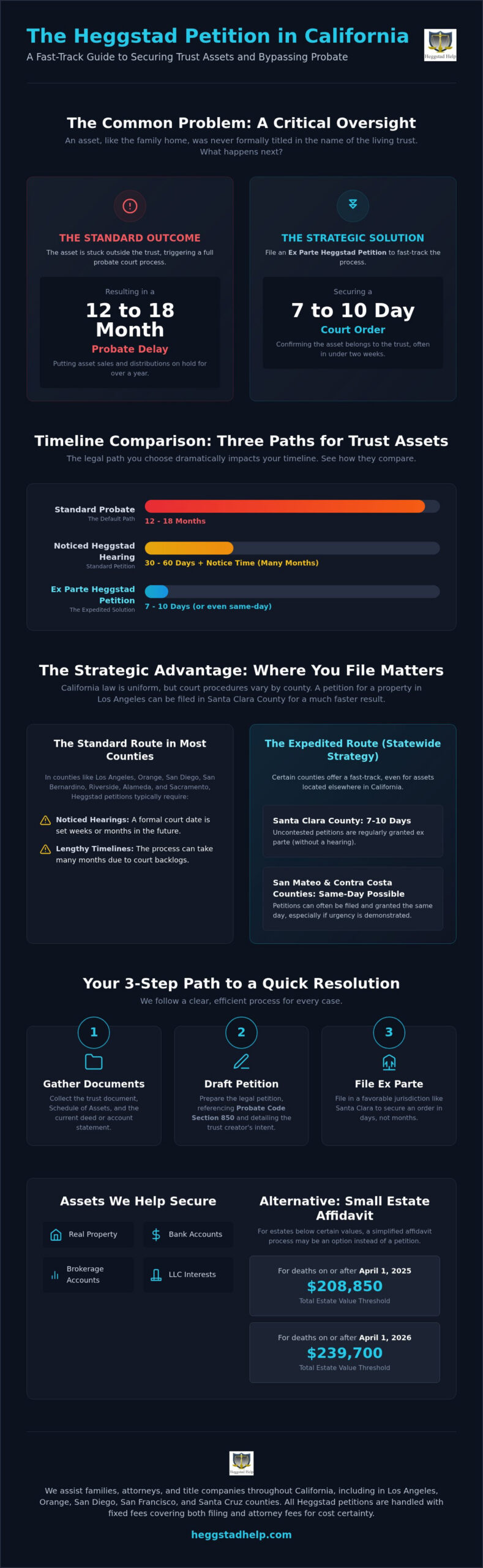
The standard process requires a noticed hearing that can take several months. However, an ex parte Heggstad petition in California acts as a fast-track mechanism. It allows for an emergency hearing that bypasses the standard 30-to-60-day notice period. Success requires clear evidence of the decedent’s intent, such as a "Schedule A" document listing the property as a trust asset.
When Urgency Justifies an Ex Parte Filing
Courts require a valid reason to expedite a hearing. If you’re facing a pending real estate sale in Los Angeles or an imminent foreclosure in Riverside, these emergencies often justify ex parte relief. Obtaining written consent from all heirs is the fastest way to secure a court decision. In jurisdictions like Santa Clara, courts may even allow ex parte filings for uncontested matters simply to clear backlogs.
If an estate is small, you might consider a Small Estate Affidavit. This applies if the total value is under $208,850 for deaths on or after April 1, 2025. For larger real property, an ex parte Heggstad petition in California remains the most efficient path to avoid the 12-to-18-month probate delay.
County-Specific Timelines for a Heggstad Petition in California
While California law is uniform, local court procedures vary significantly. In Los Angeles, Orange, or San Diego, a noticed hearing can take several months including notice time. If a petition is contested, the timeline extends much further. Conversely, Santa Clara, San Mateo, and Contra Costa Counties offer a fast-track through an ex parte Heggstad petition in California. In Santa Clara, uncontested petitions are regularly granted in 7 to 10 days without a formal hearing. San Mateo and Contra Costa can often grant these the same day, provided you demonstrate sufficient urgency in Contra Costa.
Many people assume they must file in the county where the property is located. However, a strategic advantage exists: uncontested petitions from any county, including Alameda, Sacramento, San Francisco, or Santa Cruz, can often be heard ex parte in Santa Clara County. This allows you to secure an order in days rather than waiting months for a noticed hearing in a backlogged jurisdiction. Using a Heggstad Petition to Avoid Probate in this manner is a powerful tool for successor trustees. Our office assists clients throughout the entire state of California with fixed fees covering both filing and attorney fees. If you’re managing an estate in San Bernardino or Riverside, reaching out to a specialist can clarify if this expedited path fits your needs.
The Process for Successor Trustees and Attorneys
To navigate this effectively, follow these three steps:
- Step 1: Gather the trust document, the "Schedule of Assets," other written evidence of intention concerning the assets and the current deed or account statement.
- Step 2: Draft the petition referencing Probate Code Section 850 and the specific facts showing the decedent’s intent.
- Step 3: File ex parte in a favorable jurisdiction like Santa Clara to secure an order in 7 to 10 days.
If the estate value is below the Small Estate Affidavit threshold, which is $208,850 for deaths on or after April 1, 2025.different simplified procedures might apply. For most real estate, however, the ex parte route remains the most reliable way to maintain a closing schedule.
Resolving Trust Title Errors with Fixed-Fee Legal Support
Robert P. Bergman is a Board-Certified Specialist in Estate Planning, Trust and Probate Law who has practiced since 1980. His team at HEGGSTAD HELP serves as a specialized partner for families, title companies, and probate attorneys across the state. We specialize in correcting title errors for complex holdings, including LLC interests or brokerage accounts that were inadvertently left out of a trust. By filing an ex parte Heggstad petition in California, we provide a structured, logical path to resolution that avoids the stress of traditional litigation. We regularly assist professionals in counties like Alameda, San Francisco, and Riverside to ensure that sudden title hurdles don’t derail an entire administration.
Successor trustees often appreciate the clarity provided by our fixed-fee model. This approach ensures total cost certainty because the fee covers both the court filing costs and all attorney fees. You won’t have to worry about the unpredictable nature of hourly billing while trying to resolve a "forgotten" asset. We act as a friendly, reliable guide, providing the specialized knowledge required to navigate the Probate Code with confidence.
Navigating the Small Estate Thresholds in 2026
A petition is typically necessary when the value of the unfunded assets exceeds the California Small Estate Affidavit limits. It’s critical to use the threshold matching the date of death. For deaths occurring on or after April 1, 2025, the limit is $208,850. If your assets exceed these specific values, an ex parte Heggstad petition in California is the most efficient way to maintain your timeline and avoid a 12-to-18-month probate delay.
Securing Your Trust Assets Without Delay
Navigating the aftermath of a loved one’s death is difficult, but correcting a title error doesn’t have to add months of stress. By filing an ex parte Heggstad petition in California, you can often secure trust assets in as little as 72 hours and bypass the 12-to-18-month probate delay. Whether the property is in Orange, San Bernardino, or Marin, our strategic filing in Santa Clara County provides a 7-to-10-day turnaround for uncontested matters. We offer cost certainty with fixed fees that cover both filing and attorney costs, ensuring your family’s inheritance remains protected. If the estate exceeds the Small Estate Affidavit threshold of $208,850 for deaths on or after April 1, 2025, this is your most efficient path forward. Contact Robert P. Bergman, a Board-Certified Specialist, for a Fixed-Fee Heggstad Petition Consultation and move forward with confidence.
Frequently Asked Questions
How long does a Heggstad petition in California take to complete?
The timeline depends on the county and whether you’re using a noticed hearing or an ex parte process. Noticed hearings in counties like Los Angeles or Orange typically take several months. However, an ex parte Heggstad petition in California filed in Santa Clara County is usually granted in 7 to 10 days.
Can I file an ex parte Heggstad petition if there is no pending sale?
Yes, you can file ex parte in certain jurisdictions even without an immediate real estate closing. While Contra Costa County requires demonstrated urgency, such as a pending sale or foreclosure, Santa Clara County regularly allows ex parte filings for uncontested matters to clear court backlogs. This helps successor trustees secure trust assets without waiting for a standard hearing date.
What evidence is needed to win a Probate Code Section 850 petition?
You must provide clear evidence that the decedent intended the asset to be part of the trust. This typically includes a "Schedule of Assets" (a list of property attached to the trust document) or a specific declaration within the trust itself. Under Probate Code Section 850, the court requires this proof of intent to confirm the trust’s ownership.
Is a Heggstad petition cheaper than a full probate in California?
Yes, it’s significantly more cost-effective because it avoids statutory probate fees based on the estate’s gross value. A petition is necessary when assets exceed the Small Estate Affidavit threshold of $208,850 for deaths on or after April 1, 2025, and $239,700 for deaths on or after April 1, 2026. Our office uses fixed fees for an ex parte Heggstad petition in California.
Can an attorney from Santa Clara handle a Heggstad petition in Los Angeles?
Yes, and there is often a strategic advantage to doing so. We assist families and attorneys throughout the entire state of California, including San Diego, Riverside, and San Francisco. Uncontested petitions for property located in Los Angeles or Orange County can often be heard ex parte in Santa Clara County and decided within 7 to 10 days.
What happens if a Heggstad petition is contested by a beneficiary?
The court will move the matter to a noticed hearing if a beneficiary or heir objects to the petition. Contested petitions take much longer to resolve than uncontested ones and may require formal litigation. Most Heggstad matters remain uncontested because they simply fulfill the decedent’s documented intent to keep assets in the trust and avoid the probate process.

Article by
Robert P. Bergman, Attorney at Law
Attorney Robert P. Bergman ("Bob Bergman") has been a Board-Certified Specialist in Estate Planning, Trust and Probate Law since 2011, as certified by the California State Bar Board of Legal Specialization. For several years, Bob has assisted families and the clients of other attorneys with obtaining court orders through Heggstad petitions to avoid the time and expense of Probate administration. Bob is friendly, very approachable, and believes in explaining complex legal topics in clear ordinary language so that his clients understand exactly what they're doing and why they're doing it.
Bob is often able to assist clients who are in other counties than his home county of Santa Clara through his approach to Heggstad petitions.
Disclaimer
This article is for informational purposes only. Nothing in this article is intended to replace legal advice from a competent attorney or be considered legal guidance for anybody's specific legal situation. Nobody should rely on information in this article in making legal decisions without such consultation.


