
A beneficiary notice for an 850 petition in California gives people whose rights may be affected a chance to respond before the court decides who owns or possesses the property. According to the California Legislature, the petitioner must give all parties involved 30 days’ notice of the hearing. In a Heggstad petition, the request is for the court to confirm that omitted property belongs in a trust.
If you’re focused on the notice, it’s understandable to wonder who needs to receive it and what happens after it’s served. The notice is one part of a process that can lead to a court order affecting property ownership. This article explains what a Probate Code Section 850 petition does, which interested parties may need notice, and what to expect at the hearing and judgment stage, so you can follow the process with a clearer sense of what comes next.
Key Takeaways
- Understand how a Probate Code Section 850 petition can ask the court to resolve whether specific property belongs in a trust.
- Gather trust documents and property records that help show the trustor intended the asset to be held in the trust.
- Identify people or organizations whose interests or possession of the property could be affected by the petition.
- Learn what to expect at the hearing and why the court’s final order may be an important step in correcting property title.
What is a Probate Code 850 petition and how does it work?
Probate Code Section 850 lets a petitioner ask the court to decide who owns or possesses particular property. A Heggstad petition is one use of this procedure. A trustee may ask the judge to confirm that an asset belongs to a trust, even though its title was never formally transferred. The court reviews the claim and supporting evidence before deciding whether to issue an order.
This can matter when a living trust was intended to hold an asset, but funding was incomplete. For example, a home might appear on the trust’s Schedule of Assets, while its deed still names the trustor individually. A bank account, investment account, or business interest may also have been omitted. The petition explains the trustor’s intent and asks the court to recognize the asset as trust property.
Evidence is central. Gather the trust and amendments, Schedule of Assets, relevant deeds or account records, and documents showing the trustor’s intent. A pour-over will or general assignment may also help explain how the asset was intended to be handled. The petitioner must make specific claims about ownership and provide supporting material for the court to evaluate.
Notice gives interested parties an opportunity to respond because an order may affect their rights. According to the California Legislature, a person serving the California notice by mail must be over the age of 18 and not a party to the case. Keep the mailing record with the case documents. If someone physically possesses the disputed property, personal service may be required.
A Heggstad petition can resolve an asset-specific ownership issue without formal probate of that property. It does not automatically avoid probate for every asset or settle every dispute. Full California probate takes at least 7 months, and some proceedings may last 18 months or more; most 850 petitions reach a decision within 60 days of filing. The court’s order can clarify the asset’s status and support the next title or transfer step.
California Probate Code Section 850 petitions
Probate Code Section 850 covers several kinds of property claims in California probate. The correct subsection depends on who is asking and why. Under Section 850(a)(1), a guardian, conservator, or claimant may petition in specified cases involving a minor or conservatee. Section 850(a)(2) addresses certain claims by a personal representative or interested person involving a decedent’s contract or property. Section 850(a)(3) includes specified claims by a trustee or interested person involving trust property.
For a trust-related claim, the petition should identify the property, explain the basis for the claim, and state what order the court is being asked to make. For example, a trustee claiming an asset held by another person or entity should make the ownership dispute clear. Probate Code Section 850 requires the petition to set out the facts supporting the claim.
Probate Code Section 851 concerns notice connected with a Section 850 hearing. The notice tells interested parties what property is involved and what the petitioner wants the court to decide. Form DE-115 is the Judicial Council form for the hearing notice; the petition and proposed order are separately prepared pleadings. For real estate, the notice should identify the property by street address or, if it has no address, location and assessor’s parcel number.
Plan service around the people and entities connected to the property. A person physically possessing disputed property must receive personal service. A financial institution holding the asset may also need personal service. Keep the notice, petition, and proof of service together so the court can see what was sent and to whom.
Probate Code Section 859 may permit double damages when someone takes, conceals, or disposes of specified property in bad faith. That remedy is not automatic; the court considers the circumstances and the evidence. If bad-faith conduct is part of the claim, state the relevant facts clearly and support them with records or other evidence.
Section 850(b) requires the petition to set forth the facts on which the claim is based. Supporting documents may include the trust agreement and amendments, the trust’s Schedule of Assets, and evidence of the successor trustee’s authority.
Prepare a summons, checking with the local court because some courts will not issue one for this type of matter.
Notice to interested parties
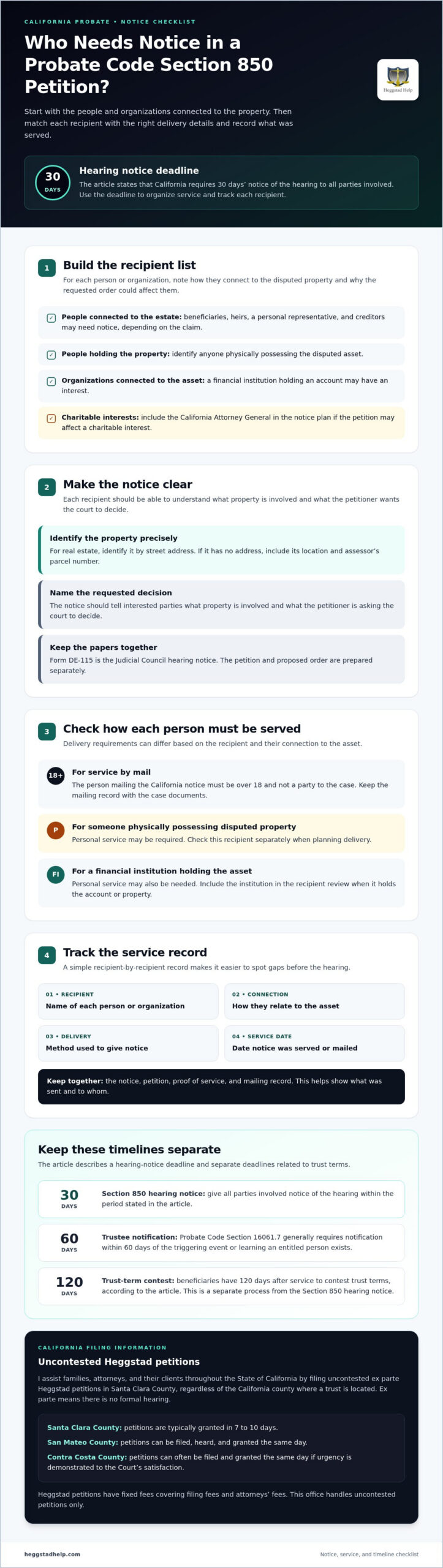
A beneficiary notice for an 850 petition in California should help each recipient understand how the requested order could affect them. The California Legislature sets the hearing-notice period at 30 days; use that deadline to organize service and track each recipient’s status. Create a list with each person’s name, connection to the asset, delivery method, and service date. This makes it easier to spot missing recipients before the hearing.
Build the list from records tied to the property and the decedent’s estate. Depending on the claim, recipients may include beneficiaries, heirs, a personal representative, creditors, or people who possess the disputed asset. A financial institution holding an account may also have an interest. For each entry, note why that person or organization may be affected, rather than relying on a general contact list.
Charitable interests require attention to the California Attorney General. If the petition may affect a charitable interest, include the Attorney General in the notice plan. Keep the reason for notice clear in the case file, especially when a charitable beneficiary or gift appears in trust documents. A well-organized record helps distinguish this recipient from individual beneficiaries and other interested parties.
Trust terms have a separate notification process under Probate Code Section 16061.7. According to the California Legislature, a trustee generally must serve the required notification within 60 days of the triggering event or learning an entitled person exists. Beneficiaries then have 120 days to contest trust terms after service, according to the California Legislature. These deadlines concern trust terms, not the Section 850 hearing. Keep copies of each notice and its service record in separate, clearly labeled files. A beneficiary notice for an 850 petition in California should not be confused with the trustee’s notice about trust terms, even when some recipients overlap.
Court hearings and judgments
At a noticed hearing, the judge reviews the petition, evidence, and any objections before deciding the property claim. The resulting order explains what the court has decided and may authorize a transfer.
Court Review and Objections
Court review means the judge evaluates the written petition, supporting documents, and responses from people claiming an interest. A person with a property claim may file a written response before the hearing or attend and explain the objection. If someone neither responds nor appears, the court may make an order affecting ownership without that person’s input. Organize evidence around the specific asset and the requested decision.
Hearings and Court Decisions
At the hearing, the petitioner presents supporting documents and explains why the requested order fits the evidence. The judge may ask questions, consider arguments, and decide whether the property belongs to the trust. Most California Probate Code Section 850 petitions reach a decision within 60 days of filing. That is a general timeframe, not a substitute for checking the hearing date and notice requirements in the individual case.
After the court rules, obtain a certified copy of the order. For real estate, record that copy in the county where the property is located. For example, an order concerning a home in Los Angeles County should be recorded there. For accounts or other assets, the order can provide direction for the next transfer step. Keep the signed order and any recording information with the trust’s records.
For an uncontested Heggstad petition, an ex parte request seeks an order without a formal hearing. Petitions filed ex parte in Santa Clara County are typically granted in 7 to 10 days. San Mateo County petitions can be filed, heard, and granted the same day. Contra Costa County petitions can often be filed and granted the same day when the court is satisfied that urgency exists. Explore ex parte court order services for an uncontested Heggstad matter. Contested cases follow a different path and take longer.
HEGGSTAD HELP: Heggstad Petition Filing
HEGGSTAD HELP, a service of attorney Robert P. Bergman, a Board-Certified Specialist in Estate Planning, Trust, and Probate Law with the State Bar of California Board of Legal Specialization, provides Heggstad petition services for trust assets that need court recognition. The practice also handles ex parte petitions for eligible matters and corrects trust asset titles after an order addresses an asset’s status.
If you’re preparing to discuss a petition, gather the trust document, amendments, and records identifying the asset. Note any disagreement or missing information that could affect whether the matter is uncontested. These details help focus the discussion on the petition and the title issue that needs attention.
Contact HEGGSTAD HELP about a Heggstad petition to discuss the next step.
Prepare for the next step with clarity
Before moving forward, bring the property records and trust documents together in one place. Add a short note identifying what still needs to happen, such as clarifying ownership, completing a transfer, or responding to an objection. This gives you a practical starting point for discussing the case and keeps the next decision focused on the asset at issue.
If you’re organizing the beneficiary notice for an 850 petition in California, keep a clear record of the people involved, the documents they received, and any responses. That information can help reveal whether the matter remains uncontested or needs a different approach. A focused review can also help you understand how the petition and the requested court order fit your circumstances.
For help preparing an uncontested Heggstad petition, contact HEGGSTAD HELP about your petition. You can take the next step with a clearer plan and steady support.
Frequently Asked Questions
What is an 850 Petition?
One less obvious use of Probate Code Section 850(a)(3) involves a creditor’s claim against trust property. The subsection also covers specified claims by a trustee or interested person involving trust property. If a creditor is involved, identify the claimed debt and the specific trust asset at issue in the case records. That helps distinguish a creditor-related property claim from a request to confirm an asset belongs to the trust.

Article by
Robert P. Bergman, Attorney at Law
Attorney Robert P. Bergman ("Bob Bergman") has been a Board-Certified Specialist in Estate Planning, Trust and Probate Law since 2011, as certified by the California State Bar Board of Legal Specialization. For several years, Bob has assisted families and the clients of other attorneys with obtaining court orders through Heggstad petitions to avoid the time and expense of Probate administration. Bob is friendly, very approachable, and believes in explaining complex legal topics in clear ordinary language so that his clients understand exactly what they're doing and why they're doing it.
Bob is often able to assist clients who are in other counties than his home county of Santa Clara through his approach to Heggstad petitions.
Disclaimer
This article is for informational purposes only. Nothing in this article is intended to replace legal advice from a competent attorney or be considered legal guidance for anybody's specific legal situation. Nobody should rely on information in this article in making legal decisions without such consultation.


