
What if the Court confirms that an asset belongs to a trust, but the ownership records still don’t reflect that decision? That gap can leave families unsure what to do next. The next steps after court confirms trust asset ownership depend on the order and the type of asset. The Court’s determination resolves an ownership question, but follow-up documentation or title work may still be needed.
If you’re a successor trustee, keep the signed order with the trust documents and records identifying the asset. Then check what the order says and what still needs attention. This article explains the difference between the Court’s decision and ongoing asset administration, which records to organize, and how to approach unresolved title information.
If a different asset still needs court confirmation, an uncontested Heggstad petition may be appropriate. HEGGSTAD HELP assists families, attorneys, title companies, and their clients throughout California with uncontested ex parte Heggstad petitions filed in the Santa Clara County Probate Court, regardless of where the trust is located. These petitions are typically granted in 7 to 10 days.
Key Takeaways
- A confirmation order recognizes an asset as trust property, but its exact wording guides what steps may follow.
- For the next steps after court confirms trust asset ownership, preserve the signed order and compare its asset description and trust name with available records.
- Track unresolved title questions and remaining administration separately. A discrepancy doesn’t by itself mean the Court’s order failed.
- If another asset still needs court confirmation, HEGGSTAD HELP assists families, attorneys, title companies, and clients throughout California with uncontested ex parte Heggstad petitions filed in the Santa Clara County Probate Court. These petitions are typically granted in 7 to 10 days.
After a California Court Confirms a Trust Asset: What the Order Means
A Court confirmation is an important milestone, but it doesn’t necessarily finish the work. The exact terms of the order guide what follows. In plain English, asset confirmation means the Court has recognized the asset identified in its decision as property of the trust. The order answers that ownership question; it doesn’t automatically update every title, account, or trust record.
A trust is a legal relationship in which a trustee manages property for beneficiaries under the trust’s terms. This helps explain why a Court decision about a particular asset and the later work of administering it are separate steps.
The Court determines whether the identified asset belongs to the trust; the successor trustee or another appropriate representative coordinates the next administrative steps. So, the next steps after court confirms trust asset ownership begin with understanding what the order covers, not assuming every related record has changed.
What does a trust-asset confirmation order establish?
The order addresses the asset described in the Court’s determination. Read that description carefully, then compare it with the trust document and available ownership records. For example, if the order identifies a particular property, don’t assume it also resolves questions about a separate account or another property. Treat the order as applying to the asset it identifies, not to unrelated assets or disputes.
Who should organize the next steps?
The successor trustee, or another appropriate trust representative, can coordinate the follow-up and keep the relevant records together. Depending on the situation, family members, attorneys, and title-company professionals may also be involved. Start by identifying who is coordinating, sharing the order and supporting records with the relevant participants, and noting any differences that still need attention. A discrepancy is a question to investigate, not by itself proof that the Court’s decision failed.
Review the California Court Order Before Changing Asset Records
Before changing or relying on an asset record, read the order carefully. Confirm that it is signed, identify the asset described, check the trust name, and note any directions the Court included. Then compare those details with the relevant trust provisions and available ownership records. Differences between documents don’t automatically mean the order is ineffective, but they do make careful review important.
The order’s wording and the asset it identifies determine the scope of the confirmation. The Court’s decision may resolve the question it addressed, while separate record updates or other administration for that asset may remain. The California Courts Self-Help Guide provides background on petitions to confirm trust assets, including property not titled in the trust’s name. Focus on what the specific order says rather than assuming it updates every record automatically.
Which records should the successor trustee keep together?
Organize the signed order, relevant trust provisions, petition materials, and existing records for the asset in one file. Add a brief status note describing how the asset was recorded before the order and what remains afterward. This gives the successor trustee and others involved a clear reference point, alongside broader guidance such as a “Successor Trustee Duties for an Unfunded Trust” guide.
What if a title or account record still looks different?
Compare the record’s exact description and ownership information with the order’s language. Write down the specific mismatch and any unanswered question instead of assuming the Court’s confirmation failed or that the record changed automatically. For context on petitions involving real property, see a “California Probate Code Section 850: A Guide to Real Property Petitions.” If an unresolved asset issue calls for Heggstad petition assistance, learn about Heggstad petition help.
Follow a Practical Checklist for Trust Assets After Court Confirmation
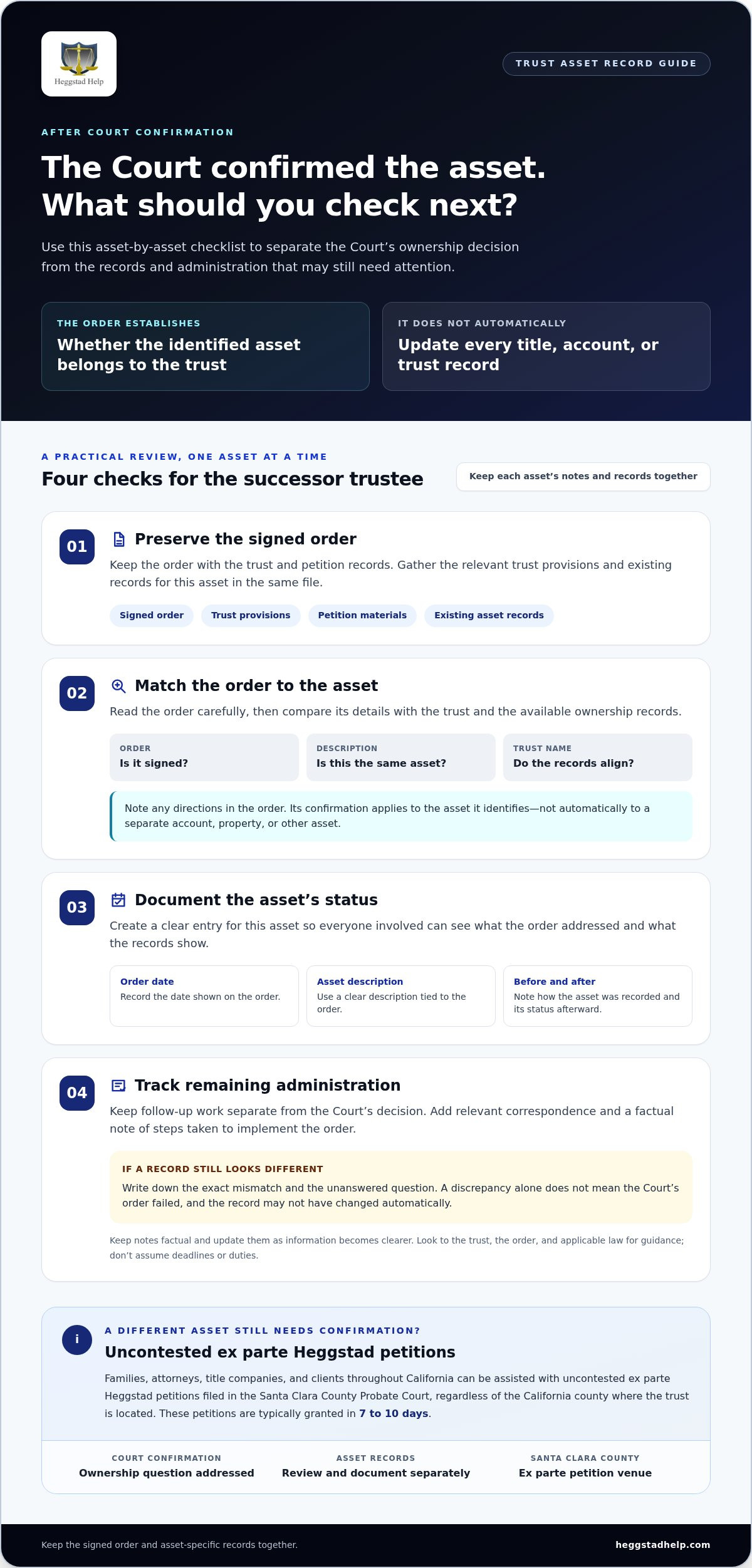
A simple asset-by-asset checklist can keep Court confirmation separate from follow-up work. For each confirmed asset:
- Preserve the order. Keep the signed order with the trust and petition records.
- Match the asset. Compare the order’s description with the asset and its available records.
- Document its status. Note the order date, what the order addresses, and the asset’s status before and after confirmation.
- Track remaining administration. Record open questions and follow-up activity without assuming that a difference in records means the order failed.
This record helps the successor trustee see what the Court confirmed and what still needs attention. Keep relevant correspondence and records of steps taken to implement the order with the asset’s file. Don’t add deadlines or duties based on assumptions; look to the trust, the order, and applicable law for guidance.
How should the trustee track a confirmed asset?
Use a separate entry for each asset, including the order date, a clear asset description, and a brief follow-up status. If a question remains, describe the mismatch and what information is still needed. Keep notes factual and update them as the asset’s status becomes clearer. For more background on the petition process, see this Heggstad petition filing guide.
What if another asset remains outside the order?
Confirmation applies to the asset addressed in the order; it doesn’t automatically confirm a different asset. Identify that asset and organize its ownership history and related trust records before considering whether another Court petition may be appropriate. A separate asset issue is not proof that the order for the confirmed asset failed.
If an additional asset still needs Court confirmation, HEGGSTAD HELP assists families, attorneys, title companies, and their clients throughout the State of California with uncontested ex parte Heggstad petitions filed in the Santa Clara County Probate Court, regardless of where the trust is located. Explore Heggstad petition assistance.
When California Heggstad Petition Help May Still Be Relevant
A confirmation order settles the Court question for the asset it identifies. A separate asset that isn’t covered by that order may still need a Court determination. Keep the two issues distinct: don’t treat a record mismatch for the confirmed asset as automatic proof that another petition is needed, and don’t assume the order also covers other property.
If another asset’s ownership remains unresolved, HEGGSTAD HELP assists families, attorneys, title companies, and their clients throughout the State of California with uncontested Heggstad petitions. An ex parte petition is a request made to the Court without a formal hearing. We file uncontested petitions ex parte in Santa Clara County, including when the trust or asset is located elsewhere in California.
How can the filing path differ across California counties?
For an uncontested ex parte petition filed in Santa Clara County, orders are typically granted in 7 to 10 days. In San Mateo County, petitions can be filed, heard, and granted the same day. Contra Costa County petitions can often be filed and granted the same day if the Court is satisfied that urgency has been demonstrated. These timelines describe the filing paths, not a guarantee of a particular result.
For families in Los Angeles County, Orange County, San Diego County, and other California counties, a Heggstad petition may often require a noticed hearing in that county and take many months to be heard. An uncontested petition can instead be filed ex parte in Santa Clara County, where it is typically granted in 7 to 10 days. HEGGSTAD HELP assists families, attorneys, title companies, and clients throughout California with this filing path, including those in Alameda County, San Francisco County, Marin County, and Sacramento County.
When might a different petition path take longer?
A noticed hearing is a court date scheduled after interested parties receive notice. It may be set 30 to 60 days after filing, or several months later in some counties, with additional time needed for notice. HEGGSTAD HELP handles uncontested petitions only, not contested petitions. Our fixed fees cover filing fees and attorneys’ fees. If a separate asset still needs confirmation, learn about uncontested Heggstad petition assistance and the available filing paths.
Move Forward With a Clear Plan for Each Trust Asset
A Court confirmation is a meaningful step, but the order’s terms define what it resolves. Keep the order and related records together, match its description to the specific asset, and track remaining record updates or administration separately. If another asset isn’t covered, treat that as a separate question rather than assuming the existing order applies.
For an asset that still needs Court confirmation, HEGGSTAD HELP assists families, attorneys, title companies, and clients throughout the State of California with uncontested ex parte Heggstad petitions. Robert P. Bergman is a California-licensed attorney and Board-Certified Specialist in Estate Planning, Trust and Probate Law. Fixed fees cover filing fees and attorneys’ fees. If you’re considering the next steps after court confirms trust asset ownership, or have a different asset that remains unresolved, explore California Heggstad petition assistance.
With the order’s scope clear and each open issue documented, you can approach the work ahead with greater confidence.
Frequently Asked Questions
What happens after a court confirms an asset belongs to a trust?
After the Court confirms an asset belongs to a trust, the successor trustee should review the order, match its description to the asset, and coordinate any follow-up administration that applies. The next steps after court confirms trust asset ownership depend on the order’s terms and the asset’s records. Keep a note of unresolved differences; they don’t, by themselves, mean the Court’s determination failed.
Does a court order confirming trust property automatically change the title?
No. A court order confirms what the Court determined about the identified asset, but it doesn’t necessarily update a deed, account record, or other ownership information automatically. Review the signed order and compare its asset description and trust name with current records. If they differ, document the precise mismatch and identify what follow-up the order and the particular asset may call for.
What documents should a successor trustee keep after a Heggstad order?
Keep the signed court order, relevant trust provisions, petition and supporting materials, and available ownership records together. Also retain related correspondence and a concise asset-status note showing the asset description, order date, what the order confirms, and any follow-up still open. Organizing records asset by asset helps the successor trustee distinguish confirmed property from other assets or questions the order didn’t address.
Can a California Heggstad petition be filed in Santa Clara County for property elsewhere in California?
Yes. HEGGSTAD HELP assists families, attorneys, title companies, and clients throughout the State of California by filing uncontested ex parte Heggstad petitions in the Santa Clara County Probate Court, regardless of where the trust is located. This includes clients in the San Francisco Bay Area, Northern California, Southern California, the Central Valley, San Diego, Sacramento, Fresno, Bakersfield, Greater Los Angeles, Orange County, Riverside County, and San Bernardino County.
How long does a California Heggstad petition take after filing?
Timing depends on the county and filing path. Uncontested ex parte petitions in Santa Clara County are typically granted in 7 to 10 days from filing. In San Mateo County, they can be filed, heard, and granted the same day. Contra Costa County petitions can often be granted the same day if the Court is satisfied that urgency is demonstrated. Elsewhere, noticed hearings may take many months, plus time for notice.

Article by
Robert P. Bergman, Attorney at Law
Attorney Robert P. Bergman ("Bob Bergman") has been a Board-Certified Specialist in Estate Planning, Trust and Probate Law since 2011, as certified by the California State Bar Board of Legal Specialization. For several years, Bob has assisted families and the clients of other attorneys with obtaining court orders through Heggstad petitions to avoid the time and expense of Probate administration. Bob is friendly, very approachable, and believes in explaining complex legal topics in clear ordinary language so that his clients understand exactly what they're doing and why they're doing it.
Bob is often able to assist clients who are in other counties than his home county of Santa Clara through his approach to Heggstad petitions.
Disclaimer
This article is for informational purposes only. Nothing in this article is intended to replace legal advice from a competent attorney or be considered legal guidance for anybody's specific legal situation. Nobody should rely on information in this article in making legal decisions without such consultation.


