Probate isn’t automatic: correcting property title after death in California depends mainly on how the property was titled and whether it was held in a trust. According to the California Legislature, a Small Estate Affidavit may be available for eligible estates valued at $208,850 for deaths on or after April 1, 2025, but that threshold doesn’t determine every real-property transfer.
It’s understandable to expect that a will or family agreement will be enough to update a deed. In practice, the deed’s vesting language (the way ownership is legally held), trust documents, and the type and value of the property all affect whether court involvement is needed. A 40-day waiting period applies to certain transfers, including some vehicle transfers, not as a general rule for every home or parcel.
This article explains how joint ownership and trust ownership affect correcting property title after death in California, when probate or a simplified procedure may be necessary, and how the deed’s vesting can change the outcome. You’ll learn how to distinguish a title correction from a transfer that may require a court order, helping you identify the next step for the property.
Key Takeaways
- Read the deed’s ownership wording first; joint tenancy, tenants in common, and survivorship language can lead to different transfer paths.
- For property held in a trust, review the trust and recorded deed to see whether title needs a further transfer to beneficiaries.
- Don’t assume the 40-day waiting period applies to real estate; it relates to certain vehicle transfers, not every property transfer after death.
- Changes to how property is vested can affect who inherits it and whether a court petition is needed, so understand the current title before taking the next step.
How property title determines the transfer process after death
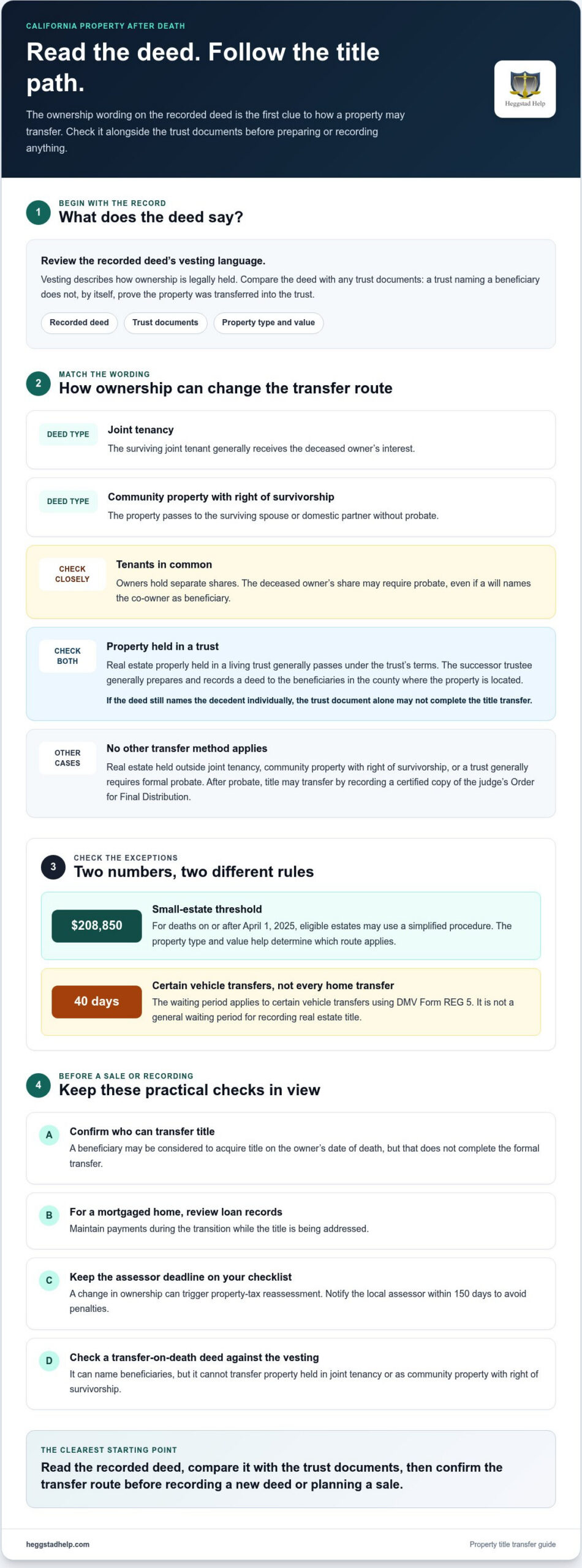
Correcting property title after death in California starts with the recorded deed: its ownership wording helps determine how the property can transfer. Review the deed alongside any trust documents before preparing a transfer or planning a sale.
Title Types and Transfer Paths
With joint tenancy, the surviving joint tenant generally receives the deceased owner’s interest. Tenants in common, by contrast, hold separate shares, and a deceased owner’s share may require probate even if a will names the co-owner as beneficiary. Community property with right of survivorship passes to the surviving spouse or domestic partner without probate.
A revocable transfer-on-death deed can name beneficiaries, but it cannot transfer property held in joint tenancy or as community property with right of survivorship. Check the deed’s vesting language before assuming the beneficiary designation controls.
Probate Requirements for Real Estate
Probate is the court process for transferring property when no other transfer method applies. Real estate held outside joint tenancy, community property with right of survivorship, or a trust generally requires formal probate. After probate, title may transfer by recording a certified copy of the judge’s Order for Final Distribution.
California’s small-estate limit is $208,850 for deaths on or after April 1, 2025, according to the California Legislature. Eligible estates may use a simplified procedure, but property type and value determine the applicable route.
Before selling inherited real estate, establish who has authority to transfer title and complete the required legal steps. A beneficiary may be considered to acquire title on the owner’s date of death, but that does not complete the formal transfer. For a transfer-on-death deed, confirm that it applies to the property’s vesting before relying on it.
For a mortgaged home, review loan records and maintain payments during the transition. A change in ownership can trigger property-tax reassessment; notify the local assessor within 150 days to avoid penalties. Families correcting a property title after death in California should compare the deed, transfer documents, and trust terms before recording anything.
Property held in trust
Real estate properly held in a living trust generally passes under the trust’s terms rather than through probate. After the trustor, the person who created the trust, dies, the successor trustee administers the trust and transfers property to its beneficiaries. Compare the recorded deed with the trust documents: the trust may name someone to receive the home, but the deed shows whether the property was actually transferred into the trust.
If the property is titled in a revocable living trust, the successor trustee generally prepares and records a deed transferring it to the named beneficiaries. Record the deed in the county where the real estate is located. For example, a successor trustee handling a home in Sacramento County should review the recorded title and trust instructions before preparing the transfer document. Naming a beneficiary in the trust does not, by itself, complete the transfer of ownership.
Timing also matters for property-tax reassessment. For property held in trust, the change-in-ownership reassessment date is the trustor’s and/or present beneficiary’s date of death, not the later date when a successor beneficiary receives the property. Keep the date of death and recorded transfer documents with the trust records to clarify the sequence if the county assessor reviews ownership.
Some transfers into or out of a revocable living trust may qualify for a documentary transfer tax exemption under Revenue and Taxation Code Section 11930. The tax treatment depends on the transfer’s legal basis, so identify the trust and the deed’s exact ownership language before recording. A tenant in common who transfers only a share, for example, has a different ownership record from a sole owner transferring an entire property.
If the decedent’s deed still names them individually, the trust document alone may not complete the title transfer. The next action depends on the deed, trust terms, and how the property was held. For help addressing a deed that needs correction, explore Trust Asset Title Correction.
40-Day waiting period
The 40-day waiting period applies to certain vehicle transfers, not every California real estate transfer. A successor generally must wait 40 days after the vehicle owner’s death before filing DMV Form REG 5 to transfer a qualifying vehicle without probate. So, if you’re handling a home deed, don’t treat that vehicle rule as a required waiting period for recording real estate title.
For a California-titled vehicle, REG 5 is an affidavit, a signed statement used to request a transfer. The process generally requires the vehicle title, a certified death certificate, a completed and signed REG 5, and a smog certificate if one is required. The vehicle must qualify for the simplified procedure, including that the decedent left no other property needing probate and the remaining estate falls within the small-estate limit.
Registered vehicles are excluded from property counted toward that limit under Probate Code Section 13050(b). Vehicle Code Section 5910 authorizes REG 5 for a qualifying California-titled vehicle. The DMV procedure doesn’t allow REG 5 for a vehicle titled outside California. Check the title’s state and the estate’s other property before relying on this affidavit.
A surviving spouse or domestic partner generally uses REG 5; California has no separate DMV form for a surviving spouse’s vehicle transfer. A deceased co-owner’s interest may also be released by an heir using REG 5, an administrator with letters of administration, or an executor with letters testamentary. If the title uses “or” between joint owners, the surviving owner can often transfer it by signing alone.
A trustee handling trust property should distinguish vehicle paperwork from real estate title documents. REG 5 doesn’t correct a house deed. Likewise, an attorney reviewing an estate should identify the asset type and title before applying the 40-day rule. For a home, follow the transfer path that legally applies to its ownership and trust status, rather than waiting 40 days without a reason.
Changing property vesting
Vesting is the wording on a deed that identifies how owners hold property. After a death, it helps determine which documents support a title change and whether a court order may be needed.
Correcting Title After an Owner Dies
To correct title, compare the recorded deed with the ownership arrangement and transfer documents. A surviving joint tenant may record an Affidavit of Death of Joint Tenant to remove the deceased owner’s name. If probate distributed the property, title may instead be transferred by recording a certified copy of the judge’s Order for Final Distribution.
For a spouse’s community property with right of survivorship, ownership passes to the surviving spouse without probate. Do not change the vesting based only on a family member’s understanding of the intended ownership. Use the deed’s wording and the applicable transfer record.
Documents for Removing a Deceased Owner
The required documents depend on how the deceased held title. A joint-tenancy transfer may use an Affidavit of Death of Joint Tenant; a probate transfer may use the certified Order for Final Distribution. For real estate held in a revocable living trust, the successor trustee prepares and records a deed transferring the property to beneficiaries.
Gather the current deed and the document supporting the transfer before filing with the county recorder. If a deed contains an error, compare its legal description and owner names with the recorded documents. Any correction must reflect the actual ownership and basis for the transfer.
Recorder fees and requirements vary by county and document. Confirm the county’s requirements for the specific document and retain the recorded copy with the estate or trust records.
If the title problem involves property intended for a trust, explore help with trust-related title correction.
HEGGSTAD HELP: Heggstad Petition Filing
Heggstad Help, a service of Robert P. Bergman, a California Board-Certified Specialist in Estate Planning, Trust and Probate Law, assists families, attorneys, title companies, and clients with trust property title issues throughout California. If real estate was intended to belong to a trust but remained titled outside it, a Heggstad petition may address that gap by asking the court to confirm the property as trust property.
Some uncontested petitions may be handled without a formal hearing, depending on the circumstances. For trusts located elsewhere in California, a petition may be an option, but the appropriate filing location and timing can depend on the circumstances. The office handles uncontested petitions, not contested petitions.
If a trust-related title issue may need a court petition, contact Heggstad Help to discuss the next step.
Take the next step with a clear title record
Before anyone signs a deed or plans a sale, bring the ownership record and transfer documents together. Compare the recorded deed with the trust or court paperwork, then note any mismatch in names, ownership shares, or vesting language. That gives you a focused starting point for correcting property title after death in California.
If property was meant to be held in a trust but remained titled in the deceased owner’s name, a Heggstad petition may be relevant. Heggstad Help provides Heggstad petition filing, ex parte court order services, and trust asset title correction. The appropriate next step depends on the property’s title history and the documents supporting the transfer.
For help with a trust-related title issue, contact HEGGSTAD HELP. A clear record can help you move forward with greater confidence.
Frequently Asked Questions
Does the estate need to go through probate?
Not always. In California, whether probate is needed depends on how the decedent held the real estate and what else the estate owns. A home in a trust or with survivorship wording may pass outside probate, while a tenants-in-common share may require court proceedings. A will alone does not settle the question. Compare the recorded deed with trust paperwork and any will to identify the applicable transfer route.
Do I Have to Complete Probate on a Property I Inherit?
Not always. If property passes through a trust or survivorship ownership, a separate probate case for that property may not be needed. If probate is handling the estate, the personal representative, the person managing estate matters, gathers property, pays estate bills, and distributes what remains. Before arranging a sale, identify who has authority to sign and which document establishes that authority.
What Happens to Property When Someone Dies?
The deed, trust terms, and any court process determine how property transfers after an owner’s death. A beneficiary may be considered to acquire title on the date of death, but that does not by itself complete the public record. For example, a successor trustee may need to prepare a deed to beneficiaries, while an executor may rely on probate distribution documents. The recorded title helps identify the next step.

Article by
Robert P. Bergman, Attorney at Law
Attorney Robert P. Bergman ("Bob Bergman") has been a Board-Certified Specialist in Estate Planning, Trust and Probate Law since 2011, as certified by the California State Bar Board of Legal Specialization. For several years, Bob has assisted families and the clients of other attorneys with obtaining court orders through Heggstad petitions to avoid the time and expense of Probate administration. Bob is friendly, very approachable, and believes in explaining complex legal topics in clear ordinary language so that his clients understand exactly what they're doing and why they're doing it.
Bob is often able to assist clients who are in other counties than his home county of Santa Clara through his approach to Heggstad petitions.
Disclaimer
This article is for informational purposes only. Nothing in this article is intended to replace legal advice from a competent attorney or be considered legal guidance for anybody's specific legal situation. Nobody should rely on information in this article in making legal decisions without such consultation.


