
What if an asset was meant to be in a living trust but its title was never transferred? That omission can leave families unsure whether the asset can still be addressed or whether probate may be needed. Specialized legal help for unfunded living trust matters may include a Heggstad petition, a court request to confirm that an asset belongs to the trust based on evidence of the creator’s intent.
The right court route depends on the county and whether anyone contests the request. We assist families, attorneys, title companies, and their clients throughout the State of California with uncontested ex parte petitions, meaning petitions submitted without a formal hearing. These can be filed in the Santa Clara County Probate Court regardless of where the trust is located. Santa Clara County petitions are typically granted in 7 to 10 days. San Mateo County petitions can be filed, heard, and granted the same day. Contra Costa County petitions can often be filed and granted the same day if the Court is satisfied that urgency has been demonstrated. In many other counties, a noticed hearing may take months. This article explains the petition process, county differences, and what specialized assistance includes.
Key Takeaways
- Legal help for unfunded living trust issues can include a Heggstad petition when an asset’s title doesn’t match the trust plan.
- A Heggstad petition asks the court to confirm that an asset belongs to the trust. The available route can depend on the county and whether the request is contested.
- Uncontested petitions from across the State of California can often be filed ex parte in Santa Clara County, regardless of where the trust is located.
- Specialized assistance can prepare an uncontested petition and seek a court order. Gather the trust documents and asset records to help clarify the title issue.
Legal Help for an Unfunded Living Trust in California: What the Problem Means
An unfunded living trust may not own an asset its creator intended to place in it. The trust document can describe how property should be managed or distributed, while the asset’s title still names an individual rather than the trust. That mismatch raises practical questions for the people handling the trust, but it doesn’t by itself determine which legal route applies or what a court may decide. Legal help for unfunded living trust concerns can assess whether an uncontested Heggstad petition may address the gap.
How a trust-funding gap can come to light
A house offers a straightforward example. The trust paperwork may identify the home as an intended trust asset, while the recorded title shows ownership in an individual’s name. The records don’t tell the same story, and the discrepancy may come to light when a successor trustee reviews documents or a family needs to manage the property. A Living Trust is a useful starting point for understanding the arrangement. To assess the specific issue, compare the trust documents with the records for the asset.
Who may need help with an unfunded trust
Successor trustees, family members, attorneys, and their clients may encounter this issue while organizing trust records or addressing an asset after the creator’s death. Start by identifying the asset and gathering the trust document and available title records. This helps clarify what appears inconsistent without assuming the answer. A successor trustee’s role may involve broader responsibilities, so review the guide to Heggstad petition assistance alongside guidance on successor trustee duties for an unfunded trust.
The focused question is whether the documents support asking a California court to confirm that the asset belongs to the trust. We help assess that question in uncontested matters. If interested parties dispute the asset’s ownership, the matter is contested, and our office does not handle contested petitions. Treat a title mismatch as a reason to examine the records carefully, not as proof that a particular process or result automatically applies.
How a Heggstad Petition Can Address a California Trust-Asset Gap
A Heggstad petition asks a court to confirm that a particular asset belongs to a trust, even though its ownership record may not show the trust as owner. The petition seeks a court order addressing that gap; it doesn’t automatically transfer ownership or guarantee the court will grant the request. A petition may concern real property or other assets held in connection with a living or irrevocable trust.
What the court order is intended to resolve
If the court grants the petition, its order may help establish the asset’s trust ownership and support correction of the title record. The goal is specific: address the identified trust-asset issue, not administer an entire estate. A petition isn’t a guaranteed substitute for probate in every situation. The appropriate route depends on the asset and the circumstances.
Why the asset’s records and circumstances matter
Before pursuing a petition, an attorney evaluates the trust document and the asset records. For real property, that may mean comparing the trust information with the ownership details shown in the title records. California Probate Code Section 850 is associated with petitions seeking court orders about property claims. Understanding the request and the records behind it helps clarify what the court is being asked to decide.
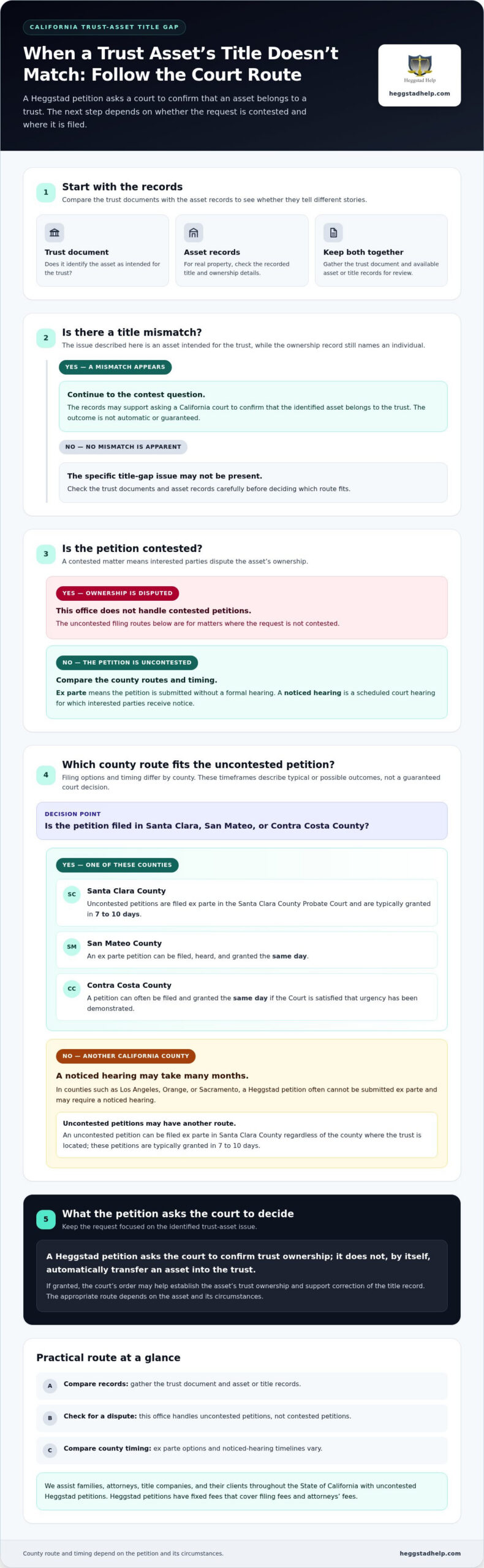
A Heggstad petition asks the court to confirm trust ownership; it does not, by itself, automatically transfer an asset into the trust. That distinction matters when explaining the issue to family members or organizing documents for review. We handle focused, uncontested Heggstad petitions for living and irrevocable trusts. Learn about our Heggstad petition assistance and how it can address a trust-asset title concern.
Which California Court Route May Fit an Uncontested Heggstad Petition?
The county where a trust or asset is located doesn’t always determine where an uncontested Heggstad petition can be filed. We assist families, attorneys, title companies, and their clients throughout the State of California, filing uncontested petitions ex parte in the Santa Clara County Probate Court regardless of the county where the trust is located. We also file ex parte petitions in San Mateo and Contra Costa Counties.
Timing depends on the court route. In Santa Clara County, ex parte petitions are typically granted in 7 to 10 days. In San Mateo County, petitions can be filed, heard, and granted the same day. In Contra Costa County, petitions can often be filed and granted the same day if the Court is satisfied that urgency has been demonstrated. These are typical or possible timelines, not a guarantee of a court decision.
How the route differs outside Santa Clara, San Mateo, and Contra Costa Counties
In counties such as Los Angeles, Orange, or Sacramento, a Heggstad petition often cannot be submitted ex parte and may require a noticed hearing, which can take many months to reach. For an uncontested petition involving a trust or asset in another California county, filing ex parte in Santa Clara County may provide a different route. The appropriate approach depends on the petition and its circumstances.
Why a noticed hearing can change the timeline
A noticed hearing is a scheduled court hearing for which interested parties must receive notice. A noticed trust-modification petition hearing is typically set 30 to 60 days after filing, or several months later in some counties. Providing notice adds time to the overall schedule. Court calendars and individual circumstances vary, so not every petition follows the same timeline.
If you’re assessing legal help for an unfunded living trust, note the asset’s county and whether anyone disputes the request. Our office handles uncontested petitions only. Learn about our uncontested Heggstad petition filing service.
What Specialized Heggstad Petition Legal Help Includes
Specialized Heggstad assistance focuses on preparing an uncontested petition and seeking an ex parte court order to confirm that an asset belongs to a trust. The work addresses the specific trust-asset issue, including title correction, rather than managing every aspect of an estate or trust. Our office handles uncontested petitions only, not contested petitions, full probate administration, or trust administration.
Heggstad petitions have fixed fees that cover filing fees and attorney fees. For broader context on the California petition process, see this California Heggstad petition filing guide.
What to have ready for an initial case review
To make an initial review more useful, gather the trust document and any available records showing the asset’s ownership or title. Also note when the funding or title gap came to light and whether the person who created the trust has died. These details help frame the issue and assess whether an uncontested petition may fit.
A focused next step for families and legal professionals
Families, attorneys, title companies, and clients throughout California can receive focused help with an uncontested Heggstad petition. Robert P. Bergman is a California-licensed attorney and a Board-Certified Specialist in Estate Planning, Trust and Probate Law. He assists clients throughout the San Francisco Bay Area, Northern California, Southern California, and the Central Valley, including San Diego, Sacramento, Fresno, Bakersfield, Greater Los Angeles, Orange County, Riverside County, and San Bernardino County. The court, not the filing attorney, decides whether to grant a petition.
To prepare, organize the trust and asset records and write a short timeline of what happened.
Take a Clear Next Step Toward Resolving the Trust-Asset Question
Uncertainty about an asset’s place in a trust can make it hard to know what to do next. Rather than assume that a title discrepancy settles the matter, frame the issue as a specific question for legal review: what do the records show, and is there an uncontested path to ask the court for confirmation? A focused assessment can help families and legal professionals distinguish known facts from unresolved questions.
Keep the discussion centered on the particular asset and the outcome you’re seeking. Clear expectations matter, especially when family members or professional advisors are coordinating around the same issue. We assist families, attorneys, title companies, and their clients across the State of California, including Los Angeles County, Orange County, San Bernardino County, San Diego County, Riverside County, Santa Clara County, Alameda County, San Francisco County, Marin County, Ventura County, Santa Cruz County, Sacramento County, Placer County, Santa Barbara County, San Joaquin County, Fresno County, Solano County, San Luis Obispo County, and Monterey County. Contact HEGGSTAD HELP to discuss an uncontested Heggstad petition.
Frequently Asked Questions
Can an irrevocable trust be involved in a Heggstad petition?
Yes. HEGGSTAD HELP handles petitions involving living and irrevocable trusts. An irrevocable trust isn’t automatically outside the scope of this focused service, but the trust type alone doesn’t establish whether a particular asset can be included. The attorney reviews the trust and asset circumstances, and the court decides whether to grant the request. No petition outcome can be promised in advance.
Can a Heggstad petition address assets other than real estate?
Yes, the service can involve real property and other assets. The work includes seeking court orders to confirm assets as trust property and address related title concerns. The specific asset and surrounding circumstances matter, so the same approach may not apply to every situation. Filing a petition requests court confirmation; it doesn’t guarantee that an asset will be transferred or treated as trust property.
Does filing a Heggstad petition guarantee that the court will confirm an asset as trust property?
No. Filing a petition is a request for court relief, not a guaranteed result. Whether the court confirms an asset as trust property depends on the specific circumstances and the court’s decision. If you’re seeking legal help for an unfunded living trust, keep confirmed facts separate from assumptions and organize available records. That preparation supports a focused review, but no attorney can promise how the court will rule.
What information can help an attorney review an unfunded trust asset?
Gather the trust document, available asset or title records, and a short timeline of when the issue surfaced. Note whether the trust creator has died. This information helps assess whether an uncontested petition may fit. HEGGSTAD HELP assists across the San Francisco Bay Area, Northern and Southern California, the Central Valley, San Diego, Sacramento, Fresno, Bakersfield, Greater Los Angeles, Orange County, Riverside County, and San Bernardino County.

Article by
Robert P. Bergman, Attorney at Law
Attorney Robert P. Bergman ("Bob Bergman") has been a Board-Certified Specialist in Estate Planning, Trust and Probate Law since 2011, as certified by the California State Bar Board of Legal Specialization. For several years, Bob has assisted families and the clients of other attorneys with obtaining court orders through Heggstad petitions to avoid the time and expense of Probate administration. Bob is friendly, very approachable, and believes in explaining complex legal topics in clear ordinary language so that his clients understand exactly what they're doing and why they're doing it.
Bob is often able to assist clients who are in other counties than his home county of Santa Clara through his approach to Heggstad petitions.
Disclaimer
This article is for informational purposes only. Nothing in this article is intended to replace legal advice from a competent attorney or be considered legal guidance for anybody's specific legal situation. Nobody should rely on information in this article in making legal decisions without such consultation.


