
What if a single forgotten real estate deed didn’t have to trigger a 12-to-18-month probate ordeal? If you’ve recently stepped into the role of successor trustee, discovering that a house or financial account was left in the decedent’s individual name can feel overwhelming. You’re likely worried about complex court rules, probate delays, and statutory fees depleting the family inheritance. Fortunately, California Probate Code Section 850 provides an expedited legal remedy, allowing trustees to transfer omitted assets into a living trust without enduring full probate administration.
You’ll discover the exact documentation required to prove the decedent intended the property to belong to the trust, securing clean, insurable title for refinancing or sale. We’ll also walk through how to bypass prolonged noticed hearings across the State of California, showing you how uncontested filings can confirm trust ownership in days rather than months.
Key Takeaways
- Learn how California Probate Code Section 850 allows successor trustees to transfer omitted real estate and financial accounts directly into a living trust without full probate.
- Identify the critical written evidence, such as trust schedules and declarations, prior recorded or unrecorded deeds, assignments of property, etc., required to demonstrate the decedent’s clear intent to trust ownership.
- Discover how filing an uncontested Heggstad petition ex parte can bypass severe court backlogs in regions like Los Angeles County, Orange County, and San Diego County.
- Understand the precise steps to obtain an expedited court order, securing clean, insurable real estate title for an impending sale or refinancing.
What Is California Probate Code Section 850 for Living Trusts?
When someone creates a revocable living trust, their primary goal is keeping their family out of the public court system after they pass away. Under the statutory structure of the California Codes, formal probate becomes necessary whenever titled assets remain solely in a decedent’s personal name. California Probate Code Section 850 serves as an expedited legal vehicle designed to remedy this exact dilemma. It allows a successor trustee (the person named to administer the trust) to petition the court for an order declaring that omitted property legally belongs to the trust.
Rooted in the landmark 1993 California appellate decision Estate of Heggstad, an 850 petition asks a probate judge to honor the creator’s true intent. If the creator documented their intention to hold the asset in trust, the court can formally transfer ownership without forcing the estate through an arduous court administration.
When Real Property Is Accidentally Left Out of a Trust
Omitted real estate occurs routinely during typical life events:
- Refinancing a mortgage: Lenders often require owners to deed their home out of a trust into their individual names during loan processing, yet property owners frequently forget to deed it back.
- New home acquisitions: Buyers often mistakenly purchase property under their individual names, forgetting to direct the escrow officer to title it into their living trust.
When an un-transferred parcel is identified after death, title insurance companies will refuse to insure future transactions without a formal court decree confirming trust ownership.
Probate Code Section 850 Petitions vs. Full Probate Administration
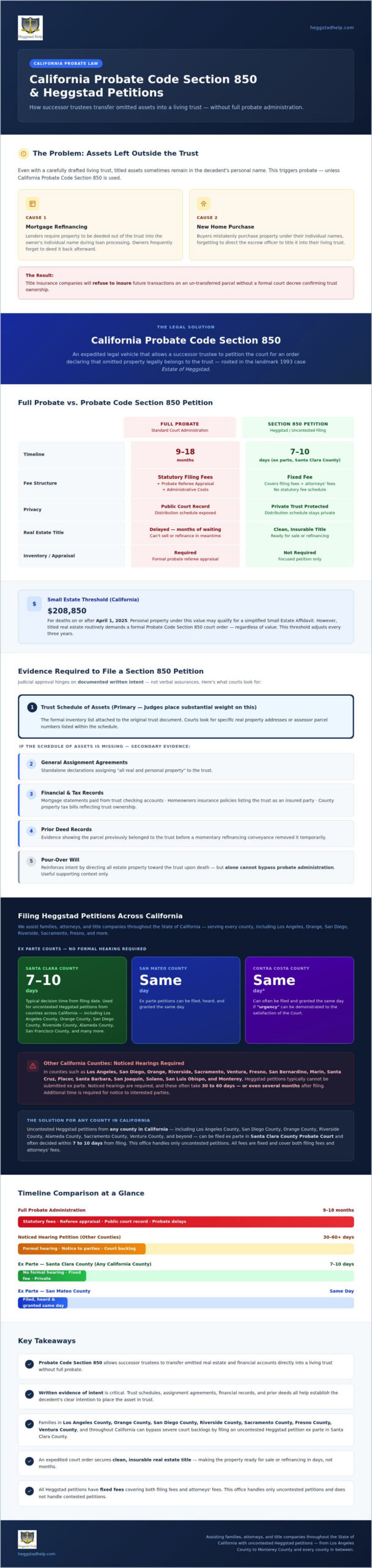
A standard probate proceeding in the State of California takes between 9 and 18 months, requiring statutory filing fees, formal inventory appraisals by a probate referee, and administrative delays. By filing an uncontested petition under California Probate Code Section 850, a trustee avoids these hurdles entirely. This focused legal remedy protects the decedent’s private distribution schedule, bypasses statutory fee schedules, and secures clear, marketable title.
Legal Requirements and Evidence Needed for an 850 Petition
Filing an uncontested petition under California Probate Code § 850 requires presenting undeniable written proof that the decedent intended to hold the property in trust. Judicial approval hinges on documenting this intent rather than relying on verbal assurances. While a pour-over will reinforces this narrative by directing all estate property toward the trust upon death, the will alone cannot bypass probate administration. For personal property valued under California’s small estate threshold of $208,850 (for deaths on or after April 1, 2025), a simplified affidavit may suffice. However, titled real estate routinely demands a formal Section 850 court order.
The Crucial Role of the Trust Schedule of Assets
Judges place substantial weight on the Schedule of Assets (the formal inventory list attached to the original trust document). When reviewing your paperwork, look for specific real property addresses or assessor parcel numbers. If you’re currently balancing administrative obligations, review our breakdown of successor trustee duties for an unfunded trust to quickly verify whether your documentation satisfies local judicial standards.
Supporting Evidence When Assets Are Missing from the Schedule
Missing schedules don’t automatically derail your filing. Clear written intent can still be established using secondary documentation:
- General assignment agreements: Standalone declarations assigning "all real and personal property" to the trust.
- Financial and tax records: Mortgage statements paid directly from trust checking accounts, homeowners insurance policies listing the trust as an insured party, and county property tax bills reflecting trust ownership.
- Prior deed records: Evidence demonstrating the parcel previously belonged to the trust before a momentary refinancing conveyance.
If you need structured guidance on marshaling these exhibits to clear clouded real estate title, consult our comprehensive resource on California Probate Code Section 850 in California.
Navigating California Probate Court Delays Across Different Counties
Probate court dockets vary drastically across the state. In busy metropolitan jurisdictions, severe administrative backlogs leave families waiting months just to appear before a judge. When petitioning under California Probate Code Section 850, understanding local procedural options can save your estate significant time. Our practice focuses exclusively on uncontested petitions, avoiding contentious disputes to deliver smooth, predictable title corrections.
The Problem with Noticed Hearings in Southern California and Central Valley Courts
In jurisdictions like Los Angeles County, Orange County, and San Diego County, Heggstad petitions usually cannot be submitted ex parte (without a formal, in-person hearing). Instead, local rules mandate formal noticed hearings. These hearings are typically set 30 to 60 days out, and frequently take several months in Riverside County, San Bernardino County, Fresno County, and Sacramento County. Such multi-month delays can easily disrupt pending home sales, jeopardize mortgage rate locks, and stall family distributions.
The Ex Parte Alternative in Northern California Probate Courts
Trustees aren’t forced to endure calendar delays in their home counties. We assist attorneys and families statewide by filing uncontested Heggstad petitions ex parte in Northern California courts, regardless of where the decedent lived or where the real estate sits.
Petitions filed ex parte in Santa Clara County are typically granted in just 7 to 10 days. In San Mateo County, uncontested petitions can often be filed, heard, and granted the same day. In Contra Costa County, courts can also grant petitions the same day upon showing urgency. Every petition is managed under a transparent fixed fee covering filing costs and attorney fees. To avoid calendar gridlock and secure clean title rapidly, start your petition with Heggstad Help.
Filing an Uncontested 850 Petition to Secure Clean Real Property Title
Correcting an unfunded trust asset shouldn’t feel like entering a courtroom war zone. While contested trust litigation involves lengthy depositions and contentious trials, an uncontested petition under California Probate Code Section 850 serves as an administrative solution. The judicial order confirms real property title directly into the trust, bypassing probate administration entirely. To ensure complete budget certainty during an already difficult transition, our services operate under clear fixed fees covering all court filing costs and legal fees.
Step-by-Step Filing Strategy for Trustees and Title Companies
Securing insurable title follows a precise four-stage administrative trajectory:
- Assembling documentation: Gather the complete trust instrument, original pour-over will, most recent recorded grant deeds, and asset schedules.
- Drafting the petition: Prepare verified pleadings articulating clear evidence of intent under California Probate Code Section 850.
- Ex parte submission: Submit the pleadings for rapid judicial review without scheduling an adversarial court appearance. For an in-depth breakdown of practical preparation tips, review our detailed guide on Heggstad petition filing in California.
- Recording certified orders: Obtain certified copies of the granted court decree and record them with the appropriate county recorder, officially correcting the chain of title.
Correcting Asset Title Across the State of California
Title defects happen in every corner of the state. We regularly help trustees resolve clouded deeds across Alameda County, San Francisco County, Marin County, and Ventura County. We also assist families managing estate parcels in Monterey County, San Joaquin County, Solano County, and San Luis Obispo County. Obtaining a certified court order creates clean, insurable title, completely satisfying title underwriters, escrow officers, lenders, and future buyers.
Resolve Omitted Trust Assets Without Probate Delay
Discovering that real estate was left out of a trust shouldn’t force your family into a year-long court ordeal. Exercising your rights under California Probate Code Section 850 allows successor trustees to establish rightful ownership, correct clouded deeds, and protect estate distributions without enduring formal probate administration.
Led by attorney Robert P. Bergman, a Board-Certified Specialist in Estate Planning, Trust and Probate Law practicing since 1980, our office assists families and attorneys throughout the State of California. By submitting uncontested filings ex parte in Santa Clara County, petitions are typically granted in just 7 to 10 days. Every matter is handled under transparent fixed fees that cover court filing costs and legal representation, giving you complete financial certainty. When you’re ready to secure clean, insurable title quickly, request assistance with an uncontested Heggstad petition to finalize your trust administration with total peace of mind.
Frequently Asked Questions
What is the main difference between a Heggstad petition and California Probate Code Section 850?
A Heggstad petition is simply a specific, practical application of California Probate Code Section 850. The statute provides broad legal authority to resolve property ownership questions involving trusts, estates, or conservatorships. In contrast, a Heggstad petition specifically requests an expedited court order declaring that an omitted asset legally belongs to a trust based on the decedent’s clear written intent.
How long does it take the court to grant an 850 petition in California?
Approval timelines depend heavily on whether your petition requires a noticed hearing or proceeds ex parte. Traditional noticed hearings in Los Angeles County or Orange County often take several months due to severe calendar backlogs. Conversely, filing an uncontested petition ex parte in Santa Clara County is typically granted in 7 to 10 days, while San Mateo County petitions can be heard and granted the same day.
Can an 850 petition transfer assets if the trust schedule is completely blank?
Yes, an 850 petition can still succeed even if the trust schedule is entirely blank. California judges evaluate the totality of written evidence demonstrating the creator’s true intent. Supporting proof can include a comprehensive general assignment of assets, prior recorded grant deeds showing temporary refinancing conveyances, or financial statements proving trust funds paid the mortgage, insurance, and property taxes.
Do I have to file my 850 petition in the county where the real property is located?
No, you don’t necessarily have to file in the specific county where the real property sits. Successor trustees managing parcels across the State of California, from San Diego County to Sacramento County, can file uncontested Heggstad petitions ex parte in the Santa Clara County Probate Court. This strategic venue option allows trustees to bypass local hearing delays and resolve title defects in days.
Can California Probate Code Section 850 be used for assets other than real estate?
Yes, California Probate Code Section 850 applies to virtually any titled property accidentally left outside a trust. Trustees frequently use this petition for substantial brokerage accounts, closely held business shares, partnership interests, and valuable personal property. While personal property valued under California’s small estate threshold of $208,850 may qualify for an affidavit, Section 850 provides a binding judicial decree for larger assets.

Article by
Robert P. Bergman, Attorney at Law
Attorney Robert P. Bergman ("Bob Bergman") has been a Board-Certified Specialist in Estate Planning, Trust and Probate Law since 2011, as certified by the California State Bar Board of Legal Specialization. For several years, Bob has assisted families and the clients of other attorneys with obtaining court orders through Heggstad petitions to avoid the time and expense of Probate administration. Bob is friendly, very approachable, and believes in explaining complex legal topics in clear ordinary language so that his clients understand exactly what they're doing and why they're doing it.
Bob is often able to assist clients who are in other counties than his home county of Santa Clara through his approach to Heggstad petitions.
Disclaimer
This article is for informational purposes only. Nothing in this article is intended to replace legal advice from a competent attorney or be considered legal guidance for anybody's specific legal situation. Nobody should rely on information in this article in making legal decisions without such consultation.


